Feeds:
Posts
Comments

Archive for the ‘Contrarian investment’ Category

Michael Mauboussin appeared Friday on Consuelo Mack’s WealthTrack to discuss several of the ideas in his excellent book, Think Twice. Particularly compelling is his story about Triple Crown prospect Big Brown and the advantage of the “outside view” – the statistical one – over the “inside view” – the specific, anecdotal one (excerpted from the book):

June 7, 2008 was a steamy day in New York, but that didn’t stop fans from stuffing the seats at Belmont Park to see Big Brown’s bid for horseracing’s pinnacle, the Triple Crown. The undefeated colt had been impressive. He won the first leg of the Triple Crown, the Kentucky Derby, by 4 ¾ lengths and cruised to a 5 ¼-length win in the second leg, the Preakness.

Oozing with confidence, Big Brown’s trainer, Rick Dutrow, suggested that it was a “foregone conclusion” that his horse would take the prize. Dutrow was emboldened by the horse’s performance, demeanor, and even the good “karma” in the barn. Despite the fact that no horse had won the Triple Crown in over 30 years, the handicappers shared Dutrow’s enthusiasm, putting 3-to-10 odds—almost a 77 percent probability—on his winning.

The fans came out to see Big Brown make history. And make history he did—it just wasn’t what everyone expected. Big Brown was the first Triple Crown contender to finish dead last.

The story of Big Brown is a good example of a common mistake in decision making: psychologists call it using the “inside” instead of the “outside” view.

The inside view considers a problem by focusing on the specific task and by using information that is close at hand. It’s the natural way our minds work. The outside view, by contrast, asks if there are similar situations that can provide a statistical basis for making a decision. The outside view wants to know if others have faced comparable problems, and if so, what happened. It’s an unnatural way to think because it forces people to set aside the information they have gathered.

Dutrow and others were bullish on Big Brown given what they had seen. But the outside view demands to know what happened to horses that had been in Big Brown’s position previously. It turns out that 11 of the 29 had succeeded in their Triple Crown bid in the prior 130 years, about a 40 percent success rate. But scratching the surface of the data revealed an important dichotomy. Before 1950, 8 of the 9 horses that had tried to win the Triple Crown did so. But since 1950, only 3 of 20 succeeded, a measly 15 percent success rate. Further, when compared to the other six recent Triple Crown aspirants, Big Brown was by far the slowest. A careful review of the outside view suggested that Big Brown’s odds were a lot longer than what the tote board suggested. A favorite to win the race? Yes. A better than three-in-four chance? Bad bet.

Mauboussin on WealthTrack:

Hat Tip Abnormal Returns.


Read Full Post »

Abnormal Returns has a great post, Blind Men And The Equity Risk Premium, with links to various estimates of the equity risk premium. Tadas says the equity risk premium is sensitive to recent performance, and mean reverting:

A recent post at Systematic Relative Strength shows just how different the equity market can look given recent history.  They show the flip-flop in trailing 10-year total returns for the S&P 500 from June 30th, 2010 and June 30th, 2000:  -0.8% vs. 17.8%.  This reversal in fortune not surprisingly affects the way individuals think about the stock market.  They do not however that:

Performance in a given asset class over the last 10 years doesn’t guarantee returns over the next 10 years.  Given the tendency for markets to revert to the mean, it is quite possible that the returns of the S&P 500 over the next 10 years will be very good.  Giving up on equities may prove to be a very poor decision over the next decade.

This idea of mean reversion is also found over at EconomPic Data.  The chart below shows that historically the US stock market has bounced back after periods of low real returns.

Read the post.

Read Full Post »

Charlie Rose has a fantastic interview with Wilbur Ross, who played Willy Tanner (the dad) on Alf before becoming an investor in distressed businesses, most notably in the coal, steel and auto parts industries. This profile describes Ross’s start thus:

In 2001, when LTV, a bankrupt steel company based in Cleveland, decided to liquidate, Ross was the only bidder. Ross suspected that President Bush, a free trader, would soon enact steel tariffs on foreign steel, the better to appeal to prospective voters in midwestern swing states. So in February 2002, Ross organized International Steel Group and agreed to buy LTV’s remnants for $325 million. A few weeks later, Bush slapped a 30 percent tariff on many types of imported steel—a huge gift. “I had read the International Trade Commission report, and it seemed like it was going to happen,” said Ross. “We talked to everyone in Washington.” (Ross is on the board of News Communications, which publishes The Hill in Washington, D.C.)

With the furnaces rekindled, LTV’s employees returned to the job, but under new work rules and with 401(k)s instead of pensions. A year later, Ross performed the same drill on busted behemoth Bethlehem Steel. Meanwhile, between the tariffs, China’s suddenly insatiable demand for steel, and the U.S. automakers’ zero-percent financing push, American steel was suddenly red hot. The price per ton of rolled steel soared, and in a career-making turnaround, Ross took ISG public in December 2003.

After pulling off a quick turnaround in the twentieth century’s iconic business—steel—Ross set about doing the same with the troubled iconic industry of the nineteenth century. In October 2003, he outdueled Warren Buffett for control of Burlington Industries, a large textile company that failed in late 2001. In March 2004, he snapped up Cone Mills, which, like Burlington, was based in Greensboro, North Carolina, and bankrupt. As with the steel companies, the PBGC took over some of the pensions, the unions made concessions, and thousands of laid-off workers were recalled. Most important, debt was slashed. Today, International Textile Group has just about $50 million in debt, less than the two companies were paying in interest a few years ago.

In the Charlie Rose interview Ross discusses his analysis of LTV, which is basically a classic Graham net current asset value analysis:

Ross: We’re in the business not so much of being contrarians deliberately, but rather we like to take perceived risk instead of actual risk. And what I mean by that is that you get paid for taking a risk that people think is risky, you particularly don’t get paid for taking actual risk. So what we had done we analysed the bid we made, we paid the money partly for fixed assets, we basically spent $90 million for assets on which LTV had spent $2.5 billion in the prior 5 years, and our assessment of the values was that if worst came to worst we could knock it down and sell it to the Chinese. Then we also bought accounts receivable and inventory for 50c on the dollar. So between those combination of things, we frankly felt we had no risk.

Charlie Rose: And then next year you bought Bethlehem.

Ross: Yes, but before that even, what happened, out came BusinessWeek asking, “Is Wilbur Ross crazy?”

The joke was, right when everybody was saying, “This is too risky. It’ll never work,” the big debate in our shop was, “Should we just liquidate it and take the profit or should we try to start it up?” That’s how sure we were that we weren’t actually taking a risk, but I wanted to start it up because if you liquidate it you make some money, but you wouldn’t change the whole industry and you wouldn’t make a large sum as we turned out to do.

Watch the interview.

Read Full Post »

Slate has a superb interview with Victor Niederhoffer, who I think is one of the most interesting people in finance (or elsewhere, for that matter). A friend gave me his book The Education of a Speculator when I was about 19. It’s a wonderful window into an eclectic, humble intellect, and a great read. Slate introduces Niederhoffer thus:

Niederhoffer is a hedge fund manager, a former partner of George Soros, a five-time U.S. Nationals squash champion, and the best-selling author of The Education of a Speculator and Practical Speculation. Those successes notwithstanding, Niederhoffer is best known for two spectacular financial blow-ups. In 1997, a risky investment in Thai bank stocks combined with a dramatic one-day drop in the Dow Jones to permanently close the doors of Niederhoffer Investments. Ten years later, having recouped his losses, Niederhoffer saw his Matador Fund, buffeted by the 2007 credit crunch, self-destruct.

Niederhoffer’s e-mails suggested a man already obsessed with wrongness. In them, he referenced the statistical concept of path dependence; shared a series of proverbs about the game of checkers (of 5,000 such proverbs, he hazarded, about 250 concerned error); meditated on the difference between Type One mistakes (excessive credulity) and Type Two mistakes (excessive skepticism) (he himself is much more prone to Type One, he says: “I’m tremendously gullible”); observed that “one should be careful of multitasking or multiromancing”; sent me the citations for hoodoo in the Oxford English Dictionary (a hoodoo is something or someone that brings bad luck); and noted that the harpooner in Moby Dick would have made a great interview subject for this series. Finally, he pointed out that the word error has no antonym. “In retrospect,” he wrote, “I know much too much about errors and much too little about the opposite, whatever it is.”

Here Niederhoffer comments on the rumor that Soros, among others, cautioned him on his Thai investment:

Why didn’t you listen to the naysayers?

Well, Soros would be the first to tell you that his predictions are completely random. He never says anything that doesn’t jibe with his current position or his hoped-for outcome. And he’s chronically bearish. He’s chronically thinking that the world needs a central planner to put it to rights and that the market itself is too prone to disaster.

I think a much better view is that the stock market never rises unless there’s a wall of fear it has to climb. When the public is most frightened, only the strong are left, and that’s when the market is in the best possible hands. I call it taking out the canes. Whenever disaster strikes, the very sagacious wealthy people take their canes, and they hobble down from their stately mansions on Fifth Avenue, and they buy stocks to the extent of their bank balances, and then a week or two later, the market rises, they deposit the overplus in their accounts, invest it in blue-chip real estate, and retire back to their stately mansions. That’s probably the best way of making money, to be a specialist in panics. Whenever there’s panic hanging in the air, that’s a great time to invest.

And discussing Soros’s attitude to wives, and, presumably, speculation:

One last thing from your e-mails: I love this checkers saying, “The popular player loses without an alibi.” I think most people are pretty bad at that. It’s like, “Well, if it hadn’t been for X, I would’ve won.”

I hope you don’t feel like I’ve alibi-ed too much. But a person likes to have a certain amount of self-respect even after disasters. Still, it’s terrible to be a bad loser. I like Soros’s proverb that you should never marry a woman you wouldn’t want to divorce.

Click here for the full interview.

Read Full Post »

Recently I’ve been discussing Michael Mauboussin’s December 2007 Mauboussin on Strategy, “Death, Taxes, and Reversion to the Mean; ROIC Patterns: Luck, Persistence, and What to Do About It,” (.pdf) about Mauboussin’s research on the tendency of return on invested capital (ROIC) to revert to the mean (See Part 1 and Part 2).

Mauboussin’s report has significant implications for modelling in general, and also several insights that are particularly useful to Graham net net investors. These implications are as follows:

  • Models are often too optimistic and don’t take into account the “large and robust reference class” about ROIC performance. Mauboussin says:

We know a small subset of companies generate persistently attractive ROICs—levels that cannot be attributed solely to chance—but we are not clear about the underlying causal factors. Our sense is most models assume financial performance that is unduly favorable given the forces of chance and competition.

  • Models often contain errors due to “hidden assumptions.” Mauboussin has identified errors in two distinct areas:

First, analysts frequently project growth, driven by sales and operating profit margins, independent of the investment needs necessary to support that growth. As a result, both incremental and aggregate ROICs are too high. A simple way to check for this error is to add an ROIC line to the model. An appreciation of the degree of serial correlations in ROICs provides perspective on how much ROICs are likely to improve or deteriorate.

The second error is with the continuing, or terminal, value in a discounted cash flow (DCF) model. The continuing value component of a DCF captures the firm’s value for the time beyond the explicit forecast period. Common estimates for continuing value include multiples (often of earnings before interest, taxes, depreciation, and amortization—EBITDA) and growth in perpetuity. In both cases, unpacking the underlying assumptions shows impossibly high future ROICs. 23

  • Models often underestimate the difficulty in sustaining high growth and returns. Few companies sustain rapid growth rates, and predicting which companies will succeed in doing so is very challenging:

Exhibit 12 illustrates this point. The distribution on the left is the actual 10-year sales growth rate for a large sample of companies with base year revenues of $500 million, which has a mean of about six percent. The distribution on the right is the three-year earnings forecast, which has a 13 percent mean and no negative growth rates. While earnings growth does tend to exceed sales growth by a modest amount over time, these expected growth rates are vastly higher than what is likely to appear. Further, as we saw earlier, there is greater persistence in sales growth rates than in earnings growth rates.

  • Models should be constructed “probabilistically.”

One powerful benefit to the outside view is guidance on how to think about probabilities. The data in Exhibit 5 offer an excellent starting point by showing where companies in each of the ROIC quintiles end up. At the extremes, for instance, we can see it is rare for really bad companies to become really good, or for great companies to plunge to the depths, over a decade.

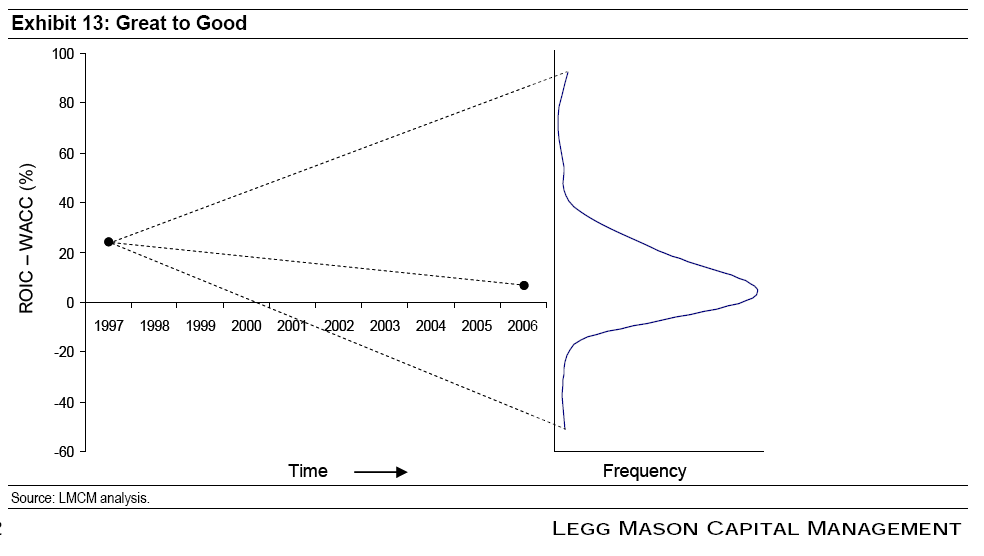
For me, the following Exhibit is the most important chart of the entire paper. It’s Mauboussin’s visualization of the probabilities. He writes:

Assume you randomly draw a company from the highest ROIC quintile in 1997, where the median ROIC less cost of capital spread is in excess of 20 percent. Where will that company end up in a decade? Exhibit 13 shows the picture: while a handful of companies earn higher economic profit spreads in the future, the center of the distribution shifts closer to zero spreads, with a small group slipping to negative.

  • Crucial for net net investors is the need to understand the chances of a turnaround. Mauboussin says the chances are extremely low:

Investors often perceive companies generating subpar ROICs as attractive because of the prospects for unpriced improvements. The challenge to this strategy comes on two fronts. First, research shows low-performing companies get higher premiums than average-performing companies, suggesting the market anticipates change for the better. 24 Second, companies don’t often sustain recoveries.

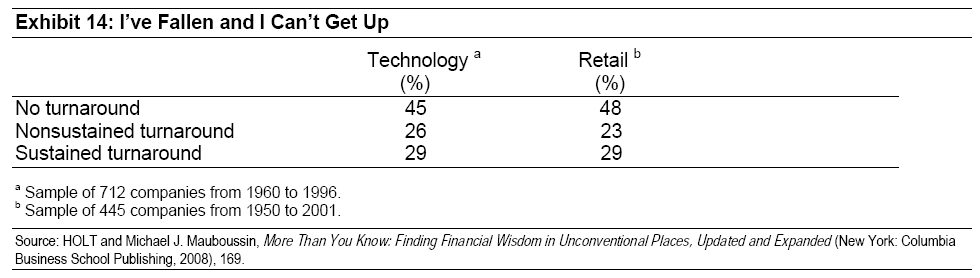
Defining a sustained recovery as three years of above-cost-of-capital returns following two years of below-cost returns, Credit Suisse research found that only about 30 percent of the sample population was able to engineer a recovery. Roughly one-quarter of the companies produced a non-sustained recovery, and the balance—just under half of the population—either saw no turnaround or disappeared. Exhibit 14 shows these results for nearly 1,200 companies in the technology and retail sectors.


Mauboussin concludes with the important point that the objective of active investors is to “find mispriced securities or situations where the expectations implied by the stock price don’t accurately reflect the fundamental outlook:”

A company with great fundamental performance may earn a market rate of return if the stock price already reflects the fundamentals. You don’t get paid for picking winners; you get paid for unearthing mispricings. Failure to distinguish between fundamentals and expectations is common in the investment business.

Read Full Post »

On October 25, 2001, Apple Inc. (Public, NASDAQ:AAPL) traded at a (split-adjusted) $9.15 per share. Fast-forward to yesterday’s close, and AAPL is a $247.01 stock. For those keeping score at home, that’s a lazy 2,600% in 8 1/2 years, or around 47% p.a. compound. And with a starting market capitalization of $5B, anyone could have put on the trade.

So what did AAPL look like in 2001? I don’t think it’s fair to cherry-pick a nine-year old article – I certainly hope no-one returns the favor for me nine years hence – so I’m only including this article from October 2001 for color and background:

Here is a breakdown of my analysis of Apple Computer — the good, the bad and the ugly.

Products: Don’t tell me about the dazzling products that Apple introduces from time to time. Because I’ll agree with you — they can be impressive. From the iMacs to the PowerBook to the new iPod portable MP3 player announced this week, it is clear that Apple knows how to design cool products.

Successful investors don’t invest in cool products, though — they invest in profits. In the past six years, against a backdrop of unparalleled profitability in tech, Apple was profitable in only three of those six years, despite a slew of provocative product introductions.

Business Model: It’s safe to say that the business model at Apple is terminally flawed. The PC industry has been completely commoditized. And Apple loses on price because machines based on Microsoft’s(MSFT) Windows are much cheaper. Apple also is a big loser compared with Windows based on the availability and breadth of applications.

To survive, Apple has to convince Windows users to migrate to the Mac platform. But since Apple is not competitive on either price or applications, there is no compelling reason for users to switch. The game is effectively over. Dell(DELL), IBM(IBM) and Hewlett Packard(HWP) have a stranglehold on the PC industry that is secure, with Dell’s build-to-order model the clear winner over the long term.

Balance Sheet: Fans of Apple stock can hail the financial strength of the company, but this is hardly a reason to buy its shares. Net of all debt (including off-balance sheet liabilities), Apple commands cash or near-cash (such as receivables) of about $7.80 a share. Interest income made up 42% of the profit in the year 2000 and is expected to contribute 50% of the pretax income in 2002.

But why should investors buy into a company with a deteriorating revenue base — sales are lower at Apple now than they were three, five and even 10 years ago — just so Steve Jobs can invest capital in short-term instruments that yield 3%? Large cash balances aren’t bad if they are accompanied by a value-creating business model that can use the cash for growth, but that’s not the case with Apple. It’s no wonder then that, assuming the company can meet earnings estimates, the return on shareholder equity in 2002 will be a paltry 3%.

Retail Stores: It’s desperation time in Cupertino, Calif., as Apple is going into the retail store business to ensure that its products receive enough attention. This move is fraught with problems, however, because the reason that Apple products are not getting the retailers’ attention is because they are not selling well. If Apple machines were moving fast off the shelves, retailers would be happy to provide the shelf space.

And the move into retail takes Apple into an area where it has demonstrated no competence. Now it’s going to take on Best Buy(BBY) and Circuit City(CC)? Have the executives at Apple considered the sobering retail experience of Gateway(GTW)?

It’s too bad for Apple that the ending to this chapter in the PC story has already been written. The company had the ultimate first-mover advantage many years ago with an array of better products, a vastly superior operating system and even the best commercials!

Apple’s story now is fodder for business historians — don’t make it fodder for your portfolio.

Would you have pulled the trigger on AAPL? The fact that it’s a tech stock, and the non-dominant player in the industry as well, makes this an easy pass for most of us, and therefore a sin of omission. The per share cash on the balance sheet, however, makes this an interesting situation to ponder:

Net of all debt (including off-balance sheet liabilities), Apple commands cash or near-cash (such as receivables) of about $7.80 a share.

At the start of 2003, AAPL could have been purchased for under $7.

Hat tip S.D. and Ben. One for you Dr.K.

[Full Disclosure: I do not hold a position in AAPL. This is neither a recommendation to buy or sell any securities. All information provided believed to be reliable and presented for information purposes only. Do your own research before investing in any security.]

Read Full Post »

In the Introduction to my 2003 copy of Philip A. Fisher’s Common Stocks and Uncommon Profits and Other Writings, his son, Kenneth L. Fisher, recounts a story about his father that has stuck with me since I first read it. For me, it speaks to Phil Fisher’s eclectic genius, and quirky sense of humor:

But one night in the early 1970’s, we were together in Monterey at one of the first elaborate dog-and-pony shows for technology stocks – then known as “The Monterey Conference” – put on by the American Electronics Association. At the Monterey Conference, Father exhibited another quality I never forgot. The conference announced a dinner contest. There was a card at each place setting, and each person was to write down what he or she thought the Dow Jones Industrials would do the next day, which is, of course, a silly exercise. The cards were collected. The person who came closest to the Dow’s change for the day would win a mini-color TV (which were hot new items then). The winner would be announced at lunch the next day, right after the market closed at one o’clock (Pacific time). Most folks, it turned out, did what I did – wrote down some small number, like down or up 5.57 points. I did that assuming that the market was unlikely to do anything particularly spectacular because most days it doesn’t. Now in those days, the Dow was at about 900, so 5 points was neither huge nor tiny. That night, back at the hotel room, I asked Father what he put down; and he said, “Up 30 points,” which would be more than 3 percent. I asked why. he said he had no idea at all what the market would do; and if you knew him, you knew that he never had a view of what the market would do on a given day. But he said that if he put down a number like I did and won, people would think he was just lucky – that winning at 5.57 meant beating out the guy that put down 5.5 or the other guy at 6.0. It would all be transparently seen as sheer luck. But if he won saying, “up 30 points,” people would think he knew something and was not just lucky. If he lost, which he was probable and he expected to, no one would know what number he had written down, and it would cost him nothing. Sure enough, the next day, the Dow was up 26 points, and Father won by 10 points.

When it was announced at lunch that Phil Fisher had won and how high his number was, there were discernable “Ooh” and “Ahhhh” sounds all over the few-hundred-person crowd. There was, of course, the news of the day, which attempted to explain the move; and for the rest of the conference, Father readily explained to people a rationale for why he had figured out all that news in advance, which was pure fiction and nothing but false showmanship. But I listened pretty carefully, and everyone he told all that to swallowed it hook, line, and sinker. Although he was socially ill at ease always, and insecure, I learned that day that my father was a much better showman than I had ever fathomed. And, oh, he didn’t want the mini-TV because he had no use at all for change in his personal life. So he gave it to me and I took it home and gave it to mother, and she used it for a very long time.

Common Stocks and Uncommon Profits and Other Writings is, of course, required reading for all value investors. I believe the Introduction to the 2003 edition, written by Kenneth Fisher, should also be regarded as required reading. There Kenneth [Edit:, an investment superstar in his own right,] shares intimate details about Phil from the perspective of a son working with the father. As the vignette above demonstrates, Phil understood human nature, but was socially awkward; he understood the folly of the narrative, but was prepared to provide a colorful one when it suited him; and he understood positively skewed risk:reward bets in all aspects of his life, and had the courage to take them, even if it meant standing apart from the crowd. What is most striking about this sketch of Phil Fisher is that it could just as easily be a discussion of Mike Burry or Warren Buffett. Perhaps great investors are like Leo Tolstoy’s happy families:

Happy families are all alike; every unhappy family is unhappy in its own way.

Read Full Post »

Mean reversion is a favorite investment topic here on Greenbackd (see, for example, my posts on Mean reversion in earnings, Contrarian value investment and Lakonishok, Shleifer, and Vishny’s Contrarian Investment, Extrapolation, and Risk).

The premise of contrarianism is mean reversion, which is the idea that stocks that have performed poorly in the past will perform better in the future and stocks that have performed well in the past will not perform as well. Benjamin Graham, quoting Horace’s Ars Poetica, described it thus:

Many shall be restored that now are fallen and many shall fall that are now in honor.

LSV argue in their paper that most investors don’t fully appreciate the phenomenon, which leads them to extrapolate past performance too far into the future. In practical terms it means the contrarian investor profits from other investors’ incorrect assessment that stocks that have performed well in the past will perform well in the future and stocks that have performed poorly in the past will continue to perform poorly.

The outstanding Shadowstock blog has identified five “strong candidates for mean reversion.” To see John’s Shadowstock.com analysis, click here.

Read Full Post »

Aswath Damodaran, a Professor of Finance at the Stern School of Business, has an interesting post on his blog Musings on Markets, Transaction costs and beating the market. Damodaran’s thesis is that transaction costs – broadly defined to include brokerage commissions, spread and the “price impact” of trading (which I believe is an important issue for some strategies) – foil in the real world investment strategies that beat the market in back-tests. He argues that transaction costs are also the reason why the “average active portfolio manager” underperforms the index by about 1% to 1.5%. I agree with Damodaran. The long-term, successful practical application of any investment strategy is difficult, and is made more so by all of the frictional costs that the investor encounters. That said, I see no reason why a systematic application of some value-based investment strategies should not outperform the market even after taking into account those transaction costs and taxes. That’s a bold statement, and requires in support the production of equally extraordinary evidence, which I do not possess. Regardless, here’s my take on Damodaran’s article.

First, Damodaran makes the point that even well-researched, back-tested, market-beating strategies underperform in practice:

Most of these beat-the-market approaches, and especially the well researched ones, are backed up by evidence from back testing, where the approach is tried on historical data and found to deliver “excess returns”. Ergo, a money making strategy is born.. books are written.. mutual funds are created.

The average active portfolio manager, who I assume is the primary user of these can’t-miss strategies does not beat the market and delivers about 1-1.5% less than the index. That number has remained surprisingly stable over the last four decades and has persisted through bull and bear markets. Worse, this under performance cannot be attributed to “bad” portfolio mangers who drag the average down, since there is very little consistency in performance. Winners this year are just as likely to be losers next year…

Then he explains why he believes market-beating strategies that work on paper fail in the real world. The answer? Transaction costs:

So, why do portfolios that perform so well in back testing not deliver results in real time? The biggest culprit, in my view, is transactions costs, defined to include not only the commission and brokerage costs but two more significant costs – the spread between the bid price and the ask price and the price impact you have when you trade. The strategies that seem to do best on paper also expose you the most to these costs. Consider one simple example: Stocks that have lost the most of the previous year seem to generate much better returns over the following five years than stocks have done the best. This “loser” stock strategy was first listed in the academic literature in the mid-1980s and greeted as vindication by contrarians. Later analysis showed, though, that almost all of the excess returns from this strategy come from stocks that have dropped to below a dollar (the biggest losing stocks are often susceptible to this problem). The bid-ask spread on these stocks, as a percentage of the stock price, is huge (20-25%) and the illiquidity can also cause large price changes on trading – you push the price up as you buy and the price down as you sell. Removing these stocks from your portfolio eliminated almost all of the excess returns.

In support of his thesis, Damodaran gives the example of Value Line and its mutual funds:

In perhaps the most telling example of slips between the cup and lip, Value Line, the data and investment services firm, got great press when Fischer Black, noted academic and believer in efficient markets, did a study where he indicated that buying stocks ranked 1 in the Value Line timeliness indicator would beat the market. Value Line, believing its own hype, decided to start mutual funds that would invest in its best ranking stocks. During the years that the funds have been in existence, the actual funds have underperformed the Value Line hypothetical fund (which is what it uses for its graphs) significantly.

Damodaran’s argument is particularly interesting to me in the context of my recent series of posts on quantitative value investing. For those new to the site, my argument is that a systematic application of the deep value methodologies like Benjamin Graham’s liquidation strategy (for example, as applied in Oppenheimer’s Ben Graham’s Net Current Asset Values: A Performance Update) or a low price-to-book strategy (as described in Lakonishok, Shleifer, and Vishny’s Contrarian Investment, Extrapolation and Risk) can lead to exceptional long-term investment returns in a fund.

When Damodaran refers to “the price impact you have when you trade” he highlights a very important reason why a strategy in practice will underperform its theoretical results. As I noted in my conclusion to Intuition and the quantitative value investor:

The challenge is making the sample mean (the portfolio return) match the population mean (the screen). As we will see, the real world application of the quantitative approach is not as straight-forward as we might initially expect because the act of buying (selling) interferes with the model.

A strategy in practice will underperform its theoretical results for two reasons:

  1. The strategy in back test doesn’t have to deal with what I call the “friction” it encounters in the real world. I define “friction” as brokerage, spread and tax, all of which take a mighty bite out of performance. These are two of Damodaran’s transaction costs and another – tax. Arguably spread is the most difficult to prospectively factor into a model. One can account for brokerage and tax in the model, but spread is always going to be unknowable before the event.
  2. The act of buying or selling interferes with the market (I think it’s a Schrodinger’s cat-like paradox, but then I don’t understand quantum superpositions). This is best illustrated at the micro end of the market. Those of us who traffic in the Graham sub-liquidation value boat trash learn to live with wide spreads and a lack of liquidity. We use limit orders and sit on the bid (ask) until we get filled. No-one is buying (selling) “at the market,” because, for the most part, there ain’t no market until we get on the bid (ask). When we do manage to consummate a transaction, we’re affecting the price. We’re doing our little part to return it to its underlying value, such is the wonderful phenomenon of value investing mean reversion in action. The back-test / paper-traded strategy doesn’t have to account for the effect its own buying or selling has on the market, and so should perform better in theory than it does in practice.

If ever the real-world application of an investment strategy should underperform its theoretical results, Graham liquidation value is where I would expect it to happen. The wide spreads and lack of liquidity mean that even a small, individual investor will likely underperform the back-test results. Note, however, that it does not necessarily follow that the Graham liquidation value strategy will underperform the market, just the model. I continue to believe that a systematic application of Graham’s strategy will beat the market in practice.

I have one small quibble with Damodaran’s otherwise well-argued piece. He writes:

The average active portfolio manager, who I assume is the primary user of these can’t-miss strategies does not beat the market and delivers about 1-1.5% less than the index.

There’s a little rhetorical sleight of hand in this statement (which I’m guilty of on occasion in my haste to get a post finished). Evidence that the “average active portfolio manager” does not beat the market is not evidence that these strategies don’t beat the market in practice. I’d argue that the “average active portfolio manager” is not using these strategies. I don’t really know what they’re doing, but I’d guess the institutional imperative calls for them to hug the index and over- or under-weight particular industries, sectors or companies on the basis of a story (“Green is the new black,” “China will consume us back to the boom,” “house prices never go down,” “the new dot com economy will destroy the old bricks-and-mortar economy” etc). Yes, most portfolio managers underperform the index in the order of 1% to 1.5%, but I think they do so because they are, in essence, buying the index and extracting from the index’s performance their own fees and other transaction costs. They are not using the various strategies identified in the academic or popular literature. That small point aside, I think the remainder of the article is excellent.

In conclusion, I agree with Damodaran’s thesis that transaction costs in the form of brokerage commissions, spread and the “price impact” of trading make many apparently successful back-tested strategies unusable in the real world. I believe that the results of any strategy’s application in practice will underperform its theoretical results because of friction and the paradox of Schrodinger’s cat’s brokerage account. That said, I still see no reason why a systematic application of Graham’s liquidation value strategy or LSV’s low price-to-book value strategy can’t outperform the market even after taking into account these frictional costs and, in particular, wide spreads.

Hat tip to the Ox.

Read Full Post »

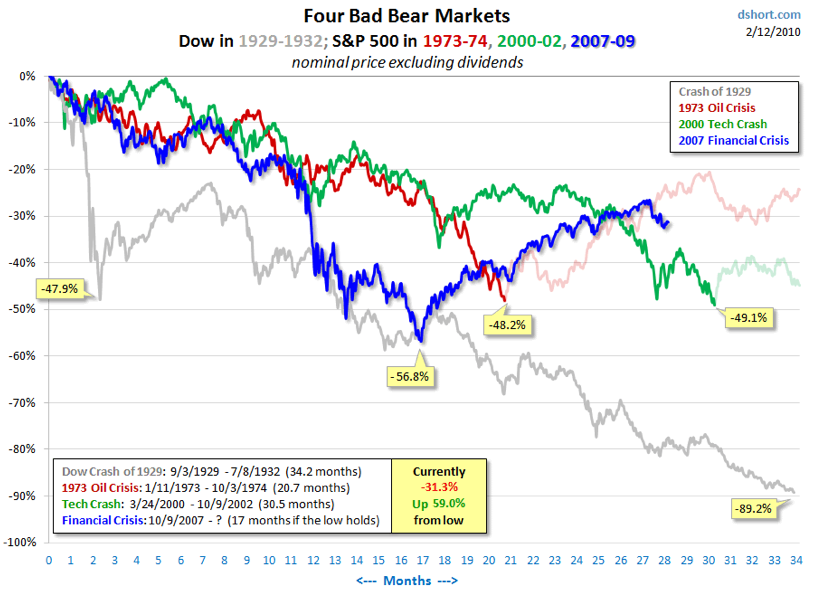
Speculating about the level of the market is a pastime for fools and knaves, as I have amply demonstrated in the past (or, as Edgar Allen Poe would have it, “I have great faith in fools — self-confidence my friends will call it.”). In April last year I ran a post, Three ghosts of bear markets past, on DShort.com’s series of charts showing how the current bear market compared to three other bear markets: the Dow Crash of 1929 (1929-1932), the Oil Crisis (1973-1974) and the Tech Wreck (2000-2002). At that time the market was up 24.4% from its low, and I said,

Anyone who thinks that the bounce means that the current bear market is over would do well to study the behavior of bear markets past (quite aside from simply looking at the plethora of data about the economy in general, the cyclical nature of long-run corporate earnings and price-earnings multiples over the same cycle). They might find it a sobering experience.

Now the market is up almost 60% from its low, which just goes to show what little I know:

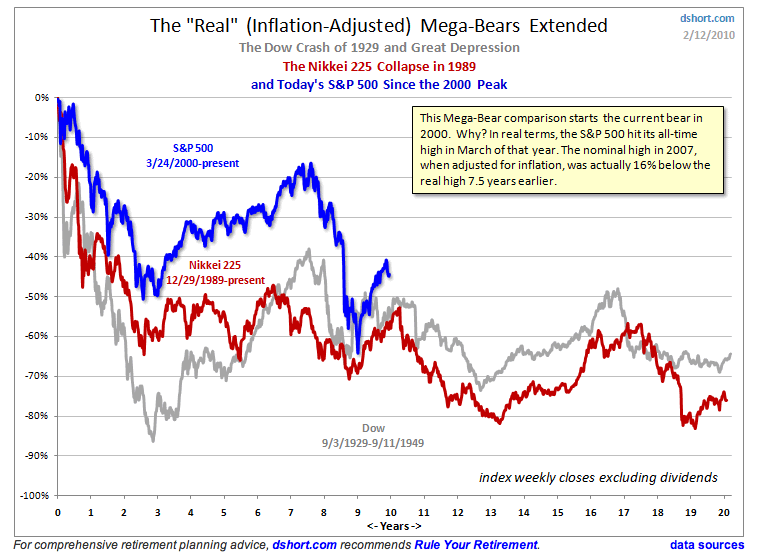
While none of us are actually investing with regard to the level of the market – we’re all analyzing individual securities – I still find it interesting to see how the present aggregate experience compares to the experience in other epochs in investing. One other chart by DShort.com worth seeing is the “Three Mega-Bears” chart, which treats the recent decline as part of the decline from the “Tech Wreck” on the basis that the peak pre-August 2007 did not exceed the peak pre-Tech Wreck after adjusting for inflation:

It’s interesting for me because it compares the Dow Crash of 1929 (from which Graham forged his “Net Net” strategy) to the present experience in the US and Japan (both of which offer the most Net-Net opportunities globally). Where are we going from here? Que sais-je? The one thing I do know is that 10 more years of a down or sideways market is, unfortunately, a real possibility.

Read Full Post »

« Newer Posts - Older Posts »