Feeds:
Posts
Comments

Archive for the ‘Contrarian investment’ Category

Further to my point that if your valuation models use forward estimates rather than twelve-month trailing data, you’re doing it wrong, here are the results of our Quantitative Value backtest on the use of consensus Institutional Brokers’ Estimate System (I/B/E/S) earnings forecasts of EPS for the fiscal year (available 1982 through 2010) for individual stock selection:

We analyze the compound annual growth rates of each price ratio over the 1964 to 2011 period for market capitalization–weighted decile portfolios.

The forward earnings estimate is the worst performed metric by a wide margin. The performance of the forward earnings estimate is uniformly poor, earning a compound annual growth rate of just 8.63 percent on average and underperforming the Standard & Poor’s (S&P) 500 by almost 1 percent per year. Investors are wise to shy away from analyst forward earnings estimates when making investment decisions.

We focus our analysis on historical valuation metrics in Quantitative Value and leave the forward earnings estimates to the promoters on Wall Street.

Read Full Post »

In the How to beat The Little Book That Beats The Market (Part 1 2, and 3) series of posts I showed how in Quantitative Value we tested Joel Greenblatt’s Magic Formula (outlined in The Little Book That (Still) Beats the Market) and found that it had consistently outperformed the market, and with lower relative risk than the market.

We sought to improve on it by creating a generic, academic alternative that we called “Quality and Price.” Quality and Price is the academic alternative to the Magic Formula because it draws its inspiration from academic research papers. We found the idea for the quality metric in an academic paper by Robert Novy-Marx called The Other Side of Value: Good Growth and the Gross Profitability Premium. Quality and Price substitutes for the Magic Formula’s ROIC a quality measure called gross profitability to total assets (GPA), defined as follows:

GPA = (Revenue − Cost of Goods Sold) / Total Assets

In Quality and Price, the higher a stock’s GPA, the higher the quality of the stock.

The price ratio, drawn from the early research into value investment by Eugene Fama and Ken French, is book value-to-market capitalization (BM), defined as follows:

BM = Book Value / Market Price

The Quality and Price strategy, like the Magic Formula, seeks to differentiate between stocks by equally weighting the quality and price metrics. Can we improve performance by seeking higher quality stocks in the value decile, rather than equal weighting the two factors?

In his paper The Quality Dimension of Value Investing, Novy-Marx considered this question. Novy-Marx’s rationale:

Value investors can also improve their performance by controlling for quality when investing in value stocks. Traditional value strategies formed on price signals alone tend to be short quality, because cheap firms are on average of lower quality than similar firms trading at higher prices. Because high quality firms on average outperform low quality firms, this quality deficit drags down the returns to traditional value strategies. The performance of value strategies can thus be significantly improved by explicitly controlling for quality when selecting stocks on the basis of price. Value strategies that buy (sell) cheap (expensive) firms from groups matched on the quality dimension significantly outperform value strategies formed solely on the basis of valuations.

His backtest method:

The value strategy that controls for quality is formed by first sorting the 500 largest financial firms each June into 10 groups of 50 on the basis of the quality signal. Within each of these deciles, which contain stocks of similar quality, the 15 with the highest value signals are assigned to the high portfolio, while the 15 with the lowest value signals are assigned to the low portfolio. This procedure ensures that the value and growth portfolios, which each hold 150 stocks, contain stocks of similar average quality.

Novy-Marx finds that the strategy “dramatically outperform[s]” portfolios formed on the basis of quality or value alone, but underperforms the Greenblatt-style joint strategy. From the paper:

The long/short strategy generated excess returns of 45 basis points per month, 50% higher than the 31 basis points per month generated by the unconditional quality strategy, despite running at lower volatility (10.4% as opposed to 12.2%). The long side outperformed the market by 32 basis points per month, 9 basis points per month more than the long-only strategy formed without regard for price. It managed this active return with a market tracking error volatility of only 5.9%, realizing an information ratio of 0.63, much higher than the information ratio of 0.42 realized on the tracking error of the unconditional long-only value strategy.

For comparison, Novy-Marx finds the Greenblatt-style joint 50/50 weighting generates higher returns:

The long/short strategy based on the joint quality and value signal generated excess returns of 61 basis points per month, twice that generated by the quality or value signals alone and a third higher than the market, despite running at a volatility of only 9.7%. The strategy realized a Sharpe ratio 0.75 over the sample, almost two and a half times that on the market over the same period, despite trading exclusively in the largest, most liquid stocks.

The long side outperformed the market by 35 basis points per month, with a tracking error volatility of only 5.7 percent, for a realized information ratio of 0.75. This information ratio is 15% higher than the 0.65 achieved running quality and value side by side. Just as importantly, it allows long-only investors to achieve a greater exposure to the high information ratio opportunities provided by quality and value. While the strategy’s 5.7% tracking error still provides a suboptimally small exposure to value and quality, this exposure is significantly larger than the long-only investor can obtain running quality alongside value.

And a pretty chart from the paper:

Novy-Marx 2.1

We tested the decile approach and the joint approach in Quantitative Value, substituting better performing value metrics and found different results. I’ll cover those next.

Read Full Post »

In How to Beat The Little Book That Beats The Market: Redux I showed how in Quantitative Value we tested Joel Greenblatt’s Magic Formula outlined in The Little Book That (Still) Beats the Market). We found that Greenblatt’s Magic Formula has consistently outperformed the market, and with lower relative risk than the market, but wondered if we could improve on it.

We created a generic, academic alternative to the Magic Formula that we call “Quality and Price.” Quality and Price is the academic alternative to the Magic Formula because it draws its inspiration from academic research papers. We found the idea for the quality metric in an academic paper by Robert Novy-Marx called The Other Side of Value: Good Growth and the Gross Profitability Premium. The price ratio is drawn from the early research into value investment by Eugene Fama and Ken French. The Quality and Price strategy, like the Magic Formula, seeks to differentiate between stocks on the basis of … wait for it … quality and price. The difference, however, is that Quality and Price uses academically based measures for price and quality that seek to improve on the Magic Formula’s factors, which might provide better performance.

The Magic Formula uses Greenblatt’s version of return on invested capital (ROIC) as a proxy for a stock’s quality. The higher the ROIC, the higher the stock’s quality and the higher the ranking received by the stock. Quality and Price substitutes for ROIC a quality measure we’ll call gross profitability to total assets (GPA). GPA is defined as follows:

GPA = (Revenue − Cost of Goods Sold) / Total Assets

In Quality and Price, the higher a stock’s GPA, the higher the quality of the stock. The rationale for using gross profitability, rather than any other measure of profitability like earnings or EBIT, is simple. Gross profitability is the “cleanest” measure of true economic profitability. According to Novy-Marx:

The farther down the income statement one goes, the more polluted profi tability measures become, and the less related they are to true economic profi tability. For example, a firm that has both lower production costs and higher sales than its competitors is unambiguously more profitable. Even so, it can easily have lower earnings than its competitors. If the firm is quickly increasing its sales though aggressive advertising, or commissions to its sales force, these actions can, even if optimal, reduce its bottom line income below that of its less profitable competitors. Similarly, if the firm spends on research and development to further increase its production advantage, or invests in organizational capital that will help it maintain its competitive advantage, these actions result in lower current earnings. Moreover, capital expenditures that directly increase the scale of the firm’s operations further reduce its free cash flows relative to its competitors. These facts suggest constructing the empirical proxy for productivity using gross profits.

The Magic Formula uses EBIT/TEV as its price measure to rank stocks. For Quality and Price, we substitute the classic measure in finance literature – book value-to-market capitalization (BM):

BM = Book Value / Market Price

 We use BM rather than the more familiar price-to-book value or (P/B) notation because the academic convention is to describe it as BM, and it makes it more directly comparable with the Magic Formula’s EBIT/TEV. The rationale for BM capitalization is straightforward. Eugene Fama and Ken French consider BM capitalization a superior metric because it varies less from period to period than other measures based on income:

We always emphasize that different price ratios are just different ways to scale a stock’s price with a fundamental, to extract the information in the cross-section of stock prices about expected returns. One fundamental (book value, earnings, or cashflow) is pretty much as good as another for this job, and the average return spreads produced by different ratios are similar to and, in statistical terms, indistinguishable from one another. We like [book-to-market capitalization] because the book value in the numerator is more stable over time than earnings or cashflow, which is important for keeping turnover down in a value portfolio.

Next I’ll compare show the results of our examination of Quality and Price strategy to the Magic Formula. If you can’t wait, you can always pick up a copy of Quantitative Value.

Read Full Post »

Robert Novy-Marx, whose The Other Side of Value paper we quoted from extensively in Quantitative Value, has produced another ripping paper called The Quality Dimension of Value Investing (.pdf). Novy-Marx argues that  value investment strategies that seek high quality stocks are “nearly as profitable as traditional value strategies based on price signals alone.”

Accounting for both dimensions by trading on combined quality and price signals yields dramatic performance improvements over traditional value strategies. Accounting for quality also yields significant performance improvements for investors trading momentum as well as value.

Novy-Marx’s The Other Side of Value paper showed that a simple quality metric, gross profits-to-assets, has roughly as much power predicting the relative performance of different stocks as tried-and-true value measures like book-to-price.

Buying profitable firms and selling unprofitable firms, where profitability is measured by the difference between a firm’s total revenues and the costs of the goods or services it sells, yields a significant gross profitability premium.

Most intriguingly, Novy-Marx finds that “the signal in gross profits-to-assets is negatively correlated with that in valuation ratios.”

High quality firms tend to trade at premium prices, so value strategies that trade on quality signals (i.e., quality strategies) hold very different stocks than value strategies that trade on price signals. Quality strategies tilt towards what would traditionally be considered growth stocks. This makes quality strategies particularly attractive to traditional value investors, because quality strategies, in addition to delivering significant returns, provide a hedge to value exposures.

Novy-Marx argues that investors can “directly combine the quality and value signals and, in line with Graham’s basic vision, only buy high quality stocks at bargain prices. By trading on a single joint profitability and value signal, an investor can effectively capture the entirety of both premiums.

Performance of Quality, Value and Joint Strategies

(Click to enlarge).

Novy-Marx 2.1

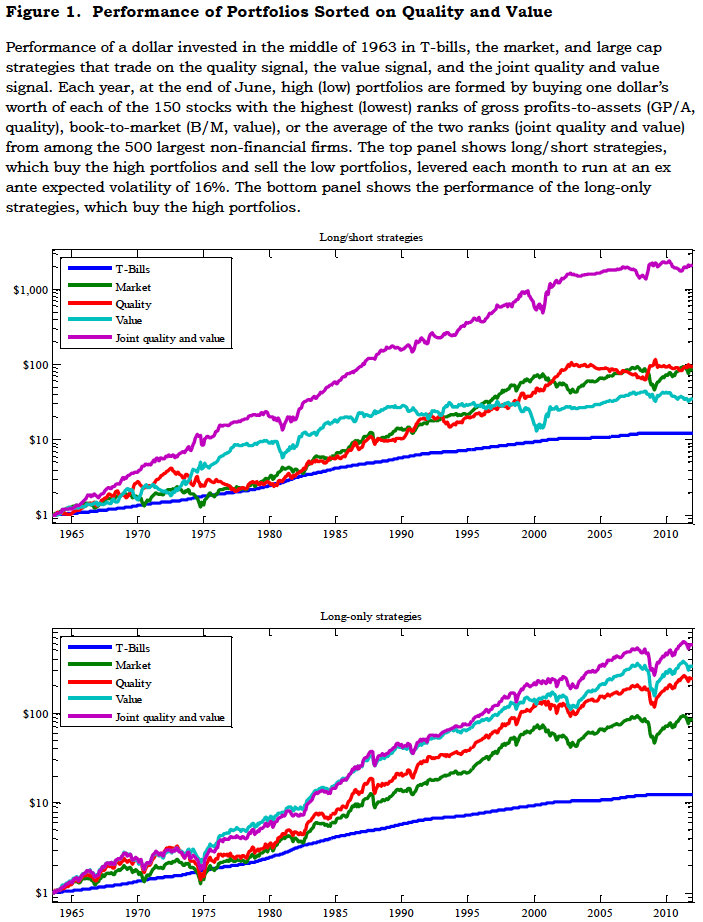
Figure 1 shows the performance of a dollar invested in mid-1963 in T-bills, the market, and strategies that trade on the quality signal, the value signal, and the joint quality and value signal. The top panel shows long/short strategies, which are levered each month to run at market volatility (i.e., an expected ex ante volatility of 16%, with leverage based on the observed volatility of the unlevered strategy over the preceding 60 months). By the end of 2011 a dollar invested in T-bills in 1963 would have grown to $12.31. A dollar invested in the market would have grown to $84.77. A dollar invested in the quality and value strategies would have grown to $94.04 and $35.12, respectively. A dollar invested in the strategy that traded on the joint quality and value signal would have grown to more than $2,131.

The bottom panel shows the performance of the long-only strategies. While a dollar invested in the market would have grown to more than $80, a dollar invested in profitable large cap stocks would have grown to $241, a dollar invested in cheap large cap stocks would have grown to $332, and a dollar invested in cheap, profitable large cap stocks would have grown to $572.

Drawdowns to Quality, Value, and Joint strategies

(Click to enlarge).

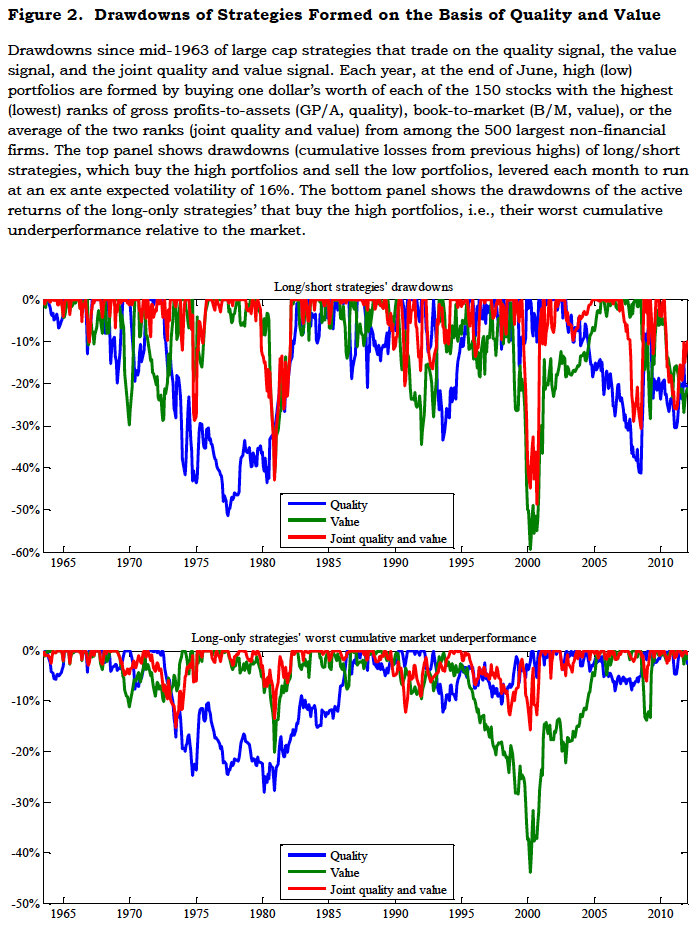
Novy Marx 2.2

Figure 2 shows the drawdowns of the long/short strategies (top panel) and the worst cumulative under performance of the long-only strategies relative to the market, i.e., the drawdowns on the long-only strategies’ active returns (bottom panel). The top panel shows that the worst drawdowns experienced over the period by the long/short strategies run at market volatility were similar to market’s worst drawdown over the period. The joint quality and value strategy had, however, the smallest drawdowns of all the strategies considered. Its worst drawdown (48.7% in 2000) compares favorably to the worst drawdowns experienced by the market (51.6% in 2008-9, not shown), the traditional value strategy (down 59.5% by 2000), and the pure quality strategy (51.4% to 1977). Similar results hold for the worst five or ten drawdowns (average losses of 35.5% versus 41.1%, 38.9%, and 35.6% for the worst five drawdowns, and average losses of 25.8% versus 28.5%, 28.7%, and 26.5% for the worst ten drawdowns).

The bottom panel shows even more dramatic results for the long-only strategies active returns. Value stocks underperformed the market by 44% through the tech run-up over the second half of the ‘90s. Quality stocks lagged behind the market through much of the ‘70s, falling 28.1% behind by the end of the decade. Cheap, profitable stocks never lagged the market by more than 15.8%. Periods over which these stocks underperformed also tended to be followed quickly by periods of strong outperformance, yielding transient drawdowns that were sharply reversed.

Importantly, the signal in gross profitability is “extremely persistent,” and works well in the large cap universe.

Profitability strategies thus have low turnover, and can be implemented using liquid stocks with large capacities.

Novy-Marx’s basic message is that investors, in general but especially traditional value investors, leave money on the table when they ignore the quality dimension of value.

Read The Quality Dimension of Value Investing (.pdf).

Tomorrow, I show in an extract from Quantitative Value how we independently tested gross-profits-on-total-assets and found it to be highly predictive.

Read Full Post »

One of my favorite Benjamin Graham quotes:

Chairman: … One other question and I will desist. When you find a special situation and you decide, just for illustration, that you can buy for 10 and it is worth 30, and you take a position, and then you cannot realise it until a lot of other people  decide it is worth 30, how is that process brought about – by advertising, or what happens? (Rephrasing) What causes a cheap stock to find its value?

Graham: That is one of the mysteries of our business, and it is a mystery to me as well as to everybody else. [But] we know from experience that eventually the market catches up with value.

Benjamin Graham
Testimony to the Committee on Banking and Commerce
Sen. William Fulbright, Chairman
(11 March 1955)

Read Full Post »

Quantitative Value Cover

I’m excited to announce that the book Quantitative Value: A Practitioner’s Guide to Automating Intelligent Investment and Eliminating Behavioral Errors (hardcover, 288 pages, Wiley Finance) is now available.

In Quantitative Value, we make the case for quantitative value investment in stock selection and portfolio construction. Our rationale is that quantitative value investing assists us to defend against our own behavioral errors, and exploit the errors made by others. We examine in detail industry and academic research into a variety of fundamental value investing methods, and simple quantitative value investment strategies. We then independently backtest each method, and strategy, and combine the best into a new quantitative value investment model.

The book can be ordered from Wiley Finance, Amazon, or Barnes and Noble.

Look Inside

(more…)

Read Full Post »

Zero Hedge has an article Buy Cash At A Discount: These Companies Have Negative Enterprise Value in which Tyler Durden argues that stock market manipulation has led to valuation dislocations, and gives as evidence the phenomenon of stocks trading with a negative enterprise value (EV):

With humans long gone from the trading arena and algorithms left solely in charge of the casino formerly known as “the stock market”, in which price discovery is purely a function of highly levered synthetic instruments such as ES and SPY or, worse, the EURUSD and not fundamentals, numerous valuation dislocations are bound to occur. Such as company equity value trading well below net cash (excluding total debt), or in other words, negative enterprise value, meaning one can buy the cash at a discount of par and assign zero value to all other corporate assets.

Just as the fact of your paranoia does not exclude the possibility that someone is following you*, you don’t need to believe in manipulation to believe that negative EV is a “valuation dislocation.” Negative EV stocks are often also Graham net nets or almost net nets, and so perform like net nets. For example, Turnkey Analyst took a look at the performance of negative EV stocks (click to enlarge):

Long story short: they ripped, but they were few (sometimes non-existent), and small (mostly micro), which means you would have been heavily concentrated in a few mostly very small stocks, and regularly carried a lot of cash. If you eliminated the tiniest (i.e. the smallest 10 or 20 percent), much of the return disappeared, and volatility spiked markedly. Says Wes:

A few key points:

  1. After you eliminate the micro-crap stocks, you end up being invested in a few names at a time (sometimes you go all-in on a single firm!)
  2. Sometimes the strategy isn’t invested.
  3. The amazing Bueffettesque returns for the “all firms” portfolio above are exclusively tied to micro-craps.

Here’s the frequency of negative EV opportunities according to Turnkey (click to enlarge):

No surprise, there were more following a crash (1987, 2001, 2009) and fewer at the peak (1986, 1999, 2007). If your universe eliminated the smallest 20 percent (the green line), you spent a lot of time in cash. If your universe was unrestricted (the red line), then you’d have had some prospects to mine most of the time. Clearly, it’s not an institutional-grade strategy, but it has worked for smaller sums.

Zero Hedge screened Russell 2000 companies finding 10 companies with negative enterprise value, and then further subdivided the screen into companies with negative, and positive free cash flow (defined here as EBITDA – Cap Ex). Here’s the list (click to enlarge):

Including short-term investments yields a bigger list (click to enlarge):

Like Graham net nets, negative EV stocks are ugly balance sheet plays. They lose money; they burn cash; the business, if they actually have one, usually needs to be taken to the woodshed (so does management, for that matter). Frankly, that’s why they’re cheap. Says Durden:

Typically negative EV companies are associated with pre-bankruptcy cases, usually involving large cash burn, in other words, where the cash may or may not be tomorrow, and which may or may not be able to satisfy all claims should the company file today, especially if it has some off balance sheet liabilities.

You can cherry-pick this screen or buy the basket. I favor the basket approach. Just for fun, I’ve formed four virtual portfolios at Tickerspy to track the performance:

  1. Zero Hedge Negative Enterprise Value Portfolio
  2. Zero Hedge Negative Enterprise Value Portfolio (Positive FCF Only)
  3. Zero Hedge Negative Enterprise Value (Inc. Short-Term Investments) Portfolio
  4. Zero Hedge Negative Enterprise Value (Inc. Short-Term Investments) Portfolio (Positive FCF Only)

I’ll check back in occasionally to see how they’re doing. My predictions for 2013:

  1. All portfolios beat the market
  2. Portfolio 1 outperforms Portfolio 2 (i.e. all negative EV stocks outperform those with positive FCF only)
  3. Portfolio 3 outperforms Portfolio 4 for the same reason that 1 outperforms 2.
  4. Portfolios 1 and 2 outperform Portfolios 3 and 4 (pure negative EV stocks outperform negative EV including short-term investments)

Take care here. The idiosyncratic risk here is huge because the portfolios are so small. Any bump to one stock leaves a huge hole in the portfolio.

* Turn around. I’m right behind you.

Read Full Post »

Embedded below is my Fall 2012 strategy paper, “Hunting Endangered Species: Investing in the Market for Corporate Control.

From the executive summary:

The market for corporate control acts to catalyze the stock prices of underperforming and undervalued corporations. An opportunity exists to front run participants in the market for corporate control—strategic acquirers, private equity firms, and activist hedge funds—and capture the control premium paid for acquired corporations. Eyquem Fund LP systematically targets stocks at the largest discount from their full change‐of‐control value with the highest probability of undergoing a near‐term catalytic change‐of‐control event. This document analyzes in detail the factors driving returns in the market for corporate control and the immense size of the opportunity.


Hunting Endangered Species: Investing in the Market for Corporate Control Fall 2012 Strategy Paper

This is the investment strategy I apply in the Eyquem Fund. It is obviously son-of-Greenbackd (deep value, contrarian and activist follow-on) and, although it deviates in several crucial aspects, it is influenced by the 1999 Piper Jaffray research report series, Wall Street’s Endangered Species.

For more of my research, see my white paper “Simple But Not Easy: The Case For Quantitative Value” and the accompanying presentation to the UC Davis MBA value investing class.

As always, I welcome any comments, criticisms, or questions.

Read Full Post »

Yesterday I took a look at the different ways of structuring an index suggested by Joel Greenblatt.

Greenblatt finds that an equal-weight portfolio far outperforms a market capitalization weight portfolio.

And for good reason. Greenblatt says that market cap weighted indexes suffer from a systematic flaw – they increase the amount they own of a particular company as that company’s stock price increases.  So they systematically invest too much in stocks when they are overpriced and too little in stocks when they are priced at bargain levels. The equal weight index corrects this systematic flaw to a degree (the small correction is still worth 2.7 percent per year in additional performance). An equally-weighted index will still own too much of overpriced stocks and too little of bargain-priced stocks, but in other cases, it will own more of bargain stocks and less of overpriced stocks. Since stocks in the index aren’t affected by price, errors will be random and average out over time.

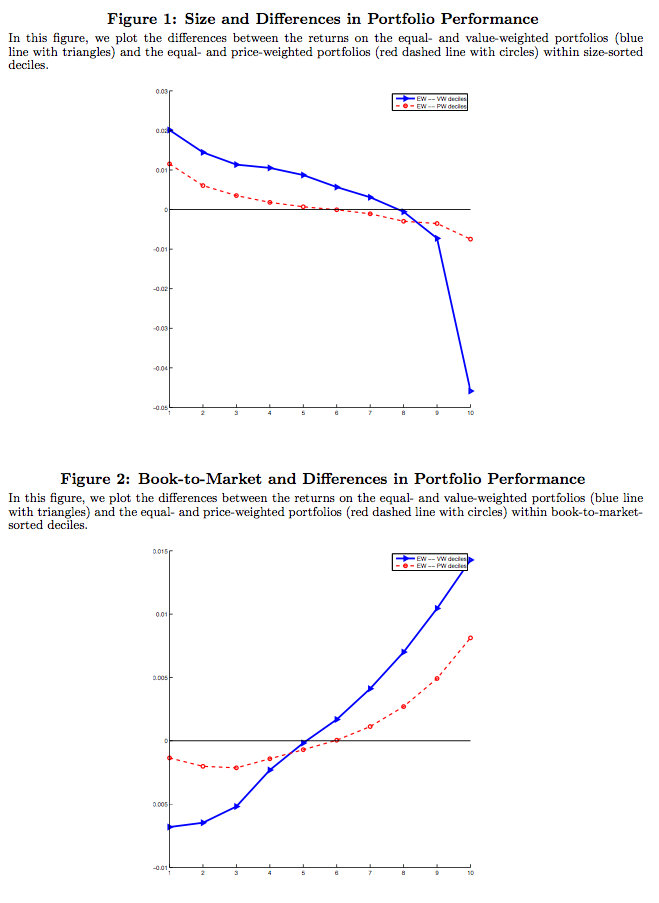
There is some good research on the structuring of indices. In a Janaury 2012 paper Why Does an Equal-Weighted Portfolio Outperform Value- and Price-Weighted Portfolios? Yuliya Plyakha, Raman Uppal and Grigory Vilkov examine the performance of equal-, value-, and price-weighted portfolios of stocks in the major U.S. equity indices over the last four decades (note that here “value” weight is used in the academic sense, meaning “market capitalization weight”).

The researchers find find that the equal-weighted portfolio with monthly rebalancing outperforms the value- and price-weighted portfolios in terms of total mean return, four factor alpha, Sharpe ratio, and certainty-equivalent return, even though the equal-weighted portfolio has greater portfolio risk. (It’s interesting that they find the equal-weighted index possesses alpha. I think that says more about the calculation of alpha than it does about the equal-weight index, but I digress.)

They find that total return of the equal-weighted portfolio exceeds that of the value- and price-weighted because the equal-weighted portfolio has both a higher return for bearing systematic risk and a higher alpha measured using the four-factor model. The higher systematic return of the equal-weighted portfolio arises from its higher exposure to the market, size, and value factors.

They seem to agree with Greenblatt when they find that the higher alpha of the equal-weighted portfolio arises from the monthly rebalancing required to maintain equal weights, which is a “contrarian strategy that exploits reversal and idiosyncratic volatility of the stock returns; thus, alpha depends only on the monthly rebalancing and not on the choice of initial weights.”

[We demonstrate that the source of this extra alpha of the equal-weighted portfolio is the “contrarian” rebalancing each month that is required to maintain equal weights, which exploits the “reversal” in stock prices that has been identified in the literature (see, for instance, Jegadeesh (1990) and Jegadeesh and Titman (1993, 2002)).

To demonstrate our claim, we consider two experiments, which are in opposite directions. In the first experiment, we reduce the frequency for rebalancing the equal-weighted portfolio from 1 month, to 6 months and then to 12 months. If our claim is correct, then as we reduce the rebalancing frequency, we should see the alpha of the equal-weighted portfolio decrease toward the level of the alpha of the value- and price-weighted portfolios, which do not entail any rebalancing.

In the second experiment, we reverse the process and artificially fix the weights of the value- and price-weighted portfolios to give them the contrarian flavor of the equal-weighted portfolio. For instance, consider the case where the rebalancing frequency is t = 12 months. Then each month we change the weights of the value- and price-weighted portfolios so that they are the same as the initial weights at t = 0. Only after 12 months have elapsed, do we set the weights to be the true value and price weights. Then, again for the next 12 months, we keep the weights of the value- and price-weighted portfolios constant so that they are equal to the weights for these portfolios at the 12-month date. Only after another 12 months have elapsed do we set the weights to be the true value and price-weighted weights at t = 24 months. We undertake this experiment for rebalancing frequencies of 6 and 12 months. If our claim is correct, then as we keep fixed the weights of the value- and price-weighted portfolios for 6 months and 12 months, the alphas of these two portfolios should increase toward the alpha of the equal-weighted portfolio.

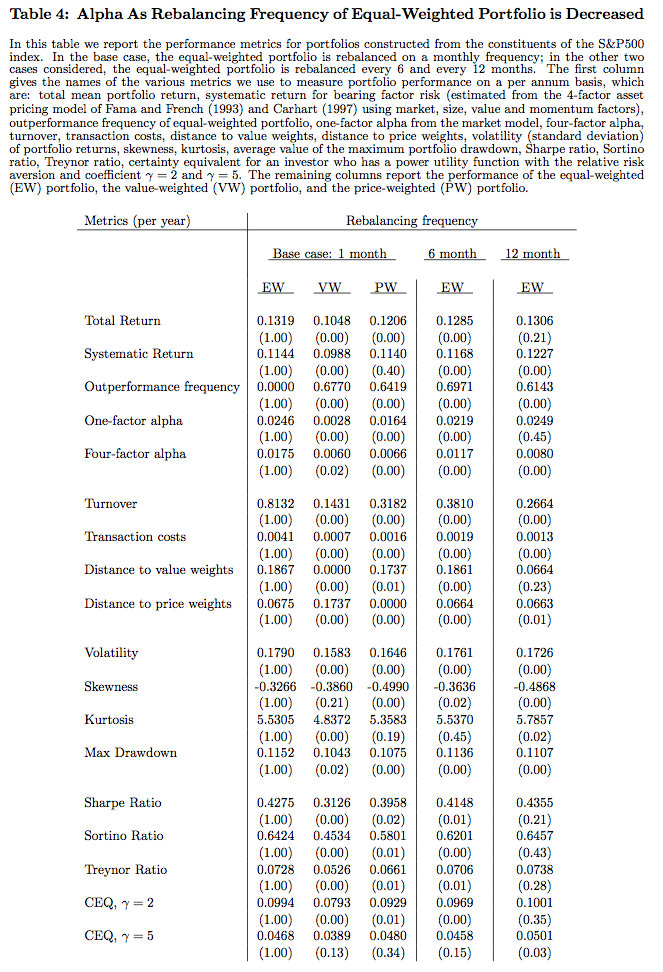
The results of both experiments confirm our hypothesis that it is the monthly rebalancing of the equal-weighted portfolio that generates the alpha for this strategy. Table 4 shows that as we reduce the rebalancing frequency of the equal-weighted portfolio from the base case of 1 month to 6 months and then to 12 months, the per annum alpha of the equal-weighted portfolio drops from 175 basis points to 117 basis points and then to 80 basis points.Once the rebalancing frequency of the equal-weighted portfolio is 12 months, the difference in the alpha of the equal-weighted portfolio and that of the value- and price-weighted portfolios is no longer statistically significant (the p-value for the difference in alpha of the equal- and value-weighted portfolios is 0.96 and for the difference of the equal- and price-weighted portfolios is 0.98).

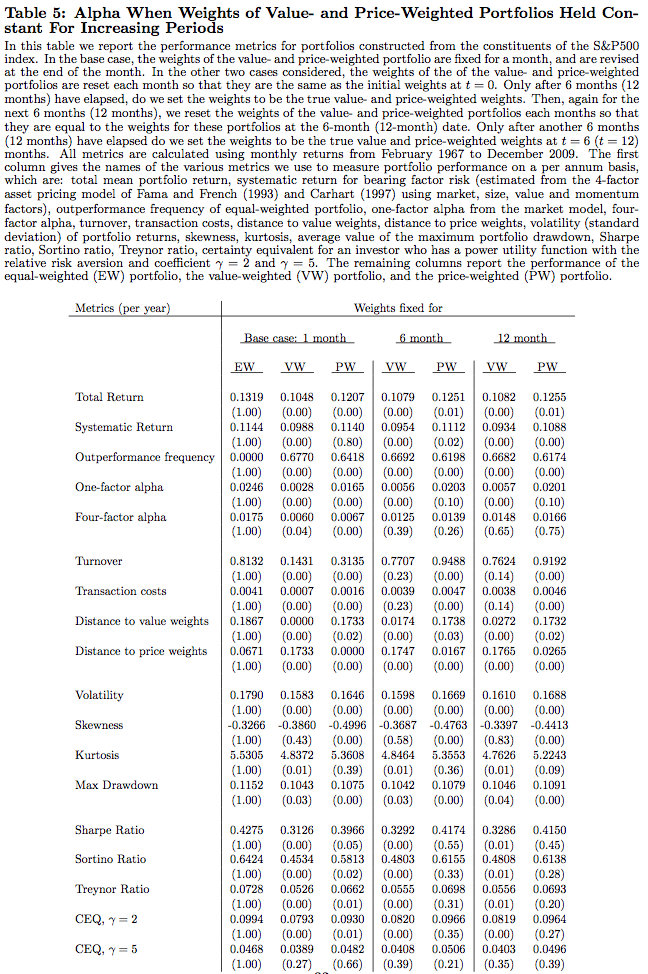
Similarly, for the second experiment we see from Table 5 that once we hold constant the weights of the value- and price-weighted portfolios for 12 months and rebalance the weights only after 12 months, the differences in alphas for the equal-weighted portfolio relative to the value- and price-weighted portfolios is statistically insignificant (with the p-values being 0.65 and 0.30).

An important insight from these experiments is that the higher alpha of the equal-weighted portfolio arises, not from the choice of equal weights, but from the monthly rebalancing to maintain equal weights, which is implicitly a contrarian strategy that exploits reversal that is present at the monthly frequency. Thus, alpha depends on only the rebalancing strategy and not on the choice of initial weights.

Table 4 (Click to embiggen)

Table 5 (click to embiggen)


And two charts showing size and book-to-market measures:

Conclusion

Equal-weighting is a contrarian strategy that exploits the “reversal” in stock prices and eliminates some of the errors in market capitalization-weighted indices.

The monthly rebalancing of the equal-weighted portfolio generates the alpha for this strategy. As we reduce the rebalancing frequency of the equal-weighted portfolio from the base case of 1 month to 6 months and then to 12 months, the per annum alpha of the equal-weighted portfolio drops from 175 basis points to 117 basis points and then to 80 basis points.

For me, the most important part of the study is the finding that “The nonparametric monotonicity relation test indicates that the differences in the total return of the equal-weighted portfolio and the value- and price-weighted portfolios is monotonically related to size, price, liquidity and idiosyncratic volatility.” (Kidding, I’ve got no idea what that means.)

Buy my book The Acquirer’s Multiple: How the Billionaire Contrarians of Deep Value Beat the Market from on Kindlepaperback, and Audible.

Here’s your book for the fall if you’re on global Wall Street. Tobias Carlisle has hit a home run deep over left field. It’s an incredibly smart, dense, 213 pages on how to not lose money in the market. It’s your Autumn smart read. –Tom Keene, Bloomberg’s Editor-At-Large, Bloomberg Surveillance, September 9, 2014.

Click here if you’d like to read more on The Acquirer’s Multiple, or connect with me on Twitter, LinkedIn or Facebook. Check out the best deep value stocks in the largest 1000 names for free on the deep value stock screener at The Acquirer’s Multiple®.

Read Full Post »

Yesterday, I examined Aswath Damodaran’s paper “Value Investing: Investing for Grown Ups?” in which Damodaran asked, “If value investing works, why do value investors underperform?”

Damodaran divides the value world into three groups:

  1. The Passive Screeners,” – “The Graham approach to value investing is a screening approach, where investors adhere to strict screens… and pick stocks that pass those screens.”
  2. The Contrarian Value Investors,” – “In this manifestation of value investing, you begin with the belief that stocks that are beaten down because of the perception that they are poor investments (because of poor investments, default risk or bad management) tend to get punished too much by markets just as stocks that are viewed as good investments get pushed up too much.”
  3. Activist value investors,” – “The strategies used by …[activist value investors] are diverse, and will reflect why the firm is undervalued in the first place. If a business has investments in poor performing assets or businesses, shutting down, divesting or spinning off these assets will create value for its investors. When a firm is being far too conservative in its use of debt, you may push for a recapitalization (where the firm borrows money and buys back stock). Investing in a firm that could be worth more to someone else because of synergy, you may push for it to become the target of an acquisition. When a company’s value is weighed down because it is perceived as having too much cash, you may demand higher dividends or stock buybacks. In each of these scenarios, you may have to confront incumbent managers who are reluctant to make these changes. In fact, if your concerns are broadly about management competence, you may even push for a change in the top management of the firm.”

We looked at Damodaran’s passive screeners yesterday, the contrarian value investors are up today, and tomorrow we’ll take a look at the activists.

The Contrarian Value Investors

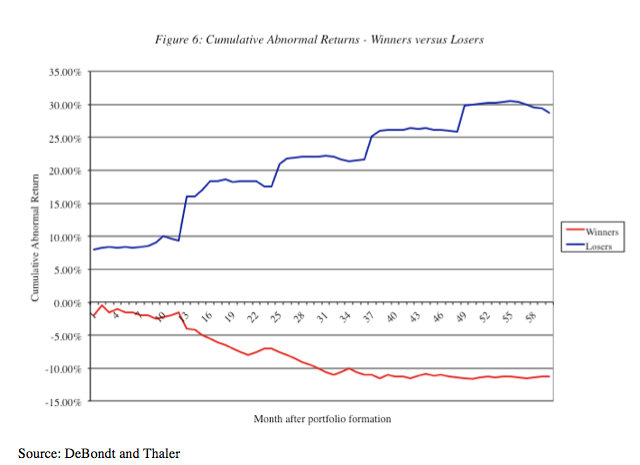
Buying losers seems to work over a long time scale.
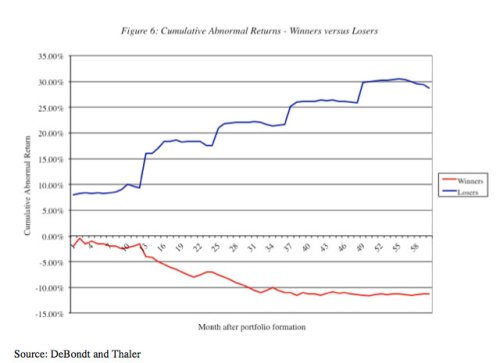
Damodaran:

This analysis suggests that an investor who bought the 35 biggest losers over the previous year and held for five years would have generated a cumulative abnormal return of approximately 30% over the market and about 40% relative to an investor who bought the winner portfolio.

This evidence is consistent with market overreaction and suggests that a simple strategy of buying stocks that have gone down the most over the last year or years may yield excess returns over the long term. Since the strategy relies entirely on past prices, you could argue that this strategy shares more with charting – consider it a long term contrarian indicator – than it does with value investing.

Several select caveats:

• Studies also seem to find loser portfolios created every December earn significantly higher returns than portfolios created every June. This suggests an interaction between this strategy and tax loss selling by investors. Since stocks that have gone down the most are likely to be sold towards the end of each tax year (which ends in December for most individuals) by investors, their prices may be pushed down by the tax loss selling.

• There seems to be a size effect when it comes to the differential returns. When you do not control for firm size, the loser stocks outperform the winner stocks, but when you match losers and winners of comparable market value, the only month in which the loser stocks outperform the winner stocks is January.21

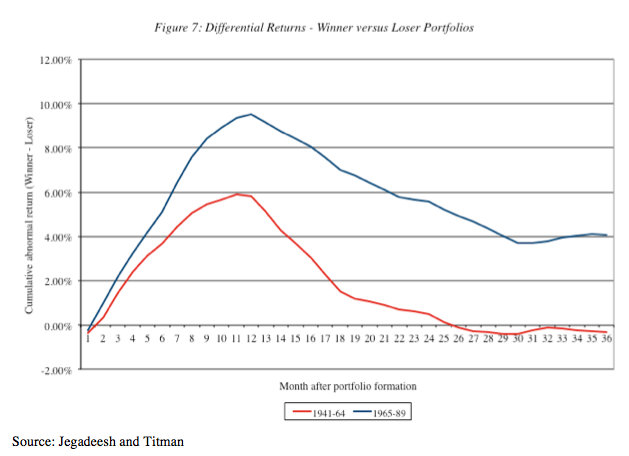
• The final point to be made relates to time horizon. There may be evidence of price reversals in long periods (3 to 5 years) and there is the contradictory evidence of price momentum– losing stocks are more likely to keep losing and winning stocks to keep winning – if you consider shorter periods (six months to a year). An earlier study that we referenced, by Jegadeesh and Titman tracked the difference between winner and loser portfolios by the number of months that you held the portfolios.22

Damodaran’s final point above – that price momentum works over short periods – is interesting:
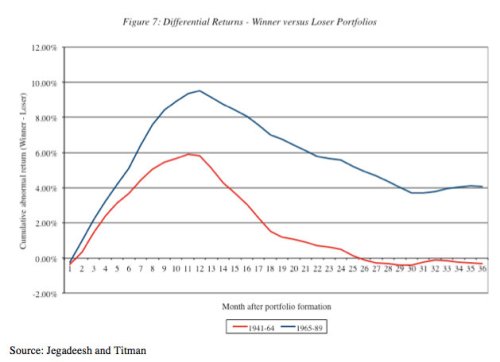
Weird. The winner portfolio actually outperforms the loser portfolio in the first 12 months. Says Damodaran:

[L]oser stocks start gaining ground on winning stocks after 12 months, [but] it took them 28 months in the 1941-64 time period to get ahead of them and the loser portfolio does not start outperforming the winner portfolio even with a 36-month time horizon in the 1965-89 time period. The payoff to buying losing companies may depend heavily on whether you have to capacity to hold these stocks for long time periods.

Bad companies can be good investments

A more sophisticated version of contrarian value investing  is buying “unexcellent” companies and selling “excellent” companies. Damodaran’s rationale is as follows:

If you are right about markets overreacting to recent events, expectations will be set too high for stocks that have been performing well and too low for stocks that have been doing badly. If you can isolate these companies, you can buy the latter and sell the former.

Take note, franchise investors:

Any investment strategy that is based upon buying well-run, good companies and expecting the growth in earnings in these companies to carry prices higher is dangerous, since it ignores the possibility that the current price of the company already reflects the quality of the management and the firm. If the current price is right (and the market is paying a premium for quality), the biggest danger is that the firm loses its luster over time, and that the premium paid will dissipate. If the market is exaggerating the value of the firm, this strategy can lead to poor returns even if the firm delivers its expected growth. It is only when markets under estimate the value of firm quality that this strategy stands a chance of making excess returns.

The tale of Tom Peters’s In Search of Excellence:

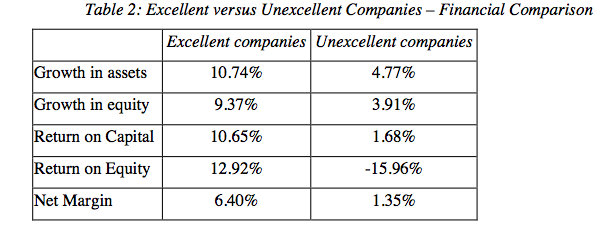
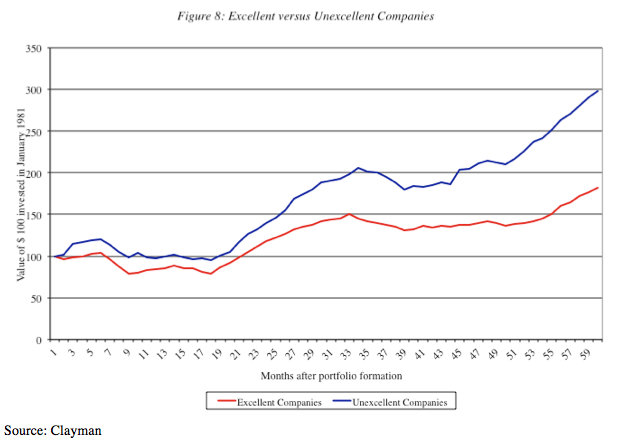
There is some evidence that well managed companies do not always make good investments. Tom Peters, in his widely read book on excellent companies a few years ago, outlined some of the qualities that he felt separated excellent companies from the rest of the market.23 Without contesting his standards, a study went through the perverse exercise of finding companies that failed on each of the criteria for excellence – a group of unexcellent companies and contrasting them with a group of excellent companies.

Here’s a statistical comparison of the two groups:
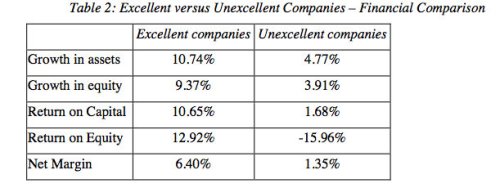
Clearly, “Excellent companies” are excellent, and “Unexcellent companies” suck (negative return on equity!). Confronted with the choice to invest in one group of the other, it’s a no-brainer. Or is it? Here are the returns:
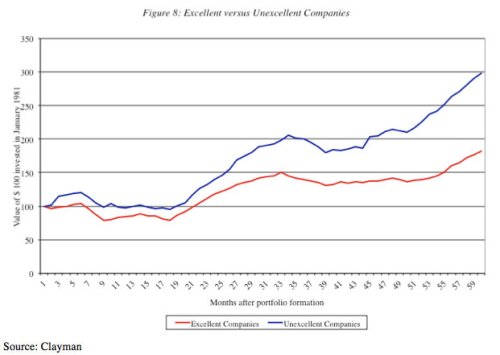
Ruh roh. Says Damodaran:

The excellent companies may be in better shape financially but the unexcellent companies would have been much better investments at least over the time period considered (1981-1985). An investment of $ 100 in unexcellent companies in 1981 would have grown to $ 298 by 1986, whereas $ 100 invested in excellent companies would have grown to only $ 182. While this study did not control for risk, it does present some evidence that good companies are not necessarily good investments, whereas bad companies can sometimes be excellent investments.

A legitimate criticism of this study is that the time period is very short (5 years) and may be an aberration – it began, after all, right at the end of a tough bear market, where any stock with the fundamentals of the unexcellent companies would have looked like poison. How about a second study?

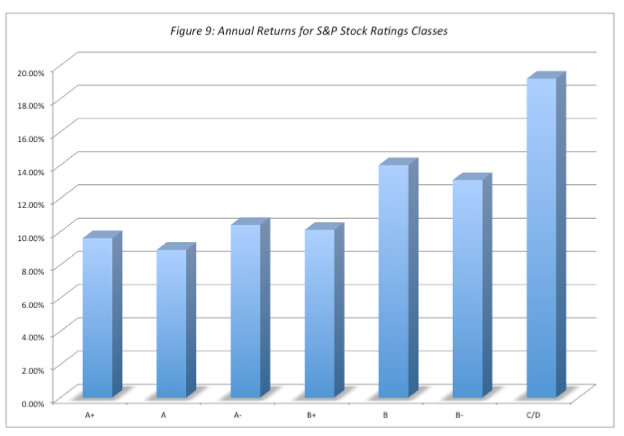
The second study used a more conventional measure of company quality. Standard and Poor’s, the ratings agency, assigns quality ratings to stocks that resemble its bond ratings. Thus, an A rated stock, according to S&P, is a higher quality investment than a B+ rated stock, and the ratings are based upon financial measures (such as profitability ratios and financial leverage). Figure 9 summarizes the returns earned by stocks in different ratings classes, and as with the previous study, the lowest rated stocks had the highest returns and the highest rated stocks had the lowest returns.

And here are the returns:
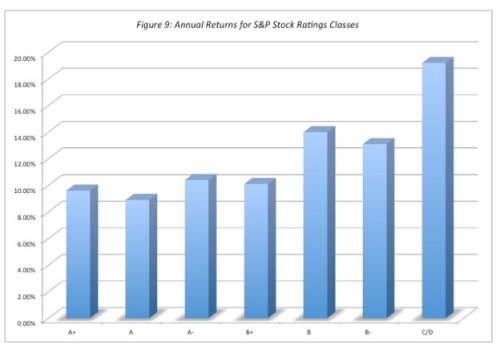
Looks like a pretty clear inverse relationship between rating and return. Sure, whereof rating, thereof “risk,” but I’m prepared to wear that “risk” for the return.

So contrarian value investing works. How do we mess this up?

a. Long Time Horizon: To succeed by buying these companies, you need to have the capacity to hold the stocks for several years. This is necessary not only because these stocks require long time periods to recover, but also to allow you to spread the high transactions costs associated with these strategies over more time. Note that having a long time horizon as a portfolio manager may not suffice if your clients can put pressure on you to liquidate holdings at earlier points. Consequently, you either need clients who think like you do and agree with you, or clients that have made enough money with you in the past that their greed overwhelms any trepidation they might have in your portfolio choices.

b. Diversify: Since poor stock price performance is often precipitated or accompanied by operating and financial problems, it is very likely that quite a few of the companies in the loser portfolio will cease to exist. If you are not diversified, your overall returns will be extremely volatile as a result of a few stocks that lose all of their value. Consequently, you will need to spread your bets across a large number of stocks in a large number of sectors. One variation that may accomplish this is to buy the worst performing stock in each sector, rather than the worst performing stocks in the entire market.

c. Personal qualities: This strategy is not for investors who are easily swayed or stressed by bad news about their investments or by the views of others (analysts, market watchers and friends). Almost by definition, you will read little that is good about the firms in your portfolio. Instead, there will be bad news about potential default, management turmoil and failed strategies at the companies you own. In fact, there might be long periods after you buy the stock, where the price continues to go down further, as other investors give up. Many investors who embark on this strategy find themselves bailing out of their investments early, unable to hold on to these stocks in the face of the drumbeat of negative information. In other words, you need both the self-confidence to stand your ground as others bail out and a stomach for short-term volatility (especially the downside variety) to succeed with this strategy.

Tomorrow, the activists.

DEEP VALUE 4 LIFE

(Hat tip Abnormal Returns)

Read Full Post »
« Newer Posts - Older Posts »