Feeds:
Posts
Comments

Archive for the ‘Contrarian investment’ Category

CXO Advisory Group has uncovered a superb paper Stocks of Admired Companies and Spurned Ones by Deniz Anginer and Meir Statman, which finds that the most admired companies on Fortune Magazine’s annual survey of list of “America’s Most Admired Companies” had lower returns, on average, than stocks of spurned companies from April 1983 through December 2007. Further, Anginer and Statman find that increases in admiration were followed, on average, by lower returns.

Anginer and Statman describe their methodology as follows:

Fortune has been publishing the results of annual surveys of company reputations since 1983 and the survey published in March 2007 included 587 companies in 62 industries. Fortune asked more than 3,000 senior executives, directors and securities analysts to rate the ten largest companies in their own industries on eight attributes of reputation, using a scale of zero (poor) to ten (excellent): quality of management; quality of products or services; innovativeness; long-term investment value; financial soundness; ability to attract, develop, and keep talented people; responsibility to the community and the environment; and wise use of corporate assets. The rating of a company is the mean rating on the eight attributes. The list of admired companies in the 2007 survey includes Walt Disney, UPS and Google, with ratings of 8.44, 8.37 and 8.07. The list of spurned companies includes Jet Blue, Bridgestone and Stanley Works, with ratings of 5.25, 5.34 and 5.37.

The mean rating of companies in some industries, such as the 6.53 of the Communications industry, are higher on average than those of other industries, such as the 5.26 of the Agricultural Production industry. Our focus is on companies and we distinguish company effects from industry effect by using industry adjusted ratings of companies. They are the difference between the rating of a company and the mean rating of companies in its industry.

Consider two portfolios constructed by Fortune ratings; each consisting of one half of the Fortune stocks. The admired portfolio contains the stocks with the highest Fortune ratings and the spurned portfolio contains the stocks with the lowest. We construct the portfolios on April 1st of 1983, based on the Fortune survey published earlier that year1. We calculate the returns of the portfolios during the 12 months from April 1st 1983 to March 31st 1984 from daily returns. We reconstruct each portfolio on April 1st of subsequent years based on the Fortune survey published earlier that year and calculate returns similarly during the following 12 months.

CXO summarize the findings as follows:

  • Over the entire sample period, the mean annualized equally-weighted (value-weighted) return for the unadmired (lower half) portfolio is 18.3% (16.1%), compared to 16.3% (13.8%) for the admired (upper half) portfolio.
  • Risk-adjusted alphas of an annually reformed hedge portfolio that is long (short) the unadmired (admired) stocks is sometimes positive and sometimes insignificant, depending on whether the risk adjustment is beta only or multi-factor.
  • Increases in admiration generally indicate lower future returns. For example, the mean annualized equally-weighted return of the stocks in the most unadmired quartile for which reputation decreased (increased) relative to the median is 18.8% (13.2%).
  • The dispersion of returns is higher within the unadmired portfolio than the admired one. Among the 12 stocks with the worst (best) annual returns, 11 (9) come from the unadmired portfolio. Investors seeking to exploit “unadmiredness” should therefore diversify widely among unadmired stocks.
  • The effect is non-linear. The annualized return of an equally-weighted portfolio of the 10 least (most) admired stocks is 13.4% (16.6%). The next ten most and least admired stocks have about the same annualized return. However, for rankings 21-30, 31-40 and 41-50, unadmired stocks substantially beat admired stocks.
  • In summary, the stocks of companies unadmired by the ostensibly well-informed may well outperform the stocks of the companies admired.

Why might this be so? I’d like to venture a guess. Anginer and Statman’s findings would seem to accord with the findings of Josef Lakonishok, Andrei Shleifer, and Robert Vishny in Contrarian Investment, Extrapolation and Risk (and the The Brandes Institute update Value vs Glamour: A Global Phenomenon. Those two papers found that value stocks (defined as the lowest decile of stocks by price-to-book) outperformed glamour stocks (and by a wide margin).Recall that glamour stocks are those that “have performed well in the past,” and “are expected by the market to perform well in the future.” Value stocks are those that “have performed poorly in the past and are expected to continue to perform poorly.” LSV say value beats glamour because investors don’t fully appreciate the phenomenon of mean reversion, which leads them to extrapolate past performance too far into the future. It’s possible that “admired” can be a proxy for “glamourous” and therefore Anginer and Statman have identified another aspect of this phenomenon. Admired companies are bid up like glamour stocks, and scorned companies are ignored like value stocks, which creates the opportunity for contrarian bet. I love a counter-intuitive strategy.

Read Full Post »

As I foreshadowed last week in The New World, I want to explore Nassim Nicholas Taleb’s Fooled by Randomness and The Black Swan in some depth. The books aren’t strictly about investing, which Taleb regards as a “less interesting, more limited –and rather boring –applications of [his] ideas,” but my interest is in investment, particularly deep value investment, and so I’ll be exploring his ideas in that context. It is no small subject, and I don’t pretend to fully understand everything that Taleb has to say. Ideally, I’d complete it before springing it on you. Alas, my daily posting schedule won’t allow that. My apologies in advance, as this will likely progress in fits and starts, requiring “decisions and revisions which a minute will reverse.”

Taleb’s ideas appeal to me for a variety of reasons: I see Montaigne’s “Que sais-je?” (“What do I know?”) as a golden thread linking Austrian economics, value investment and a variety of other views I hold unrelated to finance and investment. Benjamin Graham, being the Latin, Greek and French-speaking polymath that he was, no doubt enjoyed Essais in its original form (whereas I had to grit my teeth through the Cotton translation, before learning that connoisseurs prefer M.A. Screech for his lyrical Raymond Sebond). Montaigne may have had some influence on Graham’s concept of margin of safety, his habit of professing to know little about the businesses of the securities in which he invested, and generally cautious and conservative approach. Montaigne writes about about the failure of his own faculties to aid him in his comprehension of the world.  We don’t even understand the past – despite our “fantastic, imaginary, false privileges that man has arrogated to himself, of regimenting, arranging, and fixing truth” – so how can we possibly see what will happen in the future? We can’t. The beauty of Montaigne is that he presents a way forward through the gloom. How do we proceed? Through waver, doubt and inquiry. Taleb offers a similar view in Fooled by Randomness and The Black Swan, and that’s what makes the books so enjoyable.

Malcolm Gladwell’s Blowing up is rich in biographical detail on Taleb, and reads to me like Fooled by Randomness in essay (despite Taleb’s protestations that “while flattering,” it put him in the “wrong box”). Gladwell sets the table by describing a meeting between Victor Niederhoffer, then “one of the most successful money managers in the country” and Taleb:

He didn’t talk much, so I observed him,” Taleb recalls. “I spent seven hours watching him trade. Everyone else in his office was in his twenties, and he was in his fifties, and he had the most energy of them all. Then, after the markets closed, he went out to hit a thousand backhands on the tennis court.” Taleb is Greek-Orthodox Lebanese and his first language was French, and in his pronunciation the name Niederhoffer comes out as the slightly more exotic Niederhoffer. “Here was a guy living in a mansion with thousands of books, and that was my dream as a child,” Taleb went on. “He was part chevalier, part scholar. My respect for him was intense.” There was just one problem, however, and it is the key to understanding the strange path that Nassim Taleb has chosen, and the position he now holds as Wall Street’s principal dissident. Despite his envy and admiration, he did not want to be Victor Niederhoffer — not then, not now, and not even for a moment in between. For when he looked around him, at the books and the tennis court and the folk art on the walls — when he contemplated the countless millions that Niederhoffer had made over the years — he could not escape the thought that it might all have been the result of sheer, dumb luck.

The punchline is that Niederhoffer blew up (for the second time, thereby fulfilling his own definition of a hoodoo):

Last fall, Niederhoffer sold a large number of options, betting that the markets would be quiet, and they were, until out of nowhere two planes crashed into the World Trade Center. “I was exposed. It was nip and tuck.” Niederhoffer shook his head, because there was no way to have anticipated September 11th. “That was a totally unexpected event.”

I’m not going to recapitulate Gladwell’s article here, but it’s well worth reading in its entirety. As an aside, Niederhoffer’s The Education of a Speculator is also an excellent read. It is interesting to compare Niederhoffer’s exhortation to “test everything that can be tested” against Taleb’s “naive empiricist,” but I’ll leave that for another day. For me, one of the most interesting aspects of Taleb’s philosophy is his attack on “epistemic arrogance” and its application to value investment. As I have said before, I believe there are several problems with the received wisdom on value investment, and this is one worthy of further exposition.

Read Full Post »

One of the most fascinating examples of the phenomenon of mean reversion was identified by Werner F.M. DeBondt and Richard H. Thaler in Further Evidence on Investor Overreaction and Stock Market Seasonality. DeBondt and Thaler examined the relative performance of quintiles of stocks on the NYSE and AMEX ranked according to book value. As an adjunct to the main study, one of the variables they analyzed was the relative earnings performance of stocks in the lowest and highest price-to-book quintiles.

DeBondt and Thaler’s findings are as interesting as they are counter-intuitive. Stocks in the lowest price-to-book quintile (the cheapest stocks) grew their earnings faster than the stocks in the highest price-to-book quintile (the most expensive stocks). Tweedy Browne set out DeBondt and Thaler’s findings in Table 3 below, which describes the average earnings per share for companies in the lowest and highest quintile of price-to-book value in the three years prior to selection and the four years subsequent to selection:

tweedy-table-3

In the four years after the date of selection, the earnings of the companies in the lowest price-to-book value quintile (average price-to-book value of 0.36) increase 24.4%, more than the companies in the highest price-to-book value quintile (average price-to-book value of 3.42), whose earnings increased only 8.2%. DeBondt and Thaler attribute the earnings outperformance of the companies in the lowest quintile to mean reversion, which Tweedy Browne described as the observation that “significant declines in earnings are followed by significant earnings increases, and that significant earnings increases are followed by slower rates of increase or declines.”

The implication here is that not only does the price of stocks that are cheap relative to other stocks regress to the mean, but the underlying performance does too. That’s an amazing finding. There’s really no good reason why low price-to-book should be such a good predictor for short and mid-term earnings growth. I’ve spent some time thinking about why this might be so, and the only possible explanation I can come up with is magic. Nothing else fits.

Read Full Post »

One of the themes that I want to explore in some depth is “pure” contrarian investing, which is investing relying solely on the phenomenon of reversion to the mean. I’m calling it “pure” contrarian investing to distinguish it from the contrarian investing that is value investing disguised as contrarian investing. The reason for making this distinction is that I believe Lakonishok, Shleifer, and Vishny’s characterization of the returns to value as contrarian returns is a small flaw in Contrarian Investment, Extrapolation and Risk. I argue that it is a problem of LSV’s definition of “value.” I believe that LSV’s results contained the effects of both pure contrarianism (mean reversion) and value. While mean reversion and value were both observable in the results, I don’t believe that they are the same strategy, and I don’t believe that the returns to value are solely due to mean reversion. The returns to value stand alone and the returns to a mean reverting strategy also stand alone. In support of this contention I set out the returns to a simple pure contrarian strategy that does not rely on any calculation of value.

Contrarianism relies on mean reversion

The grundnorm of contrarianism is mean reversion, which is the idea that stocks that have performed poorly in the past will perform better in the future and stocks that have performed well in the past will not perform as well. Graham, quoting Horace’s Ars Poetica, described it thus:

Many shall be restored that now are fallen and many shall fall that are now in honor.

LSV argue that most investors don’t fully appreciate the phenomenon, which leads them to extrapolate past performance too far into the future. In practical terms it means the contrarian investor profits from other investors’ incorrect assessment that stocks that have performed well in the past will perform well in the future and stocks that have performed poorly in the past will continue to perform poorly.

LSV’s definition of value is a problem

LSV’s contrarian model argues that value strategies produce superior returns because of mean reversion. Value investors would argue that value strategies produce superior returns because they are exchanging of one store of value (say, 67c) for a greater store of value (say, a stock worth say $1). The problem is one of definition.

In Contrarian Investment, Extrapolation and Risk LSV categorized the stocks on simple one-variable classifications as either “glamour” or “value.” Two of those variables were price-to-earnings and price-to-book (there were three others). Here is the definitional problem: A low price-to-earnings multiple or a low price-to-book multiple does not necessarily connote value and the converse is also true, a high price-to-earnings multiple or a high price-to-book multiple does not necessarily indicate the absence of value.

John Burr Williams 1938 treatise The Theory of Investment Value is still the definitive word on value. Here is Buffett’s explication of Williams’s theory in his 1992 letter to shareholders, which I use because he puts his finger right on the problem with LSV’s methodology:

In The Theory of Investment Value, written over 50 years ago, John Burr Williams set forth the equation for value, which we condense here: The value of any stock, bond or business today is determined by the cash inflows and outflows – discounted at an appropriate interest rate – that can be expected to occur during the remaining life of the asset. Note that the formula is the same for stocks as for bonds. Even so, there is an important, and difficult to deal with, difference between the two: A bond has a coupon and maturity date that define future cash flows; but in the case of equities, the investment analyst must himself estimate the future “coupons.” Furthermore, the quality of management affects the bond coupon only rarely – chiefly when management is so inept or dishonest that payment of interest is suspended. In contrast, the ability of management can dramatically affect the equity “coupons.”

The investment shown by the discounted-flows-of-cash calculation to be the cheapest is the one that the investor should purchase – irrespective of whether the business grows or doesn’t, displays volatility or smoothness in its earnings, or carries a high price or low in relation to its current earnings and book value. Moreover, though the value equation has usually shown equities to be cheaper than bonds, that result is not inevitable: When bonds are calculated to be the more attractive investment, they should be bought.

What LSV observed in their paper may be attributable to contrarianism (mean reversion), but it is not necessarily attributable to value. While I think LSV’s selection of price-to-earnings and price-to-book as indicia of value in the aggregate probably means that value had some influence on the results, I don’t think they can definitively say that the cheapest stocks were in the “value” decile and the most expensive stocks were in the “glamour” decile. It’s easy to understand why they chose the indicia they did: It’s impractical to consider thousands of stocks and, in any case, impossible to reach a definitive value for each of those stocks (we would all assess the value of each stock in a different way). This leads me to conclude that the influence of value was somewhat weak, and what they were in fact observing was the influence of mean reversion. It doesn’t therefore seem valid to say that the superior returns to value are due to mean reversion when they haven’t tested for value. It does, however, raise an interesting question for investors. Can you invest solely relying on reversion to the mean? It seems you might be able to do so.

Pure contrarianism

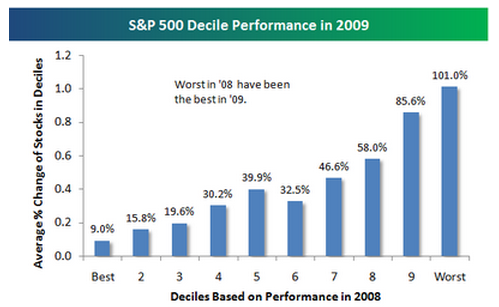
Pure contrarian investing is investing relying solely on the phenomenon of reversion to the mean without making an assessment of value. Is it possible to observe the effects of mean reversion by constructing a portfolio on a basis other than some indicia of value? It is, and the Bespoke Investment Group has done all the heavy lifting for us. Bespoke constructed from the S&P500 ten portfolios with 50 stocks in each on the basis of stock performance in 2008. They then tracked the performance of those stocks in 2009. The result?

Many of the stocks that got hit the hardest last year came roaring back this year, and the numbers below help quantify this.  As shown, the 50 stocks in the S&P 500 that did the worst in 2008 are up an average of 101% in 2009!  The 50 stocks that did the best in 2008 are up an average of just 9% in 2009.  2009 was definitely a year when buying the losers worked.

It’s a stunning outcome, and it seems that the portfolios (almost) performed in rank order. While there may be a value effect in these results, the deciles were constructed on price performance alone. This would seem to indicate that, at an aggregate level at least, mean reversion is a powerful phenomenon and a pure contrarian investment strategy relying on mean reversion should work.

Read Full Post »

« Newer Posts