Feeds:
Posts
Comments

Posts Tagged ‘Liquidating Value’

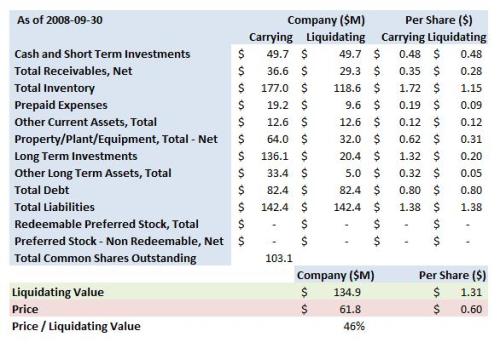
Axcelis Technologies Inc (NASDAQ:ACLS) is a new addition to the Greenbackd Portfolio at its $0.60 closing price yesterday. ACLS is an undervalued asset play with an activist investor, Sterling Capital Management, holding 10.7% of its outstanding stock. At $0.60, the company has a market capitalization of $61.8M. We estimate that its liquidating value is more than 110% higher at $134.9M, or $1.31 per share. The caveat? The company is making substantial operating losses that have widened over the last five quarters, prompting Sterling Capital Management to detail to ACLS management an aggressive restructuring strategy to salvage for stockholders what value remains.

About ACLS

ACLS designs, manufactures and services ion implantation, dry strip and other processing equipment used in the fabrication of semiconductor chips. In addition to equipment, ACLS provides aftermarket service and support, including spare parts, equipment upgrades, maintenance services and customer training. The company owns 50% of SEN Corporation (SEN), a producer of ion implantation equipment in Japan. SEN licenses technology from ACLS  for certain ion implantation products and has exclusive rights to market the licensed products in Japan. The investor relations website is here.

The value proposition

The last five quarters have not been kind to ACLS, with the company generating substantial and increasing operating losses in each, reaching a $22.8M nadir for the September quarter (see the Q3 10Q here). At present, some value remains on the balance sheet (the “Carrying” column shows the assets as they are carried in the financial statements, and the “Liquidating” column shows our estimate of the value of the assets in a liquidation):
acls-summary1

ACLS’s liquidating value is predominantly carried in its $177M in inventory, which we’ve written down by a third to $119M or $1.15 per share, and its long term investment in $136M SEN, which we’ve written down by 80% to $20.4M or $0.20 per share. The company has around $49.7M or $0.48 per share in cash and a further $12.6M or $0.12 per share in restricted cash. The company also has around $36.6M in receivables, which we’ve discounted by a fifth to $29.3M or $0.28 per share. Deducting the $1.38 per share in liabilities (including $0.80 per share in debt) leaves a value in liquidation of around $134.9M or $1.31 per share.

The catalyst

Sterling Capital Management has been in regular contact with ACLS since acquiring its original stake in October 2007. They began communicating with ACLS in November of that year, “[encouraging] management and the board of directors to move forward on several actions designed to enhance shareholder value” including “[hiring] an investment banking firm to solicit interest for a minority, majority, or strategic investment in [ACLS].” (See the full text of Sterling Capital Management’s first letter to ACLS here.)

In February 2008, Sterling Capital Management again pushed ACLS to “immediately hire an advisor and fully explore strategic alternatives.” When Sumitomo Heavy Industries (SHI), ACLS’s SEN joint venture partner, offered to acquire ACLS for $5.20 per share, Sterling Capital Management wrote:

We strongly encourage [ACLS]’s Board to fully engage SHI and work to determine if a combination is appropriate. Further, we also would expect the Board and its advisors to solicit interest from other parties that might have a desire in partnering with [ACLS].

In a subsequent February 2008 letter, Sterling Capital Management argued that the initial bid of $5.20 per share for ACLS was “clearly too low,” writing:

Even with strong industry headwinds and lack of traction to-date, it is appropriate to value [ACLS] assuming some modest level of Optima success. Our analysis would indicate that a fair price for [ACLS] under this scenario would approximate $7.00 to $7.50 per share.

When SHI increased its offer to $6.00 per share, Sterling Capital Management wrote in March 2008:

[It] would appear that we are no closer to achieving an open dialogue between Axcelis and SHI.

We are concerned that the Board and its advisors are utilizing overly optimistic assumptions regarding Optima’s ultimate market share gains and consequently embracing an intrinsic value which is not achievable.

Sterling Capital Management argued in a May 2008 letter that the failure of nominated directors at ACL’s Annual Meeting of Stockholders to receive a majority of the shareholder vote in support of their re-election demonstrated shareholders’ “discontent with the failure of the Board to fully engage SHI in negotiations that could ultimately lead to a transaction that fairly values our company.” Clearly growing frustrated with ACLS, Sterling Capital Management wrote:

Rather than battling your shareholder base, we encourage you and the Board to embrace the steps necessary to drive shareholder value via a transaction with SHI.

In Sterling Capital Management’s most recent 13D filing they write:

We believe that [ACLS] management is making good progress in addressing the company’s short term financing issues. Further, the recently announced restructuring effort should assist the company in weathering an environment of continued weak spending However, given the highly cyclical nature of the semiconductor capital equipment market, it is imperative that management actively explore all opportunities to better position [ACLS] for long term success and creation of shareholder value. As such, Sterling Capital has communicated to management of [ACLS] a concept of separating its systems business from the more stable aftermarket business. In addition to separating cyclical from non-cyclical businesses, this initiative would allow for efficient utilization of the cash currently residing on SEN’s balance sheet and the tax benefits associated with extensive NOLs at [ACLS].

Sterling Capital Management also attached their most recent letter to ACLS (reproduced below):

Ms. Mary Puma
Chairman and CEO
Axcelis Technologies, Inc.
108 Cherry Hill Drive
Beverly, MA 01915-1053

Dear Mary,

These are certainly unprecedented times which we all are trying to navigate through. We appreciate the focus and effort the entire team at Axcelis has demonstrated during the current environment. However, given the challenges facing the company, we would strongly encourage Axcelis to embrace an altered strategy which would produce both immediate and long term value for all constituents.

The initiative described below attempts to utilize all of the many resources and assets that Axcelis claims which clearly are not being recognized by the public markets. Further, we believe that the ultimate corporate structure it defines provides a more appropriate division between
cyclical and stable businesses.

Please consider:

o In March of 2008 SHI made an offer to purchase all of Axcelis’ outstanding shares for $6 per share or approximately $618 million dollars. Combined with debt on the balance sheet of Axcelis the total offer equated to $700 million. Through direct conversations with SHI and public documents it was clear that the motive behind this transaction was to consolidate the ion implant business of both Axcelis and SEN. Such a combination would yield significant cost synergies as well as enhanced product offerings.

The plan outlined below would allow SHI to achieve their initial goal, resolve short and long term financial challenges at Axcelis, and importantly create significant value for shareholders.

o Axcelis sells its implant/ dry strip systems business along with its 50% interest in SEN to SHI for $136 million. This figure approximates the book value of the SEN investment on Axcelis’ balance sheet. Importantly, such a price tag would require minimal net cash outlays by SHI as this transaction would give them immediate access to the entire $140 million of net cash currently on the books at SEN. SHI would have the ability to merge these operations and garner the synergies available.

o Axcelis Corporation would become solely focused on the aftermarket business which would include exclusive rights for SEN/Axcelis legacy accounts. The aftermarket business generates approximately $120 million in annual revenue and claims gross margins in excess of 50%. If properly sized such a business should be able to produce operating margins near the 20% level.

o Axcelis would retain existing NOLs which total $150 million and could then be applied to the operating profits generated by the aftermarket business. These NOLs could be fully utilized as no change of control event would be triggered.

o After repayment of the $85 million of debt the newly restructured Axcelis would have net cash of approximately $100 million. Given the low capital intensity of the aftermarket business and its relative stability, at least $50 million of this cash could be used for share repurchases. Assuming an average repurchase price of $1.50 per share Axcelis could retire 33 million shares.

o The new Axcelis would have approximately 70 million shares outstanding (after repurchases) and be generating $0.30 in eps. Applying a 10X multiple on this business would equate to a stock price of $3 per share. Revenue and earnings could grow at the new Axcelis as the market rebounded and SEN proved successful expanding its market share.

o The new Axcelis would have additional assets including net cash of $50 million and an unencumbered headquarters/ property which was recently appraised at almost $60 million.

Clearly, the above scenario is very different than the outcome we had all hoped for just a few months ago. However, there is no question that the world has changed and that looking forward and embracing the altered landscape is a prerequisite for future success. We hope that the Board might give full consideration to our proposal and we look forward to continuing to work with you in moving Axcelis forward.

Sincerely,
STERLING CAPITAL MANAGEMENT LLC
Brian R. Walton, CFA
Managing Director

Conclusion

At its $0.60 closing price yesterday, ACLS is trading at less than half of our estimate of its $1.31 per share value in liquidation. Its substantial and widening operating losses over the last five quarters have led management to make some efforts to restructure, which Sterling Capital Management believes will help ACLS in “weathering an environment of continued weak spending.” The company has thus far resisted Sterling Capital Management’s efforts to have ACLS negotiate with SHI or another bidder. Sterling Capital Management appears tenacious and so we think they may be able to persuade ACLS to create significant value for stockholders. With a downside limited by its presently substantial value in liquidation, we think ACLS is worthy addition to the Greenbackd Portfolio.

ACLS closed yesterday at $0.60.

The S&P500 Index closed yesterday at 906.65.

[Disclosure:  We don’t have a holding in ACLS. We have now acquired a holding in ACLS. This is neither a recommendation to buy or sell any securities. All information provided believed to be reliable and presented for information purposes only. Do your own research before investing in any security.]
Read Full Post »

InFocus Corporation (NASDAQ:INFS) has just announced that its board has amended INFS’s bylaws and adopted what it euphemistically calls a “Shareholder Rights Plan.” The company’s press release reads:

Effective today, if any person or group acquires 15 percent or more of the voting power of the Company’s outstanding common stock without the approval of the Board of Directors, there would be a triggering event causing significant dilution in the voting power of such person or group. The Plan may be terminated by the Board at any time.

In what is clearly a response to Nery Capital upping its INFS stake to 12.2% of the oustanding stock, one “right” will be distributed for each share of INFS common stock outstanding as of the close of business on January 18, 2009. In the press release, Bob O’Malley, INFS’s CEO, says:

The amendment to our Bylaws and the adoption of a Shareholder Rights Plan will help ensure that the previously appointed independent committee of our Board of Directors is able to conduct its review of strategic alternatives without the threat of coercive takeover or control tactics that do not offer shareholders a fair premium. Neither the Plan, nor the amendment to our Bylaws is intended to prevent an offer that the Board concludes is in the best interest of [INFS] and its shareholders.

INFS’s adoption of the poison pill is a disappointing step for management to take. Calling this thing a “Shareholder Rights Plan” is pretty galling when its effect is to take rights away from shareholders and deliver them to management. The suggestion that the board are the ones to determine what is “in the best interest of [INFS] and its shareholders” and how much of a premium is “fair” is just a joke given the level at which INFS’s stock languishes. We also  have a problem with the use in the press release of such emotive language (“the threat of coercive takeover or control tactics”).

We’ve been following INFS because it is a deeply undervalued asset situation with two activist investors, Nery Capital and Lloyd I. Miller, III, pushing the company to “improve [INFS]’s financial condition and increase shareholder value” (see our first post here). The company’s adoption of a poison pill is a negative development for stockholders. Hopefully it is not a precursor to management handing the company to the second potential bidding group, which includes INFS’s founder Steve Hix, because they don’t want to see it fall to the “New York sharks.” INFS management has now set itself a high bar for the “review of strategic alternatives.”

Perhaps INFS management has read an early copy of the magazine Corporate Board Member’s January issue titled “How to Icahn-proof your board.”

Head nod to commenter Chad, who seems to be doing most of the heavy lifting around here while we’re asleep at the wheel.

Read Full Post »

Nery Capital has increased its holding in InFocus Corporation (NASDAQ:INFS) according to its most recent 13D amendment filed January 5 this year.  Nery Capital now controls 12.2% of INFS’s outstanding stock, up from 11.2% at its last filing on December 5, 2008.

We’ve been following INFS because it is a deeply undervalued asset situation with two activist investors, Nery Capital and Lloyd I. Miller, III, pushing the company to “improve [INFS]’s financial condition and increase shareholder value” (see our first post here). A second potential bidding group, including INFS’s founder Steve Hix, emerged last year to fend off the “New York sharks,” and we think that is a positive development for stockholders (see our last post here).

INFS is up 28.6% to $0.81 since we started following it, but we see the liquidating value 42% higher at $1.15 per share, so we will continue to hold it.

Read Full Post »

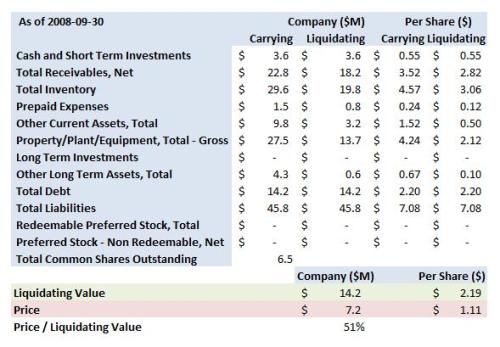
Cobra Electronics Corporation (NASDAQ:COBR) is another tiny undervalued asset play with an activist investor – Howson Tattersall Investment Counsel Limited – disclosing a 10% holding in its 13D notice filed September 24 last year. At its $1.11 close yesterday, COBR has a market capitalization of just $7.2M. We estimate that its liquidating value is almost 100% higher at $14.2M or $2.19 per share and the first new addition to the Greenbackd Portfolio for 2009.

About COBR

COBR is a designer and marketer of two-way mobile communications products in the United States, Canada and Europe. The Company has seven product lines: two-way radios, radar detectors, Citizens Band radios, power inverters, mobile navigation, marine consumer electronics, and photo-enforcement and safety detection. The company’s investor relations website is here.

The value proposition

COBR has generated mildly positive earnings for the last three quarters but has generally lost money since 2006. As always, there is some value on the balance sheet (the “Carrying” column shows the assets as they are carried in the financial statements, and the “Liquidating” column shows our estimate of the value of the assets in a liquidation):

cobr-summary

COBR’s value in liquidation is predominantly in its $22.8M in receivables, which we have discounted by a fifth to $18.2M or $2.82 per share, and $29.6M in inventory, which we value at $19.8M or $3.06 per share. The other source of value on the balance sheet is COBR’s $27.5M property, plant and equipment, which we’ve written down by half to $13.7M or $2.12 per share. COBR has $14.2M in debt and other substantial liabilities in the amount of $45.8M or $7.08 per share. Deducting COBR’s liabilities from its written down asset value, we estimate COBR’s liquidating value at around $14.2M or $2.19 per share, which is 97% higher than its $1.11 close yesterday.

The catalyst

Howson Tattersall Investment Counsel Limited’s 13D notice filed September 24, 2008 discloses a 10% holding in COBR but little else – it adopts the standard boilerplate in its filing. Howson Tattersall’s website does discuss its equity investment philosophy:

Our equity investment process is based on value investing because it provides a consistent, statistically grounded approach to the analysis of investment opportunities.

After narrowing the universe of potential investments to companies with attractive quantitative factors, we undertake independent qualitative research, which is at the core of our selection process. This involves reviewing financial statements and meeting with company management.

Conclusion

While its earnings record is spotty, with a $2.19 liquidating value some 97% higher than its closing price yesterday, COBR is very cheap. We can’t divine Howson Tattersall’s modus operandi from its public documents, which makes it difficult to determine its effectiveness as a catalyst. This doesn’t concern us too much as COBR’s steep statistical discount to its value should provide downside protection which will leave the upside to take care of itself.

Take care to use limit orders if you propose to trade in COBR as the stock is very thinly traded.

COBR closed yesterday at $1.11.

The S&P500 Index closed yesterday at 927.45.

[Disclosure:  We don’t have a holding in COBR. This is neither a recommendation to buy or sell any securities. All information provided believed to be reliable and presented for information purposes only. Do your own research before investing in any security.]
Read Full Post »

Barnwell Industries, Inc. (AMEX:BRN) has filed its September 10Q and the results are encouraging. Even though the stock is up more than 40% since our first post, we believe that BRN is still undervalued and so we are maintaining our position.

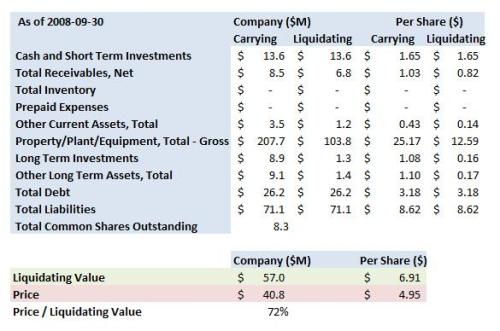
We started following BRN because its liquidation value of $55M (around $6.52 per share) was some 86% higher than its market capitalization of  $29M based on its November 28, 2008 close of $3.51. Dr. Eric Jackson’s Ironfire Capital LLC had launched a “‘friendly’ activist campaign targeting the company to unlock shareholder value”.

BRN has now filed its September 10Q and we believe that its liquidating value has increased from our original estimate of $6.52 per share to $6.91 per share, which is some 40% higher than its Friday close of $4.95. Set out below is our summary analysis of the balance sheet (each “Carrying” column shows the assets as they are carried in the financial statements, and each “Liquidating” column shows our estimate of the value of the assets in a liquidation):

brn-summary-q3

Conclusion

Although the stock has risen substantially, at 72% of its written down value, BRN is still cheap and we are maintaining our position.

[Disclosure: We do not presently have a holding in BRN. This is neither a recommendation to buy or sell any securities. All information provided believed to be reliable and presented for information purposes only.]

Read Full Post »

We’ve decided to exit our position in Kona Grill Inc (NASDAQ:KONA). We first posted about KONA on December 15, 2008 when the stock had last traded at $1.31. At Friday’s $2.46 close, our theoretical profit on the play of $1.15 equates to an absolute gain for holding KONA of 87.8%. The S&P 500 closed December 12, 2008 at 879.73 and closed Friday at 931.80 (+5.9%), so we’re up 81.9% on a relative basis.

We started following KONA because it was an undervalued asset situation with a potential acquirer – Mill Road Capital – raising its stake in the company through November last year. We’ve closed our position for two reasons:

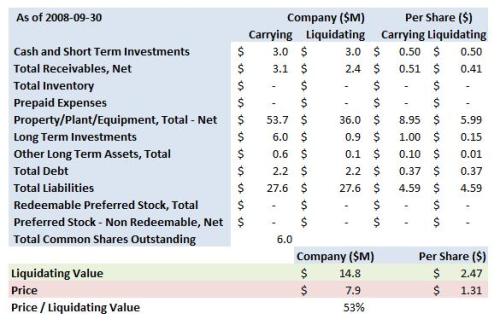
  1. KONA’s stock price has now risen to our estimate of its liquidating value of $14.8M or $2.47 per share. When we opened the position at $1.31 KONA had a market capitalization of just $7.9M, which meant it was trading at almost a 50% discount to its liquidating value. The discount is now gone, and that’s a good enough reason to close the position.
  2. KONA has entered into an agreement to issue stock to the CEO’s father at a $1.19 per share. The price is a substantial discount to the market price for KONA stock at the time of the agreement, the price KONA solicited from Mill Road Capital and the current market price. Behaviour like this – issuing stock at a discount to liquidation value when competing offers are available – raises red flags for us about KONA management’s lack of regard for KONA stockholders.

Our holding period for KONA was 18 days, which was unexpectedly short, and ended before Mill Road Capital was able to persuade KONA to undertake some catalytic event. We mentioned in our About Greenbackd page that the market would occasionally spontaneously recognize the underlying asset value and remove the discount, and that seems to have happened here. By any measure, an 88% return over 18 days is an excellent return, but we caution that it was a happy accident and is unlikely to be repeated.

Read Full Post »

Mill Road Capital has filed an amended 13D attaching a letter sent to Kona Grill Inc (NASDAQ:KONA). In the letter Mill Road Capital raises some concerns about the issuance of KONA stock to the CEO’s father at a substantial discount to the then current market price and the price that KONA solicited from Mill Road Capital in a December meeting. Mill Road Capital’s letter to KONA is set out below:

Marcus Jundt
Chairman & CEO
Kona Grill, Inc.
7150 East Camelback Road
Suite 220
Scottsdale, AZ 85251
Dear Marcus:

I am writing as a follow-up to our meeting on December 17, 2008. In that meeting which Rick Hauser attended, you outlined the following proposal:

•Mill Road Capital (“Mill Road”) would make a personal loan to Hauser and you for $6 million. This loan would be secured by Hauser’s and your personal assets including the stock in Kona Grill, Inc. (“Kona” or the “Company”).

•Hauser and you would use the $6 million to purchase 4 million newly issued shares of Kona at $1.50 per share.

•As compensation for making the loan, Mill Road would be allowed to buy 2 million newly issued shares of Kona at $1.50 per share, and Mill Road would be given one seat on the Board of Directors.

In that meeting, we rejected your proposal on two grounds. First, we believed it violated the Sarbanes-Oxley amendments to the Securities Exchange Act of 1934 prohibiting the Company from directly or indirectly arranging loans to management. We further rejected the proposal because it was not part of a competitive process that would ensure the highest value to the Company and all of its shareholders.

At the end of the meeting, we indicated that we would be willing to take part in any competitive process that the Company initiated in order to either raise funds or sell the Company. You noted that no such transactions would be completed before year end.

I note that in the 8-K filed by the Company yesterday, the Company said it had entered into a subscription agreement to sell shares to your father at $1.19 per share, a substantial discount to both the price of $1.50 per share that you solicited from us and the current market price of $1.57.

Mill Road Capital is the 2nd largest shareholder in the Company. We remain committed to seeing the Company undertake a fair and competitive capital raising process that would ensure the highest long-term value to all shareholders.

Is it your plan to subject that proposed transaction to the fully competitive process that we requested in the meeting on December 17th?

Sincerely,

Thomas Lynch
Senior Managing Director
Mill Road Capital L.P.

It seems that rather than undertake a fair and competitive capital raising process, KONA has issued stock to the CEO’s father, which is a disappointing outcome for KONA’s stockholders. The fact that the issuance was undertaken at such a discount to the prevailing market price for KONA stock raises a red flag for us.

Read Full Post »

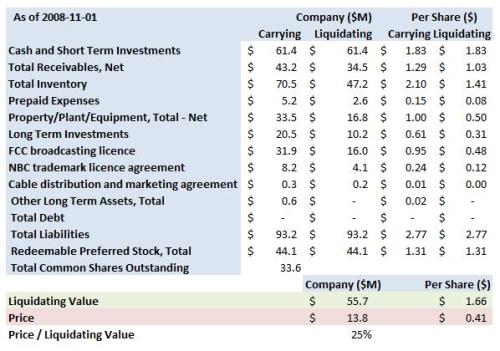
ValueVision Media Inc. (NASDAQ:VVTV), which we posted about on Wednesday last week, has filed its November 10Q. In our earlier post, we wrote that VVTV seemed to us to be one of the better opportunities available because it’s a net net stock (i.e. a stock trading for less than its net current assets) with other valuable assets and noted activist investor Carlo Cannell of Cannell Capital has an activist position in it. The company also seemed to us to be taking steps to realise that value, publicly announcing that it has appointed a special committee of independent directors to “review strategic alternatives to maximize stockholder value.” The strategic alternative the company was pursuing was an auction that the company expected to complete by February 2, 2009. At $1.66 per share, VVTV’s liquidating value is still some 300% higher than its close yesterday of $0.41, which should provide a good margin of safety until the auction can be completed.

Updated value proposition

When we first looked at the company we wrote that we estimated its liquidating value, which included its property, FCC broadcasting licence, NBC trademark licence agreement and the Cable distribution and marketing agreement, at around $2.23 per share. We now see that value lower at $1.66 per share due to the increase in liabilities from $74M to $94M, which equates to an increase of $0.57 per share. Set out below is our updated summary analysis (the “Carrying” column shows the assets as they are carried in the financial statements, and the “Liquidating” column shows our estimate of the value of the assets in a liquidation):

vvtv-summary-q3-update

At its close of $0.41, VVTV is trading at 25% of its liquidating value.

The Catalyst

Given the substantial deterioration in the company’s liquidating value in the last quarter (and in the last few years), we were expecting an update on the auction, which the company has not provided in this 10Q. The company has simply restated its earlier disclosure almost verbatim:

On September 11, 2008, our board of directors announced that it had appointed a special committee of independent directors to review strategic alternatives to maximize shareholder value. The committee currently consists of three directors: George Vandeman, who serves as the committee’s chairman, Joseph Berardino and Robert Korkowski. The special committee retained Piper Jaffray & Co., a nationally-recognized investment banking firm, as its financial advisor. There can be no assurance that the review process will result in the announcement or consummation of a sale of our company or any other strategic alternative.

The company removed the final sentence from the last disclosure:

We do not intend to comment publicly with respect to any potential strategic alternatives we may consider pursuing unless or until a specific alternative is approved by our board of directors.

This may have been removed because Mr. George Vandeman, chairman of VVTV’s special committee of independent directors charged with administering the stategic review, made public statements that VVTV has received bids from a number of companies and instructed its advisers to invite several of the proposed buyers to take part in the next phase of the process.

There have been no further public statements from Cannell Capital. We will provide an update if one is made.

Conclusion

Provided that management will sell the company in the auction process if it receives a sensible bid, this still seems to us to be one of the better opportunities available in the market. Although it has deteriorated since the last 10Q, at $1.66 per share, VVTV’s liquidating value is still some 300% higher than its close yesterday of $0.41. Cannell Capital has previously publicly stated that he sees the value as high as $5.98 per share. The company seems to be taking steps to realise that value through an auction that it expects to complete by February 2, 2009. Any investor intending to take a position should bear in mind the company’s disclosure that “there can be no assurance that the review process will result in the announcement or consummation of a sale of our company or any other strategic alternative.”

VVTV closed yesterday at $0.41.

The S&P 500 Index closed yesterday at 913.18.

[Disclosure: We have a holding in VVTV. This is neither a recommendation to buy or sell any securities. All information provided believed to be reliable and presented for information purposes only.]

Read Full Post »

Kona Grill Inc (NASDAQ:KONA) is an undervalued asset situation with a potential acquirer raising its stake in the company through November. Mill Road Capital made a cash offer in March to acquire KONA for $10.75 when the stock was trading at around $8.76. Since the offer was rebuffed by KONA in April the stock has slumped 85% to close yesterday at $1.31. Mill Road Capital has continued to buy stock, raising its stake to 10% in November from 8.2% in June. At $1.31, KONA has a market capitalization of just $7.9M. We estimate that its assets in liquidation are worth around $14.8M or $2.47 per share. With KONA trading at a discount of nearly 50% to its liquidating value and Mill Road Capital continuing to buy stock, we believe it is an attractive opportunity.

About KONA

KONA owns and operates 18 restaurants located in 12 states in the United States. The restaurants feature a selection of mainstream American dishes, as well as a range of appetizers and entrees with an international influence, including a selection of sushi. The menu items also incorporate over 40 signature sauces and dressings that Kona Grill makes from scratch, creating appeal for the lifestyle and taste trends of a diverse group of guests. The menu offerings are complemented by a full service bar offering an assortment of wines, specialty drinks and beers. Effective September 14, 2008, the Company closed its restaurant in Naples, Florida. KONA’s investor relations website is here.

The value proposition

According to the most recent 10Q, KONA has been consistently generating positive cash flow from operating activities. In the year ending December 31, 2007, the company generated $5.7M and has continued to generate positive operating cash flow each quarter for the last year. The company continues to consume cash, however, as it invests in new restaurants. While we believe that KONA has value as a going concern, our analysis demonstrates that the market is pricing its stock  at a substantial discount to its liquidating value (the “Carrying” column shows the assets as they are carried in the financial statements, and the “Liquidating” column shows our estimate of the value of the assets in a liquidation):

kona-summaryKONA’s value lies in its restaurants, carried on the balance sheet in its $53.7M in net property, plant and equipment. Discounting that figure by a third to $36M equates to $5.99 per share in value. Deducting all liabilities from the discounted assets leaves a liquidating value of around $14.8M or $2.47 per share.
The catalyst

Mill Road Capital is seeking to take KONA private. This 13D filing details Mill Road Capital’s investment thesis for KONA:

[Mill Road Capital] acquired shares of the Common Stock based on their belief that the Common Stock represents an attractive investment opportunity. [Mill Road Capital] further believe that [KONA] would be better able to realize its full value as a private entity.

On March 28, 2008, Mill Road Capital sent to Kona a non-binding offer to acquire all of KONA at a cash price of $10.75 per share:

Re: Notice of Acquisition Proposal

Ladies and Gentlemen:

Mill Road Capital, L.P. (“Mill Road”) is a substantial shareholder of Kona Grill, Inc. (“Kona” or the “Company”), currently owning approximately 325,000 shares or 4.9% of the Company. Mill Road has closely followed Kona since 2006, and we are extremely impressed with management and the Company. We believe that the public market does not adequately value small companies such as Kona, and by staying public, the Company will continue to be subject to undue regulatory burdens and pressure to maximize short-term results at the expense of long-term performance. We believe Kona will be better able to realize its full potential value as a private entity and are, therefore, making an offer to acquire all of the outstanding shares of the Company.

Mill Road is pleased to submit a non-binding offer to acquire all shares of the Company’s stock at a cash price of $10.75 per share. This represents a 23% premium to the closing price of $8.76 as of March 27, 2008. We would anticipate that the transaction would be accomplished through a merger of a company organized by Mill Road with and into the Company, as a result of which all stockholders of the Company would be entitled to this cash consideration.

Mill Road is a Greenwich, Connecticut based investment firm with approximately $250 million of committed equity capital. Our limited partners include a prominent and highly respected group of state pension funds, foundations, endowments and insurance companies. The investment professionals of Mill Road are a core group of former Blackstone professionals who have successfully completed more than 20 control transactions in which more than $600 million of equity capital was deployed with total transaction value of several billion dollars. Additionally, we have significant industry experience as a substantial investor in many public restaurant companies and through my position on the Board of Directors of Panera Bread Co. (NASDAQ: PNRA) from 2003 to 2006.

Our industry and transaction experience will allow us to quickly complete due diligence and definitive documentation. Considering the amount of our investable capital, Mill Road can readily fund the entire transaction contemplated by this acquisition proposal.

We are prepared to commence negotiations immediately with respect to this acquisition proposal and wish to close this transaction as soon as possible. We look forward to the opportunity to discuss our proposal in more detail with the Board of Directors and management. It would be our pleasure to meet in person at a location of your choice.

You may contact me directly at (203) 987-3501. I look forward to discussing our proposal at your earliest convenience.

Sincerely,
Mill Road Capital L.P.

By: Mill Road Capital GP LLC
Its General Partner

By:

Thomas Lynch
Senior Managing Director

KONA responded to Mill Road Capital on April 18, 2008 indicating that the letter had been distributed to KONA’s board for discussion at its next board meeting. On May 1, 2008, KONA told Mill Road Capital that it was not interested in pursuing the transaction.

Mill Road Capital has continued to purchase KONA stock, paying between $1.85 and $6.91 according to the latest amendment to their earlier 13D. As of November 14, 2008, Mill Road Capital controlled 10% of KONA.

Conclusion

KONA is an undervalued asset situation with a catalyst in the form of a potential takeover from Mill Road Capital. Given the deterioration in KONA’s stock price since the rejection of Mill Road Capital’s initial bid, we would not expect Mill Road Capital to offer $10.75 again. We do believe, however, that any bid would be at a premium to the current stock price. If we are wrong and a bid does not materialize from Mill Road Capital or some other acquirer, the down side should be limited because KONA is already trading at a substantial discount to its value in a liquidation.

KONA closed Friday at $1.31.

The S&P 500 closed Friday at 879.73.

[Disclosure: We do not presently hold KONA.  This is neither a recommendation to buy or sell any securities. All information provided believed to be reliable and presented for information purposes only.]

Read Full Post »

A stock buy-back is a great way for a deeply undervalued company to quickly increase its per share value. After identifying an undervalued asset situation, we look through the company’s filings to see if it has any existing plans authorizing it to buy-back its stock. On the rare occasions when we do locate such plans, we are often struck by (a) how few shares the company is authorized to buy back and (b) how few of the shares the company has actually bought back. InFocus Corporation (NASDAQ:INFS), which we posted about on Friday, is a classic example of this phenomenon.

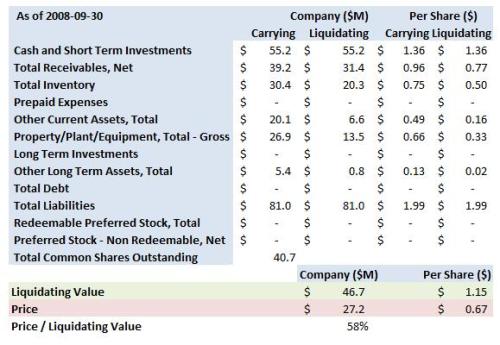
INFS is trading at a big discount to its liquidation value, it has heaps of cash on hand and no debt, all of which makes it a prime candidate to undertake a big buy-back. Given the substantial discount to its current asset backing, any shares bought back at these levels have a huge positive effect on its per share value. It has just initiated a buy-back plan to repurchase over a three-year period up to 4M shares out of 40.7M on issue. As of September 30, the company had repurchased only 50,000 shares at an average price of $1.53 per share. 50,000 shares is simply too little to have any meaningful impact on the company’s value. We’d argue that even 4M (less than 10% of the outstanding common stock) isn’t enough. Why? Let’s look at what happens if the company repurchases many more shares, say 50% of its issued stock.

In our last blog post, we argued that INFS had a liquidation value of around $1.15 per share, 70% higher than its Friday close of $0.67. The company has cash and equivalents of around $55M and no debt as the summary financials demonstrate (the “Carrying” column shows the assets as they are carried in the financial statements, and the “Liquidating” column shows our estimate of the value of the assets in a liquidation):

Before

before-infs-summary

After

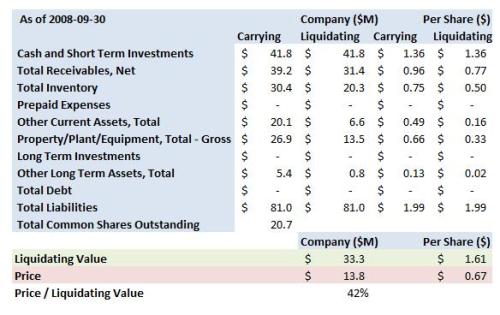
If INFS was to repurchase 50% of its stock (20M of its 40.7M shares currently on issue) at $0.67, it would cost INFS only $13.4M, leaving it with nearly $42M in cash on hand:

after-infs-summaryAfter the buy back, INFS’s per share liquidating value increases from $1.15 to $1.61 (a 40% increase).

There are very few investment opportunities that so quickly increase a company’s per share value. Given that management should know the company’s value better than the value of any other investment opportunity, it is also the most assured way of increasing a company’s per share value. There is simply no better way for an undervalued company to invest its excess cash than in its own stock.

Read Full Post »

« Newer Posts - Older Posts »