Feeds:
Posts
Comments

Posts Tagged ‘Liquidating Value’

MathStar Inc (OTC:MATH) has taken the first steps to liquidation, announcing that it is preparing to sell its Field Programmable Object Array (FPOA) technology and intellectual property.

We started following MATH in December last year when it was trading at $0.68 because it was a net cash stock with a substantial stockholder lobbying management to liquidate. The stock is up 29.4% to $0.88 yesterday, giving it a market capitalization of $8.1M. We estimate MATH’s liquidation value still to be around 80% higher at $14.8M or $1.57 per share. That value is predominantly cash and short term investments and doesn’t take into account any further value that the sale of the FPOA technology and intellectual property may yield. Two activist investors, Mr. Salvatore Muoio of S. Muoio & Co. and Mr. Zachary McAdoo of The Zanett Group, have been urging MATH’s board to consider liquidation rather than a merger. MATH’s board seems to agree, twice rejecting unsolicited merger proposals, suspending the company’s operations and exploring “strategic alternatives, which could include merger, acquisition, increasing operations in another structure or liquidation.”

The company’s announcement of the sale of the technology and intellectual property is as follows:

COLORADO SPRINGS, Colorado – January 26, 2009 – Core Capital’s Electronics and Semiconductor Group (ESG), an investment banking firm with an electronics and semiconductor focus, announces that its client, MathStar, Inc. (OTC: MATH), has prepared its technology for purchase. MathStar, a fabless semiconductor company specializing in high-performance programmable logic, is finalizing its Field Programmable Object Array (FPOA) technology and intellectual property package for sale. Arrangements have been prepared to assist prospective buyers to evaluate the opportunity, including a webinar, a private “data room” web portal, and access to key creators of the technology.

MathStar began its sales efforts in early October 2008, when it signed with the Core Capital Electronics and Semiconductor Group to complete a strategic sale of MathStar’s technology and intellectual property.

[Disclosure: We do not presently have a holding in MATH. This is neither a recommendation to buy or sell any securities. All information provided believed to be reliable and presented for information purposes only.]

Read Full Post »

Wesley Gray, who occasionally drops by here to provide some high quality commentary, has launched his maiden hedge fund, “Empirical Search Strategies.”

The fund follows a “long-biased micro-cap equity strategy,” which means it invests in “special situations opportunities such as liquidations and companies selling for less than cash value.” Sounds like a good strategy to us.

The fund is down 12.56% since its September launch, which compares favorably with the performance of the Russell 2000 Index (down more than 39% during the same period).

Gray is completing his Ph.D. at the University of Chicago Booth School of Business.

You can read more about Gray’s strategy in the FinAlternatives article Ten Hut! Ex-Marine Launches Long/Short Hedge Fund or Gray’s own website Empirical Finance Research Blog.

Congratulations, Wes. We hope to see you here more often.

Read Full Post »

Walter Schloss might be one of Benjamin Graham’s lesser-known disciples, but to Warren Buffett, perhaps Graham’s most famous disciple, Schloss is a “superinvestor.” In The Superinvestors of Graham-and-Doddsville, an article based on a speech Buffett gave at Columbia Business School on May 17, 1984 and appearing in Hermes, the Columbia Business School magazine, Buffett said of Schloss:

Walter never went to college, but took a course from Ben Graham at night at the New York Institute of Finance. Walter left Graham-Newman in 1955 and achieved the record shown here over 28 years.

Here is what ‘Adam Smith’ – after I told him about Walter – wrote about him in Supermoney (1972):

He has now connections or access to useful information. Practically no on in Wall Street knows him and he is not fed any ideas. He looks up the numbers in the manuals and sends for the annual reports, and that’s about it.

Walter has diversified enormously, owning well over 100 stocks currently. He knows how to identify securities that sell at considerably less than their value to a private owner. And that’s all he does. He doesn’t worry about whether it’s January, he doesn’t worry about whether it’s Monday, he doesn’t worry about whether it’s an election year. He simply says, if a business is worth a dollar and I can buy it for 40 cents, something good may happen to me. And he does it over and over and over again. He owns many more stocks than I do – and is far less interested in the underlying nature of the business; I don’t seem to have very much influence on Walter. That’s one of his strengths; no one has much influence on him.

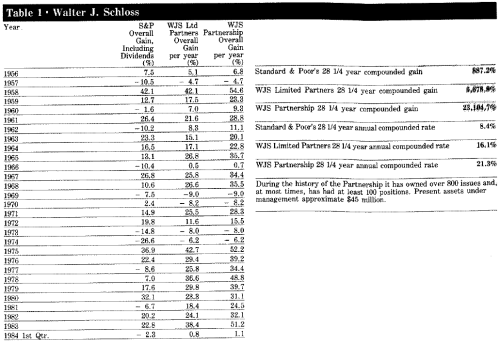
This is Schloss’ record, extracted from Buffett’s article (click to go the article for the full-size table on page 7):

walter-schloss-record1

Over 28 1/4 years between 1955 and the first quarter of 1984 (when Buffett wrote the article), WJS Limited Partners returned 5,678.8% and in the WJS Partnership returned an astonishing 23,104.7%. Annualised, that’s 16.1% in WJS Limited Partners and 21.3% in the WJS Partnership. Both dwarf the S&P’s gain of 887.2% or 8.4% annually over the same period.

Fast forward 24 years to a February 2008 Forbes article titled, Experience:

Although he stopped running others’ money in 2003–by his account, he averaged a 16% total return after fees during five decades as a stand-alone investment manager, versus 10% for the S&P 500–Schloss today oversees his own multimillion-dollar portfolio with the zeal of a guy a third his age.

The Experience article highlights a few things about Schloss that we really like (mostly because they coincide with Greenbackd’s views on investing). First, he’s an asset investor:

“Most people say, ‘What is it going to earn next year?’ I focus on assets. If you don’t have a lot of debt, it’s worth something.”

Schloss had earlier discussed his preference for assets over earnings at the New York Society of Security Analysts (NYSSA) dedication of the Value Investing Archives in November 2007 (from the article NYSAA Value Investing Archive Dedication: Walter Schloss by Peter Lindmark):

“We try to buy stocks cheap.” His investment philosophy is based on equities which are quantitatively cheap and he often holds over 100 securities. Although he expounds that, “Each one is different. I don’t think you can generalize……But I think you just have to look at each situation on its own merits and decide whether it’s worth more than its asking price.” He prefers to buy assets rather than earnings. “Assets seem to change less than earnings.”

Second, as Buffett pointed out in his article, he’s not particularly interested in the nature of the business:

Schloss doesn’t profess to understand a company’s operations intimately and almost never talks to management. He doesn’t think much about timing–am I buying at the low? selling at the high?–or momentum.

Lindmark’s article also notes Schloss’ disinterest in the underlying business:

Mr. Graham simply did not care, and tried to purchase securities strictly on a quantitative basis. Mr. Schloss advocated buying decent companies with temporary problems. He stated, ” Warren understands businesses – I don’t. We’re buying in a way that we don’t have to be too smart about the business….”

Finally, we have to admit that we admire Schloss’ gentlemanly approach to running his business:

Typical work hours when he was running his fund: 9:30 a.m. to 4:30 p.m., only a half hour after the New York Stock Exchange’s closing bell.

You can see Schloss speaking here at the Ben Graham Center For Value Investing, Richard Ivey School of Business. Our favorite line:

If this doesn’t work, we can always liquidate it and get our money back.

Read Full Post »

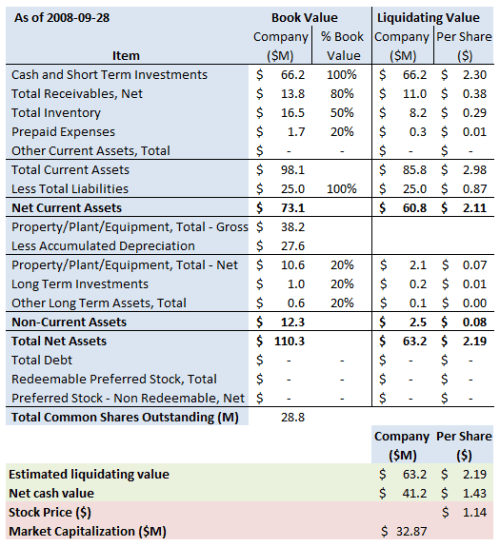
Ikanos Communications Inc (NASDAQ:IKAN) is a net cash stock that has retained a financial advisor to “assist it in exploring and evaluating strategic alternatives to maximize shareholder value.” IKAN closed yesterday at $1.14, giving it a market capitalization of $32.9M. Based on its September 10Q, we estimate the company’s liquidating value to be more than 90% higher at $63.2M or $2.19 per share. IKAN’s liquidating value is predominantly cash, and it has a net cash value of $41.2M or $1.43 per share. With a deeply undervalued stock and a board and management taking proactive steps to realise the value, we think IKAN presents a good investment opportunity.

About IKAN

IKAN is a developer and provider of semiconductors and silicon and software solutions for “interactive triple-play broadband.” Its customers consist primarily of original design manufacturers (ODM), contract manufacturers and original equipment manufacturers (OEMs), such as NEC Corporation, Sagem Communications, Uniquest Corporation and Altima. Its customers include Alcatel-Lucent, Dasan Networks, Inc., Innomedia, Inc. and Millinet Co., Ltd. The company’s investor relations website can be found here.

The value proposition

As its September 10Q demonstrates, IKAN’s income statement is a horror show. The company has consistently generated losses for the last five quarters. IKAN’s balance sheet has some value (the “Book Value” column shows the assets as they are carried in the financial statements, and the “Liquidating Value” column shows our estimate of the value of the assets in a liquidation):

ikan-summary

$66.2M of IKAN’s $85.8M current asset value is in cash. After deducting total liabilities of $25M, we estimate IKAN’s net current asset value at $60.8M, and its liquidating value at $63.2M or $2.19 per share. IKAN’s net cash value is $41.2M or $1.43 per share.

Contractual commitments and Off-balance sheet arrangements

According to the September 10Q, IKAN does not use off balance sheet arrangements with unconsolidated entities or related parties, nor does it use other forms of off balance sheet arrangements such as special purpose entities and research and development arrangements. Its liquidity and capital resources are not subject to off balance sheet risks from unconsolidated entities. IKAN leases office facilities, equipment and software under “non-cancelable” operating leases. Its contractual obligations as of September 28, 2008 are around $4.7M in total. In the normal course of business, IKAN provides indemnifications of varying scope to customers against claims of intellectual property infringement made by third parties arising from the use of our products. Historically, costs related to these indemnification provisions have not been significant, but IKAN is unable to estimate the maximum potential impact of these indemnification provisions on its future consolidated results of operations.

The catalyst

The company disclosed in its September 10Q that it has retained investment bankers to advise the board about IKAN’s strategic options:

We recently decided to retain Barclays Capital (formerly Lehman Brothers) to provide financial advice regarding potential strategic options for the Company. Such options include, without limitation, financing transactions, acquisitions, strategic partnerships, corporate restructuring and other activities. There can be no assurance that the evaluation of our options will result in the identification, announcement or consummation of any transaction. If the Board of Directors does decide to authorize a transaction, that decision could cause significant volatility in the price of the Company’s outstanding common stock. Moreover, any transactions we do sign may not be acceptable to our stockholders. In addition, our investigation of strategic options may result in added costs, potential loss of customers and key employees as well as management’s distraction from ordinary-course business operations.

There seems to be some appetite for acquisitions in this industry. IKAN competitor Centillium Communications Inc (NASDAQ: CTLM) was acquired in October last year.

Conclusion

At $1.14, IKAN is trading at a little over half its liquidating value of $2.19 per share. With the board proactively seeking a new strategic direction, which might include “financing transactions, acquisitions, strategic partnerships, corporate restructuring and other activities,” we think there’s a good chance that IKAN can realise at least its liquidating value. We’re adding IKAN to the Greenbackd Portfolio.

IKAN closed yesterday at $1.14.

The S&P500 Index closed yesterday at 836.57.

Hat tip to Steven Lobo.

[Full Disclosure:  We do not have a holding in IKAN. This is neither a recommendation to buy or sell any securities. All information provided believed to be reliable and presented for information purposes only. Do your own research before investing in any security.]

Read Full Post »

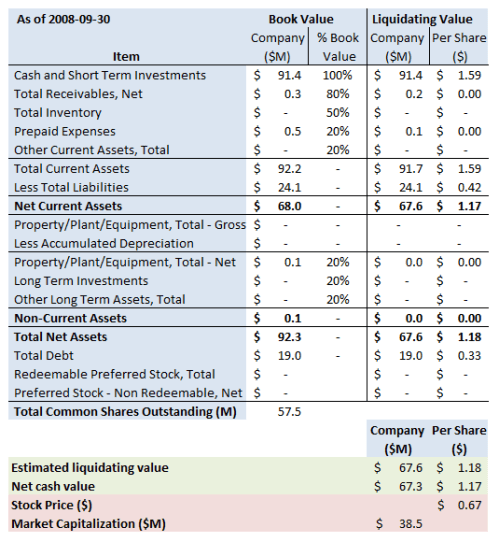
CuraGen Corporation (NASDAQ:CRGN) is a net cash stock with an investor, DellaCamera Capital Management, disclosing a 5.6% holding in a 13D filed on January 15. At its $0.67 closing price Friday, CRGN’s market capitalization is $38.5M. We estimate CRGN’s net cash value to be 60% higher at $62M or $1.07 per share. The company is not generating any operating cash flow as it is a “biopharmaceutical development company,” so the challenge for DellaCamera Capital Management is to persuade the company to pay a special dividend or liquidate before it dissipates its remaining cash.

About CRGN

CRGN is a biopharmaceutical development company engaged in developing cancer treatments. It also has a portfolio of earlier stage assets, including proteins, antibodies and small molecules that represent potential treatments for cancer. The company’s investor relations website is here.

The value proposition

As a “biopharmaceutical development company” CRGN is burning cash in development and not generating any income or operating cash flow. Its value lies in its present $67M net cash position (the “Book Value” column shows the assets as they are carried in the financial statements, and the “Liquidating Value” column shows our estimate of the value of the assets in a liquidation):

crgn-summary

CRGN’s $91.4M in cash and cash equivalents consists of $7.4M in cash, $40.4M in short-term investments and $43.6M in marketable securities.

Off-balance sheet arrangements and Contractual obligations

According to CRGN’s most recent 10Q, the company does not have any off-balance sheet arrangements. Its enforceable and legally binding obligations, along with future commitments related to all contracts that it is likely to continue, regardless of the fact that they are “cancelable as of September 30, 2008,” excluding those captured in the financial statements, are around $5.5M through 2011.

Deducting the $5.5M from the $67.6M in net assets leaves around $62M in liquidation value or $1.07 per share.

The catalyst

DellaCamera Capital Management filed a 13D notice on January 15 disclosing a 5.6% holding in CRGN. The filing is silent as to DellaCamera Capital Management’s purpose for the CRGN investment beyond the usual other than the following:

[DellaCamera Capital Management] intend to make themselves available to [CRGN] to discuss methods of delivering additional value to [CRGN]’s shareholders, including the possible alternative deployment of [CRGN]’s capital. [DellaCamera Capital Management] may seek board representation to assist in this endeavor.

Hopefully DellaCamera Capital Management can find an “alternative deployment of [CRGN]’s capital” before the company burns through its remaining cash.

Conclusion

As a net cash stock, CRGN’s current liquidating value is relatively easy to determine. At $0.67, CRGN’s liquidating value is around 60% higher at $1.07 per share. The more difficult step is to determine the liquidating value of the company if and when DellaCamera Capital Management is successful. We think that 60% is a substantial margin of safety for CRGN and so we are adding it to the Greenbackd Portfolio.

CRGN closed Friday at $0.67.

The S&P500 Index closed Friday at 850.12.

[Full Disclosure:  We do not have a holding in CRGN. This is neither a recommendation to buy or sell any securities. All information provided believed to be reliable and presented for information purposes only. Do your own research before investing in any security.]

Read Full Post »

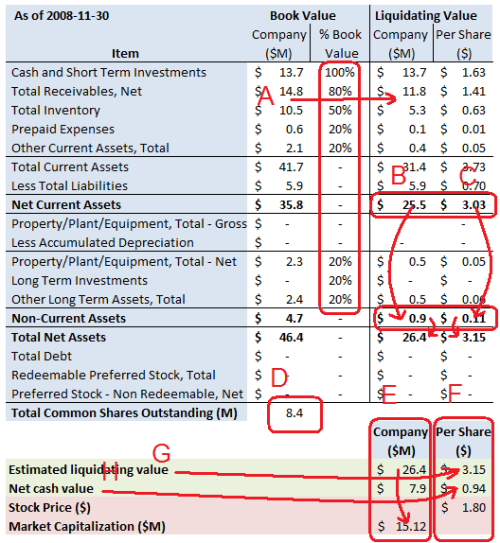
We are trialing a change to our summary presentation of company financial statements. The new summaries will look like this (this is our summary balance sheet for Aehr Test Systems (NASDAQ:AEHR) – it’s cheap but there’s no catalyst):

aehr-summary-changes

A brief explanation of the various changes:

  1. A. shows the carrying value of the receivables ($14.8M), our estimate for the percentage of carrying value the receivables will yield in liquidation (80%), the liquidating value ($11.8M) and the liquidating value per share ($1.41).
  2. B. shows the net current asset value ($25.5M), which, when added to the non-current asset value ($0.9M), gives the liquidating value for the company ($26.4M).
  3. C. is the same calculation as B. but on a per share basis: the net current asset value per share ($3.03), which, when added to the non-current asset value per share ($0.11), gives the liquidating value per share ($3.15).
  4. D. is the amount of stock the company has on issue.
  5. E. shows the liquidating value of the company ($26.4M), the net cash value of the company ($7.9M) and the market capitalization ($15.12M). In this instance, the company is trading at approximately 60% of our estimate of its liquidation value.
  6. F. shows the same amounts as E. on a per share basis against the stock price.
  7. G. and H. are the estimated liquidating value on a company and per share basis, and the net cash value on company and per share basis.

We’re keen to hear what you think of the changes. We think it presents the discount applied to the carrying values and the net current asset values more clearly than the previous summaries.

Read Full Post »

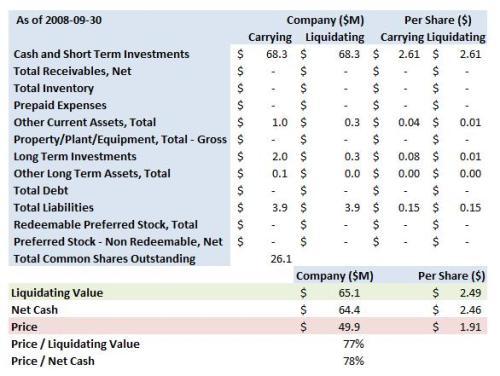
Northstar Neuroscience Inc (NASDAQ:NSTR) is a net cash stock that has announced that it plans to liquidate. NSTR closed yesterday at $1.91, giving it a market capitalization of $50M. We estimate its net cash value to be around 30% higher at $2.49 or $65.1M. The final pay out figure in the liquidation will be slightly lower. We estimate that figure at around $59.1M or $2.26 per share, which presents an upside of around 18%. The liquidation is still subject to stockholder approval and the upside isn’t huge, but NSTR presents a reasonable prospect for a good return in a short time frame.

About NSTR

The company’s most recent filing in relation to the liquidation attaches the following press release:

Northstar Neuroscience, Inc., (NASDAQ:NSTR), a medical device company developing therapies for the treatment of major depressive disorder, today announced that its Board of Directors has determined, in its best business judgment after consideration of potential strategic alternatives, that it is in the best interests of the Company and its shareholders to liquidate the Company’s assets and to dissolve the Company. The Company’s Board of Directors has approved a Plan of Complete Liquidation and Dissolution of the Company (the “Plan”), subject to shareholder approval. The Company intends to hold a special meeting of shareholders to seek approval of the Plan and will file related proxy materials with the Securities and Exchange Commission (“SEC”) in the near future. Prior to the special meeting the Company will reduce its headcount to a limited number of employees who will assist in the termination of operations.

The Plan contemplates an orderly wind down of the Company’s business and operations. If the Company’s shareholders approve the Plan, the Company intends to file articles of dissolution, satisfy or resolve its remaining liabilities and obligations, including but not limited to contingent liabilities and claims, ongoing clinical trial obligations, lease obligations, severance for terminated employees, and costs associated with the liquidation and dissolution, and make distributions to its shareholders of cash available for distribution, subject to applicable legal requirements. Following shareholder approval of the Plan and the filing of articles of dissolution, the Company would delist its common stock from NASDAQ.

The value proposition

As the press release mentions, NSTR is being wound down. The September 10Q shows value on the balance sheet  (the “Carrying” column shows the assets as they are carried in the financial statements, and the “Liquidating” column shows our estimate of the value of the assets in a liquidation):
nstr-summary

NSTR’s value is predominantly cash and short-term investments in the amount of $68.3M or $2.61 per share. With total liabilities of only $3.9M or $0.15 per share, NSTR had a net cash value in September of around $64.4M or $2.46 per share. If we assume that NSTR used around $4M in cash last quarter and it costs circa $2M to wind up the company, we estimate it will pay out around $59.1M or $2.26 per share.

The Catalyst

NSTR was prompted to liquidate at the urging of RA Capital Management, which sent the following letter (annexed to its last 13D filing) to the company on December 15 last year:

Board of Directors
c/o Alan Levy, Ph.D., Chairman of the Board
Northstar Neuroscience, Inc.
2401 Fourth Avenue, Suite 300
Seattle, Washington 98121

Dear Members of the Board of Directors:

We continue to be shocked and frustrated by the complete lack of response from Northstar Neuroscience, Inc. (the “Company” or “Northstar”) to the several options it has to preserve and return value to its stockholders. As you know, we sent a letter to each of you on July 14, 2008, in which we outlined a reasonably detailed proposal on how the Company could stop its hemorrhaging of cash, provide a distribution to its stockholders, and sell its remaining assets for as much value as possible. Since July, the Company’s stock, which was then trading at an astonishing 30% discount to its cash balance per share, has fallen by nearly 50% and continues to trade at an even more appalling 60% discount from its cash balance per share. Although you have refused to return capital to shareholders, you have put forth no viable business plan for the Company. It would seem that some of you remain content to pay yourselves salaries from cash that belongs to stockholders while contributing nothing of any positive value in return.

While we acknowledge that you have recently taken some steps to reduce expenses, we reiterate that now is not the time for half-measures. Your reduction of expenses slows value destruction but does not permit the recovery of shareholder value reflected in the Company’s cash balance. If your strategy is to arrange for a white knight to acquire the Company at a premium to cash, that is not a strategy but more like hope and a prayer given the current economic environment and market circumstances. The credit crisis and market collapse we have witnessed since July have made investors and companies much less willing to pay for all but the most valued of strategic assets. The Company’s failed programs hardly qualify as strategic assets; in fact, the market has clearly assigned them a negative enterprise value (approximately -$1.40/share, which offsets $2.40/share in cash to yield the current $1.00/share for the stock). The only asset of value that the Company possesses is its cash; this asset should not be wasted and ought to be returned to shareholders as soon as possible that they might invest it more profitably.

Our July 14, 2008 letter speaks for itself and your silence, inaction, and inability to offer any other options are increasingly alarming. Any options you might have thought you had in July have since disappeared. We also want to make clear that any attempt by you to merge or otherwise combine with any other public or private company, thereby inflating the enterprise value of the combined entity without increasing the share price for your existing stockholders, would further erode any potential value in Northstar shares that could be realized through a cash dividend or share buyback. If a merger or acquisition of another company or asset were put to a stockholder vote, we would vote against such a proposal and believe that other stockholders would likely prefer to have their capital returned to them.

We again urge you to make a distribution or dividend to your stockholders as soon as possible, preferably announcing your intention to do so prior to the end of the year. We believe that most investors have realized losses this year and that a large cash dividend would likely not have significant tax consequences for most investors. Alternatively, we urge you to craft and implement a share buy-back program, which would also have the effect of raising the share price and allowing stockholders the opportunity to salvage some of the value of their investment, possibly more tax efficiently than via a dividend. If you indeed feel that the long term prospects for the Company are good, then buy-out any stockholders who do not share your same view. Again, we expect you to take prompt action, including making a decision on these matters prior to the end of the year.

If you do not wish to take any of the actions outlined above because you have doubts about whether doing so is in the best interests of the stockholders, then we urge you to call a Special Meeting of the stockholders and simply ask your stockholders directly. After all, you owe fiduciary duties to your stockholders and they continue to see the value of their investment decline in the face of your inaction.

Alan J. Levy, you are the Chairman of the Board of Directors and therefore hold a leadership position alongside John S. Bowers, Jr., making you particularly responsible for the direction of this company. However, we also specifically recognize the role that each of the members of the board play. Susan K. Barnes, you have a responsibility to speak out against the waste of shareholder capital. Michael Ellwein, your position with Three Arch and history at Medtronic would suggest that you have not always made a career of value destruction, so we can hardly imagine that you are comfortable letting it happen at Northstar, and yet the situation continues to deteriorate. Albert J. Graf, you must be frustrated about the lack of any results from the Company’s management, and yet have you done all that you can to protect shareholders from management’s poor judgment? Robert E. McNamara, as a career CFO who ought to have an appreciation for fiscal responsibility, you are permitting Northstar’s disrespect for its shareholder’s capital to continue to the detriment of your professional reputation. Dale A. Spencer, you have had a long relationship with the Company, since 1999, but you are also a private investor, and we have to believe that some part of you is disgusted by the idea of Northstar management continuing to collect generous salaries while running an enterprise that the market has valued well below zero for nearly a year. Carol D. Winslow, what should the investors whose capital you manage at Channel Medical Partners LP conclude about your acumen and values as a business person if you continue to sit passively by while Northstar’s management transfers the wealth of its investors into the bank accounts of its executives without creating any positive equity value whatsoever? How long will each of you allow this to continue? We urge you to immediately solve this problem once and for all.

We recognize that shareholders of the Company have little influence; you have the safety of a staggered board and Washington state laws of incorporation, which make a travesty of corporate governance and fiduciary duty. Shareholders can only hope that you have the decency to give them a chance to express their wishes to you formally if you will not take immediate action to protect the value of their investment in the Company through a dividend or share buyback. While you certainly have challenged our notion that boards represent the interests of the shareholders, we remain optimistic that, with some persistence, shareholders can prevail on even the most intransigent management and board to listen to their concerns and protect their investment or personally pay back shareholders for what, in our opinion, is a gross dereliction of fiduciary duty.

Unless we hear from you by Friday, December 19, 2008, that you intend either to take the actions urged above or call a Special Meeting of the stockholders as urged above, then we intend to submit and vigorously pursue shareholder proposals for your next annual meeting. These proposals will, among other things, seek input from your stockholders on the issue of a distribution or dividend and/or share buy-back program and will put forth a slate of new candidates to be elected to your board of directors at that meeting.

We intend to pursue our interests here aggressively, both for our benefit and hopefully for the benefit of all stockholders, including preserving our right to take legal action against you and the Company.

Sincerely,

RA Capital Healthcare Fund, L.P.
By: RA Capital Management, LLC, its general partner

Peter Kolchinsky
Managing Member

The board has now agreed to put the proposal to liquidate to NSTR stockholders. We won’t know management’s estimate for the likely distributions until NSTR files the Plan of Complete Liquidation and Dissolution of the Company in anticipation of the special meeting of stockholders. As NSTR’s value is predominantly in cash and short-term investments, the liquidation should be a relatively straight-forward exercise.

Conclusion

At $1.91, NSTR is trading at an 18% discount to our $2.26 estimate of its distributions in the proposed liquidation. We will have a better estimate for the likely distribution when the company files its Plan of Complete Liquidation and Dissolution of the Company. While the upside isn’t huge, and there is still some small risk that the plan will not be approved by stockholders, we think NSTR presents a reasonable prospect for a good (but not great) return in a short time frame.

NSTR closed yesterday at $1.91.

The S&P500 Index closed yesterday at 843.74.

Hat tip to commenter manny for the tip.

[Full Disclosure:  We do not have a holding in NSTR. This is neither a recommendation to buy or sell any securities. All information provided believed to be reliable and presented for information purposes only. Do your own research before investing in any security.]

Read Full Post »

We’ve recently received several questions about our valuation methodology. Specifically, readers have asked why we include property, plant and equipment in our valuation, and why we only discount it by half, as opposed to a higher figure (two-thirds, four-fifths, one-hundred percent). They are concerned that by including property, plant and equipment in our assessment, or by failing to apply a sufficient discount to those assets, we are overstating the asset or liquidation value of the companies we cover and therefore overpaying for their stock. In this post, we better describe our approach to asset valuation. In the next post, we deal with our method for protecting ourselves from overpaying for stock.

Our valuation methodology is closely based on Benjamin Graham’s approach, which he set out in Security Analysis and The Interpretation of Financial Statements. Like Graham, we have a strong preference for current assets, and, in particular, cash. As we mention on the About Greenbackd page, our favorite stocks are those backed by greenbacks, hence our name: Greenbackd. We love to find what Graham described as gold-dollars-with-strings-attached that can be purchased for 50 cents. We believe that there is value in long-term and fixed assets, although not necessarily the value at which those assets are carried in the financial statements. The appropriate discount for long-term and fixed assets is something with which we (and we suspect other Grahamite / asset / liquidation investors) struggle. We think it’s useful to consider Graham’s approach, which we’ve set out below:

Graham’s approach to valuing long-term and fixed assets

Graham’s preference was clearly for current assets, as this quote from Chapter XXIV of The Interpretation of Financial Statements: The Classic 1937 Edition demonstrates:

It is particularly interesting when the current assets make up a relatively large part of the total assets, and the liabilities ahead of the common are relatively small. This is true because the current assets usually suffer a much smaller loss in liquidation than do the fixed assets. In some cases of liquidation it happens that the fixed assets realize only about enough to make up the shrinkage in the current assets.

Hence the “net current asset value” of an industrial security is likely to constitute a rough measure of its liquidating value. It is found by taking the net current assets (or “working capital”) alone and deducting therefrom the full claims of all senior securities. When a stock is selling at much less than its net current asset value, this fact is always of interest, although it is by no means conclusive proof that the issue is undervalued.

Despite Graham’s cautionary tone above, he did not necessarily exclude long-term and fixed assets from his assessment of value. He did, however, heavily discount those assets (from Chapter XLIII of Security Analysis: The Classic 1934 Edition “Significance of the Current Asset Value”):

The value to be ascribed to the assets however, will vary according to their character. The following schedule indicates fairly well the relative dependability of various types of assets in liquidation.

liquidation-value-schedule2

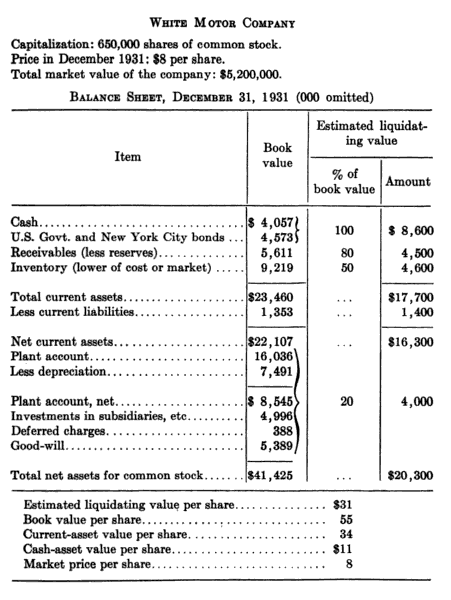
Graham then set out an example valuation for White Motor Company:

In studying this computation it must be borne in mind that our object is not to determine the exact liquidating value of White Motor, but merely to form a rough idea of this liquidating value in order ascertain whether or not the shares are selling for less than the stockholders could actually take of the business. The latter question is answered very definitively in the affirmative. With a full allowance for possible error, there was no doubt at all that White Motor would liquidate for a great deal more than $8 per share or $5,200,000 for the company. The striking fact that the cash assets alone considerably exceed this figure, after deducting all liabilities, completely clinched the argument on this score.

white-motor-example1

Current-asset Value a Rough Measure of Liquidating Value. – The estimate values in liquidation as given for White Motor are somewhat lower in respect of inventories and somewhat higher as regards the fixed and miscellaneous assets than one might be inclined to adopt in other examples. We are allowing for the fact that motor-truck inventories are likely to be less salable than the average. On the other hand some of the assets listed as noncurrent, in particular the investment in White Motor Securities Corporation, would be likely to yield a larger proportion of their book values than the ordinary property account. It will be seen that White Motor’s estimated liquidating value (about $31 per share) is not far from the current-asset value ($34 per share). In the typical case it may be said that the noncurrent assets are likely to realize enough to make up most of the shrinkage suffered in the liquidation of the quick assets. Hence our first thesis, viz., that the current-asset value affords a rough measure of the liquidating value.

Greenbackd’s approach to valuing long-term and fixed assets

The first thing to note is that we’ve got no particular insight into any of the companies that we write about or the actual value of the companies’ assets. The valuations are based on the same generalized, unsophisticated, purely mathematical application of Graham’s formula. Further, if the actual value of an asset is objectively known or determinable, then we don’t know it and, in most cases, can’t determine it. That puts us at a disadvantage to those who do know the assets’ real value or can make that determination. Secondly, we can’t make the fine judgements about value that Graham has made in the White Motor example above. Perhaps it’s blindingly obvious that “motor-truck inventories are likely to be less salable than the average,” but we don’t know anything about motor-truck inventories or the average. It’s specific knowledge that we don’t have, which means that we are forced to mechanically apply the same discount to all assets of the same type.

Given that we’ve disclaimed any ability to actually value an asset or class of assets, why not adopt the lower to middle end of Graham’s valuation range for those assets? (Editors note: What a good suggestion. From here on in, we’re taking Graham’s advice. It’s simply because, in our experience, as idiosyncratic as it has been, an 80% discount to property, plant and equipment is too much in most instances. We think that 50% is a conservative estimate. In our limited experience, commercial and industrial real estate rarely seems to sell at much less than 15% below book value, and that’s in the recent collapse.) At first blush, specialist plant and equipment might appear to be worthless because the resale market is too small, but it can also be sold at a premium to its carrying value. For example, in the recent resources boom, we heard from an acquaintance in the mining industry that mining truck tires were so scarce as to sell in many instances at a higher price second hand than new. Apparently entire junked mining trucks were purchased in one country and shipped to another simply for the tires. Without that specialist knowledge of the mining industry, one might have ascribed a minimal value to an irreparable mining truck or a pile of used mining truck tires and missed the opportunity. What these examples demonstrate, in our opinion, is that the sale price for an asset to be sold out of liquidation is extremely difficult to judge until the actual sale, by which time it’s way too late to make an investment decision.

The best that we can do is fix a point at which we feel that we a more likely to be right than wrong about the value but will also have enough opportunities to invest to make the exercise worthwhile. For us, that point is roughly 20% 50% for property, plant and equipment. That 20% 50% is not based on anything more than (Edit: Graham’s formula, which has stood the test of time and should be applied in most cases unless one has a very good reason not to do so our limited experience, which is insufficient to be statistically significant for any industry or sector, geographical location or time in the investment cycle.) We always set out for our readers our estimate so that you can amend our valuation if you think it’s not conservative enough or just plain wrong (if you do make that amendment, we’d love to hear about it, so that we can adjust our valuation in light of a better reasoned valuation).

We hope that this sheds some light on our process. We’d love to hear your thoughts on the problems with our reasoning.

Read Full Post »

Arrhythmia Research Technology Inc (AMEX:HRT) is a tiny but profitable net net stock with a plan to buy back stock. At its $2.25 close yesterday the company has a market capitalization of just $6.1M. We estimate its pre-buy back liquidation value to be more than 100% higher at around $12.7M or $4.68 per share. If the buy back is completed at the current stock price, we estimate that the company will buy back around 10% of the outstanding stock, which will cause HRT’s per share liquidation value to increase to almost $5.00, around 120% higher than the present stock price.

About HRT

HRT develops medical software that acquires data and analyzes electrical impulses of the heart to detect and aid in the treatment of potentially lethal arrhythmias. HRT’s wholly owned subsidiary, Micron Products, Inc. (Micron) is a manufacturer and distributor of silver plated and non-silver plated conductive resin sensors (sensors) used in the manufacture of disposable integrated electrodes constituting a part of electrocardiographic diagnostic and monitoring instruments. Micron also acts as a distributor of metal snap fasteners (snaps), another component used in the manufacture of disposable electrodes. The company’s investor relations website is here.

The value proposition

In a rarity for a net net stock, HRT is currently profitable. Although it didn’t pay a dividend in 2008, it has paid dividends in the past. In the 12 months ending December 31, 2007, the company earned $1.29M after tax and generated cash from operating activities of $1.47M. The balance sheet looks healthy enough (the “Carrying” column shows the assets as they are carried in the financial statements, and the “Liquidating” column shows our estimate of the value of the assets in a liquidation):

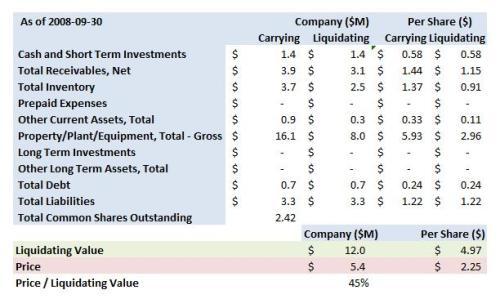
hrt-summary

HRT’s balance sheet value is predominantly in its property, plant and equipment, to the tune of $16.1M, which we’ve written down by half to $8M or $2.96 per share. The company also has receivables of $3.9M, which we’ve written down by 20% to $3.1M or $1.15 per share, and inventory of $3.7M, which we’ve discounted by a third to $2.5M or $0.91 per share. Deducting liabilities of $3.3M (including $0.7M in debt) from the written down asset value gives us a liquidation value for HRT of around $12.7M or $4.68 per share.

The catalyst

HRT has announced a stock buy back program, which authorizes it to buy back “up to $650,000 of the Company’s common stock from time to time, subject to prevailing conditions and price levels.” No shares have been acquired to date, but we would like to see the company put the buy back into operation. Buy backs effected at deep discounts to intrinsic value, and particularly at deep discounts to liquidation value, create lots of value for remaining stockholders. They also demonstrate that management is alive to the plight of the shareholders’ in a company with a stock languishing at a discount to liquidation value. With the stock at these levels ($2.25), $650,000 buys back around 289,000 shares, which is a little over 10% of the 2.7M shares outstanding. The effect of such a buy back is demonstrated below:

hrt-summary-post-buy-backThe buy back reduces HRT’s total liquidating value from $12.7M to $12.0M, but increases the per share liquidating value from $4.68 to $4.97.

Conclusion

At $2.25, HRT is trading at a 48% discount to its liquidation value of $4.68. If the company undertakes and completes its buy back at the current stock price, HRT’s per share liquidating value will increase to $4.97, which is 120% higher than HRT’s close yesterday. We think HRT is worth a punt at these levels, and we’re adding it to the Greenbackd Portfolio.

Take care with these thinly traded stocks and always use limit orders to buy stock.

HRT closed yesterday at $2.25.

The S&P500 Index closed yesterday at 871.71.

[Full Disclosure:  We do not have a holding in HRT. This is neither a recommendation to buy or sell any securities. All information provided believed to be reliable and presented for information purposes only. Do your own research before investing in any security.]

Read Full Post »

Multimedia Games Inc (NASDAQ:MGAM) is an undervalued asset play with two activist investors, Liberation Investment Group, which owns 8.7% of MGAM and has “urged the Company to retain an experienced investment bank to evaluate all strategic alternatives to maximize shareholder value and to expand the Company’s board of directors to include new independent directors who have strong industry backgrounds and are sensitive to shareholder concerns,” and Dolphin Limited Partnership, a formerly passive investor controlling 5.5% of the outstanding stock now seeking board representation. MGAM closed yesterday at $2.48, giving it a market capitalization of $66M. We estimate its liquidation value to be 50% higher at $98.3M, or $3.70 per share. The main risk to MGAM is the legal and regulatory environment. MGAM is involved in extensive litigation and its business operations and product offerings are subject to strict regulatory licenses, findings of suitability, registrations, permits and approvals.

About MGAM

MGAM is a supplier of interactive systems, server-based gaming systems, interactive electronic games, player terminals, stand-alone player terminals, video lottery terminals, electronic scratch ticket systems, electronic instant lottery systems, player tracking systems, casino cash management systems, slot accounting systems, slot accounting systems, slot management systems, unified currencies and electronic and paper bingo systems for Native American, racetrack casino, casino, charity and commercial bingo, sweepstakes, lottery and video lottery markets and provide support and services and operations support for MGAM’s customers and products. It designs and develops networks, software and content that provide its customers with, among other things, gaming systems, some of which are delivered through a telecommunications network that links its player terminals with one another, both within and among gaming facilities. MGAM’s investor relations website is here.

The value proposition

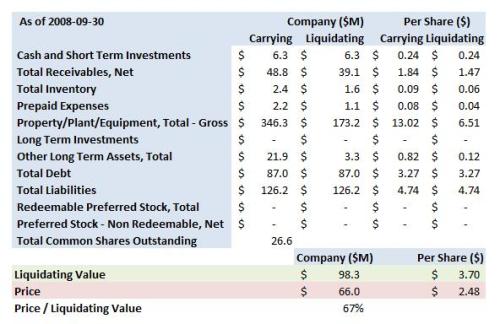
MGAM has been marginally cash flow positive for the last four years, generating good operating cash flow that seems to have been consumed in capital expenditures. That significant capital investment, while not reflected in earnings, still persists on the balance sheet (the “Carrying” column shows the assets as they are carried in the financial statements, and the “Liquidating” column shows our estimate of the value of the assets in a liquidation):

mgam-summary

MGAM’s value resides in its $346.3M in property, plant and equipment, which we’ve written down by half to $173.2M or $6.51 per share. The company also has healthy receivables in the amount of $48.8M, which we’ve discounted by a fifth to $39.1M or $1.47 per share. MGAM has a substantial debt load of $87M or $3.27 per share. Our estimate for its liquidation value is around $98M or $3.70 per share.

MGAM’s most recent 10K reveals that the company is particularly vulnerable to the legal and regulatory environment. Its business operations and product offerings are subject to strict regulatory licenses, findings of suitability, registrations, permits and approvals. It is also involved in extensive litigation to protect its intellectual property rights, or defend claims that it is infringing upon the intellectual property rights of others. The outcome of this litigation is unknown and unknowable. It is conceivable that much of the company’s value could be lost in the litigation or as a result of changes to the regulatory environment.

The catalyst

Two activist investors, Liberation Investment Group and Dolphin Limited Partnership, have declared holdings in MGAM. Dolphin Limited Partnership’s original 13D filing sets out its rationale for it amending its filing from a passive to an activist stance:

[Dolphin Limited Partnership] are long-term shareholders of [MGAM]. [Dolphin Limited Partnership] have visited [MGAM]’s facilities in Oklahoma, Austin, Texas and Mexico and have conversed in person and by teleconference with members of the Board and senior management. On numerous occasions, [Dolphin Limited Partnership] have expressed their views on the strategic, operational and financial issues facing [MGAM] and have actively encouraged efforts to maximize shareholder value. Specifically, [Dolphin Limited Partnership] have highlighted the necessity to more efficiently finance [MGAM]’s growth opportunities with its key customers and sought to provide assistance to [MGAM] in May, 2008 in optimizing its balance sheet.

[Dolphin Limited Partnership] believe that the lack of a coherent business strategy, poor execution and poor capital allocation have contributed to significant deterioration in shareholder value. Specifically, [Dolphin Limited Partnership] are deeply concerned by the following:

  • On September 30, 2008, the price for [MGAM]’s Shares closed at a level at which the Shares traded over eight years ago.
  • Since the beginning of fiscal 2005, [MGAM] has invested over $360 million (over 3x the current market capitalization of [MGAM]) on capital and other expenditures. In that time, a $59 million cumulative cash flow loss has contributed to the share price falling over 72%. (See Chart below).
  • Since the Board was reconstituted in October, 2006, the price of [MGAM]’s Shares has declined 54%, while comparable companies, on average, are down only just 7%1.
  • Since its high following the ill-fated Dutch-auction tender in June, 2007, the price of [MGAM]’s Shares has fallen 66% while comparable companies2, on average, are down considerably less.
  • At the current share price, [MGAM] is trading at just 2.1x Enterprise Value/2009 EBITDA,3 while comparable companies4 average 7.7x — a 73% discount.
  • At the current share price, [MGAM] is trading at just over its tangible book value per share of $4.22.

[Dolphin Limited Partnership] believe the Board of [MGAM] has failed to close the significant valuation gap for its long-term investors. In light of these significant concerns and the erosion of shareholder value and the share price, [Dolphin Limited Partnership] began requesting a change in senior level management in February, 2007. More than a year later, [MGAM] finally heeded [Dolphin Limited Partnership]’ calls and made a change in June, 2008.

[Dolphin Limited Partnership] look forward to hearing a Board approved, detailed strategic operating plan by the 2008 fourth quarter conference call addressing how [MGAM] intends to close the sizeable valuation gap for its shareholders. [Dolphin Limited Partnership] intend to continue to pay special attention to opportunities to make the current operations of [MGAM] more productive, efficient and profitable, as well as plans to grow the business, with prudent use of [MGAM]’s valuable equity capital. Sell-side analysts are forecasting as much as $45-$50 million in free cash flow for fiscal 2009 from the Winstar facility ramp-up, increased machine counts and notes receivable repayments. The Board faces critical decisions as to how best to deploy this inflow to maximize shareholder value.dolphin-13d
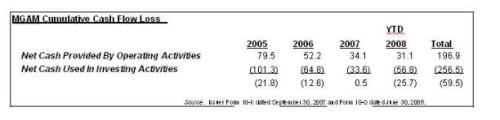
In light of the unacceptable financial performance highlighted in the chart above, [Dolphin Limited Partnership] believe a rigorous debate about proper capital allocation is required. Heretofore, the Board has followed a formula that has led to the destruction of shareholder value. [Dolphin Limited Partnership] are seeking Board representation because they understand the necessity of reversing this negative trend. As one of the largest shareholders, [Dolphin Limited Partnership] have a strong incentive to maximize shareholder value. Accordingly, in September, 2008, [Dolphin Limited Partnership] sent a letter to [MGAM] requesting consensual representation on the Board. [Dolphin Limited Partnership]’s representative(s) will be committed to working with the other members of the Board to evaluate all strategic and other alternatives to set [MGAM] on a path to maximizing shareholder value.

1 Comparable companies include IGT, WMS, BYI, ALL AU and SGMS.
2 See footnote 1.
3 Based on Bloomberg average analyst estimates. MGAM average analyst fiscal 2009 estimate of $73 million.
4 See footnote 1.

Liberation Investment Group now controls around 8.7% of MGAM’s outstanding stock. Liberation Investment Group’s original 13D filing attached the following letter to the board setting out its demands:

February 2, 2006

Mr. Clifton Lind
Chief Executive Officer
Multimedia Games, Inc.
206 Wild Basin Rd
Bldg B, Suite 400
Austin, Texas 78746

Dear Clifton:

As you know, Liberation Investments has been a shareholder in Multimedia Games for a year now. We believe the business has substantial value that isn’t reflected in its current stock price. In order to unlock this value for the benefit of all shareholders, we have developed several strategies which we have discussed with you on more than one occasion. We have also offered to introduce you to people with relevant expertise.

I met with you in September of 2005 at the G2E conference in Las Vegas. At that time, I gave you a presentation outlining three specific transaction alternatives which we believe would greatly enhance shareholder value. Shortly thereafter, an investment bank experienced in the gaming industry presented you with another potential option, which we believe would increase shareholder value. Despite our efforts to engage with you, you have not returned our calls since our meeting, except on one occasion when Randy Cieslewicz informed me that Multimedia’s Board would review the information we provided to you at its meeting during the first week of December 2005. Since then, we have not heard any feedback nor seen any progress.

We are disappointed by your lack of responsiveness, especially in light of Multimedia’s languishing stock price. It is currently trading below its levels of even four years ago. What’s more, we believe that Multimedia’s stock trades at a multiple that is significantly discounted to that of its industry peers.
Clearly, the company is not able to take full advantage of the public capital markets under these circumstances.

Now is the time to act. Multimedia must take real steps to boost shareholder value. The company should retain an experienced investment bank immediately to evaluate all strategic alternatives to maximize shareholder value. Furthermore, Liberation believes that you should add new members to the Board who have strong industry backgrounds and are sensitive to shareholder concerns. We have identified some potential candidates who are currently (or have previously been) licensed in major gaming jurisdictions, and would like to discuss with you the possibility of adding these qualified candidates to the Board.

If patient shareholders don’t see real progress quickly, you can be fairly certain that they will soon become frustrated shareholders who will demand progress. We have spoken to other large shareholders who are likewise disappointed by the performance of Multimedia’s stock and who we believe would be supportive of efforts to increase value through the execution of a strategic transaction.

Lastly, given that you have been aware of our interest in a strategic transaction for some time, we wonder why you have yet to file a proxy statement and schedule an annual meeting for 2006. The company’s amended annual report filed on January 30, 2006 provided no reason for missing the usual 120-day deadline. It has already been over a year since Multimedia filed its last proxy statement.

Liberation Investments is prepared to meet with the Board and/or the company’s financial advisors to further discuss the range of alternatives available to Multimedia and answer any questions about our presentation. Please feel free to call me to set up a meeting. As always, we remain committed to working with you to maximize value for all shareholders.

Very truly yours,

Emanuel R. Pearlman
Chairman and CEO

MGAM has now consented to Dolphin Limited Partnership’s nominee being appointed to the board, as the following letter from MGAM filed with Dolphin Limited Partnership latest 13D explains:

December 26, 2008

Dolphin Limited Partnership III, L.P.
156 W 56th Street
Suite 1203
New York, New York 10019
Attn: Mr. Justin Orlando
Vice President and Managing Director

Dear Mr. Orlando:

This letter is to confirm that the Nominating and Governance Committee of the Board of Directors (the “Board”) of Multimedia Games, Inc. (“MGAM” or the “Company”) has resolved to include your name with the Company’s slate of nominees for the Company’s Board of Directors at the Company’s upcoming annual meeting of stockholders, and to support your candidacy to the same extent as the candidacies of the other Company nominees. The Company’s Board of Directors has also unanimously approved this recommendation. The Company intends to hold its annual meeting on or about April 6th or 7th, 2009, and looks forward to your joining the Board at that time.

We would also like to invite you to attend our regularly scheduled meeting of the Board of Directors to be held telephonically on January 8th. We would ask that you and Dolphin Limited Partnership III, L.P. sign a standard confidentiality agreement in connection with your attendance at that meeting. Our counsel will provide a form to your counsel to review.

We look forward to your joining the board and working with you to build value for our stockholders.

Very truly yours,

Mike Maples, Chairman of the Board

Liberation Investment Group’s most recent 13D filing seems to suggest that it is liquidating its position in MGAM by distributing to its investors its proportionate share of MGAM stock.

Conclusion

At $2.48, MGAM is trading at two-thirds of our $3.70 per share estimate of its liquidation value. With Dolphin Limited Partnership’s nominee being invited to join the board, it seems that the chances of the company henceforth taking shareholder-friendly steps are good. The main risk to MGAM remains the legal and regulatory environment, with legal proceedings threatening much of the company’s value. Without knowing the detail of the litigation beyond what is disclosed in the financial statements, it is impossible to handicap the company’s chances. At these levels, we still think that MGAM is a worthwhile investment, but we will watch closely any and all developments in its various legal proceedings.

MGAM closed yesterday at $2.48.

The S&P500 Index closed yesterday at 909.73.

[Disclosure:  We do not have a holding in MGAM. This is neither a recommendation to buy or sell any securities. All information provided believed to be reliable and presented for information purposes only. Do your own research before investing in any security.]

Read Full Post »
« Newer Posts - Older Posts »