Feeds:
Posts
Comments

Posts Tagged ‘Liquidating Value’

Biotechnology Value Fund (BVF) has extended its tender offer for the outstanding shares of Avigen Inc (Nasdaq: AVGN).

We’ve been following AVGN (see archived posts here) because it’s a net cash stock (i.e. it’s trading at less than the value of its cash after deducting all liabilities) and specialist biotechnology activist fund BVF has been pushing it to liquidate and return its cash to shareholders. MediciNova Inc (NASDAQ:MNOV) has made an offer for AVGN that we think represents a clever way for AVGN’s stockholders to receive cash equivalent to that which they would receive in a liquidation (less $7M to be paid to MNOV) with the possibility for “an extraordinary, uncapped return” if MNOV is successful post-merger. We estimate AVGN’s cash at around $1.22 per share (BVF estimates $1.20 per share), which is around 20% higher than AVGN’s $1.01 close yesterday.

The full text of BVF’s press release is reproduced below:

BVF Acquisition LLC (the “Purchaser”), an affiliate of Biotechnology Value Fund L.P. (“BVF”), which has commenced a cash tender offer to purchase all of the outstanding shares of Avigen, Inc. (Nasdaq: AVGN) (“Avigen”) for $1.00 per share, announced today that it has extended the expiration date for the tender offer to 6:00 p.m., New York City time, on Friday, March 6, 2009. The tender offer was previously set to expire at 12:00 midnight, New York City time, on Monday, February 23, 2009. As of the close of business on February 20, 2009, a total of 1,132,192 shares had been tendered in and not withdrawn from the offer, which together with the shares owned by BVF and affiliates, represents approximately 33% of the total shares outstanding of Avigen.

[Full Disclosure: We have a holding in AVGN. This is neither a recommendation to buy or sell any securities. All information provided believed to be reliable and presented for information purposes only.]

Read Full Post »
CuraGen Corporation (NASDAQ:CRGN) has announced that it is considering strategic alternatives to enhance shareholder value including selling or licensing CR011, acquiring additional assets or business lines, or selling the company.

We started following CRGN on January 20 this year because it is a net cash stock with an investor, DellaCamera Capital Management, disclosing a 5.6% holding in January. We estimate CRGN’s net cash value to be around $62M or $1.07 per share. The company is not generating any operating cash flow as it is a “biopharmaceutical development company,” so the challenge for DellaCamera Capital Management is to persuade the company to pay a special dividend or liquidate before it dissipates its remaining cash.

The company’s press release (via Earth Times) is as follows:

CuraGen Corporation (Nasdaq: CRGN) announced today that it is undertaking a review of a broad range of strategic alternatives to enhance shareholder value.

Robert E. Patricelli, Chairman of the Board of CuraGen commented that “The Board believes that management is making exciting progress as CR011 moves through the current Phase II clinical trials and that it has taken the necessary actions over the past two years to ensure that CuraGen is a well capitalized organization in a difficult external financing environment. The Board further believes we should consider strategic alternatives that could enhance shareholder value. These alternatives range from selling or licensing CR011, to acquiring additional assets or business lines, to selling the company. The company will retain an investment bank to assist the Board with its strategic review. During our evaluation process, management will remain focused on executing our current business plan.”

Dr. Timothy M. Shannon, President and Chief Executive Officer, also announced that CuraGen has retained JSB-Partners to identify potential acquirers of CR011-vcMMAE. “In an ongoing multi-center study in heavily pretreated patients with breast cancer, CR011 is well tolerated and there is early evidence of activity. Our Phase II program in melanoma also continues to show promising activity”, commented Dr. Shannon. “The potential to move CR011-vcMMAE into more advanced development in both patients with breast cancer and patients with melanoma makes this a good time to seek strategic interest in the marketplace.”

There is no assurance that this process will result in any changes to the Company’s current business plans or lead to any specific action or transaction. While the process is underway, the Company does not intend or expect to disclose any developments regarding the process until, if ever, a definitive agreement is entered into or the board determines to terminate the process.

“We ended 2008 with $88 million of cash and investments on hand, have a clinically active attractive Phase II development asset, and over $500 million in net operating loss carryforwards (NOLs). Yet, our stock price does not reflect the intrinsic value of our assets and we continue to trade at a deep discount to our cash.” commented Dr. Shannon. “We seek to address these value disconnects through the strategic review process.”

The Company also recently completed a privately negotiated transaction with a holder of the Company’s 4% Convertible Subordinated Notes due February 2011 (the “2011 Notes”) in which the Company retired a total of $4.8 million of the 2011 Notes for an aggregate purchase price of $3.8 million or a 21% discount off of face value. This transaction added $1.0 million of net cash to the Company’s balance sheet. The Company now has $14.1 million of the 2011 Notes outstanding. The Company’s burn guidance for the first half of 2009 remains unchanged at $7.0 to $8.0 million and the Company now expects to end the second quarter of 2009 with between $76 and $77 million of cash and investments.

[Full Disclosure:  We do not have a holding in CRGN. This is neither a recommendation to buy or sell any securities. All information provided believed to be reliable and presented for information purposes only. Do your own research before investing in any security.]

Read Full Post »

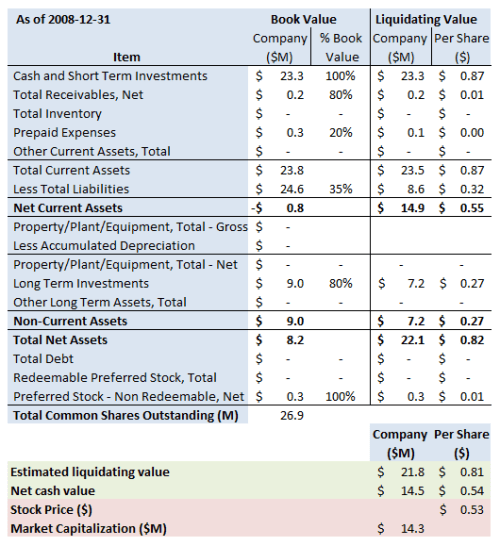
Neurobiological Technologies Inc (NASDAQ:NTII) is a particularly interesting play. Prima facie, it appears to be a cash-burning biotechnology stock trading at a premium to its liquidating value. In other words, a stock we wouldn’t touch with a ten foot pole. On closer inspection, however, it becomes clear that NTII is trading at its net cash value, has other readily valuable assets and offers the possibility of substantial additional upside. At its $0.53 close on Friday, NTII has a market capitalization of just $14.3M, which is right on our $14.5M estimate for its net cash value. Our estimate for its liquidating value is around 50% higher at $21.9M or $0.81 per share with the possibility that it is significantly higher again. Three activist investors, Biotechnology Value Fund (BVF), Millennium Technology Value Partners and Highland Capital Management, hold approximately 45% of NTII’s outstanding stock and have called for its liquidation. We’re adding it to the Greenbackd Portfolio.

About NTII

NTII is a biopharmaceutical company historically focused on developing treatments for central nervous system conditions and other serious unmet medical needs. The company recently terminated development of its most advanced product candidate, ViprinexTM. The company has the right to receive royalty payments from the sales of Namenda (memantine HCL), an approved drug marketed for Alzheimer’s disease, and potential milestone and royalty payments from the development of XERECEPT, an investigational drug which has completed a Phase 3 clinical trial for the treatment of swelling associated with cerebral tumors. Additionally, NTII’s earlier stage pipeline includes rights to a protein in preclinical development for the treatment of Alzheimer’s disease. The company’s investor relations website is here.

The value proposition

NTII has no material ongoing operations as of December 2008. It continued to burn cash through the last quarter.  According to the most recent 10Q, however, its cash burn rate should now be “significantly curtailed since the Viprinex program for acute ischemic stroke was terminated in December 2008.” The summary of our estimate for the company’s liquidation value is set out below (the “Book Value” column shows the assets as they are carried in the financial statements, and the “Liquidating Value” column shows our estimate of the value of the assets in a liquidation):

ntii-summaryThere are two unusual elements in our summary balance sheet:
  1. Total Liabilities, carried in the balance sheet at $24.6M, have been adjusted down to 35% to remove $16M attributable to deferred revenue and warrant liability. We would not normally adjust the Total Liabilities at all. We have excluded these amounts from the Total Liabilities in this instance because the company “[does] not believe these items will ever require cash payments from us” (see Liquidity and Capital Resources in the most recent 10Q).
  2. Long Term Investments, carried in the balance sheet at $9M, have only been discounted by 20%, rather than our usual 80%. The Long Term Investments are predominantly AAA-rated auction rate securities (ARS) that continue to pay interest. The figure for the ARS in the balance sheet reflects the ARS’s purchase price less impairment charges of $1.6M at December 31, 2008. From the most recent 10Q:

Beginning in February 2008, failed auctions occurred throughout the ARS market, and since then all auctions for NTI’s ARS have been unsuccessful. While the credit rating of these securities remains high and the ARS are paying interest according to their terms, as a result of the potentially long maturity and lack of liquidity for ARS, the Company believes the value of the ARS in NTI’s portfolio has been impaired. During the fiscal year ended June 30, 2008, the Company recorded an impairment charge to reduce the carrying value of the ARS. The impairment charge was based on a model of discounted future cash flows and assumptions regarding interest rates. The Company has also recorded an unrealized loss of $1,360,000 on its ARS at December 31, 2008 based on a decrease in the estimated fair value since the impairment charge was initially recorded. Due to recent wide and rapid fluctuations in the credit markets, combined with the Company’s low forecasted operating expenses in comparison to its cash and investments balances, the Company believes the current fiscal year decline in estimated market price for the ARS to be temporary. The Company believes it has the ability to hold its ARS until recovery of the temporary decline in value. All other unrealized gains and losses were immaterial. The Company has classified its ARS as long-term at December 31, 2008, and all other investments are classified as short-term.

Accordingly, we believe that a 20% discount to the value of the ARS carried in the Long Term Investments is sufficient, if overly cautious.

XERECEPT®

NTII sold the rights to XERECEPT to Celtic Pharmaceuticals in 2005. Celtic Pharmaceuticals has continued to develop XERECEPT and recently announced that it has retained an investment bank to assist with the sale of XERECEPT. NTII is entitled to receive between 13% and 22% of the net proceeds received by Celtic Pharmaceuticals upon the sale of XERECEPT. We don’t know if the sale process will be successful or if NTII will receive any payment, but it does present the possibility of additional value to stockholders of NTII.

Off-balance sheet arrangements

According to the 10Q, NTII has “no off-balance sheet arrangements that have or are reasonably likely to have a current or future effect on our consolidated financial condition, changes in our consolidated financial condition, revenues or expenses, consolidated results of operations, liquidity, capital expenditures or capital resources.”

Contractual obligations

NTII’s noncancelable contractual obligations set out in its 10Q are as follows:

  • Active ingredient production/purification and operation of a snake farm. Raw venom of the Malayan pit viper was the starting material for the active ingredient in Viprinex, and was produced by Nordmark in Germany where Nordmark maintained a colony of snakes in a manufacturing facility. We agreed to make monthly payments to Nordmark for our supply of the active ingredient and for the fully burdened costs of operating the snake farm until such time as either 1) the agreement is terminated pursuant to specified terms or 2) commercial production commences. If the agreement is terminated by us prior to commercialization, we are required to make a termination payment of up to €2.8 million (or approximately $3.7 million at the December 31, 2008 exchange rate) to Nordmark. We have notified Nordmark of our intent to terminate the agreement and remove the snakes located at the facility. Under the terms of the agreement, we are responsible for specified operating costs of the facility as long as the snakes are at the facility. We have identified several reptile zoos willing to take snakes, and are in process of completing the arrangements for the transfer of the snakes. We cannot estimate the costs for this process, but we currently expect it to be completed by March 31, 2009.
  • Clinical Research Organizations. We had agreements in place with several Clinical Research Organizations for work needed on the clinical trials in various foreign countries. We generally paid the CROs on a monthly or quarterly basis for work as it was performed, and the terms of most of the agreements allow them to be cancelled with no obligations beyond the costs incurred by the CROs to the time of termination. Our CROs have closed down the clinical trial and are in the process of reconciling pass-through costs for the clinical trial and amounts we have paid compared to actual costs incurred. We have accrued expenses as of December 31, 2008 which we believe are appropriate under the agreements, and are holding further payments to the CROs until we are satisfied that all costs are justified under the agreements. We expect resolution with all CROs in the third or fourth quarter of our fiscal year ending June 30, 2009.
  • Medical facilities conducting the clinical trials. We generally pay medical facilities for each patient enrolled into our trials, and withhold a portion of total site compensation until all data required in the clinical trial protocol is received. The portion withheld is recorded as a liability in our consolidated financial statements. As we receive the final data from each site we authorize the release of the final payments called for under the agreements. We expect this process to be completed by March 31, 2009.
  • Data management. We pay outside service organizations on a monthly or quarterly basis for services related to managing the data collected from the clinical trial. We have recorded an accrued liability for the charges we expect to incur, and the service organizations are in process of reconciling the payments from NTI to the actual charges incurred. We expect this process to be completed by June 30, 2009.
  • License agreement for Viprinex. We have an exclusive worldwide license for all human therapeutic indications for Viprinex from Abbott. Under this license, we have an obligation to use commercially reasonable efforts to develop Viprinex for the treatment of acute ischemic stroke. If we do not use commercially reasonable efforts to develop Viprinex for stroke Abbott may reclaim rights to develop the product. While no license maintenance payments are required to Abbott, milestone payments of up to $2 million would be due upon various regulatory approvals of Viprinex, along with royalty payments based on worldwide Viprinex sales. In the event we sublicense the rights to Viprinex, additional payments may be due to Abbott based on the terms of the sublicense. We have the right to terminate the agreement upon providing 90 days notice to Abbott, and Abbott has the right to terminate the agreement only in the event of our breach. We presently do not intend to develop Viprinex further under the license from Abbott and expect rights will ultimately be returned under the terms of the agreement. Upon returning the rights to Abbott, we are also required to return all drug material, data and intellectual property to Abbott.
  • Employees. All of our employees are employed on an “at-will” basis.
  • Buck Institute for Age Research. We have entered into agreements with Buck for rights to preclinical proteins for the treatment of Alzheimer’s disease and Huntington’s disease. The research programs under these agreements may be extended annually and we have the right to terminate the agreements upon 60 days notice if we determine the research program objectives cannot be substantially met. In addition, we have certain milestone obligations to Buck in the event that specified research goals are met. We have notified Buck that we do not intend to extend the research program for Huntington’s disease, and are currently reviewing the Buck proposal for the second year of the Alzheimer’s disease research program.

While these contractual obligations are significant relative to NTII’s net assets, we believe that NTII’s interest income and the royalty revenue ($2m in the last quarter) should wash these obligations for the next 12 months, or at least reduce the cash burn rate to between $1M and $2M. The royalty ends in 2009.

The catalyst

Three large shareholders, BVF, Millennium Technology Value Partners and Highland Capital, hold 45% of NTII’s outstanding stock. BVF initiated its position in June last year, disclosing a 19.7% holding. According to a later 13D amendment,  BVF sent a letter on December 23, 2008 calling on NTII’s board:

…to exercise its fiduciary duty to shareholders by winding up NTII in order to return cash to shareholders as quickly and efficiently as possible. The letter explains that costs associated with a liquidation could be limited by immediate, decisive action because  [NTII]’s remaining assets are financial and passive in nature requiring negligible activity to manage. The letter calls on [NTII] to take immediate action to maximize shareholder value by returning capital to shareholders, consistent with its fiduciary duties, and to refrain from engaging investment bankers or other advisors (except for the sole purpose of winding up the company), whose self-interests would likely lead to a further drain of capital.

Samuel L. Schwerin (Managing Partner of Millennium Technology Value Partners) filed a 13D amendment on  January 6, 2009 disclosing a 7.7% holding (which includes the Millennium Technology Value Partners’ holdings disclosed below). Schwerin’s purpose for the filing is as follows:

On January 6, 2009, in the context of the failure of the clinical trial for Viprinex, [NTII]’s primary asset, Millennium Technology Value Partners delivered a letter urging [NTII] to take immediate and decisive action to monetize the remaining value of [NTII]’s assets for the benefit of its shareholders. The letter details Millennium’s belief that the only remaining course of action for [NTII]’s management and board to pursue is the immediate dissolution and liquidation of the company. Millennium has communicated to management that such dissolution should take the form of an immediate distribution of cash to shareholders, followed by an efficient and timely monetization of remaining assets in a manner designed to maximize proceeds to shareholders. Millennium’s letter further suggests that during nearly a dozen conversations between management of [NTII] and Millennium over the past year, management made assurances to Millennium that contingency liquidation plans had been developed in the event of failed Viprinex trials. Millennium expressed its strong belief that these plans should be implemented immediately and that there is no need, nor reason, to waste time or shareholder resources on advisors or to delay the liquidation process in order to explore risky alternative strategies, courses that Millennium believes are likely to result in further diminution of value for all shareholders.

Highland Capital disclosed a 17.6% holding in its original 13D notice filed January 9, 2009. According to the notice:

Highland Capital delivered a letter to NTII requesting the expeditious wind down of [NTII]’s business. In the letter, Highland Capital expressed its belief that, due to the failure of the Viprinex program, [NTII] has no incremental value as an ongoing concern. Highland Capital expressed a strong belief that the only way to return value to the shareholders is through liquidation of [NTII]’s assets. The letter notes that [NTII] is seeking to hire a new CEO and President, and that such action shows an intention to continue operations. Highland Capital believes that the Board should immediately decide to liquidate [NTII], and that hiring a new CEO and President is unnecessary if such action is to be taken.. Highland Capital expressly lists various assets, including cash, currently held by [NTII] which are all capable of near-term liquidation. Highland Capital asserts that it is [NTII]’s Board of Directors’ fiduciary duty to the public shareholders to liquidate these assets, wind down business, and return all proceeds to the public shareholders. Highland Capital expressed concern that the Board was considering “strategic options” to continue business which would result in the immediate degradation and eventual loss of all shareholder value.

Millennium Technology Value Partners disclosed a 3.7% holding in its original 13D filing dated January 23, 2009. Annexed to the filing was the following letter:

The Board of Directors of Neurobiological Technologies, Inc.
c/o Abraham E. Cohen, Chairman of the Board
2000 Powell Street, Suite 800
Emeryville, CA 94608

Dear Members of the Board:

As you know, on January 6, 2009 Millennium Technology Value Partners L.P. (“Millennium”) delivered a letter to the Board of Neurobiological Technologies, Inc. (“NTI” or the “Company”) urging it to take immediate and decisive action to monetize and distribute the Company’s remaining assets for the benefit of shareholders. We have since learned through a review of public filings and discussions with you that the Company has received correspondence from stockholders representing 65% of NTI shares expressing a similar point of view. This would appear to constitute a clear mandate from the stockholders of the Company for you to take immediate action to commence an orderly liquidation. We are disappointed that in the face of such an overwhelming directive from your stockholders, you are able to act other than with absolute immediacy to carry out the will of your constituency.

Over the past 14 months, management and members of the Board repeatedly assured Millennium that contingency plans involving liquidation had been developed and would be implemented immediately should Viprinex fail. Now that Viprinex has failed, we can’t help but wonder, where is the contingency plan and why hasn’t it been implemented? While we appreciate the Company’s January 13 announcement regarding the reduction of staff and the trimming of costs, the ultimate inaction on the Board’s behalf is alarming. Trimming costs merely lowers the cash burn and slows the rate of decline in shareholder value. It does not stop the decline, and more importantly, it does not seek to return maximum value to shareholders.

We are further concerned by discussions involving the potential engagement of financial advisors. As you know, financial and strategic advisors often require a considerable period of time to “evaluate strategic alternatives” and are compensated in such a way as to place an inherent bias against recommending liquidation, which in NTI’s case, is the best, and most immediate, course of action. There is no need, nor reason, to waste time or shareholder resources on advisors or to delay the liquidation process in order to explore risky alternative strategies, courses certain to result in further diminution of value for all shareholders, when the majority of the stockholders of the Company appear to have already made their views perfectly clear. The Board should understand that any action that it takes that would require the approval of its stockholders — other than the prompt liquidation of the Company — will not receive sufficient votes to pass. Accordingly, and by definition, any such attempts would clearly constitute a waste of corporate assets.

Recent discussions with management and members of the Board have further confirmed that “the process of exploring alternatives is ultimately most likely to conclude that liquidation is the best course of action for the shareholders of NTI.” Yet 37 days have passed since the failure of Viprinex, “the sole major asset of the Company,” without the Board communicating or enacting a plan designed to maximize shareholder value through the dissolution and liquidation of NTI assets. We have even gone so far as to outline a plan of liquidation to the Company that we believe could be approved by a substantial majority of the Company’s stockholders. In that plan, excess cash would be immediately distributed to shareholders, with the remaining assets to be liquidated in a timely and orderly manner over the coming months by a shareholder appointed fiduciary, with all proceeds being distributed directly to shareholders immediately upon receipt.

Should the Board have any question that the plan outlined above is in the best interests of shareholders, and that any attempts to pursue an alternative course of action would be over the objection of your stockholders, then we urge you to call a Special Meeting to allow the shareholders to reinforce our own conclusions and those suggested in correspondence from shareholders representing 65% of NTI stock.

To reiterate what we said in our January 6, 2009 letter and have repeated numerous times during our discussions with management, we believe that any action other than the immediate dissolution and liquidation of the Company is an irresponsible waste of corporate assets and will result in a severe impairment of shareholder value. We trust that the best interests of NTI shareholders continue to be of utmost importance to you, the members of the Board, and look forward to your prompt response. If either the Board or management has any questions about the appropriate liquidation plan and how best to implement it, we would welcome the opportunity to discuss it further.

With every day that you fail to take action, the value of the Company declines. We urge you to consider very carefully your primary obligations to your stockholders, and the consequences of your failure to honor these obligations.

Respectfully,

Samuel L. Schwerin
Managing Partner

Conclusion

At its $0.53 close on Friday, NTII is trading at its net cash value and around two-thirds of our estimate of its $0.81 per share liquidating value. The difference between our estimates for NTII’s net cash value and its liquidation value is the $9M in ARS, which we’ve discounted by 20% to $7.2M, and which the company believes will eventually yield full value. The possibility exists that the upside might be even greater if NTII receives a portion of the net proceeds paid to Celtic Pharmaceuticals upon a sale of XERECEPT. With stockholders representing 45% (note that Samuel L. Schwerin estimates 65%) of the outstanding stock of NTII calling for its liquidation, we feel the company will be under some pressure to accede and that should lead to a reasonably quick resolution. NTII is reminiscent of our position in Avigen Inc (NASDAQ:AVGN), which seems to be working out well. We’re adding it to the Greenbackd Portfolio.

NTII closed yesterday at $0.53.

The S&P500 Index closed yesterday at 770.05.

[Full Disclosure:  We do not have a holding in NTII. This is neither a recommendation to buy or sell any securities. All information provided believed to be reliable and presented for information purposes only. Do your own research before investing in any security.]

Read Full Post »

Soapstone Networks Inc (NASDAQ:SOAP) has engaged an investment bank to explore strategic alternatives for enhancing shareholder value, which may include paying a cash dividend, repurchasing shares, selling or spinning off assets, merging, sale or liquidation.

We started following SOAP on February 2 because it was trading well below its net cash value with an activist investor, Mithras Capital, disclosing an 8.7% holding in October last year. At its $2.54 close yesterday, SOAP has a market capitalization of $37.7M. We estimate the company’s net cash value to be 142% higher at $91.2M or $6.15 per share 128% higher at $86.1M or $5.78 per share [Thanks, shp].

The company’s announcement is as follows:

Billerica, MA, February 19, 2009 – Soapstone Networks Inc. (NASDAQ: SOAP), today announced that it has engaged Morgan Stanley & Co. Incorporated (“Morgan Stanley”) as its advisor to assist the Company in exploring strategic alternatives available to the Company for enhancing shareholder value, including but not limited to, continued execution of the Company’s business plan, the payment of a cash dividend to the Company’s shareholders, a repurchase by the Company of shares of its capital stock, the sale or spin off of Company assets, partnering or other collaboration agreements, a merger, sale or liquidation of, or acquisition by, the Company or other strategic transaction. There can be no assurance that the exploration of strategic alternatives will result in any agreements or transactions, or that, if completed, any agreements or transactions will be successful or on attractive terms. The Company’s strategic review is underway, but no timetable has been set for its completion.

“Like many companies in this macro-economic environment, we have heard from certain of our shareholders that, for their particular interests, a near-term cash return from the Company is desirable,” said Bill Leighton, the Company’s CEO. “With the help of our outside advisors, we will carefully consider this expressed interest in a cash return, within the process of evaluating a range of alternatives, understanding that our goal is, as always, to provide enhanced value to all of our shareholders.”

We continue to believe that SOAP is one of the best opportunities available at the moment. The company’s ongoing business is small in comparison to its net cash position, so it shouldn’t dissipate its cash any time soon. It has no off-balance sheet arrangements, little in the way of ongoing contractual obligations and no material litigation, so the cash position seems reasonably certain. The company’s engagement of an investment bank to explore strategic alternatives is a promising step in the right direction.

[Full Disclosure:  We have a holding in SOAP. This is neither a recommendation to buy or sell any securities. All information provided believed to be reliable and presented for information purposes only. Do your own research before investing in any security.]

Read Full Post »

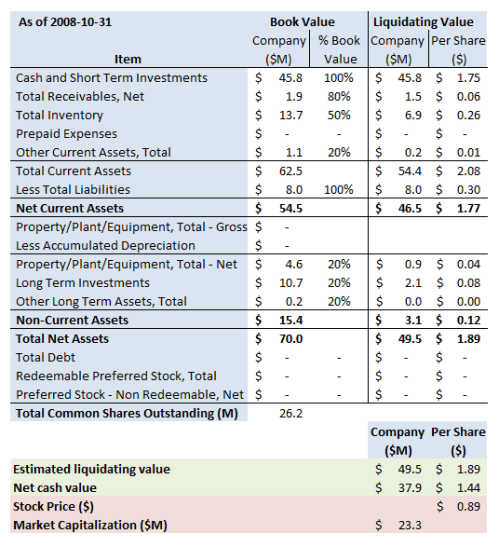
Ditech Networks Inc (NASDAQ:DITC) is a stock trading well below its net cash value with an investor, Lamassu Holdings LLC, disclosing a 9.4% holding in November last year. At yesterday’s closing price of $0.89, the company has a market capitalization of $23.3M. We estimate the net cash value to be more than 60% higher at $37.9M or $1.44 per share. Lamassu has offered to acquire DITC for $1.25 per share in cash. Lamassu says that it “anticipates its due diligence requirement will take no more than two weeks and there is no financing contingency.” We’re adding DITC to the Greenbackd Portfolio.

About DITC

DITC is a global telecommunications equipment supplier for voice networks. Its products include echo cancellers, which are used to eliminate echo in voice networks. The company’s investor relations website is here.

The value proposition

The company’s most recent 10Q tells a horrifying story. The company is consistently burning cash in its operations and burned through more than $8M in the six months to October 31 last year. A substantial (but dwindling) amount of cash remains on the balance sheet (the “Book Value” column shows the assets as they are carried in the financial statements, and the “Liquidating Value” column shows our estimate of the value of the assets in a liquidation):

ditc-summary

Off-balance sheet arrangements and Contractual obligations

According to the 10Q, DITC has around $6.2M in contractual commitments (including $2.9M in operating leases and $3.2M in purchase commitments), around $3.7 of which falls due this year and the remainder falling due within the next 3 years. DITC has no other material commitments.

The catalyst

Lamassu’s amended 13D notice attached the following letter:

January 28, 2009

Todd Simpson
CEO
Ditech Networks, Inc.
825 East Middlefield Road
Mountain View, CA 94043

Mr. Simpson and Ditech Board of Directors:

I am writing this letter to ask for your support in the acquisition of Ditech Networks by AccessData. Because AccessData is a portfolio company of Lamassu Holdings and Lamassu is a 10% owner of Ditech, the company’s poison pill precludes AccessData from officially offering to purchase the company. That said AccessData is interested in acquiring all of Ditech Networks for $1.25 per share
in cash. We would like to move forward as quickly as possible. We anticipate our due diligence requirement will take no more than two weeks and we have no financing contingency.

We strongly believe an acquisition by AccessData, at a premium to market, will result in the best outcome for all shareholders, including ourselves. We have reached this conclusion after analyzing other alternatives including a liquidation, an acquisition or staying the current course of new product
development. In a liquidation, the cash returned to shareholders could vary greatly depending on certain assumptions, but I doubt you would disagree that there is a reasonable probability this return would be below $1.25.

When we look at acquisitions or new product development as an option, we are discouraged by past performance of the Ditech organization in several attempts. While Mr. Simpson is relatively new as CEO, the Board is not. And, while I was not a shareholder over the last 9 years the company has been public, I can still use past performance to evaluate this Board’s efficacy. For this I do not need
to look much beyond the balance sheet. Retained earnings are a loss of over $194MM. So over its life, this company has lost nearly $200MM. When examined more closely, it is surprising to learn that the company had a very profitable echo cancellation product line that generated substantial profits over this time. It appears most of the money was squandered through attempts to diversify the business. There are three glaring examples of failed diversification attempts: 1) the optical systems effort that was discontinued after costing the company nearly $80MM by some accounts, 2) the Jasomi acquisition, which cost $24MM and appears to have little to no contribution to the business, and 3) the PVP development, which has yet to generate significant revenue.

After reviewing the failure of nearly every major effort to diversify the company, it does not surprise me that the current valuation is significantly below the net cash of the company. The company is faced with reinventing itself, which may be more successful with Mr. Simpson as CEO, but most of the players involved with past failures remain the same. It is clear to me that shareholders are voting by selling stock well below the net cash value and tangible book value.

I do see value in the company’s balance sheet and its technology, however, I do not believe that the right course of action for me is to wait and see if the business can be reinvented. I believe the likelihood of a successful investment for myself and other shareholders increases greatly if Ditech is acquired by AccessData which will both diversify the business and utilize overhead (legal, audit, G&A) more efficiently.

I would like an opportunity to meet with the Board either in person or telephonically in the immediate future to discuss my offer. I sincerely hope the management and Board will address my offer immediately and move quickly to reach a consensus. Based on last quarter’s results it appears the company is losing nearly $400,000 per week, so clearly time is of the essence.

Sincerely,

Tim Leehealy

Conclusion

We love a stock trading at a discount to net cash. At its $0.89 close yesterday, DITC’s net cash value is more than 60% higher. There is a good reason for DITC to trade at such a discount, but we think there is also a good chance that Lamassu can make its $1.25 offer and realise some of that value for stockholders.

DITC closed yesterday at $0.89.

The S&P500 Index closed yesterday at 788.42.

[Full Disclosure:  We do not have a holding in DITC. This is neither a recommendation to buy or sell any securities. All information provided believed to be reliable and presented for information purposes only. Do your own research before investing in any security.]

Read Full Post »

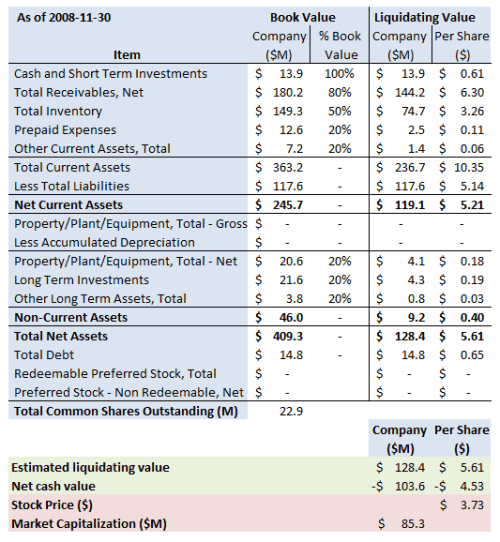
Audiovox Corporation (NASDAQ:VOXX) is a rarity in our universe: a profitable undervalued asset play. At its $3.73 close yesterday, VOXX has a market capitalization of $85.3M. We estimate the liquidation value to be 50% higher at around $128.4M or $5.60 per share. Howson Tattersal filed a 13D notice in September last year disclosing a 7.3% holding. While VOXX has been another perennial inclusion on lists of net-net stocks, we think it’s hard to ignore at this price.

About VOXX

VOXX is an “international distributor and value-added service provider in the accessory, mobile and consumer electronics industries.” The company markets its products under the Audiovox brand name and other brand names, including Acoustic Research, Advent, Ambico, Car Link, Chapman, Code-Alarm, Discwasher, Energizer, Heco, Incaar, Jensen, Mac Audio, Magnat, Movies2Go, Oehlbach, Phase Linear, Prestige, Pursuit, RCA, RCA Accessories, Recoton, Road Gear, Spikemaster and Terk, as well as private labels through a domestic and international distribution network. See the company’s website here. The company’s investor relations website is here.

The value proposition

VOXX’s sales, operating income and net income increased in the quarter ended November 30, 2008. Net sales for the third quarter were $195.6 million compared to net sales of $183.6 million reported in the comparable prior year period. Operating income was $10.7 million in the third quarter compared to $6.7 million in the preceding third quarter. Net income was $6.5 million compared to net income of $4.7 million in the comparable period. This doesn’t tell the full story however as operating activities used cash of $26.7M for the nine months ended November 30, 2008. The company used less cash for its operating activities compared to the prior year period ($92.9M), but it is still a concern for us. The balance sheet looks interesting (the “Book Value” column shows the assets as they are carried in the financial statements, and the “Liquidating Value” column shows our estimate of the value of the assets in a liquidation):

voxx-summaryWe’ve written down VOXX’s receivables by 20% to $144.2M or $6.30 per share and VOXX’s investory by 50% to $74.7M or $3.26 per share to arrive at a total current asset value of $236.7M or $10.35 per share. Deducting total liabilities gives a net current asset value of $119.1M or $5.21. We’ve discounted $46M in non-current assets to $9.2M or $0.40 per share, which, added to the net current assets, gives a liquidation value of around $128.4M or $5.61 per share.

Off-balance sheet arrangements and Contractual obligations

According to its most recent 10Q, VOXX does not maintain any off-balance sheet arrangements, transactions, obligations or other relationships with unconsolidated entities that would be expected to have a material current or future effect upon its financial condition or results of operations.

VOXX has around $42M in contractual cash obligations (including $11M in capital lease obligations and $31M in operating leases), around half of which falls due in the next 5 years and $23.7M falling due after 5 years. VOXX also has another $43M in unconditional purchase obligations falling due in the next 12 months.

The catalyst

Howson Tattersall Investment Counsel Limited filed its 13D notice on September 24, 2008 disclosing a 7.3% holding in VOXX. It seems from the filing that Howson Tattersall paid $18,825,883.44 for 1,508,075 shares in VOXX, giving them an  average purchase price around $12.50 per share. Given that Howson Tattersall has listed in the filing the “Date of Event Which Requires Filing of this Statement” as April 11, 2007, it’s possible that they are an example of the “reluctant activists” we referred to on Monday.

Conclusion

At $3.73, VOXX is trading at a discount to its net current asset value and around two-thirds of our estimate of its liquidation value of around $5.61 per share. We’ve got no particular insight into the business. The negative operating cash flow is an issue and its near term contractual obligations are significant. That aside, we think VOXX is a reasonable punt and we’re adding it to the Greenbackd Portfolio.

VOXX closed yesterday at $3.73.

The S&P500 Index closed yesterday at 789.17.

[Full Disclosure:  We do not have a holding in VOXX. This is neither a recommendation to buy or sell any securities. All information provided believed to be reliable and presented for information purposes only. Do your own research before investing in any security.]

Read Full Post »

S. Muoio & Co. has called on MathStar Inc (OTC:MATH) to include in the proxy statement for the 2009 Annual Meeting a vote by shareholders to approve a voluntary liquidation of MATH.

We’ve been following MATH since December last year when it was trading at $0.68 because it was a net cash stock with a substantial stockholder lobbying management to liquidate. The stock is up 19% to $0.81 Friday, giving it a market capitalization of $7.4M. We estimate MATH’s liquidation value still to be around 94% higher at $14.4M or $1.57 per share. That value is predominantly cash and short term investments and doesn’t take into account any further value that the sale of the FPOA technology and intellectual property may yield. Two activist investors, Mr. Salvatore Muoio of S. Muoio & Co. and Mr. Zachary McAdoo of The Zanett Group, have been urging MATH’s board to consider liquidation rather than a merger. MATH’s board seems to agree, twice rejecting unsolicited merger proposals, suspending the company’s operations and exploring “strategic alternatives, which could include merger, acquisition, increasing operations in another structure or liquidation.”

S. Muoio & Co. attached to its most recent schedule 13D notice amendment the following letter to the board of MATH:

February 10, 2009

Mr. Douglas M. Pihl
Chairman of the Board
MathStar, Inc.
19075 NW Tanabourne, Suite 200
Hillsboro, OR 97124

Dear Mr. Pihl,

It has come to our attention that MathStar has timely received a proposal from another shareholder to include in the proxy statement for the 2009 Annual Meeting a vote by shareholders to approve a voluntary liquidation of MathStar.

As we stated in our letter of December 12, 2008, we believe that a prompt liquidation of MathStar is in the best interest of the company and its stakeholders. We also continue to believe that pursuit of a merger or alternative transaction flies in the face of the wishes of many of the company’s owners.

As such, the board of directors must act in good faith and cause the proposal to be put on the ballot for the forthcoming annual meeting of shareholders.

Sincerely,

Salvatore Muoio, C.F.A.
Managing Member

cc: MathStar, Inc. Board of Directors

[Full Disclosure: We do not have a holding in MATH. This is neither a recommendation to buy or sell any securities. All information provided believed to be reliable and presented for information purposes only.]

Read Full Post »

Avigen Inc (Nasdaq: AVGN) has filed the transcript of its earnings call held last Wednesday. In the call, AVGN’s management addresses their estimate of AVGN’s net cash value, their attitude to the MediciNova Inc (NASDAQ:MNOV) offer, and the possibility of a liquidation or a return of capital.

We’ve been following AVGN (see archived posts here) because it’s a net cash stock (i.e. it’s trading at less than the value of its cash after deducting all liabilities) and specialist biotechnology activist fund BVF has been pushing it to liquidate and return its cash to shareholders. MNOV has made an offer for AVGN that we think represents a clever way for AVGN’s stockholders to receive cash equivalent to that which they would receive in a liquidation (less $7M to be paid to MNOV) with the possibility for “an extraordinary, uncapped return” if MNOV is successful post-merger. We estimate AVGN’s cash at around $1.22 per share (BVF estimates $1.20 per share), which is a little less than 15% higher than AVGN’s $1.05 close yesterday.

Selected portions of the transcript follow:

On the possibility of liquidation

Ken Chahine [President and Chief Executive Officer]

Oh, okay. So yes, our — so was the question are we committed to liquidation at some point?

Juan Sanchez, [Ladenburg and Thalmann]

Yes. You don’t come out with a real — a proposal to the investors. And in the exercise you guys are going through, are you committing to returning the money back to investors? And is $42 million the money that is going to be available to investors by then, or is a different amount? You see?

Ken Chahine

Juan, our commitment is very, very simple. We’re going to maximize the value. If liquidation ends up being the best offer we have, then liquidation is the best offer we have. There’s no hidden agenda here. It’s simply a matter of maximizing the value.

Is MediciNova the best deal? I don’t really — at this point I honestly don’t know. Could it be? It could be. Is it? I don’t know.

And I think if — let me give you an example, Juan. If you were selling a house and you got an offer for your house and your realtor came by and said you have three more offers that are coming in today, and we have three more that we think are coming next week. I think it’s fair to say that you would probably not take that first offer unless you had at least an opportunity to look at the other three and wait for the other three to come in.

Now, even if you like that first offer, you might say, I think this one is going to be hard to beat. I think you would say that it would be negligent not to at least look at those other offers.

So I think what we’re asking here is not unreasonable. I think it’s absolutely logical, and I think it’s exactly what you and other shareholders on this call would expect — would do. And so that’s all we’re saying.

And so if at the end of the day, is it going to be MediciNova, is it going to be a liquidation, is it going to be sale to a larger company? I don’t know. But I think the commitment absolutely is that whatever it is, it’s going to maximize the value to the shareholders. And if it turns out to be, in our opinion, an M&A transaction, we will propose that transaction and the shareholders will have the right to either vote for it or not vote for it, right?

So at the end of the day, the fate of this Company is not in our hands. The fate of this Company is squarely in the hands of the shareholders. And we’ve protected the burden so that there’s no risk that we’re squandering the money in the meantime.

And again, going back to your — Andy can answer some of the specific questions on the finances, but again, the severance package may or may not be payable at all by the Avigen shareholders. If it turns out that a company comes in and buys us out and retains some of the employees, then the answer is, no, there would be none.

So I think, again, we’re not trying to avoid the question.

Juan Sanchez

So the $42 million doesn’t include the severance package?

Ken Chahine

I don’t know. I’m going to pass that on to Andy, and he can answer that specifically.

Andy Sauter [Chief Financial Officer]

All right, Juan. So the $42 million does not remove any severance payments. At the end of the year we will still have a year of obligations with regard to our lease billing. Again, that’s only one more year. We avoided any extensions that could’ve put further future monies that risk.

Obviously, the process of liquidation involves a number of things. There would most likely be significant monies put in escrow to cover potential unidentified obligations for a period of time. A custodian would have to wrap up any remaining corporate rights and obligations, and that could take a couple of years.

So how exactly liquidation would spill out is something that is very hard to project, exactly what the net payment to shareholders would be and that those delays in distribution further reduce the value. And right now we believe that the value of our current assets and the potential to enter into a successful M&A has significant value over liquidation.

On the MNOV offer

Juan Sanchez

Just one last question before I move on (inaudible). In a nutshell, what do you guys find fundamentally slow or wrong with the MediciNova offer? What’s — what don’t you like about this offer that you’re not willing to entertain it in a more active way, so that –(multiple speakers) See what I mean?

Ken Chahine

Juan, can you — yes. I’d like you to please clarify, though. What have we said that’s said it’s not attractive, and what have we done to not entertain it more aggressively? — so I can answer your question more directly.

Juan Sanchez

The — it’s more like the body language that you guys transmit seems to be that the MediciNova offer is the last option that you guys have and it’s not attractive for you at this point. So from the financial point of view, what’s not to like and what’s to like?

Ken Chahine

Well, I’m very curious at that statement because we have tried, as we stated clearly in our 14D9, to engage MediciNova. As of yesterday, I am very pleased that MediciNova and Avigen came to an agreement to initiate diligence. Up until now MediciNova has been unwilling to sign a confidentiality agreement that every other company has signed.

So we’re not — and this is not a special one for them at all. So again, I take a little bit of issue with that because I think that we have not put them in any special box or disadvantaged them in any way. They’d like to preserve their right to continue to file press releases and other documents, and that’s fine. We respect that. It’s their right, and we respect their right to do that.

However, we do have a common asset in AV411, and I think it’s important that we protect that asset for Avigen shareholders in the event that if a transaction is not consummated with MediciNova and a larger pharmaceutical company would like to come in here and purchase that asset, that we haven’t devalued the asset by sharing a bunch of confidential information with MediciNova.

So we are now just starting to assess MediciNova, and we’re going to look at it very carefully. If it is the winning bid, I guarantee that it will be up to the shareholders to decide whether they like that transaction or not.

I absolutely have no judgment on that right now because we haven’t had a chance to do diligence. So I’m pleased that we’re going to get started, and we’ll see how it stacks up to the rest of the offers.

On AVGN’s net cash value

Edgar Bordovski, [Burlingame Asset Management]

Can you guys put a bound on the time at which shareholders can decide on the state of the Company and whether all possible transactions that you consider attractive will be presented before Management decides to proceed with those transactions? I understand you can’t pinpoint when that will be, but can you put an upper bound on how long we have to wait before we have clarity on all the attractive transactions?

And then my second question is, what is the lower bound on the cash, net of liabilities including remaining liabilities like the leases that you will still have to pay and liabilities that you may not be sure you have to pay? What is the net number at the end of the year? Thank you.

Ken Chahine

Was that — I think I got it right. It’s Edgar? So, Edgar, yes. So thanks for your question.

So yes, we are moving actually pretty rapidly. And I think — I will be honest with you, I think a lot of the pressure is coming from more the capital markets than any other. There’s a lot of companies out there that are in need of cash. Some of them have very attractive assets. And I think that’s what’s really driving the process.

I firmly believe in the next month or two we’re going to have some really good clarity. This is not something that’s going to drag out at all. I just don’t think that, A, we have any desire to drag it out, and, I don’t see any need to drag it out.

So I think in the next month or two we’re going to have a lot of clarity. And again I want to reiterate, I don’t know that we will find something, but I think it’s our duty and I think it’s in all shareholders’ best interest for us to go out there and see if we can find something that’s better.

And at the end, you and other shareholders are going to vote as to whether you agree that that transaction is better.And we know that that’s a high hurdle, and we don’t intend to present anything to shareholders that we don’t think is going to meet that hurdle.

So if — okay again, in a month or two I think we’re going to have some clarity, we will present it. We’ll present what we have to shareholders, and then we’ll go from there. So — then Andy, if you can just address –?

Andy Sauter

Yes. I mean, I guess just to try to reiterate, your question about what’s the lower bound on our cash. At this point, if we go through the year with this limited burn and obligations and nothing else happens, at the end of the year we believe our cash will be between $40 million and $42 million.

At that point we will have one year left on our lease obligations. That’s probably a two-year obligation — or a two-year cost that would have to be paid no matter what. And in the meantime we have significant opportunity to bring in additional cash that exceed our expenses, both through the transaction related to AV411, both through keeping up with potential Genzyme milestone payments, and then basically giving us a free look at these M&A opportunities that could create significant value for the shareholder base and give them a chance to choose something that they might not otherwise have access to.

So that’s how we look at the cash. It’s been preserved. We’ve set our year-end estimates. We’ll have very little obligations left after that. And there’s a lot more potential upside in the meantime than that lower bound is that you’re asking about.

Edgar Bordovski

So just to clarify, when you say very little liabilities, can you put an upper bound on those liabilities at the end of the year?

Ken Chahine

So, Edgar, I guess what we’re trying to say — and I will say it since I’m not a CFO — that — maybe I will say it a different way that maybe you can relate to better.

What is the only expense that shareholders would have to incur let’s say in 2009 that you wouldn’t have to incur otherwise? The reality is that it’s about — it’s under $3 million worth of salaries going forward. So even a very modest, I would argue, almost unattractive transaction in 411 will more than make up for that expense.

Other than that, I think the public listing is something that’s worth keeping up because we think we can get the value, and I can tell you now some of the offers that we have, there’s definitely value in that public listing. I think the public listing could more than make up for all of that.

So what’s really variable here — it’s very little. It’s $2 million in the salaries. There’s some in the listing, which I would argue absolutely we should maintain. And that’s it, everything else has to be paid out whether we are here for the remainder of the year or not.

So does that help a little bit?

Edgar Bordovski

So just to conclude, number one, shareholders will be able to vote within say several months as to all the possible transactions that Avigen is considering, and Avigen will not pursue a transaction without that vote. And number two, the liability at the end of the year that remains, you’ll have $40 million in cash, but you will have some liabilities relating to leases and other things. That number is going to be $2 million, $3 million, $4 million. It’s not going to be more than that.

Ken Chahine

I think that’s right. It is very difficult to think that we can cut the expenses significantly, if at all, without starting to significantly impair the value of the assets that are here.

So I think, yes, you are absolutely right. The cash is safe. The one thing that is a little bit of a variable cost — and we hate to bring it up, but it’s the reality — is the legal costs. We’ve probably spent more on legal costs now than we have spent in any other year since I have been here. I’m an attorney. We handle our finances and our legal costs very modestly, like we do the rest of the company. That’s a variable cost that I can’t help you with because I don’t know what’s down the pipe.

But shareholders will absolutely have the opportunity to vote. There’s a special meeting that has been called. We absolutely plan to have that special meeting. By the bylaws, it’s 120 days from when it’s called. When are we going to have that meeting? We really have not set a date, but we just want to make sure that you had the opportunity to say, yes, I either like this transaction or don’t like this transaction — at the time that you make the vote. And we’re happy with the decision. Whatever it is that the shareholders want, we will abide by.

Edgar Bordovski

Okay. Can I just get an answer on the net liability at the end of the year in terms of putting an upper bound on it? You mentioned it’s going to be very little, but can I — is it possible to quantify that number?

Ken Chahine

I’ll try this — Andy, please feel free to jump in — because I think I have these memorized, right? It’s — we have the leases. Those are in the 10-K. Andy went through them. It’s $2 million on the leases. They would be more except that we’ve been very aggressive at subleasing.

There is some accrued liabilities that came in the fourth quarter. You can’t just stop a trial and decide that you’re not going to pay anything further. There has been work that has been accrued up until the time that we terminated the trial. Those have now been paid, so there’s really no further obligations or very little on the AV650 and other trials.

I’m trying to think. There’s some wind-down costs that would normally have to happen. If we were to — there’s a potential of a severance — partial payment or full payment, depending on, again, what the transaction is or isn’t.

And am I missing anything?

Andy Sauter

No. Again, the only last thing here is that to wind up a company there is some sort of cost of custodialship and execution. So if we are not able to deal with the AV411 asset during 2009, there would be some cost to dealing with it after 2009. It’s hard for us to project what that would be, but as far as you can tell — or as far as we can reassure you — the only obligations we’re committed to that are on the books that you can see is going to be the one last year of leases, which is $2 million net. So we’ve certainly tried to point that out a couple of times.

Ken Chahine

Yes. And we’re certainly not trying to avoid the question. It’s just that it’s not as simple of an answer. A judge in a dissolution proceeding, for example, is not going to just take the AV411 asset and leave it completely untouched, right? There’s going to be a duty for that dissolution judge to actually try to monetize that asset, right? Well who’s going to do it? Well, it could be the Management. It could be somebody else.

But what we’re trying to point out here is that it will be someone and there will be some cost. Okay? So exactly what that, we can’t tell you for sure.

The other thing is, the judge — dissolution judge — isn’t necessarily going to say, okay, that’s it; we’re not going to keep any reserves for liabilities.

We’ve run some clinical trials, and so there may be some liabilities on the D&O side. It could be liabilities for clinical trials. There may be a reservation there that is held out. What that’s going to be? Again, we’re not trying to avoid it. There’s just no really good way for us to do it. That’s typical in a dissolution proceeding.

So I really hope I’m — we’re answering your question as clearly as possible. And we’re not trying to complicate it any further.

On the chances for a return of capital

Joe Spiegel, [Chalet Capital]

Great. I’ve got just two other quick questions. The first is, you guys talk a lot about the value of the public listing, but you said yourself it’s costing you $1.5 million. Now, we can all go and look at the present value of negative $1.5 million going out till infinity.

It seems to me that the value of the public listing is far less than your advisers are telling you. It’s a great drain. So I don’t think you should put too much weight on that.

The number two — and then I guess that was a statement, not a question. But the question becomes, have you looked at NUCRYST and this situation there? The largest holder wanted a return of capital. NUCRYST was tremendously overcapitalized. And I believe they were going to have their special meeting, which they agreed to hold, and the vote’s tomorrow, and the chances are, I would say, 100% that NUCRYST shareholders will receive a return of capital. It will leave the company with plenty of cash to pursue their business objectives or have an acquirer acquire their programs.

What — why do you guys feel that returning capital is an either/or? Capital — a dollar in the bank is only worth a dollar. There’s no multiplier in acquisitions for money, for cash. Why not return capital to shareholders, give us $1.00 a share. BVF is happy. Your other shareholders are thrilled, and you still have more than enough money to run the business. Why is that not the top option?

Ken Chahine

It may very well be. We’re not saying that it’s not.

Joe Spiegel

If it’s the top option, do it. Just do it.

Ken Chahine

Well, but I mean (multiple speakers) I’m sorry. Did I get the — is it “Joe”?

Joe Spiegel

Yes.

Ken Chahine

Joe, I mean, I don’t know this other company’s situation.

Joe Spiegel

Take a look, NCST.

Ken Chahine

That’s fine. I don’t know how long they were operating without sort of the business model. I want to just take a step back.

We are absolutely not dragging our feet. I think you can go back — and I think you even said that in many ways we’re handling this in a professional and admirable way, because we aren’t dragging our feet, and so — but this happened — the third week of October is when we announced the data. We’ve restructured. We’ve cut costs. We’ve sold one asset, and we have just engaged the process. So — and we said it’s going to take a month or two.

I’ve seen this play out many, many times. If we in the next month or two come to some decision as to where we are, we’re going to be at the very top of quick and efficient processes. So all we’re saying is, look, that may be very well the answer. And if that’s the answer, we will absolutely pursue it.

But I think — we’ve been in this thing for two months, and I think we’ve had the strategic process for three or four weeks. So I don’t think it’s even been four weeks. I think it’s been like three weeks. So all we’re saying is that. We’ve had very honest discussions in the Board, and I can tell you unequivocally, the Board is not at a position where it says, it’s an M&A or bust. We’re definitely not that way.

But we’re saying, look, we’re in a very interesting situation where capital markets are obviously shut. Where would a company that they had just launched a product — or was just about to launch a product — where would they normally get their working capital? Well, normally they would go to the credit market. That would be the most efficient way, and that’s the least dilutive way for shareholders. And then they would launch a product and then repay that debt.

Well, that whole market is shut down, right? So (multiple speakers) I guess — would you be completely opposed to the concept — if we could have a Company that would be cash flow positive in the very near term and have revenues by the end of let’s say the year — just throwing it out — would that be something that you would absolutely not consider?

Joe Spiegel

Well guys, you have to understand. You are not a bank. You’re a biotechnology Company that unfortunately is seeing hard times. You can still run your business and still bring value to the shareholders through the AV411 program while returning capital to your investors. It doesn’t have to be either/or. But remember, you’re not a bank.

Ken Chahine

Understood. And I think we do have very strong expertise in identifying opportunities that are good. And all we’re saying is, we can present it if we find one. And if we do, great. And if not, we do not intend to be a bank. But a bank is also not — doesn’t have the expertise we have.

So all we’re saying is, hey, if we can find an opportunity that makes sense — and we may not — then that’s fine. I mean, we’ll do that.

Again I want to continue to reiterate, we really — there is absolutely no hidden agenda here. The Board is completely open. And if that is the best option, we can guarantee that we’re going to pursue it.

Joe Spiegel

Well, great. I appreciate you guys taking the time to explain all of this on the conference call. And like I said, a lot of companies wouldn’t even go that far. So I do think you are doing a good job. Do see what happens at NUCRYST. And do consider the fact that these are not either/or proposals. You can satisfy all your constituents.

[Full Disclosure: We have a holding in AVGN. This is neither a recommendation to buy or sell any securities. All information provided believed to be reliable and presented for information purposes only.]

Read Full Post »

InFocus Corporation (NASDAQ:INFS) has released its results for the fourth quarter and full year ended December 31 and they are, frankly, nothing short of horrific. As always, Greenbackd’s concern is primarily for the state of the balance sheet and the liquidation value of the company. Here, the news is bad:

Balance Sheet

Total cash and restricted cash as of December 31, 2008 were $33.4 million, a decrease of $36.9 million from the end of the third quarter. The reduction in cash was primarily driven by changes in working capital, the cash loss from operations and settlement on foreign exchange hedges. Inventories at the end of the fourth quarter were $38.5 million, an increase of $8.1 million compared to the third quarter of 2008.

We generally don’t pay too much mind to earnings. We welcome it when earnings fall off a cliff and drag stock along for the ride because it creates opportunities for investors like us who are focused on the balance sheet. We do, however, take issue with a management burning through more than half of a company’s cash in quarter, especially when that cash is set alight in the “settlement on foreign exchange hedges.” An investor cannot have any confidence in a management that, confronted with cash losses from operations, not only neglects to fix operating cash flow but finds a new way to lose money. Remember INFS’s adoption of a poison pill “to help ensure … our Board of Directors is able to conduct its review of strategic alternatives without the threat of coercive takeover or control tactics that do not offer shareholders a fair premium”? Surely that argument is at an end now. Management has failed. It’s time for Nery Capital Partners to bayonet the wounded and put INFS’s stockholders out of their misery.

When we started coverage in December last year, INFS had a market capitalization of $25.6M. We estimated its liquidating value to be more than 80% higher at $46.7M or $1.15 per share. With Nery Capital Partners and Miller pushing the company to enhance its stock price, we believed INFS to be an attractive opportunity. That seems to have been a mistake. We don’t have a full 10Q / 10K to review, so we’ve adjusted our earlier model based on the information in the press release attached to the 8K (described above). Based on that incomplete information, we estimate that INFS’s liquidation value could now be as low as $8M or $0.20 per share. Given that INFS closed yesterday at $0.37, our reason for holding the stock is gone. Accordingly, we have to close out the position. We opened it at $0.63, so our INFS position is down 41.3% on an absolute basis. The S&P 500 Index closed at 873.59 on December 12, 2008 and closed yesterday at 833.74. That’s a return of -4.6% for the index and means we’re off 36.7% on a relative basis. In all, a bitterly disappointing outcome.

If you have the stomach for it, you can read a summary of the whole sorry tale below. Looking back, it seems that there were a number of portentous steps taken by management that should have tipped us off:

After we opened our position on December 12 last year, INFS announced that it would “restructure.” We wrote that management “believes it will achieve profitable operations with an 18% gross margin target and operating expenses in the range of $10-11 million per quarter.” We noted that projections about future profitability often don’t turn out as projected, saying:

They are made by managements deaf to what the market is telling them about the company. As a result, we are much more interested in the company’s plans to unlock the value in the assets. On that front, the news is mixed.

INFS has previously announced that it had retained an investment banking firm to provide “advisory services.” The new announcement says that these advisory services include “advice concerning unsolicited offers from outside sources expressing interest in purchasing the Company.” This is a positive development. The bad news is that the company has suspended the stock repurchase plan, which is slightly disappointing. We say “slightly disappointing” because a buy back of 4 million shares over a three year period does not have a meaningful effect on the per share value, so cutting it makes almost no difference. It does show, however, that management is ignoring obvious value-enhancing opportunities for stockholders.

There was a brief glimpse of light when we read a report that a group of “high-powered executives,” including INFS’s co-founder Steve Hix, wanted to buy the company if they could get financing. The executives planned to save INFS from the “New York sharks” who wanted to liquidate the company for a quick profit. Said one of the group:

We’ve got some whispers that there’s a guy in New York looking at buying 50 percent of this company, and he’ll liquidate it. We are scared. We don’t want that to happen to this company. We’ve been working for nine months on a way to save it.

Nery Capital, presumably one of the “New York Sharks,” then upped its stake to 12.2% of INFS’s outstanding stock. It seemed we might be in a competitive bid situation, which would have been very good news for stockholders as it often presages a fully valued offer for the company.

Unfortunately, the news then took a decided turn for the worse when INFS’s management adopted a poison pill, which it euphemistically described as a “Shareholder Rights Plan.” We wrote that calling such an abomination a “Shareholder Rights Plan” was pretty galling when its effect was to take rights away from shareholders and deliver them to management. We were also unhappy with the suggestion that the board were the ones to determine what was “in the best interest of [INFS] and its shareholders” and how much of a premium was “fair” given the level at which the stock languished (when we wrote that, the stock “languished” at $0.78, more than 100% higher than the level at which it languishes today).

Tuesday’s results announcement is just the final nail in the coffin. We care little for the tumble in earnings. We do care that the company has burnt through more than half its cash in a single quarter in pursuit of “foreign exchange hedges.” We’ve lost what little confidence we had in management’s ability to put shareholders first. That wouldn’t ordinarily cause us to exit a position. The accelerating destruction of value is, however, too much, and we’ve closed out the position.

[Full Disclosure:  We have a holding in INFS. This is neither a recommendation to buy or sell any securities. All information provided believed to be reliable and presented for information purposes only. Do your own research before investing in any security.]

Read Full Post »

CNBC has an interview with Ricardo Salinas, the Mexican billionaire who took a position in Circuit City Stores Inc (OTC:CCTYQ) after it fell into bankruptcy and lost $41 million. In the interview with Michelle Caruso-Cabrera, Salinas explains why he made his bet on CCTYQ and how it went wrong. Although Salinas’ CCTYQ investment wasn’t a Grahamian net net, his explanation does capture some of the pitfalls of investing based on asset values:

Mr. Salinas made the majority of his $41 million investment in Circuit City after the troubled chain filed for bankruptcy protection in November. He amassed a 28 percent stake in the company and then began trying to work out a deal with Circuit City’s suppliers in an effort to take the chain private.

But Mr. Salinas backed out of the deal just before the company decided to liquidate, according to a recent account in The Richmond Times-Dispatch.

“It was much more complicated than he expected it to be,” an unidentified source told the newspaper. Pricing on some inventory “was just too high” and the support from banks and vendors “just wasn’t there,” the Times-Dispatch quoted the source as saying.

In his CNBC interview, Mr. Salinas expressed regret about not capturing Circuit City at a bargain-basement price and losing his investment, but acknowledged that it was for the best.

“I don’t care how rich you are, it must hurt to lose $41 million,” Ms. Caruso-Cabrera said to Mr. Salinas on location in Mexico.

“You know – when you’re talking about investments and businesses- it doesn’t pay to be afraid,” Mr. Salinas said, according to a transcript of the interview, which will be broadcast Wednesday night on CNBC. “It doesn’t pay, because fear is not a good counselor. Fear makes you do stupid things. So, of course it hurts.”

Mr. Salinas said he is moving on from his experience but is still looking at buying American assets.

“Well, we’re looking at a couple of mining companies that have been really pounded by the declining commodities,” he said in the interview. “And we think that, you know, mining is a great business. So we might go into a new tack there.”

(Via The New York Times Dealbook)

Read Full Post »

« Newer Posts - Older Posts »