Feeds:
Posts
Comments

Posts Tagged ‘Activist investment’

ValueVision Media Inc. (NASDAQ:VVTV), which we posted about on Wednesday last week, has filed its November 10Q. In our earlier post, we wrote that VVTV seemed to us to be one of the better opportunities available because it’s a net net stock (i.e. a stock trading for less than its net current assets) with other valuable assets and noted activist investor Carlo Cannell of Cannell Capital has an activist position in it. The company also seemed to us to be taking steps to realise that value, publicly announcing that it has appointed a special committee of independent directors to “review strategic alternatives to maximize stockholder value.” The strategic alternative the company was pursuing was an auction that the company expected to complete by February 2, 2009. At $1.66 per share, VVTV’s liquidating value is still some 300% higher than its close yesterday of $0.41, which should provide a good margin of safety until the auction can be completed.

Updated value proposition

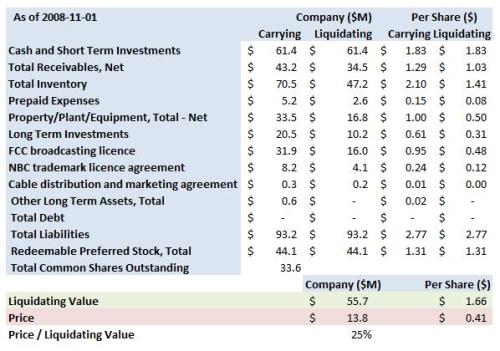
When we first looked at the company we wrote that we estimated its liquidating value, which included its property, FCC broadcasting licence, NBC trademark licence agreement and the Cable distribution and marketing agreement, at around $2.23 per share. We now see that value lower at $1.66 per share due to the increase in liabilities from $74M to $94M, which equates to an increase of $0.57 per share. Set out below is our updated summary analysis (the “Carrying” column shows the assets as they are carried in the financial statements, and the “Liquidating” column shows our estimate of the value of the assets in a liquidation):
vvtv-summary-q3-update

At its close of $0.41, VVTV is trading at 25% of its liquidating value.

The Catalyst

Given the substantial deterioration in the company’s liquidating value in the last quarter (and in the last few years), we were expecting an update on the auction, which the company has not provided in this 10Q. The company has simply restated its earlier disclosure almost verbatim:

On September 11, 2008, our board of directors announced that it had appointed a special committee of independent directors to review strategic alternatives to maximize shareholder value. The committee currently consists of three directors: George Vandeman, who serves as the committee’s chairman, Joseph Berardino and Robert Korkowski. The special committee retained Piper Jaffray & Co., a nationally-recognized investment banking firm, as its financial advisor. There can be no assurance that the review process will result in the announcement or consummation of a sale of our company or any other strategic alternative.

The company removed the final sentence from the last disclosure:

We do not intend to comment publicly with respect to any potential strategic alternatives we may consider pursuing unless or until a specific alternative is approved by our board of directors.

This may have been removed because Mr. George Vandeman, chairman of VVTV’s special committee of independent directors charged with administering the stategic review, made public statements that VVTV has received bids from a number of companies and instructed its advisers to invite several of the proposed buyers to take part in the next phase of the process.

There have been no further public statements from Cannell Capital. We will provide an update if one is made.

Conclusion

Provided that management will sell the company in the auction process if it receives a sensible bid, this still seems to us to be one of the better opportunities available in the market. Although it has deteriorated since the last 10Q, at $1.66 per share, VVTV’s liquidating value is still some 300% higher than its close yesterday of $0.41. Cannell Capital has previously publicly stated that he sees the value as high as $5.98 per share. The company seems to be taking steps to realise that value through an auction that it expects to complete by February 2, 2009. Any investor intending to take a position should bear in mind the company’s disclosure that “there can be no assurance that the review process will result in the announcement or consummation of a sale of our company or any other strategic alternative.”

VVTV closed yesterday at $0.41.

The S&P 500 Index closed yesterday at 913.18.

[Disclosure: We have a holding in VVTV. This is neither a recommendation to buy or sell any securities. All information provided believed to be reliable and presented for information purposes only.]
Read Full Post »

Electro Scientific Industries Inc (NASDAQ:ESIO) is one of the more complex undervalued asset plays we’ve dug up, but a worthwhile one to watch nonetheless. ESIO has announced a merger with Zygo Corporation (NASDAQ:ZIGO) and an authorization to buy back $100M in stock (see the October 16 announcement here). Activist investor David Nierenberg of Nierenberg Investment Management owns 15% of ESIO, supports the merger and is pushing the company to buy back stock. Management expects the the merger to be completed in the first calendar quarter of 2009.

About ESIO

ESIO and its subsidiaries provide high-technology manufacturing systems to the global electronics market, including advanced laser-based systems that are used to microengineer semiconductor device features in high-volume production environments. Website is here.

About ZIGO

ZIGO designs, develops, and manufactures ultra-high precision measurement solutions to improve its customers’ manufacturing yields, and top-tier optical sub-systems and components for original equipment manufacturers (OEM) and end-user applications. Website is here.

The value proposition

1. ESIO

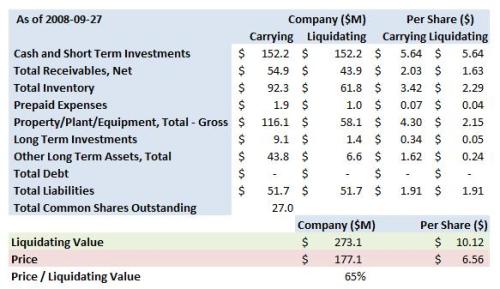
As it stands now, ESIO is an undervalued asset sitation, with a market capitalization of $177M at yesterday’s close of $6.56. We estimate ESIO’s stand alone liquidating value at around $277M or $10.12 per share, which is 54% higher than its close, as the following summary analysis demonstrates (the “Carrying” column shows the assets as they are carried in the financial statements, and the “Liquidating” column shows our estimate of the value of the assets in a liquidation):

esio-summary

2. ZIGO

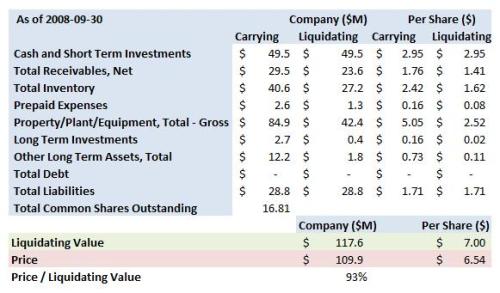
ZIGO, ESIO’s partner in the merger, has a market capitalization of $110M at it’s $6.54 close yesterday. We estimate ZIGO’s stand alone liquidating value at $118M or $7.00 per share. At $6.54 ZIGO is trading only slightly lower (about 7%) than its $7.00 per share liquidating value, and so is close to value, as the following summary analysis demonstrates (the “Carrying” column shows the assets as they are carried in the financial statements, and the “Liquidating” column shows our estimate of the value of the assets in a liquidation):

zigo-summary

The catalysts

1. Details of the merger

ESIO is offering 1.0233 shares of ESIO for each share of ZIGO. In the merger, ESIO will issue to ZIGO stockholders 18.1m shares of ESIO. This will increase the issued stock of ESIO from 27M pre merger to 45.1M post merger and give ZIGO stockholders 40% of ESIO. On October 15, the day before the announcement, ESIO closed at $10.07, valuing the merger $10.30 for each share of ZIGO, which had closed at $7.57.

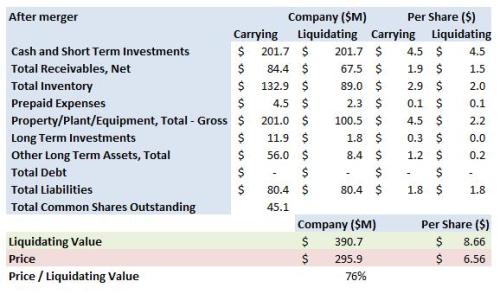
The merger will reduce the liquidating value of each share of ESIO because ZIGO at $6.54 is trading much closer to its liquidating value than ESIO at $6.56. The following summary analysis shows ESIO after the merger with ZIGO is complete (the “Carrying” column shows the assets as they are carried in the financial statements, and the “Liquidating” column shows our estimate of the value of the assets in a liquidation):

esio-zigo-summary

After the merger we estimate that ESIO stock will have a liquidating value of $391M. This equates to $8.66 per share when the expanded number of ESIO stock on issue are taken into account, down from $10.12 per share pre-merger with ZIGO. A liquidating value of $8.66 per share is around 32% higher than ESIO’s close yesterday but it’s nothing to get excited about. Fortunately, the buy back goes some of the way to restoring ESIO’s liquidating value to pre-merger levels.

2. Effect of the buy back

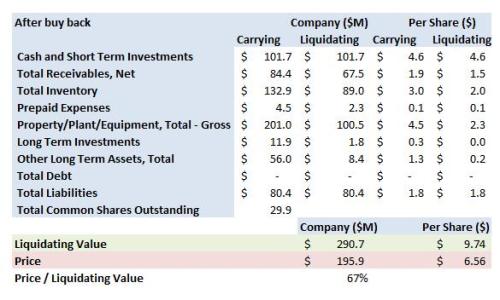
In the announcement of the merger with ZIGO, ESIO also announced an authorization to buy back $100M of stock. If that $100M buy back was completed at $6.56, the closing price of ESIO yesterday, ESIO would buy back around 15.2M shares, leaving around 29.9M on issue. The following summary analysis assumes that ESIO buys back $100M of stock at $6.56 and shows ESIO after the buy back is complete (the “Carrying” column shows the assets as they are carried in the financial statements, and the “Liquidating” column shows our estimate of the value of the assets in a liquidation):

esio-zigo-summary-post-buy-back

The buy back increases ESIO’s per share liquidating value from $8.66 to $9.74. It’s legitimate to question whether all of this sturm und drang is worth it if it only serves to reduce the liquidating value of ESIO. The honest answer is that we don’t know but we suspect that it’s probably not. We think it would have made more sense for ESIO to buy back its own shares rather than merge with ZIGO. If a merger with ZIGO was an inevitability, perhaps it would have been better to buy back the shares before the merger, especially since ESIO seems to be getting less in value from ZIGO than the value it is issuing to ZIGO’s shareholders. There is also a risk that the buy back will not proceed. According to the announcement,

The repurchases will be made at management’s discretion in the open market in compliance with applicable securities laws and other legal requirements and are subject to market conditions, share price and other factors. There is no fixed completion date for the repurchase program.

3. David Nierenberg

According to his most recent 13D, David Nierenberg (The Motely Fool has a profile here) of Nierenberg Investment Management owns 15% of ESIO. The filing details Nierenberg’s agreement with ESIO regarding ESIO’s stockholder rights plan, which prevents any stockholder – other than 19.99% owner Third Avenue Management LLC – from owning more than 15% of the company. If any stockholder purchases more than 15%, the plan limits the stockholder to voting only that portion of the stockholding up equivalent to 15% of the outstanding stock. The other shares automatically vote with ESIO’s board. Nierenberg’s agreement with ESIO provides that if ESIO buys back enough stock to push Nierenberg’s holdings over 15% of the outstanding shares, he will still be able to vote all of his stock as he wishes. The agreement will be in effect for a minimum of three years.

Conclusion

ESIO as a stand alone entity is deeply undervalued, trading at less than two-thirds of its $10.12 per share liquidating value. The effect of the merger – which appears likely to succeed – is to reduce ESIO’s per share liquidating value to $8.66, which is only 35% higher than the company’s close yesterday. This will be remedied by the $100M buy back authorized for ESIO, which will increase ESIO’s per share liquidating value to $9.74, which is nearly 50% higher than yesterday’s close. There is a risk that the merger will go through but the buy back will not be completed but we think this risk is relatively low.

There are two ways to play this:

1. If you are confidant that the merger will go through, buying ZIGO at $6.54 is buying ESIO for $6.41 (a 2.3% discount). This is because in the merger each share of ZIGO equates to 1.0233 shares of ESIO ($6.56 / 1.0233).

2. If you believe there is a risk that the merger will not go through, ESIO offers the better downside protection because it is at a deeper discount to its liquidating value.

ESIO closed yesterday at $6.56.

ZIGO closed yesterday at $6.54, which equates to paying $6.41 for ESIO.

The S&P 500 closed yesterday at 868.57.

[Disclosure: We do not presently hold either ESIO or ZIGO.  This is neither a recommendation to buy or sell any securities. All information provided believed to be reliable and presented for information purposes only.]
Read Full Post »

We’ve recently posted about INFS’s value proposition here (it’s deeply undervalued) and the effect of a big buy back on the per share value of the company here (it’s hugely positive).

The company today announced plans to restructure and reduce its global workforce by approximately 30%, commencing in January 2009 and spanning a twelve month period. The announcement also says that that INFS “believes it will achieve profitable operations with an 18% gross margin target and operating expenses in the range of $10-11 million per quarter.” While this may appear to be encouraging for stockholders, in our experience projections about future profitability often don’t turn out as projected. They are made by managements deaf to what the market is telling them about the company. As a result, we are much more interested in the company’s plans to unlock the value in the assets. On that front, the news is mixed.

INFS has previously announced that it had retained an investment banking firm to provide “advisory services.” The new announcement says that these advisory services include “advice concerning unsolicited offers from outside sources expressing interest in purchasing the Company.” This is a positive development. The bad news is that the company has suspended the stock repurchase plan, which is slightly disappointing. We say “slightly disappointing” because a buy back of 4 million shares over a three year period does not have a meaningful effect on the per share value, so cutting it makes almost no difference. It does show, however, that management is ignoring obvious value-enhancing opportunities for stockholders.

INFS will host a conference call to discuss the announcement tomorrow, December 16, 2008 at 9:00 a.m. (Eastern). No doubt Nery Capital Partners and Lloyd I. Miller, III will be on.

Hat tip to commenter Steven for the tip.

Read Full Post »

A stock buy-back is a great way for a deeply undervalued company to quickly increase its per share value. After identifying an undervalued asset situation, we look through the company’s filings to see if it has any existing plans authorizing it to buy-back its stock. On the rare occasions when we do locate such plans, we are often struck by (a) how few shares the company is authorized to buy back and (b) how few of the shares the company has actually bought back. InFocus Corporation (NASDAQ:INFS), which we posted about on Friday, is a classic example of this phenomenon.

INFS is trading at a big discount to its liquidation value, it has heaps of cash on hand and no debt, all of which makes it a prime candidate to undertake a big buy-back. Given the substantial discount to its current asset backing, any shares bought back at these levels have a huge positive effect on its per share value. It has just initiated a buy-back plan to repurchase over a three-year period up to 4M shares out of 40.7M on issue. As of September 30, the company had repurchased only 50,000 shares at an average price of $1.53 per share. 50,000 shares is simply too little to have any meaningful impact on the company’s value. We’d argue that even 4M (less than 10% of the outstanding common stock) isn’t enough. Why? Let’s look at what happens if the company repurchases many more shares, say 50% of its issued stock.

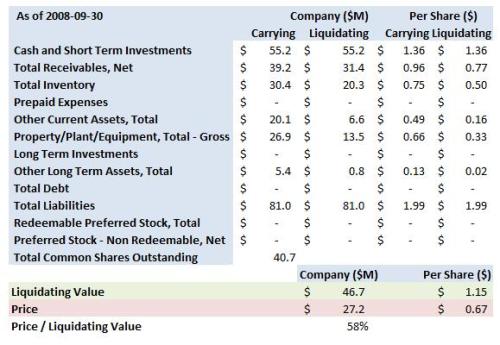
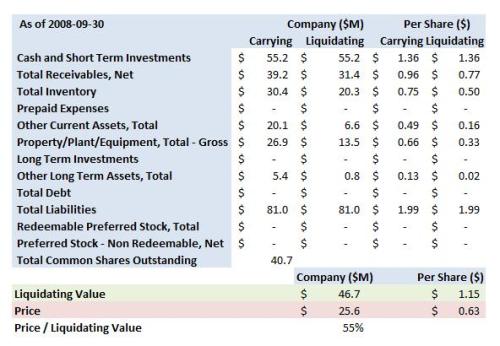
In our last blog post, we argued that INFS had a liquidation value of around $1.15 per share, 70% higher than its Friday close of $0.67. The company has cash and equivalents of around $55M and no debt as the summary financials demonstrate (the “Carrying” column shows the assets as they are carried in the financial statements, and the “Liquidating” column shows our estimate of the value of the assets in a liquidation):

Before

before-infs-summary

After

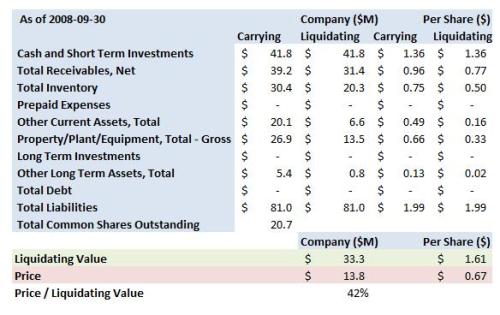
If INFS was to repurchase 50% of its stock (20M of its 40.7M shares currently on issue) at $0.67, it would cost INFS only $13.4M, leaving it with nearly $42M in cash on hand:

after-infs-summaryAfter the buy back, INFS’s per share liquidating value increases from $1.15 to $1.61 (a 40% increase).

There are very few investment opportunities that so quickly increase a company’s per share value. Given that management should know the company’s value better than the value of any other investment opportunity, it is also the most assured way of increasing a company’s per share value. There is simply no better way for an undervalued company to invest its excess cash than in its own stock.

Read Full Post »

InFocus Corporation (NASDAQ:INFS) is a deeply undervalued asset situation with two activist investors, Nery Capital Partners and Lloyd I. Miller, III, disclosing holdings in the company. At its closing price yesterday of $0.63, INFS has a market capitalization of $25.6M. We estimate its liquidating value to be more than 80% higher at $46.7M or $1.15 per share. With Nery Capital Partners and Miller pushing the company to enhance its stock price, we believe INFS is an attractive opportunity.

About INFS

INFS is a provider of digital projection technology. The company markets projectors and related accessories for use in the conference room, board room, auditorium, classroom and living room. “InFocus” is the company’s primary brand and is sold worldwide. In addition, many of the products are offered under a global reseller brand, “ASK Proxima.” INFS’s investor relation website is here.

The value proposition

According to its latest 10Q, INFS lost $25.6M last year and has continued to make losses in each of the last three quarters. The company does have some value on the balance sheet, as our summary analysis demonstrates (the “Carrying” column shows the assets as they are carried in the financial statements, and the “Liquidating” column shows our estimate of the value of the assets in a liquidation):

infs-summary

INFS has $124.7M in current assets, $55.2M ($1.36 per share) of which is cash and equivalents. We’ve discounted the receivables by a fifth to $31.4M or $0.77 per share and inventory by a third to $20.3M or $0.50 per share. The company has no debt but total liabilities of $81M or $1.99 per share. Deducting the liabilities leaves a liquidating value of $46.7M or $1.15 per share. INFS is currently trading at $0.63 or 55% of its value in liquidation.

The catalyst

Nery Capital Partners disclosed its original 9.8% holding in INFS in a November 5 13D filing. Initially purchasing its holding in INFS as a passive investment, Nery Capital Partners was moved to an active stance after an “evaluation of [INFS’s] financial performance and in light of [INFS’s] decreasing stock value.” Nery Capital Partners has since contacted the company’s board or management “with respect to, among other things, steps that [INFS] could take to improve [its] financial condition and increase shareholder value.” As of its amended filing dated December 5, Nery Capital Partners holds 11.2% of the company.

Lloyd I. Miller, III disclosed his 5% holding in INFS as a passive investment on November 5 in this 13G filing. On November 19, Miller updated his original filing to an active 13D filing. Miller said in the new filing that he acquired the holding in INFS as a passive investment but:

“…now believes it would be in his best interest, and those of other shareholders, to attempt to influence the governance and business strategies of the Company. Following Miller’s evaluation of the Company’s financial performance and in light of its recent declines in stock value, Miller decided that he may seek to contact the Company’s Board of Directors or management in order to engage in discussions regarding governance and enhancing shareholder value.”

Miller’s new filing states that he agrees with the views of Nery Capital Partners INFS is undervalued and represents an attractive investment opportunity and that the company should “consider the views expressed by its shareholders and pursue new alternatives to increase shareholder value.”

One alternative to increase shareholder value is to complete the stock back that the company initiated in the third quarter of 2008. Authorized to purchase up to 4M shares over a three-year period, as of September 30, the company had only repurchased 50,000 shares at an average price of $1.53 per share. Given the substantial discount of INFS to its current asset backing, any shares bought back at these levels have a large positive effect on the underlying asset value. We would like to see INFS buy back as many of the 4m shares as possible as rapidly as possible. Update (December 15): We’ve conducted an analysis of a buy back on INFS’s per share value. In short, if INFS buys back 20M of its 40.7M issued shares (approximately 50%) at Friday’s closing price of $0.67, it would increase its per share liquidating value from $1.15 to $1.61 (a 40% increase).

Conclusion

At $0.63 INFS is trading at 55% of its $1.15 per share value in liquidation. Although the stock jumped 25% yesterday, it is still very cheap. With Nery Capital Partners and Lloyd Miller in activist mode, this is an interesting opportunity.

Yesterday INFS closed at $0.63 and the S&P 500 Index closed at 873.59.

[Disclosure: We do not have a holding in INFS. This is neither a recommendation to buy or sell any securities. All information provided believed to be reliable and presented for information purposes only. Do your own research.]

Read Full Post »

The Official Activist Investing Blog has published its list of activist investments for November:

Ticker Company Activist Investor
ABTL Autobytel Inc Trilogy Inc
ACF AmeriCredit Corp Fairholme Capital Management
ACTL Actel Corp Ramius Capital
ADPT Adaptec, Inc Steel Partners
ARCW Arc Wireless Solutions Brean Murray Carret Group
ATSG Air Transport Services Group Perella Weinberg Partners
AVGN Avigen Inc Biotechnology Value Fund
BBI Blockbuster Inc Marlin Sams Fund
BEE Strategic Hotels & Resorts Security Capital Research & Management
BITI Bio-Imaging Technologies Healthinvest Partners
CHG CH Energy Group Inc Gamco Investors
CHIC Charlotte Russe Holding Inc KarpReilly Capital Management
CPN Calpine Corp Harbinger Capital
CRXX CombinatoRX, Incorporated Biotechnology Value Fund
CTO Consolidated Tomoka Land Co Wintergreen Advisers
CWLZ Cowlitz Bancorporation Crescent Capital
DBD Diebold Inc Gamco Investors
DCAP DCAP Group Infinity Capital Partners
DVD Dover Motorsports Mario Cibelli
ENTU Entrust Inc. Empire Capital Partners
FACE Physicians Formula Holdings, Inc Mill Road Capital
FSCI Fisher Communications Gamco Investors
FTAR.OB Footstar Inc Schultze Asset Management
GBE Grubb & Ellis Company Anthony Thompson
GGP General Growth Properties Pershing Square Capital
GSLA GS Financial Corp FJ Capital Long/Short Equity Fund
HCBK Hudson City Bancorp Gamco Investors
HFFC HF Financial Corp PL Capital
INFS Infocus Corp Nery Capital Partners
INFS Infocus Corp Lloyd Miller
ISH International Shipholding Corp Liberty Shipping Group
KANA.OB Kana Software KVO Capital Management
KEYN Keynote Systems Ramius Capital
KFS Kingsway Financial Services Joseph Stilwell
KONA Kona Grill Mill Road Capital
LCAV LCA-Vision Inc Stephen Joffe
LDIS Leadis Technology Inc Kettle Hill Capital Management
LNET LodgeNet Interactive Corporation Mark Cuban
LTM Life Time Fitness Green Equity Investors
MCGC MCG Capital Corporation Springbok Capital Management
MGAM Multimedia Games Inc. Dolphin Limited Partnership
MGI Moneygram Interntaional Inc Blum Capital
MIM MI Developments Greenlight Capital
MYE Myers Industries Inc Gamco Investors
NAV Navistar International Owl Creek
NLS Nautilus Inc Sherborne Investors
NOOF New Frontier Media Steel Partners
NYT New York Times Harbinger Capital
OEH Orient-Express Hotels SAC Capital; DE Shaw
ORNG Orange 21 Costa Brava
PBIP Prudential Bancorp Inc. of PA Joseph Stilwell
PGRI.OB Platinum Energy Resources Inc Syd Ghermezian
PHH PHH Corp. Pennant Capital Management
PNNW Pennichuck Corp Gamco Investors
PPCO Penwest Pharmaceuticals Co Perceptive Advisors
PRXI Premier Exhibitions, Inc Sellers Capital
PWER Power One Bel Fuse
PXG Phoenix Footwear Group Reidman Corp
RDEN Elizabeth Arden Shamrock Activist Value Fund
SCOP Scopus Video Networks Ltd. Optibase Ltd
SECX.PK SED International Holdings Hummingbird Management
SLTC Selectica Inc Trilogy Inc (Versata Enterprises)
SNG Canadian Superior Energy Palo Alto Investors
SNSTA Sonesta International Hotels Gamco
SUAI Specialty Underwriters Alliance Philip Stephenson
SUMT SumTotal Systems Discovery Capital
SUTM.OB Sun-Times Media Group Inc. K Capital
SUTM.OB Sun-Times Media Group Inc. Davidson Kempner Partners
SWWI Simon Worldwide Inc Everst Special Situations Fund
TIKRF.OB Tikcro Technologies Ltd Steven Bronson
TXCC TranSwitch Corp Brener International Group
TXI Texas Industries Shamrock Activist Value Fund
UIS Unisys Corp MMI Investments
UTEK Ultratech Inc Temujin Fund
WBSN Websense Inc Shamrock Activist Value Fund
WEDC White Electronic Designs Wynnefield Capital
WINS SM&A Mill Road Capital
YHOO Yahoo Carl Icahn
ZLC Zale Corp. Breeden Capital Management

Read Full Post »

« Newer Posts