Feeds:
Posts
Comments

Archive for the ‘Net Cash Stocks’ Category

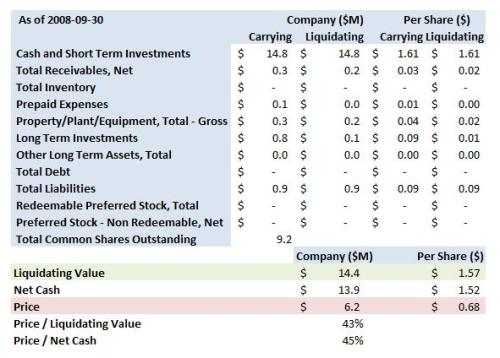
MathStar Inc (OTC:MATH) is another tiny net cash stock with a substantial stockholder lobbying management to liquidate the company. The stock closed yesterday at $0.68, giving it a market capitalization of just $6.2M. We estimate the liquidating value to be more than 120% higher at $14.4M or $1.57 per share. The value in liquidation is predominantly cash and short term investments in the amount of $14.8M. MATH has twice rejected unsolicited merger proposals. The board has largely suspended the company’s operations and is in the process of evaluating its “strategic alternatives, which could include merger, acquisition, increasing operations in another structure or liquidation.” Salvatore Muoio of S. Muoio & Co. LLC filed a Schedule 13D on December 15, 2008 urging MATH’s board to consider liquidation rather than a merger.

About MATH

MATH is a fabless semiconductor company engaged in the development, marketing and selling of high-performance, programmable platform chips and design tools required to program chips. The company’s investor relations website can be found here.

The value proposition

MATH has rapidly burned cash throughout the year, mainly on research and development. The company has now put a stop to its R&D activities, which has reduced the cash burn significantly from $6.6M in the June quarter to $1.6M in the September quarter. From the Business Overview section of the September 10Q:

During 2008, sales of our field programmable object array, or FPOA, did not materialize as expected, and development of the next generation of FPOA fell even further behind schedule. As a result, on May 20, 2008, the Board of Directors voted to suspend research and development activities and ongoing operations while analyzing strategic alternatives to protect the remaining value and increase the liquidity to the stockholders. The Board of Directors continues to explore these strategic alternatives, which could include merger, acquisition, increasing operations in another structure or liquidation.

Set out below is our summary analysis of the company’s balance sheet (the “Carrying” column shows the assets as they are carried in the financial statements, and the “Liquidating” column shows our estimate of the value of the assets in a liquidation):
math-summary

The company has a net cash position (i.e. cash remaining after paying out all liabilities) of $13.9M or $1.52 per share, which is around 120% higher than MATH’s closing price yesterday of $0.68.

The catalyst

This is one of the rare instances where management seems to have taken proactive steps to protect the company’s remaining value. The board also appears to be seeking a way to unlock that value through a merger, acquisition, increasing operations in another structure or liquidation. Salvatore Muoio of S. Muoio & Co. LLC annexed to his 13D filing the following letter setting out his preference for a liquidation over a merger:

December 12, 2008

Mr. Douglas M. Pihl
Chairman of the Board
MathStar, Inc.
19075 NW Tanabourne, Suite 200
Hillsboro, OR 97124

Dear Mr. Pihl,

Thank you for taking time out to speak with me today about MathStar’s history and current status.

To reiterate, and for the record, given the current business environment and the company’s assets and prospects, we strongly urge the Board to pursue a path of liquidation.

We have been investors in the securities of companies in liquidation for over 25 years and believe the process to be relatively straight-forward, in particular for companies as clean and litigation-free as MathStar.

As I mentioned, we don’t believe the current environment represents an attractive opportunity to merge with a speculative business in need of the company’s cash. We also don’t believe the incremental but uncertain future value of the company’s NOL in a merged entity offsets the hard cash equivalent value shareholders would receive in a liquidation in the current environment.

In addition, we would be particularly concerned if a transaction were to be announced where any appearance of a conflict of interest were present.

Sincerely,

Salvatore Muoio, C.F.A.
Managing Member

Conclusion

MATH is one of the best prospects we’ve run across recently. It is undervalued at $0.68, trading at 45% of its net cash of $1.52 per share. Management has already taken proactive steps to reduce its formerly significant cash burn rate and seems to be actively seeking a way to unlock the company’s value. We feel more comfortable that Salvatore Muoio is keeping an eye on management’s exploration of strategic alternatives and has expressed his strong preference for a liquidation. As always, the risk is that MATH is unable to unlock its value before dissipating its remaining cash but in this instance we believe that risk is low.

MATH closed yesterday at $0.68.

The S&P 500 Index closed yesterday at 913.18.

[Disclosure: We do not presently have a holding in MATH. This is neither a recommendation to buy or sell any securities. All information provided believed to be reliable and presented for information purposes only.]
Read Full Post »

We posted about Avigen, Inc. (NASDAQ:AVGN) on December 1, 2008, noting that it was a rare opportunity because it was a net cash stock (i.e. it was trading at less than the value of its cash after deducting all liabilities). Since our initial post, AVGN has fallen from $0.65 to close yesterday at $0.54. At $0.54, AVGN has a market capitalization of $16.1M against a net cash position of $36.5M, some 127% higher.

Biotechnology Value Fund (BVF), who we noted in our earlier post had an active interest in AVGN, filed an updated 13D last week. In the new filing BVF says that it sent a letter to AVGN “expressing its displeasure with [AVGN]’s recent performance and continued destruction of shareholder value.” The letter is reproduced below:

Members of the Board:

As you know, Biotechnology Value Fund, L.P., together with its affiliates, is the largest shareholder of Avigen, Inc. (“Avigen” or the “Company”), holding an ownership stake of approximately 29% of Avigen’s outstanding common stock. We first became investors in Avigen in 2004 and have provided capital directly to the Company. We are writing to express our frustration with recent developments at Avigen, particularly with what we perceive to be this Board’s self-serving actions and disregard of shareholder interests.

Since January 1, 2004, Avigen’s stock price has fallen more than 90% and the Company has accumulated a deficit of more than $110 million. Presently, Avigen’s stock trades at less than 1/3 of its net per share cash value, indicative of the investment community’s conviction that Avigen’s Board will destroy its remaining value. We have repeatedly reached out to the Company and have offered to work collaboratively to maximize shareholder value. The Company responded to our offers by unilaterally increasing and broadening management’s “golden parachute” severance agreements and by unilaterally adopting a “poison pill.”

The Board’s increase and broadening of its “golden parachute” severance agreements with management, under the ridiculous justification that such payouts are necessary to “attract and retain key employees,” is particularly outrageous given Avigen’s current circumstances. Our analysis indicates that these payouts, which we believe would be triggered by most “change in control” scenarios, including a liquidation, total at least $3 million, an incredible 20% of the Company’s entire market value. The recipients of these golden parachute arrangements include Avigen’s CEO, Ken Chahine, who resides in Park City, Utah, while the Company is based in California. How can the Company justify such actions as necessary to “attract and retain key employees” when Avigen has no real business at this time and has abandoned the development of all its products? These hastily adopted severance arrangements need to be revoked.

In addition, we believe the Board’s implementation of the “poison pill” serves no purpose other than to keep BVF from purchasing additional stock in the Company. We are concerned that management and Board members are more concerned with retaining their jobs and compensation than with maximizing shareholder value. As evidence, Avigen’s stock price has fallen more than 20% since the adoption of the poison pill. We find the poison pill to be disrespectful and offensive, given our substantial ownership position and our long history with the Company. Nevertheless, our response was to offer a compromise proposal: modify the poison pill to allow anyone to acquire as much stock as they like, however, neutralize the voting power on all shares of Avigen stock above a specified threshold. We specifically offered to have any additional shares that we acquire to abstain from voting or to vote in proportion to all other outstanding shares. This offer was not accepted. The pill should be redeemed altogether.

The Board’s recent actions reveal its true self-interest and leave us concerned that Avigen will indeed destroy and/or take all remaining value. Consequently, our primary issue has been and remains that Avigen immediately guarantee the worst case outcome for all shareholders. This guarantee could be accomplished in several ways, including by dividending or otherwise distributing all excess cash to shareholders now, or by offering to buy back any and all shares from holders that wish to sell at a specific price at a specific future date (i.e., $1.25 per share in December, 2009). In both cases, shareholders could stand to reap potentially substantial upside derived from the monetization of Avigen’s remaining assets and could finally stop worrying about whether the Company will destroy its substantial cash value. To the extent the Board believes it can generate value in excess of its cash in the bank today, offering downside protection ultimately costs the Company nothing. However, by rejecting our proposal to provide a downside guarantee, the Board has indicated its willingness to place its remaining cash at continued risk, without shareholder consent.

As the Company’s largest shareholder, we are fighting to return value to all shareholders, not just ourselves, and we feel a responsibility to do so. To be clear, we do not seek to impose our own agenda on Avigen, we only ask that shareholders be empowered to decide the fate of the Company’s residual cash, rather than the management and Board of a company which has repeatedly tried and failed to create any shareholder value whatsoever. Shareholders have good reason to worry that Avigen’s management fully intends to put its remaining cash at risk. Yesterday, at the RBC Capital Markets Healthcare Conference, CEO Ken Chahine said, “We are going to be looking at building…How do we do that?…There are some opportunities as well that have emerged from the credit crisis. There are some commercialization, or near-commercialization, type companies that could use an infusion of cash…Those are some of the things we are looking at. Now, will that be in the therapeutic space? It could be…We’re opening it up because I think that there are opportunities outside of therapeutics…We will spend the balance of 2009 trying to look for opportunities.” Mr. Chahine, shareholders do not need or want you to invest their money.

If recent empirical evidence with respect to numerous other failed biotech companies is any guide (e.g., Corgentech, Renovis, Novacea, Nitromed, Nuvelo and others), the future does not bode well for Avigen shareholders if left to its own devices. In one similar situation, the company could have returned in excess of $10/share in cash to shareholders had it been liquidated in 2005. Instead, after opting for a value-destroying merger, that company today trades at a mere 0.09 cents per share – a 99% decline! Avigen’s golden parachutes have incentivized management to merge with any company that will take it. Management would walk away with its $3 million cash windfall; shareholders would get stuck with potentially worthless stock in a merged company. In the current fiscal environment, shareholders will no longer tolerate such self-interested behavior on the part of failed biotechnology companies.

We believe the Avigen Board is not only willing to sacrifice and squander shareholder money but, in the process, its members are making a mockery of their obligations to fulfill their fiduciary duties as directors of the Company. To that end, please be advised that we intend to hold each member of the Board and management fully accountable for any continued erosion of value from the current liquidation value of the Company.

Sincerely,

Mark Lampert

Conclusion

As we noted in our earlier post, while it’s frightening to see AVGN hemorrhaging cash, BVF is working to persuade it to salvage what remains of the company’s value. If BVF is able to cause the company to quickly distribute its remaining cash to stockholders, AVGN is an attractive investment opportunity. The risk is that BVF is unable to persuade the company to do so before AVGN dissipates its remaining cash.

AVGN closed yesterday at 0.54.

The S&P 500 Index closed yesterday at 868.57.

[Disclosure: We do not presently have a holding in AVGN. This is neither a recommendation to buy or sell any securities. All information provided believed to be reliable and presented for information purposes only.]
Read Full Post »

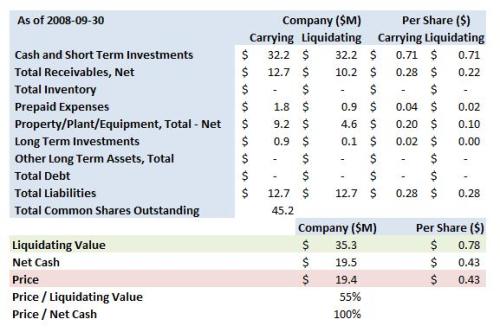
Autobytel Inc (NASDAQ:ABTL) is a net net stock with an investor declaring an active interest in late November. At yesterday’s close of $0.43, ABTL has a market capitalization of $19.4M and is trading at 55% of our estimate of its liquidation value of $35.3M. On November 21, 2008, Trilogy, Inc. filed its Schedule 13D notice, declaring an interest of 5.01%.

About ABTL

ABTL is a automotive media and marketing services company focused on helping dealers sell cars and services, and manufacturers build brands through marketing and advertising primarily through the Internet. The company owns and operates automotive websites MyRide.com, Autobytel.com, Autoweb.com, Car.com, CarSmart.com, AutoSite.com and CarTV.com. It connects automotive marketers with vehicle shoppers visiting these websites and third-party websites (primarily search engines, automotive information providers and other auto related venues). You can see the corporate website here.

The value proposition

ABTL’s most recent 10Q, specifically its earnings and cash flow, was abominable. The company lost $5.36M last year but surpassed that in the September quarter alone, losing$5.63M. ABTL had negative cash from operating activities last year of $6.91M and $2.88M in the quarter to September. As always we can find some value on the balance sheet, as our summary analysis demonstrates (the “Carrying” column shows the assets as they are carried in the financial statements, and the “Liquidating” column shows our estimate of the value of the assets in a liquidation):

abtl-summary1

With $32.2M or $0.71 per share in cash and equivalents on the balance sheet and total liabilities of $12.7M or $0.28 per share, ABTL is trading at its net cash value of $0.43. If we add in receivables of $12.7M (which we’ve written down by 20% to $10.2M or $0.22 per share), property, plant and equipment of $9.2M (written down to $4.6M or $0.10 per share) and a nominal $0.9M or $0.02 per share for the prepaid expenses, ABTL has a a liquidating value of $35.3M or $0.78 per share. ABTL’s liquidating value of $0.78 is 82% higher than its stock price of $0.43, which is a substantial margin for error (or safety).

The catalyst

Trilogy, Inc. filed its Schedule 13D notice, declaring an interest of 5.01% on November 21, 2008. The filing contains the standard boilerplate that says a great deal without actually disclosing Trilogy’s true purpose for the purchase.  Trilogy is a private operating company in the technology consulting industry, not a fund manager, so there is little public information available about its strategy. It seems odd for a technology consulting business to buy a substantial active stake in a listed company. It’s possible that the filing is a precursor to a bid for ABTL. An affiliate of Trilogy, Trilogy Automotive Advertising Services, operates a business focussed on the automotive industry. ABTL might fit nicely into that business. We’re only speculating, but on the basis that it might turn into a bid, ABTL is worth watching.

Conclusion

At its close yesterday of $0.43 ABTL is trading at its net cash and at a 45% discount to its value in liquidation. In short, it’s a bargain. With Trilogy disclosing an active interest that could be a precursor to a takeover bid, ABTL is worth a look.

ABTL closed yesterday at $0.43.

The S&P 500 Index closed at 899.24.

[Disclosure: We do not have a holding in ABTL. This is neither a recommendation to buy or sell any securities. All information provided believed to be reliable and presented for information purposes only.]
Read Full Post »

Chromcraft Revington (AMEX:CRC) is a tiny, AMEX-listed net-net stock with a substantial stockholder calling for its sale or orderly liquidation. CRC has a market capitalization of only $2.8M, but the company’s written-down net current asset value is much higher at around $15M. The only problem? The company is in a liquidity crisis and risks entering bankruptcy if its fortunes don’t turn around. Aldebaran Capital, LLC, a 7.7% stockholder, sent a letter to the company on October 29 arguing that if CRC is unable to “promptly stabilize its business and rationalize its cost structure” it should be sold or liquidated.

About CRC

CRC is engaged in the design, production, sales and import of residential and commercial furniture. It markets its residential furniture products under the CR-Home banner with the brand names Chromcraft, Peters-Revington, Cochrane, Sumter and Silver. CRC distributes its products throughout the United States and Canada, primarily through furniture dealers. The history of the company is available on its website.

The value proposition

CRC is one of the most deeply undervalued asset situations we’ve uncovered, which is no surprise given the parlous state of its earnings and operating cash flow. The company made a loss of $14.87M last year and a loss of $3.39M in the 2006 financial year. Cash from Operating Activities has also been disappointing, negative to the tune of $3M in 2007 and $4M this quarter. All is not doom and gloom however: some residual value can still be found on the balance sheet.

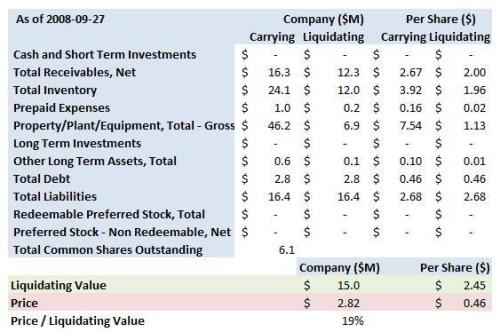
Set out below is our summary analysis (the “Carrying” column shows the assets as they are carried in the financial statements, and the “Liquidating” column shows our estimate of the value of the assets in a liquidation):

crc-summary

A quick glance at the balance sheet shows that CRC is in a liquidity crisis. The company had $8.4M in cash 12 months ago, but has burned through it since then. In three quarters the receivables have reduced from $18.4M in March to $16.3M in this quarter, with none of it flowing through to cash. The company states in its 10Q that it has “several sources of cash” that it believes will be “adequate to meet its short term liquidity requirements.” These are as follows:

  • At September 27, 2008, [CRC] has unused borrowing capacity of approximately $14,231,000 under its Bank Facility.
  • [CRC] expects to receive asset sale proceeds of approximately $3,300,000 in 2009 from the sale of its Lincolnton, North Carolina buildings, machinery and equipment.
  • At September 27, 2008, [CRC] has refundable income taxes of $3,462,000, primarily from net operating loss (NOL) carrybacks, which are expected to be received in the fourth quarter of 2008.
  • [CRC] plans to sell excess inventories and generate cash of approximately $3,000,000 in 2009.
  • [CRC] has recently implemented spending controls and overhead expense reductions in personnel.
  • Future capital spending for information technology upgrades will be delayed to 2010.

CRC’s bankruptcy is not necessarily a problem for an investor if the assets are sufficient to pay out the liabilities and leave some residual value in excess of the current stock price. We think that there is a good chance that this is the case, provided that some action is taken soon to preserve the remaining value.

Assuming the board acts quickly to salvage what remains of CRC, we estimate the company’s per share value in liquidation at around $2.45 or $15M in toto. To reach this estimate, we’ve written down the receivables by a quarter to a little over $12M or $2.00 per share, inventory by two-thirds to $12M or $1.96 per share and Property, Plant and Equipment by 85% from $46M to $6.9M or $1.13 per share. Deducting Total Liabilities of $16.4M or $2.68 per share leaves a value in liquidation of around $2.45 per share.

The catalyst

Aldebran Capital acquired its 7.7% holding in CRC in September and October of this year, paying between $0.42 and $2.72 per share. In a letter to CRC’s chairman, Aldebran Capital has asked the board to take steps to preserve the remaining value. Aldebran Capital’s letter annexed to its 13D filing of October 29, 2008 is reproduced below:

Dear Mr. Chairman:

Aldebaran Capital, LLC is an Indiana limited liability company and registered investment advisor. As noted in our recent filing, we have acquired 7.7% of the outstanding shares of Chromcraft Revington, Inc.

We have followed the transformation of the company over the past few years, as Chromcraft has undergone a major change in its business model.

As security analysts, we recognize the challenges the company has faced in implementing its plan. In addition, we fully understand that current economic conditions are causing the task to be even more difficult.

However, the company is nearly three years into restructuring maneuvers that were begun in 2006. Along the way, Chromcraft has incurred significant losses and continues to accrue costs attendant with these changes. As shareholders, we believe that it is time for the company to demonstrate that these actions are bearing fruit.

In our opinion, if the company is unable to promptly stabilize its business and rationalize its cost structure, we believe that the Board should consider either: a) the sale of the company or, b) undertake an orderly liquidation of the company assets.

We look forward to speaking with you further about Chromcraft.

Sincerely,

Kenneth R. Skarbeck
Managing Member,
Aldebaran Capital, LLC

Conclusion

It’s always difficult to recommend a stock in a liquidity crisis, but crises are what create the wide disparities between value and price, or, in other words, the bargains. CRC is such a bargain. At its close yesterday of $0.46, CRC is trading at a tiny 20% of our estimate of its liquidation value of around $2.45 per share. While there is substantial value on the balance sheet relative to the stock price, the risk is that the company continues to trade and destroys that remaining value. This is always the risk with net net stocks. The good news is that Aldebaran Capital has already called for CRC’s board to take some stockholder friendly steps. We think that Aldebran Capital will be successful and CRC’s value will sooner or later be reflected in its stock.

Warning: When trading in tiny, thinly traded stocks with a wide bid-ask spread, make sure you set a limit on the stock order or you might end up paying more than you want.

CRC closed yesterday at $0.46.

The S&P 500 Index closed at 909.70.

[Disclosure: We do not have a holding in CRC. This is neither a recommendation to buy or sell any securities. All information provided believed to be reliable and presented for information purposes only.]

Read Full Post »

The Official Activist Investing Blog has published its list of activist investments for November:

Ticker Company Activist Investor
ABTL Autobytel Inc Trilogy Inc
ACF AmeriCredit Corp Fairholme Capital Management
ACTL Actel Corp Ramius Capital
ADPT Adaptec, Inc Steel Partners
ARCW Arc Wireless Solutions Brean Murray Carret Group
ATSG Air Transport Services Group Perella Weinberg Partners
AVGN Avigen Inc Biotechnology Value Fund
BBI Blockbuster Inc Marlin Sams Fund
BEE Strategic Hotels & Resorts Security Capital Research & Management
BITI Bio-Imaging Technologies Healthinvest Partners
CHG CH Energy Group Inc Gamco Investors
CHIC Charlotte Russe Holding Inc KarpReilly Capital Management
CPN Calpine Corp Harbinger Capital
CRXX CombinatoRX, Incorporated Biotechnology Value Fund
CTO Consolidated Tomoka Land Co Wintergreen Advisers
CWLZ Cowlitz Bancorporation Crescent Capital
DBD Diebold Inc Gamco Investors
DCAP DCAP Group Infinity Capital Partners
DVD Dover Motorsports Mario Cibelli
ENTU Entrust Inc. Empire Capital Partners
FACE Physicians Formula Holdings, Inc Mill Road Capital
FSCI Fisher Communications Gamco Investors
FTAR.OB Footstar Inc Schultze Asset Management
GBE Grubb & Ellis Company Anthony Thompson
GGP General Growth Properties Pershing Square Capital
GSLA GS Financial Corp FJ Capital Long/Short Equity Fund
HCBK Hudson City Bancorp Gamco Investors
HFFC HF Financial Corp PL Capital
INFS Infocus Corp Nery Capital Partners
INFS Infocus Corp Lloyd Miller
ISH International Shipholding Corp Liberty Shipping Group
KANA.OB Kana Software KVO Capital Management
KEYN Keynote Systems Ramius Capital
KFS Kingsway Financial Services Joseph Stilwell
KONA Kona Grill Mill Road Capital
LCAV LCA-Vision Inc Stephen Joffe
LDIS Leadis Technology Inc Kettle Hill Capital Management
LNET LodgeNet Interactive Corporation Mark Cuban
LTM Life Time Fitness Green Equity Investors
MCGC MCG Capital Corporation Springbok Capital Management
MGAM Multimedia Games Inc. Dolphin Limited Partnership
MGI Moneygram Interntaional Inc Blum Capital
MIM MI Developments Greenlight Capital
MYE Myers Industries Inc Gamco Investors
NAV Navistar International Owl Creek
NLS Nautilus Inc Sherborne Investors
NOOF New Frontier Media Steel Partners
NYT New York Times Harbinger Capital
OEH Orient-Express Hotels SAC Capital; DE Shaw
ORNG Orange 21 Costa Brava
PBIP Prudential Bancorp Inc. of PA Joseph Stilwell
PGRI.OB Platinum Energy Resources Inc Syd Ghermezian
PHH PHH Corp. Pennant Capital Management
PNNW Pennichuck Corp Gamco Investors
PPCO Penwest Pharmaceuticals Co Perceptive Advisors
PRXI Premier Exhibitions, Inc Sellers Capital
PWER Power One Bel Fuse
PXG Phoenix Footwear Group Reidman Corp
RDEN Elizabeth Arden Shamrock Activist Value Fund
SCOP Scopus Video Networks Ltd. Optibase Ltd
SECX.PK SED International Holdings Hummingbird Management
SLTC Selectica Inc Trilogy Inc (Versata Enterprises)
SNG Canadian Superior Energy Palo Alto Investors
SNSTA Sonesta International Hotels Gamco
SUAI Specialty Underwriters Alliance Philip Stephenson
SUMT SumTotal Systems Discovery Capital
SUTM.OB Sun-Times Media Group Inc. K Capital
SUTM.OB Sun-Times Media Group Inc. Davidson Kempner Partners
SWWI Simon Worldwide Inc Everst Special Situations Fund
TIKRF.OB Tikcro Technologies Ltd Steven Bronson
TXCC TranSwitch Corp Brener International Group
TXI Texas Industries Shamrock Activist Value Fund
UIS Unisys Corp MMI Investments
UTEK Ultratech Inc Temujin Fund
WBSN Websense Inc Shamrock Activist Value Fund
WEDC White Electronic Designs Wynnefield Capital
WINS SM&A Mill Road Capital
YHOO Yahoo Carl Icahn
ZLC Zale Corp. Breeden Capital Management

Read Full Post »

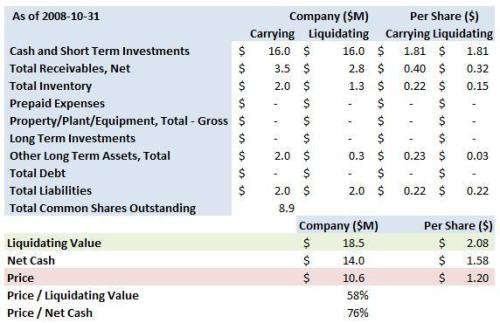
Dataram Corporation (NASDAQ: DRAM) is a classic net-net stock, with a $10.6M market cap at yesterday’s closing price of $1.20 and around $18.5M of value in liquidation, including $16M in cash.

About DRAM

According to the company’s website, DRAM is a developer, manufacturer and marketer of large-capacity memory products primarily used in high-performance network servers and workstations. The stock is down sharply because the company cut its dividend and its operating cash flow has turned negative in its most recent quarter, burning through $1.3M. We don’t know anything about “large-capacity memory products” so we don’t know if this is a short term blip on the road to more profits or the beginning of the end.

The value proposition

According to DRAM’s most recent quarterly report, the balance sheet looks reasonably healthy.  Set out below is our summary analysis (the “Carrying” column shows the assets as they are carried in the financial statements, and the “Liquidating” column shows our estimate of the value of the assets in a liquidation):

dram-summary

We estimate that DRAM has a liquidating value of around $18.5M, or $2.08 per share. In coming to that number, we’ve written down the Receivables by 20%, Inventory by 33% and Other Long Term Assets by 50%.

With its stock price at $1.20, DRAM is trading at 58% of its value in a liquidation and at a 24% discount to its net cash (cash less all liabilities) of $1.58 per share.

Catalysts

The risk with DRAM, as it is with any net net or net cash stock, is that the company might not make a profit any time soon and won’t liquidate before it dissipates its remaining cash. As we said above, we’ve got no insight into DRAM’s business and don’t know whether it can trade out of its present difficulties and back to at least a positive operating cash flow. According to the 10Q, the company is authorized to repurchase 172,196 shares under a stock repurchase plan but this is an immaterial amount in the context of the 8.9M shares on issue and the plan has been in existence since 2002. The best hope for the stockholders is that the company re-institutes its dividend, which, given its $16M in cash, it certainly seems able to do. No noted activists have disclosed a holding in the company, which means management have no incentive to do anything so stockholder friendly.

Conclusion

DRAM, at 58% of its liquidating value and 76% of its cash backing, is very cheap. We believe that it is worth watching but, with no obvious catalysts and a high cash burn rate, probably one to avoid unless you are willing to bet that its remaining cash might attract an activist or the business will turn around before it runs out of money.

[Disclosure: We do have a holding in DRAM. This is neither a recommendation to buy or sell any securities. All information provided believed to be reliable and presented for information purposes only.]

Read Full Post »

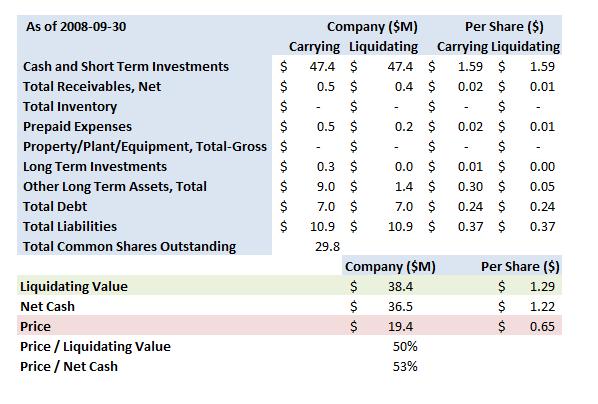
Avigen, Inc. (NASDAQ:AVGN) is an interesting opportunity: a rare net cash stock with an activist investor in pursuit. Based on its December 1, 2008 closing price of $0.65, the company has a market capitalization of $19.4M and net cash (i.e. cash less all liabilities) of $36.5M, which means that AVGN is trading at 53% of its net cash. Biotechnology Value Fund LP owns around 29% of the outstanding stock and has filed a 13D/A notice (most recent is here) requesting that AVGN “immediately reduce its expenses to as low a level as possible, partner or sell its remaining assets without further investment and take actions to distribute to [AVGN]’s stockholders as much of the resulting cash as possible.”

About AVGN

AVGN (website here) is a “biopharmaceutical company engaged in developing and commercializing small molecule therapeutics to treat neurological and neuromuscular disorders.”

The value proposition

According to AVGN’s most recent quarterly report, the company is bleeding cash, losing $9.4 in the September quarter. AVGN lost $25.2M last year and $24.3M in 2006. It has also had negative Cash Flow from Operating Activities for the September quarter in the amount of $8.4M. The company does, however, have a substantial amount of cash on its balance sheet. Set out below is our summary analysis (the “Carrying” column shows the assets as they are carried in the financial statements, and the “Liquidating” column shows our estimate of the value of the assets in a liquidation):

avgn-summaryAVGN is a net cash stock, with $1.22 of net cash (cash after subtracting Total Liabilities). With its stock price at $0.65, AVGN is trading at a little over half its net cash value. We estimate AVGN’s value in a liquidation at around $38.4M ($1.29 per share).  Given its net cash position of $36.5M or $1.22 per share, this means we have valued the rest of the company’s assets in liquidation at only $1.9M or $0.07 per share.

The catalyst

Biotechnology Value Fund originally filed a 13G notice in relation to AVGN, which indicates a passive investment. By updating to a 13D, Biotechnology Value Fund has indicated that it intends to take an active role in the company. An earlier 13D filing sets out Biotechnology Value Fund’s attitude towards the company:

“At the invitation of the Chairman of [AVGN], [Biotechnology Value Fund] articulated their views regarding the future of the Company in a conference call with the Board of Directors held on October 30, 2008. [Biotechnology Value Fund] stated their strong belief that [AVGN] should immediately reduce its expenses to as low a level as possible, partner or sell its remaining assets without further investment and take actions to distribute to [AVGN]’s stockholders as much of the resulting cash as possible. [AVGN] reported $56 million, or $1.88 per share, of financial assets as of September 30, 2008, consisting of cash, cash equivalents, available-for-sale securities and restricted investments.

[Biotechnology Value Fund] informed the Board of Directors that they think that the previously announced plan of spending [AVGN]’s remaining cash on the development of its early-stage pain drug, AV411 as well as [AVGN]’s corporate infrastructure is fundamentally flawed, especially in light of the current environment for raising additional capital. [Biotechnology Value Fund] believe that AV-411 is a high risk drug candidate that is best developed (if at all) by a larger company with greater financial resources and a lower cost of capital. By the time AV-411 could be commercialized, or even definitively proven safe and efficacious, [AVGN]’s existing cash resources would be depleted. [Biotechnology Value Fund] believe that the investment community clearly lacks confidence in such a plan, as evidenced by recent reports from stock analysts and by the $0.61 per share closing price of [AVGN]’s common stock on October 30, 2008, reflecting only 31% of [AVGN]’s financial assets as of September 30, 2008.

[Biotechnology Value Fund] intend to work with [AVGN]’s Board of Directors to effecuate a prompt return of cash to [AVGN]’s stockholders and intend to bring the matter directly to a vote of stockholders if their efforts with the Board of Directors are unsuccessful.”

Conclusion

It’s always exciting to find a net cash stock with an substantial stockholder demanding a return of cash. While it’s frightening to see AVGN hemorrhaging cash, Biotechnology Value Fund is awake to the opportunity to salvage what remains of the company’s value. If Biotechnology Value Fund is able to cause the company to quickly distribute the company’s remaining cash to stockholders, purchasers at these levels should see a good return on investment.

AVGN closed today at $0.65.

The S&P 500 Index closed at 816.21.

[Disclosure: We do not presently have a holding in AVGN. This is neither a recommendation to buy or sell any securities. All information provided believed to be reliable and presented for information purposes only.]

Read Full Post »

« Newer Posts