Feeds:
Posts
Comments

Archive for the ‘Net Cash Stocks’ Category

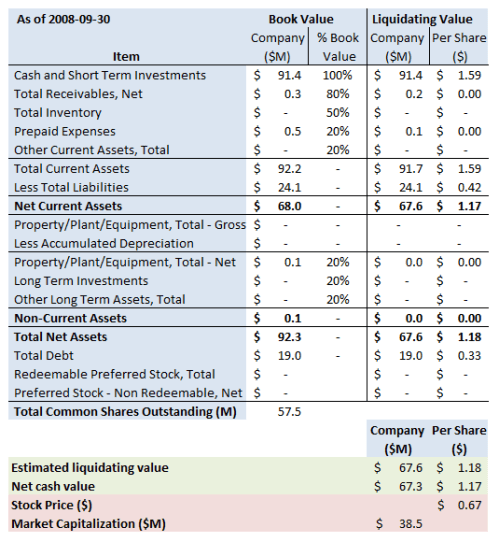
CuraGen Corporation (NASDAQ:CRGN) is a net cash stock with an investor, DellaCamera Capital Management, disclosing a 5.6% holding in a 13D filed on January 15. At its $0.67 closing price Friday, CRGN’s market capitalization is $38.5M. We estimate CRGN’s net cash value to be 60% higher at $62M or $1.07 per share. The company is not generating any operating cash flow as it is a “biopharmaceutical development company,” so the challenge for DellaCamera Capital Management is to persuade the company to pay a special dividend or liquidate before it dissipates its remaining cash.

About CRGN

CRGN is a biopharmaceutical development company engaged in developing cancer treatments. It also has a portfolio of earlier stage assets, including proteins, antibodies and small molecules that represent potential treatments for cancer. The company’s investor relations website is here.

The value proposition

As a “biopharmaceutical development company” CRGN is burning cash in development and not generating any income or operating cash flow. Its value lies in its present $67M net cash position (the “Book Value” column shows the assets as they are carried in the financial statements, and the “Liquidating Value” column shows our estimate of the value of the assets in a liquidation):

crgn-summary

CRGN’s $91.4M in cash and cash equivalents consists of $7.4M in cash, $40.4M in short-term investments and $43.6M in marketable securities.

Off-balance sheet arrangements and Contractual obligations

According to CRGN’s most recent 10Q, the company does not have any off-balance sheet arrangements. Its enforceable and legally binding obligations, along with future commitments related to all contracts that it is likely to continue, regardless of the fact that they are “cancelable as of September 30, 2008,” excluding those captured in the financial statements, are around $5.5M through 2011.

Deducting the $5.5M from the $67.6M in net assets leaves around $62M in liquidation value or $1.07 per share.

The catalyst

DellaCamera Capital Management filed a 13D notice on January 15 disclosing a 5.6% holding in CRGN. The filing is silent as to DellaCamera Capital Management’s purpose for the CRGN investment beyond the usual other than the following:

[DellaCamera Capital Management] intend to make themselves available to [CRGN] to discuss methods of delivering additional value to [CRGN]’s shareholders, including the possible alternative deployment of [CRGN]’s capital. [DellaCamera Capital Management] may seek board representation to assist in this endeavor.

Hopefully DellaCamera Capital Management can find an “alternative deployment of [CRGN]’s capital” before the company burns through its remaining cash.

Conclusion

As a net cash stock, CRGN’s current liquidating value is relatively easy to determine. At $0.67, CRGN’s liquidating value is around 60% higher at $1.07 per share. The more difficult step is to determine the liquidating value of the company if and when DellaCamera Capital Management is successful. We think that 60% is a substantial margin of safety for CRGN and so we are adding it to the Greenbackd Portfolio.

CRGN closed Friday at $0.67.

The S&P500 Index closed Friday at 850.12.

[Full Disclosure:  We do not have a holding in CRGN. This is neither a recommendation to buy or sell any securities. All information provided believed to be reliable and presented for information purposes only. Do your own research before investing in any security.]

Read Full Post »

Biotechnology Value Fund (BVF) announced today that it intends to make a tender offer for all of the outstanding stock of Avigen, Inc. (NASDAQ:AVGN) that it does not own.

We’ve been following AVGN (see archived posts here) because it’s a net cash stock (i.e. it’s trading at less than the value of its cash after deducting all liabilities) and specialist biotechnology activist fund BVF has been pushing it to liquidate and return its cash to shareholders. MediciNova, Inc.’s (NASDAQ:MNOV) has made an offer for AVGN that represents a clever way for AVGN’s stockholders to receive cash equivalent to that which they would receive in a liquidation (less $7M to be paid to MNOV) with the possibility for “an extraordinary, uncapped return” if MNOV is successful post-merger. We estimate AVGN’s cash at around $1.22 per share (BVF estimates $1.20 per share), which is a little less than 40% higher than AVGN’s $0.92 close yesterday.

The tender offer statement filed with the SEC attaches the following press release from BVF:

Biotechnology Value Fund, L.P. To Make Tender Offer For Any And All Outstanding Shares Of Avigen At $1.00 Per Share

Tender Offer provides stockholders with a near-term cash alternative if BVF nominees are elected

BVF reaffirms support for downside-protected merger with MediciNova

NEW YORK, Jan. 15 /PRNewswire/ — Biotechnology Value Fund, L.P. (“BVF”) announced today that it intends to make a cash tender offer to purchase any and all of the outstanding common stock of Avigen, Inc. (Nasdaq: AVGN – News; “Avigen”) that BVF does not own at a price of $1.00 per share under the conditions described below. The offer price represents a 35% premium over Avigen’s closing stock price of $0.74 on January 8, 2009, the day prior to BVF’s announcement that it was seeking to remove all incumbent Avigen directors and to elect its own slate of stockholder focused nominees. BVF Partners L.P., the general partner of BVF, beneficially owns an aggregate of 8,819,600 shares of Avigen, or approximately 29.63% of the outstanding shares.

On January 9, 2009, BVF announced that it had delivered a notice to Avigen to call a special meeting of stockholders (the “Special Meeting”) to remove all incumbent directors and elect its own slate of stockholder-focused nominees

The tender offer will be conditioned on the following: (i) BVF’s nominees being elected to the board of directors of Avigen (the “Board”) at the Special Meeting (or otherwise appointed) and constituting a majority of directors on the Board, (ii) the Board redeeming rights issued under Avigen’s poison pill, (iii) Avigen not committing to any strategic transactions or capital-depleting actions, pursuant to the process described by Avigen on January 14, 2009 (or otherwise), and (iv) other customary conditions such as the absence of a suspension in trading or any material adverse change at Avigen. BVF may increase the tender price if Avigen’s unrestricted cash balance increases (for example, as the result of the sale of assets.) The tender offer is not conditioned on the availability of financing.

Mark Lampert, the general partner of BVF, stated, “The tender offer provides stockholders with a choice if BVF’s nominees are elected to the Board: they can either tender their shares for near-term cash at a premium to the market price or they can retain their shares and participate with BVF in the future of Avigen, whether through a merger with MediciNova, as hoped, or otherwise. This tender is the outgrowth of Avigen’s earlier rejection of our request that the Company provide downside protection for all shareholders. If elected to the Board, BVF’s nominees intend to pursue the downside-protected transaction proposed by MediciNova, or, if not possible, to consider other alternatives including a complete return of capital.”

Mr. Lampert continued, “Yesterday Avigen announced that it will spend stockholder money on not one, but two financial advisors. Why? We believe that Avigen could retain ten financial advisors and it won’t change the fact that the risk-reward profile of the proposed merger with MediciNova is extraordinary. We are concerned that this is just another example of the Board wasting stockholders’ assets; we question the Board’s underlying motivation for these actions and whether they are simply trying to remain in office at stockholders’ expense. In order to ensure no further deterioration of Avigen’s value, we urge stockholders to vote to remove all incumbent directors and elect the BVF nominees.”

BVF expects to file offering materials with the Securities and Exchange Commission and commence the tender offer within a reasonable time. Once the tender offer is commenced, offering materials will be mailed to Avigen stockholders and filed with the Securities and Exchange Commission. Avigen stockholders are urged to read the offering materials when they become available because they will contain important information.

[Full Disclosure: We have a holding in AVGN. This is neither a recommendation to buy or sell any securities. All information provided believed to be reliable and presented for information purposes only.]

Read Full Post »

Biotechnology Value Fund (BVF) has filed its proxy material for the Special Meeting of Avigen, Inc. (NASDAQ:AVGN) stockholders. BVF want to replace AVGN’s board with BVF’s slate of director nominees who will support MediciNova, Inc.’s (NASDAQ:MNOV) offer for AVGN.

We’ve been following AVGN (see earlier posts here, here, here, here, here, here and here) because it’s a net cash stock (i.e. it’s trading at less than the value of its cash after deducting all liabilities) and specialist biotechnology activist fund BVF has been pushing it to liquidate and return its cash to shareholders. We think MNOV’s offer represents a clever way for AVGN’s stockholders to receive cash equivalent to that which they would receive in a liquidation (less $7M to be paid to MNOV) with the possibility for “an extraordinary, uncapped return” if MNOV is successful post-merger. We estimate AVGN’s cash at around $1.22 per share (BVF estimates $1.20 per share), which is a little less than 40% higher than AVGN’s $0.87 close yesterday.

BVF’s proxy material sets out the rationale for removing the incumbent directors:

The members of the BVF Group are currently the beneficial owners of an aggregate of 8,819,600 Shares, representing approximately 29.63% of the issued and outstanding common stock. As significant stockholders of Avigen, we have one goal: to maximize the value and minimize the risk on behalf of all stockholders. A brief synopsis of Avigen corporate history as well as our recent efforts to maximize stockholder value is summarized in the following chronology of events leading up to this proxy solicitation:

We first became a shareholder of Avigen in 2005, the year Avigen sold, for $12 million, its unsuccessful gene therapy business in which the Company had invested over $150 million. The Company, led by its current CEO, Ken Chahine, spent nearly two years running a “process” with the mandate to re-invent the Company by investing in whatever the current management team deemed compelling. In January 2006, this management team chose to acquire its lead development candidate, AV650, because, in their own words, “we believe it is a low risk.” In fact the Company’s entire strategy, then and now, is supposedly “designed to mitigate the risk of bringing innovative therapies to U.S. patients.” $100 million later, on October 21, 2008, Avigen announced the outright failure of its “low risk” bet on AV650, resulting in a collapse in the Company’s stock price. This same management team and Board, which has failed previously, now wishes to bet the substantial remaining shareholder capital on whatever it deems appropriate.

We recently acquired a significant number of Shares and became the largest stockholder of Avigen. We increased our investment in October 2008 based upon our belief that Avigen’s shares were significantly undervalued. In fact, Avigen reported $56 million, or $1.88 per Share, of financial assets as of September 30, 2008, consisting of cash, cash equivalents, available-for-sale securities and restricted investments, while trading at a price well below $1.00 during the two months prior to filing this proxy statement. We believe this depressed trading price, substantially below Avigen’s cash liquidation value, is based upon the market’s concern that management and the existing Board will pursue ill-advised or other value destroying ventures, at stockholders’ expense, while compensating themselves in the process.

Since this time, we have reached out to the Board numerous times, each time raising our concern that Avigen’s existing liquid assets not be wasted or otherwise committed to value destroying ventures.

We have specifically suggested that the Board “guaranty” the worst case outcome for all stockholders. This guaranty could be accomplished in several ways, including by dividending or distributing all excess cash to stockholders at the present time, or by offering to buy back any and all Shares from stockholders that wish to sell at a specific price at a specific future date (e.g. $1.25 per Share in December 2009). At no time have we asked for – nor would we accept – any consideration or benefit for ourselves that would not be offered to all stockholders.

The Board has ignored our attempts to work constructively for the benefit of all stockholders. Avigen responded to our offers by unilaterally increasing and broadening management’s “golden parachute” severance agreements and unilaterally adopting a “poison pill,” raising our concerns about this Board’s true intentions.

The Board’s “golden parachute” severance agreements with management, under the ridiculous justification that such payouts are necessary to “attract and retain key employees,” is particularly outrageous given Avigen’s current circumstances. Our analysis indicates that these payouts, which we believe would be triggered by most “change in control” scenarios, including a liquidation, total at least $3 million, an incredible 16.5% of the Company’s entire market value at the time of adoption. The recipients of these golden parachute arrangements include Avigen’s CEO, Ken Chahine, who resides in Park City, Utah, while the Company is based in California. We question how the Company can justify such actions as necessary to “attract and retain key employees” when Avigen has no real business at this time and has abandoned the development of all its products. These hastily adopted severance arrangements need to be challenged and, if possible, revoked.

In addition, we believe the Board’s implementation of the “poison pill” serves no purpose other than to entrench the Board and keep BVF from purchasing additional stock in the Company. We are concerned that management and Board members are more concerned with retaining their jobs and compensation than with maximizing stockholder value. As evidence, Avigen’s stock price fell more than 20% after the adoption of the poison pill. The pill should be redeemed. The Board’s recent actions reveal its true self-interest and leave us concerned that the Board will indeed destroy and/or take all remaining value.

On December 22, 2008, MediciNova, Inc. (“MediciNova”), a company in which we have no economic interest, proposed to merge with Avigen in an innovative and, we believe, compelling downside-protected structure. We believe the proposed merger is uncontrovertibly in the best interest of all stockholders and we had grave concerns that the Board may not negotiate in good faith with MediciNova, if at all. Avigen’s statements apparently rejecting this proposal confirmed our worst fears. We are concerned that the Board’s and management’s self-interest will prevent them from acting in what we believe to clearly be the best interests of all stockholders.

Accordingly, after much consideration we felt compelled to call this special meeting of stockholders to remove the existing directors and to elect new, truly independent directors who, if elected, will take actions to benefit all stockholders, including redeeming Avigen’s stockholder rights plan, working to consummate the proposed transaction with MediciNova and/or working to complete a distribution of Avigen’s assets to all stockholders.

[Full Disclosure: We have a holding in AVGN. This is neither a recommendation to buy or sell any securities. All information provided believed to be reliable and presented for information purposes only.]

Read Full Post »

We’ve recently received several questions about our valuation methodology. Specifically, readers have asked why we include property, plant and equipment in our valuation, and why we only discount it by half, as opposed to a higher figure (two-thirds, four-fifths, one-hundred percent). They are concerned that by including property, plant and equipment in our assessment, or by failing to apply a sufficient discount to those assets, we are overstating the asset or liquidation value of the companies we cover and therefore overpaying for their stock. In this post, we better describe our approach to asset valuation. In the next post, we deal with our method for protecting ourselves from overpaying for stock.

Our valuation methodology is closely based on Benjamin Graham’s approach, which he set out in Security Analysis and The Interpretation of Financial Statements. Like Graham, we have a strong preference for current assets, and, in particular, cash. As we mention on the About Greenbackd page, our favorite stocks are those backed by greenbacks, hence our name: Greenbackd. We love to find what Graham described as gold-dollars-with-strings-attached that can be purchased for 50 cents. We believe that there is value in long-term and fixed assets, although not necessarily the value at which those assets are carried in the financial statements. The appropriate discount for long-term and fixed assets is something with which we (and we suspect other Grahamite / asset / liquidation investors) struggle. We think it’s useful to consider Graham’s approach, which we’ve set out below:

Graham’s approach to valuing long-term and fixed assets

Graham’s preference was clearly for current assets, as this quote from Chapter XXIV of The Interpretation of Financial Statements: The Classic 1937 Edition demonstrates:

It is particularly interesting when the current assets make up a relatively large part of the total assets, and the liabilities ahead of the common are relatively small. This is true because the current assets usually suffer a much smaller loss in liquidation than do the fixed assets. In some cases of liquidation it happens that the fixed assets realize only about enough to make up the shrinkage in the current assets.

Hence the “net current asset value” of an industrial security is likely to constitute a rough measure of its liquidating value. It is found by taking the net current assets (or “working capital”) alone and deducting therefrom the full claims of all senior securities. When a stock is selling at much less than its net current asset value, this fact is always of interest, although it is by no means conclusive proof that the issue is undervalued.

Despite Graham’s cautionary tone above, he did not necessarily exclude long-term and fixed assets from his assessment of value. He did, however, heavily discount those assets (from Chapter XLIII of Security Analysis: The Classic 1934 Edition “Significance of the Current Asset Value”):

The value to be ascribed to the assets however, will vary according to their character. The following schedule indicates fairly well the relative dependability of various types of assets in liquidation.

liquidation-value-schedule2

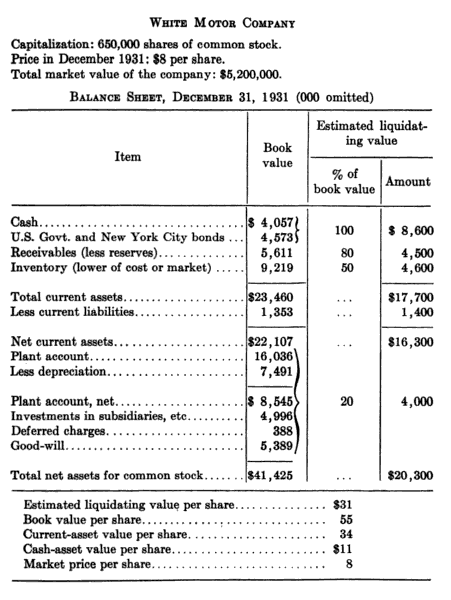
Graham then set out an example valuation for White Motor Company:

In studying this computation it must be borne in mind that our object is not to determine the exact liquidating value of White Motor, but merely to form a rough idea of this liquidating value in order ascertain whether or not the shares are selling for less than the stockholders could actually take of the business. The latter question is answered very definitively in the affirmative. With a full allowance for possible error, there was no doubt at all that White Motor would liquidate for a great deal more than $8 per share or $5,200,000 for the company. The striking fact that the cash assets alone considerably exceed this figure, after deducting all liabilities, completely clinched the argument on this score.
white-motor-example1

Current-asset Value a Rough Measure of Liquidating Value. – The estimate values in liquidation as given for White Motor are somewhat lower in respect of inventories and somewhat higher as regards the fixed and miscellaneous assets than one might be inclined to adopt in other examples. We are allowing for the fact that motor-truck inventories are likely to be less salable than the average. On the other hand some of the assets listed as noncurrent, in particular the investment in White Motor Securities Corporation, would be likely to yield a larger proportion of their book values than the ordinary property account. It will be seen that White Motor’s estimated liquidating value (about $31 per share) is not far from the current-asset value ($34 per share). In the typical case it may be said that the noncurrent assets are likely to realize enough to make up most of the shrinkage suffered in the liquidation of the quick assets. Hence our first thesis, viz., that the current-asset value affords a rough measure of the liquidating value.

Greenbackd’s approach to valuing long-term and fixed assets

The first thing to note is that we’ve got no particular insight into any of the companies that we write about or the actual value of the companies’ assets. The valuations are based on the same generalized, unsophisticated, purely mathematical application of Graham’s formula. Further, if the actual value of an asset is objectively known or determinable, then we don’t know it and, in most cases, can’t determine it. That puts us at a disadvantage to those who do know the assets’ real value or can make that determination. Secondly, we can’t make the fine judgements about value that Graham has made in the White Motor example above. Perhaps it’s blindingly obvious that “motor-truck inventories are likely to be less salable than the average,” but we don’t know anything about motor-truck inventories or the average. It’s specific knowledge that we don’t have, which means that we are forced to mechanically apply the same discount to all assets of the same type.

Given that we’ve disclaimed any ability to actually value an asset or class of assets, why not adopt the lower to middle end of Graham’s valuation range for those assets? (Editors note: What a good suggestion. From here on in, we’re taking Graham’s advice. It’s simply because, in our experience, as idiosyncratic as it has been, an 80% discount to property, plant and equipment is too much in most instances. We think that 50% is a conservative estimate. In our limited experience, commercial and industrial real estate rarely seems to sell at much less than 15% below book value, and that’s in the recent collapse.) At first blush, specialist plant and equipment might appear to be worthless because the resale market is too small, but it can also be sold at a premium to its carrying value. For example, in the recent resources boom, we heard from an acquaintance in the mining industry that mining truck tires were so scarce as to sell in many instances at a higher price second hand than new. Apparently entire junked mining trucks were purchased in one country and shipped to another simply for the tires. Without that specialist knowledge of the mining industry, one might have ascribed a minimal value to an irreparable mining truck or a pile of used mining truck tires and missed the opportunity. What these examples demonstrate, in our opinion, is that the sale price for an asset to be sold out of liquidation is extremely difficult to judge until the actual sale, by which time it’s way too late to make an investment decision.

The best that we can do is fix a point at which we feel that we a more likely to be right than wrong about the value but will also have enough opportunities to invest to make the exercise worthwhile. For us, that point is roughly 20% 50% for property, plant and equipment. That 20% 50% is not based on anything more than (Edit: Graham’s formula, which has stood the test of time and should be applied in most cases unless one has a very good reason not to do so our limited experience, which is insufficient to be statistically significant for any industry or sector, geographical location or time in the investment cycle.) We always set out for our readers our estimate so that you can amend our valuation if you think it’s not conservative enough or just plain wrong (if you do make that amendment, we’d love to hear about it, so that we can adjust our valuation in light of a better reasoned valuation).

We hope that this sheds some light on our process. We’d love to hear your thoughts on the problems with our reasoning.

Read Full Post »
Biotechnology Value Fund (BVF) has requested that the board of Avigen, Inc. (NASDAQ:AVGN) call a Special Meeting of the stockholders for the purpose of replacing the board with BVF’s slate of director nominees. BVF proposes to replace the incumbent directors with directors who will support MediciNova, Inc.’s (NASDAQ:MNOV) offer for AVGN.

We’ve been following AVGN (see earlier posts here, here, here, here, here and here) because it’s a net cash stock (i.e. it’s trading at less than the value of its cash after deducting all liabilities) and specialist biotechnology activist fund BVF has been pushing it to liquidate and return its cash to shareholders. We think MNOV’s offer represents a clever way for AVGN’s stockholders to receive cash equivalent to that which they would receive in a liquidation (less $7M to be paid to MNOV) with the possibility for “an extraordinary, uncapped return” if MNOV is successful post-merger. We estimate AVGN’s cash at around $1.22 per share (BVF estimates $1.20 per share), which is around 40% higher than AVGN’s $0.86 close Friday.

The proxy materials filed with the SEC attach the following press release:

Biotechnology Value Fund, L.P. Calls Special Meeting of Avigen Stockholders To Remove Incumbent Directors and Elect Slate of Stockholder-Focused Nominees

Friday January 9, 2009, 1:21 pm EST

Calls Special Meeting to Enable Stockholders to Determine Fate of Company’s Remaining Cash

Believes Transaction Proposed by MediciNova, Inc. Offers Avigen Stockholders Extraordinary Risk/Reward Opportunity

SAN FRANCISCO, Jan. 9 /PRNewswire/ — Biotechnology Value Fund, L.P. together with its affiliates (“BVF”) today announced that it has requested that the Board of Directors of Avigen, Inc. (“Avigen”) (Nasdaq: AVGN – News) call a Special Meeting of the stockholders for the purpose of replacing the Board with BVF’s slate of stockholder focused nominees. BVF is the beneficial owner of approximately 29.6% of Avigen’s outstanding common stock.

BVF proposes to remove the members of the Board and replace them with directors who will work to ensure Avigen’s stockholders receive the maximum value for their investment in Avigen, while minimizing both downside risk and corporate waste. If elected, BVF’s nominees intend to take steps that would benefit all stockholders, including redeeming Avigen’s stockholder rights plan, working to consummate the proposed transaction with MediciNova, Inc. (“MediciNova”) and/or working to complete a distribution of Avigen’s assets to all stockholders.

BVF has nominated four highly qualified nominees, Mark N. Lampert, Oleg Nodelman, Matthew D. Perry and Robert M. Coppedge, as its slate of director nominees to be elected at the Special Meeting to replace Avigen’s entire existing Board. Messrs. Lampert, Perry, and Nodelman are currently employed by the General Partner of BVF. Mr. Coppedge is an independent nominee, with no economic interest in BVF, Avigen, or MediciNova. Avigen’s bylaws provide that the Board shall set the date of the Special Meeting, which shall be held not less than thirty-five (35) nor more than one hundred twenty (120) days after the date of receipt of BVF’s request. The bylaws further provide that if the Board does not provide notice of the Special Meeting within sixty (60) days following receipt of the request, BVF may set the time and place of the meeting and give the notice.

“We are deeply concerned with recent corporate actions at Avigen that are indicative of a Board that seems far more interested in remaining in place to do whatever it pleases with corporate assets than in returning value and protecting downside risk for all stockholders,” stated Mark N. Lampert, the General Partner of BVF. “Given that Avigen’s stock trades at a fraction of its tangible assets, it appears the marketplace shares our concerns. Accordingly, by calling the Special Meeting, we are providing stockholders with the opportunity to elect new directors who are committed to ensuring that Avigen stockholders, not an entrenched and unsuccessful management team and Board, determine the fate of the substantial remaining value.”

Mr. Lampert continued, “In addition to the Board’s unilateral expansion of ‘golden parachute’ payments for management and its unilateral adoption of the ‘poison pill,’ we are also concerned with the Board’s apparent dismissal of the compelling transaction proposed by MediciNova. Based on our analysis, we believe the transaction, as proposed, provides benefits to stockholders that the Board and management could not match on its own. In particular, we believe this deal would provide Avigen stockholders with:

  • Downside Protection: Based on our analysis, subsequent to the transaction, if MediciNova is unsuccessful Avigen stockholders will receive a modest discount to the current liquidation value of Avigen (which we estimate to be approximately $1.20/Share, net of debt and expenses), as determined by an independent auditor. This means that, even in the worst-case scenario, this transaction would yield an approximate 40% premium to Avigen’s current stock price.
  • Tremendous Upside Potential: Based on our analysis, if MediciNova is successful post-transaction, Avigen stockholders could own a substantial percentage of MediciNova – approximately 45% of the combined company. Under the best-case scenario, this could lead to an extraordinary, uncapped return for Avigen stockholders.
  • Free Option: Additionally, stockholders would have at least one year following consummation of the transaction to choose whether they want the downside protection or upside potential, as described above. We believe this free option period offers stockholders tremendous upside potential with low risk.
  • New Stewardship of Avigen’s Assets: If successfully completed, the transaction would also result in new stewardship of Avigen’s assets, curtailing this Board’s and management’s stated plan of seeking ways to utilize and, we fear, waste Avigen’s remaining assets. We believe stockholder focused management, with a substantial personal stake in the company, is key to protecting Avigen’s assets, particularly in light of Chief Executive Officer Ken Chahine’s recent statements regarding the future of Avigen, including that “it’s hard to put a finger on exactly what we would do,” that he “intends to build” over the next year and that he “thinks that there are opportunities outside of therapeutics.”
  • Unique Synergies: We also strongly believe there are unique synergies between MediciNova and Avigen that likely would not exist with other potential acquirers of Avigen. These synergies, we believe, give rise to the compelling nature of the transaction.”

Mr. Lampert added, “For these reasons, we believe Avigen should seriously pursue the transaction with MediciNova, a company in which we have no economic stake. We are extremely concerned that this Board and management, who collectively own less than 6% of Avigen, do not share our views. It is our hope that stockholders who share our concerns will be empowered to voice these concerns by removing the current Board and replacing them with directors who are serious about maximizing value and minimizing risk for all stockholders.”

[Disclosure: We have a holding in AVGN. This is neither a recommendation to buy or sell any securities. All information provided believed to be reliable and presented for information purposes only.]

Read Full Post »

A new investor has filed a 13D notice in relation to MathStar Inc (OTC:MATH).

When we started following MATH, it had a market capitalization of just $6.2M based on its December 16, 2008 close of $0.68. We estimated its liquidating value to be more than 120% higher at $14.4M or $1.57 per share. The value in liquidation was predominantly cash and short term investments in the amount of $14.8M. The board had largely suspended the company’s operations and was in the process of evaluating its “strategic alternatives, which could include merger, acquisition, increasing operations in another structure or liquidation.”  MATH had twice rejected unsolicited merger proposals and Salvatore Muoio of S. Muoio & Co. LLC had been urging MATH’s board to consider liquidation rather than a merger.

Mr. Zachary McAdoo on behalf of The Zanett Group – the new investor entering the fray at MATH – filed its 13D notice on December 30, 2008 and attached the following letter to the company:

December 30, 2008

Douglas Pihl
Chairman of the Board
Mathstar, Inc.
19075 NW Tanabourne, Suite 200
Hillsboro, OR 97124

Dear Mr. Pihl,

I am writing to express my opinion as a shareholder that we strongly urge the
Board to liquidate Mathstar, Inc. rather than acquire another company.

Sincerely,

Zachary McAdoo, CFA

Short, sweet and to the point. Hopefully management can hear the drum beats calling for liquidation.

MATH is up around 18% since we started following it, but it’s still trading at half its liquidating value and a little more than half its net cash backing, so we’re maintaining our position.

[Disclosure: We do not presently have a holding in MATH. This is neither a recommendation to buy or sell any securities. All information provided believed to be reliable and presented for information purposes only.]

Read Full Post »

In its most recent 13D filing Biotechnology Value Fund (BVF) has provided its “full and enthusiastic support” for MediciNova, Inc.’s (NASDAQ:MNOV) offer for Avigen, Inc. (NASDAQ:AVGN).

We’ve been following AVGN (see earlier posts here, here, here, here and here) because it’s a net cash stock (i.e. it’s trading at less than the value of its cash after deducting all liabilities) and specialist biotechnology activist fund BVF has been pushing it to liquidate and return its cash to shareholders. We think that MNOV’s offer represents a clever way for AVGN’s stockholders to receive cash equivalent to that which they would receive in a liquidation (less $7M to be paid to MNOV). We estimate the cash to be paid at around $1.22 per share (BVF estimates the amount at $1.20 per share), which is more than 60% higher than AVGN’s $0.76 close Wednesday. AVGN’s shareholders also have the option to receive MNOV shares instead of the cash. MNOV values its shares at $4.00 (MNOV closed Wednesday at $1.59).

BVF’s filing sets out its rationale for endorsing the merger. The relevant text is extracted below:

On December 22, 2008 MediciNova, Inc. (“MediciNova”) described details of a Proposed Merger between MediciNova and Avigen, Inc. (“Avigen”) in a letter to Avigen’s Chairman, Zola Horovitz. The Reporting Persons hereby express their full and enthusiastic support for this Proposed Merger and believe it is the best interest of all Avigen shareholders. The Reporting Persons presently have no economic interest in MediciNova. The Reporting Persons call on Avigen’s Board of Directors to negotiate with MediciNova and work to consummate the Proposed Merger expeditiously.

The Reporting Persons support the Proposed Merger for the following reasons:

1. Downside Protection: The Proposed Merger provides for the same downside protection that the Reporting Persons encouraged Avigen to implement directly (which Avigen rejected). Subsequent to the Proposed Merger, if MediciNova is unsuccessful, Avigen shareholders will receive approximately the current liquidation value of Avigen (which the Reporting Persons estimate to be approximately $1.20/share, net of debt and expenses), as determined by an independent auditor. Incredibly, in a worst case scenario, the Proposed Merger would yield about a 60% premium to Avigen’s current stock price.

2. Extraordinary Upside Potential: If MediciNova is successful post-merger, Avigen shareholders could own a substantial percentage of MediciNova (which the Reporting Persons estimate to be approximately 45% of the combined company). Thus, in a best case scenario, Avigen shareholders could enjoy an extraordinary, uncapped return. For this reason, the Proposed Merger is superior to an immediate liquidation of Avigen.

3. Free Option: Shareholders have at least one year after the merger is consummated to choose downside protection or upside potential, as described above. This decision can be based on information obtained over the course of the free option period, including the stock performance of MediciNova. This free option period offers shareholders tremendous upside potential with virtually no risk.

4. Change of Control: The Proposed Merger would result in new stewardship of Avigen’s assets, curtailing current management’s stated plan of seeking ways to utilize (and we fear waste) Avigen’s cash in any way they wish. This is a particularly frightening prospect in light of CEO Ken Chahine’s recent statements that “it’s hard to put a finger on exactly what we would do”, that he “intends to build” and that he “thinks that there are opportunities outside of therapeutics.”

5. Unique Synergies: The Reporting Persons believe there are unique synergies between MediciNova and Avigen which likely would not exist with other potential acquirers of Avigen. These synergies give rise to the compelling nature of the Proposed Merger.

BVF wishes to see the Proposed Merger brought to a shareholder vote as soon as practical and urges other Avigen shareholders to support this offer.

We’ve noted in our earlier posts that AVGN presents an attractive investment opportunity if BVF can persuade it to quickly distribute its remaining cash to stockholders. MNOV’s offer presents a clever way for AVGN’s stockholders to receive an amount equivalent to its cash with the possibility for “an extraordinary, uncapped return” if MNOV is successful post-merger. We estimate AVGN’s cash at around $1.22 per share, which is more than 60% higher than AVGN’s $0.76 close Wednesday. With BVF’s endorsement of MNOV’s offer, we believe the investment rationale for AVGN is strong.

[Disclosure: We have a holding in AVGN. This is neither a recommendation to buy or sell any securities. All information provided believed to be reliable and presented for information purposes only.]

Read Full Post »

Avigen, Inc. (NASDAQ:AVGN) has received an offer from MediciNova, Inc. (NASDAQ:MNOV), a biopharmaceutical company that is publicly traded on both the Nasdaq Global Market and the Hercules Market of the Osaka Securities Exchange (Code Number: 4875).

We’ve been following AVGN (see earlier posts here, here, here and here) because it’s a net cash stock (i.e. it’s trading at less than the value of its cash after deducting all liabilities) and it has a specialist biotechnology activist fund Biotechnology Value Fund (BVF) pushing it to liquidate and return its cash to shareholders. We esimate AVGN’s net cash value at $43.5M or $1.46 per share.

According to this filing, MNOV proposes to offer AVGN stockholders a pro rata portion of 1.75M shares of MNOV and a convertible security representing AVGN’s Net Cash Assets,” which MNOV defines as AVGN’s cash remaining after it is wound up less $7M paid to be paid to MNOV. The convertible security issued by MNOV would allow each AVGN stockholder at their election to either (i) convert each share of the convertible security into MNOV at a conversion price of $4.00 per share or (ii) have the convertible security redeemed for cash in an amount per share that represents the Net Cash Assets per share of AVGN. The redemption would occur on the later of March 31, 2010 or 12 months from the closing of the merger transaction. The letter from MNOV to AVGN is reproduced below:

Zola Horovitz, Ph.D.

Chairman of the Board

Avigen, Inc.

Dear Dr. Horovitz:

The purpose of this letter is to provide you with more details concerning the recent expression of interest MediciNova, Inc. (“MediciNova”) made to Avigen, Inc. (“Avigen”) with respect to a potential merger of the two companies in the letter to you dated December 9, 2008.

Our present thinking, based upon the information in publicly available documents and preliminary due diligence, is that we would offer as consideration a combination of registered MediciNova common stock and shares of a MediciNova convertible security for each share of Avigen common stock outstanding. In connection with the merger, Avigen would wind up all of its business activities, including satisfying all of its obligations by way of indebtedness, severance and related liabilities, while retaining all intellectual property assets for the combined companies.

MediciNova proposes that at closing each Avigen shareholder will receive a pro rata portion of 1.75 million shares of MediciNova common stock. In consideration for this, MediciNova will receive $7 million of Avigen cash.

The remaining amount of Avigen cash after Avigen’s wind-up activities are completed and less the $7 million in cash received by MediciNova (the “Net Cash Assets”) will be sequestered and, unless converted earlier as described in the next sentence, not used until the later of March 31, 2010 or 12 months from the closing of the merger transaction (the “Final Conversion Date”). The Net Cash Assets of Avigen will be attested by an independent auditor. The convertible security issued by MediciNova as consideration would allow each Avigen stockholder at their election to either (i) convert each share of such convertible security into shares of MediciNova common stock at a conversion price of $4.00 per share at certain pre-specified accelerated conversion dates or the Final Conversion Date or (ii) have the convertible security redeemed by MediciNova on the Final Conversion Date for cash in an amount per share which represents the Net Cash Assets per share of Avigen.

Based on this proposal, we note that the proposed transaction values each Avigen share at a substantial premium to both your recent stock price and the closing average market price of Avigen’s common stock since your October 21, 2008 announcement. Additionally, the convertible security allows each Avigen stockholder the choice of receiving cash in an amount not presently available to them, other than in a liquidation scenario, or participating in what we believe will be growth in value of the combined entity.

We continue to believe that a merger between MediciNova and Avigen would be in the best interests of the stockholders of both companies for many reasons, including the likely incremental increase in value of the Companies’ combined product candidates. We note that it also addresses the recent pressures Avigen has faced from its stockholder base.

Our proposal remains subject to the completion of customary due diligence, as well as the negotiation of definitive transaction agreements and the satisfaction of necessary approvals and customary conditions to closing of a transaction to be set forth in such agreements. While this letter, and our prior letter to you dated December 9, 2008, are not intended as a binding offer, we continue to stand ready to meet with you and your advisors immediately to discuss this matter.

Please be advised that, because of the past relationships among various of our respective directors, MediciNova has constituted a Special Committee of Directors to represent MediciNova with respect to the proposed business combination. That Special Committee consists of myself as Chair, along with Alan Dunton, Arlene Morris and Hideki Nagao from the MediciNova Board. Our Committee continues to believe this proposal represents a unique opportunity for Avigen’s stockholders and we look forward to a prompt and favorable reply.

Very truly yours,

Jeff Himawan, Ph.D.

Chairman of the Board of Directors

MNOV’s offer represents a clever way for AVGN’s stockholders to receive cash in an amount almost equivalent to what they would receive in a liquidation scenario less $7M paid to MNOV. This equates to approximately $1.22 per share in cash. AVGN’s shareholders also have the option to receive MNOV shares valued at $4.00 (MNOV closed yesterday at $1.60) instead of the cash. AVGN shareholders would also receive 1.75M shares of MNOV divided between 30M AVGN shares on issue.

The offer seems broadly positive to us. Our few quibbles are as follows:

  1. the $7M payment to MNOV seems excessive
  2. the MNOV conversion price of $4.00 is too high
  3. the redemption date – on the later of March 31, 2010 or 12 months from the closing of the merger transaction – is too far away.

If these could be negotiated to a more favorable position for AVGN, the MNOV offer should be welcomed by AVGN’s stockholders.

Hat tip to commenter KC.

Read Full Post »

We posted yesterday that Avigen, Inc. (NASDAQ:AVGN) had announced the sale of its rights to an early-stage blood coagulation compound for $7M. We weren’t sure that the sale was for cash. According to this filing, the sale was for cash:

On December 17, 2008, Avigen, Inc. entered into an Asset Purchase Agreement with Baxter Healthcare Corporation, Baxter International Inc., and Baxter Healthcare S.A. (collectively “Baxter”), providing for the sale of the rights to Avigen’s early stage blood coagulation compound, AV513, to Baxter.

Avigen received a cash payment of $7.0 million from Baxter as proceeds from the sale of AV513. At September 30, 2008, Avigen reported cash, cash-equivalents, and available for sale securities and restricted investments of $56.4 million and an accumulated deficit of $244.9 million. Avigen reported no revenue for the first nine-months of 2008 and a net loss of $24.2 million. The Company is in the process of evaluating the terms of the transaction, but believe that if the transaction had been completed at the beginning of the 2008 fiscal year, the cash received would have been recorded as revenue and would have increased the amount of financial assets and decreased each of the net loss and the accumulated deficit reported at September 30, 2008 by $7.0 million. Avigen is unable to estimate the amount of any expenses that would have been avoided, if any, if the sale of AV513 had been completed at the beginning of the 2008 fiscal year. Other than these items, the transaction would not have had any other impact on Avigen’s financial statements.

We’ve been following AVGN (see earlier posts here, here and here) because it’s a net cash stock (i.e. it’s trading at less than the value of its cash after deducting all liabilities) and it has a specialist biotechnology activist fund Biotechnology Value Fund (BVF) pushing it to liquidate and return its cash to shareholders. In our initial post,we noted that AVGN’s net cash position was $36.5M. Adding the $7M or $0.24 per share to AVGN’s cash position gives it a net cash value we estimate at $43.5M or $1.46 per share against a close yesterday of $0.73.

Read Full Post »

Avigen, Inc. (NASDAQ:AVGN) announced on Thursday that it had sold its rights to an early-stage blood coagulation compound for $7M. We have not been able to confirm that the sale was for cash. Assuming that it was, we estimate that it adds $0.24 per share to AVGN’s cash position and takes its net cash value to $1.46 per share, some 122% higher than its close Friday at $0.658.

We’ve been following AVGN (see earlier posts here and here) because it’s a net cash stock (i.e. it’s trading at less than the value of its cash after deducting all liabilities) and it has a specialist biotechnology activist fund Biotechnology Value Fund (BVF) pushing it to liquidate and return its cash to shareholders. In our initial post,we noted that AVGN’s net cash position was $36.5M. Assuming that the $7M sale was for cash, adding it to AVGN’s cash position gives it a net cash value we estimate at $43.5M or $1.46 per share, 122% higher than its Friday close.

If BVF is able to cause the company to quickly distribute its remaining cash to stockholders, AVGN is an attractive investment opportunity. The risk is that BVF is unable to persuade the company to do so before AVGN dissipates its remaining cash.

AVGN closed Friday at $0.658.

The S&P 500 Index closed Friday at 887.88.

[Disclosure: We do not presently have a holding in AVGN. This is neither a recommendation to buy or sell any securities. All information provided believed to be reliable and presented for information purposes only.]

Read Full Post »

« Newer Posts - Older Posts »