Feeds:
Posts
Comments

Archive for the ‘Activist Investors’ Category

According to the Portland Business Journal, a group of “high-powered executives” plan to save InFocus Corporation (NASDAQ:INFS) from “New York sharks” who want to liquidate the company for a quick profit. The group, which includes Steve Hix, INFS’s co-founder, wants to buy the company if they can get financing. The group says its strategy, which entails expanding beyond projectors, could save the company. Said one of the group:

We’ve got some whispers that there’s a guy in New York looking at buying 50 percent of this company, and he’ll liquidate it. We are scared. We don’t want that to happen to this company. We’ve been working for nine months on a way to save it.

We’ve been following INFS recently (see earlier posts here, here, here and here) writing that it is a deeply undervalued asset situation with two activist investors, Nery Capital Partners and Lloyd I. Miller, III, pushing the company to “consider the views expressed by its shareholders and pursue new alternatives to increase shareholder value.” We see a second bidding group as a positive catalyst.

Hat tip to commenter Steven.

Read Full Post »

Borders Group, Inc. (NYSE:BGP) has released its 10Q for the third quarter. We’ve previously posted about BGP here. When we first looked at it, we said that it presented a rare opportunity to invest in a stock with a well-known brand alongside one of the best activist investors in the US, William A. Ackman of Pershing Square Capital Management, L.P. At that time, BGP’s market capitalization was $39.4M (at the previous day’s close of $0.65) and we estimated that its liquidation value was some 250% higher at $135M or $2.23 per share. Well, we’ve now had an opportunity to review the 10Q for the third quarter and the results aren’t pretty. In fact, we now believe that there is a risk that the assets may have no value in a liquidation and we’re out.

The updated value proposition

BGP has made a $175M loss for the quarter, operating cash flow was negative in the amount of $51M and the company has taken on $55M in new debt. By way of contrast, in the last quarter to August, while the company made a loss of $9M, operating cash flow was positive in the amount of $77M and the company retired $129M in debt. Our summary analysis of the balance she

et is set out below (the “Carrying” column shows the assets as they are carried in the financial statements, and the “Liquidating” column shows our estimate of the value of the assets in a liquidation):
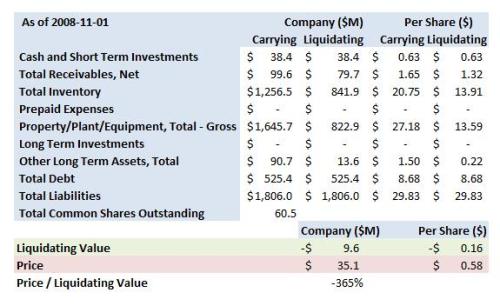
bgp-q3-summaryBGP’s value remains concentrated in its inventory and property, plant and equipment, both of which are up slightly on the last quarter. Compared to $18.01 per share in Q2, inventory is now $20.75 per share, which we’ve written down by two-thirds to $13.91 per share (written down value of $12.07 in Q2). Property, plant and equipment is now carried at $27.18 per share compared to $27.04 per share in Q2. We have written it down the by half to $13.59 per share (slightly higher than the written down value of $13.52 per share in Q2). While its assets have increased slightly, the real problem for BGP is the growth in its substantial liabilities. Total liabilities now stand at $29.83 per share, up from $25.92 per share, the debt portion of which is up from $7.69 per share to $8.68 per share.

Our previous estimate for the liquidating value of BGP was around $2.23 per share. We now estimate that its liquidating value is -$9.6M or $-0.16 per share. This is on the basis of a very conservative treatment of its tangible assets and does not take into account BGP’s intangibles, like consumer brand recognition, which must have some residual value. We also note that BGP has a seasonal business, and this most recent quarter sees BGP in a much better position than the same quarter last year, at which time we estimate that its liquidating value was closer to -$4.87 per share. We think there’s a good chance that BGP will have some substantial asset value next year, and that it’s worth more than its liquidation value, but on our very conservative treatment of its assets, it has a negative liquidating value at this point in time.

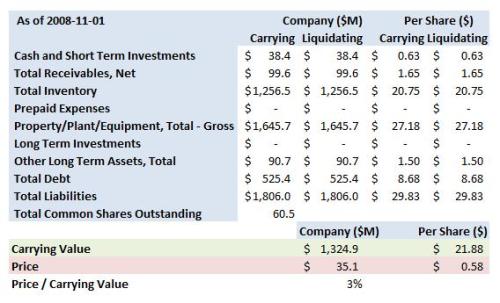
As a brief diversion, set out below is a summary financial analysis of BGP without any discount applied to the assets (both the “Carrying” and “Liquidating” columns shows the assets as they are carried in the financial statements):

bgp-q3-summary-carrying-valueIn this analysis, with no discount applied to the carrying value of the assets, BGP appears wildly undervalued. We prefer our much more conservative estimate of liquidating value for two reasons:

  1. We think the discounted values are more likely to be right; and
  2. If we’re wrong in our estimate, we hope that we’ve applied a sufficient discount that we’re wrong on the upside, and not the down side. Valuing assets in liquidation is not an exact science. Prior to the actual sale, we don’t know with any certainty how much any given asset might yield. If we were to value assets at close to their carrying values, we think that more often than not we’d be disappointed.

You can read more about our undervalued asset situations philosophy on our About Greenbackd page and our rationale and method for calculating values on our About liquidation value investing page.

Conclusion

Our overly optimistic conclusion when we first wrote about BGP deserves repeating here (if only to stop us doing it again). We said, “It’s not often that the stars align like this: a stock with a well-known brand selling at less than a third of its value in a liquidation with one of the best activist investors in the US controlling almost a third of its outstanding stock. BGP has already embarked on its value enhancing transformation. We believe that, given time, BGP will be worth more than its liquidation value, but, if we’re wrong, it’s still trading at a third of that value, which is a bargain.” We even bolded that last part, which, in retrospect, we regret. While we still agree that BGP has a well-known brand, Will Ackman is one of the best activist investors in the US, and BGP will be worth much more than its liquidation value, it’s no longer trading at a third of its liquidation value, so the downside protection is gone. Our focus here is undervalued asset situations, and BGP is not an undervalued asset situation at this time. So that mean we’re out for now. We are, however, going to keep an eye on it for its next few quarters to see if the value returns.

BGP closed yesterday at $0.58. We liked it at $0.65, so we’re down 9.83% on an absolute basis.

The S&P 500 closed yesterday at 904.42 and closed at 816.21 (+10.81%) when we liked BGP, so we’re down 20.64% on a relative basis.

[Disclosure: We have a holding in BGP but we plan to exit it soon. We may acquire it again in the future. This is neither a recommendation to buy or sell any securities. All information provided believed to be reliable and presented for information purposes only.]

Read Full Post »

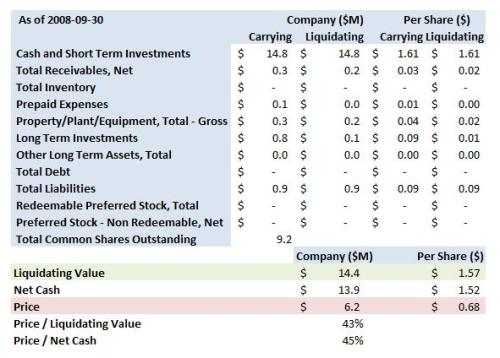
MathStar Inc (OTC:MATH) is another tiny net cash stock with a substantial stockholder lobbying management to liquidate the company. The stock closed yesterday at $0.68, giving it a market capitalization of just $6.2M. We estimate the liquidating value to be more than 120% higher at $14.4M or $1.57 per share. The value in liquidation is predominantly cash and short term investments in the amount of $14.8M. MATH has twice rejected unsolicited merger proposals. The board has largely suspended the company’s operations and is in the process of evaluating its “strategic alternatives, which could include merger, acquisition, increasing operations in another structure or liquidation.” Salvatore Muoio of S. Muoio & Co. LLC filed a Schedule 13D on December 15, 2008 urging MATH’s board to consider liquidation rather than a merger.

About MATH

MATH is a fabless semiconductor company engaged in the development, marketing and selling of high-performance, programmable platform chips and design tools required to program chips. The company’s investor relations website can be found here.

The value proposition

MATH has rapidly burned cash throughout the year, mainly on research and development. The company has now put a stop to its R&D activities, which has reduced the cash burn significantly from $6.6M in the June quarter to $1.6M in the September quarter. From the Business Overview section of the September 10Q:

During 2008, sales of our field programmable object array, or FPOA, did not materialize as expected, and development of the next generation of FPOA fell even further behind schedule. As a result, on May 20, 2008, the Board of Directors voted to suspend research and development activities and ongoing operations while analyzing strategic alternatives to protect the remaining value and increase the liquidity to the stockholders. The Board of Directors continues to explore these strategic alternatives, which could include merger, acquisition, increasing operations in another structure or liquidation.

Set out below is our summary analysis of the company’s balance sheet (the “Carrying” column shows the assets as they are carried in the financial statements, and the “Liquidating” column shows our estimate of the value of the assets in a liquidation):
math-summary

The company has a net cash position (i.e. cash remaining after paying out all liabilities) of $13.9M or $1.52 per share, which is around 120% higher than MATH’s closing price yesterday of $0.68.

The catalyst

This is one of the rare instances where management seems to have taken proactive steps to protect the company’s remaining value. The board also appears to be seeking a way to unlock that value through a merger, acquisition, increasing operations in another structure or liquidation. Salvatore Muoio of S. Muoio & Co. LLC annexed to his 13D filing the following letter setting out his preference for a liquidation over a merger:

December 12, 2008

Mr. Douglas M. Pihl
Chairman of the Board
MathStar, Inc.
19075 NW Tanabourne, Suite 200
Hillsboro, OR 97124

Dear Mr. Pihl,

Thank you for taking time out to speak with me today about MathStar’s history and current status.

To reiterate, and for the record, given the current business environment and the company’s assets and prospects, we strongly urge the Board to pursue a path of liquidation.

We have been investors in the securities of companies in liquidation for over 25 years and believe the process to be relatively straight-forward, in particular for companies as clean and litigation-free as MathStar.

As I mentioned, we don’t believe the current environment represents an attractive opportunity to merge with a speculative business in need of the company’s cash. We also don’t believe the incremental but uncertain future value of the company’s NOL in a merged entity offsets the hard cash equivalent value shareholders would receive in a liquidation in the current environment.

In addition, we would be particularly concerned if a transaction were to be announced where any appearance of a conflict of interest were present.

Sincerely,

Salvatore Muoio, C.F.A.
Managing Member

Conclusion

MATH is one of the best prospects we’ve run across recently. It is undervalued at $0.68, trading at 45% of its net cash of $1.52 per share. Management has already taken proactive steps to reduce its formerly significant cash burn rate and seems to be actively seeking a way to unlock the company’s value. We feel more comfortable that Salvatore Muoio is keeping an eye on management’s exploration of strategic alternatives and has expressed his strong preference for a liquidation. As always, the risk is that MATH is unable to unlock its value before dissipating its remaining cash but in this instance we believe that risk is low.

MATH closed yesterday at $0.68.

The S&P 500 Index closed yesterday at 913.18.

[Disclosure: We do not presently have a holding in MATH. This is neither a recommendation to buy or sell any securities. All information provided believed to be reliable and presented for information purposes only.]

Read Full Post »

InFocus Corporation (NASDAQ:INFS) held a conference call yesterday to discuss the progress of its auction. We’ve previously posted about INFS here, here and here, writing that it is a deeply undervalued asset situation with two activist investors, Nery Capital Partners and Lloyd I. Miller, III, pushing the company to “consider the views expressed by its shareholders and pursue new alternatives to increase shareholder value.”

The call is pretty tightly scripted and doesn’t shed much additional light on the auction progress (the archive of the earnings webcast is available here) (registration required). CEO Bob O’Malley, the speaker, says that INFS has retained Thomas Weisel Partners, an investment bank, to provide advisory services including advice concerning unsolicited offers from outside sources. O’Malley attributes the interest in purchasing the company to INFS’s “good brands, good projectors, market share, channels, strong and dedicated team etc.” He continued that the special committee will work with the investment bank to review the offers “so management can continue running the company.” The “structure and nature of the offers vary” so the review will take an “undeterminate” (sic) amount of time. INFS will provide updates when they reach “definitative offer” and “completed agreement” stages or “the board has terminated the process.” O’Malley reitereated that INFS has “put on hold” the buy back. Other than that, there was little else to report. O’Malley refused to take questions, so no commentary from Nery Capital Partners or Lloyd I. Miller, III, which was a little disappointing.

Read Full Post »

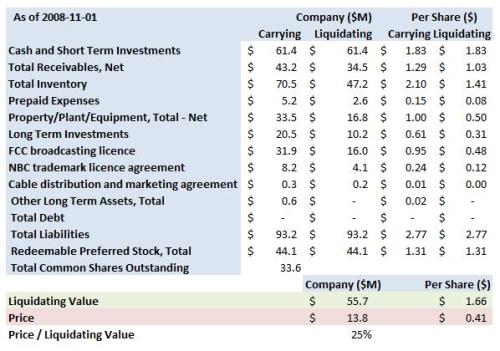
ValueVision Media Inc. (NASDAQ:VVTV), which we posted about on Wednesday last week, has filed its November 10Q. In our earlier post, we wrote that VVTV seemed to us to be one of the better opportunities available because it’s a net net stock (i.e. a stock trading for less than its net current assets) with other valuable assets and noted activist investor Carlo Cannell of Cannell Capital has an activist position in it. The company also seemed to us to be taking steps to realise that value, publicly announcing that it has appointed a special committee of independent directors to “review strategic alternatives to maximize stockholder value.” The strategic alternative the company was pursuing was an auction that the company expected to complete by February 2, 2009. At $1.66 per share, VVTV’s liquidating value is still some 300% higher than its close yesterday of $0.41, which should provide a good margin of safety until the auction can be completed.

Updated value proposition

When we first looked at the company we wrote that we estimated its liquidating value, which included its property, FCC broadcasting licence, NBC trademark licence agreement and the Cable distribution and marketing agreement, at around $2.23 per share. We now see that value lower at $1.66 per share due to the increase in liabilities from $74M to $94M, which equates to an increase of $0.57 per share. Set out below is our updated summary analysis (the “Carrying” column shows the assets as they are carried in the financial statements, and the “Liquidating” column shows our estimate of the value of the assets in a liquidation):
vvtv-summary-q3-update

At its close of $0.41, VVTV is trading at 25% of its liquidating value.

The Catalyst

Given the substantial deterioration in the company’s liquidating value in the last quarter (and in the last few years), we were expecting an update on the auction, which the company has not provided in this 10Q. The company has simply restated its earlier disclosure almost verbatim:

On September 11, 2008, our board of directors announced that it had appointed a special committee of independent directors to review strategic alternatives to maximize shareholder value. The committee currently consists of three directors: George Vandeman, who serves as the committee’s chairman, Joseph Berardino and Robert Korkowski. The special committee retained Piper Jaffray & Co., a nationally-recognized investment banking firm, as its financial advisor. There can be no assurance that the review process will result in the announcement or consummation of a sale of our company or any other strategic alternative.

The company removed the final sentence from the last disclosure:

We do not intend to comment publicly with respect to any potential strategic alternatives we may consider pursuing unless or until a specific alternative is approved by our board of directors.

This may have been removed because Mr. George Vandeman, chairman of VVTV’s special committee of independent directors charged with administering the stategic review, made public statements that VVTV has received bids from a number of companies and instructed its advisers to invite several of the proposed buyers to take part in the next phase of the process.

There have been no further public statements from Cannell Capital. We will provide an update if one is made.

Conclusion

Provided that management will sell the company in the auction process if it receives a sensible bid, this still seems to us to be one of the better opportunities available in the market. Although it has deteriorated since the last 10Q, at $1.66 per share, VVTV’s liquidating value is still some 300% higher than its close yesterday of $0.41. Cannell Capital has previously publicly stated that he sees the value as high as $5.98 per share. The company seems to be taking steps to realise that value through an auction that it expects to complete by February 2, 2009. Any investor intending to take a position should bear in mind the company’s disclosure that “there can be no assurance that the review process will result in the announcement or consummation of a sale of our company or any other strategic alternative.”

VVTV closed yesterday at $0.41.

The S&P 500 Index closed yesterday at 913.18.

[Disclosure: We have a holding in VVTV. This is neither a recommendation to buy or sell any securities. All information provided believed to be reliable and presented for information purposes only.]

Read Full Post »

We posted about Avigen, Inc. (NASDAQ:AVGN) on December 1, 2008, noting that it was a rare opportunity because it was a net cash stock (i.e. it was trading at less than the value of its cash after deducting all liabilities). Since our initial post, AVGN has fallen from $0.65 to close yesterday at $0.54. At $0.54, AVGN has a market capitalization of $16.1M against a net cash position of $36.5M, some 127% higher.

Biotechnology Value Fund (BVF), who we noted in our earlier post had an active interest in AVGN, filed an updated 13D last week. In the new filing BVF says that it sent a letter to AVGN “expressing its displeasure with [AVGN]’s recent performance and continued destruction of shareholder value.” The letter is reproduced below:

Members of the Board:

As you know, Biotechnology Value Fund, L.P., together with its affiliates, is the largest shareholder of Avigen, Inc. (“Avigen” or the “Company”), holding an ownership stake of approximately 29% of Avigen’s outstanding common stock. We first became investors in Avigen in 2004 and have provided capital directly to the Company. We are writing to express our frustration with recent developments at Avigen, particularly with what we perceive to be this Board’s self-serving actions and disregard of shareholder interests.

Since January 1, 2004, Avigen’s stock price has fallen more than 90% and the Company has accumulated a deficit of more than $110 million. Presently, Avigen’s stock trades at less than 1/3 of its net per share cash value, indicative of the investment community’s conviction that Avigen’s Board will destroy its remaining value. We have repeatedly reached out to the Company and have offered to work collaboratively to maximize shareholder value. The Company responded to our offers by unilaterally increasing and broadening management’s “golden parachute” severance agreements and by unilaterally adopting a “poison pill.”

The Board’s increase and broadening of its “golden parachute” severance agreements with management, under the ridiculous justification that such payouts are necessary to “attract and retain key employees,” is particularly outrageous given Avigen’s current circumstances. Our analysis indicates that these payouts, which we believe would be triggered by most “change in control” scenarios, including a liquidation, total at least $3 million, an incredible 20% of the Company’s entire market value. The recipients of these golden parachute arrangements include Avigen’s CEO, Ken Chahine, who resides in Park City, Utah, while the Company is based in California. How can the Company justify such actions as necessary to “attract and retain key employees” when Avigen has no real business at this time and has abandoned the development of all its products? These hastily adopted severance arrangements need to be revoked.

In addition, we believe the Board’s implementation of the “poison pill” serves no purpose other than to keep BVF from purchasing additional stock in the Company. We are concerned that management and Board members are more concerned with retaining their jobs and compensation than with maximizing shareholder value. As evidence, Avigen’s stock price has fallen more than 20% since the adoption of the poison pill. We find the poison pill to be disrespectful and offensive, given our substantial ownership position and our long history with the Company. Nevertheless, our response was to offer a compromise proposal: modify the poison pill to allow anyone to acquire as much stock as they like, however, neutralize the voting power on all shares of Avigen stock above a specified threshold. We specifically offered to have any additional shares that we acquire to abstain from voting or to vote in proportion to all other outstanding shares. This offer was not accepted. The pill should be redeemed altogether.

The Board’s recent actions reveal its true self-interest and leave us concerned that Avigen will indeed destroy and/or take all remaining value. Consequently, our primary issue has been and remains that Avigen immediately guarantee the worst case outcome for all shareholders. This guarantee could be accomplished in several ways, including by dividending or otherwise distributing all excess cash to shareholders now, or by offering to buy back any and all shares from holders that wish to sell at a specific price at a specific future date (i.e., $1.25 per share in December, 2009). In both cases, shareholders could stand to reap potentially substantial upside derived from the monetization of Avigen’s remaining assets and could finally stop worrying about whether the Company will destroy its substantial cash value. To the extent the Board believes it can generate value in excess of its cash in the bank today, offering downside protection ultimately costs the Company nothing. However, by rejecting our proposal to provide a downside guarantee, the Board has indicated its willingness to place its remaining cash at continued risk, without shareholder consent.

As the Company’s largest shareholder, we are fighting to return value to all shareholders, not just ourselves, and we feel a responsibility to do so. To be clear, we do not seek to impose our own agenda on Avigen, we only ask that shareholders be empowered to decide the fate of the Company’s residual cash, rather than the management and Board of a company which has repeatedly tried and failed to create any shareholder value whatsoever. Shareholders have good reason to worry that Avigen’s management fully intends to put its remaining cash at risk. Yesterday, at the RBC Capital Markets Healthcare Conference, CEO Ken Chahine said, “We are going to be looking at building…How do we do that?…There are some opportunities as well that have emerged from the credit crisis. There are some commercialization, or near-commercialization, type companies that could use an infusion of cash…Those are some of the things we are looking at. Now, will that be in the therapeutic space? It could be…We’re opening it up because I think that there are opportunities outside of therapeutics…We will spend the balance of 2009 trying to look for opportunities.” Mr. Chahine, shareholders do not need or want you to invest their money.

If recent empirical evidence with respect to numerous other failed biotech companies is any guide (e.g., Corgentech, Renovis, Novacea, Nitromed, Nuvelo and others), the future does not bode well for Avigen shareholders if left to its own devices. In one similar situation, the company could have returned in excess of $10/share in cash to shareholders had it been liquidated in 2005. Instead, after opting for a value-destroying merger, that company today trades at a mere 0.09 cents per share – a 99% decline! Avigen’s golden parachutes have incentivized management to merge with any company that will take it. Management would walk away with its $3 million cash windfall; shareholders would get stuck with potentially worthless stock in a merged company. In the current fiscal environment, shareholders will no longer tolerate such self-interested behavior on the part of failed biotechnology companies.

We believe the Avigen Board is not only willing to sacrifice and squander shareholder money but, in the process, its members are making a mockery of their obligations to fulfill their fiduciary duties as directors of the Company. To that end, please be advised that we intend to hold each member of the Board and management fully accountable for any continued erosion of value from the current liquidation value of the Company.

Sincerely,

Mark Lampert

Conclusion

As we noted in our earlier post, while it’s frightening to see AVGN hemorrhaging cash, BVF is working to persuade it to salvage what remains of the company’s value. If BVF is able to cause the company to quickly distribute its remaining cash to stockholders, AVGN is an attractive investment opportunity. The risk is that BVF is unable to persuade the company to do so before AVGN dissipates its remaining cash.

AVGN closed yesterday at 0.54.

The S&P 500 Index closed yesterday at 868.57.

[Disclosure: We do not presently have a holding in AVGN. This is neither a recommendation to buy or sell any securities. All information provided believed to be reliable and presented for information purposes only.]

Read Full Post »

Electro Scientific Industries Inc (NASDAQ:ESIO) is one of the more complex undervalued asset plays we’ve dug up, but a worthwhile one to watch nonetheless. ESIO has announced a merger with Zygo Corporation (NASDAQ:ZIGO) and an authorization to buy back $100M in stock (see the October 16 announcement here). Activist investor David Nierenberg of Nierenberg Investment Management owns 15% of ESIO, supports the merger and is pushing the company to buy back stock. Management expects the the merger to be completed in the first calendar quarter of 2009.

About ESIO

ESIO and its subsidiaries provide high-technology manufacturing systems to the global electronics market, including advanced laser-based systems that are used to microengineer semiconductor device features in high-volume production environments. Website is here.

About ZIGO

ZIGO designs, develops, and manufactures ultra-high precision measurement solutions to improve its customers’ manufacturing yields, and top-tier optical sub-systems and components for original equipment manufacturers (OEM) and end-user applications. Website is here.

The value proposition

1. ESIO

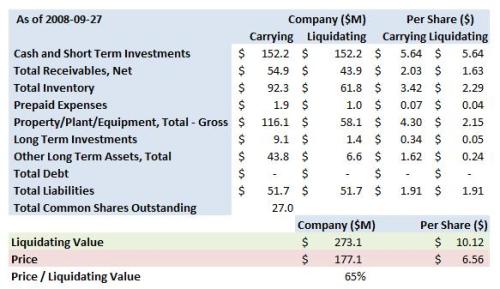
As it stands now, ESIO is an undervalued asset sitation, with a market capitalization of $177M at yesterday’s close of $6.56. We estimate ESIO’s stand alone liquidating value at around $277M or $10.12 per share, which is 54% higher than its close, as the following summary analysis demonstrates (the “Carrying” column shows the assets as they are carried in the financial statements, and the “Liquidating” column shows our estimate of the value of the assets in a liquidation):
esio-summary

2. ZIGO

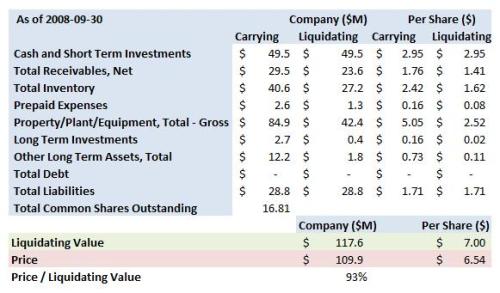
ZIGO, ESIO’s partner in the merger, has a market capitalization of $110M at it’s $6.54 close yesterday. We estimate ZIGO’s stand alone liquidating value at $118M or $7.00 per share. At $6.54 ZIGO is trading only slightly lower (about 7%) than its $7.00 per share liquidating value, and so is close to value, as the following summary analysis demonstrates (the “Carrying” column shows the assets as they are carried in the financial statements, and the “Liquidating” column shows our estimate of the value of the assets in a liquidation):

zigo-summary

The catalysts

1. Details of the merger

ESIO is offering 1.0233 shares of ESIO for each share of ZIGO. In the merger, ESIO will issue to ZIGO stockholders 18.1m shares of ESIO. This will increase the issued stock of ESIO from 27M pre merger to 45.1M post merger and give ZIGO stockholders 40% of ESIO. On October 15, the day before the announcement, ESIO closed at $10.07, valuing the merger $10.30 for each share of ZIGO, which had closed at $7.57.

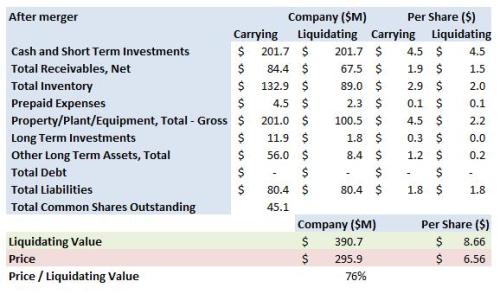
The merger will reduce the liquidating value of each share of ESIO because ZIGO at $6.54 is trading much closer to its liquidating value than ESIO at $6.56. The following summary analysis shows ESIO after the merger with ZIGO is complete (the “Carrying” column shows the assets as they are carried in the financial statements, and the “Liquidating” column shows our estimate of the value of the assets in a liquidation):

esio-zigo-summary

After the merger we estimate that ESIO stock will have a liquidating value of $391M. This equates to $8.66 per share when the expanded number of ESIO stock on issue are taken into account, down from $10.12 per share pre-merger with ZIGO. A liquidating value of $8.66 per share is around 32% higher than ESIO’s close yesterday but it’s nothing to get excited about. Fortunately, the buy back goes some of the way to restoring ESIO’s liquidating value to pre-merger levels.

2. Effect of the buy back

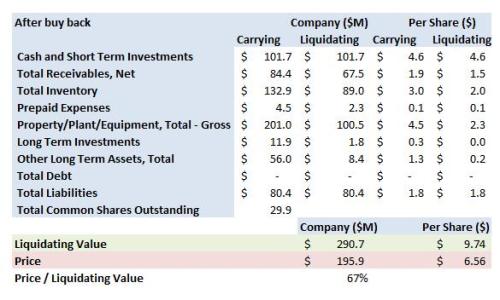
In the announcement of the merger with ZIGO, ESIO also announced an authorization to buy back $100M of stock. If that $100M buy back was completed at $6.56, the closing price of ESIO yesterday, ESIO would buy back around 15.2M shares, leaving around 29.9M on issue. The following summary analysis assumes that ESIO buys back $100M of stock at $6.56 and shows ESIO after the buy back is complete (the “Carrying” column shows the assets as they are carried in the financial statements, and the “Liquidating” column shows our estimate of the value of the assets in a liquidation):

esio-zigo-summary-post-buy-back

The buy back increases ESIO’s per share liquidating value from $8.66 to $9.74. It’s legitimate to question whether all of this sturm und drang is worth it if it only serves to reduce the liquidating value of ESIO. The honest answer is that we don’t know but we suspect that it’s probably not. We think it would have made more sense for ESIO to buy back its own shares rather than merge with ZIGO. If a merger with ZIGO was an inevitability, perhaps it would have been better to buy back the shares before the merger, especially since ESIO seems to be getting less in value from ZIGO than the value it is issuing to ZIGO’s shareholders. There is also a risk that the buy back will not proceed. According to the announcement,

The repurchases will be made at management’s discretion in the open market in compliance with applicable securities laws and other legal requirements and are subject to market conditions, share price and other factors. There is no fixed completion date for the repurchase program.

3. David Nierenberg

According to his most recent 13D, David Nierenberg (The Motely Fool has a profile here) of Nierenberg Investment Management owns 15% of ESIO. The filing details Nierenberg’s agreement with ESIO regarding ESIO’s stockholder rights plan, which prevents any stockholder – other than 19.99% owner Third Avenue Management LLC – from owning more than 15% of the company. If any stockholder purchases more than 15%, the plan limits the stockholder to voting only that portion of the stockholding up equivalent to 15% of the outstanding stock. The other shares automatically vote with ESIO’s board. Nierenberg’s agreement with ESIO provides that if ESIO buys back enough stock to push Nierenberg’s holdings over 15% of the outstanding shares, he will still be able to vote all of his stock as he wishes. The agreement will be in effect for a minimum of three years.

Conclusion

ESIO as a stand alone entity is deeply undervalued, trading at less than two-thirds of its $10.12 per share liquidating value. The effect of the merger – which appears likely to succeed – is to reduce ESIO’s per share liquidating value to $8.66, which is only 35% higher than the company’s close yesterday. This will be remedied by the $100M buy back authorized for ESIO, which will increase ESIO’s per share liquidating value to $9.74, which is nearly 50% higher than yesterday’s close. There is a risk that the merger will go through but the buy back will not be completed but we think this risk is relatively low.

There are two ways to play this:

1. If you are confidant that the merger will go through, buying ZIGO at $6.54 is buying ESIO for $6.41 (a 2.3% discount). This is because in the merger each share of ZIGO equates to 1.0233 shares of ESIO ($6.56 / 1.0233).

2. If you believe there is a risk that the merger will not go through, ESIO offers the better downside protection because it is at a deeper discount to its liquidating value.

ESIO closed yesterday at $6.56.

ZIGO closed yesterday at $6.54, which equates to paying $6.41 for ESIO.

The S&P 500 closed yesterday at 868.57.

[Disclosure: We do not presently hold either ESIO or ZIGO.  This is neither a recommendation to buy or sell any securities. All information provided believed to be reliable and presented for information purposes only.]

Read Full Post »
We’ve recently posted about INFS’s value proposition here (it’s deeply undervalued) and the effect of a big buy back on the per share value of the company here (it’s hugely positive).

The company today announced plans to restructure and reduce its global workforce by approximately 30%, commencing in January 2009 and spanning a twelve month period. The announcement also says that that INFS “believes it will achieve profitable operations with an 18% gross margin target and operating expenses in the range of $10-11 million per quarter.” While this may appear to be encouraging for stockholders, in our experience projections about future profitability often don’t turn out as projected. They are made by managements deaf to what the market is telling them about the company. As a result, we are much more interested in the company’s plans to unlock the value in the assets. On that front, the news is mixed.

INFS has previously announced that it had retained an investment banking firm to provide “advisory services.” The new announcement says that these advisory services include “advice concerning unsolicited offers from outside sources expressing interest in purchasing the Company.” This is a positive development. The bad news is that the company has suspended the stock repurchase plan, which is slightly disappointing. We say “slightly disappointing” because a buy back of 4 million shares over a three year period does not have a meaningful effect on the per share value, so cutting it makes almost no difference. It does show, however, that management is ignoring obvious value-enhancing opportunities for stockholders.

INFS will host a conference call to discuss the announcement tomorrow, December 16, 2008 at 9:00 a.m. (Eastern). No doubt Nery Capital Partners and Lloyd I. Miller, III will be on.

Hat tip to commenter Steven for the tip.

Read Full Post »

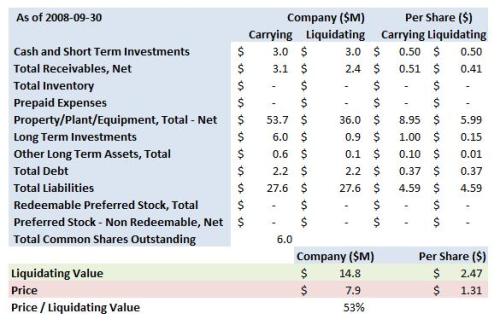
Kona Grill Inc (NASDAQ:KONA) is an undervalued asset situation with a potential acquirer raising its stake in the company through November. Mill Road Capital made a cash offer in March to acquire KONA for $10.75 when the stock was trading at around $8.76. Since the offer was rebuffed by KONA in April the stock has slumped 85% to close yesterday at $1.31. Mill Road Capital has continued to buy stock, raising its stake to 10% in November from 8.2% in June. At $1.31, KONA has a market capitalization of just $7.9M. We estimate that its assets in liquidation are worth around $14.8M or $2.47 per share. With KONA trading at a discount of nearly 50% to its liquidating value and Mill Road Capital continuing to buy stock, we believe it is an attractive opportunity.

About KONA

KONA owns and operates 18 restaurants located in 12 states in the United States. The restaurants feature a selection of mainstream American dishes, as well as a range of appetizers and entrees with an international influence, including a selection of sushi. The menu items also incorporate over 40 signature sauces and dressings that Kona Grill makes from scratch, creating appeal for the lifestyle and taste trends of a diverse group of guests. The menu offerings are complemented by a full service bar offering an assortment of wines, specialty drinks and beers. Effective September 14, 2008, the Company closed its restaurant in Naples, Florida. KONA’s investor relations website is here.

The value proposition

According to the most recent 10Q, KONA has been consistently generating positive cash flow from operating activities. In the year ending December 31, 2007, the company generated $5.7M and has continued to generate positive operating cash flow each quarter for the last year. The company continues to consume cash, however, as it invests in new restaurants. While we believe that KONA has value as a going concern, our analysis demonstrates that the market is pricing its stock  at a substantial discount to its liquidating value (the “Carrying” column shows the assets as they are carried in the financial statements, and the “Liquidating” column shows our estimate of the value of the assets in a liquidation):

kona-summaryKONA’s value lies in its restaurants, carried on the balance sheet in its $53.7M in net property, plant and equipment. Discounting that figure by a third to $36M equates to $5.99 per share in value. Deducting all liabilities from the discounted assets leaves a liquidating value of around $14.8M or $2.47 per share.

The catalyst

Mill Road Capital is seeking to take KONA private. This 13D filing details Mill Road Capital’s investment thesis for KONA:

[Mill Road Capital] acquired shares of the Common Stock based on their belief that the Common Stock represents an attractive investment opportunity. [Mill Road Capital] further believe that [KONA] would be better able to realize its full value as a private entity.

On March 28, 2008, Mill Road Capital sent to Kona a non-binding offer to acquire all of KONA at a cash price of $10.75 per share:

Re: Notice of Acquisition Proposal

Ladies and Gentlemen:

Mill Road Capital, L.P. (“Mill Road”) is a substantial shareholder of Kona Grill, Inc. (“Kona” or the “Company”), currently owning approximately 325,000 shares or 4.9% of the Company. Mill Road has closely followed Kona since 2006, and we are extremely impressed with management and the Company. We believe that the public market does not adequately value small companies such as Kona, and by staying public, the Company will continue to be subject to undue regulatory burdens and pressure to maximize short-term results at the expense of long-term performance. We believe Kona will be better able to realize its full potential value as a private entity and are, therefore, making an offer to acquire all of the outstanding shares of the Company.

Mill Road is pleased to submit a non-binding offer to acquire all shares of the Company’s stock at a cash price of $10.75 per share. This represents a 23% premium to the closing price of $8.76 as of March 27, 2008. We would anticipate that the transaction would be accomplished through a merger of a company organized by Mill Road with and into the Company, as a result of which all stockholders of the Company would be entitled to this cash consideration.

Mill Road is a Greenwich, Connecticut based investment firm with approximately $250 million of committed equity capital. Our limited partners include a prominent and highly respected group of state pension funds, foundations, endowments and insurance companies. The investment professionals of Mill Road are a core group of former Blackstone professionals who have successfully completed more than 20 control transactions in which more than $600 million of equity capital was deployed with total transaction value of several billion dollars. Additionally, we have significant industry experience as a substantial investor in many public restaurant companies and through my position on the Board of Directors of Panera Bread Co. (NASDAQ: PNRA) from 2003 to 2006.

Our industry and transaction experience will allow us to quickly complete due diligence and definitive documentation. Considering the amount of our investable capital, Mill Road can readily fund the entire transaction contemplated by this acquisition proposal.

We are prepared to commence negotiations immediately with respect to this acquisition proposal and wish to close this transaction as soon as possible. We look forward to the opportunity to discuss our proposal in more detail with the Board of Directors and management. It would be our pleasure to meet in person at a location of your choice.

You may contact me directly at (203) 987-3501. I look forward to discussing our proposal at your earliest convenience.

Sincerely,
Mill Road Capital L.P.

By: Mill Road Capital GP LLC
Its General Partner

By:

Thomas Lynch
Senior Managing Director

KONA responded to Mill Road Capital on April 18, 2008 indicating that the letter had been distributed to KONA’s board for discussion at its next board meeting. On May 1, 2008, KONA told Mill Road Capital that it was not interested in pursuing the transaction.

Mill Road Capital has continued to purchase KONA stock, paying between $1.85 and $6.91 according to the latest amendment to their earlier 13D. As of November 14, 2008, Mill Road Capital controlled 10% of KONA.

Conclusion

KONA is an undervalued asset situation with a catalyst in the form of a potential takeover from Mill Road Capital. Given the deterioration in KONA’s stock price since the rejection of Mill Road Capital’s initial bid, we would not expect Mill Road Capital to offer $10.75 again. We do believe, however, that any bid would be at a premium to the current stock price. If we are wrong and a bid does not materialize from Mill Road Capital or some other acquirer, the down side should be limited because KONA is already trading at a substantial discount to its value in a liquidation.

KONA closed Friday at $1.31.

The S&P 500 closed Friday at 879.73.

[Disclosure: We do not presently hold KONA.  This is neither a recommendation to buy or sell any securities. All information provided believed to be reliable and presented for information purposes only.]

Read Full Post »

InFocus Corporation (NASDAQ:INFS) is a deeply undervalued asset situation with two activist investors, Nery Capital Partners and Lloyd I. Miller, III, disclosing holdings in the company. At its closing price yesterday of $0.63, INFS has a market capitalization of $25.6M. We estimate its liquidating value to be more than 80% higher at $46.7M or $1.15 per share. With Nery Capital Partners and Miller pushing the company to enhance its stock price, we believe INFS is an attractive opportunity.

About INFS

INFS is a provider of digital projection technology. The company markets projectors and related accessories for use in the conference room, board room, auditorium, classroom and living room. “InFocus” is the company’s primary brand and is sold worldwide. In addition, many of the products are offered under a global reseller brand, “ASK Proxima.” INFS’s investor relation website is here.

The value proposition

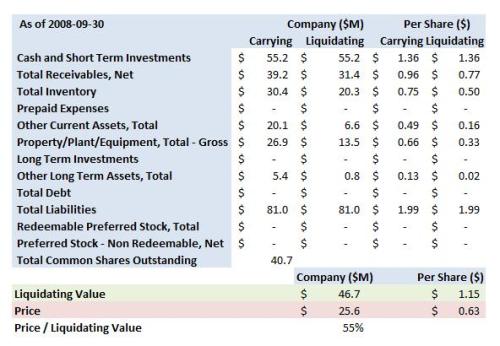
According to its latest 10Q, INFS lost $25.6M last year and has continued to make losses in each of the last three quarters. The company does have some value on the balance sheet, as our summary analysis demonstrates (the “Carrying” column shows the assets as they are carried in the financial statements, and the “Liquidating” column shows our estimate of the value of the assets in a liquidation):

infs-summary

INFS has $124.7M in current assets, $55.2M ($1.36 per share) of which is cash and equivalents. We’ve discounted the receivables by a fifth to $31.4M or $0.77 per share and inventory by a third to $20.3M or $0.50 per share. The company has no debt but total liabilities of $81M or $1.99 per share. Deducting the liabilities leaves a liquidating value of $46.7M or $1.15 per share. INFS is currently trading at $0.63 or 55% of its value in liquidation.

The catalyst

Nery Capital Partners disclosed its original 9.8% holding in INFS in a November 5 13D filing. Initially purchasing its holding in INFS as a passive investment, Nery Capital Partners was moved to an active stance after an “evaluation of [INFS’s] financial performance and in light of [INFS’s] decreasing stock value.” Nery Capital Partners has since contacted the company’s board or management “with respect to, among other things, steps that [INFS] could take to improve [its] financial condition and increase shareholder value.” As of its amended filing dated December 5, Nery Capital Partners holds 11.2% of the company.

Lloyd I. Miller, III disclosed his 5% holding in INFS as a passive investment on November 5 in this 13G filing. On November 19, Miller updated his original filing to an active 13D filing. Miller said in the new filing that he acquired the holding in INFS as a passive investment but:

“…now believes it would be in his best interest, and those of other shareholders, to attempt to influence the governance and business strategies of the Company. Following Miller’s evaluation of the Company’s financial performance and in light of its recent declines in stock value, Miller decided that he may seek to contact the Company’s Board of Directors or management in order to engage in discussions regarding governance and enhancing shareholder value.”

Miller’s new filing states that he agrees with the views of Nery Capital Partners INFS is undervalued and represents an attractive investment opportunity and that the company should “consider the views expressed by its shareholders and pursue new alternatives to increase shareholder value.”

One alternative to increase shareholder value is to complete the stock back that the company initiated in the third quarter of 2008. Authorized to purchase up to 4M shares over a three-year period, as of September 30, the company had only repurchased 50,000 shares at an average price of $1.53 per share. Given the substantial discount of INFS to its current asset backing, any shares bought back at these levels have a large positive effect on the underlying asset value. We would like to see INFS buy back as many of the 4m shares as possible as rapidly as possible. Update (December 15): We’ve conducted an analysis of a buy back on INFS’s per share value. In short, if INFS buys back 20M of its 40.7M issued shares (approximately 50%) at Friday’s closing price of $0.67, it would increase its per share liquidating value from $1.15 to $1.61 (a 40% increase).

Conclusion

At $0.63 INFS is trading at 55% of its $1.15 per share value in liquidation. Although the stock jumped 25% yesterday, it is still very cheap. With Nery Capital Partners and Lloyd Miller in activist mode, this is an interesting opportunity.

Yesterday INFS closed at $0.63 and the S&P 500 Index closed at 873.59.

[Disclosure: We do not have a holding in INFS. This is neither a recommendation to buy or sell any securities. All information provided believed to be reliable and presented for information purposes only. Do your own research.]

Read Full Post »

« Newer Posts - Older Posts »