Feeds:
Posts
Comments

Posts Tagged ‘Net Current Asset Value’

A stock buy-back is a great way for a deeply undervalued company to quickly increase its per share value. After identifying an undervalued asset situation, we look through the company’s filings to see if it has any existing plans authorizing it to buy-back its stock. On the rare occasions when we do locate such plans, we are often struck by (a) how few shares the company is authorized to buy back and (b) how few of the shares the company has actually bought back. InFocus Corporation (NASDAQ:INFS), which we posted about on Friday, is a classic example of this phenomenon.

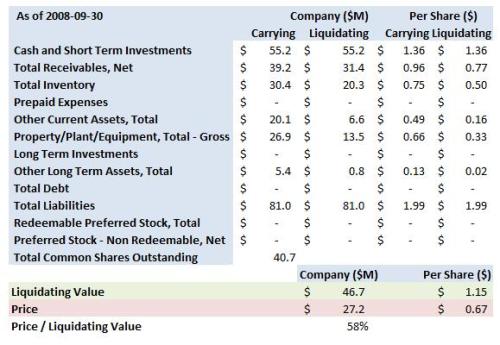
INFS is trading at a big discount to its liquidation value, it has heaps of cash on hand and no debt, all of which makes it a prime candidate to undertake a big buy-back. Given the substantial discount to its current asset backing, any shares bought back at these levels have a huge positive effect on its per share value. It has just initiated a buy-back plan to repurchase over a three-year period up to 4M shares out of 40.7M on issue. As of September 30, the company had repurchased only 50,000 shares at an average price of $1.53 per share. 50,000 shares is simply too little to have any meaningful impact on the company’s value. We’d argue that even 4M (less than 10% of the outstanding common stock) isn’t enough. Why? Let’s look at what happens if the company repurchases many more shares, say 50% of its issued stock.

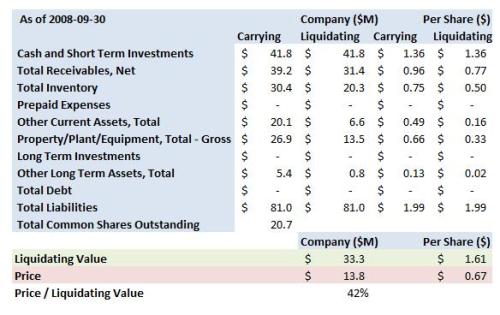
In our last blog post, we argued that INFS had a liquidation value of around $1.15 per share, 70% higher than its Friday close of $0.67. The company has cash and equivalents of around $55M and no debt as the summary financials demonstrate (the “Carrying” column shows the assets as they are carried in the financial statements, and the “Liquidating” column shows our estimate of the value of the assets in a liquidation):

Before

before-infs-summary

After

If INFS was to repurchase 50% of its stock (20M of its 40.7M shares currently on issue) at $0.67, it would cost INFS only $13.4M, leaving it with nearly $42M in cash on hand:

after-infs-summaryAfter the buy back, INFS’s per share liquidating value increases from $1.15 to $1.61 (a 40% increase).

There are very few investment opportunities that so quickly increase a company’s per share value. Given that management should know the company’s value better than the value of any other investment opportunity, it is also the most assured way of increasing a company’s per share value. There is simply no better way for an undervalued company to invest its excess cash than in its own stock.

Read Full Post »

Autobytel Inc (NASDAQ:ABTL) is a net net stock with an investor declaring an active interest in late November. At yesterday’s close of $0.43, ABTL has a market capitalization of $19.4M and is trading at 55% of our estimate of its liquidation value of $35.3M. On November 21, 2008, Trilogy, Inc. filed its Schedule 13D notice, declaring an interest of 5.01%.

About ABTL

ABTL is a automotive media and marketing services company focused on helping dealers sell cars and services, and manufacturers build brands through marketing and advertising primarily through the Internet. The company owns and operates automotive websites MyRide.com, Autobytel.com, Autoweb.com, Car.com, CarSmart.com, AutoSite.com and CarTV.com. It connects automotive marketers with vehicle shoppers visiting these websites and third-party websites (primarily search engines, automotive information providers and other auto related venues). You can see the corporate website here.

The value proposition

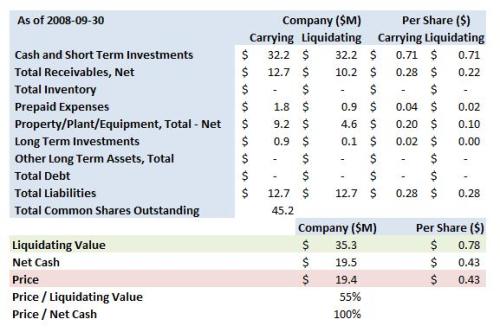
ABTL’s most recent 10Q, specifically its earnings and cash flow, was abominable. The company lost $5.36M last year but surpassed that in the September quarter alone, losing$5.63M. ABTL had negative cash from operating activities last year of $6.91M and $2.88M in the quarter to September. As always we can find some value on the balance sheet, as our summary analysis demonstrates (the “Carrying” column shows the assets as they are carried in the financial statements, and the “Liquidating” column shows our estimate of the value of the assets in a liquidation):

abtl-summary1

With $32.2M or $0.71 per share in cash and equivalents on the balance sheet and total liabilities of $12.7M or $0.28 per share, ABTL is trading at its net cash value of $0.43. If we add in receivables of $12.7M (which we’ve written down by 20% to $10.2M or $0.22 per share), property, plant and equipment of $9.2M (written down to $4.6M or $0.10 per share) and a nominal $0.9M or $0.02 per share for the prepaid expenses, ABTL has a a liquidating value of $35.3M or $0.78 per share. ABTL’s liquidating value of $0.78 is 82% higher than its stock price of $0.43, which is a substantial margin for error (or safety).

The catalyst

Trilogy, Inc. filed its Schedule 13D notice, declaring an interest of 5.01% on November 21, 2008. The filing contains the standard boilerplate that says a great deal without actually disclosing Trilogy’s true purpose for the purchase.  Trilogy is a private operating company in the technology consulting industry, not a fund manager, so there is little public information available about its strategy. It seems odd for a technology consulting business to buy a substantial active stake in a listed company. It’s possible that the filing is a precursor to a bid for ABTL. An affiliate of Trilogy, Trilogy Automotive Advertising Services, operates a business focussed on the automotive industry. ABTL might fit nicely into that business. We’re only speculating, but on the basis that it might turn into a bid, ABTL is worth watching.

Conclusion

At its close yesterday of $0.43 ABTL is trading at its net cash and at a 45% discount to its value in liquidation. In short, it’s a bargain. With Trilogy disclosing an active interest that could be a precursor to a takeover bid, ABTL is worth a look.

ABTL closed yesterday at $0.43.

The S&P 500 Index closed at 899.24.

[Disclosure: We do not have a holding in ABTL. This is neither a recommendation to buy or sell any securities. All information provided believed to be reliable and presented for information purposes only.]

Read Full Post »

ValueVision Media Inc. (NASDAQ:VVTV) is exactly the kind of opportunity we like to find: a net net stock with a management taking active steps to rectify the situation. At yesterday’s close of $0.44, VVTV has a market capitalization of $14.8M, which is half its net current asset value of around $29.5M, or $0.88 per share and 20% of our estimate of its value in liquidation of around $74.8M or $2.23 per share. After receiving some full and frank advice criticism on an August earnings call, VVTV’s board of directors has publicly announced that it has appointed a special committee of independent directors to “review strategic alternatives to maximize stockholder value.” The company is currently conducting an auction expected to close in February 2009. The auction has uncovered a number of interested bidders, including GE Capital Equity Investments (most recent 13D filing here), which owns 13.7% of the company. Activist investor Carlo Cannell of Cannell Capital LLC has disclosed an interest in the company and has also sent a number of entertaining letters to the CEO (which we’ve reproduced below).

About VVTV

According to its website, VVTV is a direct marketing company that markets, sells and distributes products directly to consumers through various forms of electronic media and direct-to-consumer mailings. The company’s principal electronic media activity is the television home shopping business, which uses on-air spokespersons to market brand name merchandise and private label consumer products at competitive prices. A live around the clock television home shopping programming is distributed primarily through cable and satellite affiliation agreements and the purchase of month-to-month full- and part-time lease agreements of cable and broadcast television time. In addition, ValueVision Media distributes its programming through a television station in Boston, Massachusetts. It also markets and sells an array of merchandise through http://www.shopnbc.com and http://www.shopnbc.tv.

The value proposition

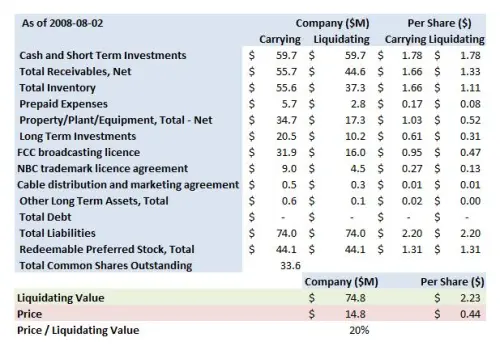
According to its most recent 10Q, VVTV lost $15.7M in the August quarter, which continues a string of five quarterly losses. Operating cash flow has also turned negative for the August quarter, which is particularly concerning. The company does have value on the balance sheet, however, as our summary analysis demonstrates (the “Carrying” column shows the assets as they are carried in the financial statements, and the “Liquidating” column shows our estimate of the value of the assets in a liquidation):

vvtv-summary1

With $59.7M in cash and equivalents, $55.7M in receivables and $55.6M in inventory, VVTV’s is trading at a substantial discount to its current assets alone. The company has $1.78 per share in cash. We’ve discounted the receivables by 20% to $44.6M or $1.33 per share and the inventory by a third to $37.3M or  $1.11 per share. Subtracting all liabilities of $74M or $2.20  per share and the preferred stock of $44.1M or $1.31 per share gives us a net current asset value for VVTV of around $29.5M or $0.88 per share. At yesterday’s closing price of $0.44, VVTV is trading at a 50% discount to its net current asset value alone.

VVTV has other valuable assets, including substantial property, its FCC broadcasting licence, its NBC trademark licence agreement and its Cable distribution and marketing agreement. We have no idea how to value these assets, but discounted by an arbitrary 50%, they are worth an additional $45.3M or $1.35 per share. This puts our estimate of the company’s liquidating value at around $74.8M or $2.23 per share, which means that VVTV is trading at 20% of its value in liquidation.

Carlo Cannell suggested in the October 27 letter to the CEO (reproduced below) that VVTV’s value is much higher. He thinks the company is “worth closer to $6.00 per share, exclusive of the $120 million net operating loss and substantial intangible value in the broad 72 million reach enjoyed by ShopNBC.” Cannell’s analysis is as follows (all figures are $/share figures):

Net Working Capital – $3.73 (Includes $2.39/share in Cash. Excludes NOL and value of Shop NBC.)
Headquarters – $1.03
Television Station – $0.95
NBC License Agreement – $0.27
Total Asset Value – $5.98

VVTV is trading at less than 7% of Cannell’s valuation.

The catalyst

VVTV’s stock is down about 91% ($5.53 per share) this year. During VVTV’s second-quarter conference call in August, shareholders lambasted management and called for the sale of the company. As a result, VVTV disclosed in its 10Q that it was pursuing “strategic alternatives”:

On September 11, 2008, our board of directors announced that it had appointed a special committee of independent directors to review strategic alternatives to maximize stockholder value. The committee currently consists of two directors: George Vandeman, who will serve as the committee’s chairman, and Robert Korkowski. We expect to appoint an additional independent director to the board, who we anticipate will serve on the special committee. The special committee retained Piper Jaffray & Co., a nationally-recognized investment banking firm, as its financial advisor. There can be no assurance that the review process will result in the announcement or consummation of a sale of our company or any other strategic alternative. We do not intend to comment publicly with respect to any potential strategic alternatives we may consider pursuing unless or until a specific alternative is approved by our board of directors.

On September 24, 2008 Cannell Capital amended an earlier 13G filing for VVTV in this 13D filing, annexing an entertaining letter from Carlo Cannell to Mr. John Buck, VVTV’s CEO (reproduced below):

Dear Mr. Buck

Cannell Capital LLC (“Cannell”), an investment adviser and General Partner to several private investment funds and partnerships, which own shares in ValueVision Media Inc. (“VVTV”), is amending its reporting requirements to reflect a more active stance.

Congratulations on your September 11, 2008 decision to appoint “a special committee of independent directors to review strategic alternatives to maximize shareholder value.” Cannell interprets this to mean that the representatives of the shareholders (aka “Directors”) have finally elected to monetize the assets on behalf of its owners.

ValueVision’s stock price is $2.20 per share. Based upon analysis our from Craig-Hallum it is our opinion the company is worth closer to $6.00 per share, exclusive of the $120 million net operating loss and substantial intangible value in the broad 72 million reach enjoyed by ShopNBC.(1)

                                                    $/Share
                                                    -------

                 Net Working Capital*                $3.73
                 Headquarters                        $1.03
                 Television Station                  $0.95
                 NBC License Agreement               $0.27
                 Total Asset Value                   $5.98

                 *Includes $2.39/share in Cash. Excludes NOL
                 and value of Shop NBC.

We will be watching carefully to make sure the committee’s actions are congruent with the interests of shareholders. We are concerned that the hiring of Piper Jaffray & Co. may be a ploy to continue to justify its pattern of wheel spinning and protection of jobs over what is best for the owners of the business. For example, on Monday, September 15, 2008 we were shocked to learn that your agent (Piper Jaffray & Co.) called to “permission” when and to whom we might talk at our Company. This is characteristic of Stalinist Russia, not America. This does not have a good taint to it. You may try to muzzle other investors, but not Cannell. It bites.

You further have called for representatives to the Board of Directors. We have several candidates in mind. Two will be contacting you shortly to present their credentials directly.

It is amazing to us how much value has been destroyed under your stewardship. That you would have to hire an agent at all to advise you on what should have been done long ago is shameful.

Godspeed!

J. Carlo Cannell
Managing Member
Cannell Capital LLC

————————-
(1) Robert J. Evans, Craig-Hallum Capital Group, 8/25/08

Cannell sent a follow up letter on October 27, 2008, which was annexed to this 13D filing and is reproduced below:

Dear Mr. Buck

Thank you for taking the time to speak with us this month. I imagine that you are busy consulting with sundry advisors as to ways to maximize shareholder value, including, but not limited to the immediate liquidation of our assets.

Regrettably, at this rate there will not be much value to realize. The price of the common stock has declined 65% this month alone.

I am sorry that you feel the name of the broker hired to sell our buildings at 6740, 6680 and 6690 Shady Oak Road, Eden Prairie, MN 55334 to be material non-public information. I disagree.

Given the slope of shareholder wealth destruction and given the inconsistency of information delivered to us by sundry directors and officers of our Company I would like to suggest that you deliver a special dividend of $1.20 per share to its owners, the shareholders.(1) Although I can’t speak for all shareholders, it is my opinion that most would see copious opportunities to allocate their capital to other stewards of this capital than that of the current board of VVTV.

If the board agrees with me, please tell me by Halloween when my investors and other shareholders might get their dividend. (Time is of the essence. If Senator Barack Obama is elected President the taxation of dividends is likely to become less favorable.) If you disagree, please state the reasons behind your opposition.

In the case of the latter outcome, Cannell Capital LLC will review your opposition and, if appropriate, we will evaluate our options in calling a special meeting of all shareholders to vote upon whether: (i) our cash should be returned to its owners or (ii) the existing board should be allowed to continue to manage it.

Best regards!

Sincerely

J. Carlo Cannell
Managing Member

————————-
(1) As of August 2, 2008, VVTV had $79.4 million of cash – $48.8 million of liquid, $10.9 million of short term equivalent and $20.5 million of auction rate securities (which should likely be discounted by $1.5 million). That is $2.36 per share. I like the idea that returning this cash is tax efficient and will deter management from performing more “science projects.” More pressure is good in my opinion.

On a conference call with analysts to discuss VVTV’s third quarter results, Mr. George Vandeman, who is chairman of VVTV’s special committee of independent directors, said the company had received bids from a number of companies and instructed its advisers to invite several of the proposed buyers to take part in the next phase of the process. Final bids would be due after that phase is completed. One of those interested bidders is GE Capital Equity Investments, which disclosed its holding in this November 17, 2008 13D filing. Vandeman also said the committee was “evaluating other alternatives to boost value, including share buybacks, paying a dividend and monetizing its balance sheet.”

The special committee and its financial advisors continue to review the full range of strategic alternatives available to the company. We anticipate that the special committee will conclude its review by the end of the fiscal year.

VVTV’s fiscal year ends February 2. These are all promising developments for VVTV.

Conclusion

This seems to us to be one of the better opportunities available in the present market. VVTV, a net net stock with additional valuable assets, is very cheap. At yesterday’s close of $0.44, VVTV has a market capitalization of $14.8M, which is half its net current asset value of around $29.5M, or $0.88 per share. Including the other assets – its property, FCC broadcasting licence, NBC trademark licence agreement and the Cable distribution and marketing agreement – we estimate VVTV is worth closer to $2.23 per share. Cannell Capital sees the value as high as $5.98 per share. The company also seems to be taking steps to realise that value, publicly announcing that it has appointed a special committee of independent directors to “review strategic alternatives to maximize stockholder value.” Currently, that means that the company is conducting an auction with a number of interested bidders but it may also mean the company buys back shares, pays a dividend or monetizes its balance sheet. The committee expect to complete this process by February 2, 2009, which means that this opportunity won’t be around for much longer.

VVTV closed yesterday at $0.44.

The S&P 500 Index closed at 888.67.

[Disclosure: We have a holding in VVTV. This is neither a recommendation to buy or sell any securities. All information provided believed to be reliable and presented for information purposes only.]

Read Full Post »

Chromcraft Revington (AMEX:CRC) is a tiny, AMEX-listed net-net stock with a substantial stockholder calling for its sale or orderly liquidation. CRC has a market capitalization of only $2.8M, but the company’s written-down net current asset value is much higher at around $15M. The only problem? The company is in a liquidity crisis and risks entering bankruptcy if its fortunes don’t turn around. Aldebaran Capital, LLC, a 7.7% stockholder, sent a letter to the company on October 29 arguing that if CRC is unable to “promptly stabilize its business and rationalize its cost structure” it should be sold or liquidated.

About CRC

CRC is engaged in the design, production, sales and import of residential and commercial furniture. It markets its residential furniture products under the CR-Home banner with the brand names Chromcraft, Peters-Revington, Cochrane, Sumter and Silver. CRC distributes its products throughout the United States and Canada, primarily through furniture dealers. The history of the company is available on its website.

The value proposition

CRC is one of the most deeply undervalued asset situations we’ve uncovered, which is no surprise given the parlous state of its earnings and operating cash flow. The company made a loss of $14.87M last year and a loss of $3.39M in the 2006 financial year. Cash from Operating Activities has also been disappointing, negative to the tune of $3M in 2007 and $4M this quarter. All is not doom and gloom however: some residual value can still be found on the balance sheet.

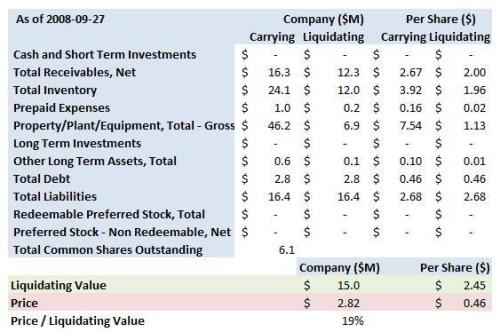
Set out below is our summary analysis (the “Carrying” column shows the assets as they are carried in the financial statements, and the “Liquidating” column shows our estimate of the value of the assets in a liquidation):

crc-summary

A quick glance at the balance sheet shows that CRC is in a liquidity crisis. The company had $8.4M in cash 12 months ago, but has burned through it since then. In three quarters the receivables have reduced from $18.4M in March to $16.3M in this quarter, with none of it flowing through to cash. The company states in its 10Q that it has “several sources of cash” that it believes will be “adequate to meet its short term liquidity requirements.” These are as follows:

  • At September 27, 2008, [CRC] has unused borrowing capacity of approximately $14,231,000 under its Bank Facility.
  • [CRC] expects to receive asset sale proceeds of approximately $3,300,000 in 2009 from the sale of its Lincolnton, North Carolina buildings, machinery and equipment.
  • At September 27, 2008, [CRC] has refundable income taxes of $3,462,000, primarily from net operating loss (NOL) carrybacks, which are expected to be received in the fourth quarter of 2008.
  • [CRC] plans to sell excess inventories and generate cash of approximately $3,000,000 in 2009.
  • [CRC] has recently implemented spending controls and overhead expense reductions in personnel.
  • Future capital spending for information technology upgrades will be delayed to 2010.

CRC’s bankruptcy is not necessarily a problem for an investor if the assets are sufficient to pay out the liabilities and leave some residual value in excess of the current stock price. We think that there is a good chance that this is the case, provided that some action is taken soon to preserve the remaining value.

Assuming the board acts quickly to salvage what remains of CRC, we estimate the company’s per share value in liquidation at around $2.45 or $15M in toto. To reach this estimate, we’ve written down the receivables by a quarter to a little over $12M or $2.00 per share, inventory by two-thirds to $12M or $1.96 per share and Property, Plant and Equipment by 85% from $46M to $6.9M or $1.13 per share. Deducting Total Liabilities of $16.4M or $2.68 per share leaves a value in liquidation of around $2.45 per share.

The catalyst

Aldebran Capital acquired its 7.7% holding in CRC in September and October of this year, paying between $0.42 and $2.72 per share. In a letter to CRC’s chairman, Aldebran Capital has asked the board to take steps to preserve the remaining value. Aldebran Capital’s letter annexed to its 13D filing of October 29, 2008 is reproduced below:

Dear Mr. Chairman:

Aldebaran Capital, LLC is an Indiana limited liability company and registered investment advisor. As noted in our recent filing, we have acquired 7.7% of the outstanding shares of Chromcraft Revington, Inc.

We have followed the transformation of the company over the past few years, as Chromcraft has undergone a major change in its business model.

As security analysts, we recognize the challenges the company has faced in implementing its plan. In addition, we fully understand that current economic conditions are causing the task to be even more difficult.

However, the company is nearly three years into restructuring maneuvers that were begun in 2006. Along the way, Chromcraft has incurred significant losses and continues to accrue costs attendant with these changes. As shareholders, we believe that it is time for the company to demonstrate that these actions are bearing fruit.

In our opinion, if the company is unable to promptly stabilize its business and rationalize its cost structure, we believe that the Board should consider either: a) the sale of the company or, b) undertake an orderly liquidation of the company assets.

We look forward to speaking with you further about Chromcraft.

Sincerely,

Kenneth R. Skarbeck
Managing Member,
Aldebaran Capital, LLC

Conclusion

It’s always difficult to recommend a stock in a liquidity crisis, but crises are what create the wide disparities between value and price, or, in other words, the bargains. CRC is such a bargain. At its close yesterday of $0.46, CRC is trading at a tiny 20% of our estimate of its liquidation value of around $2.45 per share. While there is substantial value on the balance sheet relative to the stock price, the risk is that the company continues to trade and destroys that remaining value. This is always the risk with net net stocks. The good news is that Aldebaran Capital has already called for CRC’s board to take some stockholder friendly steps. We think that Aldebran Capital will be successful and CRC’s value will sooner or later be reflected in its stock.

Warning: When trading in tiny, thinly traded stocks with a wide bid-ask spread, make sure you set a limit on the stock order or you might end up paying more than you want.

CRC closed yesterday at $0.46.

The S&P 500 Index closed at 909.70.

[Disclosure: We do not have a holding in CRC. This is neither a recommendation to buy or sell any securities. All information provided believed to be reliable and presented for information purposes only.]

Read Full Post »

Liquidation value investing is the purchase of securities at a discount to the value of the securities in a liquidation.

The rationale for such an investment is straight foward. In the 1934 edition of Security Analysis, Benjamin Graham argued that the phenomenon of a stock selling persistently below its liquidation value was “fundamentally illogical.” In Graham’s opinion, it meant:

  1. The stock was too cheap, and therefore offered an attractive opportunity for purchase and an attractive area for security analysis; and
  2. Management was pursuing a mistaken policy and should take corrective action, “if not voluntarily, then under pressure from the stockholders.”

Graham understood why these sort of stocks – also known as “net-net”, “net-quick” or “net current asset value” stocks – traded at a discount to liquidation value:

“Common stocks in this category almost always have an unsatisfactory trend of earnings.

The objection to buying these issues lies in the probability, or at least the possibility, that earnings will decline or losses continue, and that the resources will dissipated and the intrinsic value ultimately become less than the price paid.”

Graham responded to these objections that, while he could not deny that these outcomes occurred in individual cases:

“…there is a much wider range of potential developments which may result in establishing a higher market price.  These include the following:

  1. The creation of an earning power commensurate with the company’s assets.   This may result from: a. General improvement in the industry. b. Favorable change in the company’s operating policies, with or without a change in management.  These changes include more efficient methods, new products, abandonment of unprofitable lines, etc.
  2. A sale or merger, because some other concern is able to utilize the resources to better advantage and hence can pay at least liquidating value for the assets.
  3. Complete or partial liquidation.

Graham cautioned that, while there was scarcely any doubt that common stocks selling well below liquidating value represent on the whole a class of undervalued securities, the discerning securities analyst should exercise as much discrimination as possible:

“He will lean towards those for which he sees a fairly imminent prospect of some one of the favorable developments listed above.  Or else he will be partial to such as reveal other attractive statistical features besides their liquid-asset position, e.g., satisfactory current earnings and dividends, or a high average earning power in the past.  The analyst will avoid issues which have been losing their quick assets at a rapid rate and show no definite signs of ceasing to do so.”

Why securities trade below liquidation value

In 1932 Graham had authored a series of three articles for Forbes, titled, Inflated Treasuries and Deflated StockholdersShould Rich Corporations Return Stockholders’ Cash?, and Should Rich but Losing Corporations Be Liquidated? in which he discussed the phenomenon of companies trading below liquidation value.

In the first article, Inflated Treasuries and Deflated Stockholders, Graham wrote:

“…a great number of American businesses are quoted in the market for much less than their liquidating value; that in the best judgment of Wall Street, these businesses are worth more dead than alive. For most industrial companies should bring, in orderly liquidation, at least as much as their quick assets alone.”

The reasons for the selling, Graham argued, was primarily “due to fear rather than necessity,” but also because investors didn’t pay any attention to what a company owns – not even its cash.  He argued that value was associated exclusively with “earning power” and therefore “reported earnings – which might only be temporary or even deceptive – and in a complete eclipse of what had always been regarded as a vital factor in security values, namely the company’s working capital position.”
Graham proposed that investors should become not only “balance sheet conscious,” but “ownership conscious:”
“If they realized their rights as business owners, we would not have before us the insane spectacle of treasuries bloated with cash and their proprietors in a wild scramble to give away their interest on any terms they can get. Perhaps the corporation itself buys back the shares they throw on the market, and by a final touch of irony, we see the stockholders’ pitifully inadequate payment made to them with their own cash.

In the final article, Should Rich but Losing Corporations Be Liquidated?, Graham explained the logic of an investment in a security trading at a discount to its liquidating value:

“If gold dollars without any strings attached could actually be purchased for 50 cents, plenty of publicity and plenty of buying power would quickly be marshaled to take advantage of the bargain. Corporate gold dollars are now available in quantity at 50 cents and less–but they do have strings attached. Although they belong to the stockholder, he doesn’t control them. He may have to sit back and watch them dwindle and disappear as operating losses take their toll. For that reason the public refuses to accept even the cash holdings of corporations at their face value.”
Graham then considered why investors should even contemplate liquidating values when companies were not going to liquidate, responding:
“The stockholders do not have it in their power to make a business profitable, but they do have it in their power to liquidate it. At bottom it is not a theoretical question at all; the issue is both very practical and very pressing.
In its simplest terms the question comes down to this: Are these managements wrong or is the market wrong? Are these low prices merely the product of unreasoning fear, or do they convey a stern warning to liquidate while there is yet time?”

How to determine a company’s liquidation value

In Security Analysis, Graham wrote that, in determining the liquidation value, the current-asset value generally provides a rough indication:

“A company’s balance sheet does not convey exact information as to its value in liquidation, but it does supply clues or hints which may prove useful.  The first rule in calculating liquidating value is that the liabilities are real but the assets are of questionable value.  This means that all true liabilities shown on the books must be deducted at their face amount.  The value to be ascribed to the assets however, will vary according to their character.

Graham then provided the following guide for determining the value of various types of assets in a liquidation:

  • Cash assets (including securities at market) – 100%
  • Receivables (less usual reserves) – between 75% to 90% with an average of 80%.  Graham noted that retail installment accounts should be valued for liquidation at a lower rate, between 30% to 60% with an average of about 50%
  • Inventories (at lower or cost or market) – between 50% to 75% with an average of 66.6%
  • Fixed and miscellaneous assets (real estate, buildings, machinery, equipment, nonmarketable investments, intangibles etc) – between 1% to 50% with an approximate average of 15%.

Historical returns from investing at a discount to liquidation value

In 1992 Tweedy Browne, an undervalued asset investor established in 1920, produced a report What has worked in investing. The report described a number of academic studies of investment styles that have produced high rates of return, including an article in the November-December 1986 issue of Financial Analysts Journal called “Ben Graham’s Net Current Asset Values: A Performance Update”.  The article described a study undertaken by Henry Oppenheimer, an Associate Professor of Finance at the State University of New York at Binghamton, in which he examined the investment results of stocks selling at or below 66% of net current asset value during the 13-year period from December 31, 1970 through December 31, 1983:

“The study assumed that all stocks meeting the investment criterion were purchased on December 31 of each year, held for one year, and replaced on December 31 of the subsequent year by stocks meeting the same criterion on that date.  To create the annual net current asset portfolios, Oppenheimer screened the entire Standard & Poor’s Security Owners Guide.  The entire 13-year study sample size was 645 net current asset selections from the New York Stock Exchange, the American Stock Exchange and the over-the-counter securities market.  The minimum December 31 sample was 18 companies and the maximum December 31 sample was 89 companies.

The mean return from net current asset stocks for the 13-year period was 29.4% per year versus 11.5% per year for the NYSE-AMEX Index.  One million dollars invested in the net current asset portfolio on December 31, 1970 would have increased to $25,497,300 by December 31, 1983.  By comparison,$1,000,000 invested in the NYSE-AMEX Index would have increased to $3,729,600 on December 31,1983.  The net current asset portfolio’s exceptional performance over the entire 13 years was not consistent over smaller subsets of time within the 13-year period.  For the three-year period, December31, 1970 through December 31, 1973, which represents 23% of the 13-year study period, the mean annual return from the net current asset portfolio was .6% per year as compared to 4.6% per year for the NYSE-AMEX Index.

The study also examined the investment results from the net current asset companies which operated at a loss (about one-third of the entire sample of firms) as compared to the investment results of the net current asset companies which operated profitably.  The firms operating at a loss had slightly higher investment returns than the firms with positive earnings:  31.3% per year for the unprofitable companies versus 28.9% per year for the profitable companies.

Further research by Tweedy, Browne has indicated that companies satisfying the net current asset criterion have not only enjoyed superior common stock performance over time but also often have been priced at significant discounts to “real world” estimates of the specific value that stockholders would probably receive in an actual sale or liquidation of the entire corporation.  Net current asset value ascribes no value to a company’s real estate and equipment, nor is any going concern value ascribed to prospective earning power from a company’s sales base.  When liquidation value appraisals are made, the estimated “haircut” on accounts receivable and inventory is often recouped or exceeded by the estimated value of a company’s real estate and equipment.  It is not uncommon to see informed investors, such as a company’s own officers and directors or other corporations, accumulate the shares of a company priced in the stock market at less than 66% of net current asset value.  The company itself is frequently a buyer of its own shares.

Common characteristics associated with stocks selling at less than 66% of net current asset value are low price/earnings ratios, low price/sales ratios and low prices in relation to “normal” earnings; i.e., what the company would earn if it earned the average return on equity for a given industry or the average neti ncome margin on sales for such industry.  Current earnings are often depressed in relation to prior earnings.  The stock price has often declined significantly from prior price levels, causing a shrinkage in a company’s market capitalization.”

Other studies

In Testing Ben Graham’s Net Current Asset Value Strategy in London (Word format), a paper from the business school of the University of Salford in the UK, the strategy was applied to stocks listed on the London Stock Exchange in the period 1980 to 2005.  The paper found that stocks selected using the strategy:

“…substantially outperform the stock market over holding periods of up to five years. The average 60-month buy-and-hold raw return is 254 percent with equal weighting within the NCAV/MV portfolio and 216 percent with value weighting, which are much higher than market indices of only 137 percent and 108 percent. One million pounds invested in a series of NCAV/MV (equal weighted) portfolios starting on 1st July 1981 would have increased to £432 million by June 2005 based on the typical NCAV/MV returns over the study period. By comparison £1,000,000 invested in the entire UK main market would have increased to £34 million by end of June 2005.

For almost all post-formation lengths, and regardless of within portfolio weighting, the NCAV/MV portfolio outperforms either equal weighted or value weighted market indices with high statistical significance. Market-adjusted returns rise to 117 percent and 146 percent after five years if the stocks are equally weighted; and 78 percent and 108 percent after five years if the stocks are value weighted.”

The University of Salford paper is also useful because it discusses other studies and Benjamin Graham’s own results:

“Graham used the NCAV/MV criterion extensively in the operations of the Graham-Newman Corporation and report that shares selected on the basis of the NCAV/MV rule earn, on average, about 20 percent per year over the 30-year period to 1956 (Graham and Chatman (1996)). More recently, Oppenheimer (1986) tested returns of NCAV/MV portfolios with returns on both the NYSE-AMEX value-weighted index and the small-firm index from 1971 through 1983. He found that returns are rank-ordered: securities with the smallest purchase price as a percentage of NCAV show the largest returns. Over the 13-year period, the Graham criteria NCAV/MV portfolios on average outperformed the NYSE-AMEX index by 1.46 percent per month (19 percent per year) after adjusting for risk. When compared to the small-firm index, these portfolios earned an excess return of 0.67% per month (8 percent per year).  In the first study outside of the USA, Bildersee, Cheh and Zutshi (1993)’s paper focuses on the Japanese market from 1975 to 1988.  In order to maintain a sample large enough for cross-sectional analysis, Graham’s criterion was relaxed so that firms are required to merely have an NCAV/MV ratio greater than zero. They found the mean market-adjusted return of the aggregate portfolio is around 1 percent per month (13 percent per year).”

At Greenbackd, we believe that Graham’s rationale, along with the results of the studies, present a compelling argument for investing in these stocks. We spend our days trying to uncover as many of these stocks as we can. What we dig up, we review and post it to the website. Our latest review should be right here.

Buy my book The Acquirer’s Multiple: How the Billionaire Contrarians of Deep Value Beat the Market from on Kindlepaperback, and Audible.

Here’s your book for the fall if you’re on global Wall Street. Tobias Carlisle has hit a home run deep over left field. It’s an incredibly smart, dense, 213 pages on how to not lose money in the market. It’s your Autumn smart read. –Tom Keene, Bloomberg’s Editor-At-Large, Bloomberg Surveillance, September 9, 2014.

Click here if you’d like to read more on The Acquirer’s Multiple, or connect with me on Twitter, LinkedIn or Facebook. Check out the best deep value stocks in the largest 1000 names for free on the deep value stock screener at The Acquirer’s Multiple®.


Read Full Post »
« Newer Posts