Feeds:
Posts
Comments

Posts Tagged ‘Net Current Asset Value’

Regular readers of Greenbackd know that I’m no fan of “the narrative,” which is the story an investor concocts to explain the various pieces of data the investor gathers about a potential investment. It’s something I’ve been thinking about a great deal recently as I grapple with the merits of an investment in Japanese net current asset value stocks. The two arguments for and against investing in such opportunities are as follows:

Fer it: Net current asset value stocks have performed remarkably well throughout the investing world and over time. In support of this argument I cite generally Graham’s experience, Oppenheimer’s Ben Graham’s Net Current Asset Values: A Performance Update paper, Testing Ben Graham’s Net Current Asset Value Strategy in London, a paper from the business school of the University of Salford in the UK, and, more specifically, Bildersee, Cheh and Zutshi’s The performance of Japanese common stocks in relation to their net current asset values, James Montier’s Graham’’s net-nets: outdated or outstanding?, and Dylan Grice’s Are Japanese equities worth more dead than alive.

Agin it: Japan is a special case because it has weak shareholder rights and a culture that regards corporations as “social institutions with a duty to provide stable employment and consider the needs of employees and the community at large, not just shareholders.” In support of this argument I cite the recent experiences of activist investors in Japan, and Bildersee, Cheh and Zutshi’s The performance of Japanese common stocks in relation to their net current asset values (yes, it supports both sides of the argument). Further, the prospects for Japan’s economy are poor due to its large government debt and ageing population.

How to break the deadlock? Montier provides a roadmap in his excellent Behavioural Investing:

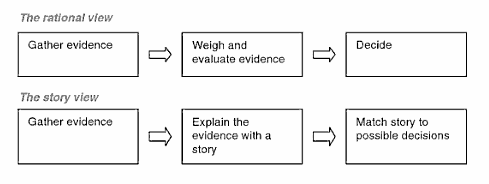
We appear to use stories to help us reach decisions. In the ‘rational’ view of the world we observe the evidence, we then weigh the evidence, and finally we come to our decision. Of course, in the rational view we all collect the evidence in a well-behaved unbiased fashion. … Usually we are prone to only look for the information that happens to agree with us (confirmatory bias), etc.

However, the real world of behaviour is a long way from the rational viewpoint, and not just in the realm of information gathering. The second stage of the rational decision is weighing the evidence. However, as the diagram below shows, a more commonly encountered approach is to construct a narrative to explain the evidence that has been gathered (the story model of thinking).

Hastie and Pennington (2000) are the leading advocates of the story view (also known as explanation-based decision-making). The central hypothesis of the explanation-based view is that the decision maker constructs a summary story of the evidence and then uses this story, rather than the original raw evidence, to make their final decision.

All too often investors are sucked into plausible sounding story. Indeed, underlying some of the most noted bubbles in history are kernels of truth.
As to the last point, arguably, the converse is also true. Investors have missed some great returns because the ugly stories about companies or markets were so compelling.

There are several points that are not contentious about an investment in Japan. The data suggests to me and to everyone else that there are a large number of net current asset value bargains available there. The contention is whether these net current asset value stocks will perform as they have in other countries, or whether they are destined to remain net current asset value bargains, the classic “value traps.” My own penchant for value investing, and quantitative value investing in particular, makes this a reasonably simple matter to resolve. I am going to invest in Japanese net current asset value stocks. Here are the bases for my reasoning:

  • I believe that value investing works. I believe that this is the case because it appeals to me as a matter of logic. I also believe that the data supports this position (see Ben Graham’s Net Current Asset Values: A Performance Update or Lakonishok, Shleifer, and Vishny’s Contrarian Investment, Extrapolation and Risk). Where a stock trades at a significant discount to its value, I am going to take a position.
  • I believe that Graham’s net current asset value works. In support of this proposition I cite the papers listed in the “Fer it” argument above.
  • I believe that simple quantitative models consistently outperform expert judgements. In support of this proposition generally I cite James Montier’s Painting By Numbers: An Ode To Quant. Where the data looks favorable to me, I am going to take a position, and I’m going to ignore the qualitative factors.
  • I believe that value is a good predictor of returns at a market level. In support I cite the Dimson, Marsh and Staunton research. I am not dissuaded from investing in a country simply because its growth prospects are low. Value is the signal predictor of returns.

The arguments militating against investing in Japan sound to me like the arguments militating against any investment in a NCAV stock, which is to say that they are arguments rooted in the narrative. I’ve never taken a position in a NCAV stock that had a good story attached to it. They have always looked ugly from an earnings or narrative perspective (otherwise, they’d be trading at a higher price). As far as I can tell, this situation is no different, other than the fact that it is in a different country and the country has economic problems (which I would ignore in the usual case anyway). While the research specific to NCAV stocks in Japan is not as compelling as I would like it to be, I always bear in mind the lessons of Taleb’s “naive empiricist,” which is to say that the data are useful only up to a point.

This is not to say that I have any great conviction about Japan or Japanese net current asset value stocks. Far from it. I fully expect, as I always do when taking a position in any stock, to be wrong and have the situation follow the narrative. Fortunately, the decision is out of my hands. I’m going to follow my simple quantitative model – the Graham net current asset value strategy – and take some positions in Japanese net nets. The rest is for the goddess Fortuna.
Read Full Post »

In his Are Japanese equities worth more dead than alive?, SocGen’s Dylan Grice conducted some research into the performance of sub-liquidation value stocks in Japan since the mid 1990s. Grice’s findings are compelling:

My Factset backtest suggests such stocks trading below liquidation value have averaged a monthly return of 1.5% since the mid 1990s, compared to -0.2% for the Topix. There is no such thing as a toxic asset, only a toxic price. It may well be that these companies have no future, that they shouldn’t be valued as going concerns and that they are worth more dead than alive. If so, they are already trading at a value lower than would be fetched in a fire sale. But what if the outlook isn’t so gloomy? If these assets aren’t actually complete duds, we could be looking at some real bargains…

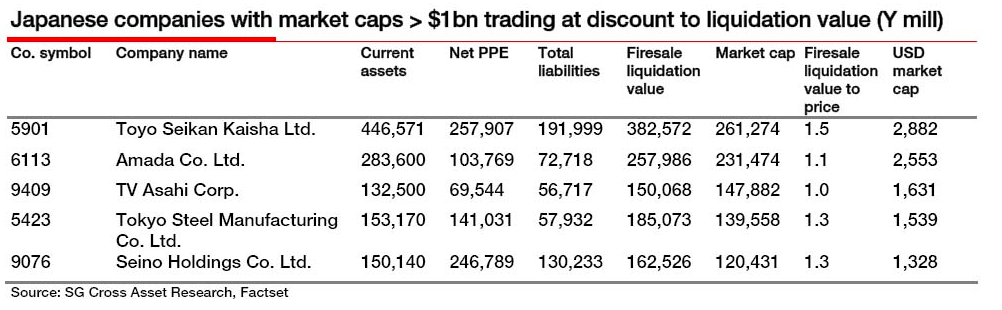
In the same article, Grice identifies five Graham net net stocks in Japan with market capitalizations bigger than $1B:

He argues that such stocks may offer value beyond the net current asset value:

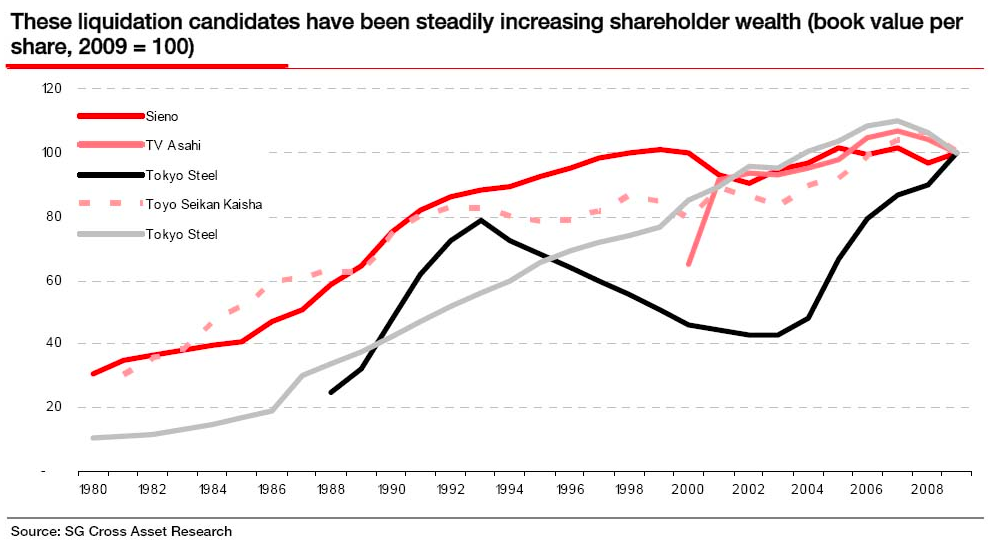
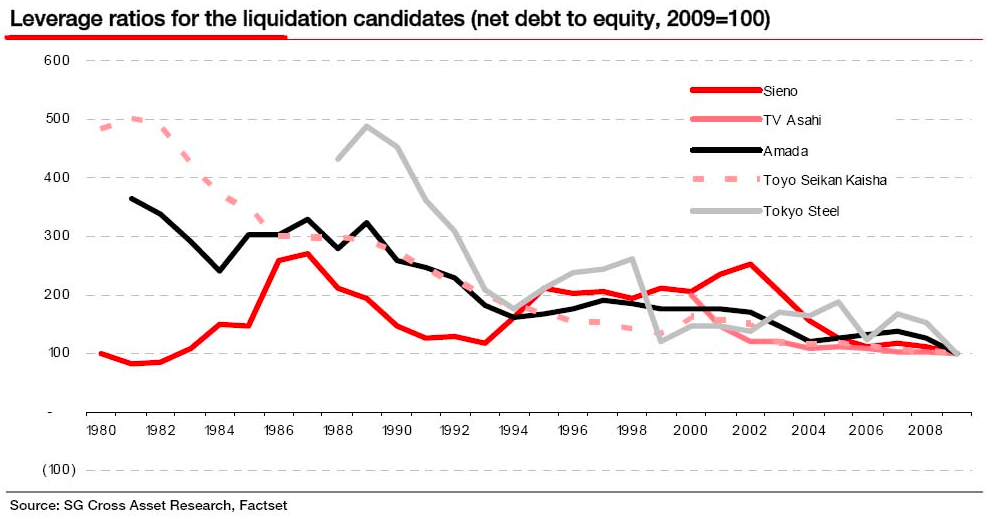
The following chart shows the debt to shareholders equity ratios for each of the stocks highlighted as a liquidation candidate above, rebased so that the last year’s number equals 100. It’s clear that these companies have been aggressively delivering in the last decade.

Despite the “Japan has weak shareholder rights” cover story, management seems to be doing the right thing:

But as it happens, most of these companies have also been buying back stock too. So per share book values have been rising steadily throughout the appalling macro climate these companies have found themselves in. Contrary to what I expected to find, these companies that are currently priced at levels making liquidation seem the most profitable option have in fact been steadily creating shareholder wealth.

This is really extraordinary. The currency is a risk that I can’t quantify, but it warrants further investigation.

Read Full Post »

Since last week’s Japanese liquidation value: 1932 US redux post, I’ve been attempting to determine whether the historical performance of Japanese sub-liquidation value stocks matches the experience in the US, which has been outstanding since the strategy was first identified by Benjamin Graham in 1932. The risk to the Japanese net net experience is the perception (rightly or not) that the weakness of shareholder rights in Japan means that net current asset value stocks there are destined to continue to trade at a discount to net current asset value. As I mentioned yesterday, I’m a little chary of the “Japan has weak shareholder rights” narrative. I’d rather look at the data, but the data are a little wanting.

As we all know, the US net net experience has been very good. Research undertaken by Professor Henry Oppenheimer on Graham’s liquidation value strategy between 1970 and 1983, published in the paper Ben Graham’s Net Current Asset Values: A Performance Update, indicates that “[the] mean return from net current asset stocks for the 13-year period was 29.4% per year versus 11.5% per year for the NYSE-AMEX Index. One million dollars invested in the net current asset portfolio on December 31, 1970 would have increased to $25,497,300 by December 31, 1983.” That’s an outstanding return.

In The performance of Japanese common stocks in relation to their net current asset values, a 1993 paper by Bildersee, Cheh and Zutshi, the authors undertook research similar to Oppenheimer’s in Japan over the period 1975 and 1988. Their findings, described in another paper, indicate that the Japanese net net investor’s experience has not been as outstanding as the US investor’s:

In the first study outside of the USA, Bildersee, Cheh and Zutshi (1993)’s paper focuses on the Japanese market from 1975 to 1988. In order to maintain a sample large enough for cross-sectional analysis, Graham’s criterion was relaxed so that firms are required to merely have an NCAV/MV ratio greater than zero. They found the mean market-adjusted return of the aggregate portfolio is around 1 percent per month (13 percent per year).

As an astute reader noted last week “…the test period for [the Bildersee] study is not the best. It includes Japan’s best analog to America’s Roaring Twenties. The Nikkei peaked on 12/29/89, and never recovered:”

Many of the “assets” on public companies’ books at that time were real estate bubble-related. At the peak in 1989, the aggregate market price for all private real estate in the city of Tokyo was purportedly greater than that of the entire state of California. You can see how the sudden runup in real estate during the bubble could cause asset-heavy companies to outperform the market.

So a better crucible for Japanese NCAVs might be the deflationary period, say beginning 1/1/90, which is more analogous to the US in 1932.

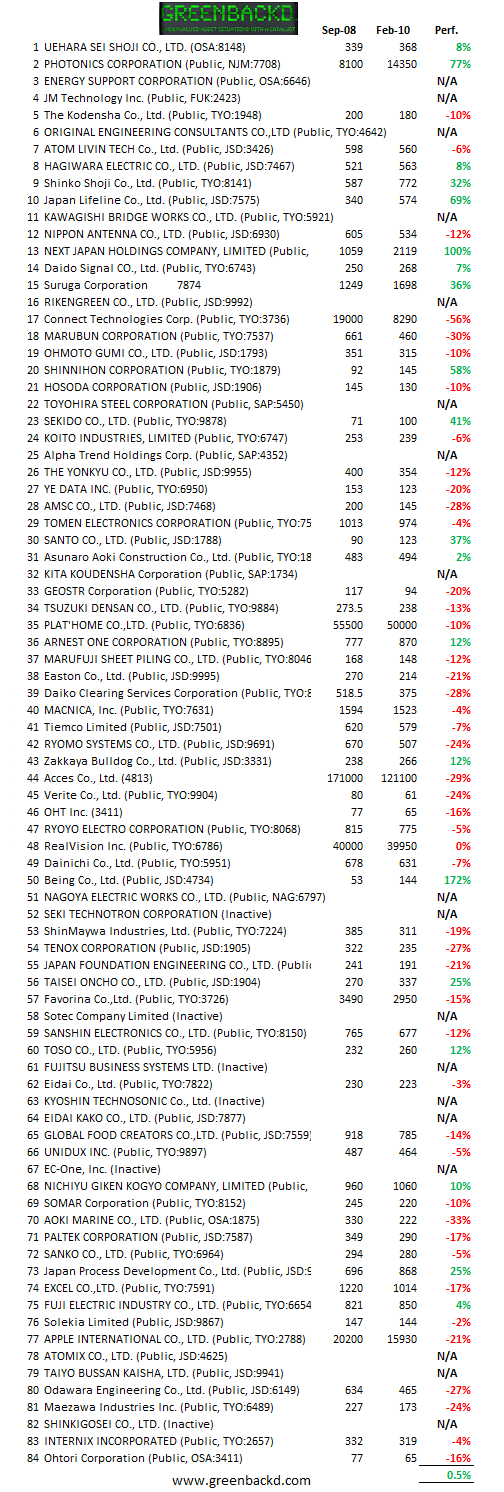
To see how the strategy has performed more recently, I’ve taken the Japanese net net stocks identified in James Montier’s Graham’’s net-nets: outdated or outstanding? article from September 2008 and tracked their performance from the data of the article to today. Before I plow into the results, I’d like to discuss my methodology and the various problems with it:

  1. It was not possible to track all of the stocks identified by Montier. Where I couldn’t find a closing price for a stock, I’ve excluded it from the results and marked the stock as “N/A”. I’ve had to exclude 18 of 84 stocks, which is a meaningful proportion. It’s possible that these stocks were either taken over or went bust, and so would have had an effect on the results not reflected in my results.
  2. The opening prices were not always available. In some instances I had to use the price on another date close to the opening date (i.e +/1 month).

Without further ado, here are the results of Montier’s Graham’’s net-nets: outdated or outstanding? picks:

The 68 stocks tracked gained on average 0.5% between September 2008 and February 2010, which is a disappointing outcome. The results relative to the  Japanese index are a little better. By way of comparison, the Nikkei 225 (roughly equivalent to the DJIA) fell from 12,834 to close yesterday at 10,057, a drop of 21.6%. Encouragingly, the net nets outperformed the N225 by a little over 21%.

The paucity of the data is a real problem for this study. I’ll update this post as I find more complete data or a more recent study.

Read Full Post »

Following on from last week’s Japanese liquidation value: 1932 US redux post, I’ve been trying to determine whether the historical performance of Japanese sub-liquidation value stocks matches the experience in the US. The question arises because of the perception (rightly or not) that the weakness of shareholder rights in Japan means that net current asset value stocks there are destined to trade at a discount to net current asset value. I’m always a little chary of the “Japan has weak shareholder rights” narrative (or any narrative, for that matter). I’d rather look at the data. In this instance, unfortunately, the data are wanting.

In The performance of Japanese common stocks in relation to their net current asset values, a 1993 paper by Bildersee, Cheh and Zutshi, the authors analyzed the performance of Japanese net nets between 1975 and 1988. Here are their findings described in another paper:

In the first study outside of the USA, Bildersee, Cheh and Zutshi (1993)’s paper focuses on the Japanese market from 1975 to 1988. In order to maintain a sample large enough for cross-sectional analysis, Graham’s criterion was relaxed so that firms are required to merely have an NCAV/MV ratio greater than zero. They found the mean market-adjusted return of the aggregate portfolio is around 1 percent per month (13 percent per year).

Not a great return, but obviously a difficult period through 1987 and not an exact facsimile of Graham’s strategy. An astute reader notes that “…the test period for that study is not the best. It includes Japan’s best analog to America’s Roaring Twenties. The Nikkei peaked on 12/29/89, and never recovered:”

Many of the “assets” on public companies’ books at that time were real estate bubble-related. At the peak in 1989, the aggregate market price for all private real estate in the city of Tokyo was purportedly greater than that of the entire state of California. You can see how the sudden runup in real estate during the bubble could cause asset-heavy companies to outperform the market.

So a better crucible for Japanese NCAVs might be the deflationary period, say beginning 1/1/90, which is more analogous to the US in 1932.

It would be interesting to see an update of the performance, but, as far as I am aware, none exists. To that end, I’ve undertaken a little research project of my own. I’ll publish the results tomorrow.

Read Full Post »

Zero Hedge has an article Uncovering Liquidation Value… In Japan? discussing SocGen’s Dylan Grice’s Are Japanese equities worth more dead than alive. The title is a nod to Benjamin Graham’s landmark 1932 Forbes article, Inflated Treasuries and Deflated Stockholders, where he discussed the large number of companies in the US then trading at a discount to liquidation value:

…a great number of American businesses are quoted in the market for much less than their liquidating value; that in the best judgment of Wall Street, these businesses are worth more dead than alive. For most industrial companies should bring, in orderly liquidation, at least as much as their quick assets alone.

Grice writes:

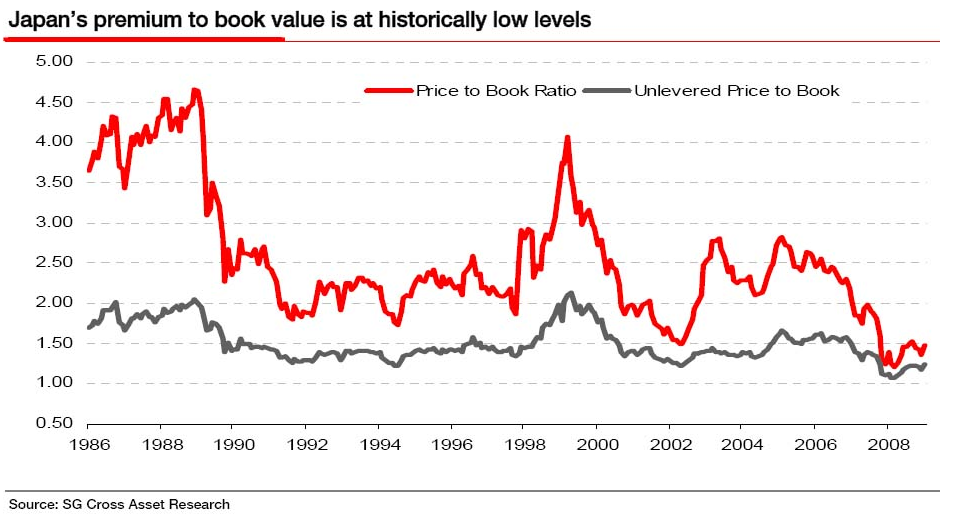
In the space of a generation, Japan has gone from the world economy’s thrusting up-and-coming superpower to its slowing silver-haired retiree. Accordingly, the Japanese market attracts a low valuation. The chart [below] shows FTSE Japan’s equity price to book ratio and enterprise price to book ratio, since equity P/B ratios alone can be distorted by leverage. Both metrics show Japan to be trading at a low premium to book compared to its recent history. So it’s certainly cheap. But does it offer value? The answer can be seen in the chart above, which shows corporate Japan’s RoEs and RoAs over recent decades to have averaged a mere 6.8% and 3.8% respectively. This is hardly the sort of earnings power which should command any premium over book value at all. Indeed, to my mind the question is one of how big a discount the market should trade at relative to book.

The fundamental problem in 1932 America, according to Graham, was that investors weren’t paying attention to the assets owned by the company, instead focussing exclusively on “earning power” and therefore “reported earnings – which might only be temporary or even deceptive – and in a complete eclipse of what had always been regarded as a vital factor in security values, namely the company’s working capital position.” Graham proposed that investors should become not only “balance sheet conscious,” but “ownership conscious:”

If they realized their rights as business owners, we would not have before us the insane spectacle of treasuries bloated with cash and their proprietors in a wild scramble to give away their interest on any terms they can get. Perhaps the corporation itself buys back the shares they throw on the market, and by a final touch of irony, we see the stockholders’ pitifully inadequate payment made to themwith their own cash.

In his article, Grice makes a parallel argument about valuations based on earnings in Japan now:

Regular readers will know I favour a Residual Income approach to valuation. It’s not perfect, and it’s still a work in process, but anchoring estimates of intrinsic value on the earnings power of company assets (relative to a required rate of return, which I set at an exacting 10%) helps avoid value traps. Things don?t necessarily come up as offering value just because they’re on low multiples. The left chart below shows Japan’s ratio of Intrinsic Value to Price (IVP ratio, where a higher number indicates higher value) to be only 0.6, suggesting that in an absolute sense, Japan is intrinsically worth only about 60% of its current market value.

Grice arrives at the same conclusion about Japan as Graham did in 1932 about the US:

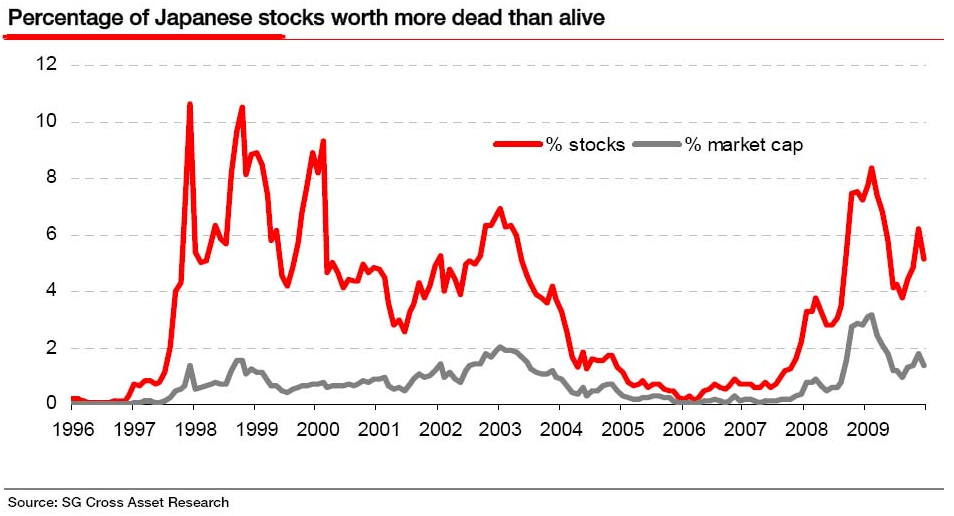
But here the tension between “going concern” valuation and “liquidation” valuation becomes important. Let’s just imagine the unimaginable for a second, and that my IVP ratios are correct. Japan currently trades on a P/B ratio of 1.5x, but if it is only worth 60% of that, its “fair value” P/B ratio (assuming we value it as a going concern) would be around 0.9x. Of course, that would only be true on average. Nearly all stocks would trade either above or below that level. And of those trading below, some would trade slightly below, others significantly below. And of those which traded significantly below, some might be expected to flirt with liquidation values which called into question whether or not the “going concern” valuation was appropriate. Indeed, this is exactly what is beginning to happen.

It seems that there are quite a few stocks trading at a discount to net current asset value in Japan:

Grice likes the net current asset value strategy in Japan (sort of):

Not only are these assets cheap but, unlike the overall market, they probably offer value as well. My Factset backtest suggests such stocks trading below liquidation value have averaged a monthly return of 1.5% since the mid 1990s, compared to -0.2% for the Topix. There is no such thing as a toxic asset, only a toxic price. It may well be that these companies have no future, that they shouldn’t be valued as going concerns and that they are worth more dead than alive. If so, they are already trading at a value lower than would be fetched in a fire sale. But what if the outlook isn’t so gloomy? If these assets aren’t actually complete duds, we could be looking at some real bargains…

So should we be filling our boots with companies trading below liquidation value? Not necessarily. But I would say the burden of proof has shifted. Why wouldn’t you want to own assets that have been generating shareholder wealth yet which trade at below their liquidation values?

It is interesting that this article echoes another SocGen article, this one a September 2008 report by James Montier called Graham’’s net-nets: outdated or outstanding? in which Montier looked at Graham sub-liquidation stocks globally. Of the 175 stocks identified around the world, Montier found that over half were in Japan.

Now all we have to do is figure out how to invest in Japan.

Read Full Post »

Continuing the quantitative value investment theme I’ve been trying to develop over the last week or so, I present my definition of a simple quantitative value strategy: net nets. James Montier, author of the essay Painting By Numbers: An Ode To Quant, which I use as the justification for simple quantitative investing, authored an article in September 2008 specifically dealing with net nets as a global investment strategy: Graham’’s net-nets: outdated or outstanding? (Edit: It seems this link no longer works as SG obliterates any article ever written by Montier). Quelle surprise, Montier found that buying net-nets is a viable and profitable strategy:

Testing such a deep value approach reveals that it would have been a highly profitable strategy. Over the period 1985-2007, buying a global basket of net-nets would have generated a return of over 35% p.a. versus an equally weighted universe return of 17% p.a.

An annual return of 35% over 23 years would put you in elite company indeed, so Montier’s methodology is worthy of closer inspection. Unfortunately he doesn’t discuss his methodology in any detail, other than to say as follows:

I decided to test the performance of buying net-nets on a global basis. I used a sample of developed markets over the period 1985 onwards, all returns were in dollar terms.

It may have been a strategy similar to the annual rebalancing methodology discussed in Oppenheimer’s Ben Graham’s Net Current Asset Values: A Performance Update. That paper demonstrates a purely mechanical annual rebalancing of stocks meeting Graham’s net current asset value criterion generated a mean return between 1970 and 1983  of “29.4% per year versus 11.5% per year for the NYSE-AMEX Index.” It doesn’t really matter exactly how Montier generated his return. Whether he bought each net net as it became a net net or simply purchased a basket on a regular basis (monthly, quarterly, annually, whatever), it’s sufficient to know that he was testing the holding of a basket of net nets throughout the period 1985 to 2007.

Montier’s findings are as follows:

  • The net-nets portfolio contains a median universe of 65 stocks per year.
  • There is a small cap bias to the portfolio. The median market cap of a net-net is US$21m.
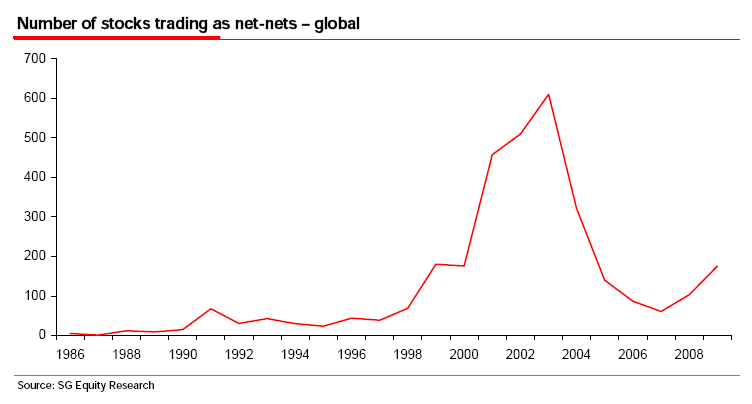
  • At the time of writing (September 2008), Montier found around 175 net-nets globally. Over half were in Japan.
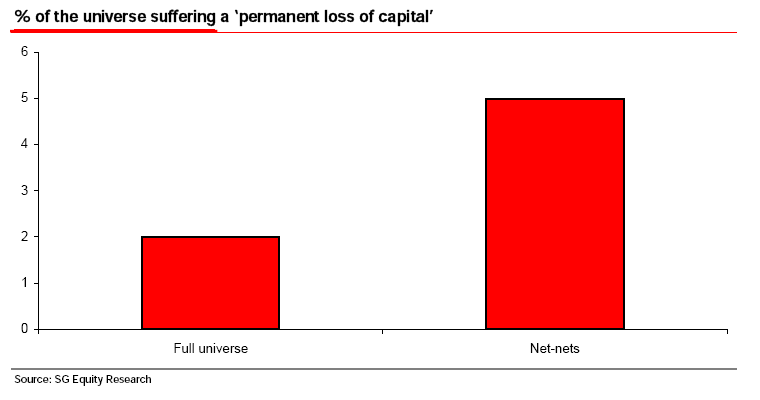
  • If we define total business failure as stocks that drop more than 90% in a year, then the net-nets portfolio sees about 5% of its constituents witnessing such an event. In the broad market only around 2% of stocks suffer such an outcome.
  • The overall portfolio suffered only three down years in our sample, compared to six for the overall market.

Several of Montier’s findings are particularly interesting to me. At an individual company level, a net net is more likely to suffer a permanent loss of capital than the average stock:

If we define a permanent loss of capital as a decline of 90% or more in a single year, then we see 5% of the net-nets selections suffering such a fate, compared with 2% in the broader market.

Here’s the chart:

This is interesting given that NCAV is often used as a proxy for liquidation value.

Very few companies turn out to have an ultimate value less than the working capital alone, although scattered instances may be found.

Montier believes this may provide a clue as to why the net net strategy continues to work:

This relatively poor performance may hint at an explanation as to why investors shy away from net-nets. If investors look at the performance of the individual stocks in their portfolio rather than the portfolio itself (known as ‘narrow-framing’), then they will see big losses more often than if they follow a broad market strategy. We know that people are generally loss averse, so they tend to feel losses far more than gains. This asymmetric response coupled with narrow framing means that investors in the net-nets strategy need to overcome several behavioural biases.

Paradoxically, it seems that what is true at the individual company level is not true at an aggregate level. The net net strategy has fewer down years than the market:

If one were to frame more broadly and look at the portfolio performance overall, the picture is much brighter. The net-net strategy only generated losses in three years in the entire sample we backtested. In contrast, the overall market witnessed some six years of negative returns.

Here’s the chart:

And it seems that the net net strategy is a reasonable contrary indicator. When the market is up, fewer can be found, and when the market is down, they seem to be available in abundance:

The main drawback to the net net strategy is its limited application. Stocks tend to be small and illiquid, which puts a limit on the amount of capital that can be safely run using it. That aside, it seems like a good way to get started in a small fund or with a individual account. Montier concludes:

…In various ways practically all these bargain issues turned out to be profitable and the average annual return proved much more remunerative than most other investments.

Good old Benjamin Graham. What a guy.

Buy my book The Acquirer’s Multiple: How the Billionaire Contrarians of Deep Value Beat the Market from on Kindlepaperback, and Audible.

Here’s your book for the fall if you’re on global Wall Street. Tobias Carlisle has hit a home run deep over left field. It’s an incredibly smart, dense, 213 pages on how to not lose money in the market. It’s your Autumn smart read. –Tom Keene, Bloomberg’s Editor-At-Large, Bloomberg Surveillance, September 9, 2014.

Click here if you’d like to read more on The Acquirer’s Multiple, or connect with me on Twitter, LinkedIn or Facebook. Check out the best deep value stocks in the largest 1000 names for free on the deep value stock screener at The Acquirer’s Multiple®.

Read Full Post »

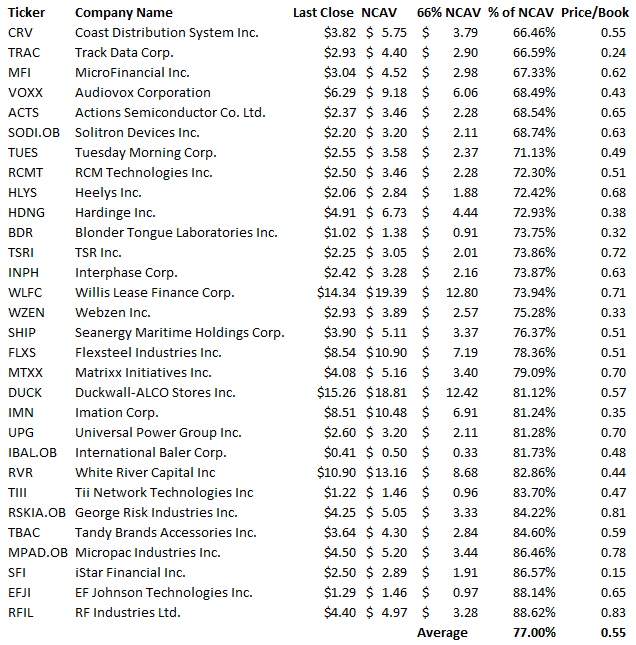
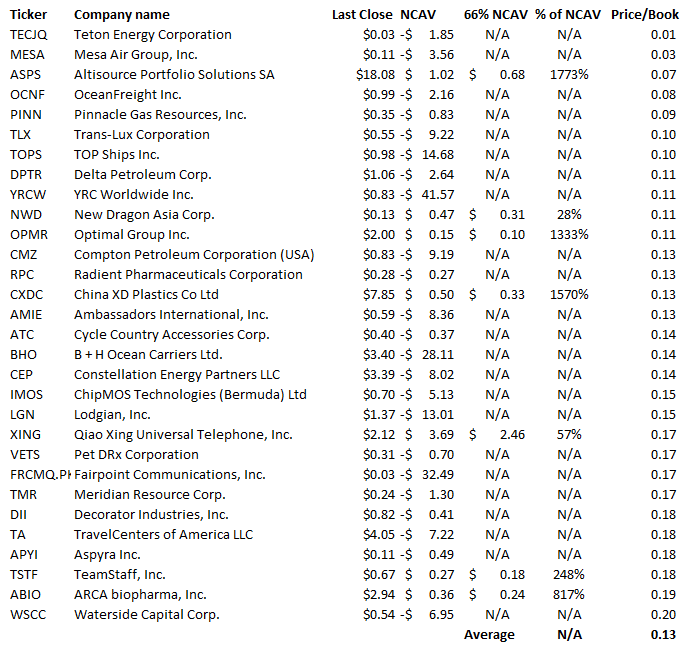
I’m setting up a new experiment for 2009/2010 along the same lines as the 2008/2009 Net Net vs Activist Legend thought experiment pitting a little Graham net net against activist investing legend Carl Icahn (Net Net vs Activist Legend: And the winner is…). This time around I’m pitting a small portfolio of near Graham net nets against a small portfolio of ultra-low price-to-book value stocks. The reason? Near Graham net nets are stocks trading at a small premium to Graham’s two-thirds NCAV cut-off, but still trading at a discount to NCAV. While they are also obviously trading at a discount to book, they will in many cases trade at a higher price-to-book value ratio than a portfolio of stocks selected on the basis of price-to-book only. I’m interested to see which will perform better in 2010. The two portfolios are set out below (each contains 30 stocks). I’ll track the equal-weighted returns of each through the year.

The Near Graham Net Net Portfolio (extracted from the Graham Investor screen):

The Ultra-low Price-to-book Portfolio:

The Ultra-low Price-to-book Portfolio contains a sickly lot from a net current asset value perspective. Most have a negative net current asset value, as their liabilities exceed their current assets. Where that occurs, the proportion of price to NCAV is meaningless, so I’ve just recorded it as “N/A”. The few stocks that do have a positive net current asset value are generally trading a substantial premium to that value, with the exception of NWD and ZING, which qualify as Graham net nets.

While the Net Net vs Activist Legend thought experiment didn’t amount to (ahem) a formal academic study, there are two studies relevant to the outcome in that experiment: Professor Henry Oppenheimer’s Ben Graham’s Net Current Asset Values: A Performance Update, which found “[the] mean return from net current asset stocks for the 13-year period [from 1970 to 1983] was 29.4% per year versus 11.5% per year for the NYSE-AMEX Index.” Also relevant was Hedge Fund Activism, Corporate Governance, and Firm Performance, by Brav, Jiang, Thomas and Partnoy, in which the authors found that the “market reacts favorably to hedge fund activism, as the abnormal return upon announcement of potential activism is in the range of [7%] seven percent, with no return reversal during the subsequent year.”

This experiment is similar to the Net Net vs Activist Legend thought experiment in that it isn’t statistically significant. There are, however, several studies relevant to divining the outcome. In this instance, Professor Oppenheimer’s study speaks to the return on the Near Graham Net Net Portfolio, as Roger Ibbotson’s Decile Portfolios of the New York Stock Exchange, 1967 – 1984 (1986), Werner F.M. DeBondt and Richard H. Thaler’s Further Evidence on Investor Overreaction and Stock Market Seasonality (1987), Josef Lakonishok, Andrei Shleifer, and Robert Vishny’s Contrarian Investment, Extrapolation and Risk (1994) as updated by The Brandes Institute’s Value vs Glamour: A Global Phenomenon (2008) speak to the return on the Ultra-low Price-to-book Portfolio. One wrinkle in that theory is that the low price-to-book value studies only examine the cheapest quintile and decile, where I have taken the cheapest 30 stocks on the Google Finance screener, which is the cheapest decile of the cheapest decile. I expect these stocks to do better than the low price-to-book studies would suggest. That said, I expect that the Near Graham Net Net Portfolio will outperform the Ultra-low Price-to-book Portfolio by a small margin. Let me know which horse you’re getting on and the reason in the comments.

[Full Disclosure:  I hold RCMT and TSRI. This is neither a recommendation to buy or sell any securities. All information provided believed to be reliable and presented for information purposes only. Do your own research before investing in any security.]

Read Full Post »

We have a guest post today on Solitron Devices Inc (OTC:SODI) from Floris Oliemans. Floris is a recent graduate of the University of Maastricht in the Netherlands with a MSc in Finance. He also holds a BSc in Economics. He wrote his masters thesis on the performance of Net Current Asset Value stocks.  He currently works as a financial analyst for a Dutch multinational. He is very interested in applying the value concepts proposed by Graham, Whitman and Buffett, for the portfolio of his family and where ever it may be used professionally. Here his view of Solitron Devices Inc (OTC:SODI):

Solitron Devices is a manufacturer of Semiconductors for military, extraorbital and industrial purposes. It produces analog vs digital semiconductors (I dont quite know the difference, I lack a BA in engineering).

The reason I bought this stock is because it is trading at a 30% discount to NCAV. I believe the assets in place are of high quality. Its current market cap is 4,97 million. After subtracting all liabilities it has (roughly) 3,5 million in net cash. The remainder of the assets is tied up in 1 million of acc. rec (very high acc rev turnover) and 2,71 mio of inventory. The inventory consists mostly of raw materials and of goods already ordered by customers. It does not produce products that the customer has not ordered, therefore inventory can and should be liquidated at near 100% of nominal value. Furthermore it has an inventory reserve of nearly 1,4 mio which might or might not be too conservative.

The company is tiny, but it has been profitable for the last decade. Based on last years earnings the firm is yielding 16%. The reason for this high earnings yield is because it has a large tax loss carryforward worth 8 million. This tax loss carry forward is due to the bankruptcy of the firm in 1993, and lasts until 2023. With net income of 900,000 last year, and a tax rate of 30%, it will not be able to use the tax loss carryforward completely. This is one reason why the tax loss carryforward is only listed in the footnotes and not on the balance sheet. One can be safe to assume that the firm will not be required to pay taxes for the foreseeable future. This is an offbalance sheet asset that can definitely add value to the current shareholder.

I do not expect a massive increase in earnings but there are a couple of factors which could act as a catalyst to the firm:

1. The large tax loss carryforward. By buying this firm, a larger competitor could use this tax loss carryforward to lower incometaxes for the entire firm. This would unlock the value of this hidden asset. A cautionary note: The annual report states that a new majority owner of the firm might not be able to use all of the tax loss carryfowards.

2. A wrapping up of all bankruptcy proceedings. The firm has promised all previous creditors that it will not pay any dividends until all the bankruptcy obligations have been paid. As far as I can deduct, the firm is still obliged to pay 1.1 mio in accrued liabilities. At the current scheduled payment rate the firm will be done paying in 4 years. After this, the built up cash reserve could be used to redistribute to shareholders.

3. An increase in business due to the new ISO certification. The company recently received an ISO certification allowing it to produce semiconducters suitable for space. What the impact on the business will be, I have no clue, but it might be positive.

4. An increase in margins. Recently a large competitor left the market, motorola. A decrease in competition lifts the bargaining power of the firm and could increase margin. It could also increase its market share.

Risks:

1. The backlog has decreased over the last 12 months. This could imply a sharp decrease in demand and lower sales volume/margins. The company has relatively few fixed assets in place, thus the risk of a decrease in NAV is minimal.
2. Fraud. Altough I have no reason to suspect fraud (the firms accounting is pretty simple), the majority shareholders could be misrepresenting the figures.
3. Majority shareholders abusing their voting rights. Majority shareholders could abuse their position to siphon of shareholder value and take Something Off the Top (SOTT). There are some options outstanding but they have not increased significantly.

4. I dont understand the business. I have no idea how a semiconductor is made or what function it has. I could be buying into a dying company and/or industry and not know about it.

Conclusion:

The high quality of assets in place, the consistent earnings and the large tax loss carryforward make this a confident invesment. Something could happen that I have not foreseen in my analysis, but this is always a risk. I am just going to leave this stock for the next 2 years and see what happens. As Pabrai says “Low Risk, High Uncertainty”.

The stock is very thinly traded, so, if you’re inclined to do so, take care getting set.

[Full Disclosure:  I do not have a holding in SODI. This is neither a recommendation to buy or sell any securities. All information provided believed to be reliable and presented for information purposes only. Do your own research before investing in any security.]

Read Full Post »

Digirad Corporation (NASDAQ:DRAD) has filed its 10Q for the quarter ended September 30, 2009.

We started following DRAD (see our post archive here) because it was an undervalued asset play with a plan to sell assets and buy back its stock. The stock is up more than 167% since we started following it to close yesterday at $2.35, giving the company a market capitalization of $36.1M. We last estimated the liquidation value to be around $32.5M or $1.73 per share. We’ve now increased our valuation to $32.9M or $1.77 per share following another very good quarter for DRAD. Year-to-date, DRAD has generated over $3.4M in cash from operations. DRAD has also started buying back stock under its previously announced $2M stock repurchase plan.

The value proposition updated

DRAD has continued its good year, generating $3.4M in operating cash flow year-to-date. Our updated estimate for the company’s liquidation value is set out below (the “Book Value” column shows the assets as they are carried in the financial statements, and the “Liquidating Value” column shows our estimate of the value of the assets in a liquidation):

DRAD Summary 2009 9 30Off-balance sheet arrangements and contractual obligations: The company hasn’t disclosed any off-balance sheet arrangements in its most recent 10Q.
The catalyst

DRAD’s board has announced a stock buyback program:

The Company also announced that its board of directors has authorized a stock buyback program to repurchase up to an aggregate of $2 million of its issued and outstanding common shares. Digirad had approximately 19 million shares outstanding as of December 31, 2008. At current valuations, this repurchase plan would authorize the buyback of approximately 2.1 million shares, or approximately 11 percent of the company’s outstanding shares.

Chairman of the Digirad Board of Directors R. King Nelson said, “The board believes the Company’s direction and goals towards generating positive cash flow and earnings coupled with an undervalued stock price present a unique investment opportunity. We are confident this will provide a solid return to our shareholders.”

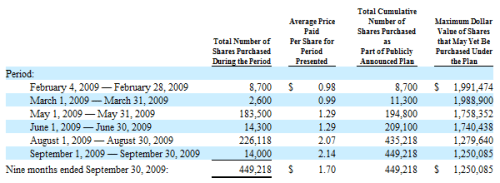
According to the most recent 10Q, the company has now started to buy its own stock, albeit a relatively small amount:

On February 4, 2009, our Board of Directors approved a stock repurchase program whereby we may, from time to time, purchase up to $2.0 million worth of our common stock in the open market, in privately negotiated transactions or otherwise, at prices that we deem appropriate. The plan has no expiration date. Details of purchases made during the nine months ended September 30, 2009 are as follows (Edited to fit this space.):

DRAD Buy Back Detail 2009 09 30

Conclusion

DRAD is now trading at a reasonable 24% premium to its $32.9M or $1.77 per share in liquidation value. It’s off about 20% from its peak, and looks likely to continue to drop. We’re generally sellers of secondary securities trading at a premium to liquidation value, but DRAD seems to have the started generating cash. We’d like to see where it can go. We can see no other reason to cease holding DRAD in the Greenbackd Portfolio and so we’re going to maintain the position for now.

[Full Disclosure:  We do not have a holding in DRAD. This is neither a recommendation to buy or sell any securities. All information provided believed to be reliable and presented for information purposes only. Do your own research before investing in any security.]

Read Full Post »

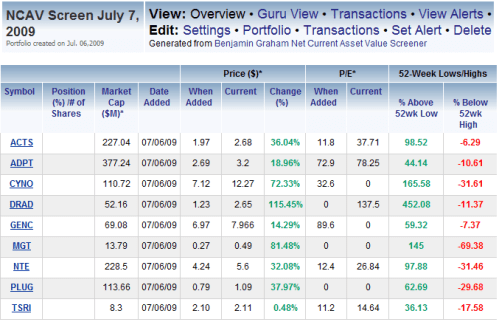
We’ve recently been using the GuruFocus Benjamin Graham Net Current Asset Value Screener (subscription required) to generate regular watchlists of net net stocks. The GuruFocus NCAV screen has some superb functionality that makes it possible to create the watchlist from the screen and then track the performance of those stocks. We created our first watchlist on July 7 of this year using the July 6 closing prices. The performance of the stocks in that first watchlist over the last quarter has been nothing short of spectacular. Here is a screen grab (with some columns removed to fit the space below):

GuruFocus NCAV Screen

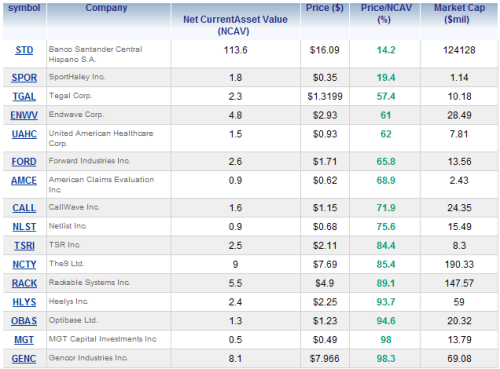
We know the market’s been somewhat frothy recently, but those returns are still notable. The average return to date across the nine stocks in the watchlist is 45.5% against the return on the S&P500 of 20.05% over the same period, an outperformance of more than 25% in ~three months. We’ve decided to run another screen today and we’ll track the return of that watchlist over the coming months. The stocks in the watchlist are set out below (again, with a column removed to fit the space below):

GuruFocus NCAV Screen 2009 10 13

We’ve done no research on these firms beyond running the screen. If you plan on buying anything in this screen, at the absolute minimum we recommend that you do some research to determine whether they are currently net net stocks and not just caught in the screen because of out-of-date filings. We’ll compare the performance of the stocks against the S&P500, which closed yesterday at 1,076.18.

[Full Disclosure:  We have a holding in FORD. This is neither a recommendation to buy or sell any securities. All information provided believed to be reliable and presented for information purposes only. Do your own research before investing in any security.]

Benjamin Graham Net Current Asset Value Screener

Read Full Post »

« Newer Posts - Older Posts »