Feeds:
Posts
Comments

Posts Tagged ‘Liquidation Value’

Jae Jun at Old School Value has a great post, NCAV NNWC Screen Strategy Backtest, comparing the performance of net current asset value stocks (NCAV) and “net net working capital” (NNWC) stocks over the last three years. To arrive at NNWC, Jae Jun discounts the current asset value of stocks in line with Graham’s liquidation value discounts, but excludes the “Fixed and miscellaneous assets” included by Graham. Here’s Jae Jun’s NNWC formula:

NNWC = Cash + (0.75 x Accounts receivables) + (0.5 x  Inventory)

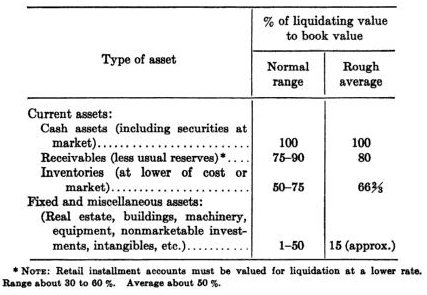
Here’s Graham’s suggested discounts (extracted from Chapter XLIII of Security Analysis: The Classic 1934 Edition “Significance of the Current Asset Value”):

Excluding the “Fixed and miscellaneous assets” from the NNWC calculation provides an austere valuation indeed (it makes Graham look like a pie-eyed optimist, which is saying something). The good news is that Jae Jun’s NNWC methodology seems to have performed exceptionally well over the period analyzed.

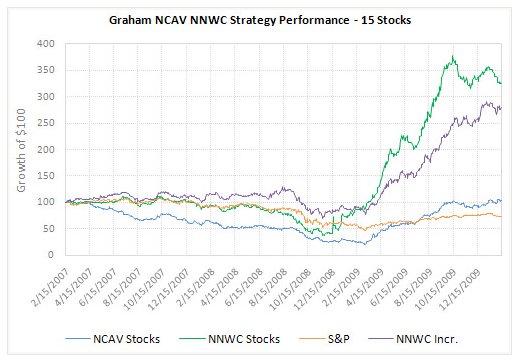
Jae Jun’s back-test methodology was to create two concentrated portfolios, one of 15 stocks and the other of 10 stocks. He rolled the positions on a four-weekly basis, which may be difficult to do in practice (as Aswath Damodaran pointed out yesterday, many a slip twixt cup and the lip renders a promising back-tested strategy useless in the real world). Here’s the performance of the 15 stock portfolio:

“NNWC Incr.” is “NNWC Increasing,” which Jae Jun describes as follows:

NNWC is positive and the latest NNWC has increased compared to the previous quarter. In this screen, NNWC doesn’t have to be less than current market price. Since the requirement is that NNWC is greater than 0, most large caps automatically fail to make the cut due to the large quantity of intangibles, goodwill and total debt.

Both the NNWC and NNWC Increasing portfolios delivered exceptional returns, up 228% and 183% respectively, while the S&P500 was off 26%. The performance of the NCAV portfolio was a surprise, eeking out just a 5% gain over the period, which is nothing to write home about, but still significantly better than the S&P500.

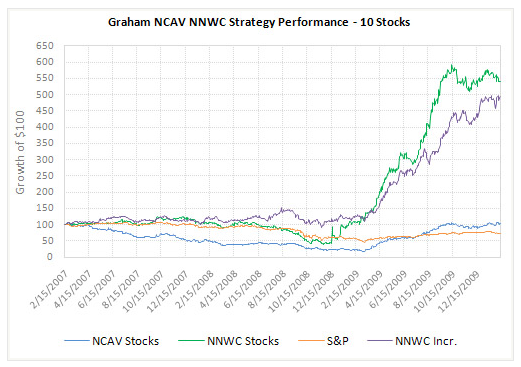
The 10 stock portfolio’s returns are simply astonishing:

Jae Jun writes:

An original $100 would have become

  • NCAV: $103
  • NNWC: $544
  • NNWC Incr: $503
  • S&P500: $74

That’s a gain of over 400% for NNWC stocks!

Amazing stuff. It would be interesting to see a full academic study on the performance of NNWC stocks, perhaps with holding periods in line with Oppenheimer’s Ben Graham’s Net Current Asset Values: A Performance Update for comparison. You can see Jae Jun’s Old School Value NNWC NCAV Screen here (it’s free). He’s also provided a list of the top 10 NNWC stocks and top 10 stocks with increasing NNWC in the NCAV NNWC Screen Strategy Backtest post.

Buy my book The Acquirer’s Multiple: How the Billionaire Contrarians of Deep Value Beat the Market from on Kindlepaperback, and Audible.

Here’s your book for the fall if you’re on global Wall Street. Tobias Carlisle has hit a home run deep over left field. It’s an incredibly smart, dense, 213 pages on how to not lose money in the market. It’s your Autumn smart read. –Tom Keene, Bloomberg’s Editor-At-Large, Bloomberg Surveillance, September 9, 2014.

Click here if you’d like to read more on The Acquirer’s Multiple, or connect with me on Twitter, LinkedIn or Facebook. Check out the best deep value stocks in the largest 1000 names for free on the deep value stock screener at The Acquirer’s Multiple®.


Read Full Post »

Aswath Damodaran, a Professor of Finance at the Stern School of Business, has an interesting post on his blog Musings on Markets, Transaction costs and beating the market. Damodaran’s thesis is that transaction costs – broadly defined to include brokerage commissions, spread and the “price impact” of trading (which I believe is an important issue for some strategies) – foil in the real world investment strategies that beat the market in back-tests. He argues that transaction costs are also the reason why the “average active portfolio manager” underperforms the index by about 1% to 1.5%. I agree with Damodaran. The long-term, successful practical application of any investment strategy is difficult, and is made more so by all of the frictional costs that the investor encounters. That said, I see no reason why a systematic application of some value-based investment strategies should not outperform the market even after taking into account those transaction costs and taxes. That’s a bold statement, and requires in support the production of equally extraordinary evidence, which I do not possess. Regardless, here’s my take on Damodaran’s article.

First, Damodaran makes the point that even well-researched, back-tested, market-beating strategies underperform in practice:

Most of these beat-the-market approaches, and especially the well researched ones, are backed up by evidence from back testing, where the approach is tried on historical data and found to deliver “excess returns”. Ergo, a money making strategy is born.. books are written.. mutual funds are created.

The average active portfolio manager, who I assume is the primary user of these can’t-miss strategies does not beat the market and delivers about 1-1.5% less than the index. That number has remained surprisingly stable over the last four decades and has persisted through bull and bear markets. Worse, this under performance cannot be attributed to “bad” portfolio mangers who drag the average down, since there is very little consistency in performance. Winners this year are just as likely to be losers next year…

Then he explains why he believes market-beating strategies that work on paper fail in the real world. The answer? Transaction costs:

So, why do portfolios that perform so well in back testing not deliver results in real time? The biggest culprit, in my view, is transactions costs, defined to include not only the commission and brokerage costs but two more significant costs – the spread between the bid price and the ask price and the price impact you have when you trade. The strategies that seem to do best on paper also expose you the most to these costs. Consider one simple example: Stocks that have lost the most of the previous year seem to generate much better returns over the following five years than stocks have done the best. This “loser” stock strategy was first listed in the academic literature in the mid-1980s and greeted as vindication by contrarians. Later analysis showed, though, that almost all of the excess returns from this strategy come from stocks that have dropped to below a dollar (the biggest losing stocks are often susceptible to this problem). The bid-ask spread on these stocks, as a percentage of the stock price, is huge (20-25%) and the illiquidity can also cause large price changes on trading – you push the price up as you buy and the price down as you sell. Removing these stocks from your portfolio eliminated almost all of the excess returns.

In support of his thesis, Damodaran gives the example of Value Line and its mutual funds:

In perhaps the most telling example of slips between the cup and lip, Value Line, the data and investment services firm, got great press when Fischer Black, noted academic and believer in efficient markets, did a study where he indicated that buying stocks ranked 1 in the Value Line timeliness indicator would beat the market. Value Line, believing its own hype, decided to start mutual funds that would invest in its best ranking stocks. During the years that the funds have been in existence, the actual funds have underperformed the Value Line hypothetical fund (which is what it uses for its graphs) significantly.

Damodaran’s argument is particularly interesting to me in the context of my recent series of posts on quantitative value investing. For those new to the site, my argument is that a systematic application of the deep value methodologies like Benjamin Graham’s liquidation strategy (for example, as applied in Oppenheimer’s Ben Graham’s Net Current Asset Values: A Performance Update) or a low price-to-book strategy (as described in Lakonishok, Shleifer, and Vishny’s Contrarian Investment, Extrapolation and Risk) can lead to exceptional long-term investment returns in a fund.

When Damodaran refers to “the price impact you have when you trade” he highlights a very important reason why a strategy in practice will underperform its theoretical results. As I noted in my conclusion to Intuition and the quantitative value investor:

The challenge is making the sample mean (the portfolio return) match the population mean (the screen). As we will see, the real world application of the quantitative approach is not as straight-forward as we might initially expect because the act of buying (selling) interferes with the model.

A strategy in practice will underperform its theoretical results for two reasons:

  1. The strategy in back test doesn’t have to deal with what I call the “friction” it encounters in the real world. I define “friction” as brokerage, spread and tax, all of which take a mighty bite out of performance. These are two of Damodaran’s transaction costs and another – tax. Arguably spread is the most difficult to prospectively factor into a model. One can account for brokerage and tax in the model, but spread is always going to be unknowable before the event.
  2. The act of buying or selling interferes with the market (I think it’s a Schrodinger’s cat-like paradox, but then I don’t understand quantum superpositions). This is best illustrated at the micro end of the market. Those of us who traffic in the Graham sub-liquidation value boat trash learn to live with wide spreads and a lack of liquidity. We use limit orders and sit on the bid (ask) until we get filled. No-one is buying (selling) “at the market,” because, for the most part, there ain’t no market until we get on the bid (ask). When we do manage to consummate a transaction, we’re affecting the price. We’re doing our little part to return it to its underlying value, such is the wonderful phenomenon of value investing mean reversion in action. The back-test / paper-traded strategy doesn’t have to account for the effect its own buying or selling has on the market, and so should perform better in theory than it does in practice.

If ever the real-world application of an investment strategy should underperform its theoretical results, Graham liquidation value is where I would expect it to happen. The wide spreads and lack of liquidity mean that even a small, individual investor will likely underperform the back-test results. Note, however, that it does not necessarily follow that the Graham liquidation value strategy will underperform the market, just the model. I continue to believe that a systematic application of Graham’s strategy will beat the market in practice.

I have one small quibble with Damodaran’s otherwise well-argued piece. He writes:

The average active portfolio manager, who I assume is the primary user of these can’t-miss strategies does not beat the market and delivers about 1-1.5% less than the index.

There’s a little rhetorical sleight of hand in this statement (which I’m guilty of on occasion in my haste to get a post finished). Evidence that the “average active portfolio manager” does not beat the market is not evidence that these strategies don’t beat the market in practice. I’d argue that the “average active portfolio manager” is not using these strategies. I don’t really know what they’re doing, but I’d guess the institutional imperative calls for them to hug the index and over- or under-weight particular industries, sectors or companies on the basis of a story (“Green is the new black,” “China will consume us back to the boom,” “house prices never go down,” “the new dot com economy will destroy the old bricks-and-mortar economy” etc). Yes, most portfolio managers underperform the index in the order of 1% to 1.5%, but I think they do so because they are, in essence, buying the index and extracting from the index’s performance their own fees and other transaction costs. They are not using the various strategies identified in the academic or popular literature. That small point aside, I think the remainder of the article is excellent.

In conclusion, I agree with Damodaran’s thesis that transaction costs in the form of brokerage commissions, spread and the “price impact” of trading make many apparently successful back-tested strategies unusable in the real world. I believe that the results of any strategy’s application in practice will underperform its theoretical results because of friction and the paradox of Schrodinger’s cat’s brokerage account. That said, I still see no reason why a systematic application of Graham’s liquidation value strategy or LSV’s low price-to-book value strategy can’t outperform the market even after taking into account these frictional costs and, in particular, wide spreads.

Hat tip to the Ox.

Read Full Post »
In his Are Japanese equities worth more dead than alive?, SocGen’s Dylan Grice conducted some research into the performance of sub-liquidation value stocks in Japan since the mid 1990s. Grice’s findings are compelling:

My Factset backtest suggests such stocks trading below liquidation value have averaged a monthly return of 1.5% since the mid 1990s, compared to -0.2% for the Topix. There is no such thing as a toxic asset, only a toxic price. It may well be that these companies have no future, that they shouldn’t be valued as going concerns and that they are worth more dead than alive. If so, they are already trading at a value lower than would be fetched in a fire sale. But what if the outlook isn’t so gloomy? If these assets aren’t actually complete duds, we could be looking at some real bargains…

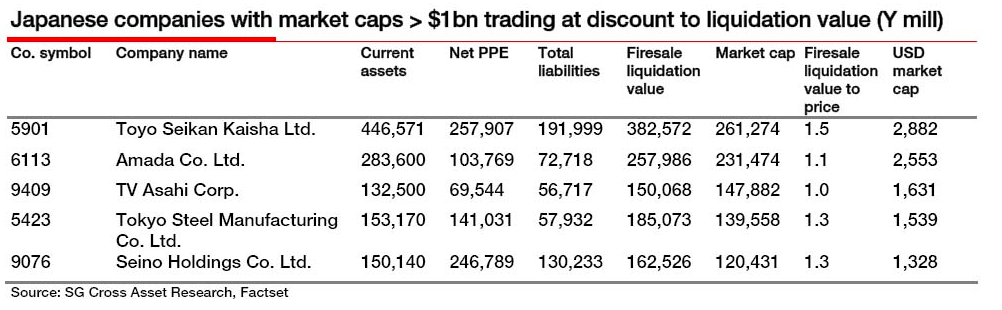
In the same article, Grice identifies five Graham net net stocks in Japan with market capitalizations bigger than $1B:

He argues that such stocks may offer value beyond the net current asset value:

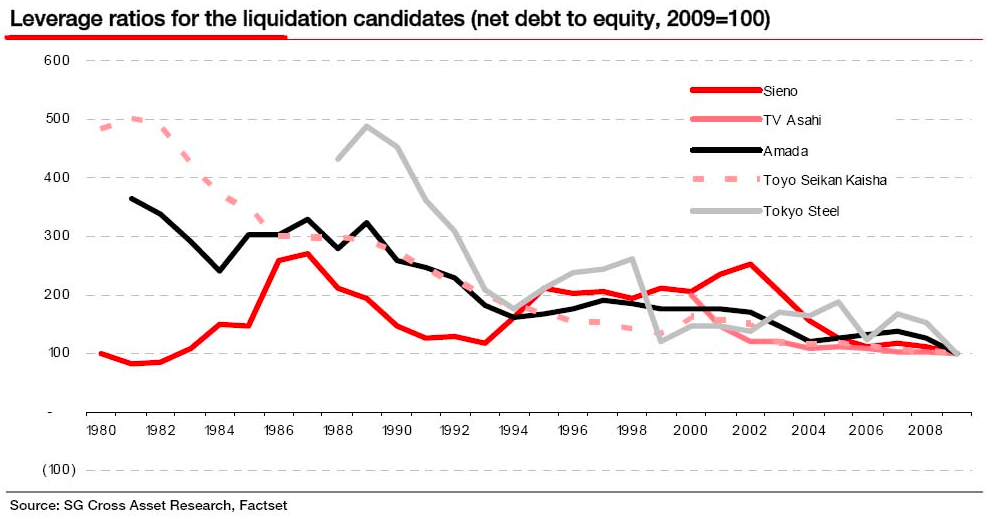
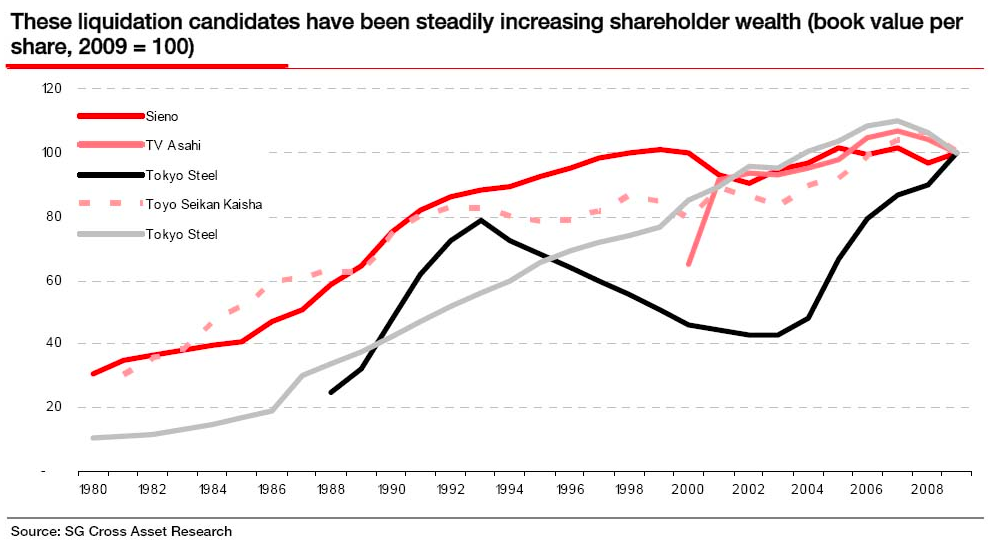
The following chart shows the debt to shareholders equity ratios for each of the stocks highlighted as a liquidation candidate above, rebased so that the last year’s number equals 100. It’s clear that these companies have been aggressively delivering in the last decade.

Despite the “Japan has weak shareholder rights” cover story, management seems to be doing the right thing:

But as it happens, most of these companies have also been buying back stock too. So per share book values have been rising steadily throughout the appalling macro climate these companies have found themselves in. Contrary to what I expected to find, these companies that are currently priced at levels making liquidation seem the most profitable option have in fact been steadily creating shareholder wealth.

This is really extraordinary. The currency is a risk that I can’t quantify, but it warrants further investigation.

Read Full Post »

Since last week’s Japanese liquidation value: 1932 US redux post, I’ve been attempting to determine whether the historical performance of Japanese sub-liquidation value stocks matches the experience in the US, which has been outstanding since the strategy was first identified by Benjamin Graham in 1932. The risk to the Japanese net net experience is the perception (rightly or not) that the weakness of shareholder rights in Japan means that net current asset value stocks there are destined to continue to trade at a discount to net current asset value. As I mentioned yesterday, I’m a little chary of the “Japan has weak shareholder rights” narrative. I’d rather look at the data, but the data are a little wanting.

As we all know, the US net net experience has been very good. Research undertaken by Professor Henry Oppenheimer on Graham’s liquidation value strategy between 1970 and 1983, published in the paper Ben Graham’s Net Current Asset Values: A Performance Update, indicates that “[the] mean return from net current asset stocks for the 13-year period was 29.4% per year versus 11.5% per year for the NYSE-AMEX Index. One million dollars invested in the net current asset portfolio on December 31, 1970 would have increased to $25,497,300 by December 31, 1983.” That’s an outstanding return.

In The performance of Japanese common stocks in relation to their net current asset values, a 1993 paper by Bildersee, Cheh and Zutshi, the authors undertook research similar to Oppenheimer’s in Japan over the period 1975 and 1988. Their findings, described in another paper, indicate that the Japanese net net investor’s experience has not been as outstanding as the US investor’s:

In the first study outside of the USA, Bildersee, Cheh and Zutshi (1993)’s paper focuses on the Japanese market from 1975 to 1988. In order to maintain a sample large enough for cross-sectional analysis, Graham’s criterion was relaxed so that firms are required to merely have an NCAV/MV ratio greater than zero. They found the mean market-adjusted return of the aggregate portfolio is around 1 percent per month (13 percent per year).

As an astute reader noted last week “…the test period for [the Bildersee] study is not the best. It includes Japan’s best analog to America’s Roaring Twenties. The Nikkei peaked on 12/29/89, and never recovered:”

Many of the “assets” on public companies’ books at that time were real estate bubble-related. At the peak in 1989, the aggregate market price for all private real estate in the city of Tokyo was purportedly greater than that of the entire state of California. You can see how the sudden runup in real estate during the bubble could cause asset-heavy companies to outperform the market.

So a better crucible for Japanese NCAVs might be the deflationary period, say beginning 1/1/90, which is more analogous to the US in 1932.

To see how the strategy has performed more recently, I’ve taken the Japanese net net stocks identified in James Montier’s Graham’’s net-nets: outdated or outstanding? article from September 2008 and tracked their performance from the data of the article to today. Before I plow into the results, I’d like to discuss my methodology and the various problems with it:

  1. It was not possible to track all of the stocks identified by Montier. Where I couldn’t find a closing price for a stock, I’ve excluded it from the results and marked the stock as “N/A”. I’ve had to exclude 18 of 84 stocks, which is a meaningful proportion. It’s possible that these stocks were either taken over or went bust, and so would have had an effect on the results not reflected in my results.
  2. The opening prices were not always available. In some instances I had to use the price on another date close to the opening date (i.e +/1 month).

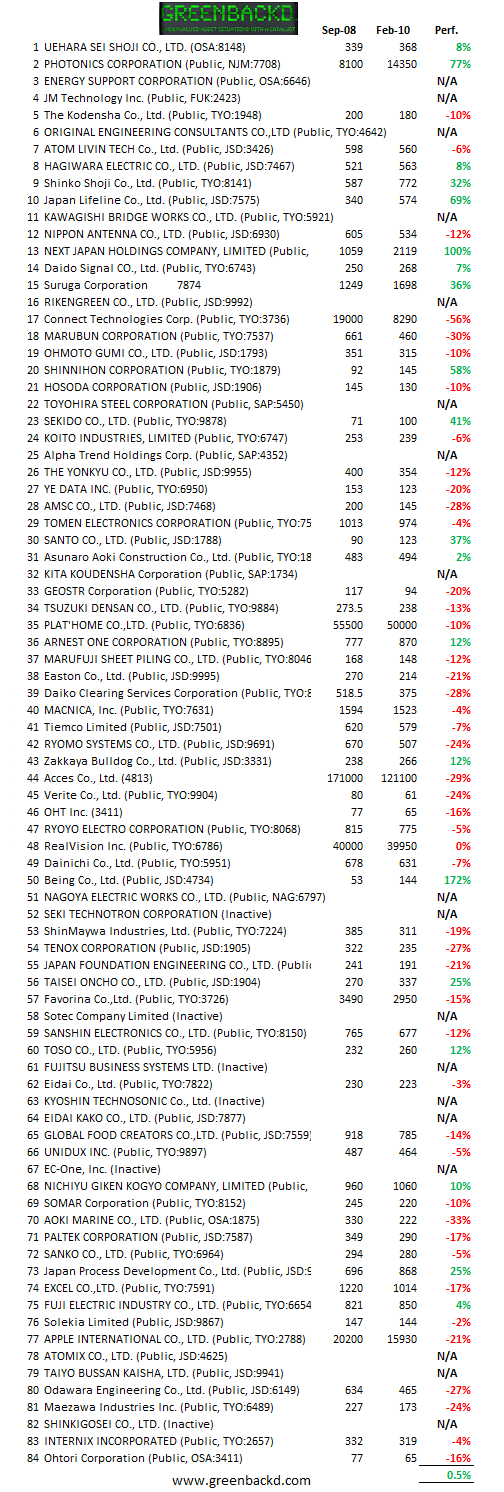
Without further ado, here are the results of Montier’s Graham’’s net-nets: outdated or outstanding? picks:

The 68 stocks tracked gained on average 0.5% between September 2008 and February 2010, which is a disappointing outcome. The results relative to the  Japanese index are a little better. By way of comparison, the Nikkei 225 (roughly equivalent to the DJIA) fell from 12,834 to close yesterday at 10,057, a drop of 21.6%. Encouragingly, the net nets outperformed the N225 by a little over 21%.

The paucity of the data is a real problem for this study. I’ll update this post as I find more complete data or a more recent study.

Read Full Post »

Carl Icahn recently gave a guest lecture to Professor Robert Shiller’s Yale Financial Markets class.

In the lecture, Icahn talks about how he started out in finance and evolved into a shareholder activist. He trots out a few of his old saws: the biggest challenge facing corporate America is weak management and today’s CEOs, with exceptions, might not be the most capable of leading global companies. He also discusses the economy and slaps down an undergrad Yalie who has the temerity to have him repeat an answer, which is fun to watch. There are a few gems, including this one:

I was borrowing money and bought all these convertibles and I thought I was a genius and Jack Dreyfus said, you’re going to lose all your money. I had made a few bucks playing poker and that’s how I started with about eight, ten thousand dollars and I made all this money by borrowing at 90%. I would go out and I was making a lot more in two weeks than my father made in two years. My father said, well you know, put the money away. I said, no Dad, I’m really going to make a fortune here. So, I went out–I remember once–and bought a Galaxy convertible. It was a beautiful car. I had a beautiful girlfriend; she was a model–it was just pretty nice.

What happened? The crash came in 1962. I was wiped out in one day; I didn’t even have the poker winnings left. I tell you, I can’t recall if the car left first or the girl left first, but it was pretty close–maybe the same day actually. After that, I learned you have to learn something and I became an expert in options.

Here’s Icahn on his investment strategy:

What I do today still is pretty much the same idea. You buy stocks in a company that is cheap and you look at the asset value of the companies that you buy the stocks in and it becomes a little more complex. Basically, you look for the reason that they’re really cheap and the major reason is often–and usually–very poor management. In a sense, it’s like an arbitrage. You go in; you buy a lot of stock in a company; and you then try to make changes at the company. Today, if you read the newspapers tomorrow, you’ll read–we’re trying to do the same thing at Motorola and if you bother to read The Wall Street Journal tomorrow–or maybe The Times, I don’t know–you’ll see a little bit of what we’re trying to do there. We’re trying to get them to change the structure of the company. We think the board is a very poor board there and we’re trying to change what happens.

And, finally, Icahn responding to a question about activism:

Student: Hi, Mr. Icahn. One major criticism that one CEO against corporate activist that they think activists don’t think long-term interest of the corporation; they just want to get money and get out. How do you answer to that?

Icahn: I would just say that the facts don’t bear that out as far as I’m concerned. I mean, if you–I own quite a few companies. Any company we got control of I put literally hundreds of millions of dollars into them. I mean, I bought a company in 1985–a rail car company–we put hundreds of millions; we still have the fleet. I bought casinos and energy companies and over the years kept them; sold them now, but that’s after ten years. So, any company that we’ve been able to get control of I actually kept. Because getting control is a great thing. If you really believe that management’s not doing well, you can go and clean them up and put a good guy in, So, we–I know they criticize you like that, but that’s part of the propaganda machine; but it’s just not the facts.

Student: A related question is that, what do you do when your activist spirit is not appreciated, as in the case of Motorola when you asked for a seat on the board but just get declined? What’s your next step?

Icahn: Alright, you have patience and now it’s a year later and we’ll see what happens now. Motorola is a good example of what I’m talking about. People don’t like it; they don’t like the cell phone business, but I really think that that business, if you look at Motorola and study it, you’re buying that whole business for nothing. It’s not reflected in the stock price, but they have to do it. As I said publicly, take that business out of Motorola; spin it off and give it to the shareholders. I think, then, you’ve got a real good value. What I’m saying is, nobody likes it now, but hopefully I’m correct on that. I really think by being an activist and putting pressure on that board that has done nothing, really–I think eventually that will happen, hopefully.

Hat tip Mark.

Read Full Post »

Soapstone Networks Inc (NASDAQ:SOAP) has released its 10Q for the period ended September 30, 2009.

We first looked at SOAP on February 2nd (see Greenbackd’s post archive here) because it was trading well below its net cash value. An activist investor, Mithras Capital, had disclosed an 8.7% holding and called on the company to liquidate. After some urging on Mithras Capital’s part, management acceded to the request and announced a liquidation. SOAP stockholders approved the liquidation of the company on July 28 and received a special dividend of $3.75 per share the next day. Based on our $2.50 purchase price, the $3.75 per share special dividend returned our initial capital plus 50%. At yesterday’s close, the $0.65 stub represents a total return to date of 76%. Management originally estimated the final distribution to be between $0.25 and $0.75 per share, which means the stub is presently trading at a 30% premium to the $0.50 midpoint of the distribution range.

On September 9, in our guest blogger series, Wes Gray and Andy Kern took a look at the SOAP stub as a stand alone investment. Gray and Kern argued that there was plenty of value left in the stub:

e. Total Return Possible

Low Estimate: .39 first distribution (Q2 2010), .06 second distribution (Q4 2010)

=>-4.57%

Expectation: .70 first distribution (Q1 2010), .06 second distribution (Q4 2010)

=>59.01%

High Estimate: .82 first distribution (Q4 2009), .15 second distribution (Q4 2010)

=>102.98%

Expected Return:

P(Low)=.25

P(Estimate)=.50

P(High)=.25

ð .25*-.0457+.50*.5901+.25*1.0298=54.11% expected return by Q4 2010.

At its $0.65 close yesterday, the stub is up 20.4% since that post.

The sale of the company’s non-cash assets including its “principal intellectual property assets,” the value of which we were speculating about on August 11, yielded cash consideration of approximately $2.2M. SOAP does not expect to receive any additional material consideration for the few remaining non-cash assets left in its possession.

The value proposition updated

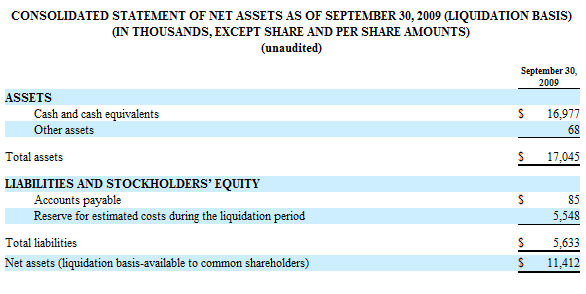
According to the most recent 10Q, which was prepared on a liquidation basis, SOAP has around $11.4M in net assets. This includes total liabilities of around $5.6, of which $5.5M is a reserve for liquidation costs. Here is an extract from the 10Q:

With 15.2M shares on issue, and assuming SOAP spends the full $5.5M reserve for liquidation costs, SOAP looks likely to yield $0.75 per share, the upper end of management’s estimated range and a 15% return from here. If there are any savings in the $5.5M reserve, SOAP could pay out substantially more.

Conclusion

Given that the stock is trading at a 15% discount to what now appears to be the low end of the likely final distribution, I’m going to maintain Greenbackd’s position in SOAP.

[Full Disclosure: I do not have holding in SOAP. This is neither a recommendation to buy or sell any securities. All information provided believed to be reliable and presented for information purposes only. Do your own research before investing in any security.]

Read Full Post »

The superb Abnormal Returns has a post “Investing by the seat of their pants,” which, among other things, discusses William Bernstein’s conjecture that “only a tiny fraction, 1 in 1000, investors have the skills to become truly competent investors.”  In the preface of his new book, Bernstein suggests four abilities successful investors must enjoy (via Information Processing):

First, they must possess an interest in the process. It is no different from carpentry, gardening, or parenting. If money management is not enjoyable, then a lousy job inevitably results, and, unfortunately, most people enjoy finance about as much as they do root canal work.

Second, investors need more than a bit of math horsepower, far beyond simple arithmetic and algebra, or even the ability to manipulate a spreadsheet. Mastering the basics of investment theory requires an understanding of the laws of probability and a working knowledge of statistics. Sadly, as one financial columnist explained to me more than a decade ago, fractions are a stretch for 90 percent of the population.

Third, investors need a firm grasp of financial history, from the South Sea Bubble to the Great Depression. Alas, as we shall soon see, this is something that even professionals have real trouble with.

Even if investors possess all three of these abilities, it will all be for naught if they do not have a fourth one: the emotional discipline to execute their planned strategy faithfully, come hell, high water, or the apparent end of capitalism as we know it. “ Stay the course ” : It sounds so easy when uttered at high tide. Unfortunately, when the water recedes, it is not. I expect no more than 10 percent of the population passes muster on each of the above counts. This suggests that as few as one person in ten thousand (10 percent to the fourth power) has the full skill set. Perhaps I am being overly pessimistic. After all, these four abilities may not be entirely independent: if someone is smart enough, it is also more likely he or she will be interested in finance and be driven to delve into financial history.

But even the most optimistic assumptions — increase the odds at any of the four steps to 30 percent and link them — suggests that no more than a few percent of the population is qualified to manage their own money. And even with the requisite skill set, more than a little moxie is involved. This last requirement — the ability to deploy what legendary investor Charley Ellis calls “ the emotional game ” — is completely independent of the other three; Wall Street is littered with the bones of those who knew just what to do, but could not bring themselves to do it.

Bernstein’s is an interesting thought experiment. Steve Hsu at Information Processing, after considering the abilities identified by Bernstein, categorizes them as follows:

…the right interests (history, finance theory, markets — relatively easily acquired, as these subjects are fascinating), personality factors (discipline, controlled risk taking, decisiveness — not so easily acquired, but can be improved over time) and intelligence (not easily acquired, but perhaps the threshold isn’t that high at 90th percentile).

Bernstein’s list and Hsu’s categorization of it feels right. Whether it winnows the universe of competent investors down to 1 in 10,000 is open to debate, but I think few would have a genuine quibble with the content of the list. The only other element that I would suggest – and it is possible that it’s already captured within Bernstein’s list as “emotional discipline” – is the ability to think and act counterintuitively.

There are many examples of strategies that are counterintuitive and produce above-market returns. Value is a counterintuitive strategy. Glamour feels like a better bet than value, but studies have shown over and over again that value outperforms glamour or momentum. Tangible asset value – liquidation value investing or low price-to-book value investing – is counterintuitive even to practitioners within the value school, who predominantly seek Buffett-style earnings and growth. The counterintuitive element is that companies within the lowest price-to-book quintile – not, by any means, earnings machines – tend to grow earnings faster than companies in the highest price-to-book quintile, a phenomenon that value investors recognize as “mean reversion”.  Even with the liquidation value investment world itself, the counterintuitive strategy – buying loss-making net nets – outperforms the intuitive one – buying net nets with positive earnings.

This suggests to me that the ability to understand a concept from an intellectual standpoint is a necessary but insufficient condition for competent investing. One must also be able to suspend instinct or intuition or disbelief and follow intellect through to action. That seems to me to be a rare trait, but one that I believe can be developed. Is it possible that, if one follows a counterintuitive strategy for long enough and succeeds with it, it becomes intuitive? I think so, but I’d like to see what you think too.

Update

I knew I was asking for it when I wrote the panglossian, “I think few would have a genuine quibble with the content of the list.” An astute reader has a quibble, and I’m embarrassed to say that I think he’s right:

I flatly deny Bernstein’s assertion that “investors need more than a bit of math horsepower.” I cite the highest authority:

1. Ben Graham explicitly warned against “calculations made about common stock values, or related investment policies, that went beyond simple arithmetic or the most elementary algebra.” Indeed, “whenever [calculus] is brought in, or higher algebra, you could take it as a warning signal that the operator is trying to substitute theory for experience, and usually also to give speculation the deceptive guise of investment.”

2. “If calculus were required,” Buffett has said, “I’d have to go back to delivering papers. I’ve never seen any need for algebra … It’s true that you have to divide by the number of shares outstanding, so division is required. If you were going out to buy a farm or an apartment house or a dry cleaning establishment, I really don’t think you’d have to take someone along to do calculus.”

3. Elsewhere, Buffett has said “read Ben Graham and Phil Fisher, read annual reports, but don’t do equations with Greek letters in them.”

4. In one of his books, Peter Lynch recounts at length that the mathematical stuff he learnt in MBA-School were hindrances rather than helps, and that “the arts/philosophy side” (or words to that effect) of his education have stood him in much better stead. Indeed, I recall Lynch saying something like “all the maths you need to invest competently you learnt in primary school.”

5. The “Ben Graham, Meet Ludwig von Mises” paper you cited a while back discusses the Austrian conception of value, markets and entrepreneurial discovery. None of these things rely upon maths, probability or stats. But they do, I think, hinge upon the ability to think unpopular or contrarian thoughts — like adherence to the Austrian School!

Mind you, I’ve never liked Bernstein and indeed have long thought that he does far more harm than good. This assertion is but one in a long list of silly things he’s said over the years. In short, not only is mathematics NOT a necessary condition of successful investment; it may be a sufficient condition of investment failure.

Read Full Post »

TSR Inc (NASDAQ:TSRI) is an interesting play at a discount to liquidation value and an ongoing cash flow positive business. At its $2.10 close yesterday, the stock has a market capitalization of $8.5M. I estimate the liquidation value to be around 26% higher at $2.65. 26% is not a huge upside, but in this instance I would not regard liquidation value as the upside. Rather, here it is the worst case scenario. TSRI has generated positive cashflow from operating activities over the last four years, growing it from around $1m per annum in 2006 to around $1.6M in 2009. The growth in its operating cash flow is encouraging, though I’ve got no particular view on TSRI’s business – contract computer programming – or the prospects for that business. It’s a consulting-type business, which means that in tough times its fixed overhead should be quite low, and it can trim its sails for the business conditions. In better times, it should be able to readily expand, although I suspect its competition will seek to do the same, pushing up salaries by competing for consultants and thereby keeping margins static. In summary, TSRI seems to have a good, ongoing, cash-generative operating business that should survive the current general malaise. It might even do a little better in the good times. If I’m wrong, as Walter Schloss would say:

We can always liquidate it and get our money back.

About TSRI

According to the 10K:

TSR, Inc. (the “Company”) is primarily engaged in the business of providing contract computer programming services to its clients. The Company provides its clients with technical computer personnel to supplement their in-house information technology (“IT”) capabilities. The Company’s clients for its contract computer programming services consist primarily of Fortune 1000 companies with significant technology budgets. In the year ended May 31, 2009, the Company provided IT staffing services to approximately 80 clients.

The Company was incorporated in Delaware in 1969.

OPERATIONS

The Company provides contract computer programming services in the New York metropolitan area, New England, and the Mid-Atlantic region. The Company provides its services principally through offices located in New York, New York, Edison, New Jersey and Long Island, New York. The Company does not currently intend to open additional offices. Due to the continuing impact of the current economic environment, the Company has reversed its plan of hiring additional account executives and technical recruiters in its existing offices to address increased competition and to promote revenue growth. As of May 31, 2009, the Company employed 9 persons who are responsible for recruiting technical personnel and 10 persons who are account executives. As of May 31, 2008 the Company had employed 14 technical personnel recruiters and 16 account executives.

A primer on Contract Computer Programming Services

Also from the 10K:

STAFFING SERVICES

The Company’s contract computer programming services involve the provision of technical staff to clients to meet the specialized requirements of their IT operations. The technical personnel provided by the Company generally supplement the in-house capabilities of the Company’s clients. The Company’s approach is to make available to its clients a broad range of technical personnel to meet their requirements rather than focusing on specific specialized areas. The Company has staffing capabilities in the areas of mainframe and mid-range computer operations, personal computers and client-server support, internet and e-commerce operations, voice and data communications (including local and wide area networks) and help desk support. The Company’s services provide clients with flexibility in staffing their day-to-day operations, as well as special projects, on a short-term or long-term basis.

The Company provides technical employees for projects, which usually range from three months to one year. Generally, clients may terminate projects at any time. Staffing services are provided at the client’s facility and are billed primarily on an hourly basis based on the actual hours worked by technical personnel provided by the Company and with reimbursement for out-of-pocket expenses. The Company pays its technical personnel on a semi-monthly basis and invoices its clients, not less frequently than monthly.

The Company’s success is dependent upon, among other things, its ability to attract and retain qualified professional computer personnel. The Company believes that there is significant competition for software professionals with the skills and experience necessary to perform the services offered by the Company. Although the Company generally has been successful in attracting employees with the skills needed to fulfill customer engagements, demand for qualified professionals conversant with certain technologies may outstrip supply as new and additional skills are required to keep pace with evolving computer technology or as competition for technical personnel increase. Increasing demand for qualified personnel could also result in increased expenses to hire and retain qualified technical personnel and could adversely affect the Company’s profit margins.

In the past few years, an increasing number of companies are using or are considering using low cost offshore outsourcing centers, particularly in India, to perform technology related work and projects. This trend has contributed to the decline in domestic IT staffing revenue. There can be no assurance that this trend will not continue to adversely impact the Company’s IT staffing revenue.

The value proposition

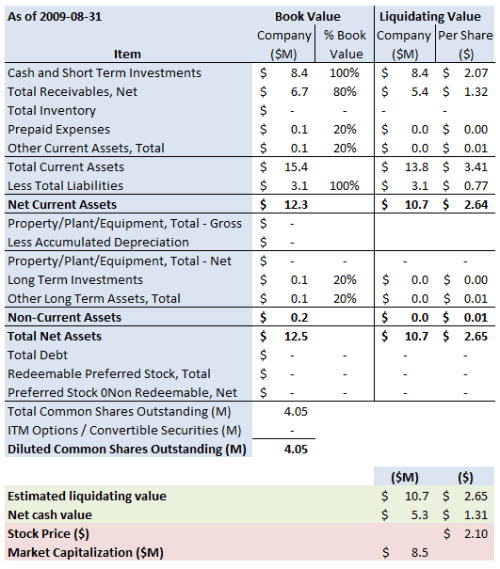
TSRI’s annual cash from operating activities has grown from $0.96M in 2006 to $1.63M in 2009. That growth is encouraging, but I’ve got no idea how sustainable it is. TSRI’s balance sheet is very liquid and it holds no debt (the “Book Value” column shows the assets as they are carried in the financial statements, and the “Liquidating Value” column shows our estimate of the value of the assets in a liquidation):

TSRI SummaryThe catalyst

There are no obvious catalysts in the stock other than a general turnaround in business conditions, which might lead to the company restarting its stock buy-back or its dividend. The company has previously repurchased stock, but the buy-back was suspended earlier in the year. It was also previously paying a dividend, but that was suspended in the second quarter and is yet to be restarted. Restarting the dividend would be an obvious positive catalyst for this stock.

Conclusion

As I mention above, I’ve got no special insight into TSRI’s business or its prospects. I believe it to be a reasonably low risk bet that the company can muddle through the downturn and do better in a few years’ time. At its $2.10 close yesterday, it’s trading at around 80% of $2.65 per share liquidating value, most of which is in cash and equivalents and other liquid current assets. Add to that the positive cash flow from operating activities in the amount of $1.63M for the last year, which has grown from just under $1M in 2006, and TSRI looks like a reasonable prospect. If it can continue to grow the cash from operations, it should do well over the next few years. If it doesn’t, the discount to liquidation value provides some downside protection. I’m going to add it to the Greenbackd Portfolio.

TSRI closed yesterday at $2.10.

The S&P500 Index closed yesterday at 1,098.51.

[Full Disclosure: I hold TSRI. This is neither a recommendation to buy or sell any securities. All information provided believed to be reliable and presented for information purposes only. Do your own research before investing in any security.]

Read Full Post »

Convera Corporation (NASDAQ:CNVR) is a liquidation play. The stock closed yesterday at $0.221. The company estimates the value of the distributions to be in the range of $0.37 to $0.45 per share.

Approvals

According to the 14(c) information statement:

The board approved the plan of dissolution on May 29, 2009. The liquidation will not be put to a shareholder vote as “the affirmative vote of holders of a majority of all outstanding shares of our Class A Common Stock is required. In order to approve the election of directors, the affirmative vote of a plurality of all outstanding shares of our Class A Common Stock is required. As of the close of business on September 22, 2009, the Record Date for the approval of the above matters, there were 53,501,183 shares of our Class A Common Stock issued and outstanding, which shares are entitled to one vote per share. Holders of our Class A Common Stock which represented a majority of the voting power of our outstanding capital stock as of the Record Date, have executed a written consent in favor of the actions described above and have delivered it to us on September 22, 2009, the Consent Date. Therefore, no other consents will be solicited in connection with this Information Statement.

Distributions

From the information statement:

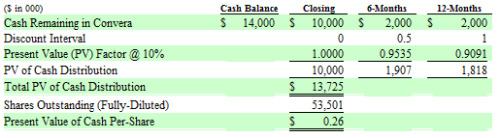
We plan to distribute $10,000,000 shortly after the closing of the Merger, with the remaining $4,000,000 to be distributed in $2,000,000 increments at six months and 12 months after the closing of the Merger, subject to possible holdbacks for potential liabilities and on-going expenses deemed necessary by our board of directors in its sole discretion.

The present value of this cash distribution, assuming a discount rate of 10%, is estimated at $0.26 per share.

CNVR 1

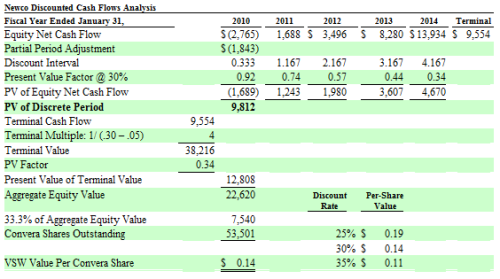
Hempstead assessed the value indication associated with a one-third equity interest in VSW based upon the discounted cash flows methodology. Specifically, under a discounted cash flows methodology, the value of a company’s stock is determined by discounting to present value the expected returns that accrue to holders of such equity. Projected cash flows for VSW were based upon projected financial data prepared by our management. Estimated cash flows to equity holders were discounted to present value based upon a range of discount rates, from 25% to 35%. This range of discount rates is reflective of the required rates of return on later-stage venture capital investments. The resultant value indications for the VSW component of the transaction, on a per-Convera share basis, are as follows:

CNVR 2

Based upon the above analyses, the value indications for the cash and VSW stock to be received by our stockholders in exchange for their current Convera shares are within a range of $0.37 to $0.45 per Convera share.

Conclusion

The trading price of the VSW stock is an unknown, but the $0.26 in cash distributions offer some protection at yesterday’s close of $0.221. Buying up to say $0.23 means getting paid $0.03 to hold a free option on the VSW stock, which, according to Hempstead, the financial consultant providing the fairness opinion, could be worth between $0.11 and $0.19 per share. It’s very thinly traded at this price, so good luck getting set, but it’s worth buying if you can get a reasonable line of stock. I’m going to add it to the Greenbackd Portfolio at yesterday’s close.

CNVR closed yesterday at $0.221.

The S&P500 closed yesterday at 1,093.01.

Hat tip to Sean.

[Full Disclosure:  We do not have a holding in CNVR. This is neither a recommendation to buy or sell any securities. All information provided believed to be reliable and presented for information purposes only. Do your own research before investing in any security.]

Read Full Post »

CoSine Communications Inc (OTC:COSN) has released its 10Q for the quarter ended September 30, 2009.

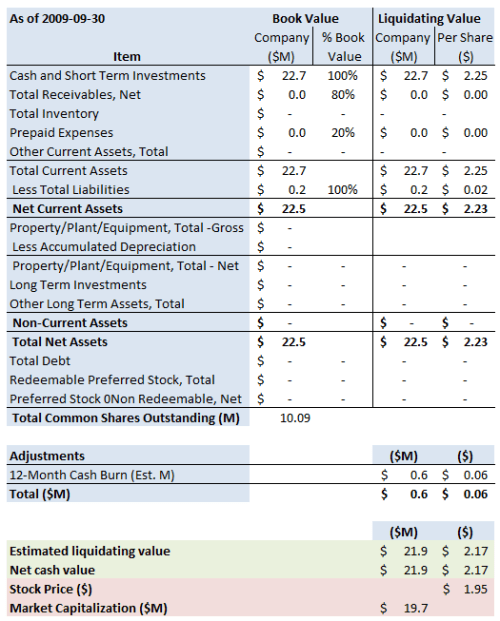
We’ve been following COSN (see Greenbackd’s COSN post archive) because it is a cash box controlled by activist investor Steel Partners. Steel Partners own 47.5% of the stock and sits on the board. The stock is up 11.4% since our initial post to close Friday at $1.95. I initially estimated the net cash value to be around $22.2M or $2.20 per share. After reviewing the 10Q I’ve slightly reduced it in line with the ~$0.3M cash burn for the last two quarters to $21.9M or $2.17 per share. The net cash value has remained relatively stable through 2006, 2007, 2008 and 2009. COSN presents an opportunity to invest alongside Steel Partners at a discount to net cash in a company with substantial NOLs.

The value proposition updated

Little has changed over the last two quarters. The valuation on COSN remains straight-forward: It has around $22.7m in cash and short-term investments, $0.2M in liabilities and 10.1M shares outstanding. I’ve set out the valuation below in the usual manner (the “Book Value” column shows the assets as they are carried in the financial statements, and the “Liquidating Value” column shows our estimate of the value of the assets in a liquidation):

COSN Summary 2009 09 30

Balance sheet adjustments

I’ve made the following adjustments to the balance sheet estimates above:

  • Cash burn: The company used $0.58M in cash in the last three quarters, which we’ve annualized to $0.6M.
  • Off-balance sheet arrangements and contractual obligations: According to COSN’s 10Q, it has no off-balance sheet arrangements.

NOLS

A quick primer on net operating loss carry-forwards (“NOLs”) from the most 2009 10K:

NOLs may be carried forward to offset federal and state taxable income in future years and eliminate income taxes otherwise payable on such taxable income, subject to certain adjustments. Based on current federal corporate income tax rates, our NOLs and other carry-forwards could provide a benefit to us, if fully utilized, of significant future tax savings. However, our ability to use these tax benefits in future years will depend upon the amount of our otherwise taxable income. If we do not have sufficient taxable income in future years to use the tax benefits before they expire, we will lose the benefit of these NOLs permanently. Consequently, our ability to use the tax benefits associated with our substantial NOLs will depend significantly on our success in identifying suitable acquisition candidates, and once identified, successfully consummating an acquisition of these candidates.

Additionally, if we underwent an ownership change, the NOLs would be subject to an annual limit on the amount of the taxable income that may be offset by our NOLs generated prior to the ownership change. If an ownership change were to occur, we may be unable to use a significant portion of our NOLs to offset taxable income. In general, an ownership change occurs when, as of any testing date, the aggregate of the increase in percentage points is more than 50 percentage points of the total amount of a corporation’s stock owned by “5-percent stockholders,” within the meaning of the NOLs limitations, whose percentage ownership of the stock has increased as of such date over the lowest percentage of the stock owned by each such “5-percent stockholder” at any time during the three-year period preceding such date. In general, persons who own 5% or more of a corporation’s stock are “5-percent stockholders,” and all other persons who own less than 5% of a corporation’s stock are treated, together, as a single, public group “5-percent stockholder,” regardless of whether they own an aggregate of 5% of a corporation’s stock.

The amount of NOLs that we have claimed has not been audited or otherwise validated by the U.S. Internal Revenue Service (“IRS”). The IRS could challenge our calculation of the amount of our NOLs or our determinations as to when a prior change in ownership occurred and other provisions of the Internal Revenue Code may limit our ability to carry forward our NOLs to offset taxable income in future years. If the IRS was successful with respect to any such challenge, the potential tax benefit of the NOLs to us could be substantially reduced.

According to the 10K, as of December 31, 2008, COSN had federal NOLs of approximately $353M, which begin to expire in 2018 if not utilized and state NOLs of approximately $213M, which will begin to expire in 2009 if not utilized. The NOLs have a substantial value as a tax shield should COSN acquire a business with taxable earnings, but assessing that value is beyond us.

Catalyst

Steel Partners’ most recent 13D filing sets out its 47.5% holding. Steel Partners’ strategy is to use COSN’s cash to acquire a business with taxable earnings that can be offset by the NOLs. From the 10Q:

Redeployment Strategy and Liquidity

In July 2005, after a comprehensive review of strategic alternatives, our board of directors approved a strategy to redeploy our existing resources to identify and acquire one or more new business operations with existing or prospective taxable earnings that can be offset by use of our NOLs.

Ordinarly, I would prefer a return of cash to the acquisition of a business. This situation is different from the usual case because Steel Partners’ business is investment, and so I think the risk that they might make a bad investment is low. That said, there’s no assurance that they will find a suitable candidate, or if they do, that COSN will be able to use the NOLs.

Conclusion

COSN initially presented an opportunity to invest alongside Steel Partners at a 26% discount to net cash in a company with substantial NOLs. With the increase in the stock price the discount to its net cash position has narrowed to around 11%. I’m maintaining the position in the Greenbackd Portfolio.

[Full Disclosure:  We do not have a holding in COSN. This is neither a recommendation to buy or sell any securities. All information provided believed to be reliable and presented for information purposes only. Do your own research before investing in any security.]

Read Full Post »

« Newer Posts - Older Posts »