Feeds:
Posts
Comments

Mean reversion is a favorite investment topic here on Greenbackd (see, for example, my posts on Mean reversion in earnings, Contrarian value investment and Lakonishok, Shleifer, and Vishny’s Contrarian Investment, Extrapolation, and Risk).

The premise of contrarianism is mean reversion, which is the idea that stocks that have performed poorly in the past will perform better in the future and stocks that have performed well in the past will not perform as well. Benjamin Graham, quoting Horace’s Ars Poetica, described it thus:

Many shall be restored that now are fallen and many shall fall that are now in honor.

LSV argue in their paper that most investors don’t fully appreciate the phenomenon, which leads them to extrapolate past performance too far into the future. In practical terms it means the contrarian investor profits from other investors’ incorrect assessment that stocks that have performed well in the past will perform well in the future and stocks that have performed poorly in the past will continue to perform poorly.

The outstanding Shadowstock blog has identified five “strong candidates for mean reversion.” To see John’s Shadowstock.com analysis, click here.

When I started out investing I summarized Warren Buffett’s letters to shareholders into a document I jokingly called the “Tractatus Logico-Valere.” The title, Latin errors aside, was intended to be an homage to Ludwig Wittgenstein’s Tractatus Logico-Philosophicus (which, according to Wikipedia, may in turn have been an homage to the Tractatus Theologico-Politicus by Baruch Spinoza). The idea was to create a comprehensive summary of Buffett’s investment process set out in a succinct, logical fashion. I kept Wittgenstein’s seventh and final proposition – “Whereof one cannot speak, thereof one must be silent” – as my own and interpreted it to mean “where you can’t value something, don’t invest” or “stay in your circle of competence.” My Tractatus wasn’t very good, and I’m not Warren Buffett’s shoelace. Consequently, I didn’t do very well with it. (Wittgenstein was not similarly burdened with self-doubt. Wikipedia says that he concluded that with his Tractatus he had resolved all philosophical problems, and upon its publication retired to become a schoolteacher in Austria.) My abortive experience attempting to create a comprehensive guide to earnings and growth-based investing has given me a great appreciation for those who are able to successfully create such a document and live by it. One investor who has done so is setting out his process for the world to see at The Fallible Investor.

The author of The Fallible Investor is a private investor who has “previously worked for a private hedge fund in Bermuda and Bankers Trust in Sydney, Australia.” He calls himself The Fallible Investor because he “often makes errors when he invests, and says, “Recognising such a weakness is also useful. As Taleb says:

Soros… knew how to handle randomness, by keeping a critical open mind and changing his opinions with minimal shame… he walked around calling himself fallible, but was so potent because he knew it while others had loftier ideas about themselves. He understood Popper. He lived the Popperian life.

I have found particularly useful his elucidation of the linkage between return-on-invested-capital, market value, replacement value, and sustainable competitive advantage:

I define the replacement value of a business as what the business’s assets would be worth if it’s ROIC was equal to its cost of capital.

The market value of a business with a high ROIC and no sustainable competitive advantage should (assuming the market eventually prices a business at its intrinsic value[1]) fall to its replacement value. This should happen because if an incumbent business has a high ROIC, and no sustainable competitive advantage, other businesses will enter this industry, or expand within the industry, to seek these higher returns. These competitors will drive down the incumbent business’s profits until its ROIC declines to the average return of a commodity business. Once this occurs, the incumbent business can only be worth the cost of replacing the business’s assets.

Professor Greenwald has another way of describing this process. He points out that if an incumbent business, with no competitive advantage, has a replacement value of $100 million and its market value is $200 million[2], competitors will drive its market value down to $100 million. Competitors will calculate that by spending $100 million to reproduce the assets of that business they can also create an enterprise with a market value higher than $100 million. These competitors will think, correctly, there is no reason for why they should have a different economic experience from the incumbent because there is nothing it can do that they cannot. Remember the incumbent business has no sustainable competitive advantage. Competitors, by reproducing the assets of the incumbent business, will increase the supply of products or services in the industry. There will now be more competition for the same business. Either prices will fall or, for differentiated products, each producer will sell fewer units. In both cases, the incumbent’s profits will decline and the market value of its business will decline with them. This process, capacity continuing to expand, and the profits and the market value of the incumbent’s business falling, will continue until the incumbent’s market value falls to the replacement value of its assets ($100 million). Its competitors will suffer the same fate.

Greenwald points out that while this process does not happen smoothly or automatically it will eventually turn out this way. It happens because the incentives for businesspeople to take advantage of the market’s excessive valuation of the incumbent’s business are too powerful.[3]

The market value of a business with a sustainable competitive advantage can, by contrast, stay much higher than its replacement value simply because it can sustain a high ROIC.

[1] The intrinsic value of a business is what I think the business is worth to a rational businessperson.

[2] Assuming the business has a high market value because it has a high ROIC.

[3] P38, ‘Value Investing: From Graham To Buffett And Beyond’, Bruce Greenwald et al, 2001.

The Fallible Investor has provided me with a full copy of his notes. I highly recommend following his posts as he sets out his investment process on the site.

Seth Klarman’s teachings, which I’ve covered on this site on several occasions (see, for example, Klarman on calculating liquidation value, on identifying catalysts, and on investing in liquidations), are always worth reading. In his most recent investor letter Klarman has provided a list of twenty investment lessons of 2008 (via the always superb Zero Hedge):

  1. Things that have never happened before are bound to occur with some regularity. You must always be prepared for the unexpected, including sudden, sharp downward swings in markets and the economy. Whatever adverse scenario you can contemplate, reality can be far worse.
  2. When excesses such as lax lending standards become widespread and persist for some time, people are lulled into a false sense of security, creating an even more dangerous situation. In some cases, excesses migrate beyond regional or national borders, raising the ante for investors and governments. These excesses will eventually end, triggering a crisis at least in proportion to the degree of the excesses. Correlations between asset classes may be surprisingly high when leverage rapidly unwinds.
  3. Nowhere does it say that investors should strive to make every last dollar of potential profit; consideration of risk must never take a backseat to return. Conservative positioning entering a crisis is crucial: it enables one to maintain long-term oriented, clear thinking, and to focus on new opportunities while others are distracted or even forced to sell. Portfolio hedges must be in place before a crisis hits. One cannot reliably or affordably increase or replace hedges that are rolling off during a financial crisis.
  4. Risk is not inherent in an investment; it is always relative to the price paid. Uncertainty is not the same as risk. Indeed, when great uncertainty – such as in the fall of 2008 – drives securities prices to especially low levels, they often become less risky investments.
  5. Do not trust financial market risk models. Reality is always too complex to be accurately modeled. Attention to risk must be a 24/7/365 obsession, with people – not computers – assessing and reassessing the risk environment in real time. Despite the predilection of some analysts to model the financial markets using sophisticated mathematics, the markets are governed by behavioral science, not physical science.
  6. Do not accept principal risk while investing short-term cash: the greedy effort to earn a few extra basis points of yield inevitably leads to the incurrence of greater risk, which increases the likelihood of losses and severe illiquidity at precisely the moment when cash is needed to cover expenses, to meet commitments, or to make compelling long-term investments.
  7. The latest trade of a security creates a dangerous illusion that its market price approximates its true value. This mirage is especially dangerous during periods of market exuberance. The concept of “private market value” as an anchor to the proper valuation of a business can also be greatly skewed during ebullient times and should always be considered with a healthy degree of skepticism.
  8. A broad and flexible investment approach is essential during a crisis. Opportunities can be vast, ephemeral, and dispersed through various sectors and markets. Rigid silos can be an enormous disadvantage at such times.
  9. You must buy on the way down. There is far more volume on the way down than on the way back up, and far less competition among buyers. It is almost always better to be too early than too late, but you must be prepared for price markdowns on what you buy.
  10. Financial innovation can be highly dangerous, though almost no one will tell you this. New financial products are typically created for sunny days and are almost never stress-tested for stormy weather. Securitization is an area that almost perfectly fits this description; markets for securitized assets such as subprime mortgages completely collapsed in 2008 and have not fully recovered. Ironically, the government is eager to restore the securitization markets back to their pre-collapse stature.
  11. Ratings agencies are highly conflicted, unimaginative dupes. They are blissfully unaware of adverse selection and moral hazard. Investors should never trust them.
  12. Be sure that you are well compensated for illiquidity – especially illiquidity without control – because it can create particularly high opportunity costs.
  13. At equal returns, public investments are generally superior to private investments not only because they are more liquid but also because amidst distress, public markets are more likely than private ones to offer attractive opportunities to average down.
  14. Beware leverage in all its forms. Borrowers – individual, corporate, or government – should always match fund their liabilities against the duration of their assets. Borrowers must always remember that capital markets can be extremely fickle, and that it is never safe to assume a maturing loan can be rolled over. Even if you are unleveraged, the leverage employed by others can drive dramatic price and valuation swings; sudden unavailability of leverage in the economy may trigger an economic downturn.
  15. Many LBOs are man-made disasters. When the price paid is excessive, the equity portion of an LBO is really an out-of-the-money call option. Many fiduciaries placed large amounts of the capital under their stewardship into such options in 2006 and 2007.
  16. Financial stocks are particularly risky. Banking, in particular, is a highly lever- aged, extremely competitive, and challenging business. A major European bank recently announced the goal of achieving a 20% return on equity (ROE) within several years. Unfortunately, ROE is highly dependent on absolute yields, yield spreads, maintaining adequate loan loss reserves, and the amount of leverage used. What is the bank’s management to do if it cannot readily get to 20%? Leverage up? Hold riskier assets? Ignore the risk of loss? In some ways, for a major financial institution even to have a ROE goal is to court disaster.
  17. Having clients with a long-term orientation is crucial. Nothing else is as important to the success of an investment firm.
  18. When a government official says a problem has been “contained,” pay no attention.
  19. The government – the ultimate short- term-oriented player – cannot with- stand much pain in the economy or the financial markets. Bailouts and rescues are likely to occur, though not with sufficient predictability for investors to comfortably take advantage. The government will take enormous risks in such interventions, especially if the expenses can be conveniently deferred to the future. Some of the price-tag is in the form of back- stops and guarantees, whose cost is almost impossible to determine.
  20. Almost no one will accept responsibility for his or her role in precipitating a crisis: not leveraged speculators, not willfully blind leaders of financial institutions, and certainly not regulators, government officials, ratings agencies or politicians.

See also Klarman’s False Lessons of 2009.

Dr. Michael Burry has received a great deal of well-deserved attention recently as a result of Michael Lewis’s The Big Short and the Vanity Fair article Betting on the Blind Side. Yesterday a reader provided a link to Burry’s techstocks.com “Value Investing” thread (now Silicon Investor) and today another reader has supplied a link to Burry’s Scion Capital investor letters. The site also sets out a time-line of Burry’s commentary on the financial crisis illustrating that, though it was not prevented, it was “eminently predictable and preventable”.

Burry is a superb writer. Here is a brief extract from the first quarter 2001 letter:

When I stand on my special-issue “Intelligent Investor” ladder and peer out over the frenzied crowd, I see very few others doing the same. Many stocks remain overvalued, and speculative excess – both on the upside and on the downside – is embedded in the frenzy around stocks of all stripes. And yes, I am talking about March 2001, not March 2000.

In essence, the stock market represents three separate categories of business. They are, adjusted for inflation, those with shrinking intrinsic value, those with approximately stable intrinsic value, and those with steadily growing intrinsic value. The preference, always, would be to buy a long-term franchise at a substantial discount from growing intrinsic value.

However, if one has been playing the buy-and-hold game with quality securities, one has been exposed to a substantial amount of market risk because the valuations placed on these securities have implied overly rosy scenarios prone to popular revision in times of more realistic expectation. This is one of those times, but it is my feeling that the revisions have not been severe enough, the expectations not yet realistic enough. Hence, the world’s best companies largely remain overpriced in the marketplace.

The bulk of the opportunities remain in undervalued, smaller, more illiquid situations that often represent average or slightly above-average businesses – these stocks, having largely missed out on the speculative ride up, have nevertheless frequently been pushed down to absurd levels owing to their illiquidity during a general market panic. I will not label this Fund a “small cap” fund, for this may not be where the best opportunities are next month or next year. For now, though, the Fund is biased toward smaller capitalization stocks. As for the future, I can only say the Fund will always be biased to where the value is. If recent trends continue, it would not be surprising to find the stocks of several larger capitalization stocks with significant long-term franchises meet value criteria and hence become eligible for potential addition to the Fund.


Buy my book The Acquirer’s Multiple: How the Billionaire Contrarians of Deep Value Beat the Market from on Kindlepaperback, and Audible.

Here’s your book for the fall if you’re on global Wall Street. Tobias Carlisle has hit a home run deep over left field. It’s an incredibly smart, dense, 213 pages on how to not lose money in the market. It’s your Autumn smart read. –Tom Keene, Bloomberg’s Editor-At-Large, Bloomberg Surveillance, September 9, 2014.

Click here if you’d like to read more on The Acquirer’s Multiple, or connect with me on Twitter, LinkedIn or Facebook. Check out the best deep value stocks in the largest 1000 names for free on the deep value stock screener at The Acquirer’s Multiple®.

Yesterday I ran a post on Dr. Michael Burry, the value investor who was one of the first, if not the first, to figure out how to short sub-prime mortgage bonds in his fund, Scion Capital. In The Big Short, Michael Lewis discusses Burry’s entry into value investing:

Late one night in November 1996, while on a cardiology rotation at Saint Thomas Hospital, in Nashville, Tennessee, he logged on to a hospital computer and went to a message board called techstocks.com. There he created a thread called “value investing.” Having read everything there was to read about investing, he decided to learn a bit more about “investing in the real world.” A mania for Internet stocks gripped the market. A site for the Silicon Valley investor, circa 1996, was not a natural home for a sober-minded value investor. Still, many came, all with opinions. A few people grumbled about the very idea of a doctor having anything useful to say about investments, but over time he came to dominate the discussion. Dr. Mike Burry—as he always signed himself—sensed that other people on the thread were taking his advice and making money with it.

Michael Burry’s blog, http://www.valuestocks.net, seems to be lost to the sands of time, but Burry’s techstocks.com “Value Investing” thread (now Silicon Investor) still exists. The original post in the thread hints at the content to come:

Started: 11/16/1996 11:01:00 PM

Ok, how about a value investing thread?

What we are looking for are value plays. Obscene value plays. In the Graham tradition.

This week’s Barron’s lists a tech stock named Premenos, which trades at 9 and has 5 1/2 bucks in cash. The business is valued at 3 1/2, and it has a lot of potential. Interesting.

We want to stay away from the obscenely high PE’s and look at net working capital models, etc. Schooling in the art of fundamental analysis is also appropriate here.

Good luck to all. Hope this thread survives.

Mike

Hat tip Toby.

The superb Manual of Ideas blog has an article by Ravi Nagarajan, Marty Whitman Reflects on Value Investing and Net-Nets, on legendary value investor Marty Whitman’s conversation with Columbia Professor Bruce Greenwald at the Columbia Investment Management Conference in New York. I have in the past discussed Marty Whitman’s adjustments to Graham’s net net formula, which I find endlessly useful. Whitman has some additional insights that I believe are particularly useful to net net investors:

“Cheap is Not Sufficient”

At several points in the discussion with Prof. Greenwald, Mr. Whitman came back to a central theme:  It is not sufficient for a security to be “cheap”.  It must also possess a margin of safety as demonstrated by a strong balance sheet and overall credit worthiness.   In other words, there are many securities that may appear cheap statistically based on a number of common criteria investors use to judge “cheapness”.  This might include current year earnings compared to the stock price, current year cash flow, and many others.  However, if the business does not have a durable balance sheet, adverse situations that are either of the company’s own making or due to macroeconomic factors can determine the ultimate fate of the company.  A durable balance sheet demonstrates the credit worthiness a business needs to manage through periodic adversity.

Whitman also discusses an issue near and dear to my heart: good corporate governance, and, by implication, activism:

One other point that Mr. Whitman made while discussing corporate governance also applies to many net-net situations.  The true value of a company may never come out if there is no threat of a change in control.  This obviously makes intuitive sense because the presence of a very cheap company alone will not result in realization of value unless management is willing to act in the interests of shareholders either by liquidating a business that has no future prospects but a very liquid balance sheet or taking steps to improve the business.

Read the balance of the article at The Manual of Ideas blog.

Michael Burry is a value investor notable for being one of the first, if not the first, to short sub-prime mortgage bonds in his fund, Scion Capital. He figures prominently in the Gregory Zuckerman’s book, The Greatest Trade Ever, and also in The Big Short, Michael Lewis’s contribution to the sub-prime mortgage bond market crash canon. In Betting on the Blind Side, Lewis excerpts The Big Short, which describes Burry’s short position in some detail, how he figured out that the bonds were mispriced, and how he bet against them (no small effort because the derivatives to do so didn’t exist when he started looking for them. He had to “prod the big Wall Street firms to create them.”).

Here Lewis describes Burry’s entry into value investing:

Late one night in November 1996, while on a cardiology rotation at Saint Thomas Hospital, in Nashville, Tennessee, he logged on to a hospital computer and went to a message board called techstocks.com. There he created a thread called “value investing.” Having read everything there was to read about investing, he decided to learn a bit more about “investing in the real world.” A mania for Internet stocks gripped the market. A site for the Silicon Valley investor, circa 1996, was not a natural home for a sober-minded value investor. Still, many came, all with opinions. A few people grumbled about the very idea of a doctor having anything useful to say about investments, but over time he came to dominate the discussion. Dr. Mike Burry—as he always signed himself—sensed that other people on the thread were taking his advice and making money with it.

Once he figured out he had nothing more to learn from the crowd on his thread, he quit it to create what later would be called a blog but at the time was just a weird form of communication. He was working 16-hour shifts at the hospital, confining his blogging mainly to the hours between midnight and three in the morning. On his blog he posted his stock-market trades and his arguments for making the trades. People found him. As a money manager at a big Philadelphia value fund said, “The first thing I wondered was: When is he doing this? The guy was a medical intern. I only saw the nonmedical part of his day, and it was simply awesome. He’s showing people his trades. And people are following it in real time. He’s doing value investing—in the middle of the dot-com bubble. He’s buying value stocks, which is what we’re doing. But we’re losing money. We’re losing clients. All of a sudden he goes on this tear. He’s up 50 percent. It’s uncanny. He’s uncanny. And we’re not the only ones watching it.”

Mike Burry couldn’t see exactly who was following his financial moves, but he could tell which domains they came from. In the beginning his readers came from EarthLink and AOL. Just random individuals. Pretty soon, however, they weren’t. People were coming to his site from mutual funds like Fidelity and big Wall Street investment banks like Morgan Stanley. One day he lit into Vanguard’s index funds and almost instantly received a cease-and-desist letter from Vanguard’s attorneys. Burry suspected that serious investors might even be acting on his blog posts, but he had no clear idea who they might be. “The market found him,” says the Philadelphia mutual-fund manager. “He was recognizing patterns no one else was seeing.”

Lewis discusses Burry’s perspective on value investing:

“The late 90s almost forced me to identify myself as a value investor, because I thought what everybody else was doing was insane,” he said. Formalized as an approach to financial markets during the Great Depression by Benjamin Graham, “value investing” required a tireless search for companies so unfashionable or misunderstood that they could be bought for less than their liquidation value. In its simplest form, value investing was a formula, but it had morphed into other things—one of them was whatever Warren Buffett, Benjamin Graham’s student and the most famous value investor, happened to be doing with his money.

Burry did not think investing could be reduced to a formula or learned from any one role model. The more he studied Buffett, the less he thought Buffett could be copied. Indeed, the lesson of Buffett was: To succeed in a spectacular fashion you had to be spectacularly unusual. “If you are going to be a great investor, you have to fit the style to who you are,” Burry said. “At one point I recognized that Warren Buffett, though he had every advantage in learning from Ben Graham, did not copy Ben Graham, but rather set out on his own path, and ran money his way, by his own rules.… I also immediately internalized the idea that no school could teach someone how to be a great investor. If it were true, it’d be the most popular school in the world, with an impossibly high tuition. So it must not be true.”

Investing was something you had to learn how to do on your own, in your own peculiar way. Burry had no real money to invest, but he nevertheless dragged his obsession along with him through high school, college, and medical school. He’d reached Stanford Hospital without ever taking a class in finance or accounting, let alone working for any Wall Street firm. He had maybe $40,000 in cash, against $145,000 in student loans. He had spent the previous four years working medical-student hours. Nevertheless, he had found time to make himself a financial expert of sorts. “Time is a variable continuum,” he wrote to one of his e-mail friends one Sunday morning in 1999: “An afternoon can fly by or it can take 5 hours. Like you probably do, I productively fill the gaps that most people leave as dead time. My drive to be productive probably cost me my first marriage and a few days ago almost cost me my fiancée. Before I went to college the military had this ‘we do more before 9am than most people do all day’ and I used to think I do more than the military. As you know there are some select people that just find a drive in certain activities that supersedes everything else.” Thinking himself different, he didn’t find what happened to him when he collided with Wall Street nearly as bizarre as it was.

And I love this story about his fund:

In Dr. Mike Burry’s first year in business, he grappled briefly with the social dimension of running money. “Generally you don’t raise any money unless you have a good meeting with people,” he said, “and generally I don’t want to be around people. And people who are with me generally figure that out.” When he spoke to people in the flesh, he could never tell what had put them off, his message or his person. Buffett had had trouble with people, too, in his youth. He’d used a Dale Carnegie course to learn how to interact more profitably with his fellow human beings. Mike Burry came of age in a different money culture. The Internet had displaced Dale Carnegie. He didn’t need to meet people. He could explain himself online and wait for investors to find him. He could write up his elaborate thoughts and wait for people to read them and wire him their money to handle. “Buffett was too popular for me,” said Burry. “I won’t ever be a kindly grandfather figure.”

This method of attracting funds suited Mike Burry. More to the point, it worked. He’d started Scion Capital with a bit more than a million dollars—the money from his mother and brothers and his own million, after tax. Right from the start, Scion Capital was madly, almost comically successful. In his first full year, 2001, the S&P 500 fell 11.88 percent. Scion was up 55 percent. The next year, the S&P 500 fell again, by 22.1 percent, and yet Scion was up again: 16 percent. The next year, 2003, the stock market finally turned around and rose 28.69 percent, but Mike Burry beat it again—his investments rose by 50 percent. By the end of 2004, Mike Burry was managing $600 million and turning money away. “If he’d run his fund to maximize the amount he had under management, he’d have been running many, many billions of dollars,” says a New York hedge-fund manager who watched Burry’s performance with growing incredulity. “He designed Scion so it was bad for business but good for investing.”

Thus when Mike Burry went into business he disapproved of the typical hedge-fund manager’s deal. Taking 2 percent of assets off the top, as most did, meant the hedge-fund manager got paid simply for amassing vast amounts of other people’s money. Scion Capital charged investors only its actual expenses—which typically ran well below 1 percent of the assets. To make the first nickel for himself, he had to make investors’ money grow. “Think about the genesis of Scion,” says one of his early investors. “The guy has no money and he chooses to forgo a fee that any other hedge fund takes for granted. It was unheard of.”

Hat tip Bo.
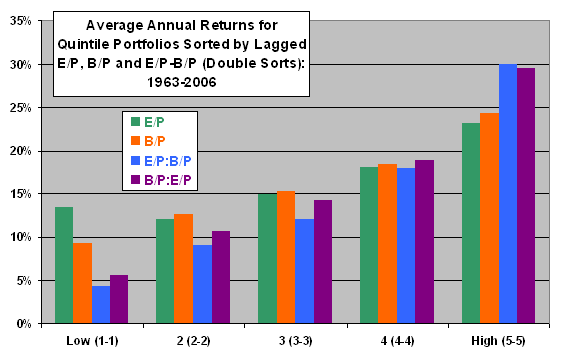
As I’ve discussed in the past, P/B and P/E are demonstratively useful as predictors of future stock returns, and more so when combined (see, for example, LSV’s Two-Dimensional Classifications). As Josef Lakonishok, Andrei Shleifer, and Robert Vishny showed in Contrarian Investment, Extrapolation, and Risk, within the set of firms whose B/M ratios are the highest (in other words, the lowest price-to-book value), further sorting on the basis of another value variable – whether it be C/P, E/P or low GS – enhances returns. In that paper, LSV concluded that value strategies based jointly on past performance and expected future performance produce higher returns than “more ad hoc strategies such as that based exclusively on the B/M ratio.” A new paper further discusses the relationship between E/P and B/P from an accounting perspective, and the degree to which E/P and B/P together predict stock returns.

The CXO Advisory Group Blog, fast becoming one of my favorite sites for new investment research, has a new post, Combining E/P and B/P, on a December 2009 paper titled “Returns to Buying Earnings and Book Value: Accounting for Growth and Risk” by Francesco Reggiani and Stephen Penman. Penman and Reggiani looked at the relationship between E/P and B/P from an accounting perspective:

This paper brings an accounting perspective to the issue: earnings and book values are accounting numbers so, if the two ratios indicate risk and return, it might have something to do with accounting principles for measuring earnings and book value.

Indeed, an accounting principle connects earnings and book value to risk: under uncertainty, accounting defers the recognition of earnings until the uncertainty has largely been resolved. The deferral of earnings to the future reduces book value, reduces short-term earnings relative to book value, and increases expected long-term earnings growth.

CXO summarize the authors’ methodology and findings as follows:

Using monthly stock return and firm financial data for a broad sample of U.S. stocks spanning 1963-2006 (153,858 firm-years over 44 years), they find that:

  • E/P predicts stock returns, consistent with the idea that it measures risk to short-term earnings.
  • B/P predicts stock returns, consistent with the idea that it measures accounting deferral of risky earnings and therefore risk to both short-term and long-term earnings. This perspective disrupts the traditional value-growth paradigm by associating expected earnings growth with high B/P.
  • For a given E/P, B/P therefore predicts incremental return associated with expected earnings growth. A joint sort on E/P and B/P discovers this incremental return and therefore generates higher returns than a sort on E/P alone, attributable to additional risk (see the chart below).
  • Results are somewhat stronger for the 1963-1984 subperiod than for the 1985-2006 subperiod.
  • Results using consensus analyst forecasts rather than lagged earnings to calculate E/P over the 1977-2006 subperiod are similar, but not as strong.

CXO set out Penman and Reggiani’s “core results” in the following table (constructed by CXO from Penman and Reggiani’s results):

The following chart, constructed from data in the paper, compares average annual returns for four sets of quintile portfolios over the entire 1963-2006 sample period, as follows:

  • “E/P” sorts on lagged earnings yield.
  • “B/P” sorts on lagged book-to-price ratio.
  • “E/P:B/P” sorts first on E/P and then sorts each E/P quintile on B/P. Reported returns are for the nth B/P quintile within the nth E/P quintile (n-n).
  • “B/P:E/P” sorts first on B/P and then sorts each B/P quintile on E/P. Reported returns are for the nth E/P quintile within the nth B/P quintile (n-n).

Start dates for return calculations are three months after fiscal year ends (when annual financial reports should be available). The holding period is 12 months. Results show that double sorts generally enhance performance discrimination among stocks. E/P measures risk to short-term earnings and therefore short-term earnings growth. B/P measures risk to short-term earnings and earnings growth and therefore incremental earnings growth. The incremental return for B/P is most striking in low E/P quintile.

The paper also discusses in some detail a phenomenon that I find deeply fascinating, mean reversion in earnings predicted by low price-to-book values:

Research (in Fama and French 1992, for example) shows that book-to-price (B/P) also predicts stock returns, so consistently so that Fama and French (1993 and 1996) have built an asset pricing model based on the observation. The same discussion of rational pricing versus market inefficiency ensues but, despite extensive modeling (and numerous conjectures), the phenomenon remains a mystery. The mystery deepens when it is said that B/P is inversely related to earnings growth while positively related to returns; low B/P stocks (referred to as “growth” stocks) yield lower returns than high B/P stocks (“value” stocks). Yet investment professionals typically think of growth as risky, requiring higher returns, consistent with the risk-return notion that one cannot buy more earnings (growth) without additional risk.

(emphasis mine)

The paper adds further weight to the predictive ability of low price-to-book value and low price-to-earnings ratios. Its conclusion that book-to-price indicates expected returns associated with expected earnings growth is particularly interesting, and accords with the same findings in Werner F.M. DeBondt and Richard H. Thaler in Further Evidence on Investor Overreaction and Stock Market Seasonality.

Jon Heller of the superb Cheap Stocks, one of the inspirations for this site, has published the results of his two year net net index experiment in Winding Down The Cheap Stocks 21 Net Net Index; Outperforms Russell Microcap by 1371 bps, S&P 500 by 2537 bps.

The “CS 21 Net/Net Index” was “the first index designed to track net/net performance.” It was a simply constructed, capitalization-weighted index comprising the 21 largest net nets by market capitalization at inception on February 15, 2008. Jon had a few other restrictions on inclusion in the index, described in his introductory post:

  • Market Cap is below net current asset value, defined as: Current Assets – Current Liabilities – all other long term liabilities (including preferred stock, and minority interest where applicable)
  • Stock Price above $1.00 per share
  • Companies have an operating business; acquisition companies were excluded
  • Minimum average 100 day volume of at least 5000 shares (light we know, but welcome to the wonderful world of net/nets)
  • Index constituents were selected by market cap. The index is comprised of the “largest” companies meeting the above criteria.

The Index is naïve in construction in that:

  • It will be rebalanced annually, and companies no longer meeting the net/net criteria will remain in the index until annual rebalancing.
  • Only bankruptcies, de-listings, or acquisitions will result in replacement
  • Does not discriminate by industry weighting—some industries may have heavy weights.

If a company was acquired, it was not replaced and the proceeds were simply held in cash. Further, stocks were not replaced if they ceased being net nets.

Says Jon of the CS 21 Net/Net Index performance:

This was simply an experiment in order to see how net/nets at a given time would perform over the subsequent two years.

The results are in, and while it was not what we’d originally hoped for, it does lend credence to the long-held notion that net/nets can outperform the broader markets.

The Cheap Stocks 21 Net Net Index finished the two year period relatively flat, gaining 5.1%. During the same period, The Russell Microcap Index was down 8.61%, while the Russell Microcap Index was down 9.9%. During the same period, the S&P 500 was down 20.27%.

Here are the components, including the weightings and returns of each:

Adaptec Inc (ADPT)
Weight: 18.72%
Computer Systems
+7.86%
Audiovox Corp (VOXX)
Weight: 12.20%
Electronics
-29.28%
Trans World Entertainment (TWMC)
Weight:7.58%
Retail-Music and Video
-69.55%
Finish Line Inc (FINL)
Weight:6.30%
Retail-Apparel
+350.83%
Nu Horizons Electronics (NUHC)
Weight:5.76%
Electronics Wholesale
-25.09%
Richardson Electronics (RELL)
Weight:5.09%
Electronics Wholesale
+43.27%
Pomeroy IT Solutions (PMRY)
Weight:4.61%
Acquired
-3.8%
Ditech Networks (DITC)
Weight:4.31%
Communication Equip
-56.67%
Parlux Fragrances (PARL)
Weight:3.92%
Personal Products
-51.39%
InFocus Corp (INFS)
Weight:3.81%
Computer Peripherals
Acquired
Renovis Inc (RNVS)
Weight:3.80%
Biotech
Acquired
Leadis Technology Inc (LDIS)
Weight:3.47%
Semiconductor-Integrated Circuits
-92.05%
Replidyne Inc (RDYN) became Cardiovascular Systems (CSII)
Weight:3.31%
Biotech
[Edit: +126.36%]
Tandy Brands Accessories Inc (TBAC)
Weight:2.94%
Apparel, Footwear, Accessories
-57.79%
FSI International Inc (FSII)
Weight:2.87%
Semiconductor Equip
+66.47%
Anadys Pharmaceuticals Inc (ANDS)
Weight:2.49%
Biotech
+43.75%
MediciNova Inc (MNOV)
Weight:2.33%
Biotech
+100%
Emerson Radio Corp (MSN)
Weight:1.71%
Electronics
+118.19%
Handleman Co (HDL)
Weight:1.66%
Music- Wholesale
-88.67%
Chromcraft Revington Inc (CRC)
Weight:1.62%
Furniture
-54.58%
Charles & Colvard Ltd (CTHR)
Weight:1.50%
Jewel Wholesale
-7.41%

Cash Weight: 8.58%

Jon is putting together a new net net index, which I’ll follow if he releases it into the wild.

One of the most interesting ideas suggested by Ian Ayers’s book Super Crunchers is the role of humans in the implementation of a quantitative investment strategy. As we know from Andrew McAfee’s Harvard Business Review blog post, The Future of Decision Making: Less Intuition, More Evidence, and James Montier’s 2006 research report, Painting By Numbers: An Ode To Quant, in context after context, simple statistical models outperform expert judgements. Further, decision makers who, when provided with the output of the simple statistical model, wave off the model’s predictions tend to make poorer decisions than the model. The reason? We are overconfident in our abilities. We tend to think that restraints are useful for the other guy but not for us. Ayres provides a great example in his article,  How computers routed the experts:

To cede complete decision-making power to lock up a human to a statistical algorithm is in many ways unthinkable.

The problem is that discretionary escape hatches have costs too. In 1961, the Mercury astronauts insisted on a literal escape hatch. They balked at the idea of being bolted inside a capsule that could only be opened from the outside. They demanded discretion. However, it was discretion that gave Liberty Bell 7 astronaut Gus Grissom the opportunity to panic upon splashdown. In Tom Wolfe’s memorable account, The Right Stuff, Grissom “screwed the pooch” when he prematurely blew the 70 explosive bolts securing the hatch before the Navy SEALs were able to secure floats. The space capsule sank and Grissom nearly drowned.

The natural question, then, is, “If humans can’t even be trusted with a small amount of discretion, what role do they play in the quantitative investment scenario?”

What does all this mean for human endeavour? If we care about getting the best decisions overall, there are many contexts where we need to relegate experts to supporting roles in the decision-making process. We, like the Mercury astronauts, probably can’t tolerate a system that forgoes any possibility of human override, but at a minimum, we should keep track of how experts fare when they wave off the suggestions of the formulas. And we should try to limit our own discretion to places where we do better than machines.

This is in many ways a depressing story for the role of flesh-and-blood people in making decisions. It looks like a world where human discretion is sharply constrained, where humans and their decisions are controlled by the output of machines. What, if anything, in the process of prediction can we humans do better than the machines?

The answer is that we formulate the factors to be tested. We hypothesise. We dream.

The most important thing left to humans is to use our minds and our intuition to guess at what variables should and should not be included in statistical analysis. A statistical regression can tell us the weights to place upon various factors (and simultaneously tell us how, precisely, it was able to estimate these weights). Humans, however, are crucially needed to generate the hypotheses about what causes what. The regressions can test whether there is a causal effect and estimate the size of the causal impact, but somebody (some body, some human) needs to specify the test itself.

So the machines still need us. Humans are crucial not only in deciding what to test, but also in collecting and, at times, creating the data. Radiologists provide important assessments of tissue anomalies that are then plugged into the statistical formulas. The same goes for parole officials who judge subjectively the rehabilitative success of particular inmates. In the new world of database decision-making, these assessments are merely inputs for a formula, and it is statistics – and not experts – that determine how much weight is placed on the assessments.

In investment terms, this means honing the strategy. LSV Asset Management, described by James Montier as being a “fairly normal” quantitative fund (as opposed to being “rocket scientist uber-geeks”) and authors of the landmark Contrarian Investment, Extrapolation and Risk paper, describe the ongoing role of the humans in its funds as follows (emphasis mine):

A proprietary investment model is used to rank a universe of stocks based on a variety of factors we believe to be predictive of future stock returns. The process is continuously refined and enhanced by our investment team although the basic philosophy has never changed – a combination of value and momentum factors.

The blasphemy about momentum aside, the refinement and enhancement process sounds like fun to me.