Feeds:
Posts
Comments

Archive for the ‘Stocks’ Category

Daniel Rudewicz, the managing member of Furlong Samex LLC, has provided a guest post today on Paragon Technologies (PGNT.PK). Furlong Samex is a deep value investment partnership based on the principles of Benjamin Graham. Daniel can be reached at rudewicz [at] furlongsamex [dot] com.

Anyone Need a (Sanborn) Map?

In his 1960 partnership letter, Warren Buffett described his investment in Sanborn Map. At the time of his investment, Sanborn Map was selling for less than the combined value of its cash and investment portfolio. Additionally, the operating portion of the company was profitable. Opportunities like Sanborn Map are a dream for value investors.

The market downturn of 2008 had created some similar opportunities. But by early 2010 the market price of most of those companies had converged to at least the value of their cash and investment portfolio. One company that has managed to stay under the radar is Paragon Technologies. It was trading below its cash level when the company elected to be listed on the Pink Sheets. This also removed the requirement to file with the SEC and now the company is no longer on many of the databases and stock screens.

It’s a fairly illiquid company whose most recent quarter was profitable. As of 9/30/2009, Paragon had just over $6 million in cash, or $3.88 per share.

Cash and cash equivalents $6,094,000
Shares outstanding 1,571,810
Cash per share $3.88

Year to date, its stock has traded between $2.20 and $2.55, quite a discount from its cash. The Board and the interim CEO are looking at strategic alternatives and will consider shareholder proposals. Unfortunately, what we had hoped was a 1960 Buffettesque proposal was turned down. In the proposal we outlined the benefits of the company offering a fixed price tender at $3.88 per share. Maybe next time. To the Board’s credit, they have authorized a large share buyback and have increased the amount authorized several times. The problem is that authorizing an amount and buying back an amount is not the same thing.

While the interim CEO searches for opportunities, the company could conceivably end up buying back enough shares in the open market so that we’re the only shareholder left. The downside is that I’m not sure that we would want that. Even though it was profitable last quarter, the long term earnings record is not that impressive. Looking back at Buffett’s Sanborn Map investment, it seems like Sanborn’s Board should have encouraged Buffett to stay on and manage its investment portfolio. Our hope is that Paragon moves in the direction of becoming a tiny Berkshire or Fairfax by putting a great capital allocator in charge of the cash. It would be a great way to use some of the company’s operating losses to shield future investment gains. So if you’re the next Buffett — or even ‘Net Quick’ Evans — send them your resume. Maybe they’ll hire you (I doubt it).

Our firm’s portfolio is relatively small and we have purchased as much of Paragon as we would like to at this time. If you would like a copy of our letter to the Board or any of our research, feel free to contact us and we’d be happy to share it with you. There are risks involved with this company so do your own research before investing.

Disclosure: Long Paragon Technologies (PGNT.PK). This is neither a recommendation to buy or sell any securities. All information provided believed to be reliable and presented for information purposes only. Do your own research before investing in any security.

[Full Disclosure: I do not hold PGNT. This is neither a recommendation to buy or sell any securities. All information provided believed to be reliable and presented for information purposes only. Do your own research before investing in any security.]
Read Full Post »

One of the major concerns with quantitative investing is that the “black box” running the portfolio suddenly goes Skynet and destroys the portfolio. It raises an interesting distinction between “quantitative investing” as I intend it and as it is often perceived. For many, the word “quantitative” in relation to investing suggests two potentially dangerous elements:

  1. A very complex investment methodology, the understanding of which is beyond the minds of mere mortals, requiring a computer to calculate its outputs, ala Long-Term Capital Management.
  2. Automated trading, where the black box interacts directly with the market, without human supervision, which some have suggested caused the “program trading” crash of 1987.

The Wall Street Journal has a florid article, The Minds Behind the Meltdown, by Scott Patterson, which speaks directly to these two fears in the context of the recent credit crisis:

PDT, one of the most secretive quant funds around, was now a global powerhouse, with offices in London and Tokyo and about $6 billion in assets (the amount could change daily depending on how much money Morgan funneled its way). It was a well-oiled machine that did little but print money, day after day.

Then it achieved sentience (which, adds Wikipedia, is not to be confused with sapience).

That week, however, PDT wouldn’t print money—it would destroy it like an industrial shredder.

The unusual behavior of stocks that PDT tracked had begun sometime in mid-July and had gotten worse in the first days of August. The previous Friday, about half a dozen of the biggest gainers on the Nasdaq were stocks that PDT had sold short, expecting them to decline, and several of the biggest losers were stocks PDT had bought, expecting them to rise. It was Bizarro World for quants. Up was down, down was up. The models were operating in reverse.

The models were operating in reverse. How do we know? Instead of making money, they started losing money.

The market moves PDT and other quant funds started to see early that week defied logic. The fine-tuned models, the bell curves and random walks, the calibrated correlations—all the math and science that had propelled the quants to the pinnacle of Wall Street—couldn’t capture what was happening.

The market, under the thrall of sentient black boxes, defies logic, fine-tuned models, bell curves, random walks and calibrated correlations, leaving only fresh Talebian epistemic humility in its wake.

The result was a catastrophic domino effect. The rapid selling scrambled the models that quants used to buy and sell stocks, forcing them to unload their own holdings. By early August, the selling had taken on a life of its own, leading to billions in losses.

The selling had taken on a life of its own. Even the selling turned sentient (or sapient).

It was utter chaos driven by pure fear. Nothing like it had ever been seen before. This wasn’t supposed to happen!

Nothing like it had ever happened before. Of course the “program trading / portfolio insurance” crash of 1987 would be a total mystery to a newly sentient black box, given that it happened a full 20 years earlier.

As conditions spun out of control, Mr. Muller was updating Morgan’s top brass. He wanted to know how much damage was acceptable. But his chiefs wouldn’t give him a number. They didn’t understand all of the nuts and bolts of how PDT worked. Mr. Muller had kept its positions and strategy so secret over the years that few people in the firm had any inkling about how PDT made money. They knew it was profitable almost all the time. That was all that mattered.

The models were so complicated, and so secret, not even the guys running them knew know they worked.

That Wednesday, what had started as a series of bizarre, unexplainable glitches in quant models turned into a catastrophic meltdown the likes of which had never been seen before in the history of financial markets. Nearly every single quantitative strategy, thought to be the most sophisticated investing ideas in the world, was shredded to pieces, leading to billions in losses. It was deleveraging gone supernova.

The bizarre computer glitches, still unexplained, led to big losses, rendering billions of dollars into nothing but dust and  Talebian epistemic humility.

Sounds pretty scary. Putting aside for one moment the melodrama of the article, it does highlight the potential problems for a quantitative investment strategy. It also presents some pretty obvious solutions, which I believe are as follows:

  1. The investment strategy should be reasonably tractable and the model should be simple. This avoids the problem of not understanding the “nuts and bolts” of the fund and should reduce the “bizarre, unexplainable glitches”.
  2. The strategy should be robust. If it can’t survive a crisis the magnitude of at least 1987, or 2007-2009, it’s not robust. The problem is probably too much leverage, either in the fund or baked into the security. What’s the “right” amount of debt? Little to none. What’s that mean? As Charlie Munger might say, “What don’t you understand about ‘no debt’?”
  3. To the extent that it is possible to do so, a human should enter the trades. Of course, human entry of trades is not the panacea for all our ills. It creates a new problem: Fat fingers are responsible for plenty of trades with too many or too few zeros.

Perhaps the best solution is a healthy skepticism about the model’s output, which is why simplicity and tractability are so important.

Read Full Post »

The New Yorker has John Cassidy’s interview with Richard Thaler, Chicago School economist and co-author (along with Werner F.M. DeBondt) of Further Evidence on Investor Overreaction and Stock Market Seasonality, a paper I like to cite in relation to low P/B quintiles and earnings mean reversion. Thaler is also the “Thaler” in Fuller & Thaler Asset Management, which James Montier identifies in his 2006 research report Painting By Numbers: An Ode To Quant as being a “fairly normal” quantitative fund (as opposed to being “rocket scientist uber-geeks”) with an “admirable track [record] in terms of outperformance.” I diverge from Thaler on a number of issues, but on these two I think he’s right:

On the remnants of efficient markets hypothesis:

Well, I always stress that there are two components to the theory. One, the market price is always right. Two, there is no free lunch: you can’t beat the market without taking on more risk. The no-free-lunch component is still sturdy, and it was in no way shaken by recent events: in fact, it may have been strengthened. Some people thought that they could make a lot of money without taking more risk, and actually they couldn’t. So either you can’t beat the market, or beating the market is very difficult—everybody agrees with that. My own view is that you can [beat the market] but it is difficult.

The question of whether asset prices get things right is where there is a lot of dispute. Gene [Fama] doesn’t like to talk about that much, but it’s crucial from a policy point of view. We had two enormous bubbles in the last decade, with massive consequences for the allocation of resources.

On stock market bubbles:

[Cassidy] When I spoke to Fama, he said he didn’t know what a bubble is—he doesn’t even like the term.

[Thaler] I think we know what a bubble is. It’s not that we can predict bubbles—if we could we would be rich. But we can certainly have a bubble warning system. You can look at things like price-to-earnings ratios, and price-to-rent ratios. These were telling stories, and the story they seemed to be telling was true.

And I love this line in relation to the impact of the recent crisis on behavioral economics:

I think it is seen as a watershed, but we have had a lot of watersheds. October 1987 was a watershed. The Internet stock bubble was a watershed. Now we have had another one. What is the old line—that science progresses funeral by funeral? Nobody changes their mind.

Science progresses funeral by funeral. Nobody changes their mind. It seems to me it’s not the only discipline that proceeds by funeral.

Read Full Post »

Continuing the quantitative value investment theme I’ve been trying to develop over the last week or so, I present my definition of a simple quantitative value strategy: net nets. James Montier, author of the essay Painting By Numbers: An Ode To Quant, which I use as the justification for simple quantitative investing, authored an article in September 2008 specifically dealing with net nets as a global investment strategy: Graham’’s net-nets: outdated or outstanding? (Edit: It seems this link no longer works as SG obliterates any article ever written by Montier). Quelle surprise, Montier found that buying net-nets is a viable and profitable strategy:

Testing such a deep value approach reveals that it would have been a highly profitable strategy. Over the period 1985-2007, buying a global basket of net-nets would have generated a return of over 35% p.a. versus an equally weighted universe return of 17% p.a.

An annual return of 35% over 23 years would put you in elite company indeed, so Montier’s methodology is worthy of closer inspection. Unfortunately he doesn’t discuss his methodology in any detail, other than to say as follows:

I decided to test the performance of buying net-nets on a global basis. I used a sample of developed markets over the period 1985 onwards, all returns were in dollar terms.

It may have been a strategy similar to the annual rebalancing methodology discussed in Oppenheimer’s Ben Graham’s Net Current Asset Values: A Performance Update. That paper demonstrates a purely mechanical annual rebalancing of stocks meeting Graham’s net current asset value criterion generated a mean return between 1970 and 1983  of “29.4% per year versus 11.5% per year for the NYSE-AMEX Index.” It doesn’t really matter exactly how Montier generated his return. Whether he bought each net net as it became a net net or simply purchased a basket on a regular basis (monthly, quarterly, annually, whatever), it’s sufficient to know that he was testing the holding of a basket of net nets throughout the period 1985 to 2007.

Montier’s findings are as follows:

  • The net-nets portfolio contains a median universe of 65 stocks per year.
  • There is a small cap bias to the portfolio. The median market cap of a net-net is US$21m.
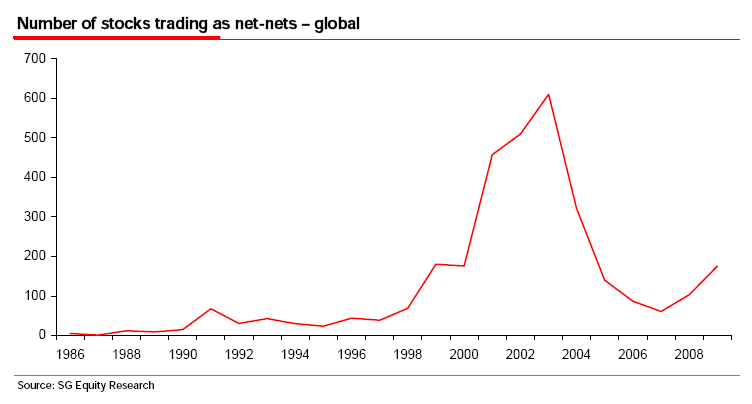
  • At the time of writing (September 2008), Montier found around 175 net-nets globally. Over half were in Japan.
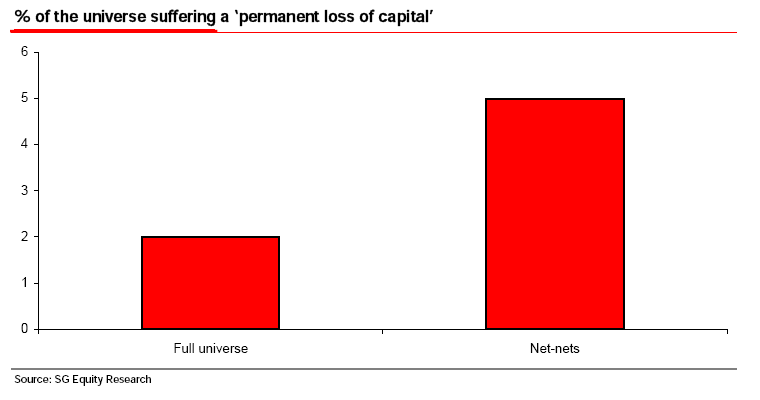
  • If we define total business failure as stocks that drop more than 90% in a year, then the net-nets portfolio sees about 5% of its constituents witnessing such an event. In the broad market only around 2% of stocks suffer such an outcome.
  • The overall portfolio suffered only three down years in our sample, compared to six for the overall market.

Several of Montier’s findings are particularly interesting to me. At an individual company level, a net net is more likely to suffer a permanent loss of capital than the average stock:

If we define a permanent loss of capital as a decline of 90% or more in a single year, then we see 5% of the net-nets selections suffering such a fate, compared with 2% in the broader market.

Here’s the chart:

This is interesting given that NCAV is often used as a proxy for liquidation value.

Very few companies turn out to have an ultimate value less than the working capital alone, although scattered instances may be found.

Montier believes this may provide a clue as to why the net net strategy continues to work:

This relatively poor performance may hint at an explanation as to why investors shy away from net-nets. If investors look at the performance of the individual stocks in their portfolio rather than the portfolio itself (known as ‘narrow-framing’), then they will see big losses more often than if they follow a broad market strategy. We know that people are generally loss averse, so they tend to feel losses far more than gains. This asymmetric response coupled with narrow framing means that investors in the net-nets strategy need to overcome several behavioural biases.

Paradoxically, it seems that what is true at the individual company level is not true at an aggregate level. The net net strategy has fewer down years than the market:

If one were to frame more broadly and look at the portfolio performance overall, the picture is much brighter. The net-net strategy only generated losses in three years in the entire sample we backtested. In contrast, the overall market witnessed some six years of negative returns.

Here’s the chart:

And it seems that the net net strategy is a reasonable contrary indicator. When the market is up, fewer can be found, and when the market is down, they seem to be available in abundance:

The main drawback to the net net strategy is its limited application. Stocks tend to be small and illiquid, which puts a limit on the amount of capital that can be safely run using it. That aside, it seems like a good way to get started in a small fund or with a individual account. Montier concludes:

…In various ways practically all these bargain issues turned out to be profitable and the average annual return proved much more remunerative than most other investments.

Good old Benjamin Graham. What a guy.

Buy my book The Acquirer’s Multiple: How the Billionaire Contrarians of Deep Value Beat the Market from on Kindlepaperback, and Audible.

Here’s your book for the fall if you’re on global Wall Street. Tobias Carlisle has hit a home run deep over left field. It’s an incredibly smart, dense, 213 pages on how to not lose money in the market. It’s your Autumn smart read. –Tom Keene, Bloomberg’s Editor-At-Large, Bloomberg Surveillance, September 9, 2014.

Click here if you’d like to read more on The Acquirer’s Multiple, or connect with me on Twitter, LinkedIn or Facebook. Check out the best deep value stocks in the largest 1000 names for free on the deep value stock screener at The Acquirer’s Multiple®.

Read Full Post »

As I foreshadowed last week in The New World, I want to explore Nassim Nicholas Taleb’s Fooled by Randomness and The Black Swan in some depth. The books aren’t strictly about investing, which Taleb regards as a “less interesting, more limited –and rather boring –applications of [his] ideas,” but my interest is in investment, particularly deep value investment, and so I’ll be exploring his ideas in that context. It is no small subject, and I don’t pretend to fully understand everything that Taleb has to say. Ideally, I’d complete it before springing it on you. Alas, my daily posting schedule won’t allow that. My apologies in advance, as this will likely progress in fits and starts, requiring “decisions and revisions which a minute will reverse.”

Taleb’s ideas appeal to me for a variety of reasons: I see Montaigne’s “Que sais-je?” (“What do I know?”) as a golden thread linking Austrian economics, value investment and a variety of other views I hold unrelated to finance and investment. Benjamin Graham, being the Latin, Greek and French-speaking polymath that he was, no doubt enjoyed Essais in its original form (whereas I had to grit my teeth through the Cotton translation, before learning that connoisseurs prefer M.A. Screech for his lyrical Raymond Sebond). Montaigne may have had some influence on Graham’s concept of margin of safety, his habit of professing to know little about the businesses of the securities in which he invested, and generally cautious and conservative approach. Montaigne writes about about the failure of his own faculties to aid him in his comprehension of the world.  We don’t even understand the past – despite our “fantastic, imaginary, false privileges that man has arrogated to himself, of regimenting, arranging, and fixing truth” – so how can we possibly see what will happen in the future? We can’t. The beauty of Montaigne is that he presents a way forward through the gloom. How do we proceed? Through waver, doubt and inquiry. Taleb offers a similar view in Fooled by Randomness and The Black Swan, and that’s what makes the books so enjoyable.

Malcolm Gladwell’s Blowing up is rich in biographical detail on Taleb, and reads to me like Fooled by Randomness in essay (despite Taleb’s protestations that “while flattering,” it put him in the “wrong box”). Gladwell sets the table by describing a meeting between Victor Niederhoffer, then “one of the most successful money managers in the country” and Taleb:

He didn’t talk much, so I observed him,” Taleb recalls. “I spent seven hours watching him trade. Everyone else in his office was in his twenties, and he was in his fifties, and he had the most energy of them all. Then, after the markets closed, he went out to hit a thousand backhands on the tennis court.” Taleb is Greek-Orthodox Lebanese and his first language was French, and in his pronunciation the name Niederhoffer comes out as the slightly more exotic Niederhoffer. “Here was a guy living in a mansion with thousands of books, and that was my dream as a child,” Taleb went on. “He was part chevalier, part scholar. My respect for him was intense.” There was just one problem, however, and it is the key to understanding the strange path that Nassim Taleb has chosen, and the position he now holds as Wall Street’s principal dissident. Despite his envy and admiration, he did not want to be Victor Niederhoffer — not then, not now, and not even for a moment in between. For when he looked around him, at the books and the tennis court and the folk art on the walls — when he contemplated the countless millions that Niederhoffer had made over the years — he could not escape the thought that it might all have been the result of sheer, dumb luck.

The punchline is that Niederhoffer blew up (for the second time, thereby fulfilling his own definition of a hoodoo):

Last fall, Niederhoffer sold a large number of options, betting that the markets would be quiet, and they were, until out of nowhere two planes crashed into the World Trade Center. “I was exposed. It was nip and tuck.” Niederhoffer shook his head, because there was no way to have anticipated September 11th. “That was a totally unexpected event.”

I’m not going to recapitulate Gladwell’s article here, but it’s well worth reading in its entirety. As an aside, Niederhoffer’s The Education of a Speculator is also an excellent read. It is interesting to compare Niederhoffer’s exhortation to “test everything that can be tested” against Taleb’s “naive empiricist,” but I’ll leave that for another day. For me, one of the most interesting aspects of Taleb’s philosophy is his attack on “epistemic arrogance” and its application to value investment. As I have said before, I believe there are several problems with the received wisdom on value investment, and this is one worthy of further exposition.

Read Full Post »

Farukh Farooqi is a long-time supporter of Greenbackd and the source of some of the better ideas on this site. He has recently launched Marquis Research, a special situations research and advisory firm. Says Farukh:

We provide clients (mainly hedge/mutual funds) with investment ideas in bankruptcies, post reorg equities, activist-driven situations, liquidations, recapitalizations and spinoffs.We currently follow more than 50 bankruptcies of large, public companies which include Six Flags, Chemtura, GSI Group, Spansion and SemGroup.  Our main goal is to provide institutional clients with actionable ideas as opposed to “Street” research.

Farukh has spent a dozen years on the sell-side and the buy-side. Prior to founding Marquis Research, he was a Senior Analyst at Kellogg Capital Group, responsible for generating investment ideas for the Special Situations Group and he also worked closely with the risk-arbitrage desk. Before joining Kellogg, he was a Senior Analyst at Jefferies & Company. His coverage included bankruptcies and post-reorg equities. He was acknowledged for his work in the post-bankruptcy space by The Deal in the article “Scavenger Hunter.”

Though he has been living in the New York Metropolitan area for more than 20 years, he has never stopped being a fan of the Washington Redskins. Farukh has also completed the Philadelphia and the New York City Marathons.

Here’s his take on Silicon Storage Technology, Inc (NASDAQ:SSTI):

Activist-Driven Situation Summary: Silicon Storage Tech. (SSTI; $2.78) dated January 6, 2010

SST is a fabless, designer and supplier of NOR flash memory chips which are used in thousands of consumer electronic products. It has two businesses – Products sales of $240 mm with 20% gross margin and licensing revenues of $40 mm with near 100% margin.

As of September 30, 2009, SST had cash and investments of $2.14 per share, net non-cash working capital of $0.41 per share and zero debt. This implies that the market is valuing its business at $0.23 per share or $22 mm. This is a Company which annually spends $50 mm on R&D alone!

Judging from last 10 years of SST’s history, valuation has suffered from (1) dismal bottom line performance and (2) Corporate governance issues.

After bottoming in Q109, Company revenues and margins have rebounded sharply. The Board has decided to take this opportune time to create “value” for shareholders by selling it to a private equity fund for … $2.10 per share. As part of the deal, the current CEO and COO are going to keep their equity interest in the private Company.

In response, an activist shareholder (Riley Invesment Management) resigned from the Board when the Go-Private deal was announced. Last week, he and certain other large shareholders formed SST Full Value Committee and have asked the Board to reconsider the transaction.

Given the governance issues (which could improve as a proxy fight to add independent members is underway), a discount to the peer group is warranted. However, whether you value it on EV/Revenue, EV/EBITDA or Price/Tangible Book Value, the stock has 50% to 200% upside potential.

[Full Disclosure: I do not hold SSTI. This is neither a recommendation to buy or sell any securities. All information provided believed to be reliable and presented for information purposes only. Do your own research before investing in any security.]
Read Full Post »

Recently I’ve been laying the groundwork for a quantitative approach to value investment. The rational is as follows: simple quantitative or statistical models outperform experts in a variety of disciplines, so why not investing in general, and why not value investing in specific? Well, it seems that they do. A new research paper argues that quantitative funds outperform their qualitative brethren. In A Comparison of Quantitative and Qualitative Hedge Funds (via CXO Advisory Group blog) Ludwig Chincarini has compared the performance characteristics of quantitative and qualitative hedge funds. Chincarini finds that “both quantitative and qualitative hedge funds have positive risk-adjusted returns,” but, “overall, quantitative hedge funds as a group have higher [alpha] than qualitative hedge funds.”

Definition of quantitative and qualitative

Chincarini distinguished between quantitative and qualitative equity-focussed funds thus:

Our main method used to classify was to look for the term quantitative or a description of a similar nature to place a fund in the quantative category. We also looked for words like discretionary to classify qualitative funds and systematic to classify quantitative funds. Of the four main hedge fund categories, we only found two of them reliable enough to classify. Thus, in the Equity Hedge category, we classified Equity Market Neutral and Quantitative Directional as quantitative hedge funds and Fundamental Growth and Fundamental Value as qualitative categories.

We did not classify any of the Event Driven funds since these funds vary too substantially within the category and it was not clear from the descriptions how to separate quantitative and qualitative funds. We also did not classify any of the Relative Value funds, even though many of these funds use quantitative techniques, because the broader descriptions left us no clear cut way to divide them.

We classified a fund as quantitative if the following words appeared in the fund description: quantitative, mathematical, model, algorithm, econometric, statistic, or automate. Also, the fund description could not contain the word qualitative. We classified a fund as qualitative if it contained the word qualitative in its description or had none of the words mentioned for the quantitative category.

Performance

Using return data from 6,354 hedge funds from January 1970 through June 2009, Cincarini concludes, based on the raw performance data:

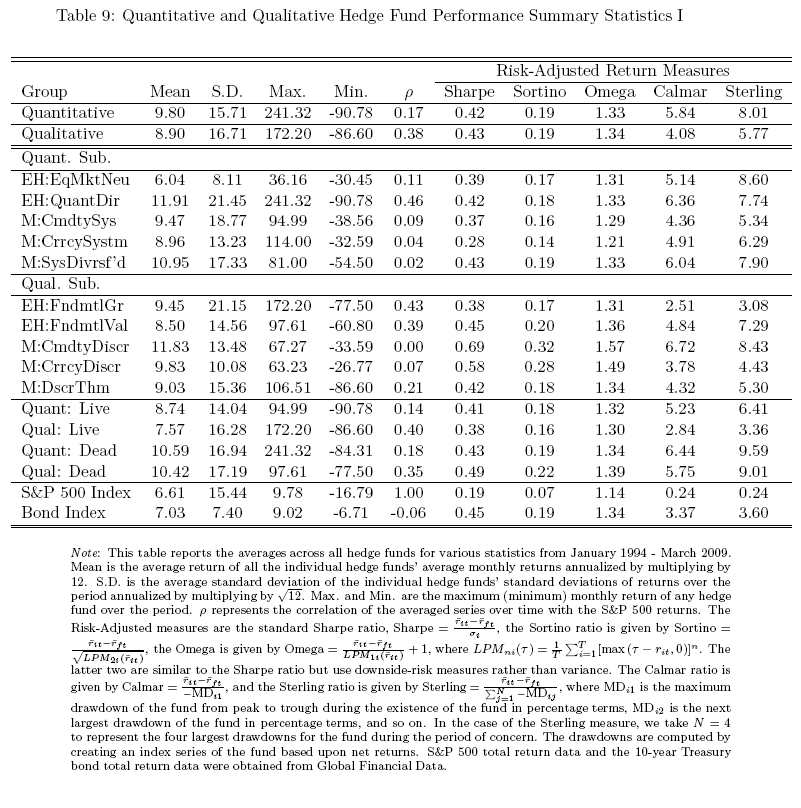
Generally, quantitative funds have a higher average return and a lower average standard deviation than qual funds. Amongst the quant funds, the highest average return comes from the Quantitative Directional strategy. The correlations of the fund categories with the S&P 500 are quite low at 0.17 and 0.38 for quant and qual respectively. The risk-adjusted return measures provide mixed evidence, but overall seems in favor of quant funds.

The qual funds perform significantly better than quant funds in up markets (25% and 15% respectively). However, the quant funds do significantly better in down markets (-2% versus -16%). This is mainly driven by the presence of Equity Market Neutral funds. In the 1990s, the average qual fund return was higher than the average quant fund return. They were roughly the same from 2000 – 2009. During the financial crisis (which we measure from January 2007 – March 2009), quant funds did better than qual funds (3.29% versus -4.77%).

Table 9 below shows performance summary statistics for the various funds:

Advantages and disadvantages of quantitative vs qualitative

Chincarini identifies several advantages quant funds hold over qualitative funds:

…the breadth of selections, the elimination of behavioral errors (which might be particularly important during the financial crisis of 2008 – 2009), and the potential lower administration costs (after hedge fund fees).

And several disadvantages:

The disadvantages for quantitative hedge funds include the reduced use of qualitative types of data, the reliance on historical data, the ability to quickly react to new economic paradigms. These three might have been especially crippling during the financial crisis of 2007 and 2009.

Finally, there is the potential of data mining, which will lead to strategies that aren’t as effective once implemented. In this paper, we will only focus on the return differences rather than attempting to detail which of the advantages or disadvantages in central in the return differences.

Hat tip Abnormal Returns.

Read Full Post »

One of the most fascinating examples of the phenomenon of mean reversion was identified by Werner F.M. DeBondt and Richard H. Thaler in Further Evidence on Investor Overreaction and Stock Market Seasonality. DeBondt and Thaler examined the relative performance of quintiles of stocks on the NYSE and AMEX ranked according to book value. As an adjunct to the main study, one of the variables they analyzed was the relative earnings performance of stocks in the lowest and highest price-to-book quintiles.

DeBondt and Thaler’s findings are as interesting as they are counter-intuitive. Stocks in the lowest price-to-book quintile (the cheapest stocks) grew their earnings faster than the stocks in the highest price-to-book quintile (the most expensive stocks). Tweedy Browne set out DeBondt and Thaler’s findings in Table 3 below, which describes the average earnings per share for companies in the lowest and highest quintile of price-to-book value in the three years prior to selection and the four years subsequent to selection:

tweedy-table-3

In the four years after the date of selection, the earnings of the companies in the lowest price-to-book value quintile (average price-to-book value of 0.36) increase 24.4%, more than the companies in the highest price-to-book value quintile (average price-to-book value of 3.42), whose earnings increased only 8.2%. DeBondt and Thaler attribute the earnings outperformance of the companies in the lowest quintile to mean reversion, which Tweedy Browne described as the observation that “significant declines in earnings are followed by significant earnings increases, and that significant earnings increases are followed by slower rates of increase or declines.”

The implication here is that not only does the price of stocks that are cheap relative to other stocks regress to the mean, but the underlying performance does too. That’s an amazing finding. There’s really no good reason why low price-to-book should be such a good predictor for short and mid-term earnings growth. I’ve spent some time thinking about why this might be so, and the only possible explanation I can come up with is magic. Nothing else fits.

Read Full Post »

The rationale for a quantitative approach to investing was first described by James Montier in his 2006 research report Painting By Numbers: An Ode To Quant:

  1. Simple statistical models outperform the judgements of the best experts
  2. Simple statistical models outperform the judgements of the best experts, even when those experts are given access to the simple statistical model.

In my experience, the immediate response to this statement in the investing context is always two-fold:

  1. What am I paying you for if I can build the model portfolio myself?
  2. Isn’t this what Long-Term Capital Management did?

Or, as Montier has it:

We find it ‘easy’ to understand the idea of analysts searching for value, and fund managers rooting out hidden opportunities. However, selling a quant model will be much harder. The term ‘black box’ will be bandied around in a highly pejorative way. Consultants may question why they are employing you at all, if ‘all’ you do is turn up and run the model and then walk away again.

It is for reasons like these that quant investing is likely to remain a fringe activity, no matter how successful it may be.

The response to these questions is as follows:

  1. It takes some discipline and faith in the model not to meddle with it. You’re paying the manager to keep his grubbly little paws off the portfolio. This is no small feat for a human being filled with powerful limbic system drives, testosterone (significant in ~50% of cases), dopamine and dopamine receptors and various other indicators interesting to someone possessing the DSM-IV-TR, all of which potentially lead to overconfidence and then to interference. You’re paying for the absence of interference, or the suppression of instinct. More on this in a moment.
  2. I’m talking about a simple model with a known error rate (momentarily leaving aside the Talebian argument about the limits of knowledge). My understanding is that LTCM’s problems were a combination of an excessively complicated, but insufficiently robust (in the Talebian sense) model, and, in any case, an inability to faithfully follow that model, which is failure of the first point above.

Suppressing intuition

We humans are clearly possessed of a powerful drive to allow our instincts to override our models. Andrew McAfee at Harvard Business Review has a recent post, The Future of Decision Making: Less Intuition, More Evidence, which essentially recapitulates Montier’s findings in relation to expertise, but McAfee frames it in the context of human intuition. McAfee discusses many examples demonstrating that intuition is flawed, and then asks how we can improve on intuition. His response? Statistical models, with a nod to the limits of the models.

Do we have an alternative to relying on human intuition, especially in complicated situations where there are a lot of factors at play? Sure. We have a large toolkit of statistical techniques designed to find patterns in masses of data (even big masses of messy data), and to deliver best guesses about cause-and-effect relationships. No responsible statistician would say that these techniques are perfect or guaranteed to work, but they’re pretty good.

And I love this story, which neatly captures the point at issue:

The arsenal of statistical techniques can be applied to almost any setting, including wine evaluation. Princeton economist Orley Ashenfleter predicts Bordeaux wine quality (and hence eventual price) using a model he developed that takes into account winter and harvest rainfall and growing season temperature. Massively influential wine critic Robert Parker has called Ashenfleter an “absolute total sham” and his approach “so absurd as to be laughable.” But as Ian Ayres recounts in his great book Supercrunchers, Ashenfelter was right and Parker wrong about the ’86 vintage, and the way-out-on-a-limb predictions Ashenfelter made about the sublime quality of the ’89 and ’90 wines turned out to be spot on.

Overall, we get inferior decisions and outcomes in crucial situations when we rely on human judgment and intuition instead of on hard, cold, boring data and math. This may be an uncomfortable conclusion, especially for today’s intuitive experts, but so what? I can’t think of a good reason for putting their interests over the interests of patients, customers, shareholders, and others affected by their judgments.

How do we proceed? McAfee has some thoughts:

So do we just dispense with the human experts altogether, or take away all their discretion and tell them to do whatever the computer says? In a few situations, this is exactly what’s been done. For most of us, our credit scores are an excellent predictor of whether we’ll pay back a loan, and banks have long relied on them to make automated yes/no decisions about offering credit. (The sub-prime mortgage meltdown stemmed in part from the fact that lenders started ignoring or downplaying credit scores in their desire to keep the money flowing. This wasn’t intuition as much as rank greed, but it shows another important aspect of relying on algorithms: They’re not greedy, either).

In most cases, though, it’s not feasible or smart to take people out of the decision-making loop entirely. When this is the case, a wise move is to follow the trail being blazed by practitioners of evidence-based medicine , and to place human decision makers in the middle of a computer-mediated process that presents an initial answer or decision generated from the best available data and knowledge. In many cases, this answer will be computer generated and statistically based. It gives the expert involved the opportunity to override the default decision. It monitors how often overrides occur, and why. it feeds back data on override frequency to both the experts and their bosses. It monitors outcomes/results of the decision (if possible) so that both algorithms and intuition can be improved.

Over time, we’ll get more data, more powerful computers, and better predictive algorithms. We’ll also do better at helping group-level (as opposed to individual) decision making, since many organizations require consensus for important decisions. This means that the ‘market share’ of computer automated or mediated decisions should go up, and intuition’s market share should go down. We can feel sorry for the human experts whose roles will be diminished as this happens. I’m more inclined, however, to feel sorry for the people on the receiving end of today’s intuitive decisions and judgments.

The quantitative value investor

To apply this quantitative approach to value investing, we would need to find simple quantitative value-based models that have outperformed the market. That is not a difficult process. We need go no further than the methodologies outlined in Oppenheimer’s Ben Graham’s Net Current Asset Values: A Performance Update or Lakonishok, Shleifer, and Vishny’s Contrarian Investment, Extrapolation and Risk. I believe that a quantitative application of either of those methodologies can lead to exceptional long-term investment returns in a fund. The challenge is making the sample mean (the portfolio return) match the population mean (the screen). As we will see, the real world application of the quantitative approach is not as straight-forward as we might initially expect because the act of buying (selling) interferes with the model.

Read Full Post »

Greenbackd is a proud sponsor of the 2010 5th Annual Value Investing Congress West and I’ve been able to secure a special discount for Greenbackd attendees.

Though the Congress is 5 months away, over 50% of the seats have already been reserved. Register by midnight next January 21, 2010 with discount code P10GB4 and you’ll save $1,600 off the regular price of admission.

Every year hundreds of people from around the world converge at this not-to-be-missed event to network with other savvy, sophisticated investors and learn from some of world’s most successful money managers. At the upcoming event, all-star investors will share their thoughts on today’s tumultuous markets and present their best, actionable investment ideas. Just one idea could earn you outstanding returns.

The confirmed speakers are an impressive bunch, including:

  • John BurbankPassport Capital
  • Patrick DegorceThélème Partners
  • Bruce BerkowitzFairholme Capital Management
  • Paul SonkinThe Hummingbird Value Funds
  • Mohnish PabraiPabrai Investment Funds
  • Thomas RussoGardner, Russo & Gardner
  • David NierenbergThe D3 Family Funds
  • Lloyd KhanerKhaner Capital
  • J. Carlo CannellCannell Capital
  • Whitney Tilson & Glenn TongueT2 Partners

See a slide show of the last Value Investing Congress in New York.

Register here. You must use discount code P10GB4 to receive the full discount. This discount expires at midnight next Thursaday, January 21st, 2010.

You’ve got exactly one week to get signed up with these savings.

The regular price of the two day event is $4,295. Greenbackd readers pay $2,695. That’s a 37% discount and savings of $1,600. If you’re from out of town, the Congress has also negotiated lower room rates at the Langham Huntington for attendees.

Make sure you get our exclusive discount for the Value Investing Congress here. Remember that you MUST use the discount code P10GB4 to receive the full discount.

Read Full Post »

« Newer Posts - Older Posts »