Feeds:
Posts
Comments

Archive for the ‘Stocks’ Category

DHT Holdings Inc (NYSE:DHT) is an interesting activist situation. MMI Investments, DHT’s largest shareholder, is calling for DHT to reinstate the company’s dividend and appoint Robert N. Cowen, a “shipping industry veteran with over 30 years of experience including with DHT’s former parent company, Overseas Shipholding Group, Inc., to the DHT Board of Directors.” At its $4.15 close on Friday, DHT has a market capitalization of $202M and is trading at a little over 5x 2010 expected free cash flow. MMI has set out its peer valuation and dividend analysis as an annexure to its latest 13D filing (set out below). The board of DHT has responded by appointing a new independent director, Einar Michael Steimler. DHT’s Chief Executive Officer, Ole Jacob Diesen, has also stepped down.

Says Clay Lifflander, President of MMI:

In the six months through February since DHT eliminated its dividend, a move that was never necessary in our view, the stock price dropped more than -30% at the same time as the average total return of its peers, all of whom currently pay dividends, was +19.5%. We believe DHT’s stockholders deserve better returns on their investment and improved performance from management and the Board. We therefore strongly urge the reinstatement of a dividend of $0.10 per share quarterly and the appointment of Bob Cowen to DHT’s Board of Directors.

The full text of MMI’s letter appended to the most recent 13D follows:

March 2, 2010

Erik A. Lind
Chairman of the Board
DHT Holdings, Inc.
26 New Street
St. Helier, Jersey JE23RA
Channel Islands

Dear Mr. Lind:

A s the largest stockholder of DHT Holdings, Inc. (“DHT” or the “Company”), MMI Investments, L.P. (“MMI”) is greatly frustrated with the poor performance of DHT stock, which is near its all-time low, and DHT’s valuation, which is at a severe discount to its peer group (see attachment: “DHT Peer Valuation”). We believe this underperformance is directly related to repeated poor decisions by management and the Board, such as the elimination of the Company’s dividend, and that stockholder value will continue to erode unless immediate action is taken. The board should act immediately to reinstate the dividend at a $0.10 per share quarterly rate and appoint as a member of the Board, Robert N. Cowen, a shipping industry veteran with over 30 years experience (including with DHT’s former corporate parent, Overseas Shipholding Group, Inc. (“OSG”)), as detailed below:

1) Reinstate the Dividend

DHT’s dividend strategy has been consistently erratic, shifting between paying out all available cash flow to paying a regular $0.25 quarterly dividend “to provide shareholders with a stable and visible distribution”1, to the dividend’s complete elimination in September – six months after the stock market bottomed and began its historic rise. This last decision was particularly toxic to stockholders, causing shares to plummet by more than 21% on the day of its announcement, due in part, we believe, to its inexplicability in the face of the nearly $40 million in free cash flow virtually guaranteed to the Company by its long-term charter agreements with OSG.

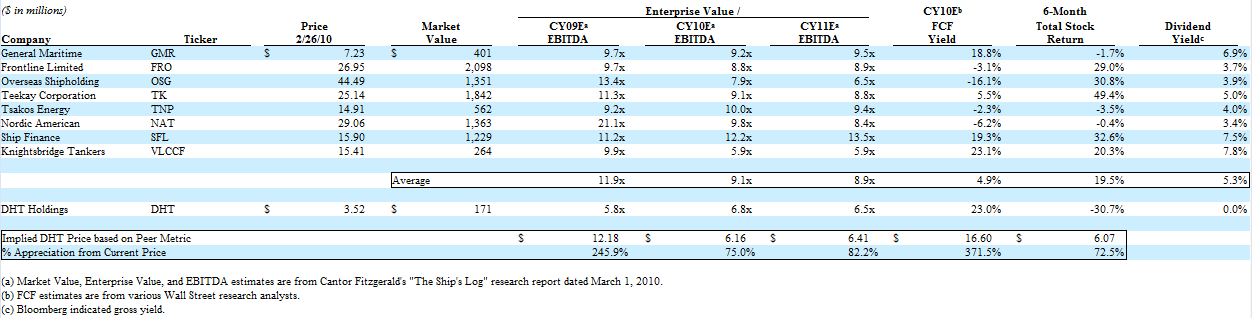
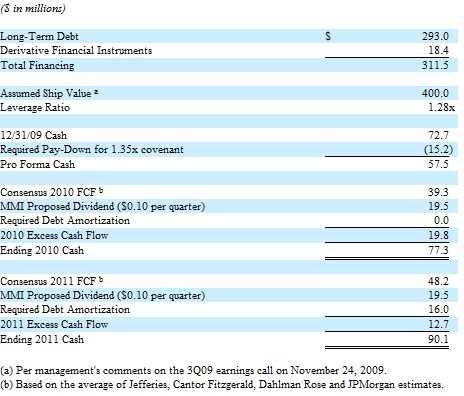
DHT’s zero dividend policy is not only inconsistent with its own intrinsic fundamentals, it is also dramatically out-of-step with its peers. DHT’s free cash flow yield2 at 23% is more than quadruple the mean of its comparable companies, who average a 5.3% dividend yield and who all currently pay dividends, including those who previously eliminated their dividend during the crisis. MMI recommends a quarterly dividend of $0.10 per share, which would leave significant free cash flow for debt repayment or other deployment in 2010 and 2011, even with the scheduled amortization of debt in 2011 (see attachment: “DHT Dividend Analysis”). A $0.10 per share quarterly dividend would also make DHT’s dividend yield a robust 11.4%, at a premium to its peers – a virtual necessity for stock price appreciation, which would drive the yield closer to parity.

2) Strengthen the Board

The Board’s non-dividend capital allocation decisions have also frequently seemed rash, and been dilutive to stockholder value. DHT’s only acquisitions since inception, the two Suezmax tanker purchases announced in 2007, were acquired at the top of the market for a total expenditure of $183 million. Today they are worth roughly half that amount in our opinion. In light of this poor acquisition track record, we believe the stated reason for eliminating the dividend, i.e. augmentation of the Company’s cash balance for potential acquisitions, only served to further unnerve stockholders.

We also believe this Board’s decision to complete an equity offering in March 2009 was similarly troubling and ill-timed. The offering came near the bottom of the stock market crisis, was priced less than a dollar above DHT’s all-time low stock price and at a dividend yield of 23% (which would subsequently become unsustainable because of the offering itself). Notably the unsustainable $0.25 per share quarterly dividend was eliminated only after it had been paid once to the new stockholders. As if to add insult to injury, at the time of the dividend elimination the offering proceeds were concurrently used to prepay debt in excess of the Company’s required covenant (ironically to the level at which DHT would be permitted to issue further dividends), and without receiving any concessions from its lender.

This past performance suggests that additional expertise and oversight at the Board level would benefit DHT and its stockholders. Therefore MMI strongly urges the immediate addition of Robert N. Cowen to the DHT board. Bob Cowen has over 30 years of experience in the oil tanker and dry bulk shipping business, having been Chief Operating Officer of DHT’s former parent company, OSG, and Chairman and Chief Executive Officer of OceanFreight Inc., a dry bulk shipping company for which he led its successful IPO and fleet start-up. The future opportunities afforded by the current industry weakness and the challenges presented by DHT’s escalating costs, both corporate and operating, require seasoned operational leadership which could augment the Board’s largely finance-related backgrounds. We believe Bob Cowen’s experience, intelligence and business acumen are well-suited to DHT’s challenges and opportunities, and that he would be a great asset to the Board.

We recommend expansion of the Board in part because of management’s comments on the February 16th, fourth quarter of 2009 earnings call, which suggest to us that they may not share stockholders’ frustration with the performance of DHT’s shares. Notably, Chief Executive Officer Ole Jacob Diesen’s remark that “…If we were to buy back shares, the share price has to be even lower” indicates an astounding belief that the stock is presently over-valued. We believe this is completely inconsistent with the facts. As we demonstrate in the attached “DHT Peer Valuation”, DHT’s stock price is presently at a 75% or greater discount to its value at its peers’ average multiples of 2010 and 2011 EBITDA, i.e. an implied stock price of approximately $6.16-$6.41 (versus $3.52 on 2/26/10) were it valued like its peers. On a net asset value basis (using management’s last estimate of DHT’s fleet value, $400 million) DHT is trading for less than its fleet value on an unchartered basis, despite the roughly $100 million at least in free cash flow to be collected by DHT through 2012 when the charters begin to roll off. This is in spite of the premium-worthy stability of DHT’s free cash flow generation from the long-term charters, and assumes virtually no additional hire in the next two years from improvement in rates. However, if market conditions continue to improve such that DHT does earn additional hire or fleet values rise, we believe the preceding valuation estimates will prove to be far too conservative.

In the six months since DHT eliminated its dividend its stock has dropped -30.7% whereas the average total return of its peers is +19.5%. We believe investors, many of whom chose DHT for its fundamental stability, have suffered more than enough capital loss and income disruption in service of a strategy so opaque and ill-communicated as to suggest there is no real strategy at all. We urge the immediate appointment of Mr. Cowen to the Board and reinstatement of the dividend to encourage strategic stability and focus and improved stock performance. Please inform us of your intentions regarding these two proposals by March 12, 2010. Mr. Cowen has indicated to me that he is available to discuss these issues with you, as are we. Please contact me at (212) 586-4333 with any questions.

Sincerely,

Clay Lifflander

_______________

1 Company press release, 1/4/08, “Double Hull Tankers, Inc. Sets Dividend Policy to a Fixed Annual Amount of $1.00 per share”

2 Calculated as DHT consensus 2010 free cash flow divided by market capitalization of $171 million on 2/26/10. All references herein to stock price, performance, valuations and yields refer to DHT’s closing price of $3.52 on 2/26/10.

MMI’s DHT Peer Valuation

(Click to enlarge)
MMI’s DHT Dividend Analysis

(Edited to fit space)
Here is the press release announcing the resignation of DHT’s Chief Executive Officer, Ole Jacob Diesen, on Thursday last week:

DHT Names Board Member Randee Day Acting Chief Executive Officer

ST. HELIER, CHANNEL ISLANDS, Mar 11, 2010 — DHT Holdings, Inc. (NYSE: DHT) announced today that Board member Randee Day has been named acting Chief Executive Officer of DHT Holdings, Inc. and DHT Maritime, Inc., effective April 1, 2010. Ms. Day will remain on the Board of Directors of both companies, but will not continue on the Audit, Nominating and Corporate Governance, and Compensation Committees.

Ms. Day succeeds Ole Jacob Diesen, who will step down as Chief Executive Officer on March 31, 2010. Mr. Diesen, who has been CEO since DHT’s initial public offering in 2005, was instrumental in developing DHT Maritime’s existing operating platform and the new corporate structure announced last week. This transition follows a comprehensive review of DHT’s strategy by the Board and management beginning in 2009. The Board and Mr. Diesen concluded it would be in DHT’s best interests to turn to new leadership as the Company pursues a more growth-oriented strategy going forward. Mr. Diesen will continue to work with DHT as a consultant for the next six months.

The DHT Board of Directors will conduct a search over the next few months for a permanent CEO and will evaluate both internal and external candidates. Ms. Day has indicated she would be a candidate for this position.

Erik A. Lind, Chairman of the Board of Directors, said, “We are indeed pleased that Randee Day has accepted our offer to become DHT’s acting CEO. Her distinguished career in the shipping industry spans nearly 35 years, and she is one of the industry’s most highly regarded financial executives. Throughout her career, she has demonstrated strong leadership qualities, both as a business originator and the initiator of innovative financial solutions. We are confident she will successfully advance the strategic objectives and growth plans endorsed by the Board. Her appointment follows the recent creation of a new holding company structure and the appointment of veteran shipping executive Einar Michael Steimler to the Board, both important steps in the company’s evolution.”

Randee Day said, “I am very pleased to serve DHT in this position at this important juncture in the Company’s evolution and am committed to executing on our strategy. With DHT’s stable cash flows, proven ability to access the capital markets, strengthened balance sheet and financial flexibility, I believe it is well positioned to capitalize on prudent growth opportunities that are available to those able to deploy capital in the current shipping market.”

Ms. Day has served as a board member and Chair of the Audit Committee of DHT Maritime since the company’s initial public offering in 2005. Since 2004, she has been Managing Director and Head of Maritime Investment Banking at the Seabury Group, a global advisory and investment banking firm for transportation companies. Before joining Seabury, Ms. Day was CEO of Day and Partners, a strategic advisory and restructuring firm that she founded with UK private investors in 1985. Prior to the formation of Day and Partners, she headed up JP Morgan’s Shipping Group in New York.

She has been a board member of TBS International Ltd, since 2001, and serves as the Chair of the Audit Committee and is a member of the Governance Committee. From 2008 to 2009, she served as a director of Ocean Rig ASA, Oslo, Norway. Ms. Day holds a Bachelor of Arts degree in International Relations from the University of Southern California.

Here is the press release announcing the appointment to the board of Einar Michael Steimler:

DHT ANNOUNCES THE APPOINTMENT OF A NEW DIRECTOR

ST. HELIER, JERSEY, CHANNEL ISLANDS, March 4, 2010 — DHT Holdings, Inc. (NYSE:DHT) announced today that it has appointed Einar Michael Steimler to its board of directors. The appointment of Mr. Steimler as a director, which expands the board from three to four independent directors, results from a rigorous process to identify prospective directors that will add valuable experience and insight to the board. Mr. Steimler is expected to join the company’s Audit, Compensation and Nominating and Corporate Governance Committees. This appointment will enable the board of directors to augment its commercial, operational and industry specific experience, particular within the tanker sector, where Mr. Steimler is a highly respected and well known industry executive.

Mr. Steimler, age 62, continues to serve as chairman of Tanker (UK) Agencies, the commercial agent to Tankers International, managers of the world’s largest VLCC pool. He was instrumental in the formation of Tanker (UK) Agencies in 2000 and served as its CEO until end 2007. Today, the Tankers International pool operates 41 ships including those of some of the world’s largest tanker companies.

Since 1998, Mr. Steimler has served as a Director of Euronav. From 1999 to 2003, he also served as a Director of EXMAR, a CMB Group company. During his long shipping career, he has been involved in both sale and purchase and chartering brokerage in the tanker, gas and chemical sectors and was a founder of Stemoco, a successful ship brokerage firm that was sold in 1994. He graduated from the Norwegian School of Business Management in 1973 with a degree in Economics.

The initial term of Mr. Steimler’s appointment to the DHT board of directors will expire at the company’s 2011 annual meeting.

Together with the company’s recent creation of a new holding company structure, the appointment of Mr. Steimler to the DHT board of directors represents a continuing step in the company’s ongoing initiatives to identify attractive growth opportunities.

The company also notes the receipt of communication from certain of its shareholders regarding the company’s strategy. As always, the company’s directors and management value the input of all of the company’s shareholders regarding the company’s direction and will continue to engage constructively with our shareholders regarding such input.

Hat tip Ben Bortner.

[Full Disclosure: I do not hold DHT. This is neither a recommendation to buy or sell any securities. All information provided believed to be reliable and presented for information purposes only. Do your own research before investing in any security.]
Read Full Post »

Yesterday I highlighted an investment strategy I first read about in a Spring 1999 research report called Wall Street’s Endangered Species by Daniel J. Donoghue, Michael R. Murphy and Mark Buckley, then at Piper Jaffray and now at Discovery Group, a firm founded by Donoghue and Murphy. The premise, simply stated, is to identify undervalued small capitalization stocks where a catalyst in the form of a merger or buy-out might emerge to close the value gap. I believe the strategy is a natural extension for Greenbackd, and so I’m going to explore it in some depth over the next few weeks.

The idea is reminiscent of “Super” Mario J. Gabelli’s Private Market Value with a Catalyst methodology, the premise of which is the value of a company “if it is acquired by an informed wealthy family, or by another private or public corporation, as opposed to the price it is trading at in the stock markets. Simply put, it is the intrinsic value of a company plus the control premium:”

To calculate PMV, Gabelli first takes into account the free cash flow (after allowing for depreciation), deducts debt and net options (stock options) and adds back the cash. To this, he then applies an ‘appropriate’ multiple to arrive at the PMV. It sounds simple enough, but where you can go completely wrong is the multiple. Gabelli says he either looks at recent valuations of similar acquisitions or applies an appropriate historical industry acquisition multiple to arrive at the PMV.

“Some of the factors that we look at while deciding multiples to apply are: what the business is going to be worth in five years from now, what kind of return on equity can we get over time, how much further debt can be put on the company, the tax rate and what the company would be worth if there was no growth or at some particular rate (4 or 8 per cent for instance),” he explains. Of course, the multiple – and the PMV – changes over time, as it is a function of interest rates, the capitalisation structure and taxes, all of which have an indirect impact on the value of the franchise.

Donoghue, Murphy and Buckley followed up their initial Wall Street’s Endangered Species research report with two updates, which I recall were each called “Endangered Species Update” and discussed the returns from the strategy. It seems that those follow-up reports are now lost to the sands of time. All that seems to remain is the press release of the final report:

For the last few years, Piper Jaffray has been reporting on the difficulties that small public companies face in today’s equity markets. Since the late 1990s many well run, profitable companies with a market capitalization of less than $250 million have watched their share prices underperform the rest of the stock market. With limited analyst coverage and low trading liquidity, many high-quality small companies are “lost in the shuffle” and trade at significantly lower valuation multiples than larger firms. Since our 1999 report “Wall Street’s Endangered Species,” we have held the position that:

This is a secular, not cyclical, trend and the undervaluation will continue. The best strategic move to increase shareholder value is to pursue a change-of-control transaction. Company management and the Board should either sell their company to a large strategic acquirer with the hope of gaining the buyer’s higher trading multiple, or take the company private.

In the last few of years, many small public companies identified this trend and agreed with the implications. Executives responded accordingly, and the number of strategic mergers and going-private transactions for small companies reached all-time highs. Shareholders of these companies were handsomely rewarded. The remaining companies, however, have watched their share prices stagnate.

Since the onset of the recent economic slowdown and the technology market correction, there has been much talk about a return to “value investing.” Many of our clients and industry contacts have even suggested that as investors search for more stable investments, they will uncover previously ignored small cap companies and these shareholders will finally be rewarded. We disagree and the data supports us:

Any recent increase in small-cap indices is misleading. Most of the smallest companies are still experiencing share price weakness and valuations continue to be well below their larger peers. We strongly believe that when the overall market rebounds, small-cap shareholders will experience significant underperformance unless their boards effect a change-of-control transaction.

In this report we review and refresh some of our original analyses from our previous publications. We also follow the actions and performance of companies that we identified over the past two years as some of the most attractive yet undervalued small-cap companies. Our findings confirm that companies that pursued a sale rewarded their shareholders with above-average returns, while the remaining companies continue to be largely ignored by the market. Finally, we conclude with our third annual list of the most attractive small-cap companies: Darwin’s Darlings Class of 2001.

Piper Jaffray did follow up the reports in a 2006 article called Is There a Renewed Prospect of Going-Private Transactions? Their conclusion:

Small-Cap Stocks Outperform

Small-cap stocks have experienced a dramatic resurgence over the past five years. With weak performances from large-cap stocks, small-caps have become more favorable investments with better returns and stronger trading multiples. Here is what we have seen:

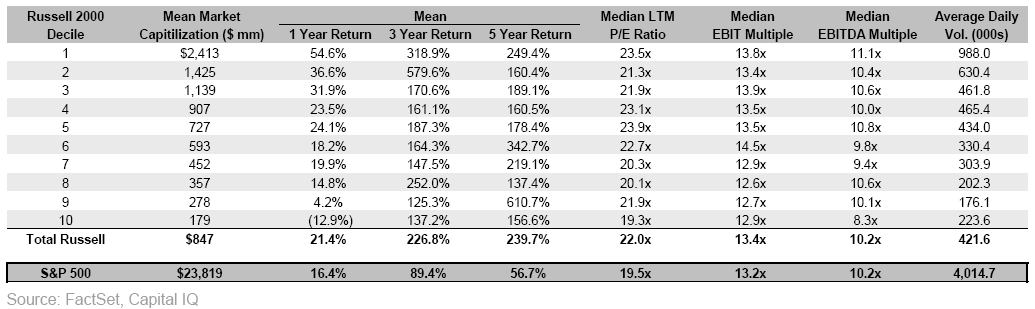
  • Over the last one-, three- and five-year periods, companies in the Russell 2000 have offered average returns of 21%, 227% and 240%, respectively, compared to S&P 500 companies with average returns of 16%, 89% and 57%, respectively.
  • The valuation gap that we saw five years ago between the bottom two deciles of companies in the Russell 2000 and the S&P 500 no longer exists, with the last two deciles in the Russell trading at only a 3% discount to the median EBIT multiple of S&P 500 companies and a 9% premium over the median P/E multiple.

(Click to embiggen)

Despite the rebound in valuations, small-cap stocks continue to face the same capital market challenges:

  • For companies with market caps between the $50 million and $250 million range, there are approximately 1.3 analysts covering each stock versus 7.7 analysts for companies with market caps of more than $250 million.
  • Trading volumes are slightly higher, with the last three deciles trading an average 202,276, 176,092 and 223,599 shares, respectively, per day, but still significantly below the volume of S&P 500 companies, which trade an average of 4.0 million shares per day.

More to come.

Read Full Post »

Back in the spring of 1999, when the world was enamored of dot coms and not much else, three guys at Piper Jaffray, Daniel J. Donoghue, Michael R. Murphy and Mark Buckley*, produced a superb research report called Wall Street’s Endangered Species. The thesis of the paper was that there were a large number of undervalued companies with strong fundamentals and solid growth prospects in the small cap sector (defined as stocks with a market capitalization between $50M and $250M) lacking a competitive auction for their shares. Donoghue, Murphy and Buckley argued that the phenomenon was secular, and only mergers or buy-outs would “close their value gap:”

Management buy-outs can provide shareholders with the attractive control premiums currently experienced in the private M&A market. Alternatively, strategic mergers can immediately deliver large cap multiples to the small cap shareholder.

I believe that this phenomenon led to the emergence of activist investors in the small cap sector over the last decade. More on this in a moment.

Endangered species report

The document is drafted from the perspective of a M&A team selling corporate advisory services. Here’s the pitch:

Many well-run and profitable public companies in the $50-250 million market capitalization range are now trading at a significant discount to the rest of the stock market. Is this a temporary, cyclical weakness in small stocks that is likely to reverse soon? No, these stocks have been permanently impaired by a shift in the economics of small cap investing. This persistent under-valuation is sure to be followed by a rise in M&A activity in the sector. We have already seen an uptick in the number of “going private” transactions and strategic mergers involving these companies. Management teams that identify this trend, and respond to it, will thrive. The inactive face extinction.

Donoghue, Murphy and Buckley’s thesis was based on the then relative underperformance of the Russell 2000 to the S&P 500:

The accompanying graph, labeled Exhibit I, illustrates just how miserably the Russell 2000 lagged the S&P 500 not only last year but in 1996 and 1997 as well. Granted, small cap returns have tended to run in cycles. Since the Depression, there have been five periods during which small cap stocks have outperformed the S&P 500 (1932-37, 1940-45, 1963-68, 1975-83, and 1991-94). It is reasonable to believe that small caps, in general, will once again have their day in the sun.

They argued that the foregoing graph was a little misleading because the entirety of the Russell 2000 universe wasn’t underperforming, just the smallest members of the index:

However, a closer look at the smallest companies within the Russell 2000 reveals a secular decline in valuations that is not likely to be reversed. The table in Exhibit II divides the Russell 2000 into deciles according to market capitalization. Immediately noticeable is the disparity between the top decile, with a median market capitalization of $1.5 billion, and the tenth decile at less than $125 million. Even more striking is the comparison of compounded annual returns for the past ten years. The data clearly demonstrates that it is not the commonly tracked small cap universe as a whole that is plagued by poor stock performance but rather the smallest of the small: companies less than about $250 million in value.

Stocks trading at a discount to private company valuations

The underperformance led to these sub-$250M market cap companies trading at a discount to private company valuations:

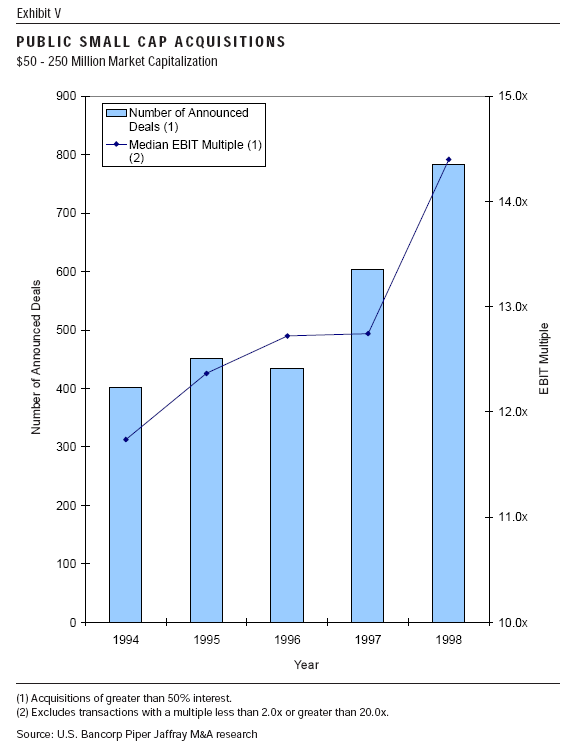
Obscurity in the stock market translates into sub-par valuations. As shown in Exhibit IV, the smaller of the Russell 2000 companies significantly lag the S&P 500 in earnings and EBIT multiples. It is startling to find that with an average EBIT multiple of 9.0 times, many of these firms are valued below the acquisition prices of private companies.

And the punchline:

Reviving shareholder value requires a fundamental change in ownership structure. Equity must be transferred out of the hands of an unadoring public, and into those of either: 1) management backed by private capital, or 2) larger companies that can capture strategic benefits. Either remedy breathes new life into these companies by providing cheaper sources of capital, and by shifting the focus away from quarterly EPS to long-term growth.

Increasing M&A activity

The market had not entirely missed the value proposition. M&A in the small cap sector was increasing in terms of price and number of transactions:

Darwin’s Darlings

Donoghue, Murphy and Buckley argued that the value proposition presented by these good-but-orphaned companies, which they called “Darwin’s darlings,” presented an attractive opportunity, described as follows:

Despite the acceleration of orphaned public company acquisitions in 1997 and 1998, there remains a very large universe of attractive public small cap firms. We sifted through the public markets, focusing on the $50-250 million market capitalization range, to construct a list of the most appealing companies. We narrowed our search by eliminating certain non-industrial sectors and ended up with over 1500 companies.

We analyzed their valuations relative to the S&P 500. The disparity is so wide that the typical S&P 500 company could pay a 50% premium to acquire the average small cap in this group without incurring earnings dilution. Those dynamics appear to be exactly what is driving small cap takeover values. The median EBIT multiple paid for small caps in 1998 was roughly equal to where the typical S&P 500 trades.

We honed in on those companies with multiples that are positive, but even more deeply discounted at less than 50% of the S&P 500. Finally, we selected only those with compounded annual EBIT growth of over 10% for the past five years. As shown in Exhibit VII, these 110 companies,“Darwin’s Darlings,” have a median valuation of only 5.8 times EBIT despite a compounded annual growth rate in EBIT of over 30% for the past five years.

The emergence of activists

Donoghue, Murphy and Buckley identified the holders of many of these so-called “Darwin’s darlings” as “small cap investment funds focused on likely take-over targets:”

As detailed in the description of our “Darwin’s Darlings” in Exhibit VIII, management ownership varies widely among these companies. For recent IPOs of family-held businesses, management stakes are generally high. For those that were corporate spin-offs, management ownership tends to be low. We frequently find large blocks of these stocks held by small cap investment funds focused on likely take-over targets, leading to a surprisingly high percentage of total insider ownership (management plus holders of more than 5%).

Regardless of ownership structure, these companies typically have the customary defensive mechanisms in place. They are also protected by the fact that they are so thinly traded. In most cases it takes more than six months to accumulate a 5% position in the stock without moving the market. Hence, we expect virtually all acquisitions in this sector to be friendly. There is no question that some very attractive targets cannot be acquired on a friendly basis. However, coercing these companies into a change of control means being prepared to launch a full proxy fight and tender offer.

In When Wall Street Scorns Good Companies, a Fortune magazine article from October 2000, writer Geoffrey Colvin asked of Darwin’s darlings, “So why are all these firms still independent?”

The answer may lie in another fact about them: On average, insiders own half their shares. When the proportion is that high, the insiders are most likely founders; they have enough stock to fend off any hostile approach, and they haven’t sold because they aren’t ready to give up control. Not many outside investors want to go along for that ride. Thus, low prices.

But there’s still a logical problem. Since the companies are so cheap, why don’t managers buy the shares they don’t already own– take the company private at today’s crummy multiple, then sell the whole shebang at an almost guaranteed higher price? Going private has in fact become more popular than ever, but what seems most striking is how rare it remains. Of Piper Jaffray’s 1999 Darwin’s Darlings– 110 companies–only three went private in the following 12 months. That makes perfect sense if you figure that many of the outfits are run by owner-managers whose top priority is keeping control. Announce a going-private transaction and you put the company in play, and even a chummy board may feel obliged to honor its fiduciary duty if a higher bid comes along.

Thus we reach the somewhat ugly truth about Wall Street’s orphaned stars: Many of them (not all) like things the way they are–that is, they like staying in control. The outsider owners are typically a diffuse bunch in no position to put heat on the controlling insiders. The stock price may be lousy, but when the owner-managers decide to sell–that is, to get out of the way–it will almost certainly rise handsomely, as it did for the 19 of last year’s Darwin’s Darlings that have since sold.

So shed no tears for these scorned companies, and don’t buy their shares without a deep understanding of what the majority owners have in mind. In theory the spreading corporate governance movement ought to protect you; in practice the shareholder activists have bigger fish to fry. Such circumstances may keep share prices down, but that’s the owner-managers’ problem. At least, in this case, the market isn’t so mysterious after all.

I believe that the third paragraph above best describes the reason for the emergence of the activists in the small cap sector. Observing that stock prices rose dramatically when owner-managers of “Wall Street’s orphaned stars” decided to sell, and outside investors were “typically a diffuse bunch in no position to put heat on the controlling insiders,” activist investors saw the obvious value proposition and path to a catalyst and entered the fray. This led to a golden decade for activist investing in the small cap sector, one that I think is unlikely to be repeated in the next decade. Regardless, it’s an interesting strategy, and an obvious extension for an investor focussed on small capitalization stocks and activist targets.

*Donoghue, Murphy and Buckley in 2002 founded Discovery Group, a fund manager and M&A advisory that takes significant ownership stakes (up to 20%) in companies trading at a discount to “fundamental economic value.”

Read Full Post »

I’m a huge fan of James Montier’s work on the rationale for a quantitative investment strategy and global Graham net net investing. Miguel Barbosa of Simoleon Sense has a wonderful interview with Montier, covering his views on behavioral investing and value investment. Particularly interesting is Montier’s concept of “seductive details” and the implications for investors:

Miguel: Let’s talk about the concept of seductive details…can you give us an example of how investors are trapped by irrelevant information?

James Montier: The sheer amount of irrelevant information faced by investors is truly staggering. Today we find ourselves captives of the information age, anything you could possibly need to know seems to appear at the touch of keypad. However, rarely, if ever, do we stop and ask ourselves exactly what we need to know in order to make a good decision.

Seductive details are the kind of information that seems important, but really isn’t. Let me give you an example. Today investors are surrounded by analysts who are experts in their fields. I once worked with an IT analyst who could take a PC apart in front of you, and tell you what every little bit did, fascinating stuff to be sure, but did it help make better investment decisions, clearly not. Did the analyst know anything at all about valuing a company or a stock, I’m afraid not. Yet he was immensely popular because he provided seductive details.

Montier’s “seductive details” is reminiscent of the discussion in Nicholas Taleb’s Fooled by Randomness on the relationship between the amount of information available to experts, the accuracy of judgments they make based on this information, and the experts’ confidence in the accuracy of these judgements. Intuition suggests that having more information should increase the accuracy of predictions about uncertain outcomes. In reality, more information decreases the accuracy of predictions while simultaneously increasing the confidence that the prediction is correct. One such example is given in the paper The illusion of knowledge: When more information reduces accuracy and increases confidence (.pdf) by Crystal C. Hall, Lynn Ariss, and Alexander Todorov. In that study, participants were asked to predict basketball games sampled from a National Basketball Association season:

All participants were provided with statistics (win record, halftime score), while half were additionally given the team names. Knowledge of names increased the confidence of basketball fans consistent with their belief that this knowledge improved their predictions. Contrary to this belief, it decreased the participants’ accuracy by reducing their reliance on statistical cues. One of the factors contributing to this underweighting of statistical cues was a bias to bet on more familiar teams against the statistical odds. Finally, in a real betting experiment, fans earned less money if they knew the team names while persisting in their belief that this knowledge improved their predictions.

This is not an isolated example. In Effects of amount of information on judgment accuracy and confidence, by Claire I. Tsai, Joshua Klayman, and Reid Hastie, the authors examined two other studies that further that demonstrate when decision makers receive more information, their confidence increases more than their accuracy, producing “substantial confidence–accuracy discrepancies.” The CIA have also examined the phenomenon. In Chapter 5 of Psychology of Intelligence Analysis, Do you really need more information?, the author argues against “the often-implicit assumption that lack of information is the principal obstacle to accurate intelligence judgments:”

Once an experienced analyst has the minimum information necessary to make an informed judgment, obtaining additional information generally does not improve the accuracy of his or her estimates. Additional information does, however, lead the analyst to become more confident in the judgment, to the point of overconfidence.

Experienced analysts have an imperfect understanding of what information they actually use in making judgments. They are unaware of the extent to which their judgments are determined by a few dominant factors, rather than by the systematic integration of all available information. Analysts actually use much less of the available information than they think they do.

Click here to see the Simoleon Sense interview.

Read Full Post »

This is a reminder that our exclusive 30% discount for the Value Investing Congress expires at midnight (PST) on March 16, 2010. On March 17, 2010 the price will go up by $1,300. Join us at the 5th Annual Value Investing Congress West, May 4 & 5, 2010, to learn from some of the world’s most successful money managers. The all-star speakers will share invaluable insights on how to navigate today’s uncertain markets ….and present their best stock picks. The wisdom you’ll gain will enhance your investing results in 2010 and beyond.

If you’re unfamiliar with the Value Investing Congress, then here’s what you need to know: One good investment idea could more than pay your cost of admission to this event and net you some great returns. The wisdom gained listening to these great investors is difficult to overstate. For a slide show of last year’s event see HERE.

Confirmed speakers include:

  • Bruce Berkowitz, Fairholme Capital Management
  • Eric Sprott, Sprott Asset Management
  • Mohnish Pabrai, Pabrai Investment Funds
  • Paul Sonkin, The Hummingbird Value Funds
  • Thomas Russo, Gardner, Russo & Gardner
  • David Nierenberg, The D3 Family Funds
  • Lloyd Khaner, Khaner Capital
  • J. Carlo Cannell, Cannell Capital
  • Patrick Degorce, Thélème Partners
  • Whitney Tilson & Glenn Tongue, T2 Partners
  • Guy Spier, Aquamarine Fund
  • Amitabh Singhi, Surefin Investments
  • Richard Vogel, Alatus SA
  • Lei Zhang, Hillhouse Gaoling Capital Management

    Click here to receive the 30% discount to VIC

    You must use discount code: P10GB8 to receive the full discount. Hurry and register!

    You’ve got exactly one week to get signed up with these savings. The regular price of the two day event is $4,295. However, Greenbackd readers pay only $2,995. That’s a 30% discount and savings of $1,300!  If you’re from out of town, the Congress has also negotiated lower room rates at the Langham Huntington for attendees.

    It’s going to be an awesome and insightful event, to say the least. Make sure you get our exclusive discount for the Value Investing Congress hereRemember that you MUST use the discount code P10GB8 to receive the full discount!

    Please let me know if you have any questions or problems when trying to register with the discount code.

    Again, the early bird rate is expiring at midnight (PST) on March 16, 2010. On March 17, 2010 the price will go up by $1,300.

    Read Full Post »

    Mean reversion is a favorite investment topic here on Greenbackd (see, for example, my posts on Mean reversion in earnings, Contrarian value investment and Lakonishok, Shleifer, and Vishny’s Contrarian Investment, Extrapolation, and Risk).

    The premise of contrarianism is mean reversion, which is the idea that stocks that have performed poorly in the past will perform better in the future and stocks that have performed well in the past will not perform as well. Benjamin Graham, quoting Horace’s Ars Poetica, described it thus:

    Many shall be restored that now are fallen and many shall fall that are now in honor.

    LSV argue in their paper that most investors don’t fully appreciate the phenomenon, which leads them to extrapolate past performance too far into the future. In practical terms it means the contrarian investor profits from other investors’ incorrect assessment that stocks that have performed well in the past will perform well in the future and stocks that have performed poorly in the past will continue to perform poorly.

    The outstanding Shadowstock blog has identified five “strong candidates for mean reversion.” To see John’s Shadowstock.com analysis, click here.

    Read Full Post »

    When I started out investing I summarized Warren Buffett’s letters to shareholders into a document I jokingly called the “Tractatus Logico-Valere.” The title, Latin errors aside, was intended to be an homage to Ludwig Wittgenstein’s Tractatus Logico-Philosophicus (which, according to Wikipedia, may in turn have been an homage to the Tractatus Theologico-Politicus by Baruch Spinoza). The idea was to create a comprehensive summary of Buffett’s investment process set out in a succinct, logical fashion. I kept Wittgenstein’s seventh and final proposition – “Whereof one cannot speak, thereof one must be silent” – as my own and interpreted it to mean “where you can’t value something, don’t invest” or “stay in your circle of competence.” My Tractatus wasn’t very good, and I’m not Warren Buffett’s shoelace. Consequently, I didn’t do very well with it. (Wittgenstein was not similarly burdened with self-doubt. Wikipedia says that he concluded that with his Tractatus he had resolved all philosophical problems, and upon its publication retired to become a schoolteacher in Austria.) My abortive experience attempting to create a comprehensive guide to earnings and growth-based investing has given me a great appreciation for those who are able to successfully create such a document and live by it. One investor who has done so is setting out his process for the world to see at The Fallible Investor.

    The author of The Fallible Investor is a private investor who has “previously worked for a private hedge fund in Bermuda and Bankers Trust in Sydney, Australia.” He calls himself The Fallible Investor because he “often makes errors when he invests, and says, “Recognising such a weakness is also useful. As Taleb says:

    Soros… knew how to handle randomness, by keeping a critical open mind and changing his opinions with minimal shame… he walked around calling himself fallible, but was so potent because he knew it while others had loftier ideas about themselves. He understood Popper. He lived the Popperian life.

    I have found particularly useful his elucidation of the linkage between return-on-invested-capital, market value, replacement value, and sustainable competitive advantage:

    I define the replacement value of a business as what the business’s assets would be worth if it’s ROIC was equal to its cost of capital.

    The market value of a business with a high ROIC and no sustainable competitive advantage should (assuming the market eventually prices a business at its intrinsic value[1]) fall to its replacement value. This should happen because if an incumbent business has a high ROIC, and no sustainable competitive advantage, other businesses will enter this industry, or expand within the industry, to seek these higher returns. These competitors will drive down the incumbent business’s profits until its ROIC declines to the average return of a commodity business. Once this occurs, the incumbent business can only be worth the cost of replacing the business’s assets.

    Professor Greenwald has another way of describing this process. He points out that if an incumbent business, with no competitive advantage, has a replacement value of $100 million and its market value is $200 million[2], competitors will drive its market value down to $100 million. Competitors will calculate that by spending $100 million to reproduce the assets of that business they can also create an enterprise with a market value higher than $100 million. These competitors will think, correctly, there is no reason for why they should have a different economic experience from the incumbent because there is nothing it can do that they cannot. Remember the incumbent business has no sustainable competitive advantage. Competitors, by reproducing the assets of the incumbent business, will increase the supply of products or services in the industry. There will now be more competition for the same business. Either prices will fall or, for differentiated products, each producer will sell fewer units. In both cases, the incumbent’s profits will decline and the market value of its business will decline with them. This process, capacity continuing to expand, and the profits and the market value of the incumbent’s business falling, will continue until the incumbent’s market value falls to the replacement value of its assets ($100 million). Its competitors will suffer the same fate.

    Greenwald points out that while this process does not happen smoothly or automatically it will eventually turn out this way. It happens because the incentives for businesspeople to take advantage of the market’s excessive valuation of the incumbent’s business are too powerful.[3]

    The market value of a business with a sustainable competitive advantage can, by contrast, stay much higher than its replacement value simply because it can sustain a high ROIC.

    [1] The intrinsic value of a business is what I think the business is worth to a rational businessperson.

    [2] Assuming the business has a high market value because it has a high ROIC.

    [3] P38, ‘Value Investing: From Graham To Buffett And Beyond’, Bruce Greenwald et al, 2001.

    The Fallible Investor has provided me with a full copy of his notes. I highly recommend following his posts as he sets out his investment process on the site.

    Read Full Post »

    Dr. Michael Burry has received a great deal of well-deserved attention recently as a result of Michael Lewis’s The Big Short and the Vanity Fair article Betting on the Blind Side. Yesterday a reader provided a link to Burry’s techstocks.com “Value Investing” thread (now Silicon Investor) and today another reader has supplied a link to Burry’s Scion Capital investor letters. The site also sets out a time-line of Burry’s commentary on the financial crisis illustrating that, though it was not prevented, it was “eminently predictable and preventable”.

    Burry is a superb writer. Here is a brief extract from the first quarter 2001 letter:

    When I stand on my special-issue “Intelligent Investor” ladder and peer out over the frenzied crowd, I see very few others doing the same. Many stocks remain overvalued, and speculative excess – both on the upside and on the downside – is embedded in the frenzy around stocks of all stripes. And yes, I am talking about March 2001, not March 2000.

    In essence, the stock market represents three separate categories of business. They are, adjusted for inflation, those with shrinking intrinsic value, those with approximately stable intrinsic value, and those with steadily growing intrinsic value. The preference, always, would be to buy a long-term franchise at a substantial discount from growing intrinsic value.

    However, if one has been playing the buy-and-hold game with quality securities, one has been exposed to a substantial amount of market risk because the valuations placed on these securities have implied overly rosy scenarios prone to popular revision in times of more realistic expectation. This is one of those times, but it is my feeling that the revisions have not been severe enough, the expectations not yet realistic enough. Hence, the world’s best companies largely remain overpriced in the marketplace.

    The bulk of the opportunities remain in undervalued, smaller, more illiquid situations that often represent average or slightly above-average businesses – these stocks, having largely missed out on the speculative ride up, have nevertheless frequently been pushed down to absurd levels owing to their illiquidity during a general market panic. I will not label this Fund a “small cap” fund, for this may not be where the best opportunities are next month or next year. For now, though, the Fund is biased toward smaller capitalization stocks. As for the future, I can only say the Fund will always be biased to where the value is. If recent trends continue, it would not be surprising to find the stocks of several larger capitalization stocks with significant long-term franchises meet value criteria and hence become eligible for potential addition to the Fund.


    Buy my book The Acquirer’s Multiple: How the Billionaire Contrarians of Deep Value Beat the Market from on Kindlepaperback, and Audible.

    Here’s your book for the fall if you’re on global Wall Street. Tobias Carlisle has hit a home run deep over left field. It’s an incredibly smart, dense, 213 pages on how to not lose money in the market. It’s your Autumn smart read. –Tom Keene, Bloomberg’s Editor-At-Large, Bloomberg Surveillance, September 9, 2014.

    Click here if you’d like to read more on The Acquirer’s Multiple, or connect with me on Twitter, LinkedIn or Facebook. Check out the best deep value stocks in the largest 1000 names for free on the deep value stock screener at The Acquirer’s Multiple®.

    Read Full Post »

    The superb Manual of Ideas blog has an article by Ravi Nagarajan, Marty Whitman Reflects on Value Investing and Net-Nets, on legendary value investor Marty Whitman’s conversation with Columbia Professor Bruce Greenwald at the Columbia Investment Management Conference in New York. I have in the past discussed Marty Whitman’s adjustments to Graham’s net net formula, which I find endlessly useful. Whitman has some additional insights that I believe are particularly useful to net net investors:

    “Cheap is Not Sufficient”

    At several points in the discussion with Prof. Greenwald, Mr. Whitman came back to a central theme:  It is not sufficient for a security to be “cheap”.  It must also possess a margin of safety as demonstrated by a strong balance sheet and overall credit worthiness.   In other words, there are many securities that may appear cheap statistically based on a number of common criteria investors use to judge “cheapness”.  This might include current year earnings compared to the stock price, current year cash flow, and many others.  However, if the business does not have a durable balance sheet, adverse situations that are either of the company’s own making or due to macroeconomic factors can determine the ultimate fate of the company.  A durable balance sheet demonstrates the credit worthiness a business needs to manage through periodic adversity.

    Whitman also discusses an issue near and dear to my heart: good corporate governance, and, by implication, activism:

    One other point that Mr. Whitman made while discussing corporate governance also applies to many net-net situations.  The true value of a company may never come out if there is no threat of a change in control.  This obviously makes intuitive sense because the presence of a very cheap company alone will not result in realization of value unless management is willing to act in the interests of shareholders either by liquidating a business that has no future prospects but a very liquid balance sheet or taking steps to improve the business.

    Read the balance of the article at The Manual of Ideas blog.

    Read Full Post »

    Michael Burry is a value investor notable for being one of the first, if not the first, to short sub-prime mortgage bonds in his fund, Scion Capital. He figures prominently in the Gregory Zuckerman’s book, The Greatest Trade Ever, and also in The Big Short, Michael Lewis’s contribution to the sub-prime mortgage bond market crash canon. In Betting on the Blind Side, Lewis excerpts The Big Short, which describes Burry’s short position in some detail, how he figured out that the bonds were mispriced, and how he bet against them (no small effort because the derivatives to do so didn’t exist when he started looking for them. He had to “prod the big Wall Street firms to create them.”).

    Here Lewis describes Burry’s entry into value investing:

    Late one night in November 1996, while on a cardiology rotation at Saint Thomas Hospital, in Nashville, Tennessee, he logged on to a hospital computer and went to a message board called techstocks.com. There he created a thread called “value investing.” Having read everything there was to read about investing, he decided to learn a bit more about “investing in the real world.” A mania for Internet stocks gripped the market. A site for the Silicon Valley investor, circa 1996, was not a natural home for a sober-minded value investor. Still, many came, all with opinions. A few people grumbled about the very idea of a doctor having anything useful to say about investments, but over time he came to dominate the discussion. Dr. Mike Burry—as he always signed himself—sensed that other people on the thread were taking his advice and making money with it.

    Once he figured out he had nothing more to learn from the crowd on his thread, he quit it to create what later would be called a blog but at the time was just a weird form of communication. He was working 16-hour shifts at the hospital, confining his blogging mainly to the hours between midnight and three in the morning. On his blog he posted his stock-market trades and his arguments for making the trades. People found him. As a money manager at a big Philadelphia value fund said, “The first thing I wondered was: When is he doing this? The guy was a medical intern. I only saw the nonmedical part of his day, and it was simply awesome. He’s showing people his trades. And people are following it in real time. He’s doing value investing—in the middle of the dot-com bubble. He’s buying value stocks, which is what we’re doing. But we’re losing money. We’re losing clients. All of a sudden he goes on this tear. He’s up 50 percent. It’s uncanny. He’s uncanny. And we’re not the only ones watching it.”

    Mike Burry couldn’t see exactly who was following his financial moves, but he could tell which domains they came from. In the beginning his readers came from EarthLink and AOL. Just random individuals. Pretty soon, however, they weren’t. People were coming to his site from mutual funds like Fidelity and big Wall Street investment banks like Morgan Stanley. One day he lit into Vanguard’s index funds and almost instantly received a cease-and-desist letter from Vanguard’s attorneys. Burry suspected that serious investors might even be acting on his blog posts, but he had no clear idea who they might be. “The market found him,” says the Philadelphia mutual-fund manager. “He was recognizing patterns no one else was seeing.”

    Lewis discusses Burry’s perspective on value investing:

    “The late 90s almost forced me to identify myself as a value investor, because I thought what everybody else was doing was insane,” he said. Formalized as an approach to financial markets during the Great Depression by Benjamin Graham, “value investing” required a tireless search for companies so unfashionable or misunderstood that they could be bought for less than their liquidation value. In its simplest form, value investing was a formula, but it had morphed into other things—one of them was whatever Warren Buffett, Benjamin Graham’s student and the most famous value investor, happened to be doing with his money.

    Burry did not think investing could be reduced to a formula or learned from any one role model. The more he studied Buffett, the less he thought Buffett could be copied. Indeed, the lesson of Buffett was: To succeed in a spectacular fashion you had to be spectacularly unusual. “If you are going to be a great investor, you have to fit the style to who you are,” Burry said. “At one point I recognized that Warren Buffett, though he had every advantage in learning from Ben Graham, did not copy Ben Graham, but rather set out on his own path, and ran money his way, by his own rules.… I also immediately internalized the idea that no school could teach someone how to be a great investor. If it were true, it’d be the most popular school in the world, with an impossibly high tuition. So it must not be true.”

    Investing was something you had to learn how to do on your own, in your own peculiar way. Burry had no real money to invest, but he nevertheless dragged his obsession along with him through high school, college, and medical school. He’d reached Stanford Hospital without ever taking a class in finance or accounting, let alone working for any Wall Street firm. He had maybe $40,000 in cash, against $145,000 in student loans. He had spent the previous four years working medical-student hours. Nevertheless, he had found time to make himself a financial expert of sorts. “Time is a variable continuum,” he wrote to one of his e-mail friends one Sunday morning in 1999: “An afternoon can fly by or it can take 5 hours. Like you probably do, I productively fill the gaps that most people leave as dead time. My drive to be productive probably cost me my first marriage and a few days ago almost cost me my fiancée. Before I went to college the military had this ‘we do more before 9am than most people do all day’ and I used to think I do more than the military. As you know there are some select people that just find a drive in certain activities that supersedes everything else.” Thinking himself different, he didn’t find what happened to him when he collided with Wall Street nearly as bizarre as it was.

    And I love this story about his fund:

    In Dr. Mike Burry’s first year in business, he grappled briefly with the social dimension of running money. “Generally you don’t raise any money unless you have a good meeting with people,” he said, “and generally I don’t want to be around people. And people who are with me generally figure that out.” When he spoke to people in the flesh, he could never tell what had put them off, his message or his person. Buffett had had trouble with people, too, in his youth. He’d used a Dale Carnegie course to learn how to interact more profitably with his fellow human beings. Mike Burry came of age in a different money culture. The Internet had displaced Dale Carnegie. He didn’t need to meet people. He could explain himself online and wait for investors to find him. He could write up his elaborate thoughts and wait for people to read them and wire him their money to handle. “Buffett was too popular for me,” said Burry. “I won’t ever be a kindly grandfather figure.”

    This method of attracting funds suited Mike Burry. More to the point, it worked. He’d started Scion Capital with a bit more than a million dollars—the money from his mother and brothers and his own million, after tax. Right from the start, Scion Capital was madly, almost comically successful. In his first full year, 2001, the S&P 500 fell 11.88 percent. Scion was up 55 percent. The next year, the S&P 500 fell again, by 22.1 percent, and yet Scion was up again: 16 percent. The next year, 2003, the stock market finally turned around and rose 28.69 percent, but Mike Burry beat it again—his investments rose by 50 percent. By the end of 2004, Mike Burry was managing $600 million and turning money away. “If he’d run his fund to maximize the amount he had under management, he’d have been running many, many billions of dollars,” says a New York hedge-fund manager who watched Burry’s performance with growing incredulity. “He designed Scion so it was bad for business but good for investing.”

    Thus when Mike Burry went into business he disapproved of the typical hedge-fund manager’s deal. Taking 2 percent of assets off the top, as most did, meant the hedge-fund manager got paid simply for amassing vast amounts of other people’s money. Scion Capital charged investors only its actual expenses—which typically ran well below 1 percent of the assets. To make the first nickel for himself, he had to make investors’ money grow. “Think about the genesis of Scion,” says one of his early investors. “The guy has no money and he chooses to forgo a fee that any other hedge fund takes for granted. It was unheard of.”

    Hat tip Bo.

    Read Full Post »

    « Newer Posts - Older Posts »