Feeds:
Posts
Comments

Archive for the ‘Net Net Stocks’ Category

Biotechnology Value Fund (BVF) announced that it has commenced its cash tender offer to purchase any and all of the outstanding common stock of Avigen Inc (NASDAQ: AVGN) that BVF does not own at $1.00 per share.

We’ve been following AVGN (see archived posts here) because it’s a net cash stock (i.e. it’s trading at less than the value of its cash after deducting all liabilities) and specialist biotechnology activist fund BVF has been pushing it to liquidate and return its cash to shareholders. MediciNova Inc (NASDAQ:MNOV) has made an offer for AVGN that represents a clever way for AVGN’s stockholders to receive cash equivalent to that which they would receive in a liquidation (less $7M to be paid to MNOV) with the possibility for “an extraordinary, uncapped return” if MNOV is successful post-merger. We estimate AVGN’s cash at around $1.22 per share (BVF estimates $1.20 per share), which is a little less than 40% higher than AVGN’s $0.92 close yesterday.

BVF’s press release reads as follows:

BVF Acquisition LLC (the “Purchaser”), a wholly owned subsidiary of Biotechnology Value Fund, L.P. (“BVF”), announced today that it has commenced a cash tender offer to purchase any and all of the outstanding common stock of Avigen, Inc. (NasdaqGM: AVGN) (“Avigen”) that BVF does not own at a price of $1.00 per share under the conditions described below. The offer price represents a 35% premium over Avigen’s closing stock price of $0.74 on January 8, 2009, the day prior to BVF’s announcement that it was seeking to remove all incumbent Avigen directors and to elect its own slate of stockholder focused nominees (the “BVF Nominees”). BVF Partners L.P., the general partner of BVF, beneficially owns an aggregate of 8,819,600 shares of Avigen, or approximately 29.63% of the outstanding shares.

The offer is currently scheduled to expire at 12:00 midnight, New York City time, on February 23, 2009, unless the offer is extended.

On January 9, 2009, BVF delivered a notice to Avigen to call a special meeting of stockholders to remove all incumbent directors and elect the BVF Nominees, among other things. As described below, a condition to this tender offer is the BVF Nominees being elected to Avigen’s Board of Directors at this special meeting of stockholders, or otherwise appointed, and constituting a majority of the directors on the Avigen board. If elected, the BVF Nominees, subject to their fiduciary duties, intend to pursue negotiations with MediciNova, Inc., related to a proposed merger with Avigen, and work to consummate the proposed merger expeditiously. Assuming the conditions to this Offer are satisfied, stockholders of Avigen would have the choice of (i) tendering their shares and receiving a fixed cash payment upon the closing of this tender offer at a premium to the market price on the day prior to both the announcement of this tender offer and the announcement that BVF was seeking to remove all incumbent Avigen directors and to elect the BVF Nominees, or (ii) maintaining their investment in Avigen and participating in the proposed merger with MediciNova, Inc., if it occurs.

The tender offer is conditioned upon, among other things, (i) the BVF Nominees being elected to Avigen’s board of directors at a special meeting of stockholders called for that purpose, or otherwise appointed, and constituting a majority of directors on Avigen’s board, (ii) the Avigen board redeeming the poison pill rights issued and outstanding under Avigen’s Poison Pill Rights Plan, or the Purchaser being satisfied in its reasonable discretion that the Poison Pill Rights are otherwise inapplicable to this tender offer, the Purchaser or any affiliate or associate of the Purchaser and (iii) Avigen not having authorized, recommended, proposed, announced its intent to enter into or entered into an agreement with respect to or effected any merger, consolidation, liquidation, dissolution, business combination, acquisition of assets, disposition of assets, alternative strategy or relinquishment of any material contract or other right of Avigen or any comparable event or capital depleting transaction not in the ordinary course of business. The tender offer is not subject to any financing condition.

The text of the offer to purchase is attached here.

[Full Disclosure: We have a holding in AVGN. This is neither a recommendation to buy or sell any securities. All information provided believed to be reliable and presented for information purposes only.]
Read Full Post »

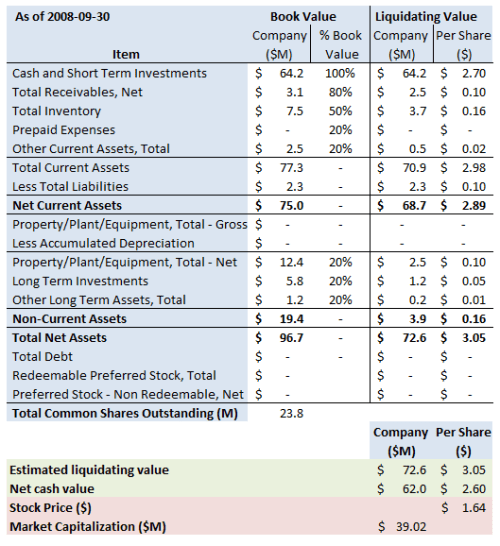
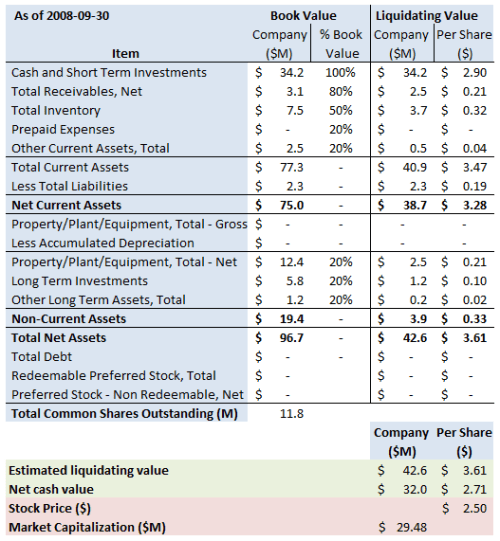
MEMSIC INC (NASDAQ:MEMS) is a deeply undervalued net net stock and the second installment in our Catalyst Wanted series. At its $1.64 close yesterday, MEMS has a market capitalization of $39M. We estimate its liquidating value to be around 86% higher at $72M or $3.05 per share. Its liquidating value is predominantly cash, so much so that MEMS has net cash of around $62M or $2.60 per share, which is around 60% higher than its stock price.

About MEMS

MEMS provides semiconductor sensors based on micro electro-mechanical systems. Its accelerometers are used to measure tilt, shock, vibration and acceleration in a range of mobile phones, automotive safety systems and video projectors. The company’s investor relations website can be found here.

The value proposition

Like TRID yesterday, MEMS has an veritable treasure trove on its balance sheet (the “Book Value” column shows the assets as they are carried in the financial statements, and the “Liquidating Value” column shows our estimate of the value of the assets in a liquidation):

mems-summary

According to its most recent 10Q, MEMS’ cash and equivalents are invested in money market funds and auction rate securities. As of September 30, 2008, MEMS’ investments included $5.8 million of auction rate securities. Auction rate securities are generally long-term fixed income instruments that provide liquidity through a Dutch auction process that resets the applicable interest rate at pre-determined calendar intervals, typically every 7, 28, 35 or 49 days. These investments have high credit quality ratings of at least AAA/Aaa. Due to recent liquidity issues, certain of the auction rate securities MEMS holds have failed at auction, meaning that the amount of securities submitted for sale at auction exceeded the amount of purchase orders. If an auction fails, the issuer becomes obligated to pay interest at penalty rates, and all of the auction rate securities MEMS holds continue to pay interest in accordance with their stated terms. However, the failed auctions create uncertainty as to the liquidity in the near term of these securities. As a result, MEMS has classified the $5.8 million of auction rate securities it held at September 30, 2008 as long-term investments. We have applied an 80% discount to those securities.

MEMS not have any off-balance sheet financing arrangements other than property and equipment operating leases, the value of which is not disclosed in the financial statements. It does not have any transactions, arrangements or other relationships with any special purpose entities established for its benefit.

The catalyst?

None. MEMS is using the cash on its balance sheet to construction a facility in Wuxi China. The company expects to complerte the first phase in the first quarter of 2009 at a total cost of $6M. The company expects to complete the second phase within three years at a total cost of $30M. Other significant cash outlays primarily consist of salaries, wages and commissions.

The construction of the Wuxi facility, and in particular the second phase of the Wuxi facility, seems to us to be an investment that carries significant risk in the present environment. We’d suggest that a better use for the cash at this time would be to buy back the company’s stock given the huge discount to its cash backing. If the company was to redirect the $30M to stock repurchases at the present stock price, we estimate that the company’s value would increase more than 150%. It might not be realistic to complete the buy-back at this level. If we were to assume a more realistic number, say $2.50, which is 50% higher than the current stock price but still at a discount to its per share cash backing, the balance sheet looks like this:

mems-summary-post-buy-back2

If the $30M buy-back is completed at $2.50, the liquidating value of the company increases around 20% from $3.05 to $3.60. If we assume that the stock price trades up to the new liquidating value as a result of the company’s new shareholder-oriented management, investors buying in at the present $1.64 stock price see the stock appreciate 120%.

Conclusion

Without a positive catalyst, MEMS will probably remain as a net cash stock for a long time. Despite its deep discount to its cash backing, MEMS is no real bargain without more shareholder-oriented management. This is another stock we’ll keep on our watchlist and let you know if anyone takes it on.

MEMS closed yesterday at $1.64.

The S&P500 Index closed yesterday at 840.24.

[Full Disclosure:  We do not have a holding in MEMS. This is neither a recommendation to buy or sell any securities. All information provided believed to be reliable and presented for information purposes only. Do your own research before investing in any security.]

Read Full Post »

Autobytel Inc (NASDAQ:ABTL) has amended its stockholder rights plan in response to Trilogy, Inc. increasing its stake to 7.4%. ABTL’s most recent filing attaches the following press release:

Autobytel Inc. (NASDAQ: ABTL) today announced that it has amended its stockholder rights plan to permit CCM Master Qualified Fund, Ltd., Coghill Capital Management, L.L.C. and Clint Coghill to acquire collective beneficial ownership of more than 15% of Autobytel’s common stock without triggering Autobytel’s stockholder rights plan. In connection with the amendment to the stockholder rights plan, Autobytel also entered into a standstill agreement with CCM, Coghill Capital and Mr. Coghill that contains certain standstill provisions and prohibits CCM, Coghill Capital and Mr. Coghill from taking certain specified actions, including, among other things, a prohibition on any actions that would attempt to direct or influence the management, Board of Directors or policies of Autobytel. The standstill restrictions apply for as long as CCM, Coghill Capital and Mr. Coghill collectively beneficially own in excess of 9.7% of Autobytel’s common stock.

Jeffrey Coats, Chief Executive Officer of Autobytel, stated: “Coghill Capital has been a valued long-term investor in Autobytel, and Autobytel appreciates Coghill Capital’s continued support of the Company. Autobytel looks forward to working with all of our stockholders to maximize stockholder value.”

ABTL is up 14% to $0.49 since we started following it in December last year. We see its liquidation value around 60% higher at $35.3M or $0.78 per share.

[Full Disclosure: We do not have a holding in ABTL. This is neither a recommendation to buy or sell any securities. All information provided believed to be reliable and presented for information purposes only.]

Read Full Post »

We’ve recently received several questions about our valuation methodology. Specifically, readers have asked why we include property, plant and equipment in our valuation, and why we only discount it by half, as opposed to a higher figure (two-thirds, four-fifths, one-hundred percent). They are concerned that by including property, plant and equipment in our assessment, or by failing to apply a sufficient discount to those assets, we are overstating the asset or liquidation value of the companies we cover and therefore overpaying for their stock. In this post, we better describe our approach to asset valuation. In the next post, we deal with our method for protecting ourselves from overpaying for stock.

Our valuation methodology is closely based on Benjamin Graham’s approach, which he set out in Security Analysis and The Interpretation of Financial Statements. Like Graham, we have a strong preference for current assets, and, in particular, cash. As we mention on the About Greenbackd page, our favorite stocks are those backed by greenbacks, hence our name: Greenbackd. We love to find what Graham described as gold-dollars-with-strings-attached that can be purchased for 50 cents. We believe that there is value in long-term and fixed assets, although not necessarily the value at which those assets are carried in the financial statements. The appropriate discount for long-term and fixed assets is something with which we (and we suspect other Grahamite / asset / liquidation investors) struggle. We think it’s useful to consider Graham’s approach, which we’ve set out below:

Graham’s approach to valuing long-term and fixed assets

Graham’s preference was clearly for current assets, as this quote from Chapter XXIV of The Interpretation of Financial Statements: The Classic 1937 Edition demonstrates:

It is particularly interesting when the current assets make up a relatively large part of the total assets, and the liabilities ahead of the common are relatively small. This is true because the current assets usually suffer a much smaller loss in liquidation than do the fixed assets. In some cases of liquidation it happens that the fixed assets realize only about enough to make up the shrinkage in the current assets.

Hence the “net current asset value” of an industrial security is likely to constitute a rough measure of its liquidating value. It is found by taking the net current assets (or “working capital”) alone and deducting therefrom the full claims of all senior securities. When a stock is selling at much less than its net current asset value, this fact is always of interest, although it is by no means conclusive proof that the issue is undervalued.

Despite Graham’s cautionary tone above, he did not necessarily exclude long-term and fixed assets from his assessment of value. He did, however, heavily discount those assets (from Chapter XLIII of Security Analysis: The Classic 1934 Edition “Significance of the Current Asset Value”):

The value to be ascribed to the assets however, will vary according to their character. The following schedule indicates fairly well the relative dependability of various types of assets in liquidation.

liquidation-value-schedule2

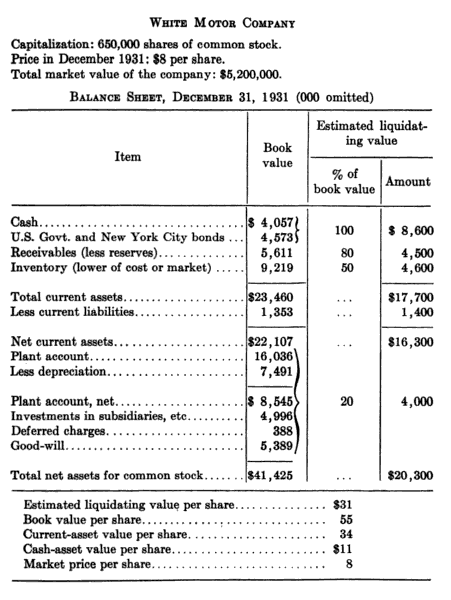
Graham then set out an example valuation for White Motor Company:

In studying this computation it must be borne in mind that our object is not to determine the exact liquidating value of White Motor, but merely to form a rough idea of this liquidating value in order ascertain whether or not the shares are selling for less than the stockholders could actually take of the business. The latter question is answered very definitively in the affirmative. With a full allowance for possible error, there was no doubt at all that White Motor would liquidate for a great deal more than $8 per share or $5,200,000 for the company. The striking fact that the cash assets alone considerably exceed this figure, after deducting all liabilities, completely clinched the argument on this score.

white-motor-example1

Current-asset Value a Rough Measure of Liquidating Value. – The estimate values in liquidation as given for White Motor are somewhat lower in respect of inventories and somewhat higher as regards the fixed and miscellaneous assets than one might be inclined to adopt in other examples. We are allowing for the fact that motor-truck inventories are likely to be less salable than the average. On the other hand some of the assets listed as noncurrent, in particular the investment in White Motor Securities Corporation, would be likely to yield a larger proportion of their book values than the ordinary property account. It will be seen that White Motor’s estimated liquidating value (about $31 per share) is not far from the current-asset value ($34 per share). In the typical case it may be said that the noncurrent assets are likely to realize enough to make up most of the shrinkage suffered in the liquidation of the quick assets. Hence our first thesis, viz., that the current-asset value affords a rough measure of the liquidating value.

Greenbackd’s approach to valuing long-term and fixed assets

The first thing to note is that we’ve got no particular insight into any of the companies that we write about or the actual value of the companies’ assets. The valuations are based on the same generalized, unsophisticated, purely mathematical application of Graham’s formula. Further, if the actual value of an asset is objectively known or determinable, then we don’t know it and, in most cases, can’t determine it. That puts us at a disadvantage to those who do know the assets’ real value or can make that determination. Secondly, we can’t make the fine judgements about value that Graham has made in the White Motor example above. Perhaps it’s blindingly obvious that “motor-truck inventories are likely to be less salable than the average,” but we don’t know anything about motor-truck inventories or the average. It’s specific knowledge that we don’t have, which means that we are forced to mechanically apply the same discount to all assets of the same type.

Given that we’ve disclaimed any ability to actually value an asset or class of assets, why not adopt the lower to middle end of Graham’s valuation range for those assets? (Editors note: What a good suggestion. From here on in, we’re taking Graham’s advice. It’s simply because, in our experience, as idiosyncratic as it has been, an 80% discount to property, plant and equipment is too much in most instances. We think that 50% is a conservative estimate. In our limited experience, commercial and industrial real estate rarely seems to sell at much less than 15% below book value, and that’s in the recent collapse.) At first blush, specialist plant and equipment might appear to be worthless because the resale market is too small, but it can also be sold at a premium to its carrying value. For example, in the recent resources boom, we heard from an acquaintance in the mining industry that mining truck tires were so scarce as to sell in many instances at a higher price second hand than new. Apparently entire junked mining trucks were purchased in one country and shipped to another simply for the tires. Without that specialist knowledge of the mining industry, one might have ascribed a minimal value to an irreparable mining truck or a pile of used mining truck tires and missed the opportunity. What these examples demonstrate, in our opinion, is that the sale price for an asset to be sold out of liquidation is extremely difficult to judge until the actual sale, by which time it’s way too late to make an investment decision.

The best that we can do is fix a point at which we feel that we a more likely to be right than wrong about the value but will also have enough opportunities to invest to make the exercise worthwhile. For us, that point is roughly 20% 50% for property, plant and equipment. That 20% 50% is not based on anything more than (Edit: Graham’s formula, which has stood the test of time and should be applied in most cases unless one has a very good reason not to do so our limited experience, which is insufficient to be statistically significant for any industry or sector, geographical location or time in the investment cycle.) We always set out for our readers our estimate so that you can amend our valuation if you think it’s not conservative enough or just plain wrong (if you do make that amendment, we’d love to hear about it, so that we can adjust our valuation in light of a better reasoned valuation).

We hope that this sheds some light on our process. We’d love to hear your thoughts on the problems with our reasoning.

Read Full Post »

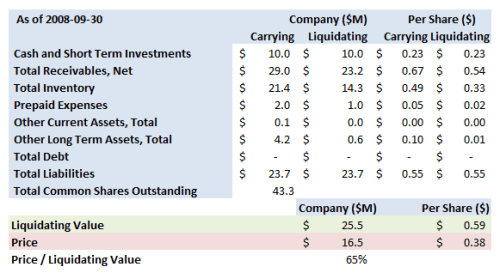
Network Engines Inc (NASDAQ:NENG) is a perennial inclusion on lists of net net stocks and so it should come as no surprise to see it back in net net land. In November 2007, an activist investor, Trinad Management, pushed the company to “immediately [implement] a share buy-back program.” The company demurred and has now seen its stock sink to all-time lows. In after-hours trading yesterday, NENG was up a little from those lows to $0.38 (it closed yesterday at $0.40), which gives it a market capitalization of $16.5M. We estimate its liquidation value at around 55% higher at $25.5M or $0.59 per share.

About NENG

NENG develops and manufactures application platform solutions that enable original equipment manufacturers, independent software vendors, and service providers to deliver software applications in the form of a network-ready device. The company offers application platform customers a suite of services associated with the design, development, manufacturing, brand fulfillment and post-sale support of these devices. It produces and fulfills devices for its customers, and derives revenues primarily from the sale of value-added hardware platforms to these customers. These customers subsequently resell and support the platforms under their own brands to their customer base. The company’s investor relations website can be found here.

The value proposition

NENG’s earnings and cash flow are patchy (its most recent 10K can be found here). Earnings have fallen in each of the last five quarters from $1.8M in the 2007 September quarter to -$9.7M in the 2008 September quarter. Cash from operating activities has been as high as $10.6M in the 12-months ending September 2007 and as low as -$5.4M in the preceding 12 months. As a result,   there is some vestigial value on the balance sheet (the “Carrying” column shows the assets as they are carried in the financial statements, and the “Liquidating” column shows our estimate of the value of the assets in a liquidation):

neng-summary

NENG has $29M in receivables that we’ve written down by 20% to $23.2M or $0.54 per share, inventory of $21.4M that we’ve discounted by 33% to $14.3M or $0.33 per share and cash in the amount of $10M or $0.23 per share. The company has no debt. Deducting liabilities of $23.7M or $0.55 per share, we estimate NENG’s liquidation value at around $25.5M or $0.59.

NENG’s most recent 10K specifically sets out that it is not party to any special-purpose or off balance sheet entities created for the purpose of raising capital, incurring debt or operating parts of its business that are not consolidated into its financial statements.

The catalyst

Trinad Management filed its original 13D in November 2007 disclosing a 6.4% holding in NENG and attaching the following letter to NENG’s board:

The Board of Directors Network Engines, Inc.
25 Dan Road
Canton, MA 02021
Dear Board Members:

We support Greg Shortell and the new management team at Network Engines and are encouraged by their accomplishments to date. We believe the focus of the sales and marketing efforts on diversifying the company’s customer base is yielding results and should allow for the continued generation of substantial free cash flow from operations.

Furthermore, we approve of management’s decision to acquire Alliance Systems, Inc. In our estimation, this acquisition should significantly increase shareholder value. It is our belief that the Company can realize increased sales through product portfolio expansion and cross selling opportunities. At the same time, synergies of the acquisition have provided Network Engines with the opportunity to significantly grow its business. The post-acquisition Network Engines should achieve economies of scale and will likely incur integration savings during FY 2008. The Alliance Systems acquisition and the shift in sales and marketing focus should result in an improved ability to successfully execute its business strategy.

Taking these positive events and Network Engines’ current and long term commitments into account, our financial analysis suggests that the Company currently has approximately $10 million in cash on its balance sheet and no funded indebtedness. In addition, our conservative projections indicate that the Company will generate an additional $10 million (or more) in free cash flow during the next 12 months. Accordingly, we strongly believe that this board and management has an obligation to dedicate a portion of its cash reserve and free cash flow to projects which have the greatest return to shareholders such as a share buy-back program. We request that the Board of Directors consider whether shareholder returns on other proposed uses of these excess funds are indeed superior to a share buy-back.

The Company’s stock hit a new 52 week low today (November 15, 2007) despite the impressive efforts and results posted by this management team. We appeal to the Board of Directors to consider immediately implementing a share buy-back program as it is in the best long-term interest of both the Company and its shareholders.

We believe that the Company is significantly undervalued and that a share buy-back program would improve investors’ overall perception of Network Engines’ equity value. Such a program could result in a reduction in the relative value discount currently applied to Network Engines’ stock by the investor community, by amongst other things demonstrating that this Board has confidence in the Company’s ability to execute its business plan. If the Board were to apply the same valuation metrics to its own stock as it did to the recently completed acquisition of Alliance Systems Inc., they would undoubtedly conclude that at these price levels the Company’s shares represent an equal or greater value than Alliance Systems. Most importantly, a smartly implemented buyback program could allow the company to materially reduce its number of outstanding shares thereby generating long term shareholder value in the most tax efficient manner. As a significant equity holder and long term investor, this is of far greater value then any short term impact to share price.

We encourage the Board of Directors and management to consider and adopt this strategy immediately and speak with other shareholders of the Company who may be equally frustrated and share our views. We would be willing to meet with the Board of Directors and work collaboratively to assist with the development of a long-term value creation plan that would benefit all shareholders.
Sincerely,

/s/ Jay Wolf
Trinad Management, LLC

Trinad Management continued to buy stock in NENG, disclosing in an amended 13D a slightly increased 6.98% holding in July last year.

Conclusion

As we mentioned in the introduction, NENG is a perennial net net stock. Jonathan Heller of Cheap Stocks-fame mentioned it back in October 2005 in a list of the Top 20 Market Cap Companies Trading Below Net Current Asset Value. It was then trading around $1.30 against a net current asset value of around $1.31. Investors buying back in October 2005 had plenty of opportunity to unload the stock at a profit while it traded up to $3.17 in March 2006. NENG’s stock has since dropped pretty consistently to its present $0.38, but its liquidating value has not fallen as far. At $0.59 per share, NENG’s liquidation value is 55% higher than its stock price, which is a significant margin of safety. We’re adding it to the Greenbackd Portfolio at $0.38.

NENG traded after hours yesterday at $0.38.

The S&P500 Index closed yesterday at 870.26.

[Full Disclosure:  We do not have a holding in NENG. This is neither a recommendation to buy or sell any securities. All information provided believed to be reliable and presented for information purposes only. Do your own research before investing in any security.]

Read Full Post »

Trilogy, Inc. has increased its stake in Autobytel Inc (NASDAQ:ABTL). On November 21, 2008, Trilogy, Inc. filed its Schedule 13D notice, declaring an interest of 5.01%. Trilogy, Inc has now filed an updated 13D notice, disclosing an increased 7.4% stake.

We started following ABTL last year because it was a net net stock with a market capitalization of $19.4M at its December 10, 2008 close of $0.43. We estimated the company’s liquidation value some 80% higher at $35.3M or $0.78 per share. Although the stock has risen some 18.6% to close Friday at $0.51, ABTL is still worth 50% more than its stock price indicates so we plan to maintain our position.

[Disclosure: We do not have a holding in ABTL. This is neither a recommendation to buy or sell any securities. All information provided believed to be reliable and presented for information purposes only.]
Read Full Post »

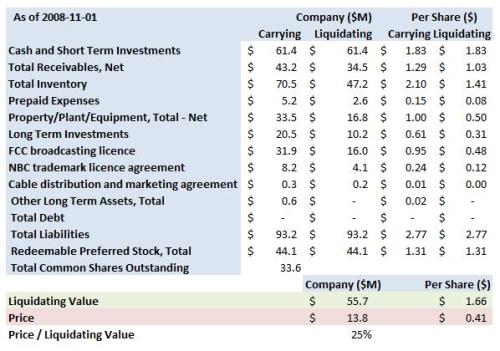
ValueVision Media Inc. (NASDAQ:VVTV), which we posted about on Wednesday last week, has filed its November 10Q. In our earlier post, we wrote that VVTV seemed to us to be one of the better opportunities available because it’s a net net stock (i.e. a stock trading for less than its net current assets) with other valuable assets and noted activist investor Carlo Cannell of Cannell Capital has an activist position in it. The company also seemed to us to be taking steps to realise that value, publicly announcing that it has appointed a special committee of independent directors to “review strategic alternatives to maximize stockholder value.” The strategic alternative the company was pursuing was an auction that the company expected to complete by February 2, 2009. At $1.66 per share, VVTV’s liquidating value is still some 300% higher than its close yesterday of $0.41, which should provide a good margin of safety until the auction can be completed.

Updated value proposition

When we first looked at the company we wrote that we estimated its liquidating value, which included its property, FCC broadcasting licence, NBC trademark licence agreement and the Cable distribution and marketing agreement, at around $2.23 per share. We now see that value lower at $1.66 per share due to the increase in liabilities from $74M to $94M, which equates to an increase of $0.57 per share. Set out below is our updated summary analysis (the “Carrying” column shows the assets as they are carried in the financial statements, and the “Liquidating” column shows our estimate of the value of the assets in a liquidation):

vvtv-summary-q3-update

At its close of $0.41, VVTV is trading at 25% of its liquidating value.

The Catalyst

Given the substantial deterioration in the company’s liquidating value in the last quarter (and in the last few years), we were expecting an update on the auction, which the company has not provided in this 10Q. The company has simply restated its earlier disclosure almost verbatim:

On September 11, 2008, our board of directors announced that it had appointed a special committee of independent directors to review strategic alternatives to maximize shareholder value. The committee currently consists of three directors: George Vandeman, who serves as the committee’s chairman, Joseph Berardino and Robert Korkowski. The special committee retained Piper Jaffray & Co., a nationally-recognized investment banking firm, as its financial advisor. There can be no assurance that the review process will result in the announcement or consummation of a sale of our company or any other strategic alternative.

The company removed the final sentence from the last disclosure:

We do not intend to comment publicly with respect to any potential strategic alternatives we may consider pursuing unless or until a specific alternative is approved by our board of directors.

This may have been removed because Mr. George Vandeman, chairman of VVTV’s special committee of independent directors charged with administering the stategic review, made public statements that VVTV has received bids from a number of companies and instructed its advisers to invite several of the proposed buyers to take part in the next phase of the process.

There have been no further public statements from Cannell Capital. We will provide an update if one is made.

Conclusion

Provided that management will sell the company in the auction process if it receives a sensible bid, this still seems to us to be one of the better opportunities available in the market. Although it has deteriorated since the last 10Q, at $1.66 per share, VVTV’s liquidating value is still some 300% higher than its close yesterday of $0.41. Cannell Capital has previously publicly stated that he sees the value as high as $5.98 per share. The company seems to be taking steps to realise that value through an auction that it expects to complete by February 2, 2009. Any investor intending to take a position should bear in mind the company’s disclosure that “there can be no assurance that the review process will result in the announcement or consummation of a sale of our company or any other strategic alternative.”

VVTV closed yesterday at $0.41.

The S&P 500 Index closed yesterday at 913.18.

[Disclosure: We have a holding in VVTV. This is neither a recommendation to buy or sell any securities. All information provided believed to be reliable and presented for information purposes only.]
Read Full Post »

A stock buy-back is a great way for a deeply undervalued company to quickly increase its per share value. After identifying an undervalued asset situation, we look through the company’s filings to see if it has any existing plans authorizing it to buy-back its stock. On the rare occasions when we do locate such plans, we are often struck by (a) how few shares the company is authorized to buy back and (b) how few of the shares the company has actually bought back. InFocus Corporation (NASDAQ:INFS), which we posted about on Friday, is a classic example of this phenomenon.

INFS is trading at a big discount to its liquidation value, it has heaps of cash on hand and no debt, all of which makes it a prime candidate to undertake a big buy-back. Given the substantial discount to its current asset backing, any shares bought back at these levels have a huge positive effect on its per share value. It has just initiated a buy-back plan to repurchase over a three-year period up to 4M shares out of 40.7M on issue. As of September 30, the company had repurchased only 50,000 shares at an average price of $1.53 per share. 50,000 shares is simply too little to have any meaningful impact on the company’s value. We’d argue that even 4M (less than 10% of the outstanding common stock) isn’t enough. Why? Let’s look at what happens if the company repurchases many more shares, say 50% of its issued stock.

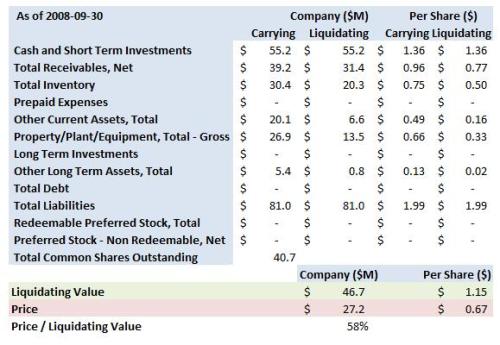
In our last blog post, we argued that INFS had a liquidation value of around $1.15 per share, 70% higher than its Friday close of $0.67. The company has cash and equivalents of around $55M and no debt as the summary financials demonstrate (the “Carrying” column shows the assets as they are carried in the financial statements, and the “Liquidating” column shows our estimate of the value of the assets in a liquidation):

Before

before-infs-summary

After

If INFS was to repurchase 50% of its stock (20M of its 40.7M shares currently on issue) at $0.67, it would cost INFS only $13.4M, leaving it with nearly $42M in cash on hand:

after-infs-summaryAfter the buy back, INFS’s per share liquidating value increases from $1.15 to $1.61 (a 40% increase).

There are very few investment opportunities that so quickly increase a company’s per share value. Given that management should know the company’s value better than the value of any other investment opportunity, it is also the most assured way of increasing a company’s per share value. There is simply no better way for an undervalued company to invest its excess cash than in its own stock.

Read Full Post »

Autobytel Inc (NASDAQ:ABTL) is a net net stock with an investor declaring an active interest in late November. At yesterday’s close of $0.43, ABTL has a market capitalization of $19.4M and is trading at 55% of our estimate of its liquidation value of $35.3M. On November 21, 2008, Trilogy, Inc. filed its Schedule 13D notice, declaring an interest of 5.01%.

About ABTL

ABTL is a automotive media and marketing services company focused on helping dealers sell cars and services, and manufacturers build brands through marketing and advertising primarily through the Internet. The company owns and operates automotive websites MyRide.com, Autobytel.com, Autoweb.com, Car.com, CarSmart.com, AutoSite.com and CarTV.com. It connects automotive marketers with vehicle shoppers visiting these websites and third-party websites (primarily search engines, automotive information providers and other auto related venues). You can see the corporate website here.

The value proposition

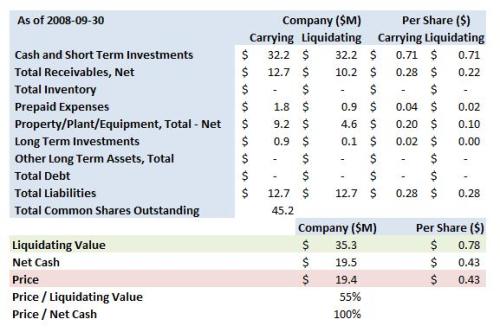
ABTL’s most recent 10Q, specifically its earnings and cash flow, was abominable. The company lost $5.36M last year but surpassed that in the September quarter alone, losing$5.63M. ABTL had negative cash from operating activities last year of $6.91M and $2.88M in the quarter to September. As always we can find some value on the balance sheet, as our summary analysis demonstrates (the “Carrying” column shows the assets as they are carried in the financial statements, and the “Liquidating” column shows our estimate of the value of the assets in a liquidation):

abtl-summary1

With $32.2M or $0.71 per share in cash and equivalents on the balance sheet and total liabilities of $12.7M or $0.28 per share, ABTL is trading at its net cash value of $0.43. If we add in receivables of $12.7M (which we’ve written down by 20% to $10.2M or $0.22 per share), property, plant and equipment of $9.2M (written down to $4.6M or $0.10 per share) and a nominal $0.9M or $0.02 per share for the prepaid expenses, ABTL has a a liquidating value of $35.3M or $0.78 per share. ABTL’s liquidating value of $0.78 is 82% higher than its stock price of $0.43, which is a substantial margin for error (or safety).

The catalyst

Trilogy, Inc. filed its Schedule 13D notice, declaring an interest of 5.01% on November 21, 2008. The filing contains the standard boilerplate that says a great deal without actually disclosing Trilogy’s true purpose for the purchase.  Trilogy is a private operating company in the technology consulting industry, not a fund manager, so there is little public information available about its strategy. It seems odd for a technology consulting business to buy a substantial active stake in a listed company. It’s possible that the filing is a precursor to a bid for ABTL. An affiliate of Trilogy, Trilogy Automotive Advertising Services, operates a business focussed on the automotive industry. ABTL might fit nicely into that business. We’re only speculating, but on the basis that it might turn into a bid, ABTL is worth watching.

Conclusion

At its close yesterday of $0.43 ABTL is trading at its net cash and at a 45% discount to its value in liquidation. In short, it’s a bargain. With Trilogy disclosing an active interest that could be a precursor to a takeover bid, ABTL is worth a look.

ABTL closed yesterday at $0.43.

The S&P 500 Index closed at 899.24.

[Disclosure: We do not have a holding in ABTL. This is neither a recommendation to buy or sell any securities. All information provided believed to be reliable and presented for information purposes only.]
Read Full Post »

Chromcraft Revington (AMEX:CRC) is a tiny, AMEX-listed net-net stock with a substantial stockholder calling for its sale or orderly liquidation. CRC has a market capitalization of only $2.8M, but the company’s written-down net current asset value is much higher at around $15M. The only problem? The company is in a liquidity crisis and risks entering bankruptcy if its fortunes don’t turn around. Aldebaran Capital, LLC, a 7.7% stockholder, sent a letter to the company on October 29 arguing that if CRC is unable to “promptly stabilize its business and rationalize its cost structure” it should be sold or liquidated.

About CRC

CRC is engaged in the design, production, sales and import of residential and commercial furniture. It markets its residential furniture products under the CR-Home banner with the brand names Chromcraft, Peters-Revington, Cochrane, Sumter and Silver. CRC distributes its products throughout the United States and Canada, primarily through furniture dealers. The history of the company is available on its website.

The value proposition

CRC is one of the most deeply undervalued asset situations we’ve uncovered, which is no surprise given the parlous state of its earnings and operating cash flow. The company made a loss of $14.87M last year and a loss of $3.39M in the 2006 financial year. Cash from Operating Activities has also been disappointing, negative to the tune of $3M in 2007 and $4M this quarter. All is not doom and gloom however: some residual value can still be found on the balance sheet.

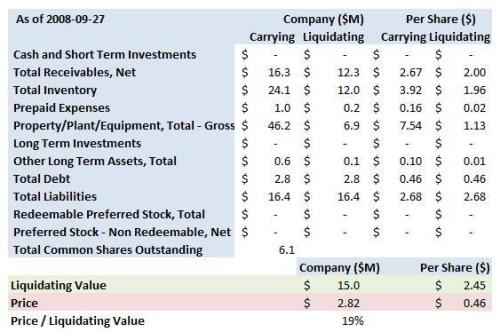
Set out below is our summary analysis (the “Carrying” column shows the assets as they are carried in the financial statements, and the “Liquidating” column shows our estimate of the value of the assets in a liquidation):

crc-summary

A quick glance at the balance sheet shows that CRC is in a liquidity crisis. The company had $8.4M in cash 12 months ago, but has burned through it since then. In three quarters the receivables have reduced from $18.4M in March to $16.3M in this quarter, with none of it flowing through to cash. The company states in its 10Q that it has “several sources of cash” that it believes will be “adequate to meet its short term liquidity requirements.” These are as follows:

  • At September 27, 2008, [CRC] has unused borrowing capacity of approximately $14,231,000 under its Bank Facility.
  • [CRC] expects to receive asset sale proceeds of approximately $3,300,000 in 2009 from the sale of its Lincolnton, North Carolina buildings, machinery and equipment.
  • At September 27, 2008, [CRC] has refundable income taxes of $3,462,000, primarily from net operating loss (NOL) carrybacks, which are expected to be received in the fourth quarter of 2008.
  • [CRC] plans to sell excess inventories and generate cash of approximately $3,000,000 in 2009.
  • [CRC] has recently implemented spending controls and overhead expense reductions in personnel.
  • Future capital spending for information technology upgrades will be delayed to 2010.

CRC’s bankruptcy is not necessarily a problem for an investor if the assets are sufficient to pay out the liabilities and leave some residual value in excess of the current stock price. We think that there is a good chance that this is the case, provided that some action is taken soon to preserve the remaining value.

Assuming the board acts quickly to salvage what remains of CRC, we estimate the company’s per share value in liquidation at around $2.45 or $15M in toto. To reach this estimate, we’ve written down the receivables by a quarter to a little over $12M or $2.00 per share, inventory by two-thirds to $12M or $1.96 per share and Property, Plant and Equipment by 85% from $46M to $6.9M or $1.13 per share. Deducting Total Liabilities of $16.4M or $2.68 per share leaves a value in liquidation of around $2.45 per share.

The catalyst

Aldebran Capital acquired its 7.7% holding in CRC in September and October of this year, paying between $0.42 and $2.72 per share. In a letter to CRC’s chairman, Aldebran Capital has asked the board to take steps to preserve the remaining value. Aldebran Capital’s letter annexed to its 13D filing of October 29, 2008 is reproduced below:

Dear Mr. Chairman:

Aldebaran Capital, LLC is an Indiana limited liability company and registered investment advisor. As noted in our recent filing, we have acquired 7.7% of the outstanding shares of Chromcraft Revington, Inc.

We have followed the transformation of the company over the past few years, as Chromcraft has undergone a major change in its business model.

As security analysts, we recognize the challenges the company has faced in implementing its plan. In addition, we fully understand that current economic conditions are causing the task to be even more difficult.

However, the company is nearly three years into restructuring maneuvers that were begun in 2006. Along the way, Chromcraft has incurred significant losses and continues to accrue costs attendant with these changes. As shareholders, we believe that it is time for the company to demonstrate that these actions are bearing fruit.

In our opinion, if the company is unable to promptly stabilize its business and rationalize its cost structure, we believe that the Board should consider either: a) the sale of the company or, b) undertake an orderly liquidation of the company assets.

We look forward to speaking with you further about Chromcraft.

Sincerely,

Kenneth R. Skarbeck
Managing Member,
Aldebaran Capital, LLC

Conclusion

It’s always difficult to recommend a stock in a liquidity crisis, but crises are what create the wide disparities between value and price, or, in other words, the bargains. CRC is such a bargain. At its close yesterday of $0.46, CRC is trading at a tiny 20% of our estimate of its liquidation value of around $2.45 per share. While there is substantial value on the balance sheet relative to the stock price, the risk is that the company continues to trade and destroys that remaining value. This is always the risk with net net stocks. The good news is that Aldebaran Capital has already called for CRC’s board to take some stockholder friendly steps. We think that Aldebran Capital will be successful and CRC’s value will sooner or later be reflected in its stock.

Warning: When trading in tiny, thinly traded stocks with a wide bid-ask spread, make sure you set a limit on the stock order or you might end up paying more than you want.

CRC closed yesterday at $0.46.

The S&P 500 Index closed at 909.70.

[Disclosure: We do not have a holding in CRC. This is neither a recommendation to buy or sell any securities. All information provided believed to be reliable and presented for information purposes only.]
Read Full Post »

« Newer Posts - Older Posts »