Feeds:
Posts
Comments

Archive for the ‘Activist Investors’ Category

Autobytel Inc (NASDAQ:ABTL) is a net net stock with an investor declaring an active interest in late November. At yesterday’s close of $0.43, ABTL has a market capitalization of $19.4M and is trading at 55% of our estimate of its liquidation value of $35.3M. On November 21, 2008, Trilogy, Inc. filed its Schedule 13D notice, declaring an interest of 5.01%.

About ABTL

ABTL is a automotive media and marketing services company focused on helping dealers sell cars and services, and manufacturers build brands through marketing and advertising primarily through the Internet. The company owns and operates automotive websites MyRide.com, Autobytel.com, Autoweb.com, Car.com, CarSmart.com, AutoSite.com and CarTV.com. It connects automotive marketers with vehicle shoppers visiting these websites and third-party websites (primarily search engines, automotive information providers and other auto related venues). You can see the corporate website here.

The value proposition

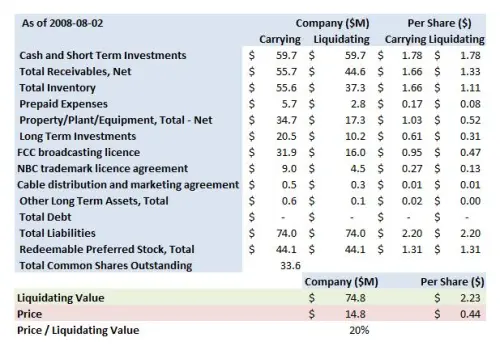
ABTL’s most recent 10Q, specifically its earnings and cash flow, was abominable. The company lost $5.36M last year but surpassed that in the September quarter alone, losing$5.63M. ABTL had negative cash from operating activities last year of $6.91M and $2.88M in the quarter to September. As always we can find some value on the balance sheet, as our summary analysis demonstrates (the “Carrying” column shows the assets as they are carried in the financial statements, and the “Liquidating” column shows our estimate of the value of the assets in a liquidation):
abtl-summary1

With $32.2M or $0.71 per share in cash and equivalents on the balance sheet and total liabilities of $12.7M or $0.28 per share, ABTL is trading at its net cash value of $0.43. If we add in receivables of $12.7M (which we’ve written down by 20% to $10.2M or $0.22 per share), property, plant and equipment of $9.2M (written down to $4.6M or $0.10 per share) and a nominal $0.9M or $0.02 per share for the prepaid expenses, ABTL has a a liquidating value of $35.3M or $0.78 per share. ABTL’s liquidating value of $0.78 is 82% higher than its stock price of $0.43, which is a substantial margin for error (or safety).

The catalyst

Trilogy, Inc. filed its Schedule 13D notice, declaring an interest of 5.01% on November 21, 2008. The filing contains the standard boilerplate that says a great deal without actually disclosing Trilogy’s true purpose for the purchase.  Trilogy is a private operating company in the technology consulting industry, not a fund manager, so there is little public information available about its strategy. It seems odd for a technology consulting business to buy a substantial active stake in a listed company. It’s possible that the filing is a precursor to a bid for ABTL. An affiliate of Trilogy, Trilogy Automotive Advertising Services, operates a business focussed on the automotive industry. ABTL might fit nicely into that business. We’re only speculating, but on the basis that it might turn into a bid, ABTL is worth watching.

Conclusion

At its close yesterday of $0.43 ABTL is trading at its net cash and at a 45% discount to its value in liquidation. In short, it’s a bargain. With Trilogy disclosing an active interest that could be a precursor to a takeover bid, ABTL is worth a look.

ABTL closed yesterday at $0.43.

The S&P 500 Index closed at 899.24.

[Disclosure: We do not have a holding in ABTL. This is neither a recommendation to buy or sell any securities. All information provided believed to be reliable and presented for information purposes only.]

Read Full Post »
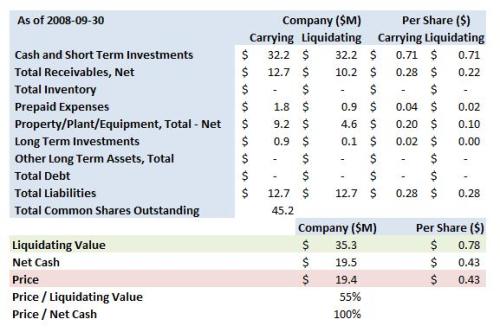
ValueVision Media Inc. (NASDAQ:VVTV) is exactly the kind of opportunity we like to find: a net net stock with a management taking active steps to rectify the situation. At yesterday’s close of $0.44, VVTV has a market capitalization of $14.8M, which is half its net current asset value of around $29.5M, or $0.88 per share and 20% of our estimate of its value in liquidation of around $74.8M or $2.23 per share. After receiving some full and frank advice criticism on an August earnings call, VVTV’s board of directors has publicly announced that it has appointed a special committee of independent directors to “review strategic alternatives to maximize stockholder value.” The company is currently conducting an auction expected to close in February 2009. The auction has uncovered a number of interested bidders, including GE Capital Equity Investments (most recent 13D filing here), which owns 13.7% of the company. Activist investor Carlo Cannell of Cannell Capital LLC has disclosed an interest in the company and has also sent a number of entertaining letters to the CEO (which we’ve reproduced below).

About VVTV

According to its website, VVTV is a direct marketing company that markets, sells and distributes products directly to consumers through various forms of electronic media and direct-to-consumer mailings. The company’s principal electronic media activity is the television home shopping business, which uses on-air spokespersons to market brand name merchandise and private label consumer products at competitive prices. A live around the clock television home shopping programming is distributed primarily through cable and satellite affiliation agreements and the purchase of month-to-month full- and part-time lease agreements of cable and broadcast television time. In addition, ValueVision Media distributes its programming through a television station in Boston, Massachusetts. It also markets and sells an array of merchandise through http://www.shopnbc.com and http://www.shopnbc.tv.

The value proposition

According to its most recent 10Q, VVTV lost $15.7M in the August quarter, which continues a string of five quarterly losses. Operating cash flow has also turned negative for the August quarter, which is particularly concerning. The company does have value on the balance sheet, however, as our summary analysis demonstrates (the “Carrying” column shows the assets as they are carried in the financial statements, and the “Liquidating” column shows our estimate of the value of the assets in a liquidation):

vvtv-summary1

With $59.7M in cash and equivalents, $55.7M in receivables and $55.6M in inventory, VVTV’s is trading at a substantial discount to its current assets alone. The company has $1.78 per share in cash. We’ve discounted the receivables by 20% to $44.6M or $1.33 per share and the inventory by a third to $37.3M or  $1.11 per share. Subtracting all liabilities of $74M or $2.20  per share and the preferred stock of $44.1M or $1.31 per share gives us a net current asset value for VVTV of around $29.5M or $0.88 per share. At yesterday’s closing price of $0.44, VVTV is trading at a 50% discount to its net current asset value alone.

VVTV has other valuable assets, including substantial property, its FCC broadcasting licence, its NBC trademark licence agreement and its Cable distribution and marketing agreement. We have no idea how to value these assets, but discounted by an arbitrary 50%, they are worth an additional $45.3M or $1.35 per share. This puts our estimate of the company’s liquidating value at around $74.8M or $2.23 per share, which means that VVTV is trading at 20% of its value in liquidation.

Carlo Cannell suggested in the October 27 letter to the CEO (reproduced below) that VVTV’s value is much higher. He thinks the company is “worth closer to $6.00 per share, exclusive of the $120 million net operating loss and substantial intangible value in the broad 72 million reach enjoyed by ShopNBC.” Cannell’s analysis is as follows (all figures are $/share figures):

Net Working Capital – $3.73 (Includes $2.39/share in Cash. Excludes NOL and value of Shop NBC.)
Headquarters – $1.03
Television Station – $0.95
NBC License Agreement – $0.27
Total Asset Value – $5.98

VVTV is trading at less than 7% of Cannell’s valuation.

The catalyst

VVTV’s stock is down about 91% ($5.53 per share) this year. During VVTV’s second-quarter conference call in August, shareholders lambasted management and called for the sale of the company. As a result, VVTV disclosed in its 10Q that it was pursuing “strategic alternatives”:

On September 11, 2008, our board of directors announced that it had appointed a special committee of independent directors to review strategic alternatives to maximize stockholder value. The committee currently consists of two directors: George Vandeman, who will serve as the committee’s chairman, and Robert Korkowski. We expect to appoint an additional independent director to the board, who we anticipate will serve on the special committee. The special committee retained Piper Jaffray & Co., a nationally-recognized investment banking firm, as its financial advisor. There can be no assurance that the review process will result in the announcement or consummation of a sale of our company or any other strategic alternative. We do not intend to comment publicly with respect to any potential strategic alternatives we may consider pursuing unless or until a specific alternative is approved by our board of directors.

On September 24, 2008 Cannell Capital amended an earlier 13G filing for VVTV in this 13D filing, annexing an entertaining letter from Carlo Cannell to Mr. John Buck, VVTV’s CEO (reproduced below):

Dear Mr. Buck

Cannell Capital LLC (“Cannell”), an investment adviser and General Partner to several private investment funds and partnerships, which own shares in ValueVision Media Inc. (“VVTV”), is amending its reporting requirements to reflect a more active stance.

Congratulations on your September 11, 2008 decision to appoint “a special committee of independent directors to review strategic alternatives to maximize shareholder value.” Cannell interprets this to mean that the representatives of the shareholders (aka “Directors”) have finally elected to monetize the assets on behalf of its owners.

ValueVision’s stock price is $2.20 per share. Based upon analysis our from Craig-Hallum it is our opinion the company is worth closer to $6.00 per share, exclusive of the $120 million net operating loss and substantial intangible value in the broad 72 million reach enjoyed by ShopNBC.(1)

                                                    $/Share
                                                    -------

                 Net Working Capital*                $3.73
                 Headquarters                        $1.03
                 Television Station                  $0.95
                 NBC License Agreement               $0.27
                 Total Asset Value                   $5.98

                 *Includes $2.39/share in Cash. Excludes NOL
                 and value of Shop NBC.

We will be watching carefully to make sure the committee’s actions are congruent with the interests of shareholders. We are concerned that the hiring of Piper Jaffray & Co. may be a ploy to continue to justify its pattern of wheel spinning and protection of jobs over what is best for the owners of the business. For example, on Monday, September 15, 2008 we were shocked to learn that your agent (Piper Jaffray & Co.) called to “permission” when and to whom we might talk at our Company. This is characteristic of Stalinist Russia, not America. This does not have a good taint to it. You may try to muzzle other investors, but not Cannell. It bites.

You further have called for representatives to the Board of Directors. We have several candidates in mind. Two will be contacting you shortly to present their credentials directly.

It is amazing to us how much value has been destroyed under your stewardship. That you would have to hire an agent at all to advise you on what should have been done long ago is shameful.

Godspeed!

J. Carlo Cannell
Managing Member
Cannell Capital LLC

————————-
(1) Robert J. Evans, Craig-Hallum Capital Group, 8/25/08

Cannell sent a follow up letter on October 27, 2008, which was annexed to this 13D filing and is reproduced below:

Dear Mr. Buck

Thank you for taking the time to speak with us this month. I imagine that you are busy consulting with sundry advisors as to ways to maximize shareholder value, including, but not limited to the immediate liquidation of our assets.

Regrettably, at this rate there will not be much value to realize. The price of the common stock has declined 65% this month alone.

I am sorry that you feel the name of the broker hired to sell our buildings at 6740, 6680 and 6690 Shady Oak Road, Eden Prairie, MN 55334 to be material non-public information. I disagree.

Given the slope of shareholder wealth destruction and given the inconsistency of information delivered to us by sundry directors and officers of our Company I would like to suggest that you deliver a special dividend of $1.20 per share to its owners, the shareholders.(1) Although I can’t speak for all shareholders, it is my opinion that most would see copious opportunities to allocate their capital to other stewards of this capital than that of the current board of VVTV.

If the board agrees with me, please tell me by Halloween when my investors and other shareholders might get their dividend. (Time is of the essence. If Senator Barack Obama is elected President the taxation of dividends is likely to become less favorable.) If you disagree, please state the reasons behind your opposition.

In the case of the latter outcome, Cannell Capital LLC will review your opposition and, if appropriate, we will evaluate our options in calling a special meeting of all shareholders to vote upon whether: (i) our cash should be returned to its owners or (ii) the existing board should be allowed to continue to manage it.

Best regards!

Sincerely

J. Carlo Cannell
Managing Member

————————-
(1) As of August 2, 2008, VVTV had $79.4 million of cash – $48.8 million of liquid, $10.9 million of short term equivalent and $20.5 million of auction rate securities (which should likely be discounted by $1.5 million). That is $2.36 per share. I like the idea that returning this cash is tax efficient and will deter management from performing more “science projects.” More pressure is good in my opinion.

On a conference call with analysts to discuss VVTV’s third quarter results, Mr. George Vandeman, who is chairman of VVTV’s special committee of independent directors, said the company had received bids from a number of companies and instructed its advisers to invite several of the proposed buyers to take part in the next phase of the process. Final bids would be due after that phase is completed. One of those interested bidders is GE Capital Equity Investments, which disclosed its holding in this November 17, 2008 13D filing. Vandeman also said the committee was “evaluating other alternatives to boost value, including share buybacks, paying a dividend and monetizing its balance sheet.”

The special committee and its financial advisors continue to review the full range of strategic alternatives available to the company. We anticipate that the special committee will conclude its review by the end of the fiscal year.

VVTV’s fiscal year ends February 2. These are all promising developments for VVTV.

Conclusion

This seems to us to be one of the better opportunities available in the present market. VVTV, a net net stock with additional valuable assets, is very cheap. At yesterday’s close of $0.44, VVTV has a market capitalization of $14.8M, which is half its net current asset value of around $29.5M, or $0.88 per share. Including the other assets – its property, FCC broadcasting licence, NBC trademark licence agreement and the Cable distribution and marketing agreement – we estimate VVTV is worth closer to $2.23 per share. Cannell Capital sees the value as high as $5.98 per share. The company also seems to be taking steps to realise that value, publicly announcing that it has appointed a special committee of independent directors to “review strategic alternatives to maximize stockholder value.” Currently, that means that the company is conducting an auction with a number of interested bidders but it may also mean the company buys back shares, pays a dividend or monetizes its balance sheet. The committee expect to complete this process by February 2, 2009, which means that this opportunity won’t be around for much longer.

VVTV closed yesterday at $0.44.

The S&P 500 Index closed at 888.67.

[Disclosure: We have a holding in VVTV. This is neither a recommendation to buy or sell any securities. All information provided believed to be reliable and presented for information purposes only.]

Read Full Post »
Chromcraft Revington (AMEX:CRC) is a tiny, AMEX-listed net-net stock with a substantial stockholder calling for its sale or orderly liquidation. CRC has a market capitalization of only $2.8M, but the company’s written-down net current asset value is much higher at around $15M. The only problem? The company is in a liquidity crisis and risks entering bankruptcy if its fortunes don’t turn around. Aldebaran Capital, LLC, a 7.7% stockholder, sent a letter to the company on October 29 arguing that if CRC is unable to “promptly stabilize its business and rationalize its cost structure” it should be sold or liquidated.

About CRC

CRC is engaged in the design, production, sales and import of residential and commercial furniture. It markets its residential furniture products under the CR-Home banner with the brand names Chromcraft, Peters-Revington, Cochrane, Sumter and Silver. CRC distributes its products throughout the United States and Canada, primarily through furniture dealers. The history of the company is available on its website.

The value proposition

CRC is one of the most deeply undervalued asset situations we’ve uncovered, which is no surprise given the parlous state of its earnings and operating cash flow. The company made a loss of $14.87M last year and a loss of $3.39M in the 2006 financial year. Cash from Operating Activities has also been disappointing, negative to the tune of $3M in 2007 and $4M this quarter. All is not doom and gloom however: some residual value can still be found on the balance sheet.

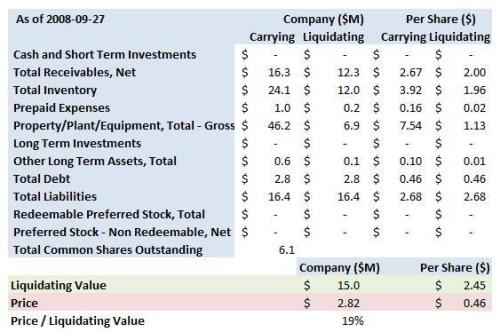
Set out below is our summary analysis (the “Carrying” column shows the assets as they are carried in the financial statements, and the “Liquidating” column shows our estimate of the value of the assets in a liquidation):

crc-summary

A quick glance at the balance sheet shows that CRC is in a liquidity crisis. The company had $8.4M in cash 12 months ago, but has burned through it since then. In three quarters the receivables have reduced from $18.4M in March to $16.3M in this quarter, with none of it flowing through to cash. The company states in its 10Q that it has “several sources of cash” that it believes will be “adequate to meet its short term liquidity requirements.” These are as follows:

  • At September 27, 2008, [CRC] has unused borrowing capacity of approximately $14,231,000 under its Bank Facility.
  • [CRC] expects to receive asset sale proceeds of approximately $3,300,000 in 2009 from the sale of its Lincolnton, North Carolina buildings, machinery and equipment.
  • At September 27, 2008, [CRC] has refundable income taxes of $3,462,000, primarily from net operating loss (NOL) carrybacks, which are expected to be received in the fourth quarter of 2008.
  • [CRC] plans to sell excess inventories and generate cash of approximately $3,000,000 in 2009.
  • [CRC] has recently implemented spending controls and overhead expense reductions in personnel.
  • Future capital spending for information technology upgrades will be delayed to 2010.

CRC’s bankruptcy is not necessarily a problem for an investor if the assets are sufficient to pay out the liabilities and leave some residual value in excess of the current stock price. We think that there is a good chance that this is the case, provided that some action is taken soon to preserve the remaining value.

Assuming the board acts quickly to salvage what remains of CRC, we estimate the company’s per share value in liquidation at around $2.45 or $15M in toto. To reach this estimate, we’ve written down the receivables by a quarter to a little over $12M or $2.00 per share, inventory by two-thirds to $12M or $1.96 per share and Property, Plant and Equipment by 85% from $46M to $6.9M or $1.13 per share. Deducting Total Liabilities of $16.4M or $2.68 per share leaves a value in liquidation of around $2.45 per share.

The catalyst

Aldebran Capital acquired its 7.7% holding in CRC in September and October of this year, paying between $0.42 and $2.72 per share. In a letter to CRC’s chairman, Aldebran Capital has asked the board to take steps to preserve the remaining value. Aldebran Capital’s letter annexed to its 13D filing of October 29, 2008 is reproduced below:

Dear Mr. Chairman:

Aldebaran Capital, LLC is an Indiana limited liability company and registered investment advisor. As noted in our recent filing, we have acquired 7.7% of the outstanding shares of Chromcraft Revington, Inc.

We have followed the transformation of the company over the past few years, as Chromcraft has undergone a major change in its business model.

As security analysts, we recognize the challenges the company has faced in implementing its plan. In addition, we fully understand that current economic conditions are causing the task to be even more difficult.

However, the company is nearly three years into restructuring maneuvers that were begun in 2006. Along the way, Chromcraft has incurred significant losses and continues to accrue costs attendant with these changes. As shareholders, we believe that it is time for the company to demonstrate that these actions are bearing fruit.

In our opinion, if the company is unable to promptly stabilize its business and rationalize its cost structure, we believe that the Board should consider either: a) the sale of the company or, b) undertake an orderly liquidation of the company assets.

We look forward to speaking with you further about Chromcraft.

Sincerely,

Kenneth R. Skarbeck
Managing Member,
Aldebaran Capital, LLC

Conclusion

It’s always difficult to recommend a stock in a liquidity crisis, but crises are what create the wide disparities between value and price, or, in other words, the bargains. CRC is such a bargain. At its close yesterday of $0.46, CRC is trading at a tiny 20% of our estimate of its liquidation value of around $2.45 per share. While there is substantial value on the balance sheet relative to the stock price, the risk is that the company continues to trade and destroys that remaining value. This is always the risk with net net stocks. The good news is that Aldebaran Capital has already called for CRC’s board to take some stockholder friendly steps. We think that Aldebran Capital will be successful and CRC’s value will sooner or later be reflected in its stock.

Warning: When trading in tiny, thinly traded stocks with a wide bid-ask spread, make sure you set a limit on the stock order or you might end up paying more than you want.

CRC closed yesterday at $0.46.

The S&P 500 Index closed at 909.70.

[Disclosure: We do not have a holding in CRC. This is neither a recommendation to buy or sell any securities. All information provided believed to be reliable and presented for information purposes only.]

Read Full Post »
Today we continue our “Net Net vs Activist Legend” thought experiment, with Yahoo! Inc. (NASDAQ: YHOO).

YHOO is a stock that is not cheap on an asset basis but it does have a prominent activist investor with a 5.5% stake and two seats on the board. At its Friday close of $11.66, which is around two-thirds lower than Microsoft’s May 2008 $33 bid, YHOO still trades at a 70% premium to our $6.82 per share estimate of its asset value. Activist investor Carl Icahn’s presence on the register, however, indicates that he believes YHOO is worth more. Icahn has paid an average of $23.59 per share to accumulate his 5.5 percent stake. At $11.66, YHOO must more than double before Icahn will see a profit. He’s unlikely to sit idly by to see if that happens.

About YHOO

According to the Overview section of the company’s most recent 10Q*, YHOO “is a leading global Internet brand and one of the most trafficked Internet destinations worldwide.” Clear enough, but here is where the 10Q gets weird:

We are focused on powering our communities of users, advertisers, publishers, and developers by creating indispensable experiences built on trust.

We have no idea what “indispensable experiences built on trust” means. We’d be keen to hear your thoughts in the comments (but we digress):

We seek to provide Internet services that are essential and relevant to these communities of users, advertisers, publishers, and developers. Publishers, such as eBay Inc., WebMD, Cars.com, Forbes.com, and the Newspaper Consortium (our strategic partnership with a consortium of more than 20 leading United States (“U.S.”) newspaper publishing companies), are a subset of our distribution network of third-party entities (referred to as “Affiliates”) and are primarily Websites and search engines that attract users by providing content of interest, presented on Web pages that have space for advertisements. We manage and measure our business geographically. Our geographic segments are the U.S. and International.

According to Wikipedia, YHOO:

…provides Internet services worldwide. The company is perhaps best known for its web portal, search engine, Yahoo! Directory, Yahoo! Mail, news, and social media websites and services. Yahoo! was founded by Jerry Yang and David Filo in January 1994 and was incorporated on March 1, 1995.

According to Web traffic analysis companies (including Compete.com, comScore, Alexa Internet, Netcraft, and Nielsen Ratings), the domain yahoo.com attracted at least 1.575 billion visitors annually by 2008. The global network of Yahoo! websites receives 3.4 billion page views per day on average as of October 2007. It is the second most visited website in the U.S., and the most visited website in the world.

* We usually link to a company’s own description of its business on its website. We didn’t for YHOO because we couldn’t find on its website a concise description of the company or its business. While this may speak more to our own ineptitude, it might also be a telling sign for a “leading global Internet brand” that has struggled lately, no?

The value proposition

Before we launch into our analysis of YHOO, we have to state up front that Greenbackd’s focus is on undervalued asset situations, and preferably undervalued tangible assets. One would think that with YHOO, a “leading global Internet brand”, one would find a great deal of value in its intangible assets. Our bias for tangible over intangible assets will almost certainly lead us to a lower valuation for YHOO than another investor with a preference for intangible assets which generate earnings or cash flow.

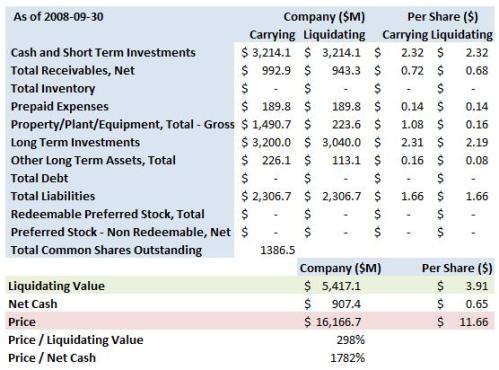
Set out below is our summary analysis (the “Carrying” column shows the assets as they are carried in the financial statements, and the “Liquidating” column shows our estimate of the value of the assets in a liquidation):

yhoo-summary

Ordinarily, when we discount a company’s assets we get a much lower liquidating value than carrying value. In YHOO’s case, most of the tangible asset value is in the Cash and Short Term Investments which we don’t write down ($3.2B or $2.32 per share) and Long Term Investments (carried at $3.2B or $2.31 per share), which we’ve only written down to $3B or $2.19 per share for reasons we’ll explain below. We’ve written down the Property, Plant and Equipment by 85%, but it only represents a small proportion of the total tangible assets and so doesn’t have a meaningful impact on the valuation. Our usual liquidation valuation – the Armageddon scenario – for YHOO is $5.4B or $3.91 per share.

We believe that the Armageddon scenario substantially undervalues YHOO because it excludes the Goodwill in the Investments in Equity Interests (which is included in the Long Term Investments above). Including the Goodwill, YHOO’s Investments in Equity Interests amount to the following:

  • a 44% equity interest in Alibaba Group valued at $2.2B
  • a 1% equity interest in Alibaba.com Limited valued at $52M and
  • a 33% equity interest in Yahoo! Japan valued at $6B.

Including the Goodwill figures in the Investments in Equity Interests above (but deducting the Deferred Income Tax) gives us an asset valuation for YHOO closer to $9.5B or $6.82 per share.

Icahn said in an interview with CNBC last Wednesday that he believes YHOO is undervalued and that he “opposes breaking up the company in a piecemeal sale” (NY Times’ Dealbook has the transcript). While we can only speculate as to Icahn’s investment thesis for YHOO, that statement leads us to believe he is valuing it on an earnings or cash flow basis. YHOO’s Cash from Operating Activities is impressive at $1.9B in 2007 and $347M in the most recent quarter to September. Even more impressive is that it achieved that operating cash flow on only $9.5B of equity (up from $9.1B in the prior year), which means it returned around 21% on average equity. We’ve got no idea about the future economics of YHOO’s businesses or the industry as a whole, so we can’t predict whether YHOO can continue to generate these types of returns and we won’t be speculating as to its value on an earnings or cash flow basis.

The catalyst

Icahn, who currently sits on the board and holds 5.5% of the company, will be the driving force in any deal involving YHOO. His decisions will likely be informed by the fact that he has paid an average of $23.59 per share to accumulate a 5.5 percent stake (according to this filing with the SEC). There are a number of suitors seeking to consummate a marriage with YHOO. This Wall Street Journal article (subscription required) suggests former AOL chief Jonathan Miller is talking to investors about raising money to purchase all or part of YHOO. Icahn has said that he would be opposed to a partial bid “even at a premium.” He also expressed doubts about Miller’s ability to raise the money but would be willing to listen if Miller made a “bid at a very high price”. Another possibility is Microsoft, which has recently engaged a former YHOO search and advertising executive, but Microsoft CEO Steve Ballmer told the Wall Street Journal Thursday (subscription required) that there were no talks to acquire YHOO’s search business.

Icahn has a long history of succesful activist investment, with recent high profile campaigns against  Blockbuster, Imclone, XO Communications, Mylan Laboratories and Time Warner. According to this 2007 Fortune profile, he is renowned for taking on the biggest targets while generating exceptional returns:

In its less-than-three-year existence, Icahn Partners has posted annualized gains of 40%, investors told Fortune. After fees, the investors pocketed 28%. That 40% gain trounces the S&P 500’s return of around 13%, as well as the 12% for all hedge funds calculated by research firm HedgeFund.net. Icahn Partners boasts a string of big wins in short periods. The acquisition of energy producer Kerr-McGee gave the fund a $300 million gain, or a 100% return in just nine months. Icahn Partners achieved gains of $100 million and $230 million, respectively, both in less than three months, on forcing the sales of Fairmont Hotels & Resorts and drugmaker MedImmune.

The same Fortune article suggests that Icahn’s biggest strength is his knack for picking targets:

His skill at prospecting is so well honed that in most cases he’s destined to make money from the day he buys the shares. Then it’s a matter of squeezing management to sweeten the inevitable gains.

This is high praise indeed. Given that Icahn has paid an average of $23.59 per share for YHOO, he clearly sees value well in excess of that number and will be agitating for it to be realised.

Conclusion

YHOO is not cheap on any theory of value we care to employ. It is trading at a substantial premium to its asset backing, which means the market is still generously valuing its future earnings. It is generating substantial operating cash flow and earnings, which in a better market might be worth more, but it’s not obviously cheap to us.

The best thing about YHOO from our perspective is the presence of Carl Icahn on the register. His holdings were purchased at much higher prices than are presently available and he is unlikely to sit idly by while the stock stagnates.

Buying YHOO at these prices is a bet that Icahn can engineer a deal for the company. Given his legendary status as an activist investor earned through canny acquisitions over many years, we think that’s a good bet. But a bet is what it is – it’s speculation and not investment. If speculation is your game, then we wish you the best of luck but know that the price might fall a long way if he sells out. If you’re an investor, the price is too high.

YHOO closed Friday at $11.66 and the S&P 500 Index closed at 876.07.

[Disclosure: We do not have a holding in YHOO. This is neither a recommendation to buy or sell any securities. All information provided believed to be reliable and presented for information purposes only.]

Read Full Post »
The Official Activist Investing Blog has published its list of activist investments for November:

Ticker Company Activist Investor
ABTL Autobytel Inc Trilogy Inc
ACF AmeriCredit Corp Fairholme Capital Management
ACTL Actel Corp Ramius Capital
ADPT Adaptec, Inc Steel Partners
ARCW Arc Wireless Solutions Brean Murray Carret Group
ATSG Air Transport Services Group Perella Weinberg Partners
AVGN Avigen Inc Biotechnology Value Fund
BBI Blockbuster Inc Marlin Sams Fund
BEE Strategic Hotels & Resorts Security Capital Research & Management
BITI Bio-Imaging Technologies Healthinvest Partners
CHG CH Energy Group Inc Gamco Investors
CHIC Charlotte Russe Holding Inc KarpReilly Capital Management
CPN Calpine Corp Harbinger Capital
CRXX CombinatoRX, Incorporated Biotechnology Value Fund
CTO Consolidated Tomoka Land Co Wintergreen Advisers
CWLZ Cowlitz Bancorporation Crescent Capital
DBD Diebold Inc Gamco Investors
DCAP DCAP Group Infinity Capital Partners
DVD Dover Motorsports Mario Cibelli
ENTU Entrust Inc. Empire Capital Partners
FACE Physicians Formula Holdings, Inc Mill Road Capital
FSCI Fisher Communications Gamco Investors
FTAR.OB Footstar Inc Schultze Asset Management
GBE Grubb & Ellis Company Anthony Thompson
GGP General Growth Properties Pershing Square Capital
GSLA GS Financial Corp FJ Capital Long/Short Equity Fund
HCBK Hudson City Bancorp Gamco Investors
HFFC HF Financial Corp PL Capital
INFS Infocus Corp Nery Capital Partners
INFS Infocus Corp Lloyd Miller
ISH International Shipholding Corp Liberty Shipping Group
KANA.OB Kana Software KVO Capital Management
KEYN Keynote Systems Ramius Capital
KFS Kingsway Financial Services Joseph Stilwell
KONA Kona Grill Mill Road Capital
LCAV LCA-Vision Inc Stephen Joffe
LDIS Leadis Technology Inc Kettle Hill Capital Management
LNET LodgeNet Interactive Corporation Mark Cuban
LTM Life Time Fitness Green Equity Investors
MCGC MCG Capital Corporation Springbok Capital Management
MGAM Multimedia Games Inc. Dolphin Limited Partnership
MGI Moneygram Interntaional Inc Blum Capital
MIM MI Developments Greenlight Capital
MYE Myers Industries Inc Gamco Investors
NAV Navistar International Owl Creek
NLS Nautilus Inc Sherborne Investors
NOOF New Frontier Media Steel Partners
NYT New York Times Harbinger Capital
OEH Orient-Express Hotels SAC Capital; DE Shaw
ORNG Orange 21 Costa Brava
PBIP Prudential Bancorp Inc. of PA Joseph Stilwell
PGRI.OB Platinum Energy Resources Inc Syd Ghermezian
PHH PHH Corp. Pennant Capital Management
PNNW Pennichuck Corp Gamco Investors
PPCO Penwest Pharmaceuticals Co Perceptive Advisors
PRXI Premier Exhibitions, Inc Sellers Capital
PWER Power One Bel Fuse
PXG Phoenix Footwear Group Reidman Corp
RDEN Elizabeth Arden Shamrock Activist Value Fund
SCOP Scopus Video Networks Ltd. Optibase Ltd
SECX.PK SED International Holdings Hummingbird Management
SLTC Selectica Inc Trilogy Inc (Versata Enterprises)
SNG Canadian Superior Energy Palo Alto Investors
SNSTA Sonesta International Hotels Gamco
SUAI Specialty Underwriters Alliance Philip Stephenson
SUMT SumTotal Systems Discovery Capital
SUTM.OB Sun-Times Media Group Inc. K Capital
SUTM.OB Sun-Times Media Group Inc. Davidson Kempner Partners
SWWI Simon Worldwide Inc Everst Special Situations Fund
TIKRF.OB Tikcro Technologies Ltd Steven Bronson
TXCC TranSwitch Corp Brener International Group
TXI Texas Industries Shamrock Activist Value Fund
UIS Unisys Corp MMI Investments
UTEK Ultratech Inc Temujin Fund
WBSN Websense Inc Shamrock Activist Value Fund
WEDC White Electronic Designs Wynnefield Capital
WINS SM&A Mill Road Capital
YHOO Yahoo Carl Icahn
ZLC Zale Corp. Breeden Capital Management

Read Full Post »

Greenbackd’s ideal investment opportunity is a deeply undervalued asset situation with a catalyst to quickly remove the discount. Unfortunately, those opportunities are few and far between.

We frequently find deeply undervalued asset situations with no obvious catalyst. We also often find activists in stocks that we woud not consider to be undervalued on an asset basis.

As a thought experiment, we thought that we would compare the performance of two stocks: one a net net and net cash stock lacking a catalyst, and the other a stock not obviously undervalued on an asset basis but nonetheless pursued by an activist investor.

We’ve selected Dataram Corporation (NASDAQ:DRAM) as representative of the net-nets. DRAM is a classic net-net stock, with a $10.5M market cap and around $19.4M of value in liquidation, including $16M in cash.

The second stock selects itself: Yahoo! Inc. (NASDAQ:YHOO), one of the original Internet stocks, has as one of its largest stockholders activist investing legend Carl Icahn and the NY Times speculates that it has a potential suitor. YHOO has a market cap of around $15.9B and tangible assets of around $5.5B, including around $3.2B in cash, which means it is not undervalued on an asset basis.

Today, we examine DRAM and on Monday we will examine YHOO.

Read Full Post »

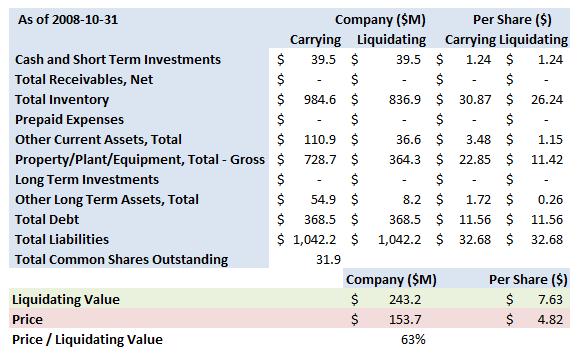
Zale Corporation (NYSE:ZLC) is an undervalued asset situation with a well-known activist investor, Richard Breeden of Breeden Capital Management LLC, holding two seats on the board. At yesterday’s closing price of $4.82, the company has a market capitalization of $154M. We estimate the liquidation value of the company at around $243M or $7.63 per share, which means that ZLC is trading at 63% of our estimated liquidation value.

About ZLC

ZLC is a specialty retailer of fine jewelry in North America. According to its website, at July 31, 2008, ZLC “operated 1,396 specialty retail jewelry stores and 739 kiosks located mainly in shopping malls throughout the United States, Canada and Puerto Rico. ZLC operates under three business segments: Fine Jewelry, Kiosk Jewelry and All Other. During the fiscal year ended July 31, 2008 (fiscal 2008), the Fine Jewelry segment generated approximately 88% of the Company’s net revenues, while the Kiosk revenues represented 12% of total revenues. On November 9, 2007, the Company completed the sale of its Bailey Banks & Biddle brand.”

The value proposition

ZLC is an undervalued asset situation with substantial Inventory and Property, Plant and Equipment (see most recent quarterly report here). Set out below is our summary analysis of the balance sheet (the “Carrying” column shows the assets as they are carried in the financial statements, and the “Liquidating” column shows our estimate of the value of the assets in a liquidation):

zlc-summary1

Perhaps unsurprisingly for a jewelry retailing business, ZLC’s asset value is predominantly in its Inventory and Property, Plant and Equipment. We don’t have any great insight into the jewelry retail business. We can see that consumers don’t have much discretionary cash available at the moment, so in a fire sale tomorrow the discount to the carrying value of Inventory could be substantial. On the other hand, there is no immediate need to sell the Inventory because jewelry is not a wasting asset and can even be a store of value. We lean towards the latter argument. ZLC has $984.6M in Inventory that we’ve written down by 15% to $837M or $26.24 per share. We’ve applied a 50% discount to the $728M worth of Property, Plant and Equipment (Gross) to arrive at $364M or $11.42 per share. We estimate the company’s liquidation value at around $243M or $7.63 per share, which means that, at yesterday’s closing price of $4.82, ZLC is trading at 63% of our estimated  value in a liquidation.

The catalyst

Activist investor Breeden Capital Management disclosed its holding in ZLC in its original 13D on September 17, 2007. Breeden has continued to buy shares of common stock in ZLC, disclosing in the most recent 13D filed November 28, 2008 that it controlled 28.46% of the company.

Breeden Capital Management’s Richard Breeden is a former chairman of the Securities and Exchange Commission. Breeden recently led a dissident shareholder group to win three seats on the board of tax preparation and accounting services company H&R Block Inc.

ZLC appointed Breeden Capital Management’s Richard Breeden and James Cotter (Cotter is a founding partner) to its board of directors on January 17, 2008

Conclusion

With ZLC trading at a substantial 33% discount to its value in liquidation and Breeden continuing to buy stock, ZLC seems like a good bet to us.

ZLC closed yesterday at $4.82.

The S&P 500 closed yesterday at 848.81.

[Disclosure: We do not presently have a holding in ZLC. This is neither a recommendation to buy or sell any securities. All information provided believed to be reliable and presented for information purposes only.]

Read Full Post »
Warning: We updated this post on December 18, 2008.

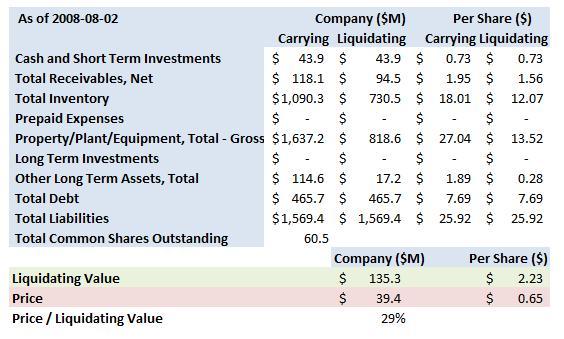
Borders Group, Inc. (NYSE:BGP) presents a rare opportunity to invest in a stock with a well-known brand alongside one of the best activist investors in the US, William A. Ackman of Pershing Square Capital Management, L.P. Want more? With a market capitalization of $39.4M at today’s close ($0.65) and a liquidation value we estimate at $135M, BGP is available right now at an astonishing 61% discount to that value.

About BGP

According to its website, BGP “operates over 509 Borders superstores in the U.S.; 32 Borders stores outside the U.S., in Australia, New Zealand, Singapore and Puerto Rico; and approximately 485 stores in the Waldenbooks Specialty Retail segment, including Waldenbooks, Borders Express, Borders airport stores, and Borders Outlet. Borders Group owns London-based Paperchase Products Limited, a retailer of stationery, cards and gifts with approximately 120 locations outside the U.S., including stand-alone stores and concessions. There are also more than 317 Paperchase shops located within U.S. Borders superstores and the company opened its first stand-alone Paperchase shop in the U.S. on Boston’s Newbury Street in 2007.”

The value proposition

While the company has been loss making for the last few years it maintained positive Cash Flow from Operating Activities of $94.1M last year, $46.9M in the 2007 year and, encouragingly, $76.6M in the most recent quarter to August 2008 (see the most recent 10Q here). There real value is in the balance sheet.  Set out below is our summary analysis (the “Carrying” column shows the assets as they are carried in the financial statements, and the “Liquidating” column shows our estimate of the value of the assets in a liquidation):

bgp-summary

BGP’s value is concentrated in its Inventory ($18.01 per share) and Property, Plant and Equipment ($27.04 per share). We have written down the Inventory by two-thirds to $12.07 per share and the Property, Plant and Equipment by half to $13.52 per share. The company has substantial liabilities of $25.92 per share, of which $7.69 is debt. We estimate the liquidating value of BGP to be around $2.23 per share. With the stock at $0.65, BGP is at an astonishing 29% of its liquidating value. Note that the liquidating value does not take into account BGP’s intangibles, like consumer brand recognition, which must have some residual value. At $0.65, we think BGP is a bargain.

The catalyst

William A. Ackman of Pershing Square Capital Management is perhaps one of the best – and best known – activist investors in the US. Pershing Square first disclosed its holding in BGP in a 13D notice filed October 9, 2007 and now controls around 33.6% of BGP’s stock (see the most recent 13D here).

Pershing Square has pushed the company to undertake certain strategies to enhance the value of its investment and BGP seems to be making progress in executing these measures.  According to the 10Q, on March 20, 2008, the company announced that it would “undergo a strategic alternative review process.”

“J.P. Morgan Securities Inc. and Merrill Lynch & Co. have been retained as the Company’s financial advisors to assist in this process. The review will include the investigation of a wide range of alternatives including the sale of the Company and/or certain divisions for the purpose of maximizing shareholder value.”

On April 9, 2008, the company completed a financing agreement with Pershing Square, which “will allow the Company to be fully funded during fiscal 2008, where absent these measures, liquidity issues may otherwise have arisen during the year.” According to the company’s most recent quarterly report, the financing agreement with Pershing Square consists of three main components:

“1. A $42.5 senior secured term loan maturing January 15, 2009 with an interest rate of 9.8% per annum. The term loan is secured by an indirect pledge of approximately 65% of the stock of Paperchase pursuant to a Deed of Charge Over Shares. In the event that Paperchase is sold, all proceeds from the sale are required to be used to prepay the term loan. The representations, covenants and events of default therein are otherwise substantially identical to the Company’s existing Multicurrency Revolving Credit Agreement (as amended, the “Credit Agreement”), other than some relating to Paperchase. Such exceptions are not expected to interfere with the operations of Paperchase or the Company in the ordinary course of business.

2. A backstop purchase offer that gave the Company the right but not the obligation, until January 15, 2009, to require Pershing Square to purchase its Paperchase, Australia, New Zealand and Singapore subsidiaries, as well as its interest in Bookshop Acquisitions, Inc. (Borders U.K.) after the Company has pursued a sale process to maximize the value of those assets. Pursuant to this sale process, the Company sold its Australia, New Zealand and Singapore subsidiaries during the second quarter of 2008 to companies affiliated with A&R Whitcoulls Group Holdings Pty Limited. Pershing Square’s remaining obligation to purchase the Company’s remaining U.K. subsidiaries remains in effect until January 15, 2009. Pershing Square’s purchase obligation for the U.K. subsidiaries is at a price of $65.0 (less any debt attributable to those assets) and on customary terms to be negotiated. Proceeds of any such purchase by Pershing Square are to be first applied to repay amounts outstanding under the $42.5 term loan. Although the Company believes that these businesses are worth substantially more than the backstop purchase offer price, the relative certainty of this arrangement provides the Company with valuable flexibility to pursue strategic alternatives. The Company has retained the right, in its sole discretion, to forego the sale of these assets or to require Pershing Square to consummate the transaction. Pershing Square has no right of first refusal or other preemptive right with respect to the sale of these businesses by the Company to other parties.

3. The issuance to Pershing Square of 9.55 million warrants to purchase the Company’s common stock at $7.00 per share. The Company is also required to issue an additional 5.15 million warrants to Pershing Square if any of the following three conditions occurs: the Company requires Pershing Square to purchase its international subsidiaries as described in (2) above, a definitive agreement relating to certain business combinations involving the Company is not signed by October 1, 2008, or the Company terminates the strategic alternatives process. The warrants will be cash-settled in certain circumstances and have a term of 6.5 years.

The warrants feature full anti-dilution protection, including preservation of the right to convert into the same percentage of the fully-diluted shares of the Company’s common stock that would be outstanding on a pro forma basis giving effect to the issuance of the shares underlying the warrants at all times, and “full-ratchet” adjustment to the exercise price for future issuances (in each case, subject to certain exceptions), and adjustments to compensate for all dividends and distributions.”

On October 1, 2008, Pershing Square exercised the right in paragraph 3 above to require the company to issue further warrants to purchase 5.15M shares at $7.00 per share, which means Pershing Square controls warrants covering an additional 14,700,000 shares.

Conclusion

It seems to us that this is one of the better opportunities out there at the moment. It’s not often that the stars align like this: a stock with a well-known brand selling at less than a third of its value in a liquidation with one of the best activist investors in the US controlling almost a third of its outstanding stock. BGP has already embarked on its value enhancing transformation. We believe that, given time, BGP will be worth more than its liquidation value, but, if we’re wrong, it’s still trading at a third of that value, which is a bargain.

BGP closed yesterday at $0.65.

The S&P 500 closed yesterday at 816.21.

[Disclosure: We do not presently have a holding in BGP. UPDATE: We have now acquired a holding in BGP. This is neither a recommendation to buy or sell any securities. All information provided believed to be reliable and presented for information purposes only.]

Read Full Post »
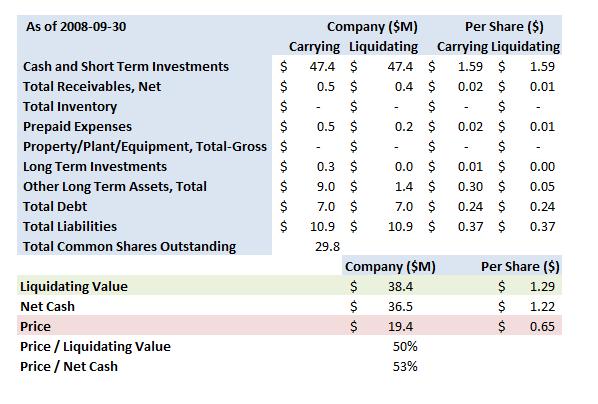
Avigen, Inc. (NASDAQ:AVGN) is an interesting opportunity: a rare net cash stock with an activist investor in pursuit. Based on its December 1, 2008 closing price of $0.65, the company has a market capitalization of $19.4M and net cash (i.e. cash less all liabilities) of $36.5M, which means that AVGN is trading at 53% of its net cash. Biotechnology Value Fund LP owns around 29% of the outstanding stock and has filed a 13D/A notice (most recent is here) requesting that AVGN “immediately reduce its expenses to as low a level as possible, partner or sell its remaining assets without further investment and take actions to distribute to [AVGN]’s stockholders as much of the resulting cash as possible.”

About AVGN

AVGN (website here) is a “biopharmaceutical company engaged in developing and commercializing small molecule therapeutics to treat neurological and neuromuscular disorders.”

The value proposition

According to AVGN’s most recent quarterly report, the company is bleeding cash, losing $9.4 in the September quarter. AVGN lost $25.2M last year and $24.3M in 2006. It has also had negative Cash Flow from Operating Activities for the September quarter in the amount of $8.4M. The company does, however, have a substantial amount of cash on its balance sheet. Set out below is our summary analysis (the “Carrying” column shows the assets as they are carried in the financial statements, and the “Liquidating” column shows our estimate of the value of the assets in a liquidation):

avgn-summaryAVGN is a net cash stock, with $1.22 of net cash (cash after subtracting Total Liabilities). With its stock price at $0.65, AVGN is trading at a little over half its net cash value. We estimate AVGN’s value in a liquidation at around $38.4M ($1.29 per share).  Given its net cash position of $36.5M or $1.22 per share, this means we have valued the rest of the company’s assets in liquidation at only $1.9M or $0.07 per share.

The catalyst

Biotechnology Value Fund originally filed a 13G notice in relation to AVGN, which indicates a passive investment. By updating to a 13D, Biotechnology Value Fund has indicated that it intends to take an active role in the company. An earlier 13D filing sets out Biotechnology Value Fund’s attitude towards the company:

“At the invitation of the Chairman of [AVGN], [Biotechnology Value Fund] articulated their views regarding the future of the Company in a conference call with the Board of Directors held on October 30, 2008. [Biotechnology Value Fund] stated their strong belief that [AVGN] should immediately reduce its expenses to as low a level as possible, partner or sell its remaining assets without further investment and take actions to distribute to [AVGN]’s stockholders as much of the resulting cash as possible. [AVGN] reported $56 million, or $1.88 per share, of financial assets as of September 30, 2008, consisting of cash, cash equivalents, available-for-sale securities and restricted investments.

[Biotechnology Value Fund] informed the Board of Directors that they think that the previously announced plan of spending [AVGN]’s remaining cash on the development of its early-stage pain drug, AV411 as well as [AVGN]’s corporate infrastructure is fundamentally flawed, especially in light of the current environment for raising additional capital. [Biotechnology Value Fund] believe that AV-411 is a high risk drug candidate that is best developed (if at all) by a larger company with greater financial resources and a lower cost of capital. By the time AV-411 could be commercialized, or even definitively proven safe and efficacious, [AVGN]’s existing cash resources would be depleted. [Biotechnology Value Fund] believe that the investment community clearly lacks confidence in such a plan, as evidenced by recent reports from stock analysts and by the $0.61 per share closing price of [AVGN]’s common stock on October 30, 2008, reflecting only 31% of [AVGN]’s financial assets as of September 30, 2008.

[Biotechnology Value Fund] intend to work with [AVGN]’s Board of Directors to effecuate a prompt return of cash to [AVGN]’s stockholders and intend to bring the matter directly to a vote of stockholders if their efforts with the Board of Directors are unsuccessful.”

Conclusion

It’s always exciting to find a net cash stock with an substantial stockholder demanding a return of cash. While it’s frightening to see AVGN hemorrhaging cash, Biotechnology Value Fund is awake to the opportunity to salvage what remains of the company’s value. If Biotechnology Value Fund is able to cause the company to quickly distribute the company’s remaining cash to stockholders, purchasers at these levels should see a good return on investment.

AVGN closed today at $0.65.

The S&P 500 Index closed at 816.21.

[Disclosure: We do not presently have a holding in AVGN. This is neither a recommendation to buy or sell any securities. All information provided believed to be reliable and presented for information purposes only.]

Read Full Post »
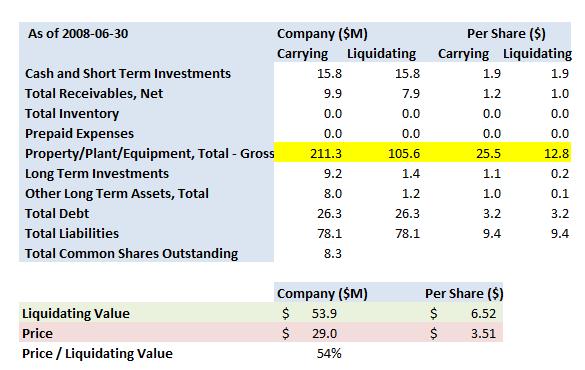
Barnwell Industries, Inc. (AMEX:BRN) is exactly the kind of opportunity Greenbackd likes to find: a company trading at a discount to its liquidating value with an activist investor agitating for change. We estimate the company has a value in liquidation of around $55M, so its market cap of $29M (based on its November 28, 2008 close of $3.51) puts the company at a 46% discount to that value. Dr. Eric Jackson’s Ironfire Capital LLC, an “equity long biased and event-driven activist investment firm”, has sniffed the value and launched a “‘friendly’ activist campaign targeting the company to unlock shareholder value”.

About BRN

BRN, according to its website, is “principally engaged in the following activities:

  • Oil and Natural Gas. Barnwell engages in oil and natural gas exploration, development, production and sales in Canada.
  • Land Investment. Barnwell invests in leasehold interests in real estate in Hawaii.
  • Real Estate Development. Established in January 2007, acquires house lots for investment and for the construction of turnkey single-family homes for sale”

Seems like an odd combination of businesses to us, which makes it a prime candidate for a bust up.

The value proposition

According to BRN’s most recent quarterly report, BRN has a reasonably healthy balance sheet and positive cash flow of operating activities of $8.7M for the three months ending June 30, 2008. Set out below is our summary analysis of the balance sheet (each “Carrying” column shows the assets as they are carried in the financial statements, and each “Liquidating” column shows our estimate of the value of the assets in a liquidation):

BRN Summary

Our liquidating value estimate for BRN is around $53.9M, or $6.52 per share. As the table above demonstrates, most of BRN’s value is in its Property, Plant, and Equipment, which is carried at $25.50 per share. In our valuation, we’ve written down BRN’s Property, Plant and Equipment per share by 50% to $12.75. Our written down value for the other assets is set out in the table. These estimates are often too conservative, but it is the only way we get to sleep at night. This is especially so given that the company is carrying $26M in total debt. With its stock price at $3.51 (at its November 28, 2008 closing price), BRN is trading at 54% of its value in a liquidation, which strikes us as a sufficient margin of safety.

The catalyst

Ironfire Capital has a position in BRN but it is presumably too small to require Ironfire to file a 13D notice.  Its founder, Dr. Eric Jackson, perhaps best known for his Yahoo! campaign, has published a number of “prescriptions” for BRN to enhance shareholder value on the web. Ironfire Capital is an interesting activist investor because it uses “Internet-based social networking tools” to “amplify the impact” of its campaigns. Dr. Jackson also writes a blog about his particular brand of web-based shareholder activism called Breakout Performance and has provided his analysis of BRN in a June post. He has also written about his prescriptions for BRN on his Sharehowner Activism Wiki, which include the following:

Simplify Corporate Structure

Barnwell’s three businesses (oil and gas, contract water drilling, and real estate/land investment) have no synergy. A simpler corporate structure would better allow the market to bid up the underlying value of the oil and gas business to reflect the doubling of the commodity pricing in the last year. Barnwell should sell its water drilling business, which is small and shrinking in revenues and earnings. If the company received 1x its revenues, its cash reserves would nearly double to $14MM, allowing a stock buyback and/or upping the dividend. Selling or spinning off the real estate business might also make sense to focus Barnwell as a small natural gas pure-play.

Reduce SG&A Costs

Over the last year, SG&A costs have gone up 50% to $3.2MM. Yet, revenues and gross profit only increased 28% and 27% respectively over that same period. Barnwell is growing its costs at twice the rate of its sales and profits. As they say in Business School, that’s not sustainable. It’s also not acceptable for a 65 person company. Selling off the water drilling business, which contributes little profit, is a step in the right direction to improving things here, but much more work is needed.

Do a Stock Buyback

The company did agree to pay out a 5 cent dividend recently. Hopefully, that will attract a new group of investors to the stock. However, a stock buyback is both prudent, given that the cash position has increased over the last year and the strength of gas and land development businesses, and would make the company more attractive by lowering further its price-earnings ratio.

Bring in Some New Blood to the Board

Barnwell’s board is large and long-tenured. RiskMetrics awarded Barnwell a Corporate Governance Quotient (CGQ) score that is lower than 70% of other energy companies. The board’s composition is part of the problem. Seven of the 11 directors are older than 64. Four of the directors have been on the board for more than a decade.

It makes sense to change the composition of the board. Some of the longstanding directors should step down now to make way for some new blood, but some of them shouldn’t be replaced. An 11-member board is too large for a $100MM company. Having fewer than 10 directors would lead to faster meetings with more participation and debate.

Better Align Executive Compensation with Performance

Executive compensation policy has also likely contributed to Barnwell’s lower CGQ score. Last year, the CEO was paid $1.2MM. He explained this by pointing to how the company’s profits increased by 200% that year, yet the stock price dropped in half over that same time. Stock price is due to external market conditions, not management. If a CEO doubles a company’s profit, that should be rewarded.”

Conclusion

At 54% of its written down value, BRN is very cheap. With Ironfire Capital agitating for change, we believe BRN presents an attractive opportunity for investment.

BRN closed on November 28, 2008 at $3.51. The S&P 500 Index closed on November 28, 2008 at 896.24.

[Disclosure: We do not presently have a holding in BRN. This is neither a recommendation to buy or sell any securities. All information provided believed to be reliable and presented for information purposes only.]

Read Full Post »

« Newer Posts