Feeds:
Posts
Comments

Archive for the ‘Activist Investors’ Category

Barnwell Industries, Inc. (AMEX:BRN) has filed its September 10Q and the results are encouraging. Even though the stock is up more than 40% since our first post, we believe that BRN is still undervalued and so we are maintaining our position.

We started following BRN because its liquidation value of $55M (around $6.52 per share) was some 86% higher than its market capitalization of  $29M based on its November 28, 2008 close of $3.51. Dr. Eric Jackson’s Ironfire Capital LLC had launched a “‘friendly’ activist campaign targeting the company to unlock shareholder value”.

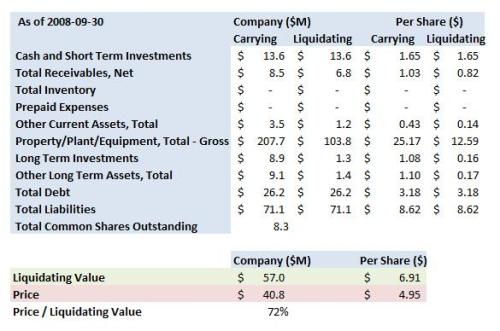
BRN has now filed its September 10Q and we believe that its liquidating value has increased from our original estimate of $6.52 per share to $6.91 per share, which is some 40% higher than its Friday close of $4.95. Set out below is our summary analysis of the balance sheet (each “Carrying” column shows the assets as they are carried in the financial statements, and each “Liquidating” column shows our estimate of the value of the assets in a liquidation):

brn-summary-q3

Conclusion

Although the stock has risen substantially, at 72% of its written down value, BRN is still cheap and we are maintaining our position.

[Disclosure: We do not presently have a holding in BRN. This is neither a recommendation to buy or sell any securities. All information provided believed to be reliable and presented for information purposes only.]

Read Full Post »
Trilogy, Inc. has increased its stake in Autobytel Inc (NASDAQ:ABTL). On November 21, 2008, Trilogy, Inc. filed its Schedule 13D notice, declaring an interest of 5.01%. Trilogy, Inc has now filed an updated 13D notice, disclosing an increased 7.4% stake.

We started following ABTL last year because it was a net net stock with a market capitalization of $19.4M at its December 10, 2008 close of $0.43. We estimated the company’s liquidation value some 80% higher at $35.3M or $0.78 per share. Although the stock has risen some 18.6% to close Friday at $0.51, ABTL is still worth 50% more than its stock price indicates so we plan to maintain our position.

[Disclosure: We do not have a holding in ABTL. This is neither a recommendation to buy or sell any securities. All information provided believed to be reliable and presented for information purposes only.]

Read Full Post »

We’ve decided to exit our position in Kona Grill Inc (NASDAQ:KONA). We first posted about KONA on December 15, 2008 when the stock had last traded at $1.31. At Friday’s $2.46 close, our theoretical profit on the play of $1.15 equates to an absolute gain for holding KONA of 87.8%. The S&P 500 closed December 12, 2008 at 879.73 and closed Friday at 931.80 (+5.9%), so we’re up 81.9% on a relative basis.

We started following KONA because it was an undervalued asset situation with a potential acquirer – Mill Road Capital – raising its stake in the company through November last year. We’ve closed our position for two reasons:

  1. KONA’s stock price has now risen to our estimate of its liquidating value of $14.8M or $2.47 per share. When we opened the position at $1.31 KONA had a market capitalization of just $7.9M, which meant it was trading at almost a 50% discount to its liquidating value. The discount is now gone, and that’s a good enough reason to close the position.
  2. KONA has entered into an agreement to issue stock to the CEO’s father at a $1.19 per share. The price is a substantial discount to the market price for KONA stock at the time of the agreement, the price KONA solicited from Mill Road Capital and the current market price. Behaviour like this – issuing stock at a discount to liquidation value when competing offers are available – raises red flags for us about KONA management’s lack of regard for KONA stockholders.

Our holding period for KONA was 18 days, which was unexpectedly short, and ended before Mill Road Capital was able to persuade KONA to undertake some catalytic event. We mentioned in our About Greenbackd page that the market would occasionally spontaneously recognize the underlying asset value and remove the discount, and that seems to have happened here. By any measure, an 88% return over 18 days is an excellent return, but we caution that it was a happy accident and is unlikely to be repeated.

Read Full Post »

Mill Road Capital has filed an amended 13D attaching a letter sent to Kona Grill Inc (NASDAQ:KONA). In the letter Mill Road Capital raises some concerns about the issuance of KONA stock to the CEO’s father at a substantial discount to the then current market price and the price that KONA solicited from Mill Road Capital in a December meeting. Mill Road Capital’s letter to KONA is set out below:

Marcus Jundt
Chairman & CEO
Kona Grill, Inc.
7150 East Camelback Road
Suite 220
Scottsdale, AZ 85251
Dear Marcus:

I am writing as a follow-up to our meeting on December 17, 2008. In that meeting which Rick Hauser attended, you outlined the following proposal:

•Mill Road Capital (“Mill Road”) would make a personal loan to Hauser and you for $6 million. This loan would be secured by Hauser’s and your personal assets including the stock in Kona Grill, Inc. (“Kona” or the “Company”).

•Hauser and you would use the $6 million to purchase 4 million newly issued shares of Kona at $1.50 per share.

•As compensation for making the loan, Mill Road would be allowed to buy 2 million newly issued shares of Kona at $1.50 per share, and Mill Road would be given one seat on the Board of Directors.

In that meeting, we rejected your proposal on two grounds. First, we believed it violated the Sarbanes-Oxley amendments to the Securities Exchange Act of 1934 prohibiting the Company from directly or indirectly arranging loans to management. We further rejected the proposal because it was not part of a competitive process that would ensure the highest value to the Company and all of its shareholders.

At the end of the meeting, we indicated that we would be willing to take part in any competitive process that the Company initiated in order to either raise funds or sell the Company. You noted that no such transactions would be completed before year end.

I note that in the 8-K filed by the Company yesterday, the Company said it had entered into a subscription agreement to sell shares to your father at $1.19 per share, a substantial discount to both the price of $1.50 per share that you solicited from us and the current market price of $1.57.

Mill Road Capital is the 2nd largest shareholder in the Company. We remain committed to seeing the Company undertake a fair and competitive capital raising process that would ensure the highest long-term value to all shareholders.

Is it your plan to subject that proposed transaction to the fully competitive process that we requested in the meeting on December 17th?

Sincerely,

Thomas Lynch
Senior Managing Director
Mill Road Capital L.P.

It seems that rather than undertake a fair and competitive capital raising process, KONA has issued stock to the CEO’s father, which is a disappointing outcome for KONA’s stockholders. The fact that the issuance was undertaken at such a discount to the prevailing market price for KONA stock raises a red flag for us.

Read Full Post »

In its most recent 13D filing Biotechnology Value Fund (BVF) has provided its “full and enthusiastic support” for MediciNova, Inc.’s (NASDAQ:MNOV) offer for Avigen, Inc. (NASDAQ:AVGN).

We’ve been following AVGN (see earlier posts here, here, here, here and here) because it’s a net cash stock (i.e. it’s trading at less than the value of its cash after deducting all liabilities) and specialist biotechnology activist fund BVF has been pushing it to liquidate and return its cash to shareholders. We think that MNOV’s offer represents a clever way for AVGN’s stockholders to receive cash equivalent to that which they would receive in a liquidation (less $7M to be paid to MNOV). We estimate the cash to be paid at around $1.22 per share (BVF estimates the amount at $1.20 per share), which is more than 60% higher than AVGN’s $0.76 close Wednesday. AVGN’s shareholders also have the option to receive MNOV shares instead of the cash. MNOV values its shares at $4.00 (MNOV closed Wednesday at $1.59).

BVF’s filing sets out its rationale for endorsing the merger. The relevant text is extracted below:

On December 22, 2008 MediciNova, Inc. (“MediciNova”) described details of a Proposed Merger between MediciNova and Avigen, Inc. (“Avigen”) in a letter to Avigen’s Chairman, Zola Horovitz. The Reporting Persons hereby express their full and enthusiastic support for this Proposed Merger and believe it is the best interest of all Avigen shareholders. The Reporting Persons presently have no economic interest in MediciNova. The Reporting Persons call on Avigen’s Board of Directors to negotiate with MediciNova and work to consummate the Proposed Merger expeditiously.

The Reporting Persons support the Proposed Merger for the following reasons:

1. Downside Protection: The Proposed Merger provides for the same downside protection that the Reporting Persons encouraged Avigen to implement directly (which Avigen rejected). Subsequent to the Proposed Merger, if MediciNova is unsuccessful, Avigen shareholders will receive approximately the current liquidation value of Avigen (which the Reporting Persons estimate to be approximately $1.20/share, net of debt and expenses), as determined by an independent auditor. Incredibly, in a worst case scenario, the Proposed Merger would yield about a 60% premium to Avigen’s current stock price.

2. Extraordinary Upside Potential: If MediciNova is successful post-merger, Avigen shareholders could own a substantial percentage of MediciNova (which the Reporting Persons estimate to be approximately 45% of the combined company). Thus, in a best case scenario, Avigen shareholders could enjoy an extraordinary, uncapped return. For this reason, the Proposed Merger is superior to an immediate liquidation of Avigen.

3. Free Option: Shareholders have at least one year after the merger is consummated to choose downside protection or upside potential, as described above. This decision can be based on information obtained over the course of the free option period, including the stock performance of MediciNova. This free option period offers shareholders tremendous upside potential with virtually no risk.

4. Change of Control: The Proposed Merger would result in new stewardship of Avigen’s assets, curtailing current management’s stated plan of seeking ways to utilize (and we fear waste) Avigen’s cash in any way they wish. This is a particularly frightening prospect in light of CEO Ken Chahine’s recent statements that “it’s hard to put a finger on exactly what we would do”, that he “intends to build” and that he “thinks that there are opportunities outside of therapeutics.”

5. Unique Synergies: The Reporting Persons believe there are unique synergies between MediciNova and Avigen which likely would not exist with other potential acquirers of Avigen. These synergies give rise to the compelling nature of the Proposed Merger.

BVF wishes to see the Proposed Merger brought to a shareholder vote as soon as practical and urges other Avigen shareholders to support this offer.

We’ve noted in our earlier posts that AVGN presents an attractive investment opportunity if BVF can persuade it to quickly distribute its remaining cash to stockholders. MNOV’s offer presents a clever way for AVGN’s stockholders to receive an amount equivalent to its cash with the possibility for “an extraordinary, uncapped return” if MNOV is successful post-merger. We estimate AVGN’s cash at around $1.22 per share, which is more than 60% higher than AVGN’s $0.76 close Wednesday. With BVF’s endorsement of MNOV’s offer, we believe the investment rationale for AVGN is strong.

[Disclosure: We have a holding in AVGN. This is neither a recommendation to buy or sell any securities. All information provided believed to be reliable and presented for information purposes only.]

Read Full Post »

We’re unabashed fans of Carl Icahn, who’s reputation for pushing up the stock prices of the companies he invests in has led to a phrase that describes his Midas touch: the “Icahn lift.” We’ve previously covered the billionaire investor’s antics in YHOO here. Our gift to you is 60 Minutes’ August profile on Icahn:

It takes a certain breed of stock market investor, the kind with lots of money and lots of guts, to thrive in queasy times like these, when the market keeps losing altitude. Carl Icahn is one of that breed.

He has a knack for turning someone else’s loss into profit for himself. But he can also help others improve their bottom line through the so-called “Icahn Lift,” an upward bounce that often happens when he starts buying a beleaguered stock.

To see the video, click here: (60 Minutes’ “The Icahn Lift”). Enjoy!

Read Full Post »

Avigen, Inc. (NASDAQ:AVGN) has received an offer from MediciNova, Inc. (NASDAQ:MNOV), a biopharmaceutical company that is publicly traded on both the Nasdaq Global Market and the Hercules Market of the Osaka Securities Exchange (Code Number: 4875).

We’ve been following AVGN (see earlier posts here, here, here and here) because it’s a net cash stock (i.e. it’s trading at less than the value of its cash after deducting all liabilities) and it has a specialist biotechnology activist fund Biotechnology Value Fund (BVF) pushing it to liquidate and return its cash to shareholders. We esimate AVGN’s net cash value at $43.5M or $1.46 per share.

According to this filing, MNOV proposes to offer AVGN stockholders a pro rata portion of 1.75M shares of MNOV and a convertible security representing AVGN’s Net Cash Assets,” which MNOV defines as AVGN’s cash remaining after it is wound up less $7M paid to be paid to MNOV. The convertible security issued by MNOV would allow each AVGN stockholder at their election to either (i) convert each share of the convertible security into MNOV at a conversion price of $4.00 per share or (ii) have the convertible security redeemed for cash in an amount per share that represents the Net Cash Assets per share of AVGN. The redemption would occur on the later of March 31, 2010 or 12 months from the closing of the merger transaction. The letter from MNOV to AVGN is reproduced below:

Zola Horovitz, Ph.D.

Chairman of the Board

Avigen, Inc.

Dear Dr. Horovitz:

The purpose of this letter is to provide you with more details concerning the recent expression of interest MediciNova, Inc. (“MediciNova”) made to Avigen, Inc. (“Avigen”) with respect to a potential merger of the two companies in the letter to you dated December 9, 2008.

Our present thinking, based upon the information in publicly available documents and preliminary due diligence, is that we would offer as consideration a combination of registered MediciNova common stock and shares of a MediciNova convertible security for each share of Avigen common stock outstanding. In connection with the merger, Avigen would wind up all of its business activities, including satisfying all of its obligations by way of indebtedness, severance and related liabilities, while retaining all intellectual property assets for the combined companies.

MediciNova proposes that at closing each Avigen shareholder will receive a pro rata portion of 1.75 million shares of MediciNova common stock. In consideration for this, MediciNova will receive $7 million of Avigen cash.

The remaining amount of Avigen cash after Avigen’s wind-up activities are completed and less the $7 million in cash received by MediciNova (the “Net Cash Assets”) will be sequestered and, unless converted earlier as described in the next sentence, not used until the later of March 31, 2010 or 12 months from the closing of the merger transaction (the “Final Conversion Date”). The Net Cash Assets of Avigen will be attested by an independent auditor. The convertible security issued by MediciNova as consideration would allow each Avigen stockholder at their election to either (i) convert each share of such convertible security into shares of MediciNova common stock at a conversion price of $4.00 per share at certain pre-specified accelerated conversion dates or the Final Conversion Date or (ii) have the convertible security redeemed by MediciNova on the Final Conversion Date for cash in an amount per share which represents the Net Cash Assets per share of Avigen.

Based on this proposal, we note that the proposed transaction values each Avigen share at a substantial premium to both your recent stock price and the closing average market price of Avigen’s common stock since your October 21, 2008 announcement. Additionally, the convertible security allows each Avigen stockholder the choice of receiving cash in an amount not presently available to them, other than in a liquidation scenario, or participating in what we believe will be growth in value of the combined entity.

We continue to believe that a merger between MediciNova and Avigen would be in the best interests of the stockholders of both companies for many reasons, including the likely incremental increase in value of the Companies’ combined product candidates. We note that it also addresses the recent pressures Avigen has faced from its stockholder base.

Our proposal remains subject to the completion of customary due diligence, as well as the negotiation of definitive transaction agreements and the satisfaction of necessary approvals and customary conditions to closing of a transaction to be set forth in such agreements. While this letter, and our prior letter to you dated December 9, 2008, are not intended as a binding offer, we continue to stand ready to meet with you and your advisors immediately to discuss this matter.

Please be advised that, because of the past relationships among various of our respective directors, MediciNova has constituted a Special Committee of Directors to represent MediciNova with respect to the proposed business combination. That Special Committee consists of myself as Chair, along with Alan Dunton, Arlene Morris and Hideki Nagao from the MediciNova Board. Our Committee continues to believe this proposal represents a unique opportunity for Avigen’s stockholders and we look forward to a prompt and favorable reply.

Very truly yours,

Jeff Himawan, Ph.D.

Chairman of the Board of Directors

MNOV’s offer represents a clever way for AVGN’s stockholders to receive cash in an amount almost equivalent to what they would receive in a liquidation scenario less $7M paid to MNOV. This equates to approximately $1.22 per share in cash. AVGN’s shareholders also have the option to receive MNOV shares valued at $4.00 (MNOV closed yesterday at $1.60) instead of the cash. AVGN shareholders would also receive 1.75M shares of MNOV divided between 30M AVGN shares on issue.

The offer seems broadly positive to us. Our few quibbles are as follows:

  1. the $7M payment to MNOV seems excessive
  2. the MNOV conversion price of $4.00 is too high
  3. the redemption date – on the later of March 31, 2010 or 12 months from the closing of the merger transaction – is too far away.

If these could be negotiated to a more favorable position for AVGN, the MNOV offer should be welcomed by AVGN’s stockholders.

Hat tip to commenter KC.

Read Full Post »

We posted yesterday that Avigen, Inc. (NASDAQ:AVGN) had announced the sale of its rights to an early-stage blood coagulation compound for $7M. We weren’t sure that the sale was for cash. According to this filing, the sale was for cash:

On December 17, 2008, Avigen, Inc. entered into an Asset Purchase Agreement with Baxter Healthcare Corporation, Baxter International Inc., and Baxter Healthcare S.A. (collectively “Baxter”), providing for the sale of the rights to Avigen’s early stage blood coagulation compound, AV513, to Baxter.

Avigen received a cash payment of $7.0 million from Baxter as proceeds from the sale of AV513. At September 30, 2008, Avigen reported cash, cash-equivalents, and available for sale securities and restricted investments of $56.4 million and an accumulated deficit of $244.9 million. Avigen reported no revenue for the first nine-months of 2008 and a net loss of $24.2 million. The Company is in the process of evaluating the terms of the transaction, but believe that if the transaction had been completed at the beginning of the 2008 fiscal year, the cash received would have been recorded as revenue and would have increased the amount of financial assets and decreased each of the net loss and the accumulated deficit reported at September 30, 2008 by $7.0 million. Avigen is unable to estimate the amount of any expenses that would have been avoided, if any, if the sale of AV513 had been completed at the beginning of the 2008 fiscal year. Other than these items, the transaction would not have had any other impact on Avigen’s financial statements.

We’ve been following AVGN (see earlier posts here, here and here) because it’s a net cash stock (i.e. it’s trading at less than the value of its cash after deducting all liabilities) and it has a specialist biotechnology activist fund Biotechnology Value Fund (BVF) pushing it to liquidate and return its cash to shareholders. In our initial post,we noted that AVGN’s net cash position was $36.5M. Adding the $7M or $0.24 per share to AVGN’s cash position gives it a net cash value we estimate at $43.5M or $1.46 per share against a close yesterday of $0.73.

Read Full Post »

A number of commenters have identified in the notes to ValueVision Media Inc. (NASDAQ:VVTV)‘s latest 10Q that VVTV has substantial cash obligations under the cable and satellite agreements and operating leases falling due over the five fiscal years from 2009 to 2012 and not reflect in VVTV’s balance sheet. The worst case scenario is that these obligations represent an additional $185M liability. If this is the case, then our previous estimate for VVTV’s $55.7M in liquidating value is obviously wrong and VVTV may have no value in liquidation.

The value proposition

We’ve previously posted about VVTV here and here, writing that it seemed to us to be one of the better opportunities available because it’s a net net stock (i.e. a stock trading for less than its net current assets) with other apparently valuable assets and noted activist investor J. Carlo Cannell of Cannell Capital holding an activist position in it. The company also seemed to us to be taking steps to realize its value, publicly announcing that it had appointed a special committee of independent directors to conduct an auction to be completed by February 2, 2009. We estimated VVTV’s liquidating value at $55.7M or $1.66 per share. We may have to alter this estimate now to account for the “contractual cash obligations and commitments with respect to [VVTV]’s cable and satellite agreements and operating leases.”

The offending statement is to be found under the Financial Condition, Liquidity and Capital Resources – Cash Requirements section and reads as follows:

In addition to the potential preferred stock redemption cash commitment mentioned above, we have additional long-term contractual cash obligations and commitments with respect to its cable and satellite agreements and operating leases totaling approximately $185 million over the next five fiscal years with average annual cash commitments of approximately $44 million from fiscal 2009 through fiscal 2012.

We don’t know the terms of the cable and satellite agreements and operating leases and so it is impossible to determine whether the “contractual cash obligations” are absolute or contingent on VVTV continuing to use the services contracted. The worst case scenario is that the obligations are absolute, and therefore represent an additional $185M liability not carried in VVTV’s financial statements. If this is the case, then VVTV may have no value in liquidation.

Conclusion

This is a particularly unfortunate situation because we don’t know how to deal with the “contractual cash obligations.”  If any commenters have a suggestion, we’d be keen to hear it. We note that Williamss commented as follows:

Operating leases are notorious for making the balance sheet appear much better than it actually is. If you add these back to the balance sheet, and combine it with the 44.6 million coming due as part of the GE capital redemption for the preferred shares, then I worry that this company seems to be rapidly headed towards illiquidity, if not insolvency.

When we run into an issue with a financial statement, we generally return to first principles. Graham writes in Security Analysis

A company’s balance sheet does not convey exact information as to its value in liquidation, but it does supply clues or hints which may prove useful.  The first rule in calculating liquidating value is that the liabilities are real but the assets are of questionable value.  This means that all true liabilities shown on the books must be deducted at their face amount.

We have to take the most conservative position, which is that the liability is real and a “true liability” and must therefore be deducted at its face amount. On that basis, VVTV has no value in liquidation and we’re out.

As we’ve discussed in our About Greenbackd and About liquidation value investing pages, we apply Graham’s liquidating value methodology because it’s conservative, it doesn’t require a great deal of sophistication – it’s a simple formula – and it doesn’t require the heroic leaps in reasoning required to forecast future earnings. We believe that this type of analysis will yield reasonable results given a sufficiently large sample size and sufficiently long period of time, even allowing for our mistakes. We’ve committed a real howler with VVTV.

VVTV closed yesterday at $0.33. We liked it at $0.44, so we’re down 25% on an absolute basis.

The S&P 500 closed yesterday at 871.63 and closed at 888.67 (-1.92%) when we liked VVTV first, so we’re down 23.08% on a relative basis.

Hat tips to commenters Williamss and Jim.

[Disclosure: We do have a holding in VVTV. This is neither a recommendation to buy or sell any securities. All information provided believed to be reliable and presented for information purposes only.]

Read Full Post »

Avigen, Inc. (NASDAQ:AVGN) announced on Thursday that it had sold its rights to an early-stage blood coagulation compound for $7M. We have not been able to confirm that the sale was for cash. Assuming that it was, we estimate that it adds $0.24 per share to AVGN’s cash position and takes its net cash value to $1.46 per share, some 122% higher than its close Friday at $0.658.

We’ve been following AVGN (see earlier posts here and here) because it’s a net cash stock (i.e. it’s trading at less than the value of its cash after deducting all liabilities) and it has a specialist biotechnology activist fund Biotechnology Value Fund (BVF) pushing it to liquidate and return its cash to shareholders. In our initial post,we noted that AVGN’s net cash position was $36.5M. Assuming that the $7M sale was for cash, adding it to AVGN’s cash position gives it a net cash value we estimate at $43.5M or $1.46 per share, 122% higher than its Friday close.

If BVF is able to cause the company to quickly distribute its remaining cash to stockholders, AVGN is an attractive investment opportunity. The risk is that BVF is unable to persuade the company to do so before AVGN dissipates its remaining cash.

AVGN closed Friday at $0.658.

The S&P 500 Index closed Friday at 887.88.

[Disclosure: We do not presently have a holding in AVGN. This is neither a recommendation to buy or sell any securities. All information provided believed to be reliable and presented for information purposes only.]

Read Full Post »

« Newer Posts - Older Posts »