Feeds:
Posts
Comments

Archive for the ‘Activist Investors’ Category

Avigen Inc (NASDAQ:AVGN) has filed its 10Q for the period ended June 30, 2009.

One interesting aspect of the 10Q is the cost the company attributes to responding to the proxy fight and hostile tender offer:

Operating Activities. Net cash used in operating activities was $8.2 million during the six months ended June 30, 2009. Net cash used in operating activities during this period was primarily used to fund costs associated with our response to a proxy fight and hostile tender offer, and winding down clinical research and development activities, including non-clinical studies and clinical trials performed by third parties.

$8.2M? That’s $0.27 per share! Granted, some of it went to other activities, but presumably costs associated with “response to a proxy fight and hostile tender offer” was the larger portion of the $8.2M and that’s why it was listed first. It’s galling what directors are allowed to spend fighting off shareholders.

We started following AVGN in December last year (see archived posts here) because it was a net cash stock and specialist biotechnology investor Biotechnology Value Fund (BVF) was pushing it to liquidate and return its cash to shareholders. Despite BVF’s failure to remove the board, we continued to maintain our position in AVGN because BVF won a number of important concessions from the board that made AVGN a much more attractive stock than it was when we started following it. AVGN is now back in negotiations with MediciNova, Inc. regarding a proposed acquisition by MediciNova. The consideration for the deal is AVGN’s “net cash liquidation value plus $3 million” and “a contingent payment right for a specific product program milestone payment associated with Avigen’s Assignment Agreement with Genzyme Corporation, potentially subject to certain adjustments.” The stock price reflects this: AVGN closed yesterday at $1.34, up 106.2% from our $0.65 purchase price. We last estimated the net cash liquidation value at around $34M or $1.14 per share. We’ve now updated our estimate to $35M or $1.17 per share. Including the $3M from MediciNova would increase that value to around $38M or $1.27per share. We believe that there is a reasonable chance that AVGN will yield more than its current $1.34 share price when the “contingent payment right” capturing the near term payments from Genzyme is taken into account. AVGN shareholders also have an option-like exposure to any value in AVGN’s AV411 assets and program, although we cannot estimate the value of this with any certainty.

The value proposition updated

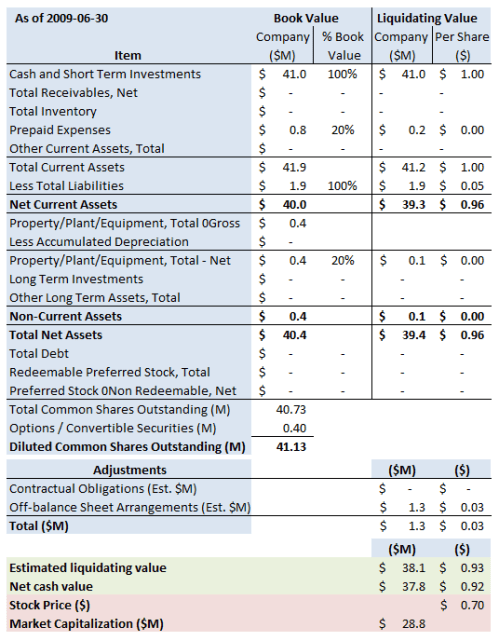
Set out below is our adjusted balance sheet for AVGN (the “Book Value” column shows the assets as they are carried in the financial statements, and the “Liquidating Value” column shows our estimate of the value of the assets in a liquidation):

AVGN Summary 2009 6 30

Conclusion

While BVF’s slate was unsuccessful at the special meeting, AVGN’s board has developed its own plan of liquidation, which should put a floor on AVGN’s stock at around its net cash value of $34M or $1.14 per share less wind down costs. There exists a good chance that AVGN will yield considerably more than its net cash value. The net cash estimate does not take into account AVGN’s AV411 assets and program or near term payments from Genzyme. With the downside protected, and a good chance at some upside from here, we think AVGN still represents good value, and we’re going to maintain our position accordingly.

[Full Disclosure: We have a holding in AVGN. This is neither a recommendation to buy or sell any securities. All information provided believed to be reliable and presented for information purposes only. Do your own research before investing in any security.]

Read Full Post »

Steel Partners has increased its holding in CoSine Communications Inc (OTC:COSN) from 44.9% to 47.5% at an average purchase price of $1.97 per share according to the fund’s most recent 13D notice.

We’ve been following COSN (see our COSN post archive) because it is a cash box controlled by activist investor Steel Partners. Steel Partners own 47.5% of the stock and sits on the board. The stock is up 16% since our initial post to close Friday at $2.03. We estimate the net cash value to be around $22.2M or $2.20 per share. The net cash value has remained stable through 2006, 2007, 2008 and 2009. COSN presents an opportunity to invest alongside Steel Partners at a discount to net cash in a company with substantial NOLs.

Hat tip FF.

[Full Disclosure:  We do not have a holding in COSN. This is neither a recommendation to buy or sell any securities. All information provided believed to be reliable and presented for information purposes only. Do your own research before investing in any security.]

Read Full Post »

Two VaxGen Inc (OTC:VXGN) shareholders have sent a letter to the board of directors of the company claiming that the directors have failed in their fiduciary duties to shareholders. After reading the “list of grievances and imponderables over the actions of VaxGen’s Board and Management” laid out in the letter, you’ll find it hard to disagree. C. Fred Toney and Ruediger Naumann-Etienne, Ph.D., the authors of the letter, “seek an immediate change to the mode of operations and the composition of the Board” and implore the Board to make “drastic changes,” which include paying a $0.50 per share dividend. The letter is of epic, Tolstoyesque proportions, but we thoroughly recommend you read it if you hold stock in VXGN.

About our position in VXGN

We’ve been following VXGN (see our post archive here) because it is trading at a substantial discount to its net cash position, has ended its cash-burning product development activities and is “seeking to maximize the value of its remaining assets through a strategic transaction or series of strategic transactions.” If the company is unable to identify and complete an alternate strategic transaction, it proposes to liquidate. One concern of ours has been a lawsuit against VXGN by its landlords, in which they sought $22.4M. That lawsuit was dismissed in May, so the path for VXGN to liquidate has now hopefully cleared.

VXGN has now also attracted the attention of BA Value Investors, which has disclosed an activist holding and called on VXGN to “act promptly to reduce the size of the board to three directors; reduce director compensation; change to a smaller audit firm; terminate the lease of its facilities; otherwise cut costs; make an immediate $10 million distribution to shareholders; make a subsequent distribution of substantially all the remaining cash after settling the lease termination; distribute any royalty income to shareholders; and explore ways to monetize the public company value of the Issuer and use of its net operating losses.”

VXGN is up 20.8% since we initiated the position. At its $0.58 close yesterday, it has a market capitalization of $19.2M. We last estimated the company’s liquidation value to be around $25.4M or $0.77 per share. VXGN has other potentially valuable assets, including a “state-of-the-art biopharmaceutical manufacturing facility with a 1,000-liter bioreactor that can be used to make cell culture or microbial biologic products” and rights to specified percentages of future net sales relating to its anthrax vaccine product candidate and related technology. The authors of the letter ajudge VXGN’s liquidation value to be significantly higher at $2.12 per share:

Excluding the lease obligations, the net financial assets alone of $37.2 million equate to $1.12 per share. The EBS royalties (assuming a 6% royalty rate and a $500 million contract as contemplated by NIH/HHS and EBS) of $30 million and milestones of $6 million total $36 million of potential additional future value (based clearly on assumptions, none of which are assured), or $1.09 per share. Adding $1.12 and $1.09 equals $2.21 per share.

The letter from C. Fred Toney and Ruediger Naumann-Etienne, Ph.D.

Here is the press release announcing the letter (via CentreDaily):

July 14, 2009

Mr. Kevin L. Reilly

VaxGen Corporation

349 Oyster Point Blvd.

South San Francisco, CA 94080

VaxGen’s Board of Directors:

Kevin L. Reilly, Chairman

James P. Panek

Franklin M. Berger, CFA

Lori F. Rafield, Ph.D.

Paul DeStefano

Re: Letter from Shareholders of VaxGen Corporation

Dear Mr. Reilly and Members of the Board of Directors:

The current modus operandi is untenable. Although there are no agreements, arrangements or understandings with any other shareholders, it is clear that a substantial portion of the shareholders of VaxGen Corporation (“VaxGen” or the “Company”) oppose the actions of the Board of Directors (the “Board”). We seek an immediate change to the mode of operations and the composition of the Board. The Board and Management spend the Company’s valuable precious resources of cash every day, lavishly on themselves and to maintain some semblance of operations even though there has been no product development or business operations for more than 18 months. Furthermore, since March 2008, for 15 months the Company has purportedly sought out a partner, merger or sale, but after more than 60 Company Board and Committee meetings during 2008 alone and at least four offers of terms, none has been shared with the shareholders of the Company for consideration.

Worse yet, there appears to be no plan by the Board or Management to change the status quo and each day the Board, Management and others consume the remaining valuable resources. In short, that appears to be the plan.

As a brief overview, the Management and Board have embarked upon a failed merger that garnered virtually no support from its shareholders, and was opposed by ISS, and continued on that path until the date of the special shareholders meeting and scheduled vote, spending lavishly in a failed effort to close it; attempted to implement substantial new options to itself, a plan opposed by ISS and the shareholders, which was withdrawn; continually paid itself outrageous sums of the shareholders money over the past three years; rejected highly qualified outside board members with deep, broad healthcare company experience supported by its shareholders; held many Board and Committee meetings with nothing to show for it; formed a new Strategic Transactions Committee that is highly paid but that has produced no deals for the shareholders to consider or for any outside valuation experts to formally review; spent lavishly on accountants, auditors and counsel; failed to successfully hire any outside professional negotiators and finally extinguish or remove the outstanding lease obligations; distributed no cash to the shareholders despite holding excess amounts; formed no special purpose entity to hold any royalty and milestone rights and payments for the benefit of its shareholders; and thus generally failed in its fiduciary duties to shareholders.

The list of grievances and imponderables over the actions of VaxGen’s Board and Management in the past 24 months is long, and only partially reviewed in more depth here:

1) In 2007, the Board signed a letter of intent and announced its intentions to present to shareholders for a vote to merge with Raven biotechnologies inc. (“Raven”). There is no evidence ever shown to shareholders that validate any broad support for this merger at any time by any large percentage of shares owned. However, the Board and Management vigorously promoted and supported this merger; they went on road shows, held private and public meetings, and espoused the benefits of such a merger. Raven was a very early development stage biotechnology that had been in business for 9 years with little to show for it. It had burned through over $100 million of cash. It possessed one product candidate that had completed a Phase I clinical trial, and Raven, according to its public statements, intended to partner this candidate if it ever showed further positive clinical trial results. All other product development work being conducted by Raven involved preclinical (i.e. non-human) testing and this was the focus on the Raven presentation describing the company. In informal discussions with large VaxGen shareholders it was hard to find any one who supported the proposed transaction, yet the Board and Management continued to pursue it, preparing for a proxy vote in February or March 2008. Management publicly stated many times that they had the support of the shareholders for approval of the transaction, and maintained this position until the proxy vote was to be counted, making many public statements regarding the supposed broad support. On the morning of the special shareholders meeting and vote, March 28, 2008, Management and the Board decided to remove its recommendation for the merger since their was not sufficient support for such a transaction—in fact, the proxies for voting that had already been submitted overwhelmingly voted against the transaction as outlined by Management at that meeting. Management also indicated at that time that the Company would undertake the repayment of more than $5 million in bridge loans that had already been forwarded to Raven in cash. Raven, we understand but have not been able to definitely confirm, was subsumed into another biotechnology company for less than $10 million – a value that would have all but wiped out VaxGen’s shareholders’ value along with VaxGen’s cash and assets. While it cannot definitely be established, we are left to believe that a motivating factor of the proposed merger with Raven was the future management team of the combined companies that would have left many of the VaxGen Management in lucrative positions. Institutional Shareholder Services (“ISS”) issued its unbiased well-researched report publicly recommending a vote against the merger. Without broad support, Management and the Board continued to spend valuable resources to seek to gain approval for the Raven merger. The Company states, “the process of identifying, negotiating and seeking stockholder approval to the proposed Raven merger was time consuming and expensive. For example, we recorded $2.3 million of costs, primarily professional fees, related to the proposed merger with Raven, during the year ended December 31, 2008.” These do not include the Company’s remaining cash burn during this period of time, which we will see was, and remains, substantial.

2) Management and the Board added a second provision for shareholders to vote on in its proxy vote for the Raven merger—a new option pool that equated to 22% new dilution to VaxGen shareholders, not including any new dilution from the proposed Raven merger. ISS issued its unbiased well-researched report publicly recommending a vote against this proposal as well, citing the violation of the VaxGen articles of incorporation that limited any new option pool to a lower percentage in any year. Management and the Board had ignored that provision and sought out shareholder approval anyway, which was never brought to a formal vote as per the above events outlined.

3) To retain Management during the undertaking of the Raven merger and beyond, in 2008 alone, retention cash payments were made to the Company’s three chief officers totaling $388,000 (Panek, Pfeffer, Whitehead). Furthermore, total compensation of these three officers alone totaled $5.3 million in 2006-2008 ($1.9 million CEO, $1.7 million CFO, $1.6 million Corporate/Business Development); these figures exclude compensation and severance to the prior CEO, who resigned with large cash severances in 2007, and all other Management or Board Members.

a. The Company’s President & CEO (and Board Member) received a cash payment of $193,050 in 2009 and resigned his position as CEO but remains President and a Board Member still earning $193,050 annually and is eligible for severance payments. His total compensation in 2008 was $667,000 (including a $209,000 option award and a $58,500 bonus), in 2007 was $777,000 (including a $147,000 option award and a $230,500 bonus), and in 2006 was $487,000 (including a $79,000 option award and a $45,750 bonus).

b. Total compensation for the Senior Vice President & CFO in 2008 was $577,000 (including a $88,000 option award and a $400,979 cash severance), in 2007 was $754,000 (including a $280,000 option award and a $165,000 bonus), and in 2006 was $414,000 (including a $154,000 option award and a $41,250 bonus). After payout of a large severance, he was employed by another public biotechnology company in less than 30 days of resigning from VaxGen.

c. Total compensation for the Vice President, Corporate & Business Development in 2008 was $613,000 (including a $75,000 option award and a $377,737 cash severance), in 2007 was $544,000 (including a $60,000 option award and a $195,000 bonus), and in 2006 was $442,000 (including a $80,000 option award and a $40,000 bonus).

4) The Board of Directors annual compensation is similarly high for a company with no ongoing operations. In 2008, the compensation for only those members of the Board that are both compensated as members and still remained on the Board at year end (which includes four members and excludes the three members that resigned as well as the President & CEO who is not compensated as a Board member) aggregates to $552,623 (of which $44,665 was an option award and the remaining $508,000 was cash). Surprisingly, the cash compensation of these same Board members has increased for 2009 to $878,000, or 73%. A portion of this increase is a full year of service as compared to a partial year, but certain Board members actually received a substantial cash compensation increase—a raise—in August 2008. In fact, one Board member received a 60% raise and another received an 80% raise, both of which serve on the Strategic Transactions Committee and were already the two highest compensated members. In the most conservative accounting, for the entire compensation of the Board of Directors (7 compensated members during 2008) the cash portion was $612,597 in 2008 and is slated to be at minimum of $878,000 in 2009 (just 4 compensated members), a 37% aggregate increase.

5) The Board formally rejected a highly qualified Board candidate with broad healthcare and life science board of director experience, including the current Chairmanship of a public company and current service on two other public-company boards, who was strongly supported by major shareholders. The Board’s stated reasoning for rejection was a lack of biotechnology company experience, which appears irrelevant to this holding company at the time of rejection and in its current form.

6) The Board has apparently been very busy with little to show for it. There were 62 full Board or Board Committee meetings held just in 2008. Of these, 34 of them were full Board meetings, 13 were Audit Committee meetings, 8 were Compensation Committee meetings and 7 were Nominating and Governance Committee meetings. The Board’s Strategic Transactions Committee was formed to take advantage of the valuable assets of the Company to secure a transaction to create greater value for its shareholders. It only holds ad hoc meetings, so those meetings were not included in the totals above. However, despite all of these meetings (the expenses for which Board members are compensated), there have been zero transactions for the shareholders to consider or even discuss presented in the past 15 months.

7) The Strategic Transactions Committee currently receives annual compensation totaling $708,000, but at the same time this Committee has not produced any possible transactions scenarios to be made public to the shareholders over the past 15 months. Management stated publicly at the most recent annual shareholders meeting in December 2008 that 4 formal transactions had been proposed in the year between March and December 2008—the shareholders have not been made aware what those transaction terms are nor what outside valuation analyses were performed for the Board, as required. Rather, these transactions, as well as any others discussed since, have all been rendered not acceptable by the Board or Special Committee. The Board has determined that doing nothing has been better than any other alternative. The Board has stated that it initially only sought out biotech companies for interest; later it expanded this search to diagnostic and medical technology companies; but it never opened the search to all types of companies, without any viable reason for failing to do so. With cash and milestone/royalties as the sole assets of the Company, limiting the type of company sought out for a transaction appears wholly insufficient.

8) To our knowledge, the Board has not hired a professional lease termination negotiator (other than outside corporate counsel or real estate agency) in order to negotiate an end to the remaining lease obligations. This task was left primarily to the President whose training is in other areas of expertise. Consequently, nothing has been accomplished regarding the termination of its existing lease obligations to date, which remains problematic.

9) Presumably to maintain its status as a public company entity with no operating business, Management and the Board have deemed it necessary to spend $2.7 million in audit and tax fees in 2007, and continue this in 2008 by spending an additional $666,000. It continues to retain the same audit and tax accountants.

In spite of these actions, substantial value remains in VaxGen today, but it continues to be squandered quickly and surgically. The Company burned $2.2 million in cash during just the first three months of 2009. At this current rate the Company will burn $0.27 per share in cash just this year, which is more than 50% of the Company’s current market value. As of April 1, 2009, the Company has valuable assets remaining in its cash and cash equivalents, investment securities, assets held for sale, and restricted cash, which total $39.0 million ($37.9 million of Financial Assets, as defined by the Company); the Company has Current Liabilities of $0.7 million. The remaining other long-term liabilities are its lease obligations, which are approximately $2.4 million per year through 2013 and approximately $2.6 million per year thereafter until expiration in 2016.

Excluding the lease obligations, the net financial assets alone of $37.2 million equate to $1.12 per share. The EBS royalties (assuming a 6% royalty rate and a $500 million contract as contemplated by NIH/HHS and EBS) of $30 million and milestones of $6 million total $36 million of potential additional future value (based clearly on assumptions, none of which are assured), or $1.09 per share. Adding $1.12 and $1.09 equals $2.21 per share. The current trading price of the Company’s stock is $0.50 per share (and the 52 week range is $0.33-0.79)—this definitively implies no confidence in the current Board or Management to maximize the value of VaxGen for its shareholders as it spends the remaining assets.

In a tip to the possible plans of the current Management and Board, the Company states most recently that, “we may use some or all of our remaining resources, including available cash, while we seek to identify a strategic transaction; we may fail to identify an appropriate transaction…we may use a portion or all of our remaining resources seeking to identify and complete a strategic transaction, but ultimately be unable to do so. Even if completed, such a transaction may not provide us with a pipeline or return value to stockholders, and either outcome could cause our stockholders to lose some or all of their investment in our common stock.”

The shareholders of VaxGen implore the Board that drastic changes must now occur. In late 2008 assurance were given by Management to us that dramatic actions would be taken within a matter of two months, but this has not occurred. No longer can the status quo suffice and the outflow of the remaining cash be squandered in payments to the Management & Board or to any outside service providers.

We, as shareholders, owners of the business, demand that the Board take the following actions within the next 20 calendar days:

1) Each member of the Board of Directors, regardless of Committee participation or Chairmanship, immediately agree to lower total compensation to $1 per year per person, retroactive to January 1, 2009 or accept the resignation of each non-participating Board member in the new plan. Welcome at least two new board members ready to serve for $1 per year in total compensation, who are highly qualified to address the current situation and who are proposed and supported by the shareholders signing here.

2) Immediately hire at least one new highly qualified professional lease termination negotiator or mediator (other than Company’s outside counsel or outside commercial real estate firm) to resolve an exit to the remaining lease within 30 days.

3) Immediately establish a Special Purpose Entity (“SPE”) that will contain upon transfer all of the rights, royalties, milestones and other payments from Emergent Biosolutions (“EBS”) for the sale of the rPA product candidate, structured such that it could be dividended out to shareholders. Also, in agreement with the public comments at the most recent annual meeting by Management, file and make public the EBS contract and all of its terms without redactions so that the potential future cash payments may be precisely calculated by its owners.

4) Make no further cash payments for any retention, severance or exit, or otherwise of any kind, to any member of the Board or Management.

5) Immediately distribute a minimum of $0.50 per share in cash to shareholders in a Special Dividend—announce the form of plan within 10 days.

Management and the Board may spend additional precious cash and assets to defend its actions, but we sincerely do not wish them to do so, nor do we believe this is the best use of the Company’s resources. In summary, many of the prior actions of the Board and Management do not appear to be in the best interests of the shareholders of the Company, with whom your fiduciary responsibilities reside.

Change is inevitable, either through pursuing the shareholders’ interest as outlined herewith, or by changing the Board of Directors to represent the owners of VaxGen, its shareholders, who have been ignored too long. We are open to meeting with you at any time you are available to further discuss these or other topics. We can be reached to schedule a meeting at 415-495-1010.

Sincerely,

C. Fred Toney

VaxGen shareholder

Ruediger Naumann-Etienne, Ph.D.

VaxGen shareholder

cc: Pat McBaine – Gruber & McBaine Capital Management

Mark Boyer, Mitch Soboleski – ROI Capital

Evan McCulloch – Franklin Advisors

Jonathan Harris – Morgan Stanley Smith Barney

Robert Andreatta, Steve Krognes – Genentech, Inc.

Dan Weston – WestCap Management

Steven Bronson – BA Value Investors

David Sandberg – Red Oak Partners

Kalimah Salahuddin, Luke Evnin, Ph.D. – MPM Capital

Steve Schatz

Allan Reine

John Plexico, Tim Lynch – Stonepine Capital

Daniel Gold – QVT Financial

Hat tip bellamyj

[Full Disclosure:  We have a holding in VXGN. This is neither a recommendation to buy or sell any securities. All information provided believed to be reliable and presented for information purposes only. Do your own research before investing in any security.]

Read Full Post »

OrthoLogic Corporation (NASDAQ:CAPS) has filed its 10Q for the quarter ended June 30, 2008.

We’ve been following CAPS (see our post archive here) because it trades below its net cash value and Biotechnology Value Fund (BVF) has a 13.42% holding. It’s an unusual holding for us because BVF’s holding is passive. CAPS is a development stage company that is spending its cash on the development and commercialization of two product platforms: AZX100 and Chrysalin® (TP508). Ordinarily, we wouldn’t touch a position like this with a ten-foot pole. We entered into it because we’ve had some success in the past with BVF, particularly with our AVGN position. As BVF’s holding in CAPS is passive, BVF seems to be punting on the return from the product platforms and doesn’t view this as a liquidation play. We’ve got no insight into the value of those product platform assets, so our holding in CAPS is tenuous. We’ll exit if the share price gets near the net cash value, or the cash burn reduces the net cash value to the share price. At CAPS’s $0.70 close yesterday, our position is up 16.7% since we initiated it. We last estimated CAPS’s net cash value at $43.8M or $1.07 per share. We’ve now adjusted that valuation to down $37.8 or $0.92 per share. At the current cash burn rate, we estimate that CAPS has six months before the cash burn reduces the net cash value to around the current share price.

The value proposition updated

The summary of our estimate for the company’s liquidation value is set out below (the “Book Value” column shows the assets as they are carried in the financial statements, and the “Liquidating Value” column shows our estimate of the value of the assets in a liquidation):

CAPS Summary 2009 06 30Off-balance sheet arrangements and Contractual obligations
There is no discussion in the 10K about CAPS’s off-balance sheet arrangements. CAPS’s only contractual obligation disclosed in 10K is for the company’s Tempe, Arizona facility and is $1.3M through 2012.

Conclusion

At its $0.70 close Friday, CAPS is trading at 76% of our estimate of its $0.92 per share net cash value.  We’ll exit if the share price gets near the net cash value, or the cash burn reduces the net cash value to the share price. At the current cash burn rate, we estimate that CAPS has six months before the cash burn reduces the net cash value to around the current share price.

[Full Disclosure:  We do not have a holding in CAPS. This is neither a recommendation to buy or sell any securities. All information provided believed to be reliable and presented for information purposes only. Do your own research before investing in any security.]

Read Full Post »

Robert L. Chapman, Jr. recently resigned as Chief Executive Officer of EDCI Holdings Inc (NASDAQ:EDCI) to focus on Chapman Capital in what he says “may be the most dynamic passive investment environment of a lifetime.” In the announcement to the market, said Chapman in his inimitable style:

Having ablated and amputated certain incontinent expenditures, and set EDCI on a prudent, judicious course of balanced scrutiny of acquisition vs. recapitalization, in addition to orchestrating EDC’s Blackburn-Hannover consolidation plan, I avidly look forward to shifting all my attention to Chapman Capital and related investment portfolios during what may be the most dynamic passive investment environment of a lifetime.

We’ve written previously about Chapman’s fondness for “asset-rich companies with battered stock prices,” which sees him frequently operating in the universe of stocks trading below liquidation value. We think it’s a good sign for sub-liquidation value investors like us that Chapman is back.

Read the announcement here:

EDCI Holdings, Inc. Announces Resignation of Robert L. Chapman, Jr. as Chief Executive Officer

NEW YORK, July 2 /PRNewswire-FirstCall/ — EDCI Holdings, Inc. (Nasdaq: EDCI – News; “EDCI”), the holding company for Entertainment Distribution Company, Inc., the majority shareholder of Entertainment Distribution Company, LLC (“EDC”), a European provider of supply chain services to the optical disc market, today announced the resignation of Robert L. Chapman, Jr. as Chief Executive Officer. Mr. Chapman, who also has resigned from EDCI’s Board of Directors, had replaced Interim Chief Executive Officer Clarke H. Bailey, who himself now replaces Mr. Chapman as EDCI Chief Executive Officer and EDC Interim Chief Executive Officer, effective July 2, 2009.

Mr. Chapman commented, “When I accepted the invitation six months ago from EDCI and EDC’s Boards of Directors to lead these companies through the difficult industry and global recessionary environment that characterized the first half of 2009, I conceived and preached the mantra of ‘Don’t Burn It & Don’t Blow It’ as it related to preserving EDCI’s sacred cash holdings. Furthermore, the seemingly constant headwinds of operating in the disc manufacturing and distribution business, with Universal Music Group as EDC’s supermajority customer, required immediate countermeasures to bolster EDC’s liquidity and longevity. Having ablated and amputated certain incontinent expenditures, and set EDCI on a prudent, judicious course of balanced scrutiny of acquisition vs. recapitalization, in addition to orchestrating EDC’s Blackburn-Hannover consolidation plan, I avidly look forward to shifting all my attention to Chapman Capital and related investment portfolios during what may be the most dynamic passive investment environment of a lifetime.”

Horace Sibley, Chairman of EDCI’s Governance Committee, commented, “In the CEO position at EDCI and EDC, Bob has demonstrated the fortitude to make tough decisions to solve tough problems. Over just a few months, Bob has reformulated the culture and streamlined the cost structure in ways that should benefit both EDCI and EDC for years to come. While the Boards of both EDCI and EDC were disappointed to learn of Bob’s decision to re-focus all his energy on his investment business, there can be no doubt that Clarke Bailey, Chairman of the Board, is the ideal leader to whom the baton should be handed to serve as CEO once again.”

Mr. Chapman joined EDCI’s Board of Directors as an independent director in November 2007, and is the Managing Member of Chapman Capital L.L.C., an investment advisor focusing on activist investing and turnaround investing. Prior to founding Chapman Capital in 1996, Mr. Chapman co-managed the Value Group within Scudder Stevens & Clark, which followed employment with NatWest Securities USA and Goldman, Sachs & Co.

Mr. Bailey joined EDCI’s Board of Directors in December 1990. From September 2008 to January 2009, he served as EDCI’s Interim Chief Executive Officer, after serving as EDCI’s Chief Executive Officer from October 2003 to November 2006 and from December 1990 to March 1994. Mr. Bailey has served as Chairman EDCI’s Board of Directors since October 1999, following his service as EDCI’s Vice Chairman from November 1992 to June 1996. Currently, Mr. Bailey serves as a director on the Boards of Directors of both Iron Mountain Incorporated and ACT Teleconferencing, Inc.

Read Full Post »

Soapstone Networks Inc (NASDAQ:SOAP) has announced the sale of its software assets to Extreme Networks, Inc. (NASDAQ: EXTR). The sale price was not disclosed in the announcement, but may have been less than $5M.

We opened the position in SOAP on February 2nd (see our post archive here) because it was trading well below our estimate of its net cash value. An activist investor, Mithras Capital, had disclosed an 8.7% holding and called on the company to liquidate. After some urging on Mithras Capital’s part, management acceded to the request and announced a liquidation. SOAP stockholders approved the liquidation of the company on July 28 and received a special dividend of $3.75 per share the next day. Based on our $2.50 purchase price, the $3.75 per share special dividend returned our initial capital plus 50%. At yesterday’s close, the $0.46 stub represents an additional 18% on our initial purchase price for a total return to date of 68%. Management estimates the final distribution will be between $0.25 and $0.75 per share, which means the stub is trading under the $0.50 midpoint of the distribution range.

As we demonstrated in an earlier post, Valuing the SOAP stub, determining the proceeds from the asset sale is key in estimating the final pay out figure. Two categories account for the majority (80%) of the difference between the upper and lower estimates of the final distribution:

  1. Real Estate and Equipment Lease termination costs: The lower bound of the range is -$5.4M and the upper bound is -$1.6M, which is a difference of around $3.8M or $0.25 per share.
  2. Proceeds from the sale of Assets: The lower bound of the range is $0.1M and the upper bound is $2.3M, which is a difference of around $2.2M or $0.14 per share.

If the sale price is in fact closer to $5m, SOAP management seems to have significantly underestimated the range for Proceeds from the sale of Assets. At its close yesterday of $0.46, the SOAP stub might become an attractive investment opportunity if we can get some certainty around the actual figure for the proceeds from the sale of the software assets.

The press release is set out below (via CNNMoney):

Extreme Networks Acquires Soapstone Networks Provisioning and Service Assurance Software

Purchase of Ethernet Service Aware Software and Control Plane Underscores Focus on Simplification of Carrier Ethernet Deployments

August 10, 2009: 08:00 AM ET

Extreme Networks, Inc. (NASDAQ: EXTR) today announced the purchase of the software assets of Soapstone Networks, Inc (PINKSHEETS: SOAP). The Soapstone Networks software serves as a foundation for provisioning and service assurance for carrier Ethernet networks.

The transaction transfers ownership of the Soapstone Networks software control plane and service aware provisioning system to Extreme Networks®, enabling Extreme Networks to simplify the service provider’s job of provisioning and maintaining Ethernet services for their subscribers.

“The addition of the software assets from Soapstone Networks into the Extreme Networks intellectual property portfolio continues our commitment to carrier Ethernet,” said Glenn Weinberg, Vice President and General Manager, Extreme Networks Software Business Unit. “The unique provisioning and service aware capabilities of the Soapstone Networks software will enable Extreme Networks to deliver a more complete, extensible solution to carrier Ethernet service providers.”

The Soapstone Networks software will be integrated into the Extreme Networks EPICenter® Network Management System, providing a service level view, provisioning and management of carrier Ethernet networks and protocols including Provider Bridging (PB), Provider Backbone Bridging (PBB), Provider Backbone Bridging with Traffic Engineering (PBB-TE), Ethernet Access Protection Switching (EAPS) and Virtual Private Line (VPLS).

Hat tip JM.

[Full Disclosure:  We have a holding in SOAP. This is neither a recommendation to buy or sell any securities. All information provided believed to be reliable and presented for information purposes only. Do your own research before investing in any security.]

Read Full Post »

CoSine Communications Inc (OTC:COSN) is an interesting little pink sheet play: a cash box controlled by activist investor Steel Partners. Steel Partners, whose holdings we recently covered in the Catalyst Investment Research on Steel Partners II Investment Portfolio post, owns 44.9% of the stock and sits on the board. At its $1.75 close yesterday, COSN’s market capitalization is just $17.7M. We estimate the net cash value to be around 26% higher at $22.2M or $2.20 per share. The net cash value has remained stable through 2006, 2007, 2008 and 2009, while the stock has halved from $3.50 to $1.75 for no fundamental reason that we can identify. Usually a discount like that wouldn’t get us excited, but this is not a liquidation play. COSN is an acquisition play with Steel Partners in the driver’s seat (the company also has substantial NOLs). We’re adding it to the Greenbackd Portfolio for those reasons.

About COSN

From the most recent 10Q:

[COSN] was incorporated in California on April 14, 1997 and in August 2000 was reincorporated in the State of Delaware. Our current business strategy is to enhance stockholder value by pursuing opportunities to redeploy our assets through an acquisition of one or more operating businesses with existing or prospective taxable earnings that can be offset by use of our net operating loss carry-forwards (“NOLs”). No assurance can be given that we will find suitable candidates, and if we do, that we will be able to utilize our existing NOLs.

We were a provider of carrier network equipment products and services until the fourth quarter of fiscal year 2004 during which time we discontinued our product lines, took actions to lay off most of our employees, terminated contract manufacturing arrangements, contractor and consulting arrangements and various facility leases, and sold, scrapped or wrote-off our inventory, property and equipment. In July 2005, our board of directors approved our strategy of redeploying our existing resources to identify and acquire new business operations. In 2006, we sold the remaining assets of our carrier network products business with the sale of our patent portfolio and the rights to the related intellectual property. During 2006, we also completed the wrap-up of our carrier services business, providing customer support services for our discontinued products through December 31, 2006, at which time we terminated all customer support offerings. Effective July 1, 2007, we engaged SP Corporate Services LLC to provide all of our executive, financial and administrative support service, rent and personnel requirements and, as a result, we no longer have any employees.

The value proposition

The valuation on COSN is straight-forward: It has around $23m in cash and short-term investments, $0.2M in liabilities and 10.1M shares outstanding. We’ve set out the valuation below in the usual manner (the “Book Value” column shows the assets as they are carried in the financial statements, and the “Liquidating Value” column shows our estimate of the value of the assets in a liquidation):

COSN Summary 2009 03 31

Balance sheet adjustments

We’ve made the following adjustments to the balance sheet estimates above:

  • Cash burn: The company used $0.1M in cash in the second quarter, which we’ve annualized to $0.6M. $0.6M might be too conservative.
  • Off-balance sheet arrangements and contractual obligations: According to COSN’s 10Q, it has no off-balance sheet arrangements.

NOLS

A quick primer on net operating loss carry-forwards (“NOLs”) from the most recent 10K:

NOLs may be carried forward to offset federal and state taxable income in future years and eliminate income taxes otherwise payable on such taxable income, subject to certain adjustments. Based on current federal corporate income tax rates, our NOLs and other carry-forwards could provide a benefit to us, if fully utilized, of significant future tax savings. However, our ability to use these tax benefits in future years will depend upon the amount of our otherwise taxable income. If we do not have sufficient taxable income in future years to use the tax benefits before they expire, we will lose the benefit of these NOLs permanently. Consequently, our ability to use the tax benefits associated with our substantial NOLs will depend significantly on our success in identifying suitable acquisition candidates, and once identified, successfully consummating an acquisition of these candidates.

Additionally, if we underwent an ownership change, the NOLs would be subject to an annual limit on the amount of the taxable income that may be offset by our NOLs generated prior to the ownership change. If an ownership change were to occur, we may be unable to use a significant portion of our NOLs to offset taxable income. In general, an ownership change occurs when, as of any testing date, the aggregate of the increase in percentage points is more than 50 percentage points of the total amount of a corporation’s stock owned by “5-percent stockholders,” within the meaning of the NOLs limitations, whose percentage ownership of the stock has increased as of such date over the lowest percentage of the stock owned by each such “5-percent stockholder” at any time during the three-year period preceding such date. In general, persons who own 5% or more of a corporation’s stock are “5-percent stockholders,” and all other persons who own less than 5% of a corporation’s stock are treated, together, as a single, public group “5-percent stockholder,” regardless of whether they own an aggregate of 5% of a corporation’s stock.

The amount of NOLs that we have claimed has not been audited or otherwise validated by the U.S. Internal Revenue Service (“IRS”). The IRS could challenge our calculation of the amount of our NOLs or our determinations as to when a prior change in ownership occurred and other provisions of the Internal Revenue Code may limit our ability to carry forward our NOLs to offset taxable income in future years. If the IRS was successful with respect to any such challenge, the potential tax benefit of the NOLs to us could be substantially reduced.

According to the 10K, as of December 31, 2008, COSN had federal NOLs of approximately $353M, which begin to expire in 2018 if not utilized and state NOLs of approximately $213M, which will begin to expire in 2009 if not utilized. The NOLs have a substantial value as a tax shield should COSN acquire a business with taxable earnings, but assessing that value is beyond us.

Catalyst

Steel Partners’ most recent 13D filing sets out its 44.9% holding. Steel Partners’ strategy is to use COSN’s cash to acquire a business with taxable earnings that can be offset by the NOLs. From the 10Q:

Redeployment Strategy and Liquidity

In July 2005, after a comprehensive review of strategic alternatives, our board of directors approved a strategy to redeploy our existing resources to identify and acquire one or more new business operations with existing or prospective taxable earnings that can be offset by use of our NOLs.

Ordinarly, we would prefer a return of cash to the acquisition of a business. This situation is different from the usual case because Steel Partners’ business is investment, and so we think the risk that they might make a bad investment is low. That said, there’s no assurance that they will find a suitable candidate, or if they do, that COSN will be able to use the NOLs.

Conclusion

COSN presents an opportunity to invest alongside Steel Partners at a 26% discount to net cash in a company with substantial NOLs. We think it’s too good to pass up, so we’re adding it to the Greenbackd Portfolio. The stock is very thinly traded, so take care getting set.

COSN closed yesterday at $1.75.

The S&P500 closed yesterday at 997.08.

[Full Disclosure:  We do not have a holding in COSN. This is neither a recommendation to buy or sell any securities. All information provided believed to be reliable and presented for information purposes only. Do your own research before investing in any security.]

Hat tip FF.

Read Full Post »

VaxGen Inc (OTC:VXGN) has released its quarterly report for the period ended June 30, 2009.

We’ve been following VXGN (see our post archive here) because it is trading at a substantial discount to its net cash position, has ended its cash-burning product development activities and is “seeking to maximize the value of its remaining assets through a strategic transaction or series of strategic transactions.” If the company is unable to identify and complete an alternate strategic transaction, it proposes to liquidate. One concern of ours has been a lawsuit against VXGN by its landlords, in which they sought $22.4M. That lawsuit was dismissed in May, so the path for VXGN to liquidate has now hopefully cleared.

VXGN has now also attracted the attention of BA Value Investors, which has disclosed an activist holding and called on VXGN to “act promptly to reduce the size of the board to three directors; reduce director compensation; change to a smaller audit firm; terminate the lease of its facilities; otherwise cut costs; make an immediate $10 million distribution to shareholders; make a subsequent distribution of substantially all the remaining cash after settling the lease termination; distribute any royalty income to shareholders; and explore ways to monetize the public company value of the Issuer and use of its net operating losses.”

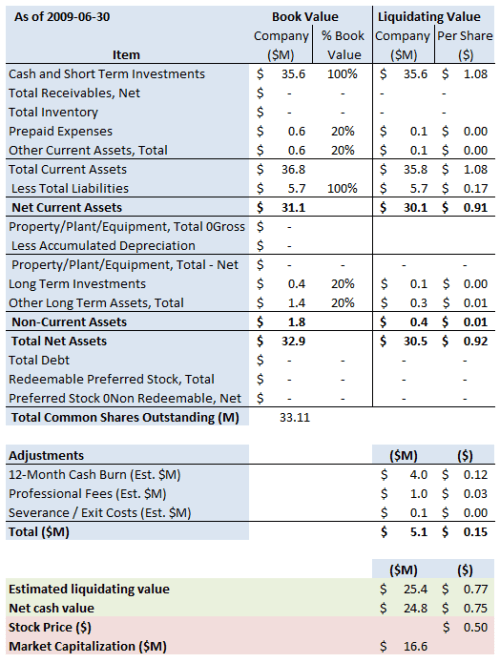
At its $0.50 close yesterday, VXGN has a market capitalization of $16.6M. We last estimated the company’s liquidation value to be around $26.5M or $0.80 per share. Following our review of the most recent quarterly report, we’ve slightly reduced our estimate to $25.4M or $0.77 per share. VXGN has other potentially valuable assets, including a “state-of-the-art biopharmaceutical manufacturing facility with a 1,000-liter bioreactor that can be used to make cell culture or microbial biologic products” and rights to specified percentages of future net sales relating to its anthrax vaccine product candidate and related technology.

The value proposition updated

VXGN has taken steps to minimize its cash burn, reducing its workforce to three employees, terminating its anthrax and smallpox development activities and selling the assets related to its anthrax product candidate. The company’s value rests on its vestigial holding of cash and equivalents (the “Book Value” column shows the assets as they are carried in the financial statements, and the “Liquidating Value” column shows our estimate of the value of the assets in a liquidation):

VXGN Summary 2009 6 30 v2Balance sheet adjustments

We’ve made the following adjustments to the balance sheet estimates above:

  • Cash burn: The company used $1.1M in cash in the second quarter, down from $2.1M in the first quarter. We have included cash burn of $4M in our estimate for the year. We have also assumed professional fees and termination payments of $1.1M.
  • Off-balance sheet arrangements and contractual obligations: According to VXGN’s 10Q, it has no off-balance sheet arrangements.

The lawsuit against VXGN by its landlords, in which they sought $22.4M, has been dismissed:

In February 2009, a lawsuit was filed against us in the Superior Court of California for the County of San Mateo by plaintiffs, Oyster Point Tech Center, LLC. The plaintiffs generally allege that we defaulted on our lease for our facility located at 349 Oyster Point, South San Francisco, California. The complaint seeks possession of the premises and the balance of the lease plus unpaid rent and expenses totaling $22.4 million, as well as an award of plaintiffs’ attorneys’ fees and costs. Our biopharmaceutical manufacturing facility is located in the leased premises that are the subject of the dispute. At a February hearing, the court denied the writ and the temporary protective order sought by landlord. In May 2009, the lawsuit was dismissed.

Conclusion

At its $0.50 close yesterday, VSGN has a market capitalization of $16.6M. We estimate the net current asset / liquidation value to be around 74% higher at $25.4M or $0.77 per share. VXGN has other potentially valuable assets, including rights to a portion of future net sales on its anthrax technology and a state-of-the-art biopharmaceutical manufacturing facility. One concern has been a lawsuit brought by the landlord against the company, so it is encouraging that the lawsuit has been dismissed. With its stock at a substantial discount to its net current asset / liquidation value, its cash-burning product development activities at an end and a proposal to identify and complete an alternate strategic transaction or liquidate, we think VXGN is still a good prospect, and we’re going to maintain our position.

[Full Disclosure: We have a holding in VXGN. This is neither a recommendation to buy or sell any securities. All information provided believed to be reliable and presented for information purposes only. Do your own research before investing in any security.]

Read Full Post »

Soapstone Networks Inc (NASDAQ:SOAP) closed Friday at $0.495 following the payment last week of a $57.5M or $3.75 per share special dividend. The company estimates the final distribution at between $0.25 and $0.75 per share. The higher end of the distribution range represents a ~50% upside from Friday’s close, so we’re going to do some work now to determine whether we hold on to the stub, buy some more or close out the position.

We opened the position in SOAP on February 2nd (see our post archive here) because it was trading well below our estimate of its net cash value. An activist investor, Mithras Capital, had disclosed an 8.7% holding and called on the company to liquidate. After some urging on Mithras Capital’s part, management acceded to the request and announced a liquidation. SOAP stockholders approved the liquidation of the company last week and were paid a special dividend of $3.75 per share. Based on our $2.50 purchase price, the $3.75 per share special dividend returns our initial capital plus 50%. At the Friday close, the $0.495 stub represents an additional 20% on our initial purchase price for a total return to date of 70%. Management estimates the final distribution will be between $0.25 and $0.75 per share, which means the stub is trading at a fraction under the midpoint of the distribution range.

The value proposition for the SOAP stub

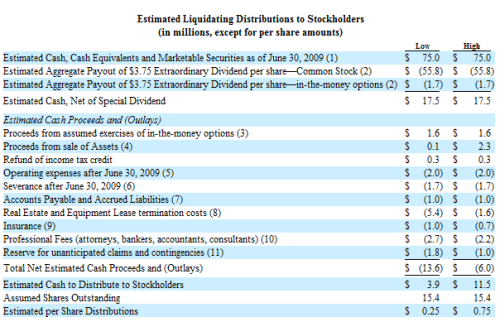
Following the payment of the special dividend, SOAP has cash of around $17.5M or a little over $1.00 per share. The basis for SOAP management’s calculation of the $0.25 and $0.75 per share distribution is set out below (extracted from the Preliminary Proxy Statement):

SOAP Estimated Liquidating Distributions

(The table above has been modified from the original to fit this space)

(1) Estimated balance is net of cash used for the period April 1, 2009 through June 30, 2009 for estimated operating expenses ($4.2 million), severance costs ($1.7 million) and accounts payable and accrued liabilities ($1.5 million), partially offset by interest income ($0.1 million).

(2) Estimated Extraordinary Dividend payments of $55.8 million are associated with 14,886,107 shares of our common stock outstanding as of June 16, 2009 and Extraordinary Dividend payments of $1.7 million are associated with 460,828 shares of our common stock subject to currently vested options that are in-the-money at $4.13, the per share closing price of our stock on the Nasdaq Global Market on June 16, 2009, which options are assumed to be exercised prior to the dividend payment.

(3) Estimated proceeds from the exercise of currently vested options for 460,828 shares of our common stock that are in-the-money at $4.13, the per share closing price of our stock on the Nasdaq Global Market on June 16, 2009, which options are assumed to be exercised prior to the dividend payment.

(4) Estimated range of cash proceeds from sale of assets, including technology, intellectual property, furniture, fixtures and equipment.

(5) Estimated operating expenses for the period of July 1, 2009 through June 30, 2010 for personnel, facilities and other expenses to conduct our wind up operations but exclusive of all other line items specifically allocated in the table above.

(6) Estimated severance costs for remaining employees involved in the wind up operations.

(7) Estimated accounts payable and accrued liabilities as of June 30, 2009.

(8) Estimated range of cash payments associated primarily with lease and lease related commitments for our headquarters facility.

(9) Estimated range of cash use for the purchase of insurance, including Directors and Officers liability insurance covering the six years from the date of stockholder approval of the plan of dissolution.

(10) Estimated range of cash use for professional fees related to our liquidation and dissolution, as well as ongoing SEC reporting requirements.

(11) Estimated range of cash use for unanticipated claims and contingencies, including potential deductibles and retentions associated with potential insurance claims.

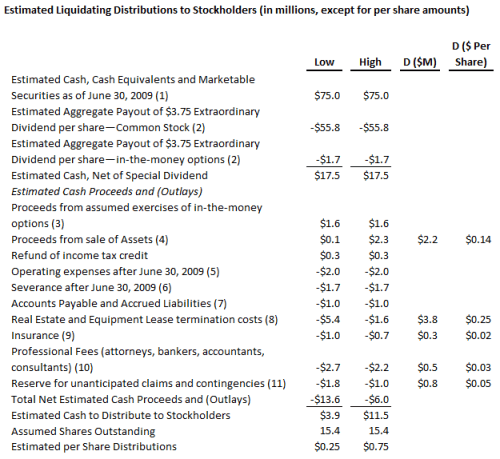
Set out below is an analysis of SOAP management’s estimates, showing the differences between the upper and lower estimates:

SOAP Estimated Liquidating Distributions 2

It becomes clear from the preceding table that two categories account for the majority (80%) of the difference between the upper and lower estimates of the final distribution:

  1. Real Estate and Equipment Lease termination costs: Around $3.8M or $0.25 per share.
  2. Proceeds from the sale of Assets: Around $2.2M or $0.14 per share.

We’ve got no real idea about the likely final figures in either of these categories, which means we won’t be buying any more at this stage. Given that the stock is trading at a fraction under the midpoint of management’s estimate of the final distribution, we’re going to hold on to our remaining stock for the time being and see how it plays out.

[Full Disclosure:  We have a holding in SOAP. This is neither a recommendation to buy or sell any securities. All information provided believed to be reliable and presented for information purposes only. Do your own research before investing in any security.]

Read Full Post »

Lamassu Holdings has sent another scorching letter to the board of Ditech Networks Inc (NASDAQ:DITC). In the letter, Lamassu claims that the “decisions of this board have shown a pattern of director entrenchment characterized by prioritizing the interest of its members in the face of poor results at the expense of the shareholders” and has called for shareholders to “receive ample representation on the board.”

We’ve been following DITC (see our archive here) because it is trading below its net cash value with an investor, Lamassu Holdings LLC, disclosing a 9.4% holding in November last year. Lamassu has previously offered to acquire DITC for $1.25 per share in cash. Lamassu says that it “anticipates its due diligence requirement will take no more than two weeks and there is no financing contingency.” Lamassu has now nominated two candidates for election to the board “who are committed to enhancing shareholder value through a review of the Company’s business and strategic direction.” Lloyd I Miller III has also disclosed a 5.9% holding and has come out in support of Mr. Leehealey and Mr. Sansone – the director candidates nominated by Lamassu Holdings for election to the board of directors at the DITC annual meeting – as “candidates who are independent of management and he seeks to encourage greater attention to corporate governance by all members of the Board of Directors.” The stock is up 47.2% from our initial $0.89 to close yesterday at $1.31, giving the company a market capitalization of $34.5M. We last estimated the net cash value at around $32.2M or $1.23 per share and the liquidation value at around $43.4M or $1.65 per share. While the deterioration in value is a concern, Mr. Miller’s support of Lamassu Holding’s director candidates introduces a new element to the position. We’re inclined to hold on to see how the annual meeting plays out.

The press release setting out the text of the open letter from Lamassu Holdings is set out below:

Lamassu Holdings LLC Says Ditech Network’s Board of Directors Benefits at Shareholders’ Expense

Lamassu Holdings LLC files an open letter to the Board of Directors of DITECH NETWORKS, INC. (NASDAQ: DITC)

NEWPORT BEACH, Calif.–(BUSINESS WIRE)–Lamassu Holdings, LLC has sent the following letter to the Board of Directors of Ditech Networks, Inc.

Dear Board of Directors:

The purpose of this letter is to inform you that while you have historically operated with impunity in your role as Directors of Ditech Networks (NASDAQ: DITC – News), going forward your actions will be regarded with a much higher degree of scrutiny. The decisions of this board have shown a pattern of director entrenchment characterized by prioritizing the interest of its members in the face of poor results at the expense of the shareholders. In light of this trend, it is time that the shareholders receive ample representation on the board.

We have taken the time to go through the company’s filing and pull out some of the decisions that were clearly made to benefit the board while adding no value to shareholders. It is worth noting that these decisions were, for the most part, made by the same people who currently serve. We believe these decisions illustrate that, with the exception of Mr. Simpons and Mr. Dramis, all of the currently serving members, including Mr. Harper, Mr. Manoliu, Mr. Sugishita, Mr. Hasler and Mr. Avis, have established a clear pattern of rewarding themselves while shareholders suffer.

In 2003 (see Figure 1), Ditech Networks moved from a policy in which board members were paid in options to one in which they were paid with both cash and options. It is worth noting that during the three years prior to this change, there was a dramatic drop in the equity value of the company. In short, since the options you awarded yourselves were no longer worth anything, you chose to guarantee your compensation regardless of performance.

In 2005, after another very difficult period for shareholders, shown in Figure 2, the Board again rewarded itself with pay raises. Beginning on July 15, 2005, non-employee directors began receiving an annual retainer of $16,000; the chairman of the Audit Committee received an additional annual retainer of $5,000; and the chairmen of the Compensation Committee, the Corporate Governance Committee and the Nominating Committee received additional annual retainers of $2,500.

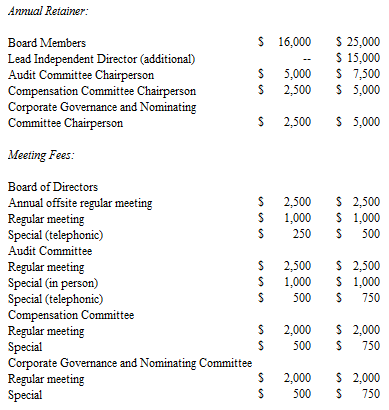
The final insult is the most recent decision made little more than a year ago. As the table below shows, effective May 1, 2008, the Board raised its salaries and several other fees. Ironically, you even actually raised the amount you get paid for “phoning it in” [“Special (telephonic)” line items below]. To put these pay increases in their full context, at the time you granted these raises for yourselves the stock was hitting all time lows on a daily basis and wouldn’t ultimately level off until it reached well below a dollar. In addition, the fundamentals of the company were never as bad as they had been. As a result of poor decisions and failed strategic maneuvers by the Board of Directors, the company had lost millions and millions of dollars. Despite this backdrop, you rewarded yourselves with additional cash at a time when the company apparently didn’t have enough money to buy back its own stock, despite the record low levels.

Lamassu Letter Table

(The table above has been modified from the original to fit this space)

Had compensation increases been used to attract new talent to the Board of Directors and resulted in new directors that brought with them a history of sound business decisions and responsible business practices, then the pay raises could be justified. However, the pay raises were not used for this purpose. Instead, in the face of massive shareholder equity losses and a long list of bad investments, the Board increased its pay with no regard for the massive losses the shareholders were experiencing—losses that were painless for the members of the Board due to their low levels of stock ownership. It is clear that under the current leadership, it has been more financially rewarding to be on the Board than to be a shareholder. For this reason and many others Lamassu has moved to replace two of the current board members with its own nominees. It is our hope that this will both give shareholders a direct voice on the Board, as well as bring about a level of fiduciary responsibility that we believe is currently lacking.

Sincerely,

Lamassu Holdings, LLC

[Full Disclosure:  We do not have a holding in DITC. This is neither a recommendation to buy or sell any securities. All information provided believed to be reliable and presented for information purposes only. Do your own research before investing in any security.]

Read Full Post »

« Newer Posts - Older Posts »