Feeds:
Posts
Comments

Archive for the ‘Value Investment’ Category

Aswath Damodaran, in his excellent paper “Value Investing: Investing for Grown Ups?”, asks whether spending time researching a company’s fundamentals (“active” investing) generates a higher return for investors than a comparable value-based index (“passive” investing)?

Says Damodaran:

Of all of the investment philosophies, value investing comes with the most impressive research backing from both academica and practitioners. The excess returns earned by stocks that fit value criteria (low multiples of earnings and book value, high dividends) and the success of some high-profile value investors (such as Warren Buffett) draws investors into the active value investing fold.

But does spending time researching a company’s fundamentals generate higher returns for investors than a passive index?  Does active value investing pay off?

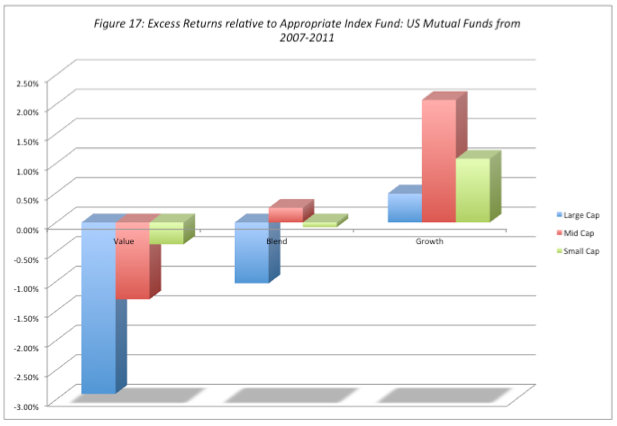
A simple test of the returns to the active component of value investing is to look at the returns earned by active value investors, relative to a passive value investment option, and compare these excess returns with those generated by active growth investors, relative to a passive growth investment alternative. In figure 17, we compute the excess returns generated for all US mutual funds, classifed into value, blend and growth categories, relative to index funds for each category. Thus, the value mutual funds are compared to index fund of just value stocks (low price to book and low price to earnings stocks) and the growth mutual funds to a growth index fund (high price to book and high price earnings stocks).

Shocker! Active value investing mutual fund managers would be better off buying the index.

The results are not good for value investing. The only funds that beat their index counterparts are growth funds, and they do so in all three market cap classes. Active value investing funds generally do the worst of any group of funds and particularly so with large market cap companies.

Damodaran has a great conclusion:

If you are an individual value investors, you can attribute this poor performance to the pressures that mutual funds managers operate under, to deliver results quickly, an expectation that may be at odds with classic value investing. That may be the case, but it points to the need for discipline and consistency in value investing and to the very real fact that beating the market is always difficult to do, even for a good value investor.

Read Full Post »

This week I’ve been taking a look at Aswath Damodaran’s paper “Value Investing: Investing for Grown Ups?” in which he asks, “If value investing works, why do value investors underperform?”

Damodaran divides the value world into three groups:

  1. The Passive Screeners,” – “The Graham approach to value investing is a screening approach, where investors adhere to strict screens… and pick stocks that pass those screens.”
  2. The Contrarian Value Investors,” – “In this manifestation of value investing, you begin with the belief that stocks that are beaten down because of the perception that they are poor investments (because of poor investments, default risk or bad management) tend to get punished too much by markets just as stocks that are viewed as good investments get pushed up too much.”
  3. Activist value investors,” – “The strategies used by …[activist value investors] are diverse, and will reflect why the firm is undervalued in the first place. If a business has investments in poor performing assets or businesses, shutting down, divesting or spinning off these assets will create value for its investors. When a firm is being far too conservative in its use of debt, you may push for a recapitalization (where the firm borrows money and buys back stock). Investing in a firm that could be worth more to someone else because of synergy, you may push for it to become the target of an acquisition. When a company’s value is weighed down because it is perceived as having too much cash, you may demand higher dividends or stock buybacks. In each of these scenarios, you may have to confront incumbent managers who are reluctant to make these changes. In fact, if your concerns are broadly about management competence, you may even push for a change in the top management of the firm.”

We looked at Damodaran’s passive screeners Tuesday, the contrarian value investors Wednesday, and today we’ll take a look at the activists.

The Activist Value Investors

Damodaran cites the well-known Brav, Jiang and Kim article that I have discussed here before:

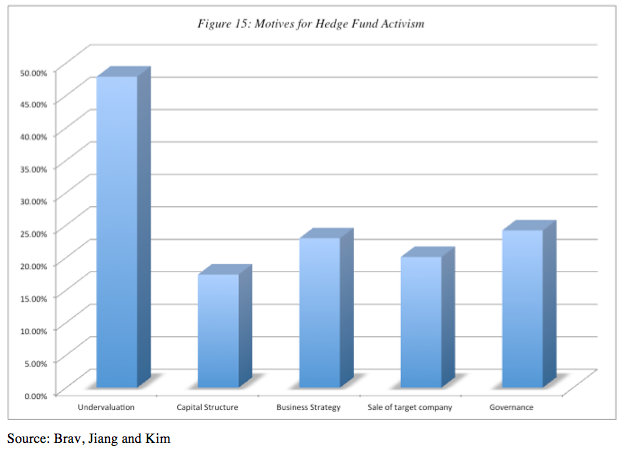
If activist investors hope to generate their returns from changing the way companies are run, they should target poorly managed companies for their campaigns. Institutional and individual activists do seem to focus on poorly managed companies, targeting companies that are less profitable and have delivered lower returns than their peer group. Hedge fund activists seem to focus their attention on a different group. A study of 888 campaigns mounted by activist hedge funds between 2001 and 2005 finds that the typical target companies are small to mid cap companies, have above average market liquidity, trade at low price to book value ratios, are profitable with solid cash flows and pay their CEOs more than other companies in their peer group. Thus, they are more likely to be under valued companies than poorly managed. A paper that examines hedge fund motives behind the targeting provides more backing for this general proposition in figure 15.

As we have seen both undervalued or poorly managed stocks can generate good returns.

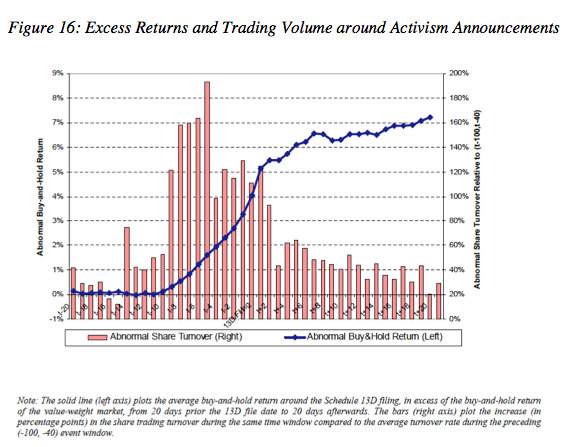
Damodaran says that the “market reaction to activist investors, whether they are hedge funds or individuals, is positive.” A study that looked at stock returns in targeted companies in the days around the announcement of activism showed the following results:

Damodaran points out that “the bulk of the excess return (about 5% of the total of 7%) is earned in the twenty days before the announcement and that the post-announcement drift is small.”

There is also a jump in trading volume prior to the announcement, which does interesting (and troubling) questions about trading being done before the announcements. The study also documents that the average returns around activism announcement has been drifting down over time, from 14% in 2001 to less than 4% in 2007.

Can you make money following activist investors?

Damodaran says “sort of,” if you follow:

The right activists: If the median activist hedge fund investor essentially breaks even, as the evidence suggests, a blunderbuss approach of investing in a company targeted by any activist investor is unlikely to generate value. However, if you are selective about the activist investors you follow, targeting only the most effective, and investing only in companies that they target, your odds improve.

Performance cues: To the extent that the excess returns from this strategy come from changes made at the firm to operations, capital structure, dividend policy and/or corporate governance, you should keep an eye on whether and how much change you see on each of these dimesions at the targeted firms. If the managers at these firms are able to stonewall activist investors successfully , the returns are likely to be unimpressive as well.

A hostile acquisition windfall? A study by Greenwood and Schor notes that while a strategy of buying stocks that have been targeted by activist investors generates  excess returns, almost all of those returns can be attributed to the subset of these firms that get taken over in hostile acquisitons.

Follow the right activists, and do ok, or front run them, and potentially do very well:

There is an alternate strategy worth considering, that may offer higher returns, that also draws on activist investing. You can try to identify companies that are poorly managed and run, and thus most likely to be targeted by activist investors. In effect, you are screening firms for low returns on capital, low debt ratios and large cash balances, representing screens for potential value enhancement, and ageing CEOs, corporate scandals and/or shifts in voting rights operating as screens for the management change. If you succeed, you should be able to generate higher returns when some of these firms change, either because of pressure from within (from an insider or an assertive board of directors) or from without (activist investors or a hostile acquisition).

So how do we mess it up?

• This power of activist value investing usually comes from having the capital to buy significant stakes in poorly managed firms and using these large stockholder positions to induce management to change their behavior. Managers are unlikely to listen to small stockholders, no matter how persuasive their case may be.

• In addition to capital, though, activist value investors need to be willing to spend substantial time fighting to make themselves heard and in pushing for change. This investment in time and resources implies that an activist value investor has to pick relatively few fights and be willing to invest substantially in each fight.

• Activist value investing, by its very nature, requires a thorough understanding of target firms, since you have to know where each of these firms is failing and how you would fix these problems. Not surprisingly, activist value investors tend to choose a sector that they know really well and take positions in firms within that sector. It is clearly not a strategy that will lead to a well diversified portfolio.

• Finally, activist value investing is not for the faint hearted. Incumbent managers are unlikely to roll over and give in to your demands, no matter how reasonable you may thing them to be. They will fight, and sometimes fight dirty, to win. You have to be prepared to counter and be the target for abuse. At the same time, you have to be adept at forming coalitions with other investors in the firm since you will need their help to get managers to do your bidding. 

Read Full Post »

Abnormal Returns asks “If value investors are the “grown ups” of the investment world, why aren’t their returns better?” and links to a great Aswath Damodaran paper “Value Investing: Investing for Grown Ups?” in which Damodaran examines the reasons why over an epic 77 pages.

Damodaran begins by asking, “Who is a value investor?” He divides the value world into three groups:

  1. The Passive Screeners,” – “The Graham approach to value investing is a screening approach, where investors adhere to strict screens… and pick stocks that pass those screens.”
  2. The Contrarian Value Investors,” – “In this manifestation of value investing, you begin with the belief that stocks that are beaten down because of the perception that they are poor investments (because of poor investments, default risk or bad management) tend to get punished too much by markets just as stocks that are viewed as good investments get pushed up too much.”
  3. Activist value investors,” – “The strategies used by …[activist value investors] are diverse, and will reflect why the firm is undervalued in the first place. If a business has investments in poor performing assets or businesses, shutting down, divesting or spinning off these assets will create value for its investors. When a firm is being far too conservative in its use of debt, you may push for a recapitalization (where the firm borrows money and buys back stock). Investing in a firm that could be worth more to someone else because of synergy, you may push for it to become the target of an acquisition. When a company’s value is weighed down because it is perceived as having too much cash, you may demand higher dividends or stock buybacks. In each of these scenarios, you may have to confront incumbent managers who are reluctant to make these changes. In fact, if your concerns are broadly about management competence, you may even push for a change in the top management of the firm.”

I’ll deal with Damodaran’s passive screeners today, the contrarian value investors tomorrow and the activists later this week.

The Passive Screeners

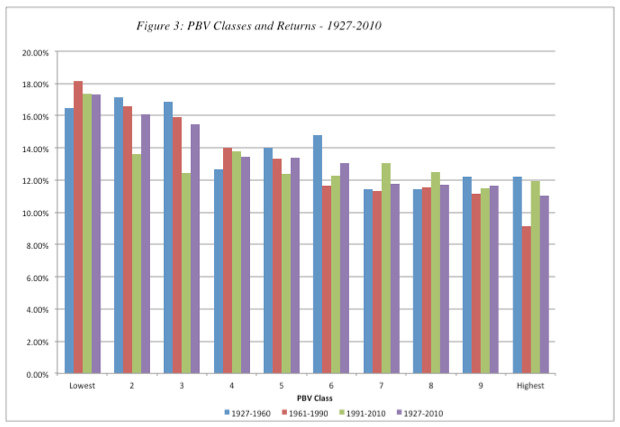
Value, if you define it with price ratios, works however you slice it. For example, the cheap price-to-book value (PBV) decile outperforms the next and so on:

Damodaran says:

The lowest price to book value stocks earned 6.24% more, on an annualized basis, than the high price to book stocks across the entire time period (1927-2010); they continued to earn higher annual returns (5.44%) than the high price to book value stocks between 1991-2010.

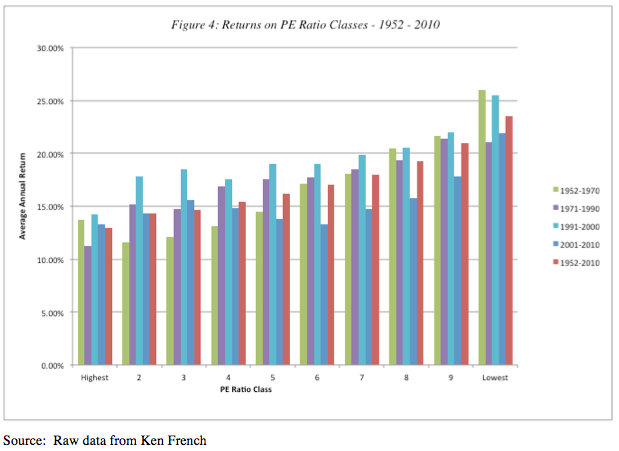
The cheap price-to-earnings (PE) ratio decile also outperforms the next and so on:

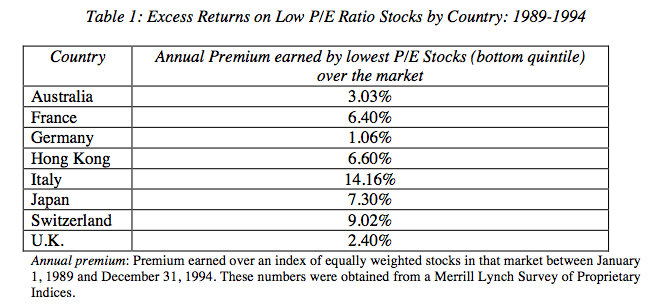
And value works all over the globe.

Damodaran asks if all we have to do to earn excess returns is invest in stocks that trade at low multiples of earnings, book value or revenues, why do value investors underperform?

He offers several reasons:

Time Horizon: All the studies quoted above look at returns over time horizons of five years or greater. In fact, low price-book value stocks have underperformed high price-book value stocks over shorter time periods. The same can be said about PE ratios and price to sales ratios.

Dueling Screens: If one screen earns you excess returns, three should do even better seems to be the attitude of some investors who proceed to multiply the screens they use. They are assisted in this process by the easy access to both data and screening technology. There are web sites (many of which are free) that allow you to screen stocks (at least in the United States) using multiple criteria.19 The problem, though, is that the use of one screen may undercut the effectiveness of others, leading to worse rather than better portfolios.

Absence of Diversification: In their enthusiasm for screens, investors sometimes forget the first principles of diversification. For instance, it is not uncommon to see stocks from one sector disproportionately represented in portfolios created using screens. A screen from low PE stocks may deliver a portfolio of banks and utilities, whereas a screen of low price to book ratios and high returns on equity may deliver stocks from a sector with high infrastructure investments that has had bad sector-specific news come out about it. In 2001, for instance, many telecom stocks traded at a discount on their book value.

Taxes and Transactions costs: As in any investment strategy, taxes and transactions costs can take a bite out of returns, although the effect should become smaller as your time horizon lengthens. Some screens, though, can increase the effect of taxes and transactions costs. For instance, screening for stocks with high dividends and low PE ratios will yield a portfolio that may have much higher tax liabilities (because of the dividends).

Success and Imitation: In some ways, the worst thing that can occur to a screen (at least from the viewpoint of investors using the screen) is that its success is publicized and that a large number of investors begin using that same screen at the same time. In the process of creating portfolios of the stocks they perceive to be undervalued, they may very well eliminate the excess returns that drew them to the screen in the first place.

Tomorrow, the contrarian value investors.

Read Full Post »

Kinnaras Capital Management has sent a follow up letter to Media General Inc (NYSE:MEG) requesting the board “selloff MEG in its entirety and divorce this company from the inept management team currently at the helm.”

In its earlier letter Kinnaras expressed frustration with the performance of MEG, and urged the Board to “take advantage of the robust M&A market for both newspaper and broadcast television and to sell all operating units of MEG in order to retire existing corporate and pension debt and achieve a share price shareholders have rarely seen in recent years.”

MEG is a provider of local news in small and mid-size communities throughout the Southeastern United States. It owns three metropolitan and 20 community newspapers and 18 network-affiliated broadcast television stations Virginia/Tennessee, Florida, Mid-South, North Carolina, and Ohio/Rhode Island.

The initial letter included Kinnaras’s sum-of-the-parts valuation, which Kinnaras Managing Member Amit Chokshi sees at $9.75 per share against a prevailing price of around $4.60.

Here’s the follow up letter:

Kinnaras also has on its website its recommendations to MEG shareholders ahead of the proxy vote.

No position.

Read Full Post »

A little while ago Portfolio ran this great Felix Salmon article about Chris Wyser-Pratte, a 1972 Stanford MBA grad who spent the next 23 years as an investment banker, and the seven principles he was taught at Stanford Business. When I read through them, I was struck by how timeless they are, and how readily applicable to value investing. Here is Mr Wyser-Pratte’s list in its unadulterated form:

I learned exactly seven things at Stanford Graduate School of Business getting an MBA degree in 1972. I always used them and never wavered. They were principles that enabled me to put the cookbook formulas that everyone revered in context and in perspective. I think they served my clients (and perhaps me) rather well. Here are those seven principles, and who taught them to me:

  1. Don’t use many financial ratios or formulas, and when you’ve picked the few that will actually tell you what you want to know, don’t believe them very much (Prof. James T.S. Porterfield);
  2. Remember that any damn fool can compute an IRR or DCF. The trick is to find a business that can return 20% after tax, understand its critical indigenous and exogenous variables, and then run it so it meets its return target. (Prof. Alexander Robichek.)
  3. Always ask what can go wrong (Porterfield);
  4. Never extrapolate beyond the observed points of a distribution, you have absolutely no information outside the observed range (Prof. J. Michael Harrison);
  5. Remember that you can always break the bank at Monte Carlo by doubling your bet on red at the roulette table every time you lose. The problem is it will break you first; It’s called “the takeout.” Therefore, always manage your financial structure so that takeout is not an issue. (Porterfield.)
  6. Big M (today Nassim Taleb’s Black Swan) is never a part of the optimal solution. If it shows up in the answer with any coefficient greater than zero, you have the wrong answer and have to continue to do program iterations. (Harrison.)
  7. There is never any excuse for looking through the substance of an economic transaction, whatever the accounting, and if the accounting permits you to do so, it’s wrong (Prof. Charles T. Horngren.)

Read more at Portfolio. I’d love to hear any other great lessons you might have learned in business school or otherwise.

Read Full Post »

Amit Chokshi of Kinnaras Capital, an independent registered investment advisor focused on deep-value, small capitalization and micro capitalization equity investing, has contributed a guest post on Imation Corp (NYSE:IMN).

About Kinnaras:

Kinnaras aims to deliver above average long-term results through application of a deep value investment strategy.  As a result, the Firm focuses on the “throwaways” of the equity market, or stocks that are generally viewed as broken from a fundamental standpoint.  The Firm utilizes a fundamental, bottom-up, research-intensive approach to security selection, focusing mainly on prospects trading below book and/or tangible book value or cheap price to free cash flow. Kinnaras is a strong advocate of mean reversion and has found that pessimistic valuations, and thus attractive investment opportunities, often manifest when the broader investment community disregards mean reversion and impounds overly pessimistic expectations into security prices.  When valuation incorporates these pessimistic assumptions, the risk/reward scenario favors the investor.

Imation Worth More Sold Than Alone

As a deep value investor, one is always confronted with companies that have potentially great assets but can be overshadowed by poor management.  As a deep value investor, often times a great stock is not necessarily a great company but the overall value available from an investment standpoint is too attractive to pass up.  Based on its current valuation, IMN appears to fall into this category.

IMN is a global developer and marketer of branded storage/recording products focused on optical media, magnetic tape media, flash and hard drive products and consumer electronic products.  The company has significant global scale and its brand portfolio includes the Imation, Memorex, and XtremeMac brands.  The company is also the exclusive licensee of the TDK Life on Record brand.

IMN has high brand recognition and is a leader in its key categories of optical and magnetic tape media.  While the company faces long term secular challenges with regards to how data is stored, the current valuation appears to be highly muted due to a number of strategic and capital allocation blunders over the company’s past 5+ years.  Management would be doing shareholders a greater service by simply putting the company up for sale given the time allotted for a number of strategic moves to play out unsuccessfully in recent years.  Moreover, IMN has been on an acquisition spree in 2011 and existing shareholders may see further value destruction given the track record of management.  The following highlights some key grievances shareholders should have with IMN’s current strategy

Horrific Capital Allocation by Management: IMN’s cash balance serves as somewhat of a fundamental backstop against permanent capital loss.  The problem, however, is that the company’s net cash balance has been used to fund a number of bad decisions, particularly M&A.  Management has acquired a number of businesses in recent years, none of which have benefited shareholders.  These acquisitions of businesses and intellectual property (“IP”) have led to clear value destruction as evidenced by IMN’s sales and operating income performance since those acquisitions along with on going write-offs of goodwill tied to a number of those purchases and constant restructuring charges eating into book equity.

One example of how poor management’s acquisition strategy was its purchase of BeCompliant Corporation (Encryptx) on February 28, 2011 which resulted in $1.6MM in goodwill.  In less than five weeks, IMN had determined the goodwill tied to this acquisition to be fully impaired!  While $1.6MM is a tiny amount, Table I highlights the total value of goodwill written off by IMN in recent years along with the ongoing restructuring charges in the context of the company’s historical acquisition capex.

TABLE I: IMN ACQUISITION CAPEX & IMPAIRMENT, RESTRUCTURING CHARGES ($MM) [Click to expand]

Since 2006, IMN management has deployed $442MM in cash to acquire a variety of businesses.  Since that time, investors have had to experience $152MM in goodwill write-offs and another $169MM in restructuring charges as IMN fumbles in regards to integrating newly acquired and existing business segments for a grand total of $320MM in charges since 2006.  IMN management is clearly a poor steward of capital.   What’s worse is that shareholders experienced value destruction at the expense of exercises which would have returned cash to shareholders.

For example, after 2007 IMN ceased paying a dividend.  The annual dividend returned over $20MM to investors annually.  Rather than provide investors with a certain return in the form of a dividend, IMN management has used that capital to obviously overpay for businesses such as Encryptx.  Another demonstration of poor capital allocation by management is its stock buyback history.  From 2005-2008, IMN spent nearly $190MM to buyback shares when its stock was valued at levels ranging from 0.4-1.1x P/S and 0.8-1.6x P/B or $14-$48 per share.  The average acquired share price of IMN’s treasury stock was $23.39.

Since 2008, IMN’s share price has ranged from its recent multi year low of $5.40 to about $14 (for a brief period in early 2009).  More importantly, IMN’s valuation has ranged from 0.15-0.25 P/S and 0.28-0.36 P/B.  So while IMN has had more than enough cash to purchase shares since that time, from 2009 on, IMN management decided to repurchase just under $10MM of stock.  This exemplifies management’s history of overpaying for assets – whether it’s businesses, IP, or the company’s own shares.

Management has no meaningful investment in IMN:  There has been considerable insider purchases since July 2011 across a number of companies.  IMN has had no major inside purchases despite the current low share price.  IMN CEO made an immaterial purchase in the open market very recently but overall, while  IMN stock has floundered, management has experienced none of the setbacks of shareholders for its inept strategy.  As mentioned above, management had the company execute on a number of buybacks from 2005-2008.  However, the overall effect of those buybacks were considerably offset by significant issuance of stock compensation.  As a result, IMN’s overall share count continued to grow despite these share buybacks.  In summary, management has demonstrated little appetite for the company’s shares, irrespective of valuation, while expecting shareholders to sit idly by while it awards itself dilutive stock compensation off the backs of investors.

There is no question that IMN has its share of challenges but is there value to be unlocked?  At current valuations, it appears that significant upside is potentially available if IMN investors can take an activist stance.  Management has had its chances for many years and it is clearly time to explore other options.  Despite the secular challenges IMN faces, the company is still worth more than current prices.  The following highlights the good aspects of IMN.

Valuation:  IMN is cheap based on a number of valuation metrics.  First, at $5.81 per share as of Monday’s (11/28/11) market close, IMN has a negative enterprise value.  IMN has $6.21 in net cash per share and the current share price means that the market is ascribing a negative value to IMN’s core operating business.  Given the number of patents and intellectual property along with a business that can generally crank out solid cash flow, IMN’s main businesses should not have a negative value despite the longer term secular challenges it faces.  On a capital return basis, IMN management should have the company repurchase shares at this level but that may be expecting far too much from management given its track record.

IMN is also trading at valuation levels below those reached even in 2008-09.  As Table II shows, IMN has not traded at levels this low at least since 2003.  Long-term challenges in its core business segments along with value destroying management are two reasons for these metrics grinding lower but at a certain point, valuation can become rather compelling.  I think current prices and valuation may reflect “highly compelling” from an investment standpoint.

TABLE II: IMN HISTORICAL VALUATION [Click to expand]

IMN’s current valuation could be ascribed to a company with major near-term problems, typical of those that burn considerable cash and have poor balance sheets characterized by high levels of debt and/or near-term refinancings.  IMN does not fit into this description.  As bad as IMN is performing, it is still on track for a positive free cash flow in 2011.  IMN has modest capital expenditure needs and IMN’s gross margins have been increasing in 2011, approaching gross margins realized in 2007.  Table III presents my estimate for FY 2011 excluding IMN’s non-cash restructuring charges and write-offs.  To be clear, a potential acquirer would also use pro forma statements in determining IMN’s value.

TABLE III: IMN 2011 SUMMARY OPERATING DATA

Using a highly conservative multiple of just 3.0x 2011 pro forma EBITDA of $49MM leads to a share price of $10.  What is clear from Table III is that if management could avoid squandering capital on acquisitions, IMN can still generate attractive free cash flow.  In addition, with a net cash balance of $233MM or $6.21/share, IMN should not generally be paying any net interest expense if that capital was better managed/allocated for cash management purposes.  A history of poor capital allocation and strategic blunders has led to IMN carrying a heavily discounted valuation.  At about $5.80, a case could be made that IMN is trading at or below liquidation value as presented in Table IV.

TABLE IV: IMN LIQUIDATION VALUE PER SHARE

Table IV shows that the major wildcard is really the value of IMN’s intangible assets.  While IMN is facing secular challenges, the IP it carries could very well have value to a potential acquirer, especially at an attractive valuation.  IMN maintains a long-term exclusive license with TDK which expires in 2032.  TDK, which owns nearly 20% of IMN, could bless a sale that allows those licenses to pass on to an acquiring company.  Aside from the TDK license, IMN holds over 275 patents.  IMN has recently entered into security focused technology for the purposes of flash and hard drive storage.  This technology uses various advanced password/encryption technology along with biometric authentication and could very well be worth much more to a larger technology company that could more broadly exploit this IP across its technology.  This is just one example of various IP IMN possesses.  In addition, IMN has leading market share and brand recognition/value in a number of areas such as optical media along with magnetic tape media.  A competitor like Sony Corp (“SNE”) or a client like IBM or Oracle (“ORCL”), both of which use IMN’s magnetic tape media in their own products for disaster storage/recovery and archiving, could find IMN’s IP of value.

TABLE V: IMN LIQUIDATION VALUE BASED ON INTANGIBLE ASSET DISCOUNT

If IMN’s IP and thus its intangible assets are absolutely worthless, IMN would be worth under $2 in a fire sale liquidation.  However, at even a 50% haircut of IP, IMN gets to where its stock is currently trading.  The less severe the discount, the more IMN is worth in a liquidation.  That’s hardly a groundbreaking statement but what if IMN’s IP is actually worth more than its carrying value?

TABLE VI: IMN LIQUIDATION VALUE BASED ON INTANGIBLE ASSET PREMIUM

What is clear is that IP has considerable value and in many cases eclipses the actual on-going business value of a number of companies.  The recent lawsuit between Micron Technology (“MU”) and Rambus Inc (“RMBS”) was for IP claims that could have yielded nearly $4B in royalties (before potentially tripling under California law) for RMBS. RMBS commanded a market valuation of roughly$2B before MU won the lawsuit.

Motorola Mobility Holdings (“MMI”) faced very challenging headwinds in the mobile device space against tough competitors such as Apple (“AAPL”), Samsung, HTC, and others.  This was reflected in the stock losing significant value once being spun off from Motorola (about 25% from its initial spin-off price).  Nonetheless, Google (“GOOG”) saw value in MMI’s IP, enough to offer a share price that was essentially 100% above its at-the-time lows.

Eastman Kodak (“EK”) has a number of operating challenges and a far less attractive balance sheet relative to RMBS, MMI, and IMN.  The company is wracking up losses and has a $1.2B pension shortfall.  Nonetheless, IP specialists MDB Capital believe that EK’s IP could be worth $3B in a sale.  EK currently has a market capitalization of just $295MM.

What is clear is that there is a wide range of valuation outcomes dependent on the value of the IP to a potential buyer.  IMN could be an easy and accretive acquisition to a number of large technology firms.  Firms like SNE, Maxell, and Verbatim could find IMN attractive for its leading position in optical media.  SNE could also find IMN’s magnetic storage division of value, as could IBM and ORCL.  IMN’s emerging storage division encompasses USB, hard disk drives, and flash drives (admittedly not really “emerging”) but has a particular focus on security focused applications in this storage format.  The IP related to biometric authentication and advanced encryption could be of value to a number of storage/storage tech companies such as Western Digital Corp (“WDC”), Seagate Technology (“STX”), SanDisk Corp. (“SNDK”), Micron Technology (“MU”). Even larger enterprise storage and software companies such EMC Corp (“EMC”), IBM, and ORCL could find this segment of value.  The small consumer electronics segment could be of interest to a company like Audiovox (“VOXX”).  However, in any case, all of IMN could be acquired at a very attractive price to nearly any large technology firm/buyer.

At a takeout price of just $10 per share, for example, an acquirer would be buying IMN’s core business for just $142MM with $6.21 of the $10 offer represented by IMN’s net cash.  This small deal size could very well lead to a quick payback period for a number of larger firms that could exploit IMN’s IP across multiple channels.  IMN could also be sold off in piecemeal fashion but given its small size and number of large technology companies that can utilize IMN’s IP, folding the entire company at an attractive price could be the easiest road.

Management and the board have had more than enough time in recent years to transform IMN or move it forward.  The operating results clearly show that this strategy is costing shareholders greatly and management appears to have little competence with regards to understanding how best to deploy capital.  Nearly $200MM was spent to repurchase far more expensive IMN shares prior to 2008 while a pittance of IMN capital has been deployed to buyback shares when the stock is trading for less than its net cash value.  In addition, upon ceasing its payment of annual dividend, IMN management has utilized that cash to pursue questionable acquisitions.  These acquisitions have led to destruction of shareholder equity given the subsequent writedowns and constant restructuring charges experienced by IMN.  The bottom line is IMN investors should pursue an activist stance and encourage management and the board to seek a sale for the sake of preserving what value is left in the company.

DISCLOSURE: AUTHOR MANAGES A HEDGE FUND AND MANAGED ACCOUNTS LONG IMN AND MU.

Greenbackd Disclosure: No Position.

Read Full Post »
Michael Mauboussin appeared Friday on Consuelo Mack’s WealthTrack to discuss several of the ideas in his excellent book, Think Twice. Particularly compelling is his story about Triple Crown prospect Big Brown and the advantage of the “outside view” – the statistical one – over the “inside view” – the specific, anecdotal one (excerpted from the book):

June 7, 2008 was a steamy day in New York, but that didn’t stop fans from stuffing the seats at Belmont Park to see Big Brown’s bid for horseracing’s pinnacle, the Triple Crown. The undefeated colt had been impressive. He won the first leg of the Triple Crown, the Kentucky Derby, by 4 ¾ lengths and cruised to a 5 ¼-length win in the second leg, the Preakness.

Oozing with confidence, Big Brown’s trainer, Rick Dutrow, suggested that it was a “foregone conclusion” that his horse would take the prize. Dutrow was emboldened by the horse’s performance, demeanor, and even the good “karma” in the barn. Despite the fact that no horse had won the Triple Crown in over 30 years, the handicappers shared Dutrow’s enthusiasm, putting 3-to-10 odds—almost a 77 percent probability—on his winning.

The fans came out to see Big Brown make history. And make history he did—it just wasn’t what everyone expected. Big Brown was the first Triple Crown contender to finish dead last.

The story of Big Brown is a good example of a common mistake in decision making: psychologists call it using the “inside” instead of the “outside” view.

The inside view considers a problem by focusing on the specific task and by using information that is close at hand. It’s the natural way our minds work. The outside view, by contrast, asks if there are similar situations that can provide a statistical basis for making a decision. The outside view wants to know if others have faced comparable problems, and if so, what happened. It’s an unnatural way to think because it forces people to set aside the information they have gathered.

Dutrow and others were bullish on Big Brown given what they had seen. But the outside view demands to know what happened to horses that had been in Big Brown’s position previously. It turns out that 11 of the 29 had succeeded in their Triple Crown bid in the prior 130 years, about a 40 percent success rate. But scratching the surface of the data revealed an important dichotomy. Before 1950, 8 of the 9 horses that had tried to win the Triple Crown did so. But since 1950, only 3 of 20 succeeded, a measly 15 percent success rate. Further, when compared to the other six recent Triple Crown aspirants, Big Brown was by far the slowest. A careful review of the outside view suggested that Big Brown’s odds were a lot longer than what the tote board suggested. A favorite to win the race? Yes. A better than three-in-four chance? Bad bet.

Mauboussin on WealthTrack:

Hat Tip Abnormal Returns.


Read Full Post »

Yesterday’s post on LSV Asset Management’s performance reminded me of the practical difficulties of implementing many theoretically well-performed investment strategies. LSV Asset Management is an outgrowth of the research conducted by Josef Lakonishok, Andrei Shleifer, and Robert Vishny. They are perhaps best known for the Contrarian Investment, Extrapolation, and Risk paper, which, among other things, analyzed low price-to-book value stocks in deciles (an approach possibly suggested by Roger Ibbotson’s study Decile Portfolios of the New York Stock Exchange, 1967 – 1984). They found that low price-to-book value stocks out perform, and in rank order (the cheapest decile outperforms the next cheapest decile and so on). The problem with the approach is that the lowest price-to-book value deciles – that is, the cheapest and therefore best performed deciles – are uninvestable.

In an earlier post, Walking the talk: Applying back-tested investment strategies in practice, I noted that Aswath Damodaran, a Professor of Finance at the Stern School of Business, has a thesis that “transaction costs” – broadly defined to include brokerage commissions, spread and the “price impact” of trading – foil in the real world investment strategies that beat the market in back-tests. Damodaran made the point that even well-researched, back-tested, market-beating strategies underperform in practice:

Most of these beat-the-market approaches, and especially the well researched ones, are backed up by evidence from back testing, where the approach is tried on historical data and found to deliver “excess returns”. Ergo, a money making strategy is born.. books are written.. mutual funds are created.

The average active portfolio manager, who I assume is the primary user of these can’t-miss strategies does not beat the market and delivers about 1-1.5% less than the index. That number has remained surprisingly stable over the last four decades and has persisted through bull and bear markets. Worse, this under performance cannot be attributed to “bad” portfolio mangers who drag the average down, since there is very little consistency in performance. Winners this year are just as likely to be losers next year…

Damodaran’s solution for why some market-beating strategies that work on paper fail in the real world is transaction costs. But it’s not the only reason. Some strategies are simply impossible to implement, and LSV’s low decile price-to-book value strategy is one such strategy.

James P. O’Shaughnessy’s What works on Wall Street is one of my favorite books on investing. In the book, O’Shaughnessy suggests another problem with the real-world application of LSV’s decile approach:

Most academic studies of market capitalization sort stocks by deciles (10 percent) and review how an investment in each fares over time. The studies are nearly unanimous in their findings that small stocks (those in the lowest four deciles) do significantly better than large ones. We too have found tremendous returns from tiny stocks.

So far so good. So what’s the problem?

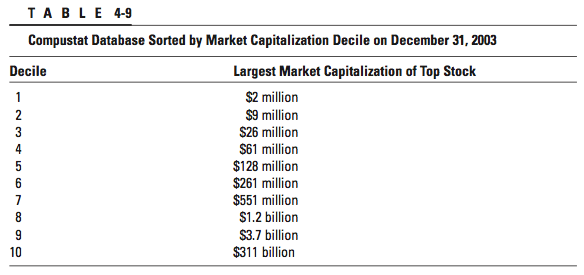
The glaring problem with this method, when used with the Compustat database, is that it’s virtually impossible to buy the stocks that account for the performance advantage of small capitalization strategies. Table 4-9 illustrates the problem. On December 31, 2003, approximately 8,178 stocks in the active Compustat database had both year-end prices and a number for common shares outstanding. If we sorted the database by decile, each decile would be made up of 818 stocks. As Table 4-9 shows, market capitalization doesn’t get past $150 million until you get to decile 6. The top market capitalization in the fourth decile is $61 million, a number far too small to allow widespread buying of those stocks.

A market capitalization of $2 million – the cheapest and best-performed decile – is uninvestable. This leads O’Shaughnessy to make the point that “micro-cap stock returns are an illusion”:

The only way to achieve these stellar returns is to invest only a few million dollars in over 2,000 stocks. Precious few investors can do that. The stocks are far too small for a mutual fund to buy and far too numerous for an individual to tackle. So there they sit, tantalizingly out of reach of nearly everyone. What’s more, even if you could spread $2,000,000 over 2,000 names, the bid–ask spread would eat you alive.

Even a small investor will struggle to buy enough stock in the 3rd or 4th deciles, which encompass stocks with market capitalizations below $26 million and $61 million respectively. These are not, therefore, institutional-grade strategies. Says O’Shaughnessy:

This presents an interesting paradox: Small-cap mutual funds justify their investments using academic research that shows small stocks outperforming large ones, yet the funds themselves cannot buy the stocks that provide the lion’s share of performance because of a lack of trading liquidity.

A review of the Morningstar Mutual Fund database proves this. On December 31, 2003, the median market capitalization of the 1,215 mutual funds in Morningstar’s all equity, small-cap category was $967 million. That’s right between decile 7 and 8 from the Compustat universe—hardly small.

The good news is, there are other strategies that do work.

Read Full Post »

Oozing Alpha has a write-up on the valuation of Aviat Networks, Inc. (NASDAQ:AVNW) (see the post archive here). AVNW is an interesting Ramius activist target trading at a small premium to net current asset value. Here’s the write-up from Oozing Alpha:

Investment Thesis
AVNW is an excellent opportunity to invest in a leading wireless backhaul producer at 19% EV/Sales and below tangible book value, while backhaul traffic continues to grow rapidly, bookings have bottomed and North American business activity begins to pick up.

AVNW has a very overcapitalized balance sheet with $137mm of net cash ($2.30/share) as of 6/30, a returning CEO who has tremendous knowledge and background in the business, and a new cost cutting program that will boost operating margins inline with business conditions and yield sustainable profitability at current trough revenue levels. Not to mention a recently announced active 6% shareholder Ramius, which outlines the opportunity well in a recent 13D filing.

I believe an investment in AVNW today has very little downside risk and 100%+ upside potential over next 1-2 years. Last night’s quarterly results and large guidance range for next quarter may provide a great entry point tomorrow.

Business
Developed market wireless subscriber growth appears to have stalled, but developing markets are growing rapidly and in many cases, the entire telecom infrastructure is wireless, providing a nice tailwind for Aviat. The keys for Aviat are new network placements and add on capacity as backhaul bottlenecks continue to occur globally.

60% of Aviat’s revenue is outside of North America currently, with Africa revenue being volatile the last 23 years as only 2 real customers historically and consolidation of carriers has hurt Aviat. Europe is having problems and it appears both it and Africa are currently losing money in their operations. Russia activity is picking up and is a key region for AVNW. Asia Pac continues to grow and management is optimistic in its future and ability to generate sound profitability, albeit exact margins there now are tough to determine.

The 10k breaks out North America vs. International operators and it appears N.A is breakeven, but a lot of costs associated with N.A. are really International given AVNW is based in CA and a lot of corporate costs associated with running the International ops are baked into the N.A. #s. Tough to say how much but management acknowledges this issue.

The general consensus is networks are moving rapidly to 4G/LTE, however, in reality Aviat believes there still exists a very large market for TDM/3G equipment, as voice uptime is more critical than data uptime. Aviat is very strong in TDM and will continue to leverage this as they build out there 4G/WIMAX abilities, given backhaul networks require more and more traffic provisioning cellular base station traffic is up 10 fold in 3 years and expected to double every 2 years, according to Yankee Group.

There is quite a bit of competition in this area with Ceragon and Dragonwave being 2 pure play comps and obviously Ericsson and Alcatel/Lucent. Ceragon is a very good competitor with strong product portfolio and have been aggressively recruiting Aviat personnel, especially in sales. Huawei in Taiwan has been a thorn in the industry’s side so to speak as Bank of China has offered them absurd financing and Huawei is financing their sales at or below cost, trying to capture market share. It has hurt industry pricing but can’t last forever.

Customers are aware of this and continue to want multiple vendors. Generally customers seem happy with Aviat (candidly, have only talked to 2 and most feedback is from analyst community), continue to require multiple vendors and Aviat should get a nice share of the market going forward given its strong customer list, global footprint and competitive product portfolio.

The new CEO Chuck Kissner was the CEO of Stratex Networks and due diligence on him over the last few weeks has come back pretty positive. He seems to be a no nonsense guy who realized the cost structure was too bloated for current business conditions and has an aggressive plan in place to adjust it the next few months. He has been there a month but knows from the board level that many investors were fed up with Harold’s growth ambitions that weren’t in sync with customer’s spending plans and the overall economic environment.

Recent changes
New strategic plan highlights and cost cutting program, per last night’s release and conference call:

* Focus on wireless transmission and their microwave backhaul solutions, where they have a strong presence and portfolio.
* Make WIMAX part of the wireless product offering, not a separate business.
* Expand its service businesses network mgmt, design, implementation.
* Achieve profitability on current revenue run rate levels of $110-120mm per quarter.
– Reduce overall cost structure by $30-35mm annually; $6-8mm per quarter in SG&A and rest in COGS through manufacturing efficiencies.

The company took major charges this quarter and made it a kitchen sink quarter dropped intangibles $71mm and PP&E $10mm, sold TX manufacturing facility, announced plans to close Raleigh facility and are moving to a 100% outsourced manufacturing model. D&A will drop $12mm annually as a result. Moved to Santa Clara will save $1.5mm annually, took $2mm of cash to do it however but still a smart move.

Company produced $28.3mm of operating cash flow in FY2010 (June), lower than previous years but decent given poor operating performance and bloated cost structure.

$10-12mm of cash will be burned to complete this restructuring, mainly over next 2 quarters. Gross margins will be weak in the 1Q due to scrap inventory charge on India WIMAX equipment, but will return to 32-33% range by 2H. If not for this charge, GM%would be up nventory charge on India WIMAX equipment, but will return to 32-33% range by 2H. If not for this charge, GM% would be up QoQ over last quarter. OPEX was $43mm last quarter and will be down $6-7mm by Q311 (3/31/11).

Worst case, if not turned around and successful by end of next year, I see 2 scenarios:

1) Deemphasize WIMAX altogether and shun Telsima acquisition operations, focus purely on TDM/3G microwave business that continues to be the core and most successful product offering, thereby reducing costs even further; or

2) Close down Africa and Europe, focus on North America and AsiaPac, dramatically reducing cost structure and running a 10% EBIT margin, albeit on $250-300mm of revenue. Less growth prospects, but highly profitable. This is a drastic move and most likely wouldn’t happen until 2012. Shareholder pressure may also cause this or a cleanup of the business to dress it up for a sale to strategic. Private equity would also be interested, especially today, but shareholders wouldn’t be rewarded enough as private equity would want the upside of the cost cuts and restructuring.

Balance sheet/Liquidity
Pristine condition with $137mm of net cash, $189mm of net working capital (current asset minus total liab) and $80mm untapped credit facility.

Buyback would be a good use of cash and board has considered it, as well as tuck in acquisitions, but neither is in the cards for now until business turns and cost structure is reset. If stock doesn’t respond in a reasonable amount of time, I fully expect the board to feel pressure to consider a sale to either a strategic like Juniper or Cisco, or to private equity worst case, both of which should be at nice premiums to today’s quote.

Valuation
$500mm revenue business with 33-35% gross margins and nice medium-long term prospects for $90mm enterprise value. Stock has traded on balance sheet value principally the last few months and appears to have bottomed.

Once cost cutting is complete and assuming revenue stays flat, AVNW should do $40-50mm of EBITDA on $450-500mm in revenue. Did $20mm on $479mm last year, plus $30-35mm of cost reductions. This would be conservative as management fully expects to grow revenue in the future given backhaul traffic growth and excellent microwave product portfolio and R&D team.

At 6x, $270mm EV would yield $6.62/share. That is my base case. D&A will be down $12mm annually so I am assuming $25mm in annual D&A and $15mm of annual capex, and 25% tax rate. At $45mm in EBITDA, that would be $15mm in net income, or $.25/share, and $25mm in FCF or $.42/share.

Please see below comp chart with Ceragon and Dragonwave. Ceragon is a better comp as Dragonwave is principally a WIMAX business even thought they are focused on expanding. DRWI blew up recently as its main customer Clearwire cut back its growth capex.

{My note: The table presented in the write-up is really “busy” and unreadable. Instead, just look up the EV/2010 Estimated EBITDA multiples of the two comps, CRNT and DRWI, on FirstCall. CRNT is trading at 12x and DRWI at 10x.}

Risks
* Bookings remain soft in Africa and N.A. doesn’t turn.
* Cost cutting cuts muscle, not just fat, hurting product portfolio, performance and company’s reputation.
* Huawei continues to take share with unprofitable bids.
* Continued pushout of deal closings and supply shortages causes further revenue weakness below $110-120mm quarterly.

Catalyst:
* Achieving cost cutting program in size and on target, generating profitable quarters once again.
* Bookings and revenue growth return.
* Market recognizes turnaround and growth potential, assigning a reasonable earnings and sales multiple.

Long AVNW.

Read Full Post »

Matt Schifrin’s Forbes “Buffetts next door” blog shines the spotlight on Tim Eriksen, one of Marketocracy’s best stock pickers (see his track record). Eriksen identifies a few stocks that I hold, and for the same reasons:

Vodafone (VOD). Vodafone is one of the world’s largest mobile communications providers in the world.  Vodafone owns 45% of Verizon Wireless, which it has not been getting any dividend from due to cash flow being used to pay down debt.  Verizon Wireless is expected to be debt free relatively soon, leaving the business with significant cash flow that can be distributed to the owners (Verizon and Vodafone). Shares trade at approximately 10 times earnings and the stock has a near 6% yield.

Reading International (RDI). RDI is in the business of owning and operating cinemas, as well as developing real estate in the U.S., Australia and New Zealand. RDI has 23 million shares outstanding and trades just under its book value of $4.85 per share.  It recently announced that it is selling a large property in Australia.  I believe the sale could bring close to $100 million, or a $50 million pre-tax gain.  The sale should increase book value by $1.50 per share.  More importantly the sale will provide the company with $80 million in cash, after taxes, which the company can use to reduce debt, develop other real estate parcels, and repurchase stock.

See the RDI archive here.

Long VOD and RDI.

Read Full Post »

« Newer Posts - Older Posts »