Feeds:
Posts
Comments

Archive for the ‘About’ Category

Pershing Square Capital Management hosted its Annual Investor Dinner in late January (Dealbreaker has a copy of the presentation (.pdf).) We’ve previously written about Pershing Square in relation to its position in Borders Group Inc (NYSE:BGP). It was not one of our better calls.

Pershing Square’s investment strategy makes for interesting reading:

We seek simple, predictable, free-cash-flow-generative businesses that trade at a large discount to intrinsic value

  • Mid-and large-cap companies
  • Typically not controlled
  • Minimal capital markets dependency
  • Typically low financial leverage and modest economic sensitivity
  • Often hidden value in asset base
  • Catalyst for value creation which we can often effectuate

At the right price, we may waive one or more of the above criteria
Our selection process is designed to help avoid permanent loss of capital while generating attractive long-term returns.

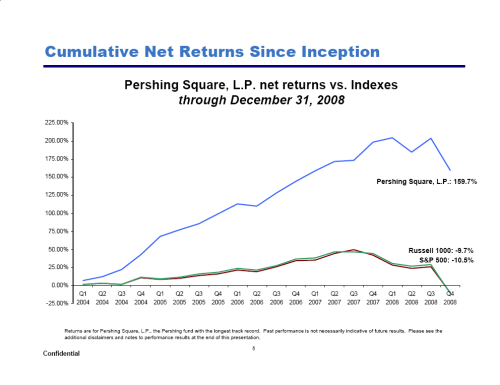
Pershing Square’s investment strategy is more Buffett than Graham (or more Fisher than Graham), but note that they do seek value that may be hidden in assets. Pershing Square’s returns have been extraordinary, as this slide attests:

pershing-square-cumulative-net-returns1

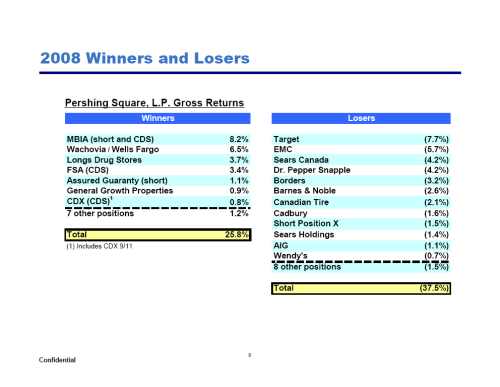
Although not all Pershing Square’s positions were winners:

pershing-square-2008-winners-and-losers

(via Dealbreaker)

Read Full Post »

Wesley Gray, who occasionally drops by here to provide some high quality commentary, has launched his maiden hedge fund, “Empirical Search Strategies.”

The fund follows a “long-biased micro-cap equity strategy,” which means it invests in “special situations opportunities such as liquidations and companies selling for less than cash value.” Sounds like a good strategy to us.

The fund is down 12.56% since its September launch, which compares favorably with the performance of the Russell 2000 Index (down more than 39% during the same period).

Gray is completing his Ph.D. at the University of Chicago Booth School of Business.

You can read more about Gray’s strategy in the FinAlternatives article Ten Hut! Ex-Marine Launches Long/Short Hedge Fund or Gray’s own website Empirical Finance Research Blog.

Congratulations, Wes. We hope to see you here more often.

Read Full Post »

Walter Schloss might be one of Benjamin Graham’s lesser-known disciples, but to Warren Buffett, perhaps Graham’s most famous disciple, Schloss is a “superinvestor.” In The Superinvestors of Graham-and-Doddsville, an article based on a speech Buffett gave at Columbia Business School on May 17, 1984 and appearing in Hermes, the Columbia Business School magazine, Buffett said of Schloss:

Walter never went to college, but took a course from Ben Graham at night at the New York Institute of Finance. Walter left Graham-Newman in 1955 and achieved the record shown here over 28 years.

Here is what ‘Adam Smith’ – after I told him about Walter – wrote about him in Supermoney (1972):

He has now connections or access to useful information. Practically no on in Wall Street knows him and he is not fed any ideas. He looks up the numbers in the manuals and sends for the annual reports, and that’s about it.

Walter has diversified enormously, owning well over 100 stocks currently. He knows how to identify securities that sell at considerably less than their value to a private owner. And that’s all he does. He doesn’t worry about whether it’s January, he doesn’t worry about whether it’s Monday, he doesn’t worry about whether it’s an election year. He simply says, if a business is worth a dollar and I can buy it for 40 cents, something good may happen to me. And he does it over and over and over again. He owns many more stocks than I do – and is far less interested in the underlying nature of the business; I don’t seem to have very much influence on Walter. That’s one of his strengths; no one has much influence on him.

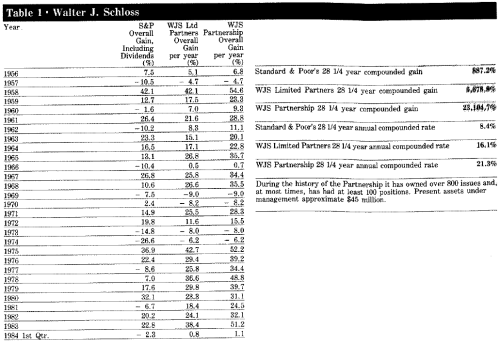
This is Schloss’ record, extracted from Buffett’s article (click to go the article for the full-size table on page 7):

walter-schloss-record1

Over 28 1/4 years between 1955 and the first quarter of 1984 (when Buffett wrote the article), WJS Limited Partners returned 5,678.8% and in the WJS Partnership returned an astonishing 23,104.7%. Annualised, that’s 16.1% in WJS Limited Partners and 21.3% in the WJS Partnership. Both dwarf the S&P’s gain of 887.2% or 8.4% annually over the same period.

Fast forward 24 years to a February 2008 Forbes article titled, Experience:

Although he stopped running others’ money in 2003–by his account, he averaged a 16% total return after fees during five decades as a stand-alone investment manager, versus 10% for the S&P 500–Schloss today oversees his own multimillion-dollar portfolio with the zeal of a guy a third his age.

The Experience article highlights a few things about Schloss that we really like (mostly because they coincide with Greenbackd’s views on investing). First, he’s an asset investor:

“Most people say, ‘What is it going to earn next year?’ I focus on assets. If you don’t have a lot of debt, it’s worth something.”

Schloss had earlier discussed his preference for assets over earnings at the New York Society of Security Analysts (NYSSA) dedication of the Value Investing Archives in November 2007 (from the article NYSAA Value Investing Archive Dedication: Walter Schloss by Peter Lindmark):

“We try to buy stocks cheap.” His investment philosophy is based on equities which are quantitatively cheap and he often holds over 100 securities. Although he expounds that, “Each one is different. I don’t think you can generalize……But I think you just have to look at each situation on its own merits and decide whether it’s worth more than its asking price.” He prefers to buy assets rather than earnings. “Assets seem to change less than earnings.”

Second, as Buffett pointed out in his article, he’s not particularly interested in the nature of the business:

Schloss doesn’t profess to understand a company’s operations intimately and almost never talks to management. He doesn’t think much about timing–am I buying at the low? selling at the high?–or momentum.

Lindmark’s article also notes Schloss’ disinterest in the underlying business:

Mr. Graham simply did not care, and tried to purchase securities strictly on a quantitative basis. Mr. Schloss advocated buying decent companies with temporary problems. He stated, ” Warren understands businesses – I don’t. We’re buying in a way that we don’t have to be too smart about the business….”

Finally, we have to admit that we admire Schloss’ gentlemanly approach to running his business:

Typical work hours when he was running his fund: 9:30 a.m. to 4:30 p.m., only a half hour after the New York Stock Exchange’s closing bell.

You can see Schloss speaking here at the Ben Graham Center For Value Investing, Richard Ivey School of Business. Our favorite line:

If this doesn’t work, we can always liquidate it and get our money back.

Read Full Post »

Warren Buffett took the opportunity Friday to lend his considerable intellectual weight to the debate about buy backs, saying, “I think if your stock is undervalued, significantly undervalued, management should look at that as an alternative to every other activity.”

We’ve been banging the drum for buy backs quite a bit recently. We wrote on Friday that they represent the lowest risk investment for any company with undervalued stock and we’ve written on a number of other occasions about their positive effect on per share value in companies with undervalued stock.

In a Nightly Business Report interview with Susie Gharib, Buffett discussed his view on stock buy backs:

Susie Gharib: What about Berkshire Hathaway stock? Were you surprised that it took such a hit last year, given that Berkshire shareholders are such buy and hold investors?

Warren Buffett: Well most of them are. But in the end our price is figured relative to everything else so the whole stock market goes down 50 percent we ought to go down a lot because you can buy other things cheaper. I’ve had three times in my lifetime since I took over Berkshire when Berkshire stock’s gone down 50 percent. In 1974 it went from $90 to $40. Did I feel badly? No, I loved it! I bought more stock. So I don’t judge how Berkshire is doing by its market price, I judge it by how our businesses are doing.

SG: Is there a price at which you would buy back shares of Berkshire? $85,000? $80,000?

WB: I wouldn’t name a number. If I ever name a number I’ll name it publicly. I mean if we ever get to the point where we’re contemplating doing it, I would make a public announcement.

SG: But would you ever be interested in buying back shares?

WB: I think if your stock is undervalued, significantly undervalued, management should look at that as an alternative to every other activity. That used to be the way people bought back stocks, but in recent years, companies have bought back stocks at high prices. They’ve done it because they like supporting the stock…

SG: What are your feelings with Berkshire. The stock is down a lot. It was up to $147,000 last year. Would you ever be opposed to buying back stock?

WB: I’m not opposed to buying back stock.

You can see the interview with Buffett here (via New York Times’ Dealbook article Buffett Hints at Buyback of Berkshire Shares)

Read Full Post »

We’re often banging on about stock buy backs to anyone who’ll listen. We like them because they represent the lowest risk investment for any company with undervalued stock. The S&P500 peaked at 1,576.09 on October 11, 2007. It’s now off a lazy 47% to 827.50. It’s probably fair to say that the average stock is better value now than it was before the financial crisis began (Note: We are not saying that we think the average stock is good value, just that it’s better value than it was 15 months ago). One might think that this relatively better value would result in a surge in buy back activity. One would be wrong (click to enlarge):

buy-backs

(Source: Bloomberg via Market Folly).

Read Full Post »

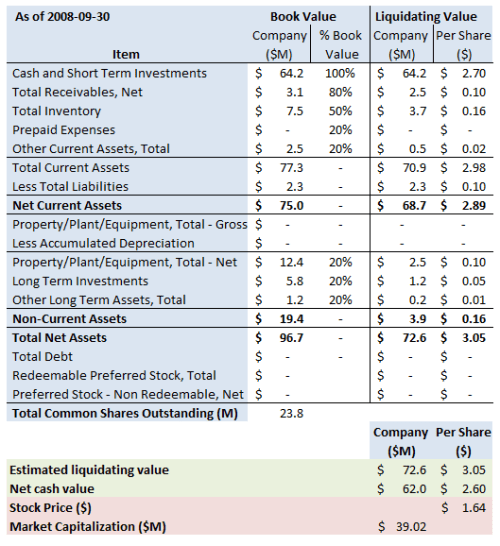
MEMSIC INC (NASDAQ:MEMS) is a deeply undervalued net net stock and the second installment in our Catalyst Wanted series. At its $1.64 close yesterday, MEMS has a market capitalization of $39M. We estimate its liquidating value to be around 86% higher at $72M or $3.05 per share. Its liquidating value is predominantly cash, so much so that MEMS has net cash of around $62M or $2.60 per share, which is around 60% higher than its stock price.

About MEMS

MEMS provides semiconductor sensors based on micro electro-mechanical systems. Its accelerometers are used to measure tilt, shock, vibration and acceleration in a range of mobile phones, automotive safety systems and video projectors. The company’s investor relations website can be found here.

The value proposition

Like TRID yesterday, MEMS has an veritable treasure trove on its balance sheet (the “Book Value” column shows the assets as they are carried in the financial statements, and the “Liquidating Value” column shows our estimate of the value of the assets in a liquidation):

mems-summary

According to its most recent 10Q, MEMS’ cash and equivalents are invested in money market funds and auction rate securities. As of September 30, 2008, MEMS’ investments included $5.8 million of auction rate securities. Auction rate securities are generally long-term fixed income instruments that provide liquidity through a Dutch auction process that resets the applicable interest rate at pre-determined calendar intervals, typically every 7, 28, 35 or 49 days. These investments have high credit quality ratings of at least AAA/Aaa. Due to recent liquidity issues, certain of the auction rate securities MEMS holds have failed at auction, meaning that the amount of securities submitted for sale at auction exceeded the amount of purchase orders. If an auction fails, the issuer becomes obligated to pay interest at penalty rates, and all of the auction rate securities MEMS holds continue to pay interest in accordance with their stated terms. However, the failed auctions create uncertainty as to the liquidity in the near term of these securities. As a result, MEMS has classified the $5.8 million of auction rate securities it held at September 30, 2008 as long-term investments. We have applied an 80% discount to those securities.

MEMS not have any off-balance sheet financing arrangements other than property and equipment operating leases, the value of which is not disclosed in the financial statements. It does not have any transactions, arrangements or other relationships with any special purpose entities established for its benefit.

The catalyst?

None. MEMS is using the cash on its balance sheet to construction a facility in Wuxi China. The company expects to complerte the first phase in the first quarter of 2009 at a total cost of $6M. The company expects to complete the second phase within three years at a total cost of $30M. Other significant cash outlays primarily consist of salaries, wages and commissions.

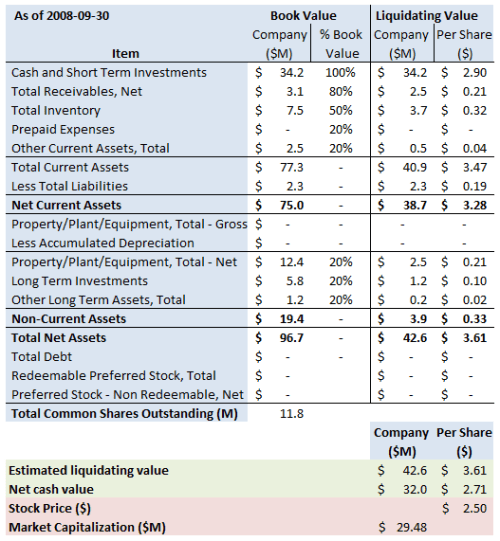
The construction of the Wuxi facility, and in particular the second phase of the Wuxi facility, seems to us to be an investment that carries significant risk in the present environment. We’d suggest that a better use for the cash at this time would be to buy back the company’s stock given the huge discount to its cash backing. If the company was to redirect the $30M to stock repurchases at the present stock price, we estimate that the company’s value would increase more than 150%. It might not be realistic to complete the buy-back at this level. If we were to assume a more realistic number, say $2.50, which is 50% higher than the current stock price but still at a discount to its per share cash backing, the balance sheet looks like this:

mems-summary-post-buy-back2

If the $30M buy-back is completed at $2.50, the liquidating value of the company increases around 20% from $3.05 to $3.60. If we assume that the stock price trades up to the new liquidating value as a result of the company’s new shareholder-oriented management, investors buying in at the present $1.64 stock price see the stock appreciate 120%.

Conclusion

Without a positive catalyst, MEMS will probably remain as a net cash stock for a long time. Despite its deep discount to its cash backing, MEMS is no real bargain without more shareholder-oriented management. This is another stock we’ll keep on our watchlist and let you know if anyone takes it on.

MEMS closed yesterday at $1.64.

The S&P500 Index closed yesterday at 840.24.

[Full Disclosure:  We do not have a holding in MEMS. This is neither a recommendation to buy or sell any securities. All information provided believed to be reliable and presented for information purposes only. Do your own research before investing in any security.]

Read Full Post »

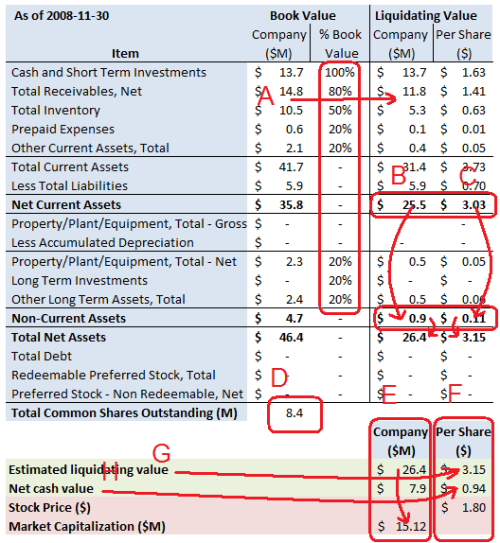
We are trialing a change to our summary presentation of company financial statements. The new summaries will look like this (this is our summary balance sheet for Aehr Test Systems (NASDAQ:AEHR) – it’s cheap but there’s no catalyst):

aehr-summary-changes

A brief explanation of the various changes:

  1. A. shows the carrying value of the receivables ($14.8M), our estimate for the percentage of carrying value the receivables will yield in liquidation (80%), the liquidating value ($11.8M) and the liquidating value per share ($1.41).
  2. B. shows the net current asset value ($25.5M), which, when added to the non-current asset value ($0.9M), gives the liquidating value for the company ($26.4M).
  3. C. is the same calculation as B. but on a per share basis: the net current asset value per share ($3.03), which, when added to the non-current asset value per share ($0.11), gives the liquidating value per share ($3.15).
  4. D. is the amount of stock the company has on issue.
  5. E. shows the liquidating value of the company ($26.4M), the net cash value of the company ($7.9M) and the market capitalization ($15.12M). In this instance, the company is trading at approximately 60% of our estimate of its liquidation value.
  6. F. shows the same amounts as E. on a per share basis against the stock price.
  7. G. and H. are the estimated liquidating value on a company and per share basis, and the net cash value on company and per share basis.

We’re keen to hear what you think of the changes. We think it presents the discount applied to the carrying values and the net current asset values more clearly than the previous summaries.

Read Full Post »

The New York Times’ Dealbook has a copy of Ramius Capital’s recent white paper, The case for activist strategies. The paper seeks to explain how activist investment strategies create shareholder value and improve corporate governance by resolving conflicts of interest between shareholders, directors and management.

Perhaps most interesting for Greenbackd readers is the paper’s discussion of the results of two recent comprehensive studies about the effectiveness of activist strategies:

The first, “Hedge Fund Activism, Corporate Governance and Firm Performance,” conducted by four university professors, analyzed nearly 800 activist events in the US from 2001 to 2006. The authors found that success or partial success was attained in nearly 2/3rds of the cases. The study highlighted that the target firm typically outperforms the market by 7% to 8% over a four-week period before and after announced activist campaigns by hedge funds. If this boost in performance was temporary and activist funds did little to generate value, the stock price would have reverted back over the course of the investment but the study concluded that this was not the case. The study also found that the highest market performance response to activist activities were when the stated objective was strategic in nature whether intending to sell the company, divest non-core assets, or refocus the business strategy. It also found that the effects of activist activities improved long term operational performance at target firms, demonstrated by ROE and ROA increases, while evidence of positive financial and corporate governance effects were observed in the form of increased dividend payouts and lowered CEO compensation. Another interesting conclusion was that hostile activism, which was found in roughly 30% of the cases, typically received more favorable market responses than non-hostile activism. The second, “Hedge Fund Activism” by April Klein, an associate professor at NYU, examined a sample group of 155 activist campaigns. Her conclusion was that in many cases the perceived threat of a proxy fight was sufficient for the activist to achieve its goal. This study reaffirmed many of the same conclusions as the previously mentioned study, including the abnormal stock returns surrounding the initial announcement. This study also found that the abnormal return of activist targets during the subsequent year was even greater, roughly 11%, confirming that activists generate returns significantly beyond the initial market reaction.

The paper concludes that both of the studies confirm that activism creates value, and can augment returns for traditional passive value investors. We think it confirms the value proposition of our approach to investing alongside activist investors in deep value situations.

Read Full Post »

In our last post, we discussed our approach to long-term and fixed asset valuation. We concluded that, given our inability to actually value any given asset or class of assets, the best that we could do is fix a point at which we feel that we are more likely to be right than wrong about a stock’s value but would also have enough opportunities to invest. We argued that magic point for us in relation to property, plant and equipment is 50%, based on nothing more more than our limited experience. We acknowledge that this method will cause us to make many mistakes, so in this post we set out our method for protecting ourselves from those mistakes.

We try to protect ourselves from our mistakes in three ways:

  1. We try to buy at a substantial (i.e. more than 1/3) discount to our estimate of the written down value. Sometimes our valuation will be so wrong that the discount will be an illusion, and the real value will be well south of our estimate (maybe somewhere near Antarctica). In those instances, if the liquidation becomes a reality, we will lose money. In other instances, the real value will be higher than our estimate, and we will make money. Our hope is that the latter occurs more frequently than the former, but we are certain that the former will occur regularly.
  2. We try to buy a portfolio of these securities and we don’t concentrate too much of the portfolio in any one security. The more certain we are about a security, the larger the portion of the portfolio it will command. This means that net cash stocks that have ceased trading and are in liquidation or paying a special dividend take up a larger proportion of our portfolio than cash-burning industrials in liquidity crises with value wholly concentrated in property, plant and equipment (that said, at a big enough discount, they might take up a lot of the portfolio). This means that if any one stock, or even a handful of stocks, go to zero or thereabouts, they don’t destroy our entire stake and we can live to invest another day.
  3. We try to follow investors much smarter than we are. From our perspective, there’s no shame in riding on someone else’s coat-tails, especially when those coat-tails are on the back of someone smarter, better resourced and more experienced. This is one of the main reasons we only invest when we can see a Schedule 13D notice filed with the SEC (the other reason is that the 13D filing is the precursor to the catalytic event that removes the discount). Often, the 13D notice will set out the investor’s rationale for the investment, which may include their view on the stock’s valuation. While we always do our own research, we are comforted when we see other value-oriented investors in the stock, and we hope that experienced, professional, value investors are right more often than they are wrong (even though we know that they will also make mistakes).

The first method above attempts to limit the effect of an error in valuation on any given investment. We hope that if we’re wrong about the value, it’s only by a matter of degree, and we can salvage some value from the investment. The second limits the damage that a total, or near total, destruction of value in any one investment does to the portolio as a whole. The third is a check on our thought process. If we’re right about a situation, we’d expect to see investors smarter than we are already in the stock. If they’re not there, we’d have to look deep into the abyss before jumping in. We haven’t had to do that yet.

We hope that this better explains our approach to investment. Once again, we’re always keen to hear other points of view, or to have someone point out the obvious holes in the argument.

Read Full Post »

We’ve recently received several questions about our valuation methodology. Specifically, readers have asked why we include property, plant and equipment in our valuation, and why we only discount it by half, as opposed to a higher figure (two-thirds, four-fifths, one-hundred percent). They are concerned that by including property, plant and equipment in our assessment, or by failing to apply a sufficient discount to those assets, we are overstating the asset or liquidation value of the companies we cover and therefore overpaying for their stock. In this post, we better describe our approach to asset valuation. In the next post, we deal with our method for protecting ourselves from overpaying for stock.

Our valuation methodology is closely based on Benjamin Graham’s approach, which he set out in Security Analysis and The Interpretation of Financial Statements. Like Graham, we have a strong preference for current assets, and, in particular, cash. As we mention on the About Greenbackd page, our favorite stocks are those backed by greenbacks, hence our name: Greenbackd. We love to find what Graham described as gold-dollars-with-strings-attached that can be purchased for 50 cents. We believe that there is value in long-term and fixed assets, although not necessarily the value at which those assets are carried in the financial statements. The appropriate discount for long-term and fixed assets is something with which we (and we suspect other Grahamite / asset / liquidation investors) struggle. We think it’s useful to consider Graham’s approach, which we’ve set out below:

Graham’s approach to valuing long-term and fixed assets

Graham’s preference was clearly for current assets, as this quote from Chapter XXIV of The Interpretation of Financial Statements: The Classic 1937 Edition demonstrates:

It is particularly interesting when the current assets make up a relatively large part of the total assets, and the liabilities ahead of the common are relatively small. This is true because the current assets usually suffer a much smaller loss in liquidation than do the fixed assets. In some cases of liquidation it happens that the fixed assets realize only about enough to make up the shrinkage in the current assets.

Hence the “net current asset value” of an industrial security is likely to constitute a rough measure of its liquidating value. It is found by taking the net current assets (or “working capital”) alone and deducting therefrom the full claims of all senior securities. When a stock is selling at much less than its net current asset value, this fact is always of interest, although it is by no means conclusive proof that the issue is undervalued.

Despite Graham’s cautionary tone above, he did not necessarily exclude long-term and fixed assets from his assessment of value. He did, however, heavily discount those assets (from Chapter XLIII of Security Analysis: The Classic 1934 Edition “Significance of the Current Asset Value”):

The value to be ascribed to the assets however, will vary according to their character. The following schedule indicates fairly well the relative dependability of various types of assets in liquidation.

liquidation-value-schedule2

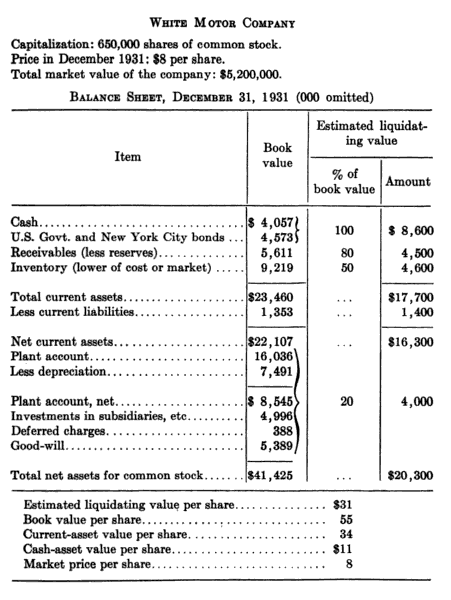
Graham then set out an example valuation for White Motor Company:

In studying this computation it must be borne in mind that our object is not to determine the exact liquidating value of White Motor, but merely to form a rough idea of this liquidating value in order ascertain whether or not the shares are selling for less than the stockholders could actually take of the business. The latter question is answered very definitively in the affirmative. With a full allowance for possible error, there was no doubt at all that White Motor would liquidate for a great deal more than $8 per share or $5,200,000 for the company. The striking fact that the cash assets alone considerably exceed this figure, after deducting all liabilities, completely clinched the argument on this score.
white-motor-example1

Current-asset Value a Rough Measure of Liquidating Value. – The estimate values in liquidation as given for White Motor are somewhat lower in respect of inventories and somewhat higher as regards the fixed and miscellaneous assets than one might be inclined to adopt in other examples. We are allowing for the fact that motor-truck inventories are likely to be less salable than the average. On the other hand some of the assets listed as noncurrent, in particular the investment in White Motor Securities Corporation, would be likely to yield a larger proportion of their book values than the ordinary property account. It will be seen that White Motor’s estimated liquidating value (about $31 per share) is not far from the current-asset value ($34 per share). In the typical case it may be said that the noncurrent assets are likely to realize enough to make up most of the shrinkage suffered in the liquidation of the quick assets. Hence our first thesis, viz., that the current-asset value affords a rough measure of the liquidating value.

Greenbackd’s approach to valuing long-term and fixed assets

The first thing to note is that we’ve got no particular insight into any of the companies that we write about or the actual value of the companies’ assets. The valuations are based on the same generalized, unsophisticated, purely mathematical application of Graham’s formula. Further, if the actual value of an asset is objectively known or determinable, then we don’t know it and, in most cases, can’t determine it. That puts us at a disadvantage to those who do know the assets’ real value or can make that determination. Secondly, we can’t make the fine judgements about value that Graham has made in the White Motor example above. Perhaps it’s blindingly obvious that “motor-truck inventories are likely to be less salable than the average,” but we don’t know anything about motor-truck inventories or the average. It’s specific knowledge that we don’t have, which means that we are forced to mechanically apply the same discount to all assets of the same type.

Given that we’ve disclaimed any ability to actually value an asset or class of assets, why not adopt the lower to middle end of Graham’s valuation range for those assets? (Editors note: What a good suggestion. From here on in, we’re taking Graham’s advice. It’s simply because, in our experience, as idiosyncratic as it has been, an 80% discount to property, plant and equipment is too much in most instances. We think that 50% is a conservative estimate. In our limited experience, commercial and industrial real estate rarely seems to sell at much less than 15% below book value, and that’s in the recent collapse.) At first blush, specialist plant and equipment might appear to be worthless because the resale market is too small, but it can also be sold at a premium to its carrying value. For example, in the recent resources boom, we heard from an acquaintance in the mining industry that mining truck tires were so scarce as to sell in many instances at a higher price second hand than new. Apparently entire junked mining trucks were purchased in one country and shipped to another simply for the tires. Without that specialist knowledge of the mining industry, one might have ascribed a minimal value to an irreparable mining truck or a pile of used mining truck tires and missed the opportunity. What these examples demonstrate, in our opinion, is that the sale price for an asset to be sold out of liquidation is extremely difficult to judge until the actual sale, by which time it’s way too late to make an investment decision.

The best that we can do is fix a point at which we feel that we a more likely to be right than wrong about the value but will also have enough opportunities to invest to make the exercise worthwhile. For us, that point is roughly 20% 50% for property, plant and equipment. That 20% 50% is not based on anything more than (Edit: Graham’s formula, which has stood the test of time and should be applied in most cases unless one has a very good reason not to do so our limited experience, which is insufficient to be statistically significant for any industry or sector, geographical location or time in the investment cycle.) We always set out for our readers our estimate so that you can amend our valuation if you think it’s not conservative enough or just plain wrong (if you do make that amendment, we’d love to hear about it, so that we can adjust our valuation in light of a better reasoned valuation).

We hope that this sheds some light on our process. We’d love to hear your thoughts on the problems with our reasoning.

Read Full Post »
« Newer Posts - Older Posts »