Feeds:
Posts
Comments

Archive for the ‘About’ Category

Walter Schloss, one of Warren Buffett’s Superinvestors of Graham-and-Doddsville, has died at 95.

Says Bloomberg:

From 1955 to 2002, by Schloss’s estimate, his investments returned 16 percent annually on average after fees, compared with 10 percent for the Standard & Poor’s 500 Index.

His firm, Walter J. Schloss Associates, became a partnership, Walter & Edwin Schloss Associates, when his son joined him in 1973.

“He was a true fundamentalist,” Edwin Schloss, now retired, said today in an interview. “He did his fundamental analysis and was very concerned that he was buying something at a discount. Margin of safety was always essential.”

Buffett, another Graham disciple, called Schloss a “superinvestor” in a 1984 speech at Columbia Business School.

He again saluted Schloss as “one of the good guys of Wall Street” in his 2006 letter to shareholders of his Berkshire Hathaway Inc.

“Following a strategy that involved no real risk — defined as permanent loss of capital — Walter produced results over his 47 partnership years that dramatically surpassed those of the S&P 500,” wrote Buffett, whose stewardship of Berkshire

Hathaway (BRK) has made him one of the world’s richest men and most emulated investors. “It’s particularly noteworthy that he built this record by investing in about 1,000 securities, mostly of a lackluster type. A few big winners did not account for his success.”

For more on Schloss and his outstanding record, see Walter Schloss, superinvestor.

Read Full Post »

A little while ago Portfolio ran this great Felix Salmon article about Chris Wyser-Pratte, a 1972 Stanford MBA grad who spent the next 23 years as an investment banker, and the seven principles he was taught at Stanford Business. When I read through them, I was struck by how timeless they are, and how readily applicable to value investing. Here is Mr Wyser-Pratte’s list in its unadulterated form:

I learned exactly seven things at Stanford Graduate School of Business getting an MBA degree in 1972. I always used them and never wavered. They were principles that enabled me to put the cookbook formulas that everyone revered in context and in perspective. I think they served my clients (and perhaps me) rather well. Here are those seven principles, and who taught them to me:

  1. Don’t use many financial ratios or formulas, and when you’ve picked the few that will actually tell you what you want to know, don’t believe them very much (Prof. James T.S. Porterfield);
  2. Remember that any damn fool can compute an IRR or DCF. The trick is to find a business that can return 20% after tax, understand its critical indigenous and exogenous variables, and then run it so it meets its return target. (Prof. Alexander Robichek.)
  3. Always ask what can go wrong (Porterfield);
  4. Never extrapolate beyond the observed points of a distribution, you have absolutely no information outside the observed range (Prof. J. Michael Harrison);
  5. Remember that you can always break the bank at Monte Carlo by doubling your bet on red at the roulette table every time you lose. The problem is it will break you first; It’s called “the takeout.” Therefore, always manage your financial structure so that takeout is not an issue. (Porterfield.)
  6. Big M (today Nassim Taleb’s Black Swan) is never a part of the optimal solution. If it shows up in the answer with any coefficient greater than zero, you have the wrong answer and have to continue to do program iterations. (Harrison.)
  7. There is never any excuse for looking through the substance of an economic transaction, whatever the accounting, and if the accounting permits you to do so, it’s wrong (Prof. Charles T. Horngren.)

Read more at Portfolio. I’d love to hear any other great lessons you might have learned in business school or otherwise.

Read Full Post »

Amit Chokshi of Kinnaras Capital, an independent registered investment advisor focused on deep-value, small capitalization and micro capitalization equity investing, has contributed a guest post on Imation Corp (NYSE:IMN).

About Kinnaras:

Kinnaras aims to deliver above average long-term results through application of a deep value investment strategy.  As a result, the Firm focuses on the “throwaways” of the equity market, or stocks that are generally viewed as broken from a fundamental standpoint.  The Firm utilizes a fundamental, bottom-up, research-intensive approach to security selection, focusing mainly on prospects trading below book and/or tangible book value or cheap price to free cash flow. Kinnaras is a strong advocate of mean reversion and has found that pessimistic valuations, and thus attractive investment opportunities, often manifest when the broader investment community disregards mean reversion and impounds overly pessimistic expectations into security prices.  When valuation incorporates these pessimistic assumptions, the risk/reward scenario favors the investor.

Imation Worth More Sold Than Alone

As a deep value investor, one is always confronted with companies that have potentially great assets but can be overshadowed by poor management.  As a deep value investor, often times a great stock is not necessarily a great company but the overall value available from an investment standpoint is too attractive to pass up.  Based on its current valuation, IMN appears to fall into this category.

IMN is a global developer and marketer of branded storage/recording products focused on optical media, magnetic tape media, flash and hard drive products and consumer electronic products.  The company has significant global scale and its brand portfolio includes the Imation, Memorex, and XtremeMac brands.  The company is also the exclusive licensee of the TDK Life on Record brand.

IMN has high brand recognition and is a leader in its key categories of optical and magnetic tape media.  While the company faces long term secular challenges with regards to how data is stored, the current valuation appears to be highly muted due to a number of strategic and capital allocation blunders over the company’s past 5+ years.  Management would be doing shareholders a greater service by simply putting the company up for sale given the time allotted for a number of strategic moves to play out unsuccessfully in recent years.  Moreover, IMN has been on an acquisition spree in 2011 and existing shareholders may see further value destruction given the track record of management.  The following highlights some key grievances shareholders should have with IMN’s current strategy

Horrific Capital Allocation by Management: IMN’s cash balance serves as somewhat of a fundamental backstop against permanent capital loss.  The problem, however, is that the company’s net cash balance has been used to fund a number of bad decisions, particularly M&A.  Management has acquired a number of businesses in recent years, none of which have benefited shareholders.  These acquisitions of businesses and intellectual property (“IP”) have led to clear value destruction as evidenced by IMN’s sales and operating income performance since those acquisitions along with on going write-offs of goodwill tied to a number of those purchases and constant restructuring charges eating into book equity.

One example of how poor management’s acquisition strategy was its purchase of BeCompliant Corporation (Encryptx) on February 28, 2011 which resulted in $1.6MM in goodwill.  In less than five weeks, IMN had determined the goodwill tied to this acquisition to be fully impaired!  While $1.6MM is a tiny amount, Table I highlights the total value of goodwill written off by IMN in recent years along with the ongoing restructuring charges in the context of the company’s historical acquisition capex.

TABLE I: IMN ACQUISITION CAPEX & IMPAIRMENT, RESTRUCTURING CHARGES ($MM) [Click to expand]

Since 2006, IMN management has deployed $442MM in cash to acquire a variety of businesses.  Since that time, investors have had to experience $152MM in goodwill write-offs and another $169MM in restructuring charges as IMN fumbles in regards to integrating newly acquired and existing business segments for a grand total of $320MM in charges since 2006.  IMN management is clearly a poor steward of capital.   What’s worse is that shareholders experienced value destruction at the expense of exercises which would have returned cash to shareholders.

For example, after 2007 IMN ceased paying a dividend.  The annual dividend returned over $20MM to investors annually.  Rather than provide investors with a certain return in the form of a dividend, IMN management has used that capital to obviously overpay for businesses such as Encryptx.  Another demonstration of poor capital allocation by management is its stock buyback history.  From 2005-2008, IMN spent nearly $190MM to buyback shares when its stock was valued at levels ranging from 0.4-1.1x P/S and 0.8-1.6x P/B or $14-$48 per share.  The average acquired share price of IMN’s treasury stock was $23.39.

Since 2008, IMN’s share price has ranged from its recent multi year low of $5.40 to about $14 (for a brief period in early 2009).  More importantly, IMN’s valuation has ranged from 0.15-0.25 P/S and 0.28-0.36 P/B.  So while IMN has had more than enough cash to purchase shares since that time, from 2009 on, IMN management decided to repurchase just under $10MM of stock.  This exemplifies management’s history of overpaying for assets – whether it’s businesses, IP, or the company’s own shares.

Management has no meaningful investment in IMN:  There has been considerable insider purchases since July 2011 across a number of companies.  IMN has had no major inside purchases despite the current low share price.  IMN CEO made an immaterial purchase in the open market very recently but overall, while  IMN stock has floundered, management has experienced none of the setbacks of shareholders for its inept strategy.  As mentioned above, management had the company execute on a number of buybacks from 2005-2008.  However, the overall effect of those buybacks were considerably offset by significant issuance of stock compensation.  As a result, IMN’s overall share count continued to grow despite these share buybacks.  In summary, management has demonstrated little appetite for the company’s shares, irrespective of valuation, while expecting shareholders to sit idly by while it awards itself dilutive stock compensation off the backs of investors.

There is no question that IMN has its share of challenges but is there value to be unlocked?  At current valuations, it appears that significant upside is potentially available if IMN investors can take an activist stance.  Management has had its chances for many years and it is clearly time to explore other options.  Despite the secular challenges IMN faces, the company is still worth more than current prices.  The following highlights the good aspects of IMN.

Valuation:  IMN is cheap based on a number of valuation metrics.  First, at $5.81 per share as of Monday’s (11/28/11) market close, IMN has a negative enterprise value.  IMN has $6.21 in net cash per share and the current share price means that the market is ascribing a negative value to IMN’s core operating business.  Given the number of patents and intellectual property along with a business that can generally crank out solid cash flow, IMN’s main businesses should not have a negative value despite the longer term secular challenges it faces.  On a capital return basis, IMN management should have the company repurchase shares at this level but that may be expecting far too much from management given its track record.

IMN is also trading at valuation levels below those reached even in 2008-09.  As Table II shows, IMN has not traded at levels this low at least since 2003.  Long-term challenges in its core business segments along with value destroying management are two reasons for these metrics grinding lower but at a certain point, valuation can become rather compelling.  I think current prices and valuation may reflect “highly compelling” from an investment standpoint.

TABLE II: IMN HISTORICAL VALUATION [Click to expand]

IMN’s current valuation could be ascribed to a company with major near-term problems, typical of those that burn considerable cash and have poor balance sheets characterized by high levels of debt and/or near-term refinancings.  IMN does not fit into this description.  As bad as IMN is performing, it is still on track for a positive free cash flow in 2011.  IMN has modest capital expenditure needs and IMN’s gross margins have been increasing in 2011, approaching gross margins realized in 2007.  Table III presents my estimate for FY 2011 excluding IMN’s non-cash restructuring charges and write-offs.  To be clear, a potential acquirer would also use pro forma statements in determining IMN’s value.

TABLE III: IMN 2011 SUMMARY OPERATING DATA

Using a highly conservative multiple of just 3.0x 2011 pro forma EBITDA of $49MM leads to a share price of $10.  What is clear from Table III is that if management could avoid squandering capital on acquisitions, IMN can still generate attractive free cash flow.  In addition, with a net cash balance of $233MM or $6.21/share, IMN should not generally be paying any net interest expense if that capital was better managed/allocated for cash management purposes.  A history of poor capital allocation and strategic blunders has led to IMN carrying a heavily discounted valuation.  At about $5.80, a case could be made that IMN is trading at or below liquidation value as presented in Table IV.

TABLE IV: IMN LIQUIDATION VALUE PER SHARE

Table IV shows that the major wildcard is really the value of IMN’s intangible assets.  While IMN is facing secular challenges, the IP it carries could very well have value to a potential acquirer, especially at an attractive valuation.  IMN maintains a long-term exclusive license with TDK which expires in 2032.  TDK, which owns nearly 20% of IMN, could bless a sale that allows those licenses to pass on to an acquiring company.  Aside from the TDK license, IMN holds over 275 patents.  IMN has recently entered into security focused technology for the purposes of flash and hard drive storage.  This technology uses various advanced password/encryption technology along with biometric authentication and could very well be worth much more to a larger technology company that could more broadly exploit this IP across its technology.  This is just one example of various IP IMN possesses.  In addition, IMN has leading market share and brand recognition/value in a number of areas such as optical media along with magnetic tape media.  A competitor like Sony Corp (“SNE”) or a client like IBM or Oracle (“ORCL”), both of which use IMN’s magnetic tape media in their own products for disaster storage/recovery and archiving, could find IMN’s IP of value.

TABLE V: IMN LIQUIDATION VALUE BASED ON INTANGIBLE ASSET DISCOUNT

If IMN’s IP and thus its intangible assets are absolutely worthless, IMN would be worth under $2 in a fire sale liquidation.  However, at even a 50% haircut of IP, IMN gets to where its stock is currently trading.  The less severe the discount, the more IMN is worth in a liquidation.  That’s hardly a groundbreaking statement but what if IMN’s IP is actually worth more than its carrying value?

TABLE VI: IMN LIQUIDATION VALUE BASED ON INTANGIBLE ASSET PREMIUM

What is clear is that IP has considerable value and in many cases eclipses the actual on-going business value of a number of companies.  The recent lawsuit between Micron Technology (“MU”) and Rambus Inc (“RMBS”) was for IP claims that could have yielded nearly $4B in royalties (before potentially tripling under California law) for RMBS. RMBS commanded a market valuation of roughly$2B before MU won the lawsuit.

Motorola Mobility Holdings (“MMI”) faced very challenging headwinds in the mobile device space against tough competitors such as Apple (“AAPL”), Samsung, HTC, and others.  This was reflected in the stock losing significant value once being spun off from Motorola (about 25% from its initial spin-off price).  Nonetheless, Google (“GOOG”) saw value in MMI’s IP, enough to offer a share price that was essentially 100% above its at-the-time lows.

Eastman Kodak (“EK”) has a number of operating challenges and a far less attractive balance sheet relative to RMBS, MMI, and IMN.  The company is wracking up losses and has a $1.2B pension shortfall.  Nonetheless, IP specialists MDB Capital believe that EK’s IP could be worth $3B in a sale.  EK currently has a market capitalization of just $295MM.

What is clear is that there is a wide range of valuation outcomes dependent on the value of the IP to a potential buyer.  IMN could be an easy and accretive acquisition to a number of large technology firms.  Firms like SNE, Maxell, and Verbatim could find IMN attractive for its leading position in optical media.  SNE could also find IMN’s magnetic storage division of value, as could IBM and ORCL.  IMN’s emerging storage division encompasses USB, hard disk drives, and flash drives (admittedly not really “emerging”) but has a particular focus on security focused applications in this storage format.  The IP related to biometric authentication and advanced encryption could be of value to a number of storage/storage tech companies such as Western Digital Corp (“WDC”), Seagate Technology (“STX”), SanDisk Corp. (“SNDK”), Micron Technology (“MU”). Even larger enterprise storage and software companies such EMC Corp (“EMC”), IBM, and ORCL could find this segment of value.  The small consumer electronics segment could be of interest to a company like Audiovox (“VOXX”).  However, in any case, all of IMN could be acquired at a very attractive price to nearly any large technology firm/buyer.

At a takeout price of just $10 per share, for example, an acquirer would be buying IMN’s core business for just $142MM with $6.21 of the $10 offer represented by IMN’s net cash.  This small deal size could very well lead to a quick payback period for a number of larger firms that could exploit IMN’s IP across multiple channels.  IMN could also be sold off in piecemeal fashion but given its small size and number of large technology companies that can utilize IMN’s IP, folding the entire company at an attractive price could be the easiest road.

Management and the board have had more than enough time in recent years to transform IMN or move it forward.  The operating results clearly show that this strategy is costing shareholders greatly and management appears to have little competence with regards to understanding how best to deploy capital.  Nearly $200MM was spent to repurchase far more expensive IMN shares prior to 2008 while a pittance of IMN capital has been deployed to buyback shares when the stock is trading for less than its net cash value.  In addition, upon ceasing its payment of annual dividend, IMN management has utilized that cash to pursue questionable acquisitions.  These acquisitions have led to destruction of shareholder equity given the subsequent writedowns and constant restructuring charges experienced by IMN.  The bottom line is IMN investors should pursue an activist stance and encourage management and the board to seek a sale for the sake of preserving what value is left in the company.

DISCLOSURE: AUTHOR MANAGES A HEDGE FUND AND MANAGED ACCOUNTS LONG IMN AND MU.

Greenbackd Disclosure: No Position.

Read Full Post »

Another one for the annals of behavioral finance. From Handbook of the Economics of Finance, Chapter 18, A Survey Of Behavioral Finance by Nicholas BARBERIS, and Richard THALER, University of Chicago:

7.1 Insufficient diversification

A large body of evidence suggests that investors diversify their portfolio holdings much less than is recommended by normative models of portfolio choice. First, investors exhibit a pronounced “home bias” French and Poterba (1991) report that investors in the USA, Japan and the UK allocate 94%, 98%, and 82% of their overall equity investment, respectively, to domestic equities explain this fact on rational grounds [Lewis (1999)] Indeed, normative portfolio choice models that take human capital into account typically advise investors to short their national stock market, because of its high correlation with their human capital [Baxter and Jermann (1997)].

At the very least, it’s an argument for investing globally.

Read Full Post »

Michael Mauboussin appeared Friday on Consuelo Mack’s WealthTrack to discuss several of the ideas in his excellent book, Think Twice. Particularly compelling is his story about Triple Crown prospect Big Brown and the advantage of the “outside view” – the statistical one – over the “inside view” – the specific, anecdotal one (excerpted from the book):

June 7, 2008 was a steamy day in New York, but that didn’t stop fans from stuffing the seats at Belmont Park to see Big Brown’s bid for horseracing’s pinnacle, the Triple Crown. The undefeated colt had been impressive. He won the first leg of the Triple Crown, the Kentucky Derby, by 4 ¾ lengths and cruised to a 5 ¼-length win in the second leg, the Preakness.

Oozing with confidence, Big Brown’s trainer, Rick Dutrow, suggested that it was a “foregone conclusion” that his horse would take the prize. Dutrow was emboldened by the horse’s performance, demeanor, and even the good “karma” in the barn. Despite the fact that no horse had won the Triple Crown in over 30 years, the handicappers shared Dutrow’s enthusiasm, putting 3-to-10 odds—almost a 77 percent probability—on his winning.

The fans came out to see Big Brown make history. And make history he did—it just wasn’t what everyone expected. Big Brown was the first Triple Crown contender to finish dead last.

The story of Big Brown is a good example of a common mistake in decision making: psychologists call it using the “inside” instead of the “outside” view.

The inside view considers a problem by focusing on the specific task and by using information that is close at hand. It’s the natural way our minds work. The outside view, by contrast, asks if there are similar situations that can provide a statistical basis for making a decision. The outside view wants to know if others have faced comparable problems, and if so, what happened. It’s an unnatural way to think because it forces people to set aside the information they have gathered.

Dutrow and others were bullish on Big Brown given what they had seen. But the outside view demands to know what happened to horses that had been in Big Brown’s position previously. It turns out that 11 of the 29 had succeeded in their Triple Crown bid in the prior 130 years, about a 40 percent success rate. But scratching the surface of the data revealed an important dichotomy. Before 1950, 8 of the 9 horses that had tried to win the Triple Crown did so. But since 1950, only 3 of 20 succeeded, a measly 15 percent success rate. Further, when compared to the other six recent Triple Crown aspirants, Big Brown was by far the slowest. A careful review of the outside view suggested that Big Brown’s odds were a lot longer than what the tote board suggested. A favorite to win the race? Yes. A better than three-in-four chance? Bad bet.

Mauboussin on WealthTrack:

Hat Tip Abnormal Returns.


Read Full Post »

The excellent Empirical Finance Blog has a superb series of posts on an investment strategy called “Profit and Value” (How “Magic” is the Magic Formula? and The Other Side of Value), which Wes describes as the “academic version” of Joel Greenblatt’s “Magic Formula.” (Incidentally, Greenblatt is speaking at the New York Value Investors Congress in October this year. I think seeing Greenblatt alone is worth the price of admission.) The Profit and Value approach is similar to the Magic Formula in that it ranks stocks independently on “value” and “quality,” and then reranks on the combined rankings. The stock with the lowest combined ranking is the most attractive, the stock with the next lowest combined ranking the next most attractive, and so on.

The Profit and Value strategy differs from the Magic Formula strategy in its methods of determining value and quality. Profit and Value uses straight book-to-market to determine value, where the Magic Formula uses EBIT / TEV. And where the Magic Formula uses EBIT / (NPPE +net working capital) to determine quality, Profit and Value uses “Gross Profitability,” a metric described in a fascinating paper by Robert Novy-Marx called “The other side of value” (more on this later).

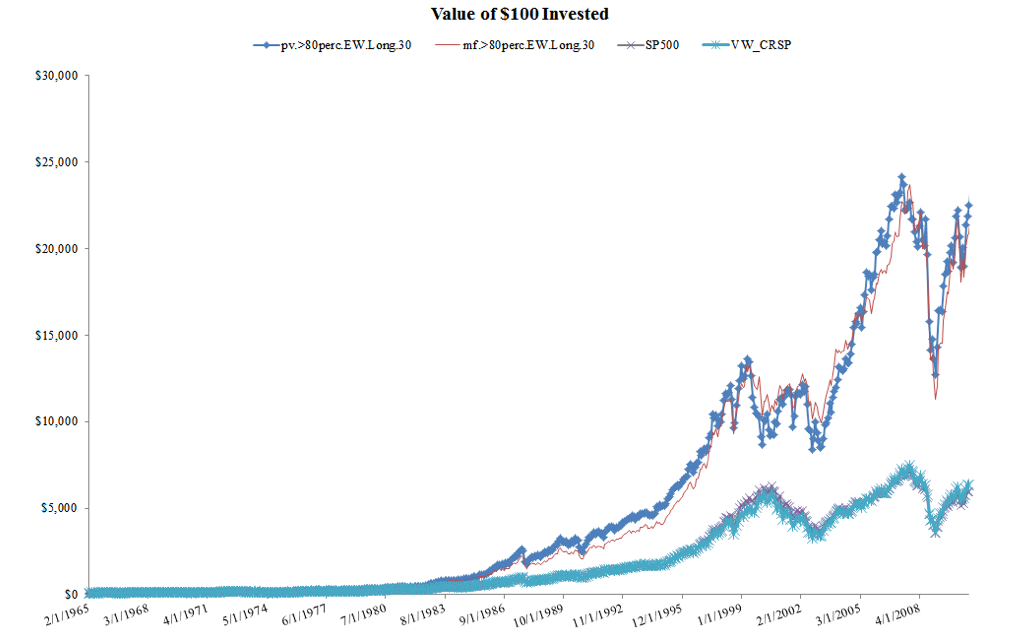
My prima facie attraction to the Profit and Value strategy was twofold: First, Profit and Value uses book-to-market as the measure of value. I have a long-standing bias for asset-based metrics over income-based ones, and for good reasons. (After examining the performance analysis of Profit and Value, however, I’ve made a permanent switch to another metric that I’ll discuss in more detail later.) Secondly, the back-tested returns to the strategy appear to be considerably higher than those for the Magic Formula. Here’s a chart from Empirical Finance comparing the back-tested returns to each strategy with a yearly rebalancing (click to enlarge):

Profit and Value is the clear slight winner. This is the obvious reason for preferring one strategy over another. It is not, however, the end of the story. There are some problems with the performance of Profit and Value, which I discuss in some detail later. Over the next few weeks I’ll post my full thoughts in a series of posts on the following headings, but, for now, here are the summaries. I welcome any feedback.

Determining “quality” using “gross profitability”

In a 2010 paper called “The other side of value: Good growth and the gross profitability premium,” author Robert Novy-Marks discusses his preference for “gross profitability” over other measures of performance like earnings, or free cash flow. The actual “Gross Profitability” factor Novy-Marx uses is as follows:

Gross Profitability = (Revenues – Cost of Goods Sold) / Total Assets

Novy-Marx’s rationale for preferring gross profitability is compelling. First, it makes sense:

Gross profits is the cleanest accounting measure of true economic profitability. The farther down the income statement one goes, the more polluted profitability measures become, and the less related they are to true economic profitability. For example, a firm that has both lower production costs and higher sales than its competitors is unambiguously more profitable. Even so, it can easily have lower earnings than its competitors. If the firm is quickly increasing its sales though aggressive advertising, or commissions to its sales force, these actions can, even if optimal, reduce its bottom line income below that of its less profitable competitors. Similarly, if the firm spends on research and development to further increase its production advantage, or invests in organizational capital that will help it maintain its competitive advantage, these actions result in lower current earnings. Moreover, capital expenditures that directly increase the scale of the firm’s operations further reduce its free cashflows relative to its competitors. These facts suggest constructing the empirical proxy for productivity using gross profits. Scaling by a book-based measure, instead of a market based measure, avoids hopelessly conflating the productivity proxy with book-to-market. I scale gross profits by book assets, not book equity, because gross profits are not reduced by interest payments and are thus independent of leverage.

Second, it works:

In a horse race between these three measures of productivity, gross profits-to-assets is the clear winner. Gross profits-to-assets has roughly the same power predicting the cross section of expected returns as book-to-market. It completely subsumes the earnings based measure, and has significantly more power than the measure based on free cash flows. Moreover, demeaning this variable dramatically increases its power. Gross profits-to-assets also predicts long run growth in earnings and free crashflow, which may help explain why it is useful in forecasting returns.

I think it’s interesting that gross profits-to-assets is as predictive as book-to-market. I can’t recall any other fundamental performance measure that is predictive at all, let alone as predictive as book-to-market (EBIT / (NPPE +net working capital) is not. Neither are gross margins, ROE, ROA, or five-year earnings gains). There are, however, some obvious problems with gross profitability as a stand alone metric. More later.

White knuckles: Profit and Value performance analysis

While Novy-Marx’s “Gross Profitability” factor seems to be predictive, in combination with the book-to-market value factor the results are very volatile. To the extent that an individual investor can ignore this volatility, the strategy will work very well. As an institutional strategy, however, Profit and Value is a widow-maker. The peak-to-trough drawdown on Profit and Value through the 2007-2009 credit crisis puts any professional money manager following the strategy out of business. Second, the strategy selects highly leveraged stocks, and one needs a bigger set of mangoes than I possess to blindly buy them. The second problem – the preference for highly leveraged stocks – contributes directly to the first problem – big drawdowns in a downturn because investors tend to vomit up highly leveraged stocks as the market falls. Also concerning is the likely performance of Profit and Value in an environment of rising interest rates. Given the negative rates that presently prevail, such an environment seems likely to manifest in the future. I look specifically at the performance of Profit and Value in an environment of rising interest rates.

A better metric than book-to-market

The performance issues with Profit and Value discussed above – the volatility and the preference for highly leveraged balance sheets – are problems with the book-to-market criterion. As Greenblatt points out in his “You can be a stockmarket genius” book, it is partially the leverage embedded in low book-to-market that contributes to the outperformance over the long term. In the short term, however, the leverage can be a problem. There are other problems with cheap book value. As I discussed in The Small Cap Paradox: A problem with LSV’s Contrarian Investment, Extrapolation, and Risk in practice, the low price-to-book decile is very small. James P. O’Shaughnessy discusses this issue in What works on Wall Street:

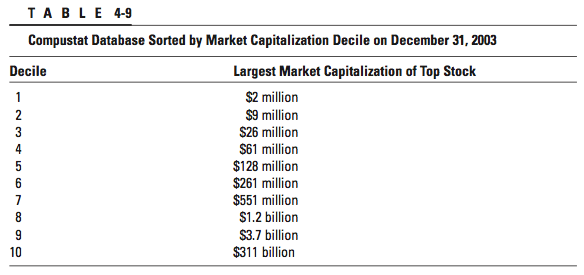
The glaring problem with this method, when used with the Compustat database, is that it’s virtually impossible to buy the stocks that account for the performance advantage of small capitalization strategies. Table 4-9 illustrates the problem. On December 31, 2003, approximately 8,178 stocks in the active Compustat database had both year-end prices and a number for common shares outstanding. If we sorted the database by decile, each decile would be made up of 818 stocks. As Table 4-9 shows, market capitalization doesn’t get past $150 million until you get to decile 6. The top market capitalization in the fourth decile is $61 million, a number far too small to allow widespread buying of those stocks.

A market capitalization of $2 million – the cheapest and best-performed decile – is uninvestable. This leads O’Shaughnessy to make the point that “micro-cap stock returns are an illusion”:

The only way to achieve these stellar returns is to invest only a few million dollars in over 2,000 stocks. Precious few investors can do that. The stocks are far too small for a mutual fund to buy and far too numerous for an individual to tackle. So there they sit, tantalizingly out of reach of nearly everyone. What’s more, even if you could spread $2,000,000 over 2,000 names, the bid–ask spread would eat you alive.

Even a small investor will struggle to buy enough stock in the 3rd or 4th deciles, which encompass stocks with market capitalizations below $26 million and $61 million respectively. These are not, therefore, institutional-grade strategies. Says O’Shaughnessy:

This presents an interesting paradox: Small-cap mutual funds justify their investments using academic research that shows small stocks outperforming large ones, yet the funds themselves cannot buy the stocks that provide the lion’s share of performance because of a lack of trading liquidity.

A review of the Morningstar Mutual Fund database proves this. On December 31, 2003, the median market capitalization of the 1,215 mutual funds in Morningstar’s all equity, small-cap category was $967 million. That’s right between decile 7 and 8 from the Compustat universe—hardly small.

I spent some time researching alternatives to book-to-market. As much as it pained me to do so, I’ve now abandoned book-to-market as my primary valuation metric. In fact I no longer use it all. I discuss these metrics, and their advantages over book in a later post.

Read Full Post »

Top posts of the year

I’m on break for the next three weeks. Here are the top posts for the past 12 months:

  1. Mike Burry’s Scion Capital investor letters
  2. Guest post: The short case for Berkshire
  3. Graham’s P/E10 ratio
  4. Tweedy Browne updates What Has Worked In Investing
  5. What Montier’s Painting by Numbers can offer to value investors
  6. The long and short of The St. Joe Company
  7. Seth Klarman on Liquidation Value
  8. Intuition and the quantitative value investor
  9. The long and short of Berkshire Hathaway
  10. Guest post update: Valuation for Berkshire Hathaway

Good investing.

Read Full Post »

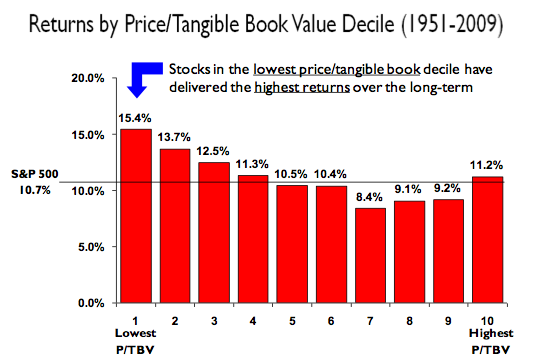
The Fall 2010 edition of the Graham and Doddsville Newsletter, Columbia Business School‘s student-led investment newsletter co-sponsored by the Heilbrunn Center for Graham & Dodd Investing and the Columbia Investment Management Association, has a fascinating interview with Donald G. Smith. Smith, who volunteered for Benjamin Graham at UCLA, concentrates on the bottom decile of price to tangible book stocks and has compounded at 15.3% over 30 years:

G&D: Briefly describe the history of your firm and how you got started?

DS: Donald Smith & Co. was founded in 1980 and now has $3.6 billion under management. Over 30 years since inception our compounded annualized return is 15.3%. Over the last 10 years our annualized return is 12.1% versus −0.4% for the S&P 500.

Our investment philosophy goes back to when I was going to UCLA Law School and Benjamin Graham was teaching in the UCLA Business School. In one of his lectures he discussed a Drexel Firestone study which analyzed the performance of a portfolio of the lowest P/E third of the Dow Jones (which was the beginning of ―Dogs of the Dow 30). Graham wanted to update that study but he didn‘t have access to a database in those days, so he asked for volunteers to manually calculate the data. I was curious about this whole approach so I decided to volunteer. There was no question that this approach beat the market. However, doing the analysis, especially by hand, you could see some of the flaws in the P/E based approach. Based on the system you would buy Chrysler every time the earnings boomed and it was selling at only a 5x P/E, but the next year or two they would go into a down cycle, the P/E would expand and you were forced to sell it. So in effect, you were often buying high and selling low. So it dawned on me that P/E and earnings were too volatile to base an investment philosophy on. That‘s why I started playing with book value to develop a better investment approach based on a more stable metric.

G&D: There are plenty of studies suggesting that the lowest price to book stocks outperform. However, only 1/10 of 1% of all money managers focus on the lowest decile of price to book stocks. Why do you think that‘s so, and how do people ignore all of this evidence?

DS: They haven‘t totally ignored it. There are periods of time when quant funds, in particular, use this strategy. However a lot of the purely quant funds buying low price to book stocks have blown up, as was the case in the summer of 2007. Now not as many funds are using the approach. Low price to book stocks tend to be out-of-favor companies. Often their earnings are really depressed, and when earnings are going down and stock prices are going down, it‘s a tough sell.

G&D: Would you mind talking about how the composition of that bottom decile has changed over time? Is it typically composed of firms in particular out of favor industries or companies dealing with specific issues unique to them?

DS: The bulk is companies with specific issues unique to them, but often there is a sector theme. Back in the early 1980‘s small stocks were all the rage and big slow-growing companies were very depressed. At that time we loaded up on a lot of these large companies. Then the KKR‘s of the world started buying them because of their stable cash flow and the stocks went up. About six years ago, a lot of the energy-related stocks were very cheap. We owned oil shipping, oil services and coal companies trading below book and liquidation value. When oil went up they became the darlings of Wall Street. Over the years we have consistently owned electric utilities because there always seem to be stocks that are temporarily depressed because of a bad rate decision by the public service commission. Also, cyclicals have been a staple for us over the years because, by definition, they go up and down a lot which gives us buying opportunities. We‘ve been in and out of the hotel group, homebuilders, airlines, and tech stocks.

Performance of the low-price-to-tangible book value:

Read the Graham and Doddsville newsletter Fall 2010 (.pdf).

Hat tip George.

Read Full Post »

For a period from late 2008 through mid 2009 the GSI Group (PINK:LASR) was prima facie the cheapest stock on my net net screen, but I couldn’t pull the trigger because it was delinquent a few quarterly filings. The company entered Chapter 11 due to the technical default of not filing financial statements and is now an extremely interesting prospect post reorganization. The superb Above Average Odds Investing blog has a guest post from Ben Rosenzweig, an analyst at Privet Fund Management, titled The GSI Group (LASR.PK) – Another Low-Risk, High-Return Post Reorg Equity w/ Substantial Near-Term Catalyst(s), which really says it all. Here’s the summary:

Thesis Summary: Privet Fund LP is long GSIGQ common stock. Our post-emergence price target is $5.00 per common share, an internal rate of return of 123% based on closing price of $2.70 and right to purchase .99 shares for every 1 share currently owned at a price of $1.80 per share. The market has failed to fully price in the impact of the Plan of Reorganization that was confirmed on Thursday, May 27, 2010.

We believe GSI is an attractive investment opportunity for the following reasons:

  • Due to the efforts of the equity committee throughout the bankruptcy process, the pre-emergence equity holders will be able to maintain an 87% ownership in the post-emergence company, up from an initial distribution of 18.6% in the first Plan of Reorganization
  • The end markets for the Company’s precision technology and semiconductor products are coming out of the trough of a cycle and, as a result, GSI’s bookings have been increasing at an exponential rate
  • The purging of the previous management regime opens the door for an experienced operator to run the Company much more efficiently and make strategic decisions with a view toward enhancing the value of the enterprise
  • The significant reduction in debt gives management the needed flexibility to focus solely on improving operations. This should result in significant fixed cost leverage going forward as evidenced by the Q1 2010 EBITDA margin of 14%, a figure that previous management suggested was not achievable until the end of 2011
  • The current market valuation, which includes the right to buy .99 shares at $1.80 per share, implies a 2010 sales figure and discounted cash flow valuation that is simply not possible even if the Company’s financial performance does not follow through on the radical improvements that have been shown during the past two quarters

Read the post in full.

Read Full Post »

Yesterday’s post on LSV Asset Management’s performance reminded me of the practical difficulties of implementing many theoretically well-performed investment strategies. LSV Asset Management is an outgrowth of the research conducted by Josef Lakonishok, Andrei Shleifer, and Robert Vishny. They are perhaps best known for the Contrarian Investment, Extrapolation, and Risk paper, which, among other things, analyzed low price-to-book value stocks in deciles (an approach possibly suggested by Roger Ibbotson’s study Decile Portfolios of the New York Stock Exchange, 1967 – 1984). They found that low price-to-book value stocks out perform, and in rank order (the cheapest decile outperforms the next cheapest decile and so on). The problem with the approach is that the lowest price-to-book value deciles – that is, the cheapest and therefore best performed deciles – are uninvestable.

In an earlier post, Walking the talk: Applying back-tested investment strategies in practice, I noted that Aswath Damodaran, a Professor of Finance at the Stern School of Business, has a thesis that “transaction costs” – broadly defined to include brokerage commissions, spread and the “price impact” of trading – foil in the real world investment strategies that beat the market in back-tests. Damodaran made the point that even well-researched, back-tested, market-beating strategies underperform in practice:

Most of these beat-the-market approaches, and especially the well researched ones, are backed up by evidence from back testing, where the approach is tried on historical data and found to deliver “excess returns”. Ergo, a money making strategy is born.. books are written.. mutual funds are created.

The average active portfolio manager, who I assume is the primary user of these can’t-miss strategies does not beat the market and delivers about 1-1.5% less than the index. That number has remained surprisingly stable over the last four decades and has persisted through bull and bear markets. Worse, this under performance cannot be attributed to “bad” portfolio mangers who drag the average down, since there is very little consistency in performance. Winners this year are just as likely to be losers next year…

Damodaran’s solution for why some market-beating strategies that work on paper fail in the real world is transaction costs. But it’s not the only reason. Some strategies are simply impossible to implement, and LSV’s low decile price-to-book value strategy is one such strategy.

James P. O’Shaughnessy’s What works on Wall Street is one of my favorite books on investing. In the book, O’Shaughnessy suggests another problem with the real-world application of LSV’s decile approach:

Most academic studies of market capitalization sort stocks by deciles (10 percent) and review how an investment in each fares over time. The studies are nearly unanimous in their findings that small stocks (those in the lowest four deciles) do significantly better than large ones. We too have found tremendous returns from tiny stocks.

So far so good. So what’s the problem?

The glaring problem with this method, when used with the Compustat database, is that it’s virtually impossible to buy the stocks that account for the performance advantage of small capitalization strategies. Table 4-9 illustrates the problem. On December 31, 2003, approximately 8,178 stocks in the active Compustat database had both year-end prices and a number for common shares outstanding. If we sorted the database by decile, each decile would be made up of 818 stocks. As Table 4-9 shows, market capitalization doesn’t get past $150 million until you get to decile 6. The top market capitalization in the fourth decile is $61 million, a number far too small to allow widespread buying of those stocks.

A market capitalization of $2 million – the cheapest and best-performed decile – is uninvestable. This leads O’Shaughnessy to make the point that “micro-cap stock returns are an illusion”:

The only way to achieve these stellar returns is to invest only a few million dollars in over 2,000 stocks. Precious few investors can do that. The stocks are far too small for a mutual fund to buy and far too numerous for an individual to tackle. So there they sit, tantalizingly out of reach of nearly everyone. What’s more, even if you could spread $2,000,000 over 2,000 names, the bid–ask spread would eat you alive.

Even a small investor will struggle to buy enough stock in the 3rd or 4th deciles, which encompass stocks with market capitalizations below $26 million and $61 million respectively. These are not, therefore, institutional-grade strategies. Says O’Shaughnessy:

This presents an interesting paradox: Small-cap mutual funds justify their investments using academic research that shows small stocks outperforming large ones, yet the funds themselves cannot buy the stocks that provide the lion’s share of performance because of a lack of trading liquidity.

A review of the Morningstar Mutual Fund database proves this. On December 31, 2003, the median market capitalization of the 1,215 mutual funds in Morningstar’s all equity, small-cap category was $967 million. That’s right between decile 7 and 8 from the Compustat universe—hardly small.

The good news is, there are other strategies that do work.

Read Full Post »

« Newer Posts - Older Posts »