Feeds:
Posts
Comments

Archive for February, 2010

Regular readers of Greenbackd know that I’m no fan of “the narrative,” which is the story an investor concocts to explain the various pieces of data the investor gathers about a potential investment. It’s something I’ve been thinking about a great deal recently as I grapple with the merits of an investment in Japanese net current asset value stocks. The two arguments for and against investing in such opportunities are as follows:

Fer it: Net current asset value stocks have performed remarkably well throughout the investing world and over time. In support of this argument I cite generally Graham’s experience, Oppenheimer’s Ben Graham’s Net Current Asset Values: A Performance Update paper, Testing Ben Graham’s Net Current Asset Value Strategy in London, a paper from the business school of the University of Salford in the UK, and, more specifically, Bildersee, Cheh and Zutshi’s The performance of Japanese common stocks in relation to their net current asset values, James Montier’s Graham’’s net-nets: outdated or outstanding?, and Dylan Grice’s Are Japanese equities worth more dead than alive.

Agin it: Japan is a special case because it has weak shareholder rights and a culture that regards corporations as “social institutions with a duty to provide stable employment and consider the needs of employees and the community at large, not just shareholders.” In support of this argument I cite the recent experiences of activist investors in Japan, and Bildersee, Cheh and Zutshi’s The performance of Japanese common stocks in relation to their net current asset values (yes, it supports both sides of the argument). Further, the prospects for Japan’s economy are poor due to its large government debt and ageing population.

How to break the deadlock? Montier provides a roadmap in his excellent Behavioural Investing:

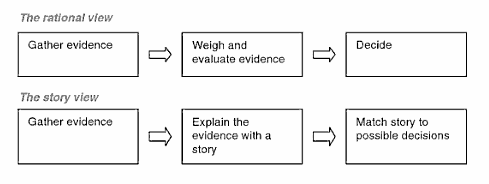
We appear to use stories to help us reach decisions. In the ‘rational’ view of the world we observe the evidence, we then weigh the evidence, and finally we come to our decision. Of course, in the rational view we all collect the evidence in a well-behaved unbiased fashion. … Usually we are prone to only look for the information that happens to agree with us (confirmatory bias), etc.

However, the real world of behaviour is a long way from the rational viewpoint, and not just in the realm of information gathering. The second stage of the rational decision is weighing the evidence. However, as the diagram below shows, a more commonly encountered approach is to construct a narrative to explain the evidence that has been gathered (the story model of thinking).

Hastie and Pennington (2000) are the leading advocates of the story view (also known as explanation-based decision-making). The central hypothesis of the explanation-based view is that the decision maker constructs a summary story of the evidence and then uses this story, rather than the original raw evidence, to make their final decision.

All too often investors are sucked into plausible sounding story. Indeed, underlying some of the most noted bubbles in history are kernels of truth.
As to the last point, arguably, the converse is also true. Investors have missed some great returns because the ugly stories about companies or markets were so compelling.

There are several points that are not contentious about an investment in Japan. The data suggests to me and to everyone else that there are a large number of net current asset value bargains available there. The contention is whether these net current asset value stocks will perform as they have in other countries, or whether they are destined to remain net current asset value bargains, the classic “value traps.” My own penchant for value investing, and quantitative value investing in particular, makes this a reasonably simple matter to resolve. I am going to invest in Japanese net current asset value stocks. Here are the bases for my reasoning:

  • I believe that value investing works. I believe that this is the case because it appeals to me as a matter of logic. I also believe that the data supports this position (see Ben Graham’s Net Current Asset Values: A Performance Update or Lakonishok, Shleifer, and Vishny’s Contrarian Investment, Extrapolation and Risk). Where a stock trades at a significant discount to its value, I am going to take a position.
  • I believe that Graham’s net current asset value works. In support of this proposition I cite the papers listed in the “Fer it” argument above.
  • I believe that simple quantitative models consistently outperform expert judgements. In support of this proposition generally I cite James Montier’s Painting By Numbers: An Ode To Quant. Where the data looks favorable to me, I am going to take a position, and I’m going to ignore the qualitative factors.
  • I believe that value is a good predictor of returns at a market level. In support I cite the Dimson, Marsh and Staunton research. I am not dissuaded from investing in a country simply because its growth prospects are low. Value is the signal predictor of returns.

The arguments militating against investing in Japan sound to me like the arguments militating against any investment in a NCAV stock, which is to say that they are arguments rooted in the narrative. I’ve never taken a position in a NCAV stock that had a good story attached to it. They have always looked ugly from an earnings or narrative perspective (otherwise, they’d be trading at a higher price). As far as I can tell, this situation is no different, other than the fact that it is in a different country and the country has economic problems (which I would ignore in the usual case anyway). While the research specific to NCAV stocks in Japan is not as compelling as I would like it to be, I always bear in mind the lessons of Taleb’s “naive empiricist,” which is to say that the data are useful only up to a point.

This is not to say that I have any great conviction about Japan or Japanese net current asset value stocks. Far from it. I fully expect, as I always do when taking a position in any stock, to be wrong and have the situation follow the narrative. Fortunately, the decision is out of my hands. I’m going to follow my simple quantitative model – the Graham net current asset value strategy – and take some positions in Japanese net nets. The rest is for the goddess Fortuna.
Read Full Post »

This is a reminder that readers of Greenbackd will be able to receive an exclusive discount for the Value Investing Congress taking place on May 4 & 5, 2010 at the Langham Huntington Hotel & Spa in Pasadena, CA. If you want to hear from some of the best hedge fund managers in the game, then this is the conference to attend. It’s also a great opportunity to network. Over 50% of all seats are already reserved, so readers must act fast.

If you’re unfamiliar with the Value Investing Congress, then here’s what you need to know: One good investment idea could more than pay your cost of admission to this event and net you some great returns. The wisdom gained listening to these great investors is difficult to overstate. For a slide show of last year’s event see HERE.

Speakers at the two day event include:

  • John Burbank, Passport Capital
  • Patrick Degorce, Thélème Partners
  • Bruce Berkowitz, Fairholme Capital Management
  • Eric Sprott, Sprott Asset Management
  • Paul Sonkin, Hummingbird Value Funds
  • Mohnish Pabrai, Pabrai Investment Funds
  • Thomas Russo, Gardner, Russo & Gardner
  • Lloyd Khaner, Khaner Capital
  • J. Carlo Cannell, Cannell Capital
  • Whitney Tilson & Glenn Tongue, T2

Click here to receive the over 30% discount to VIC

You must use discount code: P10GB6 to receive the full discount. Hurry and register!

You’ve got exactly one week to get signed up with these savings. The regular price of the two day event is $4,295. However, Greenbackd readers pay only $2,845. That’s over a 30% discount and savings of $1,450!  If you’re from out of town, the Congress has also negotiated lower room rates at the Langham Huntington for attendees.

It’s going to be an awesome and insightful event, to say the least. Make sure you get our exclusive discount for the Value Investing Congress here. Remember that you MUST use the discount code P10GB6 to receive the full discount!

Please let me know if you have any questions or problems when trying to register with the discount code.

Read Full Post »

Central to the discussion of sub-liquidation value investing in Japan is the ability or willingness of shareholders to influence management, and management’s willingness to listen. As Ben Graham noted in the 1934 edition of Security Analysis, in the US:

The whole issue may be summarized in the form of a basic principle, viz:

When a common stocks sells persistently below its liquidating value, then either the price is too low, or the company should be liquidated. Two corollaries may be deduced from this principle:

Corollary I. Such a price should impel the stockholders to raise the question whether it is in their interest to continue the business.

Corollary II. Such a price should impel the management to take all proper steps to correct the obvious disparity between market quotation and intrinsic value, including a reconsideration of its own policies and a frank justification to the stockholders of its decision to continue the business.

The perception is that, in Japan, these two corollaries do not flow from that basic principle. As The Economist notes in a February 2008 article, Samurai v shareholders: Japan’s establishment continues to rebuff foreign activist investors (subscription required):

Japanese businessmen and politicians fear that the activists are short-term investors keen to strip firms of their cash. The conflict highlights a fundamental divide: companies in Japan are social institutions with a duty to provide stable employment and consider the needs of employees and the community at large, not just shareholders.

And therein lies the rub. Companies in Japan are social institutions with a duty to provide stable employment and consider the needs of employees and the community at large, not just shareholders.

Can foreign investors not subject to the cultural expectation that companies consider the needs of employees and the community at large succeed?

According to a 2009 Knowledge@Wharton article, How the Environment for Foreign Direct Investment in Japan Is Changing — for the Better, the environment for foreign investors in Japan is improving, but continues to be more bureaucratic than in the US:

Despite the support shown by elected officials for increasing [foreign direct investment] in Japan, foreign investors still face a substantial amount of bureaucratic red tape, particularly with respect to protected industries. [Direct investment] is principally governed by the Foreign Exchange and Foreign Trade Control Law, which specifically prevents foreign investors from acquiring a majority stake in Japanese companies within industry sectors classified as closely related to national security and public safety. This includes industries as diverse as aeronautics, defense, nuclear power generation, energy, telecom, broadcasting, railways, tourist transportation, petroleum and leather processing.

Foreign investors intending to make direct investments in certain industries must file with the Japanese Ministry of Finance as well as the respective ministry governing the specific industry of the investment target. If issues are found in relation to the investment, either the Ministry of Finance or the industry-specific ministry has the authority to issue an official recommendation to revise the investment plan or to put a complete stop to the acquisition. Industry-specific regulations that, for example, limit foreign ownership to one-third for airline and telecom companies, further constrain foreign investors.

It’s worth considering the experience of two notable activist campaigns in Japan. The first, Steel Partners’ campaign for Sapporo, the brewer, is described in the Knowledge@Wharton article:

Steel Partners has imported its U.S. activist investment model to Japan and has shown a willingness to question publicly the strategy of current management at its investment targets and to litigate disagreements.

As a result of Steel Partners’ posture, the firm’s take-over bid for household-brand Bulldog Sauce met with resistance from the media and Japan’s legal system. The court to which Steel Partners appealed a failed injunction to prevent Bulldog’s poison-pill strategy stated: “[Steel Partners] pursues its own interests exclusively and seeks only to secure profits by selling companies’ shares back to the company or to third parties in the short term, in some cases with an eye to disposing of company assets…. As such, it is proper to consider the plaintiff an abusive acquirer.”

The Economist article discusses the The Children’s Investment Fund’s (TCI) battle for the Japanese power provider J-Power:

The biggest showdown between the activists and the establishment is at J-Power, the former state-run energy firm, which was privatised in 2004. [TCI] a British fund, which owns 9.9% of the firm, has been politely but firmly lobbying J-Power to appoint two TCI representatives to its board, improve margins and unwind cross-shareholdings with other firms. Having been rebuffed, TCI now wants to double its bet. In January it asked for permission to increase its stake to 20% (any holding above 10% requires government approval). John Ho, the head of TCI’s Asian operations, says the deal is a test of the integrity of Japan’s reform agenda. And it would be, except that Mr Ho has chosen a remarkably hard case. Japan, lacking natural resources, is worried about energy security and is reluctant to hand more control over its power infrastructure to foreign investors.

The Knowledge@Wharton article concludes:

After applying for approval to increase shareholdings to 20%, TCI met a wall of resistance: J-Power management cautioned that TCI could cut maintenance and investment costs in nuclear plants, and the Japanese media relayed sensationalist warnings about the potential for “blackouts.” The result: The Japanese government blocked the investment.

These are not encouraging outcomes. The final word is best left to Takao Kitabata, the vice-minister of Japan’s powerful Ministry of Economy, Trade and Industry (METI):

To be blunt, shareholders in general do not have the ability to run a company. They are fickle and irresponsible. They only take on a limited responsibility, but they greedily demand high dividend payments.

High dividend payments? We’re a long way from liquidation as a matter of course.

Read Full Post »

In his Are Japanese equities worth more dead than alive?, SocGen’s Dylan Grice conducted some research into the performance of sub-liquidation value stocks in Japan since the mid 1990s. Grice’s findings are compelling:

My Factset backtest suggests such stocks trading below liquidation value have averaged a monthly return of 1.5% since the mid 1990s, compared to -0.2% for the Topix. There is no such thing as a toxic asset, only a toxic price. It may well be that these companies have no future, that they shouldn’t be valued as going concerns and that they are worth more dead than alive. If so, they are already trading at a value lower than would be fetched in a fire sale. But what if the outlook isn’t so gloomy? If these assets aren’t actually complete duds, we could be looking at some real bargains…

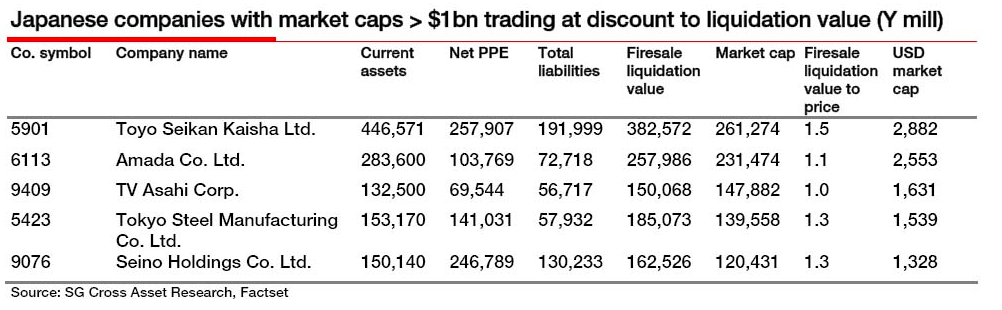
In the same article, Grice identifies five Graham net net stocks in Japan with market capitalizations bigger than $1B:

He argues that such stocks may offer value beyond the net current asset value:

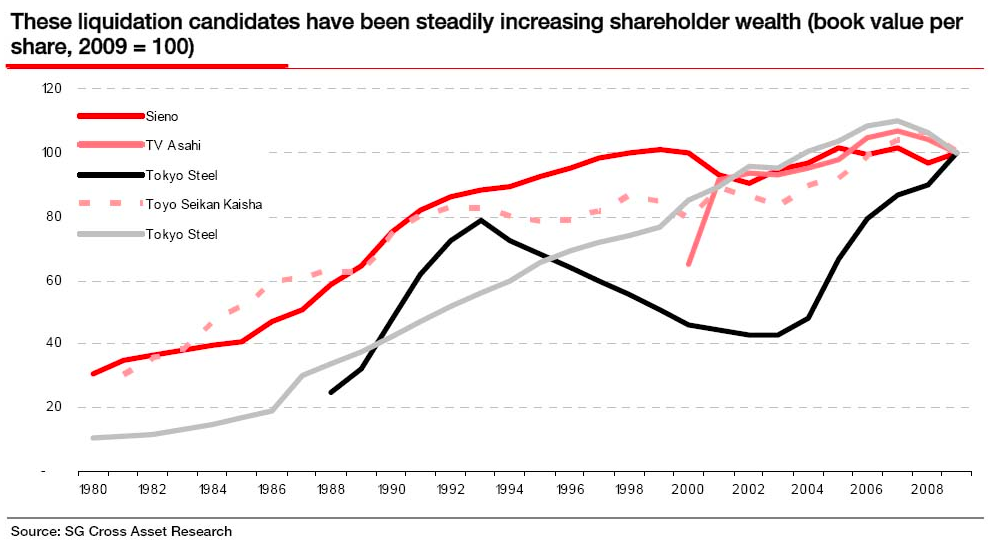
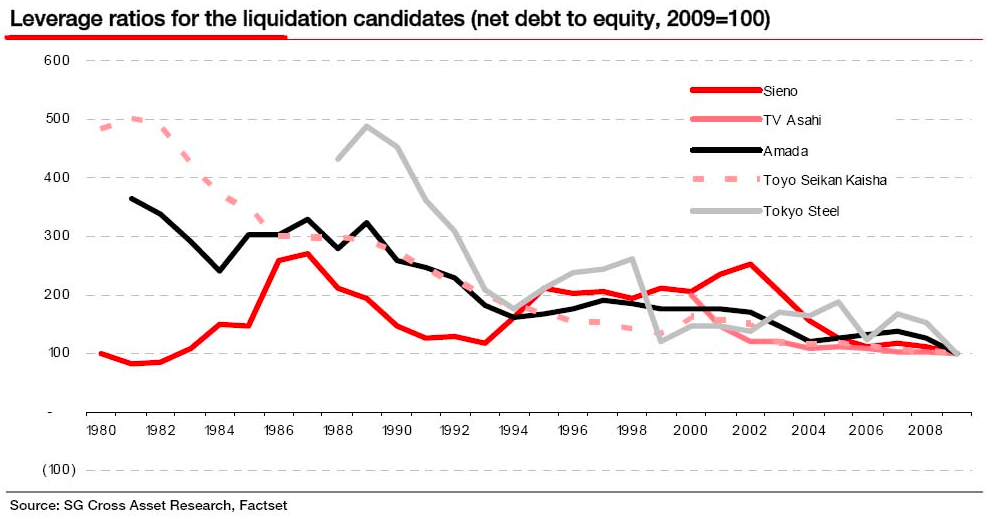
The following chart shows the debt to shareholders equity ratios for each of the stocks highlighted as a liquidation candidate above, rebased so that the last year’s number equals 100. It’s clear that these companies have been aggressively delivering in the last decade.

Despite the “Japan has weak shareholder rights” cover story, management seems to be doing the right thing:

But as it happens, most of these companies have also been buying back stock too. So per share book values have been rising steadily throughout the appalling macro climate these companies have found themselves in. Contrary to what I expected to find, these companies that are currently priced at levels making liquidation seem the most profitable option have in fact been steadily creating shareholder wealth.

This is really extraordinary. The currency is a risk that I can’t quantify, but it warrants further investigation.

Read Full Post »

Since last week’s Japanese liquidation value: 1932 US redux post, I’ve been attempting to determine whether the historical performance of Japanese sub-liquidation value stocks matches the experience in the US, which has been outstanding since the strategy was first identified by Benjamin Graham in 1932. The risk to the Japanese net net experience is the perception (rightly or not) that the weakness of shareholder rights in Japan means that net current asset value stocks there are destined to continue to trade at a discount to net current asset value. As I mentioned yesterday, I’m a little chary of the “Japan has weak shareholder rights” narrative. I’d rather look at the data, but the data are a little wanting.

As we all know, the US net net experience has been very good. Research undertaken by Professor Henry Oppenheimer on Graham’s liquidation value strategy between 1970 and 1983, published in the paper Ben Graham’s Net Current Asset Values: A Performance Update, indicates that “[the] mean return from net current asset stocks for the 13-year period was 29.4% per year versus 11.5% per year for the NYSE-AMEX Index. One million dollars invested in the net current asset portfolio on December 31, 1970 would have increased to $25,497,300 by December 31, 1983.” That’s an outstanding return.

In The performance of Japanese common stocks in relation to their net current asset values, a 1993 paper by Bildersee, Cheh and Zutshi, the authors undertook research similar to Oppenheimer’s in Japan over the period 1975 and 1988. Their findings, described in another paper, indicate that the Japanese net net investor’s experience has not been as outstanding as the US investor’s:

In the first study outside of the USA, Bildersee, Cheh and Zutshi (1993)’s paper focuses on the Japanese market from 1975 to 1988. In order to maintain a sample large enough for cross-sectional analysis, Graham’s criterion was relaxed so that firms are required to merely have an NCAV/MV ratio greater than zero. They found the mean market-adjusted return of the aggregate portfolio is around 1 percent per month (13 percent per year).

As an astute reader noted last week “…the test period for [the Bildersee] study is not the best. It includes Japan’s best analog to America’s Roaring Twenties. The Nikkei peaked on 12/29/89, and never recovered:”

Many of the “assets” on public companies’ books at that time were real estate bubble-related. At the peak in 1989, the aggregate market price for all private real estate in the city of Tokyo was purportedly greater than that of the entire state of California. You can see how the sudden runup in real estate during the bubble could cause asset-heavy companies to outperform the market.

So a better crucible for Japanese NCAVs might be the deflationary period, say beginning 1/1/90, which is more analogous to the US in 1932.

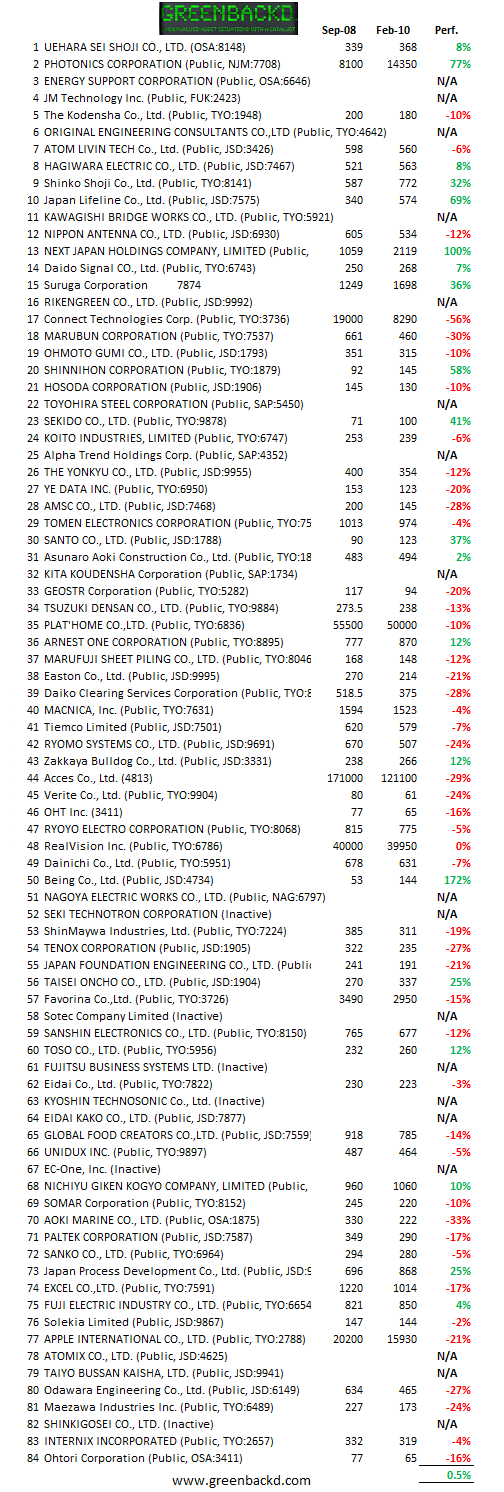
To see how the strategy has performed more recently, I’ve taken the Japanese net net stocks identified in James Montier’s Graham’’s net-nets: outdated or outstanding? article from September 2008 and tracked their performance from the data of the article to today. Before I plow into the results, I’d like to discuss my methodology and the various problems with it:

  1. It was not possible to track all of the stocks identified by Montier. Where I couldn’t find a closing price for a stock, I’ve excluded it from the results and marked the stock as “N/A”. I’ve had to exclude 18 of 84 stocks, which is a meaningful proportion. It’s possible that these stocks were either taken over or went bust, and so would have had an effect on the results not reflected in my results.
  2. The opening prices were not always available. In some instances I had to use the price on another date close to the opening date (i.e +/1 month).

Without further ado, here are the results of Montier’s Graham’’s net-nets: outdated or outstanding? picks:

The 68 stocks tracked gained on average 0.5% between September 2008 and February 2010, which is a disappointing outcome. The results relative to the  Japanese index are a little better. By way of comparison, the Nikkei 225 (roughly equivalent to the DJIA) fell from 12,834 to close yesterday at 10,057, a drop of 21.6%. Encouragingly, the net nets outperformed the N225 by a little over 21%.

The paucity of the data is a real problem for this study. I’ll update this post as I find more complete data or a more recent study.

Read Full Post »

Following on from last week’s Japanese liquidation value: 1932 US redux post, I’ve been trying to determine whether the historical performance of Japanese sub-liquidation value stocks matches the experience in the US. The question arises because of the perception (rightly or not) that the weakness of shareholder rights in Japan means that net current asset value stocks there are destined to trade at a discount to net current asset value. I’m always a little chary of the “Japan has weak shareholder rights” narrative (or any narrative, for that matter). I’d rather look at the data. In this instance, unfortunately, the data are wanting.

In The performance of Japanese common stocks in relation to their net current asset values, a 1993 paper by Bildersee, Cheh and Zutshi, the authors analyzed the performance of Japanese net nets between 1975 and 1988. Here are their findings described in another paper:

In the first study outside of the USA, Bildersee, Cheh and Zutshi (1993)’s paper focuses on the Japanese market from 1975 to 1988. In order to maintain a sample large enough for cross-sectional analysis, Graham’s criterion was relaxed so that firms are required to merely have an NCAV/MV ratio greater than zero. They found the mean market-adjusted return of the aggregate portfolio is around 1 percent per month (13 percent per year).

Not a great return, but obviously a difficult period through 1987 and not an exact facsimile of Graham’s strategy. An astute reader notes that “…the test period for that study is not the best. It includes Japan’s best analog to America’s Roaring Twenties. The Nikkei peaked on 12/29/89, and never recovered:”

Many of the “assets” on public companies’ books at that time were real estate bubble-related. At the peak in 1989, the aggregate market price for all private real estate in the city of Tokyo was purportedly greater than that of the entire state of California. You can see how the sudden runup in real estate during the bubble could cause asset-heavy companies to outperform the market.

So a better crucible for Japanese NCAVs might be the deflationary period, say beginning 1/1/90, which is more analogous to the US in 1932.

It would be interesting to see an update of the performance, but, as far as I am aware, none exists. To that end, I’ve undertaken a little research project of my own. I’ll publish the results tomorrow.

Read Full Post »

Farukh Farooqi, a long-time supporter of Greenbackd and the founder of Marquis Research, a special situations research and advisory firm (for more on Farukh and his methodology, see The Deal in the article “Scavenger Hunter”) provided a guest post on Silicon Storage Technology, Inc (NASDAQ:SSTI) a few weeks back. Farukh wrote:

Activist-Driven Situation Summary: Silicon Storage Tech. (SSTI; $2.78) dated January 6, 2010

SST is a fabless, designer and supplier of NOR flash memory chips which are used in thousands of consumer electronic products. It has two businesses – Products sales of $240 mm with 20% gross margin and licensing revenues of $40 mm with near 100% margin.

As of September 30, 2009, SST had cash and investments of $2.14 per share, net non-cash working capital of $0.41 per share and zero debt. This implies that the market is valuing its business at $0.23 per share or $22 mm. This is a Company which annually spends $50 mm on R&D alone!

Judging from last 10 years of SST’s history, valuation has suffered from (1) dismal bottom line performance and (2) Corporate governance issues.

After bottoming in Q109, Company revenues and margins have rebounded sharply. The Board has decided to take this opportune time to create “value” for shareholders by selling it to a private equity fund for … $2.10 per share. As part of the deal, the current CEO and COO are going to keep their equity interest in the private Company.

In response, an activist shareholder (Riley Invesment Management) resigned from the Board when the Go-Private deal was announced. Last week, he and certain other large shareholders formed SST Full Value Committee and have asked the Board to reconsider the transaction.

Given the governance issues (which could improve as a proxy fight to add independent members is underway), a discount to the peer group is warranted. However, whether you value it on EV/Revenue, EV/EBITDA or Price/Tangible Book Value, the stock has 50% to 200% upside potential.

Farukh has left a comment that I want to draw to your attention:

SSTI being acquired by MCHP for $2.85 per share.

Does this price make sense?

SSTI has $2.55 per share in cash, investments and net working capital. Which means, MCHP is really offering $0.35 per share in value or approximately $35 mm for a semiconductor business which generates $280 mm in sales and almost $50 mm per anum in gross profit and another $40 mm per year in license fees.

The license fees alone can be worth $200 mm using a 20% yield.

SST story reminds me of the Road Runners cartoon with management being the Wile E. Coyote, trying to sabotage shareholders every which way….. Beep Beep.

[Full Disclosure: I do not hold SSTI. This is neither a recommendation to buy or sell any securities. All information provided believed to be reliable and presented for information purposes only. Do your own research before investing in any security.]

Read Full Post »

Zero Hedge has an article Uncovering Liquidation Value… In Japan? discussing SocGen’s Dylan Grice’s Are Japanese equities worth more dead than alive. The title is a nod to Benjamin Graham’s landmark 1932 Forbes article, Inflated Treasuries and Deflated Stockholders, where he discussed the large number of companies in the US then trading at a discount to liquidation value:

…a great number of American businesses are quoted in the market for much less than their liquidating value; that in the best judgment of Wall Street, these businesses are worth more dead than alive. For most industrial companies should bring, in orderly liquidation, at least as much as their quick assets alone.

Grice writes:

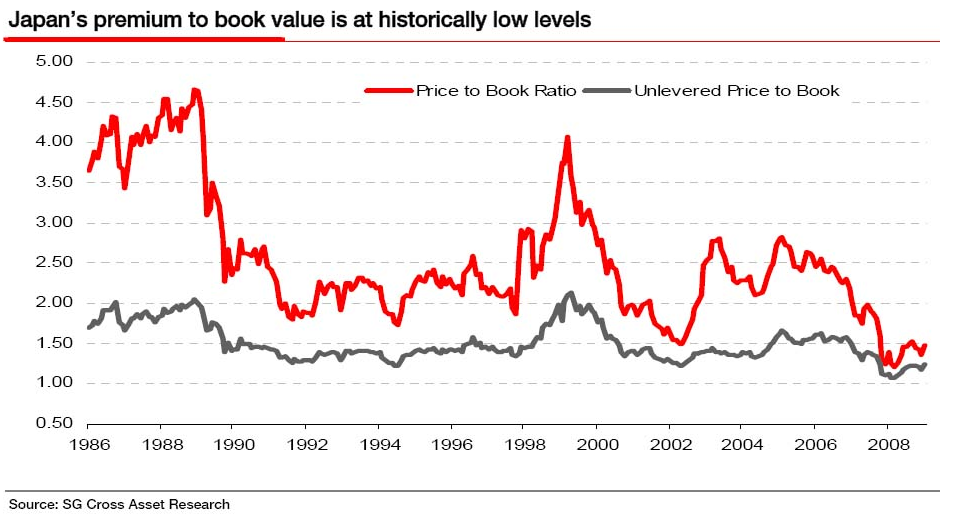
In the space of a generation, Japan has gone from the world economy’s thrusting up-and-coming superpower to its slowing silver-haired retiree. Accordingly, the Japanese market attracts a low valuation. The chart [below] shows FTSE Japan’s equity price to book ratio and enterprise price to book ratio, since equity P/B ratios alone can be distorted by leverage. Both metrics show Japan to be trading at a low premium to book compared to its recent history. So it’s certainly cheap. But does it offer value? The answer can be seen in the chart above, which shows corporate Japan’s RoEs and RoAs over recent decades to have averaged a mere 6.8% and 3.8% respectively. This is hardly the sort of earnings power which should command any premium over book value at all. Indeed, to my mind the question is one of how big a discount the market should trade at relative to book.

The fundamental problem in 1932 America, according to Graham, was that investors weren’t paying attention to the assets owned by the company, instead focussing exclusively on “earning power” and therefore “reported earnings – which might only be temporary or even deceptive – and in a complete eclipse of what had always been regarded as a vital factor in security values, namely the company’s working capital position.” Graham proposed that investors should become not only “balance sheet conscious,” but “ownership conscious:”

If they realized their rights as business owners, we would not have before us the insane spectacle of treasuries bloated with cash and their proprietors in a wild scramble to give away their interest on any terms they can get. Perhaps the corporation itself buys back the shares they throw on the market, and by a final touch of irony, we see the stockholders’ pitifully inadequate payment made to themwith their own cash.

In his article, Grice makes a parallel argument about valuations based on earnings in Japan now:

Regular readers will know I favour a Residual Income approach to valuation. It’s not perfect, and it’s still a work in process, but anchoring estimates of intrinsic value on the earnings power of company assets (relative to a required rate of return, which I set at an exacting 10%) helps avoid value traps. Things don?t necessarily come up as offering value just because they’re on low multiples. The left chart below shows Japan’s ratio of Intrinsic Value to Price (IVP ratio, where a higher number indicates higher value) to be only 0.6, suggesting that in an absolute sense, Japan is intrinsically worth only about 60% of its current market value.

Grice arrives at the same conclusion about Japan as Graham did in 1932 about the US:

But here the tension between “going concern” valuation and “liquidation” valuation becomes important. Let’s just imagine the unimaginable for a second, and that my IVP ratios are correct. Japan currently trades on a P/B ratio of 1.5x, but if it is only worth 60% of that, its “fair value” P/B ratio (assuming we value it as a going concern) would be around 0.9x. Of course, that would only be true on average. Nearly all stocks would trade either above or below that level. And of those trading below, some would trade slightly below, others significantly below. And of those which traded significantly below, some might be expected to flirt with liquidation values which called into question whether or not the “going concern” valuation was appropriate. Indeed, this is exactly what is beginning to happen.

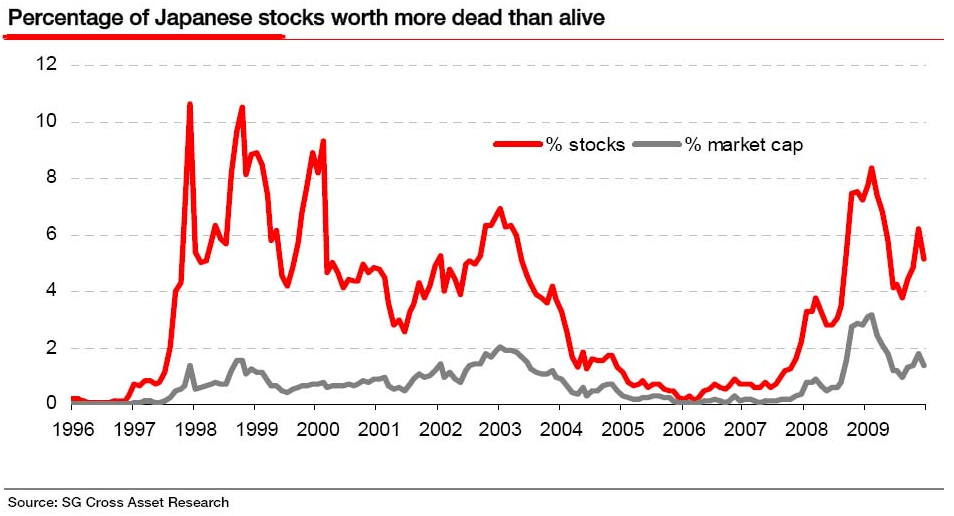
It seems that there are quite a few stocks trading at a discount to net current asset value in Japan:

Grice likes the net current asset value strategy in Japan (sort of):

Not only are these assets cheap but, unlike the overall market, they probably offer value as well. My Factset backtest suggests such stocks trading below liquidation value have averaged a monthly return of 1.5% since the mid 1990s, compared to -0.2% for the Topix. There is no such thing as a toxic asset, only a toxic price. It may well be that these companies have no future, that they shouldn’t be valued as going concerns and that they are worth more dead than alive. If so, they are already trading at a value lower than would be fetched in a fire sale. But what if the outlook isn’t so gloomy? If these assets aren’t actually complete duds, we could be looking at some real bargains…

So should we be filling our boots with companies trading below liquidation value? Not necessarily. But I would say the burden of proof has shifted. Why wouldn’t you want to own assets that have been generating shareholder wealth yet which trade at below their liquidation values?

It is interesting that this article echoes another SocGen article, this one a September 2008 report by James Montier called Graham’’s net-nets: outdated or outstanding? in which Montier looked at Graham sub-liquidation stocks globally. Of the 175 stocks identified around the world, Montier found that over half were in Japan.

Now all we have to do is figure out how to invest in Japan.

Read Full Post »

Mariusz Skonieczny is the founder and president of Classic Value Investors LLC and runs the Classic Value Investors website. He has provided me with a copy of his book Why Are We So Clueless about the Stock Market? Learn How to Invest Your Money, How to Pick Stocks, and How to Make Money in the Stock Market and has asked me to review it for the site. I am happy to do so.

Mariusz says that the purpose of this book is to “help readers understand the basics of stock market investing:”

Material covered includes the difference between stocks and businesses, what constitutes a good business, when to buy and sell stocks, and how to value individual stocks. The book also includes a chapter covering four case studies as well as a supplemental chapter on the pros and cons of real estate versus stock market investing.

The book discusses the basics of valuation through return on equity, how to identify a “good” businesses with sustainable competitive advantages (moats), diversification, how to understand the capital structure, and the implications of the economy for the business analyzed. Most usefully, Mariusz also discusses how to analyze an investment and provides several case studies discussing his methodology. In my opinion, the book is an excellent introduction to Buffett-style investing, and I would recommend it to investors seeking “wonderful companies at a fair price.”

Read Full Post »

The Official Activist Investing Blog has published its list of activist investments for December:

Ticker Company Investor
ALCO Alico Inc. Atlantic Blue Group
ALOG Analogic Corporation Ramius Capital
ALOY Alloy Inc. SRB Management
BASI Bioanalytical Systems Inc Peter Kissinger
CNBC Center Bancorp Lawrence Seidman
COBR Cobra Electronics Corp Timothy Stabosz
CTO Consolidated Tomoka Land Co Wintergreen Advisers
DGTC.OB Del Global Technologies Steel Partners
DHT DHT Maritime Inc MMI Investments
DPTR Delta Petroleum Corp. Tracinda Corp
DVD Dover Motorsports inc Marathon Capital
ENZN Enzon Pharmaceuticals inc. DellaCamera Capital Management
EVOL Evolving Systems Inc. Karen Singer
EZEN.OB Ezenia! Inc North & Webster
EZEN.OB Ezenia! Inc Hummingbird Management
FACT Facet Biotech Corp Biotechnology Value Fund
FACT Facet Biotech Corp Baupost Group
FFHS First Franklin Corp Lenox Wealth Management
FGF SunAmerica Focused Alpha Growth Inc Bulldog Investors
FGI SunAmerica Focused Alpha Large-Cap Fund, Inc. Bulldog Investors
FMMH.OB Fremont Michigan InsuraCorp Steak & Shake
GSIGQ.PK GSI Group Stephen Bershad
GSIGQ.PK GSI Group JEC II Associates
GST Gastar Exploration Ltd Palo Alto Investors
HBRF.OB Highbury Financial Inc. Peerless Systems Corp
HFFC HF Financial Corp Financial Edge Fund
IMMR Immersion Corp Ramius Capital
JTX Jackson Hewitt Tax Service JTH Tax Inc.
KYN Kayne Anderson MLP Investment Co Karpus Management
LM Legg Mason Inc. Trian Fund
MZF MBIA Capital Claymore Man Dur Inv Grd Muni Western Investment
OSTE Osteotech Inc. Heartland Advisors
PMO The Putnam Funds Karpus Management
PTEC Phoenix Technologies Ltd Ramius Capital
RIC Richmont Mines Gregory Chamandy
RRGB Red Robin Gourmet Burgers Clinton Group
RRGB Red Robin Gourmet Burgers Spotlight Advisors
SLTC Selectica Inc Lloyd Miller
SMTS Somanetics Corp Discovery Capital
SSE Southern Connecticut Bancorp Inc Lawrence Seidman
TFC Taiwan Greater China Fund City of London Investment Group
TRA Terra Industries Inc CF Industries Holdings
TTWO Take-Two Interactive Software Carl Icahn
TUNE Microtune Inc Ramius Capital
UAHC United American Healthcare Corp Lloyd Miller
UAHC United American Healthcare Corp John Fife
USAT USA Technologies Brad Tirpak; Craig Thomas
UTSI UTStarcom Inc Shah Capital Management
VRX Valeant Pharmaceuticals Value Act Capital
WXCO WHX Corp Steel Partners
YORW York Water Co GAMCO

Read Full Post »

« Newer Posts - Older Posts »