Feeds:
Posts
Comments

Posts Tagged ‘Value investing’

Last week I looked at James Montier’s 2006 paper The Little Note That Beats The Market and his view that investors would struggle to implement the Magic Formula strategy for behavioral reasons, a view borne out by Greenblatt’s own research. This is not a criticism of the strategy, which is tractable and implementable, but an observation on how pernicious our cognitive biases are.

Greenblatt found that a compilation of all the “professionally managed” – read “systematic, automatic (hydromatic)” – accounts earned 84.1 percent over two years against the S&P 500 (up 62.7 percent). A compilation of “self-managed” accounts (the humans) over the same period showed a cumulative return of 59.4 percent, losing to the market by 20 percent, and to the machines by almost 25 percent. So the humans took this unmessupable system and messed it up. As predicted by Montier and Greenblatt.

Ugh.

Greenblatt, perhaps dismayed at the fact that he dragged the horses all the way to the water to find they still wouldn’t drink, has a new idea: value-weighted indexing (not to be confused with the academic term for market capitalization-weighting, which is, confusingly, also called value weighting).

I know from speaking to some of you that this is not a particularly popular idea, but I like it. Here’s Greenblatt’s rationale, paraphrased:

  • Most investors, pro’s included, can’t beat the index. Therefore, buying an index fund is better than messing it up yourself or getting an active manager to mess it up for you.
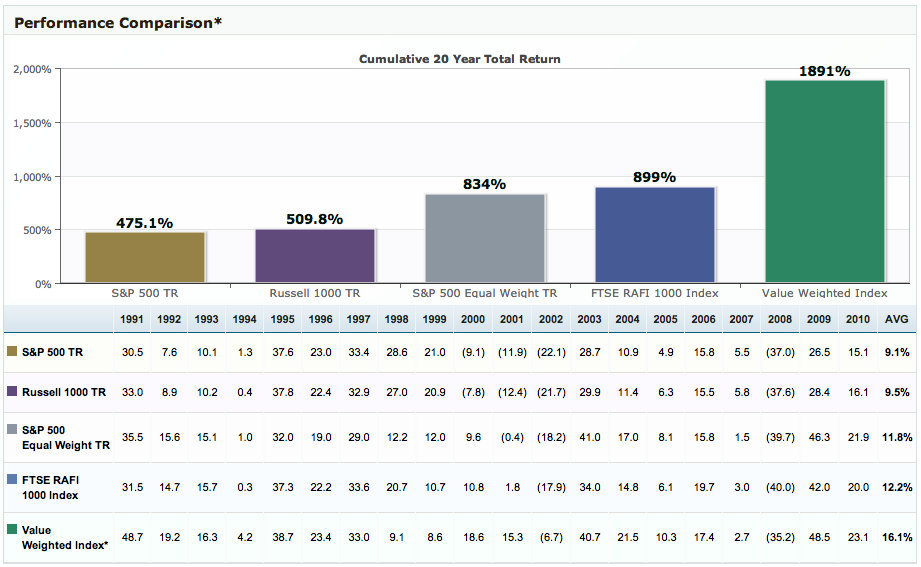
  • If you’re going to buy an index, you might as well buy the best one. An index based on the market capitalization-weighted S&P500 will be handily beaten by an equal-weighted index, which will be handily beaten by a fundamentally weighted index, which is in turn handily beaten by a “value-weighted index,” which is what Greenblatt calls his “Magic Formula-weighted index.”

I like the logic. I also think the data on the last point are persuasive. In chart form, the data on that last point look like this:

The value weighted index knocked out a CAGR of 16.1 percent per year over the last 20 years. Not bad.

Greenblatt explains his rationale in some depth in his latest book The Big Secret. The book has taken some heavy criticism on Amazon – average review is 3.2 out of 5 as of now – most of which I think is unwarranted (for example, “Like many others here, I do not exactly understand the reason for this book’s existence.”).

I’m going to take a close look at the value-weighted index this week.

Read Full Post »

Since Joel Greenblatt’s introduction of the Magic Formula in the 2006 book “The Little Book That Beats The Market,” researchers have conducted a number of studies on the strategy and found it to be a market beater, both domestically and abroad.

Greenblatt claims returns in the order of 30.8 percent per year against a market average of 12.3 percent, and S&P500 return of 12.4 percent per year:

In Does Joel Greenblatt’s Magic Formula Investing Have Any Alpha? Meena Krishnamsetty finds that the Magic Formula generates annual alpha 4.5 percent:

It doesn’t beat the index funds by 18% per year and generate Warren Buffett like returns, but the excess return is still more than 5% per year. This is better than Eugene Fama’s DFA Small Cap Value Fund. It is also better than Lakonishok’s LSV Value Equity Fund.

Wes Gray’s Empirical Finance Blog struggles to repeat the study:

[We] can’t replicate the results under a variety of methods.

We’ve hacked and slashed the data, dealt with survivor bias, point-in-time bias, erroneous data, and all the other standard techniques used in academic empirical asset pricing analysis–still no dice.

In the preliminary results presented below, we analyze a stock universe consisting of large-caps (defined as being larger than 80 percentile on the NYSE in a given year). We test a portfolio that is annually rebalanced on June 30th, equal-weight invested across 30 stocks on July 1st, and held until June 30th of the following year.

Wes finds “serious outperformance” but “nowhere near the 31% CAGR outlined in the book.

Wes thinks that the outperformance of the Magic Formula is due to small cap stocks, which he tests in a second post “Magic Formula and Small Caps–The Missing Link?

Here are Wes’s results:

[While] the MF returns are definitely higher when you allow for smaller stocks, the results still do not earn anywhere near 31% CAGR.

Some closer observations of our results versus the results from the book:

For major “up” years, it seems that our backtest of the magic formula are very similar (especially from a statistical standpoint where the portfolios only have 30 names): 1991, 1995, 1997, 1999, 2001, and 2003.

The BIG difference is during down years: 1990, 1994, 2000, and 2002. For some reason, our backtest shows results which are roughly in line with the R2K (Russell 2000), but the MF results from the book present compelling upside returns during market downturns–so somehow the book results have negative beta during market blowouts? Weird to say the least…

James Montier, in a 2006 paper, “The Little Note That Beats the Markets” says that it works globally:

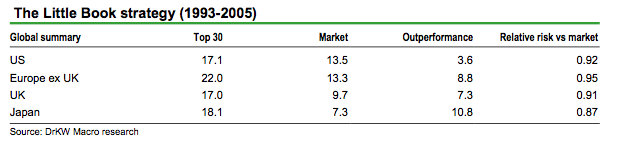
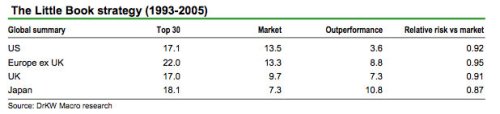
The results of our backtest suggest that Greenblatt’s strategy isn’t unique to the US. We tested the Little Book strategy on US, European, UK and Japanese markets between 1993 and 2005. The results are impressive. The Little Book strategy beat the market (an equally weighted stock index) by 3.6%, 8.8%, 7.3% and 10.8% in the various regions respectively. And in all cases with lower volatility than the market! The outperformance was even better against the cap weighted indices.

So the Magic Formula generates alpha, and beats the market globally, but not by as much as Greenblatt found originally, and much of the outperformance may be due to small cap stocks.

The Magic Formula and EBIT/TEV

Last week I took a look at the Loughran Wellman and Gray Vogel papers that found the enterprise multiple,  EBITDA/enterprise value, to be the best performing price ratio. A footnote in the Gray and Vogel paper says that they conducted the same research substituting EBIT for EBITDA and found “nearly identical results,” which is perhaps a little surprising but not inconceivable because they are so similar.

EBIT/TEV is one of two components in the Magic Formula (the other being ROC). I have long believed that the quality metric (ROC) adds little to the performance of the value metric (EBIT/EV), and that much of the success of the Magic Formula is due to its use of the enterprise multiple. James Montier seems to agree. In 2006, Montier backtested the strategy and its components in the US, Europe ex UK, UK and Japan:

The universe utilised was a combination of the FTSE and MSCI indices. This gave us the largest sample of data. We analysed the data from 1993 until the end of 2005. All returns and prices were measured in dollars. Utilities and Financials were both excluded from the test, for reasons that will become obvious very shortly. We only rebalance yearly.

Here are the results of Montier’s backtest of the Magic Formula:
And here’re the results for EBIT/TEV over the same period:

Huh? EBIT/TEV alone outperforms the Magic Formula everywhere but Japan?

Montier says that return on capital seems to bring little to the party in the UK and the USA:

In all the regions except Japan, the returns are higher from simply using a pure [EBIT/TEV] filter than they are from using the Little Book strategy. In the US and the UK, the gains from a pure [EBIT/TEV] strategy are very sizeable. In Europe, a pure [EBIT/TEV] strategy doesn’t alter the results from the Little Book strategy very much, but it is more volatile than the Little Book strategy. In Japan, the returns are lower than the Little Book strategy, but so is the relative volatility.

Montier suggests that one reason for favoring the Magic Formula over “pure” EBIT/TEV is career defence. The backtest covers an unusual period in the markets when expensive stocks outperformed for an extended period of time.

The charts below suggest a reason why one might want to have some form of quality input into the basic value screen. The first chart shows the top and bottom ranked deciles by EBIT/EV for the US (although other countries tell a similar story). It clearly shows the impact of the bubble. For a number of years, during the bubble, stocks that were simply cheap were shunned as we all know.


However, the chart below shows the top and bottom deciles using the combined Little Book strategy again for the US. The bubble is again visible, but the ROC component of the screen prevented the massive underperformance that was seen with the pure value strategy. Of course, the resulting returns are lower, but a fund manager following this strategy is unlikely to have lost his job.
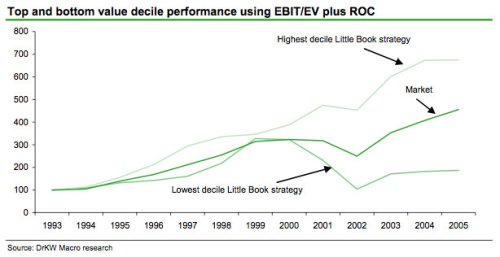
In the second chart, note that it took eight years for the value decile to catch up to the glamour decile. They were tough times for value investors.

Conclusion

The Magic Formula beats the market, and generates real alpha. It might not beat the market by as much as Greenblatt found originally, and much of the outperformance is due to small cap stocks, but it’s a useful strategy. Better performance may be found in the use of pure EBIT/EV, but investors employing such a strategy could have very long periods of lean years.

Buy my book The Acquirer’s Multiple: How the Billionaire Contrarians of Deep Value Beat the Market from on Kindlepaperback, and Audible.

Here’s your book for the fall if you’re on global Wall Street. Tobias Carlisle has hit a home run deep over left field. It’s an incredibly smart, dense, 213 pages on how to not lose money in the market. It’s your Autumn smart read. –Tom Keene, Bloomberg’s Editor-At-Large, Bloomberg Surveillance, September 9, 2014.

Click here if you’d like to read more on The Acquirer’s Multiple, or connect with me on Twitter, LinkedIn or Facebook. Check out the best deep value stocks in the largest 1000 names for free on the deep value stock screener at The Acquirer’s Multiple®.


Read Full Post »
In their March 2012 paper, “Analyzing Valuation Measures: A Performance Horse-Race over the past 40 Years,” Wes Gray and Jack Vogel asked whether the business cycle should affect our choice of price ratio:

For example, cash-focused measures, such as free-cash-flow, might perform better during economic downturns than accounting-focused measures like earnings. Or perhaps a more asset-based measure, like book value, will outperform when the economy is more manufacturing-based (‘70s and ‘80s), and struggle when the economy is more human capital and services oriented (therefore making asset-based measures less relevant).

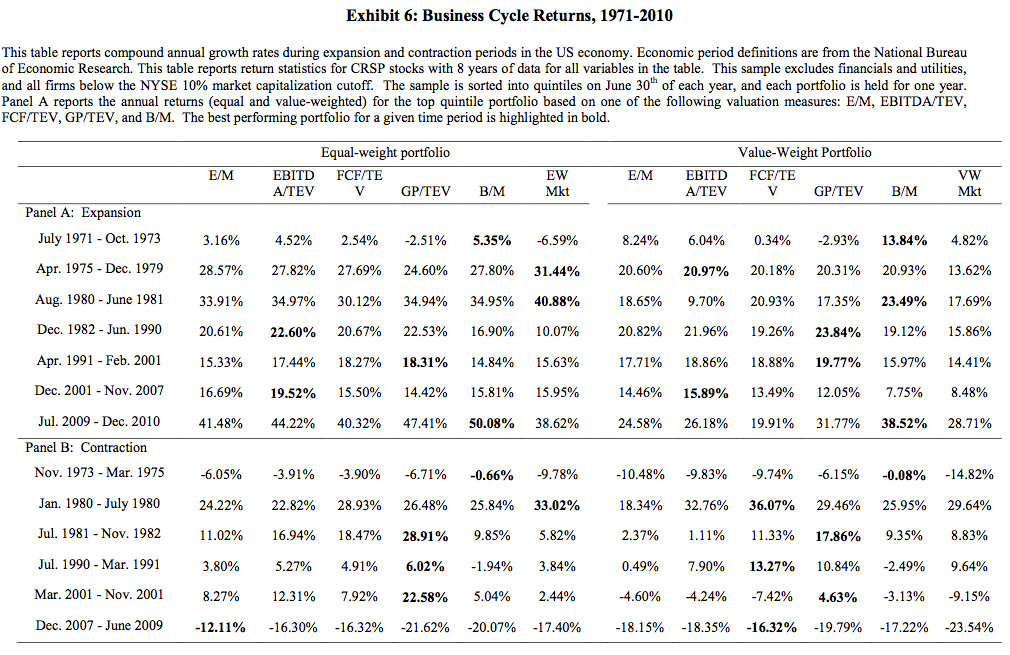
Gray and Vogel analyze the returns of different price ratios over economic expansions and contractions defined by the National Bureau of Economic Research.

Economic Expansions and Contractions 

(Click to enlarge)

The first panel presents the returns for different price ratios during economic expansions. Gray and Vogel observe:

B/M enjoys periods of relative out-performance in the early ‘70s, early ‘80s, and in late 2009. The B/M performance pattern lends weak evidence to the hypothesis that balance-sheet-based value measures perform better than income or cash-flow statement value metrics when the economy generates more returns from tangible assets (e.g., property, plant, and equipment) relative to intangible assets (e.g., human capital, R&D, and brand equity). Overall, there is no strong evidence that a particular valuation metrics systematically outperform all other metrics during expanding economic periods.

The second panel presents the returns for different price ratios during economic contractions. Gray and Vogel observe:

[The] results in Panel B suggest there is no clear evidence that a particular value strategy systematically outperforms all other strategies in contracting economic periods. For example, during the July 1981 to November 1982 and March 2001 to November 2001 contractions GP/TEV shows strong outperformance, but this same metric has the worst performance in the December 2007 to June 2009 recession.

Conclusion

Gray and Vogel conclude:

[There] is little evidence that a particular value strategy outperforms all other metrics during economic contractions and expansions. However, there is clear evidence that value strategies as a whole do outperform passive benchmarks in good times and in bad. The one exception to this rule is during the April 1975 to June 1981 business cycle, a time when a passive small-cap equity portfolio performed exceptionally well.

Read Full Post »

In their March 2012 paper, “Analyzing Valuation Measures: A Performance Horse-Race over the past 40 Years,” Wes Gray and Jack Vogel asked, “Do long-term, normalized price ratios outperform single-year price ratios?

Benjamin Graham promoted the use of long-term, “normalized” price ratios over single-year price ratios. Graham suggested in Security Analysis that “[earnings in P/E] should cover a period of not less than five years, and preferably seven to ten years.

Robert Shiller has also advocated for long-term price ratios because “annual earnings are noisy as a measure of fundamental value.” A study in the UK by Anderson and Brooks [2006] found that a long-term average (eight-years) of earnings increased the value premium (i.e. the spread in returns between value and growth stocks) by 6 percent over one-year earnings.

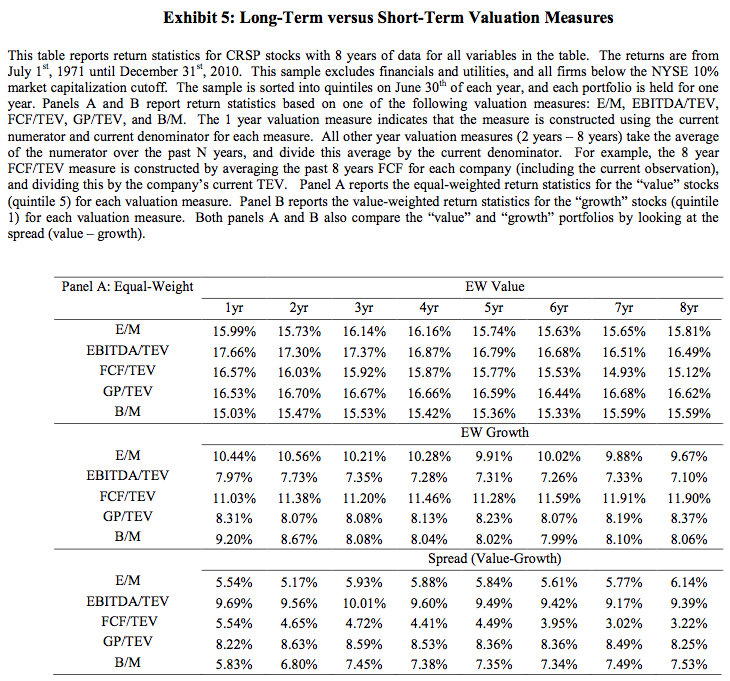
Gray and Vogel test a range of year averages for all the price ratios from yesterday’s post. The results are presented below. Equal-weight first:

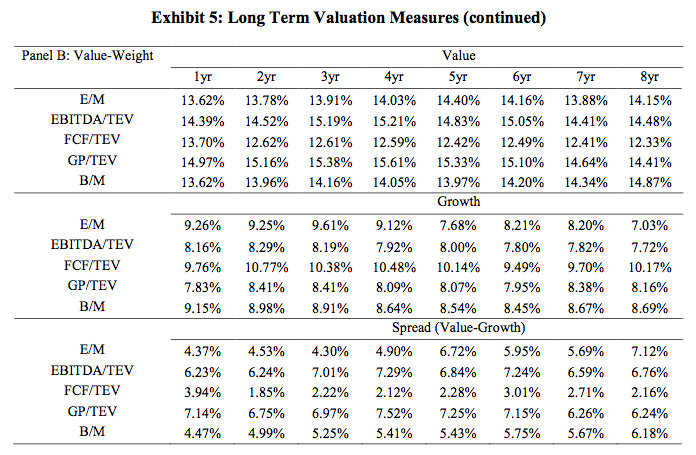
Market capitalization-weight:

Commentary

We can make several observations about the long-term averages. First, there is no evidence that any long-term average is consistently better than any other, measured either on the raw performance to the value decile, or by the value premium created. This is true for both equal-weight portfolios and market capitalization-weighted portfolios, which we would expect. For example, in the equal-weight table, the E/M value portfolio generates its best return using a 4-year average, but the spread is biggest using the 3-year average. Compare this with EBITDA/TEV, which generates its best return using a single-year ratio, and its biggest spread using a 3-year average, or FCF/TEV, which generates both its best return and biggest spread with a single-year average. There is no consistency, or pattern to the results that we can detect. If anything, the results appear random to me, which leads me to conclude that there’s no evidence that long-term averages outperform single-year price ratios.

We can make other, perhaps more positive observations. For example, in the equal-weight panel, the enterprise multiple is consistently the best performing price ratio across most averages (although it seems to get headed by GP/TEV near the 7-year and 8-year averages). It also generates the biggest value premium across all long-term averages.  It’s also a stand-out performer in the market capitalization-weighted panel, delivering the second best returns to GP/TEV, but generating a bigger value premium than GP/TEV about half the time.

The final observation that we can make is that the value portfolio consistently outperforms the “growth” or expensive portfolio. For every price ratio, and over every long-term average, the better returns were found in the value portfolio. Value works.

Conclusion

While long-term average price ratios have been promoted by giants of the investment world like Graham and Shiller as being better than single-year ratios, there exists scant evidence that this is true. A single UK study found a significant premium for long-term average price ratios, but Gray and Vogel’s results do not support the findings of that study. There is no evidence in Gray and Vogel’s results that any long-term average is better than any other, or better than a single-year price ratio. One heartening observation is that, however we slice it, value outperforms glamour. Whichever price ratio we choose to examine, over any long-term average, value is the better bet.

Read Full Post »

This week I’ve been taking a look at Aswath Damodaran’s paper “Value Investing: Investing for Grown Ups?” in which he asks, “If value investing works, why do value investors underperform?”

Damodaran divides the value world into three groups:

  1. The Passive Screeners,” – “The Graham approach to value investing is a screening approach, where investors adhere to strict screens… and pick stocks that pass those screens.”
  2. The Contrarian Value Investors,” – “In this manifestation of value investing, you begin with the belief that stocks that are beaten down because of the perception that they are poor investments (because of poor investments, default risk or bad management) tend to get punished too much by markets just as stocks that are viewed as good investments get pushed up too much.”
  3. Activist value investors,” – “The strategies used by …[activist value investors] are diverse, and will reflect why the firm is undervalued in the first place. If a business has investments in poor performing assets or businesses, shutting down, divesting or spinning off these assets will create value for its investors. When a firm is being far too conservative in its use of debt, you may push for a recapitalization (where the firm borrows money and buys back stock). Investing in a firm that could be worth more to someone else because of synergy, you may push for it to become the target of an acquisition. When a company’s value is weighed down because it is perceived as having too much cash, you may demand higher dividends or stock buybacks. In each of these scenarios, you may have to confront incumbent managers who are reluctant to make these changes. In fact, if your concerns are broadly about management competence, you may even push for a change in the top management of the firm.”

We looked at Damodaran’s passive screeners Tuesday, the contrarian value investors Wednesday, and today we’ll take a look at the activists.

The Activist Value Investors

Damodaran cites the well-known Brav, Jiang and Kim article that I have discussed here before:

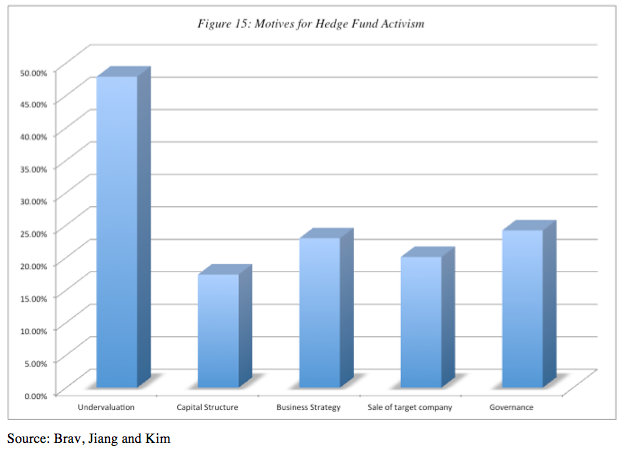
If activist investors hope to generate their returns from changing the way companies are run, they should target poorly managed companies for their campaigns. Institutional and individual activists do seem to focus on poorly managed companies, targeting companies that are less profitable and have delivered lower returns than their peer group. Hedge fund activists seem to focus their attention on a different group. A study of 888 campaigns mounted by activist hedge funds between 2001 and 2005 finds that the typical target companies are small to mid cap companies, have above average market liquidity, trade at low price to book value ratios, are profitable with solid cash flows and pay their CEOs more than other companies in their peer group. Thus, they are more likely to be under valued companies than poorly managed. A paper that examines hedge fund motives behind the targeting provides more backing for this general proposition in figure 15.

As we have seen both undervalued or poorly managed stocks can generate good returns.

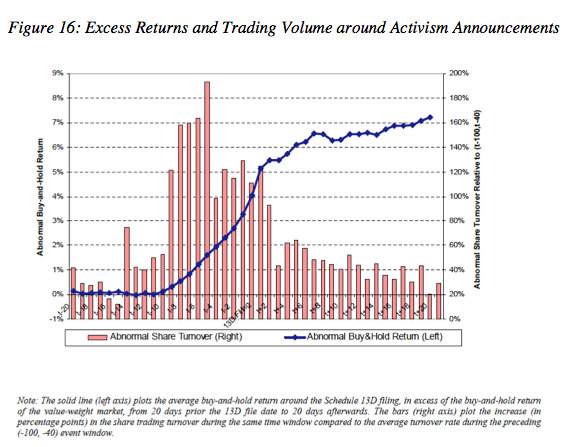
Damodaran says that the “market reaction to activist investors, whether they are hedge funds or individuals, is positive.” A study that looked at stock returns in targeted companies in the days around the announcement of activism showed the following results:

Damodaran points out that “the bulk of the excess return (about 5% of the total of 7%) is earned in the twenty days before the announcement and that the post-announcement drift is small.”

There is also a jump in trading volume prior to the announcement, which does interesting (and troubling) questions about trading being done before the announcements. The study also documents that the average returns around activism announcement has been drifting down over time, from 14% in 2001 to less than 4% in 2007.

Can you make money following activist investors?

Damodaran says “sort of,” if you follow:

The right activists: If the median activist hedge fund investor essentially breaks even, as the evidence suggests, a blunderbuss approach of investing in a company targeted by any activist investor is unlikely to generate value. However, if you are selective about the activist investors you follow, targeting only the most effective, and investing only in companies that they target, your odds improve.

Performance cues: To the extent that the excess returns from this strategy come from changes made at the firm to operations, capital structure, dividend policy and/or corporate governance, you should keep an eye on whether and how much change you see on each of these dimesions at the targeted firms. If the managers at these firms are able to stonewall activist investors successfully , the returns are likely to be unimpressive as well.

A hostile acquisition windfall? A study by Greenwood and Schor notes that while a strategy of buying stocks that have been targeted by activist investors generates  excess returns, almost all of those returns can be attributed to the subset of these firms that get taken over in hostile acquisitons.

Follow the right activists, and do ok, or front run them, and potentially do very well:

There is an alternate strategy worth considering, that may offer higher returns, that also draws on activist investing. You can try to identify companies that are poorly managed and run, and thus most likely to be targeted by activist investors. In effect, you are screening firms for low returns on capital, low debt ratios and large cash balances, representing screens for potential value enhancement, and ageing CEOs, corporate scandals and/or shifts in voting rights operating as screens for the management change. If you succeed, you should be able to generate higher returns when some of these firms change, either because of pressure from within (from an insider or an assertive board of directors) or from without (activist investors or a hostile acquisition).

So how do we mess it up?

• This power of activist value investing usually comes from having the capital to buy significant stakes in poorly managed firms and using these large stockholder positions to induce management to change their behavior. Managers are unlikely to listen to small stockholders, no matter how persuasive their case may be.

• In addition to capital, though, activist value investors need to be willing to spend substantial time fighting to make themselves heard and in pushing for change. This investment in time and resources implies that an activist value investor has to pick relatively few fights and be willing to invest substantially in each fight.

• Activist value investing, by its very nature, requires a thorough understanding of target firms, since you have to know where each of these firms is failing and how you would fix these problems. Not surprisingly, activist value investors tend to choose a sector that they know really well and take positions in firms within that sector. It is clearly not a strategy that will lead to a well diversified portfolio.

• Finally, activist value investing is not for the faint hearted. Incumbent managers are unlikely to roll over and give in to your demands, no matter how reasonable you may thing them to be. They will fight, and sometimes fight dirty, to win. You have to be prepared to counter and be the target for abuse. At the same time, you have to be adept at forming coalitions with other investors in the firm since you will need their help to get managers to do your bidding. 

Read Full Post »

Yesterday, I examined Aswath Damodaran’s paper “Value Investing: Investing for Grown Ups?” in which Damodaran asked, “If value investing works, why do value investors underperform?”

Damodaran divides the value world into three groups:

  1. The Passive Screeners,” – “The Graham approach to value investing is a screening approach, where investors adhere to strict screens… and pick stocks that pass those screens.”
  2. The Contrarian Value Investors,” – “In this manifestation of value investing, you begin with the belief that stocks that are beaten down because of the perception that they are poor investments (because of poor investments, default risk or bad management) tend to get punished too much by markets just as stocks that are viewed as good investments get pushed up too much.”
  3. Activist value investors,” – “The strategies used by …[activist value investors] are diverse, and will reflect why the firm is undervalued in the first place. If a business has investments in poor performing assets or businesses, shutting down, divesting or spinning off these assets will create value for its investors. When a firm is being far too conservative in its use of debt, you may push for a recapitalization (where the firm borrows money and buys back stock). Investing in a firm that could be worth more to someone else because of synergy, you may push for it to become the target of an acquisition. When a company’s value is weighed down because it is perceived as having too much cash, you may demand higher dividends or stock buybacks. In each of these scenarios, you may have to confront incumbent managers who are reluctant to make these changes. In fact, if your concerns are broadly about management competence, you may even push for a change in the top management of the firm.”

We looked at Damodaran’s passive screeners yesterday, the contrarian value investors are up today, and tomorrow we’ll take a look at the activists.

The Contrarian Value Investors

Buying losers seems to work over a long time scale.

Damodaran:

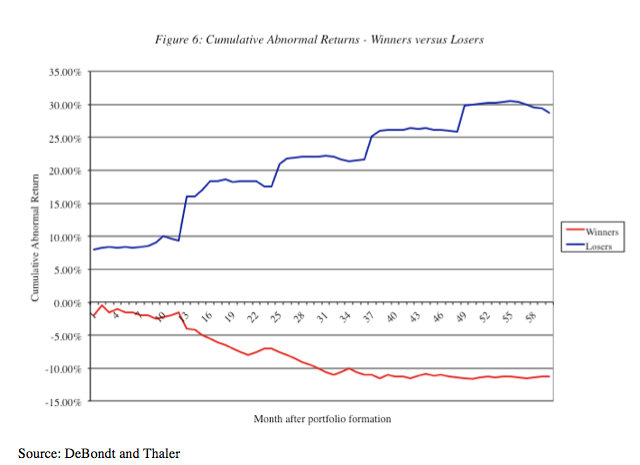
This analysis suggests that an investor who bought the 35 biggest losers over the previous year and held for five years would have generated a cumulative abnormal return of approximately 30% over the market and about 40% relative to an investor who bought the winner portfolio.

This evidence is consistent with market overreaction and suggests that a simple strategy of buying stocks that have gone down the most over the last year or years may yield excess returns over the long term. Since the strategy relies entirely on past prices, you could argue that this strategy shares more with charting – consider it a long term contrarian indicator – than it does with value investing.

Several select caveats:

• Studies also seem to find loser portfolios created every December earn significantly higher returns than portfolios created every June. This suggests an interaction between this strategy and tax loss selling by investors. Since stocks that have gone down the most are likely to be sold towards the end of each tax year (which ends in December for most individuals) by investors, their prices may be pushed down by the tax loss selling.

• There seems to be a size effect when it comes to the differential returns. When you do not control for firm size, the loser stocks outperform the winner stocks, but when you match losers and winners of comparable market value, the only month in which the loser stocks outperform the winner stocks is January.21

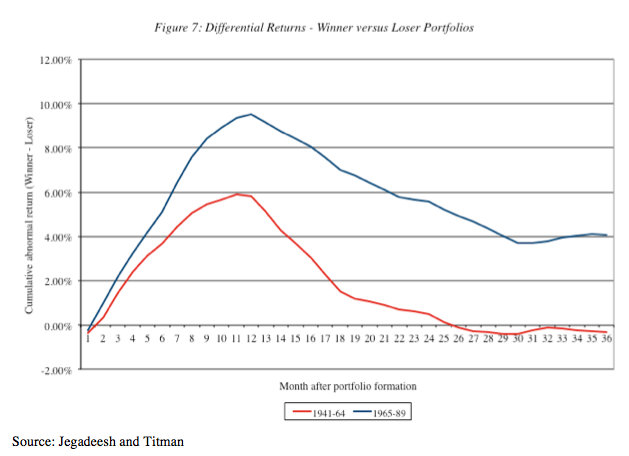
• The final point to be made relates to time horizon. There may be evidence of price reversals in long periods (3 to 5 years) and there is the contradictory evidence of price momentum– losing stocks are more likely to keep losing and winning stocks to keep winning – if you consider shorter periods (six months to a year). An earlier study that we referenced, by Jegadeesh and Titman tracked the difference between winner and loser portfolios by the number of months that you held the portfolios.22

Damodaran’s final point above – that price momentum works over short periods – is interesting:

Weird. The winner portfolio actually outperforms the loser portfolio in the first 12 months. Says Damodaran:

[L]oser stocks start gaining ground on winning stocks after 12 months, [but] it took them 28 months in the 1941-64 time period to get ahead of them and the loser portfolio does not start outperforming the winner portfolio even with a 36-month time horizon in the 1965-89 time period. The payoff to buying losing companies may depend heavily on whether you have to capacity to hold these stocks for long time periods.

Bad companies can be good investments

A more sophisticated version of contrarian value investing  is buying “unexcellent” companies and selling “excellent” companies. Damodaran’s rationale is as follows:

If you are right about markets overreacting to recent events, expectations will be set too high for stocks that have been performing well and too low for stocks that have been doing badly. If you can isolate these companies, you can buy the latter and sell the former.

Take note, franchise investors:

Any investment strategy that is based upon buying well-run, good companies and expecting the growth in earnings in these companies to carry prices higher is dangerous, since it ignores the possibility that the current price of the company already reflects the quality of the management and the firm. If the current price is right (and the market is paying a premium for quality), the biggest danger is that the firm loses its luster over time, and that the premium paid will dissipate. If the market is exaggerating the value of the firm, this strategy can lead to poor returns even if the firm delivers its expected growth. It is only when markets under estimate the value of firm quality that this strategy stands a chance of making excess returns.

The tale of Tom Peters’s In Search of Excellence:

There is some evidence that well managed companies do not always make good investments. Tom Peters, in his widely read book on excellent companies a few years ago, outlined some of the qualities that he felt separated excellent companies from the rest of the market.23 Without contesting his standards, a study went through the perverse exercise of finding companies that failed on each of the criteria for excellence – a group of unexcellent companies and contrasting them with a group of excellent companies.

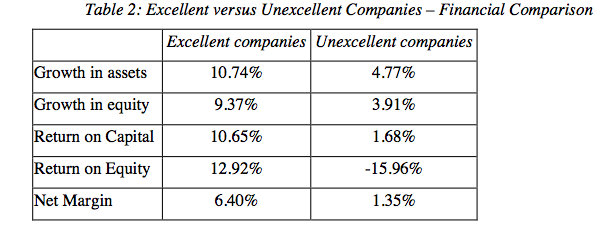
Here’s a statistical comparison of the two groups:

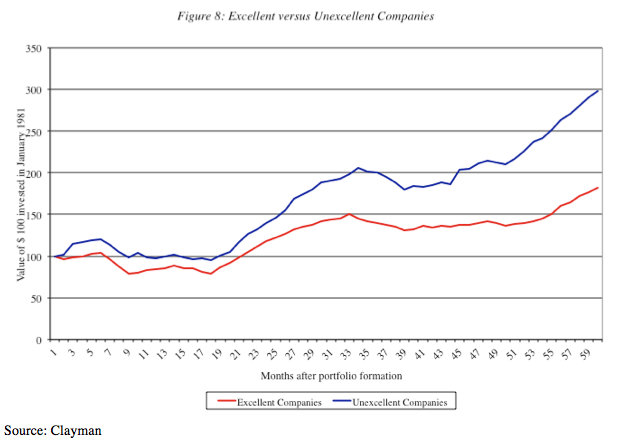
Clearly, “Excellent companies” are excellent, and “Unexcellent companies” suck (negative return on equity!). Confronted with the choice to invest in one group of the other, it’s a no-brainer. Or is it? Here are the returns:

Ruh roh. Says Damodaran:

The excellent companies may be in better shape financially but the unexcellent companies would have been much better investments at least over the time period considered (1981-1985). An investment of $ 100 in unexcellent companies in 1981 would have grown to $ 298 by 1986, whereas $ 100 invested in excellent companies would have grown to only $ 182. While this study did not control for risk, it does present some evidence that good companies are not necessarily good investments, whereas bad companies can sometimes be excellent investments.

A legitimate criticism of this study is that the time period is very short (5 years) and may be an aberration – it began, after all, right at the end of a tough bear market, where any stock with the fundamentals of the unexcellent companies would have looked like poison. How about a second study?

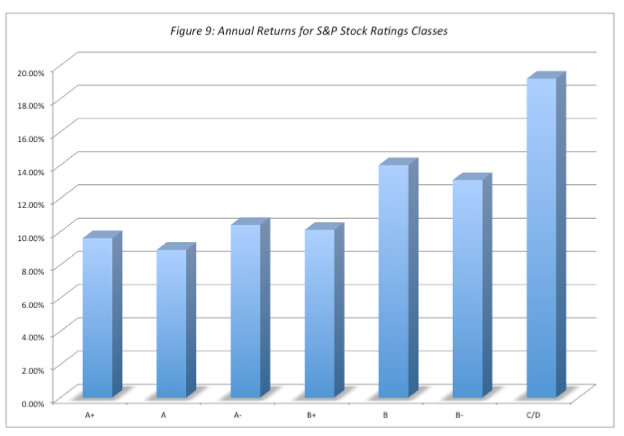
The second study used a more conventional measure of company quality. Standard and Poor’s, the ratings agency, assigns quality ratings to stocks that resemble its bond ratings. Thus, an A rated stock, according to S&P, is a higher quality investment than a B+ rated stock, and the ratings are based upon financial measures (such as profitability ratios and financial leverage). Figure 9 summarizes the returns earned by stocks in different ratings classes, and as with the previous study, the lowest rated stocks had the highest returns and the highest rated stocks had the lowest returns.

And here are the returns:

Looks like a pretty clear inverse relationship between rating and return. Sure, whereof rating, thereof “risk,” but I’m prepared to wear that “risk” for the return.

So contrarian value investing works. How do we mess this up?

a. Long Time Horizon: To succeed by buying these companies, you need to have the capacity to hold the stocks for several years. This is necessary not only because these stocks require long time periods to recover, but also to allow you to spread the high transactions costs associated with these strategies over more time. Note that having a long time horizon as a portfolio manager may not suffice if your clients can put pressure on you to liquidate holdings at earlier points. Consequently, you either need clients who think like you do and agree with you, or clients that have made enough money with you in the past that their greed overwhelms any trepidation they might have in your portfolio choices.

b. Diversify: Since poor stock price performance is often precipitated or accompanied by operating and financial problems, it is very likely that quite a few of the companies in the loser portfolio will cease to exist. If you are not diversified, your overall returns will be extremely volatile as a result of a few stocks that lose all of their value. Consequently, you will need to spread your bets across a large number of stocks in a large number of sectors. One variation that may accomplish this is to buy the worst performing stock in each sector, rather than the worst performing stocks in the entire market.

c. Personal qualities: This strategy is not for investors who are easily swayed or stressed by bad news about their investments or by the views of others (analysts, market watchers and friends). Almost by definition, you will read little that is good about the firms in your portfolio. Instead, there will be bad news about potential default, management turmoil and failed strategies at the companies you own. In fact, there might be long periods after you buy the stock, where the price continues to go down further, as other investors give up. Many investors who embark on this strategy find themselves bailing out of their investments early, unable to hold on to these stocks in the face of the drumbeat of negative information. In other words, you need both the self-confidence to stand your ground as others bail out and a stomach for short-term volatility (especially the downside variety) to succeed with this strategy.

Tomorrow, the activists.

DEEP VALUE 4 LIFE

(Hat tip Abnormal Returns)

Read Full Post »

Abnormal Returns asks “If value investors are the “grown ups” of the investment world, why aren’t their returns better?” and links to a great Aswath Damodaran paper “Value Investing: Investing for Grown Ups?” in which Damodaran examines the reasons why over an epic 77 pages.

Damodaran begins by asking, “Who is a value investor?” He divides the value world into three groups:

  1. The Passive Screeners,” – “The Graham approach to value investing is a screening approach, where investors adhere to strict screens… and pick stocks that pass those screens.”
  2. The Contrarian Value Investors,” – “In this manifestation of value investing, you begin with the belief that stocks that are beaten down because of the perception that they are poor investments (because of poor investments, default risk or bad management) tend to get punished too much by markets just as stocks that are viewed as good investments get pushed up too much.”
  3. Activist value investors,” – “The strategies used by …[activist value investors] are diverse, and will reflect why the firm is undervalued in the first place. If a business has investments in poor performing assets or businesses, shutting down, divesting or spinning off these assets will create value for its investors. When a firm is being far too conservative in its use of debt, you may push for a recapitalization (where the firm borrows money and buys back stock). Investing in a firm that could be worth more to someone else because of synergy, you may push for it to become the target of an acquisition. When a company’s value is weighed down because it is perceived as having too much cash, you may demand higher dividends or stock buybacks. In each of these scenarios, you may have to confront incumbent managers who are reluctant to make these changes. In fact, if your concerns are broadly about management competence, you may even push for a change in the top management of the firm.”

I’ll deal with Damodaran’s passive screeners today, the contrarian value investors tomorrow and the activists later this week.

The Passive Screeners

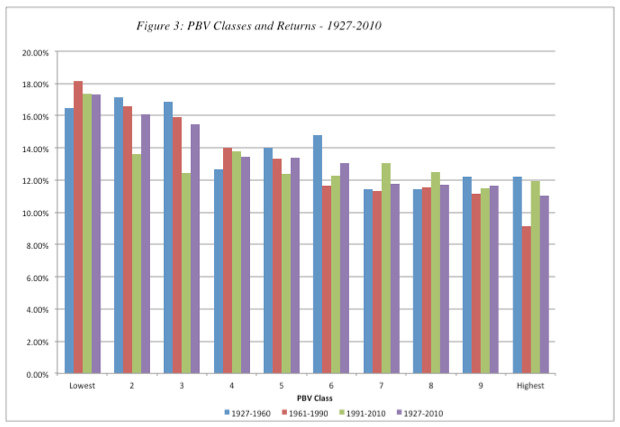
Value, if you define it with price ratios, works however you slice it. For example, the cheap price-to-book value (PBV) decile outperforms the next and so on:

Damodaran says:

The lowest price to book value stocks earned 6.24% more, on an annualized basis, than the high price to book stocks across the entire time period (1927-2010); they continued to earn higher annual returns (5.44%) than the high price to book value stocks between 1991-2010.

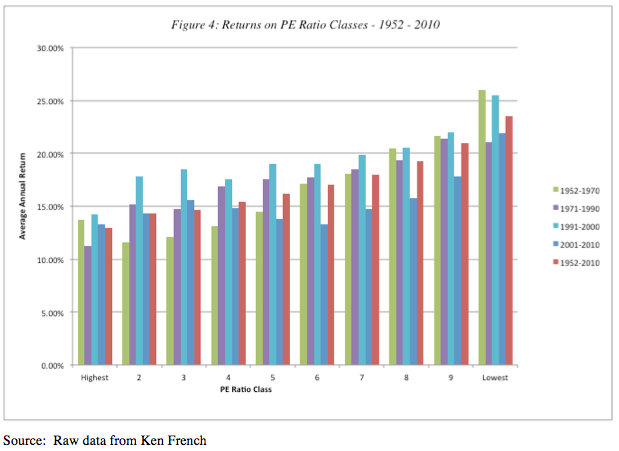
The cheap price-to-earnings (PE) ratio decile also outperforms the next and so on:

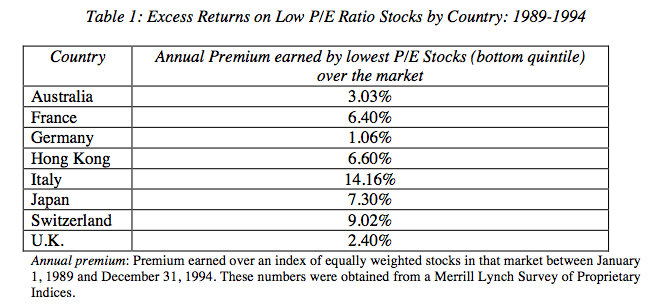
And value works all over the globe.

Damodaran asks if all we have to do to earn excess returns is invest in stocks that trade at low multiples of earnings, book value or revenues, why do value investors underperform?

He offers several reasons:

Time Horizon: All the studies quoted above look at returns over time horizons of five years or greater. In fact, low price-book value stocks have underperformed high price-book value stocks over shorter time periods. The same can be said about PE ratios and price to sales ratios.

Dueling Screens: If one screen earns you excess returns, three should do even better seems to be the attitude of some investors who proceed to multiply the screens they use. They are assisted in this process by the easy access to both data and screening technology. There are web sites (many of which are free) that allow you to screen stocks (at least in the United States) using multiple criteria.19 The problem, though, is that the use of one screen may undercut the effectiveness of others, leading to worse rather than better portfolios.

Absence of Diversification: In their enthusiasm for screens, investors sometimes forget the first principles of diversification. For instance, it is not uncommon to see stocks from one sector disproportionately represented in portfolios created using screens. A screen from low PE stocks may deliver a portfolio of banks and utilities, whereas a screen of low price to book ratios and high returns on equity may deliver stocks from a sector with high infrastructure investments that has had bad sector-specific news come out about it. In 2001, for instance, many telecom stocks traded at a discount on their book value.

Taxes and Transactions costs: As in any investment strategy, taxes and transactions costs can take a bite out of returns, although the effect should become smaller as your time horizon lengthens. Some screens, though, can increase the effect of taxes and transactions costs. For instance, screening for stocks with high dividends and low PE ratios will yield a portfolio that may have much higher tax liabilities (because of the dividends).

Success and Imitation: In some ways, the worst thing that can occur to a screen (at least from the viewpoint of investors using the screen) is that its success is publicized and that a large number of investors begin using that same screen at the same time. In the process of creating portfolios of the stocks they perceive to be undervalued, they may very well eliminate the excess returns that drew them to the screen in the first place.

Tomorrow, the contrarian value investors.

Read Full Post »

Michael Mauboussin appeared Friday on Consuelo Mack’s WealthTrack to discuss several of the ideas in his excellent book, Think Twice. Particularly compelling is his story about Triple Crown prospect Big Brown and the advantage of the “outside view” – the statistical one – over the “inside view” – the specific, anecdotal one (excerpted from the book):

June 7, 2008 was a steamy day in New York, but that didn’t stop fans from stuffing the seats at Belmont Park to see Big Brown’s bid for horseracing’s pinnacle, the Triple Crown. The undefeated colt had been impressive. He won the first leg of the Triple Crown, the Kentucky Derby, by 4 ¾ lengths and cruised to a 5 ¼-length win in the second leg, the Preakness.

Oozing with confidence, Big Brown’s trainer, Rick Dutrow, suggested that it was a “foregone conclusion” that his horse would take the prize. Dutrow was emboldened by the horse’s performance, demeanor, and even the good “karma” in the barn. Despite the fact that no horse had won the Triple Crown in over 30 years, the handicappers shared Dutrow’s enthusiasm, putting 3-to-10 odds—almost a 77 percent probability—on his winning.

The fans came out to see Big Brown make history. And make history he did—it just wasn’t what everyone expected. Big Brown was the first Triple Crown contender to finish dead last.

The story of Big Brown is a good example of a common mistake in decision making: psychologists call it using the “inside” instead of the “outside” view.

The inside view considers a problem by focusing on the specific task and by using information that is close at hand. It’s the natural way our minds work. The outside view, by contrast, asks if there are similar situations that can provide a statistical basis for making a decision. The outside view wants to know if others have faced comparable problems, and if so, what happened. It’s an unnatural way to think because it forces people to set aside the information they have gathered.

Dutrow and others were bullish on Big Brown given what they had seen. But the outside view demands to know what happened to horses that had been in Big Brown’s position previously. It turns out that 11 of the 29 had succeeded in their Triple Crown bid in the prior 130 years, about a 40 percent success rate. But scratching the surface of the data revealed an important dichotomy. Before 1950, 8 of the 9 horses that had tried to win the Triple Crown did so. But since 1950, only 3 of 20 succeeded, a measly 15 percent success rate. Further, when compared to the other six recent Triple Crown aspirants, Big Brown was by far the slowest. A careful review of the outside view suggested that Big Brown’s odds were a lot longer than what the tote board suggested. A favorite to win the race? Yes. A better than three-in-four chance? Bad bet.

Mauboussin on WealthTrack:

Hat Tip Abnormal Returns.


Read Full Post »

James P. O’Shaughnessy’s What works on Wall Street is one of my favorite books on investing. The thing that I like most about the book is O’Shaughnessy use of data to slaughter several sacred value investing cows, one of which I mentioned yesterday (see The Small Cap Paradox: A problem with LSV’s Contrarian Investment, Extrapolation, and Risk in practice).

Another sacred cow put to the sword in the book is the use of five-year earnings-per-share growth to improve the returns from a price-to-earnings screen. O’Shaughnessy describes the issue in this way:

Some analysts believe that a one-year change in earnings is meaningless, and we would be better off focusing on five-year growth rates. This, they argue, is enough time to separate the one-trick pony from the true thoroughbred.

So what does the data say?

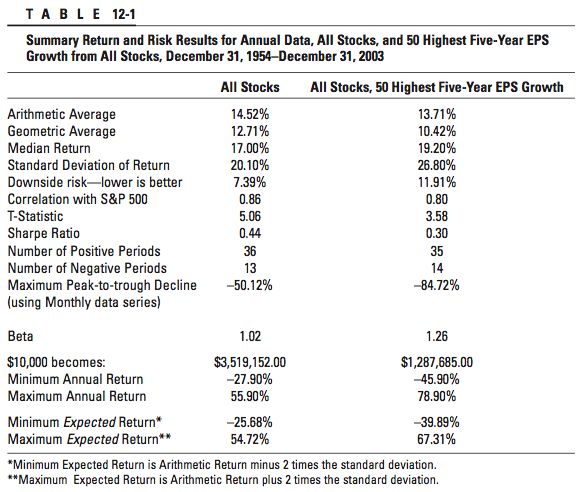
Unfortunately, five years of big earnings gains doesn’t help us pick thoroughbreds either. Starting on December 31, 1954 (we need five years of data to compute the compound five-year earnings growth rate), $10,000 invested in the 50 stocks from the All Stocks universe with the highest five-year compound earnings-per-share growth rates grew to $1,287,685 by the end of 2003, a compound return of 10.42 percent (Table 12-1). A $10,000 investment in the All Stocks universe on December 31, 1954 was worth $3,519,152 on December 31, 2003, a return of 12.71 percent a year.

O’Shaughnessy interprets the data thus:

Much like the 50 stocks with the highest one-year earnings gains, investors get dazzled by high five-year earnings growth rates and bid prices to unsustainable levels. When the future earnings are lower than expected, investors punish their former darlings and prices swoon.

The evidence shows that it is a mistake to get overly excited by big earnings gains.

Five-year growth rates are clearly mean reverting, and I love to see an intuitive strategy beaten by a little reversion to the mean.

Read Full Post »

Fortune has an article asking whether VCs can be value investors:

After all, the philosophy of value investing, in theory, should cut across all asset classes and managers. The precepts and principals therefore should apply to the venture capital business as well.

Sadly, they don’t.

Jeffrey Bussgang, the author, identifies the problem as an inability to invest with a margin of safety:

Klarman writes: “Investing in bargain-priced securities provides a “margin of safety” — room for error, imprecision, bad luck, or the vicissitudes of the economy and stock market.”

Unfortunately, VCs don’t operate with a margin of safety, even if they are able to find and negotiate good deals. Later stage investors may have downside protection if they buy smart, but early-stage VCs do not. If a portfolio company goes bad, there is typically barely any salvage value.

I don’t know that venture capital investing necessarily means investing without a margin of safety, but I agree that many early stage investments lack a margin of safety.

An estimate of intrinsic value is key to determining a margin of safety. Early stage businesses by definition lack a track record, and – BYD aside – not even Buffett can value a business without a track record. It is more difficult when the business has promise, but is burning cash, if only because the blue sky makes it easier to ignore the ugly financial statements.

Confronted with this state of affairs – no track record, no ability to see the future – most value investors would do as Buffett suggests and simply refuse to swing. This is one of the nice things about value investing. You don’t have to know everything about everything, or even much about anything. All you have to know is what you do know, and what you don’t know, and the location of the line separating the two.

Venture capitalists, however, must know stuff about the future, and must be able to “see around corners” (seriously?). To the extent that venture capitalists undertake any sort of valuation that a value investor might recognize, they must extrapolate revenue growth from non-existent revenue, hope that some of it eventually falls to the bottom line, and then into the hands of shareholders, and plug it into a model with the Gordon Growth Model (GGM) at its heart. (As an aside, I could barely type with a straight face that part about venture capitalists waiting for the dividends. I know they “exit” in a trade sale or IPO, which I guess is a euphemism for “sell to a greater fool.”)

Every value investor knows that big growth assumptions in the GGM – even those based on a historical track record – are a recipe for disaster. Why? Simply because the growth is always going to be so astronomical as to overwhelm the discount rate portion of the model, leading to a “Choose your own value” output. To wit:

Value = D / R – G

Where D is next year’s dividend, R is your discount rate and  G is the perpetuity growth rate

If R is say 10-12%, any G over 9-11% gives a value that is more than 100x dividends, which is pricey. I doubt there are any VCs getting out of bed for 10% growth assumptions, so I assume they crank up their discount rates, but the result is the same. As G approaches R, value approaches infinity, and, in some instances, beyond. The solution to this problem is obviously to assume a short period of supernormal growth and then a perpetuity of GDP (or some other, lower) growth figure. This just creates another problem, which, for mine, is too many assumptions, and too many moving parts to get a meaningful valuation.

In this vein, I had a chat with a friend who is a value guy about Facebook’s “valuation”. He says:

Originally thought that the $33b Facebook valuation was ridiculous but am beginning to breathe the fumes. It is taking over the world. Set me straight please!

I responded:

Sounds pretty crazy to me. Might be based on a Gordon Growth Model-type valuation which #Refs out once the assumed growth exceeds the discount rate (which it almost assuredly would for Facebook). That said, these crazies don’t seem to think it’s so crazy.

Says he:

One of the commenters on that site has set me straight:

“Google provides a relevant service. FB is a spam hole. No one is going to pay for spam unless it’s from the guy at the other end of the ad stealing your credit card #. FB is worthless. And of that 1 billion (doubt it), they still owe around 150 million for financing servers and other things. If they had the funds, don;t you think they’d be smart enough to pay CASH, instead of paying interest on a LOAN?”

Insightful stuff. Shame on me.

So the answer for VCs is simple. The valuation is too hard so ignore it, but buy a portfolio of interesting businesses and hope that you get a few home runs. Oh, also sell some of your early shares in Facebook at that $33B valuation because you never know what lurks around the corner.

Read Full Post »

« Newer Posts - Older Posts »