Feeds:
Posts
Comments

Posts Tagged ‘Net Net’

Continuing the quantitative value investment theme I’ve been trying to develop over the last week or so, I present my definition of a simple quantitative value strategy: net nets. James Montier, author of the essay Painting By Numbers: An Ode To Quant, which I use as the justification for simple quantitative investing, authored an article in September 2008 specifically dealing with net nets as a global investment strategy: Graham’’s net-nets: outdated or outstanding? (Edit: It seems this link no longer works as SG obliterates any article ever written by Montier). Quelle surprise, Montier found that buying net-nets is a viable and profitable strategy:

Testing such a deep value approach reveals that it would have been a highly profitable strategy. Over the period 1985-2007, buying a global basket of net-nets would have generated a return of over 35% p.a. versus an equally weighted universe return of 17% p.a.

An annual return of 35% over 23 years would put you in elite company indeed, so Montier’s methodology is worthy of closer inspection. Unfortunately he doesn’t discuss his methodology in any detail, other than to say as follows:

I decided to test the performance of buying net-nets on a global basis. I used a sample of developed markets over the period 1985 onwards, all returns were in dollar terms.

It may have been a strategy similar to the annual rebalancing methodology discussed in Oppenheimer’s Ben Graham’s Net Current Asset Values: A Performance Update. That paper demonstrates a purely mechanical annual rebalancing of stocks meeting Graham’s net current asset value criterion generated a mean return between 1970 and 1983  of “29.4% per year versus 11.5% per year for the NYSE-AMEX Index.” It doesn’t really matter exactly how Montier generated his return. Whether he bought each net net as it became a net net or simply purchased a basket on a regular basis (monthly, quarterly, annually, whatever), it’s sufficient to know that he was testing the holding of a basket of net nets throughout the period 1985 to 2007.

Montier’s findings are as follows:

  • The net-nets portfolio contains a median universe of 65 stocks per year.
  • There is a small cap bias to the portfolio. The median market cap of a net-net is US$21m.
  • At the time of writing (September 2008), Montier found around 175 net-nets globally. Over half were in Japan.
  • If we define total business failure as stocks that drop more than 90% in a year, then the net-nets portfolio sees about 5% of its constituents witnessing such an event. In the broad market only around 2% of stocks suffer such an outcome.
  • The overall portfolio suffered only three down years in our sample, compared to six for the overall market.

Several of Montier’s findings are particularly interesting to me. At an individual company level, a net net is more likely to suffer a permanent loss of capital than the average stock:

If we define a permanent loss of capital as a decline of 90% or more in a single year, then we see 5% of the net-nets selections suffering such a fate, compared with 2% in the broader market.

Here’s the chart:
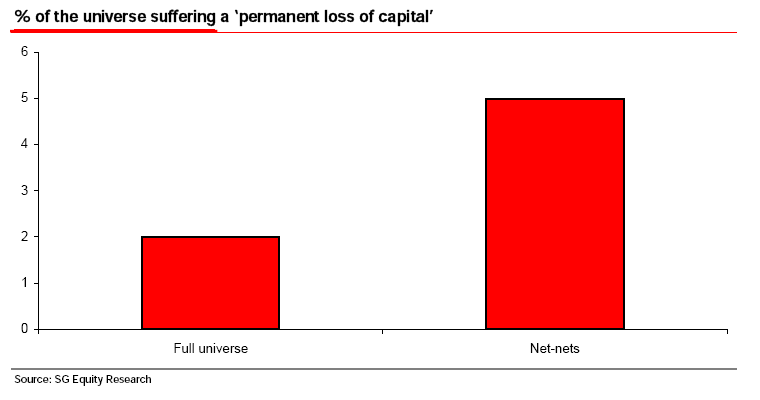
This is interesting given that NCAV is often used as a proxy for liquidation value.

Very few companies turn out to have an ultimate value less than the working capital alone, although scattered instances may be found.

Montier believes this may provide a clue as to why the net net strategy continues to work:

This relatively poor performance may hint at an explanation as to why investors shy away from net-nets. If investors look at the performance of the individual stocks in their portfolio rather than the portfolio itself (known as ‘narrow-framing’), then they will see big losses more often than if they follow a broad market strategy. We know that people are generally loss averse, so they tend to feel losses far more than gains. This asymmetric response coupled with narrow framing means that investors in the net-nets strategy need to overcome several behavioural biases.

Paradoxically, it seems that what is true at the individual company level is not true at an aggregate level. The net net strategy has fewer down years than the market:

If one were to frame more broadly and look at the portfolio performance overall, the picture is much brighter. The net-net strategy only generated losses in three years in the entire sample we backtested. In contrast, the overall market witnessed some six years of negative returns.

Here’s the chart:

And it seems that the net net strategy is a reasonable contrary indicator. When the market is up, fewer can be found, and when the market is down, they seem to be available in abundance:
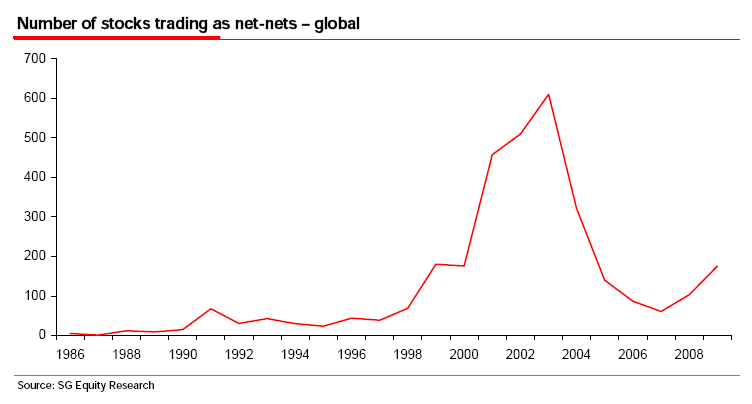
The main drawback to the net net strategy is its limited application. Stocks tend to be small and illiquid, which puts a limit on the amount of capital that can be safely run using it. That aside, it seems like a good way to get started in a small fund or with a individual account. Montier concludes:

…In various ways practically all these bargain issues turned out to be profitable and the average annual return proved much more remunerative than most other investments.

Good old Benjamin Graham. What a guy.

Buy my book The Acquirer’s Multiple: How the Billionaire Contrarians of Deep Value Beat the Market from on Kindlepaperback, and Audible.

Here’s your book for the fall if you’re on global Wall Street. Tobias Carlisle has hit a home run deep over left field. It’s an incredibly smart, dense, 213 pages on how to not lose money in the market. It’s your Autumn smart read. –Tom Keene, Bloomberg’s Editor-At-Large, Bloomberg Surveillance, September 9, 2014.

Click here if you’d like to read more on The Acquirer’s Multiple, or connect with me on Twitter, LinkedIn or Facebook. Check out the best deep value stocks in the largest 1000 names for free on the deep value stock screener at The Acquirer’s Multiple®.
Read Full Post »

Forward Industries Inc (NASDAQ:FORD) has filed its 10K for the period ended September 30, 2009.

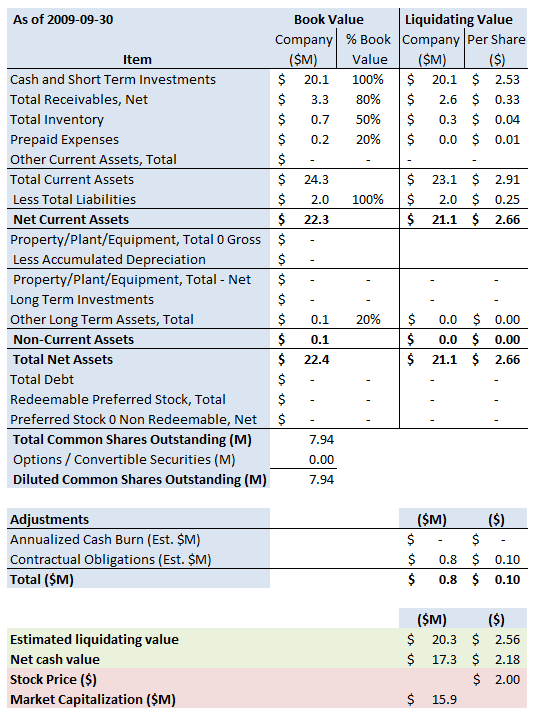
We started following FORD (see the post archive here) because it was trading at a discount to its net cash and liquidation values, although there was no obvious catalyst. Management appeared to be considering a “strategic transaction” of some kind, which might have included an “acquisition or some other combination.” I think a better use of the cash on the balance sheet is a share buy-back or a dividend. Trinad Management had an activist position in the stock, but had been selling at the time I opened the position and only one stockholder owned more than 5% of the stock. The stock is up 40.3% since I opened the position to close yesterday at $2.00, giving the company a market capitalization of $15.9M. Following my review of the most recent 10K, I’ve increased my estimate of FORD’s liquidation value to around $20.3M or $2.56 per share.

The value proposition updated

FORD continues to face difficult trading conditions, writing in the most recent 10K:

Trends and Economic Environment

We believe that the poor economy, high unemployment, tight credit markets, and heightened uncertainty in financial markets during the past two years have adversely impacted discretionary consumer spending, including spending on the types of electronic devices that are accessorized by our products. In response to the economic recession certain of our major diabetic case customers have significantly reduced their sales forecasts to us for blood glucose diagnostic kits, with which our products are packaged in box, therefore implying reduced sales revenues from these customers in future periods. We expect this challenging business environment to continue in the near term.

Our response to current conditions has been to cut operating expenses and reduce headcount; and we have attempted to limit increases in operating expenses except where we think increases are critical to potential future growth.

In response to increasing customer and sales concentration, we have focused marketing efforts on expanding our customer base. These efforts are meeting with some preliminary success, although the degree of success will not become apparent until we are deeper into Fiscal 2010. We have received small, initial orders from first time customers. The key question in Fiscal 2010 will be whether our overall net sales and net profit will primarily reflect revenue contribution from new customers or the decline in revenues from existing customers that have indicated reduced order flow in Fiscal 2010. See Part I, Item IA. of this Annual Report, “Risk Factors”, including “We have announced our intention to diversify our business by means of acquisition or other business combination.”

The company had another quarter that was better than the preceding one, generating positive cash from operating activities of around $0.35M (the “Book Value” column shows the assets as they are carried in the financial statements, and the “Liquidating Value” column shows our estimate of the value of the assets in a liquidation):

Summary balance sheet adjustments

I’ve made the following adjustments to the balance sheet estimates (included in the valuation above):

  • Cash burn: I’ve got no real idea about FORD’s prospects. It seems to have stopped burning cash over the last quarter and actually generated $0.35M. If we assume, as management has, that the company will face a tough operating environment over the next 12 months, I estimate that the company will generate no cash over that period.
  • Off-balance sheet arrangements: According to FORD’s most recent 10Q, it has no off-balance sheet arrangements.
  • Contractual obligations: FORD’s contractual obligations are minimal, totalling $0.8M.

Possible catalysts

FORD’s President and Acting Chairman, Mr. Doug Sabra, said in the letter to FORD shareholders accompanying the notice of annual shareholders’ meeting, that in 2008 “management began to implement operational and strategic initiatives in order to put [FORD]’s business on a stronger, more sustainable footing. …  This past August we retained an outside consultant to assist us in vetting possible partners for a strategic transaction.” It seems that the “strategic transaction” might include a “possible acquisition or other combination that makes sense in the context of [FORD’s] existing business, without jeopardizing the strong financial position that we have worked so hard to build.” My vast preference is for a sale of the company, buyback, special dividend or return of capital over an acquisition. Rather than spend the cash on their balance sheet, they should focus on the work on their desk and pay a big dividend.

Any sale transaction will require the consent of FORD’s board. While it has a free float of around 92%, the company’s so-called “Anti-takeover Provisions” authorize the board to issue up to 4M shares of “blank check” preferred stock. From the 10K:

Our Board of Directors is authorized to issue up to 4,000,000 shares of “blank check” preferred stock. Our Board of Directors has the authority, without shareholder approval, to issue such preferred stock in one or more series and to fix the relative rights and preferences thereof including their redemption, dividend and conversion rights. Our ability to issue the authorized but unissued shares of preferred stock could be used to impede takeovers of our company. Under certain circumstance, the issuance of the preferred stock could make it more difficult for a third party to gain control of Forward, discourage bids for the common stock at a premium, or otherwise adversely affect the market price of our common stock. In addition, our certificate of incorporation requires the affirmative vote of two-thirds of the shares outstanding to approve a business combination such as a merger or sale of all or substantially all assets. Such provision and blank check preferred stock may discourage attempts to acquire Forward. Applicable laws that impose restrictions on, or regulate the manner of, a takeover attempt may also have the effect of deterring any such transaction. We are not aware of any attempt to acquire Forward.

Conclusion

FORD is still trading at a substantial discount to its liquidation and net cash values. The risk to this position is management spraying the cash away on an acquisition. A far better use of the company’s cash is a buyback, special dividend or return of capital. Another concern is Trinad Management exiting its activist position in the stock. Those concerns aside, I’m going to maintain the position because it still looks cheap at a discount to net cash.

[Full Disclosure:  We have a holding in FORD. This is neither a recommendation to buy or sell any securities. All information provided believed to be reliable and presented for information purposes only. Do your own research before investing in any security.]

Read Full Post »

Greenbackd is dedicated to unearthing undervalued asset situations where a catalyst exists likely to remove the discount or unlock the value. My favorite stocks are those trading at a substantial discount to net current assets or liquidation value, with an activist pushing for a catalyst to unlock the value. Those opportunities, however, are few and far between. I can frequently find deeply undervalued asset situations with no obvious catalyst. I can often also find activists in stocks that are not undervalued on a Graham asset basis.

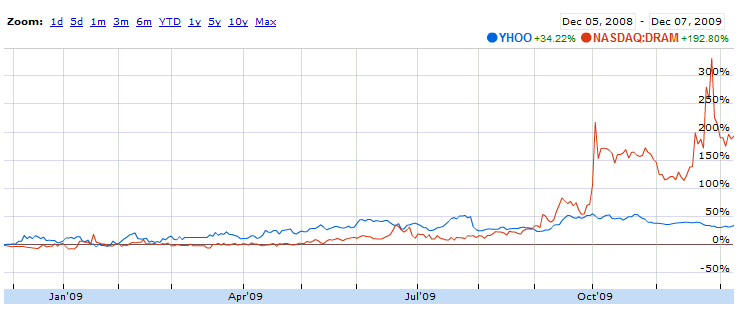
A little over a year ago in a post titled Net Net vs Activist Legend I started a thought experiment pitting Dataram Corporation (NASDAQ:DRAM), a little Graham net net, against activist investing legend Carl Icahn and his position in Yahoo! Inc. (NASDAQ: YHOO) (click on the links to laugh at how rudimentary Greenbackd looked then). The idea was simple: Compare the performance of two stocks, one a net net / net cash stock lacking a catalyst, and the other a stock not obviously undervalued on an asset basis, but nonetheless pursued by an activist investor, Carl Icahn.

In the blue corner, YHOO, the super heavyweight

Here’s what I had to say about YHOO at the time:

YHOO is a stock that is not cheap on an asset basis but it does have a prominent activist investor with a 5.5% stake and two seats on the board. At its Friday close of $11.66, which is around two-thirds lower than Microsoft’s May 2008 $33 bid, YHOO still trades at a 70% premium to our $6.82 per share estimate of its asset value. Activist investor Carl Icahn’s presence on the register, however, indicates that he believes YHOO is worth more. Icahn has paid an average of $23.59 per share to accumulate his 5.5 percent stake. At $11.66, YHOO must more than double before Icahn will see a profit. He’s unlikely to sit idly by to see if that happens.

YHOO is not cheap on any theory of value we care to employ. It is trading at a substantial premium to its asset backing, which means the market is still generously valuing its future earnings. It is generating substantial operating cash flow and earnings, which in a better market might be worth more, but it’s not obviously cheap to us.

The best thing about YHOO from our perspective is the presence of Carl Icahn on the register. His holdings were purchased at much higher prices than are presently available and he is unlikely to sit idly by while the stock stagnates.

Buying YHOO at these prices is a bet that Icahn can engineer a deal for the company. Given his legendary status as an activist investor earned through canny acquisitions over many years, we think that’s a good bet. But a bet is what it is – it’s speculation and not investment. If speculation is your game, then we wish you the best of luck but know that the price might fall a long way if he sells out. If you’re an investor, the price is too high.

YHOO closed Friday at $11.66 and the S&P 500 Index closed at 876.07.

And in the red corner, DRAM, a light flyweight

Here’s my take on DRAM’s chances:

DRAM, at 58% of its liquidating value and 76% of its cash backing, is very cheap. We believe that it is worth watching but, with no obvious catalysts and a high cash burn rate, probably one to avoid unless you are willing to bet that its remaining cash might attract an activist or the business will turn around before it runs out of money.

The risk with DRAM, as it is with any net net or net cash stock, is that the company might not make a profit any time soon and won’t liquidate before it dissipates its remaining cash. As we said above, we’ve got no insight into DRAM’s business and don’t know whether it can trade out of its present difficulties and back to at least a positive operating cash flow. According to the 10Q, the company is authorized to repurchase 172,196 shares under a stock repurchase plan but this is an immaterial amount in the context of the 8.9M shares on issue and the plan has been in existence since 2002. The best hope for the stockholders is that the company re-institutes its dividend, which, given its $16M in cash, it certainly seems able to do. No noted activists have disclosed a holding in the company, which means management have no incentive to do anything so stockholder friendly.

Let’s get ready to rumbllllllllllllllllllllllllle…..

Here’s the call of the fight:

The first 10 rounds were to YHOO, but DRAM landed a crushing blow at the end of the 10th. From there, DRAM pounded away while YHOO got the staggers. At the final bell, YHOO managed a respectable 34.2%, but it wasn’t in DRAM’s league, up an incredible 192.8%.

Post mortem

There’s nothing statistically significant about this little experiment, but, regardless, I think it’s interesting. As I’ve discussed in previous posts, small investors have a huge advantage over larger, professional investors. There is nothing easier to analyse than a Graham net net or liquidation play (here’s my post on Graham’s liquidation value methodology), and, as Professor Henry Oppenheimer demonstrated, the returns to a very simple buy-and-hold-for-a-year-and-repeat strategy will put investment professionals to shame. Graham’s methodology is robust and has withstood the test of time. With a little patience, investing like Graham did provides a tailwind that forgives many investing sins. Here’s to the little guys.

Gonna fly now

Go. Go. Go. Go. Go. Goooooooooo…..

Read Full Post »

« Newer Posts