Feeds:
Posts
Comments

Posts Tagged ‘Net Current Asset Value’

Value Investors For Change, a group dedicated to restoring stockholder value to damaged companies, filed a definitive proxy statement today nominating eight candidates to the board of MRV Communications, Inc. (OTC:MRVC). Value Investors For Change sent a letter to stockholders  detailing the failures of the current board and the turnaround plan put forth by Value Investors For Change.

We’ve been following MRVC (see our MRVC post archive) because it’s an activist play with Value Investors for Change – who recently filed proxy documents in relation to VXGN – seeking to replace the “current, ineffective board of directors” with a new board of “highly qualified, independent directors committed to realizing for all MRVC stockholders the fullest potential of their investments.” Value Investors for Change detail a litany of problems with this stock in the preliminary proxy filing, which range from a simple failure to file financial statements or hold an annual meeting to the mishandling of an acquisition and an options dating scandal. What’s the attraction to the stock? Two things:

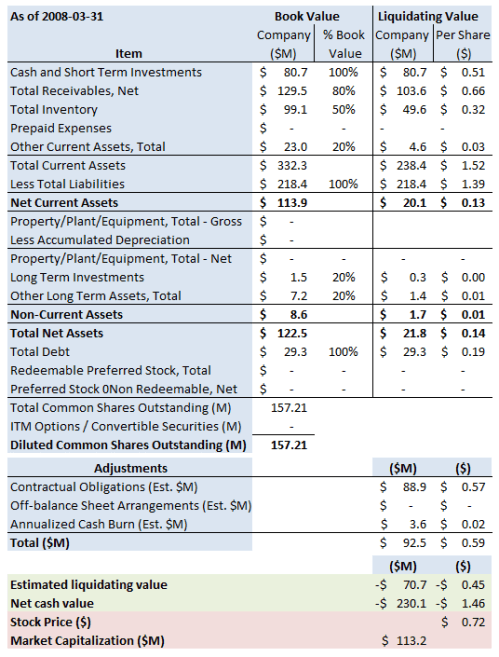
1. As at the last filing date, for the period ended March 31, 2008, MRVC’s (unaudited) NCAV was around $113.9M or $0.72 per share. Note that the liquidation value is likely negligible and the financial statements are more than a year out of date (which makes any valuation problematic). One positive is the revenue: the company has annualized revenue of around $500M. A small improvement in margins could result in a big improvement in earnings.

2. Value Investors for Change believes the company has a “valuable franchise and a strong market position” and we like their approach, described in the preliminary proxy documents thus:

The participants in this solicitation (collectively, “Value Investors for Change”) are investors who seek to encourage companies to create, preserve and enhance long-term value for their stockholders, the true owners of America’s public companies. We have developed a sophisticated screening process that we use to identify public companies that we believe (i) are undervalued, (ii) are not adequately serving the interests of their stockholders and (iii) require a new board of directors, so that, with the encouragement of stockholders such as you, we can begin implementing reforms ourselves with the goal of increasing stockholder value.

The stock is up 19.4% since we started following it to close yesterday at $0.86.

The text of the letter to stockholders is set out below:

Dear Fellow Stockholders of MRV Communications, Inc.:

We are seeking your support to elect highly qualified and experienced telecom and corporate finance executives to the Board of Directors of MRV Communications, Inc. (“MRV” or the “Company”) at the 2009 Annual Meeting of stockholders on November 11, 2009. Value Investors for Change and its participants named in our proxy statement filed on October 7, 2009 collectively own 1,982,085 shares of common stock of MRV. We are concerned and alarmed by the actions this Board has taken over the past ten years, which we believe have not been in the best interests of stockholders. The Board members have enriched themselves at the expense of stockholders. It is imperative that the incumbent Board members be replaced with our qualified nominees who will truly represent the interests of stockholders.

DO NOT LET THE CURRENT BOARD MEMBERS FURTHER JEOPARDIZE YOUR INVESTMENT

In our view, this Board’s actions of the last ten years reflect poor corporate governance, poor acquisition strategy and poor oversight of management. The incumbent Board has presided over a company that has failed to file its financial statements for any period since the quarter ended March 31, 2008, failed to hold an annual meeting since 2007, and failed to file an Annual Report for the year ended 2008. Meanwhile, this Board has paid itself hundreds of thousands of dollars per year.

For years, the incumbent Board members have compensated themselves with generous cash payments even as MRV’s stock price has fallen. In contrast, our nominees will accept no cash payments. In fact, our nominees will accept no compensation whatsoever except for stock option grants at or above market value. Our nominees will therefore earn absolutely nothing for their Board service unless they increase the share price.

We expect that the incumbent Board members will now spend stockholder money to keep their positions with mailings and telephone calls aimed at discrediting our nominees and our views of their stewardship. For example, the incumbent board recently sent a letter to stockholders that claimed the Company’s recent troubles were caused by “one of the most economically challenging periods in recent history.” In fact, MRV’s troubles began long before the recent global economic crisis.

Fact: The share price of MRV has dropped from $95 (adjusted for stock split) on March 9, 2000 to 66 cents on August 21, 2009. On August 21, 2009, we announced our intention to intervene at MRV to create value for all MRV stockholders.

Fact: Over a period of 15 years (1993 to 2007), MRV has reported losses of approximately one billion dollars.

Fact: While MRV’s performance has continued to be poor under this Board’s leadership, its competitors have thrived. Ciena Corporation and Extreme Networks posted net income of $39 million and $8 million, respectively, for 2008. MRV has not filed its financials for most of 2008 and has not filed any financials for 2009, but in the first quarter of 2008, it posted a net loss of $3.68 million. This is consistent with the negative net income numbers MRV posted in 33 of the last 41 quarters for which it has actually disclosed its financials.

Fact: Under this Board’s “leadership,” MRV was suspended from its listing on the NASDAQ Global Market on June 17, 2009 and formally delisted on August 31, 2009 with a stock price of 74 cents per share.

THIS BOARD HAS PURSUED ILL CONCEIVED ACQUISITIONS THAT HAVE DESTROYED STOCKHOLDER VALUE OVER THE COURSE OF NEARLY A DECADE

• MRV began a risky acquisition strategy in 2000 that we believe has destroyed well over a billion dollars of stockholder value.

• MRV spent $690 million during an acquisition spree in 2000, over 4 times the Company’s current market capitalization.

• Almost $500 million — or 72% — of the purchase price of acquisitions in the year 2000 was allocated to goodwill (indicating the Company might have paid a substantial premium over fair value). After just two years, in 2002, the Company recorded nearly $300 million of impairment (cumulative effect of accounting change) related to goodwill and other intangibles, in addition to impairment of $73 million of goodwill related to the acquisitions. We believe impairment of goodwill so soon after the acquisitions is consistent with a failure of management to operate the business capably.

• MRV acquired Fiber Optic Communications Inc. for $310 million in April 2000 and acquired Quantum Optech Inc. for $36 million in July 2000. In October 2002, 78% of Fiber Optic and 100% of Quantum Optech were sold to the prior management of Fiber Optic for a mere $8 million, resulting in an astonishing loss of hundreds of millions of dollars for MRV stockholders.

We believe the most egregious of the Company’s ill conceived out acquisitions was the 2007 acquisition of Chinese component manufacturer Fiberxon, Inc. Fiberxon was a company so fraught with accounting irregularities that its own auditing firm resigned midway through the transaction process. Yet the Board of MRV decided to continue to pursue the acquisition anyway. Below is a time line displaying a decision-making process at odds with the best interests of the Company’s stockholders:

• In January 2007, MRV announced the merger of one of its wholly owned subsidiaries with Fiberxon. We believe questions concerning the integration of two such disparate companies existed, especially considering MRV’s poor acquisition history.

• During the due diligence phase of the acquisition, MRV became aware of accounting irregularities at Fiberxon that called into question the reliability of Fiberxon’s historical financial statements, which were serious enough in nature to lead to the removal of the Chief Executive Officer and the Vice-President of Finance of Fiberxon in the first half of 2007. The Chief Financial Officer of MRV, who had been playing a major role in the auditing process, resigned mid-way through the transaction process in July 2007.

Fiberxon’s own auditors walked away from the auditing engagement in June 2007 when they determined that insufficient progress had been made by Fiberxon to correct identified issues. The auditors stated in a Form 8-K filed by the Company on July 2, 2007 that they found “a number of serious issues and encountered significant difficulties in the performance of the audit that…called into question the commitment of Fiberxon’s management to maintain reliable financial reporting systems, including accounting books and records, in conformity with accounting principles generally accepted in the U.S. and China.

• On July 1, 2007, the MRV Board decided to proceed with the merger despite (1) the accounting issues communicated to them throughout the auditing process, (2) the resignation of MRV’s Chief Financial Officer and (3) the resignation of Fiberxon’s own auditors.

• After spending over $875 million on acquisitions in the past ten years, MRV’s current market cap today is under $150 million.

THE CURRENT BOARD’S CORPORATE GOVERNANCE FAILURES, LACK OF INDEPENDENCE AND EXCESSIVE COMPENSATION ARE DETRIMENTAL TO STOCKHOLDERS

MRV has not filed financial statements for any period since the quarter ended March 31, 2008. Five financial quarters have passed since MRV last filed financials. Why has it taken so long?

We believe the MRV Board suffers from a significant lack of independence and a lack of share ownership by its independent directors. We also believe the Board has a particularly cozy relationship with the management team that it is supposed to be overseeing. For example:

• Shlomo Margalit, Chairman of the Board, and Near Margalit, the head of MRV’s wholly owned subsidiary Luminent, are father and son.

• Harold Furchtgott-Roth, a director on the Board since 2005, served on the Audit Committee during MRV’s failure to file financials for almost two years, and beneficially owned only 27,500 shares of MRV as of April 2007. Mr. Furchtgott-Roth is related to the wife of the Company’s Chief Executive Officer, Noam Lotan, and according to a Company filing with the U.S. Securities and Exchange Commission on October 2, 2009, received $119,000 in cash compensation for sitting on the Board, over twice as much as any other “independent” Board member.

• The Board has complete discretion over executive compensation with no formula tying compensation directly to Company performance. In fact, despite being delisted and failing to file financial statements for any period since the quarter ended March 31, 2008, the Compensation Committee recently awarded a bonus to Near Margalit, the son of MRV’s Chairman, for “his efforts in addressing the impact of the challenging market environment.”

This Board has made a number of poor decisions which have led to value destruction for all stockholders. By electing our nominees, you are sending a clear message to the Board that they will be held responsible for these actions.

The incumbent independent directors own little or no shares and the Board continues to be paid without having to even run for election – until now. Indeed, Spencer Capital Opportunity Fund, LP had to bring a lawsuit to compel the Company to hold its 2009 Annual Meeting. Our nominees are committed to working hard to maximize value for all stockholders. They will show their commitment by accepting no cash compensation and only receiving stock option grants at or above market value. Accordingly, they will be compensated only if they increase MRV’s stock price.

OUR NOMINEES HAVE THE EXPERIENCE TO IMPROVE THE PERFORMANCE OF MRV AND THEREFORE THE VALUE OF ITS STOCK

Value Investors for Change has assembled a team combining individuals with extensive telecom expertise with financial experts who understand the importance of corporate governance. We firmly believe our nominees, along with our industry advisors, will make a significant positive impact for the benefit of MRV’s stockholders.

Our proposed nominees and our advisors have experience and specific skill sets that are complementary and will benefit the Company. The telecom executives, who are part of Value Investors for Change, have more than 90 years of combined experience. Others in the group bring operational, legal, financial and management expertise. Our nominees and advisors have worked with Fortune 500 telecom companies and venture-funded start-ups, they have navigated turnaround situations and managed high-growth companies. They understand operations, marketing, R&D, sales and have extensive international business development experience.

The following is a list of our Board Nominees:

Raul Martynek is an experienced telecom executive who has successfully executed turnarounds on several occasions during his 15-year career. He currently serves as a Senior Advisor to Plainfield Asset Management, advising them on investment opportunities in the telecommunications sector and also works with portfolio companies on strategic and tactical initiatives. Mr. Martynek received a B.A. in Political Science from SUNY-Binghamton and received a Masters in International Finance from Columbia University School of International and Public Affairs.

Christopher Downie is a telecom executive with diverse experience spanning more than ten years. He is currently the President and Chief Financial Officer of The Telx Group, Inc. and he previously served as Vice President, Executive Vice President, Chief Operating Officer, Chief Financial Officer and Treasurer of Motient Corporation, D/B/A Terrestar Corporation. Mr. Downie received a B.A. from Dartmouth College and holds an MBA from New York University Stern School of Business.

Michael McConnell is currently the Chief Executive Officer of Collectors Universe, Inc., a third-party grading and authentication services company. Previously he was a Managing Director of Shamrock Capital Advisors, Inc., a privately owned investment company of the Roy E. Disney family, where he helped guide numerous companies through strategic restructurings. Mr. McConnell received a B.A. in economics from Harvard University and his MBA degree from the Darden School of the University of Virginia.

Mark Stolper has served in numerous executive capacities in different industries over his 15-year career. He is currently the Chief Financial Officer of RadNet, Inc., a leading owner and operator of outpatient medical diagnostic imaging centers in the United States. He received a B.S. in Finance and B.A. in Social Economics & Public Policy from the Wharton School and the College of Arts and Sciences at the University of Pennsylvania.

Mark Crockett is a performance improvement consultant with more than 15 years of experience. He worked at McKinsey & Company for five years and served as Chief Executive Officer of Tax One, a retail financial services company from 1999 to 2002. He received a B.S. in Economics from Brigham Young University and a J.D. from Stanford Law School.

Charles Gillman is an experienced value investor with expertise in the analysis of companies going through dramatic corporate transitions. He is the founder of Value Fund Advisors, LLC, an investment management firm. Mr. Gillman is an alumnus of McKinsey & Company. Mr. Gillman received a B.S. from the Wharton School of the University of Pennsylvania.

Kenneth Shubin Stein is the founder of Spencer Capital Management, LLC, an investment management firm. A successful value investor, he began his career in medicine serving as an Orthopedic Resident at Mount Sinai Hospital. Dr. Shubin Stein is a graduate of the Albert Einstein College of Medicine and graduated from Columbia College.

Kiril Dobrovolsky is the principal and founder of SFVentureLaw, PC, a law firm in San Francisco. Mr. Dobrovolsky practices as a corporate and securities law attorney and has extensive expertise in equity and debt offerings, mergers and acquisitions, licensing and partnering arrangements and commercial agreements. Mr. Dobrovolsky received a B.A. from University of California at Berkeley and a J.D. from Stanford Law School.

The following two individuals are our special advisors:

Dilip Singh is a special advisor to Value Investors for Change. With more than 35 years of operational executive management experience, Mr. Singh is well suited to provide tactical and innovative guidance to the Value Investors for Change team through his blend of business acumen, market and technical knowledge and strategic insight. He has held key leadership roles at of Telia-Sonera Spice Nepal, Telenity, Sprint, GTE, ADC Telecom, Alcatel, NewNet, MC Venture Partners and United Database. Mr. Singh will not be soliciting proxies on our behalf for this solicitation.

Jack Whelan is a special advisor to Value Investors for Change. He is a former networking industry sales executive whose career spans more than 30 years. From 1989-1996, he was Vice-President for business development for Xyplex Inc., a telecommunications company that later became MRV Communications.

OUR NOMINEES HAVE A PLAN TO IMPROVE THE COMPANY’S OPERATIONAL AND FINANCIAL PERFORMANCE, WHICH WE BELIEVE WILL MAXIMIZE VALUE FOR STOCKHOLDERS

Value Investors for Change will take steps we believe will restore profitability and create wealth for all MRV stockholders.

• Our nominees will immediately suspend the practice of paying excessive fees to Board members. Our nominees will accept no cash payments for board service, and will not accept any form of compensation except for stock option grants at or above market value. Therefore the only way our nominees can benefit financially from their service to the Board will be through long-term appreciation in the stock price.

• We will institute a management compensation system that is heavily weighted towards pay for performance.

• We will conduct a forensic review of the Company’s financials and bring MRV into compliance with all of its reporting requirements.

• We will work with regulatory authorities and outside parties to quickly resolve the many outstanding legal difficulties of the Company.

• We will look to optimize MRV’s cost structure and maximize operating efficiency.

• We will utilize the expertise of our advisors and board members to enhance the Company’s distribution channels, both domestically and internationally.

• We will work tirelessly to create substantial long-term wealth for the stockholders.

These changes and others will unlock stockholder value and put MRV in a position to realize its full potential.

VOTE THE WHITE PROXY CARD TODAY AND PUT NEW PEOPLE ON THE MRV BOARD – PEOPLE WHO ARE COMMITTED TO ACTING IN THE BEST INTERESTS OF STOCKHOLDERS

PROTECT YOUR INVESTMENT FROM AN INCUMBENT BOARD THAT HAS SPENT ALMOST TEN YEARS DESTROYING STOCKHOLDER VALUE

We urge all stockholders to elect our director nominees on the enclosed WHITE proxy card today. Vote for much needed change at MRV by signing, dating and returning the enclosed WHITE proxy card. Or you may vote by telephone or internet if you own stock through a bank or broker. We urge stockholders to discard any proxy materials you receive from MRV and to vote only the WHITE proxy card.

If you have already voted the proxy card provided by the Company, you have every right to change your vote by executing the enclosed WHITE proxy card – only the latest dated proxy card returned will be counted.

Your vote is very important, regardless of how many or how few shares you own. If you have any questions, or need assistance in voting your shares, please call our proxy solicitors, Okapi Partners LLC, toll-free at 1-877-274-8654.

Thank you for your support,

VALUE INVESTORS FOR CHANGE

[Full Disclosure: We do not have a holding in MRVC. This is neither a recommendation to buy or sell any securities. All information provided believed to be reliable and presented for information purposes only. Do your own research before investing in any security.]
Read Full Post »

MRV Communications Inc  (OTC:MRVC) is an activist play with Value Investors for Change – who recently filed proxy documents in relation to VXGN – seeking to replace the “current, ineffective board of directors” with a new board of “highly qualified, independent directors committed to realizing for all MRVC stockholders the fullest potential of their investments.” Value Investors for Change detail a litany of problems with this stock in the preliminary proxy filing, which range from a simple failure to file financial statements or hold an annual meeting to the mishandling of an acquisition and an options dating scandal. What’s the attraction to the stock? Two things:

1. As at the last filing date, for the period ended March 31, 2008, MRVC’s (unaudited) NCAV was around $113.9M or $0.72 per share, which is yesterday’s closing price. Note that the liquidation value is likely negligible and the financial statements are more than a year out of date (which makes any valuation problematic). One positive is the revenue: the company has annualized revenue of around $500M. A small improvement in margins could result in a big improvement in earnings.

2. Value Investors for Change believes the company has a “valuable franchise and a strong market position” and we like their approach, described in the preliminary proxy documents thus:

The participants in this solicitation (collectively, “Value Investors for Change”) are investors who seek to encourage companies to create, preserve and enhance long-term value for their stockholders, the true owners of America’s public companies. We have developed a sophisticated screening process that we use to identify public companies that we believe (i) are undervalued, (ii) are not adequately serving the interests of their stockholders and (iii) require a new board of directors, so that, with the encouragement of stockholders such as you, we can begin implementing reforms ourselves with the goal of increasing stockholder value.

We’re adding MRVC to our Special Situations portfolio at its $0.72 close yesterday.

About MRVC

From the last 10Q:

MRV Communications is a supplier of communications equipment and services to carriers, governments and enterprise customers, worldwide. We are also a supplier of optical components, primarily through our wholly owned subsidiaries: Source Photonics and Fiberxon. We conduct our business along three principal segments: (1) the network equipment group, (2) the network integration group and (3) the optical components group. Our network equipment group provides communications equipment that facilitates access, transport, aggregation and management of voice, data and video traffic in networks, data centers and laboratories used by telecommunications service providers, cable operators, enterprise customers and governments worldwide. Our network integration group operates primarily in Italy, France, Switzerland and Scandinavia, servicing Tier One carriers, regional carriers, large enterprises, and government institutions. We provide network system design, integration and distribution services that include products manufactured by third-party vendors, as well as products developed and manufactured by the network equipment group. Our optical components group designs, manufactures and sells optical communications products used in telecommunications systems and data communications networks. These products include passive optical network, or PON, subsystems, optical transceivers used in enterprise, access and metropolitan applications as well as other optical components, modules and subsystems. We market and sell our products worldwide, through a variety of channels, which include a dedicated direct sales force, manufacturers’ representatives, value-added-resellers, distributors and systems integrators.

In July 2007, we completed our acquisition of Fiberxon, a PRC-based supplier of transceivers for applications in metropolitan networks, access networks and passive optical networks, for approximately $131 million in cash and stock. Fiberxon is part of the Optical Components group, and its results of operations are included in our Consolidated Financial Statements from July 1, 2007.

The value proposition

The main problem with any analysis of MRVC is that the financial statements are more than a year out of date. As at the last filing, MRVC’s NCAV was around $113.9M or $0.72 per share. We believe that the liquidation value is likely neglible. We’ve set out the valuation below in the usual manner (the “Book Value” column shows the assets as they are carried in the financial statements, and the “Liquidating Value” column shows our estimate of the value of the assets in a liquidation):

MRVC SummaryAs at the last filing date, the company had quarterly revenue of $125M, which annualizes to around $500M. A small improvement in margins could result in a big improvement in earnings. Value Investors for Change seek to provide that improvement, which they describe in the preliminary proxy documents set out below.

The catalyst

From the preliminary proxy documents:

REASONS FOR THE SOLICITATION

Value Investors for Change believes that the Company has a valuable franchise and a strong market position. However, we believe this value has been masked and the Company’s potential remains unrealized due to the Board’s lack of effective oversight and appropriate corporate governance policies.

Our Nominees will provide new independent voices in the Company’s boardroom and they will seek to start the process of rebuilding stockholder value. Our Nominees are committed to fully implementing and embracing long overdue corporate governance reforms.

We do not believe the current directors serving on the Board are acting in the best interests of stockholders and are concerned that this Board will fail to take the steps we believe are necessary to preserve stockholder value.

Fate of the Company’s remaining cash balance

This Annual Meeting may be the only opportunity for stockholders to determine the fate of MRVC’s substantial remaining cash balance (this amount was $73.7 million as of June 30, 2009, including short-term investments, as per the Company’s press release attached as an exhibit to its Form 8-K filed on July 27, 2009). Actions and statements by the Company indicate that the existing management and Board are prepared to ignore the best interests of the Company’s stockholders. Indeed, their track record of negative operating cash flows over the past several years is reflective of the same. If the incumbent Board and management are not replaced at this Annual Meeting, stockholders may not only lose any hope of determining the fate of MRVC’s remaining cash reserves, but also will likely have their share value further eroded. If elected to the Board, none of our Nominees intend to accept any cash fees from the Company. The Funds’ only interest here is as a stockholder.

Deficient Corporate Governance Procedures; Recent Options Scandal

The Company continues to be embroiled in an options scandal. We believe the Board was in need of change even before the current scandal broke, but the options scandal has served to underscore the need for urgent reform.

According to a press release issued by the Company on June 5, 2008, beginning in the middle of 2006 through early 2007, MRVC conducted an informal review of its share-based award practices and concluded that there was no evidence that grant dates of options were designed to occur on dates with more favorable exercise prices (i.e., on dates with lower market prices). Given subsequent events, it appears though that this review, which lasted over six months, was inadequate and did not discover certain inappropriate practices which had taken place. During this lengthy investigation and after its completion, the Company filed numerous quarterly reports and an annual report on Form 10-K for the fiscal year ended December 31, 2007, certifying to the accuracy of those financial statements. Well after this investigation and after these filings, management then determined that the conclusions reached from the earlier review were incorrect with respect to certain options granted during the period from 2002 through the first quarter of 2004. The Board determined that the financial statements for the periods from 2002 to 2008 and the related reports of MRVC’s independent public accountants, earnings press releases, and similar communications previously issued by MRVC should not be relied upon as a consequence of the pending restatement of its historical financial statements. It has been over a year since the press release announcing this major problem for the Company was issued and yet no restatements of the Company’s financial statements have been filed.

As a result of these actions,

• the Company currently faces an inquiry by the Securities and Exchange Commission (the “Commission”);

• the Company has been unable to file its annual report on Form 10-K for the year ended December 31, 2008;

• the Company has been unable to file its quarterly reports on Form 10-Q for the periods ended June 30, 2008, September 20, 2008, March 31, 2009 and June 30, 2009;

• the Company has received 6 determination letters from NASDAQ informing the Company that it would be subject to delisting as a result of its failure to timely file its financial statements and, on June 17, 2009, NASDAQ suspended the listing of the Company’s common stock from the NASDAQ Stock Market as a result of the Company’s failure to file such financial statements;

• on August 19, 2009, the NASDAQ Stock Market announced that it will delist the Company’s common stock (NASDAQ will file a Form 25 with the Commission to complete the delisting which becomes effective ten days after the Form 25 is filed); and

• the Company faces various lawsuits related to its stock option practices.

These option grants raise serious questions about the Board’s judgment and apparent disregard for the interests of stockholders. Such behavior raises significant doubts about the integrity of the Board.

Mishandling of the Acquisition of Fiberxon

On June 26, 2007, the Company amended an Agreement and Plan of Merger between affiliates of the Company and Fiberxon, Inc. that was initially entered into on January 26, 2007 (the “Merger Agreement”) to, among other things, remove as a condition precedent for the consummation of the merger that Fiberxon, Inc. deliver to MRVC its audited consolidated financial statements prior to the closing of the transaction. This amendment was unanimously approved by MRVC’s Board despite their knowledge that:

• there were allegations of financial and accounting irregularities that called into question the reliability of Fiberxon’s consolidated financial statements for its fiscal years ended December 31, 2004 and 2005 raising serious concerns regarding Fiberxon’s financial and reporting processes;

• in addition to the irregularities, Fiberxon’s independent auditors called into question the commitment of Fiberxon’s management to maintain reliable financial reporting systems, including accounting books and records, in conformity with accounting principles generally accepted in the United States and the People’s Republic of China;

• in the view of Fiberxon’s auditors, these matters also raised doubt on the ability of Fiberxon’s existing management to provide its auditors the written representations required under auditing standards generally accepted in the United States; and

• the suspension by the independent auditors of its audit of Fiberxon’s financial statements in June 2007 would likely have an adverse impact on the Company’s ability to obtain and file Fiberxon’s financial statement within the time allowed by, and in the form and content required by, the Commission’s rules thereby leading to:

• MRVC not being eligible to use the Commission’s short-form registration statement on Form S-3 to register the issuance of its securities; and

• the delisting of the Company’s common stock from the NASDAQ Stock Market and, as a result of the delisting, a default on the Company’s outstanding convertible notes.

Additionally, the Board was aware that if MRVC delayed filing with the Commission certain financial statements relating to the Fiberxon acquisition, as required by the Commission, this would put at risk the Company’s ability to use an effective registration statement to issue securities, thus handcuffing the Company’s ability to raise funds if it became necessary to do so. We believe this lack of regard that the Board showed for the stockholders of the Company highlights the incompetence of the Board and the management of the Company.

Failure to Hold an Annual Meeting

The Annual Meeting is the once-a-year event for all stockholders to voice their views and concerns. Despite the Company’s professed commitment to stockholder democracy and good corporate governance, the Company appears unable to take appropriate actions regarding governance.

On July 20, 2009, Spencer Capital Opportunity Fund, LP filed a lawsuit in Delaware pursuant to Section 211(c) of the Delaware General Corporation Law requesting that the Court of Chancery of the State of Delaware (the “Chancery Court”) order MRVC to hold its 2009 annual meeting of stockholders without delay and to grant other relief deemed appropriate by the Court. Under Delaware law, if a corporation fails to hold an annual meeting of stockholders or take action by written consent to elect directors for a period of 13 months, any stockholder may petition the Chancery Court to order that a meeting be held. MRVC has not held an annual meeting of stockholders since May 29, 2007 and accordingly has not met its obligations under Delaware law.

Pursuant to a Stipulated Order entered into in the Chancery Court dated August 7, 2009 (the “Order”), MRVC will hold its Annual Meeting on or before November 11, 2009. In the event that the Company’s Board or its outside auditor determines that the Company’s restatement of its financial statements is complete such that the Annual Meeting could be held at a date earlier than November 11, 2009, then the Company will hold the Annual Meeting not more than 40 days after this determination.

Damage to Company’s Credibility

It seems clear to us that the crucial issue of the credibility of the Company’s Board and management has been identified both outside and inside the Company. We believe MRVC is at a crossroads. The Company is beset by problems arising out of actions taken by management and overseen by the Board. Moreover, these issues have diverted the Board and management from attending to the successful operation of the business. In the face of these developments, the Company’s stock price meaningfully lags behind its peers. It is up to us, as MRVC’s stockholders, to send a clear and definite message to MRVC’s Board and management that meaningful change is needed. By voting for our Nominees, you will join us in sending that message to the current Board and help put MRVC back on the right course.

Dismal Share Price Performance

Last, but certainly not least, is MRVC’s ever-worsening stock price. Between January 1, 2005 and July 20, 2009, the date on which Spencer Capital Opportunity Fund, LP, filed a complaint requesting that the Chancery Court compel the Company to hold its Annual Meeting, MRVC’s stock price has fallen by 87.2%. We believe this is due to the perception of the investment community that this Board will destroy the Company’s remaining value.

An action plan to rebuild stockholder value is needed, and fast. Value Investors for Change proposes to take the following steps which we believe will return the Company to a positive track and serve the best interests of all of MRVC’s stockholders:

(1) Restore confidence in the Board and management by:

• appointing new independent, unbiased directors to the Board who are both expertly capable and determined to steer a new course for the Company; and

• instituting corporate governance reforms, including applying a pay for performance compensation plan for management.

(2) Create and implement a new corporate strategy by:

• assessing the Company’s competitive prospects and strategic options for growth and profitability and implementing a new corporate strategy; and

• enlisting the guidance of telecommunications industry executives to assist with this review and strategy.

(3) Resolve the outstanding accounting, legal and regulatory issues by:

• concluding the internal accounting review and taking appropriate steps to rectify this matter;

• coming into full compliance with the rules of the Commission; and

• engaging with plaintiffs in the various lawsuits against the Company to seek timely resolutions.

Value Investors for Change urges you to vote FOR the Funds’ proposal to elect our Nominees on the enclosed WHITE proxy card, thereby ending this disregard for stockholder interests. For too long, MRVC has operated without proper oversight by the Board and has hidden behind poor corporate governance policies that neither respect the interests of the Company’s stockholders nor provide meaningful Board accountability. Vote to elect a new slate of directors who are willing to stand up for the interests of all stockholders and work to maximize stockholder value.

Conclusion

MRVC is an activist play with Value Investors for Change. Two things attract us to the stock:

1. MRVC’s NCAV is around $113.9M or $0.72 per share, although we note that the liquidation value is likely negligible and the financial statements are more than a year out of date, which makes any valuation problematic. One positive is the revenue: the company has annualized revenue of around $500M. A small improvement in margins could result in a big improvement in earnings.

2. We like the approach of Value Investors for Change.

We’re adding MRVC to our Special Situations portfolio at its $0.72 close yesterday.

MRVC closed yesterday $0.72.

The S&P500 closed yesterday at 1,025.56.

[Full Disclosure: We do not have a holding in MRVC. This is neither a recommendation to buy or sell any securities. All information provided believed to be reliable and presented for information purposes only. Do your own research before investing in any security.]

Read Full Post »

Bespoke Investment Group (via The Reformed Broker) has a list of the biggest gainers for 2009. It should come as no surprise to regular readers of Greenbackd that a number of the stocks are former sub-liquidation value plays (most of which we missed):

Little ten baggersWe opened a position in VNDA and got a great return. We lost our nerve with BGP and missed out on a great return. We completely ignored ATSG, DTSG, SMRT, RFMD, PIR and CHUX although all appeared on our NCAV screen at some stage earlier this year. A little more evidence that diamonds can be found if you dig through enough trash.
Read Full Post »

VaxGen Inc (OTC:VXGN) has released its quarterly report for the period ended June 30, 2009.

We’ve been following VXGN (see our post archive here) because it is trading at a substantial discount to its net cash position, has ended its cash-burning product development activities and is “seeking to maximize the value of its remaining assets through a strategic transaction or series of strategic transactions.” If the company is unable to identify and complete an alternate strategic transaction, it proposes to liquidate. One concern of ours has been a lawsuit against VXGN by its landlords, in which they sought $22.4M. That lawsuit was dismissed in May, so the path for VXGN to liquidate has now hopefully cleared.

VXGN has now also attracted the attention of BA Value Investors, which has disclosed an activist holding and called on VXGN to “act promptly to reduce the size of the board to three directors; reduce director compensation; change to a smaller audit firm; terminate the lease of its facilities; otherwise cut costs; make an immediate $10 million distribution to shareholders; make a subsequent distribution of substantially all the remaining cash after settling the lease termination; distribute any royalty income to shareholders; and explore ways to monetize the public company value of the Issuer and use of its net operating losses.”

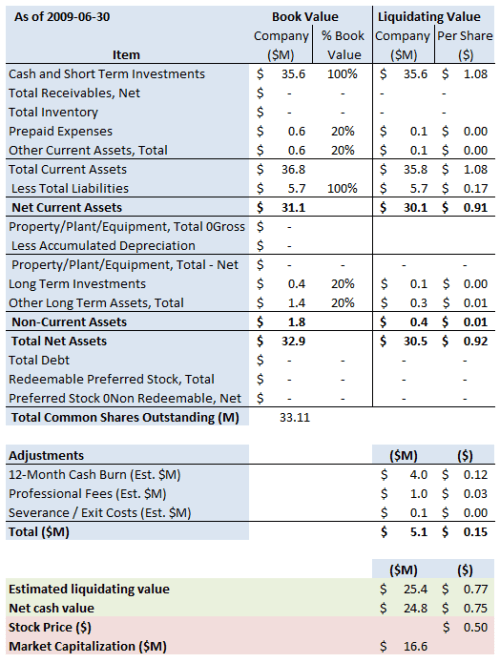
At its $0.50 close yesterday, VXGN has a market capitalization of $16.6M. We last estimated the company’s liquidation value to be around $26.5M or $0.80 per share. Following our review of the most recent quarterly report, we’ve slightly reduced our estimate to $25.4M or $0.77 per share. VXGN has other potentially valuable assets, including a “state-of-the-art biopharmaceutical manufacturing facility with a 1,000-liter bioreactor that can be used to make cell culture or microbial biologic products” and rights to specified percentages of future net sales relating to its anthrax vaccine product candidate and related technology.

The value proposition updated

VXGN has taken steps to minimize its cash burn, reducing its workforce to three employees, terminating its anthrax and smallpox development activities and selling the assets related to its anthrax product candidate. The company’s value rests on its vestigial holding of cash and equivalents (the “Book Value” column shows the assets as they are carried in the financial statements, and the “Liquidating Value” column shows our estimate of the value of the assets in a liquidation):

VXGN Summary 2009 6 30 v2Balance sheet adjustments

We’ve made the following adjustments to the balance sheet estimates above:

  • Cash burn: The company used $1.1M in cash in the second quarter, down from $2.1M in the first quarter. We have included cash burn of $4M in our estimate for the year. We have also assumed professional fees and termination payments of $1.1M.
  • Off-balance sheet arrangements and contractual obligations: According to VXGN’s 10Q, it has no off-balance sheet arrangements.

The lawsuit against VXGN by its landlords, in which they sought $22.4M, has been dismissed:

In February 2009, a lawsuit was filed against us in the Superior Court of California for the County of San Mateo by plaintiffs, Oyster Point Tech Center, LLC. The plaintiffs generally allege that we defaulted on our lease for our facility located at 349 Oyster Point, South San Francisco, California. The complaint seeks possession of the premises and the balance of the lease plus unpaid rent and expenses totaling $22.4 million, as well as an award of plaintiffs’ attorneys’ fees and costs. Our biopharmaceutical manufacturing facility is located in the leased premises that are the subject of the dispute. At a February hearing, the court denied the writ and the temporary protective order sought by landlord. In May 2009, the lawsuit was dismissed.

Conclusion

At its $0.50 close yesterday, VSGN has a market capitalization of $16.6M. We estimate the net current asset / liquidation value to be around 74% higher at $25.4M or $0.77 per share. VXGN has other potentially valuable assets, including rights to a portion of future net sales on its anthrax technology and a state-of-the-art biopharmaceutical manufacturing facility. One concern has been a lawsuit brought by the landlord against the company, so it is encouraging that the lawsuit has been dismissed. With its stock at a substantial discount to its net current asset / liquidation value, its cash-burning product development activities at an end and a proposal to identify and complete an alternate strategic transaction or liquidate, we think VXGN is still a good prospect, and we’re going to maintain our position.

[Full Disclosure: We have a holding in VXGN. This is neither a recommendation to buy or sell any securities. All information provided believed to be reliable and presented for information purposes only. Do your own research before investing in any security.]

Read Full Post »

In the following video, legendary value investor Marty Whitman discusses Benjamin Graham’s net-net formula and his adjustments to it. We’ve previously covered those adjustments here, but we’ve added the video because we think it’s quite amazing to see the great man explaining his rationale for making them. The highlight, from our perspective, is this gem:

We do net-nets based more on common sense. As, for example, you have an asset – a Class A office building – financed with recourse finance, fully tenanted by credit-worthy tenants; That, for accounting purposes, is classified as a fixed asset, but, given such a building, you pick up the telephone and sell it, and really it’s more current than K-Mart’s inventories, for example, which is classified as a current asset. 

 Enjoy the rest of his wit below:


Read Full Post »

Long-term readers of Greenbackd might remember our initial struggle to apply the net net / liquidation formula described by Benjamin Graham in the 1934 Edition of Security Analysis in the context of modern accounting. Putting aside our attempt to include and tweak the discounts to PP&E (kind of like fixing the smile on the Mona Lisa), most embarassing was our failure to factor into the valuation off-balance sheet liabilities and contractual obligations. The best thing that we can say about the whole sorry episode is that we got there in the end and we’ve been applying a more robust formulation for the last quarter. With that in mind, we thought it was particularly interesting to see the Financial Post’s article, Veteran tweaks Graham’s rule to find bargains (via Graham and Doddsville), which details the refinements legendary value investor Marty Whitman makes to Graham’s net-net formulation.

According to the article, Whitman makes the following adjustments to Graham’s 90-year old formula:

  • Companies must be well-financed

First and foremost, companies must be well-financed in keeping with the core tenet of Third Avenue’s “safe and cheap” method of value investing.

The goal is to own companies that are going concerns, not ones destined for liquidation. This difference is a crucial point of distinction between the focus of equity investors, who are often wiped out in liquidation, and bond investors, who have rights to the assets of a company in liquidation.

  • Whitman includes long-term assets that are easily liquidated

The second adjustment is to the assets themselves. Graham and Dodd focused exclusively on current assets when calculating liquidation value whereas Whitman includes long-term assets that are easily liquidated.

For example, roughly one third of long-term assets of Toyota Industries Corp. are investment securities, including a 6% position in Toyota Motor Corp. (TM/TSX), says Ian Lapey, portfolio manager at Third Avenue and designated successor to Whitman on the Third Avenue Value Fund.

These securities are therefore included in Third Avenue’s calculations of net-net.

Closer to home, oil and gas producer Encana Corp. (ECA/ TSX) has proved reserves of oil and natural gas that are not included in current assets, says Lapey.

“They are liquid in that there is a real market, current commodity prices notwithstanding, for high-quality proved reserves of oil and gas.” Encana is a top holding in AIC Global Focused Fund, sub-advised by Third Avenue and managed by Lapey.

  • Adjust for off-balance sheet liabilities

The third adjustment is the inclusion of off-balance-sheet liabilities. Here, U. S. banks’ structured investment vehicles readily spring to mind.

  • Include some PP&E

The fourth and final adjustment to Graham and Dodd is the inclusion of “some property, plant and equipment” for their liquidated cash value and associated tax losses that often produce cash savings.

Hong Kong real estate companies, such as top holding Henderson Land Development Co. Ltd. (0012/HK),are required to mark property values to market prices, so liquidation values are easily ascertained.

“In most time periods, the market for fully leased office buildings is quite liquid,” says Lapey, justifying their inclusion in net-net calculations of these companies.

The article also discusses one of Whitman’s current positions, Sycamore Networks Inc (NASDAQ:SCMR):

Sycamore Networks Inc. (SCMR/NASDAQ) is the most compelling example of a net-net situation in the United States offered up by Lapey.

The telecom equipment company has more cash — US$935-million in all — than the total value assessed to it by the market, in light of its US$800-million market capitalization and US$38-million in total liabilities.

“We feel that there is value to their technology that is being recognized by some of the large telecom carriers,” says Lapey of Sycamore Networks, but he acknowledges its current weak earnings power. Lapey is also attracted to the one-third of outstanding share ownership by management because it presents an important alignment of their interests with those of Third Avenue, who are by and large passive investors.

These large valuation discounts in the market are reassuring words for investors from the one of the finest practitioners of Graham and Dodd.

“We are holding these companies trading at huge discounts,” says Lapey, “and if these companies were to sell assets or sell the whole companies we think the result would be a terrific return for our investment.”

As we discussed in our review of our first quarter, we started Greenbackd in an effort to extend our understanding of asset-based valuation described by Graham. Over the last few quarters we have refined our process a great deal, and it’s pleasing to us that we already include the adjustments identified by Whitman. We believe that our analyses are now qualitatively more robust than when we started out and seeing Whitman’s adjustments gives us some confidence that we’re on the right track.

Read Full Post »

Tweedy Browne, the deep value investment firm established in 1920, has updated its booklet, What Has Worked In Investing (.pdf). First published in 1992 and now updated for 2009, the booklet discusses over fifty academic studies of investment criteria that have produced high rates of investment return. Our interest in the booklet stems from its examination of a group of investment styles falling under the rubric, “Assets bought cheap,” in particular, Benjamin Graham’s “Net current asset value” method and the “Low price to book value” method.

Graham’s “Net current asset value” method

Says Tweedy Browne of Graham’s “Net current asset value” method:

The net current asset value approach is the oldest approach to investment in groups of securities with common selection characteristics of which we are aware. Benjamin Graham developed and tested this criterion between 1930 and 1932. The net current assets investment selection criterion calls for the purchase of stocks which are priced at 66% or less of a company’s underlying current assets (cash, receivables and inventory) net of all liabilities and claims senior to a company’s common stock (current liabilities, long-term debt, preferred stock, unfunded pension liabilities). For example, if a company’s current assets are $100 per share and the sum of current liabilities, long-term debt, preferred stock, and unfunded pension liabilities is $40 per share, then net current assets would be $60 per share, and Graham would pay no more than 66% of $60, or $40, for this stock. Graham used the net current asset investment selection technique extensively in the operations of his investment management business, Graham-Newman Corporation, through 1956. Graham reported that the average return, over a 30-year period, on diversified portfolios of net current asset stocks was about 20% per year

The booklet discusses a study conducted by Henry Oppenheimer, an Associate Professor of Finance at the State University of New York at Binghamton, in which he examined the returns of such stocks over a 13-year period from December 31, 1970 through December 31, 1983. Oppenheimer’s study assumed that all stocks meeting the investment criterion were purchased on December 31 of each year, held for one year, and replaced on December 31 of the subsequent year by stocks meeting the same criterion on that date. The total sample size was 645 net current asset selections. The smallest annual sample was 18 companies and the largest was 89 companies.

Oppenheimer’s conclusion about the returns from such stocks was nothing short of extraordinary:

The mean return from net current asset stocks for the 13-year period was 29.4% per year versus 11.5% per year for the NYSE-AMEX Index. One million dollars invested in the net current asset portfolio on December 31, 1970 would have increased to $25,497,300 by December 31, 1983. By comparison, $1,000,000 invested in the NYSE-AMEX Index would have increased to $3,729,600 on December 31, 1983. The net current asset portfolio’s exceptional performance over the entire 13 years was not consistent over smaller subsets of time within the 13-year period. For the three-year period, December 31, 1970 through December 31, 1973, which represents 23% of the 13-year study period, the mean annual return from the net current asset portfolio was .6% per year as compared to 4.6% per year for the NYSE-AMEX Index.

Perhaps most intriguing, though, was Oppenheimer’s conclusion about the relative outperformance of the loss-making stocks over the profitable ones:

The study also examined the investment results from the net current asset companies which operated at a loss (about one-third of the entire sample of companies) as compared to the investment results of the net current asset companies which operated profitably. The companies operating at a loss had slightly higher investment returns than the companies with positive earnings: 31.3% per year for the unprofitable companies versus 28.9% per year for the profitable companies.

We believe that Oppenheimer’s study presents a compelling argument for such an investment approach.

Low price in relation to book value

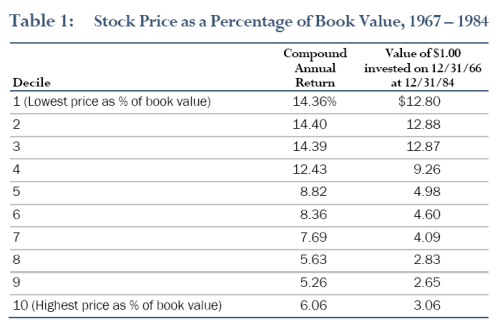
The second investment method falling under the rubric of “Assets bought cheap” is the “Low price in relation to book value” method. The booklet discusses a study conducted by Roger Ibbotson, Professor in the Practice of Finance at Yale School of Management and President of Ibbotson Associates, Inc., a consulting firm specializing in economics, investments and finance. In “Decile Portfolios of the New York Stock Exchange, 1967 – 1984,” Working Paper, Yale School of Management, 1986, Ibbotson studied the relationship between stock price as a proportion of book value and investment returns. To test this relationship, all stocks listed on the NYSE were ranked on December 31 of each year, according to stock price as a percentage of book value, and sorted into deciles. Ibbotson then measured the compound average annual returns for each decile for the 18-year period, December 31, 1966 through December 31, 1984.

Ibbotson found that stocks with a low price-to-book value ratio had significantly better investment returns over the 18-year period than stocks priced high as a proportion of book value. Tweedy Browne set out Ibbotson’s results in the following Table 1:

tweedy-table-1

A second study conducted by Werner F.M. DeBondt and Richard H. Thaler, Finance Professors at University of Wisconsin and Cornell University, respectively, examined stock price in relation to book value in “Further Evidence on Investor Overreaction and Stock Market Seasonality,” The Journal of Finance, July 1987. DeBondt and Thaler ranked all companies listed on the NYSE and AMEX, except companies that were part of the S&P 40 Financial Index, according to stock price in relation to book value and then sorted them into quintiles on December 31 in each of 1969, 1971, 1973, 1975, 1977 and 1979. DeBondt and Thaler then calculated the investment return against the equal weighted NYSE Index over the subsequent four years for all of the stocks in each selection period. The four-year returns against the market index were then averaged.

The stocks in the lowest quintile had an average market price to book value ratio of 0.36 and an average earnings yield (the inverse of the P/E ratio) of 0.10 (indicating a P/E of 10). DeBondt and Thaler found a cumulative average return in excess of the market index over the four years of 40.7%. Meanwhile, the stocks in the highest quintile, those with an average market price to book value ratio of 3.42 and an average earnings yield of 0.147 (a P/E of 6.8), returned 1.3% less than the market index over the four years after portfolio formation.

Perhaps the most striking finding by DeBondt and Thaler, and one that accords with our view about the difficulty of predicting earnings with any degree of accuracy, was the contrast between the earnings pattern of the companies in the lowest quintile (average price/book value of 0.36) and the highest quintile (average price/book value of 3.42). Tweedy Browne set out DeBondt and Thaler’s findings in Table 3 below, which describes the average earnings per share for companies in the lowest and highest quintile of price/book value in the three years prior to selection and the four years subsequent to selection:

tweedy-table-3

In the four years after the date of selection, the earnings of the companies in the lowest price/book value quintile increase 24.4%, more than the companies in the highest price/book value quintile, whose earnings increased only 8.2%. DeBondt and Thaler attribute the earnings outperformance of the companies in the lowest quintile to the phenomenon of “mean reversion,” which Tweedy Browne describes as the observation that “significant declines in earnings are followed by significant earnings increases, and that significant earnings increases are followed by slower rates of increase or declines.”

The booklet continues to discuss Tweedy Browne’s own findings confirming those of the studies described above, and a range of other studies that confirm the findings over different periods of time and in different countries. The findings form a compelling argument for an investment philosophy rooted in deep value and focused on assets, such as Greenbackd’s.

Buy my book The Acquirer’s Multiple: How the Billionaire Contrarians of Deep Value Beat the Market from on Kindlepaperback, and Audible.

Here’s your book for the fall if you’re on global Wall Street. Tobias Carlisle has hit a home run deep over left field. It’s an incredibly smart, dense, 213 pages on how to not lose money in the market. It’s your Autumn smart read. –Tom Keene, Bloomberg’s Editor-At-Large, Bloomberg Surveillance, September 9, 2014.

Click here if you’d like to read more on The Acquirer’s Multiple, or connect with me on Twitter, LinkedIn or Facebook. Check out the best deep value stocks in the largest 1000 names for free on the deep value stock screener at The Acquirer’s Multiple®.

Read Full Post »

Seth Klarman, the founder of The Baupost Group, an exceptionally well-performed, deep value-oriented private investment partnership, is known for seeking idiosyncratic investments. The Baupost Group’s returns bear out his unusual strategy: Over the past 25 years, The Baupost Group has generated an annual compound return of 20% and is ranked 49th in Alpha’s hedge fund rankings.

Klarman detailed his investment process in Margin of Safety: Risk-Averse Value Investing Strategies for the Thoughtful Investor, an iconic book on value investing that is required reading for all value investors. Published in 1991, the book is long out-of-print and famously difficult to obtain. According to a 2006 Business Week article, The $700 Used Book: Why all the buzz about Seth Klarman’s out-of-print investing classic?:

The 249-page book is especially hot among those seeking jobs with value-oriented investment firms. “You win serious points for talking Klarman,” says a newly minted MBA who got his hands on a copy prior to a late-round interview with a top mutual fund firm. “It’s pretty much assumed that you’ve read Graham and Dodd and Warren Buffett.” (Benjamin Graham and David Dodd’s 1934 work, Security Analysis, is a seminal book on value investing, while Buffett’s annual letters to shareholders are considered gospel.) “The book belongs in the category of Buffett and Graham,” says Oakmark Funds manager Bill Nygren, a collector of stock market tomes.

In the book, Klarman carefully explains the rationale for an investment strategy grounded in the value school. He also discusses at some length several sources for value investment opportunities. Why is the book germane to Greenbackd’s ongoing discussion of liquidation value investment? One source of investment opportunity identified by Klarman is stocks trading below liquidation value.

Klarman’s attitude to liquidation value investment closely accords with our own, and so we’ve reproduced below the relevant portion of Chapter 8 The Art of Business Valuation in Margin of Safety, in which he provides the basis for making such investments and outlines his approach to assessing liquidation value:

Liquidation Value

The liquidation value of a business is a conservative assessment of its worth in which only tangible assets are considered and intangibles, such as going-concern value, are not. Accordingly, when a stock is selling at a discount to liquidation value per share, a near rock-bottom appraisal, it is frequently an attractive investment.

A liquidation analysis is a theoretical exercise in valuation but not usually an actual approach to value realization. The assets of a company are typically worth more as part of an going concern than in liquidation, so liquidation value is generally a worst-case assessment. Even when an ongoing business is dismantled, many of its component parts are not actually liquidated but instead are sold intact as operating entities. Breakup value is one form of liquidation analysis, this involves determining the highest value of each component of a business, either as an ongoing enterprise or in liquidation. Most announced corporate liquidations are really breakups; ongoing business value is preserved whenever it exceeds liquidation value.

How should investors value assets in a liquidation analysis? An orderly liquidation over time is virtually certain to realize greater proceeds than a “fire sale,” but time is not always available to a company in liquidation. When a business is in financial distress, a quick liquidation (a fire sale) may maximize the estate value. In a fire sale the value of inventory, depending on its nature, must be discounted steeply below carrying value. Receivables should probably be significantly discounted as well; the nature of the business, the identity of the customer, the amount owed, and whether or not the business is in any way ongoing all influence the ultimate realization from each receivable.

When no crisis is at hand, liquidation proceeds are usually maximized through a more orderly winding up of a business. In an orderly liquidation the values realized from disposing of current assets will more closely approximate stated book value. Cash, as in any liquidation analysis, is worth one hundred cents on the dollar. Investment securities should be valued at market prices, less estimated transaction costs in selling them. Accounts receivable are appraised at close to their face amount. The realizable value of inventories – tens of thousands of programmed computer diskettes hundreds of thousands of purple slippers, or millions of sticks of chewing gum – is not so easily determinable and may well be less than book value. The discount depends on whether the inventories consist of finished goods, work in process, or raw materials, and whether or not there is the risk of technological or fashion obsolescence. The value of inventory in a supermarket does not fluctuate much, but the value of a warehouse full of computers certainly may. Obviously a liquidation sale would yield less for inventory than would an orderly sale to regular customers.

The liquidation value of a company’s fixed assets can be difficult to determine. The value of plant and equipment, for example, depends on its ability to generate cash flows, either in the current use or in alternative uses. Some machines and facilities are multipurpose and widely owned; others may have value only to the present owner. The value of restaurant equipment, for example, is more readily determinable than the value of an aging steel mill.

In approximating the liquidation value of a company, some value investors, emulating Benjamin Graham, calculate “net-net working capital” as a shortcut. Net working capital consists of current assets (cash, marketable securities, receivables, and inventories) less current liabilities (accounts, notes, and taxes payable within one year.) Net-net working capital is defined as net working capital minus all long-term liabilities. even when a company has little ongoing business value, investors who buy at a price below net-net working capital are protected by the approximate liquidation value of current assets alone. As long as working capital is not overstated and operations are not rapidly consuming cash, a company could liquidate its assets, extinguish all liabilities, and still distribute proceeds in excess of the market price to investors. Ongoing business losses can, however, quickly erode net-net working capital. Investors must therefore always consider the state of a company’s current operations before buying. Investors should also consider any off-balance sheet or contingent liabilities that might be incurred in the course of an actual liquidation, such as plant closing and environmental laws.

A corporate liquidation typically connotes business failure; but ironically, it may correspond with investment success. The reason is that the liquidation or breakup of a company is a catalyst for the realization of the underlying business value. Since value investors attempt to buy securities trading at a considerable discount from the value of a business’s underlying assets, a liquidation is one way for investors to realize profits.

A liquidation is, in a sense, one of the few interfaces where the essence of the stock market is revealed. Are stocks pieces of paper to be endlessly traded back and forth, or are they proportional interests in underlying businesses? A liquidation settles this debate, distributing to owners of pieces of paper the actual cash proceeds resulting from the sale of corporate assets to the highest bidder. A liquidation thereby acts as a tether to reality for the stock market, forcing either undervalued or overvalued share prices to move into line with actual underlying value.

We’ll continue our discussion on Seth Klarman and his approach to liquidation value investment later this week.

Buy my book The Acquirer’s Multiple: How the Billionaire Contrarians of Deep Value Beat the Market from on Kindlepaperback, and Audible.

Here’s your book for the fall if you’re on global Wall Street. Tobias Carlisle has hit a home run deep over left field. It’s an incredibly smart, dense, 213 pages on how to not lose money in the market. It’s your Autumn smart read. –Tom Keene, Bloomberg’s Editor-At-Large, Bloomberg Surveillance, September 9, 2014.

Click here if you’d like to read more on The Acquirer’s Multiple, or connect with me on Twitter, LinkedIn or Facebook. Check out the best deep value stocks in the largest 1000 names for free on the deep value stock screener at The Acquirer’s Multiple®.

Read Full Post »

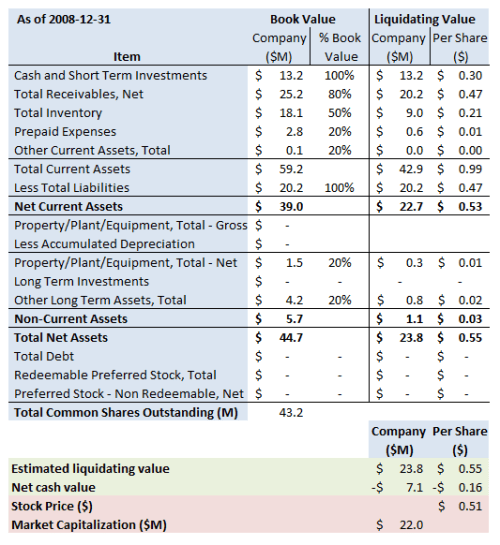
Network Engines Inc (NASDAQ:NENG) has released its results for the quarter to December 31, 2008. We’ve adjusted our valuation down 7% from $25.5m or $0.59 per share to $23.8M or $0.55 per share. With the stock price at $0.51, we’re going to maintain our position for now, but we’re mindful that NENG is a perennial net net stock and so we might take the opportunity to exit if it gets to our target valuation of $0.55.

We started following NENG on January 13 when it was trading at $0.38, which gave it a market capitalization of just $16.5M. The stock is up 34.2% since our initial post to $0.51, which gives it a market capitalization of $22.0M. In November 2007, an activist investor, Trinad Management, pushed the company to “immediately [implement] a share buy-back program.” The company demurred and saw its stock sink to all-time lows.

The value proposition updated

NENG’s Q1 10Q shows an increase in cash, which seems to be largely as a result of reducing accounts receivable and inventories (the “Carrying” column shows the assets as they are carried in the financial statements, and the “Liquidating” column shows our estimate of the value of the assets in a liquidation):

neng-summary-q4

Conclusion

We are inclined to exit NENG if it gets to our $0.55 valuation. It’s a perennial net net stock, so we think there’s a good chance NENG will be back in net net land again. As we pointed out in our earlier post, Jonathan Heller of Cheap Stocks-fame mentioned it back in October 2005 in a list of the Top 20 Market Cap Companies Trading Below Net Current Asset Value. It was then trading around $1.30 against a net current asset value of around $1.31. Investors buying back in October 2005 had plenty of opportunity to unload the stock at a profit while it traded up to $3.17 in March 2006. We’re planning to do the same again, but at $0.55.

[Full Disclosure:  We do not have a holding in NENG. This is neither a recommendation to buy or sell any securities. All information provided believed to be reliable and presented for information purposes only. Do your own research before investing in any security.]

Read Full Post »

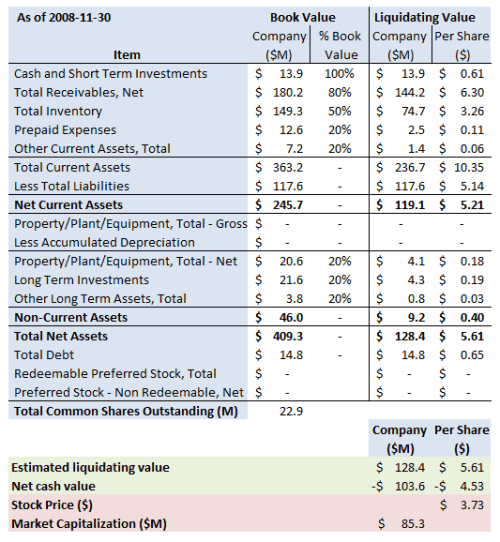
Audiovox Corporation (NASDAQ:VOXX) is a rarity in our universe: a profitable undervalued asset play. At its $3.73 close yesterday, VOXX has a market capitalization of $85.3M. We estimate the liquidation value to be 50% higher at around $128.4M or $5.60 per share. Howson Tattersal filed a 13D notice in September last year disclosing a 7.3% holding. While VOXX has been another perennial inclusion on lists of net-net stocks, we think it’s hard to ignore at this price.

About VOXX

VOXX is an “international distributor and value-added service provider in the accessory, mobile and consumer electronics industries.” The company markets its products under the Audiovox brand name and other brand names, including Acoustic Research, Advent, Ambico, Car Link, Chapman, Code-Alarm, Discwasher, Energizer, Heco, Incaar, Jensen, Mac Audio, Magnat, Movies2Go, Oehlbach, Phase Linear, Prestige, Pursuit, RCA, RCA Accessories, Recoton, Road Gear, Spikemaster and Terk, as well as private labels through a domestic and international distribution network. See the company’s website here. The company’s investor relations website is here.

The value proposition

VOXX’s sales, operating income and net income increased in the quarter ended November 30, 2008. Net sales for the third quarter were $195.6 million compared to net sales of $183.6 million reported in the comparable prior year period. Operating income was $10.7 million in the third quarter compared to $6.7 million in the preceding third quarter. Net income was $6.5 million compared to net income of $4.7 million in the comparable period. This doesn’t tell the full story however as operating activities used cash of $26.7M for the nine months ended November 30, 2008. The company used less cash for its operating activities compared to the prior year period ($92.9M), but it is still a concern for us. The balance sheet looks interesting (the “Book Value” column shows the assets as they are carried in the financial statements, and the “Liquidating Value” column shows our estimate of the value of the assets in a liquidation):

voxx-summaryWe’ve written down VOXX’s receivables by 20% to $144.2M or $6.30 per share and VOXX’s investory by 50% to $74.7M or $3.26 per share to arrive at a total current asset value of $236.7M or $10.35 per share. Deducting total liabilities gives a net current asset value of $119.1M or $5.21. We’ve discounted $46M in non-current assets to $9.2M or $0.40 per share, which, added to the net current assets, gives a liquidation value of around $128.4M or $5.61 per share.

Off-balance sheet arrangements and Contractual obligations

According to its most recent 10Q, VOXX does not maintain any off-balance sheet arrangements, transactions, obligations or other relationships with unconsolidated entities that would be expected to have a material current or future effect upon its financial condition or results of operations.

VOXX has around $42M in contractual cash obligations (including $11M in capital lease obligations and $31M in operating leases), around half of which falls due in the next 5 years and $23.7M falling due after 5 years. VOXX also has another $43M in unconditional purchase obligations falling due in the next 12 months.

The catalyst

Howson Tattersall Investment Counsel Limited filed its 13D notice on September 24, 2008 disclosing a 7.3% holding in VOXX. It seems from the filing that Howson Tattersall paid $18,825,883.44 for 1,508,075 shares in VOXX, giving them an  average purchase price around $12.50 per share. Given that Howson Tattersall has listed in the filing the “Date of Event Which Requires Filing of this Statement” as April 11, 2007, it’s possible that they are an example of the “reluctant activists” we referred to on Monday.

Conclusion

At $3.73, VOXX is trading at a discount to its net current asset value and around two-thirds of our estimate of its liquidation value of around $5.61 per share. We’ve got no particular insight into the business. The negative operating cash flow is an issue and its near term contractual obligations are significant. That aside, we think VOXX is a reasonable punt and we’re adding it to the Greenbackd Portfolio.

VOXX closed yesterday at $3.73.

The S&P500 Index closed yesterday at 789.17.

[Full Disclosure:  We do not have a holding in VOXX. This is neither a recommendation to buy or sell any securities. All information provided believed to be reliable and presented for information purposes only. Do your own research before investing in any security.]

Read Full Post »

« Newer Posts - Older Posts »