Feeds:
Posts
Comments

Posts Tagged ‘Net Cash Stock’

Tiberius Capital has announced that it is increasing its offer for MathStar Inc (OTC:MATH) common shares from $1.15 to $1.25 per share in cash.

We’ve been following MATH since December last year (see our post archive here) when it was trading at $0.68. We initiated the position because MATH was trading below its net cash value and had two substantial stockholders lobbying management to liquidate. The stock is up 79.4% to close yesterday at $1.22, giving it a market capitalization of $11.2M. We last estimated MATH’s liquidation value to be around $12.0M or $1.31 per share. Following a quick review of the last 10Q filing, we’ve slightly reduced our estimate to around $11.7M or $1.27 per share. That value is predominantly cash and short term investments and doesn’t take into account any further value that the sale of the FPOA technology and intellectual property may yield. The two activist investors, Mr. Zachary McAdoo of The Zanett Group and Mr. Salvatore Muoio of S. Muoio & Co., have been urging MATH’s board to consider liquidation rather than a merger. MATH’s board seems to agree, rejecting several unsolicited merger proposals from PureChoice, Inc, suspending the company’s operations and exploring “strategic alternatives, which could include merger, acquisition, increasing operations in another structure or liquidation.” Tiberius Capital launched its original tender offer for MATH on June 1, 2009 at $1.15 cash per share, bidding for 51% of the outstanding shares. Robert T. Sullivan, one of the principals of Tiberius said in the press release announcing the initial offer:

We are making the tender offer to enhance shareholder value. The potential strategies that we may cause MathStar to pursue include a partial repurchase of Shares, an extraordinary dividend, liquidation, selling or licensing MathStar’s technology assets, a business re-start in which MathStar would hire new personnel to improve and commercially exploit its technology assets, and/or a merger or other business combination. We will use the balance of 2009 to carefully examine whether to re-start MathStar’s business and/or to identify a suitable merger partner.

The latest press release from Tiberius is below:

TIBERIUS CAPITAL INCREASES ITS TENDER OFFER PRICE TO $1.25 PER SHARE FOR ALL MATHSTAR (OTC: MATH.PK) COMMON SHARES;

EXTENDS OFFER UNTIL 11:59 P.M., NEW YORK CITY TIME ON JULY 20, 2009

CHICAGO, Illinois, July 6, 2009—Tiberius Capital II, LLC (“Tiberius”), a value-opportunity fund located in Chicago, announced today that it is increasing the purchase price in its tender offer for all MathStar (OTC: MATH.PK) common shares from $1.15 to $1.25 net per share in cash (without interest and subject to applicable withholding taxes). Tiberius also announced that it is extending the tender offer until 11:59 P.M., New York City time, on July 20, 2009, and that it is reducing the “Minimum Tender Condition” to the tender offer from a majority of outstanding MathStar shares to 3,000,000 of such shares. As of July 2, 2009, approximately 672,000 MathStar common shares have been tendered and not withdrawn. All MathStar shareholders who have tendered will receive the higher $1.25 price.

Tiberius urges all MathStar shareholders to tender all of their shares as soon as possible prior to the Expiration Date on July 20, 2009, at 11:59 p.m., New York City Time.

[Full Disclosure:  We do not have a holding in MATH. This is neither a recommendation to buy or sell any securities. All information provided believed to be reliable and presented for information purposes only. Do your own research before investing in any security.]
Read Full Post »

Soapstone Networks Inc (NASDAQ:SOAP) has announced that it intends to liquidate and has filed its Plan of Liquidation.

We been following SOAP (see our post archive here) because it was trading well below its net cash value with an activist investor, Mithras Capital, disclosing an 8.7% holding in October last year. The stock is up 65% from $2.50 when we initiated our position to close today at $4.13, giving SOAP a market capitalization of $61.0M. We last estimated the company’s net cash value to be $80.3M or $5.21 per share. The company has now announced that it proposes to liquidate. It estimates that the total distribution, including an extraordinary cash dividend of $3.75 per share, will be between $4.00 and $4.50 per share

The press release from the company is set out below:

Soapstone Networks Announces Approval of Plan of Liquidation and Dissolution by Board of Directors and Wind Down of Operations

Billerica, MA, June 15, 2009 — Soapstone Networks Inc. (NASDAQ: SOAP), today announced that its Board of Directors (the “Board”) has unanimously approved a plan of dissolution and liquidation of the Company (the “Plan of Liquidation”) and that it will file a proxy statement seeking stockholder approval of such plan.

As part of this decision, the Company has ceased the development and marketing of the Soapstone Provider Network Controller (PNC) product and has reduced its workforce by 50 to a total of 14 employees. Moreover, if the Company’s stockholders approve the Plan of Liquidation, the Company intends to file a certificate of dissolution, delist its shares from NASDAQ, sell and monetize its non-cash assets, satisfy or settle its remaining liabilities and obligations, including any contingent liabilities and claims, terminate its remaining employees throughout the wind down period, and make one or more distributions to its stockholders of cash available for distribution.

The Company also announced that its Board has unanimously approved an extraordinary cash dividend of $3.75 per share, provided that the Board may adjust such amount at a later date to ensure there is remaining cash to satisfy potential liabilities. Such dividend will be payable after the stockholder meeting at which the Plan of Liquidation is approved by the Company’s stockholders and in connection with the filing of a Certificate of Dissolution with the Delaware Secretary of State.

The Company has analyzed its liquidation value and currently estimates that the amount of subsequent distributions to stockholders will range from $0.25 to $0.75 per share, for a total distribution, including the extraordinary cash dividend, of between $4.00 and $4.50 per share. The amount of these distributions, however, may vary substantially from these estimates based on the resolution of outstanding known and contingent liabilities and the possible assertion of claims that are currently unknown to the Company. If, prior to its dissolution, the Company receives an offer for a transaction that will, in the view of the Board, provide superior value to stockholders than the value of the estimated distributions under the Plan, taking into account all factors that could affect valuation, including timing and certainty of payment or closing, credit market risks, proposed terms and other factors, the Plan of Liquidation and the dissolution could be abandoned in favor of such a transaction.

The Board made this decision after completing an exhaustive evaluation of various strategic alternatives available to the Company for enhancing stockholder value, including but not limited to, continued execution of the Company’s business plan, the payment of a cash dividend to the Company’s stockholders, a repurchase by the Company of shares of its capital stock, the sale or spin off of Company assets, partnering or other collaboration agreements, a merger, sale or liquidation of, or acquisition by, the Company or other strategic transaction. The Company and its external advisors, including its financial advisor Morgan Stanley & Co. Incorporated, devoted substantial time and effort in identifying potential buyers or strategic partners and entered into negotiations with several potential partners; however, that process did not yield a potential transaction which the Board viewed as reasonably likely to provide greater realizable value to its stockholders than the complete dissolution and liquidation of the Company in accordance with the Plan of Liquidation.

[Full Disclosure:  We have a holding in SOAP. This is neither a recommendation to buy or sell any securities. All information provided believed to be reliable and presented for information purposes only. Do your own research before investing in any security.]

Read Full Post »

MathStar Inc’s (OTC:MATH) board has rejected the $1.04 per share cash merger offer from PureChoice, Inc. because “the $1.04 per share price is less than the liquidation value of MathStar, including the value from any technology sale, and, in the Merger, MathStar’s shareholders would derive no value from MathStar’s net operating loss carryforwards.”

We’ve been following MATH since December last year (see our post archive here) when it was trading at $0.68. We initiated the position because MATH was trading below its net cash value and had two substantial stockholders lobbying management to liquidate. The stock is up 48.5% to $1.01 yesterday, giving it a market capitalization of $9.3M. We estimate MATH’s liquidation value to be around $12.0M or $1.31 per share. That value is predominantly cash and short term investments and doesn’t take into account any further value that the sale of the FPOA technology and intellectual property may yield. The two activist investors, Mr. Zachary McAdoo of The Zanett Group and Mr. Salvatore Muoio of S. Muoio & Co., have been urging MATH’s board to consider liquidation rather than a merger. MATH’s board seems to agree, twice rejecting PureChoice, Inc’s previous unsolicited merger proposals and now rejecting PureChoice, Inc for a third time, suspending the company’s operations and exploring “strategic alternatives, which could include merger, acquisition, increasing operations in another structure or liquidation.”

The press release from MATH is below:

On May 11, 2009, MathStar, Inc. received a letter containing an unsolicited proposal by PureChoice, Inc. (“PCI”) to enter into a merger transaction with MathStar (the “Merger”). As proposed by PCI, MathStar’s stockholders would receive cash consideration of $1.04 per share in the Merger for all of their MathStar shares.

MathStar’s Board considered and analyzed PCI’s Merger proposal. It concluded that PCI’s proposal was not acceptable because, among other reasons, the $1.04 per share price is less than the liquidation value of MathStar, including the value from any technology sale, and, in the Merger, MathStar’s shareholders would derive no value from MathStar’s net operating loss carryforwards. Thus, the Board rejected PCI’s Merger proposal as not being in the best interests of MathStar’s stockholders. The Board will continue to pursue strategic alternatives.

We said on the filing of the letter to MATH that we thought that, to be successful, any merger offer would, at the minimum, need to be pitched at MATH’s liquidation value (which we estimated at $12.0M or $1.31 per share). Hopefully PureChoice, Inc. will return with a genuine bid that reflects this value.

[Full Disclosure:  We do not have a holding in MATH. This is neither a recommendation to buy or sell any securities. All information provided believed to be reliable and presented for information purposes only. Do your own research before investing in any security.]

Read Full Post »

CuraGen Corporation (NASDAQ:CRGN) has filed its 10Q for the period ended March 31, 2009. CRGN’s stock has risen strongly over the last few months, and is now trading at $1.02, giving it a market capitalization slightly higher than our estimate of its liquidation value. Accordingly, we’re going to take this opportunity to exit. The stock was at $0.67 when we started following it and closed Friday at $1.02, which means we’re up 52.2% on an absolute basis. The S&P500 Index closed on the day we opened the position at 850.12 and closed Friday at 882.88, which means we’re up 48.4% on a relative basis.

Post mortem

We started following CRGN on January 20, 2009 (see our post archive here) because it was a net cash stock with an investor, DellaCamera Capital Management, pushing the company to seek “alternative deployment of [its] capital.” DellaCamera Capital Management increased its stake from 5.6% to 6.5% and nominated two candidates to the board. We last estimated CRGN’s net cash value to be around $59.9M or $1.05 per share. After reviewing the 10Q, we slightly reduced our valuation to $56.9M or $1.00 per share. We exited because the stock is trading at a premium to that estimated value.

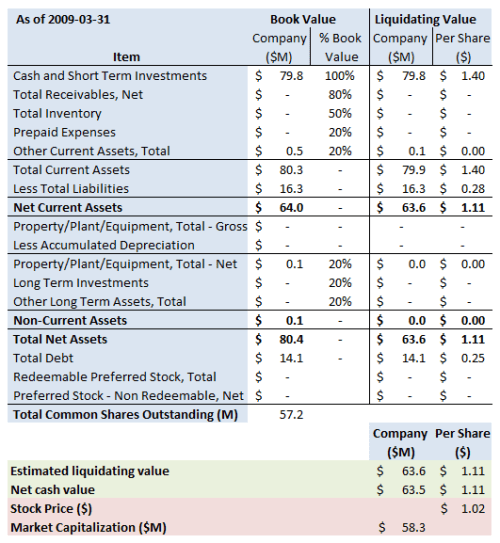
The company is not generating any operating cash flow, so was a pure undervalued asset play. The major change to the balance sheet since we opened the position was CRGN’s February repurchase of $4.8M of its 4% convertible subordinated debentures due February 2011, for an aggregate purchase price of $3.8M, which reflected an aggregate discount from the face value of such 2011 notes of approximately 21%. We’ve updated the summary balance sheet below (the “Book Value” column shows the assets as they are carried in the financial statements, and the “Liquidating Value” column shows our estimate of the value of the assets in a liquidation):

CRGN Summary 2009 3 31CRGN’s $79.8M in cash and short term investments consists of $45.6M in cash and equivalents, $18.0M in short-term investments and $16.1M in marketable securities.
Balance sheet adjustments

In reaching our estimate, we made the following adjustments to the balance sheet estimates above:

  • Cash burn: The company used $4.0M in cash in operations in the first quarter. We have included cash burn of $3M in our estimate for the remainder of the quarter.
  • Off-balance sheet arrangements and contractual obligations: According to CRGN’s 10Q, it has no off-balance sheet arrangements. Its contractual obligations (excluding the convertible notes, which we’ve included in the summary balance sheet above) are $3.7M in total.

Deducting the $6.7M from the $63.6M in net assets leaves around $56.9M in liquidation value or $1.00 per share.

Conclusion

We are reasonably happy with the outcome in CRGN. While DellaCamera Capital Management’s campaign has not been run to its conclusion, we feel that with the stock trading at around CRGN’s liquidation value, it is an opportune time to exit. CRGN has announced a plan to undertake a review of strategic alternatives that it says could enhance shareholder value, which might range from selling or licensing CR011, to acquiring additional assets or business lines, to selling the company. While these alternatives might offer more value from here, there is no assurance that the process will result in any specific action or transaction, and CRGN will continue to burn cash as it funds its operations and develops CR011-vcMMAE. For these reasons, we’ve taken our chips off the table.

[Full Disclosure:  We do not have a holding in CRGN. This is neither a recommendation to buy or sell any securities. All information provided believed to be reliable and presented for information purposes only. Do your own research before investing in any security.]

Read Full Post »

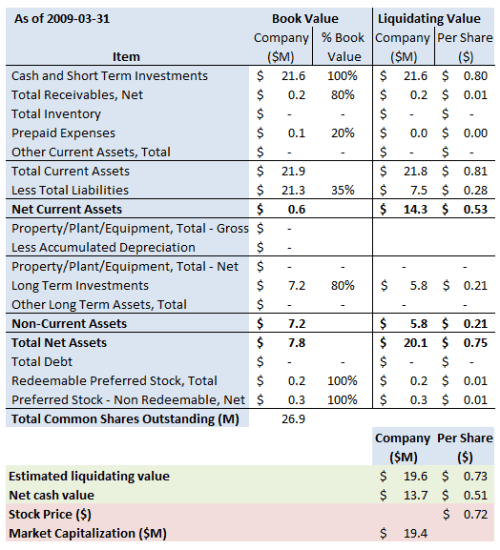
Neurobiological Technologies Inc (NASDAQ:NTII) has filed its 10Q for the period ended march 31, 2009. After reviewing the 10Q, we have reduced our estimate of NTII’s liquidation value to $19.6M or $0.73 per share. NTII closed on Friday at $0.72, which is approximately our estimate of its value, and so we are taking the opportunity to exit. We opened the position on February 23, 2009 at $0.53, so we are up 35.9% on an absolute basis. The S&P500 Index was at 770.05 when we opened the position, and closed Friday at 929.23, which means we are up 15.2% on a relative basis.

We started following NTII (see our post archive here) because it was trading at a substantial discount to our estimate of its $21.9M or $0.81 per share liquidation value and Biotechnology Value Fund, Millennium Technology Value Partners and Highland Capital Management held approximately 45% of NTII’s outstanding stock (one stockholder estimated 65%) and were calling for its liquidation. NTII has now reached our reduced estimate of its liquidation value, so we are exiting the position.

The value proposition updated

NTII expects “cash, cash equivalents, short-term and long-term investments to total approximately $23 million at June 30, 2009,” which is up slightly from our estimate as at March 31, 2009. The summary of our estimate for the company’s liquidation value is set out below (the “Book Value” column shows the assets as they are carried in the financial statements, and the “Liquidating Value” column shows our estimate of the value of the assets in a liquidation):

NTII Summary 2009 3 31

Conclusion

At its $0.72 close on Friday, NTII is trading at just under our estimate of its $0.73 per share liquidating value. While we believe that there may be slightly more value in NTII (for example, if it receives a portion of the net proceeds paid to Celtic Pharmaceuticals upon a sale of XERECEPT), we ‘re not certain of that value, so we’re taking the opportunity to exit now.

[Full Disclosure:  We do not have a holding in NTII. This is neither a recommendation to buy or sell any securities. All information provided believed to be reliable and presented for information purposes only. Do your own research before investing in any security.]

Read Full Post »

VaxGen Inc (OTC:VXGN) has released its quarterly report for the period ended March 31, 2009.

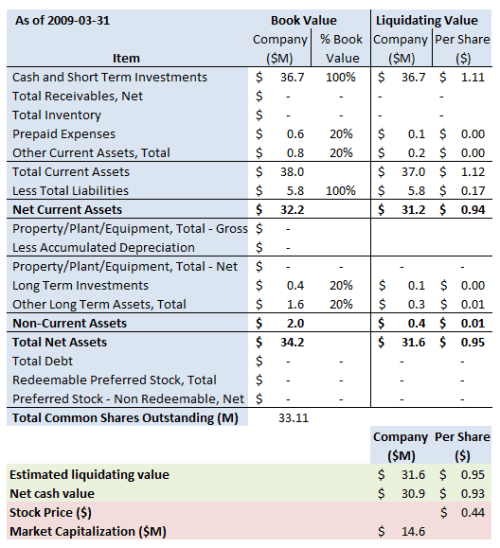
We started following VXGN (see our post archive here) because it was trading at a substantial discount to its net cash position, had ended its cash-burning product development activities and is “seeking to maximize the value of its remaining assets through a strategic transaction or series of strategic transactions.” If the company is unable to identify and complete an alternate strategic transaction, it proposes to liquidate. At its $0.44 close yesterday, VXGN has a market capitalization of $14.6M. We initially estimated the company’s net cash value to be around $27.7M or $0.84 per share. We’ve now reduced that slightly to $26.5M or $0.80 per share. VXGN has other potentially valuable assets, including a “a state-of-the-art biopharmaceutical manufacturing facility with a 1,000-liter bioreactor that can be used to make cell culture or microbial biologic products” and rights to specified percentages of future net sales relating to its anthrax vaccine product candidate and related technology.

The value proposition updated

VXGN has taken steps to minimize its cash burn, reducing its workforce to three employees, terminating its anthrax and smallpox development activities and selling the assets related to its anthrax product candidate. The company’s value rests on its vestigial holding of cash and equivalents (the “Book Value” column shows the assets as they are carried in the financial statements, and the “Liquidating Value” column shows our estimate of the value of the assets in a liquidation):

vxgn-summary-2009-3-31

Balance sheet adjustments

We make the following adjustments to the balance sheet estimates above:

  • Cash burn: The company used $2.1M in cash in the first quarter. We have included cash burn of $5M in our estimate for the remainder of the year. We have also assumed termination payments of $0.2M.
  • Off-balance sheet arrangements and contractual obligations: According to VXGN’s 10Q, it has no off-balance sheet arrangements.

One concern is the lawsuit against VXGN by its landlords, in which they seek $22.4M:

In February 2009, a lawsuit was filed against the Company by plaintiffs, Oyster Point Tech Center, LLC. The plaintiffs generally allege that the Company defaulted on the lease on the 349 Oyster Point, South San Francisco facility. The complaint seeks possession of the premises and the balance of lease plus unpaid rent and expenses totaling $22.4 million, as well as an award of plaintiffs’ attorneys’ fees and costs. The Company’s biopharmaceutical manufacturing facility is located in the leased premises that are the subject of the dispute. At a February hearing, the court denied the writ and the temporary protective order sought by landlord. The parties are currently in discussions to achieve an amicable resolution to the matters alleged in the complaint and a negotiated termination of the lease. However, if necessary, the Company intends to vigorously defend against such allegations.

The Company may incur substantial expenses in defending against such claim, and it is not presently possible to accurately forecast the outcome. The Company does not believe, based on current knowledge, that the foregoing legal proceeding is likely to have a material adverse effect on its financial position, results of operations or cash flows. In the event of a determination adverse to the Company, the Company may incur substantial monetary liability and could have a material adverse effect on the Company’s financial position, results of operations or cash flows.

If the lawsuit is succesful, then VXGN has next to no value. We’re taking our guidance from the company, which “does not believe, based on current knowledge, that the foregoing legal proceeding is likely to have a material adverse effect on its financial position, results of operations or cash flows.”

Conclusion

At its $0.44 close yesterday, VSGN has a market capitalization of $14.6M. We estimate the net cash value to be around 82% higher at $26.5M or $0.80 per share. VXGN has other potentially valuable assets, including rights to portion of future net sales on its anthrax technology and a state-of-the-art biopharmaceutical manufacturing facility. One concern is lawsuit by the landlord against the company, but that company states that it does not believe the lawsuit will have a material adverse effect on its financial position.With its stock at a substantial discount to its net cash position, its cash-burning product development activities at an end and a proposal to identify and complete an alternate strategic transaction or liquidate, we think VXGN is a good prospect, and we’re going to maintain our position.

[Full Disclosure: We have a holding in VXGN. This is neither a recommendation to buy or sell any securities. All information provided believed to be reliable and presented for information purposes only. Do your own research before investing in any security.]

Read Full Post »

Long-term readers of Greenbackd might remember our initial struggle to apply the net net / liquidation formula described by Benjamin Graham in the 1934 Edition of Security Analysis in the context of modern accounting. Putting aside our attempt to include and tweak the discounts to PP&E (kind of like fixing the smile on the Mona Lisa), most embarassing was our failure to factor into the valuation off-balance sheet liabilities and contractual obligations. The best thing that we can say about the whole sorry episode is that we got there in the end and we’ve been applying a more robust formulation for the last quarter. With that in mind, we thought it was particularly interesting to see the Financial Post’s article, Veteran tweaks Graham’s rule to find bargains (via Graham and Doddsville), which details the refinements legendary value investor Marty Whitman makes to Graham’s net-net formulation.

According to the article, Whitman makes the following adjustments to Graham’s 90-year old formula:

  • Companies must be well-financed

First and foremost, companies must be well-financed in keeping with the core tenet of Third Avenue’s “safe and cheap” method of value investing.

The goal is to own companies that are going concerns, not ones destined for liquidation. This difference is a crucial point of distinction between the focus of equity investors, who are often wiped out in liquidation, and bond investors, who have rights to the assets of a company in liquidation.

  • Whitman includes long-term assets that are easily liquidated

The second adjustment is to the assets themselves. Graham and Dodd focused exclusively on current assets when calculating liquidation value whereas Whitman includes long-term assets that are easily liquidated.

For example, roughly one third of long-term assets of Toyota Industries Corp. are investment securities, including a 6% position in Toyota Motor Corp. (TM/TSX), says Ian Lapey, portfolio manager at Third Avenue and designated successor to Whitman on the Third Avenue Value Fund.

These securities are therefore included in Third Avenue’s calculations of net-net.

Closer to home, oil and gas producer Encana Corp. (ECA/ TSX) has proved reserves of oil and natural gas that are not included in current assets, says Lapey.

“They are liquid in that there is a real market, current commodity prices notwithstanding, for high-quality proved reserves of oil and gas.” Encana is a top holding in AIC Global Focused Fund, sub-advised by Third Avenue and managed by Lapey.

  • Adjust for off-balance sheet liabilities

The third adjustment is the inclusion of off-balance-sheet liabilities. Here, U. S. banks’ structured investment vehicles readily spring to mind.

  • Include some PP&E

The fourth and final adjustment to Graham and Dodd is the inclusion of “some property, plant and equipment” for their liquidated cash value and associated tax losses that often produce cash savings.

Hong Kong real estate companies, such as top holding Henderson Land Development Co. Ltd. (0012/HK),are required to mark property values to market prices, so liquidation values are easily ascertained.

“In most time periods, the market for fully leased office buildings is quite liquid,” says Lapey, justifying their inclusion in net-net calculations of these companies.

The article also discusses one of Whitman’s current positions, Sycamore Networks Inc (NASDAQ:SCMR):

Sycamore Networks Inc. (SCMR/NASDAQ) is the most compelling example of a net-net situation in the United States offered up by Lapey.

The telecom equipment company has more cash — US$935-million in all — than the total value assessed to it by the market, in light of its US$800-million market capitalization and US$38-million in total liabilities.

“We feel that there is value to their technology that is being recognized by some of the large telecom carriers,” says Lapey of Sycamore Networks, but he acknowledges its current weak earnings power. Lapey is also attracted to the one-third of outstanding share ownership by management because it presents an important alignment of their interests with those of Third Avenue, who are by and large passive investors.

These large valuation discounts in the market are reassuring words for investors from the one of the finest practitioners of Graham and Dodd.

“We are holding these companies trading at huge discounts,” says Lapey, “and if these companies were to sell assets or sell the whole companies we think the result would be a terrific return for our investment.”

As we discussed in our review of our first quarter, we started Greenbackd in an effort to extend our understanding of asset-based valuation described by Graham. Over the last few quarters we have refined our process a great deal, and it’s pleasing to us that we already include the adjustments identified by Whitman. We believe that our analyses are now qualitatively more robust than when we started out and seeing Whitman’s adjustments gives us some confidence that we’re on the right track.

Read Full Post »

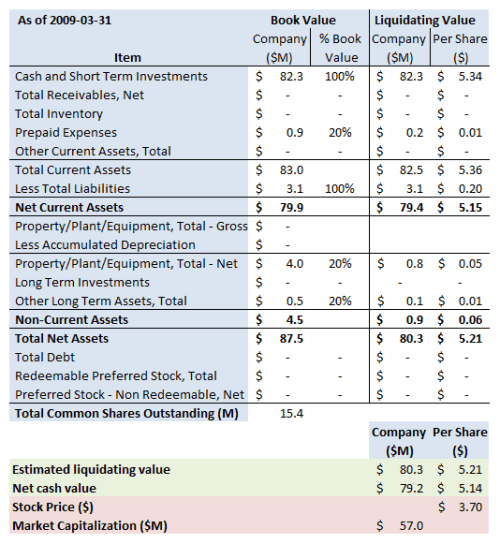
Soapstone Networks Inc (NASDAQ:SOAP) has filed its 10Q for the quarter ended March 31, 2009.

We been following SOAP (see our post archive here) because it is trading well below its net cash value with an activist investor, Mithras Capital, disclosing an 8.7% holding in October last year. The stock is up 48.0% from $2.50 when we initiated our position to close yesterday at $3.70, giving SOAP a market capitalization of $52.0M. We last estimated the company’s net cash value to be $86.1M or $5.59 per share. Following our review of the Q1 10Q, we’ve adjusted our valuation down 6% to $80.3M or $5.21 per share as a result of $6.7M of cash burned.

The value proposition updated

The company’s balance sheet value is almost wholly cash, which it continues to burn (the “Book Value” column shows the assets as they are carried in the financial statements, and the “Liquidating Value” column shows our estimate of the value of the assets in a liquidation):

soap-summary-2009-3-311

Balance sheet adjustments

We need to make the following adjustments to the balance sheet estimates above:

  • Cash burn: The company used $6.7M in cash in the first quarter. They expect cash burn to continue to be between $6M and $6.5M per quarter.
  • Off-balance sheet arrangements and contractual obligations: SOAP does not have any off-balance-sheet arrangements and its contractual obligations, which consist entirely of operating leases, are $3.9M. These operating lease payments are the minimum rent expense for SOAP’s facilities, including its head office.

Conclusion

We continue to believe that SOAP is a very good opportunity. The company’s ongoing business is small in comparison to its net cash position, so it shouldn’t dissipate its cash any time soon. It has no off-balance sheet arrangements, little in the way of ongoing contractual obligations and no material litigation, so the cash position seems reasonably certain. The company’s engagement of an investment bank to explore strategic alternatives is a promising step in the right direction. We continue to be concerned by the continued issuance of options at a huge discount to liquidation value. The sooner Mithras Capital gets control of this situation the better.

[Full Disclosure:  We have a holding in SOAP. This is neither a recommendation to buy or sell any securities. All information provided believed to be reliable and presented for information purposes only. Do your own research before investing in any security.]

Read Full Post »

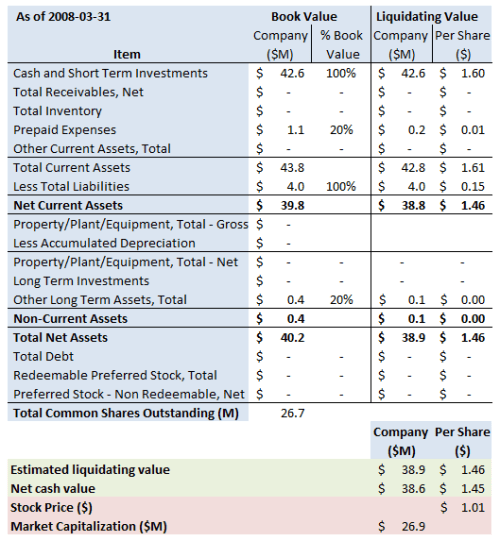
Vanda Pharmaceuticals Inc. (NASDAQ:VNDA) has reported its results for the first quarter ended March 31, 2009.

We’ve been following VNDA (see our post archive here) because it’s trading below its net cash value and Tang Capital Partners (TCP) has called for the company to “cease operations immediately, liquidate [VNDA]’s assets and distribute all remaining capital to the Stockholders.” TCP has now filed a preliminary proxy statement for the 2009 Annual Meeting urging stockholders to support TCP’s slate of two director nominees, Kevin C. Tang and Andrew D. Levin, M.D., Ph.D. The stock is up 29.5% since we initiated the position to close yesterday at $1.01, giving the company a market capitalization of $24.3M. We initially estimated the net cash value to be around $42.6M or $1.60 per share. We’ve now reduced our estimate of the net cash value to $38.6M or $1.45 per share. The company continues to hemorrhage cash, so the investment turns on TCP’s ability to get control of the board at the Annual Meeting and staunch the bleeding. If TCP cannot get onto the board quickly, the company will continue to burn cash and the investment will be a dud. VNDA has a staggered board, which makes TCP’s task difficult.

The value proposition updated

In the first quarter of 2009 VNDA burned through $3.8M in cash, which reduces our estimate of the net cash value from $42.6M to $38.6M or $1.45 per share (the remaining difference is due to the slight increase in shares on issue). Set out below is our summary balance sheet  (the “Book Value” column shows the assets as they are carried in the financial statements, and the “Liquidating Value” column shows our estimate of the value of the assets in a liquidation):

vnda-summary-2009-12-31

Conclusion

VNDA continues to be an interesting play. While the stock is up nearly 30% since we initiated the position, it is still trading at a 45% discount to our estimate of its $1.45 per share net cash value. That value is of course deteriorating rapidly, and the challenge for investors is to determine which of two outcomes is more likely: If TCP can get on the board quickly, stop the cash burn and liquidate the company, we’re likely to see a good return. If TCP cannot get onto the board quickly or at all, the company will continue to burn cash and the investment will be a dud. VNDA has a staggered board, so this will make TCP’s task difficult. We’re inclined to maintain our position and see how this plays out.

[Full Disclosure:  We do not have a holding in VNDA. This is neither a recommendation to buy or sell any securities. All information provided believed to be reliable and presented for information purposes only. Do your own research before investing in any security.]

Read Full Post »

Autobytel Inc’s (NASDAQ:ABTL) board has responded to Trilogy, Inc’s $0.35 per share tender offer, calling it “grossly inadequate” and “unequivocally” recommending that stockholders reject it.

We started following ABTL (see our post archive here) because it was trading at a substantial discount to its liquidation and net cash values and Trilogy had filed a 13D notice disclosing a 7.4% holding. Trilogy has now launched a tender offer for ABTL at $0.35 per share, which is at our estimate of ABTL’s $15.4M or $0.34 per share net cash value, but at a substantial discount to our estimate of ABTL’s $24.3M or $0.54 per share liquidation value. When Trilogy launched its offer, we wrote that we believed that $0.35 per share was only the opening salvo and a higher price was possible if the board terminated the rights plan poison pill. The stock closed yesterday at $0.515, which is a huge 47% premium to Trilogy’s offer price and suggests the market is also anticipating a higher offer. The stock is up 19.8% since we started following it in December.

Here’s the letter from ABTL:

April 27, 2009

Dear Stockholder:

On Monday, April 20, 2009, I received a letter from Trilogy Enterprises, Inc. (“Trilogy”) indicating that Trilogy had launched a tender offer for all of Autobytel Inc.’s (our “Company”) outstanding shares of common stock at $0.35 per share.

Our Board of Directors (our “Board”), in consultation with its legal and financial advisors, has evaluated Trilogy’s offer and has found Trilogy’s $0.35 offer price to be grossly inadequate and unequivocally recommends to stockholders that they reject Trilogy’s offer and not tender their shares to Trilogy.

Our Board also believes that the combination of actions taken by our Company as described below will result in our stockholders achieving significantly more value than the offer made by Trilogy. In reaching its decision to recommend that stockholders reject the Trilogy offer and not tender their shares to Trilogy, our Board considered many factors, including:

• Our Company’s strong balance sheet and current cash and receivables position, noting, in particular, that our Company’s cash position alone is substantially in excess of Trilogy’s offer.

• The initial reaction of the securities trading markets to Trilogy’s offer appears to support our Board’s decision that the offer price is inadequate.

• The recent thorough evaluation of strategic alternatives conducted by our Board, including the possible sale of our Company, which concluded that selling our Company in today’s environment was not in the best interest of maximizing value.

• The indications of interest received and offers from potential buyers for our Company as a result of the sale process.

• Inquiries made to our Company’s financial advisor by other interested parties in response to Trilogy’s offer.

• The reasons for the Board’s decision to terminate the sale process, including:

• The value of our Company’s websites; and

• The value of our Company’s intellectual property, particularly its patents, which resulted in a $20 million settlement with the Dealix Corporation in 2006 and most recently settlements with Edmunds.com, Internet Brands, InsWeb and Lead Point that will provide our Company with valuable content, images, shopping and interactive tools and data for our websites.

• Other strategic alternatives being evaluated by our Board and management team.

• The belief that Trilogy is being opportunist in exploiting a recent extreme price decline in our common stock and use of confidential information about our Company obtained by Trilogy under a non-disclosure agreement.

Based upon the above, our Board recommends that you reject Trilogy’s offer and not tender your shares of common stock for purchase by Trilogy.

In addition, we encourage you to read the enclosed Schedule 14D-9, which provides further details with regard to our Board’s recommendation and discusses the factors that our Board carefully considered and evaluated in making its decision to reject Trilogy’s offer.

If you have any questions, please do not hesitate to contact our information agent, MacKenzie Partners, Inc., at the following numbers: Toll-Free 1-800-322-2885 or at 1-212-929-5500 (collect) or by email at autobytel@mackenziepartners.com.

On Behalf of the Board of Directors,

Jeffrey H. Coats
President and Chief Executive Officer

At $0.515, ABTL has a market capitalization of $23.3M, which is approaching our estimate of its $0.54 per share liquidation value. We’re planning to maintain the position as we believe a higher bid is on the cards and Trilogy will know that it is unlikely to get sufficient acceptances at a discount to ABTL’s liquidation value.

[Full Disclosure:  We do not have a holding in ABTL. This is neither a recommendation to buy or sell any securities. All information provided believed to be reliable and presented for information purposes only. Do your own research before investing in any security.]

Read Full Post »

« Newer Posts - Older Posts »