Feeds:
Posts
Comments

Posts Tagged ‘Net Cash Stock’

Trident Microsystems Inc (NASDAQ:TRID) is an undervalued net cash stock looking for a catalyst. We think it’s a good candidate for an activist campaign for a number of reasons:

  1. It’s large for a net cash stock: As its $1.67 close yesterday, the company has a market capitalization of $103M. That puts it into the strike zone for funds with around $100M under management.
  2. It’s deeply undervalued: We estimate its liquidation value is around $170M or $2.75 per share, which is 65% higher than its close yesterday.
  3. Its value is predominantly cash: TRID is trading at two-thirds of its net cash value of approximately $155M or $2.50 per share.
  4. Its stock is liquid enough: According to TRID’s Google Finance page, the average volume for the stock is more than 500,000 shares per day. It traded more than 350,000 yesterday. With 62M shares on issue, an investor seeking ~5% of TRID needs a few more than 3M shares, which should be readily achievable in a reasonably short period of time.

About TRID

TRID develops and markets integrated circuits for digital televisions, LCD televisions and digital set-top boxes. The company’s investor relations page is here.

The value proposition

TRID has an embarrassment of riches on its balance sheet (the “Book Value” column shows the assets as they are carried in the financial statements, and the “Liquidating Value” column shows our estimate of the value of the assets in a liquidation):

trid-summaryThere are no off-balance sheet arrangements and its contractual obligations are only $15M, including $2.7M in operating leases and $12.3M in purchase obligations.

TRID’s most recent 10Q makes for interesting reading:

Shareholder Derivative Litigation

Trident has been named as a nominal defendant in several purported shareholder derivative lawsuits concerning the granting of stock options. The federal court cases have been consolidated as In re Trident Microsystems Inc. Derivative Litigation, Master File No. C-06-3440-JF. A case also has been filed in State court, Limke v. Lin et al., No. 1:07-CV-080390. Plaintiffs in all cases allege that certain of the Company’s current or former officers and directors caused it to grant options at less than fair market value, contrary to its public statements (including its financial statements); and that as a result those officers and directors are liable to the Company. No particular amount of damages has been alleged, and by the nature of the lawsuit no damages will be alleged against the Company. The Board of Directors has appointed a Special Litigation Committee (“SLC”) composed solely of independent directors to review and manage any claims that the Company may have relating to the stock option grant practices investigated by the Special Committee. The scope of the SLC’s authority includes the claims asserted in the derivative actions. In federal court, Trident has moved to stay the case pending the assessment by the SLC that was formed to consider nominal plaintiffs’ claims. In State court, Trident moved to stay the case in deference to the federal lawsuit, and the parties have agreed, with the Court’s approval, to take that motion off of the Court’s calendar to await the assessment of the SLC. The Company cannot predict whether these actions are likely to result in any material recovery by or expense to, Trident. The Company expects to continue to incur legal fees in responding to these lawsuits, including expenses for the reimbursement of legal fees of present and former officers and directors under indemnification obligations.

Regulatory Actions

The Department of Justice (“DOJ”) is currently conducting an investigation of the Company in connection with its investigation into its stock option grant practices and related issues, and the Company is subject to a subpoena from the DOJ. The Company is also subject to a formal investigation by the SEC on the same issues. The Company has been cooperating with, and continues to cooperate with, inquiries from the SEC and DOJ investigations. In addition, the Company has received an inquiry from the Internal Revenue Service to which it has responded. The Company is unable to predict what consequences, if any, that any investigation by any regulatory agency may have on it. Any regulatory investigation could result in substantial legal and accounting expenses, divert management’s attention from other business concerns and harm the Company’s business. If a regulatory agency were to commence civil or criminal action against the Company, it is possible that the Company could be required to pay significant penalties and/or fines and could become subject to administrative or court orders, and could result in civil or criminal sanctions against certain of its former officers, directors and/or employees and might result in such sanctions against the Company and/or its current officers, directors and/or employees. Any regulatory action could result in the filing of additional restatements of the Company’s prior financial statements or require that the Company take other actions. If the Company is subject to an adverse finding resulting from the SEC and DOJ investigations, it could be required to pay damages or penalties or have other remedies imposed upon it. The period of time necessary to resolve the investigation by the DOJ and the investigation from the SEC is uncertain, and these matters could require significant management and financial resources which could otherwise be devoted to the operation of its business. In addition, the Company’s 401(k) plan and its administration were audited by the Department of Labor but no further action was noted.

The catalyst?

None. There are no activist investors in this stock and management seems intent on helping itself to large portions of options and restricted stock. Rather than pay dividends to long-suffering stockholders, they’ll retain the earnings in the faint hope it’ll pump up the stock price, which helps with their options. The company could comfortably pay a special dividend of around $3 per share and still leave $43M of cash in the bank.

Conclusion

TRID is another perennial inclusion on the lists of net net stocks. Even though it’s deeply undervalued, without a catalyst it seems destined to remain that way. We’ll keep an eye on its filings and let you know if anyone takes it on.

TRID closed yesterday at $1.67.

The S&P500 Index closed yesterday at 805.22.

[Full Disclosure:  We do not have a holding in TRID. This is neither a recommendation to buy or sell any securities. All information provided believed to be reliable and presented for information purposes only. Do your own research before investing in any security.]
Read Full Post »

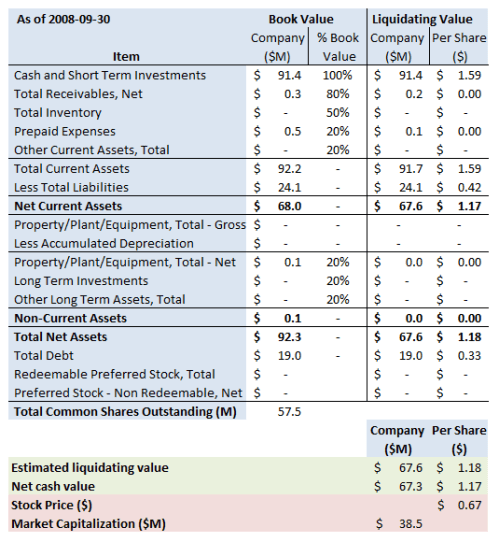
CuraGen Corporation (NASDAQ:CRGN) is a net cash stock with an investor, DellaCamera Capital Management, disclosing a 5.6% holding in a 13D filed on January 15. At its $0.67 closing price Friday, CRGN’s market capitalization is $38.5M. We estimate CRGN’s net cash value to be 60% higher at $62M or $1.07 per share. The company is not generating any operating cash flow as it is a “biopharmaceutical development company,” so the challenge for DellaCamera Capital Management is to persuade the company to pay a special dividend or liquidate before it dissipates its remaining cash.

About CRGN

CRGN is a biopharmaceutical development company engaged in developing cancer treatments. It also has a portfolio of earlier stage assets, including proteins, antibodies and small molecules that represent potential treatments for cancer. The company’s investor relations website is here.

The value proposition

As a “biopharmaceutical development company” CRGN is burning cash in development and not generating any income or operating cash flow. Its value lies in its present $67M net cash position (the “Book Value” column shows the assets as they are carried in the financial statements, and the “Liquidating Value” column shows our estimate of the value of the assets in a liquidation):

crgn-summary

CRGN’s $91.4M in cash and cash equivalents consists of $7.4M in cash, $40.4M in short-term investments and $43.6M in marketable securities.

Off-balance sheet arrangements and Contractual obligations

According to CRGN’s most recent 10Q, the company does not have any off-balance sheet arrangements. Its enforceable and legally binding obligations, along with future commitments related to all contracts that it is likely to continue, regardless of the fact that they are “cancelable as of September 30, 2008,” excluding those captured in the financial statements, are around $5.5M through 2011.

Deducting the $5.5M from the $67.6M in net assets leaves around $62M in liquidation value or $1.07 per share.

The catalyst

DellaCamera Capital Management filed a 13D notice on January 15 disclosing a 5.6% holding in CRGN. The filing is silent as to DellaCamera Capital Management’s purpose for the CRGN investment beyond the usual other than the following:

[DellaCamera Capital Management] intend to make themselves available to [CRGN] to discuss methods of delivering additional value to [CRGN]’s shareholders, including the possible alternative deployment of [CRGN]’s capital. [DellaCamera Capital Management] may seek board representation to assist in this endeavor.

Hopefully DellaCamera Capital Management can find an “alternative deployment of [CRGN]’s capital” before the company burns through its remaining cash.

Conclusion

As a net cash stock, CRGN’s current liquidating value is relatively easy to determine. At $0.67, CRGN’s liquidating value is around 60% higher at $1.07 per share. The more difficult step is to determine the liquidating value of the company if and when DellaCamera Capital Management is successful. We think that 60% is a substantial margin of safety for CRGN and so we are adding it to the Greenbackd Portfolio.

CRGN closed Friday at $0.67.

The S&P500 Index closed Friday at 850.12.

[Full Disclosure:  We do not have a holding in CRGN. This is neither a recommendation to buy or sell any securities. All information provided believed to be reliable and presented for information purposes only. Do your own research before investing in any security.]
Read Full Post »

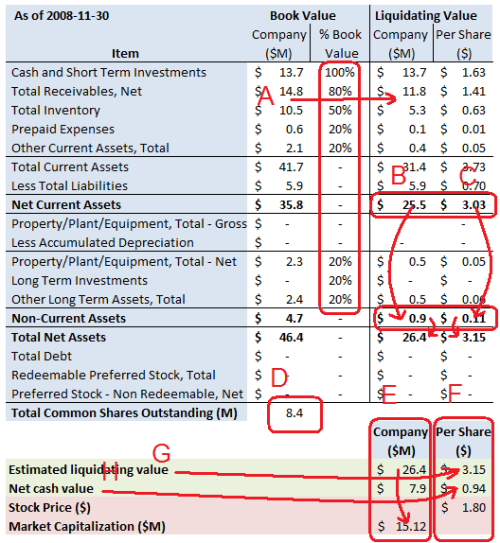
We are trialing a change to our summary presentation of company financial statements. The new summaries will look like this (this is our summary balance sheet for Aehr Test Systems (NASDAQ:AEHR) – it’s cheap but there’s no catalyst):

aehr-summary-changes

A brief explanation of the various changes:

  1. A. shows the carrying value of the receivables ($14.8M), our estimate for the percentage of carrying value the receivables will yield in liquidation (80%), the liquidating value ($11.8M) and the liquidating value per share ($1.41).
  2. B. shows the net current asset value ($25.5M), which, when added to the non-current asset value ($0.9M), gives the liquidating value for the company ($26.4M).
  3. C. is the same calculation as B. but on a per share basis: the net current asset value per share ($3.03), which, when added to the non-current asset value per share ($0.11), gives the liquidating value per share ($3.15).
  4. D. is the amount of stock the company has on issue.
  5. E. shows the liquidating value of the company ($26.4M), the net cash value of the company ($7.9M) and the market capitalization ($15.12M). In this instance, the company is trading at approximately 60% of our estimate of its liquidation value.
  6. F. shows the same amounts as E. on a per share basis against the stock price.
  7. G. and H. are the estimated liquidating value on a company and per share basis, and the net cash value on company and per share basis.

We’re keen to hear what you think of the changes. We think it presents the discount applied to the carrying values and the net current asset values more clearly than the previous summaries.

Read Full Post »

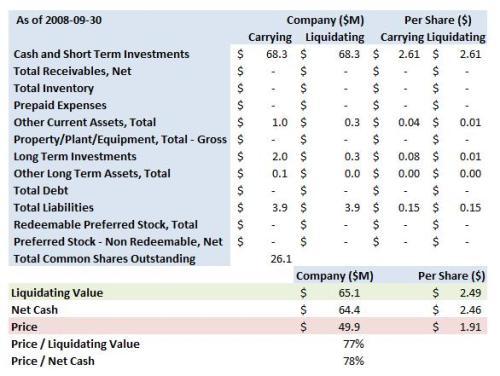
Northstar Neuroscience Inc (NASDAQ:NSTR) is a net cash stock that has announced that it plans to liquidate. NSTR closed yesterday at $1.91, giving it a market capitalization of $50M. We estimate its net cash value to be around 30% higher at $2.49 or $65.1M. The final pay out figure in the liquidation will be slightly lower. We estimate that figure at around $59.1M or $2.26 per share, which presents an upside of around 18%. The liquidation is still subject to stockholder approval and the upside isn’t huge, but NSTR presents a reasonable prospect for a good return in a short time frame.

About NSTR

The company’s most recent filing in relation to the liquidation attaches the following press release:

Northstar Neuroscience, Inc., (NASDAQ:NSTR), a medical device company developing therapies for the treatment of major depressive disorder, today announced that its Board of Directors has determined, in its best business judgment after consideration of potential strategic alternatives, that it is in the best interests of the Company and its shareholders to liquidate the Company’s assets and to dissolve the Company. The Company’s Board of Directors has approved a Plan of Complete Liquidation and Dissolution of the Company (the “Plan”), subject to shareholder approval. The Company intends to hold a special meeting of shareholders to seek approval of the Plan and will file related proxy materials with the Securities and Exchange Commission (“SEC”) in the near future. Prior to the special meeting the Company will reduce its headcount to a limited number of employees who will assist in the termination of operations.

The Plan contemplates an orderly wind down of the Company’s business and operations. If the Company’s shareholders approve the Plan, the Company intends to file articles of dissolution, satisfy or resolve its remaining liabilities and obligations, including but not limited to contingent liabilities and claims, ongoing clinical trial obligations, lease obligations, severance for terminated employees, and costs associated with the liquidation and dissolution, and make distributions to its shareholders of cash available for distribution, subject to applicable legal requirements. Following shareholder approval of the Plan and the filing of articles of dissolution, the Company would delist its common stock from NASDAQ.

The value proposition

As the press release mentions, NSTR is being wound down. The September 10Q shows value on the balance sheet  (the “Carrying” column shows the assets as they are carried in the financial statements, and the “Liquidating” column shows our estimate of the value of the assets in a liquidation):

nstr-summary

NSTR’s value is predominantly cash and short-term investments in the amount of $68.3M or $2.61 per share. With total liabilities of only $3.9M or $0.15 per share, NSTR had a net cash value in September of around $64.4M or $2.46 per share. If we assume that NSTR used around $4M in cash last quarter and it costs circa $2M to wind up the company, we estimate it will pay out around $59.1M or $2.26 per share.

The Catalyst

NSTR was prompted to liquidate at the urging of RA Capital Management, which sent the following letter (annexed to its last 13D filing) to the company on December 15 last year:

Board of Directors
c/o Alan Levy, Ph.D., Chairman of the Board
Northstar Neuroscience, Inc.
2401 Fourth Avenue, Suite 300
Seattle, Washington 98121

Dear Members of the Board of Directors:

We continue to be shocked and frustrated by the complete lack of response from Northstar Neuroscience, Inc. (the “Company” or “Northstar”) to the several options it has to preserve and return value to its stockholders. As you know, we sent a letter to each of you on July 14, 2008, in which we outlined a reasonably detailed proposal on how the Company could stop its hemorrhaging of cash, provide a distribution to its stockholders, and sell its remaining assets for as much value as possible. Since July, the Company’s stock, which was then trading at an astonishing 30% discount to its cash balance per share, has fallen by nearly 50% and continues to trade at an even more appalling 60% discount from its cash balance per share. Although you have refused to return capital to shareholders, you have put forth no viable business plan for the Company. It would seem that some of you remain content to pay yourselves salaries from cash that belongs to stockholders while contributing nothing of any positive value in return.

While we acknowledge that you have recently taken some steps to reduce expenses, we reiterate that now is not the time for half-measures. Your reduction of expenses slows value destruction but does not permit the recovery of shareholder value reflected in the Company’s cash balance. If your strategy is to arrange for a white knight to acquire the Company at a premium to cash, that is not a strategy but more like hope and a prayer given the current economic environment and market circumstances. The credit crisis and market collapse we have witnessed since July have made investors and companies much less willing to pay for all but the most valued of strategic assets. The Company’s failed programs hardly qualify as strategic assets; in fact, the market has clearly assigned them a negative enterprise value (approximately -$1.40/share, which offsets $2.40/share in cash to yield the current $1.00/share for the stock). The only asset of value that the Company possesses is its cash; this asset should not be wasted and ought to be returned to shareholders as soon as possible that they might invest it more profitably.

Our July 14, 2008 letter speaks for itself and your silence, inaction, and inability to offer any other options are increasingly alarming. Any options you might have thought you had in July have since disappeared. We also want to make clear that any attempt by you to merge or otherwise combine with any other public or private company, thereby inflating the enterprise value of the combined entity without increasing the share price for your existing stockholders, would further erode any potential value in Northstar shares that could be realized through a cash dividend or share buyback. If a merger or acquisition of another company or asset were put to a stockholder vote, we would vote against such a proposal and believe that other stockholders would likely prefer to have their capital returned to them.

We again urge you to make a distribution or dividend to your stockholders as soon as possible, preferably announcing your intention to do so prior to the end of the year. We believe that most investors have realized losses this year and that a large cash dividend would likely not have significant tax consequences for most investors. Alternatively, we urge you to craft and implement a share buy-back program, which would also have the effect of raising the share price and allowing stockholders the opportunity to salvage some of the value of their investment, possibly more tax efficiently than via a dividend. If you indeed feel that the long term prospects for the Company are good, then buy-out any stockholders who do not share your same view. Again, we expect you to take prompt action, including making a decision on these matters prior to the end of the year.

If you do not wish to take any of the actions outlined above because you have doubts about whether doing so is in the best interests of the stockholders, then we urge you to call a Special Meeting of the stockholders and simply ask your stockholders directly. After all, you owe fiduciary duties to your stockholders and they continue to see the value of their investment decline in the face of your inaction.

Alan J. Levy, you are the Chairman of the Board of Directors and therefore hold a leadership position alongside John S. Bowers, Jr., making you particularly responsible for the direction of this company. However, we also specifically recognize the role that each of the members of the board play. Susan K. Barnes, you have a responsibility to speak out against the waste of shareholder capital. Michael Ellwein, your position with Three Arch and history at Medtronic would suggest that you have not always made a career of value destruction, so we can hardly imagine that you are comfortable letting it happen at Northstar, and yet the situation continues to deteriorate. Albert J. Graf, you must be frustrated about the lack of any results from the Company’s management, and yet have you done all that you can to protect shareholders from management’s poor judgment? Robert E. McNamara, as a career CFO who ought to have an appreciation for fiscal responsibility, you are permitting Northstar’s disrespect for its shareholder’s capital to continue to the detriment of your professional reputation. Dale A. Spencer, you have had a long relationship with the Company, since 1999, but you are also a private investor, and we have to believe that some part of you is disgusted by the idea of Northstar management continuing to collect generous salaries while running an enterprise that the market has valued well below zero for nearly a year. Carol D. Winslow, what should the investors whose capital you manage at Channel Medical Partners LP conclude about your acumen and values as a business person if you continue to sit passively by while Northstar’s management transfers the wealth of its investors into the bank accounts of its executives without creating any positive equity value whatsoever? How long will each of you allow this to continue? We urge you to immediately solve this problem once and for all.

We recognize that shareholders of the Company have little influence; you have the safety of a staggered board and Washington state laws of incorporation, which make a travesty of corporate governance and fiduciary duty. Shareholders can only hope that you have the decency to give them a chance to express their wishes to you formally if you will not take immediate action to protect the value of their investment in the Company through a dividend or share buyback. While you certainly have challenged our notion that boards represent the interests of the shareholders, we remain optimistic that, with some persistence, shareholders can prevail on even the most intransigent management and board to listen to their concerns and protect their investment or personally pay back shareholders for what, in our opinion, is a gross dereliction of fiduciary duty.

Unless we hear from you by Friday, December 19, 2008, that you intend either to take the actions urged above or call a Special Meeting of the stockholders as urged above, then we intend to submit and vigorously pursue shareholder proposals for your next annual meeting. These proposals will, among other things, seek input from your stockholders on the issue of a distribution or dividend and/or share buy-back program and will put forth a slate of new candidates to be elected to your board of directors at that meeting.

We intend to pursue our interests here aggressively, both for our benefit and hopefully for the benefit of all stockholders, including preserving our right to take legal action against you and the Company.

Sincerely,

RA Capital Healthcare Fund, L.P.
By: RA Capital Management, LLC, its general partner

Peter Kolchinsky
Managing Member

The board has now agreed to put the proposal to liquidate to NSTR stockholders. We won’t know management’s estimate for the likely distributions until NSTR files the Plan of Complete Liquidation and Dissolution of the Company in anticipation of the special meeting of stockholders. As NSTR’s value is predominantly in cash and short-term investments, the liquidation should be a relatively straight-forward exercise.

Conclusion

At $1.91, NSTR is trading at an 18% discount to our $2.26 estimate of its distributions in the proposed liquidation. We will have a better estimate for the likely distribution when the company files its Plan of Complete Liquidation and Dissolution of the Company. While the upside isn’t huge, and there is still some small risk that the plan will not be approved by stockholders, we think NSTR presents a reasonable prospect for a good (but not great) return in a short time frame.

NSTR closed yesterday at $1.91.

The S&P500 Index closed yesterday at 843.74.

Hat tip to commenter manny for the tip.

[Full Disclosure:  We do not have a holding in NSTR. This is neither a recommendation to buy or sell any securities. All information provided believed to be reliable and presented for information purposes only. Do your own research before investing in any security.]

Read Full Post »

Biotechnology Value Fund (BVF) announced today that it intends to make a tender offer for all of the outstanding stock of Avigen, Inc. (NASDAQ:AVGN) that it does not own.

We’ve been following AVGN (see archived posts here) because it’s a net cash stock (i.e. it’s trading at less than the value of its cash after deducting all liabilities) and specialist biotechnology activist fund BVF has been pushing it to liquidate and return its cash to shareholders. MediciNova, Inc.’s (NASDAQ:MNOV) has made an offer for AVGN that represents a clever way for AVGN’s stockholders to receive cash equivalent to that which they would receive in a liquidation (less $7M to be paid to MNOV) with the possibility for “an extraordinary, uncapped return” if MNOV is successful post-merger. We estimate AVGN’s cash at around $1.22 per share (BVF estimates $1.20 per share), which is a little less than 40% higher than AVGN’s $0.92 close yesterday.

The tender offer statement filed with the SEC attaches the following press release from BVF:

Biotechnology Value Fund, L.P. To Make Tender Offer For Any And All Outstanding Shares Of Avigen At $1.00 Per Share

Tender Offer provides stockholders with a near-term cash alternative if BVF nominees are elected

BVF reaffirms support for downside-protected merger with MediciNova

NEW YORK, Jan. 15 /PRNewswire/ — Biotechnology Value Fund, L.P. (“BVF”) announced today that it intends to make a cash tender offer to purchase any and all of the outstanding common stock of Avigen, Inc. (Nasdaq: AVGN – News; “Avigen”) that BVF does not own at a price of $1.00 per share under the conditions described below. The offer price represents a 35% premium over Avigen’s closing stock price of $0.74 on January 8, 2009, the day prior to BVF’s announcement that it was seeking to remove all incumbent Avigen directors and to elect its own slate of stockholder focused nominees. BVF Partners L.P., the general partner of BVF, beneficially owns an aggregate of 8,819,600 shares of Avigen, or approximately 29.63% of the outstanding shares.

On January 9, 2009, BVF announced that it had delivered a notice to Avigen to call a special meeting of stockholders (the “Special Meeting”) to remove all incumbent directors and elect its own slate of stockholder-focused nominees

The tender offer will be conditioned on the following: (i) BVF’s nominees being elected to the board of directors of Avigen (the “Board”) at the Special Meeting (or otherwise appointed) and constituting a majority of directors on the Board, (ii) the Board redeeming rights issued under Avigen’s poison pill, (iii) Avigen not committing to any strategic transactions or capital-depleting actions, pursuant to the process described by Avigen on January 14, 2009 (or otherwise), and (iv) other customary conditions such as the absence of a suspension in trading or any material adverse change at Avigen. BVF may increase the tender price if Avigen’s unrestricted cash balance increases (for example, as the result of the sale of assets.) The tender offer is not conditioned on the availability of financing.

Mark Lampert, the general partner of BVF, stated, “The tender offer provides stockholders with a choice if BVF’s nominees are elected to the Board: they can either tender their shares for near-term cash at a premium to the market price or they can retain their shares and participate with BVF in the future of Avigen, whether through a merger with MediciNova, as hoped, or otherwise. This tender is the outgrowth of Avigen’s earlier rejection of our request that the Company provide downside protection for all shareholders. If elected to the Board, BVF’s nominees intend to pursue the downside-protected transaction proposed by MediciNova, or, if not possible, to consider other alternatives including a complete return of capital.”

Mr. Lampert continued, “Yesterday Avigen announced that it will spend stockholder money on not one, but two financial advisors. Why? We believe that Avigen could retain ten financial advisors and it won’t change the fact that the risk-reward profile of the proposed merger with MediciNova is extraordinary. We are concerned that this is just another example of the Board wasting stockholders’ assets; we question the Board’s underlying motivation for these actions and whether they are simply trying to remain in office at stockholders’ expense. In order to ensure no further deterioration of Avigen’s value, we urge stockholders to vote to remove all incumbent directors and elect the BVF nominees.”

BVF expects to file offering materials with the Securities and Exchange Commission and commence the tender offer within a reasonable time. Once the tender offer is commenced, offering materials will be mailed to Avigen stockholders and filed with the Securities and Exchange Commission. Avigen stockholders are urged to read the offering materials when they become available because they will contain important information.

[Full Disclosure: We have a holding in AVGN. This is neither a recommendation to buy or sell any securities. All information provided believed to be reliable and presented for information purposes only.]

Read Full Post »

Biotechnology Value Fund (BVF) has filed its proxy material for the Special Meeting of Avigen, Inc. (NASDAQ:AVGN) stockholders. BVF want to replace AVGN’s board with BVF’s slate of director nominees who will support MediciNova, Inc.’s (NASDAQ:MNOV) offer for AVGN.

We’ve been following AVGN (see earlier posts here, here, here, here, here, here and here) because it’s a net cash stock (i.e. it’s trading at less than the value of its cash after deducting all liabilities) and specialist biotechnology activist fund BVF has been pushing it to liquidate and return its cash to shareholders. We think MNOV’s offer represents a clever way for AVGN’s stockholders to receive cash equivalent to that which they would receive in a liquidation (less $7M to be paid to MNOV) with the possibility for “an extraordinary, uncapped return” if MNOV is successful post-merger. We estimate AVGN’s cash at around $1.22 per share (BVF estimates $1.20 per share), which is a little less than 40% higher than AVGN’s $0.87 close yesterday.

BVF’s proxy material sets out the rationale for removing the incumbent directors:

The members of the BVF Group are currently the beneficial owners of an aggregate of 8,819,600 Shares, representing approximately 29.63% of the issued and outstanding common stock. As significant stockholders of Avigen, we have one goal: to maximize the value and minimize the risk on behalf of all stockholders. A brief synopsis of Avigen corporate history as well as our recent efforts to maximize stockholder value is summarized in the following chronology of events leading up to this proxy solicitation:

We first became a shareholder of Avigen in 2005, the year Avigen sold, for $12 million, its unsuccessful gene therapy business in which the Company had invested over $150 million. The Company, led by its current CEO, Ken Chahine, spent nearly two years running a “process” with the mandate to re-invent the Company by investing in whatever the current management team deemed compelling. In January 2006, this management team chose to acquire its lead development candidate, AV650, because, in their own words, “we believe it is a low risk.” In fact the Company’s entire strategy, then and now, is supposedly “designed to mitigate the risk of bringing innovative therapies to U.S. patients.” $100 million later, on October 21, 2008, Avigen announced the outright failure of its “low risk” bet on AV650, resulting in a collapse in the Company’s stock price. This same management team and Board, which has failed previously, now wishes to bet the substantial remaining shareholder capital on whatever it deems appropriate.

We recently acquired a significant number of Shares and became the largest stockholder of Avigen. We increased our investment in October 2008 based upon our belief that Avigen’s shares were significantly undervalued. In fact, Avigen reported $56 million, or $1.88 per Share, of financial assets as of September 30, 2008, consisting of cash, cash equivalents, available-for-sale securities and restricted investments, while trading at a price well below $1.00 during the two months prior to filing this proxy statement. We believe this depressed trading price, substantially below Avigen’s cash liquidation value, is based upon the market’s concern that management and the existing Board will pursue ill-advised or other value destroying ventures, at stockholders’ expense, while compensating themselves in the process.

Since this time, we have reached out to the Board numerous times, each time raising our concern that Avigen’s existing liquid assets not be wasted or otherwise committed to value destroying ventures.

We have specifically suggested that the Board “guaranty” the worst case outcome for all stockholders. This guaranty could be accomplished in several ways, including by dividending or distributing all excess cash to stockholders at the present time, or by offering to buy back any and all Shares from stockholders that wish to sell at a specific price at a specific future date (e.g. $1.25 per Share in December 2009). At no time have we asked for – nor would we accept – any consideration or benefit for ourselves that would not be offered to all stockholders.

The Board has ignored our attempts to work constructively for the benefit of all stockholders. Avigen responded to our offers by unilaterally increasing and broadening management’s “golden parachute” severance agreements and unilaterally adopting a “poison pill,” raising our concerns about this Board’s true intentions.

The Board’s “golden parachute” severance agreements with management, under the ridiculous justification that such payouts are necessary to “attract and retain key employees,” is particularly outrageous given Avigen’s current circumstances. Our analysis indicates that these payouts, which we believe would be triggered by most “change in control” scenarios, including a liquidation, total at least $3 million, an incredible 16.5% of the Company’s entire market value at the time of adoption. The recipients of these golden parachute arrangements include Avigen’s CEO, Ken Chahine, who resides in Park City, Utah, while the Company is based in California. We question how the Company can justify such actions as necessary to “attract and retain key employees” when Avigen has no real business at this time and has abandoned the development of all its products. These hastily adopted severance arrangements need to be challenged and, if possible, revoked.

In addition, we believe the Board’s implementation of the “poison pill” serves no purpose other than to entrench the Board and keep BVF from purchasing additional stock in the Company. We are concerned that management and Board members are more concerned with retaining their jobs and compensation than with maximizing stockholder value. As evidence, Avigen’s stock price fell more than 20% after the adoption of the poison pill. The pill should be redeemed. The Board’s recent actions reveal its true self-interest and leave us concerned that the Board will indeed destroy and/or take all remaining value.

On December 22, 2008, MediciNova, Inc. (“MediciNova”), a company in which we have no economic interest, proposed to merge with Avigen in an innovative and, we believe, compelling downside-protected structure. We believe the proposed merger is uncontrovertibly in the best interest of all stockholders and we had grave concerns that the Board may not negotiate in good faith with MediciNova, if at all. Avigen’s statements apparently rejecting this proposal confirmed our worst fears. We are concerned that the Board’s and management’s self-interest will prevent them from acting in what we believe to clearly be the best interests of all stockholders.

Accordingly, after much consideration we felt compelled to call this special meeting of stockholders to remove the existing directors and to elect new, truly independent directors who, if elected, will take actions to benefit all stockholders, including redeeming Avigen’s stockholder rights plan, working to consummate the proposed transaction with MediciNova and/or working to complete a distribution of Avigen’s assets to all stockholders.

[Full Disclosure: We have a holding in AVGN. This is neither a recommendation to buy or sell any securities. All information provided believed to be reliable and presented for information purposes only.]

Read Full Post »

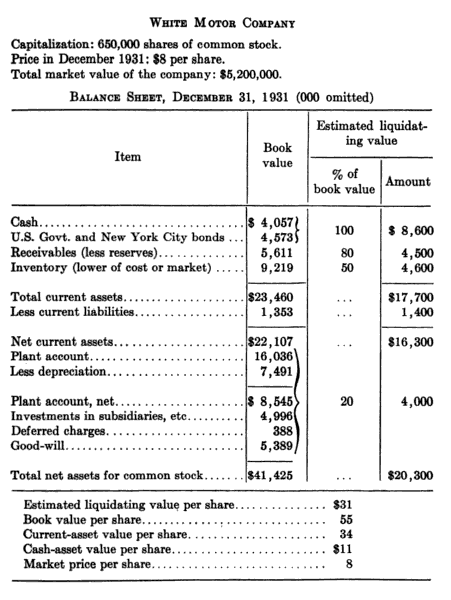
We’ve recently received several questions about our valuation methodology. Specifically, readers have asked why we include property, plant and equipment in our valuation, and why we only discount it by half, as opposed to a higher figure (two-thirds, four-fifths, one-hundred percent). They are concerned that by including property, plant and equipment in our assessment, or by failing to apply a sufficient discount to those assets, we are overstating the asset or liquidation value of the companies we cover and therefore overpaying for their stock. In this post, we better describe our approach to asset valuation. In the next post, we deal with our method for protecting ourselves from overpaying for stock.

Our valuation methodology is closely based on Benjamin Graham’s approach, which he set out in Security Analysis and The Interpretation of Financial Statements. Like Graham, we have a strong preference for current assets, and, in particular, cash. As we mention on the About Greenbackd page, our favorite stocks are those backed by greenbacks, hence our name: Greenbackd. We love to find what Graham described as gold-dollars-with-strings-attached that can be purchased for 50 cents. We believe that there is value in long-term and fixed assets, although not necessarily the value at which those assets are carried in the financial statements. The appropriate discount for long-term and fixed assets is something with which we (and we suspect other Grahamite / asset / liquidation investors) struggle. We think it’s useful to consider Graham’s approach, which we’ve set out below:

Graham’s approach to valuing long-term and fixed assets

Graham’s preference was clearly for current assets, as this quote from Chapter XXIV of The Interpretation of Financial Statements: The Classic 1937 Edition demonstrates:

It is particularly interesting when the current assets make up a relatively large part of the total assets, and the liabilities ahead of the common are relatively small. This is true because the current assets usually suffer a much smaller loss in liquidation than do the fixed assets. In some cases of liquidation it happens that the fixed assets realize only about enough to make up the shrinkage in the current assets.

Hence the “net current asset value” of an industrial security is likely to constitute a rough measure of its liquidating value. It is found by taking the net current assets (or “working capital”) alone and deducting therefrom the full claims of all senior securities. When a stock is selling at much less than its net current asset value, this fact is always of interest, although it is by no means conclusive proof that the issue is undervalued.

Despite Graham’s cautionary tone above, he did not necessarily exclude long-term and fixed assets from his assessment of value. He did, however, heavily discount those assets (from Chapter XLIII of Security Analysis: The Classic 1934 Edition “Significance of the Current Asset Value”):

The value to be ascribed to the assets however, will vary according to their character. The following schedule indicates fairly well the relative dependability of various types of assets in liquidation.

liquidation-value-schedule2

Graham then set out an example valuation for White Motor Company:

In studying this computation it must be borne in mind that our object is not to determine the exact liquidating value of White Motor, but merely to form a rough idea of this liquidating value in order ascertain whether or not the shares are selling for less than the stockholders could actually take of the business. The latter question is answered very definitively in the affirmative. With a full allowance for possible error, there was no doubt at all that White Motor would liquidate for a great deal more than $8 per share or $5,200,000 for the company. The striking fact that the cash assets alone considerably exceed this figure, after deducting all liabilities, completely clinched the argument on this score.

white-motor-example1

Current-asset Value a Rough Measure of Liquidating Value. – The estimate values in liquidation as given for White Motor are somewhat lower in respect of inventories and somewhat higher as regards the fixed and miscellaneous assets than one might be inclined to adopt in other examples. We are allowing for the fact that motor-truck inventories are likely to be less salable than the average. On the other hand some of the assets listed as noncurrent, in particular the investment in White Motor Securities Corporation, would be likely to yield a larger proportion of their book values than the ordinary property account. It will be seen that White Motor’s estimated liquidating value (about $31 per share) is not far from the current-asset value ($34 per share). In the typical case it may be said that the noncurrent assets are likely to realize enough to make up most of the shrinkage suffered in the liquidation of the quick assets. Hence our first thesis, viz., that the current-asset value affords a rough measure of the liquidating value.

Greenbackd’s approach to valuing long-term and fixed assets

The first thing to note is that we’ve got no particular insight into any of the companies that we write about or the actual value of the companies’ assets. The valuations are based on the same generalized, unsophisticated, purely mathematical application of Graham’s formula. Further, if the actual value of an asset is objectively known or determinable, then we don’t know it and, in most cases, can’t determine it. That puts us at a disadvantage to those who do know the assets’ real value or can make that determination. Secondly, we can’t make the fine judgements about value that Graham has made in the White Motor example above. Perhaps it’s blindingly obvious that “motor-truck inventories are likely to be less salable than the average,” but we don’t know anything about motor-truck inventories or the average. It’s specific knowledge that we don’t have, which means that we are forced to mechanically apply the same discount to all assets of the same type.

Given that we’ve disclaimed any ability to actually value an asset or class of assets, why not adopt the lower to middle end of Graham’s valuation range for those assets? (Editors note: What a good suggestion. From here on in, we’re taking Graham’s advice. It’s simply because, in our experience, as idiosyncratic as it has been, an 80% discount to property, plant and equipment is too much in most instances. We think that 50% is a conservative estimate. In our limited experience, commercial and industrial real estate rarely seems to sell at much less than 15% below book value, and that’s in the recent collapse.) At first blush, specialist plant and equipment might appear to be worthless because the resale market is too small, but it can also be sold at a premium to its carrying value. For example, in the recent resources boom, we heard from an acquaintance in the mining industry that mining truck tires were so scarce as to sell in many instances at a higher price second hand than new. Apparently entire junked mining trucks were purchased in one country and shipped to another simply for the tires. Without that specialist knowledge of the mining industry, one might have ascribed a minimal value to an irreparable mining truck or a pile of used mining truck tires and missed the opportunity. What these examples demonstrate, in our opinion, is that the sale price for an asset to be sold out of liquidation is extremely difficult to judge until the actual sale, by which time it’s way too late to make an investment decision.

The best that we can do is fix a point at which we feel that we a more likely to be right than wrong about the value but will also have enough opportunities to invest to make the exercise worthwhile. For us, that point is roughly 20% 50% for property, plant and equipment. That 20% 50% is not based on anything more than (Edit: Graham’s formula, which has stood the test of time and should be applied in most cases unless one has a very good reason not to do so our limited experience, which is insufficient to be statistically significant for any industry or sector, geographical location or time in the investment cycle.) We always set out for our readers our estimate so that you can amend our valuation if you think it’s not conservative enough or just plain wrong (if you do make that amendment, we’d love to hear about it, so that we can adjust our valuation in light of a better reasoned valuation).

We hope that this sheds some light on our process. We’d love to hear your thoughts on the problems with our reasoning.

Read Full Post »

Biotechnology Value Fund (BVF) has requested that the board of Avigen, Inc. (NASDAQ:AVGN) call a Special Meeting of the stockholders for the purpose of replacing the board with BVF’s slate of director nominees. BVF proposes to replace the incumbent directors with directors who will support MediciNova, Inc.’s (NASDAQ:MNOV) offer for AVGN.

We’ve been following AVGN (see earlier posts here, here, here, here, here and here) because it’s a net cash stock (i.e. it’s trading at less than the value of its cash after deducting all liabilities) and specialist biotechnology activist fund BVF has been pushing it to liquidate and return its cash to shareholders. We think MNOV’s offer represents a clever way for AVGN’s stockholders to receive cash equivalent to that which they would receive in a liquidation (less $7M to be paid to MNOV) with the possibility for “an extraordinary, uncapped return” if MNOV is successful post-merger. We estimate AVGN’s cash at around $1.22 per share (BVF estimates $1.20 per share), which is around 40% higher than AVGN’s $0.86 close Friday.

The proxy materials filed with the SEC attach the following press release:

Biotechnology Value Fund, L.P. Calls Special Meeting of Avigen Stockholders To Remove Incumbent Directors and Elect Slate of Stockholder-Focused Nominees

Friday January 9, 2009, 1:21 pm EST

Calls Special Meeting to Enable Stockholders to Determine Fate of Company’s Remaining Cash

Believes Transaction Proposed by MediciNova, Inc. Offers Avigen Stockholders Extraordinary Risk/Reward Opportunity

SAN FRANCISCO, Jan. 9 /PRNewswire/ — Biotechnology Value Fund, L.P. together with its affiliates (“BVF”) today announced that it has requested that the Board of Directors of Avigen, Inc. (“Avigen”) (Nasdaq: AVGN – News) call a Special Meeting of the stockholders for the purpose of replacing the Board with BVF’s slate of stockholder focused nominees. BVF is the beneficial owner of approximately 29.6% of Avigen’s outstanding common stock.

BVF proposes to remove the members of the Board and replace them with directors who will work to ensure Avigen’s stockholders receive the maximum value for their investment in Avigen, while minimizing both downside risk and corporate waste. If elected, BVF’s nominees intend to take steps that would benefit all stockholders, including redeeming Avigen’s stockholder rights plan, working to consummate the proposed transaction with MediciNova, Inc. (“MediciNova”) and/or working to complete a distribution of Avigen’s assets to all stockholders.

BVF has nominated four highly qualified nominees, Mark N. Lampert, Oleg Nodelman, Matthew D. Perry and Robert M. Coppedge, as its slate of director nominees to be elected at the Special Meeting to replace Avigen’s entire existing Board. Messrs. Lampert, Perry, and Nodelman are currently employed by the General Partner of BVF. Mr. Coppedge is an independent nominee, with no economic interest in BVF, Avigen, or MediciNova. Avigen’s bylaws provide that the Board shall set the date of the Special Meeting, which shall be held not less than thirty-five (35) nor more than one hundred twenty (120) days after the date of receipt of BVF’s request. The bylaws further provide that if the Board does not provide notice of the Special Meeting within sixty (60) days following receipt of the request, BVF may set the time and place of the meeting and give the notice.

“We are deeply concerned with recent corporate actions at Avigen that are indicative of a Board that seems far more interested in remaining in place to do whatever it pleases with corporate assets than in returning value and protecting downside risk for all stockholders,” stated Mark N. Lampert, the General Partner of BVF. “Given that Avigen’s stock trades at a fraction of its tangible assets, it appears the marketplace shares our concerns. Accordingly, by calling the Special Meeting, we are providing stockholders with the opportunity to elect new directors who are committed to ensuring that Avigen stockholders, not an entrenched and unsuccessful management team and Board, determine the fate of the substantial remaining value.”

Mr. Lampert continued, “In addition to the Board’s unilateral expansion of ‘golden parachute’ payments for management and its unilateral adoption of the ‘poison pill,’ we are also concerned with the Board’s apparent dismissal of the compelling transaction proposed by MediciNova. Based on our analysis, we believe the transaction, as proposed, provides benefits to stockholders that the Board and management could not match on its own. In particular, we believe this deal would provide Avigen stockholders with:

  • Downside Protection: Based on our analysis, subsequent to the transaction, if MediciNova is unsuccessful Avigen stockholders will receive a modest discount to the current liquidation value of Avigen (which we estimate to be approximately $1.20/Share, net of debt and expenses), as determined by an independent auditor. This means that, even in the worst-case scenario, this transaction would yield an approximate 40% premium to Avigen’s current stock price.
  • Tremendous Upside Potential: Based on our analysis, if MediciNova is successful post-transaction, Avigen stockholders could own a substantial percentage of MediciNova – approximately 45% of the combined company. Under the best-case scenario, this could lead to an extraordinary, uncapped return for Avigen stockholders.
  • Free Option: Additionally, stockholders would have at least one year following consummation of the transaction to choose whether they want the downside protection or upside potential, as described above. We believe this free option period offers stockholders tremendous upside potential with low risk.
  • New Stewardship of Avigen’s Assets: If successfully completed, the transaction would also result in new stewardship of Avigen’s assets, curtailing this Board’s and management’s stated plan of seeking ways to utilize and, we fear, waste Avigen’s remaining assets. We believe stockholder focused management, with a substantial personal stake in the company, is key to protecting Avigen’s assets, particularly in light of Chief Executive Officer Ken Chahine’s recent statements regarding the future of Avigen, including that “it’s hard to put a finger on exactly what we would do,” that he “intends to build” over the next year and that he “thinks that there are opportunities outside of therapeutics.”
  • Unique Synergies: We also strongly believe there are unique synergies between MediciNova and Avigen that likely would not exist with other potential acquirers of Avigen. These synergies, we believe, give rise to the compelling nature of the transaction.”

Mr. Lampert added, “For these reasons, we believe Avigen should seriously pursue the transaction with MediciNova, a company in which we have no economic stake. We are extremely concerned that this Board and management, who collectively own less than 6% of Avigen, do not share our views. It is our hope that stockholders who share our concerns will be empowered to voice these concerns by removing the current Board and replacing them with directors who are serious about maximizing value and minimizing risk for all stockholders.”

[Disclosure: We have a holding in AVGN. This is neither a recommendation to buy or sell any securities. All information provided believed to be reliable and presented for information purposes only.]

Read Full Post »

A new investor has filed a 13D notice in relation to MathStar Inc (OTC:MATH).

When we started following MATH, it had a market capitalization of just $6.2M based on its December 16, 2008 close of $0.68. We estimated its liquidating value to be more than 120% higher at $14.4M or $1.57 per share. The value in liquidation was predominantly cash and short term investments in the amount of $14.8M. The board had largely suspended the company’s operations and was in the process of evaluating its “strategic alternatives, which could include merger, acquisition, increasing operations in another structure or liquidation.”  MATH had twice rejected unsolicited merger proposals and Salvatore Muoio of S. Muoio & Co. LLC had been urging MATH’s board to consider liquidation rather than a merger.

Mr. Zachary McAdoo on behalf of The Zanett Group – the new investor entering the fray at MATH – filed its 13D notice on December 30, 2008 and attached the following letter to the company:

December 30, 2008

Douglas Pihl
Chairman of the Board
Mathstar, Inc.
19075 NW Tanabourne, Suite 200
Hillsboro, OR 97124

Dear Mr. Pihl,

I am writing to express my opinion as a shareholder that we strongly urge the
Board to liquidate Mathstar, Inc. rather than acquire another company.

Sincerely,

Zachary McAdoo, CFA

Short, sweet and to the point. Hopefully management can hear the drum beats calling for liquidation.

MATH is up around 18% since we started following it, but it’s still trading at half its liquidating value and a little more than half its net cash backing, so we’re maintaining our position.

[Disclosure: We do not presently have a holding in MATH. This is neither a recommendation to buy or sell any securities. All information provided believed to be reliable and presented for information purposes only.]

Read Full Post »

In its most recent 13D filing Biotechnology Value Fund (BVF) has provided its “full and enthusiastic support” for MediciNova, Inc.’s (NASDAQ:MNOV) offer for Avigen, Inc. (NASDAQ:AVGN).

We’ve been following AVGN (see earlier posts here, here, here, here and here) because it’s a net cash stock (i.e. it’s trading at less than the value of its cash after deducting all liabilities) and specialist biotechnology activist fund BVF has been pushing it to liquidate and return its cash to shareholders. We think that MNOV’s offer represents a clever way for AVGN’s stockholders to receive cash equivalent to that which they would receive in a liquidation (less $7M to be paid to MNOV). We estimate the cash to be paid at around $1.22 per share (BVF estimates the amount at $1.20 per share), which is more than 60% higher than AVGN’s $0.76 close Wednesday. AVGN’s shareholders also have the option to receive MNOV shares instead of the cash. MNOV values its shares at $4.00 (MNOV closed Wednesday at $1.59).

BVF’s filing sets out its rationale for endorsing the merger. The relevant text is extracted below:

On December 22, 2008 MediciNova, Inc. (“MediciNova”) described details of a Proposed Merger between MediciNova and Avigen, Inc. (“Avigen”) in a letter to Avigen’s Chairman, Zola Horovitz. The Reporting Persons hereby express their full and enthusiastic support for this Proposed Merger and believe it is the best interest of all Avigen shareholders. The Reporting Persons presently have no economic interest in MediciNova. The Reporting Persons call on Avigen’s Board of Directors to negotiate with MediciNova and work to consummate the Proposed Merger expeditiously.

The Reporting Persons support the Proposed Merger for the following reasons:

1. Downside Protection: The Proposed Merger provides for the same downside protection that the Reporting Persons encouraged Avigen to implement directly (which Avigen rejected). Subsequent to the Proposed Merger, if MediciNova is unsuccessful, Avigen shareholders will receive approximately the current liquidation value of Avigen (which the Reporting Persons estimate to be approximately $1.20/share, net of debt and expenses), as determined by an independent auditor. Incredibly, in a worst case scenario, the Proposed Merger would yield about a 60% premium to Avigen’s current stock price.

2. Extraordinary Upside Potential: If MediciNova is successful post-merger, Avigen shareholders could own a substantial percentage of MediciNova (which the Reporting Persons estimate to be approximately 45% of the combined company). Thus, in a best case scenario, Avigen shareholders could enjoy an extraordinary, uncapped return. For this reason, the Proposed Merger is superior to an immediate liquidation of Avigen.

3. Free Option: Shareholders have at least one year after the merger is consummated to choose downside protection or upside potential, as described above. This decision can be based on information obtained over the course of the free option period, including the stock performance of MediciNova. This free option period offers shareholders tremendous upside potential with virtually no risk.

4. Change of Control: The Proposed Merger would result in new stewardship of Avigen’s assets, curtailing current management’s stated plan of seeking ways to utilize (and we fear waste) Avigen’s cash in any way they wish. This is a particularly frightening prospect in light of CEO Ken Chahine’s recent statements that “it’s hard to put a finger on exactly what we would do”, that he “intends to build” and that he “thinks that there are opportunities outside of therapeutics.”

5. Unique Synergies: The Reporting Persons believe there are unique synergies between MediciNova and Avigen which likely would not exist with other potential acquirers of Avigen. These synergies give rise to the compelling nature of the Proposed Merger.

BVF wishes to see the Proposed Merger brought to a shareholder vote as soon as practical and urges other Avigen shareholders to support this offer.

We’ve noted in our earlier posts that AVGN presents an attractive investment opportunity if BVF can persuade it to quickly distribute its remaining cash to stockholders. MNOV’s offer presents a clever way for AVGN’s stockholders to receive an amount equivalent to its cash with the possibility for “an extraordinary, uncapped return” if MNOV is successful post-merger. We estimate AVGN’s cash at around $1.22 per share, which is more than 60% higher than AVGN’s $0.76 close Wednesday. With BVF’s endorsement of MNOV’s offer, we believe the investment rationale for AVGN is strong.

[Disclosure: We have a holding in AVGN. This is neither a recommendation to buy or sell any securities. All information provided believed to be reliable and presented for information purposes only.]

Read Full Post »

« Newer Posts - Older Posts »