Feeds:
Posts
Comments

Posts Tagged ‘Net Cash Stock’

Biotechnology Value Fund (BVF) yesterday called for the management of Avigen Inc (Nasdaq: AVGN) to “address certain fundamental questions BVF believes need to be answered in order for stockholders to effectively evaluate [AVGN]’s future strategic direction.”

We’ve been following AVGN (see archived posts here) because it’s a net cash stock (i.e. it’s trading at less than the value of its cash after deducting all liabilities) and specialist biotechnology activist fund BVF has been pushing it to liquidate and return its cash to shareholders. MediciNova Inc (NASDAQ:MNOV) has made an offer for AVGN that we think represents a clever way for AVGN’s stockholders to receive cash equivalent to that which they would receive in a liquidation (less $7M to be paid to MNOV) with the possibility for “an extraordinary, uncapped return” if MNOV is successful post-merger. We estimate AVGN’s cash at around $1.22 per share (BVF estimates $1.20 per share), which is a little less than 20% higher than AVGN’s $1.04 close yesterday.

The full text of BVF’s press release is reproduced below:

Biotechnology Value Fund, L.P. Requests Avigen Board to Provide Critical Information to Stockholders

Tuesday February 10, 2009, 1:04 pm EST

Raises Questions to be Addressed by Board and Management on Avigen’s February 11, 2009 Conference Call

SAN FRANCISCO, Feb. 10 /PRNewswire/ — Biotechnology Value Fund, L.P. (“BVF”), today called for the management of Avigen, Inc. (Nasdaq: AVGN – News) to address certain fundamental questions BVF believes need to be answered in order for stockholders to effectively evaluate Avigen’s future strategic direction. Avigen announced in its January 14, 2009 press release that it will hold a conference call on Wednesday, February 11, 2009 (time to be announced) to, among other things, “provide an update on the progress of the strategic review.” To make that update more effective, BVF raises the following questions and challenges the Board and management to finally address these fundamental issues:

1. Why has Avigen failed to call the special meeting of stockholders that would permit stockholders to have a say in Avigen’s future? BVF delivered its request for a special meeting to the Board over a month ago. To date, the Board has failed to call the requested special meeting. This meeting would provide stockholders with the ability to exercise their fundamental right to vote on Avigen’s strategic direction. If stockholders agree with BVF, they can vote to remove existing directors and elect BVF’s nominees. If the Board does not act prior to Wednesday, March 11, 2009 to set a meeting date, BVF can unilaterally set the date of the special meeting and would anticipate setting a meeting date for early April.

2. Why has Avigen not offered downside protection to stockholders? BVF has repeatedly called on Avigen to commit to protecting stockholder value by offering all stockholders a fixed amount of cash under any resulting scenario. Management has continually resisted this suggestion, leading us to believe that Avigen intends to gamble that money. MediciNova has proposed a transaction that offers critical downside protection to stockholders. So why hasn’t Avigen done so directly?

3. Why does Avigen not consider the MediciNova proposed merger to be a compelling outcome for stockholders? BVF does not understand why Avigen appears to be resisting the MediciNova transaction. Economically, based on publicly available information, we believe this proposed transaction to be in the best interest of all stockholders. In a worst case scenario, stockholders would receive approximately Avigen’s liquidation value. In a best-case scenario, stockholders would own 45% of the combined company.

4. Is management requiring downside protection for Avigen stockholders as a condition to all potential “strategic alternatives?” If this is the case, Avigen should state so explicitly so stockholders can stop worrying about losing the bulk of their investment. If not, please explain how any alternative without downside protection could be more attractive to stockholders. Most biotech companies in Avigen’s shoes have managed to destroy the majority of stockholder value through by pursuing their favorite merger. How can Avigen justify standing in the way of the downside protection being offered by MediciNova?

5. What is the estimated net liquidation value of Avigen? In response to our tender offer, management claimed that Avigen is currently worth more than our offer of $1 per share, without support of any kind. We call on management to publicly provide their estimate of Avigen’s liquidation value, together with a detailed analysis. Management should also disclose how much cash was burned by Avigen since its last public filing on September 30, 2008 and how much cash net of debt and obligations will be available on March 31, 2009.

6. What are Avigen’s total “golden parachute” obligations and how much time did Avigen’s CEO spend in Utah versus California during the critical months of December and January? In a shameless example of acting in their own self-interest, in October 2008 management increased its “golden parachute” payments in order to “to attract and retain key executive talent.” At the time, we estimated these payouts to total at least $3 million, an incredible 16.5% of Avigen’s entire market value at the time of adoption. BVF believes this is particularly egregious given the current economic environment. What is the current value of these obligations and how many employees stand to receive these payouts?

7. What is Avigen’s relationship with its financial advisers and how are they being compensated? In January 2009, the Board of Directors announced that it had retained not one but two financial advisers, RBC Capital Markets and Pacific Growth Equities LLC. Why did the Board find it necessary to engage two financial advisers? Will these advisors be paid in the same currency as stockholders or will they, like management, take cash and leave stockholders with paper?

Mark N. Lampert, the General Partner of BVF stated, “Since management announced the failure of AV650 in October of last year, we have found their reluctance to address certain issues, which we believe are integral for stockholders’ assessment of Avigen’s current prospects and future direction, to be incredibly frustrating. We are hopeful management will not hide behind vague generalities, and will provide specific answers to these important questions.

Mr. Lampert continued, “We hope the Board and management will address our questions and concerns and provide stockholders with the disclosure necessary to properly evaluate and determine the best strategic direction for Avigen. We call on each Board member, consistent with his fiduciary duties, to act in the best interests of all stockholders. If we determine this Board has acted inconsistently with its fiduciary duties, we will not hesitate to take any and all actions within our rights as stockholders, including commencing litigation and/or seeking an injunction, in order to protect our investment in Avigen. We look forward to the Board’s and management’s response.”

[Full Disclosure: We have a holding in AVGN. This is neither a recommendation to buy or sell any securities. All information provided believed to be reliable and presented for information purposes only.]
Read Full Post »

Biotechnology Value Fund (BVF) responded on Friday to Avigen, Inc.’s (NASDAQ:AVGN) announcement that its board is “considering ‘strategic alternatives,'” announcing that it is “gravely concerned” that AVGN’s announcement is “silent on downside protection for all stockholders.”

The full text of BVF’s announcement is reproduced below:

BVF WARNS STOCKHOLDERS: AVIGEN CONTINUES TO REMAIN SILENT ON DOWNSIDE PROTECTION

AVIGEN’S LATEST MOVES REINFORCE TROUBLING PATTERN OF DISMISSING ALTERNATIVES WHICH PROTECT STOCKHOLDER VALUE

BVF URGES AVIGEN BOARD TO CALL SPECIAL MEETING SO STOCKHOLDERS CAN VOTE FOR DIRECTORS COMMITTED TO MAXIMIZING VALUE AND MINIMIZING RISK AND WASTE

NEW YORK, February 6, 2009 – BVF Acquisition LLC (the “Purchaser”), an affiliate of Biotechnology Value Fund L.P. (“BVF”), announced today that it is gravely concerned that today’s announcement by the Board of Directors of Avigen, Inc. (NASDAQ:AVGN) that it is considering “strategic alternatives” is silent on downside protection for all stockholders.

Speaking on behalf of BVF, Mark Lampert, BVF’s General Partner, stated, “As the largest stockholder in Avigen, holding 8,819,600, or approximately 29.63% of Avigen’s outstanding shares, we are worried that this Board is embarking on a path that will use the companies cash and valuable assets in a misguided transaction which offers no downside protection to stockholders — a key feature of the proposed merger with MediciNova . The landscape is littered with numerous parallels in which cash shells like Avigen have entered into transactions promoted as value-creating, but which ultimately left investors holding nearly worthless stock. Our nominees are committed to closing the downside-protected merger with MediciNova. We are disappointed that the current Board seems to be more interested in entrenching itself by means of implementing golden parachutes and a poison pill, actions that we believe are detrimental to the creation of value at Avigen. We reiterate our call to the Avigen Board to institute downside protection for all stockholders.”

Separately, BVF is notifying the SEC of significant and blatant inaccuracies in Avigen’s 14D-9 filing. BVF will hold Avigen responsible for any harm caused to BVF by these inaccuracies.

“We believe Avigen’s board and management has a long history of failure and waste and do not believe this Board should be making any decisions about Avigen’s future. Any decision by this Board for the direction of Avigen should be subject to a vote of stockholders,” Mr. Lampert said. “We note that Avigen’s directors and officers own an aggregate of 48,233 shares of Avigen stock, as opposed to BVF’s over 8.8 million shares. BVF shares the interests of all stockholders in the direction of the Company, and has never requested any benefit in which all stockholders would not fully participate. Our tender offer provides other stockholders with a liquidity option. We welcome any stockholders who do not wish to tender to continue as holders alongside BVF.”

BVF continues to urge the Avigen Board to stop stalling and to promptly call a special meeting of stockholders to enable the true owners of the company, the stockholders, to determine the fate of their investment. BVF submitted a request on January 9, 2009 for Avigen to call special meeting. Today, nearly one month later, the Company has taken no action in this regard. At the special meeting, stockholders will be asked to replace the existing Board with directors who would be dedicated to maximizing value and minimizing risk and waste on behalf of all Avigen stockholders. BVF believes that stockholders who are concerned about the continuing destruction of value at Avigen – whether or not they intend to tender their shares – should urge the Board to call a meeting as soon as possible.

On January 23, 2009, BVF commenced a tender offer at $1.00 per share, which represented a premium of 35% over the closing stock price of $0.74 on January 8, 2009, the day before BVF announced its desire to replace Avigen’s incumbent Board of Directors. Subsequent to the commencement of BVF’s tender, Avigen’s stock price has increased to above the tender price. The offer, which is not subject to any financing condition, was and is intended to give certain stockholders, who desire near-term liquidity, an alternative to the proposed merger with MediciNova. Each stockholder should make their own decision on whether or not to tender.

The tender offer is conditioned upon, among other things, the BVF nominees being elected or appointed to the Avigen Board of Directors so that they would constitute a majority of the Board. If placed on the Board, the BVF nominees would, subject to their fiduciary duties, pursue merger negotiations with MediciNova, Inc. or other actions that would be designed to enhance value and minimize risk for all Avigen stockholders.

MacKenzie Partners, Inc. is the Information Agent for the tender offer and any questions or requests for the Offer to Purchase and related materials with respect to the tender offer or the special meeting may be directed to MacKenzie Partners, Inc.

[Full Disclosure: We have a holding in AVGN. This is neither a recommendation to buy or sell any securities. All information provided believed to be reliable and presented for information purposes only.]
Read Full Post »

The board of Avigen Inc (NASDAQ: AVGN) has responded to Biotechnology Value Fund’s (BVF) cash tender offer to purchase the outstanding common stock of AVGN, writing that the offer is “inadequate and not in the best interests of stockholders.”

We’ve been following AVGN (see archived posts here) because it’s a net cash stock (i.e. it’s trading at less than the value of its cash after deducting all liabilities) and specialist biotechnology activist fund BVF has been pushing it to liquidate and return its cash to shareholders. MediciNova Inc (NASDAQ:MNOV) has made an offer for AVGN that we think represents a clever way for AVGN’s stockholders to receive cash equivalent to that which they would receive in a liquidation (less $7M to be paid to MNOV) with the possibility for “an extraordinary, uncapped return” if MNOV is successful post-merger. We estimate AVGN’s cash at around $1.22 per share (BVF estimates $1.20 per share), which is a little less than 20% higher than AVGN’s $1.04 close yesterday.

The letter to AVGN stockholders is reproduced below:

Dear Avigen Stockholder:

Your Board of Directors has determined that the unsolicited conditional offer (“Offer”) by BVF Acquisition LLC (“BVF”) to acquire your shares is inadequate and not in the best interests of stockholders. The Board strongly urges you not to tender any shares into BVF’s Offer, and to withdraw any previously tendered shares. We believe we can create more value for your investment than the $1.00 per share that has been offered by BVF.

To that end, we are pleased to report good progress in our process of considering strategic alternatives to maximize stockholder value. In the last few weeks, Avigen has received multiple proposals that place significant value on its cash position, intellectual property portfolio, AV411 product development program, and public listing on the NASDAQ Global Market. We expect to receive additional proposals in the weeks ahead and are optimistic about achieving our objective of creating significant value for all stockholders.

Reasons for the Board’s Recommendation to Reject the BVF Offer

The Board cited the following reasons for recommending that stockholders reject BVF’s Offer:

* The Offer price is inadequate and substantially undervalues Avigen. The Board believes the Offer price substantially undervalues Avigen’s business, including its cash position, AV411 development program, intellectual property, license with Genzyme, experienced management team and public listing.

* We believe we can structure a transaction that will allow you to receive value for many or all of the company’s assets. The Board believes that the current global economic crisis provides significant strategic opportunities to companies such as Avigen that have a strong cash position and public listing. In addition to pursuing a potential strategic relationship with MediciNova, Inc., we have recently received other written proposals which appear competitive to the MediciNova proposal. These proposals place significant value on many or all of Avigen’s assets, and we believe we will receive additional proposals in the weeks ahead.

* The Avigen stock price has recently traded as high as $1.06 per share, and closed February 5, 2009 at a price of $1.00 per Share.

* The BVF Offer transfers to BVF any future increases in the price of your Avigen stock. Under the terms of BVF’s Offer, if you tender your shares, and the Offer is consummated, you would not receive more than $1.00 per share. The Board does not believe that BVF would make this Offer unless it expected the stock price to increase.

In fact, BVF states in its Offer that “[t]he Purchaser is making this Offer because BVF believes that the purchase of Shares at the purchase price pursuant to the Offer represents an attractive investment for the Purchaser.” If you tender your shares to BVF and the Offer is consummated, BVF will benefit from any gains in Avigen’s stock price, not you.

* The BVF Offer is not a firm commitment to you and is unlikely to close by the Expiration Time. The Offer has conditions that make it unlikely to close on February 23, 2009 as stated in the Offer, and carries significant uncertainty that the Offer will be consummated at all.

Avigen’s Board is committed to listening to its stockholders and working with them to achieve the maximum value of the company’s assets. The Board has met and interacted with BVF a number of times, received and evaluated its proposals, and tried to draw on its ideas in a collaborative manner. These efforts to work with BVF are described in detail in Avigen’s Schedule 14D-9, which accompanies this letter and has been filed with the Securities and Exchange Commission.

The Board also has worked diligently to engage in discussions with MediciNova, Inc., which in December 2008 proposed acquiring Avigen. Since making that unsolicited proposal, however, MediciNova has been slow to advance discussions, as more fully described in Avigen’s Schedule 14D-9 filing.

Our Pledge to Stockholders

Avigen’s Board and management took decisive action since the announcement of our AV650 trial results on October 21, 2008, and acted swiftly to preserve cash. We believe the value of Avigen’s remaining assets is significant and the potential for a strategic transaction is worthy of consideration. Whatever the outcome, we intend to apply the same financial judgment used in the past to decisions going forward.

In the meantime, Avigen intends to provide its stockholders with regular updates and to continue to work with all its stockholders in a thoughtful, collaborative and respectful manner.
Respectfully,

Signed for the Board of Directors:

/s/ Zola Horovitz, Ph.D.
Zola Horovitz, Ph.D. as Chairman of the Board

/s/ Kenneth G. Chahine, Ph.D., J.D.
Kenneth G. Chahine, Ph.D., J.D. as Chief Executive Officer

The relevant portion of AVGN’s Schedule 14D-9 filing follows:

Although BVF had previously been a significant stockholder of Avigen, BVF’s filings with the SEC show that BVF had sold almost all of its Shares prior to October 21, 2008. Specifically, in the two months prior to October 21, BVF sold more than 640,000 Shares, at prices ranging from $3.95 to $4.60 per Share.

On October 21, 2008, Avigen announced that the top-line data from its AV650 trial for the treatment of spasticity in patients with multiple sclerosis did not meet its primary endpoint. As a result of this announcement, Avigen’s stock price dropped by more than 80% and, on the same day, BVF purchased more than 8,100,000 Shares in the open market at an average price of approximately $0.58 per Share.

Avigen held a conference call announcing the data from the AV650 trial. On the call, Avigen stated that the management and Board were pleased with the trial design and execution, but unfortunately the results were unequivocal. As a result, the AV650 program would be immediately terminated and no additional investment in the program was planned.

On October 22, 2008, Avigen’s representatives met with BVF’s representatives. At the meeting, BVF’s representatives expressed admiration for the team’s past performance in creating stockholder value. BVF proposed that Avigen, given its expertise and cash balance, look for attractive companies to merge with or acquire. BVF expressed its belief that such a strategy could lead to a significant return on its recent investment.

Avigen’s Chairman, Dr. Zola Horovitz, invited Mark Lampert, President of BVF, to present his views to the Board at the upcoming Board meeting on October 30, 2008. Mr. Lampert presented at the meeting and again expressed his admiration of the Board and management on taking swift and decisive action to terminate the AV650 program. However, instead of pursuing strategic alternatives, Mr. Lampert recommended to the Board that Avigen immediately liquidate. Following Mr. Lampert’s participation, the Board approved management’s recommendation to significantly reduce head count and to monetize both the AV513 and AV411 assets through either a partnership or sale transaction, and authorized management to initiate a process to identify potential strategic opportunities that could maximize stockholder value and result in returns that exceeded Avigen’s liquidation value.

On the next day, and without waiting for any response from the Board, BVF filed an amendment to its Schedule 13D expressing the same view Mr. Lampert had expressed at the Board meeting and threatening to bring a proposal for liquidation directly to a vote of the stockholders.

On November 3, 2008, Avigen announced a significant restructuring aimed at preserving cash and reassessing strategic opportunities, including staff reductions of over 70 percent of Avigen’s total workforce, as approved by the Board on October 30.

Dr. Kenneth Chahine, Avigen’s CEO, continued to have an open dialogue with Mr. Lampert through phone conversations and emails. Dr. Chahine tried to reassure BVF that Avigen was going to conduct an orderly and efficient process and that Avigen was being fiscally prudent. Mr. Lampert expressed his opinion that Avigen should grant BVF a “put option” (an option to sell its Shares back to Avigen at a set price in the future) to guarantee the minimum “worst case outcome” for BVF. Dr. Chahine expressed that such a put option could potentially weaken Avigen’s negotiating position in its efforts to monetize AV411 or a sale of Avigen. Dr. Chahine explained his concerns by using the analogy of someone trying to sell their house for full value when the buyers know the house is scheduled to go into foreclosure at a fraction of the price in the future.

On November 21, 2008, Avigen entered into the Rights Agreement described in more detail in Item 8 below, in order to discourage a hostile takeover by a third party at a price that would prevent stockholders from obtaining fair value for their Shares.

During the next two weeks Avigen continued discussions with strategic advisors and began negotiating engagement letters with Pacific Growth Equities (“Pacific Growth”) and RBC Capital Markets (“RBC”).

On December 4, 2008, Dr. Chahine, along with one of the strategic advisors, spoke with Mr. Lampert. Dr. Chahine stated that he had spoken with counsel, strategic advisors, and several Board members regarding BVF’s demand for a put option. Dr. Chahine conveyed that numerous legal and business concerns had been raised and cautioned that a put option might have unintended consequences that would disadvantage all stockholders, including BVF. Nevertheless, Dr. Chahine stated that he remained open-minded and invited Mr. Lampert to provide Avigen’s strategic advisors at Pacific Growth support and rationale for BVF’s proposal for presentation and consideration by the Board at a meeting to be held on December 9.

On December 8, 2008, Dr. Horovitz received a letter from MediciNova, Inc. (“MediciNova”), proposing an acquisition of Avigen by MediciNova and setting forth very general terms for the proposed acquisition. Dr. Horovitz promptly contacted MediciNova’s Chairman and expressed that Avigen was in the process of retaining strategic advisors to consider proposals such as this early in the new year. This timing was necessary to permit Avigen’s management to focus on the ongoing restructuring efforts and to complete the negotiation of the sale of AV513 to Baxter Healthcare, and to formally retain strategic advisors.

On December 9, 2008, the Board met. While not formally engaged, strategic advisors from Pacific Growth and RBC gave presentations outlining their expertise and the review process. The Board discussed the MediciNova proposal and Dr. Horovitz stated that he had contacted MediciNova’s Chairman and had proposed a timeline for discussion. BVF did not provide any supporting material to strategic advisors on the mechanism or rationale for a put option.

On December 11, 2008, BVF published an open letter to the Board. In the letter BVF accused management and the Board of general mismanagement and reiterated BVF’s demand that the Board “guaranty” an outcome for stockholders.

On December 18, 2008, Avigen announced the sale of its AV513 product candidate for $7,000,000 ($0.23 per Share) to Baxter Healthcare.

On December 22, 2008, Drs. Horovitz and Chahine issued a letter to stockholders underscoring the Board’s and management’s commitment to act in the best interests of Avigen’s stockholders and emphasizing the swift and decisive actions already taken to preserve cash since the AV650 announcement. The letter to stockholders also reminded stockholders of the significant value of Avigen’s remaining assets, and of the Board’s and management’s commitment to pursue possible strategic transactions that would be in the best interests of all of Avigen’s stockholders. The letter concluded with a pledge to stockholders that Avigen would continue to use the same fiscally prudent approach that had allowed it to preserve cash.

On that same day, Dr. Horovitz received a second (and modified) proposal from MediciNova. In the letter, MediciNova proposed terms substantially similar to those contained in MediciNova’s December 8 letter, modified to reflect the $7,000,000 received from the sale of AV513.

The Board subsequently reviewed the proposal from MediciNova and concluded that the MediciNova proposal, as revised, should be carefully considered and that due diligence should commence early in the new year following the engagement of strategic advisors. Dr. Horovitz again contacted MediciNova’s Chairman and communicated the Board’s conclusion.

On December 29, 2008, BVF filed an amended Schedule 13D advocating that Avigen should “consummate the Proposed Merger expeditiously.” It was the Board’s view that BVF’s publicly-stated support for the MediciNova proposal weakened Avigen’s negotiating position, making it more difficult for Avigen to negotiate a better transaction with MediciNova on behalf of all of Avigen’s stockholders.

On January 9, 2009, BVF delivered a notice to Avigen, demanding that Avigen call a special meeting of stockholders to, among other things, remove the current members of Avigen’s Board, without cause, and for the proposed election of BVF’s slate of director nominees (the “BVF Nominees”).

On January 14, 2009, Avigen announced that it had engaged RBC to oversee the review of merger and acquisition opportunities for Avigen and had engaged Pacific Growth primarily to assist in monetizing Avigen’s AV411 assets.

On the very next day, BVF publicly announced its intention to make a tender offer to purchase all of the outstanding Shares of Avigen. In its offering documents filed subsequently, BVF incorrectly stated that Avigen had rejected the MediciNova proposal and expressed BVF’s view that, if elected to the Board of Avigen, the BVF Nominees would pursue the MediciNova proposal.

On January 19, 2009, Avigen sent a confidentiality agreement to MediciNova’s Chairman of the Board, in order to initiate the due diligence process and negotiations regarding a possible transaction between Avigen and MediciNova. The Board proposed in the confidentiality agreement that both Avigen and MediciNova share information with each other in order to permit the Board and, if a transaction is agreed upon, Avigen stockholders, to understand key aspects of MediciNova’s business, including anticipated expenses, development plans, and commercialization strategy in order to properly evaluate the proposal and determine whether it is appropriate to recommend or, if recommended, approve.

In the days following, Avigen’s strategic advisors at RBC met with representatives of BVF to engage in further discussions.

On January 20, 2009, RBC presented various financial analyses and an overview and update of the process of evaluating Avigen’s strategic alternatives to the Board. On that date, Avigen received multiple proposals from companies to engage in strategic transactions that, on their face, appeared competitive with the MediciNova proposal. Avigen contacted these companies and initiated discussions to assess these potential strategic transactions.

Avigen’s strategic advisors at RBC sent an email to MediciNova’s Chairman on January 22, 2009, stating that efforts to reach MediciNova’s CEO and CFO were unsuccessful and urging him to review and return the confidentiality agreement so that due diligence could commence as soon as possible. The Chairman responded that he would remind the MediciNova management. RBC subsequently received a communication from MediciNova’s CFO promising that they would review the draft and return it with any comments.

In spite of Avigen’s continuing efforts to assess potential strategic transactions and the Board’s and management’s efforts to engage Mr. Lampert in productive discussions, on January 23, 2009, the Purchaser filed a Schedule TO with the SEC, formally initiating the Offer.

At Board meetings held on January 26 and 29, 2009, at each of which the Board assessed the Offer, RBC presented various financial analyses and an overview and update regarding the process of evaluating Avigen’s strategic alternatives.

One week after MediciNova’s prior communication, on January 29, 2009, strategic advisors at RBC once again contacted MediciNova’s Chairman reiterating that efforts to reach MediciNova’s CEO and CFO were unsuccessful and urging him to review and return the confidentiality agreement so that diligence could commence as soon as possible. The Chairman responded that he would remind the management again.

On January 30, 2009, RBC received a revised version of the confidentiality agreement from MediciNova with suggested changes. The draft was reviewed by Avigen’s counsel and on February 3, 2009, promptly returned to MediciNova. RBC proposed that MediciNova’s counsel call Avigen’s counsel to expedite the process and resolve any issues so that the due diligence process could be initiated as soon as possible.

As of the date of this statement, MediciNova’s counsel had not yet contacted Avigen’s counsel.

AVGN’s other proxy documents can be found here.

[Full Disclosure: We have a holding in AVGN. This is neither a recommendation to buy or sell any securities. All information provided believed to be reliable and presented for information purposes only.]
Read Full Post »

MathStar Inc (OTC:MATH) has taken the first steps to liquidation, announcing that it is preparing to sell its Field Programmable Object Array (FPOA) technology and intellectual property.

We started following MATH in December last year when it was trading at $0.68 because it was a net cash stock with a substantial stockholder lobbying management to liquidate. The stock is up 29.4% to $0.88 yesterday, giving it a market capitalization of $8.1M. We estimate MATH’s liquidation value still to be around 80% higher at $14.8M or $1.57 per share. That value is predominantly cash and short term investments and doesn’t take into account any further value that the sale of the FPOA technology and intellectual property may yield. Two activist investors, Mr. Salvatore Muoio of S. Muoio & Co. and Mr. Zachary McAdoo of The Zanett Group, have been urging MATH’s board to consider liquidation rather than a merger. MATH’s board seems to agree, twice rejecting unsolicited merger proposals, suspending the company’s operations and exploring “strategic alternatives, which could include merger, acquisition, increasing operations in another structure or liquidation.”

The company’s announcement of the sale of the technology and intellectual property is as follows:

COLORADO SPRINGS, Colorado – January 26, 2009 – Core Capital’s Electronics and Semiconductor Group (ESG), an investment banking firm with an electronics and semiconductor focus, announces that its client, MathStar, Inc. (OTC: MATH), has prepared its technology for purchase. MathStar, a fabless semiconductor company specializing in high-performance programmable logic, is finalizing its Field Programmable Object Array (FPOA) technology and intellectual property package for sale. Arrangements have been prepared to assist prospective buyers to evaluate the opportunity, including a webinar, a private “data room” web portal, and access to key creators of the technology.

MathStar began its sales efforts in early October 2008, when it signed with the Core Capital Electronics and Semiconductor Group to complete a strategic sale of MathStar’s technology and intellectual property.

[Disclosure: We do not presently have a holding in MATH. This is neither a recommendation to buy or sell any securities. All information provided believed to be reliable and presented for information purposes only.]

Read Full Post »

Wesley Gray, who occasionally drops by here to provide some high quality commentary, has launched his maiden hedge fund, “Empirical Search Strategies.”

The fund follows a “long-biased micro-cap equity strategy,” which means it invests in “special situations opportunities such as liquidations and companies selling for less than cash value.” Sounds like a good strategy to us.

The fund is down 12.56% since its September launch, which compares favorably with the performance of the Russell 2000 Index (down more than 39% during the same period).

Gray is completing his Ph.D. at the University of Chicago Booth School of Business.

You can read more about Gray’s strategy in the FinAlternatives article Ten Hut! Ex-Marine Launches Long/Short Hedge Fund or Gray’s own website Empirical Finance Research Blog.

Congratulations, Wes. We hope to see you here more often.

Read Full Post »

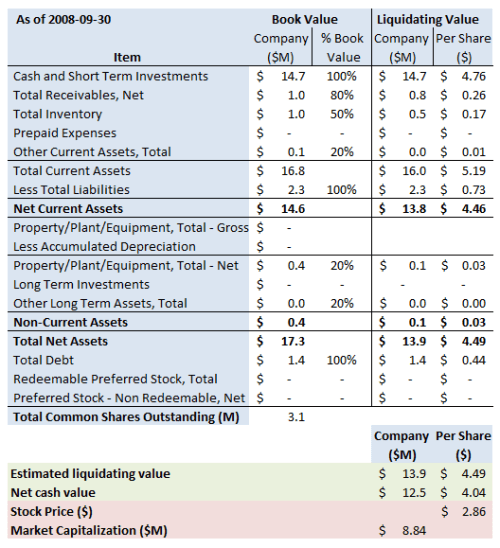
ARC Wireless Solutions (NASDAQ:ARCW) is a net cash stock with an activist investor, Brean Murray Carret, disclosing a 13.9% position on November 3 last year. ARCW closed yesterday at $2.86, giving it a market capitalization of just $8.8M. We estimate its liquidation value to be 57% higher at $13.9M. Brean Murray Carret’s original 13D filing disclosed its intention to tip out ARCW’s board and “nominate an alternative slate of directors for election to [ARCW’s]’s Board of Directors at the earliest possible opportunity.” Its subsequent 13D filing indicated that this occurred quickly, and Brean Murray Carret’s nominees were elected by the board of ARCW on November 12, 2008. This bodes well for the company chances of taking a new, shareholder-friendly direction.

About ARCW

ARCW is a provider of wireless network components. The company designs and manufactures antennas and related wireless communication systems, including cellular base station, mobile, cellular, conformal and flat panel antennas. ARCW also designs and distributes cable in the United States through original equipment manufacturers, retailers and the Internet. The company’s investor relations website is here.

The value proposition

ARCW’s most recent 10Q shows a loss-making, generally cash-consuming company. The company’s balance sheet has, however, retained some value (the “Book Value” column shows the assets as they are carried in the financial statements, and the “Liquidating Value” column shows our estimate of the value of the assets in a liquidation):

arcw-summary

The value on ARCW’s balance sheet is as a result of its sale in 2006 of its wholly owned subsidiary Winncom for $17M. The company has since burned through some of that cash, but it does still have a net cash value of $12.5M or $4.04 per share. We estimate its liquidation value to be slightly higher at $13.9M or $4.49 per share.

The catalyst

Brean Murray Carret filed its original 13D notice in November last year, disclosing a 13.9% position in ARCW and calling for the removal of the board:

[Brean Murray Carret] intend to nominate an alternative slate of directors for election to [ARCW]’s Board of Directors at the earliest possible opportunity.

Brean Murray Carret amended its 13D filing later in November, by which time it had secured the board:

The annual meeting of shareholders of [ARCW], which was scheduled to occur on November 5, 2008, was adjourned until November 19, 2008. On November 17, 2008, [ARCW] announced that on November 19, 2008, the annual meeting of shareholders will be adjourned until a later date for which [ARCW]’s shareholders will be sent a written notice along with updated proxy materials for the meeting.

Effective November 12, 2008, Sigmund A. Balaban, Donald A. Huebner, Randall P. Marx and Robert E. Wade have resigned as members of [ARCW]’s Board of Directors. Messrs. Balaban, Huebner and Wade also resigned as members of the Board’s Audit Committee and Compensation Committee and Mr. Marx resigned as Chairman of the Board. In connection with their previously disclosed intention, [Brean Murray Carret]’s proposed Viktor Nemeth and Marco Vega to fill the vacancies thereby created on [ARCW]’s Board of Directors. [Brean Murray Carret]’s nominees were elected by the Board of Directors on November 12, 2008. [Brean Murray Carret]  expect that their nominees, and Jason Young, a current director, will be nominated for election to [ARCW]’s Board of Directors at the annual shareholders meeting as adjourned.

Effective November 12, 2008, Jason Young was appointed to serve as Chairman of the Board. Effective November 18, 2008, Randall P. Marx resigned as Chief Executive Officer and Secretary of [ARCW] and Jason Young was elected to serve as interim Chief Executive Officer.

Conclusion

ARCW is undervalued at $2.86 with a net cash value of $12.5M or $4.04 per share and a liquidation value of $13.9M or $4.49 per share. Whether it continues to be so will depend on the steps taken by the Brean Murray Carret. The value that remains on the balance sheet derives from the sale in 2006 of ARCW’s wholly owned subsidiary, Winncom, for $17M. Given ARCW’s marginal business prospects, with any luck Brean Murray Carret plans to pay out the cash received from the sale of Winncomm and then do what it can with the business.

ARCW closed yesterday at $2.86.

The S&P500 Index closed yesterday at 845.71.

[Full Disclosure:  We do not have a holding in ARCW. This is neither a recommendation to buy or sell any securities. All information provided believed to be reliable and presented for information purposes only. Do your own research before investing in any security.]

Read Full Post »

The board of Avigen Inc (NASDAQ: AVGN) has announced that it will review BVF’s tender offer and advise AVGN’s stockholders of the board’s position by February 6.

We’ve been following AVGN (see archived posts here) because it’s a net cash stock (i.e. it’s trading at less than the value of its cash after deducting all liabilities) and specialist biotechnology activist fund BVF has been pushing it to liquidate and return its cash to shareholders. MediciNova Inc (NASDAQ:MNOV) has made an offer for AVGN that represents a clever way for AVGN’s stockholders to receive cash equivalent to that which they would receive in a liquidation (less $7M to be paid to MNOV) with the possibility for “an extraordinary, uncapped return” if MNOV is successful post-merger. We estimate AVGN’s net cash at around $1.22 per share (BVF estimates $1.20 per share), which is 30% higher than AVGN’s $0.94 close yesterday.

AVGN’s press release is as follows:

Avigen, Inc. (Nasdaq: AVGN), a biopharmaceutical company, today confirmed that BVF Acquisition LLC, a wholly owned subsidiary of Biotechnology Value Fund, L.P. (collectively, “BVF”), had commenced an unsolicited tender offer to purchase all of the outstanding shares of Avigen’s common stock that BVF does not already own for $1.00 per share in cash.

Avigen’s Board of Directors, consistent with its fiduciary duties, and in consultation with its financial and legal advisors, will carefully review and consider BVF’s unsolicited tender offer and will, on or before February 6, 2009, advise Avigen’s stockholders of the position of the Board of Directors regarding the offer as well as the reasons for the position taken.

Accordingly, Avigen’s Board of Directors urges Avigen’s stockholders to defer making a determination whether to accept or reject BVF’s unsolicited tender offer until they have been advised of the position of the Board of Directors.

[Full Disclosure: We have a holding in AVGN. This is neither a recommendation to buy or sell any securities. All information provided believed to be reliable and presented for information purposes only.]

Read Full Post »

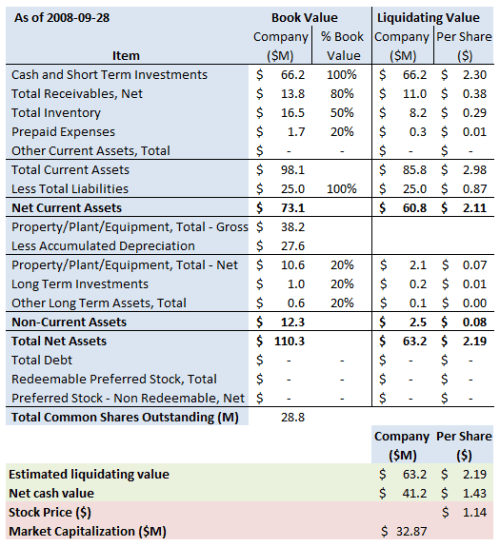
Ikanos Communications Inc (NASDAQ:IKAN) is a net cash stock that has retained a financial advisor to “assist it in exploring and evaluating strategic alternatives to maximize shareholder value.” IKAN closed yesterday at $1.14, giving it a market capitalization of $32.9M. Based on its September 10Q, we estimate the company’s liquidating value to be more than 90% higher at $63.2M or $2.19 per share. IKAN’s liquidating value is predominantly cash, and it has a net cash value of $41.2M or $1.43 per share. With a deeply undervalued stock and a board and management taking proactive steps to realise the value, we think IKAN presents a good investment opportunity.

About IKAN

IKAN is a developer and provider of semiconductors and silicon and software solutions for “interactive triple-play broadband.” Its customers consist primarily of original design manufacturers (ODM), contract manufacturers and original equipment manufacturers (OEMs), such as NEC Corporation, Sagem Communications, Uniquest Corporation and Altima. Its customers include Alcatel-Lucent, Dasan Networks, Inc., Innomedia, Inc. and Millinet Co., Ltd. The company’s investor relations website can be found here.

The value proposition

As its September 10Q demonstrates, IKAN’s income statement is a horror show. The company has consistently generated losses for the last five quarters. IKAN’s balance sheet has some value (the “Book Value” column shows the assets as they are carried in the financial statements, and the “Liquidating Value” column shows our estimate of the value of the assets in a liquidation):

ikan-summary

$66.2M of IKAN’s $85.8M current asset value is in cash. After deducting total liabilities of $25M, we estimate IKAN’s net current asset value at $60.8M, and its liquidating value at $63.2M or $2.19 per share. IKAN’s net cash value is $41.2M or $1.43 per share.

Contractual commitments and Off-balance sheet arrangements

According to the September 10Q, IKAN does not use off balance sheet arrangements with unconsolidated entities or related parties, nor does it use other forms of off balance sheet arrangements such as special purpose entities and research and development arrangements. Its liquidity and capital resources are not subject to off balance sheet risks from unconsolidated entities. IKAN leases office facilities, equipment and software under “non-cancelable” operating leases. Its contractual obligations as of September 28, 2008 are around $4.7M in total. In the normal course of business, IKAN provides indemnifications of varying scope to customers against claims of intellectual property infringement made by third parties arising from the use of our products. Historically, costs related to these indemnification provisions have not been significant, but IKAN is unable to estimate the maximum potential impact of these indemnification provisions on its future consolidated results of operations.

The catalyst

The company disclosed in its September 10Q that it has retained investment bankers to advise the board about IKAN’s strategic options:

We recently decided to retain Barclays Capital (formerly Lehman Brothers) to provide financial advice regarding potential strategic options for the Company. Such options include, without limitation, financing transactions, acquisitions, strategic partnerships, corporate restructuring and other activities. There can be no assurance that the evaluation of our options will result in the identification, announcement or consummation of any transaction. If the Board of Directors does decide to authorize a transaction, that decision could cause significant volatility in the price of the Company’s outstanding common stock. Moreover, any transactions we do sign may not be acceptable to our stockholders. In addition, our investigation of strategic options may result in added costs, potential loss of customers and key employees as well as management’s distraction from ordinary-course business operations.

There seems to be some appetite for acquisitions in this industry. IKAN competitor Centillium Communications Inc (NASDAQ: CTLM) was acquired in October last year.

Conclusion

At $1.14, IKAN is trading at a little over half its liquidating value of $2.19 per share. With the board proactively seeking a new strategic direction, which might include “financing transactions, acquisitions, strategic partnerships, corporate restructuring and other activities,” we think there’s a good chance that IKAN can realise at least its liquidating value. We’re adding IKAN to the Greenbackd Portfolio.

IKAN closed yesterday at $1.14.

The S&P500 Index closed yesterday at 836.57.

Hat tip to Steven Lobo.

[Full Disclosure:  We do not have a holding in IKAN. This is neither a recommendation to buy or sell any securities. All information provided believed to be reliable and presented for information purposes only. Do your own research before investing in any security.]

Read Full Post »

Biotechnology Value Fund (BVF) announced that it has commenced its cash tender offer to purchase any and all of the outstanding common stock of Avigen Inc (NASDAQ: AVGN) that BVF does not own at $1.00 per share.

We’ve been following AVGN (see archived posts here) because it’s a net cash stock (i.e. it’s trading at less than the value of its cash after deducting all liabilities) and specialist biotechnology activist fund BVF has been pushing it to liquidate and return its cash to shareholders. MediciNova Inc (NASDAQ:MNOV) has made an offer for AVGN that represents a clever way for AVGN’s stockholders to receive cash equivalent to that which they would receive in a liquidation (less $7M to be paid to MNOV) with the possibility for “an extraordinary, uncapped return” if MNOV is successful post-merger. We estimate AVGN’s cash at around $1.22 per share (BVF estimates $1.20 per share), which is a little less than 40% higher than AVGN’s $0.92 close yesterday.

BVF’s press release reads as follows:

BVF Acquisition LLC (the “Purchaser”), a wholly owned subsidiary of Biotechnology Value Fund, L.P. (“BVF”), announced today that it has commenced a cash tender offer to purchase any and all of the outstanding common stock of Avigen, Inc. (NasdaqGM: AVGN) (“Avigen”) that BVF does not own at a price of $1.00 per share under the conditions described below. The offer price represents a 35% premium over Avigen’s closing stock price of $0.74 on January 8, 2009, the day prior to BVF’s announcement that it was seeking to remove all incumbent Avigen directors and to elect its own slate of stockholder focused nominees (the “BVF Nominees”). BVF Partners L.P., the general partner of BVF, beneficially owns an aggregate of 8,819,600 shares of Avigen, or approximately 29.63% of the outstanding shares.

The offer is currently scheduled to expire at 12:00 midnight, New York City time, on February 23, 2009, unless the offer is extended.

On January 9, 2009, BVF delivered a notice to Avigen to call a special meeting of stockholders to remove all incumbent directors and elect the BVF Nominees, among other things. As described below, a condition to this tender offer is the BVF Nominees being elected to Avigen’s Board of Directors at this special meeting of stockholders, or otherwise appointed, and constituting a majority of the directors on the Avigen board. If elected, the BVF Nominees, subject to their fiduciary duties, intend to pursue negotiations with MediciNova, Inc., related to a proposed merger with Avigen, and work to consummate the proposed merger expeditiously. Assuming the conditions to this Offer are satisfied, stockholders of Avigen would have the choice of (i) tendering their shares and receiving a fixed cash payment upon the closing of this tender offer at a premium to the market price on the day prior to both the announcement of this tender offer and the announcement that BVF was seeking to remove all incumbent Avigen directors and to elect the BVF Nominees, or (ii) maintaining their investment in Avigen and participating in the proposed merger with MediciNova, Inc., if it occurs.

The tender offer is conditioned upon, among other things, (i) the BVF Nominees being elected to Avigen’s board of directors at a special meeting of stockholders called for that purpose, or otherwise appointed, and constituting a majority of directors on Avigen’s board, (ii) the Avigen board redeeming the poison pill rights issued and outstanding under Avigen’s Poison Pill Rights Plan, or the Purchaser being satisfied in its reasonable discretion that the Poison Pill Rights are otherwise inapplicable to this tender offer, the Purchaser or any affiliate or associate of the Purchaser and (iii) Avigen not having authorized, recommended, proposed, announced its intent to enter into or entered into an agreement with respect to or effected any merger, consolidation, liquidation, dissolution, business combination, acquisition of assets, disposition of assets, alternative strategy or relinquishment of any material contract or other right of Avigen or any comparable event or capital depleting transaction not in the ordinary course of business. The tender offer is not subject to any financing condition.

The text of the offer to purchase is attached here.

[Full Disclosure: We have a holding in AVGN. This is neither a recommendation to buy or sell any securities. All information provided believed to be reliable and presented for information purposes only.]

Read Full Post »

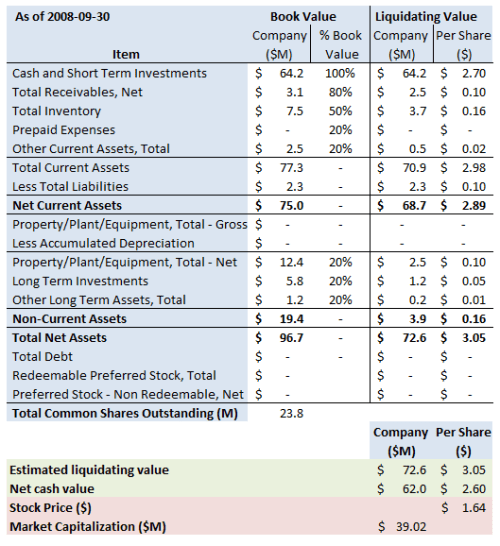
MEMSIC INC (NASDAQ:MEMS) is a deeply undervalued net net stock and the second installment in our Catalyst Wanted series. At its $1.64 close yesterday, MEMS has a market capitalization of $39M. We estimate its liquidating value to be around 86% higher at $72M or $3.05 per share. Its liquidating value is predominantly cash, so much so that MEMS has net cash of around $62M or $2.60 per share, which is around 60% higher than its stock price.

About MEMS

MEMS provides semiconductor sensors based on micro electro-mechanical systems. Its accelerometers are used to measure tilt, shock, vibration and acceleration in a range of mobile phones, automotive safety systems and video projectors. The company’s investor relations website can be found here.

The value proposition

Like TRID yesterday, MEMS has an veritable treasure trove on its balance sheet (the “Book Value” column shows the assets as they are carried in the financial statements, and the “Liquidating Value” column shows our estimate of the value of the assets in a liquidation):

mems-summary

According to its most recent 10Q, MEMS’ cash and equivalents are invested in money market funds and auction rate securities. As of September 30, 2008, MEMS’ investments included $5.8 million of auction rate securities. Auction rate securities are generally long-term fixed income instruments that provide liquidity through a Dutch auction process that resets the applicable interest rate at pre-determined calendar intervals, typically every 7, 28, 35 or 49 days. These investments have high credit quality ratings of at least AAA/Aaa. Due to recent liquidity issues, certain of the auction rate securities MEMS holds have failed at auction, meaning that the amount of securities submitted for sale at auction exceeded the amount of purchase orders. If an auction fails, the issuer becomes obligated to pay interest at penalty rates, and all of the auction rate securities MEMS holds continue to pay interest in accordance with their stated terms. However, the failed auctions create uncertainty as to the liquidity in the near term of these securities. As a result, MEMS has classified the $5.8 million of auction rate securities it held at September 30, 2008 as long-term investments. We have applied an 80% discount to those securities.

MEMS not have any off-balance sheet financing arrangements other than property and equipment operating leases, the value of which is not disclosed in the financial statements. It does not have any transactions, arrangements or other relationships with any special purpose entities established for its benefit.

The catalyst?

None. MEMS is using the cash on its balance sheet to construction a facility in Wuxi China. The company expects to complerte the first phase in the first quarter of 2009 at a total cost of $6M. The company expects to complete the second phase within three years at a total cost of $30M. Other significant cash outlays primarily consist of salaries, wages and commissions.

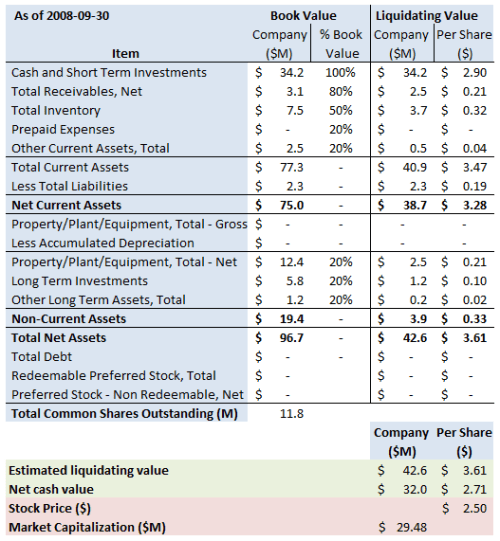
The construction of the Wuxi facility, and in particular the second phase of the Wuxi facility, seems to us to be an investment that carries significant risk in the present environment. We’d suggest that a better use for the cash at this time would be to buy back the company’s stock given the huge discount to its cash backing. If the company was to redirect the $30M to stock repurchases at the present stock price, we estimate that the company’s value would increase more than 150%. It might not be realistic to complete the buy-back at this level. If we were to assume a more realistic number, say $2.50, which is 50% higher than the current stock price but still at a discount to its per share cash backing, the balance sheet looks like this:

mems-summary-post-buy-back2

If the $30M buy-back is completed at $2.50, the liquidating value of the company increases around 20% from $3.05 to $3.60. If we assume that the stock price trades up to the new liquidating value as a result of the company’s new shareholder-oriented management, investors buying in at the present $1.64 stock price see the stock appreciate 120%.

Conclusion

Without a positive catalyst, MEMS will probably remain as a net cash stock for a long time. Despite its deep discount to its cash backing, MEMS is no real bargain without more shareholder-oriented management. This is another stock we’ll keep on our watchlist and let you know if anyone takes it on.

MEMS closed yesterday at $1.64.

The S&P500 Index closed yesterday at 840.24.

[Full Disclosure:  We do not have a holding in MEMS. This is neither a recommendation to buy or sell any securities. All information provided believed to be reliable and presented for information purposes only. Do your own research before investing in any security.]

Read Full Post »

« Newer Posts - Older Posts »