Feeds:
Posts
Comments

Posts Tagged ‘Liquidation Value’

The always superb Manual Of Ideas has nine new additions to its list of activist targets. Companies on the list must have a “strong balance sheet that could be recapitalized or liquidated to achieve activist value creation; and insiders must own less than 20% of the shares, implying an inability to exercise voting control over the company:”

  • Semiconductor equipment provider Axcelis Technologies (ACLS) joins the list in first place, based on a ratio of “net net” current assets to market value of 1.3x, making ACLS a Ben Graham-style bargain stock. We calculate “net net” current assets as current assets minus total liabilities. A ratio of 1.3x suggests that the liquidation value of ACLS may exceed the company’s market value, potentially attracting the interest of activist investment funds.
  • Biotech drug developer Myriad Pharmaceuticals (MYRX) joins the list in second place, as the company has net cash of $169 million versus market value of $135 million. Insiders own virtually no shares of the company, making Myriad vulnerable to activist shareholder action.
  • Communications equipment provider Radvision (RVSN) joins the list in 12th place. Radvision shares recently tumbled to a market value of $115 million, only $8 million above the company net cash balance. The stock price decline came on the heels of Cisco’s announcement that it would aquire video conferencing company Tandberg. Radvision provides such technology to Cisco, with the latter Radvision’s largest customer.
  • Specialty steel product maker Universal Stainless & Alloy (USAP) joins the list in 30th place. The shares trade at 0.8x price to tangible book value, and the company has 19% of its market value in net cash. “Net net” current assets account for two-thirds of USAP’s market value, making the company a potentially interesting recapitalization candidate.
  • Biopharma company Progenics Pharmaceuticals (PGNX) joins the list in 34th place. The shares trade within 10% of their 52-week low, reflecting the stock’s lack of participation in the recent stock market rally. With a market value of $155 million and more than $100 million of net cash, the shares could attract the attention of activist investors familiar with the biopharma industry.
  • Cancer drug discovery firm Infinity Pharma (INFI) joins the list in 36th place. While the company is losing money as it advances its drug development pipeline, management has stated that the company has sufficient liquidity through 2013. INFI has a market value of $152 million versus a net cash position of $150 million.
  • Zoran Corp. (ZRAN), a provider of digital solutions for application in the digital entertainment and imaging markets, joins the list in 42nd place. The company recently posted strong sequential revenue growth in key business segments and returned to positive cash flow generation. With 63% of the market value in net cash, the company may be in a position to aggressively repurchase shares, thereby boosting shareholder value on a per-share basis.
  • Semiconductor equipment company Rudolph Technologies (RTEC) joins the list in 43rd place. The company’s Q2 revenue growth exceeded guidance, but investors continue to shun the stock. RTEC has one-third of its market value in net cash and nearly two-thirds in “net net” current assets.
  • Finally, fabless semiconductor company Sigma Designs (SIGM) joins the list in 44th place. With one-half of market value in net cash and an enterprise value-to-revenue multiple of 0.9x, the shares appear quite cheap. The company may be in a position to boost shareholder value by using excess liquidity to repurchase shares or pay a one-time cash dividend.

We’ve been following Axcelis Technologies Inc (NASDAQ:ACLS) since January 8 this year (see our post archive here) because it is an undervalued asset play with an activist investor, Sterling Capital Management, holding 10.7% of its outstanding stock. ACLS has completed the sale of its 50% interest in SEN Corporation, its joint venture with Sumitomo Heavy Industries, Ltd. (SHI) to SHI for proceeds of $122.3 million. ACLS received around $35.9M in cash after applying $86.4M of the proceeds to meet obligations to the holders of the company’s 4.25% Convertible Senior Subordinated Notes, upon which ACLS defaulted in January. Our position in ACLS is up 120% to $1.32, which gives the company a market capitalization of  $137M. We’re not quite as bullish on ACLS as the Manual of Ideas. We last estimated ACLS’s liquidation value at around  $113.6M or $1.10, because we think that cash burn is a significant issue for ACLS. At the current rate of cash burn, we estimate the company has around six months before its liquidation value is around $0.60, and around a year before it’s worthless. That said, Citi thinks ACLS could be worth $3 (for what that’s worth):

Citi upgrades Axcelis Technologies Inc (Nasdaq: ACLS) from Hold to Buy. Price target lowered from $5.50 to $3.

Citi analyst says, “Following the collapse of its merger talks with Sumitomo Heavy Industries (SHI) and subsequent ~70% decline in stock price, we think the stock is now trading below liquidation value. So, while we are far from bullish on business prospects and we acknowledge that there’s risk to ACLS’ ability to raise much-needed cash in the next several months, we think the company will be able to raise sufficient capital w/o going to the public markets.”

Axcelis Technologies, Inc. (Axcelis) designs, manufactures and services ion implantation, dry strip and other processing equipment used in the fabrication of semiconductor chips.

[Full Disclosure:  We do not have a holding in ACLS. This is neither a recommendation to buy or sell any securities. All information provided believed to be reliable and presented for information purposes only. Do your own research before investing in any security.]

Read Full Post »

We’re adding Aspen Exploration Corporation (OTC:ASPN) to the Greenbackd Portfolio for the reasons identified by MCN1 in his September 3 guest post. ASPN closed yesterday at $0.985, giving it a market capitalization of just $7.2M. We estimate the liquidation value to be around 20% higher at $8.5M or $1.17 per share. Again, not a huge upside but reasonably certain. There are several potential catalysts in the stock. Investor Tymothi O. Tombar filed a 13D notice on July 30, 2009 disclosing a 5.8% holding and calling for the liquidation of the company. Additionally, the company plans to distribute substantially all of the net, after-tax proceeds from the completion of the Venoco sale to its stockholders, an amount that the company estimates will be from $5M to $5.5M.

About ASPN

From the most recent 10K:

Aspen was incorporated under the laws of the State of Delaware on February 28, 1980 for the primary purpose of acquiring, exploring and developing oil and gas and other mineral properties. Our principal executive offices are located at 2050 S. Oneida St., Suite 208, Denver, Colorado 80224-2426. Our telephone number is (303) 639-9860, and our facsimile number is (303) 639-9863. Our websites are http://www.aspenexploration.com and http://www.aspnx.com. Our email address is aecorp2@qwestoffice.net. During our fiscal year ended June 30, 2009, we were engaged primarily in the exploration, development and production of oil and gas properties in California and Montana. On June 30, 2009, the Company disposed of all of its remaining oil and gas producing assets and is not currently engaged in any oil and gas producing activities. We have an interest in an inactive subsidiary: Aspen Gold Mining Co., a company that has not been engaged in business since 1995.

During more than the past five years through June 30, 2009, our emphasis had been participation in the oil and gas segment, acquiring interests in producing oil or gas properties and participating in drilling operations. We were engaged in a broad range of activities associated with the oil and gas business in an effort to develop oil and gas reserves. Our participation in the oil and gas exploration and development segment consisted of two different lines of business – ownership of working interests and operating properties.

(1) We acquired and held operating interests in oil and gas properties where we acted as the operator of oil and gas wells and properties; and

(2) We acquired and held non-operating interests in oil and gas properties.

Previously, we held a non-operating working interest in approximately 37 oil wells in the East Poplar Field, Roosevelt County, Montana which contributed only nominally (if at all) to our positive cash flow and profitability, and during much of the latter half of calendar 2008 resulted in operating losses. Effective January 1, 2009, we sold our entire interest in these oil properties.

Prior to June 30, 2009, we operated 67 gas wells in the Sacramento Valley of northern California. Additionally, we held a non-operated interest in 26 gas wells in the Sacramento Valley of northern California. As described below, we sold our interest in our California properties on June 30, 2009.

Additionally, in the past we have engaged in business activities related to the exploration and development of other minerals and resources. At the present time, we are not engaged in any drilling operations or acreage acquisition programs nor have we drilled any new wells in our current fiscal year.

The value proposition

ASPN is another relatively simple value proposition: it’s liquid assets of $10.7M of cash and marketable securities against total liabilities of around $2.3M, and it has no active business operations. We’ve set out the valuation below in the usual manner (the “Book Value” column shows the assets as they are carried in the financial statements, and the “Liquidating Value” column shows our estimate of the value of the assets in a liquidation):

ASPN Summary G

The catalyst

ASPN proposes to distribute substantially all of the net, after-tax proceeds from the Venoco transaction to its stockholders. It estimates that this amount will be between $5M and $5.5M or between $0.69 and $0.76 per share. ASPN “needs to complete certain calculations before it is able to determine the dollar amount of the assets to be distributed” but “believes it will be able to make this calculation after the October 28, 2009 settlement date based on preliminary tax calculations.” It also proposes to present a dissolution proposal to its stockholders at its next annual meeting, tentatively scheduled for late November 2009. Such a dissolution is not certain, as ASPN “intends to consider other opportunities in the broad scope of the natural resources industry, which may include an acquisition of assets or business operations, or a merger or other business combination.” ASPN has “engaged in preliminary discussions with third parties about various possibilities” however “none of these discussions have resulted in an agreement or any definitive steps toward the conclusion of any future relationship.” One issue worth noting is that such a transaction “may or may not require stockholder approval”:

If the transaction does not require stockholder approval, the board of directors will be entitled to accomplish the transaction in its discretion, although the board may (but would not be required to) seek an advisory vote of the stockholders. There can be no assurance that Aspen will identify an appropriate business opportunity or corporate transaction and consummate any such transactions.

Tymothi O. Tombar filed a 13D notice on July 30, 2009 disclosing a 5.8% holding and calling for the liquidation of the company:

As Aspen currently has no active business operations and a significant amount of liquid assets, Mr. Tombar believes that there is broad shareholder support for the implementation of a plan of liquidation and distribution of substantially all of the proceeds from the Sale and Aspen’s additional liquid assets to Aspen’s stockholders. Mr. Tombar is considering several stockholder resolutions in accordance with SEC Rule 14a-8 for inclusion in Aspen’s proxy statement for its next meeting of stockholders. In the unlikely event of a delayed meeting of stockholders beyond the anticipated late October or November 2009, Mr. Tombar may acquire a sufficient number of additional shares of Aspen’s stock or contact other shareholders with the intent of calling a special meeting to consider shareholder proposals and the election of new directors to the board of the corporation.

Conclusion

ASPN is trading at a small discount to its liquidation value with a likely catalyst in the near future. At its $0.985 close yesterday, it has a market capitalization of $7.2M against a liquidation value we estimate at $8.5M or $1.17 per share. It’s not a huge upside but we believe it’s reasonably certain given that has no active business operations. There are several potential catalysts in the stock. Investor Tymothi O. Tombar filed a 13D notice on July 30, 2009 disclosing a 5.8% holding and calling for the liquidation of the company. Additionally, the company plans to distribute substantially all of the net, after-tax proceeds from the completion of the Venoco sale to its stockholders, an amount that the company estimates will be from $5M to $5.5M, which equates to between $0.69 and $0.76 per share.

ASPN closed yesterday at $0.985.

The S&P500 closed at 1,057.07.

[Full Disclosure:  We have a holding in ASPN. This is neither a recommendation to buy or sell any securities. All information provided believed to be reliable and presented for information purposes only. Do your own research before investing in any security.]
Read Full Post »

Cadus Corporation (OTC:KDUS) is an interesting play, but not without hairs on it. First, the good news: It’s trading at a discount to net cash with Carl Icahn disclosing an activist holding in 2002, and Moab Capital Partners disclosing an activist holding more recently. At its $1.51 close yesterday, the company has a market capitalization of $19.9M. The valuation is straight-forward. We estimate the net cash value to be around $20.6M or $1.57 per share and the liquidation value to be around $23.2M or $1.77 per share. The liquidation value excludes the potential value of federal and New York State and City net operating loss carry-forwards. It’s not a huge upside but it’s reasonably certain, and we think that’s a good thing in this market. The problem with the position is the catalyst. It’s a relatively tiny position for Icahn, so he’s got no real incentive to do anything with it. He’s been in the position since 2002, so he’s clearly in no hurry. That said, he’s not ignoring the position. He last updated his 13D filing in March this year, disclosing an increased 40% stake. He’s also got Moab Capital Partners to contend with. Moab holds 9.8% of the stock and says that it “has had good interaction with the CEO of Cadus, David Blitz, and feels comfortable that he will structure a transaction with an operating business that will generate significant long-term value for Cadus holders.” KDUS could end up being a classic value trap, but we think it’s worth a look at a discount to net cash, and two interested shareholders.

About KDUS

From the most recent 10Q:

The Company was incorporated in 1992 and until July 30, 1999, devoted substantially all of its resources to the development and application of novel yeast-based and other drug discovery technologies. On July 30, 1999, the Company sold its drug discovery assets and ceased its internal drug discovery operations and research efforts for collaborative partners.

At June 30, 2009, the Company had an accumulated deficit of approximately $34.9 million. The Company’s losses have resulted principally from costs incurred in connection with its research and development activities and from general and administrative costs associated with the Company’s operations. These costs have exceeded the Company’s revenues and interest income. As a result of the sale of its drug discovery assets and the cessation of its internal drug discovery operations and research efforts for collaborative partners, the Company ceased to have research funding revenues and substantially reduced its operating expenses. The Company expects to generate revenues in the future only if it is able to license its technologies.

The value proposition

KDUS is a relatively simple value proposition. It’s $21M of cash, and $3.1M in Bank of America Columbia Strategic Cash Portfolio (more on this below) against total liabilities of around $0.03M (that’s ~$27,000). We’ve set out the valuation below in the usual manner (the “Book Value” column shows the assets as they are carried in the financial statements, and the “Liquidating Value” column shows our estimate of the value of the assets in a liquidation):

KDUS Summary

Bank of America Columbia Strategic Cash Portfolio

We are not treating the Bank of America Columbia Strategic Cash Portfolio as cash. The asset has some issues, best described by this passage from the 10Q:

On December 10, 2007, the Fund notified the Company that conditions in the short-term credit markets had created a broad based perception of risk in non subprime asset-backed securities causing illiquidity across the market which led to extreme pricing pressure in those securities. The Fund also notified the Company that it is primarily invested in such securities, that it will begin an orderly liquidation of such securities, that unitholders would no longer be able to redeem their units in the Fund and that the Fund would redeem its units as it liquidated its investments. The Fund also began to value its securities based on market value rather than amortized value for purposes of determining net asset value per unit. The Fund has continued to pay interest monthly. The Company reclassified its investment in the Fund from cash equivalents to short-term investments. Through December 31, 2008, the Fund redeemed 19,445,459 units held by the Company for $18,787,142, which redemption was $658,317 in the aggregate less than the cost of such units. From January 1, 2009 to June 30, 2009, the Fund has redeemed an additional 2,314,849 units in the Fund for $1,934,798 which redemption was $380,051 in the aggregate less than the original $2,314,849 cost of such units. At June 30, 2009, the Company still owned 3,793,032 units in the Fund which was recorded on the balance sheet at $3,135,321. Such 3,793,032 units had a net asset value of $3,306,385 at June 30, 2009. The Fund has advised the Company that the balance or most of the balance, of the Company’s investment in the Fund will be redeemed by December 31, 2009. However, there can be no assurance as to when the redemption will take place or as to the net asset value at which the Company’s investment in the Fund will be redeemed.

We’ve applied a 20% discount to the Strategic Cash Portfolio, which is an additional discount to that applied by KDUS. This may be too conservative, but that is the only way that we feel comfortable.

The catalyst

Carl Icahn filed an amended 13D notice on March 12 this year, indicating an increased 40% holding in KDUS. Moab Capital Partners also holds around 9.8% of KDUS. Said Moab of its KDUS position in the August 16, 2007 13D:

The Reporting Persons have purchased the Shares in open market transactions because in their opinion, the market has not given full appreciation to Cadus’ cash balance, net operating loss carry-forwards and future prospects. Based on publically available information, as of 8/16/07, the company currently holds cash, equivalents and investments in marketable securities of $25.4 million and has significant federal and New York State and City net operating loss carry-forwards. The current market capitalization stands at $23.1 million, a 9% discount to the cash and investments on Cadus’ balance sheet. Moab feels the loss carry-forwards should also be ascribed market value. Cadus is cash flow positive and the share count has not increased in over five years. Moab has had good interaction with the CEO of Cadus, David Blitz, and feels comfortable that he will structure a transaction with an operating business that will generate significant long-term value for Cadus holders.

Moab’s purchase prices – between $1.86 and $1.76 – are higher than the current trading price of KDUS.

Despite these promising sentiments, a catalyst in KDUS is probably not imminent. We believe the position will require some patience for the following reasons: First, KDUS is controlled by Icahn and represents a very small part of his empire. He’s got no real immediate impetus to unlock the value. The play is probably Icahn selling his stake to another investor looking for a shell, or Icahn vending into KDUS some other business. You’d have to be brave / insane / a little of both to buy from Icahn usually, and doubly so in this instance given that he’s got no reason to sell. Second, it’s illiquid. Average volume is close to nada: 900 shares were traded on Friday and 6,500 were traded on Thursday. Even a small retail investor could make the entire market for a day or so. Finally, KDUS is a fairly well known position in the industry. It’s viewed as a stock that has been stagnant for years and unlikely to go anywhere because Icahn is too rich to care. We’ve heard that investing in KDUS is a “right of passage for would-be shell buyers.” Consider yourself warned.

Conclusion

Despite the foregoing misgivings, we’re reasonably comfortable with a position in KDUS for several reasons:

  1. The value. We’re primarily attracted to KDUS’s cash and liquidation values. While it’s not a huge upside from here, it’s downside is very limited. With slightly higher interest rates, KDUS will also likely return to cash flow positive territory.
  2. While Icahn is obviously not seeking an immediate resolution of the position, he controls an asset with a value not yet fully recognised by the market. If a worthwhile transaction materializes like Marley’s ghost before Scrooge’s eyes, we’re prepared to bet that Scrooge will buy us the biggest turkey in the poulterer’s shop. But it won’t happen this Christmas.

KDUS won’t ever be a 10 bagger, or even a double, but it’s got 20 – 30% in it. In an overheated market, that’s good enough for us. For these reasons, we’re adding it to the Greenbackd Portfolio.

KDUS closed Friday at $1.51.

The S&P500 closed Friday at 1,044.38.

[Full Disclosure:  We have a holding in KDUS. This is neither a recommendation to buy or sell any securities. All information provided believed to be reliable and presented for information purposes only. Do your own research before investing in any security.]

Read Full Post »

A group of investors in VaxGen Inc (OTC:VXGN) have formed the “VaxGen Full Value Committee” to conduct a proxy contest to replace the current board of VXGN at the next annual shareholders meeting. The group, comprising BA Value Investors’ Steven N. Bronson and ROI Capital Management’s Mark T. Boyer and Mitchell J. Soboleski, intends to replace the current board with directors who will focus on the following objectives:

1. Returning capital to [VXGN]’s shareholders, including an immediate distribution of $10,000,000 in cash;

2. Terminating [VXGN]’s lease with its landlord, Oyster Point Tech Center, LLC, and settling with the landlord the obligations of [VXGN] on the remaining lease payments;

3. Exploring ways to monetize [VXGN] as a “public shell,” including the utilization of [VXGN]’s Substantial Net Operating Losses; and

4. Protecting for the benefit of shareholders royalty payments receivable from the sale of [VXGN]’s intellectual property.

We’ve been following VXGN (see our post archive here) because it is trading at a substantial discount to its net cash position, has ended its cash-burning product development activities and is “seeking to maximize the value of its remaining assets through a strategic transaction or series of strategic transactions.” Management has said that, if the company is unable to identify and complete an alternate strategic transaction, it proposes to liquidate. One concern of ours has been a lawsuit against VXGN by its landlords, in which they sought $22.4M. That lawsuit was dismissed in May, so the path for VXGN to liquidate has now hopefully cleared. The board has, however, been dragging its feet on the liquidation. Given their relatively high compensation and almost non-existent shareholding, it’s not hard to see why.

BA Value Investors had previously disclosed an activist holding and, in a June 12 letter to the board, called on VXGN to “act promptly to reduce the size of the board to three directors; reduce director compensation; change to a smaller audit firm; terminate the lease of its facilities; otherwise cut costs; make an immediate $10 million distribution to shareholders; make a subsequent distribution of substantially all the remaining cash after settling the lease termination; distribute any royalty income to shareholders; and explore ways to monetize the public company value of the Issuer and use of its net operating losses.”

Another group led by Spencer Capital and styling itself “Value Investors for Change” has also filed preliminary proxy documents to remove the board. In the proxy documents, Value Investors for Change call out VXGN’s board on its “track record of failure and exorbitant cash compensation”:

VaxGen does not have any operations, other than preparing public reports. The Company has three employees, including the part-time principal executive officer and director, and four non-employee directors. Since the Company’s failed merger with Raven Biotechnologies, Inc. in March 2008, the Board has publicly disclosed that it would either pursue a strategic transaction or a series of strategic transactions or dissolve the Company. The Company has done neither. In the meantime, members of the Board have treated themselves to exorbitant cash compensation. Until July 2009, two non-employee members of the Board were paid over $300,000 per year in compensation. The principal executive officer will likely receive over $400,000 in cash compensation this year.

VXGN is up 31.3% since we initiated the position. At its $0.63 close yesterday, it has a market capitalization of $20.9M. We last estimated the company’s liquidation value to be around $25.4M or $0.77 per share. VXGN has other potentially valuable assets, including a “state-of-the-art biopharmaceutical manufacturing facility with a 1,000-liter bioreactor that can be used to make cell culture or microbial biologic products” and rights to specified percentages of future net sales relating to its anthrax vaccine product candidate and related technology. The authors of a letter sent to the board on July 14 of this year adjudge VXGN’s liquidation value to be significantly higher at $2.12 per share:

Excluding the lease obligations, the net financial assets alone of $37.2 million equate to $1.12 per share. The EBS royalties (assuming a 6% royalty rate and a $500 million contract as contemplated by NIH/HHS and EBS) of $30 million and milestones of $6 million total $36 million of potential additional future value (based clearly on assumptions, none of which are assured), or $1.09 per share. Adding $1.12 and $1.09 equals $2.21 per share.

The entry of the VaxGen Full Value Committee into the proxy contest will certainly make the next meeting an interesting spectacle, and, with any luck, we will see a liquidation of VXGN soon, either at the hands of the present board, by Value Investors for Change or the VaxGen Full Value Committee.

The Purpose of Transaction portion of the amended 13D filing is set out below:

The Reporting Persons acquired the shares of Common Stock to which this statement relates for investment purposes.

On June 12, 2009, Mr. Bronson, on behalf of BA Value Investors, LLC, sent a letter to the Board of Directors of the Issuer. In the letter, Mr. Bronson stated that the Company must act promptly to reduce the size of the board to three directors; reduce director compensation; change to a smaller audit firm; terminate the lease of its facilities; otherwise cut costs; make an immediate $10 million distribution to shareholders; make a subsequent distribution of substantially all the remaining cash after settling the lease termination; distribute any royalty income to shareholders; and explore ways to monetize the public company value of the Issuer and use of its net operating losses. A copy of the letter to the Issuer has been filed as Exhibit 1 to the Statement.

On August 21, 2009, the Reporting Persons formed a committee called the “VaxGen Full Value Committee.” The VaxGen Full Value Committee intends to conduct a proxy contest to replace the current Board of Directors at the next annual shareholders meeting with directors who will focus on the following objectives:

1. Returning capital to the Issuer’s shareholders, including an immediate distribution of $10,000,000 in cash;

2. Terminating the Issuer’s lease with its landlord, Oyster Point Tech Center, LLC, and settling with the landlord the obligations of the Issuer on the remaining lease payments;

3. Exploring ways to monetize the Issuer as a “public shell,” including the utilization of the Issuer’s Substantial Net Operating Losses; and

4. Protecting for the benefit of shareholders royalty payments receivable from the sale of the Issuer’s intellectual property.

[Full Disclosure:  We have a holding in VXGN. This is neither a recommendation to buy or sell any securities. All information provided believed to be reliable and presented for information purposes only. Do your own research before investing in any security.]

Read Full Post »

We were going to stay away until after Labor Day, but this is too good to miss. From reader MCN1 on Aspen Exploration Corporation (OTC:ASPN):

Company Name: Aspen Exploration Corporation

Ticker: ASPN

Market Cap: $6.53M (as of 9/2/09)

Stock Price: $0.90 (as of 9/2/09)

Company Overview: Aspen Exploration Corporation is engaged in the exploration and development of oil and gas properties in California and Montana.

Situation:

Being a micro cap stock the management acknowledged in a press release in Sept 2008 that it would begin exploring strategic alternatives for Aspen “including the possibility of selling Aspen’s assets or considering another appropriate merger or acquisition transaction (from press release dated 9/4/08).” The motive behind pursing “strategic alternatives” was three fold: (1) the cost of being a public company for a company their size, (2) the belief the market price did not reflect the true value of ASPN’s assets, and (3) the president’s health issues (had a stroke in Jan 2008).

In Feb 2009, ASPN announced it had entered into an agreement with Venoco, Inc (VQ) to sell its California assets for approximately $8.425M (approximately because it was subject to adjustments). It was a good strategic fit for Venoco who has operations close to Aspen’s. On June 30, 2009 the transaction closed with Aspen receiving $7.6M (net of fees). Additionally, during this time period, Feb 09 – Jun 09, Aspen also sold its interests in Montana for $1.2M. Thus, the total sale proceeds to the company were $8.8M between the two transactions.

The company is trying to decide what to do with its liquid assets, either liquidated and payout to stockholders or pursue new business opportunities. Now management has stated it has reviewed some business opportunities, and thankfully, and has passed on those opportunities. Especially when you take into account that management is willing to look at opportunities outside of oil & gas – which was the company’s core business.

In either late October or November of this year, the company is going to “propose a resolution to consider the possibility of dissolution of Aspen to our stockholders at a meeting of stockholders….If Aspen were to dissolve, it would not enter into another business opportunity but would wind up its operations and distribute its remaining assets to stockholders (from 8-K filing dated 6/30/09).” This is what I and others are betting will happen.

Financials & Valuations:

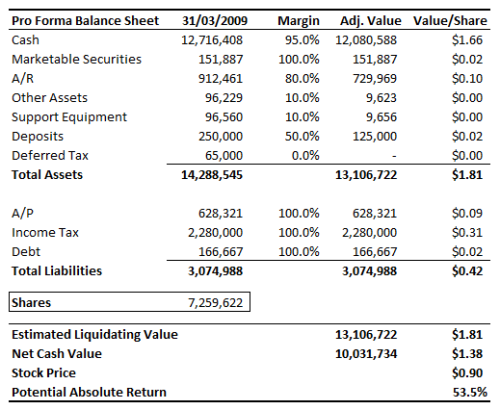
Here is a look at the post transaction balance sheet (pro forma) as of 3/30/09. The numbers below are taken from a SEC 8-K filing dated 7/2/09.

ASPN SummaryComments on Valuation:

Cash – I margined it at 95% to account for ongoing overhead the company still has to pay.

Deposits – not sure what that figure represents, could be overstating liquidation value here. 50% is arbitrary though amount is insignificant to the whole deal.

Valuation – Estimated net liquidation value of $1.38/share, the majority of which, represents cash and marketable securities at $1.26 compared to market price of $0.90.

Other:

The company also has joint venture, which they entered into in January 2007, with a company called Hemis Corporation where Hemis is the operator and is permitted to explore for commercial amounts of gold. Because Hemis is the operator, Aspen is not obligated to pay for any of the exploration and production costs, instead, Aspen retained a 5% gross royalty on production. As part of the agreement, Hemis paid Aspen $50k in Jan 07, $50k in Aug 07, was obligated to pay another $50k in Sept 08 (which hasn’t been received), and $50k on each anniversary date until production begins. Since the Sept 08 has not been received (and no updates have been provided), the agreement could have been terminated as non-payments was grounds for termination. I have assigned no value to this joint venture.

The stock is thinly traded, usually a couple thousand shares trade everyday. Since my purchases in July 09, the stock has ranged from $0.87 – $0.97.

Catalyst:

Catalyst one – the stockholder meeting in late October or November with stockholders voting to dissolve the company and proceeds are paid out.

Catalyst two (which helps ensure catalyst one occurs) – during May 09 – June 09 an individual (I’ll spare the name, you can refer to the SEC 13D filing, just look it up under Aspen’s filings on the SEC website) acquired $422.7K of stock in the company for an approximate 5% stake. In the 13D filing the individual states his intent which is “As Aspen currently has no active business operations and a significant amount of liquid assets, (individual name) believes that there is broad shareholder support for the implementation of a plan of liquidation and distribution of substantially all the proceeds from the Sale and Aspen’s additional liquid assets to Aspen’s shareholders. (individual name) is considering several stockholder resolutions…for inclusion in Aspen’s proxy statement for its next meeting of stockholders”

Disclosure: I am long ASPN. The information presented is obtained from public filing, please perform your own due diligence as this is neither a recommendation to buy or sell.

[Full Disclosure: We do not have a holding in ASPN. This is neither a recommendation to buy or sell any securities. All information provided believed to be reliable and presented for information purposes only. Do your own research before investing in any security.]

Read Full Post »

Although we closed our position in Avigen Inc (NASDAQ:AVGN) earlier this week, we’re keeping a watching brief on the stock. AVGN has now filed with the SEC the terms of the deal with MediciNova Inc (NASDAQ:MNOV), and they’re not as bad as the earlier report seemed to suggest. The deal has, however, attracted the ire of The Pennsylvania Funds, an AVGN shareholder, who has filed a class action lawsuit on behalf of all AVGN stockholders. The stock closed yesterday at $1.28, about $0.01 under our exit price. The terms of deal provide some downside protection and some upside optionality, and so are worth considering in some more detail, although probably not enough of either to persuade us to re-enter the stock. If the lawsuit gains traction and pushes the stock price down, however, AVGN might become attractive again.

About AVGN

We started following AVGN in December last year (see archived posts here) because it was a net cash stock and specialist biotechnology investor Biotechnology Value Fund (BVF) was pushing it to liquidate and return its cash to shareholders. Despite BVF’s failure to remove the board, we continued to maintain our position in AVGN because BVF won a number of important concessions from the board that made AVGN a much more attractive stock than it was when we started following it. We continuted to hold on when AVGN announced that it was back in negotiations with MediciNova, Inc, but closed the position for a 98.5% gain when the initial terms of the deal were announced.

The terms of the deal

The downside protection

Under the terms of the merger agreement AVGN shareholders will have the right to elect to receive an amount currently estimated by AVGN’s board at $1.24 per share in either cash or secured convertible notes to be issued by MNOV. Approximately $1.19 of the consideration will be paid at the closing, and approximately $0.05 will be paid at June 30, 2010. Both payments are subject to certain potential adjustments. The first payment is subject to adjustment based on activities related to the liquidation or sale of certain assets of AVGN in connection with the winding down of its operations prior to closing. The second payment is subject to upward adjustment based on savings in estimated expenses through closing and receipt of certain payments post-closing as well as downward adjustment in the event that closing liabilities exceed estimated liabilities through closing.

The upside optionality

The secured convertible notes will be convertible on the final business day of each month into shares of MNOV common stock at a conversion price of $6.80 per share, which conversion price is based on the volume-weighted average price of MNOV’s common stock as quoted on Nasdaq and the Osaka Securities Exchange over the 20 trading days prior to signing of the merger agreement. The convertible notes will mature on the 18-month anniversary of the closing of the merger, and the indenture governing the notes will include customary events of default and anti-dilution adjustments. Note that the last time MNOV traded above $6.80 was two years ago in August 2007.

The joint press release announcing the terms of the deal is set out below:

MediciNova and Avigen Enter Into Definitive Agreement for Business Combination

SAN DIEGO, Calif., and ALAMEDA, Calif., August 21, 2009 — MediciNova, Inc., a biopharmaceutical company that is publicly traded on the Nasdaq Global Market (Nasdaq:MNOV) and the Hercules Market of the Osaka Securities Exchange (Code Number:4875) and Avigen, Inc. (Nasdaq:AVGN), a biopharmaceutical company, today announced that they have entered into a definitive merger agreement pursuant to which MediciNova’s wholly-owned subsidiary will merge with and into Avigen. Completion of the transaction will permit the combination of the companies’ broad neurological clinical development programs based on ibudilast (Avigen’s AV-411 and MediciNova’s MN-166).

Under the terms of the merger agreement, which has been approved by both companies’ boards of directors, Avigen shareholders will have the right to elect to receive an amount currently estimated at approximately $1.24 per share in either cash or secured convertible notes to be issued by MediciNova. Approximately $1.19 of this consideration will be paid at the closing, and approximately $0.05 will be paid at June 30, 2010. As set forth in the merger agreement, both payments are subject to certain potential adjustments. The first payment is subject to adjustment based on activities related to the liquidation or sale of certain assets of Avigen in connection with the winding down of its operations prior to closing. The second payment is subject to upward adjustment based on savings in estimated expenses through closing and receipt of certain payments post-closing as well as downward adjustment in the event that closing liabilities exceed estimated liabilities through closing.

The secured convertible notes will be convertible on the final business day of each month into shares of MediciNova common stock at a conversion price of $6.80 per share, which conversion price is based on the volume-weighted average price of MediciNova’s common stock as quoted on Nasdaq and the Osaka Securities Exchange over the 20 trading days prior to signing of the merger agreement. The convertible notes will mature on the 18-month anniversary of the closing of the merger, and the indenture governing the notes will include customary events of default and anti-dilution adjustments.

In addition, Avigen’s stockholders will be entitled to one Contingent Payment Right (“CPR”) that will entitle holders under certain circumstances to a pro rata portion of one or more of the following: (1) in the event the first milestone payment of $6.0 million, or approximately $0.20 per share, under Avigen’s 2005 assignment agreement with Genzyme Corporation (“Genzyme Agreement”) is achieved in the 20 months following closing, a cash payment of the proceeds (to the extent such cash is received by MediciNova in the 20 months following closing); (2) in the event the Parkinson’s product reverts to MediciNova under the Genzyme Agreement and is subsequently sold, licensed or otherwise transferred, 50% of the proceeds received in cash in the 20 months following closing; and (3) the amount of money remaining in the plan trust established under Avigen’s management transition plan following termination of such trust. In each case, the payments will be net of any related out-of-pocket costs, damages, fines, penalties and expenses incurred by MediciNova. The CPRs will not be transferable except in limited circumstances.

Yuichi Iwaki, M.D., Ph.D., MediciNova’s President and Chief Executive Officer, said, “We are excited about combining Avigen with MediciNova and believe that it presents a unique opportunity for shareholders of both companies, most notably, the ability to more fully take advantage of the opportunities that the ibudilast compound and analogs provide in a variety of indications and markets.”

“We believe the transaction reduces many of the uncertainties involved with dissolution and is in the best interests of our shareholders,” commented Andrew Sauter, Avigen’s Chief Executive Officer, President and Chief Financial Officer. “In addition, we believe that combining the two companies’ ibudilast programs will enhance the global development potential for the compound that could benefit patients with a range of neurological indications.”

The transaction is expected to close in the fourth quarter of 2009 and is subject to approval of Avigen’s stockholders and approval of MediciNova’s stockholders as well as other customary closing conditions. In addition, the closing is conditioned on the receipt of certain releases from Avigen’s directors (other than John K.A. Prendergast), Kenneth Chahine, Kirk Johnson and Andrew A. Sauter.

RBC Capital Markets Corporation is acting as financial advisor to Avigen and Cooley Godward Kronish LLP is serving as its legal counsel. Ladenburg Thalmann & Co. Inc. (NYSE Amex: LTS) is acting as financial advisor to MediciNova, Euclidean Life Science Advisors is acting as its business advisor and Dechert LLP is serving as its legal counsel.

The AVGN press release disclosing the law suit is set out below:

On August 25, 2009, The Pennsylvania Funds filed a class action lawsuit in the Superior Court of the State of California, County of Alameda, purportedly on behalf of the stockholders of Avigen, Inc., against Avigen and its directors, alleging that Avigen’s directors breached their fiduciary duties to the stockholders of Avigen in connection with the proposed acquisition of Avigen by MediciNova, Inc. The complaint seeks to enjoin the defendants from completing the acquisition as currently contemplated.

Avigen and its directors intend to take all appropriate actions to defend the suit.

It is possible that additional similar complaints may be filed in the future. If this does occur, Avigen does not intend to announce the filing of any similar complaints unless they contain allegations that are substantially distinct from those made in the pending action.

Conclusion

With the terms of the deal announced by AVGN, we’re still happy to be out of the stock. The downside protection is subject to various adjustments, and the upside is wholly dependent on the performance of MNOV’s stock over $6.80, which is higher than the stock has traded since 2007. That said, it’s worth watching to the see the effect of the class action on the stock price, because there is a price at which the stock again becomes attractive.

Hat tip GR.

[Full Disclosure: We do not have a holding in AVGN. This is neither a recommendation to buy or sell any securities. All information provided believed to be reliable and presented for information purposes only. Do your own research before investing in any security.]

Read Full Post »

MRV Communications Inc  (OTC:MRVC) is an activist play with Value Investors for Change – who recently filed proxy documents in relation to VXGN – seeking to replace the “current, ineffective board of directors” with a new board of “highly qualified, independent directors committed to realizing for all MRVC stockholders the fullest potential of their investments.” Value Investors for Change detail a litany of problems with this stock in the preliminary proxy filing, which range from a simple failure to file financial statements or hold an annual meeting to the mishandling of an acquisition and an options dating scandal. What’s the attraction to the stock? Two things:

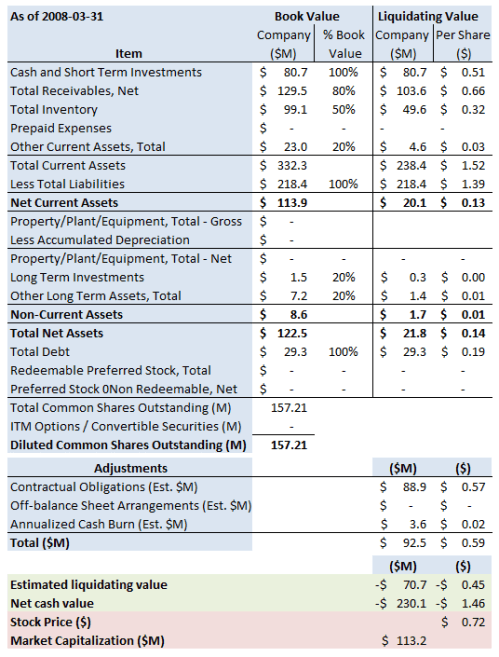
1. As at the last filing date, for the period ended March 31, 2008, MRVC’s (unaudited) NCAV was around $113.9M or $0.72 per share, which is yesterday’s closing price. Note that the liquidation value is likely negligible and the financial statements are more than a year out of date (which makes any valuation problematic). One positive is the revenue: the company has annualized revenue of around $500M. A small improvement in margins could result in a big improvement in earnings.

2. Value Investors for Change believes the company has a “valuable franchise and a strong market position” and we like their approach, described in the preliminary proxy documents thus:

The participants in this solicitation (collectively, “Value Investors for Change”) are investors who seek to encourage companies to create, preserve and enhance long-term value for their stockholders, the true owners of America’s public companies. We have developed a sophisticated screening process that we use to identify public companies that we believe (i) are undervalued, (ii) are not adequately serving the interests of their stockholders and (iii) require a new board of directors, so that, with the encouragement of stockholders such as you, we can begin implementing reforms ourselves with the goal of increasing stockholder value.

We’re adding MRVC to our Special Situations portfolio at its $0.72 close yesterday.

About MRVC

From the last 10Q:

MRV Communications is a supplier of communications equipment and services to carriers, governments and enterprise customers, worldwide. We are also a supplier of optical components, primarily through our wholly owned subsidiaries: Source Photonics and Fiberxon. We conduct our business along three principal segments: (1) the network equipment group, (2) the network integration group and (3) the optical components group. Our network equipment group provides communications equipment that facilitates access, transport, aggregation and management of voice, data and video traffic in networks, data centers and laboratories used by telecommunications service providers, cable operators, enterprise customers and governments worldwide. Our network integration group operates primarily in Italy, France, Switzerland and Scandinavia, servicing Tier One carriers, regional carriers, large enterprises, and government institutions. We provide network system design, integration and distribution services that include products manufactured by third-party vendors, as well as products developed and manufactured by the network equipment group. Our optical components group designs, manufactures and sells optical communications products used in telecommunications systems and data communications networks. These products include passive optical network, or PON, subsystems, optical transceivers used in enterprise, access and metropolitan applications as well as other optical components, modules and subsystems. We market and sell our products worldwide, through a variety of channels, which include a dedicated direct sales force, manufacturers’ representatives, value-added-resellers, distributors and systems integrators.

In July 2007, we completed our acquisition of Fiberxon, a PRC-based supplier of transceivers for applications in metropolitan networks, access networks and passive optical networks, for approximately $131 million in cash and stock. Fiberxon is part of the Optical Components group, and its results of operations are included in our Consolidated Financial Statements from July 1, 2007.

The value proposition

The main problem with any analysis of MRVC is that the financial statements are more than a year out of date. As at the last filing, MRVC’s NCAV was around $113.9M or $0.72 per share. We believe that the liquidation value is likely neglible. We’ve set out the valuation below in the usual manner (the “Book Value” column shows the assets as they are carried in the financial statements, and the “Liquidating Value” column shows our estimate of the value of the assets in a liquidation):

MRVC SummaryAs at the last filing date, the company had quarterly revenue of $125M, which annualizes to around $500M. A small improvement in margins could result in a big improvement in earnings. Value Investors for Change seek to provide that improvement, which they describe in the preliminary proxy documents set out below.
The catalyst

From the preliminary proxy documents:

REASONS FOR THE SOLICITATION

Value Investors for Change believes that the Company has a valuable franchise and a strong market position. However, we believe this value has been masked and the Company’s potential remains unrealized due to the Board’s lack of effective oversight and appropriate corporate governance policies.

Our Nominees will provide new independent voices in the Company’s boardroom and they will seek to start the process of rebuilding stockholder value. Our Nominees are committed to fully implementing and embracing long overdue corporate governance reforms.

We do not believe the current directors serving on the Board are acting in the best interests of stockholders and are concerned that this Board will fail to take the steps we believe are necessary to preserve stockholder value.

Fate of the Company’s remaining cash balance

This Annual Meeting may be the only opportunity for stockholders to determine the fate of MRVC’s substantial remaining cash balance (this amount was $73.7 million as of June 30, 2009, including short-term investments, as per the Company’s press release attached as an exhibit to its Form 8-K filed on July 27, 2009). Actions and statements by the Company indicate that the existing management and Board are prepared to ignore the best interests of the Company’s stockholders. Indeed, their track record of negative operating cash flows over the past several years is reflective of the same. If the incumbent Board and management are not replaced at this Annual Meeting, stockholders may not only lose any hope of determining the fate of MRVC’s remaining cash reserves, but also will likely have their share value further eroded. If elected to the Board, none of our Nominees intend to accept any cash fees from the Company. The Funds’ only interest here is as a stockholder.

Deficient Corporate Governance Procedures; Recent Options Scandal

The Company continues to be embroiled in an options scandal. We believe the Board was in need of change even before the current scandal broke, but the options scandal has served to underscore the need for urgent reform.

According to a press release issued by the Company on June 5, 2008, beginning in the middle of 2006 through early 2007, MRVC conducted an informal review of its share-based award practices and concluded that there was no evidence that grant dates of options were designed to occur on dates with more favorable exercise prices (i.e., on dates with lower market prices). Given subsequent events, it appears though that this review, which lasted over six months, was inadequate and did not discover certain inappropriate practices which had taken place. During this lengthy investigation and after its completion, the Company filed numerous quarterly reports and an annual report on Form 10-K for the fiscal year ended December 31, 2007, certifying to the accuracy of those financial statements. Well after this investigation and after these filings, management then determined that the conclusions reached from the earlier review were incorrect with respect to certain options granted during the period from 2002 through the first quarter of 2004. The Board determined that the financial statements for the periods from 2002 to 2008 and the related reports of MRVC’s independent public accountants, earnings press releases, and similar communications previously issued by MRVC should not be relied upon as a consequence of the pending restatement of its historical financial statements. It has been over a year since the press release announcing this major problem for the Company was issued and yet no restatements of the Company’s financial statements have been filed.

As a result of these actions,

• the Company currently faces an inquiry by the Securities and Exchange Commission (the “Commission”);

• the Company has been unable to file its annual report on Form 10-K for the year ended December 31, 2008;

• the Company has been unable to file its quarterly reports on Form 10-Q for the periods ended June 30, 2008, September 20, 2008, March 31, 2009 and June 30, 2009;

• the Company has received 6 determination letters from NASDAQ informing the Company that it would be subject to delisting as a result of its failure to timely file its financial statements and, on June 17, 2009, NASDAQ suspended the listing of the Company’s common stock from the NASDAQ Stock Market as a result of the Company’s failure to file such financial statements;

• on August 19, 2009, the NASDAQ Stock Market announced that it will delist the Company’s common stock (NASDAQ will file a Form 25 with the Commission to complete the delisting which becomes effective ten days after the Form 25 is filed); and

• the Company faces various lawsuits related to its stock option practices.

These option grants raise serious questions about the Board’s judgment and apparent disregard for the interests of stockholders. Such behavior raises significant doubts about the integrity of the Board.

Mishandling of the Acquisition of Fiberxon

On June 26, 2007, the Company amended an Agreement and Plan of Merger between affiliates of the Company and Fiberxon, Inc. that was initially entered into on January 26, 2007 (the “Merger Agreement”) to, among other things, remove as a condition precedent for the consummation of the merger that Fiberxon, Inc. deliver to MRVC its audited consolidated financial statements prior to the closing of the transaction. This amendment was unanimously approved by MRVC’s Board despite their knowledge that:

• there were allegations of financial and accounting irregularities that called into question the reliability of Fiberxon’s consolidated financial statements for its fiscal years ended December 31, 2004 and 2005 raising serious concerns regarding Fiberxon’s financial and reporting processes;

• in addition to the irregularities, Fiberxon’s independent auditors called into question the commitment of Fiberxon’s management to maintain reliable financial reporting systems, including accounting books and records, in conformity with accounting principles generally accepted in the United States and the People’s Republic of China;

• in the view of Fiberxon’s auditors, these matters also raised doubt on the ability of Fiberxon’s existing management to provide its auditors the written representations required under auditing standards generally accepted in the United States; and

• the suspension by the independent auditors of its audit of Fiberxon’s financial statements in June 2007 would likely have an adverse impact on the Company’s ability to obtain and file Fiberxon’s financial statement within the time allowed by, and in the form and content required by, the Commission’s rules thereby leading to:

• MRVC not being eligible to use the Commission’s short-form registration statement on Form S-3 to register the issuance of its securities; and

• the delisting of the Company’s common stock from the NASDAQ Stock Market and, as a result of the delisting, a default on the Company’s outstanding convertible notes.

Additionally, the Board was aware that if MRVC delayed filing with the Commission certain financial statements relating to the Fiberxon acquisition, as required by the Commission, this would put at risk the Company’s ability to use an effective registration statement to issue securities, thus handcuffing the Company’s ability to raise funds if it became necessary to do so. We believe this lack of regard that the Board showed for the stockholders of the Company highlights the incompetence of the Board and the management of the Company.

Failure to Hold an Annual Meeting

The Annual Meeting is the once-a-year event for all stockholders to voice their views and concerns. Despite the Company’s professed commitment to stockholder democracy and good corporate governance, the Company appears unable to take appropriate actions regarding governance.

On July 20, 2009, Spencer Capital Opportunity Fund, LP filed a lawsuit in Delaware pursuant to Section 211(c) of the Delaware General Corporation Law requesting that the Court of Chancery of the State of Delaware (the “Chancery Court”) order MRVC to hold its 2009 annual meeting of stockholders without delay and to grant other relief deemed appropriate by the Court. Under Delaware law, if a corporation fails to hold an annual meeting of stockholders or take action by written consent to elect directors for a period of 13 months, any stockholder may petition the Chancery Court to order that a meeting be held. MRVC has not held an annual meeting of stockholders since May 29, 2007 and accordingly has not met its obligations under Delaware law.

Pursuant to a Stipulated Order entered into in the Chancery Court dated August 7, 2009 (the “Order”), MRVC will hold its Annual Meeting on or before November 11, 2009. In the event that the Company’s Board or its outside auditor determines that the Company’s restatement of its financial statements is complete such that the Annual Meeting could be held at a date earlier than November 11, 2009, then the Company will hold the Annual Meeting not more than 40 days after this determination.

Damage to Company’s Credibility

It seems clear to us that the crucial issue of the credibility of the Company’s Board and management has been identified both outside and inside the Company. We believe MRVC is at a crossroads. The Company is beset by problems arising out of actions taken by management and overseen by the Board. Moreover, these issues have diverted the Board and management from attending to the successful operation of the business. In the face of these developments, the Company’s stock price meaningfully lags behind its peers. It is up to us, as MRVC’s stockholders, to send a clear and definite message to MRVC’s Board and management that meaningful change is needed. By voting for our Nominees, you will join us in sending that message to the current Board and help put MRVC back on the right course.

Dismal Share Price Performance

Last, but certainly not least, is MRVC’s ever-worsening stock price. Between January 1, 2005 and July 20, 2009, the date on which Spencer Capital Opportunity Fund, LP, filed a complaint requesting that the Chancery Court compel the Company to hold its Annual Meeting, MRVC’s stock price has fallen by 87.2%. We believe this is due to the perception of the investment community that this Board will destroy the Company’s remaining value.

An action plan to rebuild stockholder value is needed, and fast. Value Investors for Change proposes to take the following steps which we believe will return the Company to a positive track and serve the best interests of all of MRVC’s stockholders:

(1) Restore confidence in the Board and management by:

• appointing new independent, unbiased directors to the Board who are both expertly capable and determined to steer a new course for the Company; and

• instituting corporate governance reforms, including applying a pay for performance compensation plan for management.

(2) Create and implement a new corporate strategy by:

• assessing the Company’s competitive prospects and strategic options for growth and profitability and implementing a new corporate strategy; and

• enlisting the guidance of telecommunications industry executives to assist with this review and strategy.

(3) Resolve the outstanding accounting, legal and regulatory issues by:

• concluding the internal accounting review and taking appropriate steps to rectify this matter;

• coming into full compliance with the rules of the Commission; and

• engaging with plaintiffs in the various lawsuits against the Company to seek timely resolutions.

Value Investors for Change urges you to vote FOR the Funds’ proposal to elect our Nominees on the enclosed WHITE proxy card, thereby ending this disregard for stockholder interests. For too long, MRVC has operated without proper oversight by the Board and has hidden behind poor corporate governance policies that neither respect the interests of the Company’s stockholders nor provide meaningful Board accountability. Vote to elect a new slate of directors who are willing to stand up for the interests of all stockholders and work to maximize stockholder value.

Conclusion

MRVC is an activist play with Value Investors for Change. Two things attract us to the stock:

1. MRVC’s NCAV is around $113.9M or $0.72 per share, although we note that the liquidation value is likely negligible and the financial statements are more than a year out of date, which makes any valuation problematic. One positive is the revenue: the company has annualized revenue of around $500M. A small improvement in margins could result in a big improvement in earnings.

2. We like the approach of Value Investors for Change.

We’re adding MRVC to our Special Situations portfolio at its $0.72 close yesterday.

MRVC closed yesterday $0.72.

The S&P500 closed yesterday at 1,025.56.

[Full Disclosure: We do not have a holding in MRVC. This is neither a recommendation to buy or sell any securities. All information provided believed to be reliable and presented for information purposes only. Do your own research before investing in any security.]

Read Full Post »

MediciNova Inc. (NASDAQ:MNOV) will acquire Avigen Inc (NASDAQ:AVGN) for $1.24 per share in cash or secured convertible notes. While the stock is trading at a slight premium to the bid, we’re taking the opportunity to exit. AVGN closed Friday at $1.29, which means we’re up 98.5% on an absolute basis. The S&P500 was at 816.21 when we opened the position, and closed Friday at 1,026.13, which means we’re up 72.7% on a relative basis.

Post mortem

We started following AVGN in December last year (see archived posts here) because it was a net cash stock and specialist biotechnology investor Biotechnology Value Fund (BVF) was pushing it to liquidate and return its cash to shareholders. Despite BVF’s failure to remove the board, we continued to maintain our position in AVGN because BVF won a number of important concessions from the board that made AVGN a much more attractive stock than it was when we started following it. We continuted to hold on when AVGN announced that it was back in negotiations with MediciNova, Inc. The consideration for the deal was announced as AVGN’s “net cash liquidation value plus $3 million” and “a contingent payment right for a specific product program milestone payment associated with Avigen’s Assignment Agreement with Genzyme Corporation, potentially subject to certain adjustments.” That seems tono longer be the case. The deal announced Friday calls for a payment of around $1.19 a share when the deal closes, with approximately $0.05 per share to be paid on June 30, 2010. This is a disappointing deal. AVGN has been sold for its net cash liquidation value plus $3M from MediciNova. We held on because we believed that there was a reasonable chance that AVGN could yield more than its then $1.34 share price when the “contingent payment right” capturing the near term payments from Genzyme was taken into account. MNOV has not provided AVGN shareholders with any value for AVGN’s AV411 assets and program.

Here is the press release announcing the sale (via MarketWatch):

MediciNova To Acquire Avigen For $1.24 a Share

William L. Watts

MarketWatch Pulse

LONDON — Biopharmaceutical firm MediciNova Inc. will acquire Avigen Inc. for $1.24 a share in cash or secured convertible notes, under an agreement announced Friday by the biopharmaceutical firms. Under the deal, around $1.19 a share will be paid when the deal closes, with approximately 5 cents a share to be paid on June 30, 2010. The transaction is expected to close in the fourth quarter, pending the approval of Avigen and MediciNova stockholders and other considerations. The companies said the merger will allow them to combine their neurological clinical development programs based on ibudilast, an anti-inflammatory drug.

[Full Disclosure: We have a holding in AVGN. This is neither a recommendation to buy or sell any securities. All information provided believed to be reliable and presented for information purposes only. Do your own research before investing in any security.]

Read Full Post »

Spencer Capital has filed preliminary proxy documents to remove the board of VaxGen Inc (OTC:VXGN). In the documents, Spencer Capital, which leads a group of investors calling themselves “Value Investors for Change,” call out VXGN’s board on its “track record of failure and exorbitant cash compensation”:

VaxGen does not have any operations, other than preparing public reports. The Company has three employees, including the part-time principal executive officer and director, and four non-employee directors. Since the Company’s failed merger with Raven Biotechnologies, Inc. in March 2008, the Board has publicly disclosed that it would either pursue a strategic transaction or a series of strategic transactions or dissolve the Company. The Company has done neither. In the meantime, members of the Board have treated themselves to exorbitant cash compensation. Until July 2009, two non-employee members of the Board were paid over $300,000 per year in compensation. The principal executive officer will likely receive over $400,000 in cash compensation this year.

We’ve been following VXGN (see our post archive here) because it is trading at a substantial discount to its net cash position, has ended its cash-burning product development activities and is “seeking to maximize the value of its remaining assets through a strategic transaction or series of strategic transactions.” Management has said that, if the company is unable to identify and complete an alternate strategic transaction, it proposes to liquidate. One concern of ours has been a lawsuit against VXGN by its landlords, in which they sought $22.4M. That lawsuit was dismissed in May, so the path for VXGN to liquidate has now hopefully cleared. The board has, however, been dragging its feet on the liquidation. Given their relatively high compensation and almost non-existent shareholding, it’s not hard to see why.

VXGN has now also attracted the attention of BA Value Investors, which has disclosed an activist holding and called on VXGN to “act promptly to reduce the size of the board to three directors; reduce director compensation; change to a smaller audit firm; terminate the lease of its facilities; otherwise cut costs; make an immediate $10 million distribution to shareholders; make a subsequent distribution of substantially all the remaining cash after settling the lease termination; distribute any royalty income to shareholders; and explore ways to monetize the public company value of the Issuer and use of its net operating losses.”

VXGN is up 25.0% since we initiated the position. At its $0.60 close yesterday, it has a market capitalization of $19.9M. We last estimated the company’s liquidation value to be around $25.4M or $0.77 per share. VXGN has other potentially valuable assets, including a “state-of-the-art biopharmaceutical manufacturing facility with a 1,000-liter bioreactor that can be used to make cell culture or microbial biologic products” and rights to specified percentages of future net sales relating to its anthrax vaccine product candidate and related technology. The authors of a letter sent to the board on July 14 of this year ajudge VXGN’s liquidation value to be significantly higher at $2.12 per share:

Excluding the lease obligations, the net financial assets alone of $37.2 million equate to $1.12 per share. The EBS royalties (assuming a 6% royalty rate and a $500 million contract as contemplated by NIH/HHS and EBS) of $30 million and milestones of $6 million total $36 million of potential additional future value (based clearly on assumptions, none of which are assured), or $1.09 per share. Adding $1.12 and $1.09 equals $2.21 per share.

Spencer Capital’s proxy solicitation is a welcome relief, and, with any luck, we will see a liquidation of VXGN soon, either at the hands of the present board, or by Value Investors for Change.

The preliminary proxy statement sets out the Value Investors for Change group’s “Reasons for the solicition” thus:

Even though VaxGen does not have substantial operations, Value Investors for Change believes that the Company has valuable assets, consisting of cash and net operating loss carryforwards (“NOLs”). We believe these assets should be unlocked for the benefit of shareholders, rather than consumed over time by the current Board.

We do not believe the members of the current Board are acting in the best interests of stockholders. Since the Company’s failed merger with Raven Biotechnologies, Inc. in March 2008, the Board has publicly disclosed that it would either pursue a strategic transaction or a series of strategic transactions or dissolve the Company. The Company has done neither. Instead, the Board has overseen the consumption of a large portion of the Company’s assets while paying itself exorbitant compensation. In addition, the Board’s interests are not aligned with the stockholders, as displayed by their miniscule equity stake in the Company.

Consumption of Assets

Since discontinuing its operations, the Company has consumed a significant amount of assets. According to its most recent quarterly report on Form 10-Q, since June 30, 2008, the Company’s assets have decreased by $31.7 million, or 45%. Since December 31, 2008, the Company’s assets have decreased by over $3.5 million, or 8.4%.

In addition, the Company recorded $3.6 million in general and administrative expenses during the six month period ended June 30, 2009. Much of this expense consisted of cash compensation to the Board.

Exorbitant Board Compensation

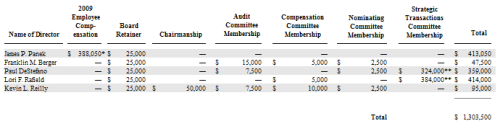
Despite the relatively simple task of overseeing a shell company and conducting an ordinary sale process, the Board has paid itself inordinately high compensation. The table below describes the principal executive officer’s 2009 cash compensation and the director cash compensation scheme for the VaxGen Board, as described in the Company’s 2008 annual report on Form 10-K:

VXGN Board Compensation 1

(This table has been modified from the original to fit this space)

* Consists of $195,000 annual base salary for 25 hours per week employment and a $193,050 lump sum payment. The lump sum payment was approved by the Board in consideration for Mr. Panek’s agreement not to resign for “good reason” under his employment agreement.

** VaxGen announced in its quarterly report for the period ended June 30, 2009 that, effective September 1, 2009, it had disbanded the Strategic Transactions Committee and that, following its disbandment, Board members would no longer receive additional compensation for service thereon.

While it is difficult to envision the rationale for the high cash compensation awarded to the Chairman Kevin Reilly and Franklin Berger, the most excessive portion of the director compensation consisted of the payments to the non-employee members of the Strategic Transactions Committee. Beginning in May 2008, Board members Lori F. Rafield and Paul DeStefano received $20,000 per month and $15,000 per month, respectively, for service on the Strategic Transactions Committee, which was formed to identify, review and evaluate potential strategic transactions and alternatives. Within a few months, these directors increased their compensation to $32,000 and $27,000 per month, respectively. This compensation is extraordinarily excessive.

Insignificant Board Equity Ownership

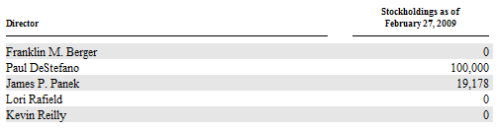
The members of the Board hold very few shares of the Company’s common stock. Most of the Board’s beneficial ownership holdings consist of underwater stock options. The following table describes the stockholdings of the Board, as set forth in the 2008 annual report, excluding options.

VXGN Board Compensation 2This Board has failed to take the steps we believe are necessary to preserve and enhance stockholder value. We believe the actions taken by the Board indicate that they are more interested in acting in their own self-interest rather than in the best interests of stockholders.

Value Investors for Change urges you to vote FOR the Fund’s proposal to elect the Nominees on the enclosed WHITE proxy card, thereby ending this disregard for stockholder interests. Vote to elect a new slate of directors who are willing to stand up for the interests of all stockholders and work to maximize stockholder value.

The members of the Board hold very few shares of the Company’s common stock. Most of the Board’s beneficial ownership holdings consist of underwater stock options. The following table describes the stockholdings of the Board, as set forth in the 2008 annual report, excluding options.

Hat tip bellamyj and matt.jensen08.

[Full Disclosure:  We have a holding in VXGN. This is neither a recommendation to buy or sell any securities. All information provided believed to be reliable and presented for information purposes only. Do your own research before investing in any security.]

Read Full Post »

Axcelis Technologies Inc (NASDAQ:ACLS) has filed its 10Q for the period ended June 30, 2009.

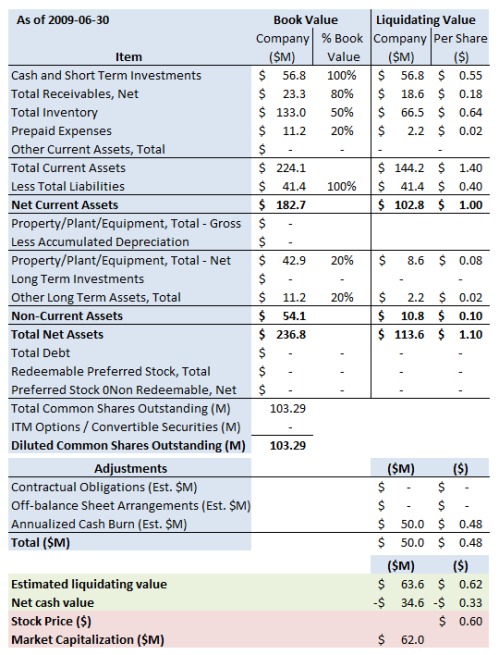
We started following ACLS on January 8 this year (see our post archive here) because it is an undervalued asset play with an activist investor, Sterling Capital Management, holding 10.7% of its outstanding stock. ACLS has completed the sale of its 50% interest in SEN Corporation, its joint venture with Sumitomo Heavy Industries, Ltd. (SHI) to SHI for proceeds of $122.3 million. ACLS received around $35.9M in cash after applying $86.4M of the proceeds to meet obligations to the holders of the company’s 4.25% Convertible Senior Subordinated Notes, upon which ACLS defaulted in January. We last estimated ACLS’s liquidation value at around $117.8M or $1.14 per share. Following our review of the 10Q, we’ve reduced our estimate to $113.6M or $1.10, which is around 80% higher than its $0.60 close yesterday. Cash burn is a significant issue for ACLS. At the current rate of cash burn, we estimate the company has around six months before its liquidation value meets its current price, and around a year before it’s worthless.

The value proposition updated

During the three months ended June 30, 2009, ACLS continued to burn cash in its operations, which it attributes to the depressed semiconductor equipment market and the resultant decline in revenues. Cash and cash equivalents at June 30, 2009 were $56.8M, compared to $71.2M at March 31, 2009. The company attributes the $21.4M decrease in cash and cash equivalents to the cash used in operations and payments of fees and other costs associated with the sale of the investment in SEN. The company anticipates net cash outflows from operations in the remainder of 2009. Set out below is our adjusted balance sheet for ACLS (the “Book Value” column shows the assets as they are carried in the financial statements, and the “Liquidating Value” column shows our estimate of the value of the assets in a liquidation):

ACLS Summary 2009 6 30

We’ve been quite kind to ACLS by assuming only $50M of cash burn over the next twelve months. On its current form, $80M would have been closer to the mark. We’re assuming management takes some action to staunch the flow, but an assumptions like that might make us look like fools.

Conclusion

ACLS has made substantial operating losses over the last two years, and it is likely to be continue to do so. While its liquidation value of around $113.6M or $1.10 per share is more than 80% higher than its close yesterday of $0.60, it is likely to deteriorate while it continues its operating losses. ACLS continues to be our problem child, and we don’t think there is any good news on the horizon near-term, but we find it difficult to exit the position while it’s trading at a such a large discount to its (albeit deteriorating) liquidation value. Accordingly, we’re going to hold on for the moment, and see how the position plays out. If we get an opportunity to exit at close to value, however, we’ll take it. If the position hasn’t improved by the next Q, we’re likely sellers.

[Full Disclosure:  We have a holding in ACLS. This is neither a recommendation to buy or sell any securities. All information provided believed to be reliable and presented for information purposes only. Do your own research before investing in any security.]

Read Full Post »

« Newer Posts - Older Posts »