Feeds:
Posts
Comments

Posts Tagged ‘Liquidation Value’

VaxGen Inc (OTC:VXGN) is all over. The latest 10Q has come out and, while not much has changed, it’s irrelevant in light of the pending deal with OXGN. The liquidation value remains around $23.6M or $0.71 per share. Whether that deal is consummated or not, VXGN shareholders will be worse off. The stock price is in no man’s land at the moment. It’s not cheap enough to buy more, and it’s still trading at a big discount to liquidation value. In this instance, it’s probably justified given the malice the board seems to have towards its shareholders. I’m closing Greenbackd’s position out at yesterday’s closing price of $0.53. Greenbackd is up 12.5% on VXGN on an absolute basis, which is off 13.0% relative to the S&P500. It’s a shame because I had plenty of chances to read the writing on the wall and get out at a decent profit. I didn’t, so more fool me. I hung around for too long, hoping that something would happen. Nothing did. The end.

Post mortem

We started following VXGN (see the VXGN post archive here) because it was trading at a substantial discount to its net cash position, had ended its cash-burning product development activities and was “seeking to maximize the value of its remaining assets through a strategic transaction or series of strategic transactions.” VXGN had other potentially valuable assets, including a “state-of-the-art biopharmaceutical manufacturing facility with a 1,000-liter bioreactor that can be used to make cell culture or microbial biologic products” and rights to specified percentages of future net sales relating to its anthrax vaccine product candidate and related technology. I initially estimated the liquidation value to be around $0.84 per share, although that reduced over the holding period to yesterdays $0.71 per share. The authors of a letter sent to the board on July 14 of this year adjudged VXGN’s liquidation value to be significantly higher at $2.12 per share:

Excluding the lease obligations, the net financial assets alone of $37.2 million equate to $1.12 per share. The EBS royalties (assuming a 6% royalty rate and a $500 million contract as contemplated by NIH/HHS and EBS) of $30 million and milestones of $6 million total $36 million of potential additional future value (based clearly on assumptions, none of which are assured), or $1.09 per share. Adding $1.12 and $1.09 equals $2.21 per share.

On the catalyst front, management had said that, if the company was unable to identify and complete an alternate strategic transaction, it proposed to liquidate. One concern of mine was the lawsuit against VXGN by its landlords, in which they sought $22.4M. That lawsuit was dismissed in May, at which point the path for VXGN to liquidate appeared to clear. Unfortunately the board dragged its feet on the liquidation, which, given their relatively high compensation and almost non-existent shareholding, was not difficult to understand.

This state of affairs drew two competing alternate proxy slates seeking nomination to the board of VXGN, Value Investors for Change and the VaxGen Full Value Committee. Value Investors for Change, led by Spencer Capital, filed preliminary proxy documents in August to remove the board. In the proxy documents, Value Investors for Change called out VXGN’s board on its “track record of failure and exorbitant cash compensation”:

VaxGen does not have any operations, other than preparing public reports. The Company has three employees, including the part-time principal executive officer and director, and four non-employee directors. Since the Company’s failed merger with Raven Biotechnologies, Inc. in March 2008, the Board has publicly disclosed that it would either pursue a strategic transaction or a series of strategic transactions or dissolve the Company. The Company has done neither. In the meantime, members of the Board have treated themselves to exorbitant cash compensation. Until July 2009, two non-employee members of the Board were paid over $300,000 per year in compensation. The principal executive officer will likely receive over $400,000 in cash compensation this year.

The VaxGen Full Value Committee, comprising BA Value Investors’ Steven N. Bronson and ROI Capital Management’s Mark T. Boyer and Mitchell J. Soboleski, intended to replace the current board with directors who would focus on the following objectives:

1. Returning capital to [VXGN]’s shareholders, including an immediate distribution of $10,000,000 in cash;

2. Terminating [VXGN]’s lease with its landlord, Oyster Point Tech Center, LLC, and settling with the landlord the obligations of [VXGN] on the remaining lease payments;

3. Exploring ways to monetize [VXGN] as a “public shell,” including the utilization of [VXGN]’s Substantial Net Operating Losses; and

4. Protecting for the benefit of shareholders royalty payments receivable from the sale of [VXGN]’s intellectual property.

BA Value Investors had previously disclosed an activist holding and, in a June 12 letter to the board, called on VXGN to “act promptly to reduce the size of the board to three directors; reduce director compensation; change to a smaller audit firm; terminate the lease of its facilities; otherwise cut costs; make an immediate $10 million distribution to shareholders; make a subsequent distribution of substantially all the remaining cash after settling the lease termination; distribute any royalty income to shareholders; and explore ways to monetize the public company value of the Issuer and use of its net operating losses.”

For a while it looked like a decent outcome was possible, but then VXGN threw a spanner in the works, striking an appalling deal with OXGN at a discount to VXGN’s $0.70 close the prior day. It is also priced at a discount to VXGN’s net cash and liquidation values, and payment is to be made in the watered scrip of OXGN, a speculative biotech play (see our more detailed take on the terms of the VXGN / OXGN deal). BA Value Investors and VaxGen Full Value Committee exited the stock shortly thereafter. Value Investors for Change has also been conspicuously silent, so I think we can assume they’ve thrown in the towel.

Disgruntled shareholders have now initiated several class actions against the board of VXGN over possible breaches of fiduciary duty in the sale to OXGN. The board certainly deserved the suit, but a successful outcome in any litigation will be a Pyrrhic victory for participating VXGN shareholders. As I understand it, VXGN’s board is indemnified out of VXGN’s assets and so as any damages award will return to VXGN plaintiffs VXGN’s assets less legal fees and the break fee.

It’s also possible that the merger will not survive the shareholder vote. As reader bellamyj noted, in November 2007 VXGN announced another disastrous merger with Raven Biotechnologies. Over the next few days VXGN stock fell almost 50% and the merger was terminated the day before the special meeting, apparently due to shareholder opposition. Perhaps that will happen again. If it does, OXGN will still tear out ~$2.5M from VXGN, but it may be a better outcome than the deal on the table. If that happens, we’ll revisit VXGN, but for now, we’re going to say, “Good riddance.” VXGN directors, hang your heads in shame.

Hat tip garp.

[Full Disclosure:  We don’t have a holding in VXGN. This is neither a recommendation to buy or sell any securities. All information provided believed to be reliable and presented for information purposes only. Do your own research before investing in any security.]

Read Full Post »

Forward Industries Inc (NASDAQ:FORD) has fired its investment and engaged another. It looks like FORD is intent on spending the cash on its balance sheet, which is a shame. Rather than make an acquisition, they should focus on the work on their desk and pay a big dividend. There’s a half chance that the bank could suggest a sale of the company, but that seems unlikely. I can’t believe there are no activists out there willing to take on this company. It’s 40% off its 52-week high. It’s net cash. There are no big holders. Management’s not doing a bad job, but an acquisition is a ridiculous idea. This is an instance of a management trying to plow a dollar back into the business and turn it into fifty cents. I could use that dollar more profitably. Then again, I’d probably just spend it on pennywhistles and moonpies.

We started following FORD (see our post archive here) because it was trading at a discount to its net cash and liquidation values, although there was no obvious catalyst. Management appeared to be considering a “strategic transaction” of some kind, which might have included an “acquisition or some other combination.” Trinad Management had an activist position in the stock, but had been selling at the time we opened the position and only one stockholder owned more than 5% of the stock. The stock is up 36.8% since we opened the position to close yesterday at $1.97, giving the company a market capitalization of $13.4M. Following our review of the most recent 10Q, we’ve estimate the liquidation value to $19.5M or $2.47 per share.

Here’s a link to the announcement (it’s just a marketing announcement by the bank so I’m not going to repost it).

FORD is trading at a substantial discount to its liquidation and net cash values. The risk to this position is management spraying the cash away on an acquisition. A far better use of the company’s cash is a buyback, special dividend or return of capital. Another concern is Trinad Management exiting its activist position in the stock. Those concerns aside, I’m going to maintain the position because it still looks cheap at a discount to net cash.

[Full Disclosure:  We have a holding in FORD. This is neither a recommendation to buy or sell any securities. All information provided believed to be reliable and presented for information purposes only. Do your own research before investing in any security.]

Read Full Post »

We’ve just completed an interview with Miguel Barbosa of the wonderful Simoleon Sense. Go there now, and get trapped in an endless loop as you are recirculated back here and so on.

Read Full Post »

Yesterday was the record date for the first dividend in the liquidation of Leadis Technology Inc (NASDAQ:LDIS). The dividend is likely to be approximately $0.93 per share. The board estimates that “if we are able to dispose of substantially all of our non-cash assets, the aggregate amount of all liquidating distributions that will be paid to stockholders will be in the range of approximately $0.93 to $1.20 per share of Leadis common stock.” After the initial $0.93 dividend, the remaining dividends will be in the range of nil to $0.27 ($1.20 less $0.93). LDIS closed yesterday at $0.99. If the stub starts trading tomorrow at $0.06 ($0.99 less $0.93), it becomes an interesting security offering the potential for some substantial upside.

The definitive proxy filings have the detail:

How much can stockholders expect to receive if the Plan of Dissolution is approved at the special meeting?

At this time, we cannot predict with certainty the amount of any liquidating distributions to our stockholders. However, based on information currently available to us, assuming, among other things, no unanticipated actual or contingent liabilities, we estimate that over time stockholders will receive one or more distributions that in the aggregate range from approximately $0.93 to $1.20 per share. This range of estimated distributions represents our estimate of the amount to be distributed to stockholders during the liquidation, but does not represent the minimum or maximum distribution amount. Actual distributions could be higher or lower.

This estimated range is based upon, among other things, the fact that as of August 31, 2009, we had approximately $28.6 million in cash, cash equivalents, restricted cash equivalents and short-term and non-current investments. In addition, subsequent to August 31, 2009, we received approximately $3.2 million in connection with the sale of certain assets to IXYS Corporation. We expect to use cash of approximately $2.3 million to satisfy liabilities on our unaudited balance sheet after August 31, 2009. In addition to converting our remaining non-cash assets to cash and satisfying the liabilities currently on our balance sheet, we have used and anticipate using cash for a number of items, including but not limited to: satisfying capital leases and other contractual commitments. In addition to the satisfaction of our liabilities, we have used and anticipate continuing to use cash in the next several months for a number of items, including, but not limited to, the following:

• ongoing operating expenses;

• expenses incurred in connection with extending our directors’ and officers’ insurance coverage;

• expenses incurred in connection with the liquidation and dissolution process;

• severance and related costs;

• resolution of pending and potential claims, assessments and obligations; and

• professional, legal, consulting and accounting fees.

We are unable at this time to predict the ultimate amount of our liabilities because the settlement of our existing liabilities could cost more than we anticipate and we may incur additional liabilities arising out of contingent claims that have not been quantified, are not yet reflected as liabilities on our balance sheet and have not been included in the estimated range of potential distributions, such as liabilities relating to claims that have not been resolved and claims or lawsuits that could be brought against us in the future. If any payments are made with respect to the foregoing, the estimated range of distributions to stockholders will be negatively impacted and less than estimated. If the ultimate amount of our liabilities is greater than what we anticipate, the distribution to our stockholders may be substantially lower than anticipated. Therefore, we are unable at this time to predict the precise nature, amount and timing of any distributions due in part to our inability to predict the ultimate amount of our liabilities. Accordingly, you will not know the exact amount of any liquidating distributions you may receive as a result of the Plan of Dissolution when you vote on the proposal to approve the Plan of Dissolution. You may receive substantially less than the low end of the current estimate.

For some further background, see Shake&Bake’s take on LDIS.

Hat tip Joseph.

[Full Disclosure:  We have a holding in LDIS. This is neither a recommendation to buy or sell any securities. All information provided believed to be reliable and presented for information purposes only. Do your own research before investing in any security.]

Read Full Post »

Digirad Corporation (NASDAQ:DRAD) has filed its 10Q for the quarter ended September 30, 2009.

We started following DRAD (see our post archive here) because it was an undervalued asset play with a plan to sell assets and buy back its stock. The stock is up more than 167% since we started following it to close yesterday at $2.35, giving the company a market capitalization of $36.1M. We last estimated the liquidation value to be around $32.5M or $1.73 per share. We’ve now increased our valuation to $32.9M or $1.77 per share following another very good quarter for DRAD. Year-to-date, DRAD has generated over $3.4M in cash from operations. DRAD has also started buying back stock under its previously announced $2M stock repurchase plan.

The value proposition updated

DRAD has continued its good year, generating $3.4M in operating cash flow year-to-date. Our updated estimate for the company’s liquidation value is set out below (the “Book Value” column shows the assets as they are carried in the financial statements, and the “Liquidating Value” column shows our estimate of the value of the assets in a liquidation):

DRAD Summary 2009 9 30Off-balance sheet arrangements and contractual obligations: The company hasn’t disclosed any off-balance sheet arrangements in its most recent 10Q.
The catalyst

DRAD’s board has announced a stock buyback program:

The Company also announced that its board of directors has authorized a stock buyback program to repurchase up to an aggregate of $2 million of its issued and outstanding common shares. Digirad had approximately 19 million shares outstanding as of December 31, 2008. At current valuations, this repurchase plan would authorize the buyback of approximately 2.1 million shares, or approximately 11 percent of the company’s outstanding shares.

Chairman of the Digirad Board of Directors R. King Nelson said, “The board believes the Company’s direction and goals towards generating positive cash flow and earnings coupled with an undervalued stock price present a unique investment opportunity. We are confident this will provide a solid return to our shareholders.”

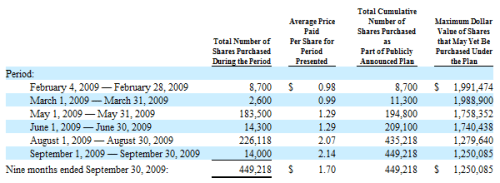
According to the most recent 10Q, the company has now started to buy its own stock, albeit a relatively small amount:

On February 4, 2009, our Board of Directors approved a stock repurchase program whereby we may, from time to time, purchase up to $2.0 million worth of our common stock in the open market, in privately negotiated transactions or otherwise, at prices that we deem appropriate. The plan has no expiration date. Details of purchases made during the nine months ended September 30, 2009 are as follows (Edited to fit this space.):

DRAD Buy Back Detail 2009 09 30

Conclusion

DRAD is now trading at a reasonable 24% premium to its $32.9M or $1.77 per share in liquidation value. It’s off about 20% from its peak, and looks likely to continue to drop. We’re generally sellers of secondary securities trading at a premium to liquidation value, but DRAD seems to have the started generating cash. We’d like to see where it can go. We can see no other reason to cease holding DRAD in the Greenbackd Portfolio and so we’re going to maintain the position for now.

[Full Disclosure:  We do not have a holding in DRAD. This is neither a recommendation to buy or sell any securities. All information provided believed to be reliable and presented for information purposes only. Do your own research before investing in any security.]

Read Full Post »

Disgruntled VaxGen Inc (OTC:VXGN) shareholders have initiated a class action against the board of VXGN over possible breaches of fiduciary duty in the sale to OXGN. The board certainly deserves the suit because of the appalling deal struck with OXGN. Priced at a discount to VXGN’s net cash and liquidation values, and payment in the watered scrip of a speculative biotech play, it’s a real dud for VXGN shareholders (see our more detailed take on the terms of the VXGN / OXGN deal). A successful outcome in any litigation may be a Pyrrhic victory for participating VXGN shareholders. As we understand it, VXGN’s board is indemnified out of VXGN’s assets and so as any damages award will return to VXGN plaintiffs VXGN’s assets less legal fees and the break fee. Perhaps someone more knowledgable can illuminate the situation for us in the comments. It’s also possible that the merger will not survive the shareholder vote. As reader bellamyj notes, in November 2007 VXGN announced another disastrous merger with Raven Biotechnologies. Over the next few days VXGN stock fell almost 50% and the merger was terminated the day before the special meeting, apparently due to shareholder opposition. Perhaps that will happen again. If it does, OXGN will still tear out ~$2.5M from VXGN, but it may be a better outcome than the deal on the table.

About our VXGN position

We’ve been following VXGN (see our post archive here) because it is trading at a substantial discount to its net cash position, has ended its cash-burning product development activities and is “seeking to maximize the value of its remaining assets through a strategic transaction or series of strategic transactions.” Management has said that, if the company is unable to identify and complete an alternate strategic transaction, it proposes to liquidate. One concern of ours has been a lawsuit against VXGN by its landlords, in which they sought $22.4M. That lawsuit was dismissed in May, so the path for VXGN to liquidate has now hopefully cleared. The board has, however, been dragging its feet on the liquidation. Given their relatively high compensation and almost non-existent shareholding, it’s not hard to see why.

There are two competing alternate proxy slates seeking nomination to the board of VXGN, Value Investors for Change and the VaxGen Full Value Committee. Value Investors for Change, led by Spencer Capital, filed preliminary proxy documents in August to remove the board. In the proxy documents, Value Investors for Change call out VXGN’s board on its “track record of failure and exorbitant cash compensation”:

VaxGen does not have any operations, other than preparing public reports. The Company has three employees, including the part-time principal executive officer and director, and four non-employee directors. Since the Company’s failed merger with Raven Biotechnologies, Inc. in March 2008, the Board has publicly disclosed that it would either pursue a strategic transaction or a series of strategic transactions or dissolve the Company. The Company has done neither. In the meantime, members of the Board have treated themselves to exorbitant cash compensation. Until July 2009, two non-employee members of the Board were paid over $300,000 per year in compensation. The principal executive officer will likely receive over $400,000 in cash compensation this year.

The VaxGen Full Value Committee comprising BA Value Investors’ Steven N. Bronson and ROI Capital Management’s Mark T. Boyer and Mitchell J. Soboleski, intends to replace the current board with directors who will focus on the following objectives:

1. Returning capital to [VXGN]’s shareholders, including an immediate distribution of $10,000,000 in cash;

2. Terminating [VXGN]’s lease with its landlord, Oyster Point Tech Center, LLC, and settling with the landlord the obligations of [VXGN] on the remaining lease payments;

3. Exploring ways to monetize [VXGN] as a “public shell,” including the utilization of [VXGN]’s Substantial Net Operating Losses; and

4. Protecting for the benefit of shareholders royalty payments receivable from the sale of [VXGN]’s intellectual property.

BA Value Investors had previously disclosed an activist holding and, in a June 12 letter to the board, called on VXGN to “act promptly to reduce the size of the board to three directors; reduce director compensation; change to a smaller audit firm; terminate the lease of its facilities; otherwise cut costs; make an immediate $10 million distribution to shareholders; make a subsequent distribution of substantially all the remaining cash after settling the lease termination; distribute any royalty income to shareholders; and explore ways to monetize the public company value of the Issuer and use of its net operating losses.”

VXGN is up 25.0% since we initiated the position. At its $0.60 close yesterday, it has a market capitalization of $22.5M. We last estimated the company’s liquidation value to be around $25.4M or $0.77 per share. VXGN has other potentially valuable assets, including a “state-of-the-art biopharmaceutical manufacturing facility with a 1,000-liter bioreactor that can be used to make cell culture or microbial biologic products” and rights to specified percentages of future net sales relating to its anthrax vaccine product candidate and related technology. The authors of a letter sent to the board on July 14 of this year adjudge VXGN’s liquidation value to be significantly higher at $2.12 per share:

Excluding the lease obligations, the net financial assets alone of $37.2 million equate to $1.12 per share. The EBS royalties (assuming a 6% royalty rate and a $500 million contract as contemplated by NIH/HHS and EBS) of $30 million and milestones of $6 million total $36 million of potential additional future value (based clearly on assumptions, none of which are assured), or $1.09 per share. Adding $1.12 and $1.09 equals $2.21 per share.

Here’s the press release announcing the litigation:

Levi & Korsinsky, LLP Investigates Possible Breach of Fiduciary Duty by the Board of VaxGen, Inc. – VXGN.OB

Levi & Korsinsky is investigating the Board of Directors of VaxGen, Inc. (“VaxGen” or the “Company”) (OTC BB: VXGN) for possible breaches of fiduciary duty and other violations of state law in connection with their attempt to sell the Company to Oxigene Inc. (“Oxigene”) (NasdaqGM: OXGN). Under the terms of the transaction, VaxGen shareholders will receive 0.4719 Oxigene shares for every VaxGen share they own which, based on the $1.42 per share closing price of Oxigene stock on October 14, 2009, the day prior to the announcement, is valued at approximately $0.67. In addition, Oxigene is to place approximately 8.5 million common shares in escrow to be released to VaxGen shareholders contingent upon the occurrence of certain events over the two-year period following the closing.

The investigation concerns whether the VaxGen Board of Directors breached their fiduciary duties to VaxGen shareholders given that (i) the Company has approximately $1.07 per share in cash with no debt; (ii) the Company has a book value of approximately $0.99 a share; (iii) at least one analyst has set a $2.00 price target for VaxGen stock; and (iv) and the Board agreed to a non-solicitation provision and a termination fee up to $1,425,000 that will all but ensure that no superior offers will ever be forthcoming.

If you own common stock in VaxGen and wish to obtain additional information, please contact us at the number listed below or visit http://www.zlk.com/vxgn1.html.

Levi & Korsinsky has expertise in prosecuting investor securities litigation and extensive experience in actions involving financial fraud and represents investors throughout the nation, concentrating its practice in securities and shareholder litigation.

Hat tip JM.

[Full Disclosure:  We have a holding in VXGN. This is neither a recommendation to buy or sell any securities. All information provided believed to be reliable and presented for information purposes only. Do your own research before investing in any security.]

Read Full Post »

Axcelis Technologies Inc (NASDAQ:ACLS) has had an amazing run over the last few weeks, up more than 50% since the end of September to hit a 52-week high yesterday. We’ve decided to close our position because it’s trading at a substantial premium to our estimate of its liquidation value and we don’t think the underlying business is all that great (not that we have any particular insight into these things). At its $1.63 close yesterday, our position in ACLS is up 171.7% on an absolute basis. The S&P500 closed at 906.65 on the day we opened the position, and closed yesterday at 1,073.18, an 18.4% gain, which means we’ve outperformed the S&P500 over the same period by 153.3%.

Post mortem

We started following ACLS on January 8 this year (see our post archive here) because it was trading at a discount to our estimate of its liquidation value with an activist investor, Sterling Capital Management, holding 10.7% of its outstanding stock. The picture for ACLS looked fairly grim at that stage. We noted that it had been “making substantial operating losses that have widened over the last five quarters” that had prompted “Sterling Capital Management to detail to ACLS management an aggressive restructuring strategy to salvage for stockholders what value remains.” Shortly after we opened the position ACLS failed to make a payment required under its 4.25% Convertible Senior Subordinated Notes, which meant that the company was required to repay the outstanding principal amount of the notes plus a maturity premium and accrued interest (a total payment of approximately $85 million) on January 15. On February 26, in a remarkable deal given the extremely difficult conditions, ACLS managed to sell to Sumitomo Heavy Industries, Ltd. (SHI) of its 50% interest in SEN Corporation, its joint venture with SHI, for proceeds of $122.3 million. ACLS received around $35.9M in cash after applying $86.4M of the proceeds to meet its obligations to the Convertible Senior Subordinated Noteholders. The company hit its low of $0.17 on Feburary 25, at which point our position was down over 70%. From its February 25 nadir, ACLS is up approximately 860% to close yesterday at $1.63, which gives the company a market capitalization of $170M.

We last estimated ACLS’s liquidation value at around  $113.6M or $1.10. Its net current asset value at the last reporting date was a little higher at around $180M or $1.77 per share. We still think that cash burn is a significant issue for ACLS, and we suspect that both the liquidation and net current asset values will be lower at the upcoming reporting date. At the rate of cash burn prevailing at the last reporting date, we estimated the company had around six months before its liquidation value was around $0.60, and around a year before it was worthless. We think that’s an improbable – but not impossible – outcome.

ACLS’s recent run-up may be attributable to attention it has now started receiving from the mainstream media and larger investment banks. Citi thinks ACLS could be worth $3, noting that “while we are far from bullish on business prospects and we acknowledge that there’s risk to ACLS’ ability to raise much-needed cash in the next several months, we think the company will be able to raise sufficient capital w/o going to the public markets.” The Wall Street Journal also ran an article yesterday in which it quoted an analyst as saying “the stock is undervalued, since there were concerns about whether the company would survive. It was one of the hardest hit in the downturn … partly because it had market-share losses amid a cyclical semiconductor decline before the financial crisis even hit. … Now it looks like the company will probably make it, so there’s a correction in valuation.” That may be so, but we’ve got no particular insight into the business or the industry, and so we’re closing the position.

[Disclosure:  We don’t have a holding in ACLS. This is neither a recommendation to buy or sell any securities. All information provided believed to be reliable and presented for information purposes only. Do your own research before investing in any security.]

Read Full Post »

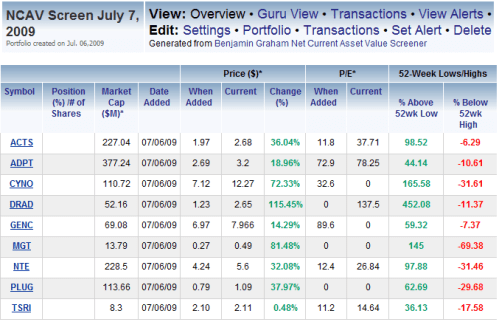
We’ve recently been using the GuruFocus Benjamin Graham Net Current Asset Value Screener (subscription required) to generate regular watchlists of net net stocks. The GuruFocus NCAV screen has some superb functionality that makes it possible to create the watchlist from the screen and then track the performance of those stocks. We created our first watchlist on July 7 of this year using the July 6 closing prices. The performance of the stocks in that first watchlist over the last quarter has been nothing short of spectacular. Here is a screen grab (with some columns removed to fit the space below):

GuruFocus NCAV Screen

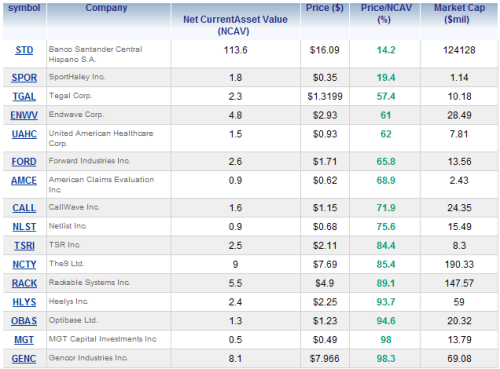
We know the market’s been somewhat frothy recently, but those returns are still notable. The average return to date across the nine stocks in the watchlist is 45.5% against the return on the S&P500 of 20.05% over the same period, an outperformance of more than 25% in ~three months. We’ve decided to run another screen today and we’ll track the return of that watchlist over the coming months. The stocks in the watchlist are set out below (again, with a column removed to fit the space below):

GuruFocus NCAV Screen 2009 10 13

We’ve done no research on these firms beyond running the screen. If you plan on buying anything in this screen, at the absolute minimum we recommend that you do some research to determine whether they are currently net net stocks and not just caught in the screen because of out-of-date filings. We’ll compare the performance of the stocks against the S&P500, which closed yesterday at 1,076.18.

[Full Disclosure:  We have a holding in FORD. This is neither a recommendation to buy or sell any securities. All information provided believed to be reliable and presented for information purposes only. Do your own research before investing in any security.]

Benjamin Graham Net Current Asset Value Screener

Read Full Post »

Aspen Exploration Corporation (OTC:ASPN) has filed its definitive proxy statement for its November 30, 2009 general meeting and included is a proposal seeking authority for ASPN’s board of directors to dissolve the company

We’ve been following ASPN (see our ASPN post archive) because it’s trading at a discount to its $1.17 per share liquidation value and there are several potential catalysts in the stock, including a 13D filing from Tymothi O. Tombar, a plan to distribute substantially all of the net, after-tax proceeds from the completion of the Venoco sale to its stockholders ($5M to $5.5M), and the possibility that the company will dissolve. The stock is up 6.6% since we initiated the position to close Friday at $1.05.

The relevant portion of the definitive proxy statement is set out below:

10. Why is the Board of Directors submitting a proposal to the stockholders to grant the Board authority to dissolve Aspen?

In connection with preparing for and conducting the May 22, 2009 meeting of stockholders, one stockholder submitted a request that Aspen include a dissolution proposal to be considered at the same time that the stockholders were being asked to consider the sale of Aspen’s oil and gas assets to Venoco, Inc. The Board of Directors had previously considered that possibility, but had determined that presenting the dissolution proposal at the same time as the asset sale proposal would add a significant amount of complexity and risk stockholder consideration of the asset sale. Consequently, Aspen advised the stockholder that Aspen would offer stockholders the opportunity to consider dissolution of Aspen at the next meeting. In response to that statement, the stockholder withdrew his proposal and the Securities and Exchange Commission was able to complete its review of the proxy statement for the May 22, 2009 meeting.

11. How does the Board recommend that I vote with respect to the proposal that would grant the Board of Directors the discretion to dissolve Aspen?

The Board of Directors proposed dissolution of Aspen for consideration of its stockholders because of commitments made in March 2009. The Board, however, has not determined by majority vote what recommendation should be made to stockholders in connection with the vote:

* One director, R.V. Bailey, believes that the prospective value of Aspen as a public corporation with a continuous filing record and clean financial statements exceeds the value of the remaining net assets, and believes that stockholders may benefit by the possibility of making a business acquisition (including a reverse takeover) that could offer Aspen’s stockholders potential long term value.

* Three directors, Robert A. Cohan, Kevan B. Hensman and Douglas P. Imperato are continuing to evaluate whether they believe the Company can identify and execute on a business opportunity that may offer long term value to the Company’s stockholders and as such none have yet authorized the Board to make a recommendation for or against approval of Proposal No. 2.

Although the Board did not determine whether dissolution is in Aspen’s best interests at the present time, the Board did determine it is appropriate to submit the proposal to its stockholders at the Annual Meeting. As such the proposal is being submitted to the stockholders without any recommendation from the Board of Directors. For further discussion on this issue see page 30 of this Proxy Statement.

It’s worth noting that R.V. Bailey, the director opposed to the liquidation, holds 19.17% of the outstanding stock.

[Full Disclosure:  We have a holding in ASPN. This is neither a recommendation to buy or sell any securities. All information provided believed to be reliable and presented for information purposes only. Do your own research before investing in any security.]

Read Full Post »

Value Investors For Change, a group dedicated to restoring stockholder value to damaged companies, filed a definitive proxy statement today nominating eight candidates to the board of MRV Communications, Inc. (OTC:MRVC). Value Investors For Change sent a letter to stockholders  detailing the failures of the current board and the turnaround plan put forth by Value Investors For Change.

We’ve been following MRVC (see our MRVC post archive) because it’s an activist play with Value Investors for Change – who recently filed proxy documents in relation to VXGN – seeking to replace the “current, ineffective board of directors” with a new board of “highly qualified, independent directors committed to realizing for all MRVC stockholders the fullest potential of their investments.” Value Investors for Change detail a litany of problems with this stock in the preliminary proxy filing, which range from a simple failure to file financial statements or hold an annual meeting to the mishandling of an acquisition and an options dating scandal. What’s the attraction to the stock? Two things:

1. As at the last filing date, for the period ended March 31, 2008, MRVC’s (unaudited) NCAV was around $113.9M or $0.72 per share. Note that the liquidation value is likely negligible and the financial statements are more than a year out of date (which makes any valuation problematic). One positive is the revenue: the company has annualized revenue of around $500M. A small improvement in margins could result in a big improvement in earnings.

2. Value Investors for Change believes the company has a “valuable franchise and a strong market position” and we like their approach, described in the preliminary proxy documents thus:

The participants in this solicitation (collectively, “Value Investors for Change”) are investors who seek to encourage companies to create, preserve and enhance long-term value for their stockholders, the true owners of America’s public companies. We have developed a sophisticated screening process that we use to identify public companies that we believe (i) are undervalued, (ii) are not adequately serving the interests of their stockholders and (iii) require a new board of directors, so that, with the encouragement of stockholders such as you, we can begin implementing reforms ourselves with the goal of increasing stockholder value.

The stock is up 19.4% since we started following it to close yesterday at $0.86.

The text of the letter to stockholders is set out below:

Dear Fellow Stockholders of MRV Communications, Inc.:

We are seeking your support to elect highly qualified and experienced telecom and corporate finance executives to the Board of Directors of MRV Communications, Inc. (“MRV” or the “Company”) at the 2009 Annual Meeting of stockholders on November 11, 2009. Value Investors for Change and its participants named in our proxy statement filed on October 7, 2009 collectively own 1,982,085 shares of common stock of MRV. We are concerned and alarmed by the actions this Board has taken over the past ten years, which we believe have not been in the best interests of stockholders. The Board members have enriched themselves at the expense of stockholders. It is imperative that the incumbent Board members be replaced with our qualified nominees who will truly represent the interests of stockholders.

DO NOT LET THE CURRENT BOARD MEMBERS FURTHER JEOPARDIZE YOUR INVESTMENT

In our view, this Board’s actions of the last ten years reflect poor corporate governance, poor acquisition strategy and poor oversight of management. The incumbent Board has presided over a company that has failed to file its financial statements for any period since the quarter ended March 31, 2008, failed to hold an annual meeting since 2007, and failed to file an Annual Report for the year ended 2008. Meanwhile, this Board has paid itself hundreds of thousands of dollars per year.

For years, the incumbent Board members have compensated themselves with generous cash payments even as MRV’s stock price has fallen. In contrast, our nominees will accept no cash payments. In fact, our nominees will accept no compensation whatsoever except for stock option grants at or above market value. Our nominees will therefore earn absolutely nothing for their Board service unless they increase the share price.

We expect that the incumbent Board members will now spend stockholder money to keep their positions with mailings and telephone calls aimed at discrediting our nominees and our views of their stewardship. For example, the incumbent board recently sent a letter to stockholders that claimed the Company’s recent troubles were caused by “one of the most economically challenging periods in recent history.” In fact, MRV’s troubles began long before the recent global economic crisis.

Fact: The share price of MRV has dropped from $95 (adjusted for stock split) on March 9, 2000 to 66 cents on August 21, 2009. On August 21, 2009, we announced our intention to intervene at MRV to create value for all MRV stockholders.

Fact: Over a period of 15 years (1993 to 2007), MRV has reported losses of approximately one billion dollars.

Fact: While MRV’s performance has continued to be poor under this Board’s leadership, its competitors have thrived. Ciena Corporation and Extreme Networks posted net income of $39 million and $8 million, respectively, for 2008. MRV has not filed its financials for most of 2008 and has not filed any financials for 2009, but in the first quarter of 2008, it posted a net loss of $3.68 million. This is consistent with the negative net income numbers MRV posted in 33 of the last 41 quarters for which it has actually disclosed its financials.

Fact: Under this Board’s “leadership,” MRV was suspended from its listing on the NASDAQ Global Market on June 17, 2009 and formally delisted on August 31, 2009 with a stock price of 74 cents per share.

THIS BOARD HAS PURSUED ILL CONCEIVED ACQUISITIONS THAT HAVE DESTROYED STOCKHOLDER VALUE OVER THE COURSE OF NEARLY A DECADE

• MRV began a risky acquisition strategy in 2000 that we believe has destroyed well over a billion dollars of stockholder value.

• MRV spent $690 million during an acquisition spree in 2000, over 4 times the Company’s current market capitalization.

• Almost $500 million — or 72% — of the purchase price of acquisitions in the year 2000 was allocated to goodwill (indicating the Company might have paid a substantial premium over fair value). After just two years, in 2002, the Company recorded nearly $300 million of impairment (cumulative effect of accounting change) related to goodwill and other intangibles, in addition to impairment of $73 million of goodwill related to the acquisitions. We believe impairment of goodwill so soon after the acquisitions is consistent with a failure of management to operate the business capably.

• MRV acquired Fiber Optic Communications Inc. for $310 million in April 2000 and acquired Quantum Optech Inc. for $36 million in July 2000. In October 2002, 78% of Fiber Optic and 100% of Quantum Optech were sold to the prior management of Fiber Optic for a mere $8 million, resulting in an astonishing loss of hundreds of millions of dollars for MRV stockholders.

We believe the most egregious of the Company’s ill conceived out acquisitions was the 2007 acquisition of Chinese component manufacturer Fiberxon, Inc. Fiberxon was a company so fraught with accounting irregularities that its own auditing firm resigned midway through the transaction process. Yet the Board of MRV decided to continue to pursue the acquisition anyway. Below is a time line displaying a decision-making process at odds with the best interests of the Company’s stockholders:

• In January 2007, MRV announced the merger of one of its wholly owned subsidiaries with Fiberxon. We believe questions concerning the integration of two such disparate companies existed, especially considering MRV’s poor acquisition history.

• During the due diligence phase of the acquisition, MRV became aware of accounting irregularities at Fiberxon that called into question the reliability of Fiberxon’s historical financial statements, which were serious enough in nature to lead to the removal of the Chief Executive Officer and the Vice-President of Finance of Fiberxon in the first half of 2007. The Chief Financial Officer of MRV, who had been playing a major role in the auditing process, resigned mid-way through the transaction process in July 2007.

Fiberxon’s own auditors walked away from the auditing engagement in June 2007 when they determined that insufficient progress had been made by Fiberxon to correct identified issues. The auditors stated in a Form 8-K filed by the Company on July 2, 2007 that they found “a number of serious issues and encountered significant difficulties in the performance of the audit that…called into question the commitment of Fiberxon’s management to maintain reliable financial reporting systems, including accounting books and records, in conformity with accounting principles generally accepted in the U.S. and China.

• On July 1, 2007, the MRV Board decided to proceed with the merger despite (1) the accounting issues communicated to them throughout the auditing process, (2) the resignation of MRV’s Chief Financial Officer and (3) the resignation of Fiberxon’s own auditors.

• After spending over $875 million on acquisitions in the past ten years, MRV’s current market cap today is under $150 million.

THE CURRENT BOARD’S CORPORATE GOVERNANCE FAILURES, LACK OF INDEPENDENCE AND EXCESSIVE COMPENSATION ARE DETRIMENTAL TO STOCKHOLDERS

MRV has not filed financial statements for any period since the quarter ended March 31, 2008. Five financial quarters have passed since MRV last filed financials. Why has it taken so long?

We believe the MRV Board suffers from a significant lack of independence and a lack of share ownership by its independent directors. We also believe the Board has a particularly cozy relationship with the management team that it is supposed to be overseeing. For example:

• Shlomo Margalit, Chairman of the Board, and Near Margalit, the head of MRV’s wholly owned subsidiary Luminent, are father and son.

• Harold Furchtgott-Roth, a director on the Board since 2005, served on the Audit Committee during MRV’s failure to file financials for almost two years, and beneficially owned only 27,500 shares of MRV as of April 2007. Mr. Furchtgott-Roth is related to the wife of the Company’s Chief Executive Officer, Noam Lotan, and according to a Company filing with the U.S. Securities and Exchange Commission on October 2, 2009, received $119,000 in cash compensation for sitting on the Board, over twice as much as any other “independent” Board member.

• The Board has complete discretion over executive compensation with no formula tying compensation directly to Company performance. In fact, despite being delisted and failing to file financial statements for any period since the quarter ended March 31, 2008, the Compensation Committee recently awarded a bonus to Near Margalit, the son of MRV’s Chairman, for “his efforts in addressing the impact of the challenging market environment.”

This Board has made a number of poor decisions which have led to value destruction for all stockholders. By electing our nominees, you are sending a clear message to the Board that they will be held responsible for these actions.

The incumbent independent directors own little or no shares and the Board continues to be paid without having to even run for election – until now. Indeed, Spencer Capital Opportunity Fund, LP had to bring a lawsuit to compel the Company to hold its 2009 Annual Meeting. Our nominees are committed to working hard to maximize value for all stockholders. They will show their commitment by accepting no cash compensation and only receiving stock option grants at or above market value. Accordingly, they will be compensated only if they increase MRV’s stock price.

OUR NOMINEES HAVE THE EXPERIENCE TO IMPROVE THE PERFORMANCE OF MRV AND THEREFORE THE VALUE OF ITS STOCK

Value Investors for Change has assembled a team combining individuals with extensive telecom expertise with financial experts who understand the importance of corporate governance. We firmly believe our nominees, along with our industry advisors, will make a significant positive impact for the benefit of MRV’s stockholders.

Our proposed nominees and our advisors have experience and specific skill sets that are complementary and will benefit the Company. The telecom executives, who are part of Value Investors for Change, have more than 90 years of combined experience. Others in the group bring operational, legal, financial and management expertise. Our nominees and advisors have worked with Fortune 500 telecom companies and venture-funded start-ups, they have navigated turnaround situations and managed high-growth companies. They understand operations, marketing, R&D, sales and have extensive international business development experience.

The following is a list of our Board Nominees:

Raul Martynek is an experienced telecom executive who has successfully executed turnarounds on several occasions during his 15-year career. He currently serves as a Senior Advisor to Plainfield Asset Management, advising them on investment opportunities in the telecommunications sector and also works with portfolio companies on strategic and tactical initiatives. Mr. Martynek received a B.A. in Political Science from SUNY-Binghamton and received a Masters in International Finance from Columbia University School of International and Public Affairs.

Christopher Downie is a telecom executive with diverse experience spanning more than ten years. He is currently the President and Chief Financial Officer of The Telx Group, Inc. and he previously served as Vice President, Executive Vice President, Chief Operating Officer, Chief Financial Officer and Treasurer of Motient Corporation, D/B/A Terrestar Corporation. Mr. Downie received a B.A. from Dartmouth College and holds an MBA from New York University Stern School of Business.

Michael McConnell is currently the Chief Executive Officer of Collectors Universe, Inc., a third-party grading and authentication services company. Previously he was a Managing Director of Shamrock Capital Advisors, Inc., a privately owned investment company of the Roy E. Disney family, where he helped guide numerous companies through strategic restructurings. Mr. McConnell received a B.A. in economics from Harvard University and his MBA degree from the Darden School of the University of Virginia.

Mark Stolper has served in numerous executive capacities in different industries over his 15-year career. He is currently the Chief Financial Officer of RadNet, Inc., a leading owner and operator of outpatient medical diagnostic imaging centers in the United States. He received a B.S. in Finance and B.A. in Social Economics & Public Policy from the Wharton School and the College of Arts and Sciences at the University of Pennsylvania.

Mark Crockett is a performance improvement consultant with more than 15 years of experience. He worked at McKinsey & Company for five years and served as Chief Executive Officer of Tax One, a retail financial services company from 1999 to 2002. He received a B.S. in Economics from Brigham Young University and a J.D. from Stanford Law School.

Charles Gillman is an experienced value investor with expertise in the analysis of companies going through dramatic corporate transitions. He is the founder of Value Fund Advisors, LLC, an investment management firm. Mr. Gillman is an alumnus of McKinsey & Company. Mr. Gillman received a B.S. from the Wharton School of the University of Pennsylvania.

Kenneth Shubin Stein is the founder of Spencer Capital Management, LLC, an investment management firm. A successful value investor, he began his career in medicine serving as an Orthopedic Resident at Mount Sinai Hospital. Dr. Shubin Stein is a graduate of the Albert Einstein College of Medicine and graduated from Columbia College.

Kiril Dobrovolsky is the principal and founder of SFVentureLaw, PC, a law firm in San Francisco. Mr. Dobrovolsky practices as a corporate and securities law attorney and has extensive expertise in equity and debt offerings, mergers and acquisitions, licensing and partnering arrangements and commercial agreements. Mr. Dobrovolsky received a B.A. from University of California at Berkeley and a J.D. from Stanford Law School.

The following two individuals are our special advisors:

Dilip Singh is a special advisor to Value Investors for Change. With more than 35 years of operational executive management experience, Mr. Singh is well suited to provide tactical and innovative guidance to the Value Investors for Change team through his blend of business acumen, market and technical knowledge and strategic insight. He has held key leadership roles at of Telia-Sonera Spice Nepal, Telenity, Sprint, GTE, ADC Telecom, Alcatel, NewNet, MC Venture Partners and United Database. Mr. Singh will not be soliciting proxies on our behalf for this solicitation.

Jack Whelan is a special advisor to Value Investors for Change. He is a former networking industry sales executive whose career spans more than 30 years. From 1989-1996, he was Vice-President for business development for Xyplex Inc., a telecommunications company that later became MRV Communications.

OUR NOMINEES HAVE A PLAN TO IMPROVE THE COMPANY’S OPERATIONAL AND FINANCIAL PERFORMANCE, WHICH WE BELIEVE WILL MAXIMIZE VALUE FOR STOCKHOLDERS

Value Investors for Change will take steps we believe will restore profitability and create wealth for all MRV stockholders.

• Our nominees will immediately suspend the practice of paying excessive fees to Board members. Our nominees will accept no cash payments for board service, and will not accept any form of compensation except for stock option grants at or above market value. Therefore the only way our nominees can benefit financially from their service to the Board will be through long-term appreciation in the stock price.

• We will institute a management compensation system that is heavily weighted towards pay for performance.

• We will conduct a forensic review of the Company’s financials and bring MRV into compliance with all of its reporting requirements.

• We will work with regulatory authorities and outside parties to quickly resolve the many outstanding legal difficulties of the Company.

• We will look to optimize MRV’s cost structure and maximize operating efficiency.

• We will utilize the expertise of our advisors and board members to enhance the Company’s distribution channels, both domestically and internationally.

• We will work tirelessly to create substantial long-term wealth for the stockholders.

These changes and others will unlock stockholder value and put MRV in a position to realize its full potential.

VOTE THE WHITE PROXY CARD TODAY AND PUT NEW PEOPLE ON THE MRV BOARD – PEOPLE WHO ARE COMMITTED TO ACTING IN THE BEST INTERESTS OF STOCKHOLDERS

PROTECT YOUR INVESTMENT FROM AN INCUMBENT BOARD THAT HAS SPENT ALMOST TEN YEARS DESTROYING STOCKHOLDER VALUE

We urge all stockholders to elect our director nominees on the enclosed WHITE proxy card today. Vote for much needed change at MRV by signing, dating and returning the enclosed WHITE proxy card. Or you may vote by telephone or internet if you own stock through a bank or broker. We urge stockholders to discard any proxy materials you receive from MRV and to vote only the WHITE proxy card.

If you have already voted the proxy card provided by the Company, you have every right to change your vote by executing the enclosed WHITE proxy card – only the latest dated proxy card returned will be counted.

Your vote is very important, regardless of how many or how few shares you own. If you have any questions, or need assistance in voting your shares, please call our proxy solicitors, Okapi Partners LLC, toll-free at 1-877-274-8654.

Thank you for your support,

VALUE INVESTORS FOR CHANGE

[Full Disclosure: We do not have a holding in MRVC. This is neither a recommendation to buy or sell any securities. All information provided believed to be reliable and presented for information purposes only. Do your own research before investing in any security.]

Read Full Post »

« Newer Posts - Older Posts »