Feeds:
Posts
Comments

Posts Tagged ‘Liquidating Value’

In his Are Japanese equities worth more dead than alive?, SocGen’s Dylan Grice conducted some research into the performance of sub-liquidation value stocks in Japan since the mid 1990s. Grice’s findings are compelling:

My Factset backtest suggests such stocks trading below liquidation value have averaged a monthly return of 1.5% since the mid 1990s, compared to -0.2% for the Topix. There is no such thing as a toxic asset, only a toxic price. It may well be that these companies have no future, that they shouldn’t be valued as going concerns and that they are worth more dead than alive. If so, they are already trading at a value lower than would be fetched in a fire sale. But what if the outlook isn’t so gloomy? If these assets aren’t actually complete duds, we could be looking at some real bargains…

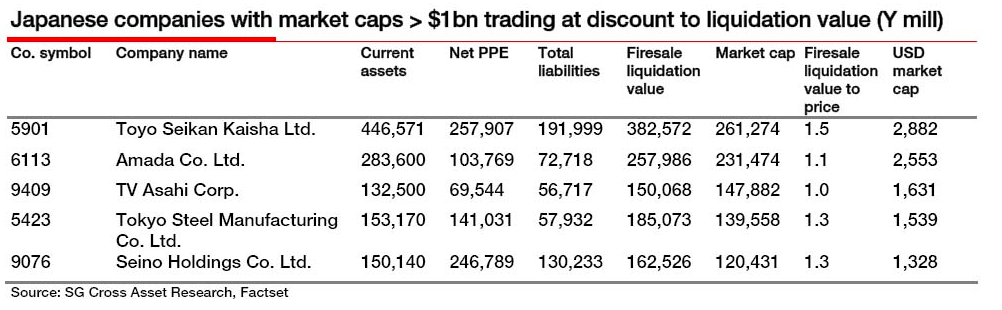
In the same article, Grice identifies five Graham net net stocks in Japan with market capitalizations bigger than $1B:

He argues that such stocks may offer value beyond the net current asset value:

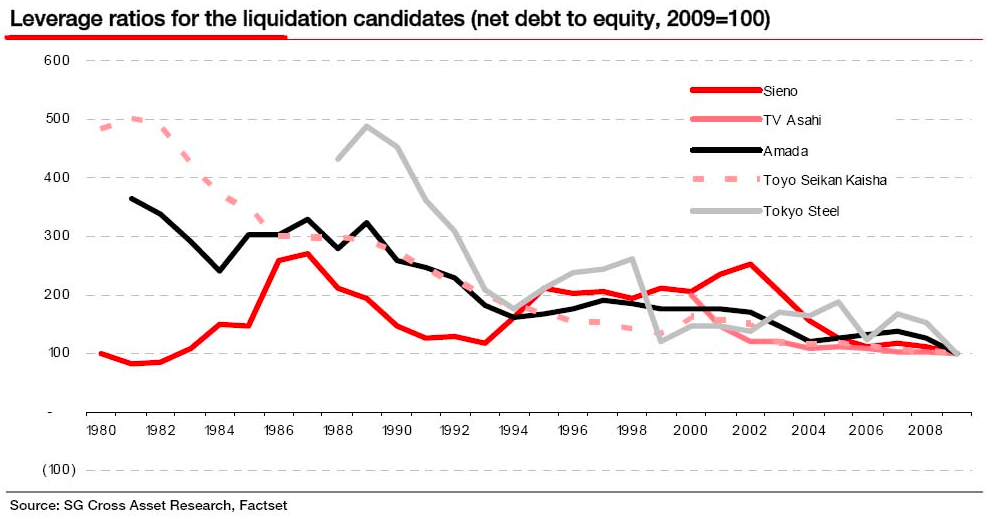
The following chart shows the debt to shareholders equity ratios for each of the stocks highlighted as a liquidation candidate above, rebased so that the last year’s number equals 100. It’s clear that these companies have been aggressively delivering in the last decade.

Despite the “Japan has weak shareholder rights” cover story, management seems to be doing the right thing:

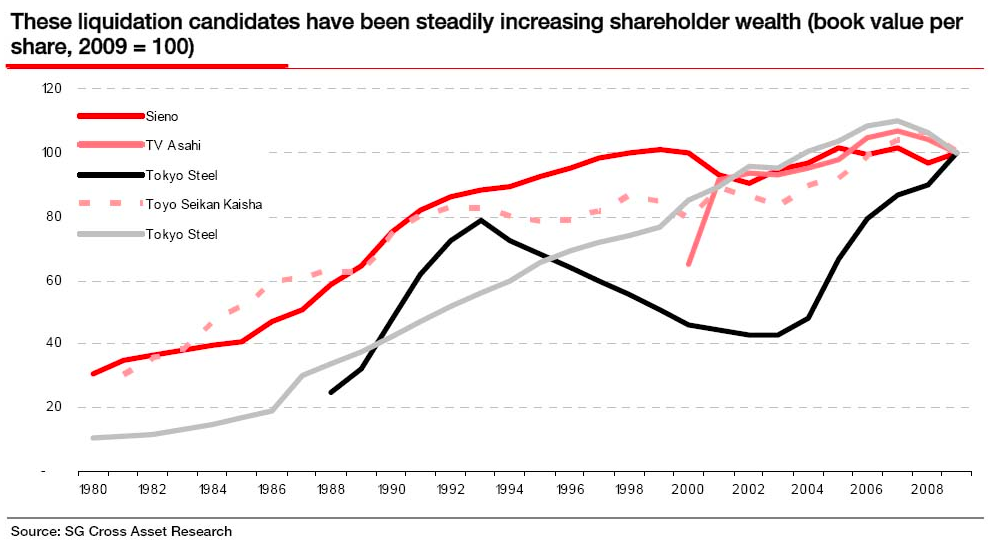
But as it happens, most of these companies have also been buying back stock too. So per share book values have been rising steadily throughout the appalling macro climate these companies have found themselves in. Contrary to what I expected to find, these companies that are currently priced at levels making liquidation seem the most profitable option have in fact been steadily creating shareholder wealth.

This is really extraordinary. The currency is a risk that I can’t quantify, but it warrants further investigation.

Read Full Post »

Since last week’s Japanese liquidation value: 1932 US redux post, I’ve been attempting to determine whether the historical performance of Japanese sub-liquidation value stocks matches the experience in the US, which has been outstanding since the strategy was first identified by Benjamin Graham in 1932. The risk to the Japanese net net experience is the perception (rightly or not) that the weakness of shareholder rights in Japan means that net current asset value stocks there are destined to continue to trade at a discount to net current asset value. As I mentioned yesterday, I’m a little chary of the “Japan has weak shareholder rights” narrative. I’d rather look at the data, but the data are a little wanting.

As we all know, the US net net experience has been very good. Research undertaken by Professor Henry Oppenheimer on Graham’s liquidation value strategy between 1970 and 1983, published in the paper Ben Graham’s Net Current Asset Values: A Performance Update, indicates that “[the] mean return from net current asset stocks for the 13-year period was 29.4% per year versus 11.5% per year for the NYSE-AMEX Index. One million dollars invested in the net current asset portfolio on December 31, 1970 would have increased to $25,497,300 by December 31, 1983.” That’s an outstanding return.

In The performance of Japanese common stocks in relation to their net current asset values, a 1993 paper by Bildersee, Cheh and Zutshi, the authors undertook research similar to Oppenheimer’s in Japan over the period 1975 and 1988. Their findings, described in another paper, indicate that the Japanese net net investor’s experience has not been as outstanding as the US investor’s:

In the first study outside of the USA, Bildersee, Cheh and Zutshi (1993)’s paper focuses on the Japanese market from 1975 to 1988. In order to maintain a sample large enough for cross-sectional analysis, Graham’s criterion was relaxed so that firms are required to merely have an NCAV/MV ratio greater than zero. They found the mean market-adjusted return of the aggregate portfolio is around 1 percent per month (13 percent per year).

As an astute reader noted last week “…the test period for [the Bildersee] study is not the best. It includes Japan’s best analog to America’s Roaring Twenties. The Nikkei peaked on 12/29/89, and never recovered:”

Many of the “assets” on public companies’ books at that time were real estate bubble-related. At the peak in 1989, the aggregate market price for all private real estate in the city of Tokyo was purportedly greater than that of the entire state of California. You can see how the sudden runup in real estate during the bubble could cause asset-heavy companies to outperform the market.

So a better crucible for Japanese NCAVs might be the deflationary period, say beginning 1/1/90, which is more analogous to the US in 1932.

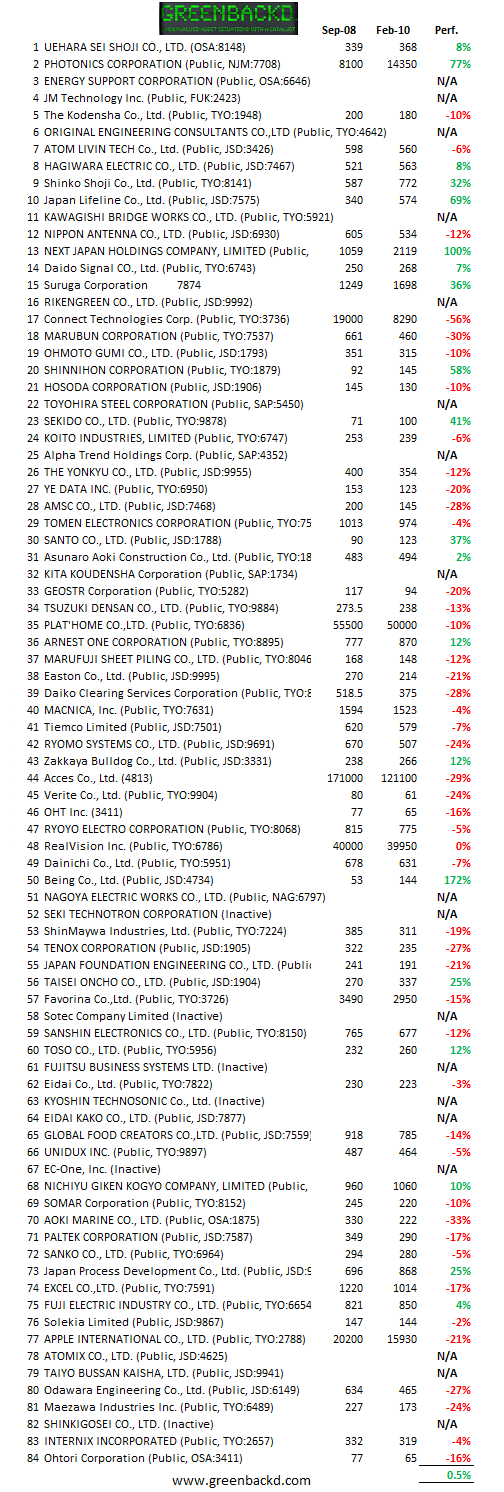
To see how the strategy has performed more recently, I’ve taken the Japanese net net stocks identified in James Montier’s Graham’’s net-nets: outdated or outstanding? article from September 2008 and tracked their performance from the data of the article to today. Before I plow into the results, I’d like to discuss my methodology and the various problems with it:

  1. It was not possible to track all of the stocks identified by Montier. Where I couldn’t find a closing price for a stock, I’ve excluded it from the results and marked the stock as “N/A”. I’ve had to exclude 18 of 84 stocks, which is a meaningful proportion. It’s possible that these stocks were either taken over or went bust, and so would have had an effect on the results not reflected in my results.
  2. The opening prices were not always available. In some instances I had to use the price on another date close to the opening date (i.e +/1 month).

Without further ado, here are the results of Montier’s Graham’’s net-nets: outdated or outstanding? picks:

The 68 stocks tracked gained on average 0.5% between September 2008 and February 2010, which is a disappointing outcome. The results relative to the  Japanese index are a little better. By way of comparison, the Nikkei 225 (roughly equivalent to the DJIA) fell from 12,834 to close yesterday at 10,057, a drop of 21.6%. Encouragingly, the net nets outperformed the N225 by a little over 21%.

The paucity of the data is a real problem for this study. I’ll update this post as I find more complete data or a more recent study.

Read Full Post »

Highway Holdings Limited (NASDAQ:HIHO) is presently the only stock listed on the American Association of Individual Investors website with a Piotroski F_SCORE of 9, the highest possible Piotroski F_SCORE. An F_SCORE of 9 indicates that HIHO is “financially strong” in Piotroski’s framework. An F_SCORE of 8 indicates that it has failed on one dimension, and so on. Piotroski’s F_SCORE probably works better in the aggregate than in the case of a single company simply because the binary signal of each component is insufficiently granular to provide much information. Ideally, I’d identify 30 high BM companies scoring 9 on the Piotroski F_SCORE and construct a portfolio from them. The only problem with the practical implementation of that strategy is there aren’t 30 high BM companies scoring 9 on the Piotroski F_SCORE, so we’re stuck with HIHO as the only representative of Piotroski’s F_SCORE in practice. For that reason, this test is imperfect, but that does not mean it is not useful. It analyses more dimensions that I typically do, so perhaps it will work fine for a single company.

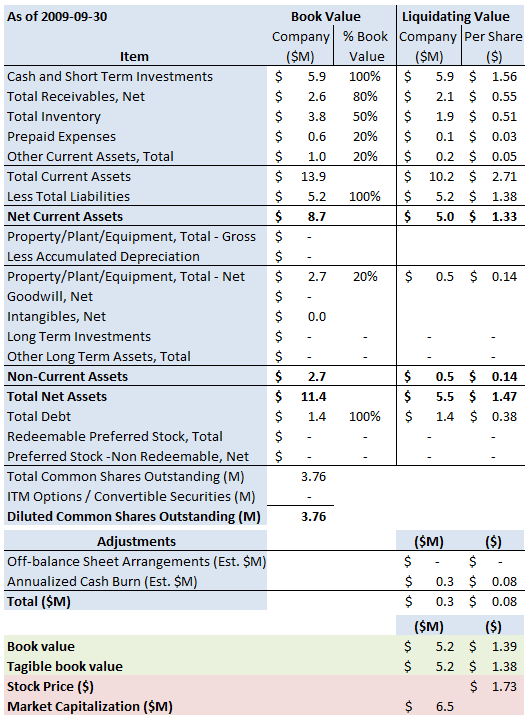
HIHO closed Friday at $1.73, giving it a market capitalization of $6.5M. Book value is $11.4M, or $3.03 per share, which means that HIHO is trading at approximately 57% of book value (a P/B of 0.57 or a BM of 1.75). I estimate the liquidation value to be around $5.2M or $1.39 per share, which means that HIHO is trading at a premium to its liquidation value and is not, therefore, a liquidation play. I regard the $1.39 per share liquidation value as the downside in this instance, and the $3.03 per share book value as the upside.

About HIHO

HIHO is a foreign issuer based in Hong Kong. From the most recent 6K dated November 10, 2009:

Highway Holdings produces a wide variety of high-quality products for blue chip original equipment manufacturers — from simple parts and components to sub-assemblies. It also manufactures finished products, such as LED lights, radio chimes and other electronic products. Highway Holdings operates three manufacturing facilities in the People’s Republic of China.

The value proposition: Piotroski’s F_SCORE

The objective of Piotroski’s F_SCORE is to identify “financially strong high BM firms.” It does so by summing the following 9 binary signals (for a more full explanation, see my post on Piotroski’s F_SCORE):

F_SCORE = F_ROA + F_[Delta]ROA + F_CFO + F_ ACCRUAL + F_[Delta]MARGIN + F_[Delta]TURN + F_[Delta]LEVER + F_[Delta]LIQUID + EQ_OFFER.

The components are categorized as follows:

  • F_ROA, F_[Delta]ROA, F_CFO, and F_ACCRUAL measure profitability
  • F_[Delta]MARGIN and F_[Delta]TURN measure operating efficiency
  • F_[Delta]LEVER, F_[Delta]LIQUID, and EQ_OFFER measure leverage, liquidity, and source of funds

The following are based on HIHO’s March 31 year end accounts set out in its 20F dated June 22, 2009. Here’s how HIHO achieves its F_SCORE of 9:

  1. F_ROA:  Net income before extraordinary items scaled by beginning of the year total assets (1 if positive, 0 otherwise). HIHO’s net income for 2009 was $0.8M/$17.8M = 0.04, which is positive so F_ROA is 1.
  2. F_CFO: Cash flow from operations scaled by beginning of the year total assets (1 if positive, 0 otherwise). HIHO’s cash flow from operations for 2009 was $2.0M/$17.8M = 0.11, which is positive so F_CFO is 1.
  3. F_[Delta]ROA: Current year’s ROA less the prior year’s ROA (1 if positive, 0 otherwise). HIHO’s ROA for 2009 was 0.04, and its ROA for 2008 was -0.09, and 0.04 less -0.09 = 0.13, which is positive so F_ROA is 1.
  4. F_ACCRUAL: Current year’s net income before extraordinary items less cash flow from operations, scaled by beginning of the year total assets (1 if CFO is greater than ROA, 0 otherwise). HIHO’s net income for 2009 was $0.8M/$17.8M less cash flow from operations of $2.0M/$17.8M. CFO > ROA so F_ACCRUAL is 1.
  5. F_[Delta]LEVER: The change in the ratio of total long-term debt to average total assets year-on-year (1 if decrease, 0 if otherwise). HIHO’s long-term debt ratio in 2009 was $0.6M/average($17.8M and $20.5M) = 0.03 and in 2008 was $0.8M/average($22.4M and $20.5M) = 0.04, which is a decrease year-on-year so F_[Delta]LEVER is 1.
  6. F_[Delta]LIQUID: The change in the current ratio between the current and prior year (1 if increase, 0 if otherwise). HIHO’s current ratio in 2009 was $14.9M/$5.9M = 2.53 and in 2008 was $16.8M/$9.2M = 1.83, which means it was increasing year-on-year and so F_[Delta]LIQUID is 1.
  7. EQ_OFFER: 1 if the firm did not issue common equity in the year preceding portfolio formation, 0 otherwise.  HIHO reduced its common equity on issue in 2009 by 99,000 shares, so EQ_OFFER is 1.
  8. F_[Delta]MARGIN: The current gross margin ratio (gross margin scaled by total sales) less the prior year’s gross margin ratio (1 if positive, 0 otherwise). HIHO’s gross margin ratio in 2009 was $6.7M/$33.7M = 0.2 and in 2008 was $5.1M/$33.2M = 0.15. 0.2 less 0.15 = 0.05, which is positive, so F_[Delta]MARGIN is 1.
  9. F_[Delta]TURN: The current year asset turnover ratio (total sales scaled by beginning of the year total assets) less the prior year’s asset turnover ratio (1 if positive, 0 otherwise). HIHO’s 2009 year asset turnover ratio was $33.7M/$17.8M = 1.9  and in 2008 was $33.2M/$20.5M = 1.6. 1.9 less 1.6 = 0.3, which is positive, so F_[Delta]TURN is 1.

HIHO has a perfect 9 on the Piotroski F_SCORE.

The value proposition: Liquidation value

Here is the liquidation value analysis based on its most recent quarterly financial statement to September 30, 2009 (the “Book Value” column shows the assets as they are carried in the financial statements, and the “Liquidating Value” column shows our estimate of the value of the assets in a liquidation):

Conclusion

With a book value of $11.4M against a market capitalization of $6.5M, HIHO has a book-to-market ratio of 1.75 and is therefore a high BM stock. This makes HIHO an ideal candidate for the application of the Piotroski F_SCORE, which seeks to use “context-specific financial performance measures to differentiate strong and weak firms” within the universe of high BM stocks. HIHO scores a perfect 9 on the Piotroski F_SCORE, which indicates that it is a “strong firm” within that framework. As a check on the downside, I estimate the liquidation value to be around $5.2M or $1.39 per share. For these reasons, HIHO looks like a reasonable bet to me, so I’m adding it to the Special Situations portfolio.

HIHO closed Friday at $1.73.

The S&P500 Index closed Friday at 1,105.98.

[Full Disclosure: I do not have a holding in HIHO. This is neither a recommendation to buy or sell any securities. All information provided believed to be reliable and presented for information purposes only. Do your own research before investing in any security.]

Read Full Post »
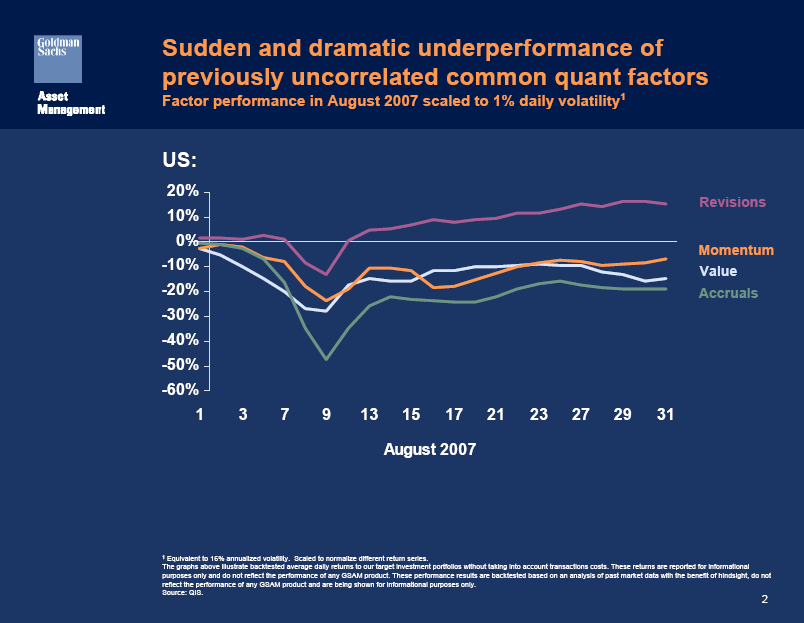
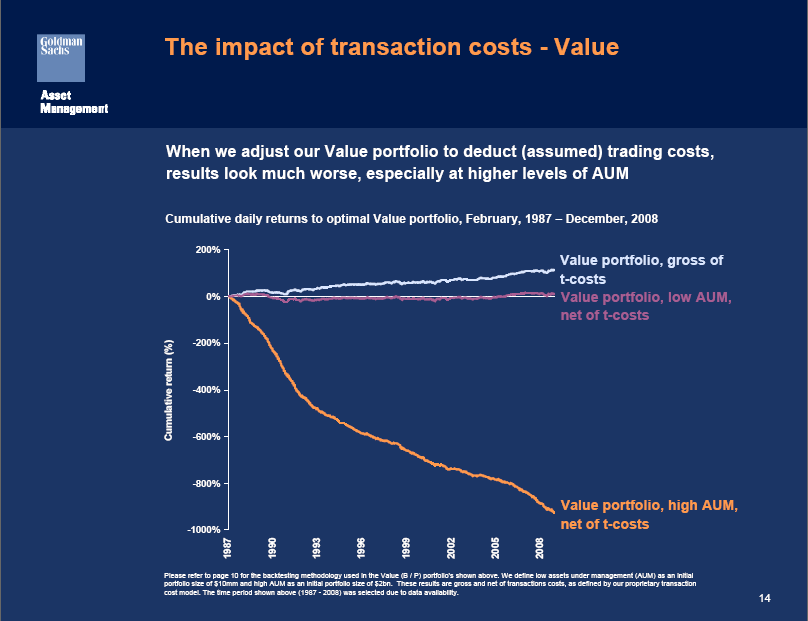
The phenomenal Zero Hedge has an article, Goldman Claims Momentum And Value Quant Strategies Now Overcrowded, Future Returns Negligible, discussing Goldman Sachs head of quantitative resources Robert Litterman’s view that  “strategies such as those which focus on price rises in cheaply-valued stocks…[have] become very crowded” since August 2007 and therefore unprofitable. The strategy to which Litterman refers is “HML” or “High Book-to-Price Minus Low Book-to-Price,” which is particularly interesting given our recent consideration of the merits of price-to-book value as an investment strategy and the various methods discussed in the academic literature for improving returns from a low P/B strategy. Litterman argues that only special situations and event-driven strategies that focus on mergers or restructuring provide opportunities for profit:

What we’re going to have to do to be successful is to be more dynamic and more opportunistic and focus especially on more proprietary forecasting signals … and exploit shorter-term opportunistic and event-driven types of phenomenon.

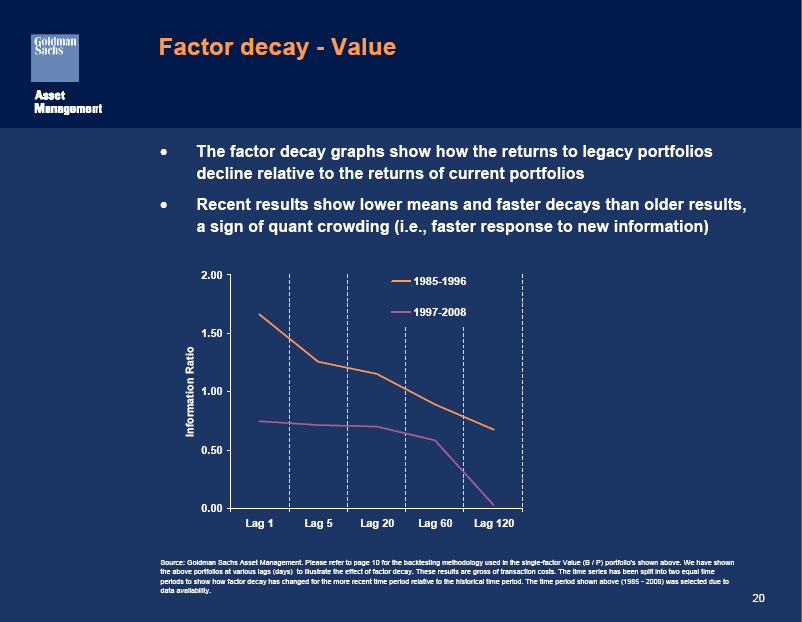
In a follow-up article, More On The Futility Of Groupthink Quant Strategies, And Why Momos Are Guaranteed To Lose Money Over Time, Zero Hedge provides a link to a Goldman Sachs Asset Management presentation, Maybe it really is different this time (.pdf via Zero Hedge), from the June 2009 Nomura Quantitative Investment Strategies Conference. The presentation supports Litterman’s view on the underperformance of HML since August 2007. Here’s the US:

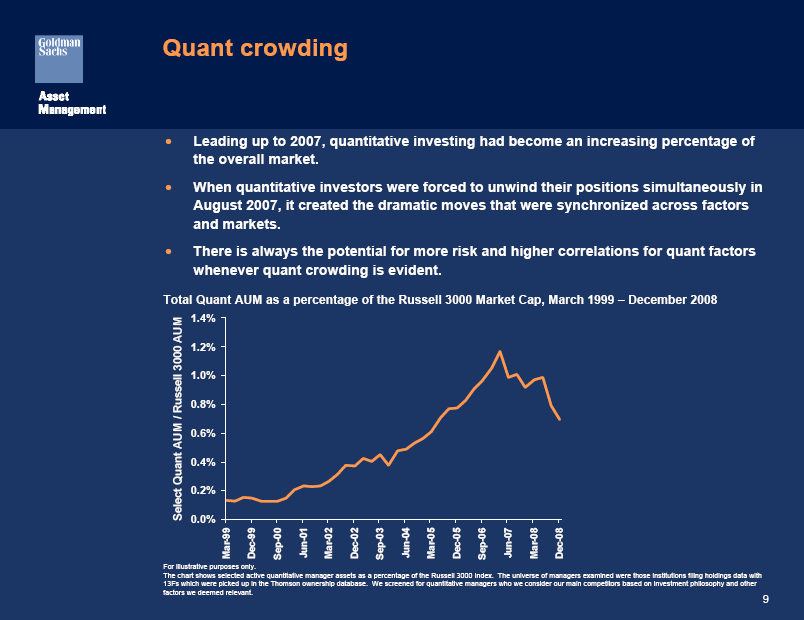
Here’s a slide showing the ‘overcrowding” to which Litterman refers:

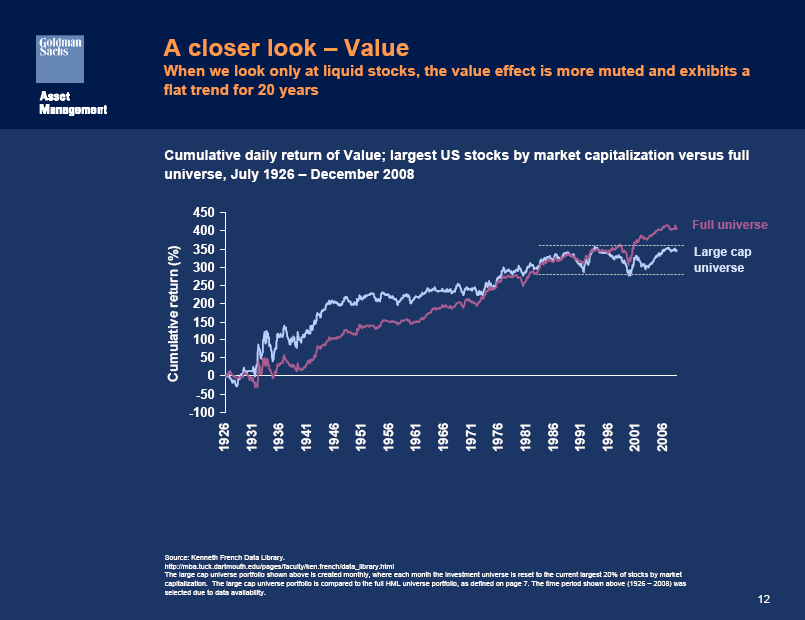
And its effect on the relative performance of large capitalization value to the full universe:

The returns get really ugly when transaction costs are factored into the equation:

A factor decay graph showing the decline in legacy portfolios relative to current portfolios, lower means and faster decay indicating crowding:

Goldman says that there are two possible responses to the underperformance, and characterizes each as either a “sticker” or an “adapter.” The distinction, according to Zero Hedge, is as follows:

The Stickers believe this is part of the normal volatility of such strategies

• Long-term perspective: results for HML (High Book-to-Price Minus Low Book-to-Price) and WML (Winners Minus Losers) not outside historical experience

• Investors who stick to their process will end up amply rewarded

The Adapters believe that quant crowding has fundamentally changed the nature of these factors

• Likely to be more volatile and offer lower returns going forward

• Need to adapt your process if you want to add value consistently in the future

In Contrarian Investment, Extrapolation, and Risk, Josef Lakonishok, Andrei Shleifer, and Robert Vishny argued that value strategies produce superior returns because most investors don’t fully appreciate the phenomenon of mean reversion, which leads them to extrapolate past performance too far into the future. Value strategies “exploit the suboptimal behavior of the typical investor” by behaving in a contrarian manner: selling stocks with high past growth as well as high expected future growth and buying stocks with low past growth and as well as low expected future growth. It makes sense that crowding would reduce the returns to a contrarian strategy. Lending further credence to Litterman and Goldman’s argument is the fact that the underperformance seems to be most pronounced in the large capitalization universe (see the “A closer look – value” slide) where the larger investors must fish. If you’re not forced by the size of your portfolio to invest in that universe it certainly makes sense to invest where contrarian returns are still available. Special situations like liquidations and event-driven investments like activist campaigns offer a place to hide if (and when) the market resumes the long bear.

My firm Acquirers Funds® helps you put the acquirer’s multiple into action. Click here to learn more about our deep value strategy.

Read Full Post »

Aspen Exploration Corporation (OTC:ASPN) took the unusual step several days ago of making a second announcement regarding the payment of a cash dividend of $0.73 per share to stockholders of record on November 16, 2009. The company initially announced that the dividend would be payable to stockholders of record on November 16, 2009, with the dividend being paid on or about December 2, 2009. The second announcement provides that the Financial Industry Regulatory Authority (FINRA) has advised the company of the operation of Nasdaq Rule 11140(b)(2), which states:

In respect to cash dividends or distributions, stock dividends and/or splits, and the distribution of warrants, which are 25% or greater of the value of the subject security, the ex-dividend date shall be the first business day following the payable date.

This means that the dividend will trade with the stock until December 2, 2009, the payable date. Purchasers on December 3 or later will not be entitled to the dividend.

We’ve been following ASPN (see our ASPN post archive) because it’s trading at a discount to its $1.17 per share liquidation value and there are several potential catalysts in the stock, including a 13D filing from Tymothi O. Tombar, a plan to distribute substantially all of the net, after-tax proceeds from the completion of the Venoco sale to its stockholders ($5.3M), and the possibility that the company will dissolve. The stock is down 1.5% since we initiated the position to close yesterday at $0.983. This values the remaining stub of ASPN at $0.24 ($0.97 less $0.73) against a liquidating value I estimate at $0.44 ($1.17 less $0.73).

Here’s the text of the announcement [via Marketwire]:

DENVER, CO–(Marketwire – November 18, 2009) – Aspen Exploration Corporation (OTCBB: ASPN) viewed what appeared to be unusual market activity yesterday and today in light of its previous announcement of November 3, 2009. That announcement advised the public that a cash dividend of $0.73 per share will be payable to stockholders of record on November 16, 2009, with the dividend being paid on or about December 2, 2009. Notwithstanding the Board’s declaration of a record date, Aspen has been advised by the Financial Industry Regulatory Authority (FINRA) of the application of Nasdaq Rule 11140(b)(2) which states: “In respect to cash dividends or distributions, stock dividends and/or splits, and the distribution of warrants, which are 25% or greater of the value of the subject security, the ex-dividend date shall be the first business day following the payable date.” Persons needing further information or interpretation should consult with their broker-dealer or legal advisors.

[Full Disclosure:  I do not have a holding in ASPN. This is neither a recommendation to buy or sell any securities. All information provided believed to be reliable and presented for information purposes only. Do your own research before investing in any security.]

Read Full Post »
Following my Simoleon Sense interview with Miguel Barbosa, I’ve had a few requests for a post on Tom Evans. Here it is, hacked together like Frankenstein’s monster from all the public information I could track down:

Thomas Mellon Evans was a one of the first modern corporate raiders, taking Graham’s net current asset analysis and using it to wreak havoc on the gray flannel suits of the 40s and 50s. He’s not particularly well-known today, but he waged numerous takeover battles using tactics that are forerunners of those employed by many of the takeover artists of the 1980s and the activists of the 1990s and 2000s. Proxy battles? Check. Greenmail? Check. Liquidations? Check.

Born September 8, 1920 in Pittsburgh, and orphaned at the age of 11, Evans grew up poor. Despite his famous middle name (his grandmother’s first cousin was Andrew Mellon), he began his financial career at the bottom. After graduating from Yale University in 1931 in the teeth of the Great Depression, he landed a $100-a-month clerk’s job at Gulf Oil.

While his friends headed out in the evening, Evans would stay home reading balance sheets and looking for promising companies: those he could he could buy for less than the assets were worth in liquidation. Evans found such companies by calculating their “net quick assets,” the long forgotten name for “net current assets.” His friends teased him about his obsession and gave him a nickname: “Net Quick” Evans. From the 1944 Time Magazine article, Young Tom Evans:

With only some fatherly advice from Gulf’s Board Chairman, W. L. Mellon, Tom Evans made his way alone. For six years he saved money, like an Alger hero; and played the stockmarket, unlike an Alger hero. Thus he collected $10,000. He wanted to find and buy a family-owned business that had gone to pot. In the down-at-the-heels H. K. Porter Co., in Pittsburgh’s slummy Lawrenceville section, he found it. Once a No. 1 builder of industrial locomotives, Porter Co. was down to 40 workers.

Tom Evans bought up Porter bonds at 10 to 15 cents on the dollar, reorganized the company under 77B, and became president at 28.

From then on, Evan was the chief terror of the sleepy boardrooms of the era, much like Icahn would be 30 years later. As a connoisseur of deep value on the balance sheet, one has to admire his methods (From the New York Times obituary, Thomas Evans, 86, a Takeover Expert, Dies):

‘He was never really an operator; he was a financial guy — a balance sheet buyer,” one of his sons, Robert Sheldon Evans, told Forbes magazine in 1995. ”He would buy something for less than book value and figure the worst that could happen was he would liquidate it and come out O.K. What he didn’t want to do was lose money on the deal. If he knew his downside was covered, then he figured the upside would probably take care of itself.

”It was a very shrewd policy in the 50’s and 60’s, when there were highly inefficient markets: buying undervalued assets, running them for cash and selling off pieces. The 80’s leveraged buyout guys were just taking a lot of his deals to their logical extension.”

The book The White Sharks of Wall Street: Thomas Mellon Evans and the Original Corporate Raiders by Diana B. Henriques is an excellent biography on Evans. More than that, it describes many of the battles for corporate control in the 40s, 50s and 60s. In contradistinction to the takeover battles of the 80s, the dogfights in the 40s, 50s, and 60s were largely proxy fights, and in as much, should be familiar to today’s “activist investors.” James B. Stewart’s Let’s make a deal, his review of Henriques’ book, does it justice:

There are surely few phenomena more remarkable in American business than the periodic ability of cash-poor but swashbuckling newcomers, using little or none of their own money, to seize control of some of the country’s most valuable corporations. In its most recent, frenzied incarnation, dot-com entrepreneurs have exchanged stock in companies with few tangible assets and even fewer profits for control of established, profitable companies. Fifteen years ago, the currency was junk bonds rather than inflated stock. And before that, it was bank loans using a target’s assets as collateral.

Wall Street greets each wave of takeovers as the dawning of a new era. But the proposition that nothing has fundamentally changed is convincingly set forth in ”The White Sharks of Wall Street,” an engaging and thorough history of early corporate takeovers by Diana B. Henriques, a financial reporter for The New York Times. Her central character is Thomas Mellon Evans, who surfaces in what seems like nearly every trendsetting corporate battle from 1945 until his retirement in 1984, and whose tactics remain essential to practitioners of corporate warfare. Junk bonds? Greenmail? Scorched earth? Evans had been there long before investment bankers coined a catchy vocabulary to describe the maneuvers of people like T. Boone Pickens, Carl Icahn and Saul Steinberg.

Though Evans seems to have escaped the widespread public resentment and envy the others generated, and Henriques’s portrait is carefully nonjudgmental, it is difficult for a reader to work up much sympathy for him. He was ruthless, bad-tempered, usually indifferent to workers and communities. He repeatedly displayed what appears to be a criminal disregard for the antitrust laws (though he was never prosecuted). He divorced two wives (the second later committed suicide), and both times a replacement was conspicuously at hand long before any legal proceedings had begun. He betrayed two of his own sons in his quest for corporate dominance and wealth.

Yet as a deal maker Evans displayed a natural audacity and genius. In 1935, 24 years old and lacking any money to speak of, he decided he wanted to gain control of Pittsburgh’s struggling H. K. Porter Company, a manufacturer of steam locomotives. Inspired by a Fortune magazine account of Floyd Odlum, who became rich by using borrowed securities as collateral for loans to buy undervalued stock, Evans borrowed shares from a Mellon mentor, took out a loan and invested in Gulf Oil stock, then a Mellon enterprise. When Gulf’s stock rose handsomely as the nation emerged from the Depression, Evans used his profits to buy Porter bonds, then selling for a small fraction of their face value. When Porter finally had to declare bankruptcy and was reorganized, Evans, as the largest creditor, traded his bonds for equity and became the largest shareholder. Porter, essentially acquired for junk bonds, would be Evans’s vehicle for most of his life.

I highly recommend The White Sharks of Wall Street: Thomas Mellon Evans and the Original Corporate Raiders by Diana B. Henriques for fans of deep value and activist investment.

Read Full Post »

We’ve just completed an interview with Miguel Barbosa of the wonderful Simoleon Sense. Go there now, and get trapped in an endless loop as you are recirculated back here and so on.

Read Full Post »

It’s been a big week for VaxGen Inc (OTC:VXGN). On Tuesday last week the “VaxGen Full Value Committee” nominated five director candidates to the board. Then on Thursday BizJournals.com reported that VXGN’s “failed AIDS vaccine” was “successful in a new trial that combined it with another failed vaccine in reducing the risk of becoming infected with HIV.” The stock ran on the news, prompting VXGN to clarify yesterday that it “retains an option to obtain the exclusive right to manufacture, commercialize, and further develop the HIV vaccine candidates in the U.S., Europe, Japan and other countries that are members of the Organization of Economic Cooperation and Development” but “has no rights or obligations to manufacture or develop the vaccine candidates unless and until it exercises this option.”

We’ve been following VXGN (see our post archive here) because it is trading at a substantial discount to its net cash position, has ended its cash-burning product development activities and is “seeking to maximize the value of its remaining assets through a strategic transaction or series of strategic transactions.” Management has said that, if the company is unable to identify and complete an alternate strategic transaction, it proposes to liquidate. One concern of ours has been a lawsuit against VXGN by its landlords, in which they sought $22.4M. That lawsuit was dismissed in May, so the path for VXGN to liquidate has now hopefully cleared. The board has, however, been dragging its feet on the liquidation. Given their relatively high compensation and almost non-existent shareholding, it’s not hard to see why.

BA Value Investors had previously disclosed an activist holding and, in a June 12 letter to the board, called on VXGN to “act promptly to reduce the size of the board to three directors; reduce director compensation; change to a smaller audit firm; terminate the lease of its facilities; otherwise cut costs; make an immediate $10 million distribution to shareholders; make a subsequent distribution of substantially all the remaining cash after settling the lease termination; distribute any royalty income to shareholders; and explore ways to monetize the public company value of the Issuer and use of its net operating losses.”

Another group led by Spencer Capital and styling itself “Value Investors for Change” has also filed preliminary proxy documents to remove the board. In the proxy documents, Value Investors for Change call out VXGN’s board on its “track record of failure and exorbitant cash compensation”:

VaxGen does not have any operations, other than preparing public reports. The Company has three employees, including the part-time principal executive officer and director, and four non-employee directors. Since the Company’s failed merger with Raven Biotechnologies, Inc. in March 2008, the Board has publicly disclosed that it would either pursue a strategic transaction or a series of strategic transactions or dissolve the Company. The Company has done neither. In the meantime, members of the Board have treated themselves to exorbitant cash compensation. Until July 2009, two non-employee members of the Board were paid over $300,000 per year in compensation. The principal executive officer will likely receive over $400,000 in cash compensation this year.

VXGN is up 41.7% since we initiated the position. At its $0.68 close yesterday, it has a market capitalization of $22.5M. We last estimated the company’s liquidation value to be around $25.4M or $0.77 per share. VXGN has other potentially valuable assets, including a “state-of-the-art biopharmaceutical manufacturing facility with a 1,000-liter bioreactor that can be used to make cell culture or microbial biologic products” and rights to specified percentages of future net sales relating to its anthrax vaccine product candidate and related technology. The authors of a letter sent to the board on July 14 of this year adjudge VXGN’s liquidation value to be significantly higher at $2.12 per share:

Excluding the lease obligations, the net financial assets alone of $37.2 million equate to $1.12 per share. The EBS royalties (assuming a 6% royalty rate and a $500 million contract as contemplated by NIH/HHS and EBS) of $30 million and milestones of $6 million total $36 million of potential additional future value (based clearly on assumptions, none of which are assured), or $1.09 per share. Adding $1.12 and $1.09 equals $2.21 per share.

The entry of the VaxGen Full Value Committee into the proxy contest will certainly make the next meeting an interesting spectacle, and, with any luck, we will see a liquidation of VXGN soon, either at the hands of the present board, by Value Investors for Change or the VaxGen Full Value Committee. We believe VXGN’s rights to the AIDS vaccine should make little difference to the outcome of the proxy contest.

The press release announcing the nomination is set out below:

Contact: Steven N. Bronson

Telephone: 561-362-4199 ext 4

The VaxGen Full Value Committee Nominates Five Highly

Qualified Candidates to Replace Current VaxGen Board

Boca Raton, FL, September 22, 2009 –(Business Wire)–The VaxGen Full Value Committee (Committee) today reported that, on September 17th, it delivered to VaxGen Inc. (VXGN.OB) a solicitation notice for the nomination of five highly qualified director candidates to reconstitute the board of VaxGen at the upcoming 2009 annual meeting.

Members of the Committee, which currently consist of BA Value Investors LLC, a private investment firm founded by Steven N. Bronson, and ROI Capital Management, a registered investment advisor managed by Mark T. Boyer and Mitchell J. Soboleski, collectively own 13.7% of the outstanding common stock of VaxGen. The Committee expects that, if elected, its nominees will work to–

1. Return capital to VaxGen’s shareholders, including an immediate distribution of $10,000,000 in cash;

2. Negotiate a termination of VaxGen’s real property lease, which is out of all proportion to the Company’s needs and constitutes a serious drain on the Company’s resources;

3. Explore ways to monetize VaxGen’s value as a “public shell,” including the utilization of the Company’s substantial net operating losses; and

4. Protect for the benefit of shareholders royalty payments receivable as a result of the sale of VaxGen’s intellectual property.

The VaxGen Full Value Committee is dedicated to maximizing value for all shareholders. After the Company’s failed merger with Raven Biotechnologies, Inc. in March 2008, the Board publicly disclosed that it would either pursue one or more strategic transactions or, failing to do so, dissolve the Company. The Company has done neither. Instead, members of the VaxGen board of directors have been paid compensation in amounts that the Committee believes are exorbitant, considering that the Company has no operations and is continuing to burn cash and cumulate losses. Since 2008, over $300,000 annually was paid to each of two non-employee directors serving on the strategic transaction committee of the Company’s board. It was only after Mr. Bronson’s letter to the board in June 2009 that the Company announced that it was discontinuing the compensation to the two outside board members for service on this committee. The Committee is committed to eliminating this type of board conduct.

Certain information concerning the Committee’s nominees follows.

Steven N. Bronson. Mr. Bronson, age 44, is the President of Catalyst Financial LLC, a privately held full service investment banking firm, and has held that position since September 1998. Mr. Bronson also serves as an officer and director of 4net Software, Inc., Ridgefield Acquisition Corp. and BKF Capital Group, Inc.David E. Castaneda. Mr. Castaneda, age 45, is the President of the Market Development Consulting Group, Inc. (MDC Group), a management consulting firm he founded in 1991 to offer expertise in corporate finance, corporate development and investor relations. From January 2004 to October 2007, he was Vice President Investor Relations for Cheniere Energy, Inc.

Leonard Hagan. Mr. Hagan, age 56, is a partner at Hagan & Burns CPA’s, PC in New York and has held that position since 2004. Mr. Hagan is also a director of 4net Software, Inc., BKF Capital Group, Inc. and Ridgefield Acquisition Corp.

Mark Boyer. Mr. Boyer, age 52, has been the President and a Director of ROI Capital Management, an investment advisor, since July 1992.

E. Steven zum Tobel. Mr. zum Tobel, age 42, is the founder, director and shareholder of First American Capital & Trading Corporation, a wholesale institutional specialty brokerage firm. He has been with First American Capital since 2002.

The press release clarifying the rights to the HIV vaccine is set out below:

VaxGen Congratulates HIV Prime-Boost Vaccine Study Collaborators and Clarifies Commercial Rights

South San Francisco, California — September 25, 2009 — VaxGen, Inc. today congratulated the Thai Ministry of Health, the U.S. Army, Sanofi Pasteur and VaxGen’s licensee Global Solutions for Infectious Disease (GSID) on the encouraging results demonstrated in the RV144 clinical trial. The top-line results of the placebo controlled study in 16,000 Thai volunteers were released today, and according to the sponsors of the trial, demonstrated that the vaccine regimen reduced HIV infection in a community-based population by 31.2% compared with placebo. The full results of the clinical trial have not yet been released by the study sponsors. The vaccine regimen tested in the study combined a priming vaccine developed by Sanofi Pasteur (ALVAC® HIV vCP1521) and GSID’s boosting vaccine (AIDSVAX® B/E).

In January 2006, VaxGen granted to GSID a worldwide license to research, develop, manufacture, register, use, market, import, offer for sale, and sell its HIV vaccine candidates, including the AIDSVAX B/E vaccine. VaxGen retains an option to obtain the exclusive right to manufacture, commercialize, and further develop the HIV vaccine candidates in the U.S., Europe, Japan and other countries that are members of the Organization of Economic Cooperation and Development. This option is, however, subject to an option held by Genentech, Inc. to commercialize HIV vaccines in North America. VaxGen’s option may be exercised during a period immediately following the filing of an application for marketing approval (i.e., a Biologics License Application with the U.S. FDA, or equivalent). VaxGen has no rights or obligations to manufacture or develop the vaccine candidates unless and until it exercises this option. If VaxGen exercises its option, it will owe royalties to GSID and be required to reimburse 50% of GSID’s development expenses. If VaxGen does not exercise its option, it will be entitled to receive royalties for sales in the above-mentioned countries. VaxGen is not entitled to royalties on sales in developing countries as defined in the agreement with GSID. VaxGen believes it will not receive any payments under the agreement, if ever, for many years.

Substantial additional research and clinical development will be required to clarify the public health benefits of this outcome. The vaccine combination tested in Thailand was developed based on the strains of HIV that circulate in that country. Separate versions of the vaccine may have to be developed for HIV strains that predominate elsewhere in the world, including Europe and North America. “We are very pleased that this clinical study has yielded encouraging results, and may provide significant new scientific insights into the future development of effective HIV vaccines,” said James P. Panek, VaxGen President. “However, we believe potential commercialization of such a vaccine remains many years away.”

[Full Disclosure:  We have a holding in VXGN. This is neither a recommendation to buy or sell any securities. All information provided believed to be reliable and presented for information purposes only. Do your own research before investing in any security.]


Read Full Post »
The board of Ditech Networks Inc (NASDAQ:DITC) has agreed to nominate Lamassu Holdings’ representatives, Alan B. Howe and Frank J. Sansone, to be elected to the board at DITC’s next annual meeting. It seems that the board’s concern in nominating Howe and Sansone was that they not participate in any “withhold the vote” campaign or disparage the board. It’s a big win for Lamassu, and it appears their letter writing campaign was successful. The stock is now trading at a premium to our estimate of its liquidation value, which value is continuing to deteriorate, so we’re exiting the position. The stock is up from our initial $0.89 to close Friday at $1.75,which is an absolute return of 96.6%. The S&P500 closed at 788.42 when we opened the position, and closed Friday at 1,0472.73, which means our outperformance over the S$P500 was 64.4%.

Post Mortem

We started following DITC (see our archive here) because it was trading below its net cash value with an investor, Lamassu Holdings LLC, disclosing a 9.4% holding in November last year. Lamassu had previously offered to acquire DITC for $1.25 per share in cash. At that time, Lamassu said that it “[anticipated] its due diligence requirement [would] take no more than two weeks and there [was] no financing contingency.” Lamassu then nominated two candidates for election to the board “who [were] committed to enhancing shareholder value through a review of the Company’s business and strategic direction.” Lloyd I Miller III subsequently disclosed a 5.9% holding. Miller came out in support of the director candidates nominated by Lamassu as “candidates who [were] independent of management.” Miller said he sought “to encourage greater attention to corporate governance by all members of the Board of Directors.”

Lamassu then initiated a pointed letter campaign aimed at DITC’s board. In the first letter, Lamassu accused DITC management of “spending as though Ditech Networks has money to burn, adding to the amount of money you have already lost for shareholders during your tenure,” “aggressively [overstepping] the bounds of good corporate governance” and “clearly [violating] your fiduciary responsibility.” In the second, Lamassu claimed that the “decisions of this board [had] shown a pattern of director entrenchment characterized by prioritizing the interest of its members in the face of poor results at the expense of the shareholders” and called for shareholders to “receive ample representation on the board.” The campaign was succesful, and DITC agreeing to nominate Lamassu Holdings’ representatives for election to the board. The stock is up from our initial $0.89 to close Friday at $1.75, which gives the company a market capitalization of $46M. We last estimated the net cash value at around $32.2M or $1.23 per share and the liquidation value at around $43.4M or $1.65 per share. With the stock at a premium to the liquidation value, and that liquidation value deteriorating, we’ve decided to exit the position for a 96.6% gain.

The proxy statement for DITC’s 2009 annual meeting of stockholders more fully describes the agreement between Lamassu and DITC thus:

The Board of Directors currently has seven members. There are two directors in the class whose term of office expires in 2009. Both of the directors currently in serving in this term will not be standing for re-election. The Board of Directors has nominated two new persons to fill these positions. The two nominees, Mr. Alan B. Howe and Mr. Frank J. Sansone, are not currently directors of Ditech. The nomination of each of Mr. Howe and Mr. Sansone was recommended by a securityholder. If elected at the annual meeting, each of the nominees would serve until the 2012 annual meeting and until his successor is elected and has qualified, or until the director’s death, resignation or removal.

On September 2, 2009, Ditech and Lamassu Holdings L.L.C. and certain of its affiliates (collectively, “Lamassu”), entered into a letter agreement in which Ditech and Lamassu agreed that each of Mr. Howe and Mr. Sansone would be nominated to be elected to the Board of Directors at this annual meeting. In addition to the nomination of each of Mr. Howe and Mr. Sansone for election to the Board of Directors, the letter agreement also provides that:

• If Mr. Sansone is unable to serve as a director at a time when Lamassu owns at least 5% of the Ditech common stock, Ditech will appoint a replacement director designated by Lamassu and reasonably acceptable to Ditech Networks;

• Mr. Sansone and any replacement director will sign a conditional resignation from the Board of Directors, which may be accepted by the Board of Directors in the event that Lamassu’s beneficial ownership of Ditech common stock falls below 5% of the outstanding Ditech common stock;

• Lamassu will vote all of the shares it beneficially owns in support of the slate of directors nominated by the Board of Directors at this annual meeting of stockholders (and will not support or participate in any “withhold the vote” or similar campaign, or support any other nominees other than the slate of directors nominated by the Board of Directors);

• Lamassu withdrew its previously announced notice of its intent to nominate directors with respect to this annual meeting of stockholders;

• For a period ending 90 days from the date of this annual meeting of stockholders, Lamassu will not (i) make any public statement regarding Ditech, the Board of Directors or any of Ditech’s officers, directors or employees, except for the press release attached to the agreement or as may be required by law, or (ii) disparage Ditech, the Board of Directors, or any of Ditech’s officers, directors or employees, in any manner, including in any manner which could be harmful to Ditech or its business, the Board of Directors or its reputation, or the business reputation or personal reputation of any officer, director or employee of Ditech.

[Full Disclosure:  We do not have a holding in DITC. This is neither a recommendation to buy or sell any securities. All information provided believed to be reliable and presented for information purposes only. Do your own research before investing in any security.]

Read Full Post »
Bespoke Investment Group (via The Reformed Broker) has a list of the biggest gainers for 2009. It should come as no surprise to regular readers of Greenbackd that a number of the stocks are former sub-liquidation value plays (most of which we missed):

Little ten baggersWe opened a position in VNDA and got a great return. We lost our nerve with BGP and missed out on a great return. We completely ignored ATSG, DTSG, SMRT, RFMD, PIR and CHUX although all appeared on our NCAV screen at some stage earlier this year. A little more evidence that diamonds can be found if you dig through enough trash.

Read Full Post »

« Newer Posts - Older Posts »