Feeds:
Posts
Comments

Posts Tagged ‘Joel Greenblatt’

Last week I looked at James Montier’s 2006 paper The Little Note That Beats The Market and his view that investors would struggle to implement the Magic Formula strategy for behavioral reasons, a view borne out by Greenblatt’s own research. This is not a criticism of the strategy, which is tractable and implementable, but an observation on how pernicious our cognitive biases are.

Greenblatt found that a compilation of all the “professionally managed” – read “systematic, automatic (hydromatic)” – accounts earned 84.1 percent over two years against the S&P 500 (up 62.7 percent). A compilation of “self-managed” accounts (the humans) over the same period showed a cumulative return of 59.4 percent, losing to the market by 20 percent, and to the machines by almost 25 percent. So the humans took this unmessupable system and messed it up. As predicted by Montier and Greenblatt.

Ugh.

Greenblatt, perhaps dismayed at the fact that he dragged the horses all the way to the water to find they still wouldn’t drink, has a new idea: value-weighted indexing (not to be confused with the academic term for market capitalization-weighting, which is, confusingly, also called value weighting).

I know from speaking to some of you that this is not a particularly popular idea, but I like it. Here’s Greenblatt’s rationale, paraphrased:

  • Most investors, pro’s included, can’t beat the index. Therefore, buying an index fund is better than messing it up yourself or getting an active manager to mess it up for you.
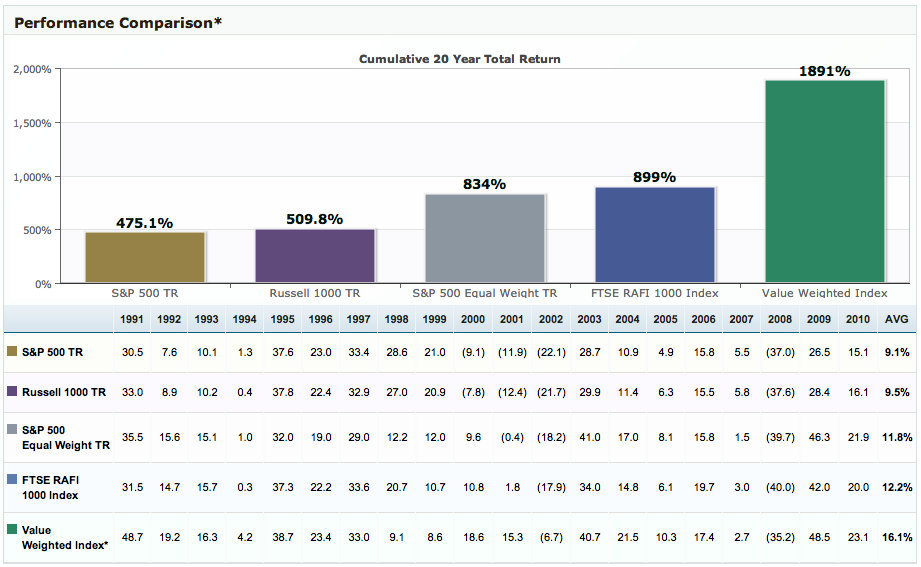
  • If you’re going to buy an index, you might as well buy the best one. An index based on the market capitalization-weighted S&P500 will be handily beaten by an equal-weighted index, which will be handily beaten by a fundamentally weighted index, which is in turn handily beaten by a “value-weighted index,” which is what Greenblatt calls his “Magic Formula-weighted index.”

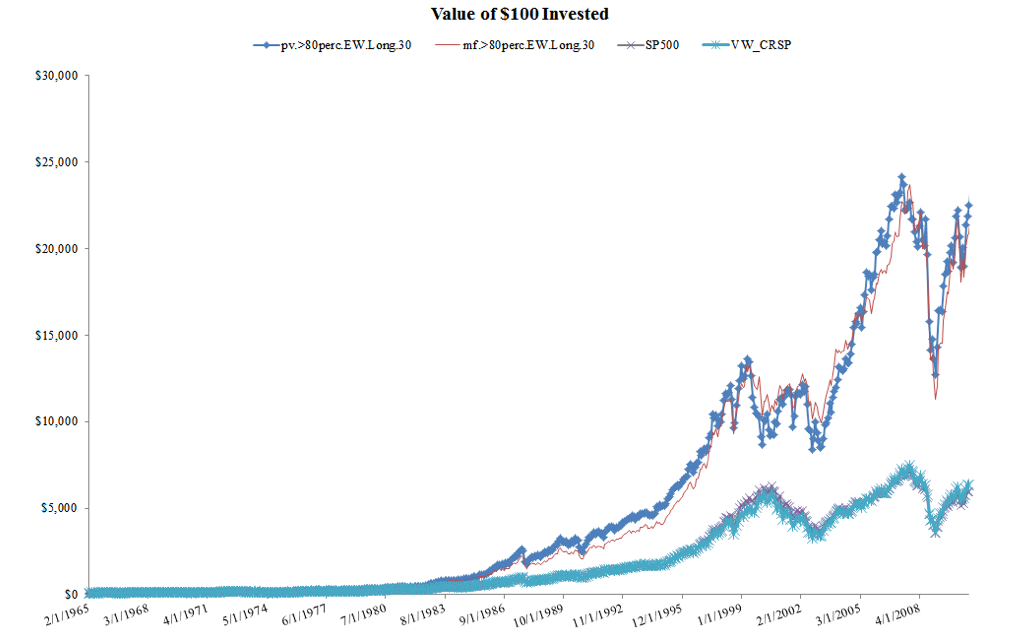
I like the logic. I also think the data on the last point are persuasive. In chart form, the data on that last point look like this:

The value weighted index knocked out a CAGR of 16.1 percent per year over the last 20 years. Not bad.

Greenblatt explains his rationale in some depth in his latest book The Big Secret. The book has taken some heavy criticism on Amazon – average review is 3.2 out of 5 as of now – most of which I think is unwarranted (for example, “Like many others here, I do not exactly understand the reason for this book’s existence.”).

I’m going to take a close look at the value-weighted index this week.

Read Full Post »

Investors struggle to implement the Magic Formula strategy for behavioral reasons. They take a market beating model and proceed to underperform.

Greenblatt found that a compilation of all the “professionally managed” accounts earned 84.1 percent over two years against the S&P 500 (up 62.7 percent). A compilation of “self-managed” accounts over the same period showed a cumulative return of 59.4 percent, losing to the market by 20 percent, and to the machines by almost 25 percent. 

Joel Greenblatt has a series of recommendations that he describes as “a helpful list of things NOT to do!“:

1.  Self-managed investors avoided buying many of the biggest winners.

Wow? Well, the market prices certain businesses cheaply for reasons that are usually very well known. Whether you read the newspaper or follow the news in some other way, you’ll usually know what’s “wrong” with most stocks that appear at the top of the magic formula list. That’s part of the reason they’re available cheap in the first place! Most likely, the near future for a company might not look quite as bright as the recent past or there’s a great deal of uncertainty about the company for one reason or another. Buying stocks that appear cheap relative to trailing measures of cash flow or other measures (even if they’re still “good” businesses that earn high returns on capital), usually means you’re buying companies that are out of favor. These types of companies are systematically avoided by both individuals and institutional investors. Most people and especially professional managers want to make money now. A company that may face short term issues isn’t where most investors look for near term profits. Many self-managed investors just eliminate companies from the list that they just know from reading the newspaper face a near term problem or some uncertainty. But many of these companies turn out to be the biggest future winners.

2.  Many self-managed investors changed their game plan after the strategy underperformed for a period of time.

Many self-managed investors got discouraged after the magic formula strategy underperformed the market for a period of time and simply sold stocks without replacing them, held more cash, and/or stopped updating the strategy on a periodic basis. It’s hard to stick with a strategy that’s not working for a little while. The best performing mutual fund for the decade of the 2000’s actually earned over 18% per year over a decade where the popular market averages were essentially flat. However, because of the capital movements of investors who bailed out during periods after the fund had underperformed for awhile, the average investor (weighted by dollars invested) actually turned that 18% annual gain into an 11% LOSS per year during the same 10 year period.[2]

3.  Many self-managed investors changed their game plan after the market and their self-managed portfolio declined (regardless of whether the self-managed strategy was outperforming or underperforming a declining market).

This is a similar story to #2 above. Investors don’t like to lose money. Beating the market by losing less than the market isn’t that comforting. Many self-managed investors sold stocks without replacing them, held more cash, and/or stopped updating the strategy on a periodic basis after the markets and their portfolio declined for a period of time. It didn’t matter whether the strategy was outperforming or underperforming over this same period. Investors in that best performing mutual fund of the decade that I mentioned above likely withdrew money after the fund declined regardless of whether it was outperforming a declining market during that same period.

4.  Many self-managed investors bought more AFTER good periods of performance.

You get the idea. Most investors sell right AFTER bad performance and buy right AFTER good performance. This is a great way to lower long term investment returns.


Read Full Post »

Yesterday I looked at James Montier’s 2006 paper The Little Note That Beats The Market and his view that investors would struggle to implement the Magic Formula strategy for behavioral reasons.

The Magic Formula is a logical value strategy, it works in backtest, and, most importantly, it seems to work in practice, as this chart from Formula Investing attests:

As Montier predicted, Joel Greenblatt has found that investors do in fact struggle to implement in the Magic Formula strategy in practice. In a great piece published earlier this year, Adding Your Two Cents May Cost You A Lot Over The Long-Term, Greenblatt examined the first two years of returns to Formula Investing’s US separately managed accounts:

Formula Investing provides two choices for retail clients to invest in U.S. stocks, either through what we call a “self-managed” account or through a “professionally managed” account. A self-managed account allows clients to make a number of their own choices about which top ranked stocks to buy or sell and when to make these trades. Professionally managed accounts follow a systematic process that buys and sells top ranked stocks with trades scheduled at predetermined intervals. During the two year period under study[1], both account types chose from the same list of top ranked stocks based on the formulas described in The Little Book that Beats the Market.

Greenblatt has conducted a great real-time behavioral investing experiment. Self-managed accounts have discretion over buy and sell decisions, while professionally managed accounts are automated. Both choose from the same list of stocks. So what happened?

[The] self-managed accounts, where clients could choose their own stocks from the pre-approved list and then follow (or not) our guidelines for trading the stocks at fixed intervals didn’t do too badly. A compilation of all self-managed accounts for the two year period showed a cumulative return of 59.4% after all expenses. Pretty darn good, right? Unfortunately, the S&P 500 during the same period was actually up 62.7%.

“Hmmm….that’s interesting”, you say (or I’ll say it for you, it works either way), “so how did the ‘professionally managed’ accounts do during the same period?” Well, a compilation of all the “professionally managed” accounts earned 84.1% after all expenses over the same two years, beating the “self managed” by almost 25% (and the S&P by well over 20%). For just a two year period, that’s a huge difference! It’s especially huge since both “self-managed” and “professionally managed” chose investments from the same list of stocks and supposedly followed the same basic game plan.

Let’s put it another way: on average the people who “self-managed” their accounts took a winning system and used their judgment to unintentionally eliminate all the outperformance and then some!

Just as Montier (and Greenblatt) predicted, investors struggle to implement the Magic Formula. Discretion over buy-and-sell decisions in aggregate can turn a model that generates a market beating return into a sub-par return. Extraordinary!

Greenblatt has to be admired for sharing this research with the world. Value investing is as misunderstood in the investment community at large as quantitative value investing is misunderstood in the value investing community. It takes a great deal of courage to point out the flaws (such as they are) in the implementation of a strategy, particularly when they are not known to those outside his firm. Given that Greenblatt has a great deal of money riding on the Magic Formula, he should be commended for conducting and sharing a superb bit of research.

I love his conclusion:

[The] best performing “self-managed” account didn’t actually do anything. What I mean is that after the initial account was opened, the client bought stocks from the list and never touched them again for the entire two year period. That strategy of doing NOTHING outperformed all other “self-managed” accounts. I don’t know if that’s good news, but I like the message it appears to send—simply, when it comes to long-term investing, doing “less” is often “more”. Well, good work if you can get it, anyway.

Read Full Post »

In his 2006 paper, “The Little Note That Beats the Markets” James Montier backtested the Magic Formula and found that it supported the claim in the “Little Book That Beats The Market” that the Magic Formula does in fact beat the market:

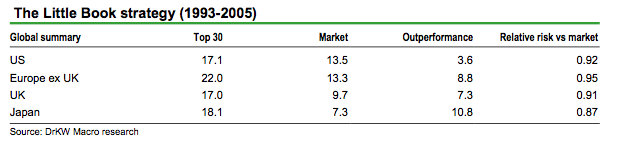
The results certainly support the notions put forward in the Little Book. In all the regions, the Little Book strategy substantially outperformed the market, and with lower risk! The range of outperformance went from just over 3.5% in the US to an astounding 10% in Japan.

The results of our backtest suggest that Greenblatt’s strategy isn’t unique to the US. We tested the Little Book strategy on US, European, UK and Japanese markets between 1993 and 2005. The results are impressive. The Little Book strategy beat the market (an equally weighted stock index) by 3.6%, 8.8%, 7.3% and 10.8% in the various regions respectively. And in all cases with lower volatility than the market! The outperformance was even better against the cap weighted indices.

Regardless, Montier felt that investors would struggle to implement the strategy for behavioral reasons:

Greenblatt suggests two reasons why investors will struggle to follow the Little Book strategy. Both ring true with us from our meeting with investors over the years. The first is “investing by using a magic formula may take away some of the fun”. Following a quant model or even a set of rules takes a lot of the excitement out of stock investing. What would you do all day if you didn’t have to meet companies or sit down with the sell side?

As Keynes noted “The game of professional investment is intolerably boring and over- exacting to anyone who is entirely exempt from the gambling instinct; whilst he who has it must pay to this propensity the appropriate toll”.

Secondly, the Little Book strategy, and all value strategies for that matter, requires patience. And patience is in very short supply amongst investors in today’s markets. I’ve even come across fund managers whose performance is monitored on a daily basis – congratulations are to be extended to their management for their complete mastery of measuring noise! Everyone seems to want the holy grail of profits without any pain. Dream on. It doesn’t exist.

Value strategies work over the long run, but not necessarily in the short term. There can be prolonged periods of underperformance. It is these periods of underperformance that ensure that not everyone becomes a value investor (coupled with a hubristic belief in their own abilities to pick stocks).

As Greenblatt notes “Imagine diligently watching those stocks each day as they do worse than the market averages over the course of many months or even years… The magic formula portfolio fared poorly relative to the market average in 5 out of every 12 months tested. For full-year periods… failed to beat the market averages once every four years”.

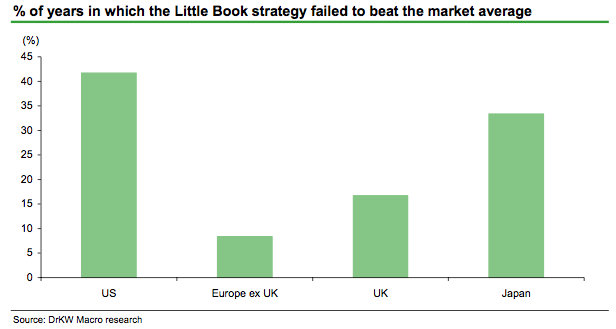
The chart below shows the proportion of years within Montier’s sample where the Magic Formula failed to beat the market  in each of the respective regions.

Europe and the UK show surprisingly few years of historic market underperformance. Montier says investors should “bear in mind the lessons from the US and Japan, where underperformance has been seen on a considerably more frequent basis:”

It is this periodic underperformance that really helps ensure the survival of such strategies. As long as investors continue to be overconfident in their abilities to consistently pick winners, and myopic enough that even a year of underperformance is enough to send them running, then strategies such as the Little Book are likely to continue to do well over the long run. Thankfully for those of us with faith in such models, the traits just described seem to be immutable characteristics of most people. As Warren Buffet said “Investing is simple but not easy”.

Montier has long promoted the theme that the reason value investors underperform value models is due to behavioral errors and cognitive biases. For example, in his excellent  2006 research report Painting By Numbers: An Ode To Quant Montier attributes most of the underperformance to overconfidence:

We all think that we know better than simple models. The key to the quant model’s performance is that it has a known error rate while our error rates are unknown.

The most common response to these findings is to argue that surely a fund manager should be able to use quant as an input, with the flexibility to override the model when required. However, as mentioned above, the evidence suggests that quant models tend to act as a ceiling rather than a floor for our behaviour. Additionally there is plenty of evidence to suggest that we tend to overweight our own opinions and experiences against statistical evidence.

Greenblatt has conducted a study on exactly this point. More tomorrow.

Read Full Post »

Since Joel Greenblatt’s introduction of the Magic Formula in the 2006 book “The Little Book That Beats The Market,” researchers have conducted a number of studies on the strategy and found it to be a market beater, both domestically and abroad.

Greenblatt claims returns in the order of 30.8 percent per year against a market average of 12.3 percent, and S&P500 return of 12.4 percent per year:

In Does Joel Greenblatt’s Magic Formula Investing Have Any Alpha? Meena Krishnamsetty finds that the Magic Formula generates annual alpha 4.5 percent:

It doesn’t beat the index funds by 18% per year and generate Warren Buffett like returns, but the excess return is still more than 5% per year. This is better than Eugene Fama’s DFA Small Cap Value Fund. It is also better than Lakonishok’s LSV Value Equity Fund.

Wes Gray’s Empirical Finance Blog struggles to repeat the study:

[We] can’t replicate the results under a variety of methods.

We’ve hacked and slashed the data, dealt with survivor bias, point-in-time bias, erroneous data, and all the other standard techniques used in academic empirical asset pricing analysis–still no dice.

In the preliminary results presented below, we analyze a stock universe consisting of large-caps (defined as being larger than 80 percentile on the NYSE in a given year). We test a portfolio that is annually rebalanced on June 30th, equal-weight invested across 30 stocks on July 1st, and held until June 30th of the following year.

Wes finds “serious outperformance” but “nowhere near the 31% CAGR outlined in the book.

Wes thinks that the outperformance of the Magic Formula is due to small cap stocks, which he tests in a second post “Magic Formula and Small Caps–The Missing Link?

Here are Wes’s results:

[While] the MF returns are definitely higher when you allow for smaller stocks, the results still do not earn anywhere near 31% CAGR.

Some closer observations of our results versus the results from the book:

For major “up” years, it seems that our backtest of the magic formula are very similar (especially from a statistical standpoint where the portfolios only have 30 names): 1991, 1995, 1997, 1999, 2001, and 2003.

The BIG difference is during down years: 1990, 1994, 2000, and 2002. For some reason, our backtest shows results which are roughly in line with the R2K (Russell 2000), but the MF results from the book present compelling upside returns during market downturns–so somehow the book results have negative beta during market blowouts? Weird to say the least…

James Montier, in a 2006 paper, “The Little Note That Beats the Markets” says that it works globally:

The results of our backtest suggest that Greenblatt’s strategy isn’t unique to the US. We tested the Little Book strategy on US, European, UK and Japanese markets between 1993 and 2005. The results are impressive. The Little Book strategy beat the market (an equally weighted stock index) by 3.6%, 8.8%, 7.3% and 10.8% in the various regions respectively. And in all cases with lower volatility than the market! The outperformance was even better against the cap weighted indices.

So the Magic Formula generates alpha, and beats the market globally, but not by as much as Greenblatt found originally, and much of the outperformance may be due to small cap stocks.

The Magic Formula and EBIT/TEV

Last week I took a look at the Loughran Wellman and Gray Vogel papers that found the enterprise multiple,  EBITDA/enterprise value, to be the best performing price ratio. A footnote in the Gray and Vogel paper says that they conducted the same research substituting EBIT for EBITDA and found “nearly identical results,” which is perhaps a little surprising but not inconceivable because they are so similar.

EBIT/TEV is one of two components in the Magic Formula (the other being ROC). I have long believed that the quality metric (ROC) adds little to the performance of the value metric (EBIT/EV), and that much of the success of the Magic Formula is due to its use of the enterprise multiple. James Montier seems to agree. In 2006, Montier backtested the strategy and its components in the US, Europe ex UK, UK and Japan:

The universe utilised was a combination of the FTSE and MSCI indices. This gave us the largest sample of data. We analysed the data from 1993 until the end of 2005. All returns and prices were measured in dollars. Utilities and Financials were both excluded from the test, for reasons that will become obvious very shortly. We only rebalance yearly.

Here are the results of Montier’s backtest of the Magic Formula:

And here’re the results for EBIT/TEV over the same period:

Huh? EBIT/TEV alone outperforms the Magic Formula everywhere but Japan?

Montier says that return on capital seems to bring little to the party in the UK and the USA:

In all the regions except Japan, the returns are higher from simply using a pure [EBIT/TEV] filter than they are from using the Little Book strategy. In the US and the UK, the gains from a pure [EBIT/TEV] strategy are very sizeable. In Europe, a pure [EBIT/TEV] strategy doesn’t alter the results from the Little Book strategy very much, but it is more volatile than the Little Book strategy. In Japan, the returns are lower than the Little Book strategy, but so is the relative volatility.

Montier suggests that one reason for favoring the Magic Formula over “pure” EBIT/TEV is career defence. The backtest covers an unusual period in the markets when expensive stocks outperformed for an extended period of time.

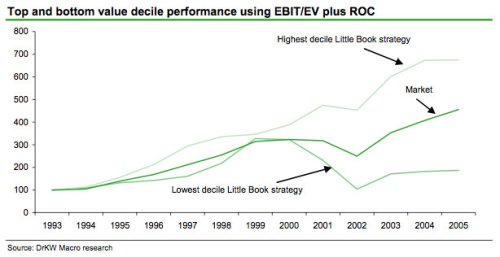
The charts below suggest a reason why one might want to have some form of quality input into the basic value screen. The first chart shows the top and bottom ranked deciles by EBIT/EV for the US (although other countries tell a similar story). It clearly shows the impact of the bubble. For a number of years, during the bubble, stocks that were simply cheap were shunned as we all know.


However, the chart below shows the top and bottom deciles using the combined Little Book strategy again for the US. The bubble is again visible, but the ROC component of the screen prevented the massive underperformance that was seen with the pure value strategy. Of course, the resulting returns are lower, but a fund manager following this strategy is unlikely to have lost his job.

In the second chart, note that it took eight years for the value decile to catch up to the glamour decile. They were tough times for value investors.

Conclusion

The Magic Formula beats the market, and generates real alpha. It might not beat the market by as much as Greenblatt found originally, and much of the outperformance is due to small cap stocks, but it’s a useful strategy. Better performance may be found in the use of pure EBIT/EV, but investors employing such a strategy could have very long periods of lean years.

Buy my book The Acquirer’s Multiple: How the Billionaire Contrarians of Deep Value Beat the Market from on Kindlepaperback, and Audible.

Here’s your book for the fall if you’re on global Wall Street. Tobias Carlisle has hit a home run deep over left field. It’s an incredibly smart, dense, 213 pages on how to not lose money in the market. It’s your Autumn smart read. –Tom Keene, Bloomberg’s Editor-At-Large, Bloomberg Surveillance, September 9, 2014.

Click here if you’d like to read more on The Acquirer’s Multiple, or connect with me on Twitter, LinkedIn or Facebook. Check out the best deep value stocks in the largest 1000 names for free on the deep value stock screener at The Acquirer’s Multiple®.


Read Full Post »

The excellent Empirical Finance Blog has a superb series of posts on an investment strategy called “Profit and Value” (How “Magic” is the Magic Formula? and The Other Side of Value), which Wes describes as the “academic version” of Joel Greenblatt’s “Magic Formula.” (Incidentally, Greenblatt is speaking at the New York Value Investors Congress in October this year. I think seeing Greenblatt alone is worth the price of admission.) The Profit and Value approach is similar to the Magic Formula in that it ranks stocks independently on “value” and “quality,” and then reranks on the combined rankings. The stock with the lowest combined ranking is the most attractive, the stock with the next lowest combined ranking the next most attractive, and so on.

The Profit and Value strategy differs from the Magic Formula strategy in its methods of determining value and quality. Profit and Value uses straight book-to-market to determine value, where the Magic Formula uses EBIT / TEV. And where the Magic Formula uses EBIT / (NPPE +net working capital) to determine quality, Profit and Value uses “Gross Profitability,” a metric described in a fascinating paper by Robert Novy-Marx called “The other side of value” (more on this later).

My prima facie attraction to the Profit and Value strategy was twofold: First, Profit and Value uses book-to-market as the measure of value. I have a long-standing bias for asset-based metrics over income-based ones, and for good reasons. (After examining the performance analysis of Profit and Value, however, I’ve made a permanent switch to another metric that I’ll discuss in more detail later.) Secondly, the back-tested returns to the strategy appear to be considerably higher than those for the Magic Formula. Here’s a chart from Empirical Finance comparing the back-tested returns to each strategy with a yearly rebalancing (click to enlarge):
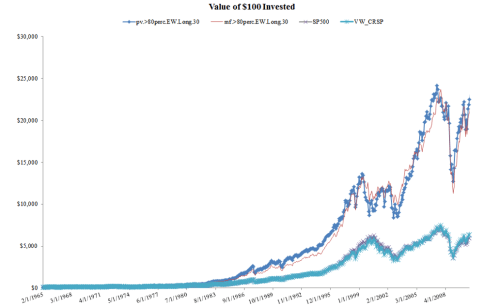
Profit and Value is the clear slight winner. This is the obvious reason for preferring one strategy over another. It is not, however, the end of the story. There are some problems with the performance of Profit and Value, which I discuss in some detail later. Over the next few weeks I’ll post my full thoughts in a series of posts on the following headings, but, for now, here are the summaries. I welcome any feedback.

Determining “quality” using “gross profitability”

In a 2010 paper called “The other side of value: Good growth and the gross profitability premium,” author Robert Novy-Marks discusses his preference for “gross profitability” over other measures of performance like earnings, or free cash flow. The actual “Gross Profitability” factor Novy-Marx uses is as follows:

Gross Profitability = (Revenues – Cost of Goods Sold) / Total Assets

Novy-Marx’s rationale for preferring gross profitability is compelling. First, it makes sense:

Gross profits is the cleanest accounting measure of true economic profitability. The farther down the income statement one goes, the more polluted profitability measures become, and the less related they are to true economic profitability. For example, a firm that has both lower production costs and higher sales than its competitors is unambiguously more profitable. Even so, it can easily have lower earnings than its competitors. If the firm is quickly increasing its sales though aggressive advertising, or commissions to its sales force, these actions can, even if optimal, reduce its bottom line income below that of its less profitable competitors. Similarly, if the firm spends on research and development to further increase its production advantage, or invests in organizational capital that will help it maintain its competitive advantage, these actions result in lower current earnings. Moreover, capital expenditures that directly increase the scale of the firm’s operations further reduce its free cashflows relative to its competitors. These facts suggest constructing the empirical proxy for productivity using gross profits. Scaling by a book-based measure, instead of a market based measure, avoids hopelessly conflating the productivity proxy with book-to-market. I scale gross profits by book assets, not book equity, because gross profits are not reduced by interest payments and are thus independent of leverage.

Second, it works:

In a horse race between these three measures of productivity, gross profits-to-assets is the clear winner. Gross profits-to-assets has roughly the same power predicting the cross section of expected returns as book-to-market. It completely subsumes the earnings based measure, and has significantly more power than the measure based on free cash flows. Moreover, demeaning this variable dramatically increases its power. Gross profits-to-assets also predicts long run growth in earnings and free crashflow, which may help explain why it is useful in forecasting returns.

I think it’s interesting that gross profits-to-assets is as predictive as book-to-market. I can’t recall any other fundamental performance measure that is predictive at all, let alone as predictive as book-to-market (EBIT / (NPPE +net working capital) is not. Neither are gross margins, ROE, ROA, or five-year earnings gains). There are, however, some obvious problems with gross profitability as a stand alone metric. More later.

White knuckles: Profit and Value performance analysis

While Novy-Marx’s “Gross Profitability” factor seems to be predictive, in combination with the book-to-market value factor the results are very volatile. To the extent that an individual investor can ignore this volatility, the strategy will work very well. As an institutional strategy, however, Profit and Value is a widow-maker. The peak-to-trough drawdown on Profit and Value through the 2007-2009 credit crisis puts any professional money manager following the strategy out of business. Second, the strategy selects highly leveraged stocks, and one needs a bigger set of mangoes than I possess to blindly buy them. The second problem – the preference for highly leveraged stocks – contributes directly to the first problem – big drawdowns in a downturn because investors tend to vomit up highly leveraged stocks as the market falls. Also concerning is the likely performance of Profit and Value in an environment of rising interest rates. Given the negative rates that presently prevail, such an environment seems likely to manifest in the future. I look specifically at the performance of Profit and Value in an environment of rising interest rates.

A better metric than book-to-market

The performance issues with Profit and Value discussed above – the volatility and the preference for highly leveraged balance sheets – are problems with the book-to-market criterion. As Greenblatt points out in his “You can be a stockmarket genius” book, it is partially the leverage embedded in low book-to-market that contributes to the outperformance over the long term. In the short term, however, the leverage can be a problem. There are other problems with cheap book value. As I discussed in The Small Cap Paradox: A problem with LSV’s Contrarian Investment, Extrapolation, and Risk in practice, the low price-to-book decile is very small. James P. O’Shaughnessy discusses this issue in What works on Wall Street:

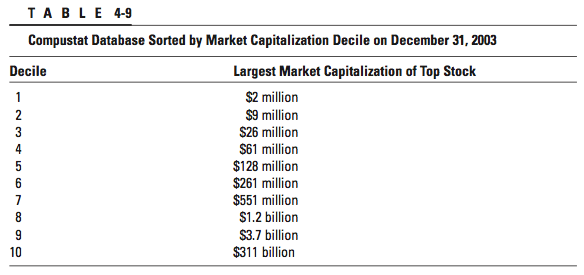
The glaring problem with this method, when used with the Compustat database, is that it’s virtually impossible to buy the stocks that account for the performance advantage of small capitalization strategies. Table 4-9 illustrates the problem. On December 31, 2003, approximately 8,178 stocks in the active Compustat database had both year-end prices and a number for common shares outstanding. If we sorted the database by decile, each decile would be made up of 818 stocks. As Table 4-9 shows, market capitalization doesn’t get past $150 million until you get to decile 6. The top market capitalization in the fourth decile is $61 million, a number far too small to allow widespread buying of those stocks.

A market capitalization of $2 million – the cheapest and best-performed decile – is uninvestable. This leads O’Shaughnessy to make the point that “micro-cap stock returns are an illusion”:

The only way to achieve these stellar returns is to invest only a few million dollars in over 2,000 stocks. Precious few investors can do that. The stocks are far too small for a mutual fund to buy and far too numerous for an individual to tackle. So there they sit, tantalizingly out of reach of nearly everyone. What’s more, even if you could spread $2,000,000 over 2,000 names, the bid–ask spread would eat you alive.

Even a small investor will struggle to buy enough stock in the 3rd or 4th deciles, which encompass stocks with market capitalizations below $26 million and $61 million respectively. These are not, therefore, institutional-grade strategies. Says O’Shaughnessy:

This presents an interesting paradox: Small-cap mutual funds justify their investments using academic research that shows small stocks outperforming large ones, yet the funds themselves cannot buy the stocks that provide the lion’s share of performance because of a lack of trading liquidity.

A review of the Morningstar Mutual Fund database proves this. On December 31, 2003, the median market capitalization of the 1,215 mutual funds in Morningstar’s all equity, small-cap category was $967 million. That’s right between decile 7 and 8 from the Compustat universe—hardly small.

I spent some time researching alternatives to book-to-market. As much as it pained me to do so, I’ve now abandoned book-to-market as my primary valuation metric. In fact I no longer use it all. I discuss these metrics, and their advantages over book in a later post.

Read Full Post »
« Newer Posts