Feeds:
Posts
Comments

Posts Tagged ‘Activist investment’

A group of investors in VaxGen Inc (OTC:VXGN) have formed the “VaxGen Full Value Committee” to conduct a proxy contest to replace the current board of VXGN at the next annual shareholders meeting. The group, comprising BA Value Investors’ Steven N. Bronson and ROI Capital Management’s Mark T. Boyer and Mitchell J. Soboleski, intends to replace the current board with directors who will focus on the following objectives:

1. Returning capital to [VXGN]’s shareholders, including an immediate distribution of $10,000,000 in cash;

2. Terminating [VXGN]’s lease with its landlord, Oyster Point Tech Center, LLC, and settling with the landlord the obligations of [VXGN] on the remaining lease payments;

3. Exploring ways to monetize [VXGN] as a “public shell,” including the utilization of [VXGN]’s Substantial Net Operating Losses; and

4. Protecting for the benefit of shareholders royalty payments receivable from the sale of [VXGN]’s intellectual property.

We’ve been following VXGN (see our post archive here) because it is trading at a substantial discount to its net cash position, has ended its cash-burning product development activities and is “seeking to maximize the value of its remaining assets through a strategic transaction or series of strategic transactions.” Management has said that, if the company is unable to identify and complete an alternate strategic transaction, it proposes to liquidate. One concern of ours has been a lawsuit against VXGN by its landlords, in which they sought $22.4M. That lawsuit was dismissed in May, so the path for VXGN to liquidate has now hopefully cleared. The board has, however, been dragging its feet on the liquidation. Given their relatively high compensation and almost non-existent shareholding, it’s not hard to see why.

BA Value Investors had previously disclosed an activist holding and, in a June 12 letter to the board, called on VXGN to “act promptly to reduce the size of the board to three directors; reduce director compensation; change to a smaller audit firm; terminate the lease of its facilities; otherwise cut costs; make an immediate $10 million distribution to shareholders; make a subsequent distribution of substantially all the remaining cash after settling the lease termination; distribute any royalty income to shareholders; and explore ways to monetize the public company value of the Issuer and use of its net operating losses.”

Another group led by Spencer Capital and styling itself “Value Investors for Change” has also filed preliminary proxy documents to remove the board. In the proxy documents, Value Investors for Change call out VXGN’s board on its “track record of failure and exorbitant cash compensation”:

VaxGen does not have any operations, other than preparing public reports. The Company has three employees, including the part-time principal executive officer and director, and four non-employee directors. Since the Company’s failed merger with Raven Biotechnologies, Inc. in March 2008, the Board has publicly disclosed that it would either pursue a strategic transaction or a series of strategic transactions or dissolve the Company. The Company has done neither. In the meantime, members of the Board have treated themselves to exorbitant cash compensation. Until July 2009, two non-employee members of the Board were paid over $300,000 per year in compensation. The principal executive officer will likely receive over $400,000 in cash compensation this year.

VXGN is up 31.3% since we initiated the position. At its $0.63 close yesterday, it has a market capitalization of $20.9M. We last estimated the company’s liquidation value to be around $25.4M or $0.77 per share. VXGN has other potentially valuable assets, including a “state-of-the-art biopharmaceutical manufacturing facility with a 1,000-liter bioreactor that can be used to make cell culture or microbial biologic products” and rights to specified percentages of future net sales relating to its anthrax vaccine product candidate and related technology. The authors of a letter sent to the board on July 14 of this year adjudge VXGN’s liquidation value to be significantly higher at $2.12 per share:

Excluding the lease obligations, the net financial assets alone of $37.2 million equate to $1.12 per share. The EBS royalties (assuming a 6% royalty rate and a $500 million contract as contemplated by NIH/HHS and EBS) of $30 million and milestones of $6 million total $36 million of potential additional future value (based clearly on assumptions, none of which are assured), or $1.09 per share. Adding $1.12 and $1.09 equals $2.21 per share.

The entry of the VaxGen Full Value Committee into the proxy contest will certainly make the next meeting an interesting spectacle, and, with any luck, we will see a liquidation of VXGN soon, either at the hands of the present board, by Value Investors for Change or the VaxGen Full Value Committee.

The Purpose of Transaction portion of the amended 13D filing is set out below:

The Reporting Persons acquired the shares of Common Stock to which this statement relates for investment purposes.

On June 12, 2009, Mr. Bronson, on behalf of BA Value Investors, LLC, sent a letter to the Board of Directors of the Issuer. In the letter, Mr. Bronson stated that the Company must act promptly to reduce the size of the board to three directors; reduce director compensation; change to a smaller audit firm; terminate the lease of its facilities; otherwise cut costs; make an immediate $10 million distribution to shareholders; make a subsequent distribution of substantially all the remaining cash after settling the lease termination; distribute any royalty income to shareholders; and explore ways to monetize the public company value of the Issuer and use of its net operating losses. A copy of the letter to the Issuer has been filed as Exhibit 1 to the Statement.

On August 21, 2009, the Reporting Persons formed a committee called the “VaxGen Full Value Committee.” The VaxGen Full Value Committee intends to conduct a proxy contest to replace the current Board of Directors at the next annual shareholders meeting with directors who will focus on the following objectives:

1. Returning capital to the Issuer’s shareholders, including an immediate distribution of $10,000,000 in cash;

2. Terminating the Issuer’s lease with its landlord, Oyster Point Tech Center, LLC, and settling with the landlord the obligations of the Issuer on the remaining lease payments;

3. Exploring ways to monetize the Issuer as a “public shell,” including the utilization of the Issuer’s Substantial Net Operating Losses; and

4. Protecting for the benefit of shareholders royalty payments receivable from the sale of the Issuer’s intellectual property.

[Full Disclosure:  We have a holding in VXGN. This is neither a recommendation to buy or sell any securities. All information provided believed to be reliable and presented for information purposes only. Do your own research before investing in any security.]

Read Full Post »

Although we closed our position in Avigen Inc (NASDAQ:AVGN) earlier this week, we’re keeping a watching brief on the stock. AVGN has now filed with the SEC the terms of the deal with MediciNova Inc (NASDAQ:MNOV), and they’re not as bad as the earlier report seemed to suggest. The deal has, however, attracted the ire of The Pennsylvania Funds, an AVGN shareholder, who has filed a class action lawsuit on behalf of all AVGN stockholders. The stock closed yesterday at $1.28, about $0.01 under our exit price. The terms of deal provide some downside protection and some upside optionality, and so are worth considering in some more detail, although probably not enough of either to persuade us to re-enter the stock. If the lawsuit gains traction and pushes the stock price down, however, AVGN might become attractive again.

About AVGN

We started following AVGN in December last year (see archived posts here) because it was a net cash stock and specialist biotechnology investor Biotechnology Value Fund (BVF) was pushing it to liquidate and return its cash to shareholders. Despite BVF’s failure to remove the board, we continued to maintain our position in AVGN because BVF won a number of important concessions from the board that made AVGN a much more attractive stock than it was when we started following it. We continuted to hold on when AVGN announced that it was back in negotiations with MediciNova, Inc, but closed the position for a 98.5% gain when the initial terms of the deal were announced.

The terms of the deal

The downside protection

Under the terms of the merger agreement AVGN shareholders will have the right to elect to receive an amount currently estimated by AVGN’s board at $1.24 per share in either cash or secured convertible notes to be issued by MNOV. Approximately $1.19 of the consideration will be paid at the closing, and approximately $0.05 will be paid at June 30, 2010. Both payments are subject to certain potential adjustments. The first payment is subject to adjustment based on activities related to the liquidation or sale of certain assets of AVGN in connection with the winding down of its operations prior to closing. The second payment is subject to upward adjustment based on savings in estimated expenses through closing and receipt of certain payments post-closing as well as downward adjustment in the event that closing liabilities exceed estimated liabilities through closing.

The upside optionality

The secured convertible notes will be convertible on the final business day of each month into shares of MNOV common stock at a conversion price of $6.80 per share, which conversion price is based on the volume-weighted average price of MNOV’s common stock as quoted on Nasdaq and the Osaka Securities Exchange over the 20 trading days prior to signing of the merger agreement. The convertible notes will mature on the 18-month anniversary of the closing of the merger, and the indenture governing the notes will include customary events of default and anti-dilution adjustments. Note that the last time MNOV traded above $6.80 was two years ago in August 2007.

The joint press release announcing the terms of the deal is set out below:

MediciNova and Avigen Enter Into Definitive Agreement for Business Combination

SAN DIEGO, Calif., and ALAMEDA, Calif., August 21, 2009 — MediciNova, Inc., a biopharmaceutical company that is publicly traded on the Nasdaq Global Market (Nasdaq:MNOV) and the Hercules Market of the Osaka Securities Exchange (Code Number:4875) and Avigen, Inc. (Nasdaq:AVGN), a biopharmaceutical company, today announced that they have entered into a definitive merger agreement pursuant to which MediciNova’s wholly-owned subsidiary will merge with and into Avigen. Completion of the transaction will permit the combination of the companies’ broad neurological clinical development programs based on ibudilast (Avigen’s AV-411 and MediciNova’s MN-166).

Under the terms of the merger agreement, which has been approved by both companies’ boards of directors, Avigen shareholders will have the right to elect to receive an amount currently estimated at approximately $1.24 per share in either cash or secured convertible notes to be issued by MediciNova. Approximately $1.19 of this consideration will be paid at the closing, and approximately $0.05 will be paid at June 30, 2010. As set forth in the merger agreement, both payments are subject to certain potential adjustments. The first payment is subject to adjustment based on activities related to the liquidation or sale of certain assets of Avigen in connection with the winding down of its operations prior to closing. The second payment is subject to upward adjustment based on savings in estimated expenses through closing and receipt of certain payments post-closing as well as downward adjustment in the event that closing liabilities exceed estimated liabilities through closing.

The secured convertible notes will be convertible on the final business day of each month into shares of MediciNova common stock at a conversion price of $6.80 per share, which conversion price is based on the volume-weighted average price of MediciNova’s common stock as quoted on Nasdaq and the Osaka Securities Exchange over the 20 trading days prior to signing of the merger agreement. The convertible notes will mature on the 18-month anniversary of the closing of the merger, and the indenture governing the notes will include customary events of default and anti-dilution adjustments.

In addition, Avigen’s stockholders will be entitled to one Contingent Payment Right (“CPR”) that will entitle holders under certain circumstances to a pro rata portion of one or more of the following: (1) in the event the first milestone payment of $6.0 million, or approximately $0.20 per share, under Avigen’s 2005 assignment agreement with Genzyme Corporation (“Genzyme Agreement”) is achieved in the 20 months following closing, a cash payment of the proceeds (to the extent such cash is received by MediciNova in the 20 months following closing); (2) in the event the Parkinson’s product reverts to MediciNova under the Genzyme Agreement and is subsequently sold, licensed or otherwise transferred, 50% of the proceeds received in cash in the 20 months following closing; and (3) the amount of money remaining in the plan trust established under Avigen’s management transition plan following termination of such trust. In each case, the payments will be net of any related out-of-pocket costs, damages, fines, penalties and expenses incurred by MediciNova. The CPRs will not be transferable except in limited circumstances.

Yuichi Iwaki, M.D., Ph.D., MediciNova’s President and Chief Executive Officer, said, “We are excited about combining Avigen with MediciNova and believe that it presents a unique opportunity for shareholders of both companies, most notably, the ability to more fully take advantage of the opportunities that the ibudilast compound and analogs provide in a variety of indications and markets.”

“We believe the transaction reduces many of the uncertainties involved with dissolution and is in the best interests of our shareholders,” commented Andrew Sauter, Avigen’s Chief Executive Officer, President and Chief Financial Officer. “In addition, we believe that combining the two companies’ ibudilast programs will enhance the global development potential for the compound that could benefit patients with a range of neurological indications.”

The transaction is expected to close in the fourth quarter of 2009 and is subject to approval of Avigen’s stockholders and approval of MediciNova’s stockholders as well as other customary closing conditions. In addition, the closing is conditioned on the receipt of certain releases from Avigen’s directors (other than John K.A. Prendergast), Kenneth Chahine, Kirk Johnson and Andrew A. Sauter.

RBC Capital Markets Corporation is acting as financial advisor to Avigen and Cooley Godward Kronish LLP is serving as its legal counsel. Ladenburg Thalmann & Co. Inc. (NYSE Amex: LTS) is acting as financial advisor to MediciNova, Euclidean Life Science Advisors is acting as its business advisor and Dechert LLP is serving as its legal counsel.

The AVGN press release disclosing the law suit is set out below:

On August 25, 2009, The Pennsylvania Funds filed a class action lawsuit in the Superior Court of the State of California, County of Alameda, purportedly on behalf of the stockholders of Avigen, Inc., against Avigen and its directors, alleging that Avigen’s directors breached their fiduciary duties to the stockholders of Avigen in connection with the proposed acquisition of Avigen by MediciNova, Inc. The complaint seeks to enjoin the defendants from completing the acquisition as currently contemplated.

Avigen and its directors intend to take all appropriate actions to defend the suit.

It is possible that additional similar complaints may be filed in the future. If this does occur, Avigen does not intend to announce the filing of any similar complaints unless they contain allegations that are substantially distinct from those made in the pending action.

Conclusion

With the terms of the deal announced by AVGN, we’re still happy to be out of the stock. The downside protection is subject to various adjustments, and the upside is wholly dependent on the performance of MNOV’s stock over $6.80, which is higher than the stock has traded since 2007. That said, it’s worth watching to the see the effect of the class action on the stock price, because there is a price at which the stock again becomes attractive.

Hat tip GR.

[Full Disclosure: We do not have a holding in AVGN. This is neither a recommendation to buy or sell any securities. All information provided believed to be reliable and presented for information purposes only. Do your own research before investing in any security.]

Read Full Post »

MRV Communications Inc  (OTC:MRVC) is an activist play with Value Investors for Change – who recently filed proxy documents in relation to VXGN – seeking to replace the “current, ineffective board of directors” with a new board of “highly qualified, independent directors committed to realizing for all MRVC stockholders the fullest potential of their investments.” Value Investors for Change detail a litany of problems with this stock in the preliminary proxy filing, which range from a simple failure to file financial statements or hold an annual meeting to the mishandling of an acquisition and an options dating scandal. What’s the attraction to the stock? Two things:

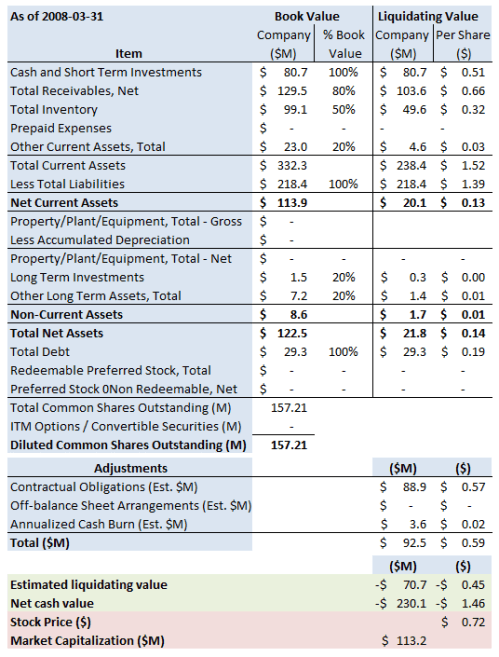
1. As at the last filing date, for the period ended March 31, 2008, MRVC’s (unaudited) NCAV was around $113.9M or $0.72 per share, which is yesterday’s closing price. Note that the liquidation value is likely negligible and the financial statements are more than a year out of date (which makes any valuation problematic). One positive is the revenue: the company has annualized revenue of around $500M. A small improvement in margins could result in a big improvement in earnings.

2. Value Investors for Change believes the company has a “valuable franchise and a strong market position” and we like their approach, described in the preliminary proxy documents thus:

The participants in this solicitation (collectively, “Value Investors for Change”) are investors who seek to encourage companies to create, preserve and enhance long-term value for their stockholders, the true owners of America’s public companies. We have developed a sophisticated screening process that we use to identify public companies that we believe (i) are undervalued, (ii) are not adequately serving the interests of their stockholders and (iii) require a new board of directors, so that, with the encouragement of stockholders such as you, we can begin implementing reforms ourselves with the goal of increasing stockholder value.

We’re adding MRVC to our Special Situations portfolio at its $0.72 close yesterday.

About MRVC

From the last 10Q:

MRV Communications is a supplier of communications equipment and services to carriers, governments and enterprise customers, worldwide. We are also a supplier of optical components, primarily through our wholly owned subsidiaries: Source Photonics and Fiberxon. We conduct our business along three principal segments: (1) the network equipment group, (2) the network integration group and (3) the optical components group. Our network equipment group provides communications equipment that facilitates access, transport, aggregation and management of voice, data and video traffic in networks, data centers and laboratories used by telecommunications service providers, cable operators, enterprise customers and governments worldwide. Our network integration group operates primarily in Italy, France, Switzerland and Scandinavia, servicing Tier One carriers, regional carriers, large enterprises, and government institutions. We provide network system design, integration and distribution services that include products manufactured by third-party vendors, as well as products developed and manufactured by the network equipment group. Our optical components group designs, manufactures and sells optical communications products used in telecommunications systems and data communications networks. These products include passive optical network, or PON, subsystems, optical transceivers used in enterprise, access and metropolitan applications as well as other optical components, modules and subsystems. We market and sell our products worldwide, through a variety of channels, which include a dedicated direct sales force, manufacturers’ representatives, value-added-resellers, distributors and systems integrators.

In July 2007, we completed our acquisition of Fiberxon, a PRC-based supplier of transceivers for applications in metropolitan networks, access networks and passive optical networks, for approximately $131 million in cash and stock. Fiberxon is part of the Optical Components group, and its results of operations are included in our Consolidated Financial Statements from July 1, 2007.

The value proposition

The main problem with any analysis of MRVC is that the financial statements are more than a year out of date. As at the last filing, MRVC’s NCAV was around $113.9M or $0.72 per share. We believe that the liquidation value is likely neglible. We’ve set out the valuation below in the usual manner (the “Book Value” column shows the assets as they are carried in the financial statements, and the “Liquidating Value” column shows our estimate of the value of the assets in a liquidation):

MRVC SummaryAs at the last filing date, the company had quarterly revenue of $125M, which annualizes to around $500M. A small improvement in margins could result in a big improvement in earnings. Value Investors for Change seek to provide that improvement, which they describe in the preliminary proxy documents set out below.

The catalyst

From the preliminary proxy documents:

REASONS FOR THE SOLICITATION

Value Investors for Change believes that the Company has a valuable franchise and a strong market position. However, we believe this value has been masked and the Company’s potential remains unrealized due to the Board’s lack of effective oversight and appropriate corporate governance policies.

Our Nominees will provide new independent voices in the Company’s boardroom and they will seek to start the process of rebuilding stockholder value. Our Nominees are committed to fully implementing and embracing long overdue corporate governance reforms.

We do not believe the current directors serving on the Board are acting in the best interests of stockholders and are concerned that this Board will fail to take the steps we believe are necessary to preserve stockholder value.

Fate of the Company’s remaining cash balance

This Annual Meeting may be the only opportunity for stockholders to determine the fate of MRVC’s substantial remaining cash balance (this amount was $73.7 million as of June 30, 2009, including short-term investments, as per the Company’s press release attached as an exhibit to its Form 8-K filed on July 27, 2009). Actions and statements by the Company indicate that the existing management and Board are prepared to ignore the best interests of the Company’s stockholders. Indeed, their track record of negative operating cash flows over the past several years is reflective of the same. If the incumbent Board and management are not replaced at this Annual Meeting, stockholders may not only lose any hope of determining the fate of MRVC’s remaining cash reserves, but also will likely have their share value further eroded. If elected to the Board, none of our Nominees intend to accept any cash fees from the Company. The Funds’ only interest here is as a stockholder.

Deficient Corporate Governance Procedures; Recent Options Scandal

The Company continues to be embroiled in an options scandal. We believe the Board was in need of change even before the current scandal broke, but the options scandal has served to underscore the need for urgent reform.

According to a press release issued by the Company on June 5, 2008, beginning in the middle of 2006 through early 2007, MRVC conducted an informal review of its share-based award practices and concluded that there was no evidence that grant dates of options were designed to occur on dates with more favorable exercise prices (i.e., on dates with lower market prices). Given subsequent events, it appears though that this review, which lasted over six months, was inadequate and did not discover certain inappropriate practices which had taken place. During this lengthy investigation and after its completion, the Company filed numerous quarterly reports and an annual report on Form 10-K for the fiscal year ended December 31, 2007, certifying to the accuracy of those financial statements. Well after this investigation and after these filings, management then determined that the conclusions reached from the earlier review were incorrect with respect to certain options granted during the period from 2002 through the first quarter of 2004. The Board determined that the financial statements for the periods from 2002 to 2008 and the related reports of MRVC’s independent public accountants, earnings press releases, and similar communications previously issued by MRVC should not be relied upon as a consequence of the pending restatement of its historical financial statements. It has been over a year since the press release announcing this major problem for the Company was issued and yet no restatements of the Company’s financial statements have been filed.

As a result of these actions,

• the Company currently faces an inquiry by the Securities and Exchange Commission (the “Commission”);

• the Company has been unable to file its annual report on Form 10-K for the year ended December 31, 2008;

• the Company has been unable to file its quarterly reports on Form 10-Q for the periods ended June 30, 2008, September 20, 2008, March 31, 2009 and June 30, 2009;

• the Company has received 6 determination letters from NASDAQ informing the Company that it would be subject to delisting as a result of its failure to timely file its financial statements and, on June 17, 2009, NASDAQ suspended the listing of the Company’s common stock from the NASDAQ Stock Market as a result of the Company’s failure to file such financial statements;

• on August 19, 2009, the NASDAQ Stock Market announced that it will delist the Company’s common stock (NASDAQ will file a Form 25 with the Commission to complete the delisting which becomes effective ten days after the Form 25 is filed); and

• the Company faces various lawsuits related to its stock option practices.

These option grants raise serious questions about the Board’s judgment and apparent disregard for the interests of stockholders. Such behavior raises significant doubts about the integrity of the Board.

Mishandling of the Acquisition of Fiberxon

On June 26, 2007, the Company amended an Agreement and Plan of Merger between affiliates of the Company and Fiberxon, Inc. that was initially entered into on January 26, 2007 (the “Merger Agreement”) to, among other things, remove as a condition precedent for the consummation of the merger that Fiberxon, Inc. deliver to MRVC its audited consolidated financial statements prior to the closing of the transaction. This amendment was unanimously approved by MRVC’s Board despite their knowledge that:

• there were allegations of financial and accounting irregularities that called into question the reliability of Fiberxon’s consolidated financial statements for its fiscal years ended December 31, 2004 and 2005 raising serious concerns regarding Fiberxon’s financial and reporting processes;

• in addition to the irregularities, Fiberxon’s independent auditors called into question the commitment of Fiberxon’s management to maintain reliable financial reporting systems, including accounting books and records, in conformity with accounting principles generally accepted in the United States and the People’s Republic of China;

• in the view of Fiberxon’s auditors, these matters also raised doubt on the ability of Fiberxon’s existing management to provide its auditors the written representations required under auditing standards generally accepted in the United States; and

• the suspension by the independent auditors of its audit of Fiberxon’s financial statements in June 2007 would likely have an adverse impact on the Company’s ability to obtain and file Fiberxon’s financial statement within the time allowed by, and in the form and content required by, the Commission’s rules thereby leading to:

• MRVC not being eligible to use the Commission’s short-form registration statement on Form S-3 to register the issuance of its securities; and

• the delisting of the Company’s common stock from the NASDAQ Stock Market and, as a result of the delisting, a default on the Company’s outstanding convertible notes.

Additionally, the Board was aware that if MRVC delayed filing with the Commission certain financial statements relating to the Fiberxon acquisition, as required by the Commission, this would put at risk the Company’s ability to use an effective registration statement to issue securities, thus handcuffing the Company’s ability to raise funds if it became necessary to do so. We believe this lack of regard that the Board showed for the stockholders of the Company highlights the incompetence of the Board and the management of the Company.

Failure to Hold an Annual Meeting

The Annual Meeting is the once-a-year event for all stockholders to voice their views and concerns. Despite the Company’s professed commitment to stockholder democracy and good corporate governance, the Company appears unable to take appropriate actions regarding governance.

On July 20, 2009, Spencer Capital Opportunity Fund, LP filed a lawsuit in Delaware pursuant to Section 211(c) of the Delaware General Corporation Law requesting that the Court of Chancery of the State of Delaware (the “Chancery Court”) order MRVC to hold its 2009 annual meeting of stockholders without delay and to grant other relief deemed appropriate by the Court. Under Delaware law, if a corporation fails to hold an annual meeting of stockholders or take action by written consent to elect directors for a period of 13 months, any stockholder may petition the Chancery Court to order that a meeting be held. MRVC has not held an annual meeting of stockholders since May 29, 2007 and accordingly has not met its obligations under Delaware law.

Pursuant to a Stipulated Order entered into in the Chancery Court dated August 7, 2009 (the “Order”), MRVC will hold its Annual Meeting on or before November 11, 2009. In the event that the Company’s Board or its outside auditor determines that the Company’s restatement of its financial statements is complete such that the Annual Meeting could be held at a date earlier than November 11, 2009, then the Company will hold the Annual Meeting not more than 40 days after this determination.

Damage to Company’s Credibility

It seems clear to us that the crucial issue of the credibility of the Company’s Board and management has been identified both outside and inside the Company. We believe MRVC is at a crossroads. The Company is beset by problems arising out of actions taken by management and overseen by the Board. Moreover, these issues have diverted the Board and management from attending to the successful operation of the business. In the face of these developments, the Company’s stock price meaningfully lags behind its peers. It is up to us, as MRVC’s stockholders, to send a clear and definite message to MRVC’s Board and management that meaningful change is needed. By voting for our Nominees, you will join us in sending that message to the current Board and help put MRVC back on the right course.

Dismal Share Price Performance

Last, but certainly not least, is MRVC’s ever-worsening stock price. Between January 1, 2005 and July 20, 2009, the date on which Spencer Capital Opportunity Fund, LP, filed a complaint requesting that the Chancery Court compel the Company to hold its Annual Meeting, MRVC’s stock price has fallen by 87.2%. We believe this is due to the perception of the investment community that this Board will destroy the Company’s remaining value.

An action plan to rebuild stockholder value is needed, and fast. Value Investors for Change proposes to take the following steps which we believe will return the Company to a positive track and serve the best interests of all of MRVC’s stockholders:

(1) Restore confidence in the Board and management by:

• appointing new independent, unbiased directors to the Board who are both expertly capable and determined to steer a new course for the Company; and

• instituting corporate governance reforms, including applying a pay for performance compensation plan for management.

(2) Create and implement a new corporate strategy by:

• assessing the Company’s competitive prospects and strategic options for growth and profitability and implementing a new corporate strategy; and

• enlisting the guidance of telecommunications industry executives to assist with this review and strategy.

(3) Resolve the outstanding accounting, legal and regulatory issues by:

• concluding the internal accounting review and taking appropriate steps to rectify this matter;

• coming into full compliance with the rules of the Commission; and

• engaging with plaintiffs in the various lawsuits against the Company to seek timely resolutions.

Value Investors for Change urges you to vote FOR the Funds’ proposal to elect our Nominees on the enclosed WHITE proxy card, thereby ending this disregard for stockholder interests. For too long, MRVC has operated without proper oversight by the Board and has hidden behind poor corporate governance policies that neither respect the interests of the Company’s stockholders nor provide meaningful Board accountability. Vote to elect a new slate of directors who are willing to stand up for the interests of all stockholders and work to maximize stockholder value.

Conclusion

MRVC is an activist play with Value Investors for Change. Two things attract us to the stock:

1. MRVC’s NCAV is around $113.9M or $0.72 per share, although we note that the liquidation value is likely negligible and the financial statements are more than a year out of date, which makes any valuation problematic. One positive is the revenue: the company has annualized revenue of around $500M. A small improvement in margins could result in a big improvement in earnings.

2. We like the approach of Value Investors for Change.

We’re adding MRVC to our Special Situations portfolio at its $0.72 close yesterday.

MRVC closed yesterday $0.72.

The S&P500 closed yesterday at 1,025.56.

[Full Disclosure: We do not have a holding in MRVC. This is neither a recommendation to buy or sell any securities. All information provided believed to be reliable and presented for information purposes only. Do your own research before investing in any security.]

Read Full Post »

MediciNova Inc. (NASDAQ:MNOV) will acquire Avigen Inc (NASDAQ:AVGN) for $1.24 per share in cash or secured convertible notes. While the stock is trading at a slight premium to the bid, we’re taking the opportunity to exit. AVGN closed Friday at $1.29, which means we’re up 98.5% on an absolute basis. The S&P500 was at 816.21 when we opened the position, and closed Friday at 1,026.13, which means we’re up 72.7% on a relative basis.

Post mortem

We started following AVGN in December last year (see archived posts here) because it was a net cash stock and specialist biotechnology investor Biotechnology Value Fund (BVF) was pushing it to liquidate and return its cash to shareholders. Despite BVF’s failure to remove the board, we continued to maintain our position in AVGN because BVF won a number of important concessions from the board that made AVGN a much more attractive stock than it was when we started following it. We continuted to hold on when AVGN announced that it was back in negotiations with MediciNova, Inc. The consideration for the deal was announced as AVGN’s “net cash liquidation value plus $3 million” and “a contingent payment right for a specific product program milestone payment associated with Avigen’s Assignment Agreement with Genzyme Corporation, potentially subject to certain adjustments.” That seems tono longer be the case. The deal announced Friday calls for a payment of around $1.19 a share when the deal closes, with approximately $0.05 per share to be paid on June 30, 2010. This is a disappointing deal. AVGN has been sold for its net cash liquidation value plus $3M from MediciNova. We held on because we believed that there was a reasonable chance that AVGN could yield more than its then $1.34 share price when the “contingent payment right” capturing the near term payments from Genzyme was taken into account. MNOV has not provided AVGN shareholders with any value for AVGN’s AV411 assets and program.

Here is the press release announcing the sale (via MarketWatch):

MediciNova To Acquire Avigen For $1.24 a Share

William L. Watts

MarketWatch Pulse

LONDON — Biopharmaceutical firm MediciNova Inc. will acquire Avigen Inc. for $1.24 a share in cash or secured convertible notes, under an agreement announced Friday by the biopharmaceutical firms. Under the deal, around $1.19 a share will be paid when the deal closes, with approximately 5 cents a share to be paid on June 30, 2010. The transaction is expected to close in the fourth quarter, pending the approval of Avigen and MediciNova stockholders and other considerations. The companies said the merger will allow them to combine their neurological clinical development programs based on ibudilast, an anti-inflammatory drug.

[Full Disclosure: We have a holding in AVGN. This is neither a recommendation to buy or sell any securities. All information provided believed to be reliable and presented for information purposes only. Do your own research before investing in any security.]

Read Full Post »

Spencer Capital has filed preliminary proxy documents to remove the board of VaxGen Inc (OTC:VXGN). In the documents, Spencer Capital, which leads a group of investors calling themselves “Value Investors for Change,” call out VXGN’s board on its “track record of failure and exorbitant cash compensation”:

VaxGen does not have any operations, other than preparing public reports. The Company has three employees, including the part-time principal executive officer and director, and four non-employee directors. Since the Company’s failed merger with Raven Biotechnologies, Inc. in March 2008, the Board has publicly disclosed that it would either pursue a strategic transaction or a series of strategic transactions or dissolve the Company. The Company has done neither. In the meantime, members of the Board have treated themselves to exorbitant cash compensation. Until July 2009, two non-employee members of the Board were paid over $300,000 per year in compensation. The principal executive officer will likely receive over $400,000 in cash compensation this year.

We’ve been following VXGN (see our post archive here) because it is trading at a substantial discount to its net cash position, has ended its cash-burning product development activities and is “seeking to maximize the value of its remaining assets through a strategic transaction or series of strategic transactions.” Management has said that, if the company is unable to identify and complete an alternate strategic transaction, it proposes to liquidate. One concern of ours has been a lawsuit against VXGN by its landlords, in which they sought $22.4M. That lawsuit was dismissed in May, so the path for VXGN to liquidate has now hopefully cleared. The board has, however, been dragging its feet on the liquidation. Given their relatively high compensation and almost non-existent shareholding, it’s not hard to see why.

VXGN has now also attracted the attention of BA Value Investors, which has disclosed an activist holding and called on VXGN to “act promptly to reduce the size of the board to three directors; reduce director compensation; change to a smaller audit firm; terminate the lease of its facilities; otherwise cut costs; make an immediate $10 million distribution to shareholders; make a subsequent distribution of substantially all the remaining cash after settling the lease termination; distribute any royalty income to shareholders; and explore ways to monetize the public company value of the Issuer and use of its net operating losses.”

VXGN is up 25.0% since we initiated the position. At its $0.60 close yesterday, it has a market capitalization of $19.9M. We last estimated the company’s liquidation value to be around $25.4M or $0.77 per share. VXGN has other potentially valuable assets, including a “state-of-the-art biopharmaceutical manufacturing facility with a 1,000-liter bioreactor that can be used to make cell culture or microbial biologic products” and rights to specified percentages of future net sales relating to its anthrax vaccine product candidate and related technology. The authors of a letter sent to the board on July 14 of this year ajudge VXGN’s liquidation value to be significantly higher at $2.12 per share:

Excluding the lease obligations, the net financial assets alone of $37.2 million equate to $1.12 per share. The EBS royalties (assuming a 6% royalty rate and a $500 million contract as contemplated by NIH/HHS and EBS) of $30 million and milestones of $6 million total $36 million of potential additional future value (based clearly on assumptions, none of which are assured), or $1.09 per share. Adding $1.12 and $1.09 equals $2.21 per share.

Spencer Capital’s proxy solicitation is a welcome relief, and, with any luck, we will see a liquidation of VXGN soon, either at the hands of the present board, or by Value Investors for Change.

The preliminary proxy statement sets out the Value Investors for Change group’s “Reasons for the solicition” thus:

Even though VaxGen does not have substantial operations, Value Investors for Change believes that the Company has valuable assets, consisting of cash and net operating loss carryforwards (“NOLs”). We believe these assets should be unlocked for the benefit of shareholders, rather than consumed over time by the current Board.

We do not believe the members of the current Board are acting in the best interests of stockholders. Since the Company’s failed merger with Raven Biotechnologies, Inc. in March 2008, the Board has publicly disclosed that it would either pursue a strategic transaction or a series of strategic transactions or dissolve the Company. The Company has done neither. Instead, the Board has overseen the consumption of a large portion of the Company’s assets while paying itself exorbitant compensation. In addition, the Board’s interests are not aligned with the stockholders, as displayed by their miniscule equity stake in the Company.

Consumption of Assets

Since discontinuing its operations, the Company has consumed a significant amount of assets. According to its most recent quarterly report on Form 10-Q, since June 30, 2008, the Company’s assets have decreased by $31.7 million, or 45%. Since December 31, 2008, the Company’s assets have decreased by over $3.5 million, or 8.4%.

In addition, the Company recorded $3.6 million in general and administrative expenses during the six month period ended June 30, 2009. Much of this expense consisted of cash compensation to the Board.

Exorbitant Board Compensation

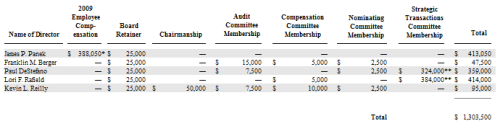
Despite the relatively simple task of overseeing a shell company and conducting an ordinary sale process, the Board has paid itself inordinately high compensation. The table below describes the principal executive officer’s 2009 cash compensation and the director cash compensation scheme for the VaxGen Board, as described in the Company’s 2008 annual report on Form 10-K:

VXGN Board Compensation 1

(This table has been modified from the original to fit this space)

* Consists of $195,000 annual base salary for 25 hours per week employment and a $193,050 lump sum payment. The lump sum payment was approved by the Board in consideration for Mr. Panek’s agreement not to resign for “good reason” under his employment agreement.

** VaxGen announced in its quarterly report for the period ended June 30, 2009 that, effective September 1, 2009, it had disbanded the Strategic Transactions Committee and that, following its disbandment, Board members would no longer receive additional compensation for service thereon.

While it is difficult to envision the rationale for the high cash compensation awarded to the Chairman Kevin Reilly and Franklin Berger, the most excessive portion of the director compensation consisted of the payments to the non-employee members of the Strategic Transactions Committee. Beginning in May 2008, Board members Lori F. Rafield and Paul DeStefano received $20,000 per month and $15,000 per month, respectively, for service on the Strategic Transactions Committee, which was formed to identify, review and evaluate potential strategic transactions and alternatives. Within a few months, these directors increased their compensation to $32,000 and $27,000 per month, respectively. This compensation is extraordinarily excessive.

Insignificant Board Equity Ownership

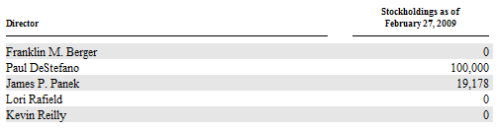
The members of the Board hold very few shares of the Company’s common stock. Most of the Board’s beneficial ownership holdings consist of underwater stock options. The following table describes the stockholdings of the Board, as set forth in the 2008 annual report, excluding options.

VXGN Board Compensation 2This Board has failed to take the steps we believe are necessary to preserve and enhance stockholder value. We believe the actions taken by the Board indicate that they are more interested in acting in their own self-interest rather than in the best interests of stockholders.

Value Investors for Change urges you to vote FOR the Fund’s proposal to elect the Nominees on the enclosed WHITE proxy card, thereby ending this disregard for stockholder interests. Vote to elect a new slate of directors who are willing to stand up for the interests of all stockholders and work to maximize stockholder value.

The members of the Board hold very few shares of the Company’s common stock. Most of the Board’s beneficial ownership holdings consist of underwater stock options. The following table describes the stockholdings of the Board, as set forth in the 2008 annual report, excluding options.

Hat tip bellamyj and matt.jensen08.

[Full Disclosure:  We have a holding in VXGN. This is neither a recommendation to buy or sell any securities. All information provided believed to be reliable and presented for information purposes only. Do your own research before investing in any security.]

Read Full Post »

Axcelis Technologies Inc (NASDAQ:ACLS) has filed its 10Q for the period ended June 30, 2009.

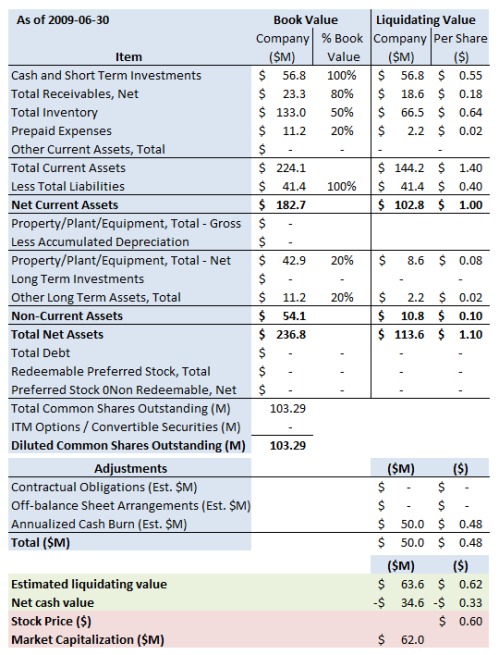
We started following ACLS on January 8 this year (see our post archive here) because it is an undervalued asset play with an activist investor, Sterling Capital Management, holding 10.7% of its outstanding stock. ACLS has completed the sale of its 50% interest in SEN Corporation, its joint venture with Sumitomo Heavy Industries, Ltd. (SHI) to SHI for proceeds of $122.3 million. ACLS received around $35.9M in cash after applying $86.4M of the proceeds to meet obligations to the holders of the company’s 4.25% Convertible Senior Subordinated Notes, upon which ACLS defaulted in January. We last estimated ACLS’s liquidation value at around $117.8M or $1.14 per share. Following our review of the 10Q, we’ve reduced our estimate to $113.6M or $1.10, which is around 80% higher than its $0.60 close yesterday. Cash burn is a significant issue for ACLS. At the current rate of cash burn, we estimate the company has around six months before its liquidation value meets its current price, and around a year before it’s worthless.

The value proposition updated

During the three months ended June 30, 2009, ACLS continued to burn cash in its operations, which it attributes to the depressed semiconductor equipment market and the resultant decline in revenues. Cash and cash equivalents at June 30, 2009 were $56.8M, compared to $71.2M at March 31, 2009. The company attributes the $21.4M decrease in cash and cash equivalents to the cash used in operations and payments of fees and other costs associated with the sale of the investment in SEN. The company anticipates net cash outflows from operations in the remainder of 2009. Set out below is our adjusted balance sheet for ACLS (the “Book Value” column shows the assets as they are carried in the financial statements, and the “Liquidating Value” column shows our estimate of the value of the assets in a liquidation):

ACLS Summary 2009 6 30

We’ve been quite kind to ACLS by assuming only $50M of cash burn over the next twelve months. On its current form, $80M would have been closer to the mark. We’re assuming management takes some action to staunch the flow, but an assumptions like that might make us look like fools.

Conclusion

ACLS has made substantial operating losses over the last two years, and it is likely to be continue to do so. While its liquidation value of around $113.6M or $1.10 per share is more than 80% higher than its close yesterday of $0.60, it is likely to deteriorate while it continues its operating losses. ACLS continues to be our problem child, and we don’t think there is any good news on the horizon near-term, but we find it difficult to exit the position while it’s trading at a such a large discount to its (albeit deteriorating) liquidation value. Accordingly, we’re going to hold on for the moment, and see how the position plays out. If we get an opportunity to exit at close to value, however, we’ll take it. If the position hasn’t improved by the next Q, we’re likely sellers.

[Full Disclosure:  We have a holding in ACLS. This is neither a recommendation to buy or sell any securities. All information provided believed to be reliable and presented for information purposes only. Do your own research before investing in any security.]

Read Full Post »

Avigen Inc (NASDAQ:AVGN) has filed its 10Q for the period ended June 30, 2009.

One interesting aspect of the 10Q is the cost the company attributes to responding to the proxy fight and hostile tender offer:

Operating Activities. Net cash used in operating activities was $8.2 million during the six months ended June 30, 2009. Net cash used in operating activities during this period was primarily used to fund costs associated with our response to a proxy fight and hostile tender offer, and winding down clinical research and development activities, including non-clinical studies and clinical trials performed by third parties.

$8.2M? That’s $0.27 per share! Granted, some of it went to other activities, but presumably costs associated with “response to a proxy fight and hostile tender offer” was the larger portion of the $8.2M and that’s why it was listed first. It’s galling what directors are allowed to spend fighting off shareholders.

We started following AVGN in December last year (see archived posts here) because it was a net cash stock and specialist biotechnology investor Biotechnology Value Fund (BVF) was pushing it to liquidate and return its cash to shareholders. Despite BVF’s failure to remove the board, we continued to maintain our position in AVGN because BVF won a number of important concessions from the board that made AVGN a much more attractive stock than it was when we started following it. AVGN is now back in negotiations with MediciNova, Inc. regarding a proposed acquisition by MediciNova. The consideration for the deal is AVGN’s “net cash liquidation value plus $3 million” and “a contingent payment right for a specific product program milestone payment associated with Avigen’s Assignment Agreement with Genzyme Corporation, potentially subject to certain adjustments.” The stock price reflects this: AVGN closed yesterday at $1.34, up 106.2% from our $0.65 purchase price. We last estimated the net cash liquidation value at around $34M or $1.14 per share. We’ve now updated our estimate to $35M or $1.17 per share. Including the $3M from MediciNova would increase that value to around $38M or $1.27per share. We believe that there is a reasonable chance that AVGN will yield more than its current $1.34 share price when the “contingent payment right” capturing the near term payments from Genzyme is taken into account. AVGN shareholders also have an option-like exposure to any value in AVGN’s AV411 assets and program, although we cannot estimate the value of this with any certainty.

The value proposition updated

Set out below is our adjusted balance sheet for AVGN (the “Book Value” column shows the assets as they are carried in the financial statements, and the “Liquidating Value” column shows our estimate of the value of the assets in a liquidation):

AVGN Summary 2009 6 30

Conclusion

While BVF’s slate was unsuccessful at the special meeting, AVGN’s board has developed its own plan of liquidation, which should put a floor on AVGN’s stock at around its net cash value of $34M or $1.14 per share less wind down costs. There exists a good chance that AVGN will yield considerably more than its net cash value. The net cash estimate does not take into account AVGN’s AV411 assets and program or near term payments from Genzyme. With the downside protected, and a good chance at some upside from here, we think AVGN still represents good value, and we’re going to maintain our position accordingly.

[Full Disclosure: We have a holding in AVGN. This is neither a recommendation to buy or sell any securities. All information provided believed to be reliable and presented for information purposes only. Do your own research before investing in any security.]

Read Full Post »

Steel Partners has increased its holding in CoSine Communications Inc (OTC:COSN) from 44.9% to 47.5% at an average purchase price of $1.97 per share according to the fund’s most recent 13D notice.

We’ve been following COSN (see our COSN post archive) because it is a cash box controlled by activist investor Steel Partners. Steel Partners own 47.5% of the stock and sits on the board. The stock is up 16% since our initial post to close Friday at $2.03. We estimate the net cash value to be around $22.2M or $2.20 per share. The net cash value has remained stable through 2006, 2007, 2008 and 2009. COSN presents an opportunity to invest alongside Steel Partners at a discount to net cash in a company with substantial NOLs.

Hat tip FF.

[Full Disclosure:  We do not have a holding in COSN. This is neither a recommendation to buy or sell any securities. All information provided believed to be reliable and presented for information purposes only. Do your own research before investing in any security.]

Read Full Post »

Two VaxGen Inc (OTC:VXGN) shareholders have sent a letter to the board of directors of the company claiming that the directors have failed in their fiduciary duties to shareholders. After reading the “list of grievances and imponderables over the actions of VaxGen’s Board and Management” laid out in the letter, you’ll find it hard to disagree. C. Fred Toney and Ruediger Naumann-Etienne, Ph.D., the authors of the letter, “seek an immediate change to the mode of operations and the composition of the Board” and implore the Board to make “drastic changes,” which include paying a $0.50 per share dividend. The letter is of epic, Tolstoyesque proportions, but we thoroughly recommend you read it if you hold stock in VXGN.

About our position in VXGN

We’ve been following VXGN (see our post archive here) because it is trading at a substantial discount to its net cash position, has ended its cash-burning product development activities and is “seeking to maximize the value of its remaining assets through a strategic transaction or series of strategic transactions.” If the company is unable to identify and complete an alternate strategic transaction, it proposes to liquidate. One concern of ours has been a lawsuit against VXGN by its landlords, in which they sought $22.4M. That lawsuit was dismissed in May, so the path for VXGN to liquidate has now hopefully cleared.

VXGN has now also attracted the attention of BA Value Investors, which has disclosed an activist holding and called on VXGN to “act promptly to reduce the size of the board to three directors; reduce director compensation; change to a smaller audit firm; terminate the lease of its facilities; otherwise cut costs; make an immediate $10 million distribution to shareholders; make a subsequent distribution of substantially all the remaining cash after settling the lease termination; distribute any royalty income to shareholders; and explore ways to monetize the public company value of the Issuer and use of its net operating losses.”

VXGN is up 20.8% since we initiated the position. At its $0.58 close yesterday, it has a market capitalization of $19.2M. We last estimated the company’s liquidation value to be around $25.4M or $0.77 per share. VXGN has other potentially valuable assets, including a “state-of-the-art biopharmaceutical manufacturing facility with a 1,000-liter bioreactor that can be used to make cell culture or microbial biologic products” and rights to specified percentages of future net sales relating to its anthrax vaccine product candidate and related technology. The authors of the letter ajudge VXGN’s liquidation value to be significantly higher at $2.12 per share:

Excluding the lease obligations, the net financial assets alone of $37.2 million equate to $1.12 per share. The EBS royalties (assuming a 6% royalty rate and a $500 million contract as contemplated by NIH/HHS and EBS) of $30 million and milestones of $6 million total $36 million of potential additional future value (based clearly on assumptions, none of which are assured), or $1.09 per share. Adding $1.12 and $1.09 equals $2.21 per share.

The letter from C. Fred Toney and Ruediger Naumann-Etienne, Ph.D.

Here is the press release announcing the letter (via CentreDaily):

July 14, 2009

Mr. Kevin L. Reilly

VaxGen Corporation

349 Oyster Point Blvd.

South San Francisco, CA 94080

VaxGen’s Board of Directors:

Kevin L. Reilly, Chairman

James P. Panek

Franklin M. Berger, CFA

Lori F. Rafield, Ph.D.

Paul DeStefano

Re: Letter from Shareholders of VaxGen Corporation

Dear Mr. Reilly and Members of the Board of Directors:

The current modus operandi is untenable. Although there are no agreements, arrangements or understandings with any other shareholders, it is clear that a substantial portion of the shareholders of VaxGen Corporation (“VaxGen” or the “Company”) oppose the actions of the Board of Directors (the “Board”). We seek an immediate change to the mode of operations and the composition of the Board. The Board and Management spend the Company’s valuable precious resources of cash every day, lavishly on themselves and to maintain some semblance of operations even though there has been no product development or business operations for more than 18 months. Furthermore, since March 2008, for 15 months the Company has purportedly sought out a partner, merger or sale, but after more than 60 Company Board and Committee meetings during 2008 alone and at least four offers of terms, none has been shared with the shareholders of the Company for consideration.

Worse yet, there appears to be no plan by the Board or Management to change the status quo and each day the Board, Management and others consume the remaining valuable resources. In short, that appears to be the plan.

As a brief overview, the Management and Board have embarked upon a failed merger that garnered virtually no support from its shareholders, and was opposed by ISS, and continued on that path until the date of the special shareholders meeting and scheduled vote, spending lavishly in a failed effort to close it; attempted to implement substantial new options to itself, a plan opposed by ISS and the shareholders, which was withdrawn; continually paid itself outrageous sums of the shareholders money over the past three years; rejected highly qualified outside board members with deep, broad healthcare company experience supported by its shareholders; held many Board and Committee meetings with nothing to show for it; formed a new Strategic Transactions Committee that is highly paid but that has produced no deals for the shareholders to consider or for any outside valuation experts to formally review; spent lavishly on accountants, auditors and counsel; failed to successfully hire any outside professional negotiators and finally extinguish or remove the outstanding lease obligations; distributed no cash to the shareholders despite holding excess amounts; formed no special purpose entity to hold any royalty and milestone rights and payments for the benefit of its shareholders; and thus generally failed in its fiduciary duties to shareholders.

The list of grievances and imponderables over the actions of VaxGen’s Board and Management in the past 24 months is long, and only partially reviewed in more depth here:

1) In 2007, the Board signed a letter of intent and announced its intentions to present to shareholders for a vote to merge with Raven biotechnologies inc. (“Raven”). There is no evidence ever shown to shareholders that validate any broad support for this merger at any time by any large percentage of shares owned. However, the Board and Management vigorously promoted and supported this merger; they went on road shows, held private and public meetings, and espoused the benefits of such a merger. Raven was a very early development stage biotechnology that had been in business for 9 years with little to show for it. It had burned through over $100 million of cash. It possessed one product candidate that had completed a Phase I clinical trial, and Raven, according to its public statements, intended to partner this candidate if it ever showed further positive clinical trial results. All other product development work being conducted by Raven involved preclinical (i.e. non-human) testing and this was the focus on the Raven presentation describing the company. In informal discussions with large VaxGen shareholders it was hard to find any one who supported the proposed transaction, yet the Board and Management continued to pursue it, preparing for a proxy vote in February or March 2008. Management publicly stated many times that they had the support of the shareholders for approval of the transaction, and maintained this position until the proxy vote was to be counted, making many public statements regarding the supposed broad support. On the morning of the special shareholders meeting and vote, March 28, 2008, Management and the Board decided to remove its recommendation for the merger since their was not sufficient support for such a transaction—in fact, the proxies for voting that had already been submitted overwhelmingly voted against the transaction as outlined by Management at that meeting. Management also indicated at that time that the Company would undertake the repayment of more than $5 million in bridge loans that had already been forwarded to Raven in cash. Raven, we understand but have not been able to definitely confirm, was subsumed into another biotechnology company for less than $10 million – a value that would have all but wiped out VaxGen’s shareholders’ value along with VaxGen’s cash and assets. While it cannot definitely be established, we are left to believe that a motivating factor of the proposed merger with Raven was the future management team of the combined companies that would have left many of the VaxGen Management in lucrative positions. Institutional Shareholder Services (“ISS”) issued its unbiased well-researched report publicly recommending a vote against the merger. Without broad support, Management and the Board continued to spend valuable resources to seek to gain approval for the Raven merger. The Company states, “the process of identifying, negotiating and seeking stockholder approval to the proposed Raven merger was time consuming and expensive. For example, we recorded $2.3 million of costs, primarily professional fees, related to the proposed merger with Raven, during the year ended December 31, 2008.” These do not include the Company’s remaining cash burn during this period of time, which we will see was, and remains, substantial.

2) Management and the Board added a second provision for shareholders to vote on in its proxy vote for the Raven merger—a new option pool that equated to 22% new dilution to VaxGen shareholders, not including any new dilution from the proposed Raven merger. ISS issued its unbiased well-researched report publicly recommending a vote against this proposal as well, citing the violation of the VaxGen articles of incorporation that limited any new option pool to a lower percentage in any year. Management and the Board had ignored that provision and sought out shareholder approval anyway, which was never brought to a formal vote as per the above events outlined.

3) To retain Management during the undertaking of the Raven merger and beyond, in 2008 alone, retention cash payments were made to the Company’s three chief officers totaling $388,000 (Panek, Pfeffer, Whitehead). Furthermore, total compensation of these three officers alone totaled $5.3 million in 2006-2008 ($1.9 million CEO, $1.7 million CFO, $1.6 million Corporate/Business Development); these figures exclude compensation and severance to the prior CEO, who resigned with large cash severances in 2007, and all other Management or Board Members.

a. The Company’s President & CEO (and Board Member) received a cash payment of $193,050 in 2009 and resigned his position as CEO but remains President and a Board Member still earning $193,050 annually and is eligible for severance payments. His total compensation in 2008 was $667,000 (including a $209,000 option award and a $58,500 bonus), in 2007 was $777,000 (including a $147,000 option award and a $230,500 bonus), and in 2006 was $487,000 (including a $79,000 option award and a $45,750 bonus).

b. Total compensation for the Senior Vice President & CFO in 2008 was $577,000 (including a $88,000 option award and a $400,979 cash severance), in 2007 was $754,000 (including a $280,000 option award and a $165,000 bonus), and in 2006 was $414,000 (including a $154,000 option award and a $41,250 bonus). After payout of a large severance, he was employed by another public biotechnology company in less than 30 days of resigning from VaxGen.

c. Total compensation for the Vice President, Corporate & Business Development in 2008 was $613,000 (including a $75,000 option award and a $377,737 cash severance), in 2007 was $544,000 (including a $60,000 option award and a $195,000 bonus), and in 2006 was $442,000 (including a $80,000 option award and a $40,000 bonus).

4) The Board of Directors annual compensation is similarly high for a company with no ongoing operations. In 2008, the compensation for only those members of the Board that are both compensated as members and still remained on the Board at year end (which includes four members and excludes the three members that resigned as well as the President & CEO who is not compensated as a Board member) aggregates to $552,623 (of which $44,665 was an option award and the remaining $508,000 was cash). Surprisingly, the cash compensation of these same Board members has increased for 2009 to $878,000, or 73%. A portion of this increase is a full year of service as compared to a partial year, but certain Board members actually received a substantial cash compensation increase—a raise—in August 2008. In fact, one Board member received a 60% raise and another received an 80% raise, both of which serve on the Strategic Transactions Committee and were already the two highest compensated members. In the most conservative accounting, for the entire compensation of the Board of Directors (7 compensated members during 2008) the cash portion was $612,597 in 2008 and is slated to be at minimum of $878,000 in 2009 (just 4 compensated members), a 37% aggregate increase.

5) The Board formally rejected a highly qualified Board candidate with broad healthcare and life science board of director experience, including the current Chairmanship of a public company and current service on two other public-company boards, who was strongly supported by major shareholders. The Board’s stated reasoning for rejection was a lack of biotechnology company experience, which appears irrelevant to this holding company at the time of rejection and in its current form.

6) The Board has apparently been very busy with little to show for it. There were 62 full Board or Board Committee meetings held just in 2008. Of these, 34 of them were full Board meetings, 13 were Audit Committee meetings, 8 were Compensation Committee meetings and 7 were Nominating and Governance Committee meetings. The Board’s Strategic Transactions Committee was formed to take advantage of the valuable assets of the Company to secure a transaction to create greater value for its shareholders. It only holds ad hoc meetings, so those meetings were not included in the totals above. However, despite all of these meetings (the expenses for which Board members are compensated), there have been zero transactions for the shareholders to consider or even discuss presented in the past 15 months.

7) The Strategic Transactions Committee currently receives annual compensation totaling $708,000, but at the same time this Committee has not produced any possible transactions scenarios to be made public to the shareholders over the past 15 months. Management stated publicly at the most recent annual shareholders meeting in December 2008 that 4 formal transactions had been proposed in the year between March and December 2008—the shareholders have not been made aware what those transaction terms are nor what outside valuation analyses were performed for the Board, as required. Rather, these transactions, as well as any others discussed since, have all been rendered not acceptable by the Board or Special Committee. The Board has determined that doing nothing has been better than any other alternative. The Board has stated that it initially only sought out biotech companies for interest; later it expanded this search to diagnostic and medical technology companies; but it never opened the search to all types of companies, without any viable reason for failing to do so. With cash and milestone/royalties as the sole assets of the Company, limiting the type of company sought out for a transaction appears wholly insufficient.

8) To our knowledge, the Board has not hired a professional lease termination negotiator (other than outside corporate counsel or real estate agency) in order to negotiate an end to the remaining lease obligations. This task was left primarily to the President whose training is in other areas of expertise. Consequently, nothing has been accomplished regarding the termination of its existing lease obligations to date, which remains problematic.

9) Presumably to maintain its status as a public company entity with no operating business, Management and the Board have deemed it necessary to spend $2.7 million in audit and tax fees in 2007, and continue this in 2008 by spending an additional $666,000. It continues to retain the same audit and tax accountants.

In spite of these actions, substantial value remains in VaxGen today, but it continues to be squandered quickly and surgically. The Company burned $2.2 million in cash during just the first three months of 2009. At this current rate the Company will burn $0.27 per share in cash just this year, which is more than 50% of the Company’s current market value. As of April 1, 2009, the Company has valuable assets remaining in its cash and cash equivalents, investment securities, assets held for sale, and restricted cash, which total $39.0 million ($37.9 million of Financial Assets, as defined by the Company); the Company has Current Liabilities of $0.7 million. The remaining other long-term liabilities are its lease obligations, which are approximately $2.4 million per year through 2013 and approximately $2.6 million per year thereafter until expiration in 2016.

Excluding the lease obligations, the net financial assets alone of $37.2 million equate to $1.12 per share. The EBS royalties (assuming a 6% royalty rate and a $500 million contract as contemplated by NIH/HHS and EBS) of $30 million and milestones of $6 million total $36 million of potential additional future value (based clearly on assumptions, none of which are assured), or $1.09 per share. Adding $1.12 and $1.09 equals $2.21 per share. The current trading price of the Company’s stock is $0.50 per share (and the 52 week range is $0.33-0.79)—this definitively implies no confidence in the current Board or Management to maximize the value of VaxGen for its shareholders as it spends the remaining assets.

In a tip to the possible plans of the current Management and Board, the Company states most recently that, “we may use some or all of our remaining resources, including available cash, while we seek to identify a strategic transaction; we may fail to identify an appropriate transaction…we may use a portion or all of our remaining resources seeking to identify and complete a strategic transaction, but ultimately be unable to do so. Even if completed, such a transaction may not provide us with a pipeline or return value to stockholders, and either outcome could cause our stockholders to lose some or all of their investment in our common stock.”

The shareholders of VaxGen implore the Board that drastic changes must now occur. In late 2008 assurance were given by Management to us that dramatic actions would be taken within a matter of two months, but this has not occurred. No longer can the status quo suffice and the outflow of the remaining cash be squandered in payments to the Management & Board or to any outside service providers.

We, as shareholders, owners of the business, demand that the Board take the following actions within the next 20 calendar days:

1) Each member of the Board of Directors, regardless of Committee participation or Chairmanship, immediately agree to lower total compensation to $1 per year per person, retroactive to January 1, 2009 or accept the resignation of each non-participating Board member in the new plan. Welcome at least two new board members ready to serve for $1 per year in total compensation, who are highly qualified to address the current situation and who are proposed and supported by the shareholders signing here.

2) Immediately hire at least one new highly qualified professional lease termination negotiator or mediator (other than Company’s outside counsel or outside commercial real estate firm) to resolve an exit to the remaining lease within 30 days.

3) Immediately establish a Special Purpose Entity (“SPE”) that will contain upon transfer all of the rights, royalties, milestones and other payments from Emergent Biosolutions (“EBS”) for the sale of the rPA product candidate, structured such that it could be dividended out to shareholders. Also, in agreement with the public comments at the most recent annual meeting by Management, file and make public the EBS contract and all of its terms without redactions so that the potential future cash payments may be precisely calculated by its owners.

4) Make no further cash payments for any retention, severance or exit, or otherwise of any kind, to any member of the Board or Management.

5) Immediately distribute a minimum of $0.50 per share in cash to shareholders in a Special Dividend—announce the form of plan within 10 days.

Management and the Board may spend additional precious cash and assets to defend its actions, but we sincerely do not wish them to do so, nor do we believe this is the best use of the Company’s resources. In summary, many of the prior actions of the Board and Management do not appear to be in the best interests of the shareholders of the Company, with whom your fiduciary responsibilities reside.

Change is inevitable, either through pursuing the shareholders’ interest as outlined herewith, or by changing the Board of Directors to represent the owners of VaxGen, its shareholders, who have been ignored too long. We are open to meeting with you at any time you are available to further discuss these or other topics. We can be reached to schedule a meeting at 415-495-1010.

Sincerely,

C. Fred Toney

VaxGen shareholder

Ruediger Naumann-Etienne, Ph.D.

VaxGen shareholder

cc: Pat McBaine – Gruber & McBaine Capital Management

Mark Boyer, Mitch Soboleski – ROI Capital

Evan McCulloch – Franklin Advisors

Jonathan Harris – Morgan Stanley Smith Barney

Robert Andreatta, Steve Krognes – Genentech, Inc.

Dan Weston – WestCap Management

Steven Bronson – BA Value Investors

David Sandberg – Red Oak Partners

Kalimah Salahuddin, Luke Evnin, Ph.D. – MPM Capital

Steve Schatz

Allan Reine

John Plexico, Tim Lynch – Stonepine Capital

Daniel Gold – QVT Financial
Hat tip bellamyj

[Full Disclosure:  We have a holding in VXGN. This is neither a recommendation to buy or sell any securities. All information provided believed to be reliable and presented for information purposes only. Do your own research before investing in any security.]

Read Full Post »

Robert L. Chapman, Jr. recently resigned as Chief Executive Officer of EDCI Holdings Inc (NASDAQ:EDCI) to focus on Chapman Capital in what he says “may be the most dynamic passive investment environment of a lifetime.” In the announcement to the market, said Chapman in his inimitable style:

Having ablated and amputated certain incontinent expenditures, and set EDCI on a prudent, judicious course of balanced scrutiny of acquisition vs. recapitalization, in addition to orchestrating EDC’s Blackburn-Hannover consolidation plan, I avidly look forward to shifting all my attention to Chapman Capital and related investment portfolios during what may be the most dynamic passive investment environment of a lifetime.

We’ve written previously about Chapman’s fondness for “asset-rich companies with battered stock prices,” which sees him frequently operating in the universe of stocks trading below liquidation value. We think it’s a good sign for sub-liquidation value investors like us that Chapman is back.

Read the announcement here:

EDCI Holdings, Inc. Announces Resignation of Robert L. Chapman, Jr. as Chief Executive Officer

NEW YORK, July 2 /PRNewswire-FirstCall/ — EDCI Holdings, Inc. (Nasdaq: EDCI – News; “EDCI”), the holding company for Entertainment Distribution Company, Inc., the majority shareholder of Entertainment Distribution Company, LLC (“EDC”), a European provider of supply chain services to the optical disc market, today announced the resignation of Robert L. Chapman, Jr. as Chief Executive Officer. Mr. Chapman, who also has resigned from EDCI’s Board of Directors, had replaced Interim Chief Executive Officer Clarke H. Bailey, who himself now replaces Mr. Chapman as EDCI Chief Executive Officer and EDC Interim Chief Executive Officer, effective July 2, 2009.

Mr. Chapman commented, “When I accepted the invitation six months ago from EDCI and EDC’s Boards of Directors to lead these companies through the difficult industry and global recessionary environment that characterized the first half of 2009, I conceived and preached the mantra of ‘Don’t Burn It & Don’t Blow It’ as it related to preserving EDCI’s sacred cash holdings. Furthermore, the seemingly constant headwinds of operating in the disc manufacturing and distribution business, with Universal Music Group as EDC’s supermajority customer, required immediate countermeasures to bolster EDC’s liquidity and longevity. Having ablated and amputated certain incontinent expenditures, and set EDCI on a prudent, judicious course of balanced scrutiny of acquisition vs. recapitalization, in addition to orchestrating EDC’s Blackburn-Hannover consolidation plan, I avidly look forward to shifting all my attention to Chapman Capital and related investment portfolios during what may be the most dynamic passive investment environment of a lifetime.”

Horace Sibley, Chairman of EDCI’s Governance Committee, commented, “In the CEO position at EDCI and EDC, Bob has demonstrated the fortitude to make tough decisions to solve tough problems. Over just a few months, Bob has reformulated the culture and streamlined the cost structure in ways that should benefit both EDCI and EDC for years to come. While the Boards of both EDCI and EDC were disappointed to learn of Bob’s decision to re-focus all his energy on his investment business, there can be no doubt that Clarke Bailey, Chairman of the Board, is the ideal leader to whom the baton should be handed to serve as CEO once again.”

Mr. Chapman joined EDCI’s Board of Directors as an independent director in November 2007, and is the Managing Member of Chapman Capital L.L.C., an investment advisor focusing on activist investing and turnaround investing. Prior to founding Chapman Capital in 1996, Mr. Chapman co-managed the Value Group within Scudder Stevens & Clark, which followed employment with NatWest Securities USA and Goldman, Sachs & Co.

Mr. Bailey joined EDCI’s Board of Directors in December 1990. From September 2008 to January 2009, he served as EDCI’s Interim Chief Executive Officer, after serving as EDCI’s Chief Executive Officer from October 2003 to November 2006 and from December 1990 to March 1994. Mr. Bailey has served as Chairman EDCI’s Board of Directors since October 1999, following his service as EDCI’s Vice Chairman from November 1992 to June 1996. Currently, Mr. Bailey serves as a director on the Boards of Directors of both Iron Mountain Incorporated and ACT Teleconferencing, Inc.

Read Full Post »

« Newer Posts - Older Posts »