Feeds:
Posts
Comments

The Official Activist Investing Blog has published its list of activist investments for December (the investments with links are to our latest update at the time of this post):

Ticker Company Name Activist Investor
ACLS Axcelis Technologies Inc Sterling Capital
AEPI AEP Industries KSA Capital
ARS Arris Group Shamrock Activist Value fund
ATML Atmel Corp. Microchip Technology
AVGN Avigen Inc Biotechnology Value Fund
BCSB BCSB Bancorp Financial Edge Fund
BIOD Biodel Inc Moab Partners
CAMD California Micro Devices Corp Dialectic Capital Management
CKEC Carmike Cinemas Mark Cuban
CPWM Cost Plus Stephens Investment Management
CRXX CombinatoRX, Incorporated Biotechnology Value Fund
CTO Consolidated Tomoka Land Co Wintergreen Advisers
DANKY Danka Business Systems PLC DCML LLC
DDS Dillard’s Inc. Barington Capital; Clinton Group
DIN DineEquity Inc Southeastern Asset Management
DPS Dr Pepper Snapple Group Trian Fund
DUSA DUSA Pharmaceuticals SRB Management
DVD Dover Motorsports GAMCO
ESIO Electro Scientific Industries Nieremberg Investment Management
FIC Fair Isaac Corp Sandell Asset Management
FSFG First Savings Financial Group Joseph Stilwell
GGP General Growth Properties Pershing Square Capital
GLOB.OB Global Med Technologies Victory Park Capital
HIFN Hifn, Inc Adaptec, Inc
ICGN ICAgen, Inc Xmark Opportunity Partners
INFS InFocus Corp Nery Capital Partners
ITP Intertape Polymer Group KSA Capital Management
JAVA Sun Microsystems Southeastern Asset Management
JTX Jackson Hewitt Tax Service Shamrock
KANA.OB Kana Software KVO Capital Management
KFS Kingsway Financial Services Joseph Stilwell
KONA Kona Grill Mill Road Capital
LAQ The Latin America Equity Fund City of London Investment Management Co
LCAV LCA-Vision Inc. Stephen Joffe
MAG Magnetek Inc Riley Investment Management
MATH.PK Mathstar, Inc Salvatore Muoio; Zannet Opportunity Fund
MGAM Multimedia Games Dolphin Limited Partnership
MGLN Magellan Health Services Shamrock
MOVE Move Inc. Nierenberg Investment Management
MVCO Meadow Valley Corp Carpe Diem Capital
NDD Neuberger Berman Dividend Advantage Fund Western Investment
NTMD Nitromed Inc Deerfield Capital
OFIX Orthofix International Ramius Capital;
OPTV OpenTV Corp. Discovery Equity Partners
ORNG Orange 21 Costa Brava Partnership
PHMD PhotoMedex, Inc. James Sight
PIF Insured Municipal Income Fund Bulldog Investors
PPCO PenWest Pharmaceuticals Perceptive Advisors
PRXI Premier Exhibitions, Inc Sellers Capital
RDC Rowan Companies Steel Partners
RHIE RHI Entertainment Baupost Group
RIVR River Valley Bancorp Davee Thomas
SLRY Salary.com Cannell Capital
SLTC Selectica, Inc Versata
SUG Southern Union Co Sandell Asset Management
SUTM.OB Sun-Times Media Group Inc. K Capital
TIER Tier Technologies Inc Discovery Equity Partners
TLGD Tollgrade Communications Inc Bradford Capital
TMI TM Entertainment & Media Bulldog Investors
TRGL Toreador Resources Nanes Delorme Partners
TRMA Trico Marine Kistefos AS
TXCC TranSwitch Corp Brener International Group
TXI Texas Industries Southeastern Asset Management
WBSN Websense Inc Shamrock
WEDC White Electronic Designs Corp Wynnefield Capital
WOC Wilshire Enterprises Bulldog Investors
WRLS Telular Corp Simcoe Partners

Cobra Electronics Corporation (NASDAQ:COBR) is another tiny undervalued asset play with an activist investor – Howson Tattersall Investment Counsel Limited – disclosing a 10% holding in its 13D notice filed September 24 last year. At its $1.11 close yesterday, COBR has a market capitalization of just $7.2M. We estimate that its liquidating value is almost 100% higher at $14.2M or $2.19 per share and the first new addition to the Greenbackd Portfolio for 2009.

About COBR

COBR is a designer and marketer of two-way mobile communications products in the United States, Canada and Europe. The Company has seven product lines: two-way radios, radar detectors, Citizens Band radios, power inverters, mobile navigation, marine consumer electronics, and photo-enforcement and safety detection. The company’s investor relations website is here.

The value proposition

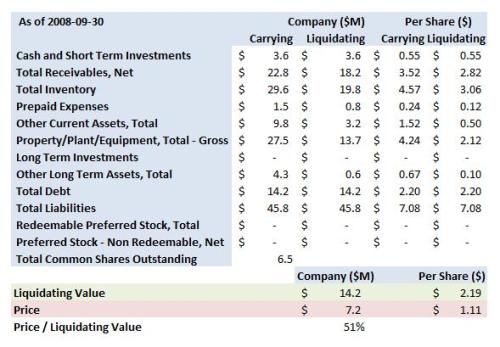
COBR has generated mildly positive earnings for the last three quarters but has generally lost money since 2006. As always, there is some value on the balance sheet (the “Carrying” column shows the assets as they are carried in the financial statements, and the “Liquidating” column shows our estimate of the value of the assets in a liquidation):

cobr-summary

COBR’s value in liquidation is predominantly in its $22.8M in receivables, which we have discounted by a fifth to $18.2M or $2.82 per share, and $29.6M in inventory, which we value at $19.8M or $3.06 per share. The other source of value on the balance sheet is COBR’s $27.5M property, plant and equipment, which we’ve written down by half to $13.7M or $2.12 per share. COBR has $14.2M in debt and other substantial liabilities in the amount of $45.8M or $7.08 per share. Deducting COBR’s liabilities from its written down asset value, we estimate COBR’s liquidating value at around $14.2M or $2.19 per share, which is 97% higher than its $1.11 close yesterday.

The catalyst

Howson Tattersall Investment Counsel Limited’s 13D notice filed September 24, 2008 discloses a 10% holding in COBR but little else – it adopts the standard boilerplate in its filing. Howson Tattersall’s website does discuss its equity investment philosophy:

Our equity investment process is based on value investing because it provides a consistent, statistically grounded approach to the analysis of investment opportunities.

After narrowing the universe of potential investments to companies with attractive quantitative factors, we undertake independent qualitative research, which is at the core of our selection process. This involves reviewing financial statements and meeting with company management.

Conclusion

While its earnings record is spotty, with a $2.19 liquidating value some 97% higher than its closing price yesterday, COBR is very cheap. We can’t divine Howson Tattersall’s modus operandi from its public documents, which makes it difficult to determine its effectiveness as a catalyst. This doesn’t concern us too much as COBR’s steep statistical discount to its value should provide downside protection which will leave the upside to take care of itself.

Take care to use limit orders if you propose to trade in COBR as the stock is very thinly traded.

COBR closed yesterday at $1.11.

The S&P500 Index closed yesterday at 927.45.

[Disclosure:  We don’t have a holding in COBR. This is neither a recommendation to buy or sell any securities. All information provided believed to be reliable and presented for information purposes only. Do your own research before investing in any security.]

Welcome back to Greenbackd and happy new year for 2009. We hope that you had a good break. There have been a number of positive developments in the companies we discussed last year. Set out below is an update on those positions we had open in the Greenbackd Portfolio at the close of 2008:

  • Trilogy has increased its stake in ABTL to 7.4%. ABTL is up 18.6% since our first post but we are maintaining our position because we think it’s still worth 50% more.
  • BVF has endorsed the MNOV offer for AVGN. AVGN is up 20% since our first post but we are holding on because we think the merger presents an opportunity for AVGN’s stockholders to receive around $1.20 per share in cash (almost 60% higher than AVGN’s $0.78 close Friday) and the possibility of “an extraordinary, uncapped return” if MNOV is successful post-merger.
  • BRN has filed its September 10Q and we believe that its liquidation value has increased from $6.52 per share to $6.91 per share. The stock is up 41% since our initial post. We still see the liquidation value some 40% higher than BRN’s Friday close of $4.95, so we will maintain our position.
  • CRC is down 6.3% from our initial post. Other than the retirement of the CFO, we have no other news to report. With CRC in a liquidity crisis, the retirement of the CFO is a worrying development. That said, we see CRC’s liquidation value at around $2.45 per share, which is more than 450% higher than its Friday close of $0.43, so we propose to maintain our position.
  • A group of “high-powered executives” plan to save INFS from “New York sharks.” The stock is up 15.9% to $0.73 since our initial post. Its liquidating value is still some 58% higher at $1.15 per share and so we are maintaining the position.
  • We’ve closed our position in KONA for an 88% gain in 18 days.
  • A new activist investor has filed a 13D for MATH and is lobbying the company to liquidate. MATH is up 17.7% since our first post but it’s still trading at half its liquidating value and a little more than half its net cash backing, so we’re maintaining our position.
  • ZLC is off 16.8% from our initial post. We’ve estimated its liquidation value at $7.63 per share, which is still 90% higher than its $4.01 close Friday, so we are maintaining our position in ZLC.

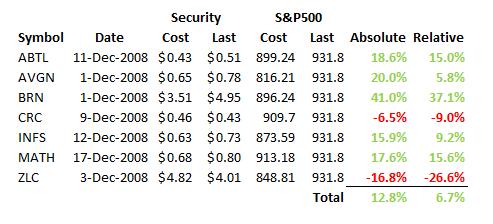
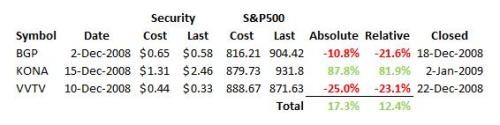
Although it is still too early to determine how Greenbackd’s strategy of investing in undervalued asset situations with a catalyst is performing, we’ve set out below a list of all the stocks we’ve included in the Greenbackd Portfolio and the absolute and relative performance of each. This is the standardized format we propose to adopt to track Greenbackd’s performance at 6-monthly intervals:

Current holdings (As at January 5, 2009)

greenbackd-portfolio-current-holdings-performance

Former holdings (As at date of our closure of the position)greenbackd-portfolio-former-holdings-performance

The absolute total return across the current and former positions as at January 5, 2009 is 14.2%, which is 8.4% higher than the S&P500’s return over the same periods. As we discussed above, the holding periods for Greenbackd’s positions has been too short to provide any meaningful information about the likely performance of the strategy over the long term (2 to 5 years), but we believe that the strategy should outperform the market by a small margin.

We look forward to bringing you the best undervalued asset situations we can dig up in 2009.

A new investor has filed a 13D notice in relation to MathStar Inc (OTC:MATH).

When we started following MATH, it had a market capitalization of just $6.2M based on its December 16, 2008 close of $0.68. We estimated its liquidating value to be more than 120% higher at $14.4M or $1.57 per share. The value in liquidation was predominantly cash and short term investments in the amount of $14.8M. The board had largely suspended the company’s operations and was in the process of evaluating its “strategic alternatives, which could include merger, acquisition, increasing operations in another structure or liquidation.”  MATH had twice rejected unsolicited merger proposals and Salvatore Muoio of S. Muoio & Co. LLC had been urging MATH’s board to consider liquidation rather than a merger.

Mr. Zachary McAdoo on behalf of The Zanett Group – the new investor entering the fray at MATH – filed its 13D notice on December 30, 2008 and attached the following letter to the company:

December 30, 2008

Douglas Pihl
Chairman of the Board
Mathstar, Inc.
19075 NW Tanabourne, Suite 200
Hillsboro, OR 97124

Dear Mr. Pihl,

I am writing to express my opinion as a shareholder that we strongly urge the
Board to liquidate Mathstar, Inc. rather than acquire another company.

Sincerely,

Zachary McAdoo, CFA

Short, sweet and to the point. Hopefully management can hear the drum beats calling for liquidation.

MATH is up around 18% since we started following it, but it’s still trading at half its liquidating value and a little more than half its net cash backing, so we’re maintaining our position.

[Disclosure: We do not presently have a holding in MATH. This is neither a recommendation to buy or sell any securities. All information provided believed to be reliable and presented for information purposes only.]

Barnwell Industries, Inc. (AMEX:BRN) has filed its September 10Q and the results are encouraging. Even though the stock is up more than 40% since our first post, we believe that BRN is still undervalued and so we are maintaining our position.

We started following BRN because its liquidation value of $55M (around $6.52 per share) was some 86% higher than its market capitalization of  $29M based on its November 28, 2008 close of $3.51. Dr. Eric Jackson’s Ironfire Capital LLC had launched a “‘friendly’ activist campaign targeting the company to unlock shareholder value”.

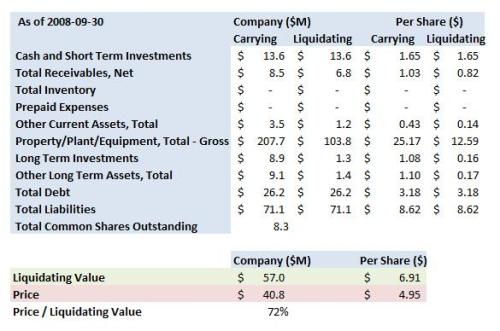
BRN has now filed its September 10Q and we believe that its liquidating value has increased from our original estimate of $6.52 per share to $6.91 per share, which is some 40% higher than its Friday close of $4.95. Set out below is our summary analysis of the balance sheet (each “Carrying” column shows the assets as they are carried in the financial statements, and each “Liquidating” column shows our estimate of the value of the assets in a liquidation):

brn-summary-q3

Conclusion

Although the stock has risen substantially, at 72% of its written down value, BRN is still cheap and we are maintaining our position.

[Disclosure: We do not presently have a holding in BRN. This is neither a recommendation to buy or sell any securities. All information provided believed to be reliable and presented for information purposes only.]

Trilogy, Inc. has increased its stake in Autobytel Inc (NASDAQ:ABTL). On November 21, 2008, Trilogy, Inc. filed its Schedule 13D notice, declaring an interest of 5.01%. Trilogy, Inc has now filed an updated 13D notice, disclosing an increased 7.4% stake.

We started following ABTL last year because it was a net net stock with a market capitalization of $19.4M at its December 10, 2008 close of $0.43. We estimated the company’s liquidation value some 80% higher at $35.3M or $0.78 per share. Although the stock has risen some 18.6% to close Friday at $0.51, ABTL is still worth 50% more than its stock price indicates so we plan to maintain our position.

[Disclosure: We do not have a holding in ABTL. This is neither a recommendation to buy or sell any securities. All information provided believed to be reliable and presented for information purposes only.]

We’ve decided to exit our position in Kona Grill Inc (NASDAQ:KONA). We first posted about KONA on December 15, 2008 when the stock had last traded at $1.31. At Friday’s $2.46 close, our theoretical profit on the play of $1.15 equates to an absolute gain for holding KONA of 87.8%. The S&P 500 closed December 12, 2008 at 879.73 and closed Friday at 931.80 (+5.9%), so we’re up 81.9% on a relative basis.

We started following KONA because it was an undervalued asset situation with a potential acquirer – Mill Road Capital – raising its stake in the company through November last year. We’ve closed our position for two reasons:

  1. KONA’s stock price has now risen to our estimate of its liquidating value of $14.8M or $2.47 per share. When we opened the position at $1.31 KONA had a market capitalization of just $7.9M, which meant it was trading at almost a 50% discount to its liquidating value. The discount is now gone, and that’s a good enough reason to close the position.
  2. KONA has entered into an agreement to issue stock to the CEO’s father at a $1.19 per share. The price is a substantial discount to the market price for KONA stock at the time of the agreement, the price KONA solicited from Mill Road Capital and the current market price. Behaviour like this – issuing stock at a discount to liquidation value when competing offers are available – raises red flags for us about KONA management’s lack of regard for KONA stockholders.

Our holding period for KONA was 18 days, which was unexpectedly short, and ended before Mill Road Capital was able to persuade KONA to undertake some catalytic event. We mentioned in our About Greenbackd page that the market would occasionally spontaneously recognize the underlying asset value and remove the discount, and that seems to have happened here. By any measure, an 88% return over 18 days is an excellent return, but we caution that it was a happy accident and is unlikely to be repeated.

Mill Road Capital has filed an amended 13D attaching a letter sent to Kona Grill Inc (NASDAQ:KONA). In the letter Mill Road Capital raises some concerns about the issuance of KONA stock to the CEO’s father at a substantial discount to the then current market price and the price that KONA solicited from Mill Road Capital in a December meeting. Mill Road Capital’s letter to KONA is set out below:

Marcus Jundt
Chairman & CEO
Kona Grill, Inc.
7150 East Camelback Road
Suite 220
Scottsdale, AZ 85251
Dear Marcus:

I am writing as a follow-up to our meeting on December 17, 2008. In that meeting which Rick Hauser attended, you outlined the following proposal:

•Mill Road Capital (“Mill Road”) would make a personal loan to Hauser and you for $6 million. This loan would be secured by Hauser’s and your personal assets including the stock in Kona Grill, Inc. (“Kona” or the “Company”).

•Hauser and you would use the $6 million to purchase 4 million newly issued shares of Kona at $1.50 per share.

•As compensation for making the loan, Mill Road would be allowed to buy 2 million newly issued shares of Kona at $1.50 per share, and Mill Road would be given one seat on the Board of Directors.

In that meeting, we rejected your proposal on two grounds. First, we believed it violated the Sarbanes-Oxley amendments to the Securities Exchange Act of 1934 prohibiting the Company from directly or indirectly arranging loans to management. We further rejected the proposal because it was not part of a competitive process that would ensure the highest value to the Company and all of its shareholders.

At the end of the meeting, we indicated that we would be willing to take part in any competitive process that the Company initiated in order to either raise funds or sell the Company. You noted that no such transactions would be completed before year end.

I note that in the 8-K filed by the Company yesterday, the Company said it had entered into a subscription agreement to sell shares to your father at $1.19 per share, a substantial discount to both the price of $1.50 per share that you solicited from us and the current market price of $1.57.

Mill Road Capital is the 2nd largest shareholder in the Company. We remain committed to seeing the Company undertake a fair and competitive capital raising process that would ensure the highest long-term value to all shareholders.

Is it your plan to subject that proposed transaction to the fully competitive process that we requested in the meeting on December 17th?

Sincerely,

Thomas Lynch
Senior Managing Director
Mill Road Capital L.P.

It seems that rather than undertake a fair and competitive capital raising process, KONA has issued stock to the CEO’s father, which is a disappointing outcome for KONA’s stockholders. The fact that the issuance was undertaken at such a discount to the prevailing market price for KONA stock raises a red flag for us.

In its most recent 13D filing Biotechnology Value Fund (BVF) has provided its “full and enthusiastic support” for MediciNova, Inc.’s (NASDAQ:MNOV) offer for Avigen, Inc. (NASDAQ:AVGN).

We’ve been following AVGN (see earlier posts here, here, here, here and here) because it’s a net cash stock (i.e. it’s trading at less than the value of its cash after deducting all liabilities) and specialist biotechnology activist fund BVF has been pushing it to liquidate and return its cash to shareholders. We think that MNOV’s offer represents a clever way for AVGN’s stockholders to receive cash equivalent to that which they would receive in a liquidation (less $7M to be paid to MNOV). We estimate the cash to be paid at around $1.22 per share (BVF estimates the amount at $1.20 per share), which is more than 60% higher than AVGN’s $0.76 close Wednesday. AVGN’s shareholders also have the option to receive MNOV shares instead of the cash. MNOV values its shares at $4.00 (MNOV closed Wednesday at $1.59).

BVF’s filing sets out its rationale for endorsing the merger. The relevant text is extracted below:

On December 22, 2008 MediciNova, Inc. (“MediciNova”) described details of a Proposed Merger between MediciNova and Avigen, Inc. (“Avigen”) in a letter to Avigen’s Chairman, Zola Horovitz. The Reporting Persons hereby express their full and enthusiastic support for this Proposed Merger and believe it is the best interest of all Avigen shareholders. The Reporting Persons presently have no economic interest in MediciNova. The Reporting Persons call on Avigen’s Board of Directors to negotiate with MediciNova and work to consummate the Proposed Merger expeditiously.

The Reporting Persons support the Proposed Merger for the following reasons:

1. Downside Protection: The Proposed Merger provides for the same downside protection that the Reporting Persons encouraged Avigen to implement directly (which Avigen rejected). Subsequent to the Proposed Merger, if MediciNova is unsuccessful, Avigen shareholders will receive approximately the current liquidation value of Avigen (which the Reporting Persons estimate to be approximately $1.20/share, net of debt and expenses), as determined by an independent auditor. Incredibly, in a worst case scenario, the Proposed Merger would yield about a 60% premium to Avigen’s current stock price.

2. Extraordinary Upside Potential: If MediciNova is successful post-merger, Avigen shareholders could own a substantial percentage of MediciNova (which the Reporting Persons estimate to be approximately 45% of the combined company). Thus, in a best case scenario, Avigen shareholders could enjoy an extraordinary, uncapped return. For this reason, the Proposed Merger is superior to an immediate liquidation of Avigen.

3. Free Option: Shareholders have at least one year after the merger is consummated to choose downside protection or upside potential, as described above. This decision can be based on information obtained over the course of the free option period, including the stock performance of MediciNova. This free option period offers shareholders tremendous upside potential with virtually no risk.

4. Change of Control: The Proposed Merger would result in new stewardship of Avigen’s assets, curtailing current management’s stated plan of seeking ways to utilize (and we fear waste) Avigen’s cash in any way they wish. This is a particularly frightening prospect in light of CEO Ken Chahine’s recent statements that “it’s hard to put a finger on exactly what we would do”, that he “intends to build” and that he “thinks that there are opportunities outside of therapeutics.”

5. Unique Synergies: The Reporting Persons believe there are unique synergies between MediciNova and Avigen which likely would not exist with other potential acquirers of Avigen. These synergies give rise to the compelling nature of the Proposed Merger.

BVF wishes to see the Proposed Merger brought to a shareholder vote as soon as practical and urges other Avigen shareholders to support this offer.

We’ve noted in our earlier posts that AVGN presents an attractive investment opportunity if BVF can persuade it to quickly distribute its remaining cash to stockholders. MNOV’s offer presents a clever way for AVGN’s stockholders to receive an amount equivalent to its cash with the possibility for “an extraordinary, uncapped return” if MNOV is successful post-merger. We estimate AVGN’s cash at around $1.22 per share, which is more than 60% higher than AVGN’s $0.76 close Wednesday. With BVF’s endorsement of MNOV’s offer, we believe the investment rationale for AVGN is strong.

[Disclosure: We have a holding in AVGN. This is neither a recommendation to buy or sell any securities. All information provided believed to be reliable and presented for information purposes only.]

The Icahn Lift

We’re unabashed fans of Carl Icahn, who’s reputation for pushing up the stock prices of the companies he invests in has led to a phrase that describes his Midas touch: the “Icahn lift.” We’ve previously covered the billionaire investor’s antics in YHOO here. Our gift to you is 60 Minutes’ August profile on Icahn:

It takes a certain breed of stock market investor, the kind with lots of money and lots of guts, to thrive in queasy times like these, when the market keeps losing altitude. Carl Icahn is one of that breed.

He has a knack for turning someone else’s loss into profit for himself. But he can also help others improve their bottom line through the so-called “Icahn Lift,” an upward bounce that often happens when he starts buying a beleaguered stock.

To see the video, click here: (60 Minutes’ “The Icahn Lift”). Enjoy!