Feeds:
Posts
Comments

MathStar Inc (OTC:MATH) has received another merger offer from PureChoice, Inc., this one providing for a $1.04 per share cash payment to the MATH stockholders.

We’ve been following MATH since December last year (see our post archive here) when it was trading at $0.68. We initiated the position because MATH was trading below its net cash value and had two substantial stockholders lobbying management to liquidate. The stock is up 33.8% to $0.91 yesterday, giving it a market capitalization of $8.4M. We estimate MATH’s liquidation value to be around $12.0M or $1.31 per share. That value is predominantly cash and short term investments and doesn’t take into account any further value that the sale of the FPOA technology and intellectual property may yield. The two activist investors, Mr. Zachary McAdoo of The Zanett Group and Mr. Salvatore Muoio of S. Muoio & Co., have been urging MATH’s board to consider liquidation rather than a merger. MATH’s board seems to agree, twice rejecting unsolicited merger proposals from PureChoice, Inc., suspending the company’s operations and exploring “strategic alternatives, which could include merger, acquisition, increasing operations in another structure or liquidation.”

The press release from PureChoice, Inc. (via Earth Times) is as follows:

BURNSVILLE, Minn., May 11 /PRNewswire/ — PureChoice, Inc., a leader in building performance software, has made a merger offer to MathStar, Inc. providing for a $1.04 per share cash payment to the MathStar stockholders. The offer represents a 23 percent premium over Friday, May 8, 2009 market close of $.84 per share.

The merger offer was outlined Monday in a letter to the MathStar board of directors from Bryan Reichel, President and CEO of PureChoice.

The merger offer is contingent upon several factors, including minimum MathStar cash balances and maximum MathStar liabilities at closing, and the absence of certain specified transactions, commitments or other arrangements between January 1, 2009 and the closing date.

We need to see the full terms of the offer, but it seems to be pitched at a large discount to MATH’s liquidation value. We would hope that any merger offer would, at the minimum, reflect MATH’s liquidation value of $12.0M or $1.31 per share. We’ll keep a weather eye on the negotiations.

[Full Disclosure:  We do not have a holding in MATH. This is neither a recommendation to buy or sell any securities. All information provided believed to be reliable and presented for information purposes only. Do your own research before investing in any security.]
Bill Ackman’s Pershing Square has filed the presentation to be delivered to the shareholders of Target Corporation (NYSE: TGT) at TGT’s 2009 Annual Meeting of Shareholders. See our post TGT archive here.

See Bloomberg’s interview with Bill Ackman about his slate (via The Manual of Ideas):

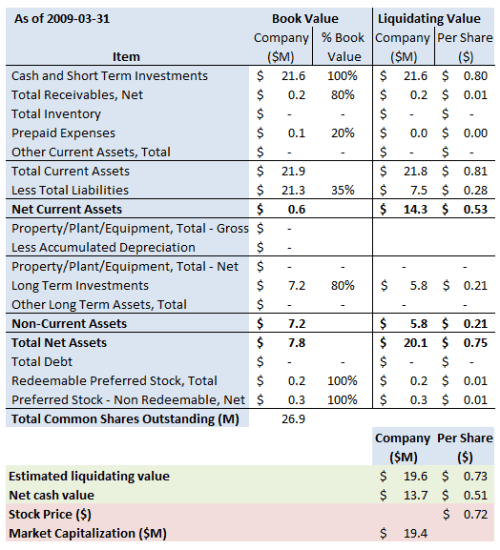
Neurobiological Technologies Inc (NASDAQ:NTII) has filed its 10Q for the period ended march 31, 2009. After reviewing the 10Q, we have reduced our estimate of NTII’s liquidation value to $19.6M or $0.73 per share. NTII closed on Friday at $0.72, which is approximately our estimate of its value, and so we are taking the opportunity to exit. We opened the position on February 23, 2009 at $0.53, so we are up 35.9% on an absolute basis. The S&P500 Index was at 770.05 when we opened the position, and closed Friday at 929.23, which means we are up 15.2% on a relative basis.

We started following NTII (see our post archive here) because it was trading at a substantial discount to our estimate of its $21.9M or $0.81 per share liquidation value and Biotechnology Value Fund, Millennium Technology Value Partners and Highland Capital Management held approximately 45% of NTII’s outstanding stock (one stockholder estimated 65%) and were calling for its liquidation. NTII has now reached our reduced estimate of its liquidation value, so we are exiting the position.

The value proposition updated

NTII expects “cash, cash equivalents, short-term and long-term investments to total approximately $23 million at June 30, 2009,” which is up slightly from our estimate as at March 31, 2009. The summary of our estimate for the company’s liquidation value is set out below (the “Book Value” column shows the assets as they are carried in the financial statements, and the “Liquidating Value” column shows our estimate of the value of the assets in a liquidation):

NTII Summary 2009 3 31

Conclusion

At its $0.72 close on Friday, NTII is trading at just under our estimate of its $0.73 per share liquidating value. While we believe that there may be slightly more value in NTII (for example, if it receives a portion of the net proceeds paid to Celtic Pharmaceuticals upon a sale of XERECEPT), we ‘re not certain of that value, so we’re taking the opportunity to exit now.

[Full Disclosure:  We do not have a holding in NTII. This is neither a recommendation to buy or sell any securities. All information provided believed to be reliable and presented for information purposes only. Do your own research before investing in any security.]

Vanda Pharmaceuticals Inc. (NASDAQ:VNDA) yesterday announced that the US Food and Drug Administration (FDA) had granted marketing approval following its Phase III clinical study of Fanapt™ (iloperidone). Tang Capital Partners has ended its proxy contest by withdrawing its nominations of director candidates for election to VNDA’s Board of Directors and its stockholder proposal to liquidate VNDA. We are closing our position too. The stock ran 900% on the announcement to $10.00 in after-hours trade and closed yesterday at $7.84. We opened the position on March 12, 2009 at $0.78, so we’re up 905.1% on an absolute basis. The S&P500 Index closed at 721.36 on the same day, and closed yesterday at 907.39, which means we’re up 881.7% on a relative basis.

We started following VNDA (see our post archive here) because it was trading below its net cash value and Tang Capital Partners (TCP) had called for the company to “cease operations immediately, liquidate [VNDA]’s assets and distribute all remaining capital to the Stockholders.” TCP had filed a preliminary proxy statement for the 2009 Annual Meeting urging stockholders to support TCP’s slate of two director nominees, Kevin C. Tang and Andrew D. Levin, M.D., Ph.D. We estimated VNDA’s net cash value to be around $38.6M or $1.45 per share, and believed that the investment turned on TCP’s ability to get control of the board at the Annual Meeting. It seems we were wrong about that. The big run up in the stock occurred because the FDA granted marketing approval of Fanapt™, which demonstrates one of the great things about investing in liquidation plays: good surprises. We generally ascribe zero value to the intangibles, because more often than not, that’s what they’re worth. Very occassionaly, however, the  intangibles are worth something, and purchasers below liquidation value have a free option on them. We’re not going to pretend that we thought it was a real possibility in this instance. As Lefty Gomez liked to say, “I’d rather be lucky than good.”

Here’s the text of the announcement of the FDA approval:

FDA Approves Vanda Pharmaceuticals’ Fanapt for the Treatment of Schizophrenia

Rockville, MD. (May 6, 2009)— Vanda Pharmaceuticals Inc. (NASDAQ: VNDA) announced today that the US Food and Drug Administration (FDA) has granted marketing approval of Fanapt™ (iloperidone) for the acute treatment of adult patients with schizophrenia. The approval was supported by two placebo-controlled Phase III clinical studies comparing Fanapt™ to placebo and active control in patients with schizophrenia, as well as safety data from more than 3,000 patients.

Fanapt™ is a mixed dopamine D2 / serotonin 5HT2A receptor antagonist, and belongs to the class of atypical antipsychotics.

“The approval of Fanapt™ marks a new opportunity for many patients with schizophrenia, who experience only partial responses to current therapies, to achieve better control of their symptoms,” remarked Dr. Peter J. Weiden, Professor of Psychiatry and Director of the Psychotic Disorders Program at the University of Illinois at Chicago. “Having Fanapt™ available is a major help for our patients in offering an effective antipsychotic with an excellent side effect profile across a wide range of major tolerability problems associated with other antipsychotic therapies.”

The efficacy of Fanapt™ for the treatment of schizophrenia was supported by two placebo-controlled short-term (4- and 6-week) trials. Both trials enrolled patients who met the DSM-III/IV criteria for schizophrenia, and Fanapt™ was shown to be superior to placebo in controlling symptoms of schizophrenia across doses of 12mg to 24mg per day. The recommended target dose range of Fanapt™ is 12mg to 24 mg per day. Titration to the target dose of 12mg per day can be achieved in 4 days.

Vanda plans to make Fanapt™ available in pharmacies later this year.

–snip–

And TCP’s withdrawal of its director nominees:

Vanda Pharmaceuticals Announces Withdrawal of Director Nominees and Proposal to Liquidate Submitted by Tang Capital

Rockville, MD. (May 7, 2009) — Vanda Pharmaceuticals Inc. (NASDAQ: VNDA) (“Vanda” or the “Company”) announced today that Tang Capital Partners, LP (“TCP”) has ended its proxy contest by withdrawing its nominations of director candidates for election to Vanda’s Board of Directors and its stockholder proposal to liquidate the Company. TCP had previously notified the Company of its intention to solicit proxies for the election of two of its candidates to the Vanda Board at the Company’s 2009 Annual Meeting and for its proposal that the Board take action to liquidate the Company.

Kevin Tang, the managing director of the general partner of TCP, notified Vanda of TCP’s intention not to pursue a proxy contest on May 6, 2009 in an email to Vanda’s Chief Executive Officer, Mihael H. Polymeropoulos, M.D. and Chairman of the Board, Argeris N. Karabelas, Ph.D. TCP’s withdrawal of its nominations and stockholder proposal follows Vanda’s announcement that the U.S. Food & Drug Administration had granted marketing approval of its product, Fanapt™ (iloperidone), for the acute treatment of adult patients with schizophrenia.

[Full Disclosure:  We do not have a holding in VNDA. This is neither a recommendation to buy or sell any securities. All information provided believed to be reliable and presented for information purposes only. Do your own research before investing in any security.]
Dr. Roderick Wong has withdrawn his slate of director nominees for election at Facet Biotech Corporation’s (NASDAQ:FACT) 2009 annual meeting of stockholders. Wong’s withdrawal means that our investment thesis is gone, and we’re closing the position.

We opened the position at $9.13 and closed it at $8.96, which means we’re down 1.86% on an absolute basis. The S&P500 Index closed at 850.08 on the day we opened the position and closed yesterday at 919.53, which means we’re off 10% on a relative basis.

Post mortem

FACT was a new category of investment for us: special situations (see our post archive here). It was an activist play with a catalyst in the form of Dr. Roderick Wong’s nomination for the annual meeting of an alternative slate of directors, including well-known activist investor Robert. L. Chapman. The dissident slate called for a cash dividend of up to $15 per share and demanded the sale of the other non-cash assets, estimating they may be worth an additional $8 to $16 per share, which represented a substantial upside at FACT’s $9.13 closing price (equivalent to a market capitalization of $216.8M) at the time we opened the position. We estimated the liquidation value to be anywhere from nil to $259M or ~$10.85 per share and the net cash value from nil to $228M or $10.54 per share, so it wasn’t a typical liquidation play for us. The company was burning through its cash at a rapid rate, so the main risk to the investment was that the status quo was maintained. Although Wong et al held only 0.5% of FACT’s outstanding stock, we thought the presence of Bob Chapman and other noted activist and deep value investors on the register (Baupost Group holds ~18%) indicated a good chance of success for the dissidents.

The position started falling apart when Chapman and Broenniman withdrew their consents:

In March 2009, Facet Biotech Corporation (the “Company”) received a notice of intention to nominate five candidates for election to the Company’s five-person Board of Directors at the Company’s 2009 Annual Meeting of Stockholders (the “Annual Meeting”). Sent by Roderick Wong, the notice stated the intent to nominate Philip R. Broenniman, Robert L. Chapman, Jr., David Gale, Bradd Gold and Roderick Wong, for election to the Company’s Board of Directors. On April 30, 2009, Philip R. Broenniman and Robert L. Chapman, Jr. each separately notified the Company in writing that they were withdrawing their consent to being named as nominees for election to the Company’s Board of Directors at the Annual Meeting.

And the death knell was Wong withdrawing the entire slate:

RODERICK WONG WITHDRAWS DIRECTOR NOMINATIONS

Redwood City, Calif., May 4, 2009 — Facet Biotech Corporation (Nasdaq: FACT) and Roderick Wong, M.D., today jointly announced that based on productive discussions between Facet and Dr. Wong, Dr. Wong has withdrawn his slate of director nominees for election at Facet’s 2009 annual meeting of stockholders and will not present, recommend or move for the election of any of the nominees he had submitted for election.

Faheem Hasnain, president and chief executive officer of Facet, said, “We thank Dr. Wong for raising important concerns held by some of Facet’s stockholders and advocating for these stockholders. Our Board values his insights regarding the future of the company and we look forward to an ongoing constructive dialogue with Dr. Wong.”

Dr. Wong said “I am pleased to have brought this situation to an amicable conclusion. Our discussions have focused on issues that are critical to Facet’s success and I appreciate the time and attention that the company has devoted to our discussions.”

Wong gives no indication in the press release what, if any, concessions were made by FACT to bring the situation to an “amicable conclusion.” There were no reasons given for Chapman and Broenniman’s withdrawl either. It could be that, without Chapman and Broenniman, Wong felt he didn’t have the support to roll the board and so sought a face-saving resolution with the company. We don’t know, but we welcome speculation in the comments.

[Full Disclosure:  We do not have a holding in FACT. This is neither a recommendation to buy or sell any securities. All information provided believed to be reliable and presented for information purposes only. Do your own research before investing in any security.]
VaxGen Inc (OTC:VXGN) has released its quarterly report for the period ended March 31, 2009.

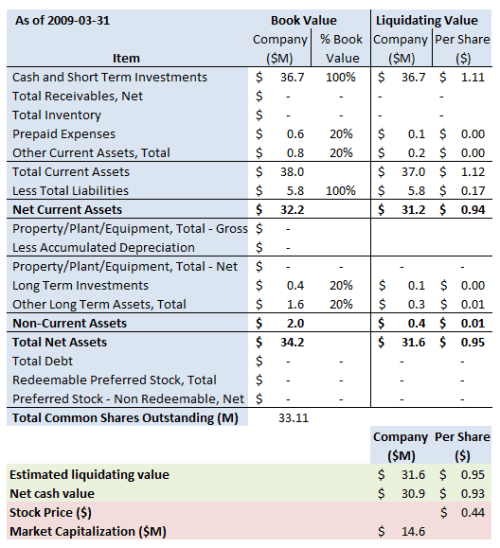
We started following VXGN (see our post archive here) because it was trading at a substantial discount to its net cash position, had ended its cash-burning product development activities and is “seeking to maximize the value of its remaining assets through a strategic transaction or series of strategic transactions.” If the company is unable to identify and complete an alternate strategic transaction, it proposes to liquidate. At its $0.44 close yesterday, VXGN has a market capitalization of $14.6M. We initially estimated the company’s net cash value to be around $27.7M or $0.84 per share. We’ve now reduced that slightly to $26.5M or $0.80 per share. VXGN has other potentially valuable assets, including a “a state-of-the-art biopharmaceutical manufacturing facility with a 1,000-liter bioreactor that can be used to make cell culture or microbial biologic products” and rights to specified percentages of future net sales relating to its anthrax vaccine product candidate and related technology.

The value proposition updated

VXGN has taken steps to minimize its cash burn, reducing its workforce to three employees, terminating its anthrax and smallpox development activities and selling the assets related to its anthrax product candidate. The company’s value rests on its vestigial holding of cash and equivalents (the “Book Value” column shows the assets as they are carried in the financial statements, and the “Liquidating Value” column shows our estimate of the value of the assets in a liquidation):

vxgn-summary-2009-3-31

Balance sheet adjustments

We make the following adjustments to the balance sheet estimates above:

  • Cash burn: The company used $2.1M in cash in the first quarter. We have included cash burn of $5M in our estimate for the remainder of the year. We have also assumed termination payments of $0.2M.
  • Off-balance sheet arrangements and contractual obligations: According to VXGN’s 10Q, it has no off-balance sheet arrangements.

One concern is the lawsuit against VXGN by its landlords, in which they seek $22.4M:

In February 2009, a lawsuit was filed against the Company by plaintiffs, Oyster Point Tech Center, LLC. The plaintiffs generally allege that the Company defaulted on the lease on the 349 Oyster Point, South San Francisco facility. The complaint seeks possession of the premises and the balance of lease plus unpaid rent and expenses totaling $22.4 million, as well as an award of plaintiffs’ attorneys’ fees and costs. The Company’s biopharmaceutical manufacturing facility is located in the leased premises that are the subject of the dispute. At a February hearing, the court denied the writ and the temporary protective order sought by landlord. The parties are currently in discussions to achieve an amicable resolution to the matters alleged in the complaint and a negotiated termination of the lease. However, if necessary, the Company intends to vigorously defend against such allegations.

The Company may incur substantial expenses in defending against such claim, and it is not presently possible to accurately forecast the outcome. The Company does not believe, based on current knowledge, that the foregoing legal proceeding is likely to have a material adverse effect on its financial position, results of operations or cash flows. In the event of a determination adverse to the Company, the Company may incur substantial monetary liability and could have a material adverse effect on the Company’s financial position, results of operations or cash flows.

If the lawsuit is succesful, then VXGN has next to no value. We’re taking our guidance from the company, which “does not believe, based on current knowledge, that the foregoing legal proceeding is likely to have a material adverse effect on its financial position, results of operations or cash flows.”

Conclusion

At its $0.44 close yesterday, VSGN has a market capitalization of $14.6M. We estimate the net cash value to be around 82% higher at $26.5M or $0.80 per share. VXGN has other potentially valuable assets, including rights to portion of future net sales on its anthrax technology and a state-of-the-art biopharmaceutical manufacturing facility. One concern is lawsuit by the landlord against the company, but that company states that it does not believe the lawsuit will have a material adverse effect on its financial position.With its stock at a substantial discount to its net cash position, its cash-burning product development activities at an end and a proposal to identify and complete an alternate strategic transaction or liquidate, we think VXGN is a good prospect, and we’re going to maintain our position.

[Full Disclosure: We have a holding in VXGN. This is neither a recommendation to buy or sell any securities. All information provided believed to be reliable and presented for information purposes only. Do your own research before investing in any security.]

Digirad Corporation (NASDAQ:DRAD) has filed its 10Q for the quarter ended March 31, 2009.

We’ve been following DRAD (see our post archive here) because it is an undervalued asset play with a plan to sell assets and buy back its stock. The stock is up more than 43% since we started following it to close yesterday at $1.26, giving the company a market capitalization of $23.9M. We initially estimated the liquidation value to be around $29.3M or $1.55 per share. After reviewing the Q1 10Q, we’ve left the valuation essentially unchanged at $29.5M or $1.56 per share. The company’s net cash value is around $15.6M or $0.82 per share. DRAD has announced a plan to repurchase $2M of its stock, but it has not yet repurchased a material amount of stock.

The value proposition updated

Our updated estimate for the company’s liquidation value is set out below (the “Book Value” column shows the assets as they are carried in the financial statements, and the “Liquidating Value” column shows our estimate of the value of the assets in a liquidation):

drad-summary-2009-3-31

Balance sheet adjustments

We make the following adjustments to the balance sheet estimates above:

  • Cash burn: The company used $0.6M in cash in the first quarter. We have not included any cash burn in our estimate as DRAD’s first quarter’s cash burn was primarily due to a seasonal increase in DRAD’s inventory and a reduction in its accrued compensation and other liabilities and we do not expect this to be repeated in the second quarter.
  • Off-balance sheet arrangements and contractual obligations: The company hasn’t disclosed any off-balance sheet arrangements in its most recent 10K. The contractual obligations as at December 31 were around $3.0M, around $1.4M of which falls due in the next 12 months..

The catalyst

DRAD’s board has announced a stock buyback program:

The Company also announced that its board of directors has authorized a stock buyback program to repurchase up to an aggregate of $2 million of its issued and outstanding common shares. Digirad had approximately 19 million shares outstanding as of December 31, 2008. At current valuations, this repurchase plan would authorize the buyback of approximately 2.1 million shares, or approximately 11 percent of the company’s outstanding shares.

Chairman of the Digirad Board of Directors R. King Nelson said, “The board believes the Company’s direction and goals towards generating positive cash flow and earnings coupled with an undervalued stock price present a unique investment opportunity. We are confident this will provide a solid return to our shareholders.”

According to the most recent 10Q, the company has not bought back a material amount of stock:

On February 4, 2009, our board of directors authorized a stock buyback program to repurchase up to an aggregate of $2.0 million of our issued and outstanding common shares. The timing of stock repurchases and the number of shares of common stock to be repurchased are in compliance with Rule 10b-18 under the Securities Exchange Act of 1934. The timing and extent of the repurchase depends upon market conditions, applicable legal and contractual requirements, and other factors. During the three months ended March 31, 2009, we repurchased 11,000 shares of our common stock at a cost totaling $11,000.

Conclusion

At its $1.26 close yesterday, DRAD is trading at around 81% of its $29.5M or $1.56 per share in liquidation value. We see no reasons to cease holding DRAD in the Greenbackd Portfolio and so we’re going to maintain the position.

[Full Disclosure:  We do not have a holding in DRAD. This is neither a recommendation to buy or sell any securities. All information provided believed to be reliable and presented for information purposes only. Do your own research before investing in any security.]

Long-term readers of Greenbackd might remember our initial struggle to apply the net net / liquidation formula described by Benjamin Graham in the 1934 Edition of Security Analysis in the context of modern accounting. Putting aside our attempt to include and tweak the discounts to PP&E (kind of like fixing the smile on the Mona Lisa), most embarassing was our failure to factor into the valuation off-balance sheet liabilities and contractual obligations. The best thing that we can say about the whole sorry episode is that we got there in the end and we’ve been applying a more robust formulation for the last quarter. With that in mind, we thought it was particularly interesting to see the Financial Post’s article, Veteran tweaks Graham’s rule to find bargains (via Graham and Doddsville), which details the refinements legendary value investor Marty Whitman makes to Graham’s net-net formulation.

According to the article, Whitman makes the following adjustments to Graham’s 90-year old formula:

  • Companies must be well-financed

First and foremost, companies must be well-financed in keeping with the core tenet of Third Avenue’s “safe and cheap” method of value investing.

The goal is to own companies that are going concerns, not ones destined for liquidation. This difference is a crucial point of distinction between the focus of equity investors, who are often wiped out in liquidation, and bond investors, who have rights to the assets of a company in liquidation.

  • Whitman includes long-term assets that are easily liquidated

The second adjustment is to the assets themselves. Graham and Dodd focused exclusively on current assets when calculating liquidation value whereas Whitman includes long-term assets that are easily liquidated.

For example, roughly one third of long-term assets of Toyota Industries Corp. are investment securities, including a 6% position in Toyota Motor Corp. (TM/TSX), says Ian Lapey, portfolio manager at Third Avenue and designated successor to Whitman on the Third Avenue Value Fund.

These securities are therefore included in Third Avenue’s calculations of net-net.

Closer to home, oil and gas producer Encana Corp. (ECA/ TSX) has proved reserves of oil and natural gas that are not included in current assets, says Lapey.

“They are liquid in that there is a real market, current commodity prices notwithstanding, for high-quality proved reserves of oil and gas.” Encana is a top holding in AIC Global Focused Fund, sub-advised by Third Avenue and managed by Lapey.

  • Adjust for off-balance sheet liabilities

The third adjustment is the inclusion of off-balance-sheet liabilities. Here, U. S. banks’ structured investment vehicles readily spring to mind.

  • Include some PP&E

The fourth and final adjustment to Graham and Dodd is the inclusion of “some property, plant and equipment” for their liquidated cash value and associated tax losses that often produce cash savings.

Hong Kong real estate companies, such as top holding Henderson Land Development Co. Ltd. (0012/HK),are required to mark property values to market prices, so liquidation values are easily ascertained.

“In most time periods, the market for fully leased office buildings is quite liquid,” says Lapey, justifying their inclusion in net-net calculations of these companies.

The article also discusses one of Whitman’s current positions, Sycamore Networks Inc (NASDAQ:SCMR):

Sycamore Networks Inc. (SCMR/NASDAQ) is the most compelling example of a net-net situation in the United States offered up by Lapey.

The telecom equipment company has more cash — US$935-million in all — than the total value assessed to it by the market, in light of its US$800-million market capitalization and US$38-million in total liabilities.

“We feel that there is value to their technology that is being recognized by some of the large telecom carriers,” says Lapey of Sycamore Networks, but he acknowledges its current weak earnings power. Lapey is also attracted to the one-third of outstanding share ownership by management because it presents an important alignment of their interests with those of Third Avenue, who are by and large passive investors.

These large valuation discounts in the market are reassuring words for investors from the one of the finest practitioners of Graham and Dodd.

“We are holding these companies trading at huge discounts,” says Lapey, “and if these companies were to sell assets or sell the whole companies we think the result would be a terrific return for our investment.”

As we discussed in our review of our first quarter, we started Greenbackd in an effort to extend our understanding of asset-based valuation described by Graham. Over the last few quarters we have refined our process a great deal, and it’s pleasing to us that we already include the adjustments identified by Whitman. We believe that our analyses are now qualitatively more robust than when we started out and seeing Whitman’s adjustments gives us some confidence that we’re on the right track.

Soapstone Networks Inc (NASDAQ:SOAP) has filed its 10Q for the quarter ended March 31, 2009.

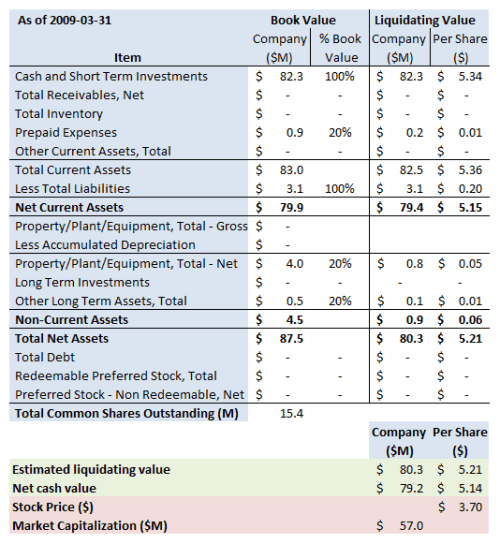
We been following SOAP (see our post archive here) because it is trading well below its net cash value with an activist investor, Mithras Capital, disclosing an 8.7% holding in October last year. The stock is up 48.0% from $2.50 when we initiated our position to close yesterday at $3.70, giving SOAP a market capitalization of $52.0M. We last estimated the company’s net cash value to be $86.1M or $5.59 per share. Following our review of the Q1 10Q, we’ve adjusted our valuation down 6% to $80.3M or $5.21 per share as a result of $6.7M of cash burned.

The value proposition updated

The company’s balance sheet value is almost wholly cash, which it continues to burn (the “Book Value” column shows the assets as they are carried in the financial statements, and the “Liquidating Value” column shows our estimate of the value of the assets in a liquidation):

soap-summary-2009-3-311

Balance sheet adjustments

We need to make the following adjustments to the balance sheet estimates above:

  • Cash burn: The company used $6.7M in cash in the first quarter. They expect cash burn to continue to be between $6M and $6.5M per quarter.
  • Off-balance sheet arrangements and contractual obligations: SOAP does not have any off-balance-sheet arrangements and its contractual obligations, which consist entirely of operating leases, are $3.9M. These operating lease payments are the minimum rent expense for SOAP’s facilities, including its head office.

Conclusion

We continue to believe that SOAP is a very good opportunity. The company’s ongoing business is small in comparison to its net cash position, so it shouldn’t dissipate its cash any time soon. It has no off-balance sheet arrangements, little in the way of ongoing contractual obligations and no material litigation, so the cash position seems reasonably certain. The company’s engagement of an investment bank to explore strategic alternatives is a promising step in the right direction. We continue to be concerned by the continued issuance of options at a huge discount to liquidation value. The sooner Mithras Capital gets control of this situation the better.

[Full Disclosure:  We have a holding in SOAP. This is neither a recommendation to buy or sell any securities. All information provided believed to be reliable and presented for information purposes only. Do your own research before investing in any security.]

Vanda Pharmaceuticals Inc. (NASDAQ:VNDA) has reported its results for the first quarter ended March 31, 2009.

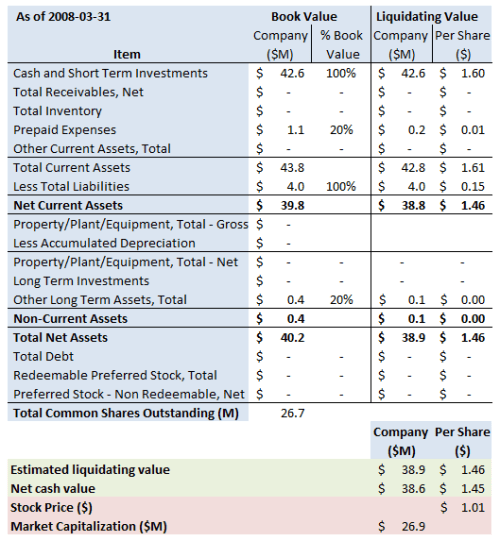
We’ve been following VNDA (see our post archive here) because it’s trading below its net cash value and Tang Capital Partners (TCP) has called for the company to “cease operations immediately, liquidate [VNDA]’s assets and distribute all remaining capital to the Stockholders.” TCP has now filed a preliminary proxy statement for the 2009 Annual Meeting urging stockholders to support TCP’s slate of two director nominees, Kevin C. Tang and Andrew D. Levin, M.D., Ph.D. The stock is up 29.5% since we initiated the position to close yesterday at $1.01, giving the company a market capitalization of $24.3M. We initially estimated the net cash value to be around $42.6M or $1.60 per share. We’ve now reduced our estimate of the net cash value to $38.6M or $1.45 per share. The company continues to hemorrhage cash, so the investment turns on TCP’s ability to get control of the board at the Annual Meeting and staunch the bleeding. If TCP cannot get onto the board quickly, the company will continue to burn cash and the investment will be a dud. VNDA has a staggered board, which makes TCP’s task difficult.

The value proposition updated

In the first quarter of 2009 VNDA burned through $3.8M in cash, which reduces our estimate of the net cash value from $42.6M to $38.6M or $1.45 per share (the remaining difference is due to the slight increase in shares on issue). Set out below is our summary balance sheet  (the “Book Value” column shows the assets as they are carried in the financial statements, and the “Liquidating Value” column shows our estimate of the value of the assets in a liquidation):

vnda-summary-2009-12-31

Conclusion

VNDA continues to be an interesting play. While the stock is up nearly 30% since we initiated the position, it is still trading at a 45% discount to our estimate of its $1.45 per share net cash value. That value is of course deteriorating rapidly, and the challenge for investors is to determine which of two outcomes is more likely: If TCP can get on the board quickly, stop the cash burn and liquidate the company, we’re likely to see a good return. If TCP cannot get onto the board quickly or at all, the company will continue to burn cash and the investment will be a dud. VNDA has a staggered board, so this will make TCP’s task difficult. We’re inclined to maintain our position and see how this plays out.

[Full Disclosure:  We do not have a holding in VNDA. This is neither a recommendation to buy or sell any securities. All information provided believed to be reliable and presented for information purposes only. Do your own research before investing in any security.]