Feeds:
Posts
Comments

The Official Activist Investing Blog has published its list of activist investments for September:

Ticker Company Investor
ARCW Arc Wireless Solutions Brean Murray Carret Group
ASCMA Ascent Media Corp GAMCO Investors
ATGN AltiGen Communications Norman Pessin
BITS BitStream Inc. Raging Capital
BKBO.OB BakBone Software Inc VantagePoint Venture Partners
BLDR Builders FirstSource Inc JLL Partners; Warburg Pincus
BLDR Builders FirstSource Inc. Stadium Capital Management
CLHI.PK CLST Holdings Red Oak Partners
CNSO.OB CNS Response Inc Leonard Brandt
DCS Claymore Dividend & Income Fund Bulldog Investors
DITC Ditech Networks Lamassu Holdings
EFII Electronics for Imaging Inc Blum Capital
FACT Facet Biotech Corp Baupost Group
FACT Facet Biotech Corp Biotechnology Value Fund
GLOB.OB Global Med Technologies Victory Park Capital
HBRF.OB Highbury Financial Peerless Systems
IMMR Immersion Corp Ramius Capital
KONA Kona Grill Inc BBS Capital Management
MINI Mobile Mini Inc. Shamrock Activist Value Fund
NFL Nuveen Insured Florida Premium Income Municipal Fund Western Investments
PCC PMC Commercial Trust REIT Redux LP
PFIN P&F Industries Timothy Stabosz
PPM Investment Grade Municipal Income Fund Western Investment
PRKA.OB Parks! America, Inc. Edla Family Limited Partnership
SCSS Select Comfort Corp Clinton Group
TESO Tesco Corporation LRP V Luxembourg Holdings
TICC TICC Capital Corp Raging Capital Management
TXI Texas Industries Inc Southeastern Asset Management
TXI Texas Industries Inc Nassef Sawiris
UAHC United American Healthcare Corp Strategic Turnaround Equity Partners
UAHC United American Healthcare Corp Lloyd Miller
VXGN.OB VaxGen Inc Steven Bronson

Axcelis Technologies Inc (NASDAQ:ACLS) has had an amazing run over the last few weeks, up more than 50% since the end of September to hit a 52-week high yesterday. We’ve decided to close our position because it’s trading at a substantial premium to our estimate of its liquidation value and we don’t think the underlying business is all that great (not that we have any particular insight into these things). At its $1.63 close yesterday, our position in ACLS is up 171.7% on an absolute basis. The S&P500 closed at 906.65 on the day we opened the position, and closed yesterday at 1,073.18, an 18.4% gain, which means we’ve outperformed the S&P500 over the same period by 153.3%.

Post mortem

We started following ACLS on January 8 this year (see our post archive here) because it was trading at a discount to our estimate of its liquidation value with an activist investor, Sterling Capital Management, holding 10.7% of its outstanding stock. The picture for ACLS looked fairly grim at that stage. We noted that it had been “making substantial operating losses that have widened over the last five quarters” that had prompted “Sterling Capital Management to detail to ACLS management an aggressive restructuring strategy to salvage for stockholders what value remains.” Shortly after we opened the position ACLS failed to make a payment required under its 4.25% Convertible Senior Subordinated Notes, which meant that the company was required to repay the outstanding principal amount of the notes plus a maturity premium and accrued interest (a total payment of approximately $85 million) on January 15. On February 26, in a remarkable deal given the extremely difficult conditions, ACLS managed to sell to Sumitomo Heavy Industries, Ltd. (SHI) of its 50% interest in SEN Corporation, its joint venture with SHI, for proceeds of $122.3 million. ACLS received around $35.9M in cash after applying $86.4M of the proceeds to meet its obligations to the Convertible Senior Subordinated Noteholders. The company hit its low of $0.17 on Feburary 25, at which point our position was down over 70%. From its February 25 nadir, ACLS is up approximately 860% to close yesterday at $1.63, which gives the company a market capitalization of $170M.

We last estimated ACLS’s liquidation value at around  $113.6M or $1.10. Its net current asset value at the last reporting date was a little higher at around $180M or $1.77 per share. We still think that cash burn is a significant issue for ACLS, and we suspect that both the liquidation and net current asset values will be lower at the upcoming reporting date. At the rate of cash burn prevailing at the last reporting date, we estimated the company had around six months before its liquidation value was around $0.60, and around a year before it was worthless. We think that’s an improbable – but not impossible – outcome.

ACLS’s recent run-up may be attributable to attention it has now started receiving from the mainstream media and larger investment banks. Citi thinks ACLS could be worth $3, noting that “while we are far from bullish on business prospects and we acknowledge that there’s risk to ACLS’ ability to raise much-needed cash in the next several months, we think the company will be able to raise sufficient capital w/o going to the public markets.” The Wall Street Journal also ran an article yesterday in which it quoted an analyst as saying “the stock is undervalued, since there were concerns about whether the company would survive. It was one of the hardest hit in the downturn … partly because it had market-share losses amid a cyclical semiconductor decline before the financial crisis even hit. … Now it looks like the company will probably make it, so there’s a correction in valuation.” That may be so, but we’ve got no particular insight into the business or the industry, and so we’re closing the position.

[Disclosure:  We don’t have a holding in ACLS. This is neither a recommendation to buy or sell any securities. All information provided believed to be reliable and presented for information purposes only. Do your own research before investing in any security.]
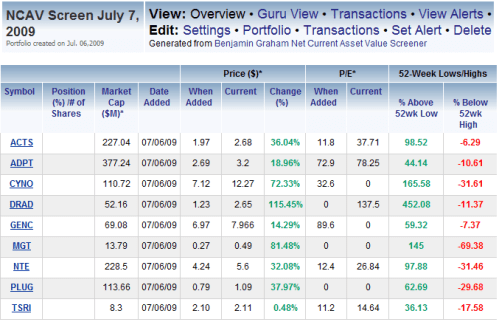
We’ve recently been using the GuruFocus Benjamin Graham Net Current Asset Value Screener (subscription required) to generate regular watchlists of net net stocks. The GuruFocus NCAV screen has some superb functionality that makes it possible to create the watchlist from the screen and then track the performance of those stocks. We created our first watchlist on July 7 of this year using the July 6 closing prices. The performance of the stocks in that first watchlist over the last quarter has been nothing short of spectacular. Here is a screen grab (with some columns removed to fit the space below):

GuruFocus NCAV Screen

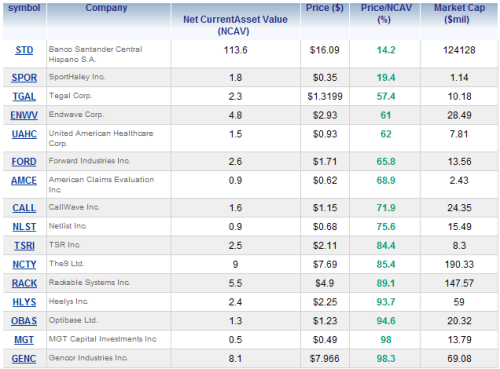
We know the market’s been somewhat frothy recently, but those returns are still notable. The average return to date across the nine stocks in the watchlist is 45.5% against the return on the S&P500 of 20.05% over the same period, an outperformance of more than 25% in ~three months. We’ve decided to run another screen today and we’ll track the return of that watchlist over the coming months. The stocks in the watchlist are set out below (again, with a column removed to fit the space below):

GuruFocus NCAV Screen 2009 10 13

We’ve done no research on these firms beyond running the screen. If you plan on buying anything in this screen, at the absolute minimum we recommend that you do some research to determine whether they are currently net net stocks and not just caught in the screen because of out-of-date filings. We’ll compare the performance of the stocks against the S&P500, which closed yesterday at 1,076.18.

[Full Disclosure:  We have a holding in FORD. This is neither a recommendation to buy or sell any securities. All information provided believed to be reliable and presented for information purposes only. Do your own research before investing in any security.]
Benjamin Graham Net Current Asset Value Screener

Aspen Exploration Corporation (OTC:ASPN) has filed its definitive proxy statement for its November 30, 2009 general meeting and included is a proposal seeking authority for ASPN’s board of directors to dissolve the company

We’ve been following ASPN (see our ASPN post archive) because it’s trading at a discount to its $1.17 per share liquidation value and there are several potential catalysts in the stock, including a 13D filing from Tymothi O. Tombar, a plan to distribute substantially all of the net, after-tax proceeds from the completion of the Venoco sale to its stockholders ($5M to $5.5M), and the possibility that the company will dissolve. The stock is up 6.6% since we initiated the position to close Friday at $1.05.

The relevant portion of the definitive proxy statement is set out below:

10. Why is the Board of Directors submitting a proposal to the stockholders to grant the Board authority to dissolve Aspen?

In connection with preparing for and conducting the May 22, 2009 meeting of stockholders, one stockholder submitted a request that Aspen include a dissolution proposal to be considered at the same time that the stockholders were being asked to consider the sale of Aspen’s oil and gas assets to Venoco, Inc. The Board of Directors had previously considered that possibility, but had determined that presenting the dissolution proposal at the same time as the asset sale proposal would add a significant amount of complexity and risk stockholder consideration of the asset sale. Consequently, Aspen advised the stockholder that Aspen would offer stockholders the opportunity to consider dissolution of Aspen at the next meeting. In response to that statement, the stockholder withdrew his proposal and the Securities and Exchange Commission was able to complete its review of the proxy statement for the May 22, 2009 meeting.

11. How does the Board recommend that I vote with respect to the proposal that would grant the Board of Directors the discretion to dissolve Aspen?

The Board of Directors proposed dissolution of Aspen for consideration of its stockholders because of commitments made in March 2009. The Board, however, has not determined by majority vote what recommendation should be made to stockholders in connection with the vote:

* One director, R.V. Bailey, believes that the prospective value of Aspen as a public corporation with a continuous filing record and clean financial statements exceeds the value of the remaining net assets, and believes that stockholders may benefit by the possibility of making a business acquisition (including a reverse takeover) that could offer Aspen’s stockholders potential long term value.

* Three directors, Robert A. Cohan, Kevan B. Hensman and Douglas P. Imperato are continuing to evaluate whether they believe the Company can identify and execute on a business opportunity that may offer long term value to the Company’s stockholders and as such none have yet authorized the Board to make a recommendation for or against approval of Proposal No. 2.

Although the Board did not determine whether dissolution is in Aspen’s best interests at the present time, the Board did determine it is appropriate to submit the proposal to its stockholders at the Annual Meeting. As such the proposal is being submitted to the stockholders without any recommendation from the Board of Directors. For further discussion on this issue see page 30 of this Proxy Statement.

It’s worth noting that R.V. Bailey, the director opposed to the liquidation, holds 19.17% of the outstanding stock.

[Full Disclosure:  We have a holding in ASPN. This is neither a recommendation to buy or sell any securities. All information provided believed to be reliable and presented for information purposes only. Do your own research before investing in any security.]

In keeping with our penchant for stories about idiosyncratic investors who trade in odd securities found off the beaten track, we bring you perhaps the best unknown activist investment of 2009. With a far away land, a young protagonist, an odd treasure, an unexpected twist and a narrow escape, it’s a bullwhip and a fedora short of being an Indiana Jones movie. In the role of young protagonist is Nicholas Bolton, a 27-year old investor who made A$4.5M ($4M) almost bringing down BrisConnections, the developer of a A$4.8B ($4.3B) Australian toll road. What’s most amazing is that he achieved this with an initial stake worth just A$47,000 ($42,000). In so doing, he became the bête noire of his fellow BrisConnections investors, attracted the attention of the Australia Securities and Investments Commission (similar to the SEC) and drew the ire of the Australian media, who variously described him as a “meddling kid,” “Australia’s foremost prat,” “the ultimate poster-boy for the much-maligned Generation Y” and “the best proof that karma does not exist.” How did he do it and why all the vitriol? Read on.

BrisConnections: The Temple of Doom

Several unusual elements make the Nicholas Bolton versus BrisConnections story reasonably complex. Bear with us, to understand the story it’s necessary to understand the BrisConnections security in detail.

BrisConnections, backed by Deutsche Bank, Credit Suisse Group, JPMorgan Chase & Co. and Macquarie Bank, raised A$1.23B ($1.16B) in July last year through the sale of an unusual equity security called a stapled unit. The BrisConnections stapled unit is a unit in the trust holding the toll road assets and a share in the corporate trustee. The trust unit and the share must trade together, and hence are said to be stapled. The reasons for creating such a security are beyond the scope of this post, but suffice it to say that stapled securities offer certain tax benefits. What really makes this story interesting is that the BrisConnections stapled units were issued on an installment basis. Installment means that on application purchasers paid A$1 ($0.90) for each stapled unit and were then obliged to make two further installments of A$1 ($0.90) each, payable nine months and 18 months after the IPO. In a world of rapidly rising stock prices, installment securities present no problem. When stockmarkets are in decline, however, the securities can trade down dramatically as investors attempt to avoid paying further installments.

The BrisConnections’ IPO tanked spectacularly, dropping 60% on the first day of trading before falling into terminal decline. A few months before the first installment was to fall due, the units had traded down to A$0.001 (that’s 1/10th of a cent). At a unit price of $0.001, a BrisConnections unit became a very dangerous security for those not realising that the units came with two A$1.00 installments for each $0.001 paid. That meant, for example, that a purchaser of $1,000 of the units owed $2M in installments and a purchaser of $10,000 owed $20M. It seems that there were many purchasers at $0.001 who were unable to fulfil their obligations and then decided that they would rather not own BrisConnections units. Unfortunately for them, they had run out of greater fools. As Charlie Munger might say, they were like the mouse who cries, “Let me out of the trap, I’ve decided I don’t want the cheese.” A month out from the first installment, there were ~70M units on the ask at $0.001 – the minimum price at which a security can trade on the Australian Stock Exchange – and no bids.

Enter Nicholas Bolton.

Bolton: Raider of the Lost Ark

Bolton had started acquiring BrisConnections units through an investment company, Australian Style Investments, in November last year. Before too long, he’d spent A$47,000 to acquire a 15% stake and become BrisConnections largest unitholder. He’d also taken on a A$94M liability, money that he did not have. What he did next comes straight from the World Poker Tour. No, he didn’t fold. He went all in, upping his stake to 19.9%. Why 19.9%? Under Australian law, a purchaser of 20% of a company’s stock is obliged to make a takeover bid to all remaining stockholders. By sitting at 19.9%, Bolton had the option of making a bid for the remaining stock, but not the obligation. He then approached BrisConnections about refinancing the liability. When BrisConnections failed to respond, he moved to have management removed and the trust dissolved. The application achieved its end: It got the attention of management. It was, however, a long shot. Bolton needed the support of 75 per cent of his fellow investors to have the dissolution resolution passed. It was also not clear that it would prevent the fund from collecting the first installment. Under Australian law, the trust had 21 days to call a general meeting and 45 days to hold it, by which date the notice demanding the first installment fee would have been issued. If BrisConnections management was nervous about the dissolution, they didn’t show it in the media. The chairman, a Mr. Trevor Rowe, described the application as “frivolous,” while a spokesman described it as “a mere sideshow to a $5B infrastructure project that is promising to provide 11,000 jobs.” They also made it known that a liquidation of the trust would not extinguish the first A$1 liability owing on each unit. BrisConnections advisers where not so sanguine: one, Macquarie, co-underwriter and financier of BrisConnections, brought an injunction action against him seeking to prevent him from holding the meeting. In a two-minute hearing, the judge did not uphold any of Macquarie’s claims, or grant the injunction to stop the meeting of unitholders from proceeding. It was swift justice, and it seemed to set the scene for something very rare: a highly entertaining general meeting.

The Last Crusade

After succeeding against Macquarie and BrisConnections in an extensive court battle, it seemed that BrisConnections was a general meeting away from dissolution. Bolton held 19.9% of the units on issue, and a sizeable number of the other holders had purchased their units at $0.001. Perhaps sensing that Bolton had the momentum, management told those investors present at the meeting were told their units would be worthless if BrisConnections was liquidated, as BrisConnections would have ”zero value” as a company. Bolton, however, was not one of the investors present at the meeting. Why? He had already voted against the resolutions he had proposed and defended at court. BrisConnections chairman told the startled unitholders present at the meeting that Australian Style Investments had voted against all seven resolutions when its proxies were received several days before the meeting. Accordingly, the special resolution fell short of the required 75% voting threshold. The unitholders might have seen Bolton as a savior after he went to court to ensure the vote took place, but they were cursing his name by the end of the day. What had happened to cause Bolton to vote against his own resolution?

Unknown to the investors at the meeting, Bolton had already sold his voting rights to Thiess John Holland, the design and construction contractor for the Airport Link. The price? A$4.5M. It seems this had been Bolton’s strategy all along. Rowe, the chairman, described to Inside Business a discussion he had with Bolton as he was searching for a buyer for his voting rights:

I called [Nicholas Bolton’s] adviser and asked him what he had in mind. He mentioned some numbers to me. I said I thought they were pretty excessive and I gave him a lower number. And he said well Mr Bolton needs $5 million otherwise he is not going to do this. And we thought about it and we decided that we would not engage further.

I said to him when he proposed a number which I thought was preposterous that it’s more like a two to three [million] number than a seven and half [million] number.

I didn’t engage in a negotiation.

Rowe didn’t want to cough up for the votes. Thiess, however, was happy to part with A$4.5M to prevent the A$4.8B project from falling over. BrisConnections other investors were unhappy. A hedge fund that was BrisConnections’s second biggest investor at 13%, threatened legal action, telling the The Sydney Morning Herald:

He’s not going to get (the $4.5 million), I can promise you that.

He’s just ruined his corporate life forever.

I’d trust Mr Bolton like I’d trust a rabbit with a lettuce leaf.

Post mortem

To date, we are not aware of any proceedings being started against Bolton. It seems he got away with the A$4.5M. Not a bad payday for an initial $47,000 investment and a little negotiation. What about the liability? Did Bolton know that the securities came with that huge downside? It seems he did. He contained the liability to his investment vehicle, Australian Style Investments. The A$4.5M was paid to an another entity of Bolton’s, Australian Style Holdings, to quarantine it from the $120M liability in Australian Style Investments. The Weekend Financial Review also reported that Bolton had been searching for an opportunity like BrisConnections for a while: A company in which he could take a large interest quickly and easily. In a confidential strategy document emailed to Ernst & Young and Deloitte in early December last year, Bolton detailed a plan to increase his holding in BrisConnections up to 49.9 per cent of the listed units and then recapitalize the company. Those advisers rejected his takeover plan, so he adjusted his strategy in late December or early January to a liquidation. He told one newspaper he was “playing a game” from the start” and “the result of that game was to extract a benefit from the carcass of BrisConnections:”

I took a commercial approach to this before buying in.  I saw an opportunity to improve the position of unit holders through our entry in the company, and the actions we were planning to undertake. It was a commercial transaction, intended for commercial gain, for unit holders and for myself.

To the extent there was an altruistic outcome it was unintended, in that my interests were aligned with the interests of all other unit holders. But there was always a commercial intention on our part. We didn’t seek the tag of white knight, and it doesn’t fit.

[Let] me say it would be commercially remiss and foolish of me, on a matter of indifference, not to take a dollar or to leave a dollar. It’s a commercial decision.

Conclusion

What’s the lesson? It’s better to be lucky than good? Well, yes, but that’s doing a disservice to young Nick. We think the lesson is that there’s value in the control or influence of a company beyond the underlying intrinsic value of the stock. It’s why we have in the past followed activist investors into stocks when it’s possible that there’s no underlying asset value, and it’s why we’ll do it again in the future.

What happened to the other investors? Well, it’s a happy ending for them too. Macquarie Bank has now thrown them a lifeline and agreed to buy their obligations if they give up their holding and 100 per cent of their units for free.

So that’s our nominee for the best unknown activist investment of 2009. Let us know if you’ve got a better one.

[Full disclosure: We don’t have a holding in BrisConnections.]

Value Investors For Change, a group dedicated to restoring stockholder value to damaged companies, filed a definitive proxy statement today nominating eight candidates to the board of MRV Communications, Inc. (OTC:MRVC). Value Investors For Change sent a letter to stockholders  detailing the failures of the current board and the turnaround plan put forth by Value Investors For Change.

We’ve been following MRVC (see our MRVC post archive) because it’s an activist play with Value Investors for Change – who recently filed proxy documents in relation to VXGN – seeking to replace the “current, ineffective board of directors” with a new board of “highly qualified, independent directors committed to realizing for all MRVC stockholders the fullest potential of their investments.” Value Investors for Change detail a litany of problems with this stock in the preliminary proxy filing, which range from a simple failure to file financial statements or hold an annual meeting to the mishandling of an acquisition and an options dating scandal. What’s the attraction to the stock? Two things:

1. As at the last filing date, for the period ended March 31, 2008, MRVC’s (unaudited) NCAV was around $113.9M or $0.72 per share. Note that the liquidation value is likely negligible and the financial statements are more than a year out of date (which makes any valuation problematic). One positive is the revenue: the company has annualized revenue of around $500M. A small improvement in margins could result in a big improvement in earnings.

2. Value Investors for Change believes the company has a “valuable franchise and a strong market position” and we like their approach, described in the preliminary proxy documents thus:

The participants in this solicitation (collectively, “Value Investors for Change”) are investors who seek to encourage companies to create, preserve and enhance long-term value for their stockholders, the true owners of America’s public companies. We have developed a sophisticated screening process that we use to identify public companies that we believe (i) are undervalued, (ii) are not adequately serving the interests of their stockholders and (iii) require a new board of directors, so that, with the encouragement of stockholders such as you, we can begin implementing reforms ourselves with the goal of increasing stockholder value.

The stock is up 19.4% since we started following it to close yesterday at $0.86.

The text of the letter to stockholders is set out below:

Dear Fellow Stockholders of MRV Communications, Inc.:

We are seeking your support to elect highly qualified and experienced telecom and corporate finance executives to the Board of Directors of MRV Communications, Inc. (“MRV” or the “Company”) at the 2009 Annual Meeting of stockholders on November 11, 2009. Value Investors for Change and its participants named in our proxy statement filed on October 7, 2009 collectively own 1,982,085 shares of common stock of MRV. We are concerned and alarmed by the actions this Board has taken over the past ten years, which we believe have not been in the best interests of stockholders. The Board members have enriched themselves at the expense of stockholders. It is imperative that the incumbent Board members be replaced with our qualified nominees who will truly represent the interests of stockholders.

DO NOT LET THE CURRENT BOARD MEMBERS FURTHER JEOPARDIZE YOUR INVESTMENT

In our view, this Board’s actions of the last ten years reflect poor corporate governance, poor acquisition strategy and poor oversight of management. The incumbent Board has presided over a company that has failed to file its financial statements for any period since the quarter ended March 31, 2008, failed to hold an annual meeting since 2007, and failed to file an Annual Report for the year ended 2008. Meanwhile, this Board has paid itself hundreds of thousands of dollars per year.

For years, the incumbent Board members have compensated themselves with generous cash payments even as MRV’s stock price has fallen. In contrast, our nominees will accept no cash payments. In fact, our nominees will accept no compensation whatsoever except for stock option grants at or above market value. Our nominees will therefore earn absolutely nothing for their Board service unless they increase the share price.

We expect that the incumbent Board members will now spend stockholder money to keep their positions with mailings and telephone calls aimed at discrediting our nominees and our views of their stewardship. For example, the incumbent board recently sent a letter to stockholders that claimed the Company’s recent troubles were caused by “one of the most economically challenging periods in recent history.” In fact, MRV’s troubles began long before the recent global economic crisis.

Fact: The share price of MRV has dropped from $95 (adjusted for stock split) on March 9, 2000 to 66 cents on August 21, 2009. On August 21, 2009, we announced our intention to intervene at MRV to create value for all MRV stockholders.

Fact: Over a period of 15 years (1993 to 2007), MRV has reported losses of approximately one billion dollars.

Fact: While MRV’s performance has continued to be poor under this Board’s leadership, its competitors have thrived. Ciena Corporation and Extreme Networks posted net income of $39 million and $8 million, respectively, for 2008. MRV has not filed its financials for most of 2008 and has not filed any financials for 2009, but in the first quarter of 2008, it posted a net loss of $3.68 million. This is consistent with the negative net income numbers MRV posted in 33 of the last 41 quarters for which it has actually disclosed its financials.

Fact: Under this Board’s “leadership,” MRV was suspended from its listing on the NASDAQ Global Market on June 17, 2009 and formally delisted on August 31, 2009 with a stock price of 74 cents per share.

THIS BOARD HAS PURSUED ILL CONCEIVED ACQUISITIONS THAT HAVE DESTROYED STOCKHOLDER VALUE OVER THE COURSE OF NEARLY A DECADE

• MRV began a risky acquisition strategy in 2000 that we believe has destroyed well over a billion dollars of stockholder value.

• MRV spent $690 million during an acquisition spree in 2000, over 4 times the Company’s current market capitalization.

• Almost $500 million — or 72% — of the purchase price of acquisitions in the year 2000 was allocated to goodwill (indicating the Company might have paid a substantial premium over fair value). After just two years, in 2002, the Company recorded nearly $300 million of impairment (cumulative effect of accounting change) related to goodwill and other intangibles, in addition to impairment of $73 million of goodwill related to the acquisitions. We believe impairment of goodwill so soon after the acquisitions is consistent with a failure of management to operate the business capably.

• MRV acquired Fiber Optic Communications Inc. for $310 million in April 2000 and acquired Quantum Optech Inc. for $36 million in July 2000. In October 2002, 78% of Fiber Optic and 100% of Quantum Optech were sold to the prior management of Fiber Optic for a mere $8 million, resulting in an astonishing loss of hundreds of millions of dollars for MRV stockholders.

We believe the most egregious of the Company’s ill conceived out acquisitions was the 2007 acquisition of Chinese component manufacturer Fiberxon, Inc. Fiberxon was a company so fraught with accounting irregularities that its own auditing firm resigned midway through the transaction process. Yet the Board of MRV decided to continue to pursue the acquisition anyway. Below is a time line displaying a decision-making process at odds with the best interests of the Company’s stockholders:

• In January 2007, MRV announced the merger of one of its wholly owned subsidiaries with Fiberxon. We believe questions concerning the integration of two such disparate companies existed, especially considering MRV’s poor acquisition history.

• During the due diligence phase of the acquisition, MRV became aware of accounting irregularities at Fiberxon that called into question the reliability of Fiberxon’s historical financial statements, which were serious enough in nature to lead to the removal of the Chief Executive Officer and the Vice-President of Finance of Fiberxon in the first half of 2007. The Chief Financial Officer of MRV, who had been playing a major role in the auditing process, resigned mid-way through the transaction process in July 2007.

Fiberxon’s own auditors walked away from the auditing engagement in June 2007 when they determined that insufficient progress had been made by Fiberxon to correct identified issues. The auditors stated in a Form 8-K filed by the Company on July 2, 2007 that they found “a number of serious issues and encountered significant difficulties in the performance of the audit that…called into question the commitment of Fiberxon’s management to maintain reliable financial reporting systems, including accounting books and records, in conformity with accounting principles generally accepted in the U.S. and China.

• On July 1, 2007, the MRV Board decided to proceed with the merger despite (1) the accounting issues communicated to them throughout the auditing process, (2) the resignation of MRV’s Chief Financial Officer and (3) the resignation of Fiberxon’s own auditors.

• After spending over $875 million on acquisitions in the past ten years, MRV’s current market cap today is under $150 million.

THE CURRENT BOARD’S CORPORATE GOVERNANCE FAILURES, LACK OF INDEPENDENCE AND EXCESSIVE COMPENSATION ARE DETRIMENTAL TO STOCKHOLDERS

MRV has not filed financial statements for any period since the quarter ended March 31, 2008. Five financial quarters have passed since MRV last filed financials. Why has it taken so long?

We believe the MRV Board suffers from a significant lack of independence and a lack of share ownership by its independent directors. We also believe the Board has a particularly cozy relationship with the management team that it is supposed to be overseeing. For example:

• Shlomo Margalit, Chairman of the Board, and Near Margalit, the head of MRV’s wholly owned subsidiary Luminent, are father and son.

• Harold Furchtgott-Roth, a director on the Board since 2005, served on the Audit Committee during MRV’s failure to file financials for almost two years, and beneficially owned only 27,500 shares of MRV as of April 2007. Mr. Furchtgott-Roth is related to the wife of the Company’s Chief Executive Officer, Noam Lotan, and according to a Company filing with the U.S. Securities and Exchange Commission on October 2, 2009, received $119,000 in cash compensation for sitting on the Board, over twice as much as any other “independent” Board member.

• The Board has complete discretion over executive compensation with no formula tying compensation directly to Company performance. In fact, despite being delisted and failing to file financial statements for any period since the quarter ended March 31, 2008, the Compensation Committee recently awarded a bonus to Near Margalit, the son of MRV’s Chairman, for “his efforts in addressing the impact of the challenging market environment.”

This Board has made a number of poor decisions which have led to value destruction for all stockholders. By electing our nominees, you are sending a clear message to the Board that they will be held responsible for these actions.

The incumbent independent directors own little or no shares and the Board continues to be paid without having to even run for election – until now. Indeed, Spencer Capital Opportunity Fund, LP had to bring a lawsuit to compel the Company to hold its 2009 Annual Meeting. Our nominees are committed to working hard to maximize value for all stockholders. They will show their commitment by accepting no cash compensation and only receiving stock option grants at or above market value. Accordingly, they will be compensated only if they increase MRV’s stock price.

OUR NOMINEES HAVE THE EXPERIENCE TO IMPROVE THE PERFORMANCE OF MRV AND THEREFORE THE VALUE OF ITS STOCK

Value Investors for Change has assembled a team combining individuals with extensive telecom expertise with financial experts who understand the importance of corporate governance. We firmly believe our nominees, along with our industry advisors, will make a significant positive impact for the benefit of MRV’s stockholders.

Our proposed nominees and our advisors have experience and specific skill sets that are complementary and will benefit the Company. The telecom executives, who are part of Value Investors for Change, have more than 90 years of combined experience. Others in the group bring operational, legal, financial and management expertise. Our nominees and advisors have worked with Fortune 500 telecom companies and venture-funded start-ups, they have navigated turnaround situations and managed high-growth companies. They understand operations, marketing, R&D, sales and have extensive international business development experience.

The following is a list of our Board Nominees:

Raul Martynek is an experienced telecom executive who has successfully executed turnarounds on several occasions during his 15-year career. He currently serves as a Senior Advisor to Plainfield Asset Management, advising them on investment opportunities in the telecommunications sector and also works with portfolio companies on strategic and tactical initiatives. Mr. Martynek received a B.A. in Political Science from SUNY-Binghamton and received a Masters in International Finance from Columbia University School of International and Public Affairs.

Christopher Downie is a telecom executive with diverse experience spanning more than ten years. He is currently the President and Chief Financial Officer of The Telx Group, Inc. and he previously served as Vice President, Executive Vice President, Chief Operating Officer, Chief Financial Officer and Treasurer of Motient Corporation, D/B/A Terrestar Corporation. Mr. Downie received a B.A. from Dartmouth College and holds an MBA from New York University Stern School of Business.

Michael McConnell is currently the Chief Executive Officer of Collectors Universe, Inc., a third-party grading and authentication services company. Previously he was a Managing Director of Shamrock Capital Advisors, Inc., a privately owned investment company of the Roy E. Disney family, where he helped guide numerous companies through strategic restructurings. Mr. McConnell received a B.A. in economics from Harvard University and his MBA degree from the Darden School of the University of Virginia.

Mark Stolper has served in numerous executive capacities in different industries over his 15-year career. He is currently the Chief Financial Officer of RadNet, Inc., a leading owner and operator of outpatient medical diagnostic imaging centers in the United States. He received a B.S. in Finance and B.A. in Social Economics & Public Policy from the Wharton School and the College of Arts and Sciences at the University of Pennsylvania.

Mark Crockett is a performance improvement consultant with more than 15 years of experience. He worked at McKinsey & Company for five years and served as Chief Executive Officer of Tax One, a retail financial services company from 1999 to 2002. He received a B.S. in Economics from Brigham Young University and a J.D. from Stanford Law School.

Charles Gillman is an experienced value investor with expertise in the analysis of companies going through dramatic corporate transitions. He is the founder of Value Fund Advisors, LLC, an investment management firm. Mr. Gillman is an alumnus of McKinsey & Company. Mr. Gillman received a B.S. from the Wharton School of the University of Pennsylvania.

Kenneth Shubin Stein is the founder of Spencer Capital Management, LLC, an investment management firm. A successful value investor, he began his career in medicine serving as an Orthopedic Resident at Mount Sinai Hospital. Dr. Shubin Stein is a graduate of the Albert Einstein College of Medicine and graduated from Columbia College.

Kiril Dobrovolsky is the principal and founder of SFVentureLaw, PC, a law firm in San Francisco. Mr. Dobrovolsky practices as a corporate and securities law attorney and has extensive expertise in equity and debt offerings, mergers and acquisitions, licensing and partnering arrangements and commercial agreements. Mr. Dobrovolsky received a B.A. from University of California at Berkeley and a J.D. from Stanford Law School.

The following two individuals are our special advisors:

Dilip Singh is a special advisor to Value Investors for Change. With more than 35 years of operational executive management experience, Mr. Singh is well suited to provide tactical and innovative guidance to the Value Investors for Change team through his blend of business acumen, market and technical knowledge and strategic insight. He has held key leadership roles at of Telia-Sonera Spice Nepal, Telenity, Sprint, GTE, ADC Telecom, Alcatel, NewNet, MC Venture Partners and United Database. Mr. Singh will not be soliciting proxies on our behalf for this solicitation.

Jack Whelan is a special advisor to Value Investors for Change. He is a former networking industry sales executive whose career spans more than 30 years. From 1989-1996, he was Vice-President for business development for Xyplex Inc., a telecommunications company that later became MRV Communications.

OUR NOMINEES HAVE A PLAN TO IMPROVE THE COMPANY’S OPERATIONAL AND FINANCIAL PERFORMANCE, WHICH WE BELIEVE WILL MAXIMIZE VALUE FOR STOCKHOLDERS

Value Investors for Change will take steps we believe will restore profitability and create wealth for all MRV stockholders.

• Our nominees will immediately suspend the practice of paying excessive fees to Board members. Our nominees will accept no cash payments for board service, and will not accept any form of compensation except for stock option grants at or above market value. Therefore the only way our nominees can benefit financially from their service to the Board will be through long-term appreciation in the stock price.

• We will institute a management compensation system that is heavily weighted towards pay for performance.

• We will conduct a forensic review of the Company’s financials and bring MRV into compliance with all of its reporting requirements.

• We will work with regulatory authorities and outside parties to quickly resolve the many outstanding legal difficulties of the Company.

• We will look to optimize MRV’s cost structure and maximize operating efficiency.

• We will utilize the expertise of our advisors and board members to enhance the Company’s distribution channels, both domestically and internationally.

• We will work tirelessly to create substantial long-term wealth for the stockholders.

These changes and others will unlock stockholder value and put MRV in a position to realize its full potential.

VOTE THE WHITE PROXY CARD TODAY AND PUT NEW PEOPLE ON THE MRV BOARD – PEOPLE WHO ARE COMMITTED TO ACTING IN THE BEST INTERESTS OF STOCKHOLDERS

PROTECT YOUR INVESTMENT FROM AN INCUMBENT BOARD THAT HAS SPENT ALMOST TEN YEARS DESTROYING STOCKHOLDER VALUE

We urge all stockholders to elect our director nominees on the enclosed WHITE proxy card today. Vote for much needed change at MRV by signing, dating and returning the enclosed WHITE proxy card. Or you may vote by telephone or internet if you own stock through a bank or broker. We urge stockholders to discard any proxy materials you receive from MRV and to vote only the WHITE proxy card.

If you have already voted the proxy card provided by the Company, you have every right to change your vote by executing the enclosed WHITE proxy card – only the latest dated proxy card returned will be counted.

Your vote is very important, regardless of how many or how few shares you own. If you have any questions, or need assistance in voting your shares, please call our proxy solicitors, Okapi Partners LLC, toll-free at 1-877-274-8654.

Thank you for your support,

VALUE INVESTORS FOR CHANGE

[Full Disclosure: We do not have a holding in MRVC. This is neither a recommendation to buy or sell any securities. All information provided believed to be reliable and presented for information purposes only. Do your own research before investing in any security.]

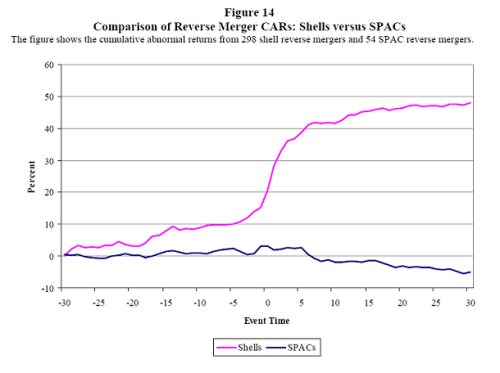
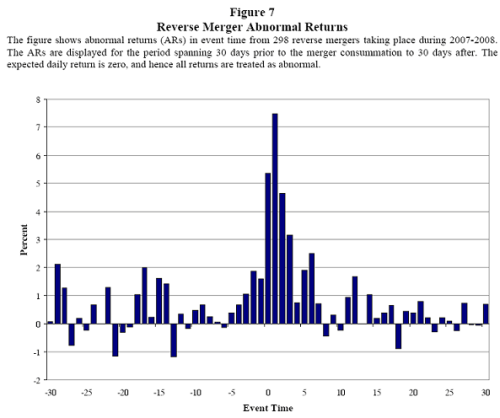
In Shell Games: On the Stock Price Performance of Shell Companies, Ioannis V. Floros and Travis R. Sapp examine the stock price performance of shell companies over the period 2006 to 2008. Floros and Sapp’s findings are quite amazing:

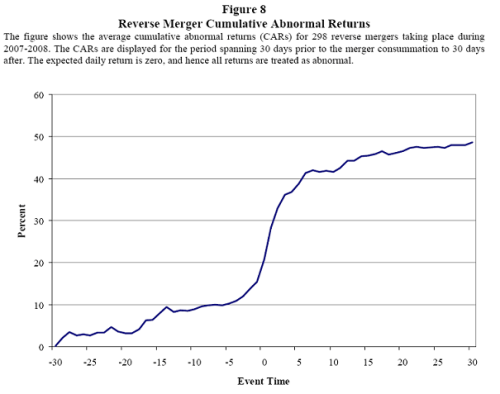
When a takeover agreement is consummated, shell company three-month abnormal returns are 48.1%.

What’s a shell?

The SEC defines any company with “no or nominal operations, and with no or nominal assets or assets consisting solely of cash and cash equivalents” as a shell company. All companies reporting to the SEC must indicate whether they declare themselves a shell company according to Rule 12b-2. Shell firms are traded either on the OTC Bulletin Board (OTCBB) or through Pink Sheets. According to the authors, “[most] shells come into existence either with the sole intent of merging with unidentified single or multiple companies (these are called virgin shells), after being created with a business plan that fails to materialize (these are called development stage shells), or after selling their operations and assets following bankruptcy (these are called natural shells).” The sole purpose of most shells is to “find a suitor for a reverse merger agreement.”

Why a reverse merger rather than an IPO?

The paper sets out five primary advantages to a reverse merger (RM) over an IPO:

First, by engaging in a RM with an existing reporting shell company, a firm can avoid having to go through the lengthy SEC review process. This can save the firm anywhere from 2-12 months. Second, less legal groundwork is needed, and therefore less legal expense. A RM typically costs $200,000 – 300,000 less than an IPO, and this does not include indirect IPO costs such as underpricing. Third, the firm does not need to time the market since a limited percentage of the total stock is typically traded in the immediate post-RM period. Many IPOs are withdrawn at the last minute due to a perceived lack of interest among investors. Fourth, the private firm’s managers don’t have to spend lots of time doing road shows. And finally, the current owners generally own a large majority of the resulting public company.

How big is the opportunity?

RMs have grown in popularity from only three in 1990 to 236 in 2008, and shell companies are providing fuel for much of this growth. Only 26 of the RMs in 2008 were between two operating companies; the other 210 were shell RMs. There are currently over 1,400 reporting shell companies in existence.

What’s a shell worth?

This is where the rubber hits the road for we deep value folk:

Shells that are already trading in the market typically sell for around $1,000,000 and virgin shells, which do not trade, sell for around $100,000 (Feldman (2006)).

Why invest in shells?

The authors found that the stock price of most shell firms “tends to decay rapidly over time. The half-life of shell share prices is 172 trading days, or about eight months.” This leads them to ask why investors continue to hold shell shares and why the number of shell firms growing:

We find that approximately half of all trading shell companies consummate a RM in a given year. Since these firms have no operations, investors must be solely attracted by an expectation of a future RM agreement.

Is that a rational expectation? You bet:

We find a three-month cumulative abnormal return of 48.1%, which far surpasses other target firm abnormal returns in the takeover literature.

Here is a graph showing the abnormal returns for the period 30 days prior to the merger consummation to 30 days after:

Reverse merger abnormal returnsAnd a cumulative version of the same graph:
Reverse merger 2

Be careful of the longer-term performance:

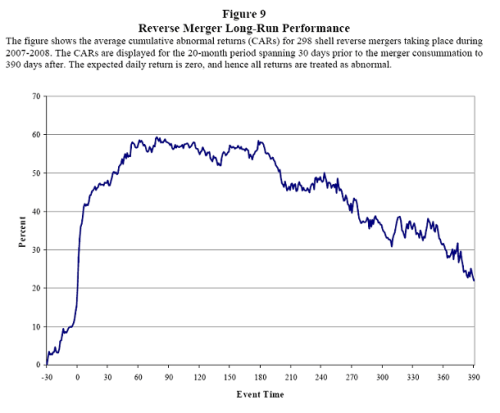
Following a RM, we find that the longer-term performance of the RM firms erases the high initial returns. The average surviving firm earns an annual post-event return of -91.2%. Shell companies engaging in RM transactions attract blockholder investment, largely from insiders or family trusts, which persists beyond lock-up periods. We find evidence suggesting that naked short-selling occurs, mainly after the lock-up period of six months, for at least one-fifth of these firms. We show that this helps explain the decline in returns that begins about nine months after the RM. We also examine liquidity and find increased trading volume and a significant decrease in the quoted spread following a RM.

Here’s a graph showing the long-run performance of the shells following a reverse merger:

Reverse merger 3

This is an interesting graph. It show a comparison of compound average returns from shells and Special Purpose Acquisition Companies (SPACs), which we previously discussed in the post, Blank checks: Fertile fishing grounds for liquidation value investors:

Shells v SPACs

Conclusion

Floros and Sapp conclude as follows:

Our results present a fascinating choice for investors. Namely, does it make sense to invest in an empty shell firm that has no assets or operations? Our results suggest that such an investment is rational as long as the probability of a RM happening soon is high. In the event of a RM deal, the shell firm returns are substantial. However, the wait can be painful. Over time, the shell burns cash to meet ongoing reporting costs and the share price tends to fall. Being able to identify shells that are more likely to consummate a deal sooner thus becomes key. Also, the extent to which shell firms are an investable alternative asset largely depends upon the depth of this rather illiquid market. Most shell firms have fewer than three market makers and trading tends to be thin and concentrated among a relatively small shareholder base. The median number of shareholders in our shell sample is 57 and on average 12% of shell outstanding shares are held by shell managers. Further, the median quoted half spread is 22.3%, showing that transaction costs for an investment in shell firms are non-trivial. We argue that the substantial average return surrounding a RM is compensation for shell stock illiquidity and the uncertainty of finding a reverse merger suitor. Further, the payoff from a shell investment is marginally sufficient to justify the growth in the number of shells alongside the growing RM industry.

Hat tip Wes and Andy.

The always superb Manual Of Ideas has nine new additions to its list of activist targets. Companies on the list must have a “strong balance sheet that could be recapitalized or liquidated to achieve activist value creation; and insiders must own less than 20% of the shares, implying an inability to exercise voting control over the company:”

  • Semiconductor equipment provider Axcelis Technologies (ACLS) joins the list in first place, based on a ratio of “net net” current assets to market value of 1.3x, making ACLS a Ben Graham-style bargain stock. We calculate “net net” current assets as current assets minus total liabilities. A ratio of 1.3x suggests that the liquidation value of ACLS may exceed the company’s market value, potentially attracting the interest of activist investment funds.
  • Biotech drug developer Myriad Pharmaceuticals (MYRX) joins the list in second place, as the company has net cash of $169 million versus market value of $135 million. Insiders own virtually no shares of the company, making Myriad vulnerable to activist shareholder action.
  • Communications equipment provider Radvision (RVSN) joins the list in 12th place. Radvision shares recently tumbled to a market value of $115 million, only $8 million above the company net cash balance. The stock price decline came on the heels of Cisco’s announcement that it would aquire video conferencing company Tandberg. Radvision provides such technology to Cisco, with the latter Radvision’s largest customer.
  • Specialty steel product maker Universal Stainless & Alloy (USAP) joins the list in 30th place. The shares trade at 0.8x price to tangible book value, and the company has 19% of its market value in net cash. “Net net” current assets account for two-thirds of USAP’s market value, making the company a potentially interesting recapitalization candidate.
  • Biopharma company Progenics Pharmaceuticals (PGNX) joins the list in 34th place. The shares trade within 10% of their 52-week low, reflecting the stock’s lack of participation in the recent stock market rally. With a market value of $155 million and more than $100 million of net cash, the shares could attract the attention of activist investors familiar with the biopharma industry.
  • Cancer drug discovery firm Infinity Pharma (INFI) joins the list in 36th place. While the company is losing money as it advances its drug development pipeline, management has stated that the company has sufficient liquidity through 2013. INFI has a market value of $152 million versus a net cash position of $150 million.
  • Zoran Corp. (ZRAN), a provider of digital solutions for application in the digital entertainment and imaging markets, joins the list in 42nd place. The company recently posted strong sequential revenue growth in key business segments and returned to positive cash flow generation. With 63% of the market value in net cash, the company may be in a position to aggressively repurchase shares, thereby boosting shareholder value on a per-share basis.
  • Semiconductor equipment company Rudolph Technologies (RTEC) joins the list in 43rd place. The company’s Q2 revenue growth exceeded guidance, but investors continue to shun the stock. RTEC has one-third of its market value in net cash and nearly two-thirds in “net net” current assets.
  • Finally, fabless semiconductor company Sigma Designs (SIGM) joins the list in 44th place. With one-half of market value in net cash and an enterprise value-to-revenue multiple of 0.9x, the shares appear quite cheap. The company may be in a position to boost shareholder value by using excess liquidity to repurchase shares or pay a one-time cash dividend.

We’ve been following Axcelis Technologies Inc (NASDAQ:ACLS) since January 8 this year (see our post archive here) because it is an undervalued asset play with an activist investor, Sterling Capital Management, holding 10.7% of its outstanding stock. ACLS has completed the sale of its 50% interest in SEN Corporation, its joint venture with Sumitomo Heavy Industries, Ltd. (SHI) to SHI for proceeds of $122.3 million. ACLS received around $35.9M in cash after applying $86.4M of the proceeds to meet obligations to the holders of the company’s 4.25% Convertible Senior Subordinated Notes, upon which ACLS defaulted in January. Our position in ACLS is up 120% to $1.32, which gives the company a market capitalization of  $137M. We’re not quite as bullish on ACLS as the Manual of Ideas. We last estimated ACLS’s liquidation value at around  $113.6M or $1.10, because we think that cash burn is a significant issue for ACLS. At the current rate of cash burn, we estimate the company has around six months before its liquidation value is around $0.60, and around a year before it’s worthless. That said, Citi thinks ACLS could be worth $3 (for what that’s worth):

Citi upgrades Axcelis Technologies Inc (Nasdaq: ACLS) from Hold to Buy. Price target lowered from $5.50 to $3.

Citi analyst says, “Following the collapse of its merger talks with Sumitomo Heavy Industries (SHI) and subsequent ~70% decline in stock price, we think the stock is now trading below liquidation value. So, while we are far from bullish on business prospects and we acknowledge that there’s risk to ACLS’ ability to raise much-needed cash in the next several months, we think the company will be able to raise sufficient capital w/o going to the public markets.”

Axcelis Technologies, Inc. (Axcelis) designs, manufactures and services ion implantation, dry strip and other processing equipment used in the fabrication of semiconductor chips.

[Full Disclosure:  We do not have a holding in ACLS. This is neither a recommendation to buy or sell any securities. All information provided believed to be reliable and presented for information purposes only. Do your own research before investing in any security.]

In an August post, Applying value principles at a country level, we discussed The growth illusion, an article appearing in a Buttonwood’s notebook column of The Economist. In that article, Buttonwood argued that valuation, rather than economic growth, determined investment returns at a country or market level. Buttonwood highlighted research undertaken by Elroy Dimson, Paul Marsh and Mike Staunton from the London Business School, which suggested that chasing growth economies is akin to chasing growth stocks, and generates similarly disappointing results. Buttonwood concluded that higher valuations – determined on an earnings, rather than asset basis – led to lower returns:

What does work? Over the long run (but not the short), it is valuation; the higher the starting price-earnings ratio when you buy a market, the lower the return over the next 10 years. That is why buying shares back in 1999 and 2000 has provided to be such a bad deal.

It raised an interesting question for us: Can relative price-to-asset values be used to determine which countries are likely to provide the best investment returns? It took some time, but we’ve tracked down some research that answers the question.

In Fundamental Determinants of International Equity Returns: A Perspective on Conditional Asset Pricing (9.17MB .pdf) Journal of Banking and Finance 21, (1997): 1625-1665. (P42), Campbell Harvey and Wayne Ferson examined, among other things, the relationship between price-to-book value and future returns from a global asset pricing perspective. Harvey and Ferson found that “the price-to-book value ratio has cross-sectional explanatory power at the country level,” although they believe that its use is mainly in determining “global stock market risk exposure.”

An earlier – and slightly more readable – study by Leila Heckman, John J . Mullin and Holly Sze, Valuation ratios and cross-country equity allocation, The Journal of Investing, Summer 1996, Vol. 5, No. 2: pp. 54-63 DOI: 10.3905/joi.5.2.54, also examined the link between equity returns at a market level and valuation measures. Heckman et al found that, despite the substantial accounting differences across countries, price-to-book measures are useful for predicting the “cross-sectional variation of national index returns.”

The results are perhaps unsurprising given the various studies demonstrating the relationship between valuation determined on a price-to-earnings basis and country level returns. We believe they are useful nonetheless given the ease with which one can invest in many global markets and our own predisposition for assets over earnings valuations.

Dr. Chris Leithner has prepared a paper for the von Mises Institute, Ludwig von Mises, Meet Benjamin Graham: Value Investing from an Austrian Point of View, in which he argues that Grahamite value investors and economists from the Austrian School hold “compatible views about a range of fundamental economic and financial phenomena” and Austrian economics should therefore be compelling to value investors “because it subsumes real economic and financial events within justifiable laws of human action.”

This paper shows that value investors and Austrians hold compatible views not only about the price and value, but also about other vital economic and financial phenomena. These include risk and arbitrage; capital and entrepreneurship; and time-preference and interest. Indeed, with respect to these matters each group may have more in common with the other than each has with the mainstream of its respective field.

While we’ve never explicitly said so on this site, many of you will have guessed that we subscribe to the Austrian School of economics. We know that view is unpopular with some of our readers, but we ask that you read Leithner’s paper before inveighing in the comments or the mail bag. Leithner is the principal of Leithner & Company, a private investment company based in Brisbane, Australia, and a strict adherent to the “traditional “value” approach to investment pioneered by Benjamin Graham and adapted by his colleagues Warren Buffett, Thomas Knapp and Walter Schloss.” His paper is a tour de force on both Grahamite value investment and Austrian economics, and describes our views with a clarity that escapes us.

Set out below are some important excerpts from Leithner’s paper. The first describes the Austrian view of the operation of markets and its rejection of Efficient Market Theory, which is relevant given the discussion in the comments on Jim Hodge’s guest post several weeks ago:

A deep chasm separates the theory of entrepreneurial discovery from the mainstream model of perfect competition. To mainstream economists, the decisions to buy and sell in the market are mere mathematical derivations. A decision, in other words, is “made” by a “given” model, probability distribution and data. The mainstream model thus eliminates the real-life, flesh-and-blood decision-maker – the heart of the Austrian economics and value investing – from the market. Market automatons do not err; accordingly, it is unthinkable that an opportunity for pure profit is not instantly noticed and grasped. The mainstream economist, goes the revealing joke, does not take the $10 banknote lying on the floor because he believes that if it were really there then somebody would already have grabbed it.

In sharp contrast, Austrians recognise that decisions are taken by real people whose plans are imperfectly clear, indistinctly ranked, often internally-inconsistent and always subject to change. Further, at any given moment a market participant will be largely unaware of other market participants’ present and future plans. It is participation in the market that makes buyers and sellers a bit more knowledgeable about their own plans and slightly less unaware of others’ plans. Market participants will inevitably make mistakes; further, it is probable that they will not automatically notice them. Accordingly, it is not just possible – it is typical – that opportunities for gain (“pure profit”) appear but are not instantly detected. Recognising the obvious – namely that he has possibly been the first to notice it – the Austrian will therefore take the $10 note inadvertently dropped on the floor and ignored by his mainstream colleague. An “Austrian” act of entrepreneurial discovery, then, occurs when a market participant seeks and finds what others have overlooked.

It is important to emphasise that this discovery, like Buffett’s and Graham’s many others, did not derive from information that other buyers and sellers could not possess. These acts of entrepreneurial discovery stemmed from the alert analysis of publicly available information and the superior detection of opportunities that others had simply overlooked. On numerous occasions, Graham and his students and followers have found promising places to look and have been the first, in effect, to detect the piles of notes that others have disregarded and left lying on the floor. Anybody, for example, could have bought parts of American Express, The Washington Post, GEICO (whose enormous potential Graham was the first to find) and Coca-Cola when Mr Buffett did; but few saw what he saw, ignored the irrelevancies and reasoned so clearly. Instead, most were distracted by myriad worries – and economic and financial fallacies – and so very few followed Buffett’s lead.

In this second excerpt, Leithner discusses the Grahamite approach to investment in an uncertain world (as it ever is), and why Grahamites pay no heed to mainstream economists’ forecasts about macroeconomic aggregates such as inflation, exchange rates, joblessness, trade and budget deficits and the like:

Grahamites recognise that the future is inherently uncertain. That is to say, there is no probability distribution and there are no data that can “model” it. The future is not radically uncertain, in the sense that Ludwig Lachmann maintained, but it is largely so. Like many Austrians, Grahamites accept that one can know some things (such as historical data, relationships of cause and effect and hence the laws of economics), and therefore that to some extent the past does project into the future. Grahamites do not agree, in other words, that anything can happen; but they are acutely aware – because they have learnt from unpleasant personal experience – that the unexpected can and often does happen. They also acknowledge that forecasting the future is the job of entrepreneurs, not economists or bureaucrats, and therefore that the entrepreneur-investor-forecaster must be cautious and humble.

Market timers, commentators and mainstream economists, then, cannot foresee economic events and developments with any useful degree of accuracy. And even if they could, the aggregate phenomena upon which they fixate are typically of little interest to Grahamites. Hence value investors ignore analysts, economists and others who claim that they possess clear crystal balls. But Grahamite investors do not ignore the future per se. Quite the contrary: they plan not by making particular predictions about what will happen but by considering general scenarios – particularly pessimistic scenarios – of what might conceivably happen. They then structure their actions and investments in order to reduce the risk of permanent loss of capital in the event that undesirable eventsand developments actually occur.

Grahamites also recognise that if markets tend towards but never attain a state of equilibrium, and if profit-seeking entrepreneurs constitute the “oil” that enables the market mechanism to operate and adapt so smoothly, then over time particularly talented and shrewd and lucky entrepreneurs will tend, more often than not and relatively consistently, to accumulate capital. Less successful entrepreneurs, on the other hand, will consistently lose some – and eventually all – of their capital. It is for this reason that Grahamites search incessantly for businesses that possess consistently solid and relatively stable track records, and the demonstrated ability to surmount a variety of unexpected changes and vicissitudes.

In this final excerpt, Leithner discusses the calculation of desired rates of return, and the relationship to firm value:

On what bases, then, do Grahamites reason towards an assessment of a given security’s value? First, they assess the structure of the underlying firm’s capital and the stability of its earnings. Second, they ascertain their time preference (i.e., the extent to which they are prepared forego consumption today in order to consume more in the future) and thus their desired rate of return. Although value investors have never used the term “time preference,” embedded within the Grahamite approach to the valuation of securities is a notion of time preference and interest that is compatible with Austrian understandings of these concepts.

What is an appropriate payback period? The answer depends upon one’s time preference; and that, in turn, will vary from one investor to another. But a few general points can be made. First, a shorter payback period (i.e., a higher rate of return) is preferable to a longer one (i.e., lower rate of return). This is because the longer the time required in order to recoup an investment, the riskier that investment becomes. The longer the payback period, the more a decision to invest depends upon the veracity of its underlying assumptions, i.e., the more imperative it becomes that those assumptions correspond to reality. With each additional year of waiting, the chances increase that unforseen or uncontrollable factors – a recession, a decrease of the purchasing power of the currency, new competition, the loss of key contracts, employees and other innumerable and perhaps unimaginable factors – will decrease (or halt the rate of increase of) the size of the yearly coupon and hence prolong further the payback period.

Second, a high natural rate of interest implies a large required rate of return and a more stringent hurdle for potential investments to surmount. For example, a natural rate of 12-15% (which Leithner & Co. uses to conduct its investment operations) and a constant stream of coupons imply a payback period of 6-8 years. By that criterion, both the Telstra stock’s and the Commonwealth bond’s payback period is unacceptably long; and by this absolute, more challenging – and, to mainstream investors, virtually unknown – yardstick, neither of these securities are compelling. Since the late 1990s, in other words, wide swaths of the investment universe (i.e., most equities, bonds and real estate) have been unacceptably dear; and the five-year investment results of most mainstream investors confirm the sad consequences of buying securities at inflated prices.

Leithner’s paper is superb,and well worth reading. His explication of the concept of “capital goods” and capital, and the relationship to firm value should not be missed.