Feeds:
Posts
Comments

Archive for the ‘Strategy’ Category

Many value investors regard the period since the beginning of 2008 as a difficult one for value strategies. After the bonanza for value in the early 2000s, when a number of value guys made their name, the going has been much tougher in the latter part of the 2000s, and early 2010s. One theory for the lower performance of value–the one to which I subscribe–is that value stocks were much cheaper in the early 2000s than they have been since because the dot com boom was mostly restricted to big, “new economy” stocks. Smaller “old economy” stocks were neglected, and unusually good value. (For more on this, see for example, this post: Implications of All-Time-High Median Valuations).

Another theory is that value strategies are now so well known and easy to implement that undervalued stocks are completely picked over, and the only cheap stocks left are value traps. Call this the “Magic Formula” effect, named for Joel Greenblatt’s cheap but good strategy discussed in his Little Book That Beats The Market, which was published in 2006. The argument goes something like, “The Little Book and the free website have made it so easy to find good, cheap stocks that there’s nothing left.” (I have a few thoughts on how to beat The Little Book That Beats The Market).

To see how tough it has been for value investors, and the impact of the Magic Formula effect, I backtested the performance of four indexes against the value decile of each (measured by the enterprise multiple or EBITDA / enterprise value —overview of the research on the enterprise multiple here). The universes I tested were the S&P 500, the Russell 1000, the Russell 3000 and the Russell 2000. As always, I lagged the fundamental data by 6 months (so portfolios formed 1/1 in year t use data from 6/30 in year t-1). All portfolios are equally weighted (for example, the 300 stocks in the Russell 3000 value decile hold 0.333 percent of the theoretical portfolio capital at inception and the ~3,000 stocks in the Russell 3000 portfolio hold 0.0333 percent of portfolio capital at inception). In the chart below, the value deciles are a hue of green, and the indexes are all reds.

Value versus Market 2008 to May 2014

EBITDA/EV Value Deciles versus Indexes (2008 to Present)


The chart shows that all the value deciles have comprehensively outperformed each of the indexes over the full period since 2008. It’s not even close. And a great deal of the outperformance seems to be recent. Here are the statistics for each index and the corresponding value decile.

S&P 500
S&P 500 Stats Value and Markets 2008 to Present

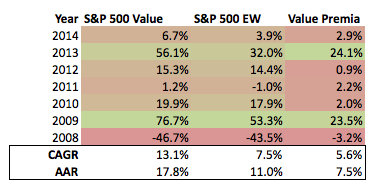
The S&P 500 is the largest, most liquid index, containing the largest ~500 stocks in the market. The smallest company has a market capitalization greater than $3 billion. It is heavily picked over. If ever there was an index that should suffer from the Magic Formula effect, this is it. Here we find that the value decile generate 17.8 percent per year compound, outperforming the index by 5.6 percent per year compound over the full period (and by 7.5 percent on average). $100,000 invested in the value decile in 2008 is worth $219,610 today, versus $158,440 for the S&P 500. The value decile also beat the S&P 500 in 6 out of 7 years, slightly underperforming in 2008. Value still works in S&P 500.

Russell 1000

Russell 1000 Stats Value and Markets 2008 to Present

The Russell 1000 contains the largest 1000 stocks in the market. The value decile returned 19.8 percent compound over the full period, beating its corresponding index by 7.0 percent per year compound (and by 10.7 percent on average). $100,000 invested in the value decile in 2008 is worth $227,280 today, versus $151,920 for the Russell 1000. Though the value decile outperformed by a wide margin over the full period, the value decile only beat the Russell 1000 in 4 out of 7 years. When it did outperform, however, it did so by a lot: 60.2 percent in 2009 and almost 20 percent in 2013.

Russell 3000
Russell 3000 Stats Value and Markets 2008 to Present

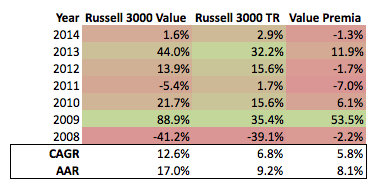
The value decile of the Russell 3000–the largest 3000 stocks in the market, and the broadest investable universe–returned 17 percent compound over the full period, beating out its index by 5.8 percent per year compound (and by 8.1 percent in the average year). $100,000 invested in the value decile in 2008 is worth $213,190 today, versus $152,540 for the Russell 3000. Here we find something interesting. Though the value decile outperformed over the full period, it only outperformed the market in 3 out of 7 years, which means that the value decile underperformed the Russell 3000 more than half the time. Perhaps this is the Magic Formula effect in action. Still, you were better off in the value decile by a wide margin over the full period. (Even if you started in 2010, and missed the big year of outperformance in 2009, you were still ahead of the Russell 3000 by 16.2 percent compound versus 14.9 percent for the index to today.)

Russell 2000
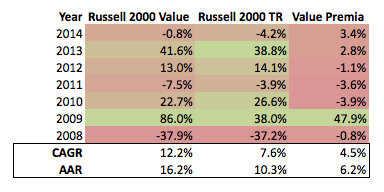
Russell 2000 Stats Value and Markets 2008 to PresentThe Russell 2000 is the smallest 2000 stocks in the Russell 3000 (the same universe as the Russell 3000 excluding the largest 1000 stocks). The value decile generated 16.2 percent compound over the full period, beating the Russell 2000 by 4.5 percent per year (or 6.2 percent in the average year). $100,000 invested in the value decile in 2008 is worth $207,930 today, versus $159,990 for the Russell 2000. Again, though the value decile outperformed by a wide margin over the full period, it only beat the Russell 2000 index in 3 out of 7 years, less than half the time.

Value investors are right. The period since 2008 has been more difficult for value strategies than it was in the early 2000s. But simple value strategies have still outperformed over the full period, and by a wide margin. This is despite the fact that, in many instances, the value decile often underperforms the market, and in some cases, more than half the time. If that’s the impact of the Magic Formula effect, I’ll take it.

My firm, Eyquem, has begun offering low cost, fee-only managed accounts that implement a deep value investment strategy. Please contact me by email at toby@eyquem.net or by telephone on (646) 535 8629 to learn more.

Click here if you’d like to read more on Quantitative Value, or connect with me on LinkedIn.


Read Full Post »

Greenbackd is able to offer  a special discount – over 50% off! — on registrations for the NY Congress taking place September 8 & 9, 2014.

This year, seating will be strictly limited to 275, so we encourage Greenbackd readers to register now, before the Congress sells out.

Regular Price: $5,995

Special Offer – Over 50% off (Offer expires: June 24, 2014)

To access the special offer, go to Valueinvestingcongress.com/congress/register-now-partners/ and use discount code: GREENBACKD

Information about the 10th Annual New York Value Investing Congress

  • Date:  September 8 – 9, 2014

Confirmed speakers include:

  • Leon Cooperman, Omega Advisors
  • Alexander Roepers, Atlantic Investment Management
  • Carson Block, Muddy Waters Research
  • Whitney Tilson, Kase Capital
  • Sahm Adrangi, Kerrisdale Capital Management
  • David Hurwitz, SC Fundamental
  • Jeffrey Smith, Starboard Value
  • Michael Kao, Akanthos Capital Management
  • Guy Gottfried, Rational Investment Group
  • John Lewis, Osmium Partners
  • Tim Eriksen, Eriksen Capital Management
  • Cliff Remily, Northwest Priority Capital
  • With many more to come!


Greenbackd receives consideration for promoting this event.

Read Full Post »

Last week  I looked at the implications of all-time-high valuations on returns in the S&P 500. This week I’ve examined the implications of high valuations on drawdown for stocks in the Russell 1000. I looked at the two most recent crashes–the 2000 to 2002 Dot Com Bust and the 2007 to 2009 Credit Crisis. I backtested the performance of the Russell 1000 Total Return (TR) and its value decile measured using the enterprise multiple (EBITDA / enterprise value — overview of the research on the enterprise multiple here). I lagged the fundamental data by 6 months (so portfolios formed 6/30 in year t use data from 12/31 in year t-1). All portfolios are equally weighted (the 100 stocks in the value decile hold 1 percent of the theoretical portfolio capital at inception and the ~1,000 stocks in the Russell 1000 portfolio hold 0.1 percent of portfolio capital at inception).

Here’s the Dot Com Bust:

Dot Com Bust

Performance of the Russell 1000 TR and Russell 1000 TR Value Decile During the Dot Com Bust (1999 to 2006)

The Dot Com Bust started in the Russell 1000 TR on September 1st, 2000. When it reached its low on October 9, 2002, two years and one month later, it had fallen 48.09 percent. It would not recover its losses from the September 1st, 2000 peak until October 12, 2006, more than six years and one month later.

By contrast, the value decile of the Russell 1000 fared much better. While it initially drew down from September 1st, 2000 more than 22 percent in sympathy with the market, it quickly recovered to make new highs by November that year. It would continue to make new highs until April 17, 2002, at which point it began falling, ending down 36.03 percent on October 9, 2002–the same day the market bottomed. The value decile recovered much faster than the Russell 1000 TR, regaining all its lost ground by September 19, 2003, one year and five months from its prior peak. 

It would not fare so well in the Credit Crisis (shown below):

Credit Crisis Drawdown

Performance of the Russell 1000 TR and the Russell 1000 TR Value Decile During the Credit Crisis (2007 to 2012)

The Credit Crisis actually began in the value decile of the Russell 1000 TR on June 4, 2007. The Russell 1000 itself would not start drawing down until a few months later on October 9, 2007. The value decile would find its low on November 21st, 2008 after falling for two years and four months. From peak to trough, the value decile lost 58.31 percent. It would not fully recover until March 30, 2011, almost three years and ten months from the start of the bust. The Russell 1000 bottomed March 9, 2009, after losing 55.41 percent. It would not make a new peak until March 15, 2012, more than three years after its low, and more than five years and four months its last peak.

The shelter offered by the value decile in the Dot Com Bust was missing in the Credit Crisis. If anything, the Credit Crisis hit the value decile harder than the market. It started drawing down four months before the rest of the Russell 1000, and it fell further–58.31 percent versus the Russell 1000’s 55.41 percent. One reason is the relative valuations of the value deciles in the Dot Com Bust and the Credit Crisis. In the early 2000s, value stocks were unusually cheap, with the median of 100 stocks in the value decile of the Russell 1000 yielding (on an EBITDA/EV basis) 17.5 percent in June 1999, 19.5 percent in June 2000, 16.9 percent in June 2001, and 17.2 percent in June 2002. By contrast, the median stock in the Russell 1000 TR yielded 9.0 percent in June 1999, 10.7 percent in June 2000, 10.4 percent in June 2001, and 9.8 percent in June 2002. In the Credit Crisis, the median stock in the value decile yielded 16.75 percent in June 2007, more expensive than at any time in the early 2000s, while the median stock in the market yielded 9.2 percent. The greater yield in the value decile, and the larger spread between the value decile and the market in the Dot Com Bust manifested in a smaller drawdown and a shorter recovery period for the value decile. The slightly smaller yields, and tighter spread in the Credit Crisis led to a larger drawdown, although the value decile did recover much faster than the market, three years and ten months for the value decile versus five years and four months for the market.

Valuation doesn’t tell the whole story, but it’s an important component in the performance of portfolios during stock market crashes. High market valuations are one of the factors that precipitate crashes. Better value portfolios of stocks  sometimes offer a little more protection than overvalued stocks, as they did in the Dot Com bust, but that is unusual. In the ordinary course, correlations go to 1 and everything sells off at the same rate, as it did in the Credit Crisis. Presently, the median stock in the Russell 1000 TR yields just 9.2 percent, while the median stock in the value decile yields almost 16.8 percent. Both are expensive.

Click here if you’d like to read more on Quantitative Value, or connect with me on LinkedIn.


Read Full Post »

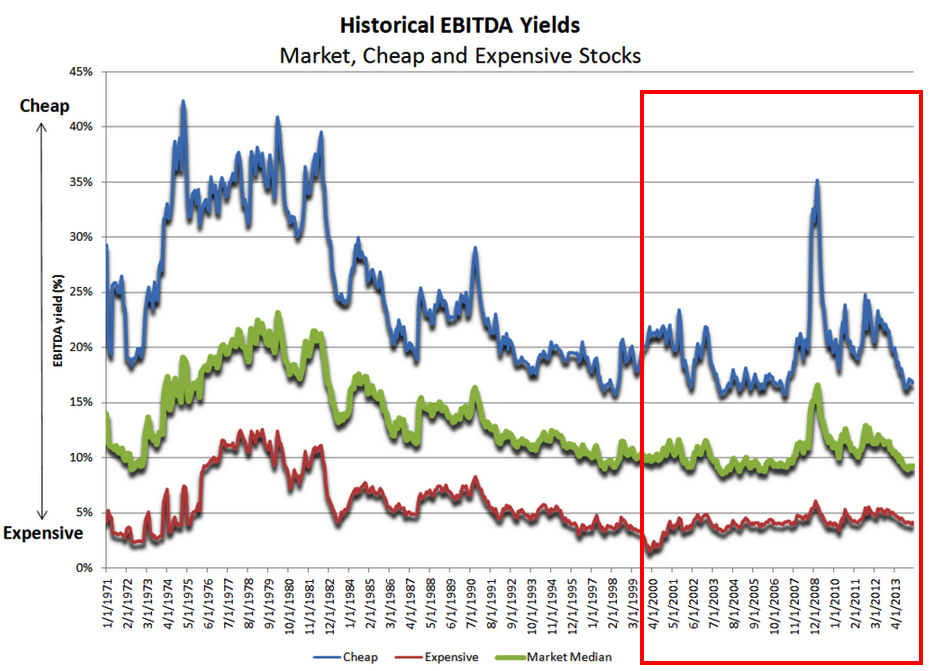
Last week I ran a post about the median stock trading at an all-time high valuation that included this chart from “Millennial Investor” Patrick O’Shaughnessy showing historical EBITDA yields for all stocks in the universe greater than $200 million market capitalization from the period 1971 to date:

Historical EBITDA Yields Millennial v2


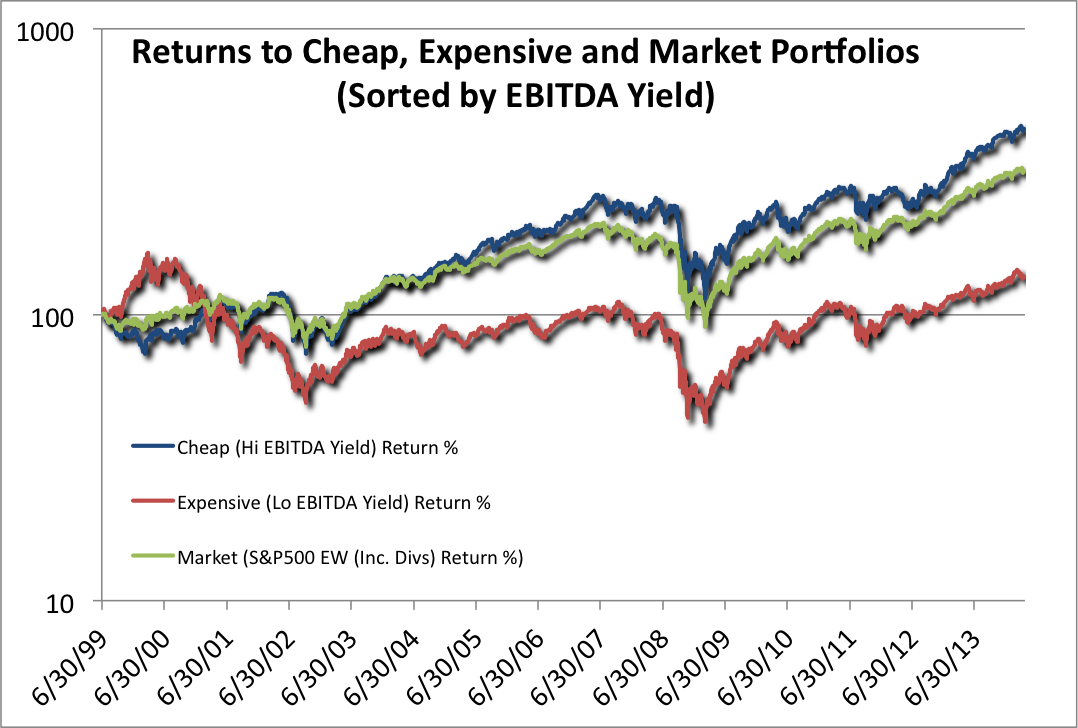
I backtested the returns for all three portfolios during the most extreme period in the data (from 1999 to date marked in the red square above). I limited my universe to the stocks in the S&P 500 and lagged the fundamental data by 6 months (so portfolios formed 6/30 in year t use data from 12/31 in year t-1). All portfolios are equally weighted (the 50 stocks in each for the Cheap and Expensive portfolios hold 2 percent of the theoretical portfolio capital at inception and the 500 stocks in the Market portfolio hold 0.2 percent of portfolio capital at inception). Here’s the return chart for the three portfolios:

S&P 500 EBITDA Portfolio Returns

(c) Eyquem Investment Management LLC

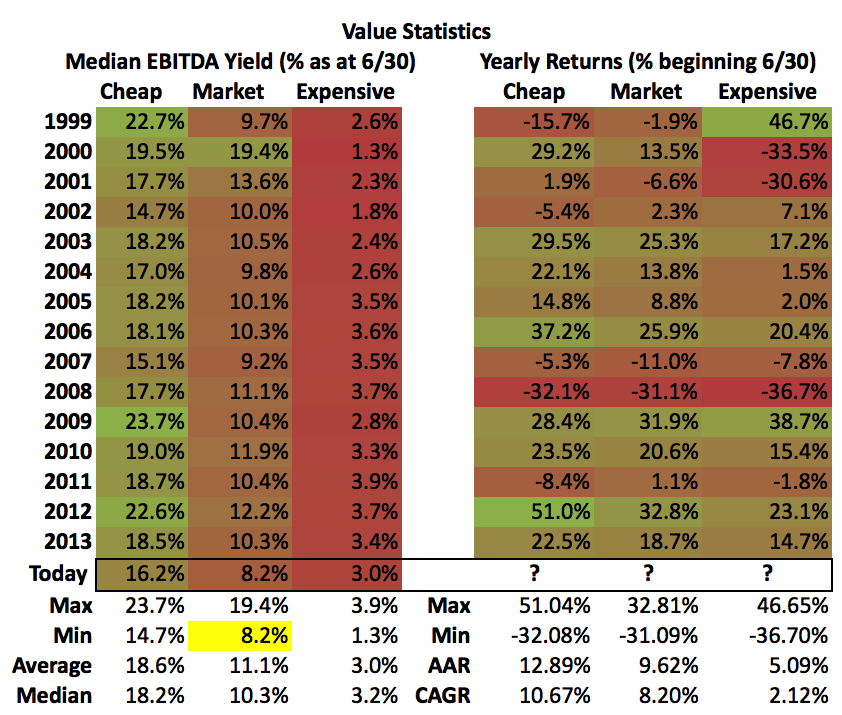
Here are the return statistics for each of the three portfolios (the cells are conditionally formatted such that green indicates a low yield or a high return, both “good” things, and red indicates a high yield or a low return (both “bad” things):

Value Statistics S&P 500 Deciles

(c) Eyquem Investment Management LLC

There are a few things to note in the chart above.

  • First, the median stock is the most expensive it has been (in the data) at an EBITDA yield of 8.2 percent (here’s my overview of the research on the enterprise multiple — the inverse of the EBITDA yield). The previous peak was 9.2 percent in 2007, and before that 9.7 percent in 1999. We see something similar in the Cheap portfolio too. It is the much more expensive than average, and is exceeded only by 2007 (15.1 percent), and 2002 (14.7 percent–the all-time high).
  • Second, it’s no accident that the worst returns are associated with the lowest EBITDA yields. If we compare the performance of the portfolios we can see that the Expensive portfolio always has the lowest yields and has consistently underperformed the Market and Cheap portfolios (with the only exception being the last year of the dot com bubble in 1999). The Cheap portfolio always has the highest yields and has consistently outperformed the Market and Expensive portfolios (again, with the only exception being the last year of the dot com bubble in 1999).
  • If we look within portfolios and compare one year to the next, we can see that, though the relationship isn’t perfect, there too low yields produce low returns. (The relationship persists perhaps because it isn’t perfect.) The worst returns don’t necessarily occur in the year of overvaluation, but they follow closely. For example, the worst yearly performances for the Market occurred in 2008 (-31.1 percent), 2007 (-11 percent) and 2001 (-6.6 percent) and 1999 (-1.9 percent), and those dates roughly conform with the lowest yields.
  • Finally, the worst years for the Cheap portfolios were in 2008 (-32.1 percent), 1999 (15.7 percent), 2011 (-8.4 percent), 2002 (-5.4 percent), and 2007 (-5.3 percent), and those dates also roughly conform with the dates that the portfolios held stocks with the lowest yields.

There’s no magic to value investment. Low yields produce low returns. High yields produce high returns. The relationship isn’t perfect. Outlier years like 1999, and 2011 will occur occasionally, but, on average, you’re better served buying Cheap stocks, and remaining cautious during periods when the median stock in the market offers a historically low yield, like right now.

Click here if you’d like to read more on Quantitative Value, or connect with me on LinkedIn.
Read Full Post »

Great charts in a piece by “Millennial Investor” Patrick O’Shaughnessy called The Five Year Market Metamorphosis. O’Shaughnessy says that the market is much more expensive now than it was at the bottom in 2009. He cites the following chart, which divides the universe of stocks with a market capitalization >$200 million into three buckets–Cheap, Expensive and Market Median–on the basis of the “EBITDA yield” (1/enterprise multiple).

O’Shaughnessy’s chart shows that the Median stock is at an all-time low EBITDA yield, meaning it’s at an all-time high valuation. As we’ve seen previously (Worst value opportunity set in 25 years, and A Market of Stocks? Distribution of S&P 500 P/E Multiples Tightest In 25 Years), market-level overvaluation of this magnitude has typically led to highly attenuated returns over the ensuing decade.

Optimists often point to the outperformance of value stocks in the early 2000s, which seemed to buck the trend of the overall market. O’Shaughnessy’s chart shows why value outperformed in 2000, but not in 2007. In 2000, Cheap stocks offered enormous 20+ percent EBITDA yields. The Market Median stock, by contrast, offered only around 10 percent, slightly less expensive than it is now. Expensive stocks, on historically low EBITDA yields  (high valuations), offered only a little over 1 percent.

Fast forward to 2007. The EBITDA yield on the Market Median stock was comparable to its yield in 2000 (and its yield now), but Cheap stocks were close to all-time low yields (all-time high valuations). That’s why there was nowhere to hide in 2007. Value stocks didn’t offer any more protection than the market did because there wasn’t much value in the “Value.”

The Market Median stock is now more overvalued than it has ever been (or at least in data going back to 1971). The bad news now is that, while the Cheap stocks aren’t quite as expensive as they were in 2007, they’re close.

Click here if you’d like to read more on Quantitative Value, or connect with me on LinkedIn.


Read Full Post »

Sponsored Post

London Value Investor Conference, 22nd May – features Mason Hawkins and Don Yacktman

The London Value Investor Conference, which is Moderated by Richard Oldfield and David Shapiro, will take place on Thursday 22nd May at the Queen Elizabeth II Conference Centre in Westminster, London. The Conference will feature well known investors such as Mason Hawkins, Don Yacktman, Mason Morfit and Jon Moulton. As an introduction this conference, please find a video of Michael Price’s 42 minute presentation from May 2013 below:


At the 2014 Conference, the following speakers will provide valuable insights in to their methods and approaches as well as giving specific investment ideas: 

  • Mason Hawkins – Chairman and CEO of Southeastern Asset Management with $34bn AUM
  • Don Yacktman – President and Co-CIO of Yacktman Asset Management with $28bn AUM
  • Mason Morfit – President of ValueAct Capital, recently appointed Directors of Microsoft
  • Jon Moulton – Founder of Better Capital; previously founded Venture Capital firm Alchemy
  • David Samra – Founding Partner of Artisan Partners, recently named Morningstar International Stock-Fund Manager of the Year 2013
  • Aled Smith – Manager of the M&G Global Leaders Fund and the M&G American Fund
  • Richard Rooney – President and CIO of Burgundy Asset Management
  • Tim Hartch, Fund Manager at Brown Brothers Harriman
  • Charles Heenan, Investment Director at Kennox Asset Management
  • Andrew Hollingworth, Founder of Holland Advisors
  • Jonathan Mills, Founder of Metropolis Capital
  • Philip Best and Marc Saint John Webb, co-Fund Managers at Argos Investment Managers

A key feature of the conference is the 10-15 minutes dedicated to audience Q&A which is led by Richard Oldfield of Oldfield Partners and David Shapiro from Towers Watson. 

There are only 8 weeks to go until this conference and for a short time you can get a discount by using “GREENBACKD-22MAY” when booking (expires 17th April 2014)

This will also be a unique networking opportunity as this conference is the largest gathering of value investors in Europe, we expect there will be 400 paying delegates present this year. 


Disclosure: I receive a small fee for the sale of tickets to the London Value Investor Conference.

Read Full Post »

Institutional Investor has a great piece from Clifford Asness and John Liew called The Great Divide over Market Efficiency on the efficient markets debate. Most interesting for me was their discussion on the launch of AQR and the “value” strategies it employs:

Starting in the mid-1980s, researchers began investigating simple value strategies. That’s not to say value investing was invented at that time. We fear the ghosts of Benjamin Graham and David Dodd too much to ever imply that. This was when researchers began formal, modern academic studies of these ideas. What they found was that Graham and Dodd had been on to something. Stocks with lower price multiples tended to produce higher average returns than stocks with higher price multiples. As a result, the simplest diversified value strategies seemed to work. Importantly, they worked after accounting for the effects of CAPM (that is, for the same beta, cheaper stocks still seemed to have higher expected returns than more expensive stocks). The statistical evidence was strong and clearly rejected the joint hypothesis of market efficiency and CAPM.

We started our careers in the early 1990s, when as a young team in the asset management group at Goldman, Sachs & Co. we were asked to develop a set of quantitative trading models. Why they let a small group of 20-somethings trade these things we’ll never know, but we’re thankful that they did. Being newly minted University of Chicago Ph.D.s and students of Gene Fama and Ken French, the natural thing for us to do was develop models in which one of the key inputs was value. …

Asness Long Short Value v2

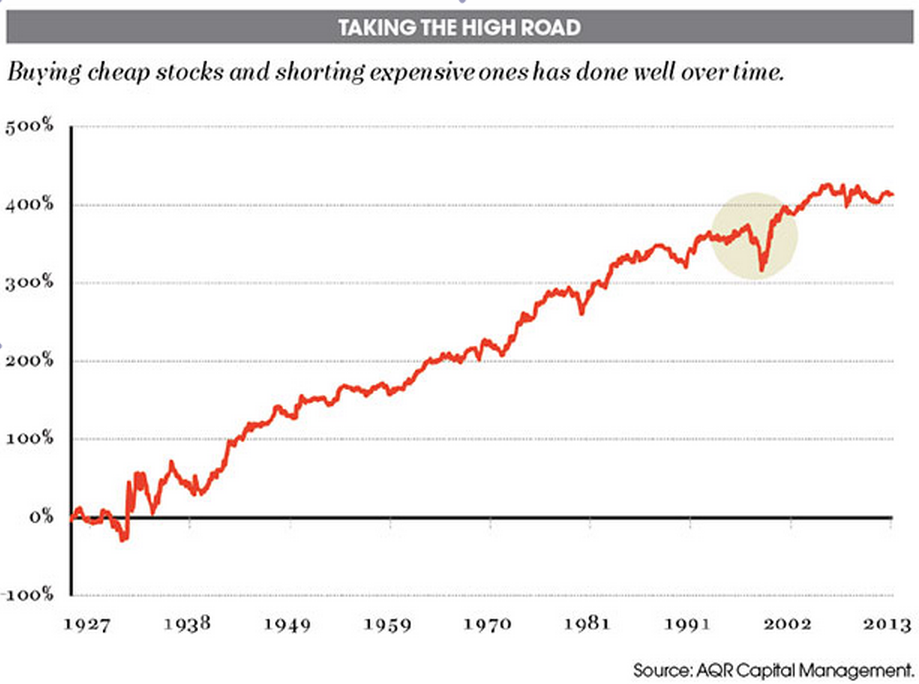
Above is a graph of the cumulative returns to something called HML (a creation of Fama and French’s). HML stands for “high minus low.” It’s a trading strategy that goes long a diversified portfolio of cheap U.S. stocks (as measured by their high book-to-price ratios) and goes short a portfolio of expensive U.S. stocks (measured by their low book-to-price ratios). The work of Fama and French shows that cheap stocks tend to outperform expensive stocks and therefore that HML produces positive returns over time (again, completely unexplained by the venerable CAPM). The graph above shows this over about 85 years.

If you notice the circled part, that’s when we started our careers. Standing at that time (before the big dip you see rather prominently), we found both the intuition and the 65 years of data behind this strategy pretty convincing. Obviously, it wasn’t perfect, but if you were a long-term investor, here was a simple strategy that produced positive average returns that weren’t correlated to the stock market. Who wouldn’t want some of this in their portfolio?

Fortunately for us, the first few years of our live experience with HML’s performance were decent, and that helped us establish a nice track record managing both Goldman’s proprietary capital, which we began with, and the capital of some of our early outside investors. This start also laid the groundwork for us to team up with a fellow Goldman colleague, David Kabiller, and set up our firm, AQR Capital Management.

As fate would have it, we launched our first AQR fund in August 1998. You may remember that as an uneventful little month containing the Russian debt crisis, a huge stock market drop and the beginning of the rapid end of hedge fund firm Long-Term Capital Management. It turned out that those really weren’t problems for us (that month we did fine; we truly were fully hedged long-short, which saved our bacon), but when this scary episode was over, the tech bubble began to inflate.

We were long cheap stocks and short expensive stocks, right in front of the worst period for value strategies since the Great Depression. Imagine a brand-new business getting that kind of result right from the get-go. Not long cheap stocks alone, which simply languished, but long cheap and short expensive! We remember a lot of long-only value managers whining at the time that they weren’t making money while all the crazy stocks soared. They didn’t know how easy they had it. At the nadir of our performance, a typical comment from our clients after hearing our case was something along the lines of “I hear what you guys are saying, and I agree: These prices seem crazy. But you guys have to understand, I report to a board, and if this keeps going on, it doesn’t matter what I think, I’m going to have to fire you.” Fortunately for us, value strategies turned around, but few know the limits of arbitrage like we do (there are some who are probably tied with us).

On the question of market efficiency, years as practitioners have put Asness and Liew somewhere between Fama and Shiller:

We usually end up thinking the market is more efficient than do Shiller and most practitioners — especially, active stock pickers, whose livelihoods depend on a strong belief in inefficiency. As novelist Upton Sinclair, presumably not a fan of efficient markets, said, “It is difficult to get a man to understand something, when his salary depends upon his not understanding it!” However, we also likely think the market is less efficient than does Fama.

After backtesting countless “value” and fundamental strategies for our book Quantitative Value I found myself in the same boat. There exist some strategies that, over the long term, lead to a consistent, small margin over market, but fewer work than most believe, and our own efforts to cherry pick the model inevitably lead to underperformance.

Click here to read The Great Divide over Market Efficiency and here if you’d like to read more on Quantitative Value, or connect with me on LinkedIn.

Read Full Post »

From the FTAlphaville’s “This is Nuts. When’s the crash?” series:

We argue Tesla cannot be valued on near-term multiple metrics like traditional auto companies given that we expect Tesla to multiply revenues by more than 10x from 2013 to 2016 by nearly 30x by 2020 and around 60x by 2028. We have thus chosen a 15-year time horizon for our DCF which captures the full maturation of the Model S, Model X (and top-hat derivatives) and also the ramp up of its mass market electric vehicle (the Gen 3). We have applied a 11% WACC with a range of 9% to 13%. The terminal value, calculated on a midpoint of 10x EV/EBITDA accounts for roughly 50% of the total DCF value across the range of methodologies we have applied to arrive at our PT.

New base case: a $320 share price, implying an almost $40bn market capitalisation.

New Bull case, $500/share or more than a $60bn valuation.

Tesla sales over the last four quarters: $1.7bn.

Tesla share price over the same period:

Revs 10x in three years. 11% WACC. 10x EBITDA/EV multiple at terminal value. Bull. Market. Insanity.

Click here if you’d like to read more on Quantitative Value, or connect with me on LinkedIn.

Read Full Post »

In 7-Footers In A Sea Of Pygmies: Why Concentrating On Just The Averages Obscures True Market Insights, Lonnie and Jacob from Farnam Street Investments have a great post on the current lack of dispersion in stock valuations. The corollary to last week’s post on the extremely tight distribution of P/E multiples for stocks in the S&P 500 (the tightest in 25 years) is that there are now fewer stocks with low P/Es than at any time in the last 25 years.

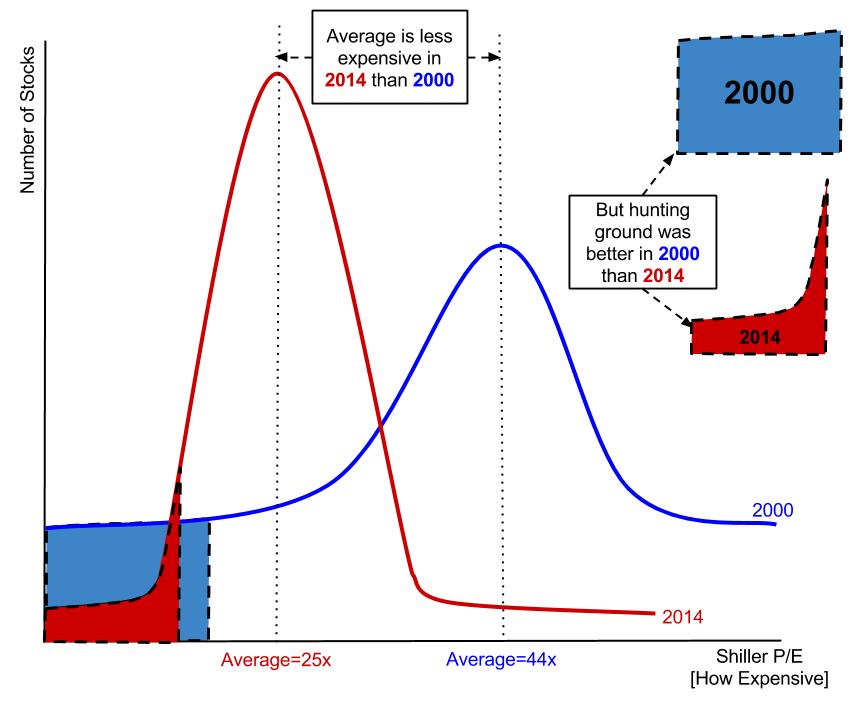
While the stock market peak in 2000 was higher than the current market (measured on the basis of the Shiller P/E ratio) the wider distribution of P/Es meant that there were many bargains available in 2000. Jacob and Lonnie write:

When there’s a wide range of cheap and expensive, the thoughtful investor can still find deals, even if the averages are generally high.

This is exactly what we saw in 2000 to 2001. Because of the disruptive arrival of the Internet, many stocks were priced to the moon, while some were being practically given away. The prevailing narrative was that new-economy internet stocks were the wave of the future and old-economy stocks were soon-to-be-extinct dinosaurs. This created a two-tiered market with a record high average price (the Shiller P/E was 44.2 in December 1999!), but a plethora of deals are available at the bottom. The chart below shows that time frame having a record high dispersion; it was a tribe with an incredibly wide range of heights to choose from.

What type of market do we find ourselves in today?

Looking back at our dispersion chart above, we’re currently at a 25-year low, meaning the cheapest 10% of the market looks an awful lot like the other 90%. And if you normalize earnings at all, the current P/E is extremely high with the Shiller CAPE at 25x. Prices are expensive and tightly packed around the average, meaning we shouldn’t expect very good returns from here. In fact by some statistical thresholds that we’ve already crossed, it’s one of the top five most dangerous markets of all time. It will be extremely difficult to be a stock picking hero in this environment. Even though the 2000 market average was higher than today, the 2000 time frame delivered a much better hunting ground.

Jacob and Lonnie conclude:

Value investors are known for ignoring “macro” developments and relying solely on their skills as bottom-up stock pickers. Their depth of research is usually unparalleled, but there’s a general hesitancy in considering broader market valuations in their analysis. We’re value investors through and through, but we think it’s a mistake not to pay attention to what the current investment opportunity set looks like compared to different points in history.

Read Farnam Street Investments’  7-Footers In A Sea Of Pygmies: Why Concentrating On Just The Averages Obscures True Market Insights.

Order Quantitative Value from Wiley FinanceAmazon, or Barnes and Noble.

Click here if you’d like to read more on Quantitative Value, or connect with me on LinkedIn.
Read Full Post »

Great piece from Tocqueville Funds’ François Sicart called Contrarian Investing in a Liquidity-Driven Environment. Tocqueville is a “bottom-up” value investor:

Individual stock selection prevails over macro opinions, be they about the economy or the markets.

This approach generally has been vindicated in the past, as value investors tended to outperform a majority of money managers over full market cycles; and this outperformance has been achieved principally during bear markets, by losing less than most.  The reason, I believe, is so obvious as to sound simplistic:  When a stock is selling close to the “intrinsic” value of its underlying company’s shares, it does not have to travel down very much to find a floor.

Good logic, but it didn’t protect Tocqueville of anyone else in 2007 to 2009:

In spite of this “unquestionable” logic, the great majority of portfolios (including those of some iconic value investors) were engulfed in the panicky downward spiral that followed the Lehman Bros. failure, between the summer of 2008 and the final bottom, in early 2009.

That part of the overall 53-percent decline from the 2007 top to the 2009 bottom was generally indiscriminate – more so than I can remember throughout my career, with the possible exception of the one-day crash of 1987; but that violent but brief market episode did not trigger a global financial crisis or recession.

“But it’s a market of stocks”:

At this stage of a discussion, a broker would typically tell you, “This is not a stock market, but a market of stocks,” implying that there are always attractive investments somewhere, even when the overall market seems overpriced.  And although this is a typical sales pitch, they usually are correct.  This time, however, we may have to work harder to find those attractive investments.

David Kostin, Goldman Sachs’ chief U.S. equity strategist, explained that investor demand for “value” has been so pervasive that low-valuation stocks had outperformed higher valuation peers by 12 percent in 2013.  As a result, the distribution of S&P 500 P/E multiples was now its tightest in at least 25 years, implying less differentiation of companies based on valuation.

“With valuation clustered together, we believe there are attractive relative value opportunities where companies with different fundamentals are trading at very similar valuation levels.”

If you’re having trouble finding undervalued stocks, this is some indication that it’s not just you. The current valuation spread is narrower than it was in 2007, and stands in stark contrast to the early 2000s when it was wider than usual.

Read Tocqueville Funds’ Contrarian Investing in a Liquidity-Driven Environment.

h/t Farnam Street Investments.

Order Quantitative Value from Wiley FinanceAmazon, or Barnes and Noble.

Click here if you’d like to read more on Quantitative Value, or connect with me on LinkedIn.

Read Full Post »

« Newer Posts - Older Posts »