Feeds:
Posts
Comments

Archive for the ‘Stocks’ Category

This week I’ve been taking a look at Aswath Damodaran’s paper “Value Investing: Investing for Grown Ups?” in which he asks, “If value investing works, why do value investors underperform?”

Damodaran divides the value world into three groups:

  1. The Passive Screeners,” – “The Graham approach to value investing is a screening approach, where investors adhere to strict screens… and pick stocks that pass those screens.”
  2. The Contrarian Value Investors,” – “In this manifestation of value investing, you begin with the belief that stocks that are beaten down because of the perception that they are poor investments (because of poor investments, default risk or bad management) tend to get punished too much by markets just as stocks that are viewed as good investments get pushed up too much.”
  3. Activist value investors,” – “The strategies used by …[activist value investors] are diverse, and will reflect why the firm is undervalued in the first place. If a business has investments in poor performing assets or businesses, shutting down, divesting or spinning off these assets will create value for its investors. When a firm is being far too conservative in its use of debt, you may push for a recapitalization (where the firm borrows money and buys back stock). Investing in a firm that could be worth more to someone else because of synergy, you may push for it to become the target of an acquisition. When a company’s value is weighed down because it is perceived as having too much cash, you may demand higher dividends or stock buybacks. In each of these scenarios, you may have to confront incumbent managers who are reluctant to make these changes. In fact, if your concerns are broadly about management competence, you may even push for a change in the top management of the firm.”

We looked at Damodaran’s passive screeners Tuesday, the contrarian value investors Wednesday, and today we’ll take a look at the activists.

The Activist Value Investors

Damodaran cites the well-known Brav, Jiang and Kim article that I have discussed here before:

If activist investors hope to generate their returns from changing the way companies are run, they should target poorly managed companies for their campaigns. Institutional and individual activists do seem to focus on poorly managed companies, targeting companies that are less profitable and have delivered lower returns than their peer group. Hedge fund activists seem to focus their attention on a different group. A study of 888 campaigns mounted by activist hedge funds between 2001 and 2005 finds that the typical target companies are small to mid cap companies, have above average market liquidity, trade at low price to book value ratios, are profitable with solid cash flows and pay their CEOs more than other companies in their peer group. Thus, they are more likely to be under valued companies than poorly managed. A paper that examines hedge fund motives behind the targeting provides more backing for this general proposition in figure 15.
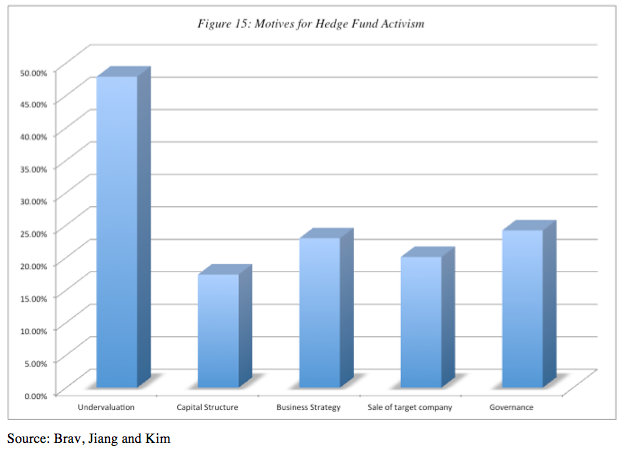
As we have seen both undervalued or poorly managed stocks can generate good returns.

Damodaran says that the “market reaction to activist investors, whether they are hedge funds or individuals, is positive.” A study that looked at stock returns in targeted companies in the days around the announcement of activism showed the following results:
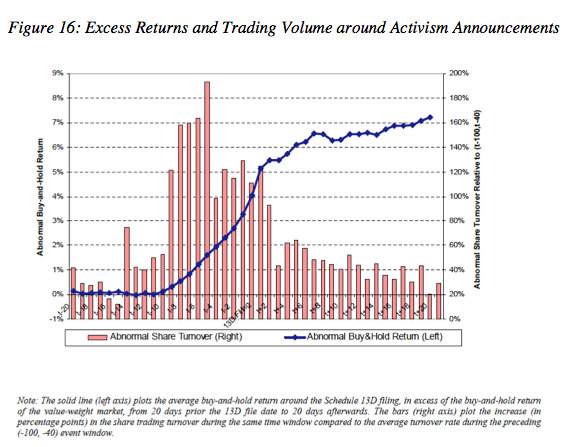
Damodaran points out that “the bulk of the excess return (about 5% of the total of 7%) is earned in the twenty days before the announcement and that the post-announcement drift is small.”

There is also a jump in trading volume prior to the announcement, which does interesting (and troubling) questions about trading being done before the announcements. The study also documents that the average returns around activism announcement has been drifting down over time, from 14% in 2001 to less than 4% in 2007.

Can you make money following activist investors?

Damodaran says “sort of,” if you follow:

The right activists: If the median activist hedge fund investor essentially breaks even, as the evidence suggests, a blunderbuss approach of investing in a company targeted by any activist investor is unlikely to generate value. However, if you are selective about the activist investors you follow, targeting only the most effective, and investing only in companies that they target, your odds improve.

Performance cues: To the extent that the excess returns from this strategy come from changes made at the firm to operations, capital structure, dividend policy and/or corporate governance, you should keep an eye on whether and how much change you see on each of these dimesions at the targeted firms. If the managers at these firms are able to stonewall activist investors successfully , the returns are likely to be unimpressive as well.

A hostile acquisition windfall? A study by Greenwood and Schor notes that while a strategy of buying stocks that have been targeted by activist investors generates  excess returns, almost all of those returns can be attributed to the subset of these firms that get taken over in hostile acquisitons.

Follow the right activists, and do ok, or front run them, and potentially do very well:

There is an alternate strategy worth considering, that may offer higher returns, that also draws on activist investing. You can try to identify companies that are poorly managed and run, and thus most likely to be targeted by activist investors. In effect, you are screening firms for low returns on capital, low debt ratios and large cash balances, representing screens for potential value enhancement, and ageing CEOs, corporate scandals and/or shifts in voting rights operating as screens for the management change. If you succeed, you should be able to generate higher returns when some of these firms change, either because of pressure from within (from an insider or an assertive board of directors) or from without (activist investors or a hostile acquisition).

So how do we mess it up?

• This power of activist value investing usually comes from having the capital to buy significant stakes in poorly managed firms and using these large stockholder positions to induce management to change their behavior. Managers are unlikely to listen to small stockholders, no matter how persuasive their case may be.

• In addition to capital, though, activist value investors need to be willing to spend substantial time fighting to make themselves heard and in pushing for change. This investment in time and resources implies that an activist value investor has to pick relatively few fights and be willing to invest substantially in each fight.

• Activist value investing, by its very nature, requires a thorough understanding of target firms, since you have to know where each of these firms is failing and how you would fix these problems. Not surprisingly, activist value investors tend to choose a sector that they know really well and take positions in firms within that sector. It is clearly not a strategy that will lead to a well diversified portfolio.

• Finally, activist value investing is not for the faint hearted. Incumbent managers are unlikely to roll over and give in to your demands, no matter how reasonable you may thing them to be. They will fight, and sometimes fight dirty, to win. You have to be prepared to counter and be the target for abuse. At the same time, you have to be adept at forming coalitions with other investors in the firm since you will need their help to get managers to do your bidding. 
Read Full Post »

Yesterday, I examined Aswath Damodaran’s paper “Value Investing: Investing for Grown Ups?” in which Damodaran asked, “If value investing works, why do value investors underperform?”

Damodaran divides the value world into three groups:

  1. The Passive Screeners,” – “The Graham approach to value investing is a screening approach, where investors adhere to strict screens… and pick stocks that pass those screens.”
  2. The Contrarian Value Investors,” – “In this manifestation of value investing, you begin with the belief that stocks that are beaten down because of the perception that they are poor investments (because of poor investments, default risk or bad management) tend to get punished too much by markets just as stocks that are viewed as good investments get pushed up too much.”
  3. Activist value investors,” – “The strategies used by …[activist value investors] are diverse, and will reflect why the firm is undervalued in the first place. If a business has investments in poor performing assets or businesses, shutting down, divesting or spinning off these assets will create value for its investors. When a firm is being far too conservative in its use of debt, you may push for a recapitalization (where the firm borrows money and buys back stock). Investing in a firm that could be worth more to someone else because of synergy, you may push for it to become the target of an acquisition. When a company’s value is weighed down because it is perceived as having too much cash, you may demand higher dividends or stock buybacks. In each of these scenarios, you may have to confront incumbent managers who are reluctant to make these changes. In fact, if your concerns are broadly about management competence, you may even push for a change in the top management of the firm.”

We looked at Damodaran’s passive screeners yesterday, the contrarian value investors are up today, and tomorrow we’ll take a look at the activists.

The Contrarian Value Investors

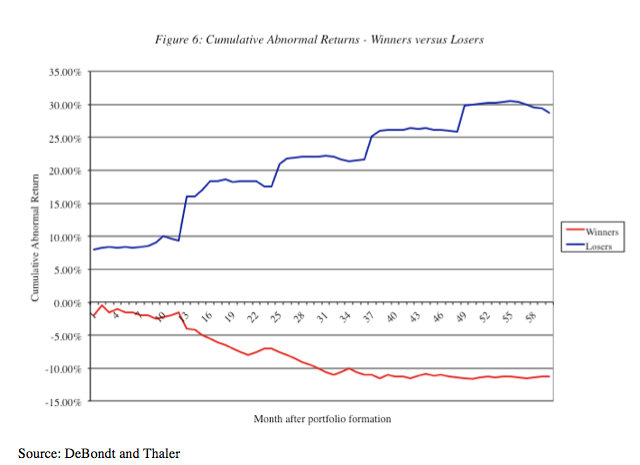
Buying losers seems to work over a long time scale.

Damodaran:

This analysis suggests that an investor who bought the 35 biggest losers over the previous year and held for five years would have generated a cumulative abnormal return of approximately 30% over the market and about 40% relative to an investor who bought the winner portfolio.

This evidence is consistent with market overreaction and suggests that a simple strategy of buying stocks that have gone down the most over the last year or years may yield excess returns over the long term. Since the strategy relies entirely on past prices, you could argue that this strategy shares more with charting – consider it a long term contrarian indicator – than it does with value investing.

Several select caveats:

• Studies also seem to find loser portfolios created every December earn significantly higher returns than portfolios created every June. This suggests an interaction between this strategy and tax loss selling by investors. Since stocks that have gone down the most are likely to be sold towards the end of each tax year (which ends in December for most individuals) by investors, their prices may be pushed down by the tax loss selling.

• There seems to be a size effect when it comes to the differential returns. When you do not control for firm size, the loser stocks outperform the winner stocks, but when you match losers and winners of comparable market value, the only month in which the loser stocks outperform the winner stocks is January.21

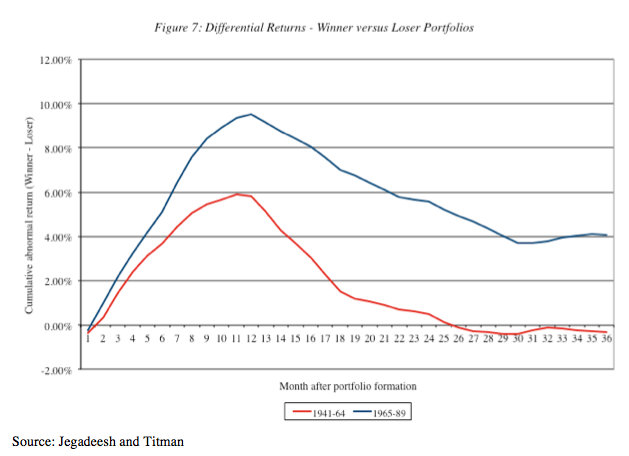
• The final point to be made relates to time horizon. There may be evidence of price reversals in long periods (3 to 5 years) and there is the contradictory evidence of price momentum– losing stocks are more likely to keep losing and winning stocks to keep winning – if you consider shorter periods (six months to a year). An earlier study that we referenced, by Jegadeesh and Titman tracked the difference between winner and loser portfolios by the number of months that you held the portfolios.22

Damodaran’s final point above – that price momentum works over short periods – is interesting:

Weird. The winner portfolio actually outperforms the loser portfolio in the first 12 months. Says Damodaran:

[L]oser stocks start gaining ground on winning stocks after 12 months, [but] it took them 28 months in the 1941-64 time period to get ahead of them and the loser portfolio does not start outperforming the winner portfolio even with a 36-month time horizon in the 1965-89 time period. The payoff to buying losing companies may depend heavily on whether you have to capacity to hold these stocks for long time periods.

Bad companies can be good investments

A more sophisticated version of contrarian value investing  is buying “unexcellent” companies and selling “excellent” companies. Damodaran’s rationale is as follows:

If you are right about markets overreacting to recent events, expectations will be set too high for stocks that have been performing well and too low for stocks that have been doing badly. If you can isolate these companies, you can buy the latter and sell the former.

Take note, franchise investors:

Any investment strategy that is based upon buying well-run, good companies and expecting the growth in earnings in these companies to carry prices higher is dangerous, since it ignores the possibility that the current price of the company already reflects the quality of the management and the firm. If the current price is right (and the market is paying a premium for quality), the biggest danger is that the firm loses its luster over time, and that the premium paid will dissipate. If the market is exaggerating the value of the firm, this strategy can lead to poor returns even if the firm delivers its expected growth. It is only when markets under estimate the value of firm quality that this strategy stands a chance of making excess returns.

The tale of Tom Peters’s In Search of Excellence:

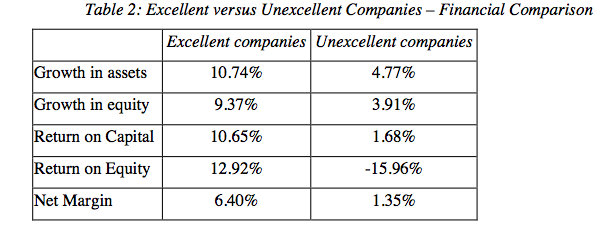
There is some evidence that well managed companies do not always make good investments. Tom Peters, in his widely read book on excellent companies a few years ago, outlined some of the qualities that he felt separated excellent companies from the rest of the market.23 Without contesting his standards, a study went through the perverse exercise of finding companies that failed on each of the criteria for excellence – a group of unexcellent companies and contrasting them with a group of excellent companies.

Here’s a statistical comparison of the two groups:

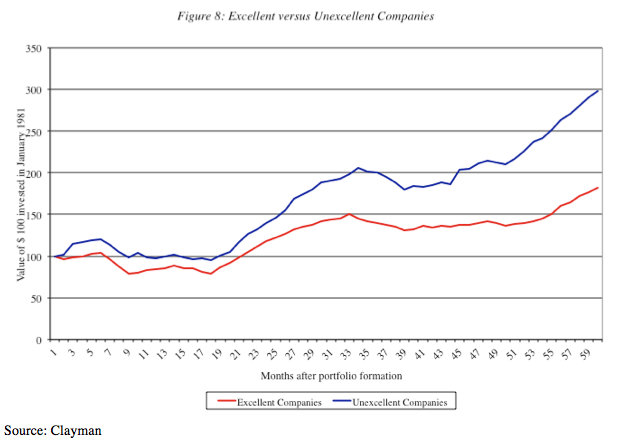
Clearly, “Excellent companies” are excellent, and “Unexcellent companies” suck (negative return on equity!). Confronted with the choice to invest in one group of the other, it’s a no-brainer. Or is it? Here are the returns:

Ruh roh. Says Damodaran:

The excellent companies may be in better shape financially but the unexcellent companies would have been much better investments at least over the time period considered (1981-1985). An investment of $ 100 in unexcellent companies in 1981 would have grown to $ 298 by 1986, whereas $ 100 invested in excellent companies would have grown to only $ 182. While this study did not control for risk, it does present some evidence that good companies are not necessarily good investments, whereas bad companies can sometimes be excellent investments.

A legitimate criticism of this study is that the time period is very short (5 years) and may be an aberration – it began, after all, right at the end of a tough bear market, where any stock with the fundamentals of the unexcellent companies would have looked like poison. How about a second study?

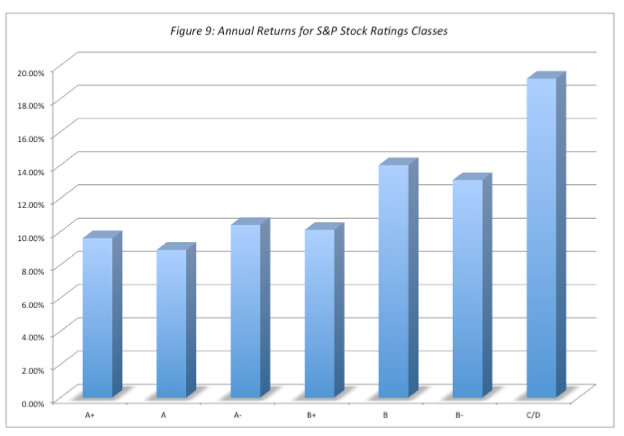
The second study used a more conventional measure of company quality. Standard and Poor’s, the ratings agency, assigns quality ratings to stocks that resemble its bond ratings. Thus, an A rated stock, according to S&P, is a higher quality investment than a B+ rated stock, and the ratings are based upon financial measures (such as profitability ratios and financial leverage). Figure 9 summarizes the returns earned by stocks in different ratings classes, and as with the previous study, the lowest rated stocks had the highest returns and the highest rated stocks had the lowest returns.

And here are the returns:

Looks like a pretty clear inverse relationship between rating and return. Sure, whereof rating, thereof “risk,” but I’m prepared to wear that “risk” for the return.

So contrarian value investing works. How do we mess this up?

a. Long Time Horizon: To succeed by buying these companies, you need to have the capacity to hold the stocks for several years. This is necessary not only because these stocks require long time periods to recover, but also to allow you to spread the high transactions costs associated with these strategies over more time. Note that having a long time horizon as a portfolio manager may not suffice if your clients can put pressure on you to liquidate holdings at earlier points. Consequently, you either need clients who think like you do and agree with you, or clients that have made enough money with you in the past that their greed overwhelms any trepidation they might have in your portfolio choices.

b. Diversify: Since poor stock price performance is often precipitated or accompanied by operating and financial problems, it is very likely that quite a few of the companies in the loser portfolio will cease to exist. If you are not diversified, your overall returns will be extremely volatile as a result of a few stocks that lose all of their value. Consequently, you will need to spread your bets across a large number of stocks in a large number of sectors. One variation that may accomplish this is to buy the worst performing stock in each sector, rather than the worst performing stocks in the entire market.

c. Personal qualities: This strategy is not for investors who are easily swayed or stressed by bad news about their investments or by the views of others (analysts, market watchers and friends). Almost by definition, you will read little that is good about the firms in your portfolio. Instead, there will be bad news about potential default, management turmoil and failed strategies at the companies you own. In fact, there might be long periods after you buy the stock, where the price continues to go down further, as other investors give up. Many investors who embark on this strategy find themselves bailing out of their investments early, unable to hold on to these stocks in the face of the drumbeat of negative information. In other words, you need both the self-confidence to stand your ground as others bail out and a stomach for short-term volatility (especially the downside variety) to succeed with this strategy.

Tomorrow, the activists.

DEEP VALUE 4 LIFE

(Hat tip Abnormal Returns)

Read Full Post »

Abnormal Returns asks “If value investors are the “grown ups” of the investment world, why aren’t their returns better?” and links to a great Aswath Damodaran paper “Value Investing: Investing for Grown Ups?” in which Damodaran examines the reasons why over an epic 77 pages.

Damodaran begins by asking, “Who is a value investor?” He divides the value world into three groups:

  1. The Passive Screeners,” – “The Graham approach to value investing is a screening approach, where investors adhere to strict screens… and pick stocks that pass those screens.”
  2. The Contrarian Value Investors,” – “In this manifestation of value investing, you begin with the belief that stocks that are beaten down because of the perception that they are poor investments (because of poor investments, default risk or bad management) tend to get punished too much by markets just as stocks that are viewed as good investments get pushed up too much.”
  3. Activist value investors,” – “The strategies used by …[activist value investors] are diverse, and will reflect why the firm is undervalued in the first place. If a business has investments in poor performing assets or businesses, shutting down, divesting or spinning off these assets will create value for its investors. When a firm is being far too conservative in its use of debt, you may push for a recapitalization (where the firm borrows money and buys back stock). Investing in a firm that could be worth more to someone else because of synergy, you may push for it to become the target of an acquisition. When a company’s value is weighed down because it is perceived as having too much cash, you may demand higher dividends or stock buybacks. In each of these scenarios, you may have to confront incumbent managers who are reluctant to make these changes. In fact, if your concerns are broadly about management competence, you may even push for a change in the top management of the firm.”

I’ll deal with Damodaran’s passive screeners today, the contrarian value investors tomorrow and the activists later this week.

The Passive Screeners

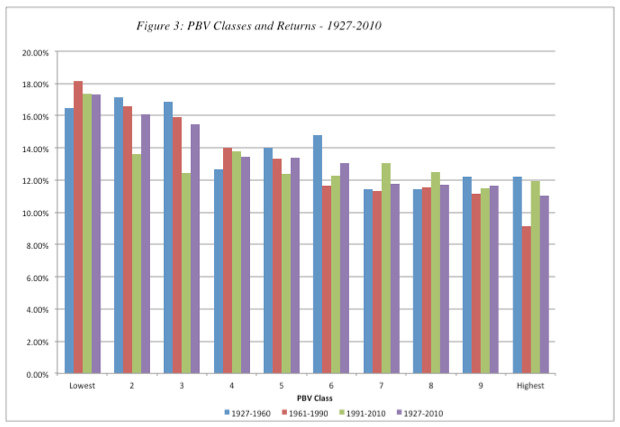
Value, if you define it with price ratios, works however you slice it. For example, the cheap price-to-book value (PBV) decile outperforms the next and so on:

Damodaran says:

The lowest price to book value stocks earned 6.24% more, on an annualized basis, than the high price to book stocks across the entire time period (1927-2010); they continued to earn higher annual returns (5.44%) than the high price to book value stocks between 1991-2010.

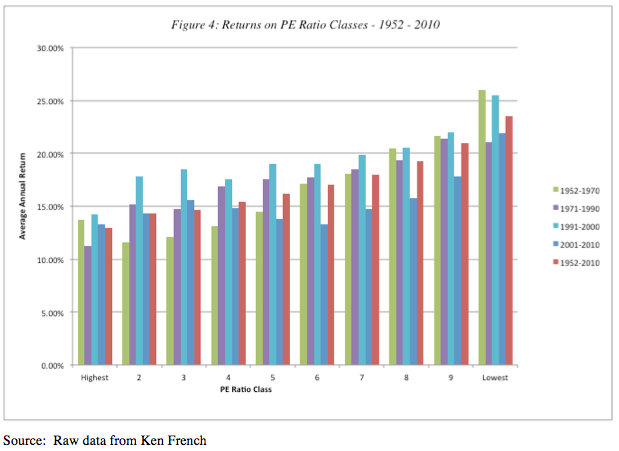
The cheap price-to-earnings (PE) ratio decile also outperforms the next and so on:

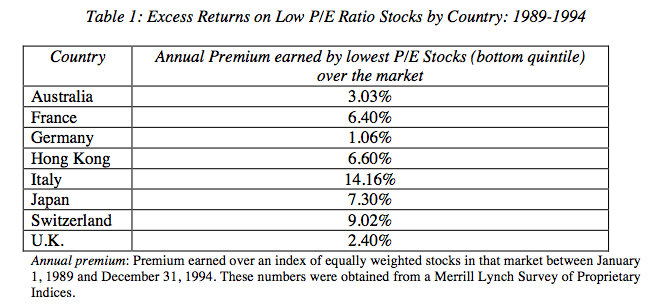
And value works all over the globe.

Damodaran asks if all we have to do to earn excess returns is invest in stocks that trade at low multiples of earnings, book value or revenues, why do value investors underperform?

He offers several reasons:

Time Horizon: All the studies quoted above look at returns over time horizons of five years or greater. In fact, low price-book value stocks have underperformed high price-book value stocks over shorter time periods. The same can be said about PE ratios and price to sales ratios.

Dueling Screens: If one screen earns you excess returns, three should do even better seems to be the attitude of some investors who proceed to multiply the screens they use. They are assisted in this process by the easy access to both data and screening technology. There are web sites (many of which are free) that allow you to screen stocks (at least in the United States) using multiple criteria.19 The problem, though, is that the use of one screen may undercut the effectiveness of others, leading to worse rather than better portfolios.

Absence of Diversification: In their enthusiasm for screens, investors sometimes forget the first principles of diversification. For instance, it is not uncommon to see stocks from one sector disproportionately represented in portfolios created using screens. A screen from low PE stocks may deliver a portfolio of banks and utilities, whereas a screen of low price to book ratios and high returns on equity may deliver stocks from a sector with high infrastructure investments that has had bad sector-specific news come out about it. In 2001, for instance, many telecom stocks traded at a discount on their book value.

Taxes and Transactions costs: As in any investment strategy, taxes and transactions costs can take a bite out of returns, although the effect should become smaller as your time horizon lengthens. Some screens, though, can increase the effect of taxes and transactions costs. For instance, screening for stocks with high dividends and low PE ratios will yield a portfolio that may have much higher tax liabilities (because of the dividends).

Success and Imitation: In some ways, the worst thing that can occur to a screen (at least from the viewpoint of investors using the screen) is that its success is publicized and that a large number of investors begin using that same screen at the same time. In the process of creating portfolios of the stocks they perceive to be undervalued, they may very well eliminate the excess returns that drew them to the screen in the first place.

Tomorrow, the contrarian value investors.

Read Full Post »

Kinnaras Capital Management demonstrates characteristic tenacity in a new letter to Media General Inc (NYSE:MEG) sent after Kinnaras’s exclusion from the most recent earnings call:

I intended to voice those concerns on the Q1 2012 conference call but despite following directions to join the queue, it appears that I was not allowed to participate in this call. This is a poor response to an engaged shareholder. I have likely purchased more shares of MEG than you ever have, yet as an owner of the Company I was not allowed to ask pertinent questions regarding MEG’s operational and financing strategies simply because I have accurately pointed out the various failures you have helmed while at Media General.

In its two earlier lettera Kinnaras expressed frustration with the performance of MEG, and urged the Board to “take advantage of the robust M&A market for both newspaper and broadcast television and to sell all operating units of MEG in order to retire existing corporate and pension debt and achieve a share price shareholders have rarely seen in recent years.”

MEG is a provider of local news in small and mid-size communities throughout the Southeastern United States. It owns three metropolitan and 20 community newspapers and 18 network-affiliated broadcast television stations Virginia/Tennessee, Florida, Mid-South, North Carolina, and Ohio/Rhode Island.

The initial letter included Kinnaras’s sum-of-the-parts valuation, which Kinnaras Managing Member Amit Chokshi sees at $9.75 per share against a prevailing price of around $4.60.

Here’s the new letter:

Kinnaras also has on its website its recommendations to MEG shareholders ahead of the proxy vote.

No position.

Read Full Post »

Robert Robotti, founder of Robotti & Company, and noted Grahamite small-to-mid cap value investor, started out as an accountant working for the auditor of Tweedy, Browne Company. After leaving the accounting firm Robotti worked for “Super” Mario Gabelli as his CFO for three years when Gabelli was only a twelve‐person firm. Applying the lessons from Tweedy, Browne and Gabelli in his own firm has led to returns of 14.1 percent compound since inception in 1993 (versus 8.7 percent for the Russell 2000). Robotti, who is speaking at the upcoming Value Investing Congress in Omaha in May, has given an interview to Value Investor Insight describing his process,  the beaten-up industries he’s presently following, and why he thought that Builders FirstSource, Inc. (BLDR) – which has more than doubled since the interview – was a good investment.

Robotti’s offsider Isaac Schwartz says of the quirky types of investments Robotti & Company makes:

We see considerable potential in Mongolia, whose economy is being fundamentally transformed by demand for its natural resources. Roads, railways and processing facilities are being built in the country to facilitate the shipping of coal, copper and iron ore to China and elsewhere. One way we’ve found to play that is through a Japanese company called Sawada Holdings [8699:JP], which owns a majority stake in Khan Bank, the dominant bank in Mongolia. Khan’s asset base has grown a hundred-fold in the last decade and it now controls roughly 30% of the country’s total banking assets. Khan in the first half of 2011 had net earnings of $24 million, a 49% return on equity. Put a 15-20x multiple on that on an annualized basis and the bank overall would be worth $700 to $950 million, making Sawada’s stake worth maybe $400-500 million. But if we value the rest of Sawada’s holdings, primarily a Japanese broker-dealer, at book value, its current market value [at a share price of around ¥740] implies a value for Khan of only $130 million at current exchange rates. That’s a pretty nice discount for a company with dominant market share, great returns on capital and extraordinary growth upside. Another bank bet we’re making is through Indonesia’s Panin Insurance [PNIN:IJ], the control shareholder of Bank Panin, a leading commercial bank serving the country’s affluent ethnic Chinese minority. There’s actually a bank museum in Jakarta that focuses on the Asian financial crisis of 1997-98, which is indicative of the influence that crisis had, resulting in a conservatively capitalized and risk-averse banking industry in Indonesia. Bank Panin trades independently at a much higher valuation, but on our look-through numbers we’re able to buy it through the insurance holding company at an implied P/E closer to 5x and at only 50% of book value. That for a bank in a growing economy that has increased its book value per share by 16% annually over the last five years.

Robotti is scheduled to speak at the Spring congress in Omaha.  There is a PDF of the Value Investor Insight interview available to readers for free on the Value Investing Congress website. The interview and special promotion will only be available until Monday, April 16th so check it out before Monday’s deadline.

To download the interview head to ValueInvestingCongress.com/Download.

To take advantage of the special offer see ValueInvestingCongress.com/GREENBACKD. Use discount code S12GB4 to save $500 before April 16.

Read Full Post »

Kinnaras Capital Management has sent a follow up letter to Media General Inc (NYSE:MEG) requesting the board “selloff MEG in its entirety and divorce this company from the inept management team currently at the helm.”

In its earlier letter Kinnaras expressed frustration with the performance of MEG, and urged the Board to “take advantage of the robust M&A market for both newspaper and broadcast television and to sell all operating units of MEG in order to retire existing corporate and pension debt and achieve a share price shareholders have rarely seen in recent years.”

MEG is a provider of local news in small and mid-size communities throughout the Southeastern United States. It owns three metropolitan and 20 community newspapers and 18 network-affiliated broadcast television stations Virginia/Tennessee, Florida, Mid-South, North Carolina, and Ohio/Rhode Island.

The initial letter included Kinnaras’s sum-of-the-parts valuation, which Kinnaras Managing Member Amit Chokshi sees at $9.75 per share against a prevailing price of around $4.60.

Here’s the follow up letter:

Kinnaras also has on its website its recommendations to MEG shareholders ahead of the proxy vote.

No position.

Read Full Post »

Kinnaras Capital Management has sent an open letter to Media General Inc (NYSE:MEG) expressing frustration with the performance of the company and “urging the Board to take advantage of the robust M&A market for both newspaper and broadcast television and to sell all operating units of MEG in order to retire existing corporate and pension debt and achieve a share price shareholders have rarely seen in recent years.”

MEG is a provider of local news in small and mid-size communities throughout the Southeastern United States. It owns three metropolitan and 20 community newspapers and 18 network-affiliated broadcast television stations Virginia/Tennessee, Florida, Mid-South, North Carolina, and Ohio/Rhode Island.

The letter includes Kinnaras’s sum-of-the-parts valuation, which Kinnaras Managing Member Amit Chokshi sees at $9.75 per share against a prevailing price of around $4.60.

Here’s the letter:

It seems like a promising situation.

No position.

Read Full Post »

Walter Schloss, one of Warren Buffett’s Superinvestors of Graham-and-Doddsville, has died at 95.

Says Bloomberg:

From 1955 to 2002, by Schloss’s estimate, his investments returned 16 percent annually on average after fees, compared with 10 percent for the Standard & Poor’s 500 Index.

His firm, Walter J. Schloss Associates, became a partnership, Walter & Edwin Schloss Associates, when his son joined him in 1973.

“He was a true fundamentalist,” Edwin Schloss, now retired, said today in an interview. “He did his fundamental analysis and was very concerned that he was buying something at a discount. Margin of safety was always essential.”

Buffett, another Graham disciple, called Schloss a “superinvestor” in a 1984 speech at Columbia Business School.

He again saluted Schloss as “one of the good guys of Wall Street” in his 2006 letter to shareholders of his Berkshire Hathaway Inc.

“Following a strategy that involved no real risk — defined as permanent loss of capital — Walter produced results over his 47 partnership years that dramatically surpassed those of the S&P 500,” wrote Buffett, whose stewardship of Berkshire

Hathaway (BRK) has made him one of the world’s richest men and most emulated investors. “It’s particularly noteworthy that he built this record by investing in about 1,000 securities, mostly of a lackluster type. A few big winners did not account for his success.”

For more on Schloss and his outstanding record, see Walter Schloss, superinvestor.

Read Full Post »

No comment necessary:

Read Full Post »

Monday is the last day to  register at the lowest available fare to this year’s Spring Value Investing Congress on May 6 and 7 in Omaha, NE, where Warren Buffett keeps alive the spiritual torch of value investing. (The Spring event was previously held in Pasadena, CA, but was moved because Charlie Munger no longer holds the Westco meeting in Pasadena). This year’s event is conveniently scheduled immediately after the Berkshire Hathaway Annual meeting at the CenturyLink Center (formerly the Qwest Center). Register here by Monday, December 19th and you’ll save $1,800 from the $4,595 others will pay later to attend. Remember to use Discount Code O12GB1.

I’ve attend the last four Value Investing Congresses, and can highly recommend them. There’s nothing better than seeing an investor you admire explaining live his or her process for finding stocks. There’s also a chance they’ll sit down beside you in the audience, which Carlo Cannell did at the Pasadena event a few years ago. For more information on the speakers, click here.

Disclosure: I get a commission if you buy through this link, which I will use to defray the cost of having Sting play at my birthday party the real, non-reggae versions of Police songs.

Read Full Post »

« Newer Posts - Older Posts »