Feeds:
Posts
Comments

Archive for the ‘Stocks’ Category

Forward Industries Inc (NASDAQ:FORD) has fired its investment and engaged another. It looks like FORD is intent on spending the cash on its balance sheet, which is a shame. Rather than make an acquisition, they should focus on the work on their desk and pay a big dividend. There’s a half chance that the bank could suggest a sale of the company, but that seems unlikely. I can’t believe there are no activists out there willing to take on this company. It’s 40% off its 52-week high. It’s net cash. There are no big holders. Management’s not doing a bad job, but an acquisition is a ridiculous idea. This is an instance of a management trying to plow a dollar back into the business and turn it into fifty cents. I could use that dollar more profitably. Then again, I’d probably just spend it on pennywhistles and moonpies.

We started following FORD (see our post archive here) because it was trading at a discount to its net cash and liquidation values, although there was no obvious catalyst. Management appeared to be considering a “strategic transaction” of some kind, which might have included an “acquisition or some other combination.” Trinad Management had an activist position in the stock, but had been selling at the time we opened the position and only one stockholder owned more than 5% of the stock. The stock is up 36.8% since we opened the position to close yesterday at $1.97, giving the company a market capitalization of $13.4M. Following our review of the most recent 10Q, we’ve estimate the liquidation value to $19.5M or $2.47 per share.

Here’s a link to the announcement (it’s just a marketing announcement by the bank so I’m not going to repost it).

FORD is trading at a substantial discount to its liquidation and net cash values. The risk to this position is management spraying the cash away on an acquisition. A far better use of the company’s cash is a buyback, special dividend or return of capital. Another concern is Trinad Management exiting its activist position in the stock. Those concerns aside, I’m going to maintain the position because it still looks cheap at a discount to net cash.

[Full Disclosure:  We have a holding in FORD. This is neither a recommendation to buy or sell any securities. All information provided believed to be reliable and presented for information purposes only. Do your own research before investing in any security.]

Read Full Post »

Following my Simoleon Sense interview with Miguel Barbosa, I’ve had a few requests for a post on Tom Evans. Here it is, hacked together like Frankenstein’s monster from all the public information I could track down:

Thomas Mellon Evans was a one of the first modern corporate raiders, taking Graham’s net current asset analysis and using it to wreak havoc on the gray flannel suits of the 40s and 50s. He’s not particularly well-known today, but he waged numerous takeover battles using tactics that are forerunners of those employed by many of the takeover artists of the 1980s and the activists of the 1990s and 2000s. Proxy battles? Check. Greenmail? Check. Liquidations? Check.

Born September 8, 1920 in Pittsburgh, and orphaned at the age of 11, Evans grew up poor. Despite his famous middle name (his grandmother’s first cousin was Andrew Mellon), he began his financial career at the bottom. After graduating from Yale University in 1931 in the teeth of the Great Depression, he landed a $100-a-month clerk’s job at Gulf Oil.

While his friends headed out in the evening, Evans would stay home reading balance sheets and looking for promising companies: those he could he could buy for less than the assets were worth in liquidation. Evans found such companies by calculating their “net quick assets,” the long forgotten name for “net current assets.” His friends teased him about his obsession and gave him a nickname: “Net Quick” Evans. From the 1944 Time Magazine article, Young Tom Evans:

With only some fatherly advice from Gulf’s Board Chairman, W. L. Mellon, Tom Evans made his way alone. For six years he saved money, like an Alger hero; and played the stockmarket, unlike an Alger hero. Thus he collected $10,000. He wanted to find and buy a family-owned business that had gone to pot. In the down-at-the-heels H. K. Porter Co., in Pittsburgh’s slummy Lawrenceville section, he found it. Once a No. 1 builder of industrial locomotives, Porter Co. was down to 40 workers.

Tom Evans bought up Porter bonds at 10 to 15 cents on the dollar, reorganized the company under 77B, and became president at 28.

From then on, Evan was the chief terror of the sleepy boardrooms of the era, much like Icahn would be 30 years later. As a connoisseur of deep value on the balance sheet, one has to admire his methods (From the New York Times obituary, Thomas Evans, 86, a Takeover Expert, Dies):

‘He was never really an operator; he was a financial guy — a balance sheet buyer,” one of his sons, Robert Sheldon Evans, told Forbes magazine in 1995. ”He would buy something for less than book value and figure the worst that could happen was he would liquidate it and come out O.K. What he didn’t want to do was lose money on the deal. If he knew his downside was covered, then he figured the upside would probably take care of itself.

”It was a very shrewd policy in the 50’s and 60’s, when there were highly inefficient markets: buying undervalued assets, running them for cash and selling off pieces. The 80’s leveraged buyout guys were just taking a lot of his deals to their logical extension.”

The book The White Sharks of Wall Street: Thomas Mellon Evans and the Original Corporate Raiders by Diana B. Henriques is an excellent biography on Evans. More than that, it describes many of the battles for corporate control in the 40s, 50s and 60s. In contradistinction to the takeover battles of the 80s, the dogfights in the 40s, 50s, and 60s were largely proxy fights, and in as much, should be familiar to today’s “activist investors.” James B. Stewart’s Let’s make a deal, his review of Henriques’ book, does it justice:

There are surely few phenomena more remarkable in American business than the periodic ability of cash-poor but swashbuckling newcomers, using little or none of their own money, to seize control of some of the country’s most valuable corporations. In its most recent, frenzied incarnation, dot-com entrepreneurs have exchanged stock in companies with few tangible assets and even fewer profits for control of established, profitable companies. Fifteen years ago, the currency was junk bonds rather than inflated stock. And before that, it was bank loans using a target’s assets as collateral.

Wall Street greets each wave of takeovers as the dawning of a new era. But the proposition that nothing has fundamentally changed is convincingly set forth in ”The White Sharks of Wall Street,” an engaging and thorough history of early corporate takeovers by Diana B. Henriques, a financial reporter for The New York Times. Her central character is Thomas Mellon Evans, who surfaces in what seems like nearly every trendsetting corporate battle from 1945 until his retirement in 1984, and whose tactics remain essential to practitioners of corporate warfare. Junk bonds? Greenmail? Scorched earth? Evans had been there long before investment bankers coined a catchy vocabulary to describe the maneuvers of people like T. Boone Pickens, Carl Icahn and Saul Steinberg.

Though Evans seems to have escaped the widespread public resentment and envy the others generated, and Henriques’s portrait is carefully nonjudgmental, it is difficult for a reader to work up much sympathy for him. He was ruthless, bad-tempered, usually indifferent to workers and communities. He repeatedly displayed what appears to be a criminal disregard for the antitrust laws (though he was never prosecuted). He divorced two wives (the second later committed suicide), and both times a replacement was conspicuously at hand long before any legal proceedings had begun. He betrayed two of his own sons in his quest for corporate dominance and wealth.

Yet as a deal maker Evans displayed a natural audacity and genius. In 1935, 24 years old and lacking any money to speak of, he decided he wanted to gain control of Pittsburgh’s struggling H. K. Porter Company, a manufacturer of steam locomotives. Inspired by a Fortune magazine account of Floyd Odlum, who became rich by using borrowed securities as collateral for loans to buy undervalued stock, Evans borrowed shares from a Mellon mentor, took out a loan and invested in Gulf Oil stock, then a Mellon enterprise. When Gulf’s stock rose handsomely as the nation emerged from the Depression, Evans used his profits to buy Porter bonds, then selling for a small fraction of their face value. When Porter finally had to declare bankruptcy and was reorganized, Evans, as the largest creditor, traded his bonds for equity and became the largest shareholder. Porter, essentially acquired for junk bonds, would be Evans’s vehicle for most of his life.

I highly recommend The White Sharks of Wall Street: Thomas Mellon Evans and the Original Corporate Raiders by Diana B. Henriques for fans of deep value and activist investment.

Read Full Post »

We’ve just completed an interview with Miguel Barbosa of the wonderful Simoleon Sense. Go there now, and get trapped in an endless loop as you are recirculated back here and so on.

Read Full Post »

Yesterday was the record date for the first dividend in the liquidation of Leadis Technology Inc (NASDAQ:LDIS). The dividend is likely to be approximately $0.93 per share. The board estimates that “if we are able to dispose of substantially all of our non-cash assets, the aggregate amount of all liquidating distributions that will be paid to stockholders will be in the range of approximately $0.93 to $1.20 per share of Leadis common stock.” After the initial $0.93 dividend, the remaining dividends will be in the range of nil to $0.27 ($1.20 less $0.93). LDIS closed yesterday at $0.99. If the stub starts trading tomorrow at $0.06 ($0.99 less $0.93), it becomes an interesting security offering the potential for some substantial upside.

The definitive proxy filings have the detail:

How much can stockholders expect to receive if the Plan of Dissolution is approved at the special meeting?

At this time, we cannot predict with certainty the amount of any liquidating distributions to our stockholders. However, based on information currently available to us, assuming, among other things, no unanticipated actual or contingent liabilities, we estimate that over time stockholders will receive one or more distributions that in the aggregate range from approximately $0.93 to $1.20 per share. This range of estimated distributions represents our estimate of the amount to be distributed to stockholders during the liquidation, but does not represent the minimum or maximum distribution amount. Actual distributions could be higher or lower.

This estimated range is based upon, among other things, the fact that as of August 31, 2009, we had approximately $28.6 million in cash, cash equivalents, restricted cash equivalents and short-term and non-current investments. In addition, subsequent to August 31, 2009, we received approximately $3.2 million in connection with the sale of certain assets to IXYS Corporation. We expect to use cash of approximately $2.3 million to satisfy liabilities on our unaudited balance sheet after August 31, 2009. In addition to converting our remaining non-cash assets to cash and satisfying the liabilities currently on our balance sheet, we have used and anticipate using cash for a number of items, including but not limited to: satisfying capital leases and other contractual commitments. In addition to the satisfaction of our liabilities, we have used and anticipate continuing to use cash in the next several months for a number of items, including, but not limited to, the following:

• ongoing operating expenses;

• expenses incurred in connection with extending our directors’ and officers’ insurance coverage;

• expenses incurred in connection with the liquidation and dissolution process;

• severance and related costs;

• resolution of pending and potential claims, assessments and obligations; and

• professional, legal, consulting and accounting fees.

We are unable at this time to predict the ultimate amount of our liabilities because the settlement of our existing liabilities could cost more than we anticipate and we may incur additional liabilities arising out of contingent claims that have not been quantified, are not yet reflected as liabilities on our balance sheet and have not been included in the estimated range of potential distributions, such as liabilities relating to claims that have not been resolved and claims or lawsuits that could be brought against us in the future. If any payments are made with respect to the foregoing, the estimated range of distributions to stockholders will be negatively impacted and less than estimated. If the ultimate amount of our liabilities is greater than what we anticipate, the distribution to our stockholders may be substantially lower than anticipated. Therefore, we are unable at this time to predict the precise nature, amount and timing of any distributions due in part to our inability to predict the ultimate amount of our liabilities. Accordingly, you will not know the exact amount of any liquidating distributions you may receive as a result of the Plan of Dissolution when you vote on the proposal to approve the Plan of Dissolution. You may receive substantially less than the low end of the current estimate.

For some further background, see Shake&Bake’s take on LDIS.

Hat tip Joseph.

[Full Disclosure:  We have a holding in LDIS. This is neither a recommendation to buy or sell any securities. All information provided believed to be reliable and presented for information purposes only. Do your own research before investing in any security.]

Read Full Post »

Digirad Corporation (NASDAQ:DRAD) has filed its 10Q for the quarter ended September 30, 2009.

We started following DRAD (see our post archive here) because it was an undervalued asset play with a plan to sell assets and buy back its stock. The stock is up more than 167% since we started following it to close yesterday at $2.35, giving the company a market capitalization of $36.1M. We last estimated the liquidation value to be around $32.5M or $1.73 per share. We’ve now increased our valuation to $32.9M or $1.77 per share following another very good quarter for DRAD. Year-to-date, DRAD has generated over $3.4M in cash from operations. DRAD has also started buying back stock under its previously announced $2M stock repurchase plan.

The value proposition updated

DRAD has continued its good year, generating $3.4M in operating cash flow year-to-date. Our updated estimate for the company’s liquidation value is set out below (the “Book Value” column shows the assets as they are carried in the financial statements, and the “Liquidating Value” column shows our estimate of the value of the assets in a liquidation):

DRAD Summary 2009 9 30Off-balance sheet arrangements and contractual obligations: The company hasn’t disclosed any off-balance sheet arrangements in its most recent 10Q.
The catalyst

DRAD’s board has announced a stock buyback program:

The Company also announced that its board of directors has authorized a stock buyback program to repurchase up to an aggregate of $2 million of its issued and outstanding common shares. Digirad had approximately 19 million shares outstanding as of December 31, 2008. At current valuations, this repurchase plan would authorize the buyback of approximately 2.1 million shares, or approximately 11 percent of the company’s outstanding shares.

Chairman of the Digirad Board of Directors R. King Nelson said, “The board believes the Company’s direction and goals towards generating positive cash flow and earnings coupled with an undervalued stock price present a unique investment opportunity. We are confident this will provide a solid return to our shareholders.”

According to the most recent 10Q, the company has now started to buy its own stock, albeit a relatively small amount:

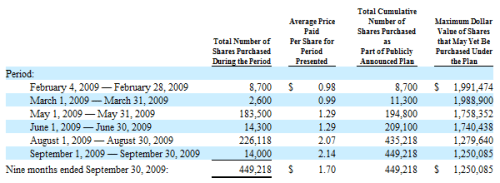
On February 4, 2009, our Board of Directors approved a stock repurchase program whereby we may, from time to time, purchase up to $2.0 million worth of our common stock in the open market, in privately negotiated transactions or otherwise, at prices that we deem appropriate. The plan has no expiration date. Details of purchases made during the nine months ended September 30, 2009 are as follows (Edited to fit this space.):

DRAD Buy Back Detail 2009 09 30

Conclusion

DRAD is now trading at a reasonable 24% premium to its $32.9M or $1.77 per share in liquidation value. It’s off about 20% from its peak, and looks likely to continue to drop. We’re generally sellers of secondary securities trading at a premium to liquidation value, but DRAD seems to have the started generating cash. We’d like to see where it can go. We can see no other reason to cease holding DRAD in the Greenbackd Portfolio and so we’re going to maintain the position for now.

[Full Disclosure:  We do not have a holding in DRAD. This is neither a recommendation to buy or sell any securities. All information provided believed to be reliable and presented for information purposes only. Do your own research before investing in any security.]

Read Full Post »

In a new paper Value vs Glamour: A Global Phenomenon (via SSRN)  The Brandes Institute updates the landmark 1994 study by Josef Lakonishok, Andrei Shleifer, and Robert Vishny investigating the performance of value stocks relative to that of glamour securities in the United States over a 26-year period. Lakonishok, Shleifer, and Vishny found that value stocks tended to outperform glamour stocks by wide margins, but their earlier research did not include the glamour-driven markets of the late 1990s and early 2000s. The paper asks, “What effect might this period have on their conclusions?” To answer that question, The Brandes Institute updated the research through to June 2008, examining the comparative performance of value and glamour over a 40-year period, and extending the scope of the initial study to include non-U.S. markets, to determine whether the value premium is evident worldwide.

The research focuses on our favorite indicator, price-to-book value, but also includes price-to-cash flow, price-to-earnings, sales growth over the preceding five years and combinations of the foregoing. Here is The Brandes Institute’s discussion on price-to-book:

Lakonishok, Shleifer, and Vishny on price-to-book

The Brandes Institute  hewed closely to Lakonishok, Shleifer, and Vishny’s methods, described on page 3 of the paper:

First, the sample of companies as of April 30, 1968 was divided into deciles based on one of the criteria above. Second, the aggregate performance of each decile was tracked for each of the next five years on each April 30. Finally, the first and second steps were repeated for each April 30 from 1969 to 1989.

We start with the price-to-book criterion as an example. First, all stocks traded on the NYSE and AMEX as of April 30, 1968 were sorted into deciles based on their price-to-book ratios on that date. Stocks with the highers P/B ratios were grouped in decile 1. For each consecutive decile, P/B ratios decreased; this cuilminated in stocks with the lowest P/B values forming decile 10.

In essence, this process created 10 separate portfolios, each with an inception date of April 30, 1968. The lower deciles, which consisted of higher-P/B stocks, represented glamour portfolios. In contrast, the higher deciles – those filled with lower-P/B stocks – represented value portfolios.

From there, annual performance of deciles 1 through 10 was tracked over the subsequent five years. Additionally, new 10-decile sets were constructed based on the combined NYSE/AMEX sample as of April 30, 1969, and every subsequent April 30 through 1989. For each of these new sets, decile-by-decile performance was recorded for the five yeras after the inception date. After completing this process, the researchers had created 22 sets of P/B deciles, and tracked five years of decile-by-decile performance for each one. Next, [Lakonishok, Shleifer, and Vishny] averaged the performance data across these 22 decile-sets to compare value and glamour.

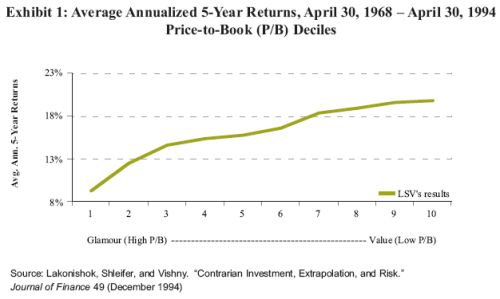
As the chart below indicates, [Lakonishok, Shleifer, and Vishny] found that performance for glamour stocks was outpaced by performance for their value counterparts. For instance, 5-year returns for decile 1 – those stocks with the highest P/B ratios – averaged an annualized 9.3%, while returns for the low-P/B decile 10 averaged 19.8%. These annualized figures are equivalent to cumulative rates of return of 56.0% and 146.2%, respectively.

Value Glamour 1

[Lakonishok, Shleifer, and Vishny] repeated this analysis for deciles based on price-to-cash flow, price-to-earnings, and sales growth. The trio found that, for each of these value/glamour criteria, value stocks outperformed glamour stocks by wide margins. Additionally, value bested glamour in experiments with groups sorted by select pairings of P/B, P/CF, P/E, and sales growth.

The Brandes Institute update

The Brandes Institute sought to extend and update Lakonishok, Shleifer, and Vishny’s findings. They replicated the results of the Lakonishok, Shleifer, and Vishny study to validate their methodology. When they were satisfied that there was sufficient parity between their results and Lakonishok, Shleifer, and Vishny’s findings “to validate our methodology as a functional approximation of the [Lakonishok, Shleifer, and Vishny] framework,” they adjusted the sample in three ways: First, they included stocks listed on the NASDAQ domiciled in the US. Second, they excluded the smalles 50% of all companies in the sample. Finally, they divided the remaining companies into small capitalization (70% of the group by number) and large capitalization (30% of the group by number):

To expand upon [Lakonishok, Shleifer, and Vishny’s] findings we begin with our adjusted sample, which now includes data through 2008. Specifically, we added decile-sets formed on April 30, 1990 through April 30, 2003 and incorporated their performance into our analysis. This increased our sample size from 22 sets of deciles to 36. In addition, the end of the period covered by our performance calculations extended from April 30, 1994 to April 30, 2008.

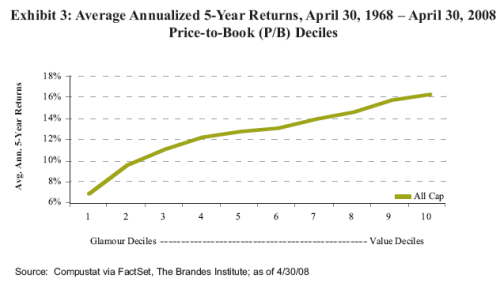
Exhibit 3 compares average annualized performance for U.S. stocks from the 1968 to 2008 period for deciles based on price-to-book. Returns for deciles across the spectrum changed only slightly in the extended time frame from our replicated [Lakonishok, Shleifer, and Vishny’s] results. Most notably, the overall pattern of substantial value stock outperformance persisted. During the 1968 to 2008 period, performance for decile 1 glamour stocks averaged an annualized 6.9% vs. an average of 16.2% for the value stocks in decile 10. Respective cumulative performance equaled 39.6% and 111.9%.

Value Glamour 2

Set out below is the comparison of large cap and small cap performance:

Value Glamour 3The paper concludes that the value premium persists for the world’s developed markets in aggregate, and on an individual coutry basis. We believe it is more compelling evidence for value based investment, and, in particular, asset based value investment.

Read Full Post »

Disgruntled VaxGen Inc (OTC:VXGN) shareholders have initiated a class action against the board of VXGN over possible breaches of fiduciary duty in the sale to OXGN. The board certainly deserves the suit because of the appalling deal struck with OXGN. Priced at a discount to VXGN’s net cash and liquidation values, and payment in the watered scrip of a speculative biotech play, it’s a real dud for VXGN shareholders (see our more detailed take on the terms of the VXGN / OXGN deal). A successful outcome in any litigation may be a Pyrrhic victory for participating VXGN shareholders. As we understand it, VXGN’s board is indemnified out of VXGN’s assets and so as any damages award will return to VXGN plaintiffs VXGN’s assets less legal fees and the break fee. Perhaps someone more knowledgable can illuminate the situation for us in the comments. It’s also possible that the merger will not survive the shareholder vote. As reader bellamyj notes, in November 2007 VXGN announced another disastrous merger with Raven Biotechnologies. Over the next few days VXGN stock fell almost 50% and the merger was terminated the day before the special meeting, apparently due to shareholder opposition. Perhaps that will happen again. If it does, OXGN will still tear out ~$2.5M from VXGN, but it may be a better outcome than the deal on the table.

About our VXGN position

We’ve been following VXGN (see our post archive here) because it is trading at a substantial discount to its net cash position, has ended its cash-burning product development activities and is “seeking to maximize the value of its remaining assets through a strategic transaction or series of strategic transactions.” Management has said that, if the company is unable to identify and complete an alternate strategic transaction, it proposes to liquidate. One concern of ours has been a lawsuit against VXGN by its landlords, in which they sought $22.4M. That lawsuit was dismissed in May, so the path for VXGN to liquidate has now hopefully cleared. The board has, however, been dragging its feet on the liquidation. Given their relatively high compensation and almost non-existent shareholding, it’s not hard to see why.

There are two competing alternate proxy slates seeking nomination to the board of VXGN, Value Investors for Change and the VaxGen Full Value Committee. Value Investors for Change, led by Spencer Capital, filed preliminary proxy documents in August to remove the board. In the proxy documents, Value Investors for Change call out VXGN’s board on its “track record of failure and exorbitant cash compensation”:

VaxGen does not have any operations, other than preparing public reports. The Company has three employees, including the part-time principal executive officer and director, and four non-employee directors. Since the Company’s failed merger with Raven Biotechnologies, Inc. in March 2008, the Board has publicly disclosed that it would either pursue a strategic transaction or a series of strategic transactions or dissolve the Company. The Company has done neither. In the meantime, members of the Board have treated themselves to exorbitant cash compensation. Until July 2009, two non-employee members of the Board were paid over $300,000 per year in compensation. The principal executive officer will likely receive over $400,000 in cash compensation this year.

The VaxGen Full Value Committee comprising BA Value Investors’ Steven N. Bronson and ROI Capital Management’s Mark T. Boyer and Mitchell J. Soboleski, intends to replace the current board with directors who will focus on the following objectives:

1. Returning capital to [VXGN]’s shareholders, including an immediate distribution of $10,000,000 in cash;

2. Terminating [VXGN]’s lease with its landlord, Oyster Point Tech Center, LLC, and settling with the landlord the obligations of [VXGN] on the remaining lease payments;

3. Exploring ways to monetize [VXGN] as a “public shell,” including the utilization of [VXGN]’s Substantial Net Operating Losses; and

4. Protecting for the benefit of shareholders royalty payments receivable from the sale of [VXGN]’s intellectual property.

BA Value Investors had previously disclosed an activist holding and, in a June 12 letter to the board, called on VXGN to “act promptly to reduce the size of the board to three directors; reduce director compensation; change to a smaller audit firm; terminate the lease of its facilities; otherwise cut costs; make an immediate $10 million distribution to shareholders; make a subsequent distribution of substantially all the remaining cash after settling the lease termination; distribute any royalty income to shareholders; and explore ways to monetize the public company value of the Issuer and use of its net operating losses.”

VXGN is up 25.0% since we initiated the position. At its $0.60 close yesterday, it has a market capitalization of $22.5M. We last estimated the company’s liquidation value to be around $25.4M or $0.77 per share. VXGN has other potentially valuable assets, including a “state-of-the-art biopharmaceutical manufacturing facility with a 1,000-liter bioreactor that can be used to make cell culture or microbial biologic products” and rights to specified percentages of future net sales relating to its anthrax vaccine product candidate and related technology. The authors of a letter sent to the board on July 14 of this year adjudge VXGN’s liquidation value to be significantly higher at $2.12 per share:

Excluding the lease obligations, the net financial assets alone of $37.2 million equate to $1.12 per share. The EBS royalties (assuming a 6% royalty rate and a $500 million contract as contemplated by NIH/HHS and EBS) of $30 million and milestones of $6 million total $36 million of potential additional future value (based clearly on assumptions, none of which are assured), or $1.09 per share. Adding $1.12 and $1.09 equals $2.21 per share.

Here’s the press release announcing the litigation:

Levi & Korsinsky, LLP Investigates Possible Breach of Fiduciary Duty by the Board of VaxGen, Inc. – VXGN.OB

Levi & Korsinsky is investigating the Board of Directors of VaxGen, Inc. (“VaxGen” or the “Company”) (OTC BB: VXGN) for possible breaches of fiduciary duty and other violations of state law in connection with their attempt to sell the Company to Oxigene Inc. (“Oxigene”) (NasdaqGM: OXGN). Under the terms of the transaction, VaxGen shareholders will receive 0.4719 Oxigene shares for every VaxGen share they own which, based on the $1.42 per share closing price of Oxigene stock on October 14, 2009, the day prior to the announcement, is valued at approximately $0.67. In addition, Oxigene is to place approximately 8.5 million common shares in escrow to be released to VaxGen shareholders contingent upon the occurrence of certain events over the two-year period following the closing.

The investigation concerns whether the VaxGen Board of Directors breached their fiduciary duties to VaxGen shareholders given that (i) the Company has approximately $1.07 per share in cash with no debt; (ii) the Company has a book value of approximately $0.99 a share; (iii) at least one analyst has set a $2.00 price target for VaxGen stock; and (iv) and the Board agreed to a non-solicitation provision and a termination fee up to $1,425,000 that will all but ensure that no superior offers will ever be forthcoming.

If you own common stock in VaxGen and wish to obtain additional information, please contact us at the number listed below or visit http://www.zlk.com/vxgn1.html.

Levi & Korsinsky has expertise in prosecuting investor securities litigation and extensive experience in actions involving financial fraud and represents investors throughout the nation, concentrating its practice in securities and shareholder litigation.

Hat tip JM.

[Full Disclosure:  We have a holding in VXGN. This is neither a recommendation to buy or sell any securities. All information provided believed to be reliable and presented for information purposes only. Do your own research before investing in any security.]

Read Full Post »

Rolfe Winkler of Reuters blog Contingent Capital has a great summary of David Einhorn’s talk to the Value Investing Congress. Despite what we say in the title, Einhorn is hardly fickle (we just couldn’t resist). If anything, he’s stubborn to a fault, so it is interesting that he’s changed his mind so dramatically about the influence of macro events on his traditional bottom-up investment style. In his speech (.pdf via Winkler’s blog), he sets out the rationale behind the change, what he perceives the current macro risks to be, and what he’s doing in response. Apologies in advance for the huge blocks of text. We believe that this is the most important factor influencing the market and the economy, and will be for the next 5-10 years. Ignore it at your peril.

Speaking of his change in attitude to secular macro trends, Einhorn said:

I want to revisit [Greenlight’s 2005 position in MDC Holdings, a homerbuilder] because the loss was not bad luck; it was bad analysis. I down played the importance of what was then an ongoing housing bubble. On the very same day, at the very same conference, a more experienced and wiser investor, Stanley Druckenmiller, explained in gory detail the big picture problem the country faced from a growing housing bubble fueled by a growing debt bubble. At the time, I wondered whether even if he were correct, would it be possible to convert such big picture macro-thinking into successful portfolio management? I thought this was particularly tricky since getting both the timing of big macro changes as well as the market’s recognition of them correct has proven at best a difficult proposition. Smart investors had been complaining about the housing bubble since at least 2001. I ignored Stan, rationalizing that even if he were right, there was no way to know when he would be right. This was an expensive error.

The lesson that I have learned is that it isn’t reasonable to be agnostic about the big picture. For years I had believed that I didn’t need to take a view on the market or the economy because I considered myself to be a “bottom up” investor. Having my eyes open to the big picture doesn’t mean abandoning stock picking, but it does mean managing the longshort exposure ratio more actively, worrying about what may be brewing in certain industries, and when appropriate, buying some just-in-case insurance for foreseeable macro risks even if they are hard to time.

What, according to Einhorn, is the secular macro trend most influencing the market and economy? The inflationary policies of the current administration:

Presently, Ben Bernanke and Tim Geithner have become the quintessential short-term decision makers. They explicitly “do whatever it takes” to “solve one problem at a time” and deal with the unintended consequences later. It is too soon for history to evaluate their work, because there hasn’t been time for the unintended consequences of the “do whatever it takes” decision-making to materialize.

Rather than deal with these simple problems with simple, obvious solutions, the official reform plans are complicated, convoluted and designed to only have the veneer of reform while mostly serving the special interests. The complications serve to reduce transparency, preventing the public at large from really seeing the overwhelming influence of the banks in shaping the new regulation.

In dealing with the continued weak economy, our leaders are so determined not to repeat the perceived mistakes of the 1930s that they are risking policies with possibly far worse consequences designed by the same people at the Fed who ran policy with the short term view that asset bubbles don’t matter because the fallout can be managed after they pop. That view created a disaster that required unprecedented intervention for which our leaders congratulated themselves for doing whatever it took to solve. With a sense of mission accomplished, the G-20 proclaimed “it worked.”

We are now being told that the most important thing is to not remove the fiscal and monetary support too soon. Christine Romer, a top advisor to the President, argues that we made a great mistake by withdrawing stimulus in 1937.

An alternative lesson from the double dip the economy took in 1938 is that the GDP created by massive fiscal stimulus is artificial. So whenever it is eventually removed, there will be significant economic fall out. Our choice may be either to maintain large annual deficits until our creditors refuse to finance them or tolerate another leg down in our economy by accepting some measure of fiscal discipline.

Over the last couple of years we have adopted a policy of private profits and socialized risks. We are transferring many private obligations onto the national ledger. Although our leaders ought to make some serious choices, they appear too trapped in short-termism and special interests to make them. Taking no action is an action.

In the nearer-term the deficit on a cash basis is about $1.6 trillion or 11% of GDP. President Obama forecasts $1.4 trillion next year, and with an optimistic economic outlook, $9 trillion over the next decade. The American Enterprise Institute for Public Policy Research recently published a study that indicated that “by all relevant debt indicators, the U.S. fiscal scenario will soon approximate the economic scenario for countries on the verge of a sovereign debt default.”

Further, the Federal Open Market Committee members may not recognize inflation when they see it, as looking at inflation solely through the prices of goods and services, while ignoring asset inflation, can lead to a repeat of the last policy error of holding rates too low for too long.

At the same time, the Treasury has dramatically shortened the duration of the government debt. As a result, higher rates become a fiscal issue, not just a monetary one. The Fed could reach the point where it perceives doing whatever it takes requires it to become the buyer of Treasuries of first and last resort.

I believe there is a real possibility that the collapse of any of the major currencies could have a similar domino effect on re-assessing the credit risk of the other fiat currencies run by countries with structural deficits and large, unfunded commitments to aging populations.

I believe that the conventional view that government bonds should be “risk free” and tied to nominal GDP is at risk of changing. Periodically, high quality corporate bonds have traded at lower yields than sovereign debt. That could happen again.

His response has been to buy physical gold “as insurance against sovereign default(s).”

Now, the question for us as investors is how to manage some of these possible risks. Four years ago I spoke at this conference and said that I favored my Grandma Cookie’s investment style of investing in stocks like Nike, IBM, McDonalds and Walgreens over my Grandpa Ben’s style of buying gold bullion and gold stocks. He feared the economic ruin of our country through a paper money and deficit driven hyper inflation. I explained how Grandma Cookie had been right for the last thirty years and would probably be right for the next thirty as well. I subscribed to Warren Buffett’s old criticism that gold just sits there with no yield and viewed gold’s long-term value as difficult to assess.

However, the recent crisis has changed my view. The question can be flipped: how does one know what the dollar is worth given that dollars can be created out of thin air or dropped from helicopters? Just because something hasn’t happened, doesn’t mean it won’t. Yes, we should continue to buy stocks in great companies, but there is room for Grandpa Ben’s view as well.

I have seen many people debate whether gold is a bet on inflation or deflation. As I see it, it is neither. Gold does well when monetary and fiscal policies are poor and does poorly when they appear sensible. Gold did very well during the Great Depression when FDR debased the currency. It did well again in the money printing 1970s, but collapsed in response to Paul Volcker’s austerity. It ultimately made a bottom around 2001 when the excitement about our future budget surpluses peaked.

Prospectively, gold should do fine unless our leaders implement much greater fiscal and monetary restraint than appears likely. Of course, gold should do very well if there is a sovereign debt default or currency crisis.

A few weeks ago, the Office of Inspector General called out the Treasury Department for misrepresenting the position of the banks last fall. The Treasury’s response was an unapologetic expression that amounted to saying that at that point “doing whatever it takes” meant pulling a Colonel Jessup: “YOU CAN’T HANDLE THE TRUTH!” At least we know what we are dealing with.

When I watch Chairman Bernanke, Secretary Geithner and Mr. Summers on TV, read speeches written by the Fed Governors, observe the “stimulus” black hole, and think about our short-termism and lack of fiscal discipline and political will, my instinct is to want to short the dollar. But then I look at the other major currencies. The Euro, the Yen, and the British Pound might be worse. So, I conclude that picking one these currencies is like choosing my favorite dental procedure. And I decide holding gold is better than holding cash, especially now, where both earn no yield.

For years, the discussion has been that our deficit spending will pass the costs onto “our grandchildren.” I believe that this is no longer the case and that the consequences will be seen during the lifetime of the leaders who have pursued short-term popularity over our solvency. The recent economic crisis and our response has brought forward the eventual reconciliation into a window that is near enough that it makes sense for investors to buy some insurance to protect themselves from a possible systemic event. To slightly modify Alexis de Tocqueville: Events can move from the impossible to the inevitable without ever stopping at the probable.

Read Full Post »

You may be familiar with the “Peter Schiff was right” Internet meme that’s been doing the rounds for a year or so. If you are not, the meme is a montage of Peter’s appearances on various business television shows between 2006 and 2007. In each clip he is alone in arguing that the US stands at the precipice of a collapse and is roundly derided by the other participants and the anchor. One such example is set out below:

Peter was indeed right about the ensuing collapse. What’s more, he was right for the right reasons, as opposed to the “permabears” who are right the way a stopped clock is right twice a day (ordinarily we’d include Nouriel Rubini in this club, but won’t do so on this occasion for reasons which will shortly become obvious). Is Peter clairvoyant? No. He’s a disciple of the Austrian School of Economics (about which we came out of the closet a few weeks back). Given Schiff’s prescience and well-known adherence to Austrian economics, one might think that the Austrian School deserves a second look, especially so given that the Keynesian orthodoxy completely missed the crash. One such paper seeks to do just that, but with a wider lense that doesn’t presuppose the conclusion.

In No One Saw This Coming: Understanding Financial Crisis Through Accounting Models (.pdf) Dirk J Bezemer of Groningen University takes a scholarly look at which macroeconomic models helped anticipate the credit crisis and economic recession and which did not. Says Bezemer:

The credit crisis and ensuing recession may be viewed as a ‘natural experiment’ in the validity of economic models. Those models that failed to foresee something this momentous may need changing in one way or another. And the change is likely to come from those models (if they exist) which did lead their users to anticipate instability. The plan of this paper, therefore, is to document such anticipations, to identify the underlying models, to compare them to models in use by official forecasters and policy makers, and to draw out the implications.

There are two broad ideas in the paper most interesting to us: The first is Bezemer’s documentation of the “sense of surprise at the credit crisis among academics and policymakers,” which gave rise to the erroneous view that “no one saw this coming”. The second “is a careful survey – applying a number of selection criteria – of those professional and academic analysts who did ‘see it coming’, and who issued public predictions of financial instability induced by falling real estate prices and leading to recession.”

“No-one saw this coming”

Bezemer makes the arguement that the view that it was impossible to know that a crash was imminent has gone unchallenged and unexamined by the mainstream press and academia:

The view that “[n]o one foresaw the volume of the current avalanche” appears justified by a lack of discussion, in the academic and policy press, of the possibility that financial globalization harboured significant risks, or that the US real estate market and its derivative products were in dangerous waters. Wellink (2009) quoted a 2006 IMF report on the global real estate boom asserting that there was “little evidence (..) to suggest that the expected or likely market corrections in the period ahead would lead to crises of systemic proportions”. On the contrary, those developments now seen as culprits of the crisis were until recently lauded by policy makers, academics, and the business community.

These assessments by the experts carried over to a popular view, enunciated in the mass media, that the recessionary impacts of the credit crisis came out of the blue. USA Today in December 2006 reported on the fall in house prices that had just started that summer, “the good news is that far more economists are in the optimist camp than the pessimist camp. Although a handful are predicting the economy will slide into a housing-led recession next year, the majority anticipate the economy will continue to grow” (Hagenbauch 2006). Kaletsky (2008) wrote in the Financial Times of “those who failed to foresee the gravity of this crisis – a group that includes Mr King, Mr Brown, Alistair Darling, Alan Greenspan and almost every leading economist and financier in the world.”

The surprise at this gravity was proportionate to the optimism beforehand. Greenspan (2008) in his October 2008 testimony before the Committee of Government Oversight and Reform professed to “shocked disbelief” while watching his “whole intellectual edifice collapse in the summer of [2007]”. Das (2008) conceded that contrary to his earlier view of financial globalization ‘eliminating’ credit risks, in fact “[p]artial blame for the fall 2008 meltdown of the global financial market does justly go to globalization.” The typical pattern was one of optimism shortly before and surprise shortly after the start of the crisis.

The common elements of the alternative view

Bezemer notes that, despite the foregoing, there was an “alternative, less sanguine interpretation of financial developments” and it was “not confined to the inevitable fringe of bearish financial commentators.” Bezemer is mindful that among those expressing the alternative view, the lucky guesses must be distinguished from the insightful predictions. Here he discusses the problem and his methodology for doing so:

A major concern in collecting these data must be the ‘stopped clock syndrome’. A stopped clock is correct twice a day, and the mere existence of predictions is not informative on the theoretical validity of such predictions since, in financial market parlance, ‘every bear has his day’. Elementary statistical reasoning suggests that given a large number of commentators with varying views on some topic, it will be possible to find any prediction on that topic, at any point in time. With a large number of bloggers and pundits continuously making random guesses, erroneous predictions will be made and quickly assigned to oblivion, while correct guesses will be magnified and repeated after the fact. This in itself is no indication of their validity, but only of confirmation bias.

In distinguishing the lucky shots from insightful predictions, the randomness of guesses is a feature to be exploited. Random guesses are supported by all sorts of reasoning (if at all), and will have little theory in common. Conversely, for a set of correct predictions to attain ex post credibility, it is additionally required that they are supported by a common theoretical framework. This study, then, looks to identify a set of predictions which are not only ex post correct but also rest on a common theoretical understanding. This will help identify the elements of a valid analytical approach to financial stability, and get into focus the contrast with conventional models.

In collecting these cases in an extensive search of the relevant literature, four selection criteria were applied. Only analysts were included who provide some account on how they arrived at their conclusions. Second, the analysts included went beyond predicting a real estate crisis, also making the link to real-sector recessionary implications, including an analytical account of those links. Third, the actual prediction must have been made by the analyst and available in the public domain, rather than being asserted by others. Finally, the prediction had to have some timing attached to it. Applying these criteria led to the exclusion of a number of (often high profile) candidates – as detailed in the Appendix – so that the final selection is truly the result of critical scrutiny.

The twelve analysts described there – the number is entirely an outcome of the selection criteria – commented on the US, UK, Australian, Danish and global conditions in housing, finance and the broader economy. All except one are (or were) analysts and commentators of global fame. They are a mixed company of academics, government advisers, consultants, investors, stock market commentators and one graduate student, often combining these roles. Already between 2000 and 2006 they warned specifically about a housingled recession within years, going against the general mood and official assessment, and well before most observers turned critical from late 2007. Together they belie the notion that ’no one saw this coming’, or that those who did were either professional doomsayers or lucky guessers.

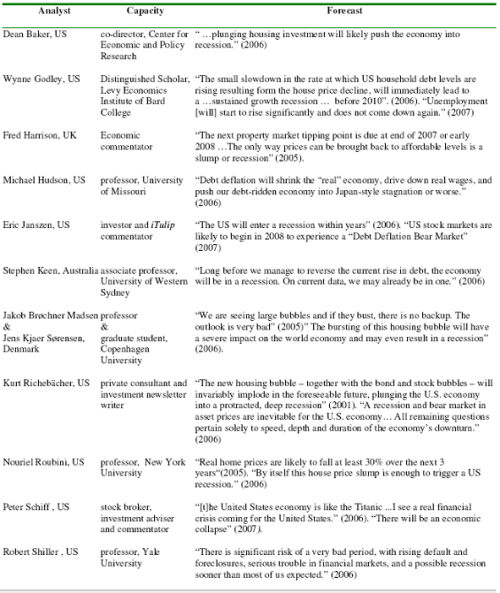
So who were those analysts able to make an accurate and cogent prediction? Here’s the table:

No One Saw This Coming Table 1

What are the common elements of these analysts?

A broadly shared element of analysis is the distinction between financial wealth and real assets. Several of the commentators (Schiff and Richebächer) adhere to the ‘Austrian School’ in economics, which means that they emphasize savings, production (not consumption) and real capital formation as the basis of sustainable economic growth. Richebächer (2006a:4) warns against ““wealth creation” though soaring asset prices” and sharply distinguishes this from “saving and investment…” (where investment is in real-sector, not financial assets). Likewise Shiller (2003) warns that our infatuation with the stock market (financial wealth) is fuelling volatility and distracting us from more the durable economic prospect of building up real assets. Hudson (2006a) comments on the unsustainable “growth of net worth through capital gains”.

A concern with debt as the counterpart of financial wealth follows naturally. “The great trouble for the future is that the credit bubble has its other side in exponential debt growth” writes Richebächer (2006b:1). Madsen from 2003 worried that Danes were living on borrowed time because of the mortgage debt which “had never been greater in our economic history”. Godley in 2006 published a paper titled Debt and Lending: A Cri de Coeur where he demonstrated the US economy’s dependence on debt growth. He argued it would plunge the US into a “sustained growth recession … somewhere before 2010” (Godley and Zezza, 2006:3). Schiff points to the low savings rate of the United States as its worst malady, citing the transformation from being the world’s largest creditor nation in the 1970s to the largest debtor nation by the year 2000. Hudson (2006a) emphasized the same ambiguous potential of house price ‘wealth’ already in the title of his Saving, Asset-Price Inflation, and Debt-Induced Deflation, where he identified the ‘large debt overhead – and the savings that form the balance-sheet counterpart to it’ as the ‘anomaly of today’s [US] economy’. He warned that ‘[r]ising debt-service payments will further divert income from new consumer spending. Taken together, these factors will further shrink the “real” economy, drive down those already declining real wages, and push our debt-ridden economy into Japan-style stagnation or worse.” (Hudson 2006b). Janszen (2009) wrote that “US households and businesses, and the government itself, had since 1980 built up too much debt. The rate of increase in debt was unsustainable… Huge imbalances in the US and global economy developed for over 30 years. Now they are rebalancing, as many non-mainstream economists have warned was certain to happen sooner or later.” Keen (2006) wrote that the debt-to-GDP ratio in Australia (then 147 per cent) “will exceed 160 per cent of GDP by the end of 2007. We simply can’t keep borrowing at that rate. We have to not merely stop the rise in debt, but reverse it. Unfortunately, long before we manage to do so, the economy will be in a recession.”

Of the analysts holding the “alternative, less sanguine” view, most were from the Austrian School. It would be nice if a few more Keynesians had Greenspan’s “shocked disbelief” while watching his “whole intellectual edifice collapse in the summer of [2007]”. We’re not holding our breath. While we don’t necessarily agree with all of Bezemer’s conclusions, the paper is superbly written and an engaging read.

Read Full Post »

VaxGen Inc (OTC:VXGN) is to be sold to Oxigene Inc (OTC.OXGN) for $22M in OXGN stock. The summary terms of the deal announced by OXGN are as follows:

  • OXGN will issue ~15.6M common shares in exchange for all outstanding VXGN common shares (~33.1M).
  • For each VXGN share held, VXGN shareholders receive 0.4719 OXGN shares.
  • OXGN closed yesterday at $1.37, valuing each VXGN share at  $0.65.

At closing OXGN will place an additional 8.5M shares of common stock in escrow to be released to VXGN stockholders contingent upon certain events over the 2 year period following the closing. Those events are the settlement of VXGN’s obligations under its lease of facilities in South San Francisco and the awarding of a procurement contract by the U.S. government to Emergent BioSolutions for which VXGN is eligible to receive certain milestone and royalty payments.

Of the 8.5M shares placed in escrow 2.7M shares are for the settlement of VXGNs lease facility obligations. The remaining 5.8M shares will be released if within two years following the closing of the transaction VXGN becomes entitled to receive a $3M milestone payment from Emergent BioSolutions. If the milestone is achieved VXGN shareholders will receive a further 1.9M shares plus additional shares based on the size of the contract awarded to Emergent up to a maximum of approximately 3.9M shares. Note that OXGN will be entitled to receive additional milestone payments and royalties from Emergent  for a period of 12 years from commercial sale with no obligations to issue additional shares to VXGN stockholders.

The fact that the deal was done at a discount to VXGN’s $0.70 close Wednesday and at a substantial discount to its $0.77 – $2.00 value in liquidation is frustrating. Perhaps most concerning, though, is the restriction on VXGN seeking a superior deal, clearly inserted to hamstring Value Investors for Change and the VaxGen Full Value Committee, the two competing alternate slates of directors for election to VXGN’s board. Here is the restriction in full:

The Merger Agreement contains certain termination rights for both VaxGen and OXiGENE, and further provides that, upon termination of the Merger Agreement under specified circumstances, including by VaxGen to pursue a superior transaction, as defined in the Merger Agreement (including a liquidation), or by OXiGENE to pursue a financing transaction with net proceeds of least $30 million, either party may be required to pay the other party a termination fee of $1,425,000 and to reimburse the other party’s expenses up to $325,000. In addition, in the event that VaxGen effects a liquidation within 180 days of the VaxGen special meeting of stockholders, it will be required to pay a termination fee of $712,500 and reimburse expenses.

If the merger doesn’t go through, the board of VXGN has committed VXGN to throwing away $2.5M of cash. It’s an appalling outcome for VXGN shareholders.

About our VXGN position

We’ve been following VXGN (see our post archive here) because it is trading at a substantial discount to its net cash position, has ended its cash-burning product development activities and is “seeking to maximize the value of its remaining assets through a strategic transaction or series of strategic transactions.” Management has said that, if the company is unable to identify and complete an alternate strategic transaction, it proposes to liquidate. One concern of ours has been a lawsuit against VXGN by its landlords, in which they sought $22.4M. That lawsuit was dismissed in May, so the path for VXGN to liquidate has now hopefully cleared. The board has, however, been dragging its feet on the liquidation. Given their relatively high compensation and almost non-existent shareholding, it’s not hard to see why.

There are two competing alternate proxy slates seeking nomination to the board of VXGN, Value Investors for Change and the VaxGen Full Value Committee. Value Investors for Change, led by Spencer Capital, filed preliminary proxy documents in August to remove the board. In the proxy documents, Value Investors for Change call out VXGN’s board on its “track record of failure and exorbitant cash compensation”:

VaxGen does not have any operations, other than preparing public reports. The Company has three employees, including the part-time principal executive officer and director, and four non-employee directors. Since the Company’s failed merger with Raven Biotechnologies, Inc. in March 2008, the Board has publicly disclosed that it would either pursue a strategic transaction or a series of strategic transactions or dissolve the Company. The Company has done neither. In the meantime, members of the Board have treated themselves to exorbitant cash compensation. Until July 2009, two non-employee members of the Board were paid over $300,000 per year in compensation. The principal executive officer will likely receive over $400,000 in cash compensation this year.

The VaxGen Full Value Committee comprising BA Value Investors’ Steven N. Bronson and ROI Capital Management’s Mark T. Boyer and Mitchell J. Soboleski, intends to replace the current board with directors who will focus on the following objectives:

1. Returning capital to [VXGN]’s shareholders, including an immediate distribution of $10,000,000 in cash;

2. Terminating [VXGN]’s lease with its landlord, Oyster Point Tech Center, LLC, and settling with the landlord the obligations of [VXGN] on the remaining lease payments;

3. Exploring ways to monetize [VXGN] as a “public shell,” including the utilization of [VXGN]’s Substantial Net Operating Losses; and

4. Protecting for the benefit of shareholders royalty payments receivable from the sale of [VXGN]’s intellectual property.

BA Value Investors had previously disclosed an activist holding and, in a June 12 letter to the board, called on VXGN to “act promptly to reduce the size of the board to three directors; reduce director compensation; change to a smaller audit firm; terminate the lease of its facilities; otherwise cut costs; make an immediate $10 million distribution to shareholders; make a subsequent distribution of substantially all the remaining cash after settling the lease termination; distribute any royalty income to shareholders; and explore ways to monetize the public company value of the Issuer and use of its net operating losses.”

VXGN is up 41.7% since we initiated the position. At its $0.68 close yesterday, it has a market capitalization of $22.5M. We last estimated the company’s liquidation value to be around $25.4M or $0.77 per share. VXGN has other potentially valuable assets, including a “state-of-the-art biopharmaceutical manufacturing facility with a 1,000-liter bioreactor that can be used to make cell culture or microbial biologic products” and rights to specified percentages of future net sales relating to its anthrax vaccine product candidate and related technology. The authors of a letter sent to the board on July 14 of this year adjudge VXGN’s liquidation value to be significantly higher at $2.12 per share:

Excluding the lease obligations, the net financial assets alone of $37.2 million equate to $1.12 per share. The EBS royalties (assuming a 6% royalty rate and a $500 million contract as contemplated by NIH/HHS and EBS) of $30 million and milestones of $6 million total $36 million of potential additional future value (based clearly on assumptions, none of which are assured), or $1.09 per share. Adding $1.12 and $1.09 equals $2.21 per share.

The sale to OXGN in detail

The terms of the deal were announced by OXGN in the following press release:

OXIGENE TO ACQUIRE VAXGEN IN A STOCK-FOR-STOCK MERGER

Acquisition to Add Approximately $33 Million in Cash to OXiGENE’s Balance Sheet

Conference Call Today at 9:00 AM Eastern

SOUTH SAN FRANCISCO — OCTOBER 15, 2009 — OXiGENE, Inc. (NASDAQ: OXGN, XSSE: OXGN), a clinical-stage, biopharmaceutical company developing novel therapeutics to treat cancer and eye diseases, and VaxGen, Inc. [OTCBB:VXGN], a biopharmaceutical company, announced today that they have entered into a definitive merger agreement pursuant to which OXiGENE will acquire VaxGen in exchange for common stock of OXiGENE. Upon closing of the transaction, VaxGen will become a wholly-owned subsidiary of OXiGENE, and VaxGen stockholders will become stockholders of OXiGENE.

At the closing of the transaction, OXiGENE will issue approximately 15.6 million shares of common stock in exchange for all outstanding shares of VaxGen’s common stock. The number of shares issued at closing will be subject to adjustment if VaxGen’s net cash, as of a date shortly before the closing, as agreed by both parties, less certain expenses and liabilities, is greater or less than approximately $33.2 million. Based upon the shares of common stock of OXiGENE and VaxGen currently outstanding and assuming net cash at closing equals the target net cash, the stockholders of VaxGen would receive approximately 0.4719 shares of common stock of OXiGENE for each share of VaxGen common stock. VaxGen currently estimates that its net cash at closing may be below the target amount of net cash, depending on the timing of the closing and the amount of VaxGen expenses.

In addition to the initial shares issued to VaxGen stockholders, OXiGENE will also place approximately 8.5 million shares of its common stock in escrow to be released to VaxGen stockholders contingent upon the occurrence of certain events over the two-year period following the closing. These events relate primarily to settlement of VaxGen’s obligations under its lease of facilities in South San Francisco, and to the potential award of a procurement contract to Emergent BioSolutions (NYSE:EBS) by the U.S. Government for which VaxGen is eligible to receive milestone and royalty payments in connection with Emergent BioSolutions’ May 2008 acquisition of VaxGen’s recombinant protective antigen (rPA) anthrax vaccine product candidate and related technology.

Immediately after the closing, VaxGen stockholders prior to the merger are expected to own approximately 20% of the outstanding shares of the combined company and OXiGENE stockholders are expected to own approximately 80%. If all of the contingent shares are released, OXiGENE anticipates having approximately 87 million shares outstanding. Under these circumstances, VaxGen stockholders prior to the merger would be expected to own approximately 28% percent of the outstanding shares of the combined company and the current OXiGENE stockholders would be expected to own approximately 72% percent, assuming no further issuances of stock by OXiGENE.

“OXiGENE’s mission is to develop new and improved therapeutics based on our vascular disrupting agent (VDA) technology that has the potential to deliver significant medical benefits to patients with cancer and sight-threatening eye diseases and conditions. We believe these programs will be significantly strengthened by the addition of approximately $33 million of cash,” said Peter Langecker, M.D., Ph.D., OXiGENE’s interim Chief Executive Officer. “This transaction represents a timely and efficient strategy to strengthen our cash position and fund operations into 2011. In addition to the benefit of an immediate infusion of significant cash which strengthens our ability to fund our clinical development programs, we believe that there is potential upside in this transaction in the form of milestones and royalties should the rPA anthrax vaccine be selected for government stockpiling. We want to welcome our prospective new stockholders and board members and look forward to their support and sharing our progress with them.”

“We believe that this merger transaction with OXiGENE represents an excellent strategy to maximize the value of VaxGen’s remaining tangible and intangible assets and to provide our stockholders with the opportunity to participate in OXiGENE’s potential success as a leader in the development of promising new agents for cancer and eye diseases,” said James Panek, President of VaxGen.

The merger agreement has been approved unanimously by the boards of directors of both OXiGENE and VaxGen. The merger is subject to customary closing conditions, including approval by both OXiGENE’s and VaxGen’s stockholders. As of June 30, 2009, VaxGen’s unaudited cash, cash equivalents and marketable securities balance was approximately $36 million and its liabilities and contractual obligations consisted primarily of costs and expenses of its outstanding leases related to its former biopharmaceutical manufacturing operations located in South San Francisco, CA.

Upon the closing, two members of VaxGen’s board of directors will be appointed to OXiGENE’s board of directors: Lori F. Rafield, Ph.D., a consultant to the biotechnology industry, and Franklin M. Berger, a former biotechnology analyst.

The transaction is expected to be completed in the first quarter of 2010. OXiGENE is receiving a fairness opinion in this transaction from Houlihan Lokey, and VaxGen is receiving a fairness opinion from Aquilo Partners.

Details of the Proposed Stock-for Stock Transaction

Upon closing of the transaction, based upon the anticipated net cash balance of VaxGen at closing and the current number of OXiGENE’s common shares outstanding, OXiGENE will issue approximately 15.6 million shares of newly issued common stock, subject to adjustment as set forth in the merger agreement, in exchange for all of VaxGen’s outstanding common stock. All of VaxGen’s outstanding stock options will be canceled immediately prior to the closing and all of VaxGen’s outstanding warrants, to the extent not terminated prior to the closing, will be assumed by OXiGENE. OXiGENE will also place an additional approximately 8.5 million shares of newly issued common stock in escrow to be issued contingent upon certain occurrences over the two-year period following the closing.

Of the 8.5 million shares placed in escrow, approximately 2.7 million shares relate primarily to the potential settlement of VaxGen’s lease facility obligation. If the outstanding lease obligation and related costs are reduced either before the closing or during the two-year period following the closing, OXiGENE will release additional shares from escrow to the VaxGen stockholders depending on the amount of the lease settlement arrangements.

The remaining 5.8 million shares to be held in escrow will be released to VaxGen’s stockholders in the event that VaxGen (as a subsidiary of OXiGENE), within two years following the closing of the transaction, becomes entitled to receive a $3 million milestone payment from Emergent BioSolutions in connection with the award of a procurement contract to Emergent by the United States government for supply of rPA anthrax vaccine. In the event this milestone is achieved, OXiGENE will release from escrow approximately 1.9 million shares, plus additional shares based on the size of the contract awarded to Emergent. OXiGENE will be entitled to receive additional milestone payments based on net sales as well as royalties from sales of rPA anthrax vaccine for a period of 12 years from commercial sale, with no obligation to issue additional shares to VaxGen stockholders. If the award of the procurement contract is announced prior to the closing, VaxGen will receive credit for the $3 million milestone payment in calculating net cash at closing, and OXiGENE will issue to VaxGen stockholders at the closing additional shares based on the size of the contract awarded to Emergent.

In connection with the Merger Agreement, VaxGen entered into voting agreements with OXiGENE and certain executive officers, directors and stockholders of OXiGENE, and OXiGENE entered into voting agreements with VaxGen and certain executive officers and directors of VaxGen pursuant to which these parties agreed to vote in favor of the adoption of the merger agreement and against approval of any proposal opposing or in competition with the consummation of the Merger.

The terms of the Agreement and Plan of Merger show how badly OXGN outnegotiated the directors of VXGN.

If you’re into self-flagellation, read the transcript of the call and weep over the lack of questions about the terms of the deal or whether it’s good for VXGN’s shareholders.

Hat tip Jim Hodges.

[Full Disclosure:  We have a holding in VXGN. This is neither a recommendation to buy or sell any securities. All information provided believed to be reliable and presented for information purposes only. Do your own research before investing in any security.]

Read Full Post »

« Newer Posts - Older Posts »