Feeds:
Posts
Comments

Archive for the ‘Stocks’ Category

One of the themes that I want to explore in some depth is “pure” contrarian investing, which is investing relying solely on the phenomenon of reversion to the mean. I’m calling it “pure” contrarian investing to distinguish it from the contrarian investing that is value investing disguised as contrarian investing. The reason for making this distinction is that I believe Lakonishok, Shleifer, and Vishny’s characterization of the returns to value as contrarian returns is a small flaw in Contrarian Investment, Extrapolation and Risk. I argue that it is a problem of LSV’s definition of “value.” I believe that LSV’s results contained the effects of both pure contrarianism (mean reversion) and value. While mean reversion and value were both observable in the results, I don’t believe that they are the same strategy, and I don’t believe that the returns to value are solely due to mean reversion. The returns to value stand alone and the returns to a mean reverting strategy also stand alone. In support of this contention I set out the returns to a simple pure contrarian strategy that does not rely on any calculation of value.

Contrarianism relies on mean reversion

The grundnorm of contrarianism is mean reversion, which is the idea that stocks that have performed poorly in the past will perform better in the future and stocks that have performed well in the past will not perform as well. Graham, quoting Horace’s Ars Poetica, described it thus:

Many shall be restored that now are fallen and many shall fall that are now in honor.

LSV argue that most investors don’t fully appreciate the phenomenon, which leads them to extrapolate past performance too far into the future. In practical terms it means the contrarian investor profits from other investors’ incorrect assessment that stocks that have performed well in the past will perform well in the future and stocks that have performed poorly in the past will continue to perform poorly.

LSV’s definition of value is a problem

LSV’s contrarian model argues that value strategies produce superior returns because of mean reversion. Value investors would argue that value strategies produce superior returns because they are exchanging of one store of value (say, 67c) for a greater store of value (say, a stock worth say $1). The problem is one of definition.

In Contrarian Investment, Extrapolation and Risk LSV categorized the stocks on simple one-variable classifications as either “glamour” or “value.” Two of those variables were price-to-earnings and price-to-book (there were three others). Here is the definitional problem: A low price-to-earnings multiple or a low price-to-book multiple does not necessarily connote value and the converse is also true, a high price-to-earnings multiple or a high price-to-book multiple does not necessarily indicate the absence of value.

John Burr Williams 1938 treatise The Theory of Investment Value is still the definitive word on value. Here is Buffett’s explication of Williams’s theory in his 1992 letter to shareholders, which I use because he puts his finger right on the problem with LSV’s methodology:

In The Theory of Investment Value, written over 50 years ago, John Burr Williams set forth the equation for value, which we condense here: The value of any stock, bond or business today is determined by the cash inflows and outflows – discounted at an appropriate interest rate – that can be expected to occur during the remaining life of the asset. Note that the formula is the same for stocks as for bonds. Even so, there is an important, and difficult to deal with, difference between the two: A bond has a coupon and maturity date that define future cash flows; but in the case of equities, the investment analyst must himself estimate the future “coupons.” Furthermore, the quality of management affects the bond coupon only rarely – chiefly when management is so inept or dishonest that payment of interest is suspended. In contrast, the ability of management can dramatically affect the equity “coupons.”

The investment shown by the discounted-flows-of-cash calculation to be the cheapest is the one that the investor should purchase – irrespective of whether the business grows or doesn’t, displays volatility or smoothness in its earnings, or carries a high price or low in relation to its current earnings and book value. Moreover, though the value equation has usually shown equities to be cheaper than bonds, that result is not inevitable: When bonds are calculated to be the more attractive investment, they should be bought.

What LSV observed in their paper may be attributable to contrarianism (mean reversion), but it is not necessarily attributable to value. While I think LSV’s selection of price-to-earnings and price-to-book as indicia of value in the aggregate probably means that value had some influence on the results, I don’t think they can definitively say that the cheapest stocks were in the “value” decile and the most expensive stocks were in the “glamour” decile. It’s easy to understand why they chose the indicia they did: It’s impractical to consider thousands of stocks and, in any case, impossible to reach a definitive value for each of those stocks (we would all assess the value of each stock in a different way). This leads me to conclude that the influence of value was somewhat weak, and what they were in fact observing was the influence of mean reversion. It doesn’t therefore seem valid to say that the superior returns to value are due to mean reversion when they haven’t tested for value. It does, however, raise an interesting question for investors. Can you invest solely relying on reversion to the mean? It seems you might be able to do so.

Pure contrarianism

Pure contrarian investing is investing relying solely on the phenomenon of reversion to the mean without making an assessment of value. Is it possible to observe the effects of mean reversion by constructing a portfolio on a basis other than some indicia of value? It is, and the Bespoke Investment Group has done all the heavy lifting for us. Bespoke constructed from the S&P500 ten portfolios with 50 stocks in each on the basis of stock performance in 2008. They then tracked the performance of those stocks in 2009. The result?

Many of the stocks that got hit the hardest last year came roaring back this year, and the numbers below help quantify this.  As shown, the 50 stocks in the S&P 500 that did the worst in 2008 are up an average of 101% in 2009!  The 50 stocks that did the best in 2008 are up an average of just 9% in 2009.  2009 was definitely a year when buying the losers worked.
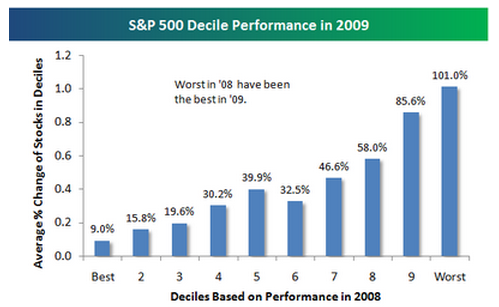
It’s a stunning outcome, and it seems that the portfolios (almost) performed in rank order. While there may be a value effect in these results, the deciles were constructed on price performance alone. This would seem to indicate that, at an aggregate level at least, mean reversion is a powerful phenomenon and a pure contrarian investment strategy relying on mean reversion should work.
Read Full Post »

As I foreshadowed yesterday, there are several related themes that I wish to explore on Greenbackd. These three ideas are as follows:

  1. Quantitative value investing
  2. Pure contrarian investing
  3. Problems with the received wisdom on value investment

Set out below is a brief overview of each.

A quantitative approach to value investment

I believe that James Montier’s 2006 research report Painting By Numbers: An Ode To Quant presents a compelling argument for a quantitative approach to value investing. Simple statistical or quantitative models have worked well in the context of value investing, and I think there is ample evidence that this is the case. (Note that simple is the operative word: I’m not advocating anything beyond basic arithmetic or the most elementary algebra.) Graham was said to know little about the businesses of the net current asset value stocks he bought. It seems that any further analysis beyond determining the net current asset value was unnecessary for him (although he does discuss in Security Analysis other considerations for the discerning security analyst). Perhaps that should be good enough for us.

As Oppenheimer’s Ben Graham’s Net Current Asset Values: A Performance Update paper demonstrates, a purely mechanical application of Graham’s net current asset value criterion generated a mean return between 1970 and 1983  of “29.4% per year versus 11.5% per year for the NYSE-AMEX Index.” Oppenheimer puts that return in context thus, “[one] million dollars invested in the net current asset portfolio on December 31, 1970 would have increased to $25,497,300 by December 31, 1983.” That’s a stunning return. It would have put you in elite company if you had been running a fund blindly following Oppenheimer’s methodology from the date of publication of the paper. Other papers examining the returns over different periods and in different markets written after Oppenheimer’s paper have found similar results (one of the papers is by Montier and I will be discussing it in some detail in the near future). The main criticism laid at the feet of the net net method is that it can only accommodate a small amount of capital. It is an individual investor or micro fund strategy. Simple strategies able to accommodate more capital are described in Lakonishok, Shleifer, and Vishny’s Contrarian Investment, Extrapolation and Risk. In that paper, the authors found substantial outperformance through the use of only one or two value-based variables, whether they be price-to-book, price-to earnings, price-to-cash flow or price-to-sales.

I believe these papers (and others I have discussed in the past) provide compelling evidence for quantitative value investing, but let me flip it around. Why not invest solely on the basis of some simple value-based variables? Because you think you can compound your portfolio faster by cherry-picking the better stocks on the screen? This despite what Montier says in Painting By Numbers about quant models representing “a ceiling in performance (from which we detract) rather than a floor (to which we can add)”? Bonne chance to you if that is the case, but you are one of the lucky few. The preponderance of data suggest that most investors will do better following a simple model.

Pure contrarian investing

By “pure” contrarian investing, I mean contrarian investing that is not value investing disguised as contrarian investing. LSV frame their Contrarian Investment, Extrapolation and Risk findings in the context of “contrarianism,” arguing that value strategies produce superior returns because most investors don’t fully appreciate the phenomenon of mean reversion, which leads them to extrapolate past performance too far into the future. LSV argues that investors can profit from the market’s (incorrect) assessment that stocks that have performed well in the past will perform well in the future and stocks that have performed poorly in the past will continue to perform poorly. If that is in fact the case, then contrarian strategies that don’t rely on value should also work. Can I simply buy some list of securities at a periodic low (52 weeks or whatever) and sell some list of securities at a periodic high (again, say 52 weeks) and expect to generate “good” (i.e. better than just hugging the index) returns? If not, it’s not contrarianism, but value that is the operative factor.

It is in this context that I want to explore Nassim Nicholas Taleb’s “naive empiricist.” If contrarianism appears to work as a stand alone strategy, how do I know that I’m not mining the data? I also want to consider whether the various papers written about value investment discussed on Greenbackd and the experiences of Buffett, Schloss, Klarman et al “prove” that value works. Taleb would say they don’t.  How, then, do I proceed if I don’t know whether the phenomenon we’re observing is real or a trick? We try to build a portfolio able to withstand stresses, or changes in circumstance. How do we do that? The answer is some combination of employing Graham’s margin of safety, diversifying, avoiding debt and holding an attitude like Montaigne’s “Que sais-je?”‘ (“What do I know?”). It’s hardly radical stuff, but, what I believe is interesting, is how well such a sceptical and un-confident approach marries with quantitative investing.

Problems with the received wisdom on value investment

Within the value investment community there are some topics that are verboten. It seems that some thoughts were proscribed some time ago, and we are now no longer even allowed to consider them. I don’t want delve into them now, other than to say that I believe they deserve some further consideration. Some principles are timeless, others are prisoners of the moment, and it is often impossible to distinguish between the two. How can we proceed if we don’t subject all received wisdom to further consideration to determine which rules are sound, and which we can safely ignore? I don’t believe we can. I’ll therefore be subjecting those topics to analysis in any attempt to find those worth following. If I’m going to make an embarrassing mistake, I’m betting it’s under this heading.

There are several other related topics that I wish to consider, but they are tangential to the foregoing three.

Read Full Post »

Welcome back to Greenbackd for 2010. I hope the holidays were as good to you as they were to me.

The break has afforded me the opportunity to gain some perspective on the direction of Greenbackd. Away from the regular posting schedule I found the time to write some Jerry McGuire The Things We Think and Do Not Say treatises, quickly consigning most of them to trash so that they couldn’t come back to haunt me at a later, more lucid and, perhaps, sober moment (I did say the holiday was good to me). Some (heavily edited) remnants of those rambling essays will filter through onto this site over the coming weeks. I’m charged up about several topics that I want to explore in some depth, which is a change from the net net ennui that was starting to creep in before the break.

The beauty of the Graham net net as a subject for investment is its simplicity. Conversely, that same characteristic makes it a poor subject for extended contemplation and writing. There is a limit to which the universe of Graham net nets, even those entwined in activist or special situations, can be subject to analysis before the returns to additional analysis diminish asymptotically to approaching zero. Note that in this context I don’t mean investment returns, but returns to the psyche, good feelings, the avoidance of boredom…in other words, the really important stuff. The investment returns in that area are good, but we all already know that to be the case. What am I contributing if I keep digging up undervalued net nets? Not much. Graham invented it. Oppenheimer proved it. Jon Heller writes about it better than anyone else. The rest of us are just regurgitating their work.

Really, this is old news. Greenbackd passed the point some time ago at which it was possible to hold off the tedium of net nets and evolved organically to embrace several related topics. I still love the activist dogfight for control or influence and I think a well-written 13D makes for excellent copy. I also still love finding blatantly misplaced securities, each one a little slash at the heart of the EMH. Greenbackd will continue to study individual securities and follow interesting activist situations, however, it will not be the sole focus of the site. For me, there are more interesting problems to tackle. My concern has been whether Greenbackd can contain the new topics or whether I’ll just annoy old Greenbackd readers with the new direction. My favorite blogger wrestled with same issue several years ago, and so I’m using her experience as a guide.

I think the smartest thinker and most lucid writer in the financial and political (in the broadest sense of the word) sphere is Marla Singer at Zero Hedge and occasionally Finem Respice (formerly Equity Private at Going Private). Marla, then writing as Equity Private, started out with a narrowly focussed blog about the “sardonic memoirs of a private equity professional,” but gradually expanded to cover only tangentially related topics like the role of government, economics, philosophy, literature, art, duelling, card sharping and cargo cults (the implications of which won’t be lost on most readers). For me, it was a thrilling departure, but Marla must have felt that Equity Private was too limited, and created Finem Respice before moving on to Zero Hedge. I was only too happy to follow, but I would have been equally happy for Equity Private to keep posting as Equity Private. (As an aside, I recommend following Marla at Zero Hedge. Her ability to tease out the hidden story from some granular detail in legislation or data is simply breathtaking and unmatched in the mainstream media.)

I’ll persist with Greenbackd because I like this boat, but it will be embarking for new shores. Pure net net investors are well served by other sites, so it’s probable that some readers will depart. This site will always be dedicated to deep value, but I want to find some uncharted territory. The voyage might not yield any new land, but I think it will be more fun than continuing to orienteer on Graham’s old maps. I have an inkling there is something interesting out there at the intersection of Montier, Montaigne, Taleb and Graham. Tomorrow, I’ll start to sketch out the new world. It also coincides with a personal change for me. Working in someone else’s fund has been enjoyable, but I feel it’s time to graduate to principal. I’m presently considering entering into an established partnership or starting my own fund. Whichever direction I go will likely have some influence on Greenbackd.

Read Full Post »

Happy holidays, folks

I’m taking a two-week break. See you back here January 11th, 2010.

In the interim, please feel free to comment or drop us a line at greenbackd [at] gmail [dot] com. I’ll be checking email and the comments on the site throughout the break, and will respond sporadically.

Thank you for supporting Greenbackd in 2009.

Read Full Post »

I find it interesting to see which posts on Greenbackd attract the most attention and I thought you might too. To that end, here are the 10 most popular Greenbackd posts of 2009:

  1. The best unknown activist investment of 2009
  2. Seth Klarman on Liquidation Value
  3. Tweedy Browne updates What Has Worked In Investing
  4. Marty Whitman’s adjustments to Graham’s net net formula
  5. Walter Schloss, superinvestor
  6. Sub-liquidation value ten baggers
  7. VXGN gifted to OXGN; VXGN directors abandon shareholders, senses
  8. Valuing long-term and fixed assets
  9. Where in the world is Chapman Capital?
  10. Counterintuition

Why was The best unknown activist investment of 2009 the most popular post of 2009, attracting 5 times the traffic of the Seth Klarman on Liquidation Value post, which is number 2 on the list? Who knows? It seems you guys like stories about idiosyncratic investors who trade in odd securities found off the beaten track.

Here are four near misses:

  1. The end of value investing?
  2. Buffett on gold
  3. Marty Whitman discusses Graham’s net-net formula
  4. John Paulson and The Greatest Trade Ever

Read Full Post »

In his 2006 research report Painting By Numbers: An Ode To Quant (via The Hedge Fund Journal) James Montier presents a compelling argument for a quantitative approach to investing. Montier’s thesis is that simple statistical or quantitative models consistently outperform expert judgements. This phenomenon continues even when the experts are provided with the models’ predictions. Montier argues that the models outperform because humans are overconfident, biased, and unable or unwilling to change.

Montier makes his argument via a series of examples drawn from fields other than investment. The first example he gives, which he describes as a “classic in the field” and which succinctly demonstrates the two important elements of his thesis, is the diagnosis of patients as either neurotic or psychotic. The distinction is as follows: a psychotic patient “has lost touch with the external world” whereas a neurotic patient “is in touch with the external world but suffering from internal emotional distress, which may be immobilising.” According to Montier, the standard test to distinguish between neurosis or psychosis is the Minnesota Multiphasic Personality Inventory or MMPI:

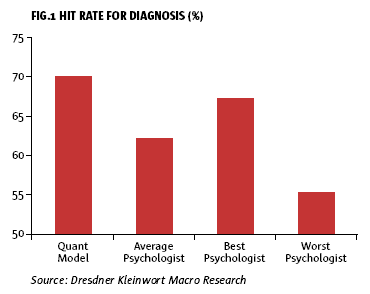
In 1968, Lewis Goldberg1 obtained access to more than 1000 patients’ MMPI test responses and final diagnoses as neurotic or psychotic. He developed a simple statistical formula, based on 10 MMPI scores, to predict the final diagnosis. His model was roughly 70% accurate when applied out of sample. Goldberg then gave MMPI scores to experienced and inexperienced clinical psychologists and asked them to diagnose the patient. As Fig.1 shows, the simple quant rule significantly outperformed even the best of the psychologists.

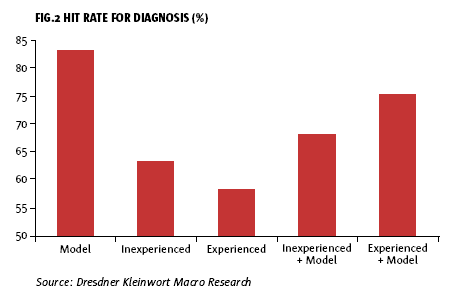
Even when the results of the rules’ predictions were made available to the psychologists, they still underperformed the model. This is a very important point: much as we all like to think we can add something to the quant model output, the truth is that very often quant models represent a ceiling in performance (from which we detract) rather than a floor (to which we can add).

The MMPI example illustrates the two important points of Montier’s thesis:

  1. The simple statistical model outperforms the judgements of the best experts.
  2. The simple statistical model outperforms the judgements of the best experts, even when those experts are given access to the simple statistical model.

Montier goes on to give diverse examples of the application of his theory, ranging from the detection of brain damage, the interview process to admit students to university, the likelihood of a criminal to re-offend, the selection of “good” and “bad” vintages of Bordeaux wine, and the buying decisions of purchasing managers. He then discusses some “meta-analysis” of studies to demonstrate that “the range of evidence I’ve presented here is not somehow a biased selection designed to prove my point:”

Grove et al consider an impressive 136 studies of simple quant models versus human judgements. The range of studies covered areas as diverse as criminal recidivism to occupational choice, diagnosis of heart attacks to academic performance. Across these studies 64 clearly favoured the model, 64 showed approximately the same result between the model and human judgement, and a mere 8 studies found in favour of human judgements. All of these eight shared one trait in common; the humans had more information than the quant models. If the quant models had the same information it is highly likely they would have outperformed.

As Paul Meehl (one of the founding fathers of the importance of quant models versus human judgements) wrote: There is no controversy in social science which shows such a large body of qualitatively diverse studies coming out so uniformly in the same direction as this one… predicting everything from the outcomes of football games to the diagnosis of liver disease and when you can hardly come up with a half a dozen studies showing even a weak tendencyin favour of the clinician, it is time to draw a practical conclusion.

Why not investing?

Montier says that, within the world of investing, the quantitative approach is “far from common,” and, where it does exist, the practitioners tend to be “rocket scientist uber-geeks,” the implication being that they would not employ a simple model. So why isn’t quantitative investing more common? According to Montier, the “most likely answer is overconfidence.”

We all think that we know better than simple models. The key to the quant model’s performance is that it has a known error rate while our error rates are unknown.

The most common response to these findings is to argue that surely a fund manager should be able to use quant as an input, with the flexibility to override the model when required. However, as mentioned above, the evidence suggests that quant models tend to act as a ceiling rather than a floor for our behaviour. Additionally there is plenty of evidence to suggest that we tend to overweight our own opinions and experiences against statistical evidence.

Montier provides the following example is support of his contention that we tend to prefer our own views to statistical evidence:

For instance, Yaniv and Kleinberger11 have a clever experiment based on general knowledge questions such as: In which year were the Dead Sea scrolls discovered?

Participants are asked to give a point estimate and a 95% confidence interval. Having done this they are then presented with an advisor’s suggested answer, and asked for their final best estimate and rate of estimates. Fig.7 shows the average mean absolute error in years for the original answer and the final answer. The final answer is more accurate than the initial guess.

The most logical way of combining your view with that of the advisor is to give equal weight to each answer. However, participants were not doing this (they would have been even more accurate if they had done so). Instead they were putting a 71% weight on their own answer. In over half the trials the weight on their own view was actually 90-100%! This represents egocentric discounting – the weighing of one’s own opinions as much more important than another’s view.

Similarly, Simonsohn et al12 showed that in a series of experiments direct experience is frequently much more heavily weighted than general experience, even if the information is equally relevant and objective. They note, “If people use their direct experience to assess the likelihood of events, they are likely to overweight the importance of unlikely events that have occurred to them, and to underestimate the importance of those that have not”. In fact, in one of their experiments, Simonsohn et al found that personal experience was weighted twice as heavily as vicarious experience! This is an uncannily close estimate to that obtained by Yaniv and Kleinberger in an entirely different setting.

It is worth noting that Montier identifies LSV Asset Management and Fuller & Thaler Asset Management as being “fairly normal” quantitative funds (as opposed to being “rocket scientist uber-geeks”) with “admirable track records in terms of outperformance.” You might recognize the names: “LSV” stands for Lakonishok, Shleifer, and Vishny, authors of the landmark Contrarian Investment, Extrapolation and Risk paper, and the “Thaler” in Fuller & Thaler is Richard H. Thaler, co-author of Further Evidence on Investor Overreaction and Stock Market Seasonality, both papers I’m wont to cite. I’m not entirely sure what strategies LSV and Fuller & Thaler pursue, wrapped as they are in the cloaks of “behavioural finance,” but judging from those two papers, I’d say it’s a fair bet that they are both pursuing value-based strategies.

It might be a while before we see a purely quantitative value fund, or at least a fund that acknowledges that it is one. As Montier notes:

We find it ‘easy’ to understand the idea of analysts searching for value, and fund managers rooting out hidden opportunities. However, selling a quant model will be much harder. The term ‘black box’ will be bandied around in a highly pejorative way. Consultants may question why they are employing you at all, if ‘all’ you do is turn up and run the model and then walk away again.

It is for reasons like these that quant investing is likely to remain a fringe activity, no matter how successful it may be.

Montier’s now at GMO, and has produced a new research report called Ten Lessons (Not?) Learnt (via Trader’s Narrative).

Read Full Post »

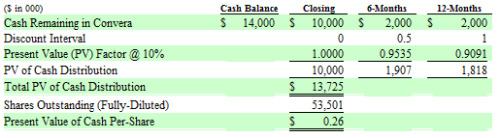
In mid November I ran a post on Convera Corporation (NASDAQ:CNVR) (see the CNVR post archive here), which was in the process of liquidating and planning to pay distributions valued in the range of $0.26 to $0.45 per share. The stock was then trading at $0.221. The distributions consisted of three cash payments with a value of $0.26 per share ($10M on liquidation, and a $2M payment on each of the 6 and 12 month anniversaries of liquidation) and a share in a newly created company, VSW, worth between nothing and $0.14 on pretty heroic assumptions. The most recent 10Q is a little troubling because it doesn’t mention the two $2M distributions, which account for about $0.07 of value in the liquidation. They are still included in the original plan of liquidation and therefore by reference in latest 10Q. We have not, however, been able to contact the CFO to confirm that the distributions are still payable. I believe that some distribution is still payable, but not in the quantum originally estimated by the company. My rough estimate, based on the accounts as at October 31, places the total cash distributions slightly lower than the company’s last estimate at ~$13.0M or $0.24 per share.

The original information statement

Here’s the description from the 14(c) information statement:

We plan to distribute $10,000,000 shortly after the closing of the Merger, with the remaining $4,000,000 to be distributed in $2,000,000 increments at six months and 12 months after the closing of the Merger, subject to possible holdbacks for potential liabilities and on-going expenses deemed necessary by our board of directors in its sole discretion.

The present value of this cash distribution, assuming a discount rate of 10%, is estimated at $0.26 per share.

CNVR 1

Hempstead assessed the value indication associated with a one-third equity interest in VSW based upon the discounted cash flows methodology. Specifically, under a discounted cash flows methodology, the value of a company’s stock is determined by discounting to present value the expected returns that accrue to holders of such equity. Projected cash flows for VSW were based upon projected financial data prepared by our management. Estimated cash flows to equity holders were discounted to present value based upon a range of discount rates, from 25% to 35%. This range of discount rates is reflective of the required rates of return on later-stage venture capital investments. The resultant value indications for the VSW component of the transaction, on a per-Convera share basis, are as follows:

CNVR 2

Based upon the above analyses, the value indications for the cash and VSW stock to be received by our stockholders in exchange for their current Convera shares are within a range of $0.37 to $0.45 per Convera share.

The most recent 10Q

This is the position according to the most recent 10Q:

On June 1, 2009, we announced our plans to merge our search business with Vertical Search Works, Inc. and our expectation to adopt a plan of dissolution with orderly wind down and liquidation of Convera before the closing of the merger. The merger with VSW contemplates the transfer of all the business assets and obligations of the search business, including $3.0 million in cash and a $1.0 million line of credit to VSW, subject to certain adjustments. The plan of dissolution contemplates a $10.0 million dividend to shareholders of record at the close of the transaction and an orderly wind up of Convera’s remaining obligations over the twelve months after closing. We believe that we have sufficient cash resources on hand to complete the merger and the plan of dissolution. We expect the conditions for the closing of the VSW transaction will be met early in 2010. However, we make no assurances that either the merger or the plan of dissolution will be completed.

Here’s my rough estimate of the state of the balance sheet here after a further 12 months of cash burn and professional fees:

According to my back-of-the-envelope calculations, the distributions estimated by management seem slightly high, but my estimate is sensitive to the quantum of the cash burn and professional fees. At the present stock price, there’s no upside in the cash distributions. The share in VSW may present some value, but no sensible estimate can be made as to that value. The range is likely nil to $0.14 per share, and I believe nil is the more likely end of the range. I’m going to maintain Greenbackd’s position in CNVR because I think the worst case scenario – which is probably the most likely scenario – is that the position is a wash, but there is some small chance that there is value in VSW.

Hat tip Rodrigo.

[Full Disclosure:  I do not hold CNVR. This is neither a recommendation to buy or sell any securities. All information provided believed to be reliable and presented for information purposes only. Do your own research before investing in any security.]

Read Full Post »

Update: I’ve removed SIG from the list.

In Ben Graham’s Net Current Asset Values: A Performance Update Professor Henry Oppenheimer examined the return on stocks selected using Benjamin Graham’s net current asset value strategy over the period 1970 to 1983. Oppenheimer’s conclusion about the returns from such stocks was nothing short of extraordinary:

The mean return from net current asset stocks for the 13-year period was 29.4% per year versus 11.5% per year for the NYSE-AMEX Index. One million dollars invested in the net current asset portfolio on December 31, 1970 would have increased to $25,497,300 by December 31, 1983. By comparison, $1,000,000 invested in the NYSE-AMEX Index would have increased to $3,729,600 on December 31, 1983. The net current asset portfolio’s exceptional performance over the entire 13 years was not consistent over smaller subsets of time within the 13-year period. For the three-year period, December 31, 1970 through December 31, 1973, which represents 23% of the 13-year study period, the mean annual return from the net current asset portfolio was .6% per year as compared to 4.6% per year for the NYSE-AMEX Index.

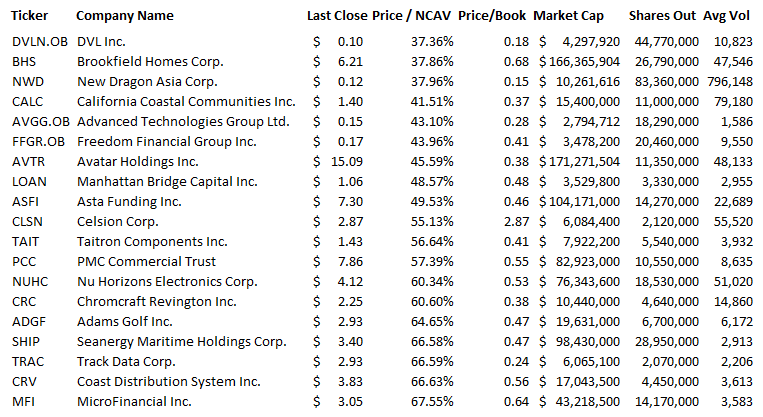
Oppenheimer’s methodology was to acquire all stocks meeting Graham’s investment criterion on December 31 of each year, hold those stocks for one year, and replace them on December 31 of the subsequent year. I’m introducing a new portfolio to track the performance of Graham NCAV stocks in real time. I’ll roll it over annually, like Oppenheimer did. Here’s the Greenbackd 2010 Graham NCAV Portfolio (extracted from the Graham Investor screen):

You can track the performance of the Greenbackd 2010 Graham NCAV Portfolio throughout 2010 with Tickerspy.

[Full Disclosure:  No positions. This is neither a recommendation to buy or sell any securities. All information provided believed to be reliable and presented for information purposes only. Do your own research before investing in any security.]

Read Full Post »

The Wall Street Journal’s Deal Journal blog has an article, The Secret to M&A: It Pays to Be Humble, about a KPMG study into the factors determining the success or otherwise of M&A deals over the period from 2002 to 2006. Some of the results are a little unexpected. Most surprising: acquirers purchasing targets with higher P/E ratios outperformed acquirers of targets with lower P/E ratios, which seems to fly in the face of every study I’ve ever read, and calls into question everything that is good and holy in the world. In effect, KPMG is saying that the relationship of value as a predictor of investment returns broke down for the period studied. I think it’s an aberration, and I’ll be sticking with value as my strategy.

In the study, The Determinants of M&A Success What Factors Contribute to Deal Success? (.pdf), KPMG examined a number of variables to determine which had a statistically significant influence on the stock performance of the acquirer. Those variables examined included the following:

  • How the deal was financed—stock vs. cash, or both
  • The size of the acquirer
  • The price-to-earnings (“P/E”) ratio of the acquirer
  • The P/E ratio of the target
  • The prior deal experience of the acquirer
  • The stated deal rationale
  • Whether or not the deal was cross-border

KPMG found that some factors were highly correlated with success (for example, paying with cash, rather than using stock or cash and stock) and others were not statistically significant (surprisingly, market capitalization). Here are KPMG’s “key findings”:

  • Cash-only deals had higher returns than stock-and-cash deals, and stock-only deals
  • Acquirers with low price-to-earnings (P/E) ratios resulted in more successful deals
  • Those companies that closed three to five deals were the most successful; closing more than five deals in a year reduced success
  • Transactions that were motivated by increasing “financial strength” were most successful
  • The size of the acquirer (based on market capitalization) was not statistically significant

The P/E ratio of the target is correlated with success, but not in the manner that one might expect:

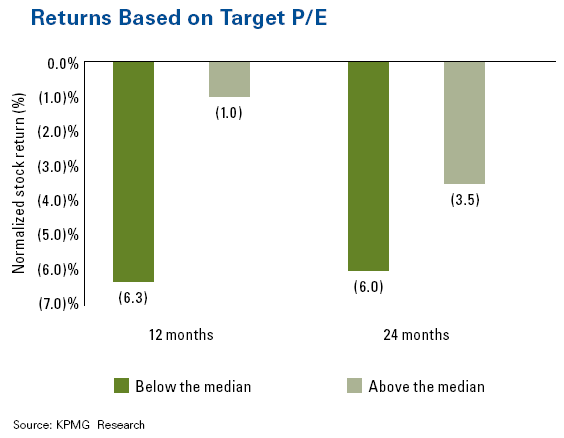
The P/E ratio of the target was also statistically significant. In contrast to our previous study, acquirers who were able to purchase companies with P/E ratios below the industry median saw a negative 6.3 percent return after one year and a negative 6.0 percent return after two years. Acquirers who purchased targets with P/E ratios above the median, including those with negative P/E ratios, had a negative 1 percent return after one year and a negative 3.5 percent return after two years. These results are very different from the ones we found in our last study for deals announced between 2000 and 2004. Those earlier deals demonstrated the more anticipated results: acquirers who purchased targets with below average P/E ratios were more successful than acquirers who purchased targets with higher P/E ratios.

It is probable that in the deals announced between 2002 and 2006, acquirers who purchased targets with high P/E ratios were buying businesses that were growing and where the acquirer was able to achieve greater synergies. Deals announced between 2000 and 2004 included deals from the “dot-com” era, where high P/E ratios were often associated with unprofitable ventures that were not able to meet future income expectations.

Here’s the chart showing the relative returns to P/E:

Now, we value folk know that, in any given instance, the P/E ratio alone tells us little about the sagacity of an investment. In the aggregate, however, we would have expected the lower P/E targets to outperform the more expensive acquisitions. That’s not just wishful thinking, it’s based on the various studies that I am so fond of quoting, most notably Lakonishok, Shleifer, and Vishny’s Contrarian Investment, Extrapolation and Risk. Lakonishok, Shleifer, and Vishny found that “value”determined on the basis of P/E consistently outperformed “glamour”. That relationship seems to have broken down over the period 2002 to 2006 according to the KPMG study.

There are several possible explanations for KPMG’s odd finding. First, they weren’t directly tracking the performance of the stock of the target, they were analysing the performance of the stock of the acquirer, which means that other factors in the acquirers’ stocks could have influenced the outcome. Second, five years is a relatively short period to study. A longer study may have resulted in the usual findings. Third, it’s possible that 2002 to 2006 was a period where the traditional value phenomenon broke down. It was a big leg up in the market, and a bull market makes everyone look like a genius. Perhaps it didn’t matter what an acquirer paid. That seems unlikely, because the stocks of the acquirers were generally down over the period. Finally, KPMG might have taken an odd sample. They looked at acquisitions “where acquirers purchased 100 percent of the target, where the target constituted at least 20 percent of the sales of the acquirer and where the purchase price was in excess of US$100 million. The average deal size of the transactions in this study was US$3.4 billion; the median was US$0.7 billion.” Perhaps that slice of the market is different from the rest of the market. Again, that seems unlikely. I think KPMG’s finding is an aberration. I certainly wouldn’t turn it into a strategy.

Read Full Post »

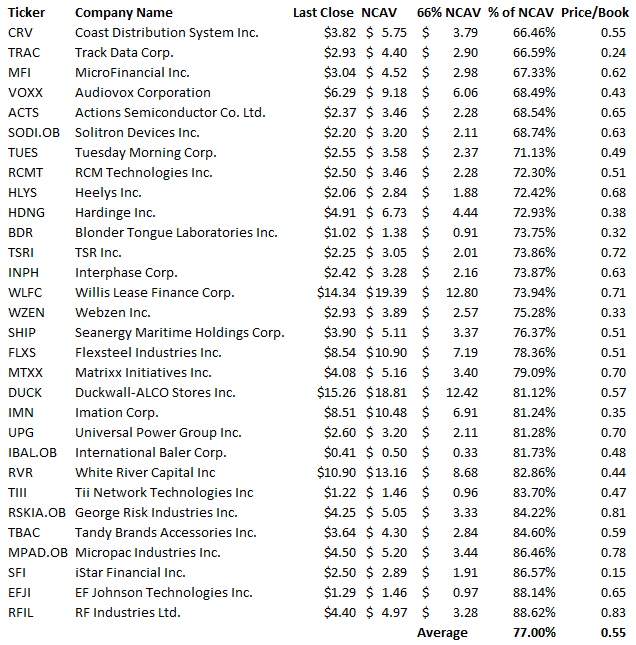
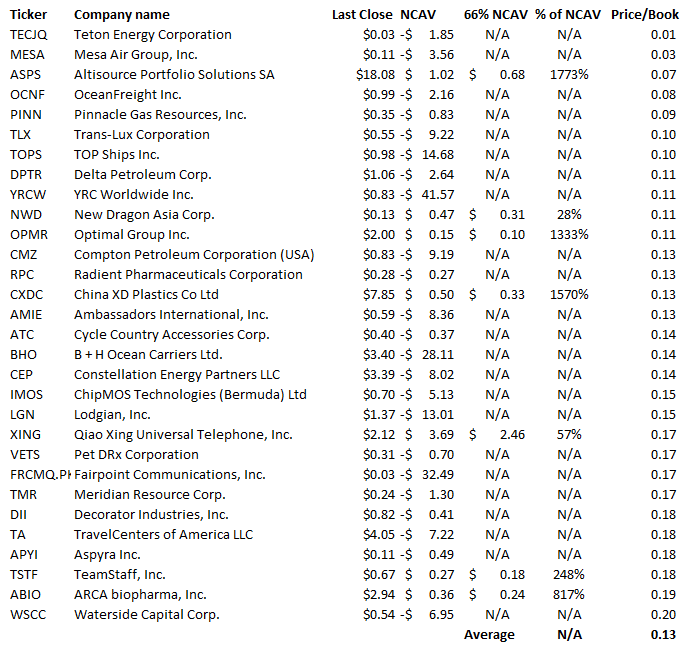
I’m setting up a new experiment for 2009/2010 along the same lines as the 2008/2009 Net Net vs Activist Legend thought experiment pitting a little Graham net net against activist investing legend Carl Icahn (Net Net vs Activist Legend: And the winner is…). This time around I’m pitting a small portfolio of near Graham net nets against a small portfolio of ultra-low price-to-book value stocks. The reason? Near Graham net nets are stocks trading at a small premium to Graham’s two-thirds NCAV cut-off, but still trading at a discount to NCAV. While they are also obviously trading at a discount to book, they will in many cases trade at a higher price-to-book value ratio than a portfolio of stocks selected on the basis of price-to-book only. I’m interested to see which will perform better in 2010. The two portfolios are set out below (each contains 30 stocks). I’ll track the equal-weighted returns of each through the year.

The Near Graham Net Net Portfolio (extracted from the Graham Investor screen):

The Ultra-low Price-to-book Portfolio:

The Ultra-low Price-to-book Portfolio contains a sickly lot from a net current asset value perspective. Most have a negative net current asset value, as their liabilities exceed their current assets. Where that occurs, the proportion of price to NCAV is meaningless, so I’ve just recorded it as “N/A”. The few stocks that do have a positive net current asset value are generally trading a substantial premium to that value, with the exception of NWD and ZING, which qualify as Graham net nets.

While the Net Net vs Activist Legend thought experiment didn’t amount to (ahem) a formal academic study, there are two studies relevant to the outcome in that experiment: Professor Henry Oppenheimer’s Ben Graham’s Net Current Asset Values: A Performance Update, which found “[the] mean return from net current asset stocks for the 13-year period [from 1970 to 1983] was 29.4% per year versus 11.5% per year for the NYSE-AMEX Index.” Also relevant was Hedge Fund Activism, Corporate Governance, and Firm Performance, by Brav, Jiang, Thomas and Partnoy, in which the authors found that the “market reacts favorably to hedge fund activism, as the abnormal return upon announcement of potential activism is in the range of [7%] seven percent, with no return reversal during the subsequent year.”

This experiment is similar to the Net Net vs Activist Legend thought experiment in that it isn’t statistically significant. There are, however, several studies relevant to divining the outcome. In this instance, Professor Oppenheimer’s study speaks to the return on the Near Graham Net Net Portfolio, as Roger Ibbotson’s Decile Portfolios of the New York Stock Exchange, 1967 – 1984 (1986), Werner F.M. DeBondt and Richard H. Thaler’s Further Evidence on Investor Overreaction and Stock Market Seasonality (1987), Josef Lakonishok, Andrei Shleifer, and Robert Vishny’s Contrarian Investment, Extrapolation and Risk (1994) as updated by The Brandes Institute’s Value vs Glamour: A Global Phenomenon (2008) speak to the return on the Ultra-low Price-to-book Portfolio. One wrinkle in that theory is that the low price-to-book value studies only examine the cheapest quintile and decile, where I have taken the cheapest 30 stocks on the Google Finance screener, which is the cheapest decile of the cheapest decile. I expect these stocks to do better than the low price-to-book studies would suggest. That said, I expect that the Near Graham Net Net Portfolio will outperform the Ultra-low Price-to-book Portfolio by a small margin. Let me know which horse you’re getting on and the reason in the comments.

[Full Disclosure:  I hold RCMT and TSRI. This is neither a recommendation to buy or sell any securities. All information provided believed to be reliable and presented for information purposes only. Do your own research before investing in any security.]

Read Full Post »

« Newer Posts - Older Posts »