Feeds:
Posts
Comments

Archive for the ‘Net Cash Stocks’ Category

Although we closed our position in Avigen Inc (NASDAQ:AVGN) earlier this week, we’re keeping a watching brief on the stock. AVGN has now filed with the SEC the terms of the deal with MediciNova Inc (NASDAQ:MNOV), and they’re not as bad as the earlier report seemed to suggest. The deal has, however, attracted the ire of The Pennsylvania Funds, an AVGN shareholder, who has filed a class action lawsuit on behalf of all AVGN stockholders. The stock closed yesterday at $1.28, about $0.01 under our exit price. The terms of deal provide some downside protection and some upside optionality, and so are worth considering in some more detail, although probably not enough of either to persuade us to re-enter the stock. If the lawsuit gains traction and pushes the stock price down, however, AVGN might become attractive again.

About AVGN

We started following AVGN in December last year (see archived posts here) because it was a net cash stock and specialist biotechnology investor Biotechnology Value Fund (BVF) was pushing it to liquidate and return its cash to shareholders. Despite BVF’s failure to remove the board, we continued to maintain our position in AVGN because BVF won a number of important concessions from the board that made AVGN a much more attractive stock than it was when we started following it. We continuted to hold on when AVGN announced that it was back in negotiations with MediciNova, Inc, but closed the position for a 98.5% gain when the initial terms of the deal were announced.

The terms of the deal

The downside protection

Under the terms of the merger agreement AVGN shareholders will have the right to elect to receive an amount currently estimated by AVGN’s board at $1.24 per share in either cash or secured convertible notes to be issued by MNOV. Approximately $1.19 of the consideration will be paid at the closing, and approximately $0.05 will be paid at June 30, 2010. Both payments are subject to certain potential adjustments. The first payment is subject to adjustment based on activities related to the liquidation or sale of certain assets of AVGN in connection with the winding down of its operations prior to closing. The second payment is subject to upward adjustment based on savings in estimated expenses through closing and receipt of certain payments post-closing as well as downward adjustment in the event that closing liabilities exceed estimated liabilities through closing.

The upside optionality

The secured convertible notes will be convertible on the final business day of each month into shares of MNOV common stock at a conversion price of $6.80 per share, which conversion price is based on the volume-weighted average price of MNOV’s common stock as quoted on Nasdaq and the Osaka Securities Exchange over the 20 trading days prior to signing of the merger agreement. The convertible notes will mature on the 18-month anniversary of the closing of the merger, and the indenture governing the notes will include customary events of default and anti-dilution adjustments. Note that the last time MNOV traded above $6.80 was two years ago in August 2007.

The joint press release announcing the terms of the deal is set out below:

MediciNova and Avigen Enter Into Definitive Agreement for Business Combination

SAN DIEGO, Calif., and ALAMEDA, Calif., August 21, 2009 — MediciNova, Inc., a biopharmaceutical company that is publicly traded on the Nasdaq Global Market (Nasdaq:MNOV) and the Hercules Market of the Osaka Securities Exchange (Code Number:4875) and Avigen, Inc. (Nasdaq:AVGN), a biopharmaceutical company, today announced that they have entered into a definitive merger agreement pursuant to which MediciNova’s wholly-owned subsidiary will merge with and into Avigen. Completion of the transaction will permit the combination of the companies’ broad neurological clinical development programs based on ibudilast (Avigen’s AV-411 and MediciNova’s MN-166).

Under the terms of the merger agreement, which has been approved by both companies’ boards of directors, Avigen shareholders will have the right to elect to receive an amount currently estimated at approximately $1.24 per share in either cash or secured convertible notes to be issued by MediciNova. Approximately $1.19 of this consideration will be paid at the closing, and approximately $0.05 will be paid at June 30, 2010. As set forth in the merger agreement, both payments are subject to certain potential adjustments. The first payment is subject to adjustment based on activities related to the liquidation or sale of certain assets of Avigen in connection with the winding down of its operations prior to closing. The second payment is subject to upward adjustment based on savings in estimated expenses through closing and receipt of certain payments post-closing as well as downward adjustment in the event that closing liabilities exceed estimated liabilities through closing.

The secured convertible notes will be convertible on the final business day of each month into shares of MediciNova common stock at a conversion price of $6.80 per share, which conversion price is based on the volume-weighted average price of MediciNova’s common stock as quoted on Nasdaq and the Osaka Securities Exchange over the 20 trading days prior to signing of the merger agreement. The convertible notes will mature on the 18-month anniversary of the closing of the merger, and the indenture governing the notes will include customary events of default and anti-dilution adjustments.

In addition, Avigen’s stockholders will be entitled to one Contingent Payment Right (“CPR”) that will entitle holders under certain circumstances to a pro rata portion of one or more of the following: (1) in the event the first milestone payment of $6.0 million, or approximately $0.20 per share, under Avigen’s 2005 assignment agreement with Genzyme Corporation (“Genzyme Agreement”) is achieved in the 20 months following closing, a cash payment of the proceeds (to the extent such cash is received by MediciNova in the 20 months following closing); (2) in the event the Parkinson’s product reverts to MediciNova under the Genzyme Agreement and is subsequently sold, licensed or otherwise transferred, 50% of the proceeds received in cash in the 20 months following closing; and (3) the amount of money remaining in the plan trust established under Avigen’s management transition plan following termination of such trust. In each case, the payments will be net of any related out-of-pocket costs, damages, fines, penalties and expenses incurred by MediciNova. The CPRs will not be transferable except in limited circumstances.

Yuichi Iwaki, M.D., Ph.D., MediciNova’s President and Chief Executive Officer, said, “We are excited about combining Avigen with MediciNova and believe that it presents a unique opportunity for shareholders of both companies, most notably, the ability to more fully take advantage of the opportunities that the ibudilast compound and analogs provide in a variety of indications and markets.”

“We believe the transaction reduces many of the uncertainties involved with dissolution and is in the best interests of our shareholders,” commented Andrew Sauter, Avigen’s Chief Executive Officer, President and Chief Financial Officer. “In addition, we believe that combining the two companies’ ibudilast programs will enhance the global development potential for the compound that could benefit patients with a range of neurological indications.”

The transaction is expected to close in the fourth quarter of 2009 and is subject to approval of Avigen’s stockholders and approval of MediciNova’s stockholders as well as other customary closing conditions. In addition, the closing is conditioned on the receipt of certain releases from Avigen’s directors (other than John K.A. Prendergast), Kenneth Chahine, Kirk Johnson and Andrew A. Sauter.

RBC Capital Markets Corporation is acting as financial advisor to Avigen and Cooley Godward Kronish LLP is serving as its legal counsel. Ladenburg Thalmann & Co. Inc. (NYSE Amex: LTS) is acting as financial advisor to MediciNova, Euclidean Life Science Advisors is acting as its business advisor and Dechert LLP is serving as its legal counsel.

The AVGN press release disclosing the law suit is set out below:

On August 25, 2009, The Pennsylvania Funds filed a class action lawsuit in the Superior Court of the State of California, County of Alameda, purportedly on behalf of the stockholders of Avigen, Inc., against Avigen and its directors, alleging that Avigen’s directors breached their fiduciary duties to the stockholders of Avigen in connection with the proposed acquisition of Avigen by MediciNova, Inc. The complaint seeks to enjoin the defendants from completing the acquisition as currently contemplated.

Avigen and its directors intend to take all appropriate actions to defend the suit.

It is possible that additional similar complaints may be filed in the future. If this does occur, Avigen does not intend to announce the filing of any similar complaints unless they contain allegations that are substantially distinct from those made in the pending action.

Conclusion

With the terms of the deal announced by AVGN, we’re still happy to be out of the stock. The downside protection is subject to various adjustments, and the upside is wholly dependent on the performance of MNOV’s stock over $6.80, which is higher than the stock has traded since 2007. That said, it’s worth watching to the see the effect of the class action on the stock price, because there is a price at which the stock again becomes attractive.

Hat tip GR.

[Full Disclosure: We do not have a holding in AVGN. This is neither a recommendation to buy or sell any securities. All information provided believed to be reliable and presented for information purposes only. Do your own research before investing in any security.]
Read Full Post »

MediciNova Inc. (NASDAQ:MNOV) will acquire Avigen Inc (NASDAQ:AVGN) for $1.24 per share in cash or secured convertible notes. While the stock is trading at a slight premium to the bid, we’re taking the opportunity to exit. AVGN closed Friday at $1.29, which means we’re up 98.5% on an absolute basis. The S&P500 was at 816.21 when we opened the position, and closed Friday at 1,026.13, which means we’re up 72.7% on a relative basis.

Post mortem

We started following AVGN in December last year (see archived posts here) because it was a net cash stock and specialist biotechnology investor Biotechnology Value Fund (BVF) was pushing it to liquidate and return its cash to shareholders. Despite BVF’s failure to remove the board, we continued to maintain our position in AVGN because BVF won a number of important concessions from the board that made AVGN a much more attractive stock than it was when we started following it. We continuted to hold on when AVGN announced that it was back in negotiations with MediciNova, Inc. The consideration for the deal was announced as AVGN’s “net cash liquidation value plus $3 million” and “a contingent payment right for a specific product program milestone payment associated with Avigen’s Assignment Agreement with Genzyme Corporation, potentially subject to certain adjustments.” That seems tono longer be the case. The deal announced Friday calls for a payment of around $1.19 a share when the deal closes, with approximately $0.05 per share to be paid on June 30, 2010. This is a disappointing deal. AVGN has been sold for its net cash liquidation value plus $3M from MediciNova. We held on because we believed that there was a reasonable chance that AVGN could yield more than its then $1.34 share price when the “contingent payment right” capturing the near term payments from Genzyme was taken into account. MNOV has not provided AVGN shareholders with any value for AVGN’s AV411 assets and program.

Here is the press release announcing the sale (via MarketWatch):

MediciNova To Acquire Avigen For $1.24 a Share

William L. Watts

MarketWatch Pulse

LONDON — Biopharmaceutical firm MediciNova Inc. will acquire Avigen Inc. for $1.24 a share in cash or secured convertible notes, under an agreement announced Friday by the biopharmaceutical firms. Under the deal, around $1.19 a share will be paid when the deal closes, with approximately 5 cents a share to be paid on June 30, 2010. The transaction is expected to close in the fourth quarter, pending the approval of Avigen and MediciNova stockholders and other considerations. The companies said the merger will allow them to combine their neurological clinical development programs based on ibudilast, an anti-inflammatory drug.

[Full Disclosure: We have a holding in AVGN. This is neither a recommendation to buy or sell any securities. All information provided believed to be reliable and presented for information purposes only. Do your own research before investing in any security.]

Read Full Post »

Spencer Capital has filed preliminary proxy documents to remove the board of VaxGen Inc (OTC:VXGN). In the documents, Spencer Capital, which leads a group of investors calling themselves “Value Investors for Change,” call out VXGN’s board on its “track record of failure and exorbitant cash compensation”:

VaxGen does not have any operations, other than preparing public reports. The Company has three employees, including the part-time principal executive officer and director, and four non-employee directors. Since the Company’s failed merger with Raven Biotechnologies, Inc. in March 2008, the Board has publicly disclosed that it would either pursue a strategic transaction or a series of strategic transactions or dissolve the Company. The Company has done neither. In the meantime, members of the Board have treated themselves to exorbitant cash compensation. Until July 2009, two non-employee members of the Board were paid over $300,000 per year in compensation. The principal executive officer will likely receive over $400,000 in cash compensation this year.

We’ve been following VXGN (see our post archive here) because it is trading at a substantial discount to its net cash position, has ended its cash-burning product development activities and is “seeking to maximize the value of its remaining assets through a strategic transaction or series of strategic transactions.” Management has said that, if the company is unable to identify and complete an alternate strategic transaction, it proposes to liquidate. One concern of ours has been a lawsuit against VXGN by its landlords, in which they sought $22.4M. That lawsuit was dismissed in May, so the path for VXGN to liquidate has now hopefully cleared. The board has, however, been dragging its feet on the liquidation. Given their relatively high compensation and almost non-existent shareholding, it’s not hard to see why.

VXGN has now also attracted the attention of BA Value Investors, which has disclosed an activist holding and called on VXGN to “act promptly to reduce the size of the board to three directors; reduce director compensation; change to a smaller audit firm; terminate the lease of its facilities; otherwise cut costs; make an immediate $10 million distribution to shareholders; make a subsequent distribution of substantially all the remaining cash after settling the lease termination; distribute any royalty income to shareholders; and explore ways to monetize the public company value of the Issuer and use of its net operating losses.”

VXGN is up 25.0% since we initiated the position. At its $0.60 close yesterday, it has a market capitalization of $19.9M. We last estimated the company’s liquidation value to be around $25.4M or $0.77 per share. VXGN has other potentially valuable assets, including a “state-of-the-art biopharmaceutical manufacturing facility with a 1,000-liter bioreactor that can be used to make cell culture or microbial biologic products” and rights to specified percentages of future net sales relating to its anthrax vaccine product candidate and related technology. The authors of a letter sent to the board on July 14 of this year ajudge VXGN’s liquidation value to be significantly higher at $2.12 per share:

Excluding the lease obligations, the net financial assets alone of $37.2 million equate to $1.12 per share. The EBS royalties (assuming a 6% royalty rate and a $500 million contract as contemplated by NIH/HHS and EBS) of $30 million and milestones of $6 million total $36 million of potential additional future value (based clearly on assumptions, none of which are assured), or $1.09 per share. Adding $1.12 and $1.09 equals $2.21 per share.

Spencer Capital’s proxy solicitation is a welcome relief, and, with any luck, we will see a liquidation of VXGN soon, either at the hands of the present board, or by Value Investors for Change.

The preliminary proxy statement sets out the Value Investors for Change group’s “Reasons for the solicition” thus:

Even though VaxGen does not have substantial operations, Value Investors for Change believes that the Company has valuable assets, consisting of cash and net operating loss carryforwards (“NOLs”). We believe these assets should be unlocked for the benefit of shareholders, rather than consumed over time by the current Board.

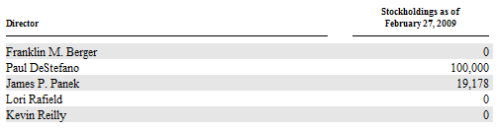
We do not believe the members of the current Board are acting in the best interests of stockholders. Since the Company’s failed merger with Raven Biotechnologies, Inc. in March 2008, the Board has publicly disclosed that it would either pursue a strategic transaction or a series of strategic transactions or dissolve the Company. The Company has done neither. Instead, the Board has overseen the consumption of a large portion of the Company’s assets while paying itself exorbitant compensation. In addition, the Board’s interests are not aligned with the stockholders, as displayed by their miniscule equity stake in the Company.

Consumption of Assets

Since discontinuing its operations, the Company has consumed a significant amount of assets. According to its most recent quarterly report on Form 10-Q, since June 30, 2008, the Company’s assets have decreased by $31.7 million, or 45%. Since December 31, 2008, the Company’s assets have decreased by over $3.5 million, or 8.4%.

In addition, the Company recorded $3.6 million in general and administrative expenses during the six month period ended June 30, 2009. Much of this expense consisted of cash compensation to the Board.

Exorbitant Board Compensation

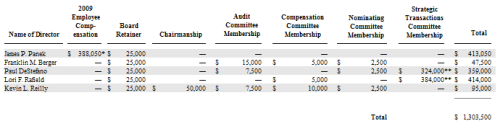
Despite the relatively simple task of overseeing a shell company and conducting an ordinary sale process, the Board has paid itself inordinately high compensation. The table below describes the principal executive officer’s 2009 cash compensation and the director cash compensation scheme for the VaxGen Board, as described in the Company’s 2008 annual report on Form 10-K:

VXGN Board Compensation 1

(This table has been modified from the original to fit this space)

* Consists of $195,000 annual base salary for 25 hours per week employment and a $193,050 lump sum payment. The lump sum payment was approved by the Board in consideration for Mr. Panek’s agreement not to resign for “good reason” under his employment agreement.

** VaxGen announced in its quarterly report for the period ended June 30, 2009 that, effective September 1, 2009, it had disbanded the Strategic Transactions Committee and that, following its disbandment, Board members would no longer receive additional compensation for service thereon.

While it is difficult to envision the rationale for the high cash compensation awarded to the Chairman Kevin Reilly and Franklin Berger, the most excessive portion of the director compensation consisted of the payments to the non-employee members of the Strategic Transactions Committee. Beginning in May 2008, Board members Lori F. Rafield and Paul DeStefano received $20,000 per month and $15,000 per month, respectively, for service on the Strategic Transactions Committee, which was formed to identify, review and evaluate potential strategic transactions and alternatives. Within a few months, these directors increased their compensation to $32,000 and $27,000 per month, respectively. This compensation is extraordinarily excessive.

Insignificant Board Equity Ownership

The members of the Board hold very few shares of the Company’s common stock. Most of the Board’s beneficial ownership holdings consist of underwater stock options. The following table describes the stockholdings of the Board, as set forth in the 2008 annual report, excluding options.

VXGN Board Compensation 2This Board has failed to take the steps we believe are necessary to preserve and enhance stockholder value. We believe the actions taken by the Board indicate that they are more interested in acting in their own self-interest rather than in the best interests of stockholders.
Value Investors for Change urges you to vote FOR the Fund’s proposal to elect the Nominees on the enclosed WHITE proxy card, thereby ending this disregard for stockholder interests. Vote to elect a new slate of directors who are willing to stand up for the interests of all stockholders and work to maximize stockholder value.

The members of the Board hold very few shares of the Company’s common stock. Most of the Board’s beneficial ownership holdings consist of underwater stock options. The following table describes the stockholdings of the Board, as set forth in the 2008 annual report, excluding options.

Hat tip bellamyj and matt.jensen08.

[Full Disclosure:  We have a holding in VXGN. This is neither a recommendation to buy or sell any securities. All information provided believed to be reliable and presented for information purposes only. Do your own research before investing in any security.]

Read Full Post »

Axcelis Technologies Inc (NASDAQ:ACLS) has filed its 10Q for the period ended June 30, 2009.

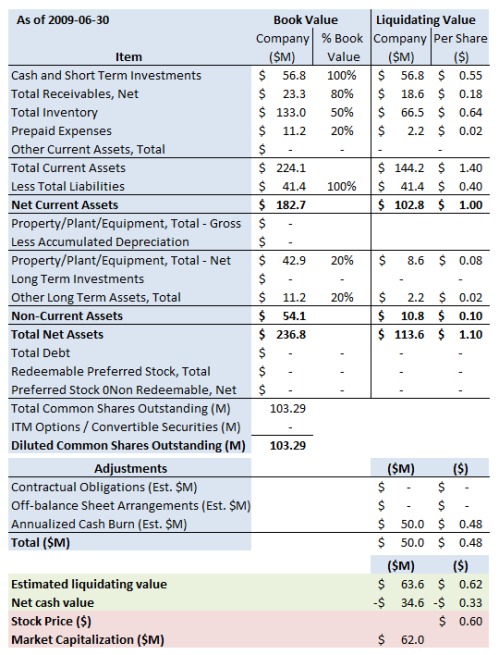
We started following ACLS on January 8 this year (see our post archive here) because it is an undervalued asset play with an activist investor, Sterling Capital Management, holding 10.7% of its outstanding stock. ACLS has completed the sale of its 50% interest in SEN Corporation, its joint venture with Sumitomo Heavy Industries, Ltd. (SHI) to SHI for proceeds of $122.3 million. ACLS received around $35.9M in cash after applying $86.4M of the proceeds to meet obligations to the holders of the company’s 4.25% Convertible Senior Subordinated Notes, upon which ACLS defaulted in January. We last estimated ACLS’s liquidation value at around $117.8M or $1.14 per share. Following our review of the 10Q, we’ve reduced our estimate to $113.6M or $1.10, which is around 80% higher than its $0.60 close yesterday. Cash burn is a significant issue for ACLS. At the current rate of cash burn, we estimate the company has around six months before its liquidation value meets its current price, and around a year before it’s worthless.

The value proposition updated

During the three months ended June 30, 2009, ACLS continued to burn cash in its operations, which it attributes to the depressed semiconductor equipment market and the resultant decline in revenues. Cash and cash equivalents at June 30, 2009 were $56.8M, compared to $71.2M at March 31, 2009. The company attributes the $21.4M decrease in cash and cash equivalents to the cash used in operations and payments of fees and other costs associated with the sale of the investment in SEN. The company anticipates net cash outflows from operations in the remainder of 2009. Set out below is our adjusted balance sheet for ACLS (the “Book Value” column shows the assets as they are carried in the financial statements, and the “Liquidating Value” column shows our estimate of the value of the assets in a liquidation):

ACLS Summary 2009 6 30

We’ve been quite kind to ACLS by assuming only $50M of cash burn over the next twelve months. On its current form, $80M would have been closer to the mark. We’re assuming management takes some action to staunch the flow, but an assumptions like that might make us look like fools.

Conclusion

ACLS has made substantial operating losses over the last two years, and it is likely to be continue to do so. While its liquidation value of around $113.6M or $1.10 per share is more than 80% higher than its close yesterday of $0.60, it is likely to deteriorate while it continues its operating losses. ACLS continues to be our problem child, and we don’t think there is any good news on the horizon near-term, but we find it difficult to exit the position while it’s trading at a such a large discount to its (albeit deteriorating) liquidation value. Accordingly, we’re going to hold on for the moment, and see how the position plays out. If we get an opportunity to exit at close to value, however, we’ll take it. If the position hasn’t improved by the next Q, we’re likely sellers.

[Full Disclosure:  We have a holding in ACLS. This is neither a recommendation to buy or sell any securities. All information provided believed to be reliable and presented for information purposes only. Do your own research before investing in any security.]

Read Full Post »

Avigen Inc (NASDAQ:AVGN) has filed its 10Q for the period ended June 30, 2009.

One interesting aspect of the 10Q is the cost the company attributes to responding to the proxy fight and hostile tender offer:

Operating Activities. Net cash used in operating activities was $8.2 million during the six months ended June 30, 2009. Net cash used in operating activities during this period was primarily used to fund costs associated with our response to a proxy fight and hostile tender offer, and winding down clinical research and development activities, including non-clinical studies and clinical trials performed by third parties.

$8.2M? That’s $0.27 per share! Granted, some of it went to other activities, but presumably costs associated with “response to a proxy fight and hostile tender offer” was the larger portion of the $8.2M and that’s why it was listed first. It’s galling what directors are allowed to spend fighting off shareholders.

We started following AVGN in December last year (see archived posts here) because it was a net cash stock and specialist biotechnology investor Biotechnology Value Fund (BVF) was pushing it to liquidate and return its cash to shareholders. Despite BVF’s failure to remove the board, we continued to maintain our position in AVGN because BVF won a number of important concessions from the board that made AVGN a much more attractive stock than it was when we started following it. AVGN is now back in negotiations with MediciNova, Inc. regarding a proposed acquisition by MediciNova. The consideration for the deal is AVGN’s “net cash liquidation value plus $3 million” and “a contingent payment right for a specific product program milestone payment associated with Avigen’s Assignment Agreement with Genzyme Corporation, potentially subject to certain adjustments.” The stock price reflects this: AVGN closed yesterday at $1.34, up 106.2% from our $0.65 purchase price. We last estimated the net cash liquidation value at around $34M or $1.14 per share. We’ve now updated our estimate to $35M or $1.17 per share. Including the $3M from MediciNova would increase that value to around $38M or $1.27per share. We believe that there is a reasonable chance that AVGN will yield more than its current $1.34 share price when the “contingent payment right” capturing the near term payments from Genzyme is taken into account. AVGN shareholders also have an option-like exposure to any value in AVGN’s AV411 assets and program, although we cannot estimate the value of this with any certainty.

The value proposition updated

Set out below is our adjusted balance sheet for AVGN (the “Book Value” column shows the assets as they are carried in the financial statements, and the “Liquidating Value” column shows our estimate of the value of the assets in a liquidation):

AVGN Summary 2009 6 30

Conclusion

While BVF’s slate was unsuccessful at the special meeting, AVGN’s board has developed its own plan of liquidation, which should put a floor on AVGN’s stock at around its net cash value of $34M or $1.14 per share less wind down costs. There exists a good chance that AVGN will yield considerably more than its net cash value. The net cash estimate does not take into account AVGN’s AV411 assets and program or near term payments from Genzyme. With the downside protected, and a good chance at some upside from here, we think AVGN still represents good value, and we’re going to maintain our position accordingly.

[Full Disclosure: We have a holding in AVGN. This is neither a recommendation to buy or sell any securities. All information provided believed to be reliable and presented for information purposes only. Do your own research before investing in any security.]

Read Full Post »

Steel Partners has increased its holding in CoSine Communications Inc (OTC:COSN) from 44.9% to 47.5% at an average purchase price of $1.97 per share according to the fund’s most recent 13D notice.

We’ve been following COSN (see our COSN post archive) because it is a cash box controlled by activist investor Steel Partners. Steel Partners own 47.5% of the stock and sits on the board. The stock is up 16% since our initial post to close Friday at $2.03. We estimate the net cash value to be around $22.2M or $2.20 per share. The net cash value has remained stable through 2006, 2007, 2008 and 2009. COSN presents an opportunity to invest alongside Steel Partners at a discount to net cash in a company with substantial NOLs.

Hat tip FF.

[Full Disclosure:  We do not have a holding in COSN. This is neither a recommendation to buy or sell any securities. All information provided believed to be reliable and presented for information purposes only. Do your own research before investing in any security.]

Read Full Post »

OrthoLogic Corporation (NASDAQ:CAPS) has filed its 10Q for the quarter ended June 30, 2008.

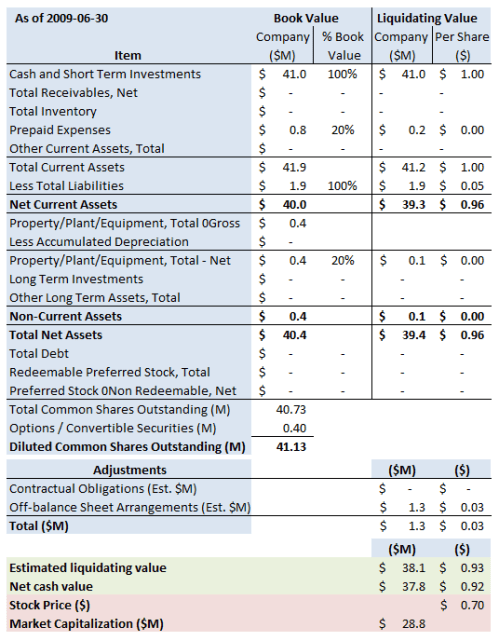
We’ve been following CAPS (see our post archive here) because it trades below its net cash value and Biotechnology Value Fund (BVF) has a 13.42% holding. It’s an unusual holding for us because BVF’s holding is passive. CAPS is a development stage company that is spending its cash on the development and commercialization of two product platforms: AZX100 and Chrysalin® (TP508). Ordinarily, we wouldn’t touch a position like this with a ten-foot pole. We entered into it because we’ve had some success in the past with BVF, particularly with our AVGN position. As BVF’s holding in CAPS is passive, BVF seems to be punting on the return from the product platforms and doesn’t view this as a liquidation play. We’ve got no insight into the value of those product platform assets, so our holding in CAPS is tenuous. We’ll exit if the share price gets near the net cash value, or the cash burn reduces the net cash value to the share price. At CAPS’s $0.70 close yesterday, our position is up 16.7% since we initiated it. We last estimated CAPS’s net cash value at $43.8M or $1.07 per share. We’ve now adjusted that valuation to down $37.8 or $0.92 per share. At the current cash burn rate, we estimate that CAPS has six months before the cash burn reduces the net cash value to around the current share price.

The value proposition updated

The summary of our estimate for the company’s liquidation value is set out below (the “Book Value” column shows the assets as they are carried in the financial statements, and the “Liquidating Value” column shows our estimate of the value of the assets in a liquidation):

CAPS Summary 2009 06 30Off-balance sheet arrangements and Contractual obligations
There is no discussion in the 10K about CAPS’s off-balance sheet arrangements. CAPS’s only contractual obligation disclosed in 10K is for the company’s Tempe, Arizona facility and is $1.3M through 2012.

Conclusion

At its $0.70 close Friday, CAPS is trading at 76% of our estimate of its $0.92 per share net cash value.  We’ll exit if the share price gets near the net cash value, or the cash burn reduces the net cash value to the share price. At the current cash burn rate, we estimate that CAPS has six months before the cash burn reduces the net cash value to around the current share price.

[Full Disclosure:  We do not have a holding in CAPS. This is neither a recommendation to buy or sell any securities. All information provided believed to be reliable and presented for information purposes only. Do your own research before investing in any security.]

Read Full Post »

Soapstone Networks Inc (NASDAQ:SOAP) has announced the sale of its software assets to Extreme Networks, Inc. (NASDAQ: EXTR). The sale price was not disclosed in the announcement, but may have been less than $5M.

We opened the position in SOAP on February 2nd (see our post archive here) because it was trading well below our estimate of its net cash value. An activist investor, Mithras Capital, had disclosed an 8.7% holding and called on the company to liquidate. After some urging on Mithras Capital’s part, management acceded to the request and announced a liquidation. SOAP stockholders approved the liquidation of the company on July 28 and received a special dividend of $3.75 per share the next day. Based on our $2.50 purchase price, the $3.75 per share special dividend returned our initial capital plus 50%. At yesterday’s close, the $0.46 stub represents an additional 18% on our initial purchase price for a total return to date of 68%. Management estimates the final distribution will be between $0.25 and $0.75 per share, which means the stub is trading under the $0.50 midpoint of the distribution range.

As we demonstrated in an earlier post, Valuing the SOAP stub, determining the proceeds from the asset sale is key in estimating the final pay out figure. Two categories account for the majority (80%) of the difference between the upper and lower estimates of the final distribution:

  1. Real Estate and Equipment Lease termination costs: The lower bound of the range is -$5.4M and the upper bound is -$1.6M, which is a difference of around $3.8M or $0.25 per share.
  2. Proceeds from the sale of Assets: The lower bound of the range is $0.1M and the upper bound is $2.3M, which is a difference of around $2.2M or $0.14 per share.

If the sale price is in fact closer to $5m, SOAP management seems to have significantly underestimated the range for Proceeds from the sale of Assets. At its close yesterday of $0.46, the SOAP stub might become an attractive investment opportunity if we can get some certainty around the actual figure for the proceeds from the sale of the software assets.

The press release is set out below (via CNNMoney):

Extreme Networks Acquires Soapstone Networks Provisioning and Service Assurance Software

Purchase of Ethernet Service Aware Software and Control Plane Underscores Focus on Simplification of Carrier Ethernet Deployments

August 10, 2009: 08:00 AM ET

Extreme Networks, Inc. (NASDAQ: EXTR) today announced the purchase of the software assets of Soapstone Networks, Inc (PINKSHEETS: SOAP). The Soapstone Networks software serves as a foundation for provisioning and service assurance for carrier Ethernet networks.

The transaction transfers ownership of the Soapstone Networks software control plane and service aware provisioning system to Extreme Networks®, enabling Extreme Networks to simplify the service provider’s job of provisioning and maintaining Ethernet services for their subscribers.

“The addition of the software assets from Soapstone Networks into the Extreme Networks intellectual property portfolio continues our commitment to carrier Ethernet,” said Glenn Weinberg, Vice President and General Manager, Extreme Networks Software Business Unit. “The unique provisioning and service aware capabilities of the Soapstone Networks software will enable Extreme Networks to deliver a more complete, extensible solution to carrier Ethernet service providers.”

The Soapstone Networks software will be integrated into the Extreme Networks EPICenter® Network Management System, providing a service level view, provisioning and management of carrier Ethernet networks and protocols including Provider Bridging (PB), Provider Backbone Bridging (PBB), Provider Backbone Bridging with Traffic Engineering (PBB-TE), Ethernet Access Protection Switching (EAPS) and Virtual Private Line (VPLS).

Hat tip JM.

[Full Disclosure:  We have a holding in SOAP. This is neither a recommendation to buy or sell any securities. All information provided believed to be reliable and presented for information purposes only. Do your own research before investing in any security.]

Read Full Post »

Forward Industries Inc (NASDAQ:FORD) has filed its quarterly report for the period ended June 30, 2009.

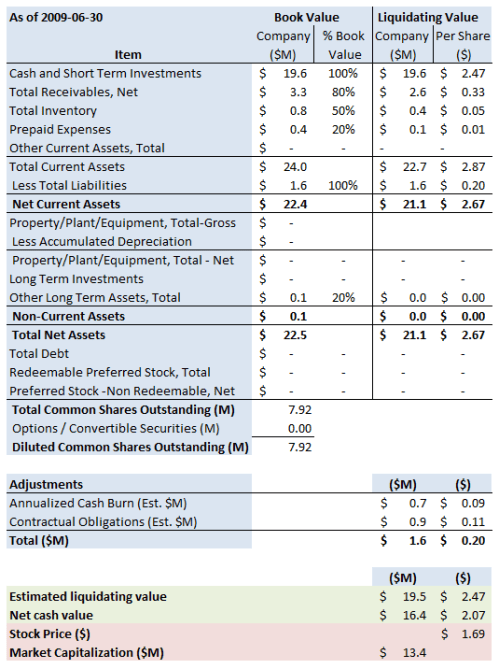
We started following FORD (see our post archive here) because it was trading at a discount to its net cash and liquidation values, although there was no obvious catalyst. Management appeared to be considering a “strategic transaction” of some kind, which might have included an “acquisition or some other combination.” Trinad Management had an activist position in the stock, but had been selling at the time we opened the position and only one stockholder owned more than 5% of the stock. The stock is up 17.4% since we opened the position to close yesterday at $1.69, giving the company a market capitalization of $13.4M. Following our review of the most recent 10Q, we’ve slightly reduced our estimate of the liquidation value to $19.5M or $2.47 per share.

The value proposition updated

FORD continues to face difficult trading conditions, writing in the most recent 10Q:

Trends and Economic Environment: We believe that the deteriorating economic conditions, rising unemployment, tight credit markets, and heightened uncertainty in financial markets during the past 18 months have adversely impacted discretionary consumer spending, including spending on the types of electronic devices that are accessorized by our products. We expect this challenging business environment to continue in the foreseeable future.

The company had a slightly better quarter than the preceding one, but still burned through nearly $0.3M of cash (the “Book Value” column shows the assets as they are carried in the financial statements, and the “Liquidating Value” column shows our estimate of the value of the assets in a liquidation):

FORD Summary 2009 06 30

Summary balance sheet adjustments

We’ve made the following adjustments to the balance sheet estimates (included in the valuation above):

  • Cash burn: We’ve got no real idea about FORD’s prospects. Its cash burn over the last quarter was around $0.3M. That was made up of $0.2M of cash used in operations and $0.1M cash used in investment activities. If we assume, as management has, that the company will face a similarly tough operating environment over the next 12 months, we estimate cash burn of around $0.7M.
  • Off-balance sheet arrangements: According to FORD’s most recent 10Q, it has no off-balance sheet arrangements.
  • Contractual obligations: FORD’s contractual obligations are minimal, totalling $0.9M.

Possible catalysts

FORD’s President and Acting Chairman, Mr. Doug Sabra, said in the letter to FORD shareholders accompanying the notice of annual shareholders’ meeting, that in 2008 “management began to implement operational and strategic initiatives in order to put [FORD]’s business on a stronger, more sustainable footing. …  This past August we retained an outside consultant to assist us in vetting possible partners for a strategic transaction.” It seems that the “strategic transaction” might include a “possible acquisition or other combination that makes sense in the context of [FORD’s] existing business, without jeopardizing the strong financial position that we have worked so hard to build.” FORD’s focus on a “strategic transaction” is a positive, in our view, although our vast preference is for a sale of the company, buyback, special dividend or return of capital over an acquisition.

Any transaction will require the consent of FORD’s board. While it has a free float of around 92%, the company’s so-called “Anti-takeover Provisions” authorize the board to issue up to 4M shares of “blank check” preferred stock. From the 10Q:

The Board of Directors has the authority and discretion, without shareholder approval, to issue preferred stock in one or more series for any consideration it deems appropriate, and to fix the relative rights and preferences thereof including their redemption, dividend and conversion rights.

Conclusion

At its $1.69 close Friday, FORD is trading at a substantial 46% discount to its $2.47 per share liquidation value and $2.07 per share net cash value. While there’s no obvious catalyst in the stock at this stage, management’s consideration of a “strategic transaction” is a positive. The risk to this position is management spending the cash on an acquisition. We think a far better use of the company’s cash is a buyback, special dividend or return of capital. Another concern is Trinad Management exiting its activist position in the stock. Those concerns aside, we’re going to maintain our position because still looks cheap at a discount to net cash.

[Full Disclosure:  We have a holding in FORD. This is neither a recommendation to buy or sell any securities. All information provided believed to be reliable and presented for information purposes only. Do your own research before investing in any security.]

Read Full Post »

CoSine Communications Inc (OTC:COSN) is an interesting little pink sheet play: a cash box controlled by activist investor Steel Partners. Steel Partners, whose holdings we recently covered in the Catalyst Investment Research on Steel Partners II Investment Portfolio post, owns 44.9% of the stock and sits on the board. At its $1.75 close yesterday, COSN’s market capitalization is just $17.7M. We estimate the net cash value to be around 26% higher at $22.2M or $2.20 per share. The net cash value has remained stable through 2006, 2007, 2008 and 2009, while the stock has halved from $3.50 to $1.75 for no fundamental reason that we can identify. Usually a discount like that wouldn’t get us excited, but this is not a liquidation play. COSN is an acquisition play with Steel Partners in the driver’s seat (the company also has substantial NOLs). We’re adding it to the Greenbackd Portfolio for those reasons.

About COSN

From the most recent 10Q:

[COSN] was incorporated in California on April 14, 1997 and in August 2000 was reincorporated in the State of Delaware. Our current business strategy is to enhance stockholder value by pursuing opportunities to redeploy our assets through an acquisition of one or more operating businesses with existing or prospective taxable earnings that can be offset by use of our net operating loss carry-forwards (“NOLs”). No assurance can be given that we will find suitable candidates, and if we do, that we will be able to utilize our existing NOLs.

We were a provider of carrier network equipment products and services until the fourth quarter of fiscal year 2004 during which time we discontinued our product lines, took actions to lay off most of our employees, terminated contract manufacturing arrangements, contractor and consulting arrangements and various facility leases, and sold, scrapped or wrote-off our inventory, property and equipment. In July 2005, our board of directors approved our strategy of redeploying our existing resources to identify and acquire new business operations. In 2006, we sold the remaining assets of our carrier network products business with the sale of our patent portfolio and the rights to the related intellectual property. During 2006, we also completed the wrap-up of our carrier services business, providing customer support services for our discontinued products through December 31, 2006, at which time we terminated all customer support offerings. Effective July 1, 2007, we engaged SP Corporate Services LLC to provide all of our executive, financial and administrative support service, rent and personnel requirements and, as a result, we no longer have any employees.

The value proposition

The valuation on COSN is straight-forward: It has around $23m in cash and short-term investments, $0.2M in liabilities and 10.1M shares outstanding. We’ve set out the valuation below in the usual manner (the “Book Value” column shows the assets as they are carried in the financial statements, and the “Liquidating Value” column shows our estimate of the value of the assets in a liquidation):

COSN Summary 2009 03 31

Balance sheet adjustments

We’ve made the following adjustments to the balance sheet estimates above:

  • Cash burn: The company used $0.1M in cash in the second quarter, which we’ve annualized to $0.6M. $0.6M might be too conservative.
  • Off-balance sheet arrangements and contractual obligations: According to COSN’s 10Q, it has no off-balance sheet arrangements.

NOLS

A quick primer on net operating loss carry-forwards (“NOLs”) from the most recent 10K:

NOLs may be carried forward to offset federal and state taxable income in future years and eliminate income taxes otherwise payable on such taxable income, subject to certain adjustments. Based on current federal corporate income tax rates, our NOLs and other carry-forwards could provide a benefit to us, if fully utilized, of significant future tax savings. However, our ability to use these tax benefits in future years will depend upon the amount of our otherwise taxable income. If we do not have sufficient taxable income in future years to use the tax benefits before they expire, we will lose the benefit of these NOLs permanently. Consequently, our ability to use the tax benefits associated with our substantial NOLs will depend significantly on our success in identifying suitable acquisition candidates, and once identified, successfully consummating an acquisition of these candidates.

Additionally, if we underwent an ownership change, the NOLs would be subject to an annual limit on the amount of the taxable income that may be offset by our NOLs generated prior to the ownership change. If an ownership change were to occur, we may be unable to use a significant portion of our NOLs to offset taxable income. In general, an ownership change occurs when, as of any testing date, the aggregate of the increase in percentage points is more than 50 percentage points of the total amount of a corporation’s stock owned by “5-percent stockholders,” within the meaning of the NOLs limitations, whose percentage ownership of the stock has increased as of such date over the lowest percentage of the stock owned by each such “5-percent stockholder” at any time during the three-year period preceding such date. In general, persons who own 5% or more of a corporation’s stock are “5-percent stockholders,” and all other persons who own less than 5% of a corporation’s stock are treated, together, as a single, public group “5-percent stockholder,” regardless of whether they own an aggregate of 5% of a corporation’s stock.

The amount of NOLs that we have claimed has not been audited or otherwise validated by the U.S. Internal Revenue Service (“IRS”). The IRS could challenge our calculation of the amount of our NOLs or our determinations as to when a prior change in ownership occurred and other provisions of the Internal Revenue Code may limit our ability to carry forward our NOLs to offset taxable income in future years. If the IRS was successful with respect to any such challenge, the potential tax benefit of the NOLs to us could be substantially reduced.

According to the 10K, as of December 31, 2008, COSN had federal NOLs of approximately $353M, which begin to expire in 2018 if not utilized and state NOLs of approximately $213M, which will begin to expire in 2009 if not utilized. The NOLs have a substantial value as a tax shield should COSN acquire a business with taxable earnings, but assessing that value is beyond us.

Catalyst

Steel Partners’ most recent 13D filing sets out its 44.9% holding. Steel Partners’ strategy is to use COSN’s cash to acquire a business with taxable earnings that can be offset by the NOLs. From the 10Q:

Redeployment Strategy and Liquidity

In July 2005, after a comprehensive review of strategic alternatives, our board of directors approved a strategy to redeploy our existing resources to identify and acquire one or more new business operations with existing or prospective taxable earnings that can be offset by use of our NOLs.

Ordinarly, we would prefer a return of cash to the acquisition of a business. This situation is different from the usual case because Steel Partners’ business is investment, and so we think the risk that they might make a bad investment is low. That said, there’s no assurance that they will find a suitable candidate, or if they do, that COSN will be able to use the NOLs.

Conclusion

COSN presents an opportunity to invest alongside Steel Partners at a 26% discount to net cash in a company with substantial NOLs. We think it’s too good to pass up, so we’re adding it to the Greenbackd Portfolio. The stock is very thinly traded, so take care getting set.

COSN closed yesterday at $1.75.

The S&P500 closed yesterday at 997.08.

[Full Disclosure:  We do not have a holding in COSN. This is neither a recommendation to buy or sell any securities. All information provided believed to be reliable and presented for information purposes only. Do your own research before investing in any security.]

Hat tip FF.

Read Full Post »

« Newer Posts - Older Posts »