Feeds:
Posts
Comments

Archive for the ‘Greenbackd Portfolio’ Category

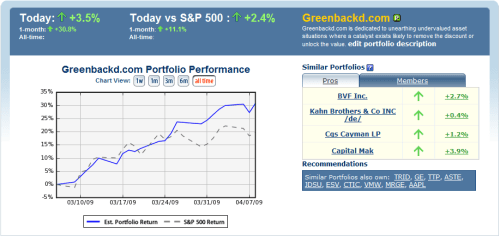
We’ve been tracking our performance using Tickerspy. You can see our up-to-date portfolio and performance here (You’ll need to set up an account with Tickerspy, which is free). We’re providing the link to the Tickerspy account so that you don’t need to wait for our quarterly report to see how the Greenbackd Portfolio is performing. For those who don’t want to set up a Tickerspy account, here’s a screen grab showing our performance since we opened our account on March 6, 2009 through April 8, 2009 (The usual caveat applies: one month is too short a period of time to determine whether Greenbackd’s strategy is working.):

tickerspy

We’re using Tickerspy because it tracks the performance of each stock in the portfolio and the portfolio performance against the S&P500 and automatically updates it all on a daily basis. It’s almost there, but Tickerspy is not entirely satisfactory. Ideally, we’d like a widget for the site that does all of this and doesn’t require our readers to open an account. We haven’t found anything like that yet. Does anyone have any suggestions for a service like this? If so, please drop us a line at greenbackd [at] gmail [dot] com or leave a comment below.

Read Full Post »

Rackable Systems Inc (NASDAQ:RACK) is a new undervalued asset play with a plan to repurchase almost 40% of its stock at current prices. At RACK’s $3.56 closing price yesterday, the company has a market capitalization of $106.4M. We estimate the company’s liquidation value to be 60% higher at $170.3M or $5.74 per share. If the buy back is completed at the current stock price, the company’s per share liquidation value will increase by almost 25% to $7.00. We’re adding RACK to the Greenbackd Portfolio.

About RACK

RACK is a provider of servers and storage products for data centers. The company was founded in 1999 and is based in Fremont, California. The company’s investor relations website is here.

The value proposition

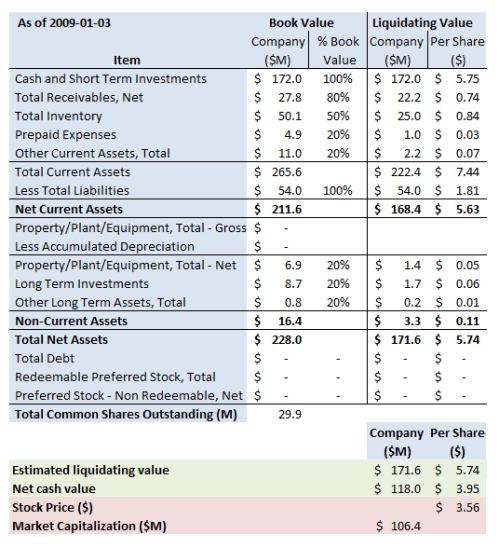
RACK, as its CEO points out in its earnings release, has had a tough year, burning through $15.7M in the 12 months to January 3, 2009. The company does still have a huge amount of cash and equivalents on its balance sheet (the “Book Value” column shows the assets as they are carried in the financial statements, and the “Liquidating Value” column shows our estimate of the value of the assets in a liquidation):

rack-summary

We estimate the company’s liquidation value to be around $171.6M or $5.74 per share, which is predominantly cash and equivalents in the amount of $172M or $5.75 per share. RACK’s net cash value is around $118M or $3.95 per share.

Off balance sheet arrangements and contractual obligations

The company hasn’t disclosed any off-balance sheet arrangements in its most recent 10Q. The contractual obligations as at September 27, 2008 were around $10.2M, around $2.1M of which falls due in the next 12 months. Those committments are minimum lease payments under the company’s operating leases. The company also had purchase committments in the amount of $30.9M to the end of 2008. We’re not sure what these committments are for the next 12 months.

The catalyst

RACK has announced a radical buy back plan to repurchase $40M of its stock. From the press release:

“2008 was a tough year for our industry and for Rackable. Given our strong financial flexibility with $181 million in cash and investments, we plan on making key investments for 2009,” said Mark J. Barrenechea, president and CEO of Rackable Systems. “First, we plan to invest up to 10% of our cash to expand our product offerings and our sales and service capabilities. Second, the company announced a $40 million share repurchase program today. We believe this is an ideal time to invest in Rackable and that these investments will place the company in a stronger competitive position to gain market share as the economy recovers.”

We estimate that that such a buy back at the present prices will increase the company’s per share liquidation value by almost 25% to $7.00. This is a substantial upside to the current stock price.

Conclusion

It’s great to see company recognizing that its stock is deeply undervalued and taking radical action to capitalize on it. If the market is pricing your stock below its liquidation value, there are bargains to be had by investing in that stock, and we believe it should be your priority. With its stock at $3.56, RACK has a market capitalization of $106.4M, which means it’s trading at a discount to both its net cash value of $118M or $3.95 per share and its liquidation value of $171.6M or $5.74 per share. The cash burn is a risk, but we think RACK is a good bet at this level.

RACK closed yesterday at $3.56.

The S&P500 Index closed yesterday at 719.60 (!).

Hat tip to manny.

[Full Disclosure:  We do not have a holding in RACK. This is neither a recommendation to buy or sell any securities. All information provided believed to be reliable and presented for information purposes only. Do your own research before investing in any security.]

Read Full Post »

The Official Activist Investing Blog has published its list of activist investments for February (links are to the relevant post archive):

Ticker Company Investor
AANB Abigail Adams National Bancorp P.S. D’Iberville Limited Partnership
ABVA Alliance Bankshares Frank Williams
ADLS Advanced Life Sciences Holdings Groundworks of Palm Beach County
AHNA.PK ATC Healthcare Inc Roaring Fork Capital
AMLN Amylin Pharmaceuticals Carl Icahn
APAC APAC Customer Service Ronald Chez
APPA AP Pharma Tang Capital
ATML Atmel Corp. Microchip
ATSG Air Transport Services Group Red Mountain Capital
AVCA Advocat Inc. Bristol Investment Fund
BARI Bancorp Rhode Island Financial Edge Fund
BGP Borders Group Inc. Pershing Square Capital Management
BIIB Biogen Idec Inc. Carl Icahn
BVF Biovail Corp Eugene Melnyk
BWC.TO Bridgewater Systems Crescendo Partners
CAMD California Microdevices Dialectic Capital Management
CAV Cavalier Homes Inc Legacy Housing
CBNJ Cape Bancorp Inc Patriot Financial
CHE Chemed Corp MMI Investors
CHG CH Energy Group Gamco Investors
CLHI.PK CLST Holdings Red Oak Partners
CVG Convergys Corporation Jana Partners
DIN DineEquity, Inc MSD Capital
DITC Ditech Networks Lamassu Holdings
DPS Dr. Pepper Snapple Group Trian Fund
ENZN Enzon Pharmaceuticals inc. DellaCamera Capital Management
EPIC Epicor Software Corp Elliott Associaes
ESHB.PK Earl Schieb Lawndale Capital
GET Gaylord Entertainment Co Gamco Investors
GSLA GS Financial Corp. Riggs Qualified Partners
IPAS iPass Inc Foxhill Opportunity Master Fund
KFS Kingsway Financial Sevices Joseph Stilwell
LCAV LCA-Vision Eduardo Baviera Sabater
LGF Lions Gate Entertainment Corp Carl Icahn
MEDW Mediware Information Systems Cannell Capital
MIM MI Developments Greenlight Capital; Farallon Capital
MIPI Molecular Insight Pharmaceuticals David Barlow
MSPD Mindspeed Technologies AIGH Investment Partners
OFIX Orthofix International Venner Capital
OPTV OpenTV Corp Kudelski SA
ORCC Online Resources Group Tennenbaum Capital Partners
ORNG Orange 21 Costa Brava
PMRY Pomeroy IT Solutions David Pomeroy
PRSC Providence Sevice Corp 73114 Investments
RLH Red Lion Hotels Corp Columbia Pacific Opportunity Fund
SNG Canadian Superior Energy Palo Alto Investors
SNR Sunair Services Dru Schmitt
SSE Southern Connecticut Bancorp Lawrence Seidman
TDS Telephone & Data Systems Gamco Investors; Southeastern Asset Management
TEAM TechTeam Global Costa Brava; Emancipation Capital
TECUA Tecumseh Products Herrick Foundation
TLGD Tollgrade Communications of PA Ramius Capital
TLX Trans Lux Corp Gamco Investors
TUC Mac-Gray Corp Fairview Capital Investment
TUTR Plato Learning Stephen Becker
VNDA Vanda Pharmaceuticals Tang Capital
WEDC White Electronic Designs Corp Wynnefield Partners
WOC Wilshire Enterprises Bulldog Investors

Read Full Post »

Digirad Corporation (NASDAQ:DRAD) is a tiny undervalued asset play with a plan to sell assets and buy back its stock. At its $0.88 close on Friday, the company has a market capitalization of $16.7M. We estimate the liquidation value to be around 76% higher at $29.3M or $1.55 per share. The company’s net cash value is around $16M or $0.85 per share, which means the company is trading at a small premium to its net cash. DRAD plans to put the cash to good use, announcing a share buyback to repurchase $2M of its stock.

About DRAD

DRAD is a provider of cardiovascular imaging services and solid-state nuclear medicine imaging products to physician offices, hospitals and other medical services. The company operates through its wholly owned subsidiaries, Digirad Imaging Solutions, Inc. and Digirad Ultrascan Solutions, Inc. The company’s investor relations website is here.

The value proposition

DRAD’s earnings and cash flow are nothing to write home about. The company generated positive cash from operating activities for the last two years of $4.72M in 2007 and $2.37M in 2008, but capital expenditures have made the company a net consumer of cash. The summary of our estimate for the company’s liquidation value is set out below (the “Book Value” column shows the assets as they are carried in the financial statements, and the “Liquidating Value” column shows our estimate of the value of the assets in a liquidation):

drad-summaryWe estimate DRAD’s liquidation value at around $29.3M or $1.55 per share.

Off balance sheet arrangements and contractual obligations

The company hasn’t disclosed any off-balance sheet arrangements in its most recent 10K. The contractual obligations as at December 31 were around $3.0M, around $1.4M of which falls due in the next 12 months.

The catalyst

DRAD’s board has announced a stock buyback program:

The Company also announced that its board of directors has authorized a stock buyback program to repurchase up to an aggregate of $2 million of its issued and outstanding common shares. Digirad had approximately 19 million shares outstanding as of December 31, 2008. At current valuations, this repurchase plan would authorize the buyback of approximately 2.1 million shares, or approximately 11 percent of the company’s outstanding shares.

Chairman of the Digirad Board of Directors R. King Nelson said, “The board believes the Company’s direction and goals towards generating positive cash flow and earnings coupled with an undervalued stock price present a unique investment opportunity. We are confident this will provide a solid return to our shareholders.”

The impact of a $2M stock buyback at Friday’s closing price is to increase per share liquidation value by around 6% to $1.64 and leaves the company with $26.3M in cash and short term investments. We’d like to see a larger buyback (for example, $5M increases the per share value by around 20% and leaves $23.3M in cash), but this is a good start.

Conclusion

At its $0.88 close on Friday, DRAD is trading at around 57% of its $29.3M or $1.55 per share in liquidation value and at a small premium to its $16M or $0.85 per share in net cash. The share buyback to repurchase $2M of its stock will increase the per share liquidation value by around 6% to $1.64. We’re adding DRAD to the Greenbackd Portfolio.

DRAD closed Friday at $0.88.

The S&P500 Index closed Friday at 683.38.

Hat tip to JM.

[Full Disclosure:  We do not have a holding in DRAD. This is neither a recommendation to buy or sell any securities. All information provided believed to be reliable and presented for information purposes only. Do your own research before investing in any security.]

Read Full Post »

Regular readers of Greenbackd will note a few changes to the website. As we foreshadowed in our earlier post, Greenbackd Portfolio Q1 performance and update, we’ve amalgamated the old Contact us and Tips pages into a single Contact us / Tips page. We’ve also added a permanent Portfolio page, which contains our current holdings and which we will update whenever we add or remove a stock from the Greenbackd Portfolio.

Please let us know if you have any comments or suggestions for improving the site. If you don’t like this new layout, then let us know that too.

Read Full Post »

Amtech Systems Inc (NASDAQ:ASYS) is a new addition to the Greenbackd Portfolio. At its $2.78 closing price yesterday, the company has a market capitalization of $25.3M. We estimate the liquidation value to be almost 60% higher at $40M or $4.40 per share. A private investor, Mr. Richard L. Scott, disclosed a 7.0% holding in July last year. Mr Scott has continued to purchase stock, and, as of February 17 this year, holds 9.1% of ASYS’s outstanding stock. We’re not sure what Mr. Scott has planned for ASYS, but we think the stock is a relatively good bet as it has continued to generate positive operating cash flow and earnings.

About ASYS

ASYS is a supplier of horizontal diffusion furnace systems used for solar (photovoltaic) cell and semiconductor manufacturing. The company operates in two business segments: solar and semiconductor equipment, and polishing supplies, under the brand names Tempress Systems and Bruce Technologies. ASYS also supplies insert carriers to manufacturers of silicon wafers under the PR Hoffman brand, and provides lapping and polishing consumable products, as well as equipment used in various industries. The company’s investor relations website is here.

The value proposition

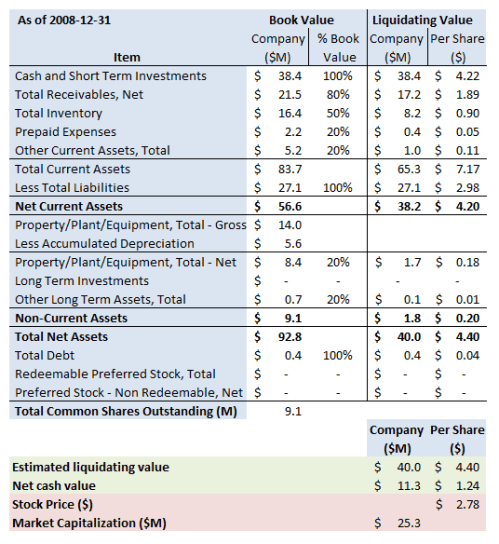
The summary of our estimate for the company’s liquidation value is set out below (the “Book Value” column shows the assets as they are carried in the financial statements, and the “Liquidating Value” column shows our estimate of the value of the assets in a liquidation):

asys-summaryWe estimate ASYS’s liquidation value to be around $40M or $4.40 per share.

Off-balance sheet arrangements and Contractual obligations

According to the company’s most recent 10Q, as of December 31, 2008, ASYS had no off-balance sheet arrangements. The only significant changes in contractual obligations since the end of fiscal 2008 have been purchase obligations in the amount of $6.1M. These purchase obligations consist of outstanding purchase orders for goods and services. While the amount represents purchase agreements, the actual amounts to be paid may be less in the event that any agreements are renegotiated, cancelled or terminated.

The catalyst

Mr. Scott disclosed his initial 7.0% holding in a 13D notice dated July 28, 2008, purchasing $5.4M of stock in ASYS at prices between $8.95 and $9.50. The initial 13D notice contains the standard disclosure for Purpose of Transaction, which we’ve reproduced below:

[Mr. Scott] purchased the Common Stock in open market transactions for general investment purposes. Consistent with such purposes, [Mr. Scott] may seek to engage in future discussions with management of [ASYS] and may make suggestions concerning [ASYS]’s operations, prospects, business and financial strategies, assets and liabilities, business and financing alternatives and such other matters as [Mr. Scott] may deem relevant to his investment in [ASYS]. In addition, [Mr. Scott] may from time to time, depending on prevailing market, economic and other conditions, acquire additional shares of the Common Stock of [ASYS] or engage in discussions with [ASYS] concerning further acquisitions of shares of the Common Stock of [ASYS] or further investments in [ASYS]. [Mr. Scott] intends to review his investment in [ASYS] on a continuing basis and, depending upon the price and availability of shares of the Common Stock, subsequent developments affecting [ASYS], [ASYS]’s business and prospects, other investment and business opportunities available to [Mr. Scott], general stock market and economic conditions, tax considerations and other factors considered relevant, may decide at any time to increase or to decrease the size of his investment in [ASYS].

Mr. Scott has continued to purchase stock in ASYS and has disclosed a 9.1% holding in an amended 13D notice dated February 20, 2009.

Stock repurchase program

According to the most recent 10Q, the company’s board approved a stock repurchase program in December authorizing the repurchase of up to $4M of ASYS’s common stock. If the buy-back is completed at the current stock price, we estimate that the company’s per share liquidation value would increase by around 7% to $4.70.

Conclusion

At its $2.78 close yesterday, ASYS is trading at a little under two-thirds of our estimate of its value in liquidation.  Given that it has continued to generate positive operating cash flow and earnings in a difficult operating environment, we think ASYS represents very good value at a discount to its liquidation value. Management seem to have recognized that the stock is too cheap, and have taken the right steps by authorizing a $4M stock buy-back. Our only criticism is that the buy-back could be bigger. For example, if the buy-back was increased to $10M and stock bought back at the current stock price, the company’s per share liquidation value would increase by 24% to $5.45, leaving ASYS with around $28M in cash and short-term investments. This is a very small criticism, and ASYS has the option to increase the buy-back in subsequent quarters if the stock price continues to trade at a discount to liquidation value. We don’t know anything about Mr. Scott, but we like to see large stockholders increasing their stakes when the stock price drops. We think ASYS is very good value, and that’s why we’re adding it to the Greenbackd Portfolio.

ASYS closed yesterday at $2.78.

The S&P500 Index closed yesterday at 712.87.

[Full Disclosure:  We do not have a holding in ASYS. This is neither a recommendation to buy or sell any securities. All information provided believed to be reliable and presented for information purposes only. Do your own research before investing in any security.]

Read Full Post »

Greenbackd Portfolio Q1 performance and update

March 1, 2009 marked the end of Greenbackd’s first quarter, so we thought we’d take the opportunity to update you on the performance of the Greenbackd Portfolio and the positions in the portfolio, discuss some changes in our valuation methodology since our first post and outline the future direction of Greenbackd.com.

First quarter performance of the Greenbackd Portfolio

We get many questions about the content and performance of the portfolio. We had originally planned to report on a six-monthly basis, but we have now decided to report on a quarterly basis so that we can address these questions on a more frequent basis. Although it is still too early to determine how Greenbackd’s strategy of investing in undervalued asset situations with a catalyst is performing, we’ve set out below a list of all the stocks we’ve included in the Greenbackd Portfolio and the absolute and relative performance of each at the close on the last trading day in our first quarter, Friday, February 28, 2009:
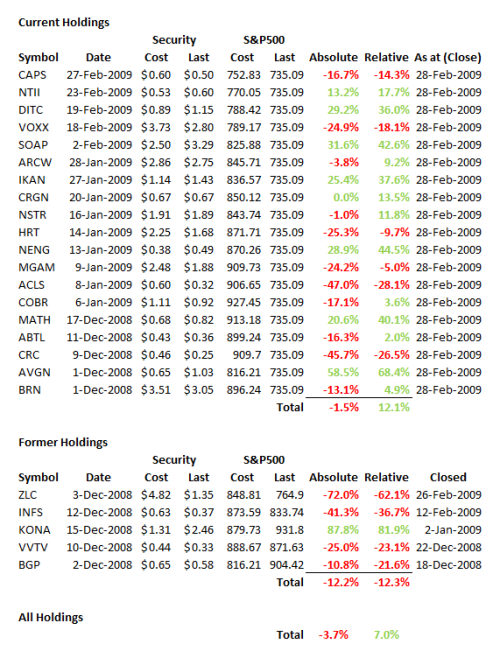
greenbackd-portfolio-performance-2009-q13The absolute total return across the current and former positions as at February 28, 2009 was -3.7%, which was +7.0% higher than the S&P500’s return over the same periods. A negative return for the first period is disappointing, but we are heartened by the fact that we outperformed the market by a small margin.

You may have noticed something odd about our presentation of performance. The S&P500 index declined by 18.0% in our first quarter (from 896.24 to 735.09). Our -3.7% performance might suggest an outperformance over the S&P500 index of +14.3%. We calculate our performance on a slightly different basis, recording the level of the S&P500 index on the day each stock is added to the portfolio and then comparing the performance of each stock against the index for the same holding period. The Total Relative performance, therefore, is the average performance of each stock against the performance of the S&P500 index for the same periods. As we discussed above, the holding period for Greenbackd’s positions has been too short to provide any meaningful information about the likely performance of the strategy over the long term (2 to 5 years), but we believe that the strategy should outperform the market by a small margin.

Greenbackd’s valuation methodology

We started Greenbackd in an effort to extend our understanding of asset-based valuation described by Benjamin Graham in the 1934 Edition of Security Analysis. Through some great discussion with our readers, many of whom work in the fund management industry as experienced analysts or even managing members of hedge funds, we have had the opportunity to refine our process. We believe that what started out as a pretty unsophisticated application of Graham’s liquidation value methodology has evolved into a more realistic analysis of the balance sheet and the relationship of certain disclosures in the financial statements to asset value. We’re not yet ready to send it into space, but we believe our analyses are now qualitatively more robust than when we started and that has manifest itself quantitatively in better performance (more on this below).

The two main differences between our early analyses and our more recent ones are as follows (these are truly cringe-worthy, but that’s why we undertook the exercise):

  1. We didn’t take account of the effect of off-balance sheet arrangements and contractual obligations. This caused us to enter into several positions we should have avoided, including BGP and VVTV.
  2. We were using overly optimistic estimates for the recovery rates of assets in liquidation. For example, we started using 50% of Gross PP&E. We now use 20% of Net PP&E. We now apply Graham’s formula as the base case and deviate only when we believe that Graham’s formulation doesn’t reflect reality.

The effect of these two broad errors in analysis was to create several “false positives,” which is to say that we added stocks to the portfolio that wouldn’t have passed our current, more rigorous standards. The performance of those “false positive” stocks has been almost uniformly negative, and dragged down the performance of the portfolio. As an exercise, we went back through all the positions we have opened since we started the site and applied our current criteria, which are more stringent and dour than our earlier standards. We found that we would not have opened positions in the following eight stocks:

  • BRN (-13.1% on an absolute basis and +4.9% on a relative basis)
  • BGP (-10.8% on an absolute basis and -21.6% on a relative basis)
  • COBR (-17.1% on an absolute basis and +3.6% on a relative basis)
  • HRT (-25.3% on an absolute basis and -9.7% on a relative basis)
  • KONA (+87.8% on an absolute basis and +81.9% on a relative basis)
  • MGAM (-24.2% on an absolute basis and -5.0% on a relative basis)
  • VVTV (-25.0% on an absolute basis and -23.1% on a relative basis)
  • ZLC (-72.0% on an absolute basis and -61.1% on a relative basis)

It seems we got lucky with KONA, but the performance of the balance of the stocks was wholly negative. The performance across all stocks listed above was -12.5% on an absolute basis and -3.9% on a relative basis. Excluding these eight stocks from our portfolio (i.e. treating the portfolio as if we had not entered into these positions) would have resulted in a slightly positive absolute return of +0.7% and a relative performance over the S&P500 of +12.5%. This is a compelling reason to apply the more dour and rigorous standards.

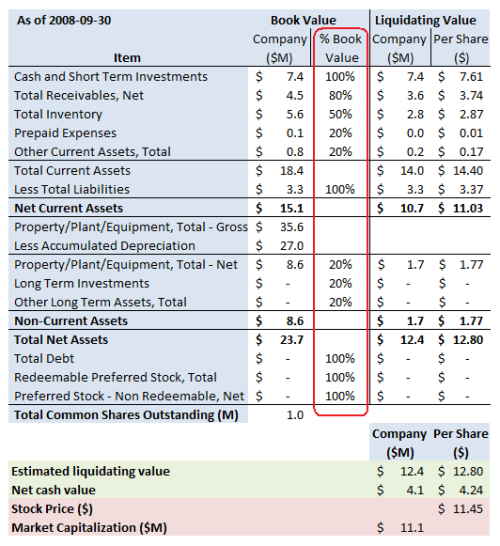
We like to think we’ve now learned out lesson and the more dour and rigorous standards are here to stay. Set out below is an example balance sheet summary (for Chicago Rivet & Machine Co. (AMEX:CVR)) showing our present base case discounts from book value (circled in red):
example-summary-2

Readers will note that these are the same base case discounts from book value suggested by Benjamin Graham in the 1934 Edition of Security Analysis, more fully described in our Valuing long-term and fixed assets post under the heading “Graham’s approach to valuing long-term and fixed assets.” Why we ever deviated from these standards in the first place is beyond us.

Update on the holdings in the Greenbackd Portfolio

Leading on from our discussion above, four of the stocks we picked using the initial, overly optimistic criteria no longer meet our more stringent standards but haven’t yet been removed from the portfolio. We’re going to take our medicine now and do just that. To make it clear, these stocks aren’t being removed because the value has deteriorated, but because we made a mistake adding them to the portfolio in the first place. As much as we’d like to treat these positions as void ab initio (“invalid from the beginning”), we’re not going to do that. We’ve made a full accounting of the impact they’ve had on the portfolio in the First quarter performance of the Greenbackd Portfolio section above, but we don’t want them affecting our future performance. The stocks to be removed from the Greenbackd Portfolio and their absolute and relative returns are as follows:

  • BRN (-13.1% on an absolute basis and +4.9% on a relative basis)
  • HRT (-25.3% on an absolute basis and -9.7% on a relative basis)
  • MGAM (-24.2% on an absolute basis and -5.0% on a relative basis)
  • COBR (-17.1% on an absolute basis and +3.6% on a relative basis)

We’ll provide a more full discussion of where we went wrong with these stocks at a later date, but suffice it to say for present purposes that all were errors from the second bullet point in the Greenbackd’s valuation methodology section above (i.e. overly optimistic estimates for the recovery rates of assets in liquidation).

There are fifteen stocks remaining in the Greenbackd Portfolio:

Eight of these positions (ABTL, ACLS, ARCW, CAPS, CRC, CRGN, NSTR, and VOXX) are trading at or below our nominal purchase price and initial valuations. The remaining seven positions (AVGN, DITC, IKAN, MATH, NENG, NTII, and SOAP) are trading above our intial purchase price but are still at varying discounts to our valuations. We’ll provide a more full update on these positions over the course of this week.

The future of Greenbackd.com

We are going to trial some small changes to the layout of the site over the next few weeks. We’ve already made the first change: the newest comments now appear at the top of the list. We’ll also be amalgamating some pages and adding some new ones, including a page dedicated to tracking the portfolio with links to the analyses. We’re also considering some options for generating income from the site. At the moment, Greenbackd is a labor of love. We try to create new content every week day, and to get the stock analyses up just after midnight Eastern Standard Time, so that they’re available before the markets open the following day. More than 80% of the stocks that are currently trading at a premium to the price at which we originally identified them (NTII, SOAP, IKAN, DITC, NENG, MATH and AVGN) traded for a period at a discount to the price at which we identified them. This means that there are plenty of opportunities to trade on our ideas (not that we suggest you do that). If you find the ideas here compelling and you get some value from them, you can support our efforts by making a donation via PayPal.

We look forward to bringing you the best undervalued asset situations we can dig up in the next quarter.

Read Full Post »
OrthoLogic Corporation (NASDAQ:CAPS) is a little unusual for us. While it trades below its net cash value and Biotechnology Value Fund (BVF) has disclosed a 13.42% holding, BVF’s holding is passive. At CAPS’s $0.60 close yesterday it has a market capitalization of $24.4M. We estimate the net cash value to be 80% higher at $1.08 per share. CAPS’s cash burn rate is quite high relative to its net cash position, so rapid steps need to be taken for this to be a profitable investment. We think that BVF is a good bet, so we’re adding CAPS to the Greenbackd Portfolio.

About CAPS

CAPS is a development stage biotechnology company focused on the development and commercialization of the synthetic peptides Chrysalin (TP508) and AZX100. Effective October 1, 2008, OrthoLogic Corp. is known and doing business as Capstone Therapeutics. The company’s investor relations website is here.

The value proposition

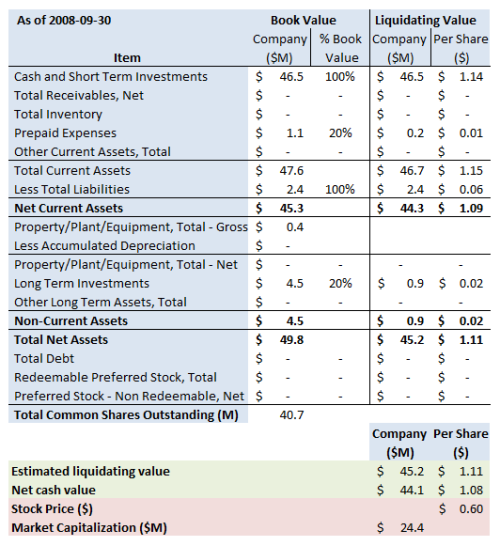
The summary of our estimate for the company’s liquidation value is set out below (the “Book Value” column shows the assets as they are carried in the financial statements, and the “Liquidating Value” column shows our estimate of the value of the assets in a liquidation):

caps-summary

Note that we have used the September 10Q. CAPS’s most recent filings indicate that cash is actually $48M (see slide 13), but we don’t know what the rest of the balance sheet looks like. The presentation also gives cash burn guidance this year of $14M to $16M.

The company also included the following in its 10Q, which seems to indicate a shift to cash preservation:

We announced that we have no immediate plans to re-enter clinical trials for Chrysalin-based product candidates and a strategic shift in our development approach to our Chrysalin Product Platform. We currently intend to pursue development partnering or licensing opportunities for our Chrysalin-based product candidates, a change from our previous development history of independently conducting human clinical trials necessary to advance our Chrysalin-based product candidates to market. We will continue to explore Chrysalin’s therapeutic value in tissues and diseases exhibiting endothelial dysfunction as well as the science behind and potential of Chrysalin. We will also continue research and development expenditures for further pre-clinical studies supporting multiple indications for AZX100 and plan to continue AZX100 dermal scarring human clinical trials.

Off-balance sheet arrangements and Contractual obligations

There is no discussion in the September 10Q about CAPS’s off-balance sheet arrangements or contractual obligations.

The catalyst

Given that BVF has filed a 13G notice, which indicates a passive investment, we’re not entirely sure what BVF has planned for CAPS. It’s possible that it is simply a passive holding. We’re reasonably comfortable following BVF into CAPS because of their efforts with Avigen Inc (NASDAQ:AVGN) and Neurobiological Technologies Inc (NASDAQ:NTII).

CAPS has been undertaking a stock repurchase program since March 5, 2008. At September 30, 2008, the company had repurchased 1.1.M shares of its common stock, at a total cost of $1.0M, and had allocated approximately a further $1.1M to fund possible future stock repurchases. We don’t know the status of the buy-back at this time.

Conclusion

At its $0.60 close yesterday, CAPS is trading at 55% of our estimate of its $1.08 per share net cash value. The risk for this investment – as it is for all of these types of investment – is that CAPS dissipates its cash before it or BVF can salvage that value. Management is taking steps to reduce its cash burn and repurchase undervalued stock, which is encouraging. Perhaps this is what BVF has seen, and the reason BVF hasn’t filed a 13D notice. We think that BVF is a good bet, so we’re adding CAPS to the Greenbackd Portfolio.

CAPS closed yesterday at $0.60.

The S&P500 Index closed yesterday at 752.83.

Hat tip to ef.

[Full Disclosure:  We do not have a holding in CAPS. This is neither a recommendation to buy or sell any securities. All information provided believed to be reliable and presented for information purposes only. Do your own research before investing in any security.]

Read Full Post »

Biotechnology Value Fund (BVF) has extended its tender offer for the outstanding shares of Avigen Inc (Nasdaq: AVGN).

We’ve been following AVGN (see archived posts here) because it’s a net cash stock (i.e. it’s trading at less than the value of its cash after deducting all liabilities) and specialist biotechnology activist fund BVF has been pushing it to liquidate and return its cash to shareholders. MediciNova Inc (NASDAQ:MNOV) has made an offer for AVGN that we think represents a clever way for AVGN’s stockholders to receive cash equivalent to that which they would receive in a liquidation (less $7M to be paid to MNOV) with the possibility for “an extraordinary, uncapped return” if MNOV is successful post-merger. We estimate AVGN’s cash at around $1.22 per share (BVF estimates $1.20 per share), which is around 20% higher than AVGN’s $1.01 close yesterday.

The full text of BVF’s press release is reproduced below:

BVF Acquisition LLC (the “Purchaser”), an affiliate of Biotechnology Value Fund L.P. (“BVF”), which has commenced a cash tender offer to purchase all of the outstanding shares of Avigen, Inc. (Nasdaq: AVGN) (“Avigen”) for $1.00 per share, announced today that it has extended the expiration date for the tender offer to 6:00 p.m., New York City time, on Friday, March 6, 2009. The tender offer was previously set to expire at 12:00 midnight, New York City time, on Monday, February 23, 2009. As of the close of business on February 20, 2009, a total of 1,132,192 shares had been tendered in and not withdrawn from the offer, which together with the shares owned by BVF and affiliates, represents approximately 33% of the total shares outstanding of Avigen.

[Full Disclosure: We have a holding in AVGN. This is neither a recommendation to buy or sell any securities. All information provided believed to be reliable and presented for information purposes only.]

Read Full Post »

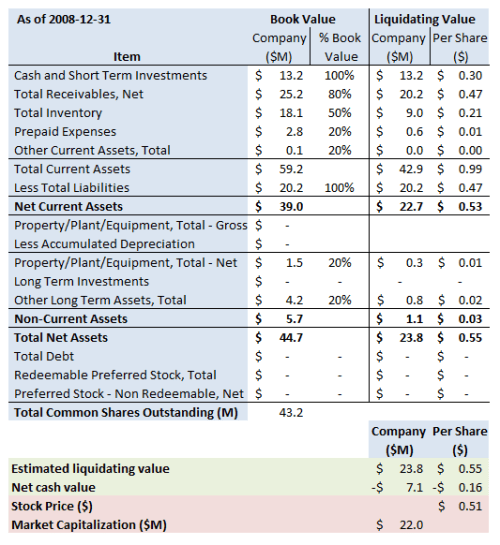
Network Engines Inc (NASDAQ:NENG) has released its results for the quarter to December 31, 2008. We’ve adjusted our valuation down 7% from $25.5m or $0.59 per share to $23.8M or $0.55 per share. With the stock price at $0.51, we’re going to maintain our position for now, but we’re mindful that NENG is a perennial net net stock and so we might take the opportunity to exit if it gets to our target valuation of $0.55.

We started following NENG on January 13 when it was trading at $0.38, which gave it a market capitalization of just $16.5M. The stock is up 34.2% since our initial post to $0.51, which gives it a market capitalization of $22.0M. In November 2007, an activist investor, Trinad Management, pushed the company to “immediately [implement] a share buy-back program.” The company demurred and saw its stock sink to all-time lows.

The value proposition updated

NENG’s Q1 10Q shows an increase in cash, which seems to be largely as a result of reducing accounts receivable and inventories (the “Carrying” column shows the assets as they are carried in the financial statements, and the “Liquidating” column shows our estimate of the value of the assets in a liquidation):

neng-summary-q4

Conclusion

We are inclined to exit NENG if it gets to our $0.55 valuation. It’s a perennial net net stock, so we think there’s a good chance NENG will be back in net net land again. As we pointed out in our earlier post, Jonathan Heller of Cheap Stocks-fame mentioned it back in October 2005 in a list of the Top 20 Market Cap Companies Trading Below Net Current Asset Value. It was then trading around $1.30 against a net current asset value of around $1.31. Investors buying back in October 2005 had plenty of opportunity to unload the stock at a profit while it traded up to $3.17 in March 2006. We’re planning to do the same again, but at $0.55.

[Full Disclosure:  We do not have a holding in NENG. This is neither a recommendation to buy or sell any securities. All information provided believed to be reliable and presented for information purposes only. Do your own research before investing in any security.]

Read Full Post »

« Newer Posts - Older Posts »