Feeds:
Posts
Comments

Archive for the ‘Activist Investors’ Category

Back in the spring of 1999, when the world was enamored of dot coms and not much else, three guys at Piper Jaffray, Daniel J. Donoghue, Michael R. Murphy and Mark Buckley*, produced a superb research report called Wall Street’s Endangered Species. The thesis of the paper was that there were a large number of undervalued companies with strong fundamentals and solid growth prospects in the small cap sector (defined as stocks with a market capitalization between $50M and $250M) lacking a competitive auction for their shares. Donoghue, Murphy and Buckley argued that the phenomenon was secular, and only mergers or buy-outs would “close their value gap:”

Management buy-outs can provide shareholders with the attractive control premiums currently experienced in the private M&A market. Alternatively, strategic mergers can immediately deliver large cap multiples to the small cap shareholder.

I believe that this phenomenon led to the emergence of activist investors in the small cap sector over the last decade. More on this in a moment.

Endangered species report

The document is drafted from the perspective of a M&A team selling corporate advisory services. Here’s the pitch:

Many well-run and profitable public companies in the $50-250 million market capitalization range are now trading at a significant discount to the rest of the stock market. Is this a temporary, cyclical weakness in small stocks that is likely to reverse soon? No, these stocks have been permanently impaired by a shift in the economics of small cap investing. This persistent under-valuation is sure to be followed by a rise in M&A activity in the sector. We have already seen an uptick in the number of “going private” transactions and strategic mergers involving these companies. Management teams that identify this trend, and respond to it, will thrive. The inactive face extinction.

Donoghue, Murphy and Buckley’s thesis was based on the then relative underperformance of the Russell 2000 to the S&P 500:

The accompanying graph, labeled Exhibit I, illustrates just how miserably the Russell 2000 lagged the S&P 500 not only last year but in 1996 and 1997 as well. Granted, small cap returns have tended to run in cycles. Since the Depression, there have been five periods during which small cap stocks have outperformed the S&P 500 (1932-37, 1940-45, 1963-68, 1975-83, and 1991-94). It is reasonable to believe that small caps, in general, will once again have their day in the sun.

They argued that the foregoing graph was a little misleading because the entirety of the Russell 2000 universe wasn’t underperforming, just the smallest members of the index:

However, a closer look at the smallest companies within the Russell 2000 reveals a secular decline in valuations that is not likely to be reversed. The table in Exhibit II divides the Russell 2000 into deciles according to market capitalization. Immediately noticeable is the disparity between the top decile, with a median market capitalization of $1.5 billion, and the tenth decile at less than $125 million. Even more striking is the comparison of compounded annual returns for the past ten years. The data clearly demonstrates that it is not the commonly tracked small cap universe as a whole that is plagued by poor stock performance but rather the smallest of the small: companies less than about $250 million in value.

Stocks trading at a discount to private company valuations

The underperformance led to these sub-$250M market cap companies trading at a discount to private company valuations:

Obscurity in the stock market translates into sub-par valuations. As shown in Exhibit IV, the smaller of the Russell 2000 companies significantly lag the S&P 500 in earnings and EBIT multiples. It is startling to find that with an average EBIT multiple of 9.0 times, many of these firms are valued below the acquisition prices of private companies.

And the punchline:

Reviving shareholder value requires a fundamental change in ownership structure. Equity must be transferred out of the hands of an unadoring public, and into those of either: 1) management backed by private capital, or 2) larger companies that can capture strategic benefits. Either remedy breathes new life into these companies by providing cheaper sources of capital, and by shifting the focus away from quarterly EPS to long-term growth.

Increasing M&A activity

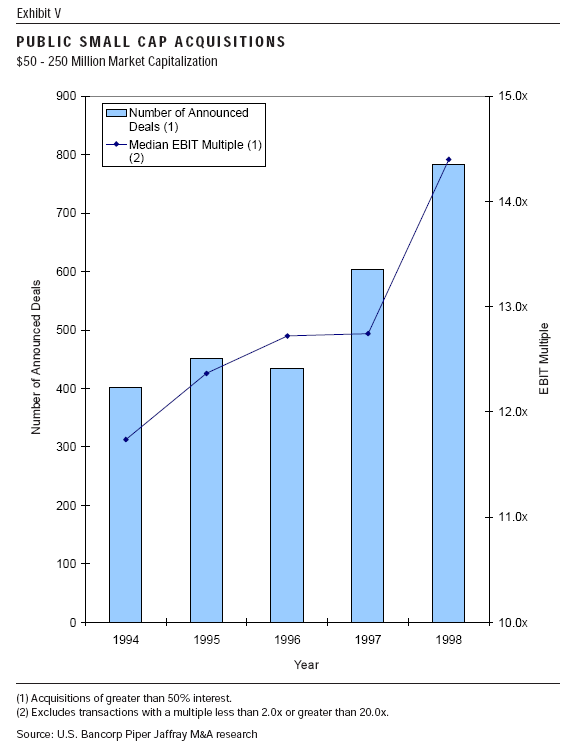
The market had not entirely missed the value proposition. M&A in the small cap sector was increasing in terms of price and number of transactions:
Darwin’s Darlings

Donoghue, Murphy and Buckley argued that the value proposition presented by these good-but-orphaned companies, which they called “Darwin’s darlings,” presented an attractive opportunity, described as follows:

Despite the acceleration of orphaned public company acquisitions in 1997 and 1998, there remains a very large universe of attractive public small cap firms. We sifted through the public markets, focusing on the $50-250 million market capitalization range, to construct a list of the most appealing companies. We narrowed our search by eliminating certain non-industrial sectors and ended up with over 1500 companies.

We analyzed their valuations relative to the S&P 500. The disparity is so wide that the typical S&P 500 company could pay a 50% premium to acquire the average small cap in this group without incurring earnings dilution. Those dynamics appear to be exactly what is driving small cap takeover values. The median EBIT multiple paid for small caps in 1998 was roughly equal to where the typical S&P 500 trades.

We honed in on those companies with multiples that are positive, but even more deeply discounted at less than 50% of the S&P 500. Finally, we selected only those with compounded annual EBIT growth of over 10% for the past five years. As shown in Exhibit VII, these 110 companies,“Darwin’s Darlings,” have a median valuation of only 5.8 times EBIT despite a compounded annual growth rate in EBIT of over 30% for the past five years.

The emergence of activists

Donoghue, Murphy and Buckley identified the holders of many of these so-called “Darwin’s darlings” as “small cap investment funds focused on likely take-over targets:”

As detailed in the description of our “Darwin’s Darlings” in Exhibit VIII, management ownership varies widely among these companies. For recent IPOs of family-held businesses, management stakes are generally high. For those that were corporate spin-offs, management ownership tends to be low. We frequently find large blocks of these stocks held by small cap investment funds focused on likely take-over targets, leading to a surprisingly high percentage of total insider ownership (management plus holders of more than 5%).

Regardless of ownership structure, these companies typically have the customary defensive mechanisms in place. They are also protected by the fact that they are so thinly traded. In most cases it takes more than six months to accumulate a 5% position in the stock without moving the market. Hence, we expect virtually all acquisitions in this sector to be friendly. There is no question that some very attractive targets cannot be acquired on a friendly basis. However, coercing these companies into a change of control means being prepared to launch a full proxy fight and tender offer.

In When Wall Street Scorns Good Companies, a Fortune magazine article from October 2000, writer Geoffrey Colvin asked of Darwin’s darlings, “So why are all these firms still independent?”

The answer may lie in another fact about them: On average, insiders own half their shares. When the proportion is that high, the insiders are most likely founders; they have enough stock to fend off any hostile approach, and they haven’t sold because they aren’t ready to give up control. Not many outside investors want to go along for that ride. Thus, low prices.

But there’s still a logical problem. Since the companies are so cheap, why don’t managers buy the shares they don’t already own– take the company private at today’s crummy multiple, then sell the whole shebang at an almost guaranteed higher price? Going private has in fact become more popular than ever, but what seems most striking is how rare it remains. Of Piper Jaffray’s 1999 Darwin’s Darlings– 110 companies–only three went private in the following 12 months. That makes perfect sense if you figure that many of the outfits are run by owner-managers whose top priority is keeping control. Announce a going-private transaction and you put the company in play, and even a chummy board may feel obliged to honor its fiduciary duty if a higher bid comes along.

Thus we reach the somewhat ugly truth about Wall Street’s orphaned stars: Many of them (not all) like things the way they are–that is, they like staying in control. The outsider owners are typically a diffuse bunch in no position to put heat on the controlling insiders. The stock price may be lousy, but when the owner-managers decide to sell–that is, to get out of the way–it will almost certainly rise handsomely, as it did for the 19 of last year’s Darwin’s Darlings that have since sold.

So shed no tears for these scorned companies, and don’t buy their shares without a deep understanding of what the majority owners have in mind. In theory the spreading corporate governance movement ought to protect you; in practice the shareholder activists have bigger fish to fry. Such circumstances may keep share prices down, but that’s the owner-managers’ problem. At least, in this case, the market isn’t so mysterious after all.

I believe that the third paragraph above best describes the reason for the emergence of the activists in the small cap sector. Observing that stock prices rose dramatically when owner-managers of “Wall Street’s orphaned stars” decided to sell, and outside investors were “typically a diffuse bunch in no position to put heat on the controlling insiders,” activist investors saw the obvious value proposition and path to a catalyst and entered the fray. This led to a golden decade for activist investing in the small cap sector, one that I think is unlikely to be repeated in the next decade. Regardless, it’s an interesting strategy, and an obvious extension for an investor focussed on small capitalization stocks and activist targets.

*Donoghue, Murphy and Buckley in 2002 founded Discovery Group, a fund manager and M&A advisory that takes significant ownership stakes (up to 20%) in companies trading at a discount to “fundamental economic value.”
Read Full Post »

Farukh Farooqi, a long-time supporter of Greenbackd and the founder of Marquis Research, a special situations research and advisory firm (for more on Farukh and his methodology see The Deal in the article “Scavenger Hunter”) provided a guest post on Silicon Storage Technology, Inc (NASDAQ:SSTI) a few weeks back (see the post archive here). At the time of the post, SSTI was trading around $2.70. The stock is up 15.6% to close yesterday at $3.12.

SSTI has announced an amended merger, increasing the bid to $3.00 per share in cash. Here’s the announcement:

Silicon Storage Technology Announces Amended Merger Agreement with Microchip

SST Shareholders to Receive $3.00 Per Share in Cash

SUNNYVALE, Calif., Feb. 23 /PRNewswire-FirstCall/ — SST (Silicon Storage Technology, Inc.) (Nasdaq: SSTI), a leading memory and non-memory products provider for high-volume applications in the digital consumer, networking, wireless communications and Internet computing markets, today announced that it has entered into an amendment to its previously announced merger agreement with Microchip Technology Incorporated (Nasdaq: MCHP) (“Microchip”), a leading provider of microcontroller and analog semiconductors. Pursuant to the amendment, the purchase price for each share of SST common stock has been increased from $2.85 to $3.00 per share in cash. The amended termination fee payable in the circumstances and manner set forth in the merger agreement remains at 3.5% of the total equity consideration.

The amended agreement has been unanimously approved by SST’s Board of Directors acting upon the unanimous recommendation of its independent Strategic Committee. Microchip proposed the revised terms in response to a proposal received by the Strategic Committee from a private equity firm.

As previously announced, the Microchip transaction, which is expected to close in the second calendar quarter of 2010, is conditioned on approval of a majority of the outstanding shares of SST common stock as well as customary closing conditions. The transaction, which will be funded with cash on hand, is not subject to financing.

Houlihan Lokey is serving as the exclusive financial advisor to the Strategic Committee of the SST Board of Directors in connection with the transaction.

Shearman & Sterling LLP is serving as legal advisor to the Strategic Committee of the SST Board of Directors in connection with the transaction.

Cooley Godward Kronish LLP is serving as legal advisor to SST in connection with the transaction.

Wilson Sonsini Goodrich & Rosati, PC is serving as legal advisor to Microchip in connection with the transaction.

Says Farukh:

Subsequent to the MCHP $3/sh cash bid, Cerberus and SST Full Value Committee (actvist group) came up with a competing bid.

This competing bid is very interesting. It offers shareholders to either (1) take $3.00 per share in cash or (2) $2.62 in cash (via a special dividend) and an equity stub, thus giving shareholders the ability to participate in future upside.

I am in the process of valuing the stub but just wanted to make you aware of the development.

This is getting really interesting in that we now have two competing bids and it remains to be seen how, if at all, MCHP counters.

[Full Disclosure: I do not hold SSTI. This is neither a recommendation to buy or sell any securities. All information provided believed to be reliable and presented for information purposes only. Do your own research before investing in any security.]

Read Full Post »

As I indicated in the first post back for 2010, I’m going to publish some of the more interesting 13D letters filed with the SEC. These are not situations for which I have considered the underlying value proposition, just interesting situations from the perspective of the activist campaign or the Schedule 13D.

Benihana Inc. (NASDAQ:BNHN and BNHNA), the operator of the Behihana teppanyaki restaurants, is the subject of a campaign by founder Rocky Aoki’s widow and eldest children (who control around 32% of the common stock via a trust called “Benihana of Tokyo”) to thwart a proposal by Benihana Inc. to increase the number of its shares of Class A common stock, which would significantly dilute existing shareholders. The campaign seems to have found some support among other large shareholders, notably Blackwell LLC and Coliseum Capital Management LLC, who filed a joint 13D on Wednesday last week. Here is the text of the letter attached to the 13D filed by Blackwell and Coliseum Capital Management:

February 17, 2010

Richard C. Stockinger, Chief Executive Officer & Director
Benihana Inc.
8685 Northwest 53rd Terrace
Miami, Florida 33166

Re: Benihana Inc. – February 22, 2010 Special Meeting of Stockholders

Dear Mr. Stockinger:

On behalf of Coliseum Capital Management, LLC (“Coliseum”), the holder of 9.9% of the Class A Common Stock of Benihana Inc. (the “Company”), I am writing to express concern over the proposed Agreement and Plan of Merger (the “Proposal”) by and between the Company and its wholly-owned subsidiary BHI Mergersub, Inc.

This Proposal (scheduled for shareholder vote on February 22nd) would give the Company the ability to issue 12,500,000 millions shares of Class A Common Stock under their Form S-3 covering the sale of up to $30,000,000 of securities.  Compounded by the anti-dilution provisions contained in the Company’s Convertible Preferred Stock, an equity issuance of this magnitude would be significantly dilutive to existing shareholders.

Thus far, the Company has not provided compelling rationale to affect such a potentially dilutive fundraising; as a result, Coliseum is not supporting the Proposal.

Specific concerns are outlined below:

1. The Company has not provided compelling rationale to affect a potentially dilutive fundraising.

The Company appears to be generating positive cash flow with which to invest in the business and/or amortize debt. Conservatively, the Company appears to produce $25-$35 million of run-rate EBITDA, require approximately $9 million in maintenance capital expenditures and have $4-$8 million of taxes, interest and preferred dividends in total, leaving $12-$18 million of positive free cash flow annually with which to further invest in the business and/or amortize debt.

It would appear that there is sufficient liquidity with which to run the business. The Company disclosed availability of over $11 million for borrowing under the terms of the Wachovia line of credit (“LOC”), as of October 11, 2009. The Company’s positive free cash flow should more than offset the $8 million of scheduled reduction in Availability under the LOC before its March 2011 maturity.

The Company does not appear to be over-levered. In the most recent 10-Q, the Company justified the now-proposed action to authorize the issuance of additional equity by highlighting concerns regarding the March 2011 maturity of the LOC. Before taking into account the positive free cash flow generated between October 2009 and March 2011, the Company is levered through its LOC at less than 1.5x its run-rate EBITDA. In our experience, similar restaurant companies are able to access senior debt in this environment at 1.5x (or more).

2. In combination with the anti-dilution provisions contained in the Convertible Preferred Stock (the “BFC Preferred”), an equity issuance at current levels would be significantly dilutive to existing shareholders (even if completed through a Rights Offering).

Depending upon the issue price of new equity, the BFC Preferred could see a reduction to its conversion price of 15%-25%, and thereby gain an additional 300,000-500,000 shares upon conversion.

3. The process through which the company is evaluating alternatives has been opaque.

We find it troubling that the Company has been unwilling to provide further details relating to Proposal, including rationale, alternatives, process and implications.

4. To date, management has been unwilling to engage in a discussion relating to key questions (below) that any shareholder should have answered before voting in favor of the proposed merger and subsequent fundraising.

What are the Company’s long term plans for each of the concepts?

What assumptions would be reasonable to make over the next several years regarding key revenue and cost drivers, investments in overhead, working capital and capital expenditures, and other sources/uses of cash from operations?

What is the framework for a potential recapitalization?

– What is the rationale for a $30 million capital raise?

– Why raise capital through an equity offering versus other sources?

– What process has been followed (i.e. advisors engaged, alternatives considered, investors/lenders approached)?

– Why change the approach from an amendment of the certificate of incorporation to the current merger proposal?

– What is BFC’s potential role?

– How is the Board dealing with potential conflicts of interest?

It may well be that the Company should undertake a recapitalization, including the issuance of new equity. However, having not been provided information with which to assess the rationale and evaluate the alternatives, Coliseum is not supporting the Proposal.

We look forward to our further discussions.

Very truly yours,
Coliseum Capital Management, LLC
By: Name: Adam L. Gray
Title: Managing Director
BNHN management responded swiftly to the 13D, releasing the following statement on Thursday:

Benihana Inc. Responds to Public Statements of Certain Shareholders Concerning Forthcoming Special Meeting of Shareholders

MIAMI, FLORIDA, February 18, 2010 — Benihana Inc. (NASDAQ: BNHNA; BNHN), operator of the nation’s largest chain of Japanese theme and sushi restaurants, today responded to public statements made by certain shareholders concerning the forthcoming special meeting of shareholders to consider and act upon a proposed merger (the “Merger”) the sole purpose of which is to increase the authorized number of shares of the Company’s Class A Common Stock by 12,500,000.

Richard C. Stockinger, President and Chief Executive Officer, said, “The increase in the authorized shares was one step in a series of actions being taken to ensure that the Company had the flexibility and capability to take advantage of opportunities and or to respond to rapidly changing economic conditions and credit markets. Although the Company’s sales and earnings have been softer than management would have hoped over the past year, we are confident that our recently implemented Renewal Program will help to mitigate or reverse these trends. Still, we remain vulnerable to fluctuations in the larger economy and other risks.”

As previously announced, one result of last year’s sales was the Company’s failure to meet required ratios under its credit agreement with Wachovia Bank, N.A. as at the end of the second quarter of the current fiscal year. That in turn led to amendments to the credit line which will materially reduce the funds available to the Company — what began as a maximum availability of $60 million has been reduced to $40.5 million, will be further reduced to $37.5 million effective July 18, 2010, and further reduced to $32.5 million effective January 2, 2011, with the outstanding balance under the line becoming due and payable in full on March 15, 2011. In addition, the Company expects the judge hearing the Company’s long running litigation with the former minority owners of the Company’s Haru segment to issue a decision in the case shortly which will require the Company to make a payment of at least $3.7 million (the amount offered by the Company) and as much as $10 million (the amount sought by the former minority owners). And while the Company has substantially reduced its capital expenditures allocated to new projects, it continues to have significant capital requirements to maintain its extensive property and equipment and to execute upon its renewal plan.

In the face of these developments, the Board does not believe it would be prudent to do nothing and accordingly has taken a series of steps (all of which have been previously publicly announced) to ensure that the Company is in the strongest possible position to meet any unanticipated challenges it may face.

The Company has detailed in its periodic filings the broad range of operational changes that have been and continue to be made to improve efficiency and increase sales. At the same time, and in support of these operational changes, the Company has taken a series of steps in support of the Company’s financial condition. These included forming a special committee of independent directors (which has retained its own investment bankers and attorneys) to undertake an analysis of the Company’s capital requirements and to evaluate the various alternatives (in the form of both debt and equity) for meeting those requirements. That analysis is ongoing. The Committee has made no recommendation, and the Board has made no decision with respect to the Company’s future capital needs or the best manner of satisfying them. The Company also filed a “generic” registration covering a broad range of alternative financing options (again, both debt and equity) so that, if it determined to do so, it would be in a position to quickly effect a capital raise, and it moved to increase the authorized number of shares of Class A Common Stock for the same reason.

The Board is very much aware of concerns with respect to potential dilution raised by various shareholders and those concerns will certainly be seriously considered in the decision making process. But the Board believes it would be foolhardy not to take the actions it has taken which are designed to give management flexibility in responding to changing circumstances, continue to execute against its renewal plan and have the ability to take advantage of selective growth opportunities as they arise. For these reasons, the Board continues to unanimously urge all shareholders to vote in favor of the proposed Merger.

As to the reasons for the proposed merger (as opposed to a simple amendment to the Certificate of Incorporation): Section 242(b) of the Delaware General Corporation law provides that a class vote is ordinarily required to approve an increase in the authorized number of shares of that class. This would mean that an increase in the Class A stock would require a vote of the holders of Class A stock and an increase in Common stock would require a vote of the holders of Common stock. Delaware law permits a company to “opt out” of this class vote requirement by so providing in its Certificate of Incorporation, and the Company has done just that. Thus, to approve an amendment to increase either the authorized Class A or the authorized Common stock, the Company’s Certificate of Incorporation requires the affirmative vote of a majority of the votes cast by all of the holders of the Company’s common equity. The Certificate of Incorporation was adopted at a time when no other voting securities of the Company were outstanding, and although the Series B Preferred Stock generally votes on an as if converted basis together with the Common Stock, the Certificate of Incorporation does not expressly deal with the voting rights of the Series B Preferred Stock in the context of the “opt out” provision relating to amendments to increase authorized stock. Accordingly, and because the Board believed this was an issue as to which the holders of the Series B Preferred Stock had an interest and as to which they should be entitled to vote, it unanimously elected to proceed under the merger provisions of the Delaware statute rather than the amendment provisions in order to avoid any possible ambiguity.

[Full Disclosure:  No holding. This is neither a recommendation to buy or sell any securities. All information provided believed to be reliable and presented for information purposes only. Do your own research before investing in any security.]

Read Full Post »

Central to the discussion of sub-liquidation value investing in Japan is the ability or willingness of shareholders to influence management, and management’s willingness to listen. As Ben Graham noted in the 1934 edition of Security Analysis, in the US:

The whole issue may be summarized in the form of a basic principle, viz:

When a common stocks sells persistently below its liquidating value, then either the price is too low, or the company should be liquidated. Two corollaries may be deduced from this principle:

Corollary I. Such a price should impel the stockholders to raise the question whether it is in their interest to continue the business.

Corollary II. Such a price should impel the management to take all proper steps to correct the obvious disparity between market quotation and intrinsic value, including a reconsideration of its own policies and a frank justification to the stockholders of its decision to continue the business.

The perception is that, in Japan, these two corollaries do not flow from that basic principle. As The Economist notes in a February 2008 article, Samurai v shareholders: Japan’s establishment continues to rebuff foreign activist investors (subscription required):

Japanese businessmen and politicians fear that the activists are short-term investors keen to strip firms of their cash. The conflict highlights a fundamental divide: companies in Japan are social institutions with a duty to provide stable employment and consider the needs of employees and the community at large, not just shareholders.

And therein lies the rub. Companies in Japan are social institutions with a duty to provide stable employment and consider the needs of employees and the community at large, not just shareholders.

Can foreign investors not subject to the cultural expectation that companies consider the needs of employees and the community at large succeed?

According to a 2009 Knowledge@Wharton article, How the Environment for Foreign Direct Investment in Japan Is Changing — for the Better, the environment for foreign investors in Japan is improving, but continues to be more bureaucratic than in the US:

Despite the support shown by elected officials for increasing [foreign direct investment] in Japan, foreign investors still face a substantial amount of bureaucratic red tape, particularly with respect to protected industries. [Direct investment] is principally governed by the Foreign Exchange and Foreign Trade Control Law, which specifically prevents foreign investors from acquiring a majority stake in Japanese companies within industry sectors classified as closely related to national security and public safety. This includes industries as diverse as aeronautics, defense, nuclear power generation, energy, telecom, broadcasting, railways, tourist transportation, petroleum and leather processing.

Foreign investors intending to make direct investments in certain industries must file with the Japanese Ministry of Finance as well as the respective ministry governing the specific industry of the investment target. If issues are found in relation to the investment, either the Ministry of Finance or the industry-specific ministry has the authority to issue an official recommendation to revise the investment plan or to put a complete stop to the acquisition. Industry-specific regulations that, for example, limit foreign ownership to one-third for airline and telecom companies, further constrain foreign investors.

It’s worth considering the experience of two notable activist campaigns in Japan. The first, Steel Partners’ campaign for Sapporo, the brewer, is described in the Knowledge@Wharton article:

Steel Partners has imported its U.S. activist investment model to Japan and has shown a willingness to question publicly the strategy of current management at its investment targets and to litigate disagreements.

As a result of Steel Partners’ posture, the firm’s take-over bid for household-brand Bulldog Sauce met with resistance from the media and Japan’s legal system. The court to which Steel Partners appealed a failed injunction to prevent Bulldog’s poison-pill strategy stated: “[Steel Partners] pursues its own interests exclusively and seeks only to secure profits by selling companies’ shares back to the company or to third parties in the short term, in some cases with an eye to disposing of company assets…. As such, it is proper to consider the plaintiff an abusive acquirer.”

The Economist article discusses the The Children’s Investment Fund’s (TCI) battle for the Japanese power provider J-Power:

The biggest showdown between the activists and the establishment is at J-Power, the former state-run energy firm, which was privatised in 2004. [TCI] a British fund, which owns 9.9% of the firm, has been politely but firmly lobbying J-Power to appoint two TCI representatives to its board, improve margins and unwind cross-shareholdings with other firms. Having been rebuffed, TCI now wants to double its bet. In January it asked for permission to increase its stake to 20% (any holding above 10% requires government approval). John Ho, the head of TCI’s Asian operations, says the deal is a test of the integrity of Japan’s reform agenda. And it would be, except that Mr Ho has chosen a remarkably hard case. Japan, lacking natural resources, is worried about energy security and is reluctant to hand more control over its power infrastructure to foreign investors.

The Knowledge@Wharton article concludes:

After applying for approval to increase shareholdings to 20%, TCI met a wall of resistance: J-Power management cautioned that TCI could cut maintenance and investment costs in nuclear plants, and the Japanese media relayed sensationalist warnings about the potential for “blackouts.” The result: The Japanese government blocked the investment.

These are not encouraging outcomes. The final word is best left to Takao Kitabata, the vice-minister of Japan’s powerful Ministry of Economy, Trade and Industry (METI):

To be blunt, shareholders in general do not have the ability to run a company. They are fickle and irresponsible. They only take on a limited responsibility, but they greedily demand high dividend payments.

High dividend payments? We’re a long way from liquidation as a matter of course.

Read Full Post »

Farukh Farooqi, a long-time supporter of Greenbackd and the founder of Marquis Research, a special situations research and advisory firm (for more on Farukh and his methodology, see The Deal in the article “Scavenger Hunter”) provided a guest post on Silicon Storage Technology, Inc (NASDAQ:SSTI) a few weeks back. Farukh wrote:

Activist-Driven Situation Summary: Silicon Storage Tech. (SSTI; $2.78) dated January 6, 2010

SST is a fabless, designer and supplier of NOR flash memory chips which are used in thousands of consumer electronic products. It has two businesses – Products sales of $240 mm with 20% gross margin and licensing revenues of $40 mm with near 100% margin.

As of September 30, 2009, SST had cash and investments of $2.14 per share, net non-cash working capital of $0.41 per share and zero debt. This implies that the market is valuing its business at $0.23 per share or $22 mm. This is a Company which annually spends $50 mm on R&D alone!

Judging from last 10 years of SST’s history, valuation has suffered from (1) dismal bottom line performance and (2) Corporate governance issues.

After bottoming in Q109, Company revenues and margins have rebounded sharply. The Board has decided to take this opportune time to create “value” for shareholders by selling it to a private equity fund for … $2.10 per share. As part of the deal, the current CEO and COO are going to keep their equity interest in the private Company.

In response, an activist shareholder (Riley Invesment Management) resigned from the Board when the Go-Private deal was announced. Last week, he and certain other large shareholders formed SST Full Value Committee and have asked the Board to reconsider the transaction.

Given the governance issues (which could improve as a proxy fight to add independent members is underway), a discount to the peer group is warranted. However, whether you value it on EV/Revenue, EV/EBITDA or Price/Tangible Book Value, the stock has 50% to 200% upside potential.

Farukh has left a comment that I want to draw to your attention:

SSTI being acquired by MCHP for $2.85 per share.

Does this price make sense?

SSTI has $2.55 per share in cash, investments and net working capital. Which means, MCHP is really offering $0.35 per share in value or approximately $35 mm for a semiconductor business which generates $280 mm in sales and almost $50 mm per anum in gross profit and another $40 mm per year in license fees.

The license fees alone can be worth $200 mm using a 20% yield.

SST story reminds me of the Road Runners cartoon with management being the Wile E. Coyote, trying to sabotage shareholders every which way….. Beep Beep.

[Full Disclosure: I do not hold SSTI. This is neither a recommendation to buy or sell any securities. All information provided believed to be reliable and presented for information purposes only. Do your own research before investing in any security.]

Read Full Post »

The Official Activist Investing Blog has published its list of activist investments for December:

Ticker Company Investor
ALCO Alico Inc. Atlantic Blue Group
ALOG Analogic Corporation Ramius Capital
ALOY Alloy Inc. SRB Management
BASI Bioanalytical Systems Inc Peter Kissinger
CNBC Center Bancorp Lawrence Seidman
COBR Cobra Electronics Corp Timothy Stabosz
CTO Consolidated Tomoka Land Co Wintergreen Advisers
DGTC.OB Del Global Technologies Steel Partners
DHT DHT Maritime Inc MMI Investments
DPTR Delta Petroleum Corp. Tracinda Corp
DVD Dover Motorsports inc Marathon Capital
ENZN Enzon Pharmaceuticals inc. DellaCamera Capital Management
EVOL Evolving Systems Inc. Karen Singer
EZEN.OB Ezenia! Inc North & Webster
EZEN.OB Ezenia! Inc Hummingbird Management
FACT Facet Biotech Corp Biotechnology Value Fund
FACT Facet Biotech Corp Baupost Group
FFHS First Franklin Corp Lenox Wealth Management
FGF SunAmerica Focused Alpha Growth Inc Bulldog Investors
FGI SunAmerica Focused Alpha Large-Cap Fund, Inc. Bulldog Investors
FMMH.OB Fremont Michigan InsuraCorp Steak & Shake
GSIGQ.PK GSI Group Stephen Bershad
GSIGQ.PK GSI Group JEC II Associates
GST Gastar Exploration Ltd Palo Alto Investors
HBRF.OB Highbury Financial Inc. Peerless Systems Corp
HFFC HF Financial Corp Financial Edge Fund
IMMR Immersion Corp Ramius Capital
JTX Jackson Hewitt Tax Service JTH Tax Inc.
KYN Kayne Anderson MLP Investment Co Karpus Management
LM Legg Mason Inc. Trian Fund
MZF MBIA Capital Claymore Man Dur Inv Grd Muni Western Investment
OSTE Osteotech Inc. Heartland Advisors
PMO The Putnam Funds Karpus Management
PTEC Phoenix Technologies Ltd Ramius Capital
RIC Richmont Mines Gregory Chamandy
RRGB Red Robin Gourmet Burgers Clinton Group
RRGB Red Robin Gourmet Burgers Spotlight Advisors
SLTC Selectica Inc Lloyd Miller
SMTS Somanetics Corp Discovery Capital
SSE Southern Connecticut Bancorp Inc Lawrence Seidman
TFC Taiwan Greater China Fund City of London Investment Group
TRA Terra Industries Inc CF Industries Holdings
TTWO Take-Two Interactive Software Carl Icahn
TUNE Microtune Inc Ramius Capital
UAHC United American Healthcare Corp Lloyd Miller
UAHC United American Healthcare Corp John Fife
USAT USA Technologies Brad Tirpak; Craig Thomas
UTSI UTStarcom Inc Shah Capital Management
VRX Valeant Pharmaceuticals Value Act Capital
WXCO WHX Corp Steel Partners
YORW York Water Co GAMCO

Read Full Post »

Daniel Rudewicz, the managing member of Furlong Samex LLC, has provided a guest post today on Paragon Technologies (PGNT.PK). Furlong Samex is a deep value investment partnership based on the principles of Benjamin Graham. Daniel can be reached at rudewicz [at] furlongsamex [dot] com.

Anyone Need a (Sanborn) Map?

In his 1960 partnership letter, Warren Buffett described his investment in Sanborn Map. At the time of his investment, Sanborn Map was selling for less than the combined value of its cash and investment portfolio. Additionally, the operating portion of the company was profitable. Opportunities like Sanborn Map are a dream for value investors.

The market downturn of 2008 had created some similar opportunities. But by early 2010 the market price of most of those companies had converged to at least the value of their cash and investment portfolio. One company that has managed to stay under the radar is Paragon Technologies. It was trading below its cash level when the company elected to be listed on the Pink Sheets. This also removed the requirement to file with the SEC and now the company is no longer on many of the databases and stock screens.

It’s a fairly illiquid company whose most recent quarter was profitable. As of 9/30/2009, Paragon had just over $6 million in cash, or $3.88 per share.

Cash and cash equivalents $6,094,000
Shares outstanding 1,571,810
Cash per share $3.88

Year to date, its stock has traded between $2.20 and $2.55, quite a discount from its cash. The Board and the interim CEO are looking at strategic alternatives and will consider shareholder proposals. Unfortunately, what we had hoped was a 1960 Buffettesque proposal was turned down. In the proposal we outlined the benefits of the company offering a fixed price tender at $3.88 per share. Maybe next time. To the Board’s credit, they have authorized a large share buyback and have increased the amount authorized several times. The problem is that authorizing an amount and buying back an amount is not the same thing.

While the interim CEO searches for opportunities, the company could conceivably end up buying back enough shares in the open market so that we’re the only shareholder left. The downside is that I’m not sure that we would want that. Even though it was profitable last quarter, the long term earnings record is not that impressive. Looking back at Buffett’s Sanborn Map investment, it seems like Sanborn’s Board should have encouraged Buffett to stay on and manage its investment portfolio. Our hope is that Paragon moves in the direction of becoming a tiny Berkshire or Fairfax by putting a great capital allocator in charge of the cash. It would be a great way to use some of the company’s operating losses to shield future investment gains. So if you’re the next Buffett — or even ‘Net Quick’ Evans — send them your resume. Maybe they’ll hire you (I doubt it).

Our firm’s portfolio is relatively small and we have purchased as much of Paragon as we would like to at this time. If you would like a copy of our letter to the Board or any of our research, feel free to contact us and we’d be happy to share it with you. There are risks involved with this company so do your own research before investing.

Disclosure: Long Paragon Technologies (PGNT.PK). This is neither a recommendation to buy or sell any securities. All information provided believed to be reliable and presented for information purposes only. Do your own research before investing in any security.

[Full Disclosure: I do not hold PGNT. This is neither a recommendation to buy or sell any securities. All information provided believed to be reliable and presented for information purposes only. Do your own research before investing in any security.]

Read Full Post »

The Official Activist Investing Blog published its list of activist investments for November (My apologies. I’m a little tardy with it):

Ticker Company Investor
ADPT Adaptec. Inc. Steel Partners
AEPI AEP Industries KSA Capital
AGYS Agilysys Inc MAK Capital One
BKS Barnes & Noble Inc Ronald Burkle
CITZ CFS Bancorp Inc. Financial Edge Fund LP
CLCT Collectors Universe Marlin Sams Fund
CNO Conseco Inc. Paulson & Co
COBR Cobra Electronics Corp Timothy Stabosz
CWLZ Cowlitz Bancorporation Crescent Capital
DEST Destination Maternity Corporation Crescendo Partners
DGTC.OB Del Global Technologies Steel Partners
DVD Dover Motorsports Marathon Partners
EDAC Edac Technologies Corp Resilience Capital
EQS Equus Total Return, Inc. Sam Douglass
FCM First Trust/Four Corners Senior

Floating Rate Income Fund

Bulldog Investors
FFHS First Franklin Corp Lenox Wealth Management
FGF SunAmerica Focused Alpha Growth Inc Bulldog Investors
FGF SunAmerica Focused Alpha Growth Fund, Inc. Bulldog Investors
FGI SunAmerica Focused Alpha Large-Cap Fund, Inc. Bulldog Investors
GLA Clark Holdings, Inc. Cherokee Capital Management
GRNB Green Bankshares, Inc. Scott Niswonger
GSIG.PK GSI Group Stephen Bershad
GSIG.PK GSI Group JEC II Associates LLC
IMMR Immersion Corp Ramius Capital
IPCS iPCS, Inc. Greywolf Capital Management
JTX Jackson Hewitt Tax Service Inc. Discovery Capital
KONA Kona Grill Inc BBS Capital Management
LEGC Legacy Bancorp Inc. Sandler O’Neill Asset Management
LNY Landry’s Restaurants Inc. Pershing Square Capital
MACE Mace Security International Inc Lawndale Capital
MEG Media General Inc GAMCO Investors
MGYR Magyar Bancorp Inc. Financial Edge Fund
MYE Myers Industries Inc GAMCO Investors
OMPI Obagi Medical Products Discovery Group
ORCC Online Resources Corp Tennenbaum Capital Partners
OSTE Osteotech Inc. Kairos Partners
PLFE Presidential Life Corp Herbert Kurz
PTEC Phoenix Technologies Ramius Capital
PTFC.PK Penn Traffic Co Foxhill Opportunity Fund
SONA Southern National Bancorp of Virginia Inc Patriot Financial Partners
SRO DWS Rreef Real Estate Fund, Inc Susan Ciciora Trust
SSTI Silicon Storage Technology Inc Lloyd Miller
TICC TICC Capital Corp Raging Capital Management
TRA Terra Industries Inc CF Industries Holdings
TXCC Transwitch Corp Brener International Group
UAHC United American Healthcare Corp. Strategic Turnaround Equity Partners
UAHC United American Healthcare Corp John Fife
USAT USA Technologies Inc. Brad Tirpak; Craig Thomas
WWVY Warwick Valley Telephone Co Santa Monica Partners

Read Full Post »

Farukh Farooqi is a long-time supporter of Greenbackd and the source of some of the better ideas on this site. He has recently launched Marquis Research, a special situations research and advisory firm. Says Farukh:

We provide clients (mainly hedge/mutual funds) with investment ideas in bankruptcies, post reorg equities, activist-driven situations, liquidations, recapitalizations and spinoffs.We currently follow more than 50 bankruptcies of large, public companies which include Six Flags, Chemtura, GSI Group, Spansion and SemGroup.  Our main goal is to provide institutional clients with actionable ideas as opposed to “Street” research.

Farukh has spent a dozen years on the sell-side and the buy-side. Prior to founding Marquis Research, he was a Senior Analyst at Kellogg Capital Group, responsible for generating investment ideas for the Special Situations Group and he also worked closely with the risk-arbitrage desk. Before joining Kellogg, he was a Senior Analyst at Jefferies & Company. His coverage included bankruptcies and post-reorg equities. He was acknowledged for his work in the post-bankruptcy space by The Deal in the article “Scavenger Hunter.”

Though he has been living in the New York Metropolitan area for more than 20 years, he has never stopped being a fan of the Washington Redskins. Farukh has also completed the Philadelphia and the New York City Marathons.

Here’s his take on Silicon Storage Technology, Inc (NASDAQ:SSTI):

Activist-Driven Situation Summary: Silicon Storage Tech. (SSTI; $2.78) dated January 6, 2010

SST is a fabless, designer and supplier of NOR flash memory chips which are used in thousands of consumer electronic products. It has two businesses – Products sales of $240 mm with 20% gross margin and licensing revenues of $40 mm with near 100% margin.

As of September 30, 2009, SST had cash and investments of $2.14 per share, net non-cash working capital of $0.41 per share and zero debt. This implies that the market is valuing its business at $0.23 per share or $22 mm. This is a Company which annually spends $50 mm on R&D alone!

Judging from last 10 years of SST’s history, valuation has suffered from (1) dismal bottom line performance and (2) Corporate governance issues.

After bottoming in Q109, Company revenues and margins have rebounded sharply. The Board has decided to take this opportune time to create “value” for shareholders by selling it to a private equity fund for … $2.10 per share. As part of the deal, the current CEO and COO are going to keep their equity interest in the private Company.

In response, an activist shareholder (Riley Invesment Management) resigned from the Board when the Go-Private deal was announced. Last week, he and certain other large shareholders formed SST Full Value Committee and have asked the Board to reconsider the transaction.

Given the governance issues (which could improve as a proxy fight to add independent members is underway), a discount to the peer group is warranted. However, whether you value it on EV/Revenue, EV/EBITDA or Price/Tangible Book Value, the stock has 50% to 200% upside potential.

[Full Disclosure: I do not hold SSTI. This is neither a recommendation to buy or sell any securities. All information provided believed to be reliable and presented for information purposes only. Do your own research before investing in any security.]

Read Full Post »

Forward Industries Inc (NASDAQ:FORD) has filed its 10K for the period ended September 30, 2009.

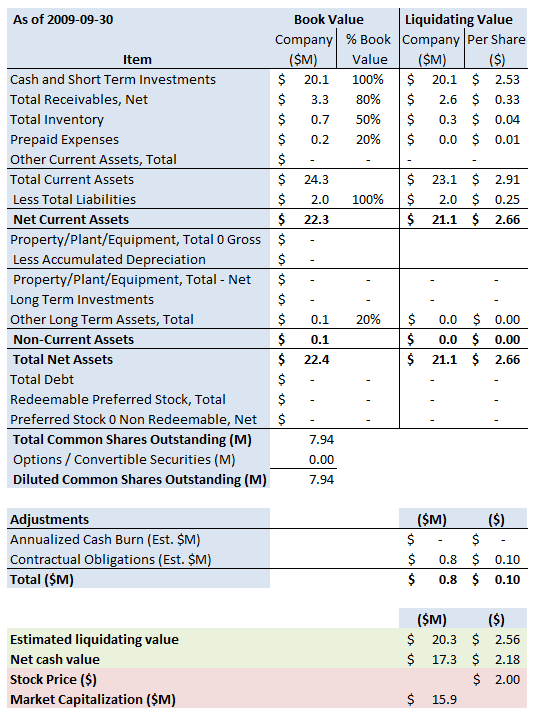
We started following FORD (see the post archive here) because it was trading at a discount to its net cash and liquidation values, although there was no obvious catalyst. Management appeared to be considering a “strategic transaction” of some kind, which might have included an “acquisition or some other combination.” I think a better use of the cash on the balance sheet is a share buy-back or a dividend. Trinad Management had an activist position in the stock, but had been selling at the time I opened the position and only one stockholder owned more than 5% of the stock. The stock is up 40.3% since I opened the position to close yesterday at $2.00, giving the company a market capitalization of $15.9M. Following my review of the most recent 10K, I’ve increased my estimate of FORD’s liquidation value to around $20.3M or $2.56 per share.

The value proposition updated

FORD continues to face difficult trading conditions, writing in the most recent 10K:

Trends and Economic Environment

We believe that the poor economy, high unemployment, tight credit markets, and heightened uncertainty in financial markets during the past two years have adversely impacted discretionary consumer spending, including spending on the types of electronic devices that are accessorized by our products. In response to the economic recession certain of our major diabetic case customers have significantly reduced their sales forecasts to us for blood glucose diagnostic kits, with which our products are packaged in box, therefore implying reduced sales revenues from these customers in future periods. We expect this challenging business environment to continue in the near term.

Our response to current conditions has been to cut operating expenses and reduce headcount; and we have attempted to limit increases in operating expenses except where we think increases are critical to potential future growth.

In response to increasing customer and sales concentration, we have focused marketing efforts on expanding our customer base. These efforts are meeting with some preliminary success, although the degree of success will not become apparent until we are deeper into Fiscal 2010. We have received small, initial orders from first time customers. The key question in Fiscal 2010 will be whether our overall net sales and net profit will primarily reflect revenue contribution from new customers or the decline in revenues from existing customers that have indicated reduced order flow in Fiscal 2010. See Part I, Item IA. of this Annual Report, “Risk Factors”, including “We have announced our intention to diversify our business by means of acquisition or other business combination.”

The company had another quarter that was better than the preceding one, generating positive cash from operating activities of around $0.35M (the “Book Value” column shows the assets as they are carried in the financial statements, and the “Liquidating Value” column shows our estimate of the value of the assets in a liquidation):

Summary balance sheet adjustments

I’ve made the following adjustments to the balance sheet estimates (included in the valuation above):

  • Cash burn: I’ve got no real idea about FORD’s prospects. It seems to have stopped burning cash over the last quarter and actually generated $0.35M. If we assume, as management has, that the company will face a tough operating environment over the next 12 months, I estimate that the company will generate no cash over that period.
  • Off-balance sheet arrangements: According to FORD’s most recent 10Q, it has no off-balance sheet arrangements.
  • Contractual obligations: FORD’s contractual obligations are minimal, totalling $0.8M.

Possible catalysts

FORD’s President and Acting Chairman, Mr. Doug Sabra, said in the letter to FORD shareholders accompanying the notice of annual shareholders’ meeting, that in 2008 “management began to implement operational and strategic initiatives in order to put [FORD]’s business on a stronger, more sustainable footing. …  This past August we retained an outside consultant to assist us in vetting possible partners for a strategic transaction.” It seems that the “strategic transaction” might include a “possible acquisition or other combination that makes sense in the context of [FORD’s] existing business, without jeopardizing the strong financial position that we have worked so hard to build.” My vast preference is for a sale of the company, buyback, special dividend or return of capital over an acquisition. Rather than spend the cash on their balance sheet, they should focus on the work on their desk and pay a big dividend.

Any sale transaction will require the consent of FORD’s board. While it has a free float of around 92%, the company’s so-called “Anti-takeover Provisions” authorize the board to issue up to 4M shares of “blank check” preferred stock. From the 10K:

Our Board of Directors is authorized to issue up to 4,000,000 shares of “blank check” preferred stock. Our Board of Directors has the authority, without shareholder approval, to issue such preferred stock in one or more series and to fix the relative rights and preferences thereof including their redemption, dividend and conversion rights. Our ability to issue the authorized but unissued shares of preferred stock could be used to impede takeovers of our company. Under certain circumstance, the issuance of the preferred stock could make it more difficult for a third party to gain control of Forward, discourage bids for the common stock at a premium, or otherwise adversely affect the market price of our common stock. In addition, our certificate of incorporation requires the affirmative vote of two-thirds of the shares outstanding to approve a business combination such as a merger or sale of all or substantially all assets. Such provision and blank check preferred stock may discourage attempts to acquire Forward. Applicable laws that impose restrictions on, or regulate the manner of, a takeover attempt may also have the effect of deterring any such transaction. We are not aware of any attempt to acquire Forward.

Conclusion

FORD is still trading at a substantial discount to its liquidation and net cash values. The risk to this position is management spraying the cash away on an acquisition. A far better use of the company’s cash is a buyback, special dividend or return of capital. Another concern is Trinad Management exiting its activist position in the stock. Those concerns aside, I’m going to maintain the position because it still looks cheap at a discount to net cash.

[Full Disclosure:  We have a holding in FORD. This is neither a recommendation to buy or sell any securities. All information provided believed to be reliable and presented for information purposes only. Do your own research before investing in any security.]

Read Full Post »

« Newer Posts - Older Posts »