Feeds:
Posts
Comments

Archive for the ‘Activist Investors’ Category

Biotechnology Value Fund (BVF) has filed its proxy material for the Special Meeting of Avigen, Inc. (NASDAQ:AVGN) stockholders. BVF want to replace AVGN’s board with BVF’s slate of director nominees who will support MediciNova, Inc.’s (NASDAQ:MNOV) offer for AVGN.

We’ve been following AVGN (see earlier posts here, here, here, here, here, here and here) because it’s a net cash stock (i.e. it’s trading at less than the value of its cash after deducting all liabilities) and specialist biotechnology activist fund BVF has been pushing it to liquidate and return its cash to shareholders. We think MNOV’s offer represents a clever way for AVGN’s stockholders to receive cash equivalent to that which they would receive in a liquidation (less $7M to be paid to MNOV) with the possibility for “an extraordinary, uncapped return” if MNOV is successful post-merger. We estimate AVGN’s cash at around $1.22 per share (BVF estimates $1.20 per share), which is a little less than 40% higher than AVGN’s $0.87 close yesterday.

BVF’s proxy material sets out the rationale for removing the incumbent directors:

The members of the BVF Group are currently the beneficial owners of an aggregate of 8,819,600 Shares, representing approximately 29.63% of the issued and outstanding common stock. As significant stockholders of Avigen, we have one goal: to maximize the value and minimize the risk on behalf of all stockholders. A brief synopsis of Avigen corporate history as well as our recent efforts to maximize stockholder value is summarized in the following chronology of events leading up to this proxy solicitation:

We first became a shareholder of Avigen in 2005, the year Avigen sold, for $12 million, its unsuccessful gene therapy business in which the Company had invested over $150 million. The Company, led by its current CEO, Ken Chahine, spent nearly two years running a “process” with the mandate to re-invent the Company by investing in whatever the current management team deemed compelling. In January 2006, this management team chose to acquire its lead development candidate, AV650, because, in their own words, “we believe it is a low risk.” In fact the Company’s entire strategy, then and now, is supposedly “designed to mitigate the risk of bringing innovative therapies to U.S. patients.” $100 million later, on October 21, 2008, Avigen announced the outright failure of its “low risk” bet on AV650, resulting in a collapse in the Company’s stock price. This same management team and Board, which has failed previously, now wishes to bet the substantial remaining shareholder capital on whatever it deems appropriate.

We recently acquired a significant number of Shares and became the largest stockholder of Avigen. We increased our investment in October 2008 based upon our belief that Avigen’s shares were significantly undervalued. In fact, Avigen reported $56 million, or $1.88 per Share, of financial assets as of September 30, 2008, consisting of cash, cash equivalents, available-for-sale securities and restricted investments, while trading at a price well below $1.00 during the two months prior to filing this proxy statement. We believe this depressed trading price, substantially below Avigen’s cash liquidation value, is based upon the market’s concern that management and the existing Board will pursue ill-advised or other value destroying ventures, at stockholders’ expense, while compensating themselves in the process.

Since this time, we have reached out to the Board numerous times, each time raising our concern that Avigen’s existing liquid assets not be wasted or otherwise committed to value destroying ventures.

We have specifically suggested that the Board “guaranty” the worst case outcome for all stockholders. This guaranty could be accomplished in several ways, including by dividending or distributing all excess cash to stockholders at the present time, or by offering to buy back any and all Shares from stockholders that wish to sell at a specific price at a specific future date (e.g. $1.25 per Share in December 2009). At no time have we asked for – nor would we accept – any consideration or benefit for ourselves that would not be offered to all stockholders.

The Board has ignored our attempts to work constructively for the benefit of all stockholders. Avigen responded to our offers by unilaterally increasing and broadening management’s “golden parachute” severance agreements and unilaterally adopting a “poison pill,” raising our concerns about this Board’s true intentions.

The Board’s “golden parachute” severance agreements with management, under the ridiculous justification that such payouts are necessary to “attract and retain key employees,” is particularly outrageous given Avigen’s current circumstances. Our analysis indicates that these payouts, which we believe would be triggered by most “change in control” scenarios, including a liquidation, total at least $3 million, an incredible 16.5% of the Company’s entire market value at the time of adoption. The recipients of these golden parachute arrangements include Avigen’s CEO, Ken Chahine, who resides in Park City, Utah, while the Company is based in California. We question how the Company can justify such actions as necessary to “attract and retain key employees” when Avigen has no real business at this time and has abandoned the development of all its products. These hastily adopted severance arrangements need to be challenged and, if possible, revoked.

In addition, we believe the Board’s implementation of the “poison pill” serves no purpose other than to entrench the Board and keep BVF from purchasing additional stock in the Company. We are concerned that management and Board members are more concerned with retaining their jobs and compensation than with maximizing stockholder value. As evidence, Avigen’s stock price fell more than 20% after the adoption of the poison pill. The pill should be redeemed. The Board’s recent actions reveal its true self-interest and leave us concerned that the Board will indeed destroy and/or take all remaining value.

On December 22, 2008, MediciNova, Inc. (“MediciNova”), a company in which we have no economic interest, proposed to merge with Avigen in an innovative and, we believe, compelling downside-protected structure. We believe the proposed merger is uncontrovertibly in the best interest of all stockholders and we had grave concerns that the Board may not negotiate in good faith with MediciNova, if at all. Avigen’s statements apparently rejecting this proposal confirmed our worst fears. We are concerned that the Board’s and management’s self-interest will prevent them from acting in what we believe to clearly be the best interests of all stockholders.

Accordingly, after much consideration we felt compelled to call this special meeting of stockholders to remove the existing directors and to elect new, truly independent directors who, if elected, will take actions to benefit all stockholders, including redeeming Avigen’s stockholder rights plan, working to consummate the proposed transaction with MediciNova and/or working to complete a distribution of Avigen’s assets to all stockholders.

[Full Disclosure: We have a holding in AVGN. This is neither a recommendation to buy or sell any securities. All information provided believed to be reliable and presented for information purposes only.]
Read Full Post »

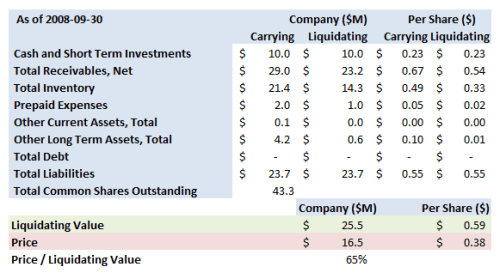
Network Engines Inc (NASDAQ:NENG) is a perennial inclusion on lists of net net stocks and so it should come as no surprise to see it back in net net land. In November 2007, an activist investor, Trinad Management, pushed the company to “immediately [implement] a share buy-back program.” The company demurred and has now seen its stock sink to all-time lows. In after-hours trading yesterday, NENG was up a little from those lows to $0.38 (it closed yesterday at $0.40), which gives it a market capitalization of $16.5M. We estimate its liquidation value at around 55% higher at $25.5M or $0.59 per share.

About NENG

NENG develops and manufactures application platform solutions that enable original equipment manufacturers, independent software vendors, and service providers to deliver software applications in the form of a network-ready device. The company offers application platform customers a suite of services associated with the design, development, manufacturing, brand fulfillment and post-sale support of these devices. It produces and fulfills devices for its customers, and derives revenues primarily from the sale of value-added hardware platforms to these customers. These customers subsequently resell and support the platforms under their own brands to their customer base. The company’s investor relations website can be found here.

The value proposition

NENG’s earnings and cash flow are patchy (its most recent 10K can be found here). Earnings have fallen in each of the last five quarters from $1.8M in the 2007 September quarter to -$9.7M in the 2008 September quarter. Cash from operating activities has been as high as $10.6M in the 12-months ending September 2007 and as low as -$5.4M in the preceding 12 months. As a result,   there is some vestigial value on the balance sheet (the “Carrying” column shows the assets as they are carried in the financial statements, and the “Liquidating” column shows our estimate of the value of the assets in a liquidation):

neng-summary

NENG has $29M in receivables that we’ve written down by 20% to $23.2M or $0.54 per share, inventory of $21.4M that we’ve discounted by 33% to $14.3M or $0.33 per share and cash in the amount of $10M or $0.23 per share. The company has no debt. Deducting liabilities of $23.7M or $0.55 per share, we estimate NENG’s liquidation value at around $25.5M or $0.59.

NENG’s most recent 10K specifically sets out that it is not party to any special-purpose or off balance sheet entities created for the purpose of raising capital, incurring debt or operating parts of its business that are not consolidated into its financial statements.

The catalyst

Trinad Management filed its original 13D in November 2007 disclosing a 6.4% holding in NENG and attaching the following letter to NENG’s board:

The Board of Directors Network Engines, Inc.
25 Dan Road
Canton, MA 02021
Dear Board Members:

We support Greg Shortell and the new management team at Network Engines and are encouraged by their accomplishments to date. We believe the focus of the sales and marketing efforts on diversifying the company’s customer base is yielding results and should allow for the continued generation of substantial free cash flow from operations.

Furthermore, we approve of management’s decision to acquire Alliance Systems, Inc. In our estimation, this acquisition should significantly increase shareholder value. It is our belief that the Company can realize increased sales through product portfolio expansion and cross selling opportunities. At the same time, synergies of the acquisition have provided Network Engines with the opportunity to significantly grow its business. The post-acquisition Network Engines should achieve economies of scale and will likely incur integration savings during FY 2008. The Alliance Systems acquisition and the shift in sales and marketing focus should result in an improved ability to successfully execute its business strategy.

Taking these positive events and Network Engines’ current and long term commitments into account, our financial analysis suggests that the Company currently has approximately $10 million in cash on its balance sheet and no funded indebtedness. In addition, our conservative projections indicate that the Company will generate an additional $10 million (or more) in free cash flow during the next 12 months. Accordingly, we strongly believe that this board and management has an obligation to dedicate a portion of its cash reserve and free cash flow to projects which have the greatest return to shareholders such as a share buy-back program. We request that the Board of Directors consider whether shareholder returns on other proposed uses of these excess funds are indeed superior to a share buy-back.

The Company’s stock hit a new 52 week low today (November 15, 2007) despite the impressive efforts and results posted by this management team. We appeal to the Board of Directors to consider immediately implementing a share buy-back program as it is in the best long-term interest of both the Company and its shareholders.

We believe that the Company is significantly undervalued and that a share buy-back program would improve investors’ overall perception of Network Engines’ equity value. Such a program could result in a reduction in the relative value discount currently applied to Network Engines’ stock by the investor community, by amongst other things demonstrating that this Board has confidence in the Company’s ability to execute its business plan. If the Board were to apply the same valuation metrics to its own stock as it did to the recently completed acquisition of Alliance Systems Inc., they would undoubtedly conclude that at these price levels the Company’s shares represent an equal or greater value than Alliance Systems. Most importantly, a smartly implemented buyback program could allow the company to materially reduce its number of outstanding shares thereby generating long term shareholder value in the most tax efficient manner. As a significant equity holder and long term investor, this is of far greater value then any short term impact to share price.

We encourage the Board of Directors and management to consider and adopt this strategy immediately and speak with other shareholders of the Company who may be equally frustrated and share our views. We would be willing to meet with the Board of Directors and work collaboratively to assist with the development of a long-term value creation plan that would benefit all shareholders.
Sincerely,

/s/ Jay Wolf
Trinad Management, LLC

Trinad Management continued to buy stock in NENG, disclosing in an amended 13D a slightly increased 6.98% holding in July last year.

Conclusion

As we mentioned in the introduction, NENG is a perennial net net stock. Jonathan Heller of Cheap Stocks-fame mentioned it back in October 2005 in a list of the Top 20 Market Cap Companies Trading Below Net Current Asset Value. It was then trading around $1.30 against a net current asset value of around $1.31. Investors buying back in October 2005 had plenty of opportunity to unload the stock at a profit while it traded up to $3.17 in March 2006. NENG’s stock has since dropped pretty consistently to its present $0.38, but its liquidating value has not fallen as far. At $0.59 per share, NENG’s liquidation value is 55% higher than its stock price, which is a significant margin of safety. We’re adding it to the Greenbackd Portfolio at $0.38.

NENG traded after hours yesterday at $0.38.

The S&P500 Index closed yesterday at 870.26.

[Full Disclosure:  We do not have a holding in NENG. This is neither a recommendation to buy or sell any securities. All information provided believed to be reliable and presented for information purposes only. Do your own research before investing in any security.]

Read Full Post »

Biotechnology Value Fund (BVF) has requested that the board of Avigen, Inc. (NASDAQ:AVGN) call a Special Meeting of the stockholders for the purpose of replacing the board with BVF’s slate of director nominees. BVF proposes to replace the incumbent directors with directors who will support MediciNova, Inc.’s (NASDAQ:MNOV) offer for AVGN.

We’ve been following AVGN (see earlier posts here, here, here, here, here and here) because it’s a net cash stock (i.e. it’s trading at less than the value of its cash after deducting all liabilities) and specialist biotechnology activist fund BVF has been pushing it to liquidate and return its cash to shareholders. We think MNOV’s offer represents a clever way for AVGN’s stockholders to receive cash equivalent to that which they would receive in a liquidation (less $7M to be paid to MNOV) with the possibility for “an extraordinary, uncapped return” if MNOV is successful post-merger. We estimate AVGN’s cash at around $1.22 per share (BVF estimates $1.20 per share), which is around 40% higher than AVGN’s $0.86 close Friday.

The proxy materials filed with the SEC attach the following press release:

Biotechnology Value Fund, L.P. Calls Special Meeting of Avigen Stockholders To Remove Incumbent Directors and Elect Slate of Stockholder-Focused Nominees

Friday January 9, 2009, 1:21 pm EST

Calls Special Meeting to Enable Stockholders to Determine Fate of Company’s Remaining Cash

Believes Transaction Proposed by MediciNova, Inc. Offers Avigen Stockholders Extraordinary Risk/Reward Opportunity

SAN FRANCISCO, Jan. 9 /PRNewswire/ — Biotechnology Value Fund, L.P. together with its affiliates (“BVF”) today announced that it has requested that the Board of Directors of Avigen, Inc. (“Avigen”) (Nasdaq: AVGN – News) call a Special Meeting of the stockholders for the purpose of replacing the Board with BVF’s slate of stockholder focused nominees. BVF is the beneficial owner of approximately 29.6% of Avigen’s outstanding common stock.

BVF proposes to remove the members of the Board and replace them with directors who will work to ensure Avigen’s stockholders receive the maximum value for their investment in Avigen, while minimizing both downside risk and corporate waste. If elected, BVF’s nominees intend to take steps that would benefit all stockholders, including redeeming Avigen’s stockholder rights plan, working to consummate the proposed transaction with MediciNova, Inc. (“MediciNova”) and/or working to complete a distribution of Avigen’s assets to all stockholders.

BVF has nominated four highly qualified nominees, Mark N. Lampert, Oleg Nodelman, Matthew D. Perry and Robert M. Coppedge, as its slate of director nominees to be elected at the Special Meeting to replace Avigen’s entire existing Board. Messrs. Lampert, Perry, and Nodelman are currently employed by the General Partner of BVF. Mr. Coppedge is an independent nominee, with no economic interest in BVF, Avigen, or MediciNova. Avigen’s bylaws provide that the Board shall set the date of the Special Meeting, which shall be held not less than thirty-five (35) nor more than one hundred twenty (120) days after the date of receipt of BVF’s request. The bylaws further provide that if the Board does not provide notice of the Special Meeting within sixty (60) days following receipt of the request, BVF may set the time and place of the meeting and give the notice.

“We are deeply concerned with recent corporate actions at Avigen that are indicative of a Board that seems far more interested in remaining in place to do whatever it pleases with corporate assets than in returning value and protecting downside risk for all stockholders,” stated Mark N. Lampert, the General Partner of BVF. “Given that Avigen’s stock trades at a fraction of its tangible assets, it appears the marketplace shares our concerns. Accordingly, by calling the Special Meeting, we are providing stockholders with the opportunity to elect new directors who are committed to ensuring that Avigen stockholders, not an entrenched and unsuccessful management team and Board, determine the fate of the substantial remaining value.”

Mr. Lampert continued, “In addition to the Board’s unilateral expansion of ‘golden parachute’ payments for management and its unilateral adoption of the ‘poison pill,’ we are also concerned with the Board’s apparent dismissal of the compelling transaction proposed by MediciNova. Based on our analysis, we believe the transaction, as proposed, provides benefits to stockholders that the Board and management could not match on its own. In particular, we believe this deal would provide Avigen stockholders with:

  • Downside Protection: Based on our analysis, subsequent to the transaction, if MediciNova is unsuccessful Avigen stockholders will receive a modest discount to the current liquidation value of Avigen (which we estimate to be approximately $1.20/Share, net of debt and expenses), as determined by an independent auditor. This means that, even in the worst-case scenario, this transaction would yield an approximate 40% premium to Avigen’s current stock price.
  • Tremendous Upside Potential: Based on our analysis, if MediciNova is successful post-transaction, Avigen stockholders could own a substantial percentage of MediciNova – approximately 45% of the combined company. Under the best-case scenario, this could lead to an extraordinary, uncapped return for Avigen stockholders.
  • Free Option: Additionally, stockholders would have at least one year following consummation of the transaction to choose whether they want the downside protection or upside potential, as described above. We believe this free option period offers stockholders tremendous upside potential with low risk.
  • New Stewardship of Avigen’s Assets: If successfully completed, the transaction would also result in new stewardship of Avigen’s assets, curtailing this Board’s and management’s stated plan of seeking ways to utilize and, we fear, waste Avigen’s remaining assets. We believe stockholder focused management, with a substantial personal stake in the company, is key to protecting Avigen’s assets, particularly in light of Chief Executive Officer Ken Chahine’s recent statements regarding the future of Avigen, including that “it’s hard to put a finger on exactly what we would do,” that he “intends to build” over the next year and that he “thinks that there are opportunities outside of therapeutics.”
  • Unique Synergies: We also strongly believe there are unique synergies between MediciNova and Avigen that likely would not exist with other potential acquirers of Avigen. These synergies, we believe, give rise to the compelling nature of the transaction.”

Mr. Lampert added, “For these reasons, we believe Avigen should seriously pursue the transaction with MediciNova, a company in which we have no economic stake. We are extremely concerned that this Board and management, who collectively own less than 6% of Avigen, do not share our views. It is our hope that stockholders who share our concerns will be empowered to voice these concerns by removing the current Board and replacing them with directors who are serious about maximizing value and minimizing risk for all stockholders.”

[Disclosure: We have a holding in AVGN. This is neither a recommendation to buy or sell any securities. All information provided believed to be reliable and presented for information purposes only.]
Read Full Post »

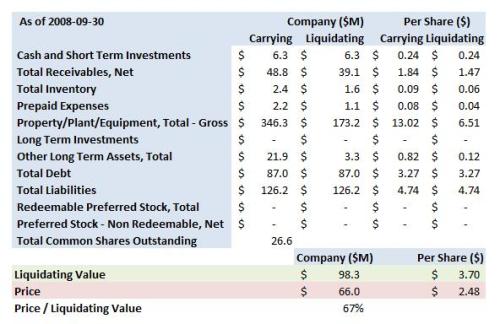
Multimedia Games Inc (NASDAQ:MGAM) is an undervalued asset play with two activist investors, Liberation Investment Group, which owns 8.7% of MGAM and has “urged the Company to retain an experienced investment bank to evaluate all strategic alternatives to maximize shareholder value and to expand the Company’s board of directors to include new independent directors who have strong industry backgrounds and are sensitive to shareholder concerns,” and Dolphin Limited Partnership, a formerly passive investor controlling 5.5% of the outstanding stock now seeking board representation. MGAM closed yesterday at $2.48, giving it a market capitalization of $66M. We estimate its liquidation value to be 50% higher at $98.3M, or $3.70 per share. The main risk to MGAM is the legal and regulatory environment. MGAM is involved in extensive litigation and its business operations and product offerings are subject to strict regulatory licenses, findings of suitability, registrations, permits and approvals.

About MGAM

MGAM is a supplier of interactive systems, server-based gaming systems, interactive electronic games, player terminals, stand-alone player terminals, video lottery terminals, electronic scratch ticket systems, electronic instant lottery systems, player tracking systems, casino cash management systems, slot accounting systems, slot accounting systems, slot management systems, unified currencies and electronic and paper bingo systems for Native American, racetrack casino, casino, charity and commercial bingo, sweepstakes, lottery and video lottery markets and provide support and services and operations support for MGAM’s customers and products. It designs and develops networks, software and content that provide its customers with, among other things, gaming systems, some of which are delivered through a telecommunications network that links its player terminals with one another, both within and among gaming facilities. MGAM’s investor relations website is here.

The value proposition

MGAM has been marginally cash flow positive for the last four years, generating good operating cash flow that seems to have been consumed in capital expenditures. That significant capital investment, while not reflected in earnings, still persists on the balance sheet (the “Carrying” column shows the assets as they are carried in the financial statements, and the “Liquidating” column shows our estimate of the value of the assets in a liquidation):

mgam-summary

MGAM’s value resides in its $346.3M in property, plant and equipment, which we’ve written down by half to $173.2M or $6.51 per share. The company also has healthy receivables in the amount of $48.8M, which we’ve discounted by a fifth to $39.1M or $1.47 per share. MGAM has a substantial debt load of $87M or $3.27 per share. Our estimate for its liquidation value is around $98M or $3.70 per share.

MGAM’s most recent 10K reveals that the company is particularly vulnerable to the legal and regulatory environment. Its business operations and product offerings are subject to strict regulatory licenses, findings of suitability, registrations, permits and approvals. It is also involved in extensive litigation to protect its intellectual property rights, or defend claims that it is infringing upon the intellectual property rights of others. The outcome of this litigation is unknown and unknowable. It is conceivable that much of the company’s value could be lost in the litigation or as a result of changes to the regulatory environment.

The catalyst

Two activist investors, Liberation Investment Group and Dolphin Limited Partnership, have declared holdings in MGAM. Dolphin Limited Partnership’s original 13D filing sets out its rationale for it amending its filing from a passive to an activist stance:

[Dolphin Limited Partnership] are long-term shareholders of [MGAM]. [Dolphin Limited Partnership] have visited [MGAM]’s facilities in Oklahoma, Austin, Texas and Mexico and have conversed in person and by teleconference with members of the Board and senior management. On numerous occasions, [Dolphin Limited Partnership] have expressed their views on the strategic, operational and financial issues facing [MGAM] and have actively encouraged efforts to maximize shareholder value. Specifically, [Dolphin Limited Partnership] have highlighted the necessity to more efficiently finance [MGAM]’s growth opportunities with its key customers and sought to provide assistance to [MGAM] in May, 2008 in optimizing its balance sheet.

[Dolphin Limited Partnership] believe that the lack of a coherent business strategy, poor execution and poor capital allocation have contributed to significant deterioration in shareholder value. Specifically, [Dolphin Limited Partnership] are deeply concerned by the following:

  • On September 30, 2008, the price for [MGAM]’s Shares closed at a level at which the Shares traded over eight years ago.
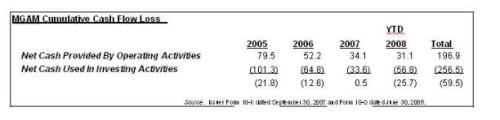
  • Since the beginning of fiscal 2005, [MGAM] has invested over $360 million (over 3x the current market capitalization of [MGAM]) on capital and other expenditures. In that time, a $59 million cumulative cash flow loss has contributed to the share price falling over 72%. (See Chart below).
  • Since the Board was reconstituted in October, 2006, the price of [MGAM]’s Shares has declined 54%, while comparable companies, on average, are down only just 7%1.
  • Since its high following the ill-fated Dutch-auction tender in June, 2007, the price of [MGAM]’s Shares has fallen 66% while comparable companies2, on average, are down considerably less.
  • At the current share price, [MGAM] is trading at just 2.1x Enterprise Value/2009 EBITDA,3 while comparable companies4 average 7.7x — a 73% discount.
  • At the current share price, [MGAM] is trading at just over its tangible book value per share of $4.22.

[Dolphin Limited Partnership] believe the Board of [MGAM] has failed to close the significant valuation gap for its long-term investors. In light of these significant concerns and the erosion of shareholder value and the share price, [Dolphin Limited Partnership] began requesting a change in senior level management in February, 2007. More than a year later, [MGAM] finally heeded [Dolphin Limited Partnership]’ calls and made a change in June, 2008.

[Dolphin Limited Partnership] look forward to hearing a Board approved, detailed strategic operating plan by the 2008 fourth quarter conference call addressing how [MGAM] intends to close the sizeable valuation gap for its shareholders. [Dolphin Limited Partnership] intend to continue to pay special attention to opportunities to make the current operations of [MGAM] more productive, efficient and profitable, as well as plans to grow the business, with prudent use of [MGAM]’s valuable equity capital. Sell-side analysts are forecasting as much as $45-$50 million in free cash flow for fiscal 2009 from the Winstar facility ramp-up, increased machine counts and notes receivable repayments. The Board faces critical decisions as to how best to deploy this inflow to maximize shareholder value.dolphin-13d

In light of the unacceptable financial performance highlighted in the chart above, [Dolphin Limited Partnership] believe a rigorous debate about proper capital allocation is required. Heretofore, the Board has followed a formula that has led to the destruction of shareholder value. [Dolphin Limited Partnership] are seeking Board representation because they understand the necessity of reversing this negative trend. As one of the largest shareholders, [Dolphin Limited Partnership] have a strong incentive to maximize shareholder value. Accordingly, in September, 2008, [Dolphin Limited Partnership] sent a letter to [MGAM] requesting consensual representation on the Board. [Dolphin Limited Partnership]’s representative(s) will be committed to working with the other members of the Board to evaluate all strategic and other alternatives to set [MGAM] on a path to maximizing shareholder value.

1 Comparable companies include IGT, WMS, BYI, ALL AU and SGMS.
2 See footnote 1.
3 Based on Bloomberg average analyst estimates. MGAM average analyst fiscal 2009 estimate of $73 million.
4 See footnote 1.

Liberation Investment Group now controls around 8.7% of MGAM’s outstanding stock. Liberation Investment Group’s original 13D filing attached the following letter to the board setting out its demands:

February 2, 2006

Mr. Clifton Lind
Chief Executive Officer
Multimedia Games, Inc.
206 Wild Basin Rd
Bldg B, Suite 400
Austin, Texas 78746

Dear Clifton:

As you know, Liberation Investments has been a shareholder in Multimedia Games for a year now. We believe the business has substantial value that isn’t reflected in its current stock price. In order to unlock this value for the benefit of all shareholders, we have developed several strategies which we have discussed with you on more than one occasion. We have also offered to introduce you to people with relevant expertise.

I met with you in September of 2005 at the G2E conference in Las Vegas. At that time, I gave you a presentation outlining three specific transaction alternatives which we believe would greatly enhance shareholder value. Shortly thereafter, an investment bank experienced in the gaming industry presented you with another potential option, which we believe would increase shareholder value. Despite our efforts to engage with you, you have not returned our calls since our meeting, except on one occasion when Randy Cieslewicz informed me that Multimedia’s Board would review the information we provided to you at its meeting during the first week of December 2005. Since then, we have not heard any feedback nor seen any progress.

We are disappointed by your lack of responsiveness, especially in light of Multimedia’s languishing stock price. It is currently trading below its levels of even four years ago. What’s more, we believe that Multimedia’s stock trades at a multiple that is significantly discounted to that of its industry peers.
Clearly, the company is not able to take full advantage of the public capital markets under these circumstances.

Now is the time to act. Multimedia must take real steps to boost shareholder value. The company should retain an experienced investment bank immediately to evaluate all strategic alternatives to maximize shareholder value. Furthermore, Liberation believes that you should add new members to the Board who have strong industry backgrounds and are sensitive to shareholder concerns. We have identified some potential candidates who are currently (or have previously been) licensed in major gaming jurisdictions, and would like to discuss with you the possibility of adding these qualified candidates to the Board.

If patient shareholders don’t see real progress quickly, you can be fairly certain that they will soon become frustrated shareholders who will demand progress. We have spoken to other large shareholders who are likewise disappointed by the performance of Multimedia’s stock and who we believe would be supportive of efforts to increase value through the execution of a strategic transaction.

Lastly, given that you have been aware of our interest in a strategic transaction for some time, we wonder why you have yet to file a proxy statement and schedule an annual meeting for 2006. The company’s amended annual report filed on January 30, 2006 provided no reason for missing the usual 120-day deadline. It has already been over a year since Multimedia filed its last proxy statement.

Liberation Investments is prepared to meet with the Board and/or the company’s financial advisors to further discuss the range of alternatives available to Multimedia and answer any questions about our presentation. Please feel free to call me to set up a meeting. As always, we remain committed to working with you to maximize value for all shareholders.

Very truly yours,

Emanuel R. Pearlman
Chairman and CEO

MGAM has now consented to Dolphin Limited Partnership’s nominee being appointed to the board, as the following letter from MGAM filed with Dolphin Limited Partnership latest 13D explains:

December 26, 2008

Dolphin Limited Partnership III, L.P.
156 W 56th Street
Suite 1203
New York, New York 10019
Attn: Mr. Justin Orlando
Vice President and Managing Director

Dear Mr. Orlando:

This letter is to confirm that the Nominating and Governance Committee of the Board of Directors (the “Board”) of Multimedia Games, Inc. (“MGAM” or the “Company”) has resolved to include your name with the Company’s slate of nominees for the Company’s Board of Directors at the Company’s upcoming annual meeting of stockholders, and to support your candidacy to the same extent as the candidacies of the other Company nominees. The Company’s Board of Directors has also unanimously approved this recommendation. The Company intends to hold its annual meeting on or about April 6th or 7th, 2009, and looks forward to your joining the Board at that time.

We would also like to invite you to attend our regularly scheduled meeting of the Board of Directors to be held telephonically on January 8th. We would ask that you and Dolphin Limited Partnership III, L.P. sign a standard confidentiality agreement in connection with your attendance at that meeting. Our counsel will provide a form to your counsel to review.

We look forward to your joining the board and working with you to build value for our stockholders.

Very truly yours,

Mike Maples, Chairman of the Board

Liberation Investment Group’s most recent 13D filing seems to suggest that it is liquidating its position in MGAM by distributing to its investors its proportionate share of MGAM stock.

Conclusion

At $2.48, MGAM is trading at two-thirds of our $3.70 per share estimate of its liquidation value. With Dolphin Limited Partnership’s nominee being invited to join the board, it seems that the chances of the company henceforth taking shareholder-friendly steps are good. The main risk to MGAM remains the legal and regulatory environment, with legal proceedings threatening much of the company’s value. Without knowing the detail of the litigation beyond what is disclosed in the financial statements, it is impossible to handicap the company’s chances. At these levels, we still think that MGAM is a worthwhile investment, but we will watch closely any and all developments in its various legal proceedings.

MGAM closed yesterday at $2.48.

The S&P500 Index closed yesterday at 909.73.

[Disclosure:  We do not have a holding in MGAM. This is neither a recommendation to buy or sell any securities. All information provided believed to be reliable and presented for information purposes only. Do your own research before investing in any security.]

Read Full Post »

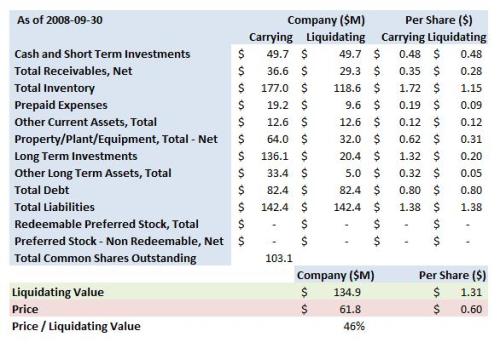
Axcelis Technologies Inc (NASDAQ:ACLS) is a new addition to the Greenbackd Portfolio at its $0.60 closing price yesterday. ACLS is an undervalued asset play with an activist investor, Sterling Capital Management, holding 10.7% of its outstanding stock. At $0.60, the company has a market capitalization of $61.8M. We estimate that its liquidating value is more than 110% higher at $134.9M, or $1.31 per share. The caveat? The company is making substantial operating losses that have widened over the last five quarters, prompting Sterling Capital Management to detail to ACLS management an aggressive restructuring strategy to salvage for stockholders what value remains.

About ACLS

ACLS designs, manufactures and services ion implantation, dry strip and other processing equipment used in the fabrication of semiconductor chips. In addition to equipment, ACLS provides aftermarket service and support, including spare parts, equipment upgrades, maintenance services and customer training. The company owns 50% of SEN Corporation (SEN), a producer of ion implantation equipment in Japan. SEN licenses technology from ACLS  for certain ion implantation products and has exclusive rights to market the licensed products in Japan. The investor relations website is here.

The value proposition

The last five quarters have not been kind to ACLS, with the company generating substantial and increasing operating losses in each, reaching a $22.8M nadir for the September quarter (see the Q3 10Q here). At present, some value remains on the balance sheet (the “Carrying” column shows the assets as they are carried in the financial statements, and the “Liquidating” column shows our estimate of the value of the assets in a liquidation):

acls-summary1

ACLS’s liquidating value is predominantly carried in its $177M in inventory, which we’ve written down by a third to $119M or $1.15 per share, and its long term investment in $136M SEN, which we’ve written down by 80% to $20.4M or $0.20 per share. The company has around $49.7M or $0.48 per share in cash and a further $12.6M or $0.12 per share in restricted cash. The company also has around $36.6M in receivables, which we’ve discounted by a fifth to $29.3M or $0.28 per share. Deducting the $1.38 per share in liabilities (including $0.80 per share in debt) leaves a value in liquidation of around $134.9M or $1.31 per share.

The catalyst

Sterling Capital Management has been in regular contact with ACLS since acquiring its original stake in October 2007. They began communicating with ACLS in November of that year, “[encouraging] management and the board of directors to move forward on several actions designed to enhance shareholder value” including “[hiring] an investment banking firm to solicit interest for a minority, majority, or strategic investment in [ACLS].” (See the full text of Sterling Capital Management’s first letter to ACLS here.)

In February 2008, Sterling Capital Management again pushed ACLS to “immediately hire an advisor and fully explore strategic alternatives.” When Sumitomo Heavy Industries (SHI), ACLS’s SEN joint venture partner, offered to acquire ACLS for $5.20 per share, Sterling Capital Management wrote:

We strongly encourage [ACLS]’s Board to fully engage SHI and work to determine if a combination is appropriate. Further, we also would expect the Board and its advisors to solicit interest from other parties that might have a desire in partnering with [ACLS].

In a subsequent February 2008 letter, Sterling Capital Management argued that the initial bid of $5.20 per share for ACLS was “clearly too low,” writing:

Even with strong industry headwinds and lack of traction to-date, it is appropriate to value [ACLS] assuming some modest level of Optima success. Our analysis would indicate that a fair price for [ACLS] under this scenario would approximate $7.00 to $7.50 per share.

When SHI increased its offer to $6.00 per share, Sterling Capital Management wrote in March 2008:

[It] would appear that we are no closer to achieving an open dialogue between Axcelis and SHI.

We are concerned that the Board and its advisors are utilizing overly optimistic assumptions regarding Optima’s ultimate market share gains and consequently embracing an intrinsic value which is not achievable.

Sterling Capital Management argued in a May 2008 letter that the failure of nominated directors at ACL’s Annual Meeting of Stockholders to receive a majority of the shareholder vote in support of their re-election demonstrated shareholders’ “discontent with the failure of the Board to fully engage SHI in negotiations that could ultimately lead to a transaction that fairly values our company.” Clearly growing frustrated with ACLS, Sterling Capital Management wrote:

Rather than battling your shareholder base, we encourage you and the Board to embrace the steps necessary to drive shareholder value via a transaction with SHI.

In Sterling Capital Management’s most recent 13D filing they write:

We believe that [ACLS] management is making good progress in addressing the company’s short term financing issues. Further, the recently announced restructuring effort should assist the company in weathering an environment of continued weak spending However, given the highly cyclical nature of the semiconductor capital equipment market, it is imperative that management actively explore all opportunities to better position [ACLS] for long term success and creation of shareholder value. As such, Sterling Capital has communicated to management of [ACLS] a concept of separating its systems business from the more stable aftermarket business. In addition to separating cyclical from non-cyclical businesses, this initiative would allow for efficient utilization of the cash currently residing on SEN’s balance sheet and the tax benefits associated with extensive NOLs at [ACLS].

Sterling Capital Management also attached their most recent letter to ACLS (reproduced below):

Ms. Mary Puma
Chairman and CEO
Axcelis Technologies, Inc.
108 Cherry Hill Drive
Beverly, MA 01915-1053

Dear Mary,

These are certainly unprecedented times which we all are trying to navigate through. We appreciate the focus and effort the entire team at Axcelis has demonstrated during the current environment. However, given the challenges facing the company, we would strongly encourage Axcelis to embrace an altered strategy which would produce both immediate and long term value for all constituents.

The initiative described below attempts to utilize all of the many resources and assets that Axcelis claims which clearly are not being recognized by the public markets. Further, we believe that the ultimate corporate structure it defines provides a more appropriate division between
cyclical and stable businesses.

Please consider:

o In March of 2008 SHI made an offer to purchase all of Axcelis’ outstanding shares for $6 per share or approximately $618 million dollars. Combined with debt on the balance sheet of Axcelis the total offer equated to $700 million. Through direct conversations with SHI and public documents it was clear that the motive behind this transaction was to consolidate the ion implant business of both Axcelis and SEN. Such a combination would yield significant cost synergies as well as enhanced product offerings.

The plan outlined below would allow SHI to achieve their initial goal, resolve short and long term financial challenges at Axcelis, and importantly create significant value for shareholders.

o Axcelis sells its implant/ dry strip systems business along with its 50% interest in SEN to SHI for $136 million. This figure approximates the book value of the SEN investment on Axcelis’ balance sheet. Importantly, such a price tag would require minimal net cash outlays by SHI as this transaction would give them immediate access to the entire $140 million of net cash currently on the books at SEN. SHI would have the ability to merge these operations and garner the synergies available.

o Axcelis Corporation would become solely focused on the aftermarket business which would include exclusive rights for SEN/Axcelis legacy accounts. The aftermarket business generates approximately $120 million in annual revenue and claims gross margins in excess of 50%. If properly sized such a business should be able to produce operating margins near the 20% level.

o Axcelis would retain existing NOLs which total $150 million and could then be applied to the operating profits generated by the aftermarket business. These NOLs could be fully utilized as no change of control event would be triggered.

o After repayment of the $85 million of debt the newly restructured Axcelis would have net cash of approximately $100 million. Given the low capital intensity of the aftermarket business and its relative stability, at least $50 million of this cash could be used for share repurchases. Assuming an average repurchase price of $1.50 per share Axcelis could retire 33 million shares.

o The new Axcelis would have approximately 70 million shares outstanding (after repurchases) and be generating $0.30 in eps. Applying a 10X multiple on this business would equate to a stock price of $3 per share. Revenue and earnings could grow at the new Axcelis as the market rebounded and SEN proved successful expanding its market share.

o The new Axcelis would have additional assets including net cash of $50 million and an unencumbered headquarters/ property which was recently appraised at almost $60 million.

Clearly, the above scenario is very different than the outcome we had all hoped for just a few months ago. However, there is no question that the world has changed and that looking forward and embracing the altered landscape is a prerequisite for future success. We hope that the Board might give full consideration to our proposal and we look forward to continuing to work with you in moving Axcelis forward.

Sincerely,
STERLING CAPITAL MANAGEMENT LLC
Brian R. Walton, CFA
Managing Director

Conclusion

At its $0.60 closing price yesterday, ACLS is trading at less than half of our estimate of its $1.31 per share value in liquidation. Its substantial and widening operating losses over the last five quarters have led management to make some efforts to restructure, which Sterling Capital Management believes will help ACLS in “weathering an environment of continued weak spending.” The company has thus far resisted Sterling Capital Management’s efforts to have ACLS negotiate with SHI or another bidder. Sterling Capital Management appears tenacious and so we think they may be able to persuade ACLS to create significant value for stockholders. With a downside limited by its presently substantial value in liquidation, we think ACLS is worthy addition to the Greenbackd Portfolio.

ACLS closed yesterday at $0.60.

The S&P500 Index closed yesterday at 906.65.

[Disclosure:  We don’t have a holding in ACLS. We have now acquired a holding in ACLS. This is neither a recommendation to buy or sell any securities. All information provided believed to be reliable and presented for information purposes only. Do your own research before investing in any security.]

Read Full Post »

InFocus Corporation (NASDAQ:INFS) has just announced that its board has amended INFS’s bylaws and adopted what it euphemistically calls a “Shareholder Rights Plan.” The company’s press release reads:

Effective today, if any person or group acquires 15 percent or more of the voting power of the Company’s outstanding common stock without the approval of the Board of Directors, there would be a triggering event causing significant dilution in the voting power of such person or group. The Plan may be terminated by the Board at any time.

In what is clearly a response to Nery Capital upping its INFS stake to 12.2% of the oustanding stock, one “right” will be distributed for each share of INFS common stock outstanding as of the close of business on January 18, 2009. In the press release, Bob O’Malley, INFS’s CEO, says:

The amendment to our Bylaws and the adoption of a Shareholder Rights Plan will help ensure that the previously appointed independent committee of our Board of Directors is able to conduct its review of strategic alternatives without the threat of coercive takeover or control tactics that do not offer shareholders a fair premium. Neither the Plan, nor the amendment to our Bylaws is intended to prevent an offer that the Board concludes is in the best interest of [INFS] and its shareholders.

INFS’s adoption of the poison pill is a disappointing step for management to take. Calling this thing a “Shareholder Rights Plan” is pretty galling when its effect is to take rights away from shareholders and deliver them to management. The suggestion that the board are the ones to determine what is “in the best interest of [INFS] and its shareholders” and how much of a premium is “fair” is just a joke given the level at which INFS’s stock languishes. We also  have a problem with the use in the press release of such emotive language (“the threat of coercive takeover or control tactics”).

We’ve been following INFS because it is a deeply undervalued asset situation with two activist investors, Nery Capital and Lloyd I. Miller, III, pushing the company to “improve [INFS]’s financial condition and increase shareholder value” (see our first post here). The company’s adoption of a poison pill is a negative development for stockholders. Hopefully it is not a precursor to management handing the company to the second potential bidding group, which includes INFS’s founder Steve Hix, because they don’t want to see it fall to the “New York sharks.” INFS management has now set itself a high bar for the “review of strategic alternatives.”

Perhaps INFS management has read an early copy of the magazine Corporate Board Member’s January issue titled “How to Icahn-proof your board.”

Head nod to commenter Chad, who seems to be doing most of the heavy lifting around here while we’re asleep at the wheel.

Read Full Post »

Nery Capital has increased its holding in InFocus Corporation (NASDAQ:INFS) according to its most recent 13D amendment filed January 5 this year.  Nery Capital now controls 12.2% of INFS’s outstanding stock, up from 11.2% at its last filing on December 5, 2008.

We’ve been following INFS because it is a deeply undervalued asset situation with two activist investors, Nery Capital and Lloyd I. Miller, III, pushing the company to “improve [INFS]’s financial condition and increase shareholder value” (see our first post here). A second potential bidding group, including INFS’s founder Steve Hix, emerged last year to fend off the “New York sharks,” and we think that is a positive development for stockholders (see our last post here).

INFS is up 28.6% to $0.81 since we started following it, but we see the liquidating value 42% higher at $1.15 per share, so we will continue to hold it.

Read Full Post »

The Official Activist Investing Blog has published its list of activist investments for December (the investments with links are to our latest update at the time of this post):

Ticker Company Name Activist Investor
ACLS Axcelis Technologies Inc Sterling Capital
AEPI AEP Industries KSA Capital
ARS Arris Group Shamrock Activist Value fund
ATML Atmel Corp. Microchip Technology
AVGN Avigen Inc Biotechnology Value Fund
BCSB BCSB Bancorp Financial Edge Fund
BIOD Biodel Inc Moab Partners
CAMD California Micro Devices Corp Dialectic Capital Management
CKEC Carmike Cinemas Mark Cuban
CPWM Cost Plus Stephens Investment Management
CRXX CombinatoRX, Incorporated Biotechnology Value Fund
CTO Consolidated Tomoka Land Co Wintergreen Advisers
DANKY Danka Business Systems PLC DCML LLC
DDS Dillard’s Inc. Barington Capital; Clinton Group
DIN DineEquity Inc Southeastern Asset Management
DPS Dr Pepper Snapple Group Trian Fund
DUSA DUSA Pharmaceuticals SRB Management
DVD Dover Motorsports GAMCO
ESIO Electro Scientific Industries Nieremberg Investment Management
FIC Fair Isaac Corp Sandell Asset Management
FSFG First Savings Financial Group Joseph Stilwell
GGP General Growth Properties Pershing Square Capital
GLOB.OB Global Med Technologies Victory Park Capital
HIFN Hifn, Inc Adaptec, Inc
ICGN ICAgen, Inc Xmark Opportunity Partners
INFS InFocus Corp Nery Capital Partners
ITP Intertape Polymer Group KSA Capital Management
JAVA Sun Microsystems Southeastern Asset Management
JTX Jackson Hewitt Tax Service Shamrock
KANA.OB Kana Software KVO Capital Management
KFS Kingsway Financial Services Joseph Stilwell
KONA Kona Grill Mill Road Capital
LAQ The Latin America Equity Fund City of London Investment Management Co
LCAV LCA-Vision Inc. Stephen Joffe
MAG Magnetek Inc Riley Investment Management
MATH.PK Mathstar, Inc Salvatore Muoio; Zannet Opportunity Fund
MGAM Multimedia Games Dolphin Limited Partnership
MGLN Magellan Health Services Shamrock
MOVE Move Inc. Nierenberg Investment Management
MVCO Meadow Valley Corp Carpe Diem Capital
NDD Neuberger Berman Dividend Advantage Fund Western Investment
NTMD Nitromed Inc Deerfield Capital
OFIX Orthofix International Ramius Capital;
OPTV OpenTV Corp. Discovery Equity Partners
ORNG Orange 21 Costa Brava Partnership
PHMD PhotoMedex, Inc. James Sight
PIF Insured Municipal Income Fund Bulldog Investors
PPCO PenWest Pharmaceuticals Perceptive Advisors
PRXI Premier Exhibitions, Inc Sellers Capital
RDC Rowan Companies Steel Partners
RHIE RHI Entertainment Baupost Group
RIVR River Valley Bancorp Davee Thomas
SLRY Salary.com Cannell Capital
SLTC Selectica, Inc Versata
SUG Southern Union Co Sandell Asset Management
SUTM.OB Sun-Times Media Group Inc. K Capital
TIER Tier Technologies Inc Discovery Equity Partners
TLGD Tollgrade Communications Inc Bradford Capital
TMI TM Entertainment & Media Bulldog Investors
TRGL Toreador Resources Nanes Delorme Partners
TRMA Trico Marine Kistefos AS
TXCC TranSwitch Corp Brener International Group
TXI Texas Industries Southeastern Asset Management
WBSN Websense Inc Shamrock
WEDC White Electronic Designs Corp Wynnefield Capital
WOC Wilshire Enterprises Bulldog Investors
WRLS Telular Corp Simcoe Partners

Read Full Post »

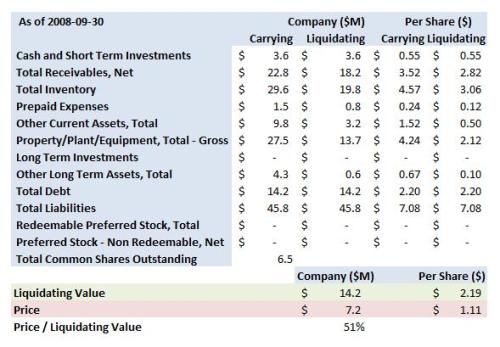
Cobra Electronics Corporation (NASDAQ:COBR) is another tiny undervalued asset play with an activist investor – Howson Tattersall Investment Counsel Limited – disclosing a 10% holding in its 13D notice filed September 24 last year. At its $1.11 close yesterday, COBR has a market capitalization of just $7.2M. We estimate that its liquidating value is almost 100% higher at $14.2M or $2.19 per share and the first new addition to the Greenbackd Portfolio for 2009.

About COBR

COBR is a designer and marketer of two-way mobile communications products in the United States, Canada and Europe. The Company has seven product lines: two-way radios, radar detectors, Citizens Band radios, power inverters, mobile navigation, marine consumer electronics, and photo-enforcement and safety detection. The company’s investor relations website is here.

The value proposition

COBR has generated mildly positive earnings for the last three quarters but has generally lost money since 2006. As always, there is some value on the balance sheet (the “Carrying” column shows the assets as they are carried in the financial statements, and the “Liquidating” column shows our estimate of the value of the assets in a liquidation):

cobr-summary

COBR’s value in liquidation is predominantly in its $22.8M in receivables, which we have discounted by a fifth to $18.2M or $2.82 per share, and $29.6M in inventory, which we value at $19.8M or $3.06 per share. The other source of value on the balance sheet is COBR’s $27.5M property, plant and equipment, which we’ve written down by half to $13.7M or $2.12 per share. COBR has $14.2M in debt and other substantial liabilities in the amount of $45.8M or $7.08 per share. Deducting COBR’s liabilities from its written down asset value, we estimate COBR’s liquidating value at around $14.2M or $2.19 per share, which is 97% higher than its $1.11 close yesterday.

The catalyst

Howson Tattersall Investment Counsel Limited’s 13D notice filed September 24, 2008 discloses a 10% holding in COBR but little else – it adopts the standard boilerplate in its filing. Howson Tattersall’s website does discuss its equity investment philosophy:

Our equity investment process is based on value investing because it provides a consistent, statistically grounded approach to the analysis of investment opportunities.

After narrowing the universe of potential investments to companies with attractive quantitative factors, we undertake independent qualitative research, which is at the core of our selection process. This involves reviewing financial statements and meeting with company management.

Conclusion

While its earnings record is spotty, with a $2.19 liquidating value some 97% higher than its closing price yesterday, COBR is very cheap. We can’t divine Howson Tattersall’s modus operandi from its public documents, which makes it difficult to determine its effectiveness as a catalyst. This doesn’t concern us too much as COBR’s steep statistical discount to its value should provide downside protection which will leave the upside to take care of itself.

Take care to use limit orders if you propose to trade in COBR as the stock is very thinly traded.

COBR closed yesterday at $1.11.

The S&P500 Index closed yesterday at 927.45.

[Disclosure:  We don’t have a holding in COBR. This is neither a recommendation to buy or sell any securities. All information provided believed to be reliable and presented for information purposes only. Do your own research before investing in any security.]

Read Full Post »

A new investor has filed a 13D notice in relation to MathStar Inc (OTC:MATH).

When we started following MATH, it had a market capitalization of just $6.2M based on its December 16, 2008 close of $0.68. We estimated its liquidating value to be more than 120% higher at $14.4M or $1.57 per share. The value in liquidation was predominantly cash and short term investments in the amount of $14.8M. The board had largely suspended the company’s operations and was in the process of evaluating its “strategic alternatives, which could include merger, acquisition, increasing operations in another structure or liquidation.”  MATH had twice rejected unsolicited merger proposals and Salvatore Muoio of S. Muoio & Co. LLC had been urging MATH’s board to consider liquidation rather than a merger.

Mr. Zachary McAdoo on behalf of The Zanett Group – the new investor entering the fray at MATH – filed its 13D notice on December 30, 2008 and attached the following letter to the company:

December 30, 2008

Douglas Pihl
Chairman of the Board
Mathstar, Inc.
19075 NW Tanabourne, Suite 200
Hillsboro, OR 97124

Dear Mr. Pihl,

I am writing to express my opinion as a shareholder that we strongly urge the
Board to liquidate Mathstar, Inc. rather than acquire another company.

Sincerely,

Zachary McAdoo, CFA

Short, sweet and to the point. Hopefully management can hear the drum beats calling for liquidation.

MATH is up around 18% since we started following it, but it’s still trading at half its liquidating value and a little more than half its net cash backing, so we’re maintaining our position.

[Disclosure: We do not presently have a holding in MATH. This is neither a recommendation to buy or sell any securities. All information provided believed to be reliable and presented for information purposes only.]
Read Full Post »

« Newer Posts - Older Posts »