Feeds:
Posts
Comments

Archive for the ‘Carl Icahn’ Category

In Icahn Takes On Kerkorian in Big Las Vegas Showdown (subscription required), The Wall Street Journal reports that Carl Icahn has built a large position in the bonds of MGM MIRAGE (NYSE:MGM) and is pushing it to restructure in bankruptcy court. MGM is struggling to service approximately $14B in debt and fund payments on its $8.6B City Center project in Las Vegas. MGM is controlled by billionaire Kirk Kerkorian, who holds about 53% of MGM valued at approximately $900M (down from ~$15B in late 2007). Kerkorian’s stake would be wiped out in a bankruptcy filing, which gives secured debtholders priority over stockholders in relation to assets.

It’s an interesting play for Icahn. The WSJ reports that he and Oaktree Capital Management hold a “little less than $500M” face value of MGM bonds out of approximately $7B of the non-bank debt. According to the WSJ, Icahn has little leverage now, but that could change as the bonds fall due:

When MGM Mirage bonds come due in July and October, the bondholders could force a filing if the company is unable to make those payments. Or, if MGM Mirage were to try to tender an offer to repurchase its bonds to lighten its debt load, they could also block that move. “Right now, it is just, sit back and wait,” said a person familiar with the matter. “The company is in a jam.”

The WSJ reports that the company has some unusual debt:

Its $7 billion in bank debt isn’t secured by the kind of assets typically used as collateral, meaning banks can’t foreclose on any of it (sic) properties. Those properties are still generating cash and stand to see strong profits if the economy improves.

MGM’s bank lenders have two reasons to help it avoid bankruptcy: 1. A bankruptcy filing would put the banks “on par with bondholders, leaving the two groups to battle over the assets,” and 2. MGM can still offer its properties as collateral to the banks and so improve their position relative to the bondholders.

The WSJ says that Icahn and Oaktree aren’t working together and their strategies aren’t yet clear:

They could be angling for equity in the company inside or outside bankruptcy. They could also be after some of MGM Mirage’s storied casino assets or simply want to ride out a bankruptcy with the bet that the bonds will recover far more than it cost to purchase them.

If MGM Mirage tried to buy up those bonds, then Mr. Icahn and Oaktree could block such steps.

But the move could blow up on Mr. Icahn and Oaktree if the company is able to avoid bankruptcy or it cuts deals with bank lenders and provides them liens on MGM Mirage’s assets, which could depress the recovery rates for MGM Mirage bonds.

It’s an interesting situation, and one we’re going to watch closely. Hunter over at Distressed Debt Investing says “MGM bondholders are licking their chops about a possible debt for equity exchange” and is looking to build a MGM bond valuation model. We’ll let you know how he goes.

Read Full Post »

In his blog, The Icahn Report, Carl Icahn argues in a new post, It’s Up to the Shareholders, Not the Government, to Demand Change at a Company, that “shareholders have been complicit in allowing management excesses and incompetence by not taking a stand.” Nell Minnow, editor and co-founder of the Corporate Library, agrees:

Shareholders have reelected these directors, have approved these pay plans and have been enablers for the addictive behavior of the corporate community.

Icahn asks, “Why should investors tolerate poor performance? Why should taxpayers?”

I have shaken up boards and managements at many companies in which I have invested, including Blockbuster, ImClone, Stratosphere, Philips Services, Federal-Mogul and many others. Generally, but not always, the net result has been very positive for the company and the shareholders. It is important to get new blood, new strategies and new ideas into underperforming companies.

Icahn laments the fact that it took a “force the size of the U.S. government” to change the board and management at General Motors Corporation (NYSE:GM):

In effect, the government has become the world’s biggest activist investor, making the same kinds of demands that any activist or creditor should rightfully make in return for its investment.

He concludes that he hopes that the “global economic meltdown” results in shareholders demanding more of their companies and not leaving it to the government.

Read Full Post »

In an opinion piece for the New York Times titled, We’re Not the Boss of A.I.G., Carl Icahn argues that the legal “devices” that disenfranchise shareholders “can be found at the root of today’s financial crisis:”

The legal landscape is filled with devices designed by state legislators and courts to prevent shareholders from influencing how companies are run and so allow management free rein. Legal mechanisms known as poison pills, permitted under the laws of most states, effectively prohibit shareholders from accumulating a large position in a company or working with other large shareholders to influence the company.

Furthermore, public corporations may legally adopt a staggered board, whereby board members are grouped into classes, with each one representing about a third of the total number of directors, so that only one class comes up for election in a year.

This means that seriously shaking up a board would require at least two very expensive proxy contests over two years. And current state laws permit incumbent board members access to the corporate treasury, allowing them to spend millions of dollars, to hire lawyers and public relations firms, run ads and mail materials to prevent shareholders from adding their designees to the board of directors.

One problem identified by Icahn is complex “advance notice” requirements that enable companies to derail efforts to elect shareholder-nominated board members:

Although a majority shareholder like the government may be able to get its nominees onto the A.I.G. board without a fight, typically even a large shareholder must conduct an expensive proxy contest to elect its nominees – that is, he needs to solicit enough votes from other shareholders. This is accomplished by mailing a statement describing the shareholder’s positions, and a card on which to vote. At a large public company, mailing, printing and other costs can run into the millions of dollars.

Icahm has a typically straight-forward solution to the problem:

Those costs could be reduced, and the election process could be made more open, if the Securities and Exchange Commission would allow “proxy access.”

Proxy access would permit shareholders to solicit votes for the election of their nominees by including the names and other relevant information about those nominees in their company’s annual proxy statement, and thus save the cost of sending additional documents. But so far the S.E.C. has said no to proxy access for the election of directors nominated by shareholders, though its new chairwoman, Mary Schapiro, said on Thursday that the commission will take up the issue in the coming months.

Echoing his thoughts in an earlier essay published in the Wall Street Journal, Icahn also argues that allowing shareholders to vote by simple majority to migrate a company from its state of incorporation to more shareholder-friendly states would stop many of the abuses:

With some exceptions, our public corporations are increasingly unable to compete globally, they pay excessive compensation to top brass and they are generally unaccountable to shareholders. The best hope to change this situation is to allow shareholders the power to move the state of incorporation of public companies from one state to another. For example, North Dakota passed a law in 2007 that, among other things, provides for proxy access and for the reimbursement of expenses to a shareholder who runs a successful proxy fight. A move to North Dakota would greatly advance shareholder rights for any company.

But under current state law shareholders can elect to move their company to another jurisdiction only if the existing board of directors approves such a move — and those incumbent boards will want to stay in the management-friendly states they already inhabit.

Federal legislation could correct this absurdity and permit shareholders to move the corporations they own to another state by a simple majority vote. Such legislation would override the restrictions of state laws that prevent such a change of jurisdiction unless approved by the board of directors. Most important, it would encourage the states, which profit from the tax revenues that flow from corporations, to compete with one another by reorienting their laws on corporate governance to benefit shareholders.

According to Icahn, a possible silver lining to the A.I.G. mess is that it will “alert Washington to the lamentable state of corporate governance in America:”

Our legislators will find – as I have as a shareholder who has waged many battles to get on corporate boards – that the rights of the shareholders are quite circumscribed.

It is time to remove the many devices that managements use to entrench their power, and give shareholders real power. The “ownership” rights that the government, as a shareholder, is now talking about are the same ones that activist shareholders have been demanding for years.

Read Full Post »

Carl Icahn contributed an article to the Wall Street Journal on President Obama’s plan to limit executive pay to $500,000 a year plus restricted stock for institutions that receive government funding. Icahn argues that while the response is “understandable,” the salary cap fails to address the root cause of the problem:

The real problem is that many corporate managements operate with impunity — with little oversight by, or accountability to, shareholders. Instead of operating as aggressive watchdogs over management and corporate assets, many boards act more like lapdogs.

Despite the fact that managements, albeit with some exceptions, have done an extremely poor job, they are often lavishly rewarded regardless of their performance.

Icahn goes on to explain that the problem is that boards and managements are entrenched by state laws and court decisions that “insulate them from shareholder accountability and allow them to maintain their salary-and-perk-laden sinecures.” He proposes a federal law that allows shareholders to vote by simple majority to migrate the company from its state of incorporation to more shareholder-friendly states. This power is currently vested in boards and management:

This move would not be a panacea for all our economic problems. But it would be a step forward, eliminating the stranglehold managements have on shareholder assets. Shouldn’t the owners of companies have these rights?

Now some might ask: If this policy proposal is right, why haven’t the big institutional shareholders that control the bulk of corporate stock and voting rights in this country risen up and demanded the changes already?

This is because many institutions have a vested interest in supporting their managements. It is the management that decides where to allocate their company’s pension plans and 401(k) funds. And while there are institutions that do care about shareholder rights, unfortunately there are others that are loath to vote against the very managements that give them valuable mandates to manage billions of dollars.

This is an obvious and insidious conflict of interest that skews voting towards management. It is a problem that has existed for years and should be addressed with new legislation that benefits both stockholders and employees, the beneficiaries of retirement plans.

I am not arguing for a wholesale repudiation of corporate law in this country. But it is in our national interest to restore rights to equity holders who have seen their portfolios crushed at the hands of managements run amok.

It’s vintage Icahn to suggest such a simple yet effective, market-based solution.

Read Full Post »

We’re unabashed fans of Carl Icahn, who’s reputation for pushing up the stock prices of the companies he invests in has led to a phrase that describes his Midas touch: the “Icahn lift.” We’ve previously covered the billionaire investor’s antics in YHOO here. Our gift to you is 60 Minutes’ August profile on Icahn:

It takes a certain breed of stock market investor, the kind with lots of money and lots of guts, to thrive in queasy times like these, when the market keeps losing altitude. Carl Icahn is one of that breed.

He has a knack for turning someone else’s loss into profit for himself. But he can also help others improve their bottom line through the so-called “Icahn Lift,” an upward bounce that often happens when he starts buying a beleaguered stock.

To see the video, click here: (60 Minutes’ “The Icahn Lift”). Enjoy!

Read Full Post »

Today we continue our “Net Net vs Activist Legend” thought experiment, with Yahoo! Inc. (NASDAQ: YHOO).

YHOO is a stock that is not cheap on an asset basis but it does have a prominent activist investor with a 5.5% stake and two seats on the board. At its Friday close of $11.66, which is around two-thirds lower than Microsoft’s May 2008 $33 bid, YHOO still trades at a 70% premium to our $6.82 per share estimate of its asset value. Activist investor Carl Icahn’s presence on the register, however, indicates that he believes YHOO is worth more. Icahn has paid an average of $23.59 per share to accumulate his 5.5 percent stake. At $11.66, YHOO must more than double before Icahn will see a profit. He’s unlikely to sit idly by to see if that happens.

About YHOO

According to the Overview section of the company’s most recent 10Q*, YHOO “is a leading global Internet brand and one of the most trafficked Internet destinations worldwide.” Clear enough, but here is where the 10Q gets weird:

We are focused on powering our communities of users, advertisers, publishers, and developers by creating indispensable experiences built on trust.

We have no idea what “indispensable experiences built on trust” means. We’d be keen to hear your thoughts in the comments (but we digress):

We seek to provide Internet services that are essential and relevant to these communities of users, advertisers, publishers, and developers. Publishers, such as eBay Inc., WebMD, Cars.com, Forbes.com, and the Newspaper Consortium (our strategic partnership with a consortium of more than 20 leading United States (“U.S.”) newspaper publishing companies), are a subset of our distribution network of third-party entities (referred to as “Affiliates”) and are primarily Websites and search engines that attract users by providing content of interest, presented on Web pages that have space for advertisements. We manage and measure our business geographically. Our geographic segments are the U.S. and International.

According to Wikipedia, YHOO:

…provides Internet services worldwide. The company is perhaps best known for its web portal, search engine, Yahoo! Directory, Yahoo! Mail, news, and social media websites and services. Yahoo! was founded by Jerry Yang and David Filo in January 1994 and was incorporated on March 1, 1995.

According to Web traffic analysis companies (including Compete.com, comScore, Alexa Internet, Netcraft, and Nielsen Ratings), the domain yahoo.com attracted at least 1.575 billion visitors annually by 2008. The global network of Yahoo! websites receives 3.4 billion page views per day on average as of October 2007. It is the second most visited website in the U.S., and the most visited website in the world.

* We usually link to a company’s own description of its business on its website. We didn’t for YHOO because we couldn’t find on its website a concise description of the company or its business. While this may speak more to our own ineptitude, it might also be a telling sign for a “leading global Internet brand” that has struggled lately, no?

The value proposition

Before we launch into our analysis of YHOO, we have to state up front that Greenbackd’s focus is on undervalued asset situations, and preferably undervalued tangible assets. One would think that with YHOO, a “leading global Internet brand”, one would find a great deal of value in its intangible assets. Our bias for tangible over intangible assets will almost certainly lead us to a lower valuation for YHOO than another investor with a preference for intangible assets which generate earnings or cash flow.

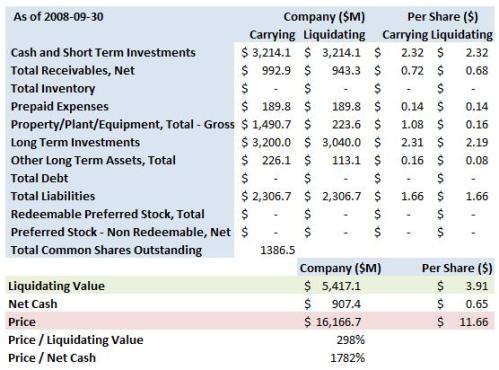
Set out below is our summary analysis (the “Carrying” column shows the assets as they are carried in the financial statements, and the “Liquidating” column shows our estimate of the value of the assets in a liquidation):
yhoo-summary

Ordinarily, when we discount a company’s assets we get a much lower liquidating value than carrying value. In YHOO’s case, most of the tangible asset value is in the Cash and Short Term Investments which we don’t write down ($3.2B or $2.32 per share) and Long Term Investments (carried at $3.2B or $2.31 per share), which we’ve only written down to $3B or $2.19 per share for reasons we’ll explain below. We’ve written down the Property, Plant and Equipment by 85%, but it only represents a small proportion of the total tangible assets and so doesn’t have a meaningful impact on the valuation. Our usual liquidation valuation – the Armageddon scenario – for YHOO is $5.4B or $3.91 per share.

We believe that the Armageddon scenario substantially undervalues YHOO because it excludes the Goodwill in the Investments in Equity Interests (which is included in the Long Term Investments above). Including the Goodwill, YHOO’s Investments in Equity Interests amount to the following:

  • a 44% equity interest in Alibaba Group valued at $2.2B
  • a 1% equity interest in Alibaba.com Limited valued at $52M and
  • a 33% equity interest in Yahoo! Japan valued at $6B.

Including the Goodwill figures in the Investments in Equity Interests above (but deducting the Deferred Income Tax) gives us an asset valuation for YHOO closer to $9.5B or $6.82 per share.

Icahn said in an interview with CNBC last Wednesday that he believes YHOO is undervalued and that he “opposes breaking up the company in a piecemeal sale” (NY Times’ Dealbook has the transcript). While we can only speculate as to Icahn’s investment thesis for YHOO, that statement leads us to believe he is valuing it on an earnings or cash flow basis. YHOO’s Cash from Operating Activities is impressive at $1.9B in 2007 and $347M in the most recent quarter to September. Even more impressive is that it achieved that operating cash flow on only $9.5B of equity (up from $9.1B in the prior year), which means it returned around 21% on average equity. We’ve got no idea about the future economics of YHOO’s businesses or the industry as a whole, so we can’t predict whether YHOO can continue to generate these types of returns and we won’t be speculating as to its value on an earnings or cash flow basis.

The catalyst

Icahn, who currently sits on the board and holds 5.5% of the company, will be the driving force in any deal involving YHOO. His decisions will likely be informed by the fact that he has paid an average of $23.59 per share to accumulate a 5.5 percent stake (according to this filing with the SEC). There are a number of suitors seeking to consummate a marriage with YHOO. This Wall Street Journal article (subscription required) suggests former AOL chief Jonathan Miller is talking to investors about raising money to purchase all or part of YHOO. Icahn has said that he would be opposed to a partial bid “even at a premium.” He also expressed doubts about Miller’s ability to raise the money but would be willing to listen if Miller made a “bid at a very high price”. Another possibility is Microsoft, which has recently engaged a former YHOO search and advertising executive, but Microsoft CEO Steve Ballmer told the Wall Street Journal Thursday (subscription required) that there were no talks to acquire YHOO’s search business.

Icahn has a long history of succesful activist investment, with recent high profile campaigns against  Blockbuster, Imclone, XO Communications, Mylan Laboratories and Time Warner. According to this 2007 Fortune profile, he is renowned for taking on the biggest targets while generating exceptional returns:

In its less-than-three-year existence, Icahn Partners has posted annualized gains of 40%, investors told Fortune. After fees, the investors pocketed 28%. That 40% gain trounces the S&P 500’s return of around 13%, as well as the 12% for all hedge funds calculated by research firm HedgeFund.net. Icahn Partners boasts a string of big wins in short periods. The acquisition of energy producer Kerr-McGee gave the fund a $300 million gain, or a 100% return in just nine months. Icahn Partners achieved gains of $100 million and $230 million, respectively, both in less than three months, on forcing the sales of Fairmont Hotels & Resorts and drugmaker MedImmune.

The same Fortune article suggests that Icahn’s biggest strength is his knack for picking targets:

His skill at prospecting is so well honed that in most cases he’s destined to make money from the day he buys the shares. Then it’s a matter of squeezing management to sweeten the inevitable gains.

This is high praise indeed. Given that Icahn has paid an average of $23.59 per share for YHOO, he clearly sees value well in excess of that number and will be agitating for it to be realised.

Conclusion

YHOO is not cheap on any theory of value we care to employ. It is trading at a substantial premium to its asset backing, which means the market is still generously valuing its future earnings. It is generating substantial operating cash flow and earnings, which in a better market might be worth more, but it’s not obviously cheap to us.

The best thing about YHOO from our perspective is the presence of Carl Icahn on the register. His holdings were purchased at much higher prices than are presently available and he is unlikely to sit idly by while the stock stagnates.

Buying YHOO at these prices is a bet that Icahn can engineer a deal for the company. Given his legendary status as an activist investor earned through canny acquisitions over many years, we think that’s a good bet. But a bet is what it is – it’s speculation and not investment. If speculation is your game, then we wish you the best of luck but know that the price might fall a long way if he sells out. If you’re an investor, the price is too high.

YHOO closed Friday at $11.66 and the S&P 500 Index closed at 876.07.

[Disclosure: We do not have a holding in YHOO. This is neither a recommendation to buy or sell any securities. All information provided believed to be reliable and presented for information purposes only.]

Read Full Post »

The Official Activist Investing Blog has published its list of activist investments for November:

Ticker Company Activist Investor
ABTL Autobytel Inc Trilogy Inc
ACF AmeriCredit Corp Fairholme Capital Management
ACTL Actel Corp Ramius Capital
ADPT Adaptec, Inc Steel Partners
ARCW Arc Wireless Solutions Brean Murray Carret Group
ATSG Air Transport Services Group Perella Weinberg Partners
AVGN Avigen Inc Biotechnology Value Fund
BBI Blockbuster Inc Marlin Sams Fund
BEE Strategic Hotels & Resorts Security Capital Research & Management
BITI Bio-Imaging Technologies Healthinvest Partners
CHG CH Energy Group Inc Gamco Investors
CHIC Charlotte Russe Holding Inc KarpReilly Capital Management
CPN Calpine Corp Harbinger Capital
CRXX CombinatoRX, Incorporated Biotechnology Value Fund
CTO Consolidated Tomoka Land Co Wintergreen Advisers
CWLZ Cowlitz Bancorporation Crescent Capital
DBD Diebold Inc Gamco Investors
DCAP DCAP Group Infinity Capital Partners
DVD Dover Motorsports Mario Cibelli
ENTU Entrust Inc. Empire Capital Partners
FACE Physicians Formula Holdings, Inc Mill Road Capital
FSCI Fisher Communications Gamco Investors
FTAR.OB Footstar Inc Schultze Asset Management
GBE Grubb & Ellis Company Anthony Thompson
GGP General Growth Properties Pershing Square Capital
GSLA GS Financial Corp FJ Capital Long/Short Equity Fund
HCBK Hudson City Bancorp Gamco Investors
HFFC HF Financial Corp PL Capital
INFS Infocus Corp Nery Capital Partners
INFS Infocus Corp Lloyd Miller
ISH International Shipholding Corp Liberty Shipping Group
KANA.OB Kana Software KVO Capital Management
KEYN Keynote Systems Ramius Capital
KFS Kingsway Financial Services Joseph Stilwell
KONA Kona Grill Mill Road Capital
LCAV LCA-Vision Inc Stephen Joffe
LDIS Leadis Technology Inc Kettle Hill Capital Management
LNET LodgeNet Interactive Corporation Mark Cuban
LTM Life Time Fitness Green Equity Investors
MCGC MCG Capital Corporation Springbok Capital Management
MGAM Multimedia Games Inc. Dolphin Limited Partnership
MGI Moneygram Interntaional Inc Blum Capital
MIM MI Developments Greenlight Capital
MYE Myers Industries Inc Gamco Investors
NAV Navistar International Owl Creek
NLS Nautilus Inc Sherborne Investors
NOOF New Frontier Media Steel Partners
NYT New York Times Harbinger Capital
OEH Orient-Express Hotels SAC Capital; DE Shaw
ORNG Orange 21 Costa Brava
PBIP Prudential Bancorp Inc. of PA Joseph Stilwell
PGRI.OB Platinum Energy Resources Inc Syd Ghermezian
PHH PHH Corp. Pennant Capital Management
PNNW Pennichuck Corp Gamco Investors
PPCO Penwest Pharmaceuticals Co Perceptive Advisors
PRXI Premier Exhibitions, Inc Sellers Capital
PWER Power One Bel Fuse
PXG Phoenix Footwear Group Reidman Corp
RDEN Elizabeth Arden Shamrock Activist Value Fund
SCOP Scopus Video Networks Ltd. Optibase Ltd
SECX.PK SED International Holdings Hummingbird Management
SLTC Selectica Inc Trilogy Inc (Versata Enterprises)
SNG Canadian Superior Energy Palo Alto Investors
SNSTA Sonesta International Hotels Gamco
SUAI Specialty Underwriters Alliance Philip Stephenson
SUMT SumTotal Systems Discovery Capital
SUTM.OB Sun-Times Media Group Inc. K Capital
SUTM.OB Sun-Times Media Group Inc. Davidson Kempner Partners
SWWI Simon Worldwide Inc Everst Special Situations Fund
TIKRF.OB Tikcro Technologies Ltd Steven Bronson
TXCC TranSwitch Corp Brener International Group
TXI Texas Industries Shamrock Activist Value Fund
UIS Unisys Corp MMI Investments
UTEK Ultratech Inc Temujin Fund
WBSN Websense Inc Shamrock Activist Value Fund
WEDC White Electronic Designs Wynnefield Capital
WINS SM&A Mill Road Capital
YHOO Yahoo Carl Icahn
ZLC Zale Corp. Breeden Capital Management

Read Full Post »

Greenbackd’s ideal investment opportunity is a deeply undervalued asset situation with a catalyst to quickly remove the discount. Unfortunately, those opportunities are few and far between.

We frequently find deeply undervalued asset situations with no obvious catalyst. We also often find activists in stocks that we woud not consider to be undervalued on an asset basis.

As a thought experiment, we thought that we would compare the performance of two stocks: one a net net and net cash stock lacking a catalyst, and the other a stock not obviously undervalued on an asset basis but nonetheless pursued by an activist investor.

We’ve selected Dataram Corporation (NASDAQ:DRAM) as representative of the net-nets. DRAM is a classic net-net stock, with a $10.5M market cap and around $19.4M of value in liquidation, including $16M in cash.

The second stock selects itself: Yahoo! Inc. (NASDAQ:YHOO), one of the original Internet stocks, has as one of its largest stockholders activist investing legend Carl Icahn and the NY Times speculates that it has a potential suitor. YHOO has a market cap of around $15.9B and tangible assets of around $5.5B, including around $3.2B in cash, which means it is not undervalued on an asset basis.

Today, we examine DRAM and on Monday we will examine YHOO.

Read Full Post »

« Newer Posts