Feeds:
Posts
Comments

Archive for the ‘Value Investment’ Category

What do requests for confidentiality reveal about hedge fund portfolio holdings? In Uncovering Hedge Fund Skill from the Portfolio Holdings They Hide, a paper to be published in the upcoming Journal of Finance (or see a February 2012 version on the SSRN), authors Vikas Agarwal, Wei Jiang, Yuehua Tang, and Baozhong Yang ask whether confidential holdings exhibit superior performance to holdings disclosed on a 13F in the ordinary course.

Institutional investment managers must disclose their quarterly portfolio holdings in a Form 13F. The 13(f) rule allows the SEC to delay disclosure that is “necessary or appropriate in the public interest or for the protection of investors.” When filers request confidential treatment for certain holdings, they may omit those holdings off their Form 13F. After the confidentiality period expires, the filer must reveal the holdings by filing an amendment to the original Form 13F.

Confidential treatment allows hedge funds to accumulate larger positions in stocks, and to spread the trades over a longer period of time. Funds request confidentiality where timely disclosure of portfolio holdings may reveal information about proprietary investment strategies that other investors can free-ride on without incurring the costs of research. The Form 13F filings of investors with the best track records are followed by many investors. Warren Buffett’s new holdings are so closely followed that he regularly requests confidential treatment on his larger investments.

Hedge funds seek confidentiality more frequently than other institutional investors. They constitute about 30 percent of all institutions, but account for 56 percent of all the confidential filings. Hedge funds on average relegate about one-third of their total portfolio values into confidentiality, while the same figure is one-fifth for investment companies/advisors and one-tenth for banks and insurance companies.

The authors make three important findings:

  1. Hedge funds with characteristics associated with more active portfolio management, such as those managing large and concentrated portfolios, and adopting non-standard investment strategies (i.e., higher idiosyncratic risk), are more likely to request confidentiality.
  2. The confidential holdings are more likely to consist of stocks associated with information-sensitive events such as mergers and acquisitions, and stocks subject to greater information asymmetry, i.e., those with smaller market capitalization and fewer analysts following.
  3. Confidential holdings of hedge funds exhibit significantly higher abnormal performance compared to their original holdings for different horizons ranging from 2 months to 12 months. For example, the difference over the 12-month horizon ranges from 5.2% to 7.5% on an annualized basis.

Read a February 2012 version on the SSRN.

Read Full Post »

On Monday I presented an expanded version of my white paper “Simple But Not Easy: The Case For Quantitative Value” to the UC Davis MBA value investing class.

Click the link to be taken to the UC Davis video:

Presentation to UC Davis Value Investing Class

A special thank you to the instructors Jacob Taylor, and Lonnie Rush, and UCD value investing class. Go Aggies!

Read Full Post »

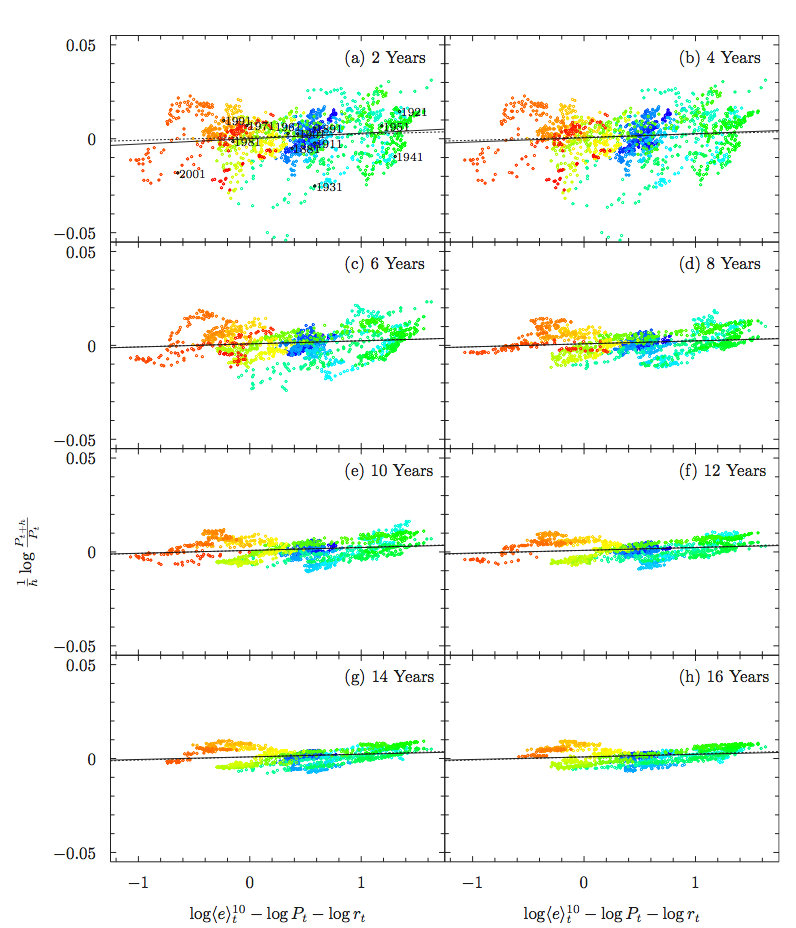
There are two great new papers on the global “predictiveness” of the Graham / Shiller Cyclically Adjusted Price Earnings (CAPE) ratio. The first, Value Matters: Predictability of Stock Index Returns, by Natascia Angelini, Giacomo Bormetti, Stefano Marmi, and Franco Nardini examines the ability of the CAPE to predict long-run stock market performance over several different periods in developed markets like the U.S., Belgium, France, Germany, Japan, the Netherlands, Norway, Sweden and Switzerland. From the abstract:

The aim of this paper is twofold: to provide a theoretical framework and to give further empirical support to Shiller’s test of the appropriateness of prices in the stock market based on the Cyclically Adjusted Price Earnings (CAPE) ratio. We devote the first part of the paper to the empirical analysis and we show that the CAPE is a powerful predictor of future long run performances of the market not only for the U.S. but also for countries such us Belgium, France, Germany, Japan, the Netherlands, Norway, Sweden and Switzerland. We show four relevant empirical facts: i) the striking ability of the logarithmic averaged earning over price ratio to predict returns of the index, with an R squared which increases with the time horizon, ii) how this evidence increases switching from returns to gross returns, iii) moving over different time horizons, the regression coefficients are constant in a statistically robust way, and iv) the poorness of the prediction when the precursor is adjusted with long term interest rate. In the second part we provide a theoretical justification of the empirical observations. Indeed we propose a simple model of the price dynamics in which the return growth depends on three components: a) a momentum component, naturally justified in terms of agents’ belief that expected returns are higher in bullish markets than in bearish ones; b) a fundamental component proportional to the log earnings over price ratio at time zero. The initial value of the ratio determines the reference growth level, from which the actual stock price may deviate as an effect of random external disturbances, and c) a driving component ensuring the diffusive behaviour of stock prices. Under these assumptions, we are able to prove that, if we consider a sufficiently large number of periods, the expected rate of return and the expected gross return are linear in the initial time value of the log earnings over price ratio, and their variance goes to zero with rate of convergence equal to minus one. Ultimately this means that, in our model, the stock prices dynamics may generate bubbles and crashes in the short and medium run, whereas for future long-term returns the valuation ratio remains a good predictor.

Figure 1 from the paper (extracted below) shows 2 year to 16 year regressions for the period 1871-2010 (Points are organized in chronological order according to the color scale ranging from dark blue to red passing through light blue, green, yellow, and orange; labels in the top left panel refer to points corresponding to the first month of the specified year.):

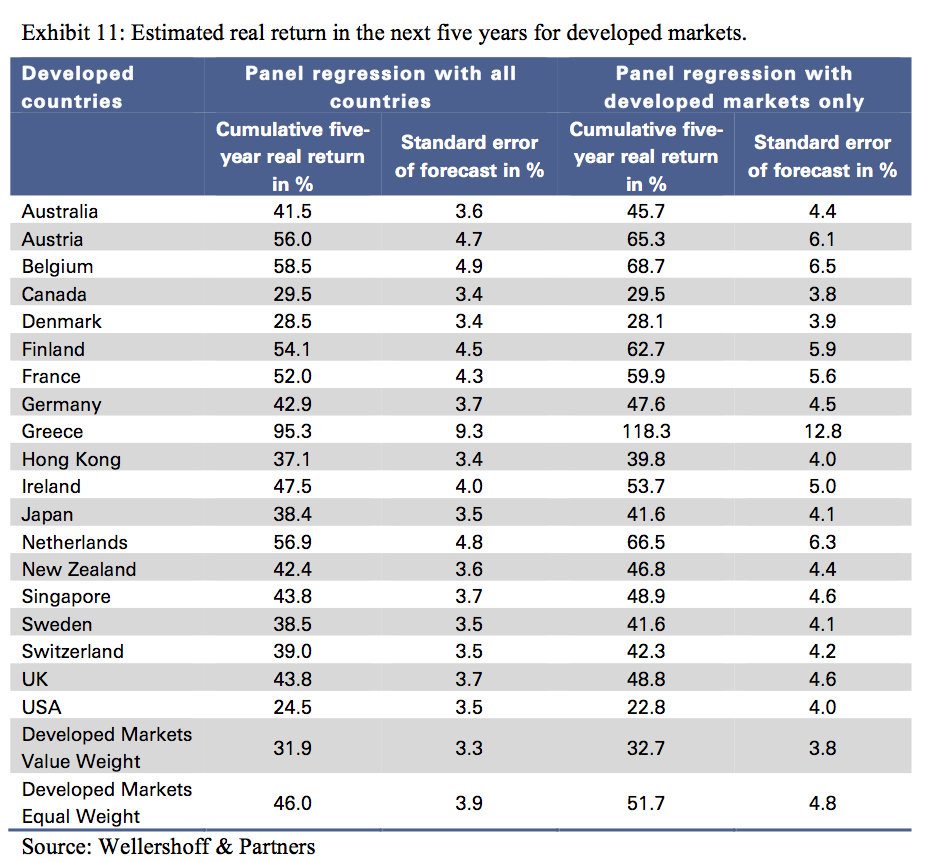
The second paper, Does the Shiller-PE Work in Emerging Markets? by Joachim Klement examines the reliability of CAPE as a forecasting and valuation tool for 35 countries including emerging markets. Klement finds that CAPE is a reliable long-term valuation indicator for developed and emerging markets. Klement uses the indicator to predict real returns on local equity markets over the next five to ten years (shown in Exhibits 11 and 12 extracted below):

Developed Markets

Emerging Markets

Klement makes some interesting observations about developed markets:

Looking at the forecasts for different markets the following observations stand out:

For all developed equity markets the expected real return in local currencies is positive and the probability of negative real returns after ten years is generally low.

The market with the lowest expected future return is the United States which together with Canada and Denmark promises real returns that are quite a bit lower than developed markets overall.

• Because of the low expected returns for US stock markets, an equal weighted portfolio of developed market equities is expected to perform significantly better than a typical value weighted portfolio. The current debate about optimal sector and country weights in a stock market index is still ongoing and there are many different rivaling approaches like equal weighting, fundamental weighting, GDP-weighting or equal risk contribution or minimum variance. The jury is still out which one of these approaches is the best for long-term investors, but our calculations indicate that an equal weighted portfolio should outperform a value weighted one.

• Looking at individual markets again, we see that the most attractive markets are generally the crisis-ridden European equity markets and in particular Greece which currently has such low valuations that real returns over the next five years could come close to 100%. But more stable markets like Finland, France or Germany also offer attractive long-term return possibilities.

And Klement on the emerging markets:

While the forecasts for emerging markets generally have a somewhat higher forecast error associated with them we can still observe some general trends:

Emerging market equities seem to be poised for significantly lower real returns than developed equities at the moment.

• Particularly smaller emerging countries like Peru, Colombia or Indonesia offer less attractive returns at the moment than more developed neighbors like Brazil or Thailand.

Some currently fashionable investment countries like China or India offer only average return prospects.

• From a regional perspective it seems that Eastern European countries together with Turkey and South Africa offer the highest future equity markets while Asia overall should be only average and in Latin America only Brazil seems a worthwhile investment at the moment.

H/T World Beta

Read Full Post »

Yesterday I covered a 2006 talk, “Journey Into the Whirlwind: Graham-and-Doddsville Revisited,” by Louis Lowenstein*, then a professor at the Columbia Law School, in which he compared the performance of a group of “true-blue, walk-the-walk value investors” and “a group of large cap growth funds”.

Lowenstein based the talk on an earlier paper he had written “Searching for Rational Investors In a Perfect Storm:”

In October, 1991, there occurred off the coast of Massachusetts a “perfect storm,” a tempest created by a rare coincidence of events. In the late ‘90s, there was another perfect storm, an also rare coincidence of forces which caused huge waves in our financial markets, as the NASDAQ index soared, collapsed, and bounced part way back.

What had happened to the so-called “rational” investors, the smart money, whom economists have for decades said would keep market prices in close touch with the underlying values? Despite the hundreds of papers on markets and their efficiency, it is a remarkable fact that no scholar, not one, has looked to see who are these rational, i.e., value, investors, how they operate, and with what results.

In the paper, Lowenstein decided to see how a group of ten value funds, selected by a knowledgeable manager, performed in the turbulent boom–crash–rebound years of 1999-2003. Did they suffer the permanent loss of capital of so many who invested in the telecom, media and tech stocks? How did their overall performance for the five years compare with the returns on the S&P 500?

To bring a group of rational/value investors out of the closet, I asked Bob Goldfarb, the highly regarded chief executive of the Sequoia Fund, to furnish the names of ten “true-blue” value funds, those which, as they say on the Street, don’t just talk the talk but walk the walk. (Had I prepared the list, I would have included Sequoia, but Goldfarb’s ten is Goldfarb’s ten.) They are all mutual funds, except for Source Capital, a closed-end fund which invests much like a mutual fund. The funds are as follows:

  • Clipper Fund
  • FPA Capital
  • First Eagle Global
  • Mutual Beacon
  • Oak Value
  • Oakmark Select
  • Longleaf Partners
  • Source Capital
  • Legg Mason Value
  • Tweedy Browne American Value

How did they perform?

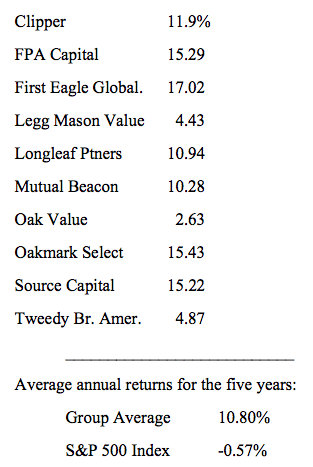
For most managers, mimicking the index, it was difficult not to own Enron, Oracle and the like, but the ten value funds had stayed far away. Instead, they owned highly selective portfolios, mostly 34 stocks or less, vs. the 160 in the average equity fund. Reflecting their consistent and disciplined approach, they turned their portfolios at one-sixth the rate of the average fund. Bottom line: every one of the ten outperformed the index over the five year period, and as a group they did so by an average of 11% per year, the financial equivalent of back-to-back no-hitters.

The five-year 1999-2003 average annual returns were as follows:

Here’s a link to the article.

Read Full Post »

The Superinvestors of Graham-and-Doddsville is a well-known article (see the original Hermes article here.pdf) by Warren Buffett defending value investing against the efficient market hypothesis. The article is an edited transcript of a talk Buffett gave at Columbia University in 1984 commemorating the fiftieth anniversary of Security Analysis, written by Benjamin Graham and David L. Dodd.

In a 2006 talk, “Journey Into the Whirlwind: Graham-and-Doddsville Revisited,” Louis Lowenstein*, then a professor at the Columbia Law School, compared the performance of a group of “true-blue, walk-the-walk value investors” (the “Goldfarb Ten”) and “a group of large cap growth funds” (the “Group of Fifteen”).

Here are Lowenstein’s findings:

For the five years ended this past August 31, the Group of Fifteen experienced on average negative returns of 8.89% per year, vs. a negative 2.71% for the S&P 500.4 The group of ten value funds I had studied in the “Searching for Rational Investors” article had been suggested by Bob Goldfarb of the Sequoia Fund.5 Over those same five years, the Goldfarb Ten enjoyed positive average annual returns of 9.83%. This audience is no doubt quick with numbers, but let me help. Those fifteen large growth funds underperformed the Goldfarb Ten during those five years by an average of over 18 percentage points per year. Hey, pretty soon you have real money. Only one of the fifteen had even modestly positive returns. Now if you go back ten years, a period that includes the bubble, the Group of Fifteen did better, averaging a positive 8.13% per year.Even for that ten year period, however, they underperformed the value group, on average, by more than 5% per year.6 With a good tailwind, those large cap funds were not great – underperforming the index by almost 2% per year – and in stormy weather their boats leaked badly.

Lowenstein takes a close look at one of the Group of Fifteen (a growth fund):

The first was the Massachusetts Investors Growth Stock Fund, chosen because of its long history. Founded in 1932, as the Massachusetts Investors Second Fund, it was, like its older sibling, Massachusetts Investors Trust, truly a mutual fund, in the sense that it was managed internally, supplemented by an advisory board of six prominent Boston businessmen.7 In 1969, when management was shifted to an external company, now known as MFS Investment Management, the total expense ratio was a modest 0.32%.

I am confident that the founders of the Massachusetts Investors Trust would no longer recognize their second fund, which has become a caricature of the “do something” culture. The expense ratio, though still below its peer group, has tripled. But it’s the turbulent pace of trading that would have puzzled and distressed them. At year-end 1999, having turned the portfolio over 174%, the manager said they had moved away from “stable growth companies” such as supermarket and financial companies, and into tech and leisure stocks, singling out in the year- end report Cisco and Sun Microsystems – each selling at the time at about 100 X earnings – for their “reasonable stock valuation.” The following year, while citing a bottom-up, “value sensitive approach,” the fund’s turnover soared to 261%. And in 2001, with the fund continuing to remark on its “fundamental . . .bottom-up investment process,” turnover reached the stratospheric level of 305%. It is difficult to conceive how, even in 2003, well after the market as a whole had stabilized, the managers of this $10 billion portfolio had sold $28 billion of stock and then reinvested that $28 billion in other stocks.

For the five years ended in 2003, turnover in the fund averaged 250%. All that senseless trading took a toll. For the five years ended this past August, average annual returns were a negative 9-1/2%. Over the past ten years, which included the glory days of the New Economy, the fund did better, almost matching the index, though still trailing our value funds by 4% a year. Net assets which had been a modest $1.9 billion at Don Phillips’ kickoff date in 1997, and had risen to $17 billion in 2000, are now about $8 billion.

If you’re feeling some sympathy for the passengers in this financial vehicle, hold on. Investors – and I’m using the term loosely – in the Mass. Inv. Growth Stock Fund were for several years running spinning their holdings in and out of the fund at rates approximating the total assets of the fund. In 2001, for example, investors cashed out of $17-1/2 billion in Class A shares, and bought $16 billion in new shares, leaving the fund at year end with net assets of about $14 billion. Having attracted, not investors, but speculators trying to catch the next new thing, management got the shareholders they deserved.

And the value investors?

Having updated my data through August of this year, I am happy to report that the Goldfarb Ten still look true blue – actually better than at year-end 2003. The portfolio turnover rates have dropped on average to 16% – translation, an average holding period of six years. Honey, what did you do today? Nothing, dear.The average cash holding is 14% of the portfolio, and five of the funds are closed to new investors.f Currently, however, two of the still open funds, Mutual Beacon and Clipper, are losing their managers. The company managing the Clipper Fund has been sold twice over and Jim Gipson and two colleagues recently announced they’re moving on. At Mutual Beacon, which is part of the Franklin Templeton family, David Winters has left to create a mutual fund, ah yes, the Wintergreen Fund. It will be interesting to see whether Mutual Beacon and Clipper will maintain their discipline.

Speaking of discipline, you may remember that after Buffett published “The Superinvestors,” someone calculated that while they were indeed superinvestors, on average they had trailed the market one year in three.20 Tom Russo, of the Semper Vic Partners fund, took a similar look at the Goldfarb Ten and found, for example, that four of them had each underperformed the S&P 500 for four consecutive years, 1996-1999, and in some cases by huge amounts. For the full ten years, of course, that underperformance was sharply reversed, and then some. Value investing thus requires not just patient managers but also patient investors, those with the temperament as well as intelligence to feel comfortable even when sorely out of step with the crowd. If you’re fretting that the CBOE Market Volatility Index may be signaling fear this week, value investing is not for you.

* Louis was father to Roger Lowenstein of Buffett: The Making of an American Capitalist.

Read Full Post »

Joel Greenblatt’s rationale for a value-weighted index can be paraphrased as follows:

  • Most investors, pro’s included, can’t beat the index. Therefore, buying an index fund is better than messing it up yourself or getting an active manager to mess it up for you.
  • If you’re going to buy an index, you might as well buy the best one. An index based on the market capitalization-weighted S&P500 will be handily beaten by an equal-weighted index, which will be handily beaten by a fundamentally weighted index, which is in turn handily beaten by a “value-weighted index,” which is what Greenblatt calls his “Magic Formula-weighted index.”

Yesterday we examined the first point. Today let’s examine the second.

Market Capitalization Weight < Equal Weight < Fundamental Weight < “Value Weight” (Greenblatt’s Magic Formula Weight)

I think this chart is compelling:

It shows the CAGRs for a variety of indices over the 20 years to December 31, 2010. The first thing to note is that the equal weight index – represented by the &P500 Equal Weight TR – has a huge advantage over the market capitalization weighted S&P500 TR. Greenblatt says:

Over time, traditional market-cap weighted indexes such as the S&P 500 and the Russell 1000 have been shown to outperform most active managers. However, market cap weighted indexes suffer from a systematic flaw. The problem is that market-cap weighted indexes increase the amount they own of a particular company as that company’s stock price increases. As a company’s stock falls, its market capitalization falls and a market cap-weighted index will automatically own less of that company. However, over the short term, stock prices can often be affected by emotion. A market index that bases its investment weights solely on market capitalization (and therefore market price) will systematically invest too much in stocks when they are overpriced and too little in stocks when they are priced at bargain levels. (In the internet bubble, for example, as internet stocks went up in price, market cap-weighted indexes became too heavily concentrated in this overpriced sector and too underweighted in the stocks of established companies in less exciting industries.) This systematic flaw appears to cost market-cap weighted indexes approximately 2% per year in return over long periods.

The equal weight index corrects this systematic flaw to a degree (the small correction is still worth 2.7 percent per year in additional performance). Greenblatt describes it as randomizing the errors made by the market capitalization weighted index:

One way to avoid the problem of buying too much of overpriced stocks and too little of bargain stocks in a market-cap weighted index is to create an index that weights each stock in the index equally. An equally-weighted index will still own too much of overpriced stocks and too little of bargain-priced stocks, but in other cases, it will own more of bargain stocks and less of overpriced stocks. Since stocks in the index aren’t affected by price, errors will be random and average out over time. For this reason, equally weighted indexes should add back the approximately 2% per year lost to the inefficiencies of market-cap weighting.

While the errors are randomized in the equal weight index, they are still systematic – it still owns too much of the expensive stocks and too little of the cheap ones. Fundamental weighting corrects this error (again to a small degree). Fundamentally-weighted indexes weight companies based on their economic size using price ratios such as sales, book value, cash flow and dividends. The surprising thing is that this change is worth only 0.4 percent per year over equal weighting (still 3.1 percent per year over market capitalization weighting).

Similar to equally-weighted indexes, company weights are not affected by market price and therefore pricing errors are also random. By correcting for the systematic errors caused by weighting solely by market-cap, as tested over the last 40+ years, fundamentally-weighted indexes can also add back the approximately 2% lost each year due to the inefficiencies of market-cap weighting (with the last 20 years adding back even more!).

The Magic Formula / “value” weighted index has a huge advantage over fundamental weighting (+3.9 percent per year), and is a massive improvement over the market capitalization index (+7 percent per year). Greenblatt describes it as follows:

On the other hand, value-weighted indexes seek not only to avoid the losses due to the inefficiencies of market-cap weighting, but to add performance by buying more of stocks when they are available at bargain prices. Value-weighted indexes are continually rebalanced to weight most heavily those stocks that are priced at the largest discount to various measures of value. Over time, these indexes can significantly outperform active managers, market cap-weighted indexes, equally-weighted indexes, and fundamentally-weighted indexes.

I like Greenblatt’s approach. I’ve got two small criticisms:

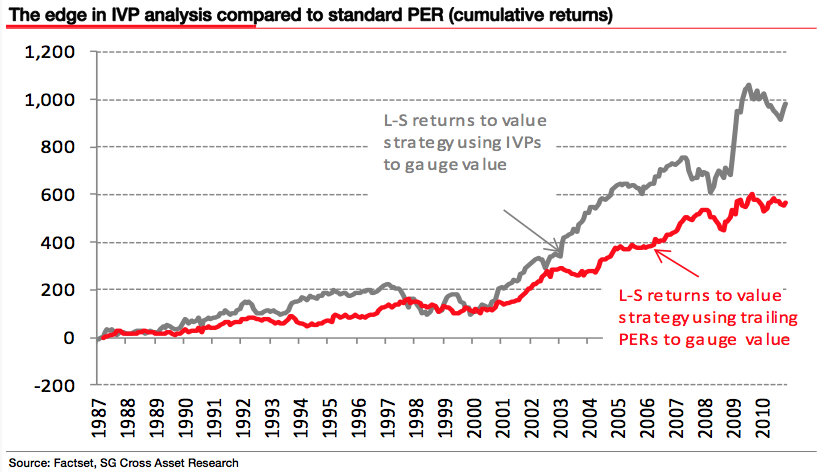
1. I’m not sure that his Magic Formula weighting is genuine “value” weighting. Contrast Greenblatt’s approach with Dylan Grice’s “Intrinsic Value to Price” or “IVP” approach, which is a modified residual income approach, the details of which I’ll discuss in a later post. Grice’s IVP is a true intrinsic value calculation. He explains his approach in a way reminiscent of Buffett’s approach:

[How] is intrinsic value estimated? To answer, think first about how much you should pay for a going concern. The simplest such example would be that of a bank account containing $100, earning 5% per year interest. This asset is highly liquid. It also provides a stable income. And if I reinvest that income forever, it provides stable growth too. What’s it worth?

Let’s assume my desired return is 5%. The bank account is worth only its book value of $100 (the annual interest payment of $5 divided by my desired return of 5%). It may be liquid, stable and even growing, but since it’s not generating any value over and above my required return, it deserves no premium to book value.

This focus on an asset’s earnings power and, in particular, the ability of assets to earn returns in excess of desired returns is the essence of my intrinsic valuation, which is based on Steven Penman’s residual income model.1 The basic idea is that if a company is not earning a return in excess of our desired return, that company, like the bank account example above, deserves no premium to book value.

And it seems to work:

Grice actually calculates IVP while Greenblatt does not. Does that actually matter? Probably not. Even if it’s not what I think the average person understands real “value” weighting to be, Greenblatt’s approach seems to work. Why quibble over semantics?

2. As I’ve discussed before, Greenblatt’s Magic Formula return owes a great deal to his selection of EBIT/TEV as the price limb of his model. EBIT/TEV has been very well performed historically. If we were to substitute EBIT/TEV for the P/B, P/E, price-to-dividends, P/S, P/whatever, we’d have seen slightly better performance than the Magic Formula provided, but you might have been out of the game somewhere between 1997 to 2001.

Read Full Post »

Joel Greenblatt’s rationale for a value-weighted index can be paraphrased as follows:

  • Most investors, pro’s included, can’t beat the index. Therefore, buying an index fund is better than messing it up yourself or getting an active manager to mess it up for you.
  • If you’re going to buy an index, you might as well buy the best one. An index based on the market capitalization-weighted S&P500 will be handily beaten by an equal-weighted index, which will be handily beaten by a fundamentally weighted index, which is in turn handily beaten by a “value-weighted index,” which is what Greenblatt calls his “Magic Formula-weighted index.”

Let’s examine each of these points in some more depth.

Most investors, pro’s included, can’t beat the index.

The most famous argument against active management (at least by mutual funds) is by John Bogle, made before the Senate Subcommittee on Financial Management, the Budget, and International Security on November 3, 2003. Bogle’s testimony was on the then market-timing scandal, but he used the opportunity to speak more broadly on the investment industry.

Bogle argued that the average mutual fund should earn the market’s return less costs, but investors earn even less because they try to time the market:

What has been described as “a pathological mutation” in corporate America has transformed traditional owners capitalism into modern-day managers capitalism. In mutual fund America, the conflict of interest between fund managers and fund owners is an echo, if not an amplification, of that unfortunate, indeed “morally unacceptable”5 transformation. The blessing of our industry’s market-timing scandal—the good for our investors blown by that ill wind—is that it has focused the spotlight on that conflict, and on its even more scandalous manifestations: the level of fund costs, the building of assets of individual funds to levels at which they can no longer differentiate themselves, and the focus on selling funds that make money for managers while far too often losing money—and lots of it—for investors.

The net results of these conflicts of interest is readily measurable by comparing the long-term returns achieved by mutual funds, and by mutual fund shareholders, with the returns earned in the stock market itself. During the period 1984-2002, the U.S. stock market, as measured by the S&P 500 Index, provided an annual rate of return of 12.2%. The return on average mutual fund was 9.3%.6 The reason for that lag is not very complicated: As the trained, experienced investment professionals employed by the industry’s managers compete with one another to pick the best stocks, their results average out. Thus, the average mutual fund should earn the market’s return—before costs. Since all-in fund costs can be estimated at something like 3% per year, the annual lag of 2.9% in after-cost return seems simply to confirm that eminently reasonable hypothesis.

But during that same period, according to a study of mutual fund data provided by mutual fund data collector Dalbar, the average fund shareholder earned a return just 2.6% a year. How could that be? How solid is that number? Can that methodology be justified? I’d like to conclude by examining those issues, for the returns that fund managers actually deliver to fund shareholders serves as the definitive test of whether the fund investor is getting a fair shake.

This makes sense. Large mutual funds are the market, so on average earn returns that equate to the market average less costs. While it’s not directly on point, the huge penalty for timing and selection errors is worth exploring further.

Timing and selection penalties

Timing and selection penalties eat a huge proportion of the return. These costs are the result of investors investing in funds after good performance, and withdrawing from funds after poor performance:

It is reasonable to expect the average mutual fund investor to earn a return that falls well short of the return of the average fund. After all, we know that investors have paid a large timing penalty in their decisions, investing little in equity funds early in the period and huge amounts as the market bubble reached its maximum. During 1984-1988, when the S&P Index was below 300, investors purchased an average of just $11 billion per year of equity funds. They added another $105 billion per year when the Index was still below 1100. But after it topped the 1100 mark in 1998, they added to their holdings at an $218 billion(!) annual rate. Then, during the three quarters before the recent rally, with the Index below 900, equity fund investors actually withdrew $80 billion. Clearly, this perverse market sensitivity ill-served fund investors.

The Dalbar study calculates the returns on these cash flows as if they had been invested in the Standard & Poor’s 500 Index, and it is that simple calculation that produces the 2.6% annual investor return. Of course, it is not entirely fair to compare the return on those periodic investments over the years with initial lump-sum investments in the S&P 500 Stock Index and in the average fund. The gap between those returns and the returns earned by investors, then, is somewhat overstated. More appropriate would be a comparison of regular periodic investments in the market with the irregular (and counterproductive) periodic investments made by fund investors, which would reduce both the market return and the fund return with which the 2.6% return has been compared.

But if the gap is overstated, so is the 2.6% return figure itself. For investors did notselect the S&P 500 Index, as the Dalbar study implies. What they selected was an average fund that lagged the S&P Index by 2.9% per year. So they paid not only a timing penalty, but a selection penalty. Looked at superficially, then, the 2.6% return earned by investors should have been minus 0.3%.

Worse, what fund investors selected was not the average fund. Rather they invested most of their money, not only at the wrong time, but in the wrong funds. The selection penalty is reflected by the eagerness of investors as a group to jump into the “new economy” funds, and in the three years of the boom phase, place some $460 billion in those speculative funds, and pull $100 billion out of old-economy value funds—choices which clearly slashed investor returns.

I can imagine how difficult the investment decision is for mutual fund investors. How else does an investor in a mutual fund differentiate between similar funds other than by using historical return? I wouldn’t select a fund with a poor return. I’d put my money into the better one. Which is what everyone does, and why the average return sucks so bad. How bad? Bogle has calculated it below.

Dollar-weighted returns

The calculation of dollar-weighted returns speaks to the cost of timing and selection penalties:

Now let me give you some dollars-and-cents examples of how pouring money into the hot performers and hot sector funds of the era created a truly astonishing gap between (time-weighted) per-share fund returns and (dollar-weighted) returns that reflect what the funds actually earned for their owners. So let’s examine the astonishing gap between those two figures during the recent stock market boom and subsequent bust.

Consider first the “hot” funds of the day—the twenty funds which turned in the largest gains during the market upsurge. These funds had a compound return of 51% per year(!) in 1996-1999, only to suffer a compound annual loss of –32% during the subsequent three years. For the full period, they earned a net annualized return of 1.5%, and a cumulative gain of 9.2%. Not all that bad! Yet the investors in those funds, pouring tens of billions of dollars of their money in after the performance gains began, earned an annual return of minus 12.2%, losing fully 54% of their money during the period.

Now consider sector funds, specific arenas in which investors can (foolishly, as it turns out) make their bets. The computer, telecommunications, and technology sectors were the favorites of the day, but only until they collapsed. The average annual returns of 53% earned in the bull market by a group of the largest sector funds were followed by returns of minus 31% a year in the bear market, a net annual return of 3% and a cumulative gain of 19.2%. Again, not too bad. Yet sector fund investors, similar to the hot fund investors I described earlier, poured billions of dollars in the funds as they soared, and their annual return averaged –12.1%, a cumulative loss of 54% of their capital, too.

While the six-year annual returns for these funds were hardly horrible, both groups did lag the 4.3% annual return of the stock market, as measured by the largest S&P 500 Index Fund, which provided a 29% cumulative gain. But the investors in that index fund, taking no selection risk, minimized the stock market’s influence on their timing and earned a positive 2.4% return, building their capital by 15% during the challenging period. Index investor +15%; sector fund and hot fund investor –54%. Gap: 69 percentage points. It’s a stunning contrast.

Bogle’s conclusion says it all: Index investor +15%; sector fund and hot fund investor –54%. Gap: 69 percentage points. It’s a stunning contrast.

Tomorrow, why fundamental indexing beats the market.

Read Full Post »
In their March 2012 paper, “Analyzing Valuation Measures: A Performance Horse-Race over the past 40 Years,” Wes Gray and Jack Vogel asked whether the business cycle should affect our choice of price ratio:

For example, cash-focused measures, such as free-cash-flow, might perform better during economic downturns than accounting-focused measures like earnings. Or perhaps a more asset-based measure, like book value, will outperform when the economy is more manufacturing-based (‘70s and ‘80s), and struggle when the economy is more human capital and services oriented (therefore making asset-based measures less relevant).

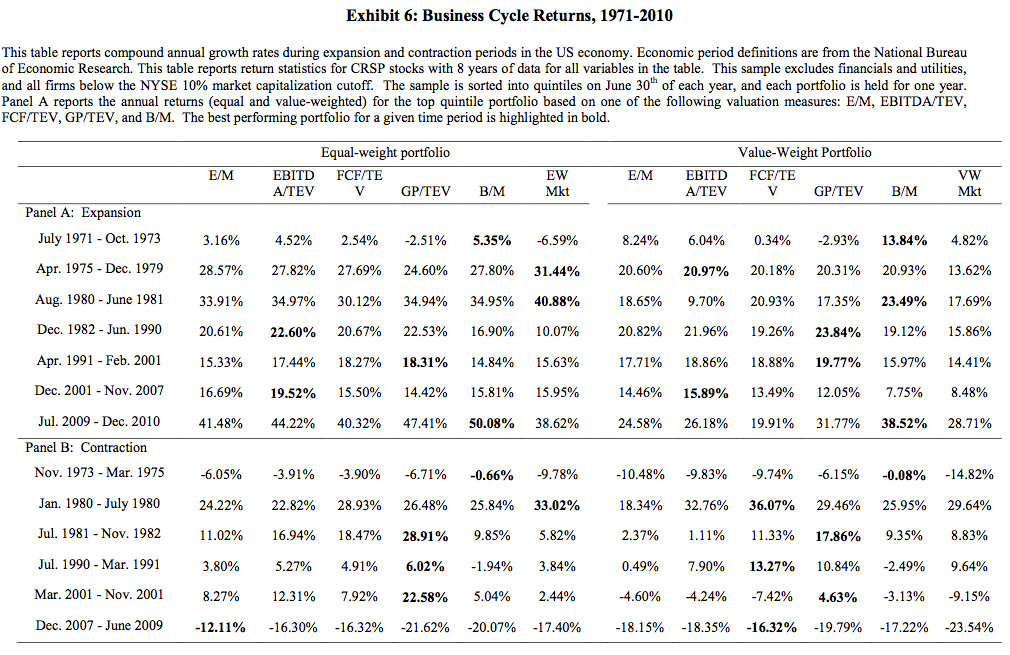
Gray and Vogel analyze the returns of different price ratios over economic expansions and contractions defined by the National Bureau of Economic Research.

Economic Expansions and Contractions 

(Click to enlarge)

The first panel presents the returns for different price ratios during economic expansions. Gray and Vogel observe:

B/M enjoys periods of relative out-performance in the early ‘70s, early ‘80s, and in late 2009. The B/M performance pattern lends weak evidence to the hypothesis that balance-sheet-based value measures perform better than income or cash-flow statement value metrics when the economy generates more returns from tangible assets (e.g., property, plant, and equipment) relative to intangible assets (e.g., human capital, R&D, and brand equity). Overall, there is no strong evidence that a particular valuation metrics systematically outperform all other metrics during expanding economic periods.

The second panel presents the returns for different price ratios during economic contractions. Gray and Vogel observe:

[The] results in Panel B suggest there is no clear evidence that a particular value strategy systematically outperforms all other strategies in contracting economic periods. For example, during the July 1981 to November 1982 and March 2001 to November 2001 contractions GP/TEV shows strong outperformance, but this same metric has the worst performance in the December 2007 to June 2009 recession.

Conclusion

Gray and Vogel conclude:

[There] is little evidence that a particular value strategy outperforms all other metrics during economic contractions and expansions. However, there is clear evidence that value strategies as a whole do outperform passive benchmarks in good times and in bad. The one exception to this rule is during the April 1975 to June 1981 business cycle, a time when a passive small-cap equity portfolio performed exceptionally well.

Read Full Post »

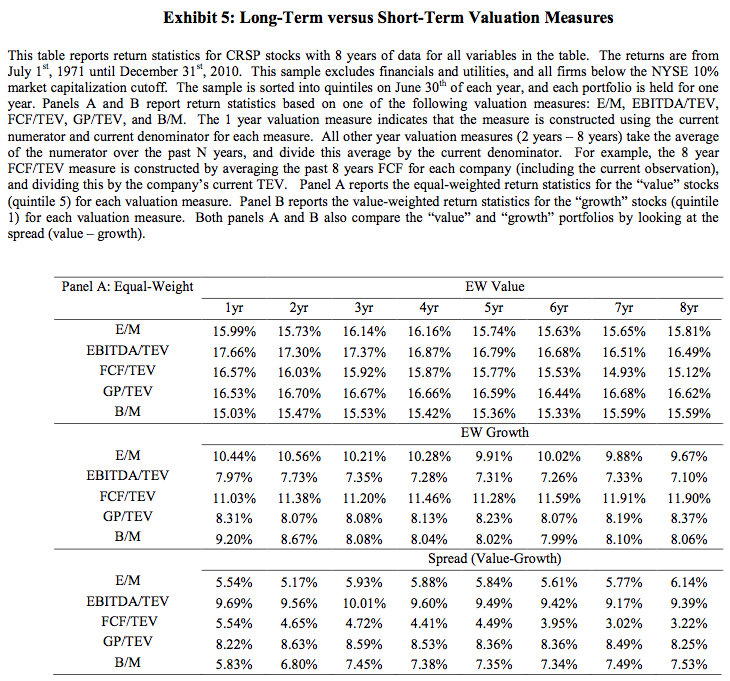
In their March 2012 paper, “Analyzing Valuation Measures: A Performance Horse-Race over the past 40 Years,” Wes Gray and Jack Vogel asked, “Do long-term, normalized price ratios outperform single-year price ratios?

Benjamin Graham promoted the use of long-term, “normalized” price ratios over single-year price ratios. Graham suggested in Security Analysis that “[earnings in P/E] should cover a period of not less than five years, and preferably seven to ten years.

Robert Shiller has also advocated for long-term price ratios because “annual earnings are noisy as a measure of fundamental value.” A study in the UK by Anderson and Brooks [2006] found that a long-term average (eight-years) of earnings increased the value premium (i.e. the spread in returns between value and growth stocks) by 6 percent over one-year earnings.

Gray and Vogel test a range of year averages for all the price ratios from yesterday’s post. The results are presented below. Equal-weight first:

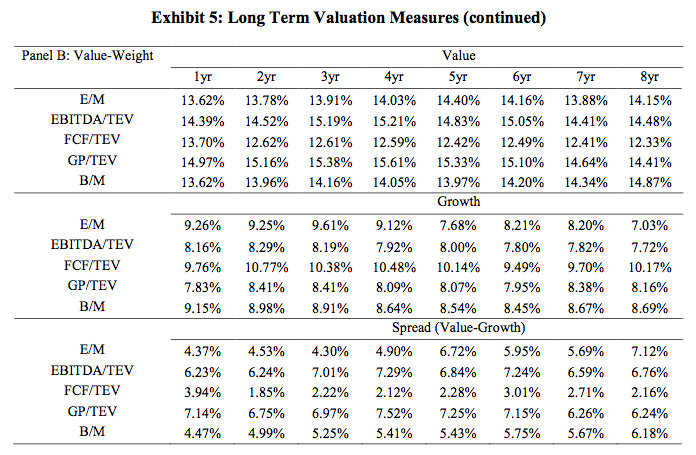
Market capitalization-weight:

Commentary

We can make several observations about the long-term averages. First, there is no evidence that any long-term average is consistently better than any other, measured either on the raw performance to the value decile, or by the value premium created. This is true for both equal-weight portfolios and market capitalization-weighted portfolios, which we would expect. For example, in the equal-weight table, the E/M value portfolio generates its best return using a 4-year average, but the spread is biggest using the 3-year average. Compare this with EBITDA/TEV, which generates its best return using a single-year ratio, and its biggest spread using a 3-year average, or FCF/TEV, which generates both its best return and biggest spread with a single-year average. There is no consistency, or pattern to the results that we can detect. If anything, the results appear random to me, which leads me to conclude that there’s no evidence that long-term averages outperform single-year price ratios.

We can make other, perhaps more positive observations. For example, in the equal-weight panel, the enterprise multiple is consistently the best performing price ratio across most averages (although it seems to get headed by GP/TEV near the 7-year and 8-year averages). It also generates the biggest value premium across all long-term averages.  It’s also a stand-out performer in the market capitalization-weighted panel, delivering the second best returns to GP/TEV, but generating a bigger value premium than GP/TEV about half the time.

The final observation that we can make is that the value portfolio consistently outperforms the “growth” or expensive portfolio. For every price ratio, and over every long-term average, the better returns were found in the value portfolio. Value works.

Conclusion

While long-term average price ratios have been promoted by giants of the investment world like Graham and Shiller as being better than single-year ratios, there exists scant evidence that this is true. A single UK study found a significant premium for long-term average price ratios, but Gray and Vogel’s results do not support the findings of that study. There is no evidence in Gray and Vogel’s results that any long-term average is better than any other, or better than a single-year price ratio. One heartening observation is that, however we slice it, value outperforms glamour. Whichever price ratio we choose to examine, over any long-term average, value is the better bet.

Read Full Post »

Friends, Romans, countrymen, lend me your ears;
I come to bury Caesar, not to praise him.

Having just anointed the enterprise multiple as king yesterday, I’m prepared to bury it in a shallow grave today if I can get a little more performance. Fickle.

In their very recent paper, “Analyzing Valuation Measures: A Performance Horse-Race over the past 40 Years,” Wes Gray and Jack Vogel asked, “Which valuation metric has historically performed the best?

Gray and Vogel examine a range of price ratios over the period 1971 to 2010:

  • Earnings to Market Capitalization (E/M)
  • Earnings before interest and taxes and depreciation and amortization to total
  • enterprise value (EBITDA/TEV)
  • Free cash flow to total enterprise value (FCF/TEV)
  • Gross profits to total enterprise value (GP/TEV)
  • Book to market (B/M)
  • Forward Earnings Estimates to Market Capitalization (FE/M)

They find that the enterprise multiple is the best performing price ratio:

The returns to an annually rebalanced equal-weight portfolio of high EBITDA/TEV stocks, earn 17.66% a year, with a 2.91% annual 3-factor alpha (stocks below the 10% NYSE market equity breakpoint are eliminated). This compares favorably to a practitioner favorite, E/M (i.e., inverted Price-to-earnings, or P/E). Cheap E/M stocks earn 15.23% a year, but show no evidence of alpha after controlling for market, size, and value exposures. The academic favorite, book-to-market (B/M), tells a similar story as E/M and earns 15.03% for the cheapest stocks, but with no alpha. FE/M is the worst performing metric by a wide margin, suggesting that investors shy away from using analyst earnings estimates to make investment decisions.

The also find that the enterprise multiple generates the biggest value premium:

We find other interesting facts about valuation metrics. When we analyze the spread in returns between the cheapest and most expensive stocks, given a specific valuation measure, we again find that EBITDA/TEV is the most effective measure. The lowest quintile returns based on EBITDA/TEV return 7.97% a year versus the 17.66% for the cheapest stocks—a spread of 9.69%. This compares very favorably to the spread created by E/M, which is only 5.82% (9.41% for the expensive quintile and 15.23% for the cheap quintile).

Here are the results for all the price ratios (click to make it bigger):

Which price ratio outperforms the enterprise multiple? None. Vivat rex.

Read Full Post »

« Newer Posts - Older Posts »