Feeds:
Posts
Comments

Archive for the ‘Value Investment’ Category

In A Crisis In Quant Confidence*, Abnormal Returns has a superb post on Scott Patterson’s recounting in his book The Quants of the reactions of several quantitative fund managers to the massive reversal in 2007:

In 2007 everything seemed to go wrong for these quants, who up until this point in time, had been coining profits.

This inevitably led to some introspection on the part of these investors as they saw their funds take massive performance hits.  Nearly all were forced to reduce their positions and risks in light of this massive drawdown.  In short, these investors were looking at their models seeing where they went wrong.  Patterson writes:

Throttled quants everywhere were suddenly engaged in a prolonged bout of soul-searching, questioning whether all their brilliant strategies were an illusion, pure luck that happened to work during a period of dramatic growth, economic prosperity, and excessive leverage that lifted everyone’s boat.

Here Patterson puts his finger on the question that vexes anyone who has ever invested, made money for a time and then given some back: Does my strategy actually work or have I been lucky? It’s what I like to call The Fear, and there’s really no simple salve for it.

The complicating factor in the application of any investing strategy, and the basis for The Fear, is that even exceptionally well-performed strategies will both underperform the market and have negative periods that can extend for three, five or, on rare occasions, more years. Take, for example, the following back-test of a simple value strategy over the period 2002 to the present. The portfolio consisted of thirty stocks drawn from the Russell 3000 rebalanced daily and allowing 0.5% for slippage:

(Click to enlarge)
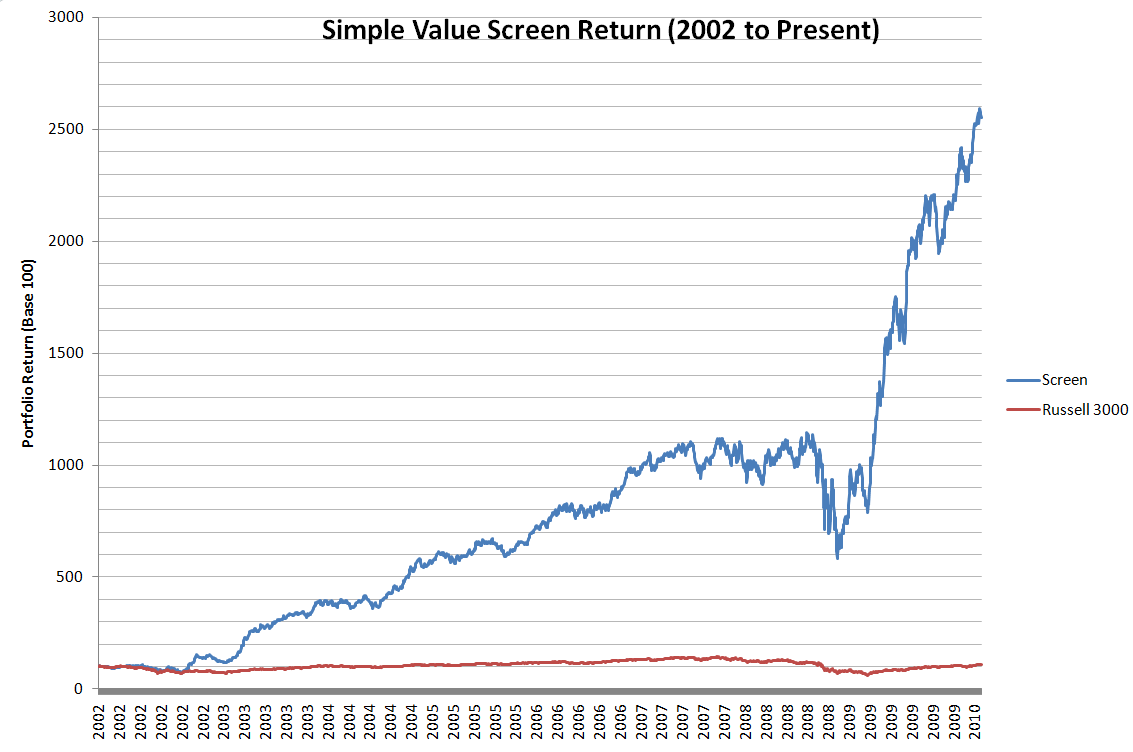
The simple value strategy returns a comically huge 2,450% over the 8 1/4 years, leaving the Russell 3000 Index in its wake (the Russell 3000 is up 9% for the entire period). 2,450% over the 8 1/4 years is an average annual compound return of 47%. That annual compound return figure is, however, misleading. It’s not a smooth upward ride at a 47% rate from 100 to 2,550. There are periods of huge returns, and, as the next chart shows, periods of substantial losses:

(Click to enlarge)
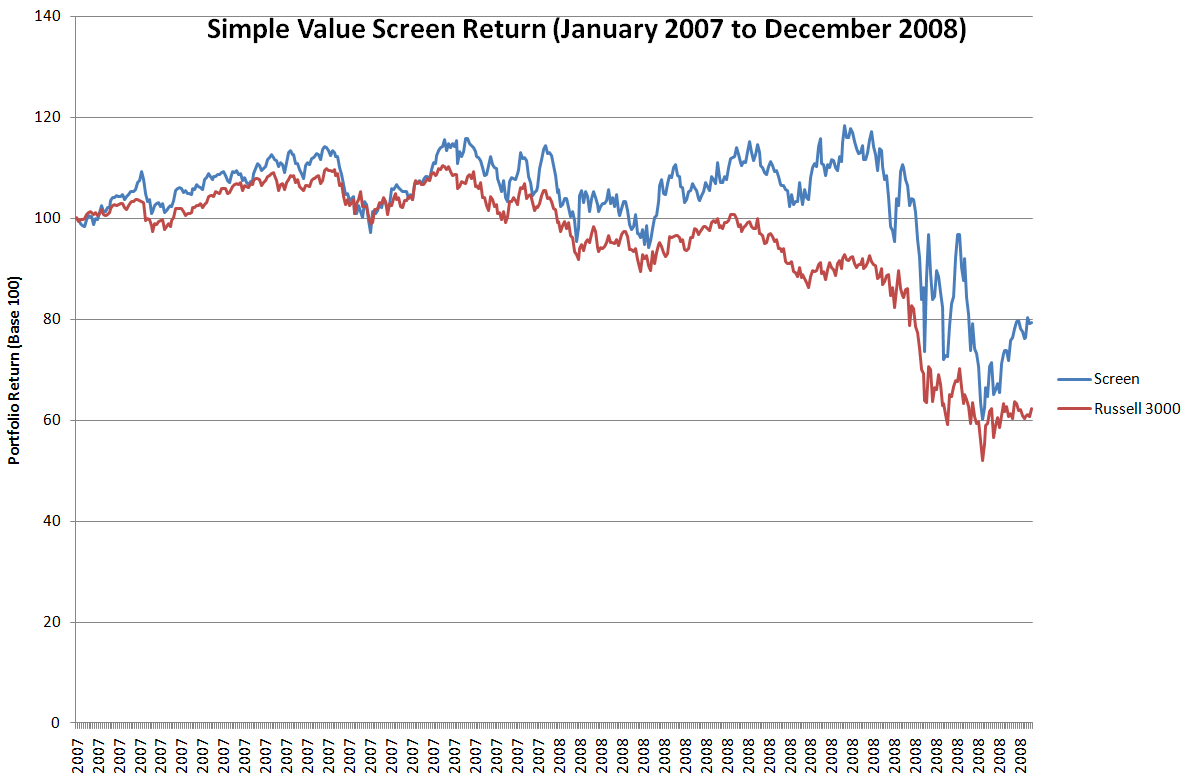
From January 2007 to December 2008, the simple value strategy lost 20% of its value, and was down 40% at its nadir. Taken from 2006, the strategy is square. That’s three years with no returns to show for it. It’s hard to believe that the two charts show the same strategy. If your investment experience starts in a down period like this, I’d suggest that you’re unlikely to use that strategy ever again. If you’re a professional investor and your fund launches into one of these periods, you’re driving trucks. Conversely, if you started in 2002 or 2009, your returns were excellent, and you’re genius. Neither conclusion is a fair one.

Abnormal Returns says of the correct conclusion to draw from performance:

An unexpectedly large drawdown may mark the failure of the model or may simply be the result of bad luck. The fact is that the decision will only be validated in hindsight. In either case it represents a chink in the armor of the human-free investment process. Ultimately every portfolio is run by a (fallible) human, whether they choose to admit it or not.

In this respect quantitative investing is not unlike discretionary investing. At some point every investor will face the choice of continuing to use their method despite losses or choosing to modify or replace the current methodology. So while quantitative investing may automate much of the investment process it still requires human input. In the end every quant model has a human with their hand on the power plug ready to pull it if things go badly wrong.

At an abstract, intellectual level, an adherence to a philosophy like value – with its focus on logic, discipline and character – alleviates some of the pain. Value answers the first part of the question above, “Does my strategy actually work?” Yes, I believe value works. The various academic studies that I’m so fond of quoting (for example, Value vs Glamour: A Global Phenomenon and Contrarian Investment, Extrapolation and Risk) confirm for me that value is a real phenomenon. I acknowledge, however, that that view is grounded in faith. We can call it logic and back-test it to an atomic level over an eon, but, ultimately, we have to accept that we’re value investors for reasons peculiar to our personalities, and not because we’re men and women of reason and rationality. It’s some comfort to know that greater minds have used the philosophy and profited. In my experience, however, abstract intellectualism doesn’t keep The Fear at bay at 3.00am. Neither does it answer the second part of the question, “Am I a value investor, or have I just been lucky?”

As an aside, whenever I see back-test results like the ones above (or like those in the Net current asset value and net net working capital back-test refined posts) I am reminded of Marcus Brutus’s oft-quoted line to Cassius in Shakespeare’s Julius Caesar:

There is a tide in the affairs of men,

Which, taken at the flood, leads on to fortune;

Omitted, all the voyage of their life

Is bound in shallows and in miseries.

As the first chart above shows, in 2002 or 2009, the simple value strategy was in flood, and lead on to fortune. Without those two periods, however, the strategy seems “bound in shallows and in miseries.” Brutus’s line seems apt, and it is, but not for the obvious reason. In the scene in Julius Caesar from which Brutus’s line is drawn, Brutus tries to persuade Cassius that they must act because the tide is at the flood (“On such a full sea are we now afloat; And we must take the current when it serves, Or lose our ventures.”). What goes unsaid, and what Brutus and Cassius discover soon enough, is that a sin of commission is deadlier than a sin of omission. The failure to take the tide at the flood leads to a life “bound in shallows and in miseries,” but taking the tide at the flood sometimes leads to death on a battlefield. It’s a stirring call to arms, and that’s why it’s quoted so often, but it’s worth remembering that Brutus and Cassius don’t see the play out.

* Yes, the link is to classic.abnormalreturns. I like my Abnormal Returns like I like my Coke.
Read Full Post »

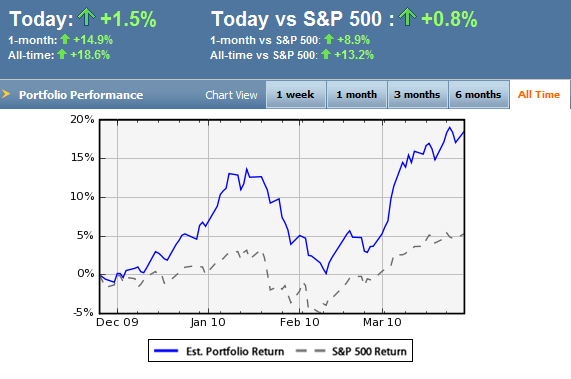
In a post in late November last year, Testing the performance of price-to-book value, I set up a hypothetical equally-weighted portfolio of the cheapest price-to-book stocks with a positive P/E ratio discovered using the Google Screener, which I called the “Greenbackd Contrarian Value Portfolio“. The portfolio has been operating for a little over 4 months, so I thought I’d check in and see how it’s going.

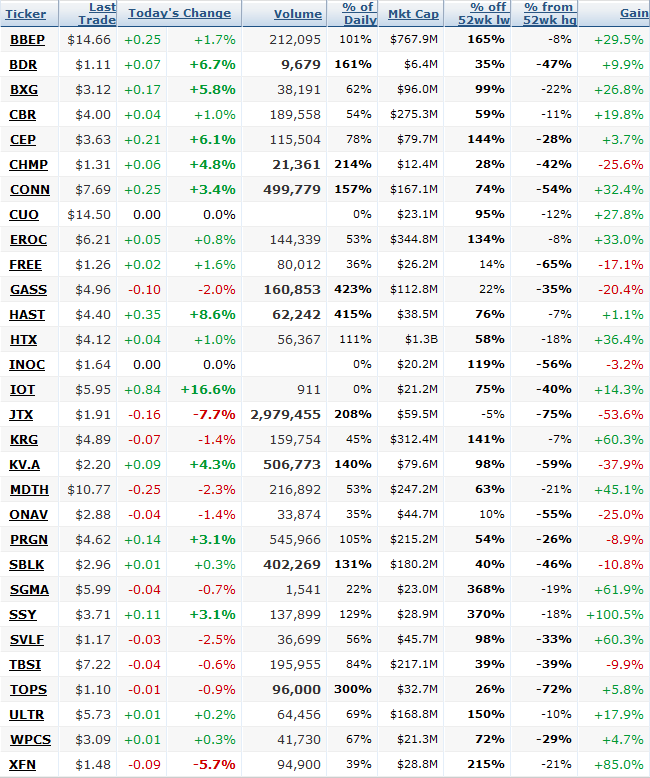
Here is the Tickerspy portfolio tracker for the Greenbackd Contrarian Value Portfolio showing how each individual stock is performing:

(Click to enlarge)

And the chart showing the performance of the portfolio against the S&P500:

[Full Disclosure:  No positions. This is neither a recommendation to buy or sell any securities. All information provided believed to be reliable and presented for information purposes only. Do your own research before investing in any security.]

Read Full Post »

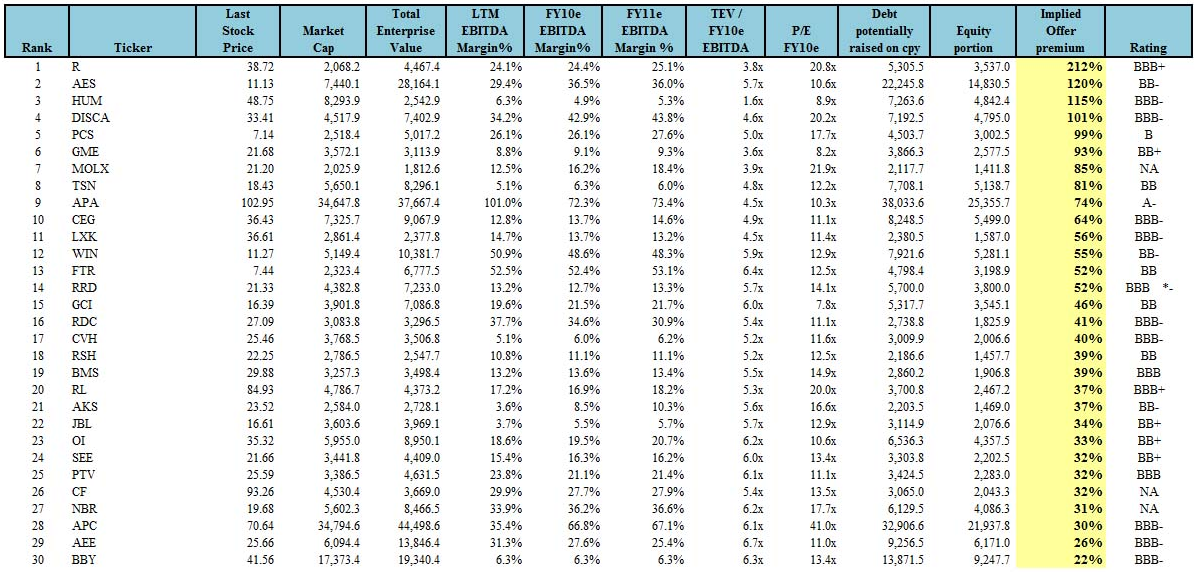
Zero Hedge has another interesting post, A Quick And Dirty LBO Screen, on the potential for a wave of going private deals. Zero Hedge uses “a simplistic template from UBS” to identify the thirty companies that would “generate the highest stock return should they get acquired.”

Zero Hedge assumes:

…a 4.5x Debt/EBITDA pro forma leverage (as much as TPG would like, 10x leverage is not coming back…Unless Joe Cassano is hired to run Chrysler’s take private group), and also assuming a 40% equity portion in the transaction. In other words, these are the companies that at least on paper have the highest equity expansion potential in a 7.5x EV/EBITDA.

Zero Hedge employs its typically elegant reasoning to identify the companies:

While this analysis ignores whether or not any of these companies actually generate substantial cash flow to cover pro forma interest, or are a logical fit for any financial acquiror, any company not on this list is likely already equity heavy and as a result even if acquired will not result in material upside.

This below list by no means suggests that any of these companies on it will be LBOed: it should merely be used a benchmark for modeling purposes.

Here’s the screen:

(Click to enlarge)

[Full Disclosure: No positions. This is neither a recommendation to buy or sell any securities. All information provided believed to be reliable and presented for information purposes only. Do your own research before investing in any security.]

Read Full Post »

I’m considering launching a subscription-only service aimed at identifying stocks similar to those in the old Wall Street’s Endangered Species reports. Like the old Wall Street’s Endangered Species reports, I’ll be seeking undervalued industrial companies where a catalyst in the form a buy-out, strategic acquisition, liquidation or activist campaign might emerge to close the gap between price and value. The main point of difference between the old Piper Jaffray reports and the Greenbackd version will be that I will also include traditional Greenbackd-type stocks (net nets, sub-liquidation values etc) to the extent that those type of opportunities are available. The cost will be between $500 and $1,000 per annum for 48 weekly emails with a list of around 30 to 50 stocks and some limited commentary.

If you would like to receive a free trial copy of the report if and when it is produced in exchange for providing feedback on its utility (or lack thereof), would you please send an email to greenbackd [at] gmail [dot] com. If there is sufficient interest in the report I’ll go ahead and produce the trial copy.

Read Full Post »

Zero Hedge has an interesting article, How To Capitalize On The Upcoming Irrationally Exuberant LBO Bubble, about “the imminent tidal wave of going private deals.” Privatisations are one of the means by which undervalued small capitalization stocks can “close their value gap.” Said Daniel J. Donoghue, Michael R. Murphy and Mark Buckley in Wall Street’s Endangered Species:

Management buy-outs can provide shareholders with the attractive control premiums currently experienced in the private M&A market. Alternatively, strategic mergers can immediately deliver large cap multiples to the small cap shareholder.

Bank of America’s Jeffrey Rosenberg sets the scene for what Zero Hedge calls “the LBO bubble v2:”

They’re back. The combination of the credit market resurgence and tight spreads, attractive equity valuations and ample private equity “dry powder” create the conditions for increasing the volumes of [leveraged buy-outs (LBOs)]. Whether deals will strike at the heart of the high grade market in the form of mega size transactions ($10b+) remains unclear, though the possibility clearly now exists. Unlike the most recent era, lower leverage and more prevalent change of control protections help to limit cram down losses. The IMS Health LBO illustrates the new LBO market dynamics – a $5.9B LBO funded with $3B in debt – where bank and mezzanine debt investors now augment the role of CLOs as key debt providers.

CLOs are “collateralized loan obligations,” which Wikipedia says “are a form of securitization where payments from multiple middle sized and large business loans are pooled together and passed on to different classes of owners in various tranches. A CLO is a type of collateralized debt obligation:”

Each class of owner may receive larger payments in exchange for being the first in line to lose money if the businesses fail to repay the loans. The actual loans used are generally multi-million dollar loans known as syndicated loans, usually originally lent by a bank with the intention of the loans being immediately paid off by the collateralized loan obligation owners. The loans are usually “leveraged loans”, that is, loans to businesses which owe an above average amount of money for their kind of business, usually because a new business owner has borrowed funds against the business to purchase it (known as a “leveraged buyout”) or because the business has borrowed funds to buy another business.

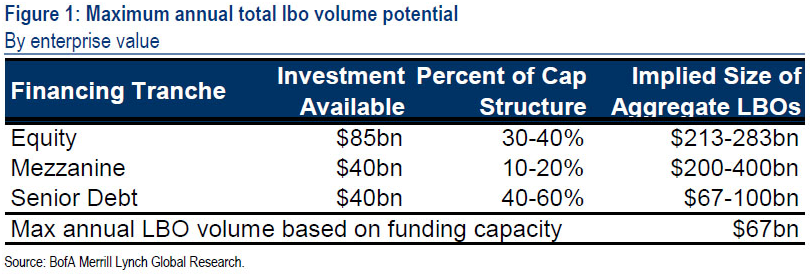
Rosenberg argues that the total pool of available LBO capital is ~$70B. Zero Hedge says, “Should CLOs indeed come back, look for this number to explode:”

Figure 1 below highlights our estimates of the maximum aggregate LBO volume supported by debt and equity fund raising capacity. These amounts represent only the limit on the size of LBO volumes, not our expectations of volumes in 2010. What is clear is that the return of the availability of senior debt financing is key to the ability to fund LBOs and this availability is supported by the new (relative to the earlier era) role of mezzanine debt in the “typical” LBO structure. According to these estimates of market capacity across senior, mezzanine and equity financing, expansion in senior debt financing capacity appears the constraint on the aggregate amount of LBO activity.

Note that this aggregate analysis does not describe the limits on mega size transactions – the $10B and above size transactions that garner greater attention and potential losses to cram down debt holders – as well as gains to public equity holders. That constraint remains the ability to absorb concentrated positions in a single fund. And as we describe more here, that constraint includes the new mezzanine debt financing capacity that contributes to today’s increasing amounts of debt funding capacity for LBOs.

Rosenberg has a noteworthy approach to identifying LBO candidates:

After having argued for the potential for increasing volumes for LBO risk, the starting point for managing that risk is to identify names that are more likely candidates. Since definitively identifying LBO candidates is impossible, we take the other approach: exclude names in which an LBO is infeasible. By limiting the universe down to feasible LBO candidates, we create a starting point for designing hedging strategies. Moving beyond this step is both an art and a science. In the sample trading strategies below, we employ both quantitative approaches as well as bottoms up input from our team of fundamental analysts to identify this small sample of feasible (though not necessarily probable) LBO candidates.

Click here to see Rosenberg’s LBO risk hedging strategies (via Zero Hedge).

Most useful for predominantly long equity investors like us, Zero Hedge also provides a copy of Goldman Sachs’ recently updated LBO screener (.xls), which looks like this (click to enlarge):

Says Zero Hedge:

The companies included represent the names most likely to be looked at actively by PE firms, and where a go private outcome would seem the highest. As such, buying the stock in a basket of the likeliest LBO candidates would be a relatively sure way to shotgun out a few quick LBO-type returns.

This is similar, in essence, to the approach of Donoghue, Murphy and Buckley as described in Wall Street’s Endangered Species, a strategy that performed well over the last 10 years.

Read Full Post »

Dr. Michael Burry has been a very popular topic on Greenbackd recently as a result of Michael Lewis’s The Big Short and the Vanity Fair article Betting on the Blind Side. I have posted a link to Burry’s techstocks.com “Value Investing” thread (now Silicon Investor) and another to Burry’s Scion Capital investor letters, but the thirst for all things Burry remains undiminished. The New York Times now has an article, The Origins of Michael Burry, Online, discussing some of Burry’s early postings on his techstocks.com thread. Here Burry discusses his strategy for shorting:

I mentioned that I pick stocks to short based on valuation, not ratios (I ask you to find the correct free cash flow — I bet most people don’t kow they’re working with negative net working capital, either). But I ENTER based on technical analysis. KO could go up or down. The odds are down, technically, but that’s what buy stops are for. This isn’t a long term short by any means. Research on shorts show that profitable shorts make money with small gains, not by waiting for businesses to bankrupt. The small gains are usually there for the picking. Another indicator — if it’s mentioned in Barron’s as a buy three different times <g> — set me onto Wells Fargo.

What’s there to understand about Coke? The business is a KISS model. This gets to my value/short strategy. When people start claiming a business deserves a special valuation above all reasonable fundamental analysis (because of the “franchise”, because there’s so little institutional ownership for a big cap growth stock, because Buffett’s in it, because global expansion will provide endless opportunity, because ROE is so damned high, because it’s nearly a monopoly, because Buffett’s in it…), that’s a short, IMO.

I just read a bunch of Graham, and he doesn’t deal with shorts (I assume it would be “speculation”), but EMT isn’t all that its panned to be either, IMO.

Just trying to think independently,

Mike

The NYT has also unearthed a Forbes magazine article from 2000:

VALUESTOCKS.NET www.valuestocks.net Supposedly for value investors, though Warren Buffett might not agree with this definition of value. Run by a 28-year-old neurology resident, Dr. Michael Burry, Valuestocks.net showcases Burry’s own $50,000 portfolio, which includes some surprising choices including Pixar, the maker of Toy Story. Has good information on how to identify net-net stocks (trading for less than assets minus all conceivable liabilities). Accompanying all this are Burry’s incisive reports, as good as anything from Wall Street. One of the site’s best features is a list of essential finance texts, including thumbnail reviews and links to Amazon.com (Burry’s only source of revenue, since he doesn’t accept banner ads). BEST: Original analysis, links to great finance sites, and a must-read book list for value investors. WORST: Limited content is sometimes dated.

It seems Greenbackd is rapidly, if unintentionally, becoming Mike Burry’s Of Permanent Value, which is Andrew Kilpatrick’s encyclopedic collection of stories about Warren Buffett. Incidentally, my copy of Of Permanent Value is around ten years old, which means it’s one-third the size of the 2010 edition (I’m not even joking. Mine came in a single volume, and it now seems to be a three-volume extravaganza. Buffett has been busy over the last 10 years).

Read Full Post »

In the Introduction to my 2003 copy of Philip A. Fisher’s Common Stocks and Uncommon Profits and Other Writings, his son, Kenneth L. Fisher, recounts a story about his father that has stuck with me since I first read it. For me, it speaks to Phil Fisher’s eclectic genius, and quirky sense of humor:

But one night in the early 1970’s, we were together in Monterey at one of the first elaborate dog-and-pony shows for technology stocks – then known as “The Monterey Conference” – put on by the American Electronics Association. At the Monterey Conference, Father exhibited another quality I never forgot. The conference announced a dinner contest. There was a card at each place setting, and each person was to write down what he or she thought the Dow Jones Industrials would do the next day, which is, of course, a silly exercise. The cards were collected. The person who came closest to the Dow’s change for the day would win a mini-color TV (which were hot new items then). The winner would be announced at lunch the next day, right after the market closed at one o’clock (Pacific time). Most folks, it turned out, did what I did – wrote down some small number, like down or up 5.57 points. I did that assuming that the market was unlikely to do anything particularly spectacular because most days it doesn’t. Now in those days, the Dow was at about 900, so 5 points was neither huge nor tiny. That night, back at the hotel room, I asked Father what he put down; and he said, “Up 30 points,” which would be more than 3 percent. I asked why. he said he had no idea at all what the market would do; and if you knew him, you knew that he never had a view of what the market would do on a given day. But he said that if he put down a number like I did and won, people would think he was just lucky – that winning at 5.57 meant beating out the guy that put down 5.5 or the other guy at 6.0. It would all be transparently seen as sheer luck. But if he won saying, “up 30 points,” people would think he knew something and was not just lucky. If he lost, which he was probable and he expected to, no one would know what number he had written down, and it would cost him nothing. Sure enough, the next day, the Dow was up 26 points, and Father won by 10 points.

When it was announced at lunch that Phil Fisher had won and how high his number was, there were discernable “Ooh” and “Ahhhh” sounds all over the few-hundred-person crowd. There was, of course, the news of the day, which attempted to explain the move; and for the rest of the conference, Father readily explained to people a rationale for why he had figured out all that news in advance, which was pure fiction and nothing but false showmanship. But I listened pretty carefully, and everyone he told all that to swallowed it hook, line, and sinker. Although he was socially ill at ease always, and insecure, I learned that day that my father was a much better showman than I had ever fathomed. And, oh, he didn’t want the mini-TV because he had no use at all for change in his personal life. So he gave it to me and I took it home and gave it to mother, and she used it for a very long time.

Common Stocks and Uncommon Profits and Other Writings is, of course, required reading for all value investors. I believe the Introduction to the 2003 edition, written by Kenneth Fisher, should also be regarded as required reading. There Kenneth [Edit:, an investment superstar in his own right,] shares intimate details about Phil from the perspective of a son working with the father. As the vignette above demonstrates, Phil understood human nature, but was socially awkward; he understood the folly of the narrative, but was prepared to provide a colorful one when it suited him; and he understood positively skewed risk:reward bets in all aspects of his life, and had the courage to take them, even if it meant standing apart from the crowd. What is most striking about this sketch of Phil Fisher is that it could just as easily be a discussion of Mike Burry or Warren Buffett. Perhaps great investors are like Leo Tolstoy’s happy families:

Happy families are all alike; every unhappy family is unhappy in its own way.

Read Full Post »

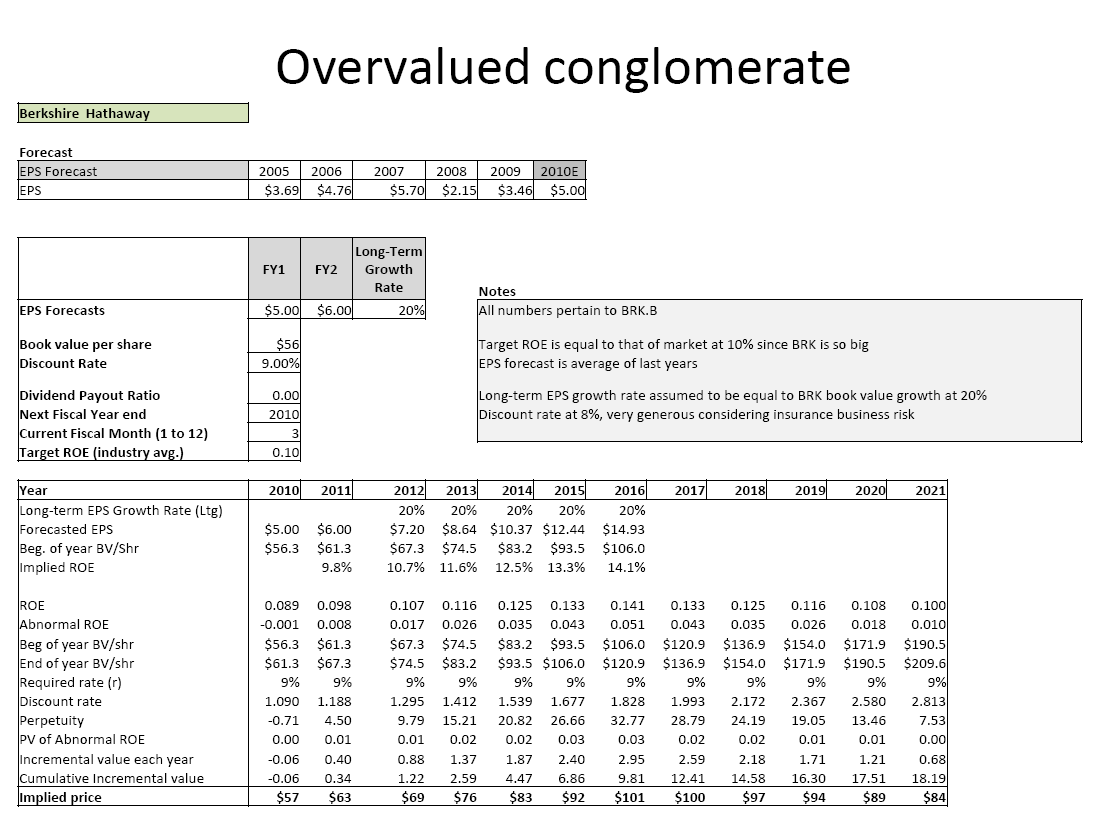
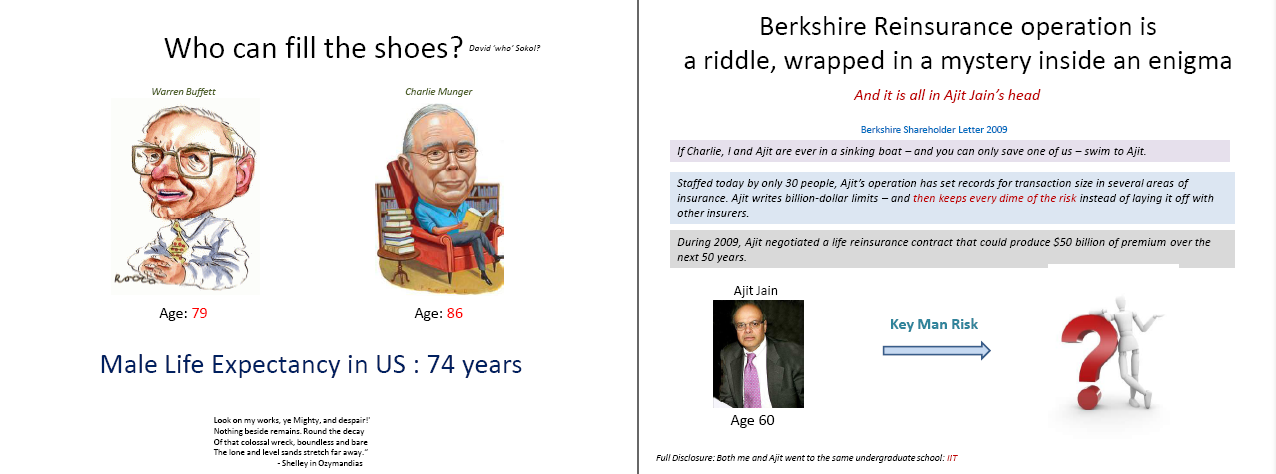
Yesterday I ran a guest post on the short case for Berkshire Hathaway Inc. (NYSE:BRK.A, BRK.B) by S. Raj Rajagopal, an MBA student at Johnson Graduate School of Management at Cornell University. The post generated several requests for the valuation supporting Raj’s short thesis, which Raj has provided and I’ve reproduced below.

Here is the valuation underpinning Raj’s short case for Berkshire Hathaway Inc. (NYSE:BRK.A,BRK.B):

(Click to enlarge)

Click here to download the full presentation including the updated valuation for the Berkshire Hathaway short case (.pdf).

Please contact Raj if you would like to discuss his valuation or his short case.

[Full Disclosure: I do not hold a position in BRK.A or BRK.B. This is neither a recommendation to buy or sell any securities. All information provided believed to be reliable and presented for information purposes only. Do your own research before investing in any security.]

Read Full Post »

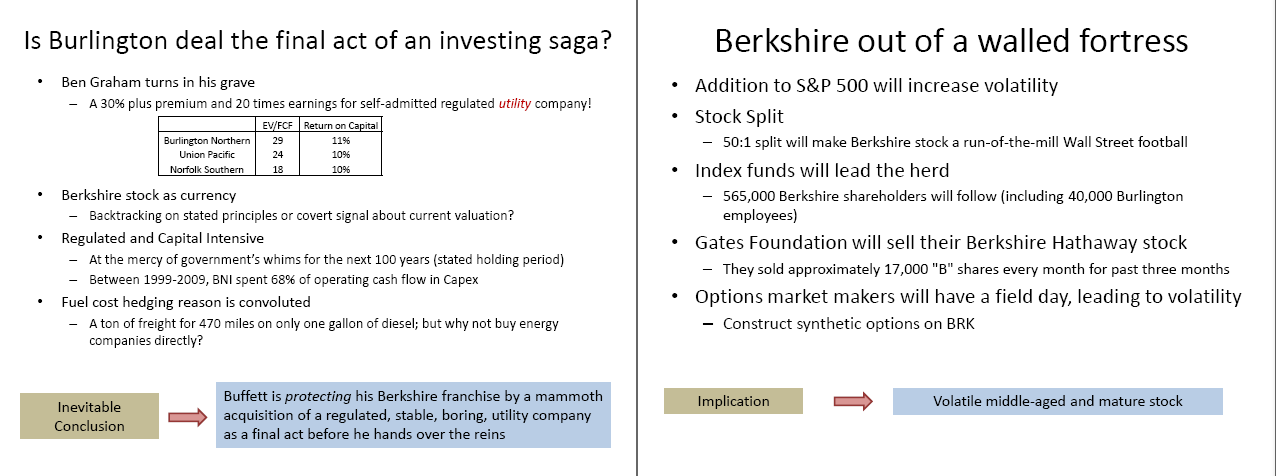
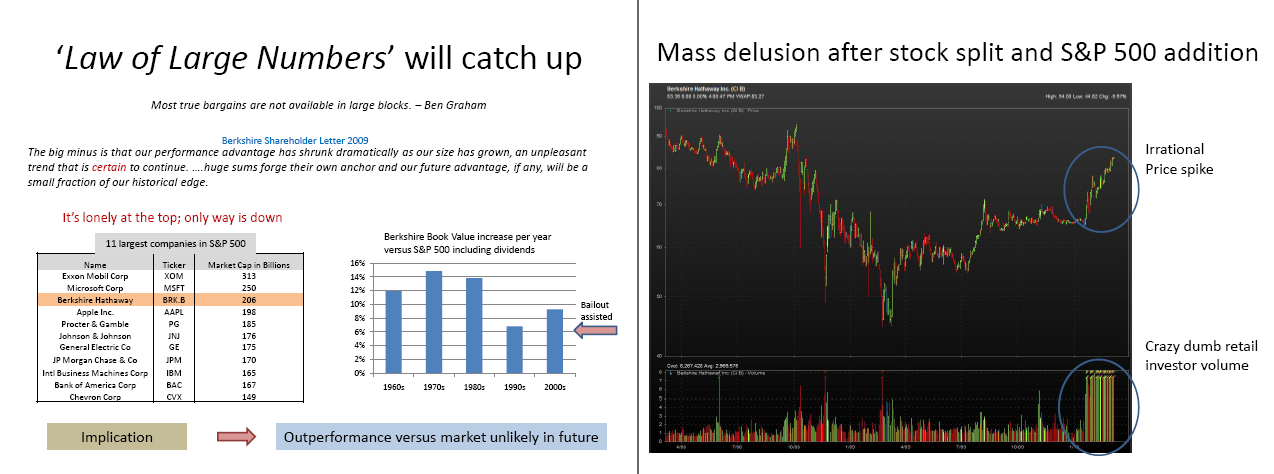
S. Raj Rajagopal has provided a guest post outlining his argument for a short position in Berkshire Hathaway Inc. (NYSE:BRK.A, BRK.B). Raj is an MBA student at Johnson Graduate School of Management at Cornell University graduating in May this year. He has worked as a portfolio manager at the Cayuga Fund, LLC, the Johnson Graduate School’s $12M hedge fund, and is currently seeking full-time employment in the investment management area. Here is his resume and his website, Gordian Knots. Please contact Raj if you would like to see his valuation on BRK.A / BRK.B.

Raj’s short case for Berkshire Hathaway Inc. (NYSE:BRK.A,BRK.B) is set out below:

(Click to enlarge)

Click here to download the Short Case for Berkshire Hathaway in full (.pdf)

[Full Disclosure: I do not hold BRK.A or BRK.B. This is neither a recommendation to buy or sell any securities. All information provided believed to be reliable and presented for information purposes only. Do your own research before investing in any security.]

Read Full Post »

Back in the spring of 1999, when the world was enamored of dot coms and not much else, three guys at Piper Jaffray, Daniel J. Donoghue, Michael R. Murphy and Mark Buckley*, produced a superb research report called Wall Street’s Endangered Species. The thesis of the paper was that there were a large number of undervalued companies with strong fundamentals and solid growth prospects in the small cap sector (defined as stocks with a market capitalization between $50M and $250M) lacking a competitive auction for their shares. Donoghue, Murphy and Buckley argued that the phenomenon was secular, and only mergers or buy-outs would “close their value gap:”

Management buy-outs can provide shareholders with the attractive control premiums currently experienced in the private M&A market. Alternatively, strategic mergers can immediately deliver large cap multiples to the small cap shareholder.

I believe that this phenomenon led to the emergence of activist investors in the small cap sector over the last decade. More on this in a moment.

Endangered species report

The document is drafted from the perspective of a M&A team selling corporate advisory services. Here’s the pitch:

Many well-run and profitable public companies in the $50-250 million market capitalization range are now trading at a significant discount to the rest of the stock market. Is this a temporary, cyclical weakness in small stocks that is likely to reverse soon? No, these stocks have been permanently impaired by a shift in the economics of small cap investing. This persistent under-valuation is sure to be followed by a rise in M&A activity in the sector. We have already seen an uptick in the number of “going private” transactions and strategic mergers involving these companies. Management teams that identify this trend, and respond to it, will thrive. The inactive face extinction.

Donoghue, Murphy and Buckley’s thesis was based on the then relative underperformance of the Russell 2000 to the S&P 500:

The accompanying graph, labeled Exhibit I, illustrates just how miserably the Russell 2000 lagged the S&P 500 not only last year but in 1996 and 1997 as well. Granted, small cap returns have tended to run in cycles. Since the Depression, there have been five periods during which small cap stocks have outperformed the S&P 500 (1932-37, 1940-45, 1963-68, 1975-83, and 1991-94). It is reasonable to believe that small caps, in general, will once again have their day in the sun.

They argued that the foregoing graph was a little misleading because the entirety of the Russell 2000 universe wasn’t underperforming, just the smallest members of the index:

However, a closer look at the smallest companies within the Russell 2000 reveals a secular decline in valuations that is not likely to be reversed. The table in Exhibit II divides the Russell 2000 into deciles according to market capitalization. Immediately noticeable is the disparity between the top decile, with a median market capitalization of $1.5 billion, and the tenth decile at less than $125 million. Even more striking is the comparison of compounded annual returns for the past ten years. The data clearly demonstrates that it is not the commonly tracked small cap universe as a whole that is plagued by poor stock performance but rather the smallest of the small: companies less than about $250 million in value.

Stocks trading at a discount to private company valuations

The underperformance led to these sub-$250M market cap companies trading at a discount to private company valuations:

Obscurity in the stock market translates into sub-par valuations. As shown in Exhibit IV, the smaller of the Russell 2000 companies significantly lag the S&P 500 in earnings and EBIT multiples. It is startling to find that with an average EBIT multiple of 9.0 times, many of these firms are valued below the acquisition prices of private companies.

And the punchline:

Reviving shareholder value requires a fundamental change in ownership structure. Equity must be transferred out of the hands of an unadoring public, and into those of either: 1) management backed by private capital, or 2) larger companies that can capture strategic benefits. Either remedy breathes new life into these companies by providing cheaper sources of capital, and by shifting the focus away from quarterly EPS to long-term growth.

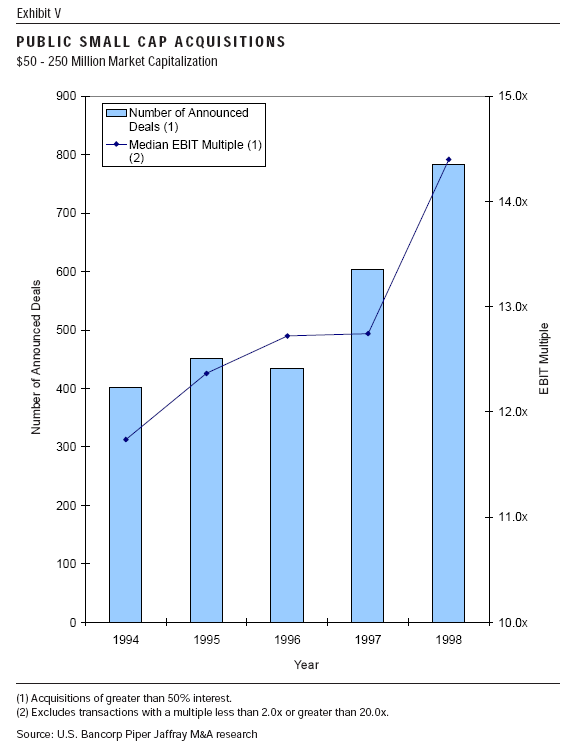
Increasing M&A activity

The market had not entirely missed the value proposition. M&A in the small cap sector was increasing in terms of price and number of transactions:

Darwin’s Darlings

Donoghue, Murphy and Buckley argued that the value proposition presented by these good-but-orphaned companies, which they called “Darwin’s darlings,” presented an attractive opportunity, described as follows:

Despite the acceleration of orphaned public company acquisitions in 1997 and 1998, there remains a very large universe of attractive public small cap firms. We sifted through the public markets, focusing on the $50-250 million market capitalization range, to construct a list of the most appealing companies. We narrowed our search by eliminating certain non-industrial sectors and ended up with over 1500 companies.

We analyzed their valuations relative to the S&P 500. The disparity is so wide that the typical S&P 500 company could pay a 50% premium to acquire the average small cap in this group without incurring earnings dilution. Those dynamics appear to be exactly what is driving small cap takeover values. The median EBIT multiple paid for small caps in 1998 was roughly equal to where the typical S&P 500 trades.

We honed in on those companies with multiples that are positive, but even more deeply discounted at less than 50% of the S&P 500. Finally, we selected only those with compounded annual EBIT growth of over 10% for the past five years. As shown in Exhibit VII, these 110 companies,“Darwin’s Darlings,” have a median valuation of only 5.8 times EBIT despite a compounded annual growth rate in EBIT of over 30% for the past five years.

The emergence of activists

Donoghue, Murphy and Buckley identified the holders of many of these so-called “Darwin’s darlings” as “small cap investment funds focused on likely take-over targets:”

As detailed in the description of our “Darwin’s Darlings” in Exhibit VIII, management ownership varies widely among these companies. For recent IPOs of family-held businesses, management stakes are generally high. For those that were corporate spin-offs, management ownership tends to be low. We frequently find large blocks of these stocks held by small cap investment funds focused on likely take-over targets, leading to a surprisingly high percentage of total insider ownership (management plus holders of more than 5%).

Regardless of ownership structure, these companies typically have the customary defensive mechanisms in place. They are also protected by the fact that they are so thinly traded. In most cases it takes more than six months to accumulate a 5% position in the stock without moving the market. Hence, we expect virtually all acquisitions in this sector to be friendly. There is no question that some very attractive targets cannot be acquired on a friendly basis. However, coercing these companies into a change of control means being prepared to launch a full proxy fight and tender offer.

In When Wall Street Scorns Good Companies, a Fortune magazine article from October 2000, writer Geoffrey Colvin asked of Darwin’s darlings, “So why are all these firms still independent?”

The answer may lie in another fact about them: On average, insiders own half their shares. When the proportion is that high, the insiders are most likely founders; they have enough stock to fend off any hostile approach, and they haven’t sold because they aren’t ready to give up control. Not many outside investors want to go along for that ride. Thus, low prices.

But there’s still a logical problem. Since the companies are so cheap, why don’t managers buy the shares they don’t already own– take the company private at today’s crummy multiple, then sell the whole shebang at an almost guaranteed higher price? Going private has in fact become more popular than ever, but what seems most striking is how rare it remains. Of Piper Jaffray’s 1999 Darwin’s Darlings– 110 companies–only three went private in the following 12 months. That makes perfect sense if you figure that many of the outfits are run by owner-managers whose top priority is keeping control. Announce a going-private transaction and you put the company in play, and even a chummy board may feel obliged to honor its fiduciary duty if a higher bid comes along.

Thus we reach the somewhat ugly truth about Wall Street’s orphaned stars: Many of them (not all) like things the way they are–that is, they like staying in control. The outsider owners are typically a diffuse bunch in no position to put heat on the controlling insiders. The stock price may be lousy, but when the owner-managers decide to sell–that is, to get out of the way–it will almost certainly rise handsomely, as it did for the 19 of last year’s Darwin’s Darlings that have since sold.

So shed no tears for these scorned companies, and don’t buy their shares without a deep understanding of what the majority owners have in mind. In theory the spreading corporate governance movement ought to protect you; in practice the shareholder activists have bigger fish to fry. Such circumstances may keep share prices down, but that’s the owner-managers’ problem. At least, in this case, the market isn’t so mysterious after all.

I believe that the third paragraph above best describes the reason for the emergence of the activists in the small cap sector. Observing that stock prices rose dramatically when owner-managers of “Wall Street’s orphaned stars” decided to sell, and outside investors were “typically a diffuse bunch in no position to put heat on the controlling insiders,” activist investors saw the obvious value proposition and path to a catalyst and entered the fray. This led to a golden decade for activist investing in the small cap sector, one that I think is unlikely to be repeated in the next decade. Regardless, it’s an interesting strategy, and an obvious extension for an investor focussed on small capitalization stocks and activist targets.

*Donoghue, Murphy and Buckley in 2002 founded Discovery Group, a fund manager and M&A advisory that takes significant ownership stakes (up to 20%) in companies trading at a discount to “fundamental economic value.”

Read Full Post »

« Newer Posts - Older Posts »