Feeds:
Posts
Comments

Archive for the ‘About’ Category

Following on from our earlier post, Seth Klarman on Liquidation Value, we present the second post in our series on Klarman’s Margin of Safety: Risk-Averse Value Investing Strategies for the Thoughtful Investor.

As we discussed in our first post, Klarman is the founder of The Baupost Group, a deep value-oriented private investment partnership that has generated an annual compound return of 20% over the past 25 years. Klarman detailed his investment process in the iconic Margin of Safety. The book is required reading for all value investors, but is long out-of-print and notoriously difficult to obtain.

In today’s extract, drawn from Chapter 10 Areas of Opportunity for Value Investors: Catalysts, Ineficiences, and Institutional Constraints, Klarman discusses the importance of the catalyst in the investment process:

Once a security is purchased at a discount from underlying value, shareholders can benefit immediately if the stock price rises to better reflect underlying value or if an event occurs that causes that value to be realized by shareholders. Such an event eliminates investors’ dependence on market forces for investment profits. By precipitating the realization of underlying value, moreover, such an event considerably enhances investors’ margin of safety. I refer to such events as catalysts.

Some catalysts for the realization of underlying value exist at the discretion of a company’s management and board of directors. The decision to sell out or liquidate, for example, is made internally. Other catalysts are external and often relate to the voting control of a company’s stock. Control of the majority of a company’s stock typically allows the holder to elect the majority of the board of directors. Thus accumulation of stock leading to voting control, or simply management’s fear that this might happen, could lead to steps being taken by a company that cause its share price to more fully reflect underlying value.

Catalysts vary in their potency. The orderly sale or liquidation of a business leads to total value realization. Corporate spinoffs, share buybacks, recapitalizations, and major asset sales usually bring about only partial value realization.

Value investors are always on the lookout for catalysts. While buying assets at a discount from underlying value is the defining characteristic of value investing, the partial or total realization of underlying value through a catalyst is an important means of generating profits. Furthermore, the presence of a catalyst serves to reduce risk. If the gap between price and underlying value is likely to be closed quickly, the probability of losing money due to market fluctuations or adverse business developments is reduced. In the absence of a catalyst, however, underlying value could erode; conversely, the gap between price and value could widen with the vagaries of the market. Owning securities with catalysts for value realization is therefore an important way for investors to reduce the risk within their portfolios, augmenting the margin of safety achieved by investing at a discount from underlying value.

Catalysts that bring about total value realization are, of course, optimal. Nevertheless, catalysts for partial value realization serve two important purposes. First, they do help to realize underlying value, sometimes by placing it directly into the hands of shareholders such as through a recapitalization or spinoff and other times by reducing the discount between price and underlying value, such as through a share buyback. Second, a company that takes action resulting in the partial realization of underlying value for shareholders serves notice that management is shareholder oriented and may pursue additional value-realization strategies in the future. Over the years, for example, investors in Teledyne have repeatedly benefitted from timely share repurchases and spinoffs.

Tomorrow we present the final installment in the series, Seth Klarman on Investing in Corporate Liquidations.

Read Full Post »

Seth Klarman, the founder of The Baupost Group, an exceptionally well-performed, deep value-oriented private investment partnership, is known for seeking idiosyncratic investments. The Baupost Group’s returns bear out his unusual strategy: Over the past 25 years, The Baupost Group has generated an annual compound return of 20% and is ranked 49th in Alpha’s hedge fund rankings.

Klarman detailed his investment process in Margin of Safety: Risk-Averse Value Investing Strategies for the Thoughtful Investor, an iconic book on value investing that is required reading for all value investors. Published in 1991, the book is long out-of-print and famously difficult to obtain. According to a 2006 Business Week article, The $700 Used Book: Why all the buzz about Seth Klarman’s out-of-print investing classic?:

The 249-page book is especially hot among those seeking jobs with value-oriented investment firms. “You win serious points for talking Klarman,” says a newly minted MBA who got his hands on a copy prior to a late-round interview with a top mutual fund firm. “It’s pretty much assumed that you’ve read Graham and Dodd and Warren Buffett.” (Benjamin Graham and David Dodd’s 1934 work, Security Analysis, is a seminal book on value investing, while Buffett’s annual letters to shareholders are considered gospel.) “The book belongs in the category of Buffett and Graham,” says Oakmark Funds manager Bill Nygren, a collector of stock market tomes.

In the book, Klarman carefully explains the rationale for an investment strategy grounded in the value school. He also discusses at some length several sources for value investment opportunities. Why is the book germane to Greenbackd’s ongoing discussion of liquidation value investment? One source of investment opportunity identified by Klarman is stocks trading below liquidation value.

Klarman’s attitude to liquidation value investment closely accords with our own, and so we’ve reproduced below the relevant portion of Chapter 8 The Art of Business Valuation in Margin of Safety, in which he provides the basis for making such investments and outlines his approach to assessing liquidation value:

Liquidation Value

The liquidation value of a business is a conservative assessment of its worth in which only tangible assets are considered and intangibles, such as going-concern value, are not. Accordingly, when a stock is selling at a discount to liquidation value per share, a near rock-bottom appraisal, it is frequently an attractive investment.

A liquidation analysis is a theoretical exercise in valuation but not usually an actual approach to value realization. The assets of a company are typically worth more as part of an going concern than in liquidation, so liquidation value is generally a worst-case assessment. Even when an ongoing business is dismantled, many of its component parts are not actually liquidated but instead are sold intact as operating entities. Breakup value is one form of liquidation analysis, this involves determining the highest value of each component of a business, either as an ongoing enterprise or in liquidation. Most announced corporate liquidations are really breakups; ongoing business value is preserved whenever it exceeds liquidation value.

How should investors value assets in a liquidation analysis? An orderly liquidation over time is virtually certain to realize greater proceeds than a “fire sale,” but time is not always available to a company in liquidation. When a business is in financial distress, a quick liquidation (a fire sale) may maximize the estate value. In a fire sale the value of inventory, depending on its nature, must be discounted steeply below carrying value. Receivables should probably be significantly discounted as well; the nature of the business, the identity of the customer, the amount owed, and whether or not the business is in any way ongoing all influence the ultimate realization from each receivable.

When no crisis is at hand, liquidation proceeds are usually maximized through a more orderly winding up of a business. In an orderly liquidation the values realized from disposing of current assets will more closely approximate stated book value. Cash, as in any liquidation analysis, is worth one hundred cents on the dollar. Investment securities should be valued at market prices, less estimated transaction costs in selling them. Accounts receivable are appraised at close to their face amount. The realizable value of inventories – tens of thousands of programmed computer diskettes hundreds of thousands of purple slippers, or millions of sticks of chewing gum – is not so easily determinable and may well be less than book value. The discount depends on whether the inventories consist of finished goods, work in process, or raw materials, and whether or not there is the risk of technological or fashion obsolescence. The value of inventory in a supermarket does not fluctuate much, but the value of a warehouse full of computers certainly may. Obviously a liquidation sale would yield less for inventory than would an orderly sale to regular customers.

The liquidation value of a company’s fixed assets can be difficult to determine. The value of plant and equipment, for example, depends on its ability to generate cash flows, either in the current use or in alternative uses. Some machines and facilities are multipurpose and widely owned; others may have value only to the present owner. The value of restaurant equipment, for example, is more readily determinable than the value of an aging steel mill.

In approximating the liquidation value of a company, some value investors, emulating Benjamin Graham, calculate “net-net working capital” as a shortcut. Net working capital consists of current assets (cash, marketable securities, receivables, and inventories) less current liabilities (accounts, notes, and taxes payable within one year.) Net-net working capital is defined as net working capital minus all long-term liabilities. even when a company has little ongoing business value, investors who buy at a price below net-net working capital are protected by the approximate liquidation value of current assets alone. As long as working capital is not overstated and operations are not rapidly consuming cash, a company could liquidate its assets, extinguish all liabilities, and still distribute proceeds in excess of the market price to investors. Ongoing business losses can, however, quickly erode net-net working capital. Investors must therefore always consider the state of a company’s current operations before buying. Investors should also consider any off-balance sheet or contingent liabilities that might be incurred in the course of an actual liquidation, such as plant closing and environmental laws.

A corporate liquidation typically connotes business failure; but ironically, it may correspond with investment success. The reason is that the liquidation or breakup of a company is a catalyst for the realization of the underlying business value. Since value investors attempt to buy securities trading at a considerable discount from the value of a business’s underlying assets, a liquidation is one way for investors to realize profits.

A liquidation is, in a sense, one of the few interfaces where the essence of the stock market is revealed. Are stocks pieces of paper to be endlessly traded back and forth, or are they proportional interests in underlying businesses? A liquidation settles this debate, distributing to owners of pieces of paper the actual cash proceeds resulting from the sale of corporate assets to the highest bidder. A liquidation thereby acts as a tether to reality for the stock market, forcing either undervalued or overvalued share prices to move into line with actual underlying value.

We’ll continue our discussion on Seth Klarman and his approach to liquidation value investment later this week.

Buy my book The Acquirer’s Multiple: How the Billionaire Contrarians of Deep Value Beat the Market from on Kindlepaperback, and Audible.

Here’s your book for the fall if you’re on global Wall Street. Tobias Carlisle has hit a home run deep over left field. It’s an incredibly smart, dense, 213 pages on how to not lose money in the market. It’s your Autumn smart read. –Tom Keene, Bloomberg’s Editor-At-Large, Bloomberg Surveillance, September 9, 2014.

Click here if you’d like to read more on The Acquirer’s Multiple, or connect with me on Twitter, LinkedIn or Facebook. Check out the best deep value stocks in the largest 1000 names for free on the deep value stock screener at The Acquirer’s Multiple®.

Read Full Post »

In a paper published in February this year, Entrepreneurial Shareholder Activism: Hedge Funds and Other Private Investors, April Klein and Emanuel Zur examine recent “confrontational activism campaigns” by “entrepreneurial shareholder activists” and conclude that such strategies generate “significantly positive market reaction for the target firm around the initial Schedule 13D filing date” and “significantly positive returns over the subsequent year.”

The paper confirms our view that the filing of a 13D notice by an activist hedge fund is a catalytic event for a firm that heralds substantial positive returns in the stock.

Klien and Zur define an entrepreneurial shareholder activist as “an investor who buys a large stake in a publicly held corporation with the intention to bring about change and thereby realize a profit on the investment,” which seems quite broad. They define “confrontational activist campaign” very narrowly, including only campaigns beginning with the filing of a 13D notice in which the activist’s clear purpose is to redirect managements’ efforts without working with or communicating with management:

The redirections stated in the Schedule 13D purpose statement include (but are not limited to) seeking seats on the company’s board, opposing an existing merger or liquidation of the firm, pursuing strategic alternatives, or replacing the CEO. We exclude 13D filings that are filed because the investor is “unwilling to give up the option of affecting the firm” (Clifford (2008, p. 326)). We also exclude 13D filings if the investor states an interest in working with or communicating with management on a regular basis. These restrictions limit our analyses to activist campaigns that can be characterized as aggressive or confrontational. (Emphasis added)

Klien and Zur find that such strategies generate significant positive stock returns:

Specifically, hedge fund targets earn 10.2% average abnormal stock returns during the period surrounding the initial Schedule 13D. Other activist targets experience a significantly positive average abnormal return of 5.1% around the SEC filing window. These findings suggest that, on average, the market believes activism creates shareholder value. Our findings are consistent with those of Holderness and Sheehan (1985), who document significant price increases for firms targeted by “notorious” corporate raiders of the late 1970s and early 1980s, and also with those of Bethel, Liebeskind, and Opler (1998), who show similar results for firms targeted by individuals, rather than corporate or institutional large shareholders. The positive abnormal returns also are consistent with the work of Brav et al. (2008), who find positive market reactions for a sample of confrontational and nonconfrontational hedge fund Schedule 13D filings. Furthermore, our target abnormal returns do not dissipate in the 1-year period following the initial Schedule 13D. Instead, hedge fund targets earn an additional 11.4% abnormal return during the subsequent year, and other activist targets realize a 17.8% abnormal return over the year following the activists’ interventions.

One particularly interesting observation in the paper is the distinction between the strategies of hedge funds on one hand and other investors (individuals, private equity funds, venture capital firms, and asset management groups for wealthy investors) on the other. Klien and Zur believe that hedge funds address the “free cash flow problem:”

Under this theory, firms can reduce agency conflicts between managers and shareholders by reducing excess cash on hand, and by obligating managers to make continuous payouts in the form of increased dividends and interest payments to creditors. Consistent with this view, hedge fund targets initially have higher levels of cash on hand than do other entrepreneurial activist targets. In addition, hedge fund activists frequently demand that the target firm buy back its own shares, cut the CEO’s salary, or initiate dividends, whereas other activists do not make these demands. Consequently, over the fiscal year following the initial Schedule 13D, hedge fund targets, on average, double their dividends, significantly increase their debt-to assets ratio, and significantly decrease their cash and short-term investments.

In contrast to the hedge funds, the other investors seek to “redirect investment strategies:”

In their initial Schedule 13Ds, they most frequently demand changes in the targets’ operating strategies. Consistent with these requests, when comparing hedge fund and other entrepreneurial activist targets, we find significant differences in changes in R&D and capital expenditures in the year following the 13D filing, with the other entrepreneurial activist targets experiencing significant declines in both parameters.

We believe that Klien and Zur’s finding that confrontational activism campaigns by entrepreneurial shareholder activists generate significant positive returns in the 12 months following the filing of the 13D notice is further compelling evidence for Greenbackd’s investment strategy.

Read Full Post »

Rackable Systems Inc (NASDAQ:RACK) is a new undervalued asset play with a plan to repurchase almost 40% of its stock at current prices. At RACK’s $3.56 closing price yesterday, the company has a market capitalization of $106.4M. We estimate the company’s liquidation value to be 60% higher at $170.3M or $5.74 per share. If the buy back is completed at the current stock price, the company’s per share liquidation value will increase by almost 25% to $7.00. We’re adding RACK to the Greenbackd Portfolio.

About RACK

RACK is a provider of servers and storage products for data centers. The company was founded in 1999 and is based in Fremont, California. The company’s investor relations website is here.

The value proposition

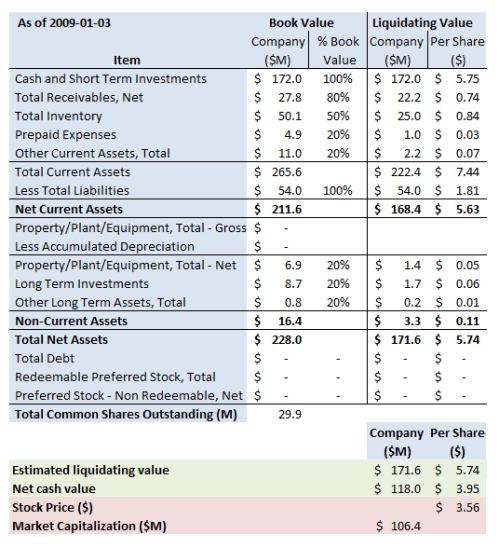
RACK, as its CEO points out in its earnings release, has had a tough year, burning through $15.7M in the 12 months to January 3, 2009. The company does still have a huge amount of cash and equivalents on its balance sheet (the “Book Value” column shows the assets as they are carried in the financial statements, and the “Liquidating Value” column shows our estimate of the value of the assets in a liquidation):

rack-summary

We estimate the company’s liquidation value to be around $171.6M or $5.74 per share, which is predominantly cash and equivalents in the amount of $172M or $5.75 per share. RACK’s net cash value is around $118M or $3.95 per share.

Off balance sheet arrangements and contractual obligations

The company hasn’t disclosed any off-balance sheet arrangements in its most recent 10Q. The contractual obligations as at September 27, 2008 were around $10.2M, around $2.1M of which falls due in the next 12 months. Those committments are minimum lease payments under the company’s operating leases. The company also had purchase committments in the amount of $30.9M to the end of 2008. We’re not sure what these committments are for the next 12 months.

The catalyst

RACK has announced a radical buy back plan to repurchase $40M of its stock. From the press release:

“2008 was a tough year for our industry and for Rackable. Given our strong financial flexibility with $181 million in cash and investments, we plan on making key investments for 2009,” said Mark J. Barrenechea, president and CEO of Rackable Systems. “First, we plan to invest up to 10% of our cash to expand our product offerings and our sales and service capabilities. Second, the company announced a $40 million share repurchase program today. We believe this is an ideal time to invest in Rackable and that these investments will place the company in a stronger competitive position to gain market share as the economy recovers.”

We estimate that that such a buy back at the present prices will increase the company’s per share liquidation value by almost 25% to $7.00. This is a substantial upside to the current stock price.

Conclusion

It’s great to see company recognizing that its stock is deeply undervalued and taking radical action to capitalize on it. If the market is pricing your stock below its liquidation value, there are bargains to be had by investing in that stock, and we believe it should be your priority. With its stock at $3.56, RACK has a market capitalization of $106.4M, which means it’s trading at a discount to both its net cash value of $118M or $3.95 per share and its liquidation value of $171.6M or $5.74 per share. The cash burn is a risk, but we think RACK is a good bet at this level.

RACK closed yesterday at $3.56.

The S&P500 Index closed yesterday at 719.60 (!).

Hat tip to manny.

[Full Disclosure:  We do not have a holding in RACK. This is neither a recommendation to buy or sell any securities. All information provided believed to be reliable and presented for information purposes only. Do your own research before investing in any security.]

Read Full Post »

Regular readers of Greenbackd will note a few changes to the website. As we foreshadowed in our earlier post, Greenbackd Portfolio Q1 performance and update, we’ve amalgamated the old Contact us and Tips pages into a single Contact us / Tips page. We’ve also added a permanent Portfolio page, which contains our current holdings and which we will update whenever we add or remove a stock from the Greenbackd Portfolio.

Please let us know if you have any comments or suggestions for improving the site. If you don’t like this new layout, then let us know that too.

Read Full Post »

Greenbackd Portfolio Q1 performance and update

March 1, 2009 marked the end of Greenbackd’s first quarter, so we thought we’d take the opportunity to update you on the performance of the Greenbackd Portfolio and the positions in the portfolio, discuss some changes in our valuation methodology since our first post and outline the future direction of Greenbackd.com.

First quarter performance of the Greenbackd Portfolio

We get many questions about the content and performance of the portfolio. We had originally planned to report on a six-monthly basis, but we have now decided to report on a quarterly basis so that we can address these questions on a more frequent basis. Although it is still too early to determine how Greenbackd’s strategy of investing in undervalued asset situations with a catalyst is performing, we’ve set out below a list of all the stocks we’ve included in the Greenbackd Portfolio and the absolute and relative performance of each at the close on the last trading day in our first quarter, Friday, February 28, 2009:
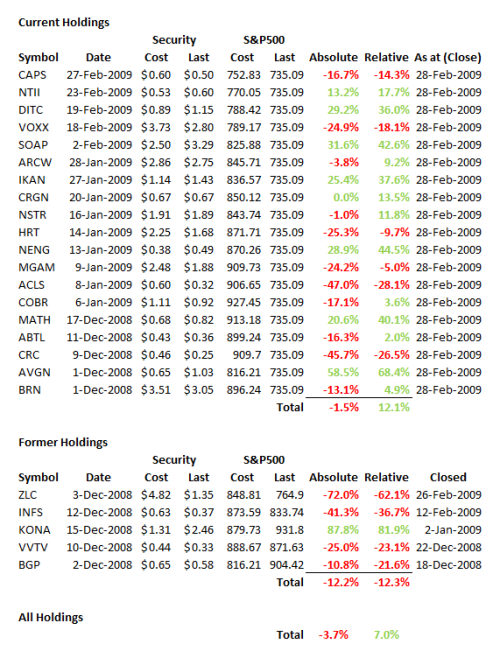
greenbackd-portfolio-performance-2009-q13The absolute total return across the current and former positions as at February 28, 2009 was -3.7%, which was +7.0% higher than the S&P500’s return over the same periods. A negative return for the first period is disappointing, but we are heartened by the fact that we outperformed the market by a small margin.

You may have noticed something odd about our presentation of performance. The S&P500 index declined by 18.0% in our first quarter (from 896.24 to 735.09). Our -3.7% performance might suggest an outperformance over the S&P500 index of +14.3%. We calculate our performance on a slightly different basis, recording the level of the S&P500 index on the day each stock is added to the portfolio and then comparing the performance of each stock against the index for the same holding period. The Total Relative performance, therefore, is the average performance of each stock against the performance of the S&P500 index for the same periods. As we discussed above, the holding period for Greenbackd’s positions has been too short to provide any meaningful information about the likely performance of the strategy over the long term (2 to 5 years), but we believe that the strategy should outperform the market by a small margin.

Greenbackd’s valuation methodology

We started Greenbackd in an effort to extend our understanding of asset-based valuation described by Benjamin Graham in the 1934 Edition of Security Analysis. Through some great discussion with our readers, many of whom work in the fund management industry as experienced analysts or even managing members of hedge funds, we have had the opportunity to refine our process. We believe that what started out as a pretty unsophisticated application of Graham’s liquidation value methodology has evolved into a more realistic analysis of the balance sheet and the relationship of certain disclosures in the financial statements to asset value. We’re not yet ready to send it into space, but we believe our analyses are now qualitatively more robust than when we started and that has manifest itself quantitatively in better performance (more on this below).

The two main differences between our early analyses and our more recent ones are as follows (these are truly cringe-worthy, but that’s why we undertook the exercise):

  1. We didn’t take account of the effect of off-balance sheet arrangements and contractual obligations. This caused us to enter into several positions we should have avoided, including BGP and VVTV.
  2. We were using overly optimistic estimates for the recovery rates of assets in liquidation. For example, we started using 50% of Gross PP&E. We now use 20% of Net PP&E. We now apply Graham’s formula as the base case and deviate only when we believe that Graham’s formulation doesn’t reflect reality.

The effect of these two broad errors in analysis was to create several “false positives,” which is to say that we added stocks to the portfolio that wouldn’t have passed our current, more rigorous standards. The performance of those “false positive” stocks has been almost uniformly negative, and dragged down the performance of the portfolio. As an exercise, we went back through all the positions we have opened since we started the site and applied our current criteria, which are more stringent and dour than our earlier standards. We found that we would not have opened positions in the following eight stocks:

  • BRN (-13.1% on an absolute basis and +4.9% on a relative basis)
  • BGP (-10.8% on an absolute basis and -21.6% on a relative basis)
  • COBR (-17.1% on an absolute basis and +3.6% on a relative basis)
  • HRT (-25.3% on an absolute basis and -9.7% on a relative basis)
  • KONA (+87.8% on an absolute basis and +81.9% on a relative basis)
  • MGAM (-24.2% on an absolute basis and -5.0% on a relative basis)
  • VVTV (-25.0% on an absolute basis and -23.1% on a relative basis)
  • ZLC (-72.0% on an absolute basis and -61.1% on a relative basis)

It seems we got lucky with KONA, but the performance of the balance of the stocks was wholly negative. The performance across all stocks listed above was -12.5% on an absolute basis and -3.9% on a relative basis. Excluding these eight stocks from our portfolio (i.e. treating the portfolio as if we had not entered into these positions) would have resulted in a slightly positive absolute return of +0.7% and a relative performance over the S&P500 of +12.5%. This is a compelling reason to apply the more dour and rigorous standards.

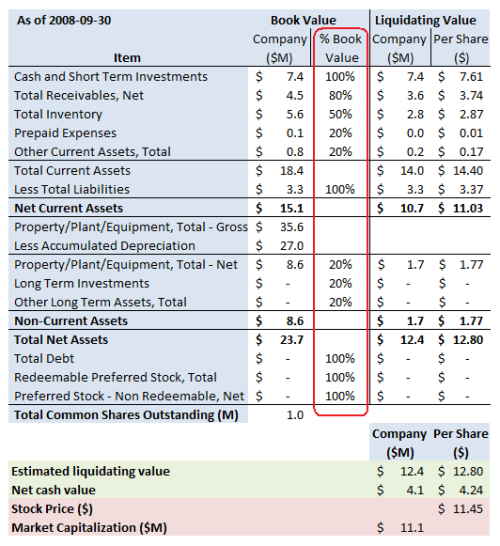
We like to think we’ve now learned out lesson and the more dour and rigorous standards are here to stay. Set out below is an example balance sheet summary (for Chicago Rivet & Machine Co. (AMEX:CVR)) showing our present base case discounts from book value (circled in red):
example-summary-2

Readers will note that these are the same base case discounts from book value suggested by Benjamin Graham in the 1934 Edition of Security Analysis, more fully described in our Valuing long-term and fixed assets post under the heading “Graham’s approach to valuing long-term and fixed assets.” Why we ever deviated from these standards in the first place is beyond us.

Update on the holdings in the Greenbackd Portfolio

Leading on from our discussion above, four of the stocks we picked using the initial, overly optimistic criteria no longer meet our more stringent standards but haven’t yet been removed from the portfolio. We’re going to take our medicine now and do just that. To make it clear, these stocks aren’t being removed because the value has deteriorated, but because we made a mistake adding them to the portfolio in the first place. As much as we’d like to treat these positions as void ab initio (“invalid from the beginning”), we’re not going to do that. We’ve made a full accounting of the impact they’ve had on the portfolio in the First quarter performance of the Greenbackd Portfolio section above, but we don’t want them affecting our future performance. The stocks to be removed from the Greenbackd Portfolio and their absolute and relative returns are as follows:

  • BRN (-13.1% on an absolute basis and +4.9% on a relative basis)
  • HRT (-25.3% on an absolute basis and -9.7% on a relative basis)
  • MGAM (-24.2% on an absolute basis and -5.0% on a relative basis)
  • COBR (-17.1% on an absolute basis and +3.6% on a relative basis)

We’ll provide a more full discussion of where we went wrong with these stocks at a later date, but suffice it to say for present purposes that all were errors from the second bullet point in the Greenbackd’s valuation methodology section above (i.e. overly optimistic estimates for the recovery rates of assets in liquidation).

There are fifteen stocks remaining in the Greenbackd Portfolio:

Eight of these positions (ABTL, ACLS, ARCW, CAPS, CRC, CRGN, NSTR, and VOXX) are trading at or below our nominal purchase price and initial valuations. The remaining seven positions (AVGN, DITC, IKAN, MATH, NENG, NTII, and SOAP) are trading above our intial purchase price but are still at varying discounts to our valuations. We’ll provide a more full update on these positions over the course of this week.

The future of Greenbackd.com

We are going to trial some small changes to the layout of the site over the next few weeks. We’ve already made the first change: the newest comments now appear at the top of the list. We’ll also be amalgamating some pages and adding some new ones, including a page dedicated to tracking the portfolio with links to the analyses. We’re also considering some options for generating income from the site. At the moment, Greenbackd is a labor of love. We try to create new content every week day, and to get the stock analyses up just after midnight Eastern Standard Time, so that they’re available before the markets open the following day. More than 80% of the stocks that are currently trading at a premium to the price at which we originally identified them (NTII, SOAP, IKAN, DITC, NENG, MATH and AVGN) traded for a period at a discount to the price at which we identified them. This means that there are plenty of opportunities to trade on our ideas (not that we suggest you do that). If you find the ideas here compelling and you get some value from them, you can support our efforts by making a donation via PayPal.

We look forward to bringing you the best undervalued asset situations we can dig up in the next quarter.

Read Full Post »
Ken Squire argues in a feature article in this week’s Barron’s magazine, A Golden Age for Activist Investing (subscription required), that the “political climate, shareholder sentiment and opportunities available to activists” means that “the sun, the moon and the stars have moved into alignment for activist investing.” Squire believes that the knowledge that investors “can’t rely on the markets to create value, so they will have to create it themselves” will turn many formerly passive investors into “reluctant activists.”

Squire makes some interesting points:

1. We are witnessing “the largest spreads ever between price and value”

While we don’t accept that we are yet witnessing “the largest spreads ever between price and value,” we believe that we are getting close. On long-term measures of value (for example, Graham’s 10-year trailing P/E ratio and corporate profits as a proportion of GDP) market prices are well below average and approaching all time lows (See Future Blind‘s post Market Valuation Charts prepared in October last year when the S&P500 was around 1160). More on this at a later date. (Note that this is not a declaration that we are nearing the bottom. We think there’s a good chance the markets will over-correct to the downside and stocks will be undervalued for an extended period).

2. The “economic and political climate will make it much easier for activist investors to succeed”

Squire argues that the “economic crisis has eroded confidence in boards and corporate leadership” and “[shareholders] have less patience for laggard management, indecisiveness and missteps, and are more likely to support an activist.” We don’t disagree with these points, but we dispute that this necessarily translates into success. Incumbent directors have a huge advantage over alternate slates. See, for example, Carl Icahn’s argument that boards and managements are entrenched by state laws and court decisions that “insulate them from shareholder accountability and allow them to maintain their salary-and-perk-laden sinecures.”

3. The “impaired credit markets will make it difficult to implement financial-engineering solutions”

Squire believes the environment will force activists to “focus on operations, strategy and governance, rather than stock repurchases and special dividends”:

There are many companies whose operations or strategy fell short, and activists will identify them and implement plans to improve operations, cut costs and redirect investment.

This is a particularly interesting point. It’s clearly more difficult for an activist investor to articulate to stockholders the benefits of improvements in operations or a redirection of investment than it is to simply promise a dividend or a buy-back, which should in turn reduce their chance of getting on the board. This might suggest that impaired credit markets actually reduce an activist investor’s chance of success.

4. We will see a “significant increase in corporate/strategic acquisitions”

Squire argues that “corporate acquirers have a low cost of capital” which will “compensate in part for the void in private-equity buyouts”:

Activists not only will be open to discussing potential transactions with strategic acquirers, but often will seek them out. The activist-investor board member will want to be involved in negotiating the transaction to assure that stockholders receive the best value.

5. Companies with net cash will attract activist investors

Squire writes that activists will target exactly the type of investments Greenbackd favors:

Given today’s backdrop, many activists are expected to emphasize net cash as an inducement to invest. Large amounts of cash give a company the financial flexibility to withstand economic stress, and make it a more attractive takeover target. Abundant cash also may be an indication that the stock is mispriced. In many cases, price/earnings ratios have been gravitating toward 10, without regard to cash balances.

Based on the foregoing, it’s hard to disagree with Squire’s conclusion that 2009 will be “a busy and exciting year for shareholder activism.” It’s certainly very good news investors like us. Lest we get a reputation for being blind cheerleaders for activist investment as an end in and of itself, we’d like to emphasize that Greenbackd’s focus is undervalued asset situations with a catalyst and we’re almost agnostic as to the source of the catalyst. Our ideal situation is a management prepared to recognize the discount of price to value and undertake some step to unlock that value or remove the discount. We remain ever optimistic that all directors – including those of smaller companies outside the glare of the analyst coverage and the mainstream media – fully embrace their fiduciary duties to stockholders. Our experience is that this doesn’t often happen in the absence of an agitating stockholder. This is the real reason that formerly passive investors become “reluctant activists.” Not because they “can’t rely on the markets to create value” but because they can’t rely on some boards and managements not to destroy value.

Read Full Post »

The Manual of Ideas has a copy of Empirical Finance Research’s paper “Fundamental Value Investors: Characteristics and Performance” (.pdf). The paper examines the investment methods of professional value investors (defined as the members of the valueinvestorsclub.com) and concludes that value investing is a broad church encompassing many different styles, but predominantly consists of “Warren Buffett-style growth investors:”

We find that investors are overwhelmingly concerned with assessing intrinsic value. Discounted cash flow models, earnings multiples, GARP, and other similar valuation techniques are overwhelmingly used (87.50% include this analysis in their recommendation). Based on these results, professional value investors tend to be Warren Buffett-style growth investors…

The paper seems to quantitatively confirm our qualitative (read, baseless) assertion in the About Greenbackd page that “assets are a contrarian measure of value.” Less than a quarter of professional value investors incorporate the value of tangible assets in their investment decisions:

[A]pproximately 24% of value investors do incorporate the classic value technique of focusing on tangible asset undervaluation. The other favorite tools of value investors are open market repurchases (12.12%), the presence of net operating loss assets (5.29%), restructuring and spin-off situations (5.12%), and insider trading activity (4.70%).

The paper also indirectly tackles the question oft posed by commenters on this site which, incidentally, questions the very raison d’etre of Greenbackd: why opportunities to invest below liquidation value and alongside activist investors persist even after the filing of the 13D notice:

According to efficient market logic (Fama (1970)), the rational arbitrager should act alone, drive the price to the fundamental level, and reap all the rewards of the arbitrage he has found. Unfortunately, arbitragers find this difficult in practice. Two primary reasons for this are capital constraints and the limits to arbitrage arising from the realities in the investment management business (Shleifer and Vishny (1997)).

The paper is typical of Empirical Finance Research’s rigorous approach and well worth the effort.

Read Full Post »

Carl Icahn contributed an article to the Wall Street Journal on President Obama’s plan to limit executive pay to $500,000 a year plus restricted stock for institutions that receive government funding. Icahn argues that while the response is “understandable,” the salary cap fails to address the root cause of the problem:

The real problem is that many corporate managements operate with impunity — with little oversight by, or accountability to, shareholders. Instead of operating as aggressive watchdogs over management and corporate assets, many boards act more like lapdogs.

Despite the fact that managements, albeit with some exceptions, have done an extremely poor job, they are often lavishly rewarded regardless of their performance.

Icahn goes on to explain that the problem is that boards and managements are entrenched by state laws and court decisions that “insulate them from shareholder accountability and allow them to maintain their salary-and-perk-laden sinecures.” He proposes a federal law that allows shareholders to vote by simple majority to migrate the company from its state of incorporation to more shareholder-friendly states. This power is currently vested in boards and management:

This move would not be a panacea for all our economic problems. But it would be a step forward, eliminating the stranglehold managements have on shareholder assets. Shouldn’t the owners of companies have these rights?

Now some might ask: If this policy proposal is right, why haven’t the big institutional shareholders that control the bulk of corporate stock and voting rights in this country risen up and demanded the changes already?

This is because many institutions have a vested interest in supporting their managements. It is the management that decides where to allocate their company’s pension plans and 401(k) funds. And while there are institutions that do care about shareholder rights, unfortunately there are others that are loath to vote against the very managements that give them valuable mandates to manage billions of dollars.

This is an obvious and insidious conflict of interest that skews voting towards management. It is a problem that has existed for years and should be addressed with new legislation that benefits both stockholders and employees, the beneficiaries of retirement plans.

I am not arguing for a wholesale repudiation of corporate law in this country. But it is in our national interest to restore rights to equity holders who have seen their portfolios crushed at the hands of managements run amok.

It’s vintage Icahn to suggest such a simple yet effective, market-based solution.

Read Full Post »

CNBC has an interview with Ricardo Salinas, the Mexican billionaire who took a position in Circuit City Stores Inc (OTC:CCTYQ) after it fell into bankruptcy and lost $41 million. In the interview with Michelle Caruso-Cabrera, Salinas explains why he made his bet on CCTYQ and how it went wrong. Although Salinas’ CCTYQ investment wasn’t a Grahamian net net, his explanation does capture some of the pitfalls of investing based on asset values:

Mr. Salinas made the majority of his $41 million investment in Circuit City after the troubled chain filed for bankruptcy protection in November. He amassed a 28 percent stake in the company and then began trying to work out a deal with Circuit City’s suppliers in an effort to take the chain private.

But Mr. Salinas backed out of the deal just before the company decided to liquidate, according to a recent account in The Richmond Times-Dispatch.

“It was much more complicated than he expected it to be,” an unidentified source told the newspaper. Pricing on some inventory “was just too high” and the support from banks and vendors “just wasn’t there,” the Times-Dispatch quoted the source as saying.

In his CNBC interview, Mr. Salinas expressed regret about not capturing Circuit City at a bargain-basement price and losing his investment, but acknowledged that it was for the best.

“I don’t care how rich you are, it must hurt to lose $41 million,” Ms. Caruso-Cabrera said to Mr. Salinas on location in Mexico.

“You know – when you’re talking about investments and businesses- it doesn’t pay to be afraid,” Mr. Salinas said, according to a transcript of the interview, which will be broadcast Wednesday night on CNBC. “It doesn’t pay, because fear is not a good counselor. Fear makes you do stupid things. So, of course it hurts.”

Mr. Salinas said he is moving on from his experience but is still looking at buying American assets.

“Well, we’re looking at a couple of mining companies that have been really pounded by the declining commodities,” he said in the interview. “And we think that, you know, mining is a great business. So we might go into a new tack there.”

(Via The New York Times Dealbook)

Read Full Post »

« Newer Posts - Older Posts »